


Circus Historical Society
Circus Scrap Book
January 1932, No. 13
Circus Scrap Book Index
Scroll down for the article you are looking for in this issue. Note: Only some articles are included in this online edition. The Circus Historical Society does not guarantee the accuracy of information contained in the information in these online articles. Information should always be checked with additional sources.
Samuel P. Stickney
By G. A. Severance. Cincinnati, O., March 20, 1877. Circus Scrap Book, No. 13 (Jan), 1932, pp. 7-10. The information should be checked with additional sources.Frank Queen: Father died this morning at 12:40, aged sixty-nine. Funeral Thursday. Rob’t Stickney.
Shriveled at last is "The Evergreen," as he was first styled twenty years ago by the few who knew the more than ripe age that lay behind brown hair unmixed with gray, sharp eyes, an erect yet pliant form, a springy step, muscles as steel, skin without an extra ounce of flesh weighting it, in fact an iron constitution. A rib-breaking fall on the ice, a few weeks of pain and inaction, and then death. So vanished one of the oldest circus-riders in America, if not actually the oldest in either hemisphere. The generation of today either knew of Samuel P. Stickney not at all, or knew of him only as manager or as ringmaster, yet as a horseman he had done good work. He had always been a fair actor in legitimate plays.
He was born in Boston early in 1808, and scented sawdust in his boyhood. The circus was then a rarity in that quarter, the first regular one having been established in 1809 at Charlestown, Mass., by two Frenchmen, Peppin & Breschard. The last time we had the delight of listening to Mr. Stickney's endless pleasantries of chat, and exhaustless anecdotes of professional travel, was in 1870 or 1871, in a billiard-room in Third Avenue, and he then casually told us when and where he made his first bow. We shall regret the more having forgotten both, in case his son, Robert, is unable to supply a serious omission. S. P. Stickney had made his mark as a rider as early as 1824-5 at least. He was of the company with which Joe Cowell opened the Olympic Circus, Ninth and Walnut, Philadelphia, Aug. 29, 1825. Before he was twenty years old he was in partnership with Jeremiah Fogg; and the legend runs that the twain owned the second circus that ever crossed the Alleghany Mountains. After showing for a week in Cincinnati, they went by flat-boat to New Orleans, taking in the important towns on the way. "This was in the Summer of 1827," says a Cincinnati paper, "and after arriving in New Orleans they took the old American Theatre there, and ran it very successfully for a season. After that they started northward again, playing as they came, and in course of time arrived here at Cincinnati, where they leased the old Columbia Theatre. The next year (1843) Stickney went into partnership with uncle John Robinson, and while with him became the pioneer in the four-horse act, which is now one of the indispensables to every circus." Let it not be inferred from the foregoing that Fogg and Stickney remained South and West from 1827 to 1843. He rode in this city in 1829, and in 1829-30 Fogg and Stickney were lessees of the Washington Amphitheatre, on the York road, at the junction of Tammany and Button wood Streets, Philadelphia; and they were again together in 1838, when Stickney was making a feature of his trained horse, Champion. In 1844 he was manager at the Philadelphia Amphitheatre, and in 1845 he was proprietor of the Amphitheatre in New Orleans, in January of which year he also started a riding academy in that city. Later he leased the American Theatre, opening it Nov. 1, 1846. He and his family took up their residence in the house, and there young Robert, who made his debut as Cora's child in the arms of Edwin Forrest as Rolla, was born the day before the following Christmas. Associated with either Joseph C. Foster or others, the elder Stickney was a circus-manager in that city for many years, chiefly in the establishment at the corner of Poydras and Baronne Streets, which at least as late as 1848-9 was called the Olympic Circus, a name that had been rendered familiar to New Yorkers at the Park Theatre nearly a decade of years before. On April 22, 1850, June and Co.'s Circus opened in this city at Eighth Street and Broadway, where now looms the Bible House, and Stickney was with them. In 1850-1-2 he was with the late Rufus Welch's National Circus, Ninth and Chestnut, Philadelphia, exhibiting his new trained horse, Cincinnatus, and also doing the six-horse act known as "The Courier of St. Petersburg," introducing the boy, Robert, as the Courier of Lilliput. In 1853-4-5 he was at the Philadelphia Circus, Walnut above Eighth, and there was doing his drunken soldier equestrian act known as "Monticello." Having long before removed his family from New Orleans to Philadelphia, in December of 1858 he opened the Phoenix Saloon, a public house at 611 Chestnut Street. This new love did not long attract him, and after a while he returned to the old. In the Autumn of 1861 he came to this city with his National Circus, and, leasing the Bowery Theatre, opened on Oct. 28. His success was even greater than he had hoped, and his season did not close until March 22, 1862, being doubtless the longest ever sustained by a circus at any theatre in New York. Before it ended he gave a benefit for the widow and orphan child of Captain Gordon, the slaver, and on March 8 he was himself the subject of a complimentary testimonial. It was then that he last appeared as a rider in this city, if not anywhere. He had not ridden at all in a long time, had not ridden in this city in thirty-two years, and now chose his favorite four horse act, bearing his little daughter, Emma, on his shoulders. But the age that would not tell on him elsewhere betrayed him on horseback. His company took the road about the middle of April, and since then, up to about 1874, he had been connected with several circuses, among them, Campbell's and Lent's, with the latter of which he had also been associated in olden times, as he had likewise been with Van Amburgh & Raymond's, and with Levi J. North, Jones, Robert Place the theatrical manager, John Eversal, and Mateer & Jackson; but after 1862 he had not been so employed as to bring him face to face with the amusement public. In nearly reaching the seldom attainable three score, he had gone beyond double the average of life with circus people; and he had lived well. These four words are an epitaph pregnant with meaning.
An elopement flashed the sparkle of romance upon his marriage, which took place in Philadelphia. A numerous family blessed the union. His wife died several years ago. Of his children who have been noted in the profession, Rosalie has been dead twenty years, as for nearly that time has also been her husband, the brother of Tourniaire; Sally, who married the sensational "Lila Zoyara" (Omar Kingsley), separated from him legally and married Willie Franklin, is no longer in the profession; young Sam has been a clown, and was treasurer for his father at the Bowery Theatre; and Robert, who married the deceased daughter (Katie) of Old John Robinson, is now a circus-proprietor, besides being still a rider and vaulter. Of S. P. Stickney's brothers, John the comedian, died in Louisiana in the Spring of 1845; Sam, the equestrian, who went to England and made his debut at Astley's on Sept. 6, 1830, is also dead; there was also Otis, a coachmaker and trimmer and he, too, is dead; and Mr. Frank Whittaker informs us that there was yet another brother of whom he last saw in Harlem two years ago.
A Giant Story
By Chas. Bernard. Circus Scrap Book, No. 13 (Jan), 1932, pp. 12-18. The information should be checked with additional sources.Seville is a small town in Medina County, Ohio. Its surroundings is a rich agricultural section, and the city of Medina is famous for its Honey Bee industry which supplies Queen bees and equipment to Apiaries all over the civilized world. In 1874 one of most noted Giants ever exhibited in the museums and circuses of America and Europe, decided to abandon public life and engage in farming.
This giant was Capt. Martin Van Buren Bates, known to museum and circus patrons as "Captain Bates, the Kentucky Giant." After an exhibition tour of Ireland, the Captain and his wife left England on the second day of July, 1874, aboard the vessel City of Antwerp; on arrival in New York they decided on a pleasure tour of the Middle West; the fine farms of Ohio appealed to the giant and his wife; a stop was made at Medina, and a trip of inspection resulted in the purchase of a valuable one hundred and thirty acre farm near Seville.
To the reader not familiar with the family history of this couple, it is timely to explain that the Novia Scotia Giantess, Anna Swan, was the wife of Captain Bates. This remarkable couple, with a combined height of fifteen feet eleven inches, and total weight of almost nine hundred pounds, required a house of proportionate size; the Captain therefore contracted for the erection of a residence designed especially suitable for their convenience and comfort; the height from floor to ceilings was fourteen feet; all doors were eight and one half feet high. All furniture was built to order, and when stock was bought for the farm, the cattle selected was short horns, best grade pure-blooded from prize herds. The draught horses were the Norman breed and the carriage horses were Clydesdale, measuring eight and a half, hands high. It was a farm of such rare equipment and unusual occupants, that it soon became an attraction for many visitors and was given much publicity.
The reputation of Anna Swan, and of Captain Bates, as attractions of unusual drawing power to bring money into the museum box-office and the circus treasury, was too great to permit them to remain in seclusion in a Medina County farm. After three years of farm life, the urge of circus representatives induced them to again accept an engagement for a season on the road. While they kept the Seville farm as a haven of rest when they felt like permanently retiring to private life, they could not resist the tempting offer to join the W. W. Cole Circus, Menagerie and Museum outfit at the opening of the 1878 season. They were given special publicity in the shows advertising as the outstanding attractions in the museum department. That engagement continued through the 1879 and 1880 seasons, and their established reputation as real giants and the tallest couple exhibited together under one management at that time, was largely responsible for the phenomenal business done by the W. W. Cole side show during that three year period.
In a Barnum Museum programme for the week ending Saturday, September 24, 1864 along with the Tom Thumb wedding party, Commodore Nutt, the Circassian Children, and other attractions, Anna Swan was the Giantess of Barnum's wonderful collection of unusual people. Among the original wood cuts designed especially for P. T. Barnum, and engraved by Waters and Son, the famous New York wood-cut makers, one special cut was made to advertise Anna Swan as the "Giant Girl," Mons Josef the "French Giant" and "General Grant Junior," a dwarf whose height reached on a level with Mons Josef's knees, thus forcibly illustrating the contrast in their heights. Other male and female giants exhibited under the P. T. Barnum management in his New York Museums at various times, whose size put them in a competitive class with Anna Swan and Captain Bates as strong drawing attractions, were Colonel Noah Orr who was advertised as the "Buckeye Giant," Colonel Goshen was known as the "Arabian Giant;" James Murphy as the "Giant Boy" and Jane Campbell was given much publicity as the "Connecticutt Giantess." Colonel Noah Orr was a native of Union County, Ohio, and like Captain Bates, was of such unusual height that he was considered a special feature in museums, circus side-show or as an independent show at the county fairs. At the age of 24 Colonel Orr's height was seven feet, ten inches and he weighed five hundred and seventy pounds. He went on tour of the large cities, one season with the famous Lilliputians Company to appear on the stage at each performance alongside of Gen. Tom Thumb. They were advertised and exhibited as nature's greatest contrast in the size of human beings who had reached maturity.
A brief biographical sketch of Captain Bates and his life partner is an essential part of this narration. Anna Swan was born in the town of New Annan, county of Colchester, Nova Scotia. She was the third child in a family of thirteen, her father was Alexander Swan, a native of Dumfries, Scotland, and her mother's name was Ann; she was from Dumbarton on the Clyde. Anna was educated in the Castle at Dumbarton. Her growth both in body and brain power was unusual to a marked extent; at the age of six she had reached the height of her mother - five feet two inches - and weighed one hundred and ten pounds; a year later her height equaled that of her father - five feet four inches. Tracing the geneology of both parental families failed to show any precedent of such growth. Her education was completed in the Turo Normal school; in the meantime her growth had reached that of a giantess; at the age of fifteen she had reached seven feet in height, had become a subject of wonder among her associates, was given unsolicited publicity and was annoyed by questions from countless curious strangers. Eventually P. T Barnum learned of this remarkable girl, a contract was made for her to appear at his Broadway and Ann Street American Museum, and Anna Swan started her show career as the "Nova Scotia Giantess." During her introductory engagement the American Museum burned; continuing under Barnum's management, she was sent on the steamer Columbia of the Anchor Line to Glascow, Scotland.
A visit to the home of her ancestors, exhibitions and receptions in the larger cities of Great Britain, then at the end of eight months, back to New York and again featured by Barnum in his new museum. After the second museum fire she was sent on a tour of Western cities. Then a company was organized by Judge H. P. Ingalls to make a tour of Europe; the "Kentucky Giant" was also engaged for this European tour. The company was organized at Elizabeth, New Jersey in November 1870, the two wonders of nature. were to be exhibited in the same company; thus they became daily in each others presence and a romance of "giant" proportions was begun.
The "Kentucky Giant" was the son of John W. and Sarah Bates of Whiteburg, Letcher County, Kentucky. He was the youngest of a family of twelve; he was born November 9, 1845. The father stood six feet two inches and weighed two hundred and twenty pounds; the mother was a woman of medium size; they owned and operated a good sized farm. Educated in Emma-Henry College, Washington County, Virginia, young Bates showed phenomenal growth; at the age of fifteen he had reached six feet in height. His father was a slave owner in Kentucky, his opinion on the slavery question in the excitment of pending war was naturally for protection of his father's interests; on the call for volunteers for the Fifth Kentucy Infantry C. S. A., he enlisted on September 15, 1861. Not yet 16, but in size a full grown man, he began service in the Southern Army.
The regiment was under command of Colonel John S. Williams, later a United States senator. Young Bates served in that regiment until November 14, 1863. He then became a first lieutenant of Company A, Virginia State Line Troops under Colonel John B. Floyd. This organization was merged into the Seventh Confederate Cavalry under Col. John Prentis; assigned to command of Troop A. and afterwards promoted to the rank of Captain, the young giant by the time he took leave of his company at Knoxville, Term., and retired from the service, had well earned the title of Captain Bates, by which he become so well known in museum and circus life.
After completing his army service he went to Cincinnati, there, his size was at once a magnet to draw the attention of the Queen City's many showmen and on the 18th of July, 1865, he made his first bow as the "Kentucky Giant." During the ensuing five years he was exhibited in all parts of the United States and Canada. Then came the offer from Judge Ingalls to make the European tour. The company sailed from New York Harbor on the Inman Line steamer, City of Brussels on April 22, 1871, arrived in Liverpool on the second of May, where the Washington Hotel was their hosltery for one week, then to London for a reception at Wills' Rooms on King Street for editors and medical men exclusively. On May 29th the first public reception was given at the same place; then on June second the company was ordered by royal command to appear before Her Most Gracious Majesty, Queen Victoria, at Buckingham Palace. The Queen's pleasure was expressed in warm terms and several valuable presents were presented members of the company.
Between the time of meeting at Elizabeth, New Jersey in November, up to presentation to Queen Victoria in June, a love match had sprung into existence between the Nova Scotia Giantess and the Kentucky Giant; following the visit to Buckingham Palace, the giant lovers decided on a life partnership; the wedding took place at the Church of St. Martins-in the-Fields on June 17, 1871. St. Martins is one of the most ancient of London's churches; it faces on Trafalger Square, and in all its history of wedding ceremonies, none was on record of a bride and groom whose combined height exceeded fifteen and one half feet. The ceremony for this notable wedding was performed by Rev. Rupert Cochran, a native of Halifax, Nova Scotia, then the minister at St. George's Church on Hanover Square. Rev. Dr. Roberts, the Vicar of St. Martins assisted. The bride's costume was white satin and orange blossoms. Elegant jewels adorned her person, among them a cluster diamond ring, the gift of England's much loved Queen. The bridesmaids were Mlle. Augustine and Mrs. Dr. Buckland. The groom wore a dress suit, no adornment save an elegant watch and chain, also a gift from Queen Victoria. The groom's best man was Honorable Henry Lee, scientific editor of "Land and Water." Judge Ingalls gave the bride away.
Captain Bates had already rented and furnished a house at 45 Craven Street, to be occupied during the stay of the company in London. The wedding breakfast was served at this new home by the celebrated caterers, Spears and Ponds. Thus begun the wedded life of a couple who were destined to be viewed and interviewed by countless thousands of the show going public who seem to crave the sight of freaks of nature. Following the wedding, the routine of exhibitions begun. On June 21st a private reception was given at Masonic Hall for the benefit of the Prince of Wales who was accompanied by his staff, the Grand Duke Valadimer of Russia, and Prince John of Luxenburg. Twice, later, they appeared before the Queen; once at Buckingham Palace and once at Windsor Castle; they were also guests of the Princess of Wales at Marlborough House; where her children and her sister Princess Christina, second daughter of the King of Denmark, were present. All this attention from Royalty was of inestimable value in their introduction at St. James Hall, the Crystal Palace and Great Britain's theatres.
A tour of the Provincial towns and cities followed the London engagements; by the Christmas holiday season they had reached Edinburg, Scotland. Personal memoirs made by Captain Bates in later years gave to Scotland the credit of being the most interesting and pleasant part of their tour of the Provinces with the Ingalls' organization. The first blow of sadness in their married life came with the death at birth of their first born; it was a girl, and like the parents, of unusual size; the weight was eighteen pounds and the height twenty seven inches. This loss had such a depressing effect on both, and the health of the wife, that a rest and pleasure trip on the Continent was the advice of doctors; they were away from the strain of being exhibited for a considerable time, only appearing when so requested by Royal command.
Eventually a tour of Ireland ended their engagement with the Ingalls organization. They left England on July 2, 1874 and then the trip to Ohio which culminated in the purchase and equipment of the farm near Seville. In the years that followed, along with their blessings and pleasures, a second affliction came with the loss of their second child; it was a boy, and like the first born was a miniature giant at birth; twenty eight inches in length and weighing twenty-two pounds, it, had the appearance in size of an ordinary child six months old. It seemed the hope of this famous couple to have an heir to perpetuate their name and fame was not to be granted. It was, however, their pleasure as the years rolled by, to enjoy that home on the Medina county farm near Seville when season engagements were ended after a long circus tour, or on a museum platform with the routine grind of a lecturer's description of what nature had done to give them notoriety. The word picture of the life, experience of travel as a curio exhibit, and finally the ringing down of the curtain for this remarkable couple could be extended into pages of human interest incidents.
Walter L. Main Says:
Circus Scrap Book, No. 13 (Jan), 1932, p. 18. The information should be checked with additional sources."Papa" Charley Andress had his own magic show when he was a young man. I first met him in 1888 in Richmond, Va., when the Dan Shelby circus was sold by the sheriff. Every circus in America was represented, but Andress had accumulated several thousand dollars and purchased the entire outfit. He had it out one or two seasons and one of them, Willie Sells, was his partner, but they met their waterloo some place in the west and Andress went to work for the writer in 1898, as legal adjuster, and I gave him for his services the outside lemonade stand. He gave the patrons all they could drink for 5c and at the same time let them view a big snake free.
His opening address was "THIS JOINT IS OWNED BY YANKEE BILL, NEVER WORKED AND NEVER WILL;" His funny expressions and his makeup like a farmer caused Andress to do a tremendous business that year, especially the four months we were in Canada, with a 21-car railroad circus. On account of the Spanish-American war that year my season was not so HOT, but I've understood that old Charlie Andress cleared more with his Yankee Bill outfit than Walter Main did with his big circus.
The next year he went to work for Ringling as adjuster and remained seven seasons. Then went with the Barnum show and he kept a horse and buggy standing by the ticket wagon all the time the show was on the lot so in case of a suit he could act quick. After a few years he retired to his farm, Andressville, Kansas, where he's now enjoying the fruits of his hard work. Charlie is about 80 and has just taken a blushing bride of about 40 summers. He is also the father of a fine healthy baby a few months old.
Spalding and Rogers’ Floating Circus
From Gleason's Pictorial Drawing-Room Companion, Feb. 19, 1853. Reprinted in Circus Scrap Book, No. 13 (Jan), 1932, pp. 19-20. The information should be checked with additional sources.
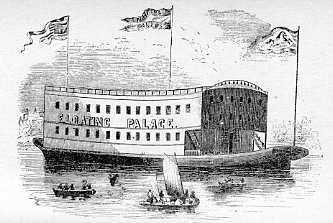
Spalding & Rogers Floating Palace
The picture which we give herewith is an accurate representation of what is called the Floating Palace, as it lately appeared at Mobile, Ala. It was built for the purpose of equestrian exhibitions, and it has been improved at the Levee, in New Orleans, and at various places on the Mississippi River, during some length of time. - It was rather a novel idea to construct such a curious ship - a regular moveable theatre; but it is said to have succeeded far beyond the expectations of its owners. It is not a sham built affair, but it is really very finely fitted, and perfect in every respect. The interior is a most commodious amphitheatre. - The "dress-circle," as it is termed, consists of eleven hundred cane-bottom arm-chairs, each numbered to correspond with the ticket issued. - The "family-circle," comprises cushioned settees for some five hundred persons, while the residue of the accommodations are comprised in nine hundred gallery seats. The amphitheatre is warmed by means of hot water pipes or steam, and altogether it is an exceedingly comfortable and pleasurable exhibition-room. The interior is lighted by over a hundred brilliant gas jets, forming a great ornament in their construction, and supplied by a gas apparatus on board - this furnishes the entire light for vestibule, the halls, offices, saloons, green rooms, dressing-rooms and the stable. A chime of bells is attached to the structure, and discourses most eloquent music previous to each performance, while Drummond-lights render the neighborhood of the floating palace brilliant during the exhibition. Every deception to delude the visitor into the idea that he is in a spacious theatre on shore is used, and it is difficult to realize that one is on the water during the performance. The whole is improved by Spalding & Rogers' united circus companies. Taken altogether it is a most curious, original and interesting affair, and we have therefore selected it as something that would interest our readers. It is now in active operation in the waters of Alabama, and attracts as many visitors to see the structure itself, as to witness the excellent performances that are conducted within its walls by the enterprising managers.
The First Bareback Somersault Rider
By James W. Shettel, Circus Historian. Circus Scrap Book, No. 13 (Jan), 1932, pp. 21-52. The information should be checked with additional sources.Prior to 1846, there were no bareback somersault riders in the circus, although a number of riders were throwing somersaults on the pad. It was in the summer of that year an 18-year-old equestrian, named John Glenroy, who had been taught to ride by the celebrated George J. Cadwalader, of Weeks, Palmer's and other early circuses turned the first backward somersault on the bareback of a horse before an audience with Welch and Mann's Circus at Chepatchet, R. I. He had been able to perform this feat successfully only after arduous practice. So well pleased was Colonel Mann, one of the proprietors of the circus, that he rewarded Glenroy with $5., which at the time was regarded as very generous.
The statement has been frequently made by their admirers that James Robinson and Levi North preceded Glenroy in doing the bareback somersault, but evidence is lacking to support such claim. In fact Robinson conceded the honor to Glenroy. Gil Robinson, son of the original John Robinson, with whose circus James Robinson was a rider, always gave Glenroy credit for being the first to do the act. It may be that James Robinson was the first to add a forward somersault to the routine of his riding act.
In a later decade, Oscar Lowande, May Wirth and possibly others, used two horses in their act and somersaulted from one horse to the other. Orrin Davenport then added a third horse and somersaulted from the first to second to third. He seems to have been the only circus rider to accomplish this feat. A near approach to it was the cart act of the late John Rooney. He used a cart in place of the second horse and somersaulted from horse to cart to horse. All these acts are elaborations of the simple somersault act John Glenroy did with the Welch and Mann Circus over 85 years ago.
When Joseph Palmer's little wagon show rolled into the town of York, Pa., July 6, 1835, from Baltimore, a newly-recruited member of the company was John Glenroy, seven years old, who had been apprenticed to Cadwalader, the principal rider.
Glenroy was a native of Washington, D. C., and an orphan. He lost both parents, when he was two years old, and was adopted by Mrs. Hannah Murdoch, of Baltimore, an aunt of the celebrated tragedian, James B. Murdoch. When four years old, Glenroy showed a liking for horses and all kind of acrobatic exercise. He grew to be strong and healthy. As he was playing one day in the street, astonishing his companions with acrobatic feats, a man who had been watching asked him how he would like to join a circus. When Glenroy answered him favorably, the stranger went with him to his home, where Mrs. Murdoch's consent for him to become a performer was obtained. It was thus that Glenroy was launched upon a circus career.
The circus showed in York on a lot that is now part of a public square, known as Penn Common, and there Glenroy took his first lesson standing on Cadwalader's shoulders, as he rode around the ring on horseback. Within the week, he made his first public appearance.
"For a period of nine months," wrote Glenroy, the author of a little volume, published in 1885 at Boston, entitled 'Ins and Outs of Circus Life.' "I continued to do the same act, that of standing on Mr. Cadwalader's shoulders, while he rode around the ring on horses at every performance by the circus."
The members of this circus at the time, besides Cadwalader and Glenroy, were: Edwin Derious, vaulter and rider; John Whittaker, vaulter and rider; William Archer, rider; James Connor, acrobat; James Stokes, said to be one of the best slack rope vaulters in the world; George Downes, scenic rider; Joseph Cloveau, clown; Louis Harrington, acrobat; Benjamin Millet, breaker of horses for trick performances; Sofia Buckley, rider and singer; Marie Harvey, actress in pantomime pieces; Sylvanus Spencer, Indian rider and acrobat; Sarah Spencer, tight rope walker; Fred Garson, ringmaster; Madam Mary Garson, actress in pantomime; Barney Burna, rider and clown; Wilson Manning, ringmaster.
The company disbanded in February, 1836, and was re-organized by Palmer the following month. The new company included Cadwalader, Glenroy, Downes, Garson, Archer, Millet, Harrington, Burns and Miss Buckley, re-engaged, Robert Miles, acrobat; William Stone, rider and acrobat; Capt. J. DeCamp, modern Hercules; William B. Carroll, rider and acrobat; Thomas M. McFarlane, vaulter; Alec Jackson, clown; John Green, modern Sampson; Moses Lipman, rider and somersault thrower; Thomas Graven, acrobat; Mrs. George Nichols, rider and juggler, and Isaac Aston, ringmaster.
In March, 1838, at Norfolk, Va,, Glenroy made his first appearance alone in the ring doing a plain riding act. Four months later, and just a year after he entered upon his circus career, he appeared In his home city, Baltimore, where he was advertised as a feature. Glenroy had made remarkable progress as a rider during the year and was considered by Cadwalader the cleverest rider for his age he had ever seen. When the circus that season reached Savannah, Ga., Glenroy, who had previously been riding with a pad, rode bareback for the first time, doing a simple riding act.
"It was considered a great feat," says Glenroy, "for a boy not yet 10 years old, as very few even of the older performers rode without the pad." At Augusta, Glenroy's riding excited such enthusiasm that an admirer presented him with a pony. The circus ended the season in April, 1837, at Charleston, S. C.
Both Cadwalader and Glenroy were again members of Palmer's Circus, when it reorganized and sailed May 5, 1837, from Charleston, on the brig Pegasus for Cuba, where it opened June 1 at Havana. The circus also showed in Mantanzes and inland towns, the tour lasting until October. A second engagement in Havana was filled upon the return and a number of nearby towns visited.
Glenroy having become a valuable asset to the circus, others envied Cadwalder his good fortune in the control of the career of the young rider. About May, 1838, discovery was made that Palmer and Captain Joy of the Pegasus were in a conspiracy to get possession of Glenroy. Joy, when he left Havana in 1837, was instructed to go to Baltimore and try to obtain from Mrs. Murdoch the requisite legal papers to enable Palmer to take Glenroy from Cadwalader's custody. Fate thwarted this scheme. Captain Joy and his crew lost their lives at sea, when the Pegasus was wrecked by a gale in the gulf of Mexico. Cadwalader placed Glenroy under the protection of a nobleman, the Marquis de Gardenes and succeeded, after Palmer made all kinds of trouble for him, in leaving Havana, April 5, with Glenroy for the United States, but losing nearly a year's salary.
Cadwalader and his protege landed at Charleston, and proceeding to Norfolk., Va., joined Bacon and Derious' Circus, June 1, 1838. They toured with it through Virginia, Maryland, West Virginia, Kentucky, Ohio, Indiana, Tennessee, Alabama and Georgia. In Savannah, Glenroy became a great social favorite. After a month in that city, the circus moved on to Norfolk, then to Portsmouth and Petersburg, Va., showing a week in each place. At Richmond, Va., which was the next stand, Cadwalader, who had a mortgage on the circus, finding he would be unable to get back what he loaned the proprietors, foreclosed and the concern was bought by Welch and Bartlett, of New York, who sent on Mr. Hopkins for that purpose.
The performers at the close of the exhibition on July 4, 1839, boarded a steamer for Washington, D. C., from where they started on the long journey with horses and wagons through Philadelphia to New York City. The tents were pitched in Brooklyn, where after showing for 10 days, the circus started on tour. Returning later to New York City, it opened on a vacant lot on Broadway in November and played until the end of March, 1840.
The company was known as the Welch and Bartlett Broadway Circus. The company after receiving an acquisition of members was as follows: G. J. Cadwalader and Glenroy, riders; Edwin Derious, vaulter and rider; Alec Rockwell, clown; Thomas McFarlane, vaulter; Marie Bacon, rider; Alec Downey, rider; Sylvanus Spencer, rider and acrobat; James McFarlane, acrobat; John Aymar, rider and acrobat; Walter Aymar, acrobat, nine years old; Charles Bacon, and pupils, rider; W. H. Cole, contortionist, father of W. W. Cole, the circus proprietor; John Wells and wife and daughters, Louisa Emily and Mary Wells, pantomime artists; William Mulligan, vaulter; Joseph Sweeney, inventor of the banjo; William Whitlock, second banjo player in U. S. and a pupil of Sweeney; John Diamond, negro delineator, pupil of P. T. Barnum; Charles J. Rogers, scenic rider; William O'Dale, rider and vaulter, who threw 56 consecutive somersaults; Elias Hood, wire dancer; Madam Hood, rider and dancer; Madam Gullin, rider; John Gossin, clown; John Smith, negro dancer, composer of "Old Bob Ridley;" Thomas Coleman, pupil of Smith; Richard Pelham, minstrel; Henry Ruggles, acrobat and slack-rope performer; Joseph Nobles, acrobat and vaulter; Harvey Leach, man monkey; James Sanford, Ethiopian dancer; George Hoyt, impersonator of negress dancer; Benjamin Jennings, ringmaster and juggler, and E. M. Dickinson, comic singer. During the latter part of the engagement Colonel Mann came with a troupe of Indians, Which he exhibited in the circus .
After leaving New York, the circus toured through New England. In Boston, owing to the enforcement of the Puritan laws, it was impossible to show after 4 o'clock Saturday afternoon. All places of amusement were required to be closed previous to 4:30 p. m., so as to not violate the observance of the Sabbath.
After leaving Massachusetts, the circus crossed into New York state and closed its tour at Sing Sing. The company then went into New York City and after a week or more of rest opened for a winter stay. Just after the beginning of 1841, Welch sold out to Bartlett and joining Colonel Mann formed a circus which started from New Orleans. Bartlett at the conclusion of the winter season in New York engaged people to take to the National theater, Philadelphia, where the circus remained a month. After that the circus went to Baltimore, Washington and towns in Virginia. At Richmond, Va., Welch and Mann bought out Bartlett and the circus from that time was under their managment. After having the wagons overhauled in Baltimore, the circus recommenced its tour July 25, 1841, at York, Pa.
The Welch and Mann Circus then had a good array of talent, which, besides Cadwalader and Glenroy, included Levi North, rider and vaulter; Sam Thrift, slack rope walker; Fred Garson, ringmaster; the Wells family, general performers; Alec Rockwell, clown; Barney Burns, assistant ringmaster; E. M. Dickinson, comic singer; Joseph Foster, stage manager; William O'Dale, rider and vaulter; Levi J. North, rider; Charles J. Foster, Joe Sweeney and his pupil, Master Chestnut. After a summer tour, the company filled a two weeks' engagement at the old Bowery Amphitheater and then opened for a winter season, October 20, 1841, at the Walnut Street Theater, Philadelphia.
The season closed in Philadelphia in March, 1842, after which the circus went on a summer tour opening in Baltimore with a company including Cadwalader, Glenroy, Matt Buckley, vaulter and slack rope performer; Henry Buckley, rider; Thomas McCollam, pupil of Matt Buckley, the finest two horse rider in the world; John Wells, clown; Wells family, riders and dancers; Levi J. North, rider; John Smith, Negro minstrel; Thomas Coleman, dancer; William Chestnut, dancer; Robert Williams, clown; Charles Bacon, rider and acrobat; Mrs. Marie Bacon, rider; Benjamin Jennings, ringmaster and juggler; Richard Risley and Son, contortionists and acrobats; George Sweet, tight rope performer, and Philip Charriskie, slack rope performer. While showing at the Front Street theater, Baltimore, for a two weeks' run, Charriskie fell a distance of over 60 feet from a slack rope, breaking a leg in three places and fracturing a thigh. He died about two weeks after the circus left Baltimore for Philadelphia, where it showed two weeks and then went on to the old Bowery Amphitheatre, New York. There the company received additions of Charles J. Rogers, scenic rider; in Glenroy's opinion the best in the U. S.; Washington Chambers, contortionist; Walter Howard, rider; Madam Louise Howard, best female rider of those days in this country. After showing for two weeks in New York Cty, the show toured New York state and Pennsylvania, and then went to Baltimore. There part of the company left through a disagreement with the managers, who wished to reduce salaries. The members who left were John Wells and family, Robert Williams, John Smith and wife, while an addition was Barney Carroll.
The circus remained a week in Baltimore and then resumed its tour of Maryland and Pennsylvania towns, after an engagement at Washington, D. C. The company disbanded at Bristol, but Glenroy, who was among the number engaged by Welch and Mann for the winter, rode horseback to Philadelphia, where he opened in the National Theatre, with a company, which included in addition to himself: Cadwalader, Charles J. Rogers, rider; Walter Howard, Indian rider; Madame Louise Howard, rider; John Gossin, clown; John Wells, clown; Wells Family, riders; John Risley and Son, contortionists; Thomas McFarlane, vaulter; Lucinda Gosin, rider; Washington Chambers, contortionist; George Sergeant, acrobat; James Sergeant, acrobat; George Hoyt and wife stage performers; Louisa Wagstaff, rider; Henry Palmer, ring hand who married Louisa Wagstaff; Charles Parsello, leader and manager of comic ballet troupe; Emma Ince, dancer; Louis and William Harrington, contortionists. There also joined during the Philadelphia stay John J. Nathan, two and four horse rider; William and Edward Kincaid, riders and tumblers, apprentices of Nathan; Monsieur LeTort, the great French rider.
The company closed in Philadelphia in January, 1843, and went on to New York, opening at the Old Park Theatre, where it consolidated with Rockwell and Stone's Circus. The members of this company included Henry Rockwell, rider; Oscar R. Stone, Indian rider; Hiram Franklin, one of the best performers of that time; Burnell Runnells, general performer; Benjamin Stevens, rider and acrobat; Harry Needham, ringmaster; John Diamond, jig dancer; Dan Emmet, violin; William Whitlock, banjo; Frank Brower, bones; Richard Pelham, tambourine, the first minstrel troupe, and Benjamin Huntington, clown and ringmaster.
At the expiration of the five weeks stay in New York, where immense audiences were attracted, the Rockwell and Stone Company went on the road. The Welch and Mann Circus, with the exception of Thomas McFarlane, Walter Howard, John Gossin, Lucinda Gossin, John Risley and Son, Washington Chambers, Louis and William Harrington returned to Philadelphia, where they were joined by Charles Bacon, the great equestrian, and his wife; and John Whittaker, rider and clown, brother of "Pop" Whittaker. The show remained in Philadelphia a month, being joined there by the celebrated clown, John May. After leaving Philadelphia, the circus went to the Front Street Theatre for three weeks and then returned to the National Theatre, Philadelphia, for three weeks, disbanding in April, 1843.
Cadwalader, Glenroy and several more members of the company went on to New York with Welch and Mann, where two companies were fitted out for the season. The one under Welch was to sail for Europe and the other under Mann to remain in the United States. Cadwalader and Glenroy were with the company under Mann's management, which opened in June at the Bowery theatre, New York. Other members of this company included James Nixon, acrobat; Edward Woods and wife, general performers; John Gossin, clown; Lucinda Gossin, rider; William B. Carroll, rider and acrobat; William Hobbs, rider; E'bner Perry, rider; John Shay, ringmaster; Jennings and Son, acrobats and jugglers; Louis Lipman, rider; Francis Whittaker, ringmaster; Washington Chambers, rider; Steve Miller, acrobat; Harry Mestaver, acrobat; George Batcheller, great leaper; John Wells, clown; Wells Family, riders; Black Jack, slack rope walker; Wilson Manning, ringmaster. The circus remained in New York until July 6, when it was divided, one showing July 4 and 5 under canvas at Eighth street and Broadway, while the other remained at the Amphitheatre.
The circus with which Cadwalader and Glenroy were connected then crossed over to Brooklyn and showed for a week at the Military Gardens and then went to Boston, under the management of Louis B. Lent and William A. Delevan, who took over the circus for five weeks. Upon returning from Boston, John Tryon took control and the circus appeared at the Bowery Amphitheatre, New York, until October 1. On October 12, a company which included Cadwalader, Glenroy, John Wells and family, Edward Woods and wife; William Hobbs, Washington Chambers, Peter Coty, "Pop" Whittaker, Steve Miller, Harry Mestayer, Louis Lipman and William McCabe, who used to pull against two horses and break inch rope, sailed on the brigantine Lawrence H. Adams for South America and the West Indies.
Returning to the United States about the middle of April, 1844, the circus re-organized for a summer season. It opened June 1, at Yonkers, N. Y., with Cadwalader, Glenroy, John J. Nathan, two and four-horse rider; William Kincaid, rider; John May, clown; George Hoyt, acrobat; Edwin Woods, rider and acrobat; Margaret Woods, rider; Walter Howard, rider; Washington Chambers, rider; Louis Lipman, rider; Francis "Pop" Whittaker, ringmaster; James W. Banker, advertiser. On July 4, of that year, at Ithaca, N. Y., it was so cold that the performers were compelled to wear overcoats.
At the close of the summer tour, the circus went to the Front Street Theater, Baltimore, where besides the regular circus business, the company produced a spectacular piece entitled "Israel Putnam," with Charles, J. Rogers in the title role. After showing a month in Baltimore, the company moved to the National Theater, Philadelphia. It remained there until the spring of 1845, producing pantomimes and the spectacular piece entitled "Mad Anthony Wayne." The modern Sampson, "Ricardo," who appeared with the company there, was a half breed, being Indian and mulatto, and lifted a steamer shaft, weighing 2,300 pounds. He could raise in one hand 800 pounds.
In February, the circus transferred its activities to New York City, where it produced "Mad Anthony Wayne" at the Park Theater. While appearing there, Nathan added an apprentice in the person of Francis Pastor, brother of the well known Tony Pastor, of Pastor's theater fame. Returning to Philadelphia, the company filled an engagement at the National Theater, during which "The Spy of Philadelphia" was produced with Barney Williams in the title role. Williams impersonated seven different characters and would have only Glenroy to attend him while making the changes. The season at the National closed in April.
Cadwalader and Glenroy were members of the Welch and Mann Circus which opened for the summer tour that year at Norristown. Other members of a fine company included John J. Nathan, rider; William Kincaid, rider, pupil of Nathan; Francis Pastor, pupil of Nathan; John May, clown; Horace Nichols, ringmaster; William Nichols, rider; George Dunbar, juggler and plate spinner; Washington Chambers, rider; James Runnels, acrobat; Edwin Woods, rider; Margaret Woods, rider; John Diamond, jig dancer; Tony Whittemore, singer; Bob Edwards, celebrated imitator of birds and whistler. William A. Delevan was the manager.
Glenroy says that is was that season that for the first time eight horses were driven in a band wagon by a man named Brown, who later in the season drove 10 horses. The five high on three horses was also presented that season for the first time with John J. Nathan, G. J. Cadwalader, Edward Kincaid and Glenroy.
After showing over many towns in Pennsylvania, the Welch and Mann Circus crossed into New York state, then back into Pennsylvania, on to Maryland and Virginia, then back to Baltimore. After showing there under canvas for two weeks, the circus travelled by railroad to Philadelphia and appeared for two weeks at the National Theater. Cadwalader and Glenroy then went on to New York to join Colonel Mann, who was forming a circus to go South and the West Indies. Upon reaching New York, Cadwalader changed his mind and decided to remain at home and get married. The wedding took place in Philadelphia, shortly after the company under Colonel Mann, departed with Glenroy, whom Cadwalader permitted to go without him.
The company which sailed for South America on the brig, Broom, Captain McGuire, included William Johnson, rider; Dorkus Johnson, rider; Johnson's daughters, riders; William Hobbs, rider and acrobat; Louis Lipman, rider; Moses Lipman, vaulter; Walter Howard, clown; Captain John DeCamp, ringmaster; John Garvey, Jr., acrobat; Washington Chambers, scenic rider; Hiram Day, acrobat; Signor Pereis, contortionist.
Upon its return April 3, 1846, to New York City, after the South American trip, the company reorganized as the Welch and Mann Circus for a tour of New England. The summer season opened April 23 in Albany, with the following performers: Charles Rivers, Frederick Rivers, and Richard Rivers, acrobats; Walter Howard, rider; Madam Louise Howard, rider; Madam Libbie Aymar, rider; John Wells, clown; Wells Family, riders John Gossin, clown; Madam Lucinda Gossin, rider; Henry Naegels, tumbler; Nicholson Johnson, ringmaster; Washington Chambers, rider; Hiram Day, acrobat; Signor Pereis, contortionist; William Day, slack rope walker; John Shindle, rider and acrobat; Captain De Camp, ringmaster; James Carter, banjo player; John Garvey and Son, acrobat; Robert Edwards, comic singer; George J. Cadwalader and John Glenroy, riders. John Drake was the manager.
After playing a number of towns in New York, the circus crossed over into Massachusetts. It played three weeks in Boston, where the authorities this time granted permission for a Saturday evening performance, because of the Fourth of July, which was a departure from the old Blue Law, which regarded the Sabbath as beginning at Saturday sunset.
Woonsocket Falls was the first town in Rhode Island visited on the tour. Then came Chepatchet, where the circus planted its canvas on Governor Dore's battle ground. It was here that Glenroy for the first time in public turned a somersault on the bareback of a horse, going at a gallop around the ring.
"At that time," says Glenroy, "the somersault was considered quite a wonderful feat, and my market value in the profession went up considerably. Then of course, every rider commenced to try, but the first to do it after that was James Robinson in 1851. Colonel Mann from that time made a still larger feature of me on his bills and I have no doubt that I was quite an attraction. To accomplish the feat cost me hours of hard work, but I am amply repaid for it all in knowing that I was the first circus rider in the world to publicly throw a somersault on a barebacked horse. Until along in 1852, Robinson and I were the only riders to do, that act."
The tour of the Welch and Mann Circus terminated at Providence. The baggage was shipped by boat to New York and Glenroy and other members of the company mounted horses and rode to Stonington, 75 miles away. There they took the boat for New York and upon receiving their baggage, they crossed to Jersey City, where they showed for three days. After engagements in a number of New York towns, the circus went into Pennsylvania, and entered winter quarters in Philadelphia, October 1.
A winter company for the National theater, Philadelphia, was then formed. It included Cadwalader, Glenroy, Edwin Derious, with his dancing mare, Haidee, and two ponies, Romeo and Juliet; Levi J. North, with his dancing horse, Tammany, and trick ponies, Jennie Lind and Black Maggie; Dan Rice, clown; John May, clown; Charles J. Rogers, scenic rider; John Gossin, clown; Sam Lathrop, clown; Joe Pentland, clown; William Kemp, clown; William Hobbs, rider; James Hernandez, rider, pupil of John Robinson; Charles, Fred and Richard Rivers, acrobats; John Wells, clown; Wells family, riders; Richard Sands, rider, who brought to America, the dancing horse, Mayfly, the trick pony, Cinderella; the fighting ponies, Deaf Durke and Tom Spring, and the ponies, Damon and Pythias; Walter Howard, rider; Wlliam O'Dale, vaulter, who threw that season 87 consecutive somersaults; William Stout, two and four-horse rider; Thomas Nevilles, backward rider; Walter Aymar, bareback rider; William and Albert Aymar, acrobats; Morris and Jessie Sands, somersault throwers; Thomas McCarthy, rider; Louise Howard, rider; Hiram Day, acrobat; Frank "Pop" Whittaker, ringmaster; John J. Nathan, two and four-horse rider; William Pastor, acrobat; Charles J. Foster, stage manager; Luigi Germani, the greatest juggled on horseback in the world, who juggled five balls in one hand, while his horses galloped the reverse way of the ring.
It was during the winter season that Glenroy was offered $25 if he would go into the ring and turn four somersaults on the bareback of a horse, while it galloped once around the ring. He practiced one day and the next evening went into the ring and did it. Glenroy claims that as late as the eighties few riders were able to turn that number of somersaults.
Welch and Mann dissolved partnership at the close of the winter show in Philadelphia and Welch formed a company in 1847 for a summer tour. His company included Cadwalader, Glenroy, Walter Howard and wife, Edwin Derious, William Stout, Thomas Nevilles, the Rivers family, including Fred, Charles and wife and daughter and pupil, and Richard Rivers; Hiram Day, Dan Rice, Horace Naegels and George Davenport, manager. The show started May 12 from Philadelphia, exhibited in several Pennsylvania towns, passed into New Jersey, then on to New York and Canada. While at Montreal, Cadwalader was called home on account of the illness of his wife and Glenroy, who was then 20 years old, was left to take care of himself.
The day after Cadwalader left, a messenger arrived from Welch's western company, then in Ohio, asking the manager to send a rider to replace one who had left. Glenroy asked to go and was given permission. He joined at Akron, and went into the ring the same evening after a fatiguing journey.
In the company, of which he now became a member were: John J. Nathan, and pupils, Frank and William Pastor; Levi North, Edward Woods and wife, Nicholson Johnson, Washington Chambers, John May, Francis Brower, Neil Jamison, and William A. Delevan. The circus toured Ohio, Indiana and Michigan.
At Cassopolis, Glenroy was seized with fever and ague and was so ill, that he could not appear in the ring. He travelled along with the circus, expected to regain his health, and then went to Ann Arbor, remaining a week. Finding that his health was not improved, he returned to Philadelphia. He was ill from October, 1847, until March, 1848, when believing himself sufficiently strong, he filled a short engagement at the old Ampitheatre, New York City. It was the first engagement Glenroy filled on his own account, being now of age. He had served Cadwalader 12 years and three months. In that time, their relations, says Glenroy, in both a business and social way, had always been pleasant.
After the New York engagement, Glenroy went to Brooklyn for a week and was then engaged, with Monsieur LeThorn, Ben Furbish, Hiram Day and a young rider named David Reid, for Dan Rice's circus to open in St. Louis. Other performers who joined the circus there were Francis Rosston, William Canada, Thomas Osborne and William Nichols. Rice chartered at St. Louis a stern wheel boat called the Alleghany Mail on which the company travelled the remainder of the season.
At Baton Rouge, Zachary Taylor, who was then running for president, came to the circus and invited Glenroy to visit him. Glenroy did so the next day and Taylor showed his guest the horses he used in his campaign. The general also praised Glenroy's riding.
In April, 1849, Dan Rice started out from St. Louis, where he showed 10 days, with a re-organized company. The company included Dan Rice, clown; Jean Johnson, rider and tight rope performer; H. P. Madgan, Indian rider; Rosa Madigan, rider; Ben Burnish, scenic rider; Thomas Osborne, two-horse rider; Mons LeThorn, cannon ball performer; John Hoppier, English and French clown; Mons Sterling, acrobat; Frank Rosston, ringmaster.
After an engagement, at Cincinnati, the Rice Circus went to Pittsburg. There an engagement of a week was played, after the circus took to wagon for a summer tour. It remained in Pennsylvania for six weeks, then crossed into New York, at Syracuse, during the fair giving five performances a day, four on the fair grounds and the other each evening in the town. Rice remained in New York state two months and then passing into Pennsylvania again, showed in a few towns on the way to Maryland, concluding the season in October, 1849, in Baltimore.
Before the close of the season, Glenroy, who had replaced another boy in a race, was injured, when the pony he was riding in rising to one of the hurdles, fell, bringing Glenroy with him to the ground. The five ponies following all fell over Glenroy and his mount. One struck Glenroy with its hoof and rendered him unconscious. When rescued from the heap, he was thought to be dead, but after 20 minutes he recovered and returned to the ring to assure the audience of his safety. His injury was worse than he thought, however, and when he joined a circus belonging to Sands, which showed in Baltimore, Glenroy was forced to give up after two weeks. He then decided to rest up and remained in Baltimore, doing nothing until April, 1850. Glenroy next went to New York. Remaining until June 1, he secured an engagement with a circus under the management of Rivers, Runnels and Franklin. This was not a large show, but had a fair array of talent. When it opened at Eighth street and Fourth avenue, New York City, there were in the company: Richard Rivers, Burnell Runnells, William Franklin, Frank Brower, Louise Brower, formerly Madam Howard; John Gossin, Henry Conover, contortionist: Nicholas Johnsan, George Orrin, (then called George Honey), father of the celebrated circus proprietors, George and Edward Orrin; and John Glenroy.
The company broke up at Sag Harbor, July 4, and returned to New York. Glenroy met there George F. Bailey, agent for Aaron Turner and entered into an engagement, going immediately to Perth, N. Y., to join the latter's circus, July 29, 1850. With this circus were: Napoleon Turner, two-and-four horse rider; James Myers, general performer, later proprietor of one of the finest circuses in England, where he went about 1857; James Ward, rider; Mike Lipman, slack rope, walker; Edward Rochelle, acrobat; Henry Rosenberg, general performer; Harrison Huff, ringmaster; Dr. Genung, manager; John Glenroy, barehack somersault rider .
Starting from Perth, the tour was through New York state into Pennsylvania, New Jersey and Maryland hack again into New Jersey. At Rahway, it was so cold that water froze in the dressing room, although there was fire there. The circus closed in Rahway, when the performers refused to go on to Newark.
Glenroy made a contract in March, 1851, with William Stone to break horses for his circus, which was to open in April. He was joined by Henry Gardiner, another rider, and they went to Philadelphia where they broke the horses in time for the opening of the circus April 23 in Camden, N. J., under the title of the World's Circus. Stone's company included Gardiner and Glenroy, riders; Silas Baldwin, juggler and plate spinner; Charles Devere, clown and slack rope walker; Thomas King, clown and acrobat; Frederick Rentz, rider; Harrison Huff, ringmaster, and Thomas Williams, cannon ball performer, leaper, juggler, just returned from an absence of eight years in South America, where he used the name of Signor Guilluamus Henrico, conferred upon him by the emperor of Brazil.
The circus started on a tour of New Jersey and in six weeks, just before arriving at Salem, the performers having received little or no money, and learning that there was a judgment against the concern, they persuaded the holder to vacate it. An attachment was then placed against the circus, which was sold out by the sheriff. All the performers were paid. Most of the effects of the circus were bought by a man named Coleman and Glenroy procured an engagement with him. The new company opened at Camden, but the performers quite after three days.
Glenroy then hired a curiosity in the form of a no-haired or India rubber mare and took her to Cape May and then to Salem, barely making expenses for two weeks. While at Salem, Dan Rice's agent came to see Glenroy and engaged him for the Rice Circus. Glenroy opened with Rice at Albany, N. Y., August 3, 1851.
The roster of the Rice Circus follows: Jean Johnson, bareback rider; Omar Richardson, rider and globe performer; James F. O'Connel, tattooed man; Thomas Burgess, clown; Henry Gardiner, rider and acrobat; Libbie and Kate Rice, riders; Frank Nash, ringmaster; Charles Brown, clown; Madam Nash, rider; Dan Rice, clown; John Glenroy, somersault rider and leaper. The Rice Circus showed during the winter of 1851-2 in New Orleans, the performers sleeping aboard the steamer, Zachary Taylor. The Spalding and Rogers Circus planted its canvas alongside, expecting to drive Rice out. Instead at the end of the second day, Spaulding and Rogers packed up and left. Spaulding at the time had with him William F. Wallett as clown. The second evening, Wallett came over to the show and Rice took him into the ring and introduced him to the audience.
After the introduction, Rice made a speech, saying he considered Wallett a friend and that as long as Wallett lived, he would never starve as he would always have Rice by him. Wallett responded, saying that he thanked Rice heartily and he could assure Rice that he reciprocated his friendly feeling and while he lived Rice would have a Wallett at his disposal.
Glenroy thus comments on Wallett, meaning no detriment to Rice: "I myself think that a better clown never stepped into a ring and I can safely assert, without fear of contradiction, that a more whole-souled generous man than Bill Wallett, as he was generously known, never lived."
With the Dan Rice show in 1852 were: Dan Rice, clown; Libbie and Kate Rice, riders; Jean Johnson, rider, tight rope performer and leaper; Omar Richardson, rider, acrobat and globe performer; Julian Kent, comic singer; Frank Robinson, acrobat; Monsieur Cassimer, greatest drummer of his time, who played on 12 drums simultaneously; Frank Nash, ringmaster; Madam Nash, rider; Monsieur Isidor, bareback rider; William Walker, equestrian manager, slack rope walker and globe performer; William Murray, cannon ball performer; George Holland, Polandrical ladder and globe performer; James Reynolds, clown and acrobat; Frank Rosston, ringmaster; Sir Isaac Newton Waite, rider and acrobat; George Beatty, rider and acrobat; Tom Burgess, clown; James F. O'Connell, tattooed man; John Church, slack wire performer; Annie Church, slack wire performer; William Odell, somersault rider and double somersault thrower; Jesse Star, gymnast; George Sweet, greatest tight rope dancer of his time; Victoria Johnson, principal lady rider; The Great Herkline, tight rope dancer; Horace Smith, scenic rider, and John Glenroy, bareback somersault rider.
The Rice show closed the winter season in New Orleans the latter part of March, 1852, and started on the Zachary Taylor steamer for a season along the Mississippi and Ohio rivers during the summer. The show reached St. Louis in August and remained 10 days. At Memphis, Rice and Glenroy had a controversy about the latter participating in parades and Glenroy left. He rested in New Orleans for one week, then crossed to Mobile and joined the Star State Circus, performing in a building owned by Barney Van Nepps.
The company included Edgar Jones, rider, acrobat and slack rope vaulter; Horace M. Smith, acrobat; John Harper, clown; James F. O'Connell, tattooed man, who had left Rice in the spring of 1852; James Robinson, the Modern Hercules, in feats of strength; John D. Connor, acrobat; James Enright, acrobat; Willis Armstrong, acrobat, and Glenroy, bareback somersault rider. The engagement ended after a week, when the management was unable to pay salaries. Whitbeck then bought the concern and Glenroy rode in his circus in New Orleans for a month. When Whitbeck later formed a circus to go to Cuba, he engaged Glenroy for the tour. The company, which included a number of the performers who had been with the Star State Circus, sailed January 3, 1853, in the bark Melodeon, Captain Butler, for Havana, where it opened the season the middle of January, in a theater.
Glenroy spent the next four years with circuses in Cuba with Whitbeck, Scopolletti, Charini and in partnership with three Americans, George Sharpe, Henry Richardson and John D. Connor. During those years, which were accompanied by the varying success experienced by the early troupers, Glenroy usually slept in a hammock slung from trees, where available, or from stakes, driven in the ground. The circus tent, he tells, was of peculiar construction, having no top and the audience supplied their own seats with the Charini circus.
Near the end of June, 1854, the Charini circus having disbanded, Connor and Glenroy left Havana for New Orleans on board the Empire State, arriving in the United States after a run of four days. Glenroy was then engaged by Spalding and Rogers at $50 a week to ride in their circus on the Floating Palace and joined at Brandenburg, Ky. The company besides Glenroy included Robert Ellingham, equestrian manager; Elizabeth Ellingham, rider; John Barry, rider; Charles Walters, acrobat; Charles Davis, gymnast; Hercules Libby, styled "The Only Hercules;" John Davenport, clown; Mike Lipman, clown; Jerry Worland, acrobat; John Booker, minstrel; George Charles, dancer; James McFarlane tight rope walker; Charles Fish, rider; Francis Cordilo, musical instrument player; Charles Gall, bugler; Phil Rice, banjoist; Omar Richardson, rider. The James Raymond, which had a steam calliope on board, towed the Floating Palace.
When the Spalding and Rogers disbanded in October in Cairo, Ill., the people of the John Robinson circus, which had closed a few days before, came aboard the Floating Palace and had a jolly time. Robinson and his wife dined with Spalding and remained on the boat that night and the following day, which was Sunday.
Leaving Cairo, Glenroy went on to New Orleans, to meet his former partners, Jones and Connor. Connor had been on to New York, while Glenroy was with the Floating Palace, and made arrangements for another tour of Cuba. The morning of the day Glenroy arrived in New Orleans, Connor and Jones had sailed for Havana, and he had to wait a week before the Catawba, the next steamer, sailed. When he met his partners in Havana, the three joined the Pancho Lopas Circus. The circus broke up in April, 1858, near Havana, and Glenroy and Connor took passage on the brig Chase for New Orleans, where they arrived after a successful run of 10 days.
They remained in New Orleans for two days and then took the boat for Cairo and went from there by cars to St. Louis. Finding no calls there for their services, they went to Chicago. From Chicago, they proceeded to Philadelphia. There they decided to make another trip that fall to Cuba. Some months were spent in daily practice at Bloomington, Ill., where Glenroy broke in a mare purchased in Cincinnati, which proved to be the best he had ever ridden. Glenroy went on to Havana, where he was later met by Connor and Lorenza Mayo and all joined Lopas for another Cuban tour. The company started the tour November 1, 1858, and showed in most of the same places as in Glenroy's previous engagements in Cuba. In February of the following year, Glenroy was taken ill and was unable to proceed with the circus. After disposing of his interest upon the advice of his physician, that he needed a change of air to save his life, he sailed for New Orleans. Upon arrival there Commodore Spalding took him along on his boat to St. Louis. At the time Glenroy weighed only 85 pounds, but under the care of a German physician, named Engles, in whose home he stayed for two and-a-half months, the rider recovered his health. Glenroy's weight, which when riding was not over 115 pounds, under the treatment of this physician increased to 128 pounds.
He then joined in June at Indianapolis a circus which had been launched by George Archer. He found it in the hands of the sheriff, who allowed the performers to give two performances July 4. The receipts enabled the circus to hold out a few weeks and on July 20 a man named McCorkle came from Shelbyville, Ind., paid all the attachments and engaged the performers.
The circus started August 1 on a tour of Indiana, after which it went into Chicago. Being heavily in debt, the proprietor skipped out. An old showman, at whose hotel the performers were staying, then ran the circus for another week on the commonwealth plan, when the sheriff levied upon it for the benefit of creditors.
J. J. LePowell, one of the clowns, and Glenroy went to St. Louis and accepted an engagement there with the Jerry Mabie Circus for a six weeks tour of Illinois. The other members of the company were Walter Waterman, two and four horse rider; William Stout, equestrian manager and rider; James DeMotte, rider; Alonzo Fortier, hurdle rider and equilibrist; John Conklin, cannon ball performer; William Miller, acrobat and somersault thrower. Demotte left after the first week out from St. Louis to go home to rest. After the six weeks, the company broke up in Shawaneetown and Glenroy went to Cincinnati and later to Indianapolis.
In July, 1860, Glenroy was engaged for the George W. DeHaven's Circus and he joined at Dubuque, Ia. The company included Oliver Bell, rider and acrobat; William Sparks, cannon ball performer; Henry Horris, horizontal bar performer and gymnast; Charles Brown, clown and acrobat; cannon ball performer; Henry Morris, horizontal bar performer and gymnast; P. H. Seaman, minstrel, and Annie Seaman, dancer.
On October 5, the firm, (for Sam Matthews had joined DeHaven a short time before), broke up, being heavily in debt. Rather than do nothing, Glenroy and Bell then accepted an engagement from DeHaven to give performances Saturday afternoon and evenings at Freeport, Ill., in return for board, lodging, washing and money for necessary use and a clear benefit during the season. In the company were Oliver Bell, rider and acrobat; Hiram Marks, clown and rider; Henry Gardner, rider and acrobat; William Sparks, cannon ball performer; P. H. Seaman, dancer; Annie Seaman, dancer, and Tom Burgess, clown.
For one month, during this engagement, Glenroy was billed as a French woman rider, without anyone outside the company knowing the deception. He was given the name Mlle Reine, and many an hour's fun the company had, while Glenroy read the love letters addressed to him. Young men hung around the dressing room door seeking an introduction to the French woman rider. The company disbanded in April, 1861.
Ii was while at Freeport, that Glenroy heard that Fort Sumpter had been fired upon. He went, May 1, to Chicago where he found the excitement intense. People were being enlisted everywhere and sent to the front. Finding nothing to do, Glenroy remained in Chicago, until the latter part of July, the excitement growing daily stronger. He then joined R. Sands in Minnessota for six weeks. The company had this talent: Charles Sherwood, Sr., as "Pete Jenkins," who was in the opinion of Glenroy the greatest impersonator of that character; Virginia Sherwood, rider; Ida Sherwood, (adopted daughter of Charles), rider; Charles Sherwood, (adopted son of Charles), rider; Martin Chariski, (L. Gilbert), juggler, plate spinner and slack wire performer; Felix Carlo, clown; William, George and Ferd Carlo; Robert Williams, clown; Thomas Baker, clown and negro artist, composed of "The Happy Land of Cacaan;" Benjamin Huntington, ringmaster.
"After the Sands circus broke up in Chicago, Glenroy went on to Pekin, Ill., to see John Robinson, who offered him an engagement. At that time, James Robinson, an adopted son, had just returned from Europe. The concern was then known as Robinson and Lake's Circus. The roster follows: John Robinson, Jr., manager; Gilbert R. Robinson, treasurer; James Robinson, bareback rider; William Dutton, pony rider; William Lake, clown; Agnes Lake, slack wire; Alice Lake, (adopted daughter of William Lake), rider; James Reynolds, clown; Archie Campbell, clown; William Odell, rider; Rosie Odell, singer; Henry Keys and William Rolland, acrobats; William Costello, ringmaster; Samuel Rhinehardt, leaper and acrobat.
After a few weeks' tour of Illinois, Glenroy left Robinson and Lake in Chicago and went to New York, where he stayed one week. He then proceeded to Albany where he joined the Kincaid Brothers for an engagement of six weeks. These were not the same Kincaids, who started out from Baltimore in 1835, when Glenroy did, but another family, who on account of the popularity of the original Kincaids had taken the same name. After an engagement at the old Green Street theater, Capt. John Smith, proprietor, the company started to do a run of public hall exhibitions, with Glenroy, P. H. Seaman and wife, and apprentice, Charles; Kincaid and two pupils and Bert Scott, as members.
After the company closed, Glenroy received a letter from Thayer and Noyes, asking him to call March 10 upon Dr. Thayer at the Florence Hotel, New York City. He did so and was engaged as principal rider for the summer season. After entering into the contract, he went to Girard, Pa., to help Noyes break horses for the ring. The circus opened May 2 with the following company of performers: James L. Thayer, clown; Charles W. Noyes, ringmaster; James Robinson, bareback rider; Eaton Stone, rider; William Hoegle and John Keefe, acrobats and trapeze artists; James Reynolds, clown; Charles Seeley, acrobat and contortionist.
A sprained ankle, following a fall, prevented Glenroy from performing for several weeks. The circus left Girard May 4, and, at every place it showed, volunteers were met going to the front to fight for the Union. At Nappanee, Ind., Glenroy fell off his horse and broke a rib, which kept him out of the ring for two weeks. At Buffalo, Reynolds left the circus and J. J. LePowell replaced him as clown. Glenroy again entered the ring at Aurora, from which the circus went into Pennsylvania, opening in Erie, where it packed up preparatory to going into Ohio.
On the way, the circus passed through Girard. The members breakfasted there with Mr. Martin, the father-in-law of both Thayer and Noyes. Martin, known in the profession as Grip Martin, was the showman, who trained the performing elephant, Hannibal. After the tour of Ohio, the circus returned to Pennsylvania and ended a successful season of 20 weeks at Girard.
Thayer and Noyes then engaged Glenroy to break horses at Girard during the winter. It was while he was at Girard that Glenroy received notice that he was drafted at Erie for military service. Because of an injury to his arm in Philadelphia in 1847, while performing in "The Battle of Monterey," Glenroy was rejected. Dr. Thayer was not so lucky and had to pay out $100 to get a substitute.
In March, 1863, Glenroy's engagement with Thayer and Noyes expiring, he went to Philadelphia, where John O'Brien engaged him and another rider, Charles Read, to break horses for him. At the end of the month, he received a letter from Castello and Van Vleck offering him an engagement. He joined them the latter part of April in Fairplay, Wis., where the season was to open. The members of the company were: Dan Castello, clown; Francis Castello, rider; Joseph Tinkham, hurdle rider; George M. Kelly and Charles Burroughs, acrobats; Thomas Poland, ringmaster; William Smith, two-horse rider; Thomas Burgess, clown; Nat McCollom, banjoist and minstrel; Richard Hammon, acrobat; John Burns, acrobat.
During the season, Glenroy rode, in addition to his somersault act, a two-horse act with Smith. The manager of the circus was Richard Van Volkenburg, who had been with Glenroy in South America, in 1845, as a groom. The summer tour started May 8 in Dubuque, Ia., and after playing through Iowa, Wisconsin, Michigan, Minnesota and Illinois, the show went to St. Louis, where Van Vleck went into partnership with McGinley and De Haven. As he did not want to travel with any company in which De Haven was interested, Glenroy severed his connection with the show.
Glenroy joined Thayer and Noyes circus for two weeks, before it disbanded for the season the middle of November, 1863. The company had James L. Thayer, clown; Charles Noyes, ringmaster and equestrian manager; James Robinson, bareback rider; Thomas Carr and Edward Winney or the Delevante Brothers, trapeze artists; John Barry, rider; Robert Johnston, rider and acrobat; Frank Howes, rider and ringmaster; Marie Howes, rider; Daniel Bushnell, juggler; Albert Aymar, scenic rider.
On disbanding in Chicago, James Robinson and Frank Howes went into partnership and erected a building on Washington street for a circus. It was opened Thanksgiving day with the following company: Frank Howes, ringmaster; Marie Howes, rider; Kelly and Burroughs, acrobats; Louis Carr and Henry Burdeau, gymnasts; John Barry and Robert Johnston, riders; William Dutton, rider of four horses; John Davenport, clown; Albert Aymar, clown; James Robinson, bareback rider; Samuel Rhinehardt, acrobat; Luke Rivers, rider and acrobat; William Blake, gymnast; Walter Wentworth, gymnast; Charles Davis, gymnast and acrobat; Dan Castello, clown; Frances Castello, rider; Frank Donaldson, wife and son, slack wire and gymnast; Monte Verdie, contortionist; Adoph Gonzales, (or The Sprite), acrobat; John Batcheller, leaper and tumbler; Thomas Burgess, clown; Charles Clarney, gymnast; Henry North, (adopted son of Levi North), gymnast.
At the time Glenroy joined Robinson and Howes, they had, in his opinion, the strongest company that had up to that time exhibited in the United States. It was known as the Champion Circus and deserved its name.
After disbanding, April 15, 1863, Robinson and Howes three days later reorganized for a summer season opening April 19 in Kenosha, Wis., with the following company: James Robinson, champion bareback rider; Frank Howes, ringmaster and equestrian manager; Marie Howes, rider; Kelly and Burroughs, gymnasts and acrobats; Louis Carr and Henry Burdeau, gymnasts; John Davenport, clown; Albert Aymar, clown and rider; Samuel Rhinehardt, leaper and somersault thrower; William Blake, gymnast and acrobat; Ada Davis, gymnast and acrobat; Adolph Gonzales, acrobat; John Batcheller, leaper and tumbler.
After leaving Kenosha, the circus played through Wisconsin, Illinois, Indiana, New York and New Jersey, then back to Illinois, covering the whole distance by railroad that season. Glenroy slipped from his horse, while showing two weeks in St. Louis and severely injured his knee. The accident compelled him to remain idle a month. As soon as he recovered, he rejoined the company at Cincinnati. After performing two days, he was again compelled to leave off work, but this time the illness was slight and he was able to open with the company at Buffalo, after an absence from the ring of several weeks. After showing through New York state, New Jersey and Ohio, the circus crossed into Indiana and opened at Fort Wayne, Ind., in August, 1864. Leaving Fort Wayne, it went to Chicago, which was in a state of intense excitement, because of the presidential campaign. George B. McClellan, who was a candidate on the Democratic ticket, in opposition to Lincoln, was then in Chicago, on a tour of Illinois.
Robinson sold out his interest in the circus at Indianapolis to Horace Norton and the company dissolved. At Chicago, Howes and Norton reorganized the circus and Glenroy was engaged. The circus started for Nashville, Tenn., with the following company: Frank J. Howes, ringmaster and equestrian manager; James Madigan, rider and acrobat; Charles Fish, bareback rider; Millie Frances, wire walker and dancer; William Lake, clown; Albert Aymar, rider and clown; Agnes Lake, principal rider; William Lester, contortionist; Alice Lake, rider; Emma Lake, singer; John Davenport, clown; John Lowlow, clown; William Donavan, leaper and acrobat; Silas Baldwin, juggler and plate spinner.
Upon arrival at Nashville, it was found that the army of the South, under General John B. Hood, was outside the city, with the Union army under General George H. Thomas occupying a position between the two. The circus tent was planted in the heart of the city, in the hope of escaping the enemy shells. It was, however, a common occurrence during the six weeks' stay, for shells to drop four or five times a day within 20 yards of the canvas.
The day after the arrival of the circus, General Thomas, who needed horses, impressed all into the service, except two mules and a ring horse. Howes went to General Thomas, who said he could do nothing as he needed the horses for his use. The next day, Vice President Johnson took Howes with him to see General Thomas and then telegraphed to President Lincoln for instructions. After a short delay, the president replied: "Release the circus, if it provides substitutes."
Upon that condition, General Thomas returned the ring horses. It took Howes nearly a week to accomplish the task of providing substitutes but he was at last successful. When the circus horses were returned to the owners, each had branded upon it in large letters, U. S. Some of the circus men who wanted to see the intrenchments, started out one morning and upon their arrival were immediately seized and put to work digging for three hours. A tired and sorry looking lot they were when they returned to the circus.
The circus people boarded at Nashville at the home of a Southern sympathizer. So confident were those in the house that Hood would beat Thomas, that they prepared to give the Confederate commander a reception upon his entrance into the city. But they never carried out their plans, for Hood did not enter Nashville a victor, while Thomas did.
Glenroy remained for five weeks and then realizing that he would be safer elsewhere, he informed Howes that he intended to leave Nashville and took the train for Louisville, Ky. On the cars with him were a number of Union soldiers going home and at the depot in Louisville, he saw between 70 and 80 Southern prisoners, most of them officers, bound for Jeffersonville prison. The condition of these men was pitiable. Most of them, apparently gentlemen, wore tatters and some were without shoes to their feet. Their ragged, homespun clothing was such that an officer could be distinguished from a private only by a small vari-colored rosette in the hat.
From Louisville, Glenroy went to Chicago, where he remained from Dec. 21, 1864, to April, 1865. He saw the city in two different phases during his stay. The one was the joyful occasion, when the news arrived that Richmond had fallen and that the war was practically ended. The other was the sorrowful occasion, when the news arrived that President Lincoln had been assassinated in Ford's Theatre, Washington, D. C., by the actor, J. Wilkes Booth.
In the month of April, 1865, Glenroy commenced to break horses for Frank Howes, who arrived from Nashville, where he disbanded the circus shortly after Glenroy's departure. On May 3, Howes opened in Chicago with a grand parade and one performance. In the company were: Frank J. Howes, rider and ringmaster; Timothy Fitch, negro delineator; Matilda Fitch, dancer; John J. Nathan, manager; Luke River, rider; William Larue, acrobat; William Blake, acrobat; Frank Lee, tumbler and vaulter; Signor Teranti, contortionist; Albert Aymar, rider; J. Walter McAndrews, negro delineator.
McAndrews was the favorite watermelon man of minstrelsy and during the tour of Missouri proved a great benefit to the circus. Predatory bands had been going about the state, plundering where they could. McAndrews had a friend, Captain Trueman, a Missourian, who more than once saved the circus from annihilation.
The whole season was unsatisfactory, for the weather was unfavorable and trouble was constantly arising between the soldiers or townsmen and the circus. Everybody, even waiter girls in the dining room and barbers in their shops, carried revolvers and knives. It was a common thing to see a negro woman walking along the street, with a revolver in her hand. In going about your business walking along the street, one had to be in constant fear that a shot fired by or at someone else would hit you.
At Warrenton, the Home Volunteer troops had just got full liberty and were making things unpleasant for all parties concerned. They had run the town since they were discharged and thought they could run the circus. The afternoon performance passed off without any trouble, but in the evening, when Glenroy was in the ring, some of the volunteers demanded admission to the show. John J. Nathan, who was on the door, told them to go to the ticket wagon and buy tickets, but they insisted upon going in without tickets. Upon the second refusal, they knocked Nathan down with the butt of a pistol.
Nathan picked himself up and shouted to Glenroy to stop the performance, turn out the audience and pull down the canvas. Before this could be done the soldiers broke past Nathan. The baggage men soon threw them out and as they returned, the canvas was hauled down. The women of the circus were sent to the hotel. The soldiers, after they were beaten off, retired to a hill about 100 yards away and commenced firing at the circus men, who formed the wagons into a circle and placed themselves and the horses in the center. The soldiers kept firing every few moments at the wagons, keeping it up until early morning, when their lieutenant, a smart, young officer, who had taken no part in the affair, came down and proposed both sides let the matter drop and shake hands all around. The circus people were satisfied to do so and the circus folks and soldiers became good friends. The only damage was to the wagons, which were filled with bullet holes. The circus casualties were Nathan, with a sore head, and one of the ring men, with broken nose. Upon completion of the tour of Missouri, Howes' Circus left St. Louis by rail for Alton, Ill., and then by wagons to Williamstown. After a tour of a number of towns in Illinois, the circus went into Chicago, where it played a week. The wagons, horses, etc., were then ordered taken to a stable belonging to Frank Howes' father, and Frank informed the performers to whom he owed $3,000, of which $450 was due Glenroy, that the whole concern belonged to his father and that the did not have a cent to pay anyone. Glenroy and Albert Aymar accepted an engagement with Fox and Henshaw, in Philadelphia November 15, and their railroad fare to that city was paid by Howes. That was, however, all that they received from him. Upon arriving in Philadelphia, they opened in the old circus building on Walnut street, above Eighth, where Glenroy had performed in 1841 and 1842.
In the company were: Frank J. Howes, ringmaster and equestrian manager; Marie Howes, rider; Albert Aymar, rider and clown; Edwin Derious, rider; Mary Ann Whittaker, (Madame Marie,) rider; Charles Read, great pad rider; Charles Fish, bareback rider and acrobat; Harry King, gymnast; Harmon and Powers, trapeze artists; Mrs. Charles Warner, (Mrs. Dan Rice) rider; William Hill, leaper, ladder balancer and acrobat; John Davenport, clown; Joe Pentland, clown; the Great Arabian troupe, gymnasts; Mlle. Zanfretta, tight rope walker; William Wallet, the English clown, first appearance in the United States since 1852.
On the day William Wallet arrived in Philadelphia, a band was sent to the railroad depot to meet him and the company was assembled to give him a fitting reception. As he left the Kensington depot, he was placed in an open carriage, and, surrounded by the company on horseback and preceded by the band, he was driven to the Continental hotel.
Glenroy tells that Wallet was a very unassuming man. When Fox engaged him, he of course assigned him to a single dressing room, done up in the finest style. When Wallet was shown the dressing room, he inquired: "Where do the other boys dress?" Upon being shown, he said: "Bring my traps in here. I guess this will do for me. I am no better than the rest of the boys."
During the season, additional members of the company were: Robert Butler, stage clown; Amelia Butler, singer, "Columbine"; George Mankin, light and heavy balancer; James Ward, juggler on horseback; Charles DeVere, clown; Three South American Brothers, acrobats.
Glenroy's engagement closed at the end of March, 1866. He made an engagement with S. O. Wheeler for an eastern tour, but was prevented from joining until April 20 at Providence. His first appearance was at Pawtucket April 23. Besides Glenroy, the company included Harry Whitby, equestrian manager; Nellie Whitby, rider; Susie Whitby, rider; Charles Monroe, clown; Robert Williams, clown; Jacob Showles, rider, and Mrs. Wheeler, rider.
The circus toured Rhode Island, Massachusetts, Maine, New Hampshire, New York, Pennsylvania and Ohio. In the mining districts of Pennsylvania, the audiences were immense. Monroe used to sing nightly, "The Wearing of the Green" and this attracted the Irish people. The season closed at Springfield and Glenroy went to Girard, Pa., where he remained all winter.
In March, 1867, Glenroy made an engagement with Col. Joseph Cushing to ride in a circus, starting from Boston. Of all the circus managers under whom he served, Glenroy thought most of him. He compared him to General Welch, of Welch and Mann. Both were whole-souled, generous men, whose liberality proved their ruin.
Cushing went into partnership with Frank Howes and they opened under the name of the United States Circus, April 22. In their company were Mary Ann (Whittaker) Howes; William and Mankin, acrobats; George M. Clarke, clown; Fred Barclay, rider; Arabi Ali and his boy, Willie, gymnasts and acrobats; Frank White, negro delineator. The orchestra was Whittemore's Celebrated Band, of Vermont.
The tour of this circus covered Massachusetts, New Hampshire, Maine, the British provinces and Lower Canada. At Lenoxville, there was a quarrel between the baggagmen of the circus and the townspeople. It started in the barroom of the hotel and was fought out in the hall. While the quarrel was going on, says Glenroy, Mrs. Jefferson Davis, who with her sons, were guests at the hotel, stood at the top of the stairs and advised the townsmen not to quarrel "with those Yanks, for if you do, you will get whipped and that badly." They did quarrel and they got whipped.
In North Stratford, the hotel at which the circus people stayed, Glenroy declares, was managed by the champion mean man. He took from the rooms the bed clothes, water pitchers, etc., everything moveable, except the beds. He removed the mattresses, leaving only the rope bottoms of the bed to lie upon. At the table, he would not allow the circus folks to eat with the guests, saying the showmen were no company far gentlemen.
The circus broke up, after a successful tour of 27 weeks, at Lawrence, and the company drove into Boston. After a short rest, Glenroy accepted an offer from Blight and Mundy for a winter season at Louisville and joined them December 10. Frank J. Howes, who performed his trick horse, General Grant, was the equestrian manager. The other members of the company were: John Glenroy, somersault rider; Mary Ann Howes, rider; George De Lewis and wife, slack wire and trapeze; George Bliss, Charles Bliss, Jr., Albert and George Bliss, gymnasts; Hiram Marks, clown and rider; William Forshay, clown; Samuel Rhinehart, leaper, tumbler and acrobat; John Davenport, clown; Frank Donelson and son, acrobats; Charles Howes, pony rider; Signer Feranti, contortionist. Glenroy remained with the company until it disbanded in February, 1868, and then left Louisville for New York City.
Later Glenroy went on to Boston and entered into an engagement with Howes to travel with his Trans-Atlantic Circus. He opened at Woburn, near Boston, April 22. In the Howes company were: Frank Howes, equestrian manager; John, Thomas, Arthur and Joseph Gregory, gymnasts; Gertrude Gregory, trained dogs; Bessie Gregory, singer; Edwin Watson, rider; George Seavey, gymnast; John Wilcox, clown; Sadie Jackson, rider; George M. Clark, clown; Madam Tomas Nobles, rider; a troupe of Indians; Mary Ann Howes, rider, and Edward O. Baldwin and Jessie O'Connors, boxers.
This concern, although nominally Howes, really belonged to Lyman Hitchcock. After a tour of the New England states and New York, Hitchcock disbanded the company and took the stock back to Capt St. Vincent, N. Y. This was the end of a 13 weeks' tour and again, says Glenroy, the management defrauded the company. Hitchcock owed Howes $1,000, the Gregory Family $1,500, Glenroy $500 and between $500 and $600 to the remaining members. He also owed Parker Spinney, of the Merrimac House, Boston, over $500 for board of the company from the time he engaged them until he opened April 22.
Colonel Cushing held a mortgage on the menagerie with this show which he foreclosed, and became the purchaser for $9,500 and then sold to John O'Brien. On leaving Capt St. Vincenti Glenroy had barely sufficient money to pay his way to Boston. Seeing no chance, when he arrived there to get an engagement, he was befriended by Parker Spinney, who told him to remain at his hotel and when he got an engagement he could pay him.
Colonel Cushing bought a large fish, caught off Eastport, in May, 1869, and with a young ourangatang, sent Glenroy and Andrew Cullen to exhibit them throughout the country. Glenroy continued in Cushing's employ until July 5. He then undertook to break a horse for Mr. Spinney on his farm. While putting the mare through the business, she fell and broke a leg. The leg was put in splints, but the mare broke the same leg three or four inches above the first break a short time later and had to be killed.
Glenroy then returned to Boston, where he remained a while before going to New York and Philadelphia. From those cities, he went back to Boston, where, as a result of the exposure to extreme heat during the late summer, he developed brain fever. His condition was serious and requiring much attention, he was taken for treatment to the Taunton Insane Asylum. His faithful friend, Parker Spinney, of the Merrimac House, Boston, sent regularly three times a week to inquire after his welfare and provide every necessary for his recovery. In five weeks Glenroy was discharged cured.
He left Boston, April 20, 1870, for Utica, where he joined Alex Robinson's circus, which began its tour the following month. Alex was a brother of the original John Robinson of circus fame. The Alex Robinson circus talent included: Mary Jane Robinson, rider; Annie Robinson, rider; Clarence Burton, gymnast; Boyd Robinson, clown and leaper; Frances Robinson, rider; Alex. Robinson, Jr., rider; William Blatt, a dwarf, four feet high, known as Master Tommy, a clever acrobat; Sam Lathrop, clown; William Worrel, clown; Andrew Showers, juggler and plate spinner; Henry Jefferson, clown and negro delineator; Lida Showers, jig dancer; William Ward, clown and comic singer; Walter Leonard and Nellie Morrell, trapeze artists. Glenroy was the equestrian manager and in addition did an Indian riding and his somersault act.
The Alex Robinson circus opened near Utica and showed in towns in New York state and then passed into Pennsylvania. At Wilkes-Barre, in that state, Hiram Day joined. When the circus went into Delaware, Glenroy made a flying trip to Baltimore, where he called upon a sister of the Kincaids and learned all the boys were dead. That was his last visit to Baltimore. He then returned to the circus which went back into Pennsylvania, toured the oil regions, and then crossed into New York state, closing its tour at Log City.
When Glenroy returned to Boston, which he regarded as his home, he found Mr. Spinney had leased the Merrimac House and gone to reside on a farm near Milton Mills. He wanted Glenroy to come there to live, but he went instead for the winter to Boston, after he had settled his bill with Spinney. His only employment at Boston was for six weeks on the door of a sideshow, conducted by John Sears.
Glenroy joined the Alex Robinson Circus for the season of 1871, and it opened May 1 at Mohawk. The company was made up largely of the same people as the previous year, with the exception of Boyd Robinson, Frances Robinson, Sam Lathrop, Henry Jefferson, William Ward and Leonard and Morrell. In their places were; Robert Clarke, clown; James Walgrove, leaper; Sanford Hoegel, acrobat.
The tour was through the same New York towns as the previous year, then into Pennsylvania, visiting the oil regions, and returning to New York state, where it disbanded about September 1 at Utica. Spinney was then keeping the Agawan House at Ipswich and Glenroy upon paying him a balance he owed him, found himself free of debt. Shortly after his arrival at Ipswich, Glenroy met General U. S. Grant at the railroad depot. The general was passing through. Glen-roy thus describes the incident:
"I stepped forward and spoke to America's greatest general and he, smiling, put out his hand and said, 'Shake hands. Don't be afraid.' I had seen him several times previous to this, but never had had the pleasure of speaking to him, and during the few minutes that I was with him then found him to be a very quiet and gentlemanly man."
On the 15th of April, 1872, Glenroy joined the Alex Robinson Circus for the third season. The circus opened its tour May 1 in Utica with the company including in addition to Glenroy, who was again equestrian manager and rider, the following: Annie Robinson, rider; William Biatt, rider and acrobat; Alec Robinson, Jr., rider; Mark and Eugene Maynard, acrobats; Clarence Burton, gymnast; Charles Cavalla, clown; Robert Clarke, clown; Sanford Hoegel, acrobat; Andy Showers, juggler and plate spinner; Lida Showers, jig dancer. The circus travelled over nearly the same route through New York and Pennsylvania as the two previous years.
The circus broke up in Mohawk, N. Y., and Glenroy went to Ipswich, where he remained until April, 1873, when he took his old position of equestrian director and rider with the Alex Robinson show. The roster of the circus for the season, with the exception of Alec Robinson, Jr., Clarence Burton and Sanford Hoegel, was the same as 1872. There were engaged in their places, Boyd Robinson, German clown and leaper; Frances Robinson, rider, and Henry Carey, acrobat. After a tour of New York and Canada, the circus disbanded at Utica and Glenroy returned to Ipswich for the winter.
In April, 1874, Glenroy again opened with the Alex Robinson circus in his former position of equestrian manager. The circus opened the season in Utica with William Costello, ringmaster and plate spinner; Henry Carey, acrobat; Maynard Brothers, gymnasts; Robert Clarke, clown and negro delineator; Andy Showers, juggler and plate spinner; Lida Showers, jig dancer; J. J. LePowell, clown; William Biatt, rider and acrobat; Ellen Robinson, wardrobe mistress. The tour was through New York and Canada that season. While showing at Avon Springs, Glenroy's mare slipped and fell, throwing its rider heavily to the ground. The fall hurt Glenroy so severely that he was laid up in bed for a month. The circus closed in October at Utica and Glenroy went to Ipswich for the winter.
In April, 1875, Glenroy again joined the Alex Robinson Circus, in the capacity of equestrian manager and rider. The opening was on April 22 at Newport, N. Y. The company, which was larger than the previous seasons had besides Glenroy, the following talent: Clarence and Tony Burton, acrobats and trapeze performers; Maynard Brothers, gymnasts; Henry Carey, acrobat; William Shedman, club swinger; George Brooks, minstrel; Robert Clarke, clown and negro delineator; Hiram Day, clown; John McGrew, minstrel; Andy Showers, juggler and plate spinner; William Biatt, rider and acrobat; William Costello, globe performer and ringmaster; Boyd Robinson, Dutch clown; Frances Robinson, rider; Marie J. Robinson, rider. The circus toured New York and Pennsylvania, then back into New York, closing October 15, in Utica. After the circus broke up for the season, Glenroy went to Boston, where his friend Spinney had again taken possession of the Merrimac House.
In April, 1876, Glenroy took his old position with the Alex Robinson circus and it started May 1 from Utica with a company, including besides Glenroy, the following: Maynard Brothers, gymnasts; Henry Carey, acrobat; William Shedman, club swinger; George Brooks, minstrel; Robert Clarke, clown; John McGrew, minstrel; Andy Showers, juggler and plate spinner; Lida Showers, jig dancer; William Biatt, rider and acrobat; William Costello, globe performer and ringmaster; Boyd Robinson, Dutch clown; Marie J. Robinson, rider; Adam Ringler, minstrel; Margaret Ringler; John Brandt, gymnast and modern Hercules.
The Alex Robinson circus opened at Riskin Fall, toured New York and Canada and Pennsylvania. At Cortland, N. Y., the members of the circus company gave a dinner in Glenroy's honor. He thus describes what happened: "After the last performance was over, I was asked to step down to the hotel. I did not know what was wanted and on arriving there, I was surprised to find that the members of the company had organized a dinner party in my honor. After the dinner was over, a gentleman of the town, deputized by the company, rose and after a nice speech presented me with a gold-headed cane with the names of the subscribers engraved on a gold plate, affixed to the cane. Mrs. Brandt also presented me with a bouquet of flowers. With singing and speech making, we passed away the time until the early hours of the morning. Returning from the dinner to our hotel with Mr. and Mrs. Brandt and one or two others, we met several roughs and one of them was insolent enough to insult Mrs. Brandt, and I christened my cane in a good cause by knocking him down."
During the season, William Nichols and son, riders, joined the circus at Aurora; J. J. LePowell, clown, at Perth, and Dave Costello, Cortland.
After the season closed October 12 in Utica, Glenroy went to the Centennial exposition at Philadelphia, remaining ten days. He then went to Boston and spent the winter at the Merrimac House. In April, 1877, he again took his old position with the Alec Robinson circus, for what was to be his farewell tour. The circus started May 2 from Utica.
The Alec Robinson Circus had that season the following performers in addition to Glenroy: Boyd Robinson, Dutch clown; William Biatt, rider and acrobat; Maynard Brothers, gymnasts; Clarence Burton, acrobat; Hiram Day, clown; J. LePowell, clown; William Costello, ringmaster and plate spinner; Andy Showers, plate spinner and juggler; Lida Showers, jig dancer; Robert Clarke, clown; Alexander Robinson, Jr., rider; Marie Robinson, rider. Young Alec Robinson had just returned from a five-year voyage around the world in a sailing vessel. The year 1877 was the last he rode in the ring. Glenroy said he afterward became the captain of a vessel on Lake Erie.
The tour of the Alec Robinson Circus that year included visits to most of the same towns on the route of the previous year. When the circus disbanded in October and returned to Utica, Glenroy had ridden for the last time in public. His career of 42 years and six months in the sawdust ring came to an end. The first of the bareback somersault riders then turned to the more prosaic life of a hotel clerk, occupying a position for many years at the Merrimac House, Boston, conducted by his friend, Parker Spinney.
In the beginning of the year 1902 Glenroy had charge of the billiard-room in the Elm House at Andover, Mass., where this little man, so full of reminiscenses of the circus, would delight his listeners in relating his exploits as a bareback rider. He was stricken with a serious illness in the Spring of 1902 and died on May 14th of that year in St. Vincent's Hospital in New York City, having just started on his way to the 75th milestone of his life. He was buried by the Actors' Fund on May 16th. John H. Glenroy was born on March 21, 1828, in Washington, D. C.
Copyright © 2006
Circus Historical Society, Inc.
About CHS
CHS webmaster J. Griffin, last modified May 2006.