


Circus Historical Society
Excerpts From Billboard - 1894-1900
-
First titled Billboard Advertising, Billboard was a monthly paper published in the interest of bill posters, starting November, 1894. In May, 1900, it became a weekly. Microfilms of Billboard are available from various libraries and other sources. Billboard contained regular news about circuses. These excerpts are interesting for the information on circuses, acts, personnel and circus life. Included here are a limited number of dates and amount of information on circuses published in Billboard. Only a few transcriptions for any issue are complete. Note: Billboard had typographical errors, and the transcription will have additional typos. Information with a word or words underlined indicate that the transcription may not be correct. Unreadable words are indicated by ___. All information should be checked with additional sources. Transcribed by Judy Griffin.
Billboard Advertising, November 1, 1894, pp. 3, 5. Note: Billboard has typographical errors, and the transcription will have additional typos. Information should be checked with additional sources. Underlined word, transcription may not be correct. Unreadable word indicated by ___.
R. C. Campbell
R. C. Campbell, President and General Manager of the American Advertising and Bill Posting Company, of Chicago, President of the Associated Bill Posters Association (the National Organization), and Treasurer of the Illinois State Bill Posters Association. . . . [was] bill poster on the advance forces of W. W. Cole in 1876, he advanced rapidly, and in 1886, when, after ten years of service, he severed his connection with the enterprise he was general agent thereof. He had in the meantime devoted his winter seasons toward directing the tours and advertising the attractions of Charles, Daniel and Gustave Frohman. In 1887 he was engaged as contracting and excursion agent with the Forepaugh Shows. In 1888 he was promoted to the position of General Agent and continued in that capacity until 1893. Having in the meantime organized and incorporated The American Bill Posting Company, of Philadelphia, in 1890, he decided to abandon circus work, and on December 1, 1893, in partnership with W. W. Cole and Col. Burr Robbins, he purchased the Broadway & Treyser and the Geo. A. Treyser Bill Posting Companies, of Chicago, which were merged into one concern, and are now operated under the firm name of American Advertising and Bill Posting Company.
Sam M. Dawson
Advertising agent. . . . The summer of '79 found him a humble, but zealous student of the world renowned Barnum Show. In '80 and '81, he was with Morton's Big Four Minstrels, which was followed by engagements with Sells Brothers Circus, the Forepaugh show, and Thatcher, Primrose & West's Minstrels. In '88 he was with Proctor, in Wilmington, and in the summer season with Howe's Circus in a tour through Canada. In '89 he went to Pittsburg as business manager of the Bijou Theatre, remaining three consecutive seasons. Since which time he has been on the road ahead of A. Pearson, and Springer & Welty, leaving the service of the latter to enter upon his present engagement with Brady & Garwood as advertising agent of Heuck's Opera House, Cincinnati.
Chas. Mozier put in the tag end of the circus season on the Wallace car No. 1.
A. G. Ringling (Gus) who manages the boys on Car No. 1 with the World's Greatest, was unable to finish the season on account of illness. He was replaced by Ralph Peckham, who put in the greater part of the season with Barnum & Bailey.
Barney Link, who was chief of the advertisers last summer for Buffalo Bill, is now managing the American Bill Posting Company, in Brooklyn.
Billboard Advertising, December 1, 1894, p. 3. Note: Billboard has typographical errors, and the transcription will have additional typos. Information should be checked with additional sources. Underlined word, transcription may not be correct. Unreadable word indicated by ___.
G. H. Hartford is one of the younger advertising agents. At present he is managing the advertising department of The Fountain Square Theatre, of Cincinnati. His experience has been wide and varied and embraces all the lines of both theatrical and circus work, he having at different times been identified with Sells Bros. Circus, Morrison's Faust Co., Ringling Bros. Shows, The Fatmen's Club, Sells and Rentfrows Circus and Irwin Bros. Shows.
1895
Billboard Advertising, January 1, 1895, pp. 7, 9. Note: Billboard has typographical errors, and the transcription will have additional typos. Information should be checked with additional sources. Underlined word, transcription may not be correct. Unreadable word indicated by ___.
Charles Holton, last season agent for Sells & Rentfrow's Shows enjoys the distinction of having posted alone and unaided, six hundred and seventy-eight sheets of paper on country route. The feat was achieved while he was in the employ of Sells Bros., during the summer of 1882, and the route lay out of Clarksville, Tenn., thirty-five miles long and was covered in just sixteen hours and forty-five minutes. Route was ridden and counted by Sam M. Dawson, now with Heuck's Opera House, Cincinnati, O.
Barney Link was born in Wisconsin, December 5, 1861. His first experience in the show business was in 1883 with the Barnum, in advance, remaining with him four seasons. In May, 1887, he went to London, England, and joined the Buffalo Bill Show, remaining until October, 1888, when the show closed in Richmond, Va. Shortly after he was engaged as Advertising Agent for the Grand Street Museum, N. Y. In the fall of 1889, he was promoted to the position of Manager, which he held until the Spring of 1891, when he again joined Buffalo Bill as Assistant Advertising Agent. He traveled with the show on an extended tour through France, Germany, Austria, Spain, Italy, Belgium, Scotland, and England. Two days after the return of the company to America he joined the Harry W. Williams Own Co., and remained with them two seasons.
Last summer he was engaged as Assistant Advertising Agent for the Buffalo Bill Wild West Show, but resigned in July to take charge of the new firm, "The American Billposting Company, of Brooklyn, N. Y.," which he had organized a short time previous. . . .
Billboard Advertising, March 1, 1895, p. 7. Note: Billboard has typographical errors, and the transcription will have additional typos. Information should be checked with additional sources. Underlined word, transcription may not be correct. Unreadable word indicated by ___.
Sam M. Dawson, of Heuck's Opera House, Cincinnati, has been engaged as special agent for L. W. Washburn's Big Allied Shows, and will commence his work about May 1st.
Billboard Advertising, April 1, 1895, p. 3. Note: Billboard has typographical errors, and the transcription will have additional typos. Information should be checked with additional sources. Underlined word, transcription may not be correct. Unreadable word indicated by ___.
John H. Gray, bill poster, Willimantic, Conn. For the past four seasons the Loomer Opera House in that city, has been leased and successfully managed by Mr. J. H. Gray, who for six years was contracting agent for Lee's London Circus, and at different times has been with other circus companies and who has had, all told, upward of twenty years experience in amusement enterprises. . . .
Billboard Advertising, May 1, 1895, pp. 3, 7. Note: Billboard has typographical errors, and the transcription will have additional typos. Information should be checked with additional sources. Underlined word, transcription may not be correct. Unreadable word indicated by ___.
[Denver] H. C. Frese, who has been agent with the Pat Rooney show all this season, closed here and left to join as press agent with the Lemon Brothers' circus.
J. F. O'Mealia is one of the most prominent bill posters in the country. He has been posting bills since he was fourteen years of age. When still a boy, he was placed in charge of the paste brigade of John Murray's Circus, and was with the first paste brigade that traveled in a car of their own, with the Great London Circus and Sanger's Royal British Menagerie. Among the members of that brigade may be mentioned: Crete Pulver, agent; Carter Couturier, general agent Buffalo Bill's Wild West; Pete Spier, formean for Reagan & Clark. He left the bill posting business to go with the late Claude DeHaven, at Tony Pastor's Theatre. He then took the road as agent for Jas. E. Cooke's Circus. . . . Mr. O'Mealia has been in business in Jersey City about thirteen years, starting with O'Mealia & Speare, and on separation from Speare, ran the business alone and afterward formed a partnership with A. P. Rikeman, under the name of Rikeman & O'Mealia. . . .
Billboard Advertising, September 1, 1895, p. 8, 7. Note: Billboard has typographical errors, and the transcription will have additional typos. Information should be checked with additional sources. Underlined word, transcription may not be correct. Unreadable word indicated by ___.
[Omaha] B. M. Drake and Dick Hunter, of the Ringling Bros. Circus, have been here the last few days. Charlie Stowe, general agent of the Barnum & Bailey Show, has just arrived to work up the press with advance notices of the big show.
1896
Billboard Advertising, March 1, 1896, p. 8. Note: Billboard has typographical errors, and the transcription will have additional typos. Information should be checked with additional sources. Underlined word, transcription may not be correct. Unreadable word indicated by ___.
When W. E. Fuller, the general agent of the Great Wallace Shows, arrived in San Francisco for the purpose of contracting for the billboards, he found that Mrs. Dunphy and Mr. S. I. Stone, composing the Pacific Coast Bill Posting Co., had granted a shut-out contract to the Syndicate Shows. Argument was futile. Mr. Stone refused utterly to bill the Wallace Show at any price. The only thing Mr. Fuller could do under the circumstances, was to start out and secure his own locations, which he did with commendable promptness. The first board he obtained was a protection fence, right opposite the Baldwin Hotel. It measured three hundred feet long and was six sheets high. The following day he also secured two hundred feet at the corner of Market and Fifth streets. The rest came easy, and withing five days he had far more space than he could utilize.
He had fully determined to pay the bill posting license and turn it over to some bright, enterprising young men, who were anxious to start a rival bill posting plant, but upon consulting the authorities, he found that if he posted his paper only, the license therefore would be nominal, hence he decided to follow this course.
Billboard Advertising, June 1, 1896, p. 8. Note: Billboard has typographical errors, and the transcription will have additional typos. Information should be checked with additional sources. Underlined word, transcription may not be correct. Unreadable word indicated by ___.
[Indianapolis] Buffalo Bill's Wild West, which exhibited here May 8-9, billed themselves entirely on boards erected by themselves and those of the Empire Bill Posting Co., and ignored the Indianapolis Bill Posting Co., owned by Dickson & Talbot. The show did an immense business, and turned the people away. The ignoring of the Indianapolis Co. for several years past by all the large-tented exhibitions visiting here, was the result of an attempt on the part of Dickson & Talbott of force the Forepaugh show, in '93, to pay exorbitant rents for posting privileges, and which the shows resented by billing themselves ever since.
Billboard Advertising, August 1, 1896, p. 7. Note: Billboard has typographical errors, and the transcription will have additional typos. Information should be checked with additional sources. Underlined word, transcription may not be correct. Unreadable word indicated by ___.
Chicago, July 20, 1989. Editor Billboard Advertising. Dear Sir - In your midsummer issue [July 1] of Billboard Advertising you state, that Ringling Bros., who formerly patronized the Empire Show Printing Co., had taken their work to the Central Show Pringint Co., "only to find out that they would have to move it again." As I am their Chicago representative, and to the ordering for the paper, the above statement os a "scoop" of show news to me, as Ringling Bros.' work is still being done at the Central to our entire satisfaction, and handled in a more prompt and thorough manner than ever before. Consquently you will greatly favor us by retracting the assertion in your next issue. Yours very truly, E. Arlington.
Billboard Advertising, November 1, 1896, cover. Note: Billboard has typographical errors, and the transcription will have additional typos. Information should be checked with additional sources. Underlined word, transcription may not be correct. Unreadable word indicated by ___.
Billboard Advertising, December 1, 1896, pp. 7, 19. Note: Billboard has typographical errors, and the transcription will have additional typos. Information should be checked with additional sources. Underlined word, transcription may not be correct. Unreadable word indicated by ___.
Ralph W. Peckham, though but twenty-eight years of age, he has been on the road since his nineteenth years, principally as contracting agent, ahead of various circuses. Born in Providence, R. I., in 1868, he attended school until age of sixteen, when he secured a position on the Providence Journal, going from it to the Providence Star, and then to Chicago, Ill., where he entered the employ of the Jeffry Printing Co., which at that time was the largest poster printing house in the West. In 1887 he severed his connection with the printing house to go ahead of T. K. Burk's Allied Shows. The following season he was with King & Franklin's New Colossal Shows in a similar capacity, returning to the Burk Show in 1889. He remained with the latter organization until it went out of business in 1892. In 1893 he was engaged to do contracting ahead of Pawnee Bills Wild West, and was engaged in a similar capacity with Barnum & Bailey during the season of 1894 and 1895. During the present season he has been principally engaged with the Great Wallace Shows, although latterly he has done special work ahead of Ringling Bros.' World's Greatest Shows.
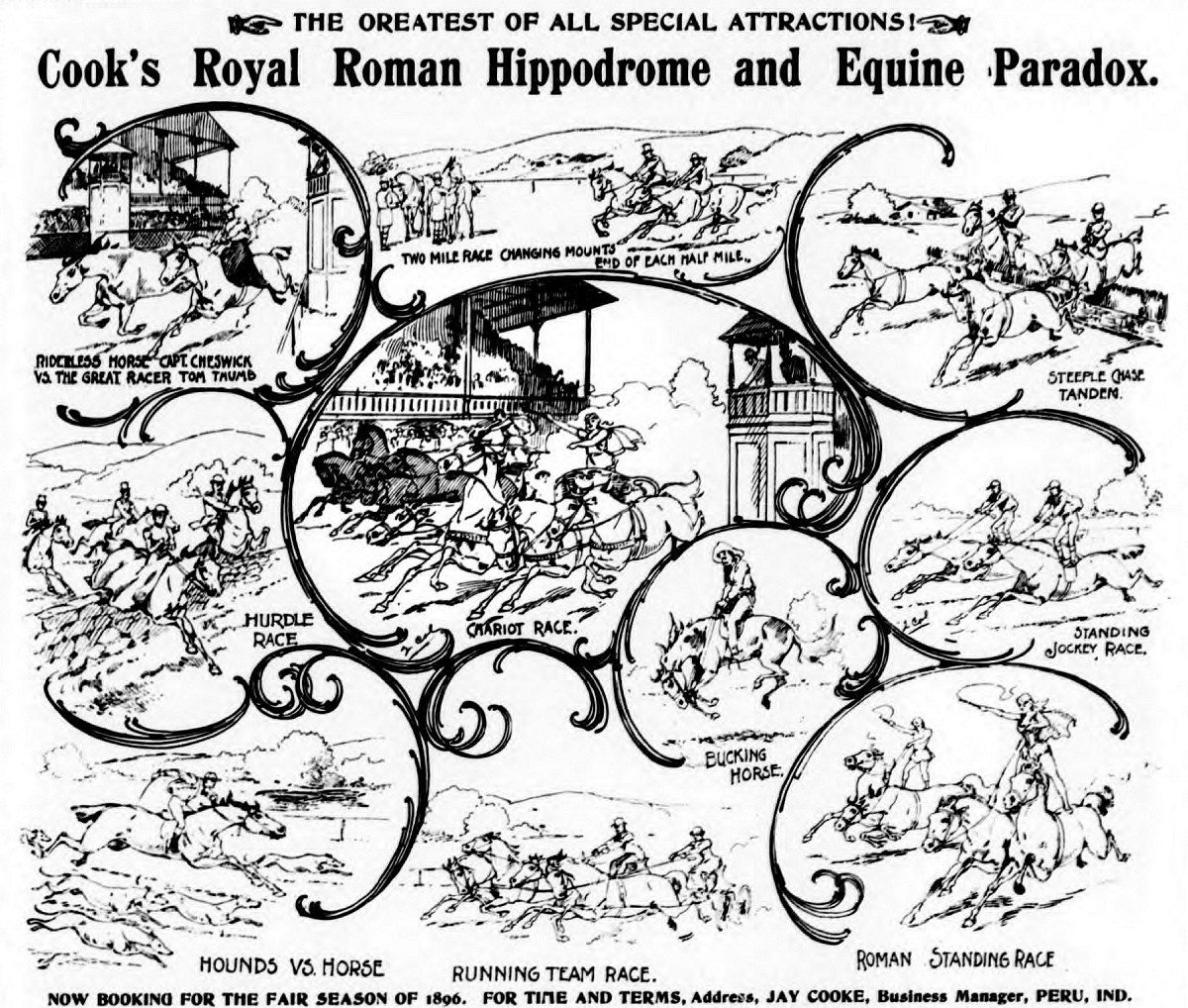
Cook's Fair Ground Hippodrome is wintering at Peru, Ind.
1897
Billboard Advertising, January 1, 1897, p. 10. Note: Billboard has typographical errors, and the transcription will have additional typos. Information should be checked with additional sources. Underlined word, transcription may not be correct. Unreadable word indicated by ___.
Australia. Adelaide, Nov. 13, 1896. Editor Billboard Advertising. Dear Sir: I may state that the people of Adelaide are not entire strangers to Messrs. Donaldson & Co.'s work, as I was much pleased to decorate my boardings with some of their beautiful pictures, for Messrs. Fitzgerald Bros.' Circus, the only Australian circus in the colonies. There were some very funny litho window one-sheets, a clown holding up a donkey, and a couple of mules in a wagon; those two were impressed upon my mind rather vividly. You may inform any circus coming here that they need not bring any bill postesr, as I have just as good men here as you have in America. My men were as good as Sells Bros.' men, when they arrived here, and I had the pleasure of showing them the route of hundred miles, north, south, east and west of our capital. . . . Yours truly, Fred. Coombs.
Billboard Advertising, March 1, 1897, p. 9. Note: Billboard has typographical errors, and the transcription will have additional typos. Information should be checked with additional sources. Underlined word, transcription may not be correct. Unreadable word indicated by ___.
Col. E. Daniel Boone, the lion tamer, has secured the "Hagenbeck Concession" at the Tennessee Centennial.
1898
Billboard, July 1, 1898, p. 3. Note: Billboard has typographical errors, and the transcription will have additional typos. Information should be checked with additional sources. Underlined word, transcription may not be correct. Unreadable word indicated by ___.
[Chicago] Ralph W. Peckham has been promoted to the position of excursion manager of the big Ringling Bros.' Shows. He has his headquarters at the Central Show Print, Monroe street.
[Chicago] The advance forces of the Wallace Shows, Sells Bros. and Buffalo Bill's Wild West make their headquarters at the National Show Print, 289 Wabash avenue.
Billboard Advertising, September 1, 1898, pp. 11, 14, 16. Note: Billboard has typographical errors, and the transcription will have additional typos. Information should be checked with additional sources. Underlined word, transcription may not be correct. Unreadable word indicated by ___.
Colonel Burr Robbins . . . He started with nothing. In fact, the story of his life reads like romance. For instance, during the panic of 1873, when business in all directions was utterly prostrated, Colonel Robbins' Circus cleared nearly $60,000. Its earnings increased every year thereafter as long as he operated it. Though at an age when most ment rae content to take things easy, Colonel Robbins still takes a lively and active interest in business. He owns the controlling interest in the American Advertising and Bill Posting Company and the Western Ad-Sign Syndicate, both of Chicago, and finances both concerns personally.
Omaha, Neb., August 18, 1898. The Editor of The Billboard: . . . the Trans-Mississippi Exposition is a success. W. W. Cole and wife and Louis E. Cooke are here. The former and his wife seem to be taking in the exposition thoroughly. The latter is here in the interests of the Buffalo Bill Show, which is here August 30 and 31. I am doing a little buiness here for the Barnum & Baile Show. Just received a cablegram from Mr. Bailey this morning of one hundred words, which cost him the small sum of $34. He want all the features and everything that is new in America to astonish all Europe with for 1899, and, as usual, he is in a hurry, as ever. Yours very truly, E. D. Colvin.
Fair managers who have failed to interest exhibitors should visit the great Wallace Shows should opportunity afford. This big circus carries a regular exhibit of agricultural implements. It occupies a prominent portion of the menagerie tent, and attractsquite as much attention as any of the rare animals. All day long farmers and folks from the country examine the various inplements and discuss their merits. The Deering Reaper, Studebaker Wagon, Oliver Chilled Plow, etc., are all in evidence, and they pay enormous prices for space.
Of course a circus gives better exhibiting value than a fair, because it appeals to an entirely new concourse of people every day, showing as it does in a different town daily. But the prices obtained by the show people for these privileges are very alluring. In no instance is it less than $1,000 for the season (150 days), and when the implement or tool requires a demonstrator, or is hauled about town in the daily parade, the price ranges to as high as $1,500.
White's Yucatan Chewing Gum has a handsome sign on the houdah and blanket of one of the elephants in parade, and all the balloons that the riders jump through bear their advertisement. They pay $500 per season therefore. The Crown Perfumery Co. of London, England, has built a costly parade chariot, equipped with a complete set of bells or chimes, and bearing their advertisement. They pay $1,250 per season for the parade privilege and space in the menagerie tent. The Wallace Shows play to an average of 4,500 people a performance, or 9,000 daily. Their total admissions in 1897 were 1,413,210. Of this, practically none was duplicated.
Billboard, November 1, 1898, p. 2. Note: Billboard has typographical errors, and the transcription will have additional typos. Information should be checked with additional sources. Underlined word, transcription may not be correct. Unreadable word indicated by ___.
When the circus agent comes along and says he wants all your bill boards, tell him that you have to retain a portion of your space for commercial work for a living eleven months out of the twelve, and that such work is therfore of consquence. The agent will object to this arrangement; will declare that he must have all your boards or ___ will go off and buy lumber and hire carpenters and start into building boards of his own. Let him go ahead. When he gets his boards built, he will come to you and take your space also, and in addition, he will sell you his newly-built lumber at about one-half value, and you are well fixed for the coming year for commercial work, theatrical work, and also for the next circus.
Billboard, December 1, 1898, p. 19. Note: Billboard has typographical errors, and the transcription will have additional typos. Information should be checked with additional sources. Underlined word, transcription may not be correct. Unreadable word indicated by ___.
Savannah, Ga., Nov. 21, 1898. Editor of The Billboard: Arrived home from my summer engagement with the Walter L. Main Show, Oct. 29. . . . I have on the boards now live commercial paper amounting to 2,870 sheets. Just got through with three weeks' showing of 4-Paw and Sells Bros. Shows, 1,358 sheets; 100 one-sheet, 20 three-sheet and 20 eight-sheet lithograph boards. Yours, Chas. Bernard. Knoxville, Tenn., Nov. 16, 1898.
1899
Billboard, February 1, 1899, p. 2. Note: Billboard has typographical errors, and the transcription will have additional typos. Information should be checked with additional sources. Underlined word, transcription may not be correct. Unreadable word indicated by ___.
Circuses in Winter Quarters
Great Wallace Shows, B. E. Wallace, proprietor, Peru, Ind.; W. E. Franklin, general agent, Terrace Park, Hamilton County, Ohio.
Sells-Forepaugh Shows, S. H. Barrett, general agent, 60 W. Fourth avenue, Columbus, O.
Pawnee Bill Wild West, Major Gordon W. Lillie, proprietor; W. E. Ferguson, general agent, North Vernon, Ind.
Harris' Nickel Plate Shows, C. C. Wilson, general agent, Macon, Ga.
Great La Pearl Shows, H. W. Link, general agent, Hastings, Mich.
Lemen Bros., Argentine, Kan.
Walter L. Main's Great Shows, Wm. Sells, general agent, Geneva, O.
Ringling Bros.' World's Greatest Shows, Baraboo, Wis. Rddress Ringling Bros.
Barnum & Bailey Shows, London, England. Address Louis E. Cooke, Newark, N. J.
Buffalo Bill's Wild West, Louis E. Cooke, general agent, 1193 Broadway, New York.
John Robinson Shows. Oliver Scott, general agent, Terrace Park, Hamilton County, Ohio.
Campbell Bros., Fairbury, Neb.
Sun Bros., Norfolk, Va.
Gollmar Bros., Baraboo, Wis.
Sig. Sautelle, Syracuse, N. Y.
Mexican Bell, Medina, N. Y.
McCormick Bros., Gallipolis, O.
F. J. Taylor, Creston, Iowa.
J. E. Warner, Lansing, Mich.
Captain W. D. Ament, Birmingham, Ala.
Welsh Bros., Lancaster, Pa.
Wintermute Bros., Hebron, Wis.
Goodrich Shows, Sig. Zano, proprietor, Bridgeport, Conn.
Sipe & Blake, Kokomo, Ind.
Norris Bros., San Antonio, Tex.
Prof. Gentry, No. 1, Houston, Tex.
Prof. Gentry, No. 2, Bloomington, Ind.
Cooper & Co., 127 E. Eighth street, Cincinnati, O.
J. H. Sparks, Whitehaven, Pa.
Bonheur Bros., What Cheer, Iowa
M. V. B. Wixom, Bancroft, Mich.
Leavitt & Seaman, Tampa, Fla.
E. Haag, La Compte, La.
Bob Hunting, Chester, Pa.
Billboard, May 1, 1899, p. 3. Note: Billboard has typographical errors, and the transcription will have additional typos. Information should be checked with additional sources. Underlined word, transcription may not be correct. Unreadable word indicated by ___.
Exeter, N. H., March 25. John H. Pendergast, an old-time circus manager, died at the Exeter Cottage Hospital yesterday afternoon. He had been ill for more than a year, and two months ago came to the hospital for treatment. He was born in Barnstead, and his age was 70 years, 1 month. Mr. Pendergast win in the show business nearly all his life as a circus manager. He had traveled all over the country, but had exhibited principally in the Southern States. For several years he had made his home in Newmarket, where he was previous to coming to the hospital. He is survived by three sons, Isaac H. Pentergast and Vila Pendergast, of Merrimac, Mass., and Andy Pendergast, of Newburyport, Mass. He also leaves one sister, Mrs. Miranda Prescott, of Hampton Falls, and two brothers, William and Charles Pendergast, of Newmarket.
Billboard, December 1, 1899, pp. 3, 12. Note: Billboard has typographical errors, and the transcription will have additional typos. Information should be checked with additional sources. Underlined word, transcription may not be correct. Unreadable word indicated by ___.
W. E. Ferguson, general agent of the Pawnee Bill Wild West Shows, is a product of Bay City, Mich., familiarly known as "Bob." His first experience was ahead of Uncle Dan Castello. He has been ahead of Miles Orton, George Richards, Bill Main, Adam Forepaugh, Pawnee Bill, Joe McMahon and Lemen Bros. . . .
At liberty to accept position as general agent or contractor, railroad show preferred. Robert Fagan, Madison, Ind.
It is rumored that the Walter L. Main Shows will be materially enlarged for the season of 1900. Their business on the Pacific coast last season was phenomenal.
Clay Lambert has been re-engaged for next season with Ringling Bros.' World's Greatest Shows.
Major G. W. Lillie (Pawnee Bill) in company with his wife and O. J. Krause, his manager, is ranching it at Pawnee, Oklahoma Territory.
Edward M. Burk, essayed the railroad contracting of the Great Wallace Shows during 1899. His experience has been wide and varied. He achieved an enviable reputation as local contractor ahead of Ringling Bros. World's Greatest Shows prior to casting his fortunes with the Wallace Shows. Prior to that he was general agent of the Reynold Shows. He has also been in the employ of the Barnum Show, and for years was a partner with his brother in the conduct of Burk's Colossal Shows. . . .
1900
Billboard, February 1, 1900, pp. 4, 12. Note: Billboard has typographical errors, and the transcription will have additional typos. Information should be checked with additional sources. Underlined word, transcription may not be correct. Unreadable word indicated by ___.
Where Circuses Are Wintering
Alphabetically arranged, address of the show proper. None but tent shows that carry their own corps of bill posters, programers, etc., have been listed. [some may not be circuses]
Adell's Dog and Pony Show, Ft. Recovery, O.
Adam's (Frank) Southern Shows.
Barlow Bros. Shows, Syracuse, Ind.
Buchanan Bros., Des Moines, Ia.
Bonheur Bros., Houston, Tex.
Barnum & Bailey, Olympia, London, Eng.
Buffalo Bill's Wild West, Bridgeport, Ct.
Buckskin Bill's Wild West, Paducah, Ky.
Barker Bros., Portsmouth, O.
Cooper & Co. (J. R. W. Hennessey), Tampa, Fla.
Clark Bros., Atoka, Ind. T.
Cullins Bros., Concordia, Kan.
Campbell Bros., Fairbury, Neb.
Conklin's, Pete, 412 Sewell st., Hoboken
Clark's, M. L., Alexandria, La.
Downie (Andrew) Shows, Medina, N. Y.
Davis (E. F.) Shows, Kalamazoo, Mich.
Dock's, Sam, Ft. Loudon, Pa.
Ely's, Geo. S., Metropolis City, Ill.
Exposition Circuit Co. (street fairs), Canton, O.
Ewers Bros., West Point, Ia.
Forepaugh-Sells Bros., Columbus, O.
Gentry's Dogs and Ponies, Bloomington, Ind.
Gollmar Bros., Baraboo, Wis.
Goodrich, Jas., Weston, W. Va.
Gibb's Olympic, Wapakoneta, O.
Gray, Jas, H. Windsor Hotel, St. Paul, Minn.
Gaskill, Frank W. (street fairs), Canton, O.
Great Syndicate Shows, Kansas City, Mo.
Grant (Colorado), Denver, Col.
Haag's, Le Compte, La.
Hall's, Geo. W. Jr., Evansville, Wis.
Harris' Nickle Plate, Chicago, Ill.
Happy Bob Robinson, Lancaster, O.
Huston's, Winchester, Ind.
Hall & Long's, Elkhart, Ind.
Hagenbeck's, Carl, 346 Wabash av., Chicago
Jones' Wild West, Weston, W. Va.
Julian, Wm., Havana, Ill.
Kemp Sisters' Wild West (parks & fairs), El Paso, Ill.
King & Ziemer, St. Louis
Kent Bros., Bloomington, Ill.
Lambrigger's, Gus, Orville, O.
La Place, Mons., Lower Salem, O.
Lemen Bros., Argentine, Kan.
Lee, Frank H., Pawtucket, R. I.
Lowande's, Toney, Santiago, Cuba
Lowande's, Marthino, Havana, Cuba
McDonald's, Walter, Abilene, Kan.
Main's, Walter L., Geneva, O.
McCormick Bros., Callipolis, O.
McGregor & Co., Detroit, Mich.
Norris & Rowe, Oakland, Cal.
Perrin's, Dave W., Eaton Rapids, Mich.
Prescott & Co.'s, Rockland, Me.
Perry & Pressly, Webster City, Ia.
Riggs' Wild West, N. York
Reed's, A. H., Vernon, Ind.
Ringling Bros., Baraboo, Wis.
Robinson's, John, Terrace Park, O.
Rice's Dog and Pony Show, New Albany, Ind.
Reno's Oriental Shows, Aurora, Neb.
Stewart's, Capt., Ft. Wayne, Ind.
Sautelle's, Sig., Homer, N. Y.
Sun Bros., ___, N. Y.
St. Julian Bros., Phila., Pa.
Shott Bros., Bluefield, W. Va.
Schaffer & Cook Bros., Portsmouth, O.
Sells-La Pearl (Wm. Sells), Peru, Ind.
Smith's, Frank E., Kansas City, Mo.
Sipe's, Geo. W., Kokomo, Ind.
Spark's, John H. (two shows), en route
Stang Bros., Burlington, Wis.
Shipman's, J. W., Syracuse, N. Y.
Tuttle's Olympic, Linesville, Pa.
Welsh Bros., Lancaster, Pa.
Ward's Shows, Plymouth, Mass.
Wallace Shows, Peru, Ind.
Williams, W. O., Gallatin, Tenn.
Wintermute Bros., Hebron, Wis.
Wetter, Albert M., Massillon, O.
Buffalo Bill Must Have Indians
It was recently announced that the Indian department had withdrawn from the Indians the privilege given of appearing in public exhibitions. This notion caused much consternation among the circus people, and especially among the Wild West show managers. Major Burk, representing Colonel W. F. Cody, called upon Commissioner Jones with a view to having the order reconsidered. He declared that such an order would simply mean the ruin of the Wild West show in which he is interested. Commissioner Jones said that personally he was opposed to Indians being taken from the reservation for any but educational purposes, and that htis would be the policy of the Interior Department. He, however, said that applications for permission would be considered on their individual merits. Even if this rule goes into effect, it will not debar Colonel Cody from getting Indians, for many have received allotments of land and are privileged to go wherever they please. But Major Burk contended that the Indians in this advanced position were of no value or interest to his exhibition. The Indians for Wild West show purposes must be as near like the original as it is possible to find him at the present time. Since no definite order has been promulgated and since the applications will be considered on their merits, we are not in the least apprehensive that the Colonel's Indians will be taken from him.
Billboard, April 1, 1900, pp. 2, 11. Note: Billboard has typographical errors, and the transcription will have additional typos. Information should be checked with additional sources. Underlined word, transcription may not be correct. Unreadable word indicated by ___.
W. C. Coup tells of Prodigous Outlays
A great circus uses large quantities of advertising paper - so much, in fact, that it is difficult to keep track of it. True, the superintendent of the advertising car gives each man so many "sheets" in the morning, and the man at night hands in a statement which is supposed to show where and how he has placed the paper. These brigades are followed by "watchers," or, as the railroad men term them, "spotters," who look carefully over the ground. But the impossibility of detecting all crooked wook may be readily understood when I say that from eight to twelve wagons containing bill posters and paper start out on country routes in as many different directions, so the "spotter" cannot follow every trail. One of my "spotters," however, did once ascertain that a party of my men had driven into the country and dozed comfortably in the shade all day, had not put up any paper and had not fed the hired horses, although they did not forget to charge for the "feeds." The horses were thus made to suffer, and the men pocketed the money which should ahve gone for eats. Of course my superindendent discharged the entire brigade, although, when the season is well under way, it is very difficult to obtain skilled bill posters, for it is quite a difficult craft and experts are in good demand.
The reader, however, can easily see what a great loss such doings entail on a show, considering the cost of the poster at the printer's, the freight or expressage, and the money paid the men for putting up the sheets. The printing bills of a first-class show are enormous. . . .
I can remember when one-sheet lithographs cost one dollar each, and for several years later they could not be bought for less than ___ to seventy-five cents apiece. They can be had now in large quantities for about five cents or less the sheet. As shows nowadays frequently use hundreds of sheets in a day, imagine what would be their cost at the price paid in the pioneeer show period.
The circus of the present day is judged by the quality of its paper. One season I arranged with a publisher to use a folded quarter sheet, three sides of which advertised our show and the fourth side contained the first chapter of a story about to be published in his magazine. These were furnished to us in enormous quantities, and our agents distributed them. In Boston we had four four-horse wagons full, and these followed our parade. The men tossed the folders high in the air, and the wind carried them in all directions. While this style of advertising surprised the people, it was soon stopped, and properly, too, by city ordinance. I think circus people would be better off if ordinances were passed wholly prohibiting bill posting; but unfortunately such a movement would go far toward breaking up a profitable industry, since many of the bill posters are rich men, some making as much as $25,000 a year, and a few fully $50,000. I believe Mr. Seth B. Howes, the veteran circus manager, was the first one to order a bill board made or past paper on the outside. Previous to this all bills were hung or fastened up with tacks. - The Saturday Evening Post.
Hagenbeck's Sale at Cincinnati
On Thursday, March 22, occurred the first big sale of Hagenbeck's animals at the Cincinnati Zoo. Representative circus and showmen from all over the country were present. Among them were noticed representatives of the following: Lincoln Park Menagerie, Chicago; Charles Woodford Circus; the Benjamin F. Wallace Show, Peru, Ind.; the John Robinson Circus, Terrace Park, O.; Midway Carnival Company, Cleveland; Great Oriental Carnival Company, Cleveland; Pawnee Bill's Wild West and others. Major James Wallace, of Cincinnati, was autioneer.
There was a fine assortment of animals put up, although most of them were more or less under the weather after their long trip. Some of the purchases were as follows: the Pittsburgh Zoo bought a full-grown babboon, with male, for $50. The egg-laying mammal echidnas, was not sold. In the carnivora the principal animals sold were a chetah leopard $255, which went to Lincoln Park menagerie; thoroughbred Bengal tiger $425, Ben Wallace Circus; African male leopard and Indian female leopard, $425 for the pair, Canton Carnival Company; male leopard, $145, Chattanooga Zoo; South American puma, $__, Sells & Gray's Circus; pair of spotted Australian cats $__, Philadelphia Zoo; stuffed gorilla $300, New York Museum; thoroughbred lioness, $260, Ben Wallace; pair of kangaroos, $80, John Robinson. After the morining sale, dinner was served in the restaurant. At 1:30 there was an exhibition of trained animals which were sold.
Billboard, May 1, 1900, pp. 6, 7. Note: Billboard has typographical errors, and the transcription will have additional typos. Information should be checked with additional sources. Underlined word, transcription may not be correct. Unreadable word indicated by ___.
Advance Rosters
Wintermute Bros.' Gigantic Shows. Agent, Halsey Wintermute. Bill posters: Clarence N. Black, of Syracuse; Lew Comstock, Barrington, Ill.; A. T. Eads, Battle Creek, Mich.
Pawnee Bill's Wild West. General agent, W. E. Ferguson; contracting agent; J. H. Rice; assistant contracting agent, D. W. Mayon. Manager No. 1 Car - Thos. R. Perry and fourteen billposters and lithographers. Press representative in advance, T. L. Nicodemus. Press representative with show, Frank Frost. No. 2 Car, ten bill posters and lithographers. Manager of box brigade, Elmer Hultzer, with four assistants. Route riders, Harry Upham and John Brice.
G. W. Hall's Circus and Menagerie. G. W. Hall, proprietors. General agent, E. O. Ferguson. Bill posters: D. Maloney, Ira Weirman, Fred Knoll. Programmer and lithographer, Fred Champion.
Elton Bros. 20c Shows. Wagon No. 1: agent, H. O. Cunningham; bill poster, Callen; lithographer, Moore. Wagon No. 2: bill posters, programmers and heralds, Joe McCleary and Chas. Mitchell.
Reno's Oriental Shows. Contracting agent, W. B. Alvord; lithographer, King Solman; bill posters - Chas. Arnold, "Swipes" Cone, "Smiler" Towne.
Bonheur Bros. Contracting agent, A. G. Bonheur; bill posters and programmers: J. A. Caanan, Marvin Melrose, James Lester.
McCormick's Great Silver-Plate Shows. Railroad contracting agent, Mr. F. E. Eadley. In charge Advance Car No. 1: W. B. McCormik, with seven assistants; Jane Wart, Dave Ward, Jim Buscher, Albert Belcher, Joseph Ward, Alex. Meige, Alex. Burton. Car No. 2: W. B. Menifee, with six assistants - Jim Coal, Harry Wells, Ed. Patchell, Harry Wartz, Harry Charles, Perry Smith. Programmers and lithographers: Car No. 1 - Harry Sells, Frank Welsch, Edward Oskey, Howard Eddes. Programmers Car No. 2 - Frank Spence, John Sheets, Harry Haven.
Col. Pete Conklin's Big Shows. General agent, Floyd C. Fox; press agent, H. W. Fox; programmer, Percy Jenkins; bill posters: Charley Cox, Willie Morton.
Cullins Show. Press agent D. G. Jarvis. Boss bill posters - C. Murphy, Joe Dawson, Earl Sage. Lithographer, Roy Colburn. Programmer, J. Heagerman.
Capt. W. D. Ament's Big City Vaudeville Circus. Contracting agent, A. J. Sharply.
Keystone Shows. Agent, Keller Iseminger. Bill posters - Thos. Acton, P. A. Howard, Will Myers, J. Hurly.
Whitney's Acrobatic and Specialty Company. General agent, E. S. Whitney; in charge advance brigade No. 1, L. P. Whitney; lithographer, W. Walbourne. Bill posters: Jas. Hardy, Fred James, Will Dugan. In charge brigade No. 2, J. F. Whitney; bill posters Art Johnson, Billy Sutton.
Fred Locke's Show. Contractor, E. A. Hill. Press agent, A. O. Landiss. Programer, C. Jones. Boss bill poster, Murphy Sanirson, with four men.
Ed. F. Davis' Big 10-20c Show. Proprietor and manager, Ed. F. Davis. General agent, DeForest Davis. Equestrian director, Sam MacFlinn. Band master, Banks Baird. Master of canvas, Chas. Watson. Master of horse, Dr. Fowler.
Walter J. McDonald's Shows. General agent, Harry Bundy. Bill posters - Wm. Bundy, Fred Jones, Spot Sickles, Frank Cann, Joe Harris. Publisher official programmes, Chas. G. Johnson. Lithographer, Frank Searls. Programmer, E. G. Templin.
The following are in the roster of the advance of the Great Wallace Circus: W. E. Franklin, general agent; E. M. Burke, railroad contractor; R. M. Harvey and D. F. Lynch, contractors; A. W. McPhail, special agent; W. R. Musgat, agent No. 1 advance car, with sixteen bill posters; R. P. Janette, agent No. 2 advance car, with fourteen bill posters; Frank Purcell, agent Brigade No. 1, with ten men; Harry Middleton, agent Brigade No. 2, with five men; W. W. Parmalee, program contractor.
The advertising department of the John T. Backman's Show consists of Will Z. Smith, agent; Frank Cook and F. R. Blose, bill posters; Chris. Mayer, programmer, and Ray Pickrell, press agent.
The advance staff of the Sun Bros. Shows is: Pete Sun, manager; Albert Moore in charge of the big No. 1 wagon; Walter Epperson, No. 2 wagon; C. I. Smitt, No. 3 wagon, and Fred Baver, lithographer, with assistants.
Harrington's Combined Shows open at Cook's Park, Evansville, Ind., May 6. Wm. Harrington will be in advance, with one assistant and two bill posters.
Fred Darling is general contractor and advance representative of the Dixon, Bowers & Dixon Big Shows. He has eight assistants. The show opens in Sydney, N. Y., May 1.
Campbell Bros. United Shows will open at Fairbury, Neb., April 26. It is a neat two-ring show.
Buckskin Bill's Wild West opens at Paducah, Ky., May 5.
Wallace Shows opened at Peru, Ind., April 28, and showed at Indianapolis, April 30.
The John Robinson Shows opened at Columbis, Cincinnati, O., April 28, and appeared at Richmond, Ind., April 30.
The Sells-Gray Show was reported at Elwood, Ind., April 28, and Alexandria, Ind., April 30.
Norris & Rowe Shows were reported as follows: Reno, Cal, April 25; Truckee, Cal., April 26; Marysville, Cal., April 27; Oroville, Cal., April 28; Chico, Cal., April 30.
The Jas. W. Goodrich Shows opened at Weston, W. Va., April 28, and appeared at Clarksburg, W. Va., April 30.
Welsh Bros. kept things lively at Reading, Pa., April 23 to 28 inclusive.
Cullins Bros. Wagon Shows open at Concordia, Kas., May 3.
The Great Syndicate Shows were seen at Centropolis, Mo., April 28.
Nickel Plate Shows made Chicago, Ill., April 28.
Elton Bros. Circus opened at Smithfield, Pa., May 1.
Kennedy Bros. Circus and Vaudeville Shows opened at Bloomington, Ill., April 25, 26 and 27, and followed to El Paso, Ill., April 28, Minonk, Ill., April 30.
Rhoda Royal Shows opened the season at Geneva, O., April 28.
Tuttle's Olympic Shows take the road May 1.
The Barlow's Refined Wagon Show began the season at Syracuse, Ind., April 28.
Basil McHenry will do the contracting for the Gollmar Bros. this season.
Wm. Powley will not go with the Wallace Shows. He will probably be found with the Sells-Gray Show.
L. F. Nicodemus, 165 E. Randolph Street, Chicago, has the advertising program of the Pawnee Bill Shows.
Sam Dock's Keystone Show and E. G. Smith's Imperial Show have combined.
The Harrington Wagon Show will tour Indiana, Illinois, Missouri and Kentucky this year.
Ringling Bros. are nothing if not spectacular. Their astonishing jump from Baragoo to Wheeling, to open (seven hudnred and eighty-five miles), had no sooner been announced than their contracting agents appeared in Jersey City at the very gates of New York. This remarkable manouver was succeeded by another equally surprising when Windstead, Conn., was announded as the next town on the list.
The New York yellow journals did not treat the Forepaugh-Sells show overkindly, but the public was more discriminating and appreciative. In other words, the Garden was packed at every performance.
F. J. Taylor, of Creston, Iowa, will try it again this season under the style of the Great F. J. Taylor's Shows (incorporated).
Ed. F. Davis' school of trained barnyard quadrupeds will make a big hit, or "The Billboard" will miss its guess.
The Robinson Show parade this season is a revelation. The cages are not only very handsome, but unique. They are odd, original and out of the ordinary in style and design.
Gil Robinson went all the way to Egypt this past winter to buy camels for the John Robinson Shows. He bought thirty, all young and strong. Despite great care, fourteen of them died on the vessel on the way over. This is one of the reasons that the price of camels in America is high.
The new feature with Harris' Nickel Plate Shows this season is a team of six camels harnessed two abreast to a handsome open den of lions, on top of which is seated a band of ten mouth pieces.
The Reno & Alvord Show opens at Aurora, Neb., April 28. Over $2,500 has gone into the show this winter, but they don't owe any one a dollar. W. B. Alvord will be ahead of the show as usual.
Geo. Peck, formerly of the firm of Peck & Fursman, has the sideshow with Buckskin Bill's Wild West this season.
Doc Parkhurst, the boss canvasman, writes that Norris & Rowe are carrying a ten-car show on six cars. He says it is the biggest six cars of stuff he ever handled.
Denny Lynch, contracting agent of the Wallace Shows, is out for a record this year. His first town was Indianapolis. He got the lot for $50 (the first time the price has been brokenin twelve years), and he made the county license for $10, which is better than any of the high-priced fixers have ever succeeded in doing.
J. R. W. Hennessey, proprietor of Cooper & Co.'s circus, was in Cincinnati, April 16.
B. E. Wallace has six of the prettiest lilliputian cages for the children's department that ever went in a parade. Each is hauled by four shetland ponies, and thecolor of the harness and plumes matches the color of the cage.
F. E. Davis is ahead of the Cooper & Co. show.
Dan R. Robinson, general agent of Buckskin Bill's Wild West, was a "Billboard" caller April 16. Dan says the show boasts of seventeen cars with the show and two ahead.
The Jas. W. Goodrich Shows will be a two-car railroad show this year. It opens at Weston, W. Va., April 28.
The Cooper & Co. Show cleaned up on the Key West engagement, and made money in the southern towns of Florida. Commencing at Jacksonville, however, business fell off and has been bad ever since. Pensacola was simply vile. Even ten cent cotton can not make the South a good country in the spring.
Clint Worral is with Frank A. Robbins street fair company.
Any show needing a good, first-class fixer will find one in John Griffen. He is at liberty. His address is No. 27 Bank st., Toronto, Ontario.
Choosing Day with the Wallace Shows falls on April 29 this year.
Mrs. Ephraim Sells died April 8 at her home in Columbus, O. Her children were present, as was also Mr. Peter Sells.
John Hamilton "gets the train over the road" this year with the Wallace Shows.
The Norris & Rowe Shows cleared $10,800 in fifteen days at the Mechanics' Pavilion, San Francisco. This is no pipe story, either, but the result of heavy billing and faithfull conscientious house-to-house program. They put up 10,000 sheets of wall work, 900 window lithos and distributed 65,000 couriers.
Leon Washburn will put out a Tom Show under canvas, opening his season at Have de Grace, Md.
The Welsh Brothers, proprietors of the big Welsh Brothers' Circus, have started a second enterprise, to be known as the Welsh Wagon Show.
Bill Doris, the sideshow man, and his wife closed with the Cooper & Co. Show at Jackson, Tenn., April 14.
The new circus rate on the Southern Railroad is a ripper. Just to ascertain what the new order meant, a prominent circus agent asked for a rate from Memphis to Chattanooga on a one-section show making four stops. He was informed that it would be $1,525. The South will not be so good next fall, even if cotton is ten cents, at this rate.
Jim Sturgis sold his sixty-foot sleeping car to J. R. W. Hennessey, April 16. The latter will place it in his train, remodeling the one he is at present using, and sending it ahead for an advance are.
Geo. Aiken has proved his ability to keep a route buried about as well as the next one. The Robinson Show stands were an unknown quantity up to the time the contracting agents started out.
The Orton Family is with the Cullins Bros. Shows this season, as is also Tony White. Davie Jarvis is looking out for the transportation for the Cullins.
Billboard, May 5, 1900, p. 3. Note: Billboard has typographical errors, and the transcription will have additional typos. Information should be checked with additional sources. Underlined word, transcription may not be correct. Unreadable word indicated by ___.
The big fight now raging in New England between Ringling Bros. on the one hand and the combined forces of Buffalo Bill's Wild West and the Forepaugh-Sells' shows on the other, is attracting great attention in the circus world. It is indeed a battle royal between giants, and bids fair to be handed down in history as the greatest circus war on record. No one, not even the constestants themselves, seems to be entirely sure of the causes which have lead up to the conflict. It appears, however, that some attempt was made to avoid it by a division of territory, but no arrangement satisfactory to all parties could be had, and the negotiations fell through. Then began the wild scramble for towns which brought on the big clash.
Buffalo Bill's Wild West and the Forepaugh-Sells' shows being allies, divided New England between them. Their contracting agents were first in the field and secured all the advantages in the way of choice and low prices. But the Ringling Bros., nothing daunted, threw down the gage and entered the fight. Their sensational jump of a thousand miles, at Wheeling, W. Va., was followed three days later by another form Connellsville, Pa., and a week later another Sunday run from Paterson, N. J., landed them in the very thick of the fracas at Meriden, Conn.
They are all the opposition towns first so far. Disinterested observers say this is a decided advantage so far as the Forepaugh-Sells shows are concerned, but are inclined to believe that it is a mistake with the Buffalo Bill shows. Most showmen believe that a circus will do better to follow the Wild West rather than precede it.
At this writing it is too early to venture a prediction as to the outcome, but all the contestants are feeling easy and confident. Money is being spent lavishly, and it is raining complimentary tickets in New England.
Speculation is rife as to whether the Ringling Bros. will make California this fall. It is generally thought that they will.
The Miloos will travel with Sells & Gray this season, to do their revolving ladder and clown brother act.
Toledo, O., April 26. Frank Appel was adjudged insane yesterday afternoon and was sent to the Toledo State Hospital for the Insane. Appel was one of the best known head balancers and rope dancers in the country, and he has traveled the world over with the best shows and circuses on the road. The physicians testified that excessive head balancing produces insanity, and that Appel's misfortune was brought on in this way.
George Aiken is suffering with a severe affection of the eyes. They are badly inflamed, and he is compelled to wear smoked glasses.
The Western Gentry Show is said to be doing a very poor business in San Francisco and vicinity. This is the natural result of following a similar show too closely.
Billboard, May 12, 1900, p. 5. Note: Billboard has typographical errors, and the transcription will have additional typos. Information should be checked with additional sources. Underlined word, transcription may not be correct. Unreadable word indicated by ___.
Dr. C. D. Gray, general manager of the International Exposition Company, has a very thorough knowledge of the circus business, having run away from home when a small boy to follow the red wagons, and having owned circuses of his own in South Africa and the Orient; and he proposes to send out old-fashioned one-ring circuses on a tour of many cities next winter, covering a period of sixteen to twenty weeks. He will lease circuses and play them under the auspices of fraternal and social organizations, for there is a demand from these sources, and he has already guarantees assured him in the different cities he has booked. There is no doubt, from the present indications, that this new fad, a winter circus, will last for several years, and Dr. Gray's plan will be pushed by his company. Circus performers will thus have an opportunity for employment the year round.
A regulation restricting the showing of circuses in the District of Columbia was recently passed by the Commissioners of the District of Columbia. It provides that no circus shall hereafter be located, operated or conducted on any lot or open space without the written consent of 75 per cent of the residents keeping house in the square on which it is proposed to locate the circus, and in the squares confronting such square. Though the Commissioners have passed this resolution, it is by no means a certainty that the residents will support it.
Winsted, Conn., April 30. (Special.) Business of all kinds was suspended here this afternoon in order that an appropriate welcome might be accorded a visiting circus (Ringling's). Every factory in the town, all the schools and many of the stores were closed, and the whole town turned out to the circus. Even the local newspaper was published at 11 a.m. in order that the employes might enjoy the holiday. Two weeks from today another circus is scheduled for Winsted, and another holiday is expected.
On May 1 a telegram to W. H. Donaldson from Oscar Lampman, Cripple Creek, Col., announced the death of Al Kohlund, the veteran circus agent. He died of plithysis April 30. Deceased was a railroad contractor of wide and varied experience, and a general agent of considerable ability, having been connnected at various times with the William Sells Shows, J. N. Rentfrow and John Hummel Shows. Of late years he had been doing newspaper work in Salt Lake City, Leadville and Cripple Creek. His relatives in Louisville and his brother in St. Louis were notified of his death.
Marysville, O., May 5. (Special.) While John Robinson's circus was exhibiting here this afternoon, one of the sleeping cars caught fire while standing on the Big Four tracks and was almost consumed by the flames. The loss is quite heavy, as it was a fine car, and nearly all the contents were consumed.
Buffalo Bill was booked for Norwich, Conn., June 2, but the date has been cancelled.
F. J. Taylor is having another trial at it this year. The show opened well and has been doing a good business to date. It could stand stronger billing than it gets.
The Sells divorce case, which was set for hearing April 27, was postponed until May 11. The many friends of Peter Sells will be glad to hear that his lawyers feel sure of the outcome. It is said that the opposing attorneys are merely sparring for time and making every effort to secure a settlement. All their overtures, so far, have been met with a quiet, firm refusal by Mr. Sells.
J. R. W. Hennessey recently purchased a car from Jim Sturgis. Sturgis' wife, who owned the car, objected. Now there is litigation, and plenty of it.
A clash between the Lemen Bros. and the Wallace shows is imminent.
Bob Whittaker will ride with the Wm. H. Gillmeyer Shows this season. Mamie Forepaugh will ride with the Gillmeyer shows.
The Wallace Show, at the split, is a rather tough proposition to encounter in opposition.
H. S. Rowe will make his headquarters at Portland, Ore., for the next two weeks.
A. H. McPhail joined the Wallace advance May 7. He is special agent.
Colonel George W. Hall (Popcorn George) is putting a show together for the fair season.
John F. Robinson keeps a private car always at his disposal at Terrace Park, so that he can join the show whenever the notion seizes him. His health is improving.
T. J. Cash is general agent with Dick Parr's Historical Wild West.
The following is the roster of advance Car No. 3 of the Ringling Bros.: Geo. W. Goodhart, manager; Joe Brown, boss bill poster; Dick Leslie, assistant; Foster McLeod, litho boards; Charles Sellers and Charles Bostwick, lithographers; Joe Horton, programmer; James Tucker, banners, and twelve bill posters.
Billboard, May 19, 1900, p. 5. Note: Billboard has typographical errors, and the transcription will have additional typos. Information should be checked with additional sources. Underlined word, transcription may not be correct. Unreadable word indicated by ___.
Sells-Gray Shows
Sells-Gray Show opened at Elwood, Ind., May 5. The show made Aurora, Ind., May 12, and the Cincinnati contingent was present in force. Among the visitors were Dan R. Robinson and wife, Jas. Hamilton and wife, ___, Chas. Arnold, Mike Mueller, Mrs. Nobby Clark and many others. The weather was all that could be desired, but the show was not seen to the best advantage. An accident to one of the cars had spilled a lot of stringers, only four of which had been recovered, and the accident, coupled with extremely bad weather for four days previous, had resulted in many of the workingmen deserting. As a consequence they were solow in getting up.
Barnum has the canvas. There are six cages in the menagerie, but these are supplemented by three tableaux wagons and a water buffalo, and the arrangement of the candy stands does away with all suggestion of bareness, and conveys an impression that is satisfactory to the average visitor. The tops are by Murray, the menagerie being a 65 withtwo 30-foot middle pieces, and the big top 110 (which lays out 103), with two 50-foot middle pieces.
The ring performance, however, is great. It is a safe bet to assert that it is the best offered by any ten-car show on the road. "Stick" Davenport is riding in great form. Rose Marretta is at her best, and her protege, Miss Edna, is certainly a wonder. A great many marvelous things have been said about this young lady's riding lately, some of which have seemed at times to have been overdrawn or at least over enthusiastic. Since witnessing her act, however, we are able to say unequivocally that it is the most finished, graceful and daring lady principal act in America. The clown band is another pleasing feature, and Harry Tyler's high diving dog, "Charlie," is fairly entitled to recognition as such also. This dog climbs a perpendicular ladder of 40 rounds to a platform right under the hood of the canvas and jumps into a net. His work is all done joyously, barking and will tail wagging.
The seating capacity, as we said before, was rather limited, but his has been remedied ere this. The blues are ten tiers high and the reserves are eight tiers high. There are two side shows, one the regulation museum, the other a hooche-coochee joint generally uptown. The concert is fairly good, as concerts go. Bunk Allen and John Barton have all the privileges. John Talbot does the fixing. Genial Nobby Clark is selling belts. John Hummell is manager in the absence of Mr. Sells, who is perforce obliged to jump on the advance frequently. Shorty Green has the stock, and it is all good stock, too. It was nearly all furnished by Gray, who, by the way, has had several seasons' experience in a small way, and bids fair to develop into a very able showman. There are ten cars, and, resplendent in new paint, they make a very brave appearance.
James A. Robinson, formerly a contracting agent for circuses, died at Philadelphia May 6. For several years he was in the employ of John O'Brien, afterward enlisting under the banner of the late Adam Forepaugh, with whom he remained as long as he cared to travel, having inherited a considerable fortune. In 1891 he was made the local manager of John A. Forepaugh's Temple Theater, Baltimore, and 1892 he was connected with the Forepaugh Theater, Philadelphia.
Albert L. Blodgett, formerly in advance of W. H. Harris' Nickel Plate Shows, is now the manager of the New Haven Bill Posting Company.
Tom Hanley will put out a small circus without riding shortly. He is organizing at North Adams, Mass., and may be addressed at that point, care of the Wilson Theater.
Dr. John E. Healy, who once conducted a circus at the Aquarium, New York City, is largely interested in real estate at New Haven, Conn. His former partner, Charles Bigelow, is president of the Kickapoo Indian Medicine Company.
The Forepaugh-Sells Show goes 100 per cent better under canvas than it did in the garden, despite the fact that there are several less people in the dressing room.
In Advance of a Circus
Advertising contributes so importantly to the success of a circus that, from the general advance agent and special press representative to the meanest bill poster, the work actually employs more men than there are performers in the "arena" when the "show" is "on the road," says the "New York Evening Post." One of the largest traveling circuses now in this country spends more than $200,000 in a season of 200 days, and employs 80 men for a much longer time for nothing but to announce its coming and boom its attractions.
There are three kinds of advertising - newspaper, bill board and "freak." The bill board announcement of the coming of the circus is first. To advertise the circus referred to, no less than 2,400,000 lithograph "sheets" were posted on bill boards and dead walls, and hung in shop windows, through a season of 215 days - an average of 1,200 a day. The lithograph bill of a circus in a year is one of the largest items of expense the proprietors are put to. It cost the proprietors of one circus more than $100,000 to "paper" the "show" for appearance in 164 cities and towns. This sum was the cost of printing alone, the whole cost of transportation, posting and distribution was considerably more. For that season, according to the proprietor himself, there were ordered from the printers about 1,200,000 sheets of "pictorial matter," 700,000 copies of two "illustrated pamphlets," and 1,200,000 "folders."
The circus has four advertising cars, to distribute this "paper" and keep it "moving" and "fresh." Three of them go over the same route at intervals of one week to the very day; the fourth is an "emergency" car, to meet unexpected circumstances. The first advance car leaves winter quarters fully stocked with bills, three or four weeks ahead of the show. It has a gorgeous exterior, and is always stalled in a conspicuous place in the railroad yard, if the chief agent knowns his business. It carries a general advance agent to oversee the work, a contracting press agent to arrange for advertising space in the newspapers, and a "boss" bill poster and his "gang." All this work is inspected by the second advance car, which arrives a week later.
It is the duty of the men on this car to "cover" the "excursion" routes - that is to say, the towns withing a radius of fifty miles not "covered" by the general advance agent in the first car. They not only put up the paper, but interest the newspapers and arrange for and advertise the excursions to the show town on the show day. The third car arrives in the week following to freshen the "paper" which the other two have posted.
The emergency car is a very important factor in the advertising. It is sent any distance at any time where it may appear to the managers that a wedge should be driven in. If, for instance, wind of the intention of an opposition circus to appear at any point on the route comes to the proprietor, the emergency car is immediately dispatched to that point. They are sometimes sent over queer routes, how attached to a cattle train, and again to a through express.
"The first work 'in advance' of a circus, however," said Frank O. Miller, and advance agent, "is done when the route is being laid out, months before the start is made from winter quarters. Men are sent out to discover the business conditions in the territory through which it is planned to take the show. Where the crops are poor, or where anyexceptional circumstances have arisen to keep the people poor, the show never goes. This first advance work is very important, and it takes an intelligent, careful man to do it. The last advertising is done on the morining when the show enters the town, by three or four press agents, whose duty it is to look after the newspaper men, see to the distribution of the final announcements, and provide for notices of the afternoon show in the evening papers. The men in this work must bee keen, companionable fellows; their duty is not so easy as it would appear, and they are busy the whole day long."
The "fake" advertising, by which is meant a sensational plan to attract attention to the circus, is done whenever the opportunity arises. The agent who can conceive the schemes is a valuable man and draws a good salary. The "elephant's bath" is a favorite device. It is well advertised that the elephants are to be taken to the river at a certain hour, and as surely as the hour comes the townspeople crowd the banks. One circus nearly lost a huge beast at Topeka, Kan., last year; the animal got in soft sand, and was nearly drowned - all of which was excellent advertising, in that it gave the local reporters something to write about.
"The old-fashioned advance agent is disappearing," said James De Wolf, another agent. "The new men are men of business from the ground up, who can make a good contract quickly and interest a man of good manners. Most of the work is done with newspaper editors and reporters, who can see through an affectation of good fellowship as quickly as most men. The proprietor of the circus I am with, though he is liberal, frowns on 'expenses' for drink and it is simply for the reason that that way of doing business is not the best way. Time was no doubt, when the circus man could buy a drink and get a paragraph. It can't be done now, however."
Billboard, May 26, 1900, p. 5. Note: Billboard has typographical errors, and the transcription will have additional typos. Information should be checked with additional sources. Underlined word, transcription may not be correct. Unreadable word indicated by ___.
S. H. Barrett, the general agent of the Forepaugh-Sells Shows, died at the United States Hotel in Boston, Mass., at 1 a.m., Wednesday, May 16. His death was due to exhaustion, following a long siege of typhoid-pneumonia. His wife and her brother, Peter Sells, were with him when he died, and did everything possible to alleviate and soothe him in his last hours. He had been very, very ill for weeks, but for all that the announcement of his death came as a great shock. He was widely known and universally esteemed. From all over America came hundred of letters and telegrams of sympathy and condolence. He leaves a wife (the sister of Mrssrs. Peter and Lewis Sells) and two children - Lewis Sells Barrett, aged 24 years, and Sheldon, aged 14 years. He was fifty-five years old when he died . . .
S. S. Thompson is agent of the E. F. Davis Shows.
Ringling Bros. were attached at Springfield, Mass., for covering the paper of the Buffalo Bill Show.
The total number of tent shows now on the road numbers 177. Up to this writing (May 19) we have not heard of a single failure.
Archie Royer is with Andrew Downie's Shows in the capacity of manager. Royer will have two next-door companies on the road next season.
Mike Coyle has taken the place of the late S. H. Barrett ahead of the Forepaugh-Sells Shows, and Mr. Silver has taken Mr. Coyle's place with the Buffalo Bill Show.
The Big Four Railroad was anxiously inquiring for the whereabouts of the Sells-Gray Shows May 19. It seems that the show left the road without settling for some repair bills.
Columbus, O., May 18. (Special.) A representative of the Buffalo Bill Show called at the office of the city clerk Thursday and when asked to pay $100, the regular amount for a license, objected strenuously, on the ground that the performance was not given under a tent, and he thought could therefore not be classed with the other shows. Director Evans, to whom the matter was submitted, decided that the regular fee should be collected. This will make it necessary for them to pay the same license that Ringling Bros. pay, although it is understood that the Robinson Show got off much less earlier in the month.
Billboard, June 2, 1900, p. 5. Note: Billboard has typographical errors, and the transcription will have additional typos. Information should be checked with additional sources. Underlined word, transcription may not be correct. Unreadable word indicated by ___.
Dr. DeGarmo Grey will have a circuit of indoor circuses next winter in the larger cities.
The opposition between Ringling Bros. and the Forepaugh-Sells Shows is over. All parties to this expensive fight are glad that it is at an end.
Frank Smith's Syndicate Shows, Campbell Bros. and the Norris and Rowe Shows will mix up very shortly. Norris and Rowe have done a wonderful business at the coast.
E. M. Burk, railroad contractor of the Great Wallace Shows, is seriously ill at this home in Dayton, Ky. He arrived Monday, May 21, and immediately took to his bed. He is suffering from inflammatory rheumatism.
"Billy" Burke (Wm. E.), for may years first singing clown of the old Forepaugh Show, and also for several seasons with the Sells Brothers, is in England with a comical educated mule, quite as comical as his predecessor.
Mrs. Adam Forepaugh, Jr., who was professionally known as Lilly Deacon, and was in private life Miss Tee, is living at Brewster, N. Y. Frank Townsend, for many a year a follower of the white tents, also resides in the same burg.
Charles Wiegehausen, master of wardrobe of Buffalo Bill's Wild West, died May 17, at the German Hospital, Philadelphia, from pneumonia. He had been with the show for five years. He was thirty-four years of age. The remains were interred May 19 in Greenwood Cemetery, Philadelphia.
Charles Edwards, purchasing agent of the Great Wallace Show, was killed May 19 at Jeannette, Pa., by being struck by a railroad train. He was about twenty-seven years of age, and had been with the Wallace Show for the past twelve years. The remains were interred May 20.
The Forepaugh-Sells Show, billed for New Haven, Conn., May 19, arrived in a tremendous northeast storm, the worst deluge of the season. As the Elm City was fairly circus-crazy, the management gave one afternoon performance in the deplorable dampness and then tore down and moved on to Boston.
Billboard, June 16, 1900, pp. 6, 7. Note: Billboard has typographical errors, and the transcription will have additional typos. Information should be checked with additional sources. Underlined word, transcription may not be correct. Unreadable word indicated by ___.
Columbus, O., June 9. (Special.) A motion to grant Mrs. Sells additional alimoney was argued today before Judge Bigger. Attorny J. E. Sater said that the depositions that the defense had brought forth in support of their charges of adultery as made in the answer and cross-petition were from perjurers, and had been paid for. He asserted that the attorney engaged in Kansas City was a cattle theif and had done time in an Iowa penitentiary. He said three of the witnesses examined in Chattanooga were shown to have criminal records. In reference to the affidavits of persons who claimed to have seen Mr. Sells in a questionable resort, affidavits were read which showed that in one case the man was forty days out of the road in the matter of time. Another, who claimed to have driven him there, never had anything to drive. The man who claimed to have seen Mr. Sells in Chattanooga was proved to have been miles away, in Georgia, at the only time it is claimed that Sells was in that city. Then Mr. Booth arose. Very adroitly he paved the way for reading some of the sensational letters which, until today, had never been given to the public. Mr. Booth said that the Court had a right to hear some of the letters in order that it might better judge of the case. One signed, "Harry," who, Mr. Booth explained, was Harry Lyon, read: "My Dear Mame - I must live to see my own dear sweetheart again, to have her put her arms about my neck and kiss as only she can kiss. Many thanks for saying, 'I love you to death and can't give you up.'" Mr. Booth opined that this went a little bit beyond the bounds usually laid down for platonic friendship. Mr. Booth said there were still other letters with details so positively revolting that he would not read them in open court. One of these had reference to a crime which it is a penitentiary offense to commit, and was merely outlined by Mr. Booth.
Circus day, the first time in history of Red Lodge, Mont., has come and gone, and as usual, it has left numerous suckers to mourn their financial loss and curse the officers of the law elected to protect the unwary and see that the State statutes against surething games is not openly and wantonly infracted. The circus, or show, or whatever it may, by courtesy, be called, which exhibited in that city May 24 under the name and company style of the "Great Syndicate English-American Shows," was as rank a fake as ever collected an aggregation of punk performers and professional mountebanks beneath a canvas. There wasn't a redeeming feature connected with the whole works. There was neither a ring nor horses nor menagerie nor performers. In fact, the entire outfit is evidently traveling up and down the land for the purpose of robbing the people without giving them the least show for their money. The fact that the management distributed complimentary tickets right and left, without regard to number or respect of persons, serves to demonstrate that the show isn't abroad so much for the purpose of making money out of its exhibitions as it is traveling around in order to allow its grafters an opportunity to successfully ply their nefarious avocations.
W. W. Cole and wife sailed for Europe June 6.
Ed M. Burk is sick again at the Wayne Hotel, Detroit, Mich.
Doc Colvin has four fine performing elephants on the way to America.
Van Amburg & Gallagher's circus has been on the road five weeks and is doing good business. They carry sixty-five people, all told.
The Gentry Show No. 3 reports good business in the east: 75 ponies, 100 dogs, 25 monkeys, 4 elephants and one zebra are carried.
Elton Bros.' Show and Rice & Davis' Big United Shows took in Tarre, Pa., the same day. Both shows did a good business. Rice & Davis' show is heading toward Ohio. J. A. Jones, its manager, is a hustler, consequently a good season should follow.
The Robinson Shows had a fine day's business at Titusville, Pa., June 8. The usual rain paid the show a visit, but they came in flocks and crowds anyway.
Ringling Brothers business at Cleveland, O., bordered on the phenomenal. An unfortuate accident marred the rejoicing. A collision between a trolley car and the pole wagon resulted in the death of the driver of the latter.
Dick Hunter left the Sells-Gray shows and joined the advance of Gollmar Bros. The change resulted in Basil McHenry being thrown out of a position. McHenry has been doing some first-class work and will make a good man for any show in need of a good contracting agetn.
The first accident to the Ed. F. Davis shows occurred the night of June 6. The performance had just started when some one cried out that the seats were falling. There were 300 people on ten lenghts of reserved seats, and only four were hurt. While moving from the lot at Kensington a valuable circus horse was killed by a live wire.
The John Robinson Show, it is said, is going to make California. This means another fight for Ringling Brothers, who are certainly getting scrapping enough to satisfy almost any one. It is said that the Robinson show will go over the Santa Fe route. Ringlings, of course, have a shut-out contract with the Southern Pacific. This secures Northern California for them absolutely. Robinson is looking for agents and preparing for battle.
To the Editor of "The Billboard:" Dear Sir - In the last issue of "The Billboard" you had among the features of the Lemen Bros.' Show, Edna, the champion lady somersault rifer of the world. You will please make the correction that she is not with Lemen Bros., but is the principal feature of the William Sells & Gray's Circus, doing her act twice daily. . . . Yours truly, E. L. Brannan, Gen'l Agt. Sells & Gray Shows.
A corporation has just been formed in Charleston, W. Va., to control the trained wild animal market of this country, if not, indeed, of the world. The charter of the company was filed a few days ago in that city, and Frank Bostock seems to be at the head of the thing, as the company will be known as the Frank C. Bostock Wild Animal Importing and Exhibition Company. Bostock practially controls the trained wild animal market of the United States today, and his brother that of England. There are large interests in this line in Germany and France, and it is proposed to consolidate most of these.
Major Mite, the midget who is attracting so much attention in the Norris & Rowe concert, is an interesting character. The Major is the smallest midget ever known, his height being but 30 inches, and his weight from 25 to 30 pounds. Although his person is so remarkably small, yet his mind is fully up to the average, and he can converse intelligently on any topic of the day. The Major will be twenty-four years old next August. He was born in New Zealand, his parents being people of ordinary size. He has three brothers and five sisters, all of them are of average size. Major Mite was equal to the average in size when an infant. But he stopped growing when about three years old, and has not grown any since. He has never had to shave, but fuzz is making its appearance on his upper lip.
The Major has been an extensive traveler. He spent some time in South Africa, going from Cape Town to Johannesburg, and is familiar with all that country. While in South Africa, the Major met President Krueger, Dr. Jameson, Cecil Rhodes and all the other big guns, including Barney Barnato, the former South African Croesus, who since committed suicide. While evidently he is a British sympathizer, Major Mite refuses to express much of an opinion of the Boers, except to say that he doesn't "go very much on them." From South Africa, Major Mite went to England, where he remained about eighteen months. He then came to America, and traveled in Canada and the United States. He went back to England, where he remained two years, "doing" the music halls and vaudeville houses throughout England, Scotland and Wales. Fifteen months ago the Major came back to the United States, and has since been playing vaudeville engagements. He is a fine singer and something of a "josher." He played an engagement of twenty-three weeks at the Chutes in San Francisco.
He has been with Norris & Rowe about a month, and says he likes it very much. He travels alone, and looks after his business affairs entirely without assistance. The Major has a good business head, and knows how to look after his own interests. He has a fiery charger all his own which he rides in the street parade of the show when he feels so disposed. Frequently he does not appear because he does not want to. The Major is an Elk, having joined Eugene Lodge, No. 357, last week.
This is what the Roanoke (Vt.) Evening World has to say of the Harris Nickel Plate Shows: ". . . Harris makes a speciallty of trained horses and ponies, and has the veteran Dan Costello, horse trainer, with the show. The performance opened with the 'lay-down' entry, a specialty done by no other show. There were forty-four acts in all, two going on simultaneously in the big ring. They include Elsa St. Leon, the champion hurdle rider; the St. Leon family, the great acrobats, six in number; the Conklings, the champion contortionists. There were a number of daring trapeze acts, Capers, trained horses, and a good clown. Clem Kerr is the press agent."
The Wallace shows seem to have made a hit at Scranton, Pa. The Scranton Republican devotes half a column to singing the praises of the Wallace aggregation. It has this to say of the performance: "The performance opened with a concert by Bronson's band, the programme embracing such numbers as Sousa's 'Man Behind the Gun' and Suppe's 'Wanderer's Hope." The brilliant introductory pageant of animals and actors followed, after which was an artistic living picture exhibition, many historic masterpieces of art being shown. Then followed one of the cleanest and best circus programmes ever given in the park, including Horace Webb on revolving ladder and trapeze, performing elephant, pony, boar hound and monkey, by Herr Herckenrolt; feats of dental strength, by Miss Inez Palmer; feats of contortion, the Maritz Sisters; double contortion act in midair, Earl Sisters; bareback equestrainism, Miss Blanche Reed; bareback riding, Miss Olgy Reed; the Stirk family, daring bicycle riders; the high wires, Hotu Wara, Nell sisters and Winnie Sweeney; bicycle riding on tight wire, Mlle. French; wire evolutions, Della Nelson; revolving ball on spiral, Mlle. French; bareback riding, William Melrose and Fred Ledgett. In addition to the above there were also 28 features, the performance concluding with a thrilling chariot race between Mlle. Inez and Fred Ledgett." Between 9,000 and 10,000 people who saw the show fully agree with the "Republican."
Billboard, June 23, 1900, p. 5. Note: Billboard has typographical errors, and the transcription will have additional typos. Information should be checked with additional sources. Underlined word, transcription may not be correct. Unreadable word indicated by ___.
Chicago, Ill., June 13. (Special.) The reserved seat section in the Ed. F. Davis Circus at Fifthy-fifth street and Kimbark avenue, fell last night during the performance, and fourteen persons were injured. Only one was hurt seriously, the other injuries being confined to scratches and bruises. . . . The reserved seat section had a capacity of 200, and those who sat on the collapsed side declare that people were crowded on it until it fell from the weight. This is denied by representatives of Davis. The tent was packed when the hour for opening arrived, at 8 o'clock. The band had scarcely finished the overture when people sitting in the east reserved portion felt the structure sway and tremble under them. A woman shrieked, and then the whole section collapsed. An alarm was sent to the Hyde Park Police station, and two wagons and an ambulance were quickly on the scene.
A futile effort was made to continue the performance, but the crowd would have none of it. Finally the main lights were turned off, and the work of tearing down the tents begun. By this time a mob of boys and men surrounded the tent, demanding their money back, and became so threatening that Sergt. Bagnells was compelled to sent for more police to control the crowd. The same circus had a collapse of the reserved section last week in South Chicago. Several persons were hurt at that time.
Chicago, Ill., June 14. (Special.) E. F. Davis, proprietor of the Davis Cricus Company, failed to appear and surrender himself at the Hyde Park Police Station today. Davis is charged with criminal carelessness in warrants sworn out by Attorney P. f. Ryan, representing a score of persons recently injured in the falling of the arena seats during the performances of the circus at South Chicago and again at Fifty-fifth street and Kimbark avenue. Davis' lawyer, whose name is witheld, called at the police station yesterday and assured Inspector Hunt that Davis would surrender himself today. At 1 o'clock this afternoon Capt. Madden of the Hyde Park Police Station detailed detectives to arrest Davis. It is believed that the circus will attempt to show on the north side tonight, and the police of the city have been ordered to prevent its opening, as two accident and three riots as a result of its performances the last ten days have convinced Chief ___ that the show is not compatible with public safety.
Mollie Bailey's Show is a familiar and welcome visitor to all the towns in this and Western Texas, says a Texas newspaper, and every year as the spring begins to wane into summer we begin to look for the appearance of Mollie Bailey's Show and the lively music of the band as it heads the street parade, with Miss Birdie sitting on her pony so nicely in her exquisitely fitting equestrian habit. The performances in the different parts of the show last night was well up in every feature. Especially was the trapeze performance by Eugene and Albertine Bailey most excellent rendered. The contortion performance by Brad Bailey was good and well worth seeing. Miss Birdie's singing was delightful to listen to, and her performance with her trained canary birds was very fine indeed. The minstrel part of the show was all that could be desired.
To the Editor of "The Billboard:" Dear Sir - Mr. J. G. Robinson, my employer, is a busy man and requests me to write you in his stead. Our business has been a shade better up to date, than last year, and quite a heavy shade at that. We have only one day of which to complain, and that was our stand at Tipton. At Lafayette rain struck us, at 7 p.m., and fell in torrents, but is had little effect on business. At Niles, Ohio, our business was very good, although the Wallace folks were only nine miles away, at Youngstown. There was considerable visiting on both sides. Most respectfully yours, F. B. Wilson.
To the Editor of "The Billboard:" Dear Sir - The Walter J. McDonald's Circus is now doing its seventh week, and by the liberal patronage bestowed upon it up to this writing, it seem as if this show is destined to become a prominent factor among the bidders for public approval. All are well, and up to date we have had no accidents. Geo. Le Noir.
To the Editor of "The Billboard:" Dear Sir - I noticed in your paper the roster of the F. J. Taylor Show's advance force. It was not right. I thought I would send you the full roster, and also the route of the show. The roster is as follows: contracting agent, H. D. Parks; press agent and manager advance, Thomas Aiton; lithographer, B. W. Turk; programmer, Otto Windell; boss bill poster, H. H. Graham; bill posters, D. S. Perry, Jerry Moore, Bud Smith, A. L. Hoover, Henry Campbell, Sig. Benson; hostlers with Nos. 1 and 2, Clarence Downey and Charlie Dunn.
The Rhoda Royal Shows get Long Island this year.
The Sells-Gray Shows play Middleboro, Ky., July 4. They get lot and license free.
Geo. Peck has left the Buckskin Bill Wild West Show, on account of a severe spell of illness.
The agreement on territory between the Forepaugh-Sells and Ringling Shows expires October 1.
The opposition between the John Robinson Shows and Pawnee Bill's Wild West was rather nasty.
Mr. Peter Sells will shortly sail for Europe, where he will spend a season of some six or eight weeks at Carlsbad Springs.
The Sells-Gray Shows added twelve very fine horses at Pekin, Ill. Mr. Sells is now looking for an elephant and two camels.
Robert O. Emmons, an animal trainer with the Davis Shows, was drowned at Jackson, Mich., while attempting to rescue a boy.
The Ed. F. Davis Shows were refused a license after the seats fell down for the second time in Chicago. The show was shipped out of town without molestation.
E. M. Burk has been moved from Detroit to Chicago. He is at the Leland Hotel, suffering severely. E. D. Colvin, Jack Holland and Ralph Peckham are looking after him.
W. E. Ferguson (Bob), general agent of the Pawnee Bill Shows, was a "Billboard" caller June 15. Pawnee Bill has had only three days of opposition so far this season - all of them with the Robinson Shows.
Bert Davis has been retained by the Forepaugh-Sells Circus as press agent, and will be with them the balance of the season. F. O. Miller and James De Wolfe look after advance press work.
The L. & N. held up the Sells-Gray train at Louisville, and after shopping it, put a hundred men at work on it. They equipped it with air, Janney couplers, and overhauled it generally. It was expensive, but the proprietors are glad it occurred.
The Buckskin Bill Wild West was almost burned up at Big Rapids, June 14. A big planing mill on the lot caught fire and the wind carried the flames and sparks in dangerous proximity to the show. A hasty tear-down resulted in the loss of the afternoon show.
Otis Turner's United Shows report that they are doing a nice business. The show comprises the following circus artists: the O'Kyle Bros., acrobats; Mr. Monmee, contortionist; Mr. Norman, high diver and trapeze performer; Mr. Watiers, slack rope walker; Frank La Rue, rings.
Billboard, June 30, 1900, p. 5. Note: Billboard has typographical errors, and the transcription will have additional typos. Information should be checked with additional sources. Underlined word, transcription may not be correct. Unreadable word indicated by ___.
To the Editor of "The Billboard:" Dear Sir - Tuesday, June 5, the Cooper & Co.'s United Railroad Shows paid a visit to Shenandoah, and agreeable surprised us with the execllency of it old-time one-ring circus. Manager Hennessey opened the season at Key West, Fla., Feb. 5, and has no complaints to make regarding the business of the show. The roster of the show is Cooper & Co., proprietor; R. W. Hennessey, manager; W. G. Stoltz, treasurer; F. E. Davis, advance manager; T. J. Oatman, equestrian director; Frank E. Piper, excursion agent; C. A. Clarke, press agent; Frank Fox, contracting agent; W. K. Bushnell, manager annex; Geo. ___, boss canvasman; Jimmie Connors, candy stand. The following performers are with the show: the Three De Bolans, Joe Cousins, Mille Lula, Wm. Sowin and wife; Lee Edmunds, ___, Storey and wife; Fukina's troupe of Japs, five in number; Billy and Charlie Boyd; Bobby Gifford, Theo. Bareta; Little Jennie Cronan, two-pony riders; Prof. Furness' Silver Cornet Band of fourteen pieces. The show is routed directly for the coast. Yours, C. L. Hoover, Shenandoah, Va.
The Lemen Bros.' Shows gave two performances at St. John's, P. Q., Thursday, June 21. The big show opened with a grand entry and a programme of unusual merit followed. Among the features deserving special mention was the only Edna Cooke, bareback somersault rider. Then came the Miller family, bicyclists and aerialists, and George Kline, the original bareback mule rider, who kept the audience in an uproar. P. Bouchard.
[Ely's Combined Shows] To the Editor of "The Billboard:" Dear Sir - We opened our season at Metropolis City, Ill., April 7, and have been playing to packed houses, with the exception of May 25, when we had a blow-down at Momcake, Ill. Our roster is as follows: G. E. Ely, sole proprietor and manager; Mrs. K. D. Ely, treasurer. Performers in big show, Geo. Loranzo, J. Sauer, Mrs. Bessie Scott, Mareta Sisters and Frank Myers. Our band consists of eight pieces, with Walter Scott, leader, W. Mitchell, J. Sauer, T. Robbins, F. ___, Bessie Scott, J. Barnes, W. Jones. Red Turner has charge of canvas, with six assistants. Chas. Fuller, hostlers, with two assistants. Ely's Combined Shows.
The Ed. F. Davis Shows have got in running order again.
Sam Dawson is now in charge of the No. 1 Car of the Buckskin Bill Wild West.
Fred Locke is about ready to take the road. His title is Fred Locke's Great Arabian Horse Show.
Ringling Bros.' excursion brigade consists of W. E. Maloney, Albert ___, W. J. Slattery, P. E. Murphy, L. C. Sloman, Jas. Casey.
The Norris & Rowe Shows have now started East, and will come fast. There will be several mix-ups among the dog and pony outfits as a consequence.
John Robinson bought the four performing elephants sent over by Hagenbeck. E. D. Colvin made the sale. The price was $6,000, and the consideration was cash.
Buckskin Bill's Wild West got considerably more than its allowance of rain at the beginning, and it had its usual effect on the receipts. Business has improved considerably of late, however, and the outlook has improved commensurately.
Tony Richardson, who was treasurer of the Walter Main Circus, holds the same position with the Great Rhoda Royal Shows this year.
The roster of Welsh Bros.' Show advance is as follows: Geo. B. Beckley, boss bill poster and four assistants; Ben Augie and H. Hope, excursion men; Harry Horner, head lithographer, with two assistants.
Billboard, July 7, 1900, p. 5. Note: Billboard has typographical errors, and the transcription will have additional typos. Information should be checked with additional sources. Underlined word, transcription may not be correct. Unreadable word indicated by ___.
New Haven, Conn., June 30. (Special Correspondence.) It has just come to the surface that "Buffalo Bill's" receipts have been drained for several weeks by dishonest employes. Suspicion was cast on Starr L. Pixley, of New York, a brother of the late Annie Pixley, the actress. He was arrested shortly before the Wild West Show began its exhibition here. He was taken into custody by local detectives at his post of ticket taker. Soon after his arrest the police also arrested George M. Monnell and Herman J. Leonard, both of New York, charging them with conspiracy. Pixley is said to have confessed that for five weeks he and the two men whom he implicated have defrauded Colonel William F. Cody to the amount of from $3,000 to $5,000 by stealing tickets. From one hundred to two hundred tickets, it is alleged, daily have been secreted by Pixley and sold by Monnell and Leonard. Pixley had about ninety tickets in his pockets when arrested.
Throughout Pennsylvania and New York States the Rhoda Royal Shows are great public favorites. In Renovo, Pa., they recently gave exceptionally creditable performances. Madam Royal in the delightful menage act; Prof. Joe Berris in his unexcelled equine paradox; the marvelous Eddys; the Petits, in their thrilling triple-bar work in mid-air; the Johnson Brothers were all special features. The finale to the circus programme was the wonderful exhibitionof horsemanship by the body of Rough Riders, under command of Capt. Sharp.
Chas. W. McClintock is agent of Tuttle's Olympic Shows.
L. S. Thompson is now general agent of the Ed. F. Davis Shows, succeeding De Forrest Davis, retired.
Ringling Bros.' Circus showed at Emmettsburg, Ia., on Friday, July 6.
The Forepaugh-Sells' Shows will be at Fargo, N. D., July 13, having cut out all Northwest territory except this date, on account of drouth.
The little fellows will do well to steer clear of the Northwest this year, expecially Minnesota and the Dakotas. The wheat is all burned up, and there is practically no harvest. Some business can be had in the big towns, but the big shows will get it all.
The Robinson advance force, in spite of promises of Messrs. Scott & Aiken, pulled Buckskin Bill's paper at Piqua, O. In retaliation, Mr. Dan Robinson put in Charleston, W. Va., and what Dawson and his braves did to the Robinson paper was - well, it was a plenty, all right.
Follow is the roster of the great Melbourn Shows' advance: Lew Cole, advertising agent; Bert Eades, boss bill poster; Frank Miller, bill poster; Lewis Comstock, lithographer and programmer. The Great Melbourn opened this season at Palmyra, Wis., May 5, and have met with great success.
Advertising Car No. 1 of the Buffalo Bill Wild West and Rough Riders was in Zanesville, O., on June 15, gladdening vacant bill boards and dead wall with lithographs of that great attraction. The car is a Pullman combination diner and sleeper, and is far above the average in comfort and appearance. Frank J. O'Donnell, general press agent, is in charge of the car. The outfit visited Marietta, O., the following day.
This is the seventh annual tour of the Keystone Shows, and up to date the bets financially. The show is on an entirely new route, but its reputation precedes it in every town, and good business has prevailed since the opening, April 21. Keller Iseminger, our hustling advance agent, reports still better prospects ahead, but miserable bad roads. The latter is abou tthe only thing we have to contend with, but having substantial platform spring wagons and good stock, we make every stand on time.
Sig Sautelle's 25-Cent Shows recently made five stands in Massachusetts. They have now entered Rhode Island for a brief stay, after which they go back to Connecticut. General agent Haley is once more in charge of the advance. Business manager J. C. Banks has exclusive control of the routing of the show. Alburtra, wire haired man, and Lou Simpson, contortionist have closed. Herbert Swift and wife joined about a week ago in Webster, Mass.
Billboard, July 21, 1900, p. 5. Note: Billboard has typographical errors, and the transcription will have additional typos. Information should be checked with additional sources. Underlined word, transcription may not be correct. Unreadable word indicated by ___.
Early in the eighties, when the Barnum & Bailey Circus was giving an exhibition in Covington, Ky., it was joined by a youth from New York, Archibald Hale Conner, son of James Connor, the wealthiest type-founder in America. The boy was sixteen years of age. He afterward became known as an aerial performer in connection with a trapeze performer named Harry Leonard. While performing some years later he was severely injured, and while in the hospital a circumstance occurred which caused him to change his career and adopt a profession that by fortuitous change led him into the possession of a vast fortune. Only a few weeks since the Appellate Division of the Supreme Court of New York recognized his claim to an interest in his deceased father's estate, which amounts to nearly $100,000. Leonard was working as a tent hand, while at the some time practicing regularly to become an expert on the horizontal bars and trapeze. He got Connor a place on one of the ticket wagons of the show, and it was agreed between the two young fellows that they should learn the bar and trapeze business, and the, when expert, become partners in following this line. The two aspirants in due time made their debut in Huntington, W. Va., with Frank A. Robbins' Circus, and made a hit. The big New York typefounder's son and Leonard traveled around a circuit, playing with success, billed as "The Monarchs of the Air." The entire estate left by typefounder Conner is said to be valued at over half a million dollars, and just one-sixth of this Archie Hall Conner, the runaway ex-trapeze performer, and now counselor-at-law, has been granted his rightful share of his late father's wealth left to his family.
Frank Frost has left the Pawnee Bill Show and joined Buckskin Bill's Wild West.
Geo. Wormald, first assistant boss canvasman with the John Robinson Shows, is home, sick with malaria.
Ed. F. Davis writes that he has closed. The season ended at Kalamazoo with a performance under the auspices of the Elks.
The Norris & Rowe Shows simply flew through the wheat country of the Northwest. They only touched ground in the high places.
A. F. Stonehouse is agent of Barnes' Dog & Pony Shows.
H. S. Rowe, manager of Norris & Rowe's Shows, visited the Forepaugh-Sells Shows at Minneapolis, July 6. It was the first tent show he had seen in two years, other than his own.
At Warren, O., the Nickel Plate Shows got capacity, afternoon and night, despite the fact that they were one day behinc the Buffalo Bill Shows, and did not have a single sheet of paper up. This shows the value of house-to-house work carefully and thoroughly done.
The Melbourn Show is just closing its tenth week out. Among the attractions are Schneider and Boyden, and the Chinaman and Sprit, on the triple bars; Zenetto, in a clever contortion act, and a troupe of dogs and ponies. The show has five cages and a band of ten pieces, led by G. B. Warn.
The members of Elks No. 50, of Kalamazoo, Mich., took hold of the advance sale of the Ed. F. Davis Shows at that city July 10, and worked the business up in great shape.
Billboard, August 4, 1900, p. 3. Note: Billboard has typographical errors, and the transcription will have additional typos. Information should be checked with additional sources. Underlined word, transcription may not be correct. Unreadable word indicated by ___.
Detroit, July 29. Section 1 of the Buffalo Bill Wild West Show's train suffered a severe collision near Milwaukee Junction shortly before daylight today, resulting in the smashing of the show employes' sleeping car, containing some forty inmates. One of the latter is dead, and nine others are in Detroit hospitals suffering from more or less serious injuries.
The dead: Edward Sullivan, aged 37, of Bridgeport, Conn., porter of the canvas car, who died from internal hemorrhage after reaching the hospital.
The injured: Henry Eastmen (nickname Nash), aged 26, of Rochester, N. Y.; oneof the processes of spine broken off, but spinal cord as yet unaffected.
A. J. Burkholder, aged 21, of Bradford, Pa.; crushed and injured very seriously, injured internally, back and leg cut by window glass. Recovery hoped for.
Henry Burton, aged 28, West Chester, Pa.; knee cut, bruised about back.
Joseph McCann, aged 23, of 65 Chambers street, New York; contusion of right hand and left eye cut.
Noyes Mix, age 43, New Haven, Conn.; slightly injured through chest and had sprained.
Thomas Kelly, aged 28, of 111 North Elliott Place, Brooklyn, N. Y.; shoulder bruised.
John Cusick, aged 25, of Pittsbon, Pa.; right ankle sprained and right side and left leg bruised.
George Hunt, aged 23, of Waterbury, Conn., contusion of both legs.
William Gilmore, aged 23, of Oskaloosa, Ia.; left shoulder and arm bruised, and skin torn from right heel.
At the time of the collision the train, consisting of twenty wagons and stock cars, four of the shows' sleeping cars and a Grand Trunk caboose, was being transferred from the Michigan Central to the Detroit, Grand Haven & Milwaukee Road. The train was being pushed backward from the "Y" at the Milwaukee Junction, when it was struck by an outgoing Grand Trunk freight train. The caboose was jammed into and forced on top of the Buffalo Bill employes' sleeper, which was filled with sleeping tent and canvas men. Wehn the uninjured men had recovered from the shock, the wrecked sleeper was chopped open and the injured gradually gotten out. The car is a complete wreck, excepting one end. All the victums will recover shortly excepting the three most serious injured.
Des Moines, Ia., Aug. 1. (Special.) We are well favored with the biggest and best shows on the road this year. Ringling's has come and gone; Buffalo Bill's Congress of Rough Riders of the World is to be here some time during the season, presumably on Sept. 8; the Sells-Forepaugh combination is to be a stellar attraction during the State Fair, provided the city council will accept the $200 for a street parade and the usual llicense fee and the directors of the State Fair can be led to see that the show will not interfere with the patronage at the colossal hippodrome three miles east of the city; and latest of all, the big Wallace Shows, which made the town last year, are coming to Des Moines again. Wallace's bill men are already inside the borders of the State and may arrive in Des Moines at any time. It is presumed that the show will come to Des Moines in September, probably after the wily William F. Cody and his band of whirling dervishes have pulled down their lithographs and left the field clear.
To the Editor of "The Billboard:" Dear Sir - Buckskin Bill certainly made a ten-strike when he dived into Kentucky territory, which had hitherto been passed up by Buffalo Bill and Pawnee Bill. Their business methods are new and up to day. Merchants to whom bills are due are not obliged to wait until 3 p.m. for their cash. The treasurer makes the rounds of the town each morning, and before the parade comes down the street the city is squared of all indebtedness - an innovation in the show business. In arranging the programme, the management has confined itself to scenes west of the Rockies, and were not forced to go to Africa for freaks and to the Orient for curios to amuse the people. While Arabs, Cossacks, etc., will tend to make a more diversified exhibition, Buckskin Bill's is as good and clean as the best. But just here we will offer a criticism. The performance is thirty minutes too shows, but while it lasts it is good and instructive. Their tribe of Sioux are the best on the road. Their concert and side attractions are likewise good. The company had smooth sailing until Danville, a town of 4,000, was struck. There it was impossible to procure a lot cheaper than $145. The town wanted $50 for a parade. The Terrells would not pay it. The crowd in town was the largest in the history of the town. They became indignant, and the way they went after that council was a caution, and a compromise was reached. C. W. Jelf.
On July 25 the Gentry Dog and Pony Show No. 2 left one of their employes at Rhinehart's Hospital, and another in the city calaboos at Ashland, Wis. When the canvasmen were busily engaged in packing up and swearing according to custom, James Gallagher and John Murphy reached an altercation that developed out of an argument on just how a certain piece of work should be done, and after nursing their anger for some time, finally decided to fight. In the row that ensued, Murphy, from evidence taken, was getting the fullness of a grand beating, and to avoid further punishment stabbed his opponent to the heart with a jack-knife. Gallagher fell bleeding and apparently mortally wounded, and for a time his chances of recovery looked bad. Murphy was taken into custody and arraigned in court for assualt with intent to kill. He pleaded not guilty, and was sent to the county jail to await his hearing. It is reported that Gallagher died on July 27.
Rialdo, hand balancer and aerialist, closed with Reed's European Shows July 23 at Lovelaceville, Ky.
C. E. Cannon has a dog and pony show out in the South. He recently showed Selina, Ala., to good business.
Ed. F. Davis writes that he got the show home intact, that he has settled with his actors and musicians and that the circus will go out again next spring, but on a different scale.
It is a lively race that the business men and the interested spectators witnessed in Iowa City, Ia., recently. It was a "fight" between the regular advertising car of one big show and the "opposition" gang of another. Buffalo Bill's regular car was in the city billing the town and taking things easy, when the "opposition" gang of the Wallace shows swooped in on them and secured half the windows and several good sides of stores before the Cody representatives realized what was up. The Cody men had already cinched the bill boards, but the Wallace people claimed the victory on everything else in sight, and were soon contracting for the erection of a mammoth bill board for their large posters, by which they hoped to outshine the brilliant color wok of the "Rough Rider" aggregation.
To the Editor of "The Billboard:" Dear Sir- The advance agent of the Rhoda Royal Show visited me on Thursday last and engaged several feet of lumber for his exhibit on Long Island. He opens at Hempstead July 23 and will visit ten of our principal show towns. The Royal Show is well known, being what was formerly known as Walter Main's Circus, which was sold at auction. Chas. Wood.
Billboard, August 11, 1900, p. 5. Note: Billboard has typographical errors, and the transcription will have additional typos. Information should be checked with additional sources. Underlined word, transcription may not be correct. Unreadable word indicated by ___.
Marion, Ky., Aug. 4. (Special.) About 12 o'clock last night C. C. Wheeler, a citizen of this place, was shot and clubbed to death by attaches of Buckskin Bill's Wild West Show. A short time before the killing two young men came from the show grounds bruised and bleeding and reported that they had been knocked down and clubbed by a gang of the showmen. Wheeler went to the depot, where the show was loading, to investigate. At the depot he met a score or more of the rough riders of the show. Words were quickly followed by pistol shots. Wheeler was knocked downa nd crawled under a wagon. The showmen quickly surrounded the wagon and some twenty shots were fired at the man beneath. He was then dragged out and pounded freely with a club. Another citizen found the guns of the showmen in his face and was told to get up town. He left and gave the alarm, and a few minutes afterward Wheeler was found fifty yards away dying. He had been robbed of his pistol and watch. He had three gunshot wounds and his skull was cracked in two places. He died before a doctor could reach him. The Corner's jury this morning said that he came to his death by wounds inflicted by unknown persons, supposed to be the rough riders of Buckskin Bill's Wild West Show. Wheeler was reckless when drinking, and witnesses are not certain as to who fired the first shot. The show pulled out shortly afterward. Today warrants were issued for seven attaches of the show and forwarded to the Sheriff of Caldwell County. Wheeler belonged to one of the oldest and wealthiest families of the county.
St. Paul, Minn., Aug. 5 (Special.) The Duluth militia companies are under orders to go to Cass Lake, Minn., where rioters are reported to have taken possession of the town. The Great Syndicate Show exhibited there Thursday. A Sheriff and Deputy from Hubbard County had warrants for the arrest of men who were following the show for alleged depredations at Park Rapids. While trying to serve the warrants one of the deputies was beaten and papers and arms taken away from him. Later in the evening citizens tried to have the train held so as to get warrants for the arrest of the gang. While doing so the railroad office was invaded by the gang and Sheriff Alexander brutally beaten and left for dead. They were followed to Grand Rapids yesterday, where one of them was captured, but this evening, while court here was being held the court house was broken open and the prisoners released by force of arms.
To the Editor of "The Billboard:" Dear Sir - Put in a pleasant evening with Norris & Rowe's Circus, and here are a few squibs. H. Fitzpatrick and W. W. Brown have returned to their homes on account of sickness in their families. Hannaford has taken the position as treasurer with the show. Dr. Parkhurst has returned from a home visit in Columbus, O. Major Mite will leave the show in three weeks to join Gus Hill's Liliputians. Dr. Miles, who has the privileges of the show has gone to New Haven, Conn., on a visit. Mr. Norris and wife will go to the Paris Exposition as soon as Fitzpatrick and Brown return. Report business very good for the week in Detroit. Added to the show this week fourteen monkeys and four ponies. Mr. Rowe still has his diamonds, notwithstanding his late frost in the Dakotas. M. L. Levyne, Detroit, Mich., Aug. 6.
Ashland, Wis., Aug. 4. (Special.) John Murphy, the employe of the Gentry Dog and Pony Show, who, in a mix-up with James Gallagher, another employe, stabbed his opponent nearly to death, has had his hearing before Judge Ben S. Smith, and was bound over to the fall term of circuit court under $300 bonds. As a means of securing the appearance of the complaining witness at the trial next fall, Gallagher was placed under a $100 bond. The facts of the stabbing as gleaned from the evidence purport that Murphy had on a quarrelsome load of squirrel whiskey and tantalized Gallagher into striking him. A row ensued, in which Gallagher was stabbed to the heart and retained life only through the most skillful and diligent medical treatment.
To the Editor of "The Billboard:" Dear Sir - Norris & Rowe's trained animal show played July 19 to good business. The Great Wallace Shows, on Aug. 2, played to packed tents, afternoon and evening. J. E. Williams.
Geo. Castello is making railroads for the Pawnee Bill Shows.
John Glennon is the star lithographer and opposition bill poster of the Wallace Shows.
E. M. Burk has recovered sufficiently to resume his duties ahead of the Great Wallace Shows.
Mrs. Jim Sturgis has the uptown show with the Buckskin Bill Wild West. Jim has gone on to the Cooper Show.
It is reported that Ike Streibig has pulled out of the Rhoda Royal Shows, and is now only a salaried man with the show.
The Sells-Gray Shows are said to be doing an immense business in Indian Territory and Oklahoma. Manager Wm. Sells writes confirming the reports.
Walter L. Main, who is now in Europe, recently visited the Barnum & Bailey Shows. He says the German officials are making all kinds of trouble for the show.
Buffalo Bill's Wild West and the Ringling Bros. Shows bid fair to clash in Texas. Buffalo Bill is new in the Lone Star State.
Dan Robinson, general agent of Buckskin Bill's Wild West, has replace his local contractor, Wm. Sloman, by promoting a bill poster to the position.
W. E. Franklin, general agent of the Great Wallace Shows, has moved his headquarters from Chicago to Carthage, Mo.
Indian Bill's Wild West, which will exhibit at fairs this fall, will be transported on two sixty-foot cars, which have just been purchased from Mr. Blank, of Pittsburg. The company will consist of fifty people, and as many horses.
Eroni Bros.' Circus and Menagerie in Australia has 180 head of horses and twelve cages of animals. J. O. Donnell, manager of the Chicago Jewelry Company, has acquired a half interest in the organization, and intends to use American printing, agents and bill posters if he can get them. His address is 50 Queen Victoria Markets, Sydney, N. S. W., Australia.
Andrew Downie's new railroad show closed its season at Pittston, Pa., July 28, and shipped direct to winter quarters at Medina, N. Y. Mr. Downie acknowledged that the show was too large for a small show and too small for a large one. All musicians and performers received their salaries in full at the closing of the show.
Billboard, August 18, 1900, p. 5. Note: Billboard has typographical errors, and the transcription will have additional typos. Information should be checked with additional sources. Underlined word, transcription may not be correct. Unreadable word indicated by ___.
The Great Wallace Circus arrived in Iowa City, Ia., loaded on two huge trains, over the C. R. I. & P. Railroad Friday morning, Aug. 10, from Davenport. Probably the greatest attraction is the Nelson family of acrobats and tumblers. We notice in our exchanges that the Wallace and John Robinson Shows are having strong opposition out in Kansas, and from all appearances the great Wallace Show is far out stripping the other circus. We were shown an instance of this fact the following telegram received this morning by George H. Hines, the official representative of the great Wallace shows, which will explain itself, and is as follows:
Garnett, Kan., Aug. 9. To Geo. H. Hines, Great Wallace Shows at Iowa City: Robinson Show courteous, small crowd in daytime, very small at night. The people are waiting for the Wallace Show. (signed) P. E. Keeney, Chief of Police.
Paducah, Ky., Aug. 9 (Special.) Buckskin Bill's Wild West Circus today sued the Erie Lithographing Company of Erie, Pa., for $2,560, alleging violation of contract in not delivering lithographs, so as not to dela the circus. The Erie Company had shipped $2,560 worth of paper to Paducah, C. O. D. The Messrs. Terrell Bros., who own the Buckskin Bill Shows, paid the C. O. D. and took the paper out, but before the agent of the Adams Express Company could return the money Messrs. Terrell Bros. attached it. Thus was the unusual anomaly presented of a show attaching a show printer. The Terrell Bros. base their suit upon the grounds that the paper was not printed on contract time, and that it has not been shipped promptly at their orders. The aver that they have been damaged severely and caused great loss thereby.
W. H. Gilmer's [Gillmeyer?] ten and twenty-cent show faild to materialize at Lebanon, Pa., July 16 and 17, as advertised. They were stranded at Reading, Pa.
F. E. Davis was let go from the Cooper & Co. advance because he was carrying his wife, son and a big dog with him, and because Pop Hennessey concluded that he was averse to over-exertion.
Doc Colvin writes: "I have some Lilliputian performing elephants and monkeys for Gentry's No. 4 Show, besides a consignment of a number of other animals for the Cincinnati Zoo. Among them is a chimpanzee.
The roster of the advance of the Cooper & Co. Shows is as follows: C. A. Clarke, general contracting agent; M. C. Cookston, manager Advance Car No. 1; Jerry Duggan, boss bill poster; Harry McHugh, lithographer; Will Morris, programmer; Wm. Smith, ___ Sewell, Duncan Brown, Lute Summers, Frank Miller, Max Levy, Harry Taylor, billposters.
Jas. W. Goodrich writes from Bridgeport, Conn., that he has been up against the weather harder than he ever was in his life. He says he has had eight blow-downs since July 1. He has also had his seats fall down twice. He has closed for eight days to fix things up. Two friends are aiding him to get sufficient horses to put the show back on wagons. The railroad show (two cars) was not a success.
Paducah, Ky., Aug. 9 (Special.) James Terrell, one of Buckskin Bill's "Rough Riders," was released by the court at Marion this morning on a charge of participation in the killing last Friday of H. H. Wheeler. Terrell proved that he was asleep at the time. The killing was the result of a fight between Wheeler and the cowboys, three of whom are under arrest.
Evansville, Ind., Aug. 7. (Special.) News of the death of George Peters, of Princeton, Ind., has been received in this city from China. Peters was manager of Warren's Circus, which was started in this city two years ago. He was killed at Tien-Tsin June 14 while the parade was going on. Warren and Peters were old showmen, and they were well known in the Central States. They spent last season in Japan and six months ago went to China.
Billboard, September 1, 1900, p. 5. Note: Billboard has typographical errors, and the transcription will have additional typos. Information should be checked with additional sources. Underlined word, transcription may not be correct. Unreadable word indicated by ___.
"Buck" Taylor is dead . . . "Buck," whose real name was Berry F. Tatum, his family being one of the oldest and best in Montgomery, Ala., died at the Providence Hospital, Washington, D. C., on Monday, August 20. He was a sergeant in Roosevelt's Rough Riders during the Spanish-American War, and contracted the disease, consumption, of which he died, while in Cuba. Since his return he has been almost unable to attend to any business, although he held a clerkship in the Census Bureau in Washington, having recieved his appointment through the kindly aid of Governor Roosevelt and Senator Morgan, of Alabama. Before he became a cowboy "Buck" Taylor, or Berry F. Tatum, was an opera singer, having appeared as Ralph Rackstraw in "Pinafore," and other light or comic opera characters. Tiring of the stage, however, he went West, and found employment on one of the ranches in Nebraska, where he afterward became celebrated as one of the most daring cow punchers of the many wild Western rangers. When Colonel Cody undertook the organization of his famous American show, "Buck" Taylor became essential to its completeness, and for years was almost as conspicuous and as much applauded in its exhibitions as the famous bison killer himself.
Peoria, Ill., Aug. 20. (Special.) Pawnee Bill's Wild West Show came to Peoria yesterday, and it was payday. The Indians and cowboys made the night hideous with a pitched fight lasting several hours, and the attempted murder of Seyenose, or Rush Harris, a full-blooded Cherokee, at 2 o'clock this morning, marked the culmination of a long day of debauchery. Seyenose and Oliver Provost, a half-breed cowboy, have been the rival admirers of Minnie Williams, an Indian girl attached to the show, and the jealousy existing between them has grown into deadly hatred. The result of the fight proved fatal. The Cherokee is lying at St. Francis Hospital in a serious condition, his skull crushed by a blow from a heavy iron-boung tent stake. The cowboy occupies a cell in the city prison, and his defense is, "It was either kills or get killed." A score of Indians, armed with knives and clubs, searched the city until morning for the man who would have murdered Scyenose, but it remained for the police to arrest him. There has been no further trouble today.
Prairie Du Chien, Wis., August 20. Thomas Vavra, a special policeman, shot Charles Triangle, and artilleryman of the Wild West Show, in the leg during an argument. The affair caused a small-sized riot. Vavra escaped to a saloon under the protection of Marshal Lindner and Policeman Merrill, who was seriously injured. The men of the Wild West Show broke into the saloon just as Vavra left it, and completely demolished the interior of the building. Vavar's house was also wrecked. An appeal was made to Colonel Cody (Buffalo Bill), who soon quieted the mob, and everything was quiet at mid-night, and not further trouble expected. A message was sent to the Governor for militia, but was withdrawn.
Allen Reiss, a well known showman, died Aug. 13, at Cleveland, O. He had at various times been connected with the T. K. Bush Circus, Tony Lowande's Circus and the Walter l. Main Circus. He was forty-two years of age.
H. S. Rowe took a peek at Kentucky and passed it up.
Dan Robinson made the N. C. and St. L. for $45 per run.
E. T. Doherty is running the Morris Dog and Pony Shows.
King E. Ziemer's Royal American Circus reports good business.
Gentry's No. 4 Show was blown down at Sheboygan, Wis., August 20.
C. C. Wilson (Charlie) is South this week in the interest of the Nickel Plate Shows.
The Sells-Forepaugh Show tents were blown down and badly damaged at Cameron, Mo., Aug. 20.
Barbara M. Wedemeyer has sued Henry, her husband, for divorce, alleging extreme cruelty and failure to provide. On April __, 1888, the couple were married in Cincinnati. Four years ago he began to mistreat her, and finally left her. He is now employed as a teamster with Barnum's Circus, and is at present in Berlin, Germany. She asks a divorce and restoration to her maiden name of Rippstein.
A small riot was caused at Prairie du Chien, Wis., Aug. 20 because a policemen shot one of Buffalo Bill's showmen, and serious trouble was prevented by Col. Cody himself. Charles Freyaugle, formerly of the Fifth Cavalry, and Harry Cinqunas, formerly of the SEventh Cavalry, both members of the Wild West Show, and City Marshal Charles Lindner, who were shot in the riot, are in a serious condition. It is believed that the marshal will die. Night policemen John Merrill was also badly injured.
The Wallace Shows experienced a heavy windstorm at Webb City, Kan., Aug. 21. At 7:30 p.m. a fierce gale suddenly struck the canvas, carried away the dressing-room top and side-show front and tore the menagerie to ribbons. The big top stayed up, but was badly ripped. People were coming from all directions when the storm broke, and the show missed a big house. The performance did not start until 9:30 p.m., and the house was light.
Billboard, September 8, 1900, p. 5. Note: Billboard has typographical errors, and the transcription will have additional typos. Information should be checked with additional sources. Underlined word, transcription may not be correct. Unreadable word indicated by ___.
Walter L. Main, after a three month's tour of Europe, arrived in New York Sept. 1. He left for the Rhoda Royal Shows Sept. 2, and after a brief visit with the hsow, will proceed to his home at Geneva, O. He will write an article and describe some forty circuses he visited in Europe.
John G. Stewart, the well-known circus man, has recently learned that his cirucs, which was touring in the Far East, was wrecked at Tien Tsin, China, early in June, when hostilities began. Mr. Stewart left Shanghai in June for a visit to his old home, near Boston. He expected to rejoin his company at Calcutta in the fall and journey with it to London, but his plans are now so upset that he does not know just what to do. According to the report received by Mr. Stewart, the company arrived at Tien Tsin on June 14. The tents, horses and paraphernalia were seized, and the circus people, thirty-five in number, were forced to flee. They saved nothing but what they could carry on their persons. The Stewart outfit included Bristol's educated horses and a trained mule, for which Mr. Stewart had refused $5,000. He intends to put in a claim to the government, to try to recover at least a portion of the value of his property.
To the Editor of "The Billboard:" Dear Sir - Emporia is full of show paper announcing the Great Wallace Shows and Buffalo Bill's Wild West. Advertising cars No. 1 and 3, of the Wallace people, have been here, and an opposition brigade, composed of Mike Fagan, Frank Purcell, Geo. Clark, Harry Farquhar, Joe Solly and Jeff Caspers, with A. M. McPahil in charge. They are in the city now industriously hunting more daubs. Only the opposition brigade of Buffalo Bill has been here so far, and the posted on the opposition boards, so only got up about 400 sheets - their entire capacity. Fred. R. Corbett.
To the Editor of "The Billboard:" Dear Sir - Never before in the history of Memphis [Tenn.] has two big shows billed the city at the same time and in so gentlemanly a manner. John Robinson and Forepaugh & Sells Brothers exhibit here one week apart. The No. 1 cars of both billed the city last Monday (August 27), and our people wondered at the amicable way things progressed. Today Memphis is a picture gallery. Van Beuren & Co.
The Norris & Rowe Shows have ordered two more elephants.
Buffalo Bill's Wild West is heavily billed for Keokuk, Ia., Sept. 18.
It is said that Streibig could not get along with Royal, hence the dissolution.
W. H. Petty, bill poster at Birmingham, Ala., has joined Cooper & Co.'s Circus.
Doc Parkhurst writes from Sarnia that the last week of the Norris & Rowe Shows in Canada was very big.
Rio Grande Bill's Wild West and Roman Hippodrome, of Chicago, entertained President McKinley at Canton, O., Sept. 6, during the Stark County Fair.
Pawnee Bill's Wild West Show is expected at Cedar Rapids, Ia., Sept. 12. General agent Geo. Costello was in that city recently, advertising the show.
The Rhoda Royal Shows have done well this season. They have met all their obligations, including all of those due to Walter L. Main, and have seven thousand dollars to the good. W. W. Powers is treasurer.
The Robinson Shows experienced a terrible storm at Bolivar, Mo., July 27. Everything went down at noon, and the canvas was frightfully ripped and torn. They lost both shows and got into Springfield late the next day.
J. J. Jay, for several years associated with the Sells Bros.' Circus, committed suicide recently by shooting himself in the right temple. He was for three seasons general agent of ___, Burke & Randall's Shows. His last engagement was with Fields & hanson's Minstrels, as agent. He leaves a widow and one son, who live at Marion, O.
Billboard, September 29, 1900, p. 5. Note: Billboard has typographical errors, and the transcription will have additional typos. Information should be checked with additional sources. Underlined word, transcription may not be correct. Unreadable word indicated by ___.
San Francisco, Cal., Sept. 22. Ringling Bros.' Circus opened an eight days' engagement here on Wednesday night, Sept. 19. One feature of the menagerie has twenty-five elephants. A group of these have been taught wonderful tricks by Prof. Lockhart. He makes them dance, play musical instruments and actually go through the details of a farcial skit. Another lot has been taught by Herr Souder to play brass instruments. Another star feature was "John O'Brien's Sixty-one Horse Act." The climax of this act is a pyramid tableau, with Mr. O'Brien on horseback on a platform fifteen feet above the ground, and ranging around this apex at distances of a few feet are tother platforms, on which the horses adjust themselves and evolve a beautiful picture. Ringling Bros.' parade is over two miles in length.
Dwelling upon the enormous success of the Wallace Shows, a write in the Wichita Eagle devotes two columns to the subject, in which appears the following well-merited tribute to the great executive power that dominates the gigantic enterprise: "The thing which appeals to one most strongly is Mr. Wallace himself. Sixteen years ago he was running a livery stable in Peru, Ind. A straggling circus, wending its uncertain way oveland, stranded in the town. He had horses, and helped them on their way. Later they stranded again. The affair was sold at auction. Wallace bought it in and put it in a loft. Later he secured another circus. Then he started out. He had an overland circus, that existed from town to town. Year by year the procession became longer. Soon a few cars were secured, and the country roads knew it no more. Then came the era of sixty-foot cars, expensive beasts, fortunes tied up in the rhinoceros and giraffe. And so it goes through the country, a perfectly moving machine.
Gentry's Dog and Pony Show [No. 4] made good money at Milwaukee during State Fair week, Sept. 10 to 15. Gentry's Dog and Pony Show [No. 1] played to splendid business in Chicago during the three weeks' engagement, which closed Sept. 22.
Sam Dawson writes that he quit the Buckskin Bill Shows on account of the severe illness of his wife.
Rumors of a sensational switch and change of route on the part of the Robinson Shows were rife at the time of going to press this issue.
The opposition between the Wallace and Robinson shows at Richmond, Va., waxes hot. Harvey for the Wallace shows; Kane for the Robinson's.
G. H. Hines, the insurance adjuster with the Wallace Shows, severed his connection with that organizatoin at Parkersburg, Sept. 19.
General agent W. E. Ferguson, of the Pawnee Bill's Wild West Show, is reported to be seriously ill in Nebraska. His wife has been summoned to join him.
Johnnie Baker, the famous rifle shot with Buffalo Bill's Wild West, and Olive Burgess, a non-professional, of Holyoke, Mass., were married in Omaha, Neb., on Sept. 10.
J. R. W. Hennessey sued the Southern Railroad for $5,000, and got $884 on a quick compromise. Air pipe broke and spilled the people around considerably, incidentally standing Pop on his head.
C. C. Wilson writes that Hamilton, O., Sept. 17, was the 75th and last day in Ohio of the Nickel Plate Shows. He avers also that thought only two days behind Wallace, and with the weather very cold, they packed them in the afternoon and turned them away at night.
Hugh O'Neill, known as "Buck" O'Neill, formerly one of the best known cowboys of Buffalo Bill's Wild West Show, gave an exhibition of shooting on a Brooklyn trolley car, last week, that caused a stampede among the passengers. He emptied two revolvers, smashed car lights and put holes in the roof. He was arrested and fined $15.
The Rio Grande Bill's Wild West and Hippodrome Show have met with the best of success this season. Engagements are reported to be plentiful for the late fairs through the South this fall, and the probablilities are that they will be out until the last of November. They have race stable in connection with the attraction, and are filling the races at all engagements when there are short horses.
John Murphy, the man who was charged with assaulting James Gallagher, boss canvasman with the Gentry Dog and Pony Show, when the Gentry people showed at Ashland, Wis., last July, was found not guilty by the jury, after being out only forty-five minutes. . . .
J. M. J. Kane, advance agent of John Robinson's Circus, met with an accident on Sept. 16, which resulted in a number of severe burns on his hands, and threatened for a time the destruction of the car on which he was traveling. Mr. Kane left Richmond, Va. Saturday morning, Sept. 15, with a force of bill posters, in the car known as advance car No. 1, which is a costly affair, which had been in the shops at Richmond a few days being overhauled. At Providence Forge, while the train was speeding along, one of the men noticed flames shooting up on the side of the car. A bucket brigade was formed, and the blaze was soon extinguished. Had it gained any headway it is possible that the circus paper inside of the car, said to be valued at $10,000, would have been destroyed.
A merry circus war was waged last week in Richmond, Va., between rival press agents representing the famous Gentry Show and the John Robinson Circus. It started by the account which appeared in the papers of the runaway of a horse and wagon, caused by the Gentry band, while playing on parade. J. M. J. Kane, one of the old-timers ahead of the Robinson Show, wanted his show to get all that was coming to it in the way of notoriety, if not more, so he immediatley inserted in the earliest issues an article saying that the runaway skate had been purchased by his show, and was being taught in a certain barn in town to stand on his head, and guarantees to have the act ready in time to be given when the outfit got to town. This information, however, was soon set at naught when Hugh E. Hoffman, the jovial young press representative of the Dog and Pony Show, strolled into a newspaper office and declared that a deal had been consummated whereby the John Robinson Circus had been absorbed by the Gentry Brothers, and will be carried along as a side show next season.
Billboard, October 13, 1900, p. 5. Note: Billboard has typographical errors, and the transcription will have additional typos. Information should be checked with additional sources. Underlined word, transcription may not be correct. Unreadable word indicated by ___.
Walter L. Main still has considerable circus property for sale at Geneva, O.
It is rumored that Geo. Aiken may do the railroad contracting for the Wallace Shows next season.
The Robinson Show and the Gentry Show play Chattanooga, Tenn., day and date Oct. 22. Hot time!
Wm. Sells' step-father died in the insane asylum at Topeka, Kan., Sept. 28. His wife, nee Mrs. Ad. Sells, survives him.
The new elephants for the Norris & Rowe Shows arrived at New York, Oct. 3. H. S. Rowe was on hand to receive them.
Robt. Nelson, Jr., of the famous Nelson Family, acrobats, is in the Hillsdale (Mich.) insane asylum, and his wife has applied for a divorce.
Burns, Hanus and Lusher started out about ten days ago from Antigo, Wis., for a two months' stand with a dog and pony show. They opened up in Mattoon.
The No. 1 Car of the Wallace Shows used twenty-two tons and 800 pounds of flour during the season of 1900. These figures are taken from W. R. Musgat's report, and are correct.
The No. 1 Car of the Wallace Shows closed the season at Circleville, O., Oct. 3, and was paid off at Columbus, O., Oct. 4. Car No. 2 closed a Circleville, O., Oct. 8, and was paid off the same day.
Owing to a bad haul at Lawrence, Kan., Buffalo Bill's Wild West did not arrive at Emporia, Kan., Oct. 2 until 1 o'clock p.m., and failed to give the afternoon performance. At night they played to a packed canvas.
A. C. Wilson, writing from New Ulm, Minn., says: "I am pleased to inform you that Rio Grande Bill's Wild West has just finished an engagement with the fair at New Ulm. The last day of the fair was Saturday, Sept. 22, and at 7 o'clock it began raining and continued all day. The next day being Sunday and New Ulm being an "open" town, about eighty miles from Minneapolis, we proposed to play the whole attraction of twenty-one acts free of charge. The day opened beautifully. We made a full street parade in costume about noon, and at 2 p.m. we had 2,000 people on the grounds."
Says the Antigo (Wis.) Republican: "In the balmy month of May an aggregation under the mysterious cognomen of B. B. & H., took the road for fame and fortune. But, alas! Wet days and dry days were too much for the boys, and in two months this embryo circus returned with its management sadder, wiser and poorer, and although it was painted a decided blue it returned bluer than it had left. History sometimes repeats itself, and Antigo has a case in point. In the early days of September a second B. B. & H. will disband, sadder, wiser, and bluer if possible than the first. The last is not a circus - such an insinuation would be unkind - the initials simply are used to designate the Bryan, Bohmich and Hill Club organized some time since, and the above is merely a prophecy.
There is a curious murder case in Washington, D. C. James C. Lanckton, alias J. C. Long, who is described on the circus posters as "the American Hercules," is accused of taking the life of a woman named Bettie L. Wren, with whom he had relations, and the only witness is her sister, a paralytic, who cannot write, talk, hear or walk. She was an absolutely helpless creature. She was in the room at the time Lanckton is supposed to have committed the assault from which the woman died, but there is no way by which she can communicate her knowledge. Lanckton is somewhere in the neighborhood of sixty-five years of age, and has performed in circuses for thirty-six years with the exception of six years, when he served as a soldier during the war in the Ninth Indiana infantry, having enlisted at Logansport. He has been with every circus of fame since he was a boy - with John Robinson, Dan Rice, Barnum, and during the present summer with Forepaugh. He has been celebrated for feats of strength, and balances a plow on his chin, has lifted two horses, and was famous as a cannon-ball tosser. He has appealed to the Grand Army of the Republic to come to his relief. His case is now being investigated.
Billboard, October 20, 1900, p. 5. Note: Billboard has typographical errors, and the transcription will have additional typos. Information should be checked with additional sources. Underlined word, transcription may not be correct. Unreadable word indicated by ___.
Paducah, Ky., Oct. 16. The Buckskin Bill Wild West arrived home unexpectedly last night, having closed it season at Knoxville, Tenn., Saturday, Oct. 13. It was not expected at winter quarters until Oct. 26, but Mr. Sid. Terrell, the manger, owing to poor prospects and poor health, decided suddenly to run the show home. It will be enlarged and go out next season bigger than ever.
The Rhoda Royal and the Lemon Shows are said to be for sale.
Buffalo Bill's Wild West closes the season at Ciro, Ill., Nov. 3.
Wintermute Bros. closed a very prosperous season at Hebron, Wis., Oct. 1, and are now in winter quarters at that place.
J. C. Miller, formerly in advance of the Sells-Renfrow Shows, was a Billboard caller Oct. 15. He has graduated from the show business into milk machines and is doing quite well, thank you.
J. P. Fagan informs us that he will be with the Great Wallace Show next year as railroad contractor.
E. M. Burk and Geo. Wl. Aiken are figuring to put out John Weber's famous concert band. If negotiations are successful, Sam Cary will do the press work, Geo. Aiken the advertising and Ed Burke the routes and railroads.
James Fitzgerald writes from Delavan, Wis.: "Gollmar Bros. closed their season Oct. 6, at Stoughton, Wis. It is almost a settled fact that the show will be a railroad show next season.
Welsh Bros.' "Newest Great" Railroad Shows closed their season Sept. 22 at Ephrata, near Lancaster, Pa., The tour opened April 14, and included twenty-three weeks and one day. Five states were visited. The new winter quarters at Lancaster are now completed, and the show is snugly installed for the dreary winter months.
Billboard, October 27, 1900, p. 5. Note: Billboard has typographical errors, and the transcription will have additional typos. Information should be checked with additional sources. Underlined word, transcription may not be correct. Unreadable word indicated by ___.
Paducah, Ky., Oct. 29. (Special Correspondence.) Harris' Nickel Plate Shows closed the season here today to remarkable good business.
Last night about 8 o'clock, Mr. Ed. Terrell, who had just retired at his residence on his farm, two miles north of the city, was awakened by his watch-dogs barking very loudly. He immediately got up, and started out to investigate the cause of their uneasiness, when the colored man, who sleeps upon the place, informed Mr. Terrell that their big barn, which sets about one hundred yards northwest of the house, was on fire. Noticing the flames, the latter telephoned to Mr. John Terrell, at the livery stable, the latter in turn notifying the fire department, which at once went to the scene, but no assistance could be rendered, as the water mains do not extend that far, and they failed to carry the engine along; but it is more than probable that nothing could have been done by throwing a stream from the pond close by, as the fire had gained great headway upon their arrival.
After notifying the department, Mr. Ed. Terrell immediately ran over to the structure and discovered that the blaze had started on the side farthest from his home, and was being fed in such a manner by the hundreds of tons of hay stored within that nothing could be done to retard its progress, and the building was completely destroyed, with its entire contents. There was nothing in the building except hay, which was partly covered by insurance, as was the barn, but as it is, about $2,500 of the $4,000 loss will fall upon the owners. The Messrs. Terrell have had a watchman on the place heretofore, guarding their property, but last night, unluckily, he was allowed to attend the Harris Circus, thereby causing his temporary absence to prove very costly.
When asked if they thought any of the former employes of Buckskin Bill's Circus had fired the structure, they stated they did not, being of the opinion that the men formerly employed with the circus would not stoop to such a dastardly deed. Several other barns are close by, but none were damaged by the conflagration, which is quite fortunate, as some of them contain some very fine animals.
Fred A. Hodgson, manager of Orrin Bros.' Circus and theater in the City of Mexico, is in Los Angeles, Cal. He has been connected with the firm for twenty years, and is a showman of great experience. Every year Mr. Hodgson makes a trip to the State to contract for attractions for the winter season. He will meet the Ringling Circus in Los Angeles, and expects to secure several of the star acts for this season, which runs from December to May.
The Mexican people are very partial to this class of entertainment, which is run as in European countries, combining a performance on stage at one end of the auditorium and regular circus acts performed in a ring in the center. Beneath the ring is a cement tank six feet deep, in which all kinds of aquatic features are given. A complete change of program occurs every night.
Giles Pullman, the veteran circus agent and old time showman, is dead. He was ill at Otsego, Mich., this fall, for quite a long time with pneumonia, but recovered sufficiently to be removed to his home in Buffalo. He suffered a relapse, however, and died Thursday morning, October 11. He lived at 42 Goodell street. The funeral was held Sunday, October 14, from his residence, under the auspices of Chapin Post, G. A. R., Mr. C. A. Orr, commanding.
Giles Pullman was born in Herkimer county, New York, in 1836, and when the Civil War broke out he enlisted in Co. A., 117th New York Volunteers. He served all through the war, and at its close he went to Buffalo, where he made his home. In 1866 he joined Alex. Robinson's circus as general agent, and in succeeding years was connected with other like ventures. From 1873 to 1876 he was with Adam Forepaugh's show. In 1881 he was associated with his brother, Henry Pullman, and Dan Shelby, of Theatre Comique fame, in the management of a circus menagerie. He was also associated with John Hamilton, under the firm name of Shelby, Pullman & Hamilton. Mr. W. E. Franklin, then a young mand, was general agent of the show. Later, he was for several years general agent of the Walter L. Main shows, and his services during the early days of that organization, while it was a wagon show, were highly esteemed. In 1894 and 1895 he was in Antwerp managing a museum in connection with Pawnee Bill's Wild West. In 1898 he returned to Europe and toured the German theatres with an Indian troupe. He returned home last June, and joined Harrison Bros.' show as general agent in the latter part of August. He fell ill on the road, and was for six weeks in bed in a Michigan town. His disorder was pneumonia, followed by acute bronchitis. He leaves one daughter, Mabel, two brothers, Henry Pullman, of Buffalo, and Harrison Pullman, of Huntington, Ind., and two sisters, Mrs. R. A. Pattison and Miss Ellen Pullman, of Buffalo. He was an uncle of the famous Dot Pullman, who is the daughter of his brother Henry. Mr. Pullman was a member of Chapin Post, G. A. R., and highly esteemed by circus folk.
Suits for salaries have been filed by eighteen attaches of Buckskin Bill's Wild West Circus, which arrived at Paducah, Ky., to enter winter quarters, Oct. 15. Is is owned by Terrell Brothers, of that city. The total amount sued for is about $800. The forty Indian attaches of the circus were shipped to the reservation at Gordon, Dak.
Terrell Bros. are now known to a select few of the profession as the Terrible Brothers.
The Wallace Show did a wonderful business in Lynchburg, Va., despite the fact that they were one day behind the Forepaugh-Sells Shows.
B. E. Wallace has re-engaged for next season the Nelson Family, the Stirk Family, the Fortuni Bros., and Herr Heckenrath, the elephant man.
Harris' Nickel Plate Shows closed a highly successful season at Paducah, Ky., Saturday, Oct. 20, and shipped to winter quarters at 223 S. Robey street, Chicago, Ill.
The Forepaugh-Sells Shows avoid the big Georgia license at Augusta by showing across the river in North Augusta, which is in South Carolina. At Columbus they do the same thing, going across the river into Alabama.
John F. Robinson is making extensive additions to his winter quarters. He has just completed the following new buildings, viz.: an elephant house, camel house and a cat animal house. They are constructed of cement and concrete, with iron toofs. There is not a particle of wood or combustible material about them, except the window casings. A mammoth cistern is also under construction. It has a capacity of 1,800 barrels, and the dimensions are width forty feet, length 50 feet, depth 8 feet.
Billboard, December 1, 1900, p. 9. Note: Billboard has typographical errors, and the transcription will have additional typos. Information should be checked with additional sources. Underlined word, transcription may not be correct. Unreadable word indicated by ___.
The Sells-Gray Shows got splendid newspaper notices in Tampa, Fla. The Earl Sisters are making a hit with the Sells-Gray Shows.
Out of thirty camels purchased by the John Robinson Shows last spring, all have died save six.
The Wintermute Bros. have started to build winter quarters on the farm they bought at Cold Springs.
W. B. Alvord, of the Reno & Alvord Shows, can be addressed for the winter at 94 Greenwood avenue, Kankakee, Ill.
Chas. Lee has sold his show to Price and Honeywell, of Wilkesbarre, Pa., and accepted a position with them as manager.
Cecil Lowande and Miss Ryland, both riders with Ringling Bros. Shows, were quietly married at St. Louis, Mo., Sept. 15.
E. G. Smith's Monster Shows closed a successful season of twenty-four weeks and are housed for the winter at ___, Pa. They will open the season of 1901 April 20. They will add six head of horses and a few ponies.
Billboard, December 15, 1900, pp. 14, 15, 16, 17, 18, 19, 20. Note: Billboard has typographical errors, and the transcription will have additional typos. Information should be checked with additional sources. Underlined word, transcription may not be correct. Unreadable word indicated by ___.
A story in the daily papers several days ago, stated that an old showman, named Robert Hunter, had been sent to the Soldiers and Sailors' Home, at Erie, Pa., in a paralyzed condition. It has since developed that the name of the unfortunate man is not Hunter, but Robert Hunting, a once famous circus proprietor, who was widel known to the profession. He failed in 1896, when operating the Hunting Circus. It is said that he is almost utterly helpless, and there is no hope for his recovery. "The Billboard" received the following letter from Mr. Hunting dated Dec. 10.
"I am afflicted with paralysis, which doubtedly you know is incurable. The disease got hold of me about two years ago, and I have had a rough time of it ever since. I can walk around a little bit, but not very far, as my left side, from my hip to my left foot, has partially lost its feeling. I fooled along with the doctors until they got about all the cash I had, but they did not do me any good. So here I am in the Soldiers' and Sailors' Home. It is the finest place of its kind in the contry. You get everything you want, plent of good wholesome food, in fact everything that you ought to have.
"My sons are doing well, they are with Fulgora's European and American Stars. Louis, my eldest boy, is married to Mollie Barry. She is a fine performer, so they are all right. I am in good health otherwise, but I find it hard to be contented here. Still, I could not getfor meony what I get here for nothing, and I do not wish to be a burden on my bosy. I have a little money left, and the boys send me some every now and then; so I get along nicely. You are probably aware that my wife died about a year ago, of heart failure. The shock brought on a second stroke of paralysis. It is a very fortunate thing for me that I was in the navy. Very truly yours, Rober Hunting."
Tony Lowande's Circus opened Oct. 30, in Marianoa, Cuba, to very large business. The roster of the company is as follows: Tony Lowande, sole owner and proprietor; Mrs. Josie Lowande, treasurer; the Great Moulier Sisters, champion lady horizontal bar performers; Welcom and Forepaugh, aerialists; Rosa Nayon, assisted by Clyde Phillips, trained bird act; Carolla and Rudolfo, juvenile aerial wonders; Martina Lowande, champion bareback rider; the Four Avons, acrobats; the Brothers Jerome, novel acrobatic feats; Morris Delphino, musical artist; Necholas Ceballos, high wire; El Nino Eddie, dancing rope artist; Rieton, juggler; Harry Higgins, mule hurdle rider; Amaie Artressi, aerialist; Daisy Deltorelli, dancer; Johnny Fernandiz, clown; Joe Artressi, double somersault leaper; Chachita, musical Cubano; Carl Michaels, German Hercules; Victor Varrano, minstrel Cubano; Bert Johnson, equestrian director; Virginia Ceballos, equestrienne; Maria Louis Arbra, dances; Pedro Farres, cloud swing; Nico Martinez, contortionist; Alex Lowande, ticket seller; Isadoro Ortega, general agent; Manuel Cortina, press agent; Daniel Tito, musical director; Willie Glen, Chas. Johnson and Chas. Perry, in charge of stock; George Baran, boss canvasman; Manuel Fernandiz, assistant.
Clint Worrall, one of the best known privilege men in the country, died at Kokomo, Ind., some time ago while sitting in an invalid chair in which he was being wheeled to the court house. He had been an invalid for several years with locomotor ataxia. He had tried all the springs and remedies known to medical science, but they gave him no relief. Worrall was a man about forty-five years of age and was known to every showman in the country. Before he went into the show business he was an attorney in a little town in Indiana. He had a very handsome winter home at Thomasville, Ga., where he entertained in fine style.
One of the veteran successful showmen of this country is E. D. Colvin, of Chicago, joint proprietor with E. H. McCoy in the Bijou Theater of that city. He began life in the circus profession, and has been manager of some of the largest circuses and similar enterprises in the United States. H is probably as well known, both in Europe and America, as anyone in the amusement line. He is interested in several different dramatic companies, besides that of the Bijou Theater. His associate, E. H. McCoy, is president of the National Printing Company, of which Mr. Colvin is also a director. This noted showman is the American representative of Carl Hagenbeck, the famous wild animal dealer. Mr. Colvin has imported most of the wild animals for the Zoological gardens and menageries of America. He is the owner of a stock barn, and is recognized as a good judge of horse flesh. He has filled many orders for horses in Europe, besides furnishing all the thoroughbreds for Barnum & Bailey's Shows.
Frank Adams's Show is touring Alabama.
Edward Reno writes that he will open again about May 1.
The John Robinson Shows will close the season Dec. 28.
Cooper & Co.'s Show are headed for Louisiana and Texas.
Jas. Goodrich is negotiating for a troupe of trained ponies in Indiana.
W. H. Kennedy will take out a Wild West Show from Bloomington, Ill., next spring, but is undecided as yet whether it will be by rail or wagon.
Clem Kerr, press agent and treasurer of the Harris Nickel Plate Sow during the past season, is ahead of Hutchinson Bros.' "Old Virginia Minstrels."
William Hart, the privilege man, will operate the cook tent with the Great Wallace Show the coming season. Mr. Hart has conducted the cafe car with the show for several years.
Blake's Dog and Pony Circus is playing a four weeks' engagement at Baltimore in Bostock's Zoo. They are also booked for four weeks at the Indianapolis Zoo and four weeks at the Milwaukee Zoo.
A baby zebra was born at the Wallace winter quarters last Tuesday. Mr. Wallace now has several full-blooded zebra colts, and is the only man who ever successfully bred and reared these animals in America.
It is not generally known that Francis Ferrari is a joint proprietor with F. M. Bostock in several of his amusement enterprises.
J. M. J. Kane, the well-known press agent of the John Robinson Shows, will retire from the road at the end of the present season to study law. He will enter the office of Rankin D. Jones, the theatrical attorney in Cincinnati.
Art. Da Coma, of the famous Da Coma family of acrobats and aerialists, owns a fine country place on the river just below Cincinnati. It is in Kentucky, and here hin a fine old colonial mansion.
C. E. Cory, secretary of the Wallace Show, was instated into the mysteries of Elkdom by Peru Lodge on the 6th inst.
Sam Dock's Keystone Show. This show opened last April 21 at Ft. Loudon, Pa., and closed Nov. 8, in Dodson, Va., and reached winter quarters Nov. 20, driving a distance of 312 miles home. the season's business has not een the largest, but was in entirely new territory, and made a reputation that will insure my next trip being a big success. April 20, 1894, my capital was 48.50. A trapeze apparatus and a troupe of seven trained dogs, the property. I invested in a small sidewall and hired six stranded actors that happened the way. Business was good from the start, and in a short time the show was transported by its own horses and wagons. While the show is not a large one yet, it opens each year with new and larger tents, and everything gets an overhauling and paint. The show owns its own winter quarters at Ft. Loudon, Pa., which consists of a dwelling house, where a good many tenters call and make it their stopping place; a ring barn, where all the paraphernalia is stored upstairs, the lower part being entirely given over to training, shedding for nine wagons and buggies. The draught horse are kept in a stable on an adjoining farm. The ponies, driving horses and all small stock are kept in a stable close to the ring barn. Exercising ground, with a stream of pure mountain water running through it, makes it a convenient place for the purpose. Two Sheltand ponies, and Indian pony, Jerry, the singing donkey, two goats, Mike the rooster, ten dogs and a den of snakes comprise the trained stock. Johnny Cousins has charge of stock. After the holidays Enoch Frey and Charles Byer will be on hand to push work for the coming season of 1901, which will open April 20, and take in the route of last year, through Pennsylvania, Maryland, Delaware, and Virginia. Yours very truly, Sam Dock, Ft. Loudon, Pa.
Peter Conklin's Shows. Conklin's winter quarters are located at West Hoboken, N. J., and occupy three acres of ground, one acre of which is covered with apple, pear and cherry trees, two large barns, a large workshop, a paint shop, a wagon shed 100 feet long by 50 feet deep, which is used for the storage of wagons. At present I have fifteen baggage wagons, one band wagon, ticket wagon, tally-ho coach, buggy and advance wagon; one barn used for storing of show paraphernalia, trapping, harness, wardrobe properties and canvases. The other barn I use for stock. At present I have two horses, which I keep for family use, the rest I have sold, thirty head - not caring to winter them. The big Primrose & Dockstader's show outfit is stored here for the winter. On the grounds is my residence, which is one of the largest in West Hoboken, in which there are twenty-two large rooms, all improvements, hot and cold water and bath. In the reading room, which is twenty feet by thirty feet, is a large old-time fire place, where I while away the cold winer months, with my family around me, which consists of my wife, may daughter and her husband, Floyd H. Fox, and my two grandsons, Henry W. and Floyd Conklin Fox, who are the life of the winter quarters. I do not know exactly what kind of show I will put out next season. My son, Peter Conklin, Jr., is in Europe, and if he sees any novelty in that country he will send it to me. He is at present in Vienna with the Barnum & Bailey Show., he has been on Mr. James Bailey's staff for years. Pete Conklin, West Hoboken, N. J.
Hall & Long's Show. We closed our season in Greenville, O., and shipped to our new winter quarters in Sturgis, Mich. Have purchased a place here and laid a track from the L. S. & M. S. R. R. right up to our car barns, so that our coaches will be stored under cover this winter. We have done but little so far, except looking for some spiral acts for next season to feature. We engaged nearly all the people we want before the show closed. The shows will be enlarged, and will open in May, 1901. The show made a season of twenty-two weeks, and did not have but one or two losing stands during the entire season. Rawls, contortionist, is still with us, and is busy breaking a troupe of ten goats for next season. He will make a feature in the parade with a small clown chariot, driving the ten goats tandem. Hall & Long, Sturgis, Mich.
Rice's Dogs and Ponies. In our mammoth pony barn, Elm street, New Albany, Ind., is found the tiny spotted Shetland ponies, sixteen in number, that have made Rice's Famous Dog and Pony Sh9ow one of the most noted exhibitions of its kind. They are housed and cared for almost like children throughout their idle months. Some go through their daily training of new and novel feats, while others romp and play at will until spring rehearsals are called. Prof. Chas. E. Rice is daily devising new plans and acts. He has lately finished a triple diving act by three splendid looking fox terriers, named Tom Reed, Duke and Loayl, who ascend a ladder forty feet in mid-air, and at a pistol shot all three leap simultaneously into the net below; a double somersault by two terriers simultaneously is also another feature. The show is summerized as follows: Mrs. Effie C. Rice, sole owner; Prof. Chas. E. Rice, lessee and manager; Wm. Bailey and John W. Peters, superintendents, and boss props. Joe Warren on dogs and mules.
Wintermute Bros.' Shows. The winter quarters of the Wintermute Bros. Show embrace 198 acres, two miles south of Hebron, Wis. The buildings consist of three dwelling houses, three stock barns, one pony barn, 24x40, with loft, one barn 30x50 and one 30x60. In addition to these there is a granary, a ring barn, a canvas and wardrobe house, a paint and repair shop and a shet 150 feet long under which are stored the cages and other paraphernalia. The brothers were all brought up on a farm. Harry Wintermute, the eldest of the trio, made his debut when 17 years of age, with a tent 24 feet in diameter. The three brothers joined hands in 1886, with three horses and a 40x60 foot top, and have since follow no other calling.
J. R. Bonheur
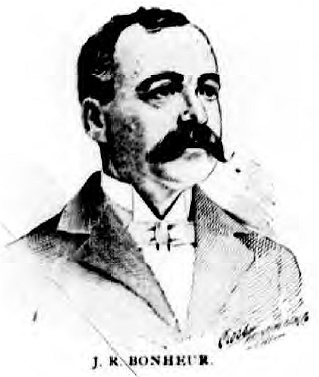
The Three Bonheurs. This famous trio have attracted the good public's attention by their originality and unique standing in the profession. Dresden, O., not 100 miles from Cincinnati, is the scene of their boyhood. Their remarkable success as showmen has been almost continuous and unvarying from the time of their first exhibition, which was given at Riley Center, Kan., in ___, unknown to their most intimate friends in Morris country, where they lived at the time. Their show consisted of a magic lantern outfit and a camera, to secure their own pictures in case they were successful.
Amos G. Bonheur, then a mere lad, purchased a white mustang from Miss Lida Gillett, sister of the notorious cattle plunger, Grant Gillett, now an exile in Mexico, to go in advance of the show, and carried his posting outfit with paper for each week's billing, in a pair of leather saddle-bags.
They were so successful with their views of Western life, with Howard A. Bonheur as operator and James R. Bonheur as lecturer, that they soon discarded the mules. A fine wagon was built to order, and four big dapple grays purchased to pull it over the country. The cast-off wagon was black, but the new one was white and gold, with a revel of color and art. This wagon, the birthplace of the marvelous living pictures, having in turn had its palmy days of trooping, now lied dismantled, in wretched destitude, at the Bonheur Bros. winter quarters. Jim Bonheur often reverts to those days as the happiest of their career. The charm of the life on the plains was its freedom, it soothing effects of sky and wind, the rolling, wide sweeping scene, and above all, the ever increasing patronage accorded them at the settlements where even a magic-lantern show was a new thing. Their routes extended into western Missouri, where they frequently met the James boys. They added to their show some photographic views of the noted bandits, which after the assassintaiton of Jesse James, proved so valuable an attraction that they went to southern Ohio and Indiana, where their exhibition netted over $10,000.
There are at least two men in Ohio living today who know how Jim Bonheur obtained his first lessons in magic-lantern delineation. At an early age he painted very creditable water color pictures. One of these water-colors, showing a group of bears at a gringo ___, was traded, "even up," to a lad of his own age for a pair of big, old-fashioned skates, intending, as he said, to make an ice sled of the runners, because they were so big. But Frank Hindle, coveting the skates because they fit his feet so well, induced young Bonheur to exchange them for ta tiny tin box, with a bill's eye lens and a sperm oil lamp, which was a magic-lantern. Bonheur had never seen one before, and was captivated with the strips of glass, on which were transparent daubs of gorgeous colored pictures. Both parties were satisfied with their bargain, and the incident of this boyish trade for the little tin lantern certainly had a direct bearing on the whole after lives of the three brothers.
In ___, through experiment with a series of glass slides of a bucking broncho, taken at at round-up, Jim Bonheur hit on the solution of the animated picture problem. He took much pride in showing a simple illustration of the ides, produced by only two views of the bucking broncho. By jerking the mechanical dissolver quickly back and forth across the optical centers of the stereopticon, the moving objects were connected in the pictures without any apparent eclipse between the change of postures, and no change whatever apparent in the surrounding landscape. The broncho bucked into the air or struck the earth in rapid succession, according as the jerking back and forth of the disolver shutter closed and opened the right or left lens.
In January 1886, while the three brothers were snowbound at Nelson's ranch, in McPherson county, Kansas, Mr. Bonheur submitted his idea in writing, accompanied with diagrams, explaining (to Edison) how unlimited continuous action could be produced on the same general optiacal principle with a single magic-lantern by passing through its optical system an endless belt of such pictures, each having a slightly advanced movement of the living objects, and referred to Muybridge's method of taking motion pictures, that he suggested might be thus utilized. In this document he credited the invention of the "Dancing Skeleton," which he had studied, to Prof. Pepper, and subsequently learned that Mr. Beale, of Greenwich, Eng., was its inventor. Mr. Bonheur's mistake unchanged remains, however, in the history of the modern animated picture, as published in The Century in 1894, by the Dicksons.
Milton Starr, a literary friend of James R. Bonheur, says, in his writings: "James Watt discovered the expansive power of steam, but other men applied the discovery and perfected the steam engine. The making of the engine was mere carpentry, but the eye that penetrated the secret of nature was the eve of genius. The kinetoscope is one of the most wonderful of Edison's inventions. The man who gave Mr. Edison the idea which that invention embodies is James R. Bonheur, the credit of which is his due in this connection."
Howard Bonheur, who was always the inseparable companion of his elder brother, has a penchant for training animals, and his control over goats, ponies and dogs, of which he has a large collection at the quarters, is remarkable, many of his pets being endowed with very human-like functions, as a result of thought and patient training. B. B.
Stewart's Family Shows. My little show opened its season April 30 and closed Oct. 20, and is all put away in sheds and barns of my own on Purman street here in Ft. Wayne, Ind. Since I got home I have built a new shop, and have arranged a neat little office in one corner. I heat and light both shop and office with natural gas. My show will be about the same as last season. We will use a 60x90 foot show top, 20x30 dining tent, 30x60 horse tent and 12x20 office tent, five baggage wagons, one bill wagon, ticket wagon, one carry-all and two seated canopy-top carriages. Our feature drawing card will be a free balloon ascension and parachute jump daily at 4 p.m., and Dewey, the high-diving dog, will dive from the top of a 50-foot pole into a barrel of water, at 1 o'clock sharp daily (the barrel is made of canvas). I will carry from twenty to twenty-five people and sixteen head of horses, two trained ponies and one clown mule. I shall open here in Ft. Wayne the last Saturday in April. My prices will remain the same as last year, 10 and 20 cents. Yours respectfully, Cap Stewart, Ft. Wayne, Ind.
The Whitneys. Our headquarters are well known to many of the profession. We are here in Imlay City, Mich., where we have been for more than twenty years. We are wintering thirty head of horses, and have one of the finest wagon shows on the road. We have a fine dining car thirty-six feet long, drawn by four coal black horses. We have six sleeping cars, which enable our people to have all the comforts of home every day, rain or shine. Everything at headquarters at present is going through the hands of the painters and repairers. Yours truly, The Whitneys.
A. H. Reed, of the Reed Shows

The winter quarters of A. H. Reed's Show are nicely situated at Vernon, Ind., on the banks of the Muscatatuck River. The main building is 40 x 60 feet. Then there is a commodious stock barn, sheds for wagons, canvas and the general outfit. John Kirkham has charge of the stock with William Perry, Dad Newton and Sim. Henry as his assistants. Everything is being overhauled and nicely painted. The show will have several new cages, which are being made under my supervision. Our agent, Bart Rowen, is busy studying maps of southern Indiana, Kentucky and West Virginia, as that is the route we expect to take next season. Mrs. Reed is hard at work training dogs to add to her present troupe. Next season will make the twenty-first under the present management of this show.
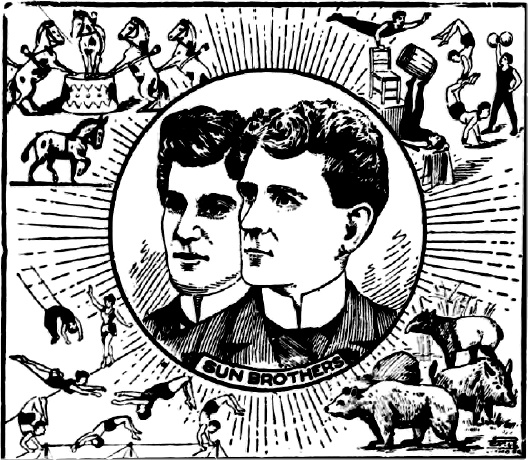
Sun Bros.' winter quarters are at Norfolk, Va. Season of 1900 was one that will be long remembered. We opened the season at Raleigh, N. C., April 5, and closed Nov. 24 at Lawrenceville, Va. The show uses sixty-five head of horses, and carries nearly 100 people. George and Pete Sun are the proprietors. Pete Sun handles the advance and George Sun manages the show. O. K. Steuer, treasurer, Otto Gleiser, superintendent; John Reynolds, veterinary surgeon; Joseph Malone, blacksmith; Harry McBride, animals; Otto Muller, night watch; Sam Morris, steward; Prof. Chas. Coons, bandmaster. During the winter Sun Bros. run a sixty-horse transfer company in Norfolk, Va., besides having two companies on the road - No. 1 under the management of Peter Sun; Company No. 2, O. R. Steuer, manager. Respectfully, Sun Bros.
Campbell Bros. Shows. We have for the season of 1901 fourteen 60 foot cars. Will use in big show two rings and an elevated stage. Fred Costel, our agent, is now in the East buying property. Our latest purchase is as fine a callipe as money can buy. Last season the show traveled 11,000 miles, and covered fifteen States. Campbell Bros.' Shows, Fairbury, Neb.
E. G. Smith's Shows. E. G. Smith's Monster Ten-cent Show and Combined Dog, Mule and Donkey Circus is most comfortable housed at the "Cable Farm," at Fyan, Pa. We are wintering four head of horses, trick donkey "Jenny Lond" and our "mule clown," Dan. Our trained stock and dogs are under the personal care of E. G. Smith, and horses and stables are under the watchful eye of George Shaffer, who has sole charge of stock and entire outfit. E. G. Smith has in training six snow white poodle dogs, which, when broke, will swell our troupe of dogs to twelve in number. We will open with all new tents, and add a new four-horse truck. Wagons will carry the colors of yellow and vermilion with gold lettering.It will take eight head of horses to transport the show. People at winter quarters are Geo. Shaffer, our kind hosts, Mr. and Mrs. Geo. Egolf, and Mr. and Mrs. E. G. Smith.
Pawnee Bill's Wild West Show is wintering at Litchfield, Ill. They went into the town Oct. 30. They are comfortably situated, having engaged the entire plant of the Litchfield Car Works, where they have stored all their paraphernalia. Four new cars will be added to the outfit. About thirty men are in charge of the show property. Many of the employes of the car works are building the new cars and repairing and repainting the old ones. The stock is mostly on pasture. W. E. Fergusen will be the general agent again this year. Pawnee Bill has just returned from a trip to Old Mexico, where he went ot find new attractions for the coming season. He is at his great ranch at Pawnee, Okla. Terr.
Lee Bros.' Shows. We have fine winter quarters with a large ice house and spring water pond located on the premises. We have sold this ice privilege to the Maine Creamery, of Providence, R. I. Last winter 400 tons were harvested from this ice field. Mr. H. Carter is in charge of the barn. Mr. Patnede and assistant are busy on the new wagons. Chas. Pratt, late of the Buffalo Bill Show will be general agent. William H. Glidden, in charge of stock, eighteen head. M. Casselli, leader of band, ten pieces. Our horses are all Canadian or St. Lawrence River horses, and noted for their great beauty, rare intelligence and haughty mane. The size of our big top is eighty feet, with forty-foot middle piece, and will be brand new. We expect its arrival Dec. 5. Yours sincerely, Lee Bros., Pawtucket, R. I.
Reno's Allied Show. The winter quarters of Reno's Allied Shows and Trained Animal Exhibition are in Kandakee, Ill. The show travels with fifty-eight horses and twenty wagons. The roster of the shows includes forty-six people.
B. E. Wallace is not only completely remodeling his city residence, but is making substantial improvements at the winter quarters and on the old Whittenberger farm, which he purchased several months ago. At the latter place he has erected new corn cribs and fences, with a beautiful arch over the gateway to the barnyard, surmounted by an engraved lion's head, and bearing the inscription "Springdale Farm." In front of the residence is being built a substantial but neat stone wall. The residence has been improved by broad porches and verandas and a fresh coat of paint. At winter quarters Mr. Wallace has built a new pony barn, and expects soon to build another like it; also to build a power house, to furnish water for the horses and animals and for fire protection. One of the leading features of the menagerie next year will be the six young lions, one litter of which are now about two months old and the other about a month old.
Allen E. Sells, son of Eph. Sells, the Famous Showman.
Billboard, December 22, 1900, pp. 10, 11. Note: Billboard has typographical errors, and the transcription will have additional typos. Information should be checked with additional sources. Underlined word, transcription may not be correct. Unreadable word indicated by ___.
The season of the John Robinson's Show, which closes in Georgia, December 28, is one of the longest on record, being excelled only so far as can be ascertained by the Wallace Show, which once stayed out until the 7th of January, 1897. As usual, the winter quarters will be at Terrace Park, a few miles from Cincinnati. The advance car No. 1 is already in, and the other advance people are expected in a few days.
B. E. Wallace bought horses in Chicago, Dec. 18. W. W. Scott, boss hostler of the Wallace Shows, is wintering in Cincinnati.
The Buckskin Bill Wild West Company is getting estimates on next season's printing.
Frank Melrose has accepted a position for the winter with Orrin Bros., City of Mexico.
Jack Pfeiffenberge, the boss canvasman, can be addressed at 915 Main street, Cincinnati.
Larry Moore, the veteran boss hostler, is working for the Pearl Laundry, Wheeling, W. Va.
W. E. Franklin is visiting at the home of his brother, Edward, in Chicago.
Warren A. Patrick, treasurer of the Sells-Gray Shows, is compiling the route book of the show.
It is reported that M. Coyle, of the Buffalo Bill Show, invested in some valuable real estate at Weedsport, N. Y.
Ed Kennedy, the boss canvasman, can be addressed at Portage City, Wis. He will entertain offers for next season.
J. J. Holland, of minstrel and circus fame, is now in advance of their big minstrel company, Ed. Giroux having resigned.
A half interest in The Great Syndicate Show, a ten-car outfit, is for sale. Address J. F. Smith, ___ Main street, Kansas City, Mo.
Billy Wilson arrived in Cincinnati. He has been with the M. L. Clark Show for some time, and reports the show is doing a big business.
Joseph Solly, who is with the Wallace Circus in the summer, is engaged this winter as one of the representatives of "The Female Drummer Company."
W. H. Gardner, general agent of the Forepaugh-Sells Show, will visit Columbus shortly to consult with Sells Brothers as to their plans for the coming season.
It is [said] that part of the Rhoda Royal Shows has been shipped to Geneva, O. The show itself, so it is said, has been re-organized on a four car basis, and will stay out all winter.
Allen McPhail, who was last season a prominent attache of the Wallace Shows, gave "The Billboard" a call last week. He is now in advance of the farce comedy, "A Female Drummer."
Mollie Bailey has five boys, Eugene, Allie, William, Brad and Bird. Her show is in winte quarters at Grand Lake, Montgomery County, but Mrs. Bailey herself occupies her residence at 1215 Oak street, Houston, Tex.
George Schmidt is probably one of the most widely known manufacturers of show wagons in this country. He made seven dens for the Robinson people, which have attracted a great deal of attention, and are proving a big advertisement for him.
Charles Sivalls, who is one of the oldest and best known railroad contracting agents in the country, is spending a few days in Cincinnati. He has not yet made his plans for next season, but will be with either the Buffalo Bill or Sells-Forepaugh's Show.
James A. Bailey arrived in New York Friday, December 14. He will finish up business appertaining to the Buffalo Bills Shows and the Forepaugh-Sells Shows, and hurry back to Vienna as soon as possible.
Engagements for 1901
Hugh F. Hoffman, press agent, with Gentry's No. 2 Show.
J. F. Fagan, railroad contractor, with the Great Wallace Shows.
H. H. Whittier, bandmaster, with Welsh Bros. Newest Great R. R. Shows.
W. E. Ferguson, general agent with Pawnee Bill's Wild West.
W. E. Franklin, general agent, with the Great Wallace Shows.
Clarence L. Dean, general agent, Barnum and Bailey Shows.
W. H. Gardner, general agent, Forepaugh-Sells Shows.
Louis E. Cooke, general agent, Buffalo Bill's Wild West.
Walter S. McDonald's Shows. This show will open at Abilene, Kan., about May 1. The spread will consist of a big top 120 feet, with one 50 feet middle menagerie. The side show will be 50x80. The company will carry sixty-five heads of horses, twelve Shetland ponies, twelve cross cages, two band wagons, three dens, two tableaux, seven baggage wagons and ticket wagons. It will be transported with five flats, two stock, two sleepers and one advance car.
Dave W. Perrine's old-time one-ring show closed a very successful season, after stumping over the corduroy roads of northern Michigan for four months, closing Oct. __. Everything is stored away at winter quarters at Eaton Rapids, Mich. This is a wagon show, consisting of twelve wagons, thirty head of horses and twenty-five people. Prof. Wm. McConkey, master of the ring stock, is training some milk-white ponies for the drill. He is also adding more dogs and goats to the line. Dave W. Perrine is proprietor and manager; Mrs. Grace Perrine, treasurer; Prof. Wm. McConkey, equestrian director and trainer.
At Bonheur Bros.' Show Quarters. The people retained at the winter quarters are Jerry and Earle West, Charles ___, Jack Lackere and two grooms. The stock, consisting of thirty head of horses and mules, has been put out on wheat land. Enough horses and mules are kept at the quarters to do the work in which teams are required for handling lumber, etc., for the buildings now being erected. All the lumber has to be brought from Alva, the county seat of Woods County, the nearest railroad point. A new wagon and repair shop has been built. More and better buildings would have been erected here, if it were not for the fact that the town site is to be moved two miles east of the quarters. Mr. Howard Bonheur is training a new troupe of dogs, raised at the quarters. He employs some of his spare hours of evenings in formulating instructions on the care and tuition of dogs and ponies. It will give his own and other trainers' methods, and embrace considerable entertaining knowledge on various subjects, both strange and curious, about fakes, illusions, etc., acquired through twenty years' intimate association and management among veteran showmen in the vaudeville branch of the profession. J. R. Bonheur has made illustrations in India ink for it and a number of half-tones. Much of the surplus property of the show will be sold, and has been catalogued by the Woods Storage Company. On account of an attack of la grippe, these two members of the firm had to remain at the quarters here longer than intended, but the contemplated trip to the Southwest their winter show has not yet been abandoned.
Mrs. Bailey's Show. Mollie A. Bailey, runs a little show of her own in Texas, and never leaves that State. She writes to "The Billboard," under date of December 11, that she is on her way to winter quarters at 1215 Oak street, Houston, Tex. The show this year traveled many miles, and she cleared $5,000 this season. Mrs. Bailey says she is glad to get back home, as he is pretty well worn out with her long siege on the road.
Circus Winter Quarters
[Note: some may not be circuses.]
Frank Adams, en route.
Adell's Dog & Pony Show, Ft. Recovery, O.
Ament's Big City Show, Muscatine, Ia.
American Circus & Ex. Co., Kansas City, Mo.
Tony Ashton's Show, London, Ind.
B. & B. Shows, Antigo, Wis.
Backman's Shows, Baltimore, Md.
Bailey & Sons, Houston, Tex.
Barber Bros., Portsmouth, O.
Barlow's Show, Syracuse, Ind.
Barnum & Bailey, Munich, Germany
Bonheur Bros., Augusta, O. T.
Buchanan Bros., Des Moines, Ia.
Buckskin Bill's Wild West, Paducah, Ky.
Buffalo Bill's Wild West, Bridgeport, Ct.
Campbell Bros., Fairbury, Neb.
Kemp Sisters' Wild West, El Paso, Ill.
King & Ziemer, 8025 Van Buren st., St. Louis
Kennedy Bros., Bloomington, Ill.
Lambrigger's, Gus, Orville, O.
La Place, Mons., Byesville, O.
Lemen Bros., Argentine, Kan.
Lee, Frank H., Pawtucket, R. I.
Lorretta, Corry, Pa.
Louis' Crescent Shows, Geneva, O.
Lowande's, Tony, Havana, Cuba
Lowande's, Marthino, Havana, Cuba
Lowery Bros.' Shows, Shenandoah, Pa.
Marietta Shows, Taylor, Tex.
McCormick Bros, Gallipolis, O.
McDonald's, Andy, 1175 W. Madison, Chicago
McDonald & Bryan, Charlotte, Mich.
McDonald & Walter, Abilene, Kan.
McGregor & Co., Detroit, Mich.
Miles Orton, Centropolis, Mo.
M. B. Mondy, Liberal, Mo.
J. C. Murray, 414 S. 5th st., Atchison, Kan.
Norris & Rowe, Oakland, Cal.
Norris Bros., Oakland, Cal.
Pan-Continental, Olean, N. Y.
Pawnee Bill's Wild West, Litchfield, Ill.
Perrin's, Dave W., Eaton Rapids, Mich.
Perry & Pressly, Webster City, Ia.
Prescott & Co.'s, Rockland, Me.
Price & Honeywell, Wilkesbarre, Pa.
Raymond's Shows (Nat), South Bend, Ind.
Reed's, A. H., Vernon, Ind.
G. W. Rehn, Danville, Harper Co., Kan.
Reno's Oriental Shows, Kankakee, Ill.
Rhoda Royal Shows, Geneva, O.
Rice & Davis, Chandler's Valley, Pa.
Rice's Dog and Pony Show, New Albany, Ind.
Ringling Bros., Baraboo, Wis.
Robinson's, John, Terrace Park, O.
Wintermute Bros., Hebron, Wis.
W. E. Winston, Pacific Grove, Cal.
Wixom Bros., Bancroft, Mich.
James Zanone, Nashville, Tenn.
Ziemer Shows, 8025 Van Buren st., St. Louis, Mo.
Billboard, December 29, 1900, pp. 5, 6 7. Note: Billboard has typographical errors, and the transcription will have additional typos. Information should be checked with additional sources. Underlined word, transcription may not be correct. Unreadable word indicated by ___.
There has been considerable interest in circus circles over the semi-official announcement that James A. Bailey would organize a new American circus for the season of 1902.
Peter Sells will be in the circus business again next year. He will be identified with the Forepaugh-Sells Bros.' Circus, in whihc show he held a one-fourth interest up until the close of the season of 1899. About one year ago Mr. Sells sold his interest in the circus to his brother, Lewis Sells, and since that time he has been devoting all his time and attention to the litigation in which he was interested in the Franklin county courts. Since the settlement of the litigation Mr. Sells has been induced to purchase back the interest in the show that he disposed of. It is understood that this deal has practically been consumated and when the circus starts out in April, 1901, Peter Sells will again be in advance of it. From Mr. Lewis Sells the information has been received that he is perfectly willing to sell back to his brother, Peter, the interest purchased from him early this year. He insisted that Peter take back this interest, and the transfer will shortly be made. The Forepaugh-Sells Bros. Circus next year will be owned by James A. Bailey, W. W. Cole, Lewis and Peter Sells.
The season of 1901 will be the last season of the Forepaugh-Sells Bros. Shows, as at present constituted. While the contract now existing between the partners does not expire until the close of the season of 1903, and Madison Square Garden in New York has been rented until that season, still a deal is now on which may revolutionize the circus business in America.
James A. Bailey holds large interests in the Barnum & Bailey Shows, now touring Europe, and the Forepaugh-Sells Bros. Show in this country. When the Barnum & Bailey Show went to Europe, no definite time was specified for the tour, but business has been of such an encouraging nature that Mr. Bailey has decided to continue the show in the old country for an indefinite period. This being the case, Mr. Bailey did not propose to let the American territory lie idle, and about a week ago he came to America for the purpose of closing a deal for a new circus. On his arrival in New York City he was met by Lewis Sells and the situation was carefully canvassed. Mr. Bailey was perfectly satisfied with the outlook, and stated that he would have a new circus on the road in 1902. Mr. Lewis Sells was importuned to join with him in the enterprise, and while no definite contract was entered into, there is but little doubt that the deal will go through, and that in 1902 there will be the Barnum, Bailey, Sells Brothers' Circus, and the Barnum-Bailey-Sells Circus both touring the United States. Mr. W. W. Cole and Mr. Peter Sells will have interests in both shows if a contract is enter into. Mr. Lewis Sells states that there will be only one show on the road in the United States next season.
Sobriquets of Showmen
Col. W. F. Cody - "Buffalo Bill"
B. E. Wallace - "Uncle Ben"
John F. Robinson - "The Governor"
W. E. Franklin - "Watseka Bill"
W. E. Ferguson - "Bob"
E. M. Burk - "The Big Fellow"
J. P. Fagan - "The Irish Prince"
Dan R. Robinson - "Col. Sellers"
G. H. Robinson - "Gil"
J. R. W. Hennessey - "Pop"
W. H. Harris - "Nickel Plate Harris"
Ringling Brothers - "The Ding-dongs"
Major G. W. Lillie - "Pawnee Bill"
Louis E. Cooke - "Boniface"
Jas. A. Bailey - "The Little Man"
Lewis Sells - "Uncle Lew"
Peter Sells - "Pete"
W. W. Cole - "Chilly Billy"
E. D. Colvin - "The Doctor"
Ralph W. Peckham - "The Cynic"
S. H. Seamon - "Si"
John G. Robinson - "Young John"
R. G. Ball - "Dick"
C. Sivalls - "Charlie"
Wm. Powley - "Canada Bill"
Engagements for 1901. Lew Graham, as side show manager with Ringling Bros. Ben Bowman, as side show manager with Wallace Shows.
The Robinson Show closed Dec. 25.
Dick Jefferys is home in Columbus, O. He says the Sells-Gray Shows have had a tremendous season.
John and Otto Ringling returned from the East, Dec. 22. They are negotiating for the purchase of six new sleepers.
Geo. Clark, late of the opposition brigade of the Great Wallace Show, is now on the door at the Walnut Street Theater.
It is rumored that Robt. Stickney, Jr., now with the Robinson Show, is to take a small show South for the winter.
Henry Richards, "chef de cuisine" of the Wallace Show, is spending the winter as clerk of Iuen's Hotel at Terrace Park, O.
Dick Jefferys and Geo. Tyler, both of circus fame, have opened a saloon at 100 and 102 West Spring street, Columbus, O.
F. M. Myers, proprietor of the Little Giant Shows, will open his next season May 4. It will be the tenth season. He is wintering at Tipton, Ind.
W. H. Horton, agent for Ringling Bros. Show, now known as the "Witch," will be a professor now, as a hypnotist. The company will tour Indiana.
Wm. Juencks, better known as Bill Jinks, the boss animal man, is wintering in Columbus, O., having resigned his position with the Robinson Show.
Ike Shipley, privilege man of the Forepaugh-Sells Shows, is conducting a news stand and cigar store in Chicago on Wabash avenue, near Twelfth street.
George Fisher, an old-time showman, who was with Robinson for many years and last season with Buckskin Bill, is open for an engagement as manager or agent.
Ben Cullen, who recently closed with the Robinson Show, left for Indianapolis to assume a position in the advertising department of the Grand Opera House in Indianapolis.
It is said that the Barnum & Bailey Shows paid no dividends last year, but instead carried over a surplus of 135,000 pounds. Part of this will be expended in refitting and wintering in Vienna.
Lewis S. Barrett has been re-engaged as the excursion agent for Buffalo Bill's Wild West, and he will soon leave Columbus, O., for New York to take up his line of work under direction of Mr. Cooke.
The famous (Aurora, Ill.) Zouaves are to sail from New York, Jan. 5, 1901, to fill a long engagement with the Barnum & Bailey Shows and afterwards to tour the Continent under the same management.
The No. 2 advertising car of the Robinson Show, in charge of Wm. Dale, arrived at the winter quarters at Terrace Park. Mr. Dale left for his home, Washington, Ind., where he will spend the winter.
B. E. Wallace, accompanied by his wife and sister-in-law, spent the week before Christmas in Chicago. Mr. Wallace spent his time at the stock yards buying horses.
B. L. Bowman, the side-show manager of the Great Wallace Shows, presented his wife with a magnificent Christmas present in the shape of a handsome home on Pulte avenue, Cincinnati.
Indian Bill's Wild West will open their season near Philadelphia about May 1. The show will be enlarged six cars. It will have fifty head of stock, two buffalos an five Texas steers.
James F. Smith, the well-known showman, whose address is 1309 Main street, Kansas City, advertises that he will entertain a proposition to sell a half interest in the great Syndicate Show, now wintering at Kansas City. It is a ten-car show, with everything complete.
Julian's Amphitheater, a winter circus, Mrs. Linda Jeal Julian, proprietor and manager, opened their third regular season, Dec. 22, at Havana, Ill., to a packed house. The members of the company are Professor Trumpy's Band, the Carrolls in a comedy musical act; Bernard Orton, dancing tight rope; Sam Bennett and Miss Dollie Julian, in double carrying act; William Siegrest, clown; Miss Nettie Carroll, high-wire bicyclist, and others.
C. C. Wilson, of Harris' Nickel Plate Show, was associated with the management of the Chicago Athletic Club circus, Dec. 19. People participating were Blanche Sloan, Dollie Julian, LaBelle Carmen, the St. Leons, Dan Castello, Gus Lee and Barney, a small elephant, and four lions belonging to W. H. Harris
Sells-Gray Shows. Billy Sells, of the Sells-Gray Show, and several members of the business staff spent a portion of the week here arranging for wintering the show at Thunderboldt, a suburban resort. Latest reports are that arrangements have been made for winter quarters at Doyle's Race Track. The Rhoda Royal Show exhibited here two days, Dec. 17 and 18. Messrs. Royal and Berris seem to have enjoyed a very good season. They have returned to Geneva, O., all property leased from Walter L. Main, and went here into Florida for the month of January. There is a possibility of them selecting Savannah as a winter quarters also. - Chas. Bernard, Savannah, Ga.
The George W. Hall's Circus and Menagerie is wintering as usual at Evansville, Wis. The animals and paraphernalia they winter at their small quarters in town, and the stock is wintered on their farm, a mile and a half from town. They closed the most successful season at Gaysmills, Wis., Oct. 18. They intend to englarge the show, and will add several cages of animals and an elephant. The show will travel by wagon, and will open about the first of May. E. O. Ferguson will have charge of the advance, making his second season. - Geo. W. Hall, Sr., Evansville, Wis.
Last modified October 2012