


Circus Historical Society
Bandwagon, January - February 1979
Back to Bandwagon Index
Bandwagon, Vol. 23, No. 1 (Jan-Feb), 1979. Note: Only some articles are included in this online edition. Many illustrations are not included. The Circus Historical Society does not guarantee the accuracy of information contained in the information in these online articles. Information should always be checked with additional sources.
By mid-December of 1926 Charles Sparks was already thinking ahead to the next season. He had an ad in the Billboard asking for performers of all kinds - side show people, wild west people, clowns (he was to enlarge this department for 1927), menage riders who would also do swinging ladders and a Boss Property Man. He also offered for sale two male lions and three baby tigers. His menagerie animals continued to be prolific.
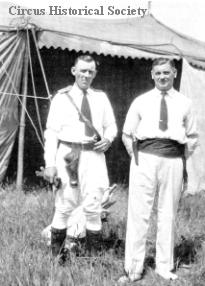 John "Chubby" Guilfoyle and Franz Woska, principal wild animal trainers on the Sparks show are shown in 1927. Eddie Jackson Photo.
Not long after this, James Randolph, who was again to be the advance car manager, was asking for experienced advance car men to get in touch with him at his home in Elk City, Oklahoma. And shortly news came from winterquarters in Macon. There were said to be 75 men at work there getting the show ready for the 1927 season. Walter McClain was breaking the large elephants into new routines for two rings and also doing the same with the young elephants for a center ring act. Both Chubby and Harriett Guilfoyle were working with the lions with four new animals having been added. Franz Woska, working with his largest group yet, had eleven tigers in training as well as his polar bear and great dane act. And two new liberty horse acts of six horses each were being broken by John and Laverne Smith.
On March 23, the advance car left after billing Macon and the surrounding countryside for the opening of the show there on Thursday, April 7. Randolph had with him on the car three press agents, Roland Butler, Bruce Chesterman and Harry Mack. In the billing crew there was a boss billposter with nine men on excursion routes (these were the men that covered the outlying towns traveling with their hod of paper, a can of paste and a paste brush on the local trains, sometimes picking up the advance car as it passed through one of the towns on their route at the end of the day or sometimes having to hurry back on a return local to catch the advance car before it left for the next stand), a Boss Bannerman with three men and a truck driver who covered the big walls in or near the town, a Boss Lithographer and three men who were responsible for filling the local store windows with those examples circus art that collectors of today are so anxious to obtain, a paste maker, programmer and special agent for a total of 27 men, a large crew for a show of this size.
The last "Want Ad" before the season started appeared in the April 2 Billboard. This was all for the side show. They wanted a three people Hawaiian act - dancers, singers and musician - a few more "lady" acts and a first class ticket seller.
Finally with the preparatory work all done the show opened on Thursday, April 7, in Macon under the sponsorship of the Junior Chamber of Commerce. As in the past years it was a gala event. As usual the business district assumed a holiday attire and many civic organizations were represented in the parade. It was said that it was "by far the most elaborate in the history of Dixies' own circus". The event was heavily covered by the local papers. The News issued an eight page circus section on Sunday April 3 and The Telegraph had a circus section on opening day. Two nights before the Elks had a dinner dance for the show folks.
The first performance went off without a hitch. Jack Phillips, who was starting his fifteenth consecutive year as bandmaster of the show, and his eighteen musicians gave their usual excellent support to the splendid performance. In the band there were four men on cornets (including Phillips), two on clarinets, one on piccolo and flute, two on french horns, two on trombones, two on baritones, two on Sousaphones, a snare drum, a bass drum and the air calliope played by Del Veccho. The steam calliope in the parade was played by Harry Wills. There were 74 musical cues for the band during the performance. Both afternoon and evening shows were given to full houses.
From Macon the show moved in long jumps to Augusta and Charleston, South Carolina, and then into North Carolina at Wilmington and New Bern, followed by four stops in Virginia at Suffolk, Norfolk, Newport News and Richmond. The week of April 18 had them in West Virginia at Beckley, Charleston, Huntington, and Logan followed by Ashland, Kentucky and Portland, Ohio.
A long 250 mile Sunday run then took them back into West Virginia at Clarksburg followed by Fairmount. Then they moved into Pennsylvania at Connellsville, Uniontown, Greensburg and Charleroi. The week of May 2 opened in Ohio at Canton where the Sells-Floto Circus was to follow them on Friday. The lot was at a new location on North Market Street. Although Sparks had not played in Canton in years and with "Wait" paper for Sells-Floto up all over town they still had two capacity houses. Also, here Weaver Gray and his wife joined the wild west contingent. The rest of the week took them into Akron, Warren, Youngstown and then Pennsylvania again at McKeesport and Vandergrift.
Another long 222 mile Sunday run started the week of May 9 in Harrisburg. From there the show moved to Lebanon, Pottstown, Bethlehem, Westfield, New Jersey, and Stapleton, Staten Island. The parade which was bringing raves all along the route had 12 open cages, 4 bandwagons (the Dancing Girls, Clown Behind the Curtains or Hallowee, Girl and Horsehead and Dolphins tab wagons), air calliope and steam calliope, two mounted sections of ten riders each, a wild west section of riders - Indians, cowboys and cowgirls - three camels, two zebras and nine elephants, stretching out over a half mile of city streets and taking about ten minutes to pass. Researcher note: Sparks Circus had three zebras, not two, in 1927 (source: photo) - Ray Lord, April 01, 2010.
The week of May 16 was spent on Long Island with the shortest mileage of any week in the season, only 127 miles. The towns played were Jackson Heights, Bayside, Hollis, Richmond Hill, Huntington and Hempstead.
By now the performance had reached its peak. Ray Glaum, female impersonator clown, kept the audience in good spirits during the come-in before the show started. The performance was as follows:
1. The opening Spec produced by J. H. DelVeccho was entitled "L'Ora the Jungle Queen". Most of the performers and lead animals and horses participated. The music of the band was supplemented by Alice Sohn, prima donna, Hazel Lamb, mezzo soprano, and George Sohn, baritone.
2. In the two end rings there were dogs and monkeys on the backs of running ponies trained by Jack Casteel and John Smith. In the steel arena in the center ring LaVerne Houser presented trained leopards.
3. In the endrings John Smith and Bert Mayo presented football kicking horses. On the track Paul Wenzel had all of his clowns.
4. In rings 1 and 3 dogs and military ponies were worked by Lorraine and Jack Casteel. In the steel arena Franz Woska presented his trained polar bears and great dane dogs.
5. Ray Glaum and the Alexander Sisters were over rings 1 and 3 in iron jaw numbers while eight girls, Babe Pope, Grace McClain, Eva Hill, Beatrice Sells, Mary Lennett, Rae Crawford, Vivian Clarkson and Terris LaVerne, performed over the track on swinging ladders.
6. John Guilfoyle put his eight lions through their paces in a very thrilling act in the center ring arena.
7. Three large elephants in each end ring trained by Walter McClain were presented by Babe Pope and Vivian Clarkson. (The babies did not get into the big elephant act this year although Walter McClain had been working with them in winterquarters).
8. Franz Woska presented eleven tigers in one of the outstanding features in the show.
9. Two ponies and a baby elephant appeared in each end ring trained by Walter McClain and presented by Babe Pope and Grace McClain. On the track Paul Wenzel, producing clown, had fourteen (including himself) of his clowns, the largest number Sparks had yet had - Charlie Fortuna, pantomimist Roy Barrett, Red Sells, Ed Green, Lindsey Wilson, Eddie McManus, Ray Glaum, Lew Hershey, Jack Howe, Bill Lennett, Floyd Hill, Tommy Vanderpool and Herbert Schneider. Some of these went on to become well known on other shows.
10. Now came another feature of the show. The Bedini four people comedy bareback act appeared in the center ring featuring Walter Guice and his wife Flora Bedini.
11. Again the clowns were on the hippodrome track with their walkaround comedy.
12. In the end rings Sparks now presented the Alexander teeterboard troupe of four men and three girls which featured a triple somersault to a chair, and the Manchichi Jap risley troupe of six people. The latter group did not join the show until May 9 at Harrisburg.
13. On the hippodrome track Jack Casteel presented leaping greyhounds.
14. Tight wire dancing by Naida Miller was another center ring feature act.
15. In all three rings Sparks Circus presented its spectacular rotation liberty horse act under the direction of Bert Mayo, John Smith and La Verne Houser. There were six horses in each ring.
16. In ring one Captain Belovockey had his performing sea lions and in ring three Jack Casteel had his educated dogs.
17. The Four Walters Troupe, headed by Walter Guice, performed over the center ring on aerial horizontal bars.
18. Again Paul Wenzel had his funny men bringing laughs to the audience.
19. On the track Sparks Circus presented 15 high jumping and broad jumping horses ridden by Bert Mayo, Myrtle Mayo, John Smith, Lorraine Casteel, Mary Lennett, Polly Watkins, Grace McClain, Eva Hill, Mabel DeOrlo, LaVerne Hauser, Vivian Clarkson, Lottie Thompson, Marion Shepard, Rae Crawford and Jim Saunders.
20. The closing number was the Spec "The Flag of America" also composed and created by D. H. DelVeccho.
After Long Island on May 23 they played in Port Chester followed by one date in Connecticut at Stamford where it preceded the 101 Ranch Wild West Show by six days which was due in on June 30. During the rest of the week the show moved north through New York toward Canada playing in Poughkeepsie, Middletown, Kingston, and Oneonta. The following week found them in Ithaca, Cortland, Oswego, Gouverneur, Potsdam and Malone.
Over the next weekend they moved into Canada for the start of thirteen days there. Monday and Tuesday, June 6-7, was spent in Montreal for their first visit to that large Canadian city. On Monday the side show had the biggest day in its history. Of the four performances given there, one entire show was donated to the orphans of the city as a result of which the show received enormous publicity and goodwill. During their stay in Canada the closing Spec was changed to "Historical Canada" to an enthusiastic reception. Montreal was followed by Ottawa, Kingston, Belleville, Peterboro, Hamilton, Brantford, London, St. Thomas and Chatham.
The show returned to the States for two days in Detroit, Saturday and Sunday (one of the rare Sunday stands the show played in its history), June 18-19. Then after another two day stand in Toledo and singles at Coldwater, Michigan, Albion and Pontiac they returned to Detroit for a single day Saturday, June 25 at another location. Before returning to the States Naida Miller, center ring tight wire star, had left to join Gentry Bros. Circus.
 Two of the ladies of the side show, one holding a sword which she might swallow inside the tent, ballyhooing the crowd to come inside to see the wonders. Eddie Jackson Photo.
The side show now had fourteen banners on the front with ten acts inside. Early in July, a couple more were added. The line up had Anna Loving with snakes; Nelson, sword swallower; Maybelle, sword walker; John Johnson, bag punching; Jack Ballenger, comic bag punching; Radio Girl Illusion; Hilda DeBarrie with her trained cockatoos; and Arthur Wright with his Georgia Minstrels and Dixieland Band. William DeBarrie was the Assistant Manager, Inside Lecturer and did a magic act. George V. Connors was again managing the show. There were the usual two ticket boxes on the front.
After the circus had returned to the States the side show was enlarged by the addition of a Hawaiian troupe of singers and dancers headed by Katherine Childers. At the same time Billy Lee, a juggler, came on giving the show twelve acts for the quarter admission charge. Across the midway there was a pit show, a big one for Sparks. It was fronted by seven half banners and featured snakes, freak animals, a 22 foot python and a giant baboon. Captain George Scott was the Manager with one ticket box out front.
After the second Detroit date the show again moved into Canada, this time for a much longer stay - almost five weeks in length. This tour started at Windsor, Monday, June 27, and was followed by Woodstock, Guelph, Simcoe, and Willard, the week being completed with a Saturday in Toronto for very good business. From now on through the rest of the Canadian tour very long weekend runs were the rule. From Toronto they moved 203 miles to Smith Falls, followed by a long run of 212 miles Monday night into Cornwall. Then came 103 miles into St. Hyacinth, 158 miles into Three Rivers but only 22 into Shawinigan Falls and 90 from there to Quebec. The average nightly run for the week had been 133 miles. This was almost double the season average of 79 miles per night.
The next week with an average of 136 per night was the highest of the season with the second longest run of the season on Sunday, July 10, into Campbellton, N.B. This was followed by a brief return to the States into Maine at Caribou and Holton and then back into Canada at Fredreick and Newcastle. During this stretch in Canada the show was moved in three sections on a couple of occasions because of the weight of the cars and the condition of the track. The usual split was three flats and the five stocks, six flats and the five coaches. But there were no delays and the show was always on time. The last two weeks in Canada started July 18 at Halifax followed by Bridgewater, Yarmouth, Digby, Kentville and Truro. The last week took in Glasgow, Amherst, Moreton, St. Johns and St. Stephan before they returned to the United States on Saturday, July 30, at Eastport, Maine.
Through all of Canada the show consistently got a good press on its parade. While it advertised a mile long street parade, as we have already noted it was perhaps only a little over one half a mile in length, taking perhaps a little over ten minutes to pass. The feature that seemed to capture the most attention were the number of open dens. It was the practice of Sparks Circus to have the sides off all twelve of its cages, a rather unusual practice on circuses for most kept half or more of their dens closed as "teasers" for the Public.
Now, as the first of August arrived with a date in Bangor, Maine, the move southward started with stands in Dover-Foxcroft, Waterville, Augusta, Lewiston and Rumford. The next week took the show into Portland on August 8 where it received good notices and good business. Then came two dates in New Hampshire at Berlin and Woodsville. The week ended in Vermont at St. Johnsbury, Newport and St. Albans. Then, starting August 15, came Montpelier, Burlington, Rutland and Bennington before the show moved into New York at Saratoga Springs and Troy.
By now with only nine weeks left in the season, the staff would be subject to virtually no further changes. So an analysis of the personnel make-up of a show of this size might be of interest. Exclusive of the advance which had, as already enumerated, about 25 people, there were about 390 people back on the show. It is interesting to note the number of people directly involved in the performance. There were about 60 acrobats, animal trainers, clowns and other actual performers. But supporting them were a band of 18, about 21 property men and 15 ring stock grooms. Also there were four or five wild west people who participated in the wild west after show. Finally there were about 15 men in the menagerie crew who took care of the elephants, camels, zebras and caged animals as well as getting them from the menagerie top into the big top for their performances and back again. Thus there were about 130-135 people inside the big top during the show at one time or another actively engaged in the actual performance.
These figures did not include others who were important to the show such as those selling the various confections and souvenirs, the concession men. In this group there were about 25. Then there were about 20 persons handling the crowds - that is ticket sellers, ticket takers, and ushers, who also put up and took down the reserved seats. Thus the total number of people on the show who were involved with the audience in one way or another added up to about 225 people, or well over half of the people on the show. The others were those that were responsible for actually moving the show. Finally there were those who worked in the side show and pit show which, including the band of ten, minstrels of four and the various side show acts of twelve plus those on the front, totaled about 32.
In the group that were responsible for moving the show, the largest single crew was George Singleton's big top canvas crew who also were responsible for getting the menagerie and dressing tops up and down, and putting up the blue seats. This crew varied from week to week but averaged somewhere near 45. Next in size but probably the most important was the commissary under John Hogbin with about 40 waiters, cooks and others. The waiters besides waiting on table also put up and took down the dining top and tables and washed the dishes. The cooks and their helpers were, of course responsible for the cook top, stoves and all their other accoutrements as well as preparing the meals. Others that worked on the lot were the side show and pit show canvas crews of about 20 and the electricians under Java Koen (who had started with Sparks Circus in the gas light era) of about eight. Finally there were those who got the show to and from and on and off the lot every day come rain or come shine, Charles Coles' train crew of 15 and the draft stock gang under Jake Posey, including blacksmiths and miscellaneous mechanics in all numbering about 30. These working men including 6 car porters gave the show another 165 people for the grand total of 390, a quite sizable staff. And to this must be added the 25 or so on the advance staff.
When the show closed Saturday night in Troy, they started on the longest run of the season, 342 miles, to York, Pennsylvania. Here the southern tour started for following Hanover and Chambersburg the next two days they moved to Hagerstown, Maryland, and Westminster ending the week in Alexandria, Virginia. The next week starting August 29 found them still in Virginia at Danville but on Tuesday they had moved into North Carolina at Winston-Salem to be followed by Durham, Raleigh, Greensboro and High Point. Then continuing in North Carolina the first full week in September beginning on the 5th they were in Asheville, Hickory, Gastonia, Salisbury, their old winter-quarters town where they were welcomed by many old friends, Burlington and Goldsboro. They finished that state in Rocky Mount and Fayettesville after which they moved into South Carolina on Wednesday, September 14 at Florence succeeded by Sumter, Newbury and Easley.
Interestingly enough at this time with the season in its last five weeks we find the show advertising for an "experienced circus cornet" for the big show band. It is something of a puzzle as to why they would bother at that late date to fill one vacancy unless perhaps it was to build a reservoir of good musicians to call on for the following season.
September 19 was played in Rome after which the show moved to Alabama at Gadsen, Anniston and Tallegda followed by LaGrange and Newnan in Georgia. Many of these towns, while by todays standards hardly seemed large enough to support a show of this size, were giving the show good business. When a town of 5-6000 can twice fill a tent that seats about 3,000 or more we know the circus business had something going for it in that area and at that time. The last week in September starting the 26th began in Columbus after which came Albany, Thomasville, Moultrie and Fitzgerald with the Saturday date being in Douglas.
By now with the season almost over the canvas was beginning to show signs of the season's use. However, it had not been subjected to any damaging storms so it was still intact. The big top was not the largest the show would yet use in its lifetime for it was only a 130 foot round with three 50 foot middles. The menagerie was a 70 foot round with four 30 foot middles. The pit show was in a 30 foot by 70 foot hip roof push pole top. The side show was in a 50 foot round with three 30 foot middles. The dining top was a 40 foot round end with one 40 and two 30 foot middles push pole, while the kitchen was a 20 by 30 foot hip roof push pole. This year for the first time the ring stock top was given up and the ring stock housed in the center of the dressing top, a 55 foot round with two 30 foot middles. And finally there were three draft stock tops with gable ends each 30 by 90 feet, to accomodate the 90 head of draft stock the show carried.
The season now had only three weeks to go starting October 3 at Brunswick. This, the 27th week, continued in Waycross, Valdosta, Bainbridge and Cuthbert and ending in Griffin. The following week opened in Cedartown and finished the tour of Georgia of sixteen towns in Cartersville. They now moved north into Dalton, North Carolina, and then to Tullahoma, Tennessee, Fayetteville and Columbia. The final week starting October 17 was spent in Clarksville, Springfield and Pulaski after which they moved for the last three stands of the season into Alabama at Culman, Birmingham and Bessemer, a suburb of Birmingham.
From Bessemer the show moved back to winter quarters at Macon, a run of about 240 miles to complete the season during which it traveled 13,751 miles. As already mentioned the longest run, was from Troy, New York, to York, Pennsylvania, 342 miles, while the shortest was three miles from Detroit to Windsor, Ontario. While Sparks Circus had had both longer and shorter seasons, it was on the whole quite successful and a money maker.
The 1978 circus season was one that is difficult to fully assess in terms of financial success for the various shows which were on the road. There appeared to be an abnormally large number of early closings and some scribes compare the season to 1938, a year which spelled disaster for so many circuses. However, there was a difference in that season and the one just concluded. In 1978 there were individual circumstances which caused the downfall or early closing of several shows but by contrast other circuses had very fine seasons. In 1938 the severe economic recession did the damage and very few circuses were able to complete the season with a profit. This past year, although inflation cut heavily in everyone's pocket-book, the overall economic situation of the country was still healthy. The long coal strike in the spring destroyed planned itineraries of some shows and another winter and early spring of severe winter did its damage but generally neither business nor weather conditions played much of a part in the downfall of several shows. Actually, the season was more similar to 1956, a year which saw a number of circuses close early, each due to circumstances peculiar to the show in question, while other shows had an extremely fine year.
Don Marcks, editor of Circus Report, and who handled these reviews for several years, has again kindly furnished us with a list of circuses on tour in 1978. This review written by the Bandwagon staff is based on reports from many individuals, some of which are actively employed by circuses. An effort was made to secure as complete and accurate account of the circus situation in 1978 as possible, however information on a number of circuses was virtually impossible to obtain. In any event it is hoped that at least one centralized report of the overall circus season of 1978 such as this will serve as a source of research for the circus historians of the future.
Several circuses (as was true in 1977) claimed to be the largest under canvas, Clyde Beatty-Cole Bros., Circus Vargas, and Carson & Barnes No. 1. Each had their fans supporting their claim. These were at the top with Hoxie Bros, and Carson & Barnes No. 2 not far behind. Rest of the canvas outfits ranged from those travelling on a dozen vehicles down to three or four.
The troubles of Acme Circus Corporation units in which two of them, Sells & Gray and King Bros.-Cole closed much earlier than usual, was the primary reason many observers termed the 1978 season a bad one. How much of these difficulties can be attributed to the illness of Acme's president, Frank McCloskey, is not publically known. McCloskey, who with his partner, Jerry Collins, has been a guiding force in the circus world for so many seasons, was sick throughout the year and spent much of his time resting in the Bahamas.
All three of the Acme units, Clyde Beatty-Cole Bros., King Bros.-Cole, and Sells & Gray made their usual season debut in the spring moving out from their DeLand, Florida winter-quarters.
The smallest of the trio, Sells & Gray, dropped the Hagan-Wallace portion of its title which had been used in 1977, and opened its season April 11 at Live Oak, Fla. The rather worn square end big top which had seen considerable service in the past was used and the show as usual moved on about 10 trucks. Wilson Storey was manager, Phil Chandler, ringmaster, and Henry Thompson in charge of the sideshow. The route took the show rapidly out of Florida, across the southern part of Georgia and Alabama and into Mississippi and Louisiana. It later headed northward to Illinois and then over into Indiana. Although a solid string of early dates had been booked, by mid June the show ran out of promoted stands and was experiencing serious routing problems. The advance headed by Bill English had not been able to book enough dates for the show and it was forced into several layovers due to lack of route. In some stands such as Lowell, Ind., June 18, which produced half houses, there had been less than a week's advance promotion. Other dates with adequate advance such as Highland, Ind. with Chamber of Commerce sponsorship, saw the largest crowd of the season with full and straw houses. In late June the show moved into Michigan and picked up some former Beatty-Cole dates such as Ann Arbor, June 24. A visitor that day said the trucks were highly painted but the canvas was well worn. Another observer said the show had a very flashy front end and all reports pointed to a strong performance and well managed show.
The route situation by mid July had become intolerable so after the stand at Radcliff, Ky., June 24, the show closed for the season and the trucks were moved to Sarasota for storage. Bill English told the press that the lack of an adequate route had closed the show and that booking problems had been encountered during the season. English pointed out that at the dates that had been booked and well promoted the show had done well and referred to the record business produced at Highland, Ind. and Grandsville, Mich. With the exception of several acts most of the show's personnel were absorbed by either King Bros.-Cole or Beatty-Cole.
King Bros.-Cole using the same title as the year before opened its season April 14 at Brunswick, Ga. B. H. "Whitey" Black was manager and Mike Nauton had the sideshow. The 90 with three 40's big top, new in 1977, was still in excellent condition. At the third stand of the season, Tifton, Ga., April 16, the show played day and date with the Great American Circus, owned by Hoxie Tucker. Both circuses claimed good business.
A Bandwagon staff member caught the show on April 22 at Ft. Gordon, Ga. and noted it had an outstanding performance which included the Flying Padillas, top notch flying return act. A four piece band headed by Willard Manley played the performance. The show moved on 10 trucks, had 2 elephants, and a cage of wild animals. At the previous day's stand, Winder, Ga., the show had posted a moderate amount of billing paper using half sheet and panel pictorials, dates, and window cards.
After 9 dates in Georgia King-Cole went into the Carolinas and then northward into Virginia. In mid May route trouble developed. The show had planned to play through the West Virginia and eastern Ohio coal fields extensively but the long coal strike cancelled these plans causing a shortage of dates to develop. In late May the show was playing some stands two and three days when normal business would call for only one. The show picked up a few dates in West Virginia and Ohio in early June then moved eastward through Pennsylvania. Some stands saw the show coming in completely cold, others with only a minimum promotion, and on other days the show just sat idle. During this period a number of acts, including the Flying Padillas, were let go in an effort to lower the daily expense. The route next carried the show into New Jersey, then into New York, and finally New England. Routing problems continued and the show had a six day layover in Wildwood, N.J. in late August and early September. A long jump next took the show to Morehead City, N.C., Sept. 3. where the day's business was one of the largest of the season, however subsequent dates in the Carolinas were not up to par. The season came to a close at Athens, Ga., September 8, then the equipment was returned to its DeLand quarters. Manager Whitey Black told the press that business had been disappointing for several weeks in the east and the poor take of late had caused the show to close some ten weeks earlier than usual. At the end Henry Thompson was serving as sideshow manager coming over from Sells & Gray when that show shuttered.
In contrast to the below par seasons of the smaller shows, Clyde Beatty-Cole Bros, had an outstanding year. The show was now fully committed to playing shopping center dates of three to four days duration. Marketing directors Tim Stinson and Doug Lyon and a staff of promotional directors set up the successful tour which began March 27 at Ft. Walton, Florida. John Pugh continued as road manager with Count Nicholas, announcer, and Charles Bertini, bandleader. A new blue and white stripped big top, 150 with three 50's, was on hand to begin the season. Physically the show was the same size as in recent seasons. There were 9 elephants, 1 camel, 8 ponies, and several cages of wild animals in the sideshow-menagerie. This year the menagerie animals were in small individual cages and consisted of a young lion, tiger, cougar, and 2 baboons. Dave Hoover who presented the trained wild animal act in the steel arena worked 5 lions and 5 tigers. Improvements noted at the opening stand included new light towers for each of the 3 rings, illuminated ring curbs, and the installation of showers in the clown sleeper.
After two Florida dates the show played Columbus, Ga. then went on to Charleston, S.C. where there were seven packed houses. The route continued through North Carolina and by May the show had moved northward into Pennsylvania. It was in New York, New England, and from the middle of July was in Ohio for several weeks. The July 22, 1978 Amusement Business reported the first half of the Beatty-Cole season had seen a six percent increase in business with 90 percent of the stands on hard-top shopping center lots. The writer was impressed with the capable staff of young marketing promoters, mostly college graduates, both men and women.
During the season Stinson and Lyon were promoted to vice presidents and Irvin Kirby, formerly with Amusement Business, was hired as national press director.
The Southern Park Mall date in Youngstown, Ohio produced record gross during its four day run and it was reported that it was the best take in 20 years. Other August dates came in Indiana and Michigan.
In Crawfordsville, Ind. in early September tragedy struck the Beatty-Cole show when the arm of a four year old boy was bitten off by one of Dave Hoover's lions. The youngster had somehow gotten past the barricade and stuck his arm inside the lion's cage. Parents of the child filed suits of 1.5 million against the show.
Bad luck again hit at Owensboro, Ky. when the show's cookhouse truck exploded and burned. It was replaced by the Sells & Gray unit which was sent promptly from Sarasota. Beatty-Cole continued stands in Kentucky, Indiana, and Ohio through September then moved south for dates in Tennessee, the Carolinas, Georgia, and Florida.
A Bandwagon staffer caught the show at its October 26-29 stand at Northlake Shopping Center in Atlanta, Ga. and reported there was a heavy advance sale and big crowds at all performances. Since schools were in session the promotional director for the date called principals of all schools in a wide area and invited them to bring their pupils to see the big top go up. Our staffer said it was the biggest lot crowd for set-up he had seen in 25 years. Two television stations covered the lot activities. Perhaps the most pleasing change noted over last season was the rather extensive amount of billing paper that was posted. Half sheet and panel pictorials from Enquirer with fully a dozen designs were used, plus dates, window and tack cards. These were placed primarily in windows of service stations and other businesses throughout a radius of ten miles from the exhibition site. Veteran circus fans in Atlanta said it was the most paper they had seen posted in the city since Ringling-Barnum's under canvas days in the early 1950's. Many favorable comments on the large use of billing paper was heard from fans and non fans alike.
The 1978 edition of Beatty-Cole following its date in Vero Beach, Florida, Dec. 10, returned to DeLand quarters for 16 days then went on the road again to play three locations in the Miami area beginning December 27 and finishing on January 7, 1979. Then the show returned to quarters to frame its 1979 edition. The season was termed highly successful.
Naturally there was much speculation on the fate of King Bros.-Cole and Sells & Gray but no decision by Acme had been publically announced by the year's end.
Clifford E. Vargas' Circus Vargas which had been the talk of the tented field for the past few years opened its season after a very short layoff at Clearwater, Fla. on December 30, 1977. An unfortunate accident marred the inaugural when two poles supporting the props for a high wire act fell causing injuries to a spectator.
During the early part of the season Circus Vargas had a spectacular layout when set up on the lot. The blue colored big top, 150 with three 50's which was purchased the previous season, was used when the show was set up on hardtop while the older orange colored top was put up when on a dirt lot. The front end featured a large sideshow-menagerie using an 80 x 160 top plus a pony ride and bubble bounce. New equipment included a large restroom facility mounted on a semi. This unit eliminated the necessity of renting portable toilets. Vargas again had a strong performance and Jim Gibson's band which played traditional circus type music. At the beginning of the season there were 18 elephants which included 3 owned by trainer Rex Williams. The policy of playing shopping center dates which Vargas pioneered a few years ago continued with most stands being of 3-4 days duration. Most of the time during the season no days were lost in moving between stands as distance between them was considerably shorter than in the past.
For the second consecutive season Vargas ran into very inclement weather during the winter months as it moved out of Florida and west through southern Mississippi and Louisiana enroute to Texas where it remained five weeks. Freezing weather and sleet was encountered in some spots and at Donna, Texas it rained during the entire stand. Enroute to Harlingen, Texas the show's office semi caught fire and burned to the ground. A replacement came on later in the season.
After Texas the show played Tucson, Ariz, then moved into California at Corono in March and remained in the state until early July. At Riverside, March 31, a section of seats with more than 90 people on them collapsed but fortunately injuries were few and slight. The opening in San Diego was delayed when the city fire marshall refused to approve the seating making it necessary to have metal frame bleachers brought in from Los Angeles before performances could be given. A squabble over the number of lighted exits also developed. California, due to its stringent regulations, was becoming one of the most difficult states in the country to play.
In the meantime Clifford Vargas developed health problems and on April 3 underwent arterial heart bypass surgery and was away from the show for a number of weeks. During this time a severe slump in business developed. When Vargas returned he immediately made some major changes. While in Salinas in May he eliminated the large sideshow-menagerie citing publically that it was too heavy and took up too much space on the lot. Only a pony ride and bubble bounce remained on the front end. Near the conclusion of the long California tour Vargas in an interview said the show had its best business ever in the State despite a three week slump in the Bay area, the best business was in the southern regions of the state. Vargas also denied rumors that his show was for sale, also there would be no second unit, and no Canadian tour in 1978 because regulations and taxes were too severe. Earlier the show had sold three elephants, a camel, and truck to Mexico's Circo Union and had purchased a baby elephant.
Vargas next went into Oregon for several weeks, then on to Washington. In late August the show left the Pacific Northwest and played through Idaho, Utah, and Colorado.
CHS Mike Sporrer of Bellevue, Wash, saw Vargas in his area and termed the circus, despite the dropping of the sideshow-Menagerie, still a first class show with a very strong performance. The circus scored turnaways in Tacoma and Seattle and the entire Pacific Northwest tour produced excellent business. At the time Sporrer saw it there were 12 elephants, 2 camels, 1 zebra, a 6 pony sweep, and liberty horses.
In late September Vargas played Kansas, then toured Oklahoma which included a 11 day stand in Oklahoma City. Latter part of October saw the route take it into western Texas followed by a further westward move to New Mexico and Arizona. Final dates in the latter state were at Mesa, Phoenix, Casa Grande, Tucson with the season's closing coming at Yuma, November 21-23. The show planned to spend considerably more time in quarters than customary. A new big top was ordered for next season and many changes in personnel and acts were expected in 1979.
The winter of 1977-78 was a busy one for Dorey R. Miller. He purchased the equipment of both the George Matthews Great London Circus and Fisher Bros, and announced he would field two shows in 1979. He also bought a number of new animals, however due to the extremely cold winter he lost three hippos, a tiger and several other beasts who succumbed to the severe weather at the Hugo, Oklahoma winterquarters.
The equipment and animals were to be used in framing the new show. Both units were titled Carson & Barnes with the original show being known as No. 1, Eastern, or Red unit and the new show as No. 2, Western, or Blue unit. Both were on a five ring format and heavily endowed with animals in the Miller tradition. Both shows continued with the local sponsor format and ordinarily playing daily stands. These two shows along with Hoxie Bros, were the only really large circuses moving every day.
Carson & Barnes No. 1 with Ed Russell, performance director and Perry Johnson, bandleader, opened in Texas in March. A balanced performance featuring caged wild animal acts, riding numbers, flying acts, and a walkaround spec entitled "The Reign of Caesar" was presented. The big top had been used the previous season and was a 120 ft round with five 40's, push pole type. During the early part of the season visitors reported the show had a total of 29 semis, 9 straight bed trucks, 3 trailers, and 6 pickups. Animals included 25 elephants, 2 zebras, 3 camels, llamas, and caged animals which were displayed in an open air arrangement between the marquee and big top as per past years. A hippo pit show was on the midway. A truck walkthru marquee with ticket window on the side was used. The route took the show on a western swing through Texas and New Mexico and then eastward and north into Oklahoma, Kansas, Nebraska, and afterwards on further east through Iowa, Missouri, Illinois, Indiana, Ohio, West Virginia and into Pennsylvania. In late June the show turned around and backtracked through Ohio enroute to Michigan.
On May 26 at Meyersdale, Pa. the big top was blown down in a storm and destroyed. The show sidewalled a few days and in Dearborn, Mich, during the annual CFA convention raised a new big top manufactured by O'Henry. It was a 125 x 335, push pole type, made of blue and orange stripped canvas.
Rest of July was spent in Michigan, Wisconsin and Minnesota and in August the show played dates in Wisconsin, Illinois, and Iowa. It remained in the mid-west with dates in Michigan, Ohio, Indiana, and Illinois until early October then headed south through Missouri, Arkansas, and on to Texas where the final date came November 1 at Paris. The show then returned to its Hugo, Okla. quarters.
Carson & Barnes No. 2 had Johnny Frazier as road manager, Bobby Gibbs in charge of the elephant herd, and Charlie Stephenson, bandleader. The equipment came from several sources. At the start of the season the former George Matthews big top was used, a 140 ft. round with three 40's. The tent was several years old but was reconditioned and expected to last for a while. The show moved on 22 trucks and had 3 in reserve. Menagerie consisted of 10 elephants, a large hippo, and variety of other animals. The hodge-podge equipment included the former George Matthews cookhouse, seat wagons, canvas spool, ticket-office wagon, pole truck, and stake driver. From Fisher Bros, came the blue colored marquee, hippo, and big top which was carried in reserve on a spool truck. Initially there was no sideshow but it did feature a free animal display which included the 8 Asiatic and 2 African elephants. Other equipment had seen prior service on Royal Bros, and Kelly-Miller, as well as the other Carson & Barnes unit.
The show opened April 15 at Tiskomingo, Okla. and after a few other dates in the state moved into Kansas for a week then went westward fast into Colorado, Nebraska, Wyoming, Idaho, and on to the Pacific northwest for dates in Oregon and Washington. During late May it. was playing western Washington. In early June the show headed into Canada where it would remain until mid-September covering the provinces of British Columbia, Alberta, and Saskatchewan. The big top wore out during the early weeks in the Dominion and was replaced by a former Carson & Barnes tent sent from Hugo, a 130 with three 40's. On July 13 just outside of Atha Basca, Alberta the cookhouse semi caught fire and burned to the frame, however the tractor was saved. A sideshow and Manuel King's snake show joined and these along with elephant and pony rides gave the show a strong front end. Unconfirmed reports said that several of the Circus Vargas sideshow attractions joined Carson & Barnes for the tour of Canada.
Returning to the United States at Langdon, N.D., the show played a couple of weeks in the Dakotas then headed south through Iowa, Missouri, Arkansas, and on to Mississippi.
In late season the show was reported to be using its third big top, the latest a push pole tent also sent from Hugo. Carson & Barnes No. 2 made a long tour of the south including several weeks in Alabama. Final stand was at Gilberton, Ala., November 18, after which the show went into quarters near Mobile. Despite the rather well-worn appearance of much of the equipment there was an excellent, well-balanced, performance and the live wire five piece band headed by Charlie Stephenson reportedly had the best old time circus music repertoire of any show on the road in 1978. Both Carson & Barnes units had good seasons and No. 2 came through its long tour of western Canada without too much hasslement over the stringent regulations and taxes.
L. B. "Hoxie" Tucker again had both of his circuses on the road, Hoxie Bros., the larger show, and Great American. Hoxie Bros, had a new stake driver built in Miami winterquarters and made a number of changes in the motorized equipment prior to start of the season. A two center pole round big top made of blue canvas, now in its second season, was used and the show moved on approximately 18 trucks painted with the traditional Hoxie colors of purple and white. No regular sideshow was carried but two pit shows were on the midway, Snake Exhibit, and Egyptian Mummy. A total of 8 elephants were on the show early in the season.
Hoxie Bros, opened April 3 at Stuart, Fla. and did excellent business in Florida and Georgia during the first weeks of the season. The route took the show up the east coast through the Carolinas and Virginia. By the middle of May it had moved into the midwest playing dates in Indiana, Illinois, and Ohio. Its customary lengthy tour of Pennsylvania began in July and afterwards it played familiar territory in New Jersey where CHS Bill Elbirn caught it and reported that Joe McMahon was serving as road manager and his long time agents, Jake Rosenheim and Dick Georgia were contracting the route south playing mostly former Beatty-Cole towns. Leaving Jersey in September the show went down the eastern seaboard picking up stands in Virginia, the Carolinas, Georgia and northern Florida. Next it went through Alabama, Mississippi, and Louisiana which included several days in New Orleans. Whitey Black, former King Bros.-Cole manager joined in the fall to handle concessions. Returning to Florida the show closed for the season at Coral Gables on November 12. Hoxie Bros., which had dabbled some in the shopping center promotional stands for past few years, seemed to be content to go it the old way with local sponsors and phones. Since Beatty-Cole's departure from this format and early close of the smaller Acme units, Hoxie pretty well had these shows' former territory and dates to itself.
The smaller Hoxie show titled Great American Circus eliminated its canvas spool truck and loaded the big top on the pole semi. The top was colored orange and blue and had two center poles and was of conventional design. The show carried 3 elephants, a camel, llama, and burro, and moved on 6 semis, 2 straight bed trucks, and 2 trailers. Jim Silverlake was road manager. There was a regular sideshow with animals, fire eater, sword swallower, and tatoo artist. The show also followed the eastern seaboard route northward through Georgia, the Carolinas, Virginia and on to Pennsylvania.
In June Great American moved over into New Jersey and then into New York state for several weeks. Later it headed west through Pennsylvania and played dates in Ohio and West Virginia prior to going south for stands in Kentucky, Tennessee, Arkansas, and Mississippi. In mid October it was in Alabama and Georgia. Closing stand was at Cairo. Georgia, October 25. The season's business for Great American was termed as excellent while for the larger Hoxie show it was spotty.
Kelly Bros., owned by Gordon Walsh with Heinz Frauenstein. manager, opened March 29 in Tulsa, Oklahoma and during the season had a number of encounters with bad weather. Very cold weather forced the show to leave its big top and go indoors during the early weeks at several stands including Perryton, Texas, and Liberal and Garden City, Kansas. At Dodge City, Kan., May 3, there was freezing temperature and an inch of snow on the ground so the big top was left on the truck and the show moved into a nearby armory to give its performances. Heavy rains at Beatrice, Neb., May 8, also forced the show to seek out an armory. The big top suffered a blow-down in Chillicothe, Mo., May 12, forcing the show to sidewall for several stands until it could be repaired. After playing through Oklahoma, Kansas, Nebraska, and Missouri the show then played in Illinois and remained in that general area until it returned to its home state of Oklahoma where the season ended October 20 at Bristow. It then went into quarter at Tulsa.
Circus Kirk which was started in 1968 by Dr. Charles Boas as a youth project and operated successfully since that time until it came upon lean days in 1977 was an early casualty in 1978. The show had played a lengthy route in 1977 not closing until December 4 in Ocala, Fla., but at that time rumors were strong that the show was on the verge of collapse. It did fold in January 1978 when the North American Operating Co. of East Berlin, Pa. filed a bankruptcy petition listing assets of 10,000 and debts of 100,000. On March 3 the court approved sale of the assets to Royal Shows Inc. of Dunn, N.C. for $42,500. George Hicks, president and executive director of the new owner, had the equipment shipped to Dunn, N.C. where preparations were made to put the show on the road. New title was Hix Bros. Circus. The former big top, 80 with two 40's, a sideshow, and cookhouse were carried and reportedly several new diesel tractors were leased to help move it. The season opened in Dunn with a two day stand, May 12-13. Jim Hand was general manager. After 23 days on the road in North Carolina the show closed June 3 at Rocky Mount and returned to Dunn for reorganization. Lack of proper publicity, booking of dates, and setting an adequate route, plus many truck and mechanical problems, all coupled with slow business forced the closing. The show had 10 trucks, 2 rented elephants, and a good performance line-up, but it just didn't click.
A smaller unit went out later in the summer to play stands in the Carolinas. Date cards were observed by a Bandwagon staffer for the stand in Brunson, S.C., August 7, but no details on the size of the show were obtained.
Hix Bros. Circus was advertised for sale in late September. The ads claimed one unit was in quarters and one unit still out. An inventory of property listed a bigtop complete with seats and all equipment, six trucks, electric generator, stake driver, music library, and misc. items. Future of the show was still uncertain at the end of the year.
Roberts Bros., owned by Bob and Doris Earl, moved on 3 trucks and a number of privately owned motor units. The show had a 60 x 150 big top made of white canvas and equipped with a blue and white stripped sidewall. One elephant, leased from Dorey Miller, was carried. Visitors reported the show had a good performance with music provided by an electric organ. The show opened in mid April in Jasper, Fla. then moved up through Georgia and over to the east coast going as far north as Massachusetts. A number of weeks was spent in Pennsylvania. Ernie King was road manager. Returning south in August the show was in the Carolinas and then in Georgia where it played many small towns, some of which haven't seen a circus in years, some probably never, little spots such as Lula, Whitesburg, and Edison. Final stand came at Sale City, Ga., Sept. 28, after which the show went into quarters in Sarasota, Fla. During the latter part of the season the show purchased some equipment from Ozzie Schleentz which had been used on the Royal Ranch show, however this was not to be used by Roberts Bros, until 1979. The season overall was a good one for the Earls' show but not as good as the record breaking 1977 tour.
Ozzie Schleentz, just mentioned, did not tour his Royal Ranch Circus but kept the equipment at his Valdosta, Ga. quarters. As early as late January he was advertising for sale, seat wagons with or without tractors, air calliope, surplus equipment and an elephant. In July he advertised his complete circus for sale, described as framed especially for shopping centers, animals, props, etc. for 7 acts, trucks, the entire works. It appeared this show had now vanished from the circus scene.
Famous Hunt Circus, operated by Marsha Hunt Jones and her husband, Donald, announced in the early spring that the show would play both canvas and indoor dates during the coming season. The initial stand was at Coatsville, May 5-6 and was followed by other Pennsylvania engagements. The big top, now in its fourth season, had been repaired and the show moved on between 15 and 20 vehicles including those privately owned. Some of the show's diesel tractors were sold to the Garden-Johnson Circus and were replaced by gasoline powered trucks. Hunt moved indoors for its date in Philadelphia, May 12-17, at the Civic Center. More canvas stands came in New Jersey followed by a tour through New York, the latter of which did not turn out to be financially profitable. In July the show closed and went back to its Florence, N.J. quarters. Marsha Jones said the circus should have remained in Jersey. In late summer she said a circus theme park, "Days of Fun" located on a 12 acre tract in Florence would be operated by her husband and herself in 1979. There would be rides and a one hour circus performance would be presented.
Wayne and Kathy Franzen's Franzen Bros. Circus made its fourth tour as a one ring show. It carried one elephant. The show opened April 1 at DeBerry, Fla. and later moved northward through Georgia. In May it had reached Illinois. The big top was in a blow-down at Dodgeville, Wis., June 17. Playing small towns in the mid-west during the summer the show was in Indiana in September just prior to moving south. It put in a long season not closing until December 19 in Louisiana. Business for the year was said to have been good.
Big John Strong, owner of the circus bearing his name, celebrated its 30th anniversary during the 1978 season. The show had a red and blue stripped big top, about an 80 with two 20's and a 30. It traveled on a half dozen well painted and lettered trucks. The show opened and played several strong weeks in California, then moved east through Arizona, New Mexico, and Texas. Later it went northward to Oklahoma, Kansas, and on to Missouri, Iowa, and Illinois. Returning west it went through Kansas on to the Pacific coast in Oregon and Washington. The show played Vancouver, B.C., Sept. 8-10, but the elephant, Neena, was not permitted to go into Canada as the necessary permit from the Department of the Interior had not been obtained. Big John later moved south along the Pacific coast picking up stands until close of the season. Strong said that the first 7 weeks of 1978 were the best in years and was as profitable to him as the entire 1977 season. Big John also said there had been some rough spots with 2-3 circuses in ahead of many of his dates. He concluded by saying it had been a pretty fair year, terming California stands very good, both Illinois and Iowa good, but the Pacific northwest in the early fall was down due to heavy opposition. The final weeks in California were better. Strong also said he did not have his route published because of heavy opposition. He advised that other shows were playing his route and trying to sign up his sponsors. The Big John Strong show went into quarters at Yucaipa, Calif, where it had moved in 1977 from its long time base in Thousand Oaks.
Title used by John "Gopher" Davenport's show in 1978 was World Wide Jungle Wonders Circus. Later he dropped the "World Wide" portion. The show opened in January in the Phoenix, Ariz, area and while playing nearby a few days later had snow on the lot but despite bad weather did good business. Ken Benson was ringmaster and announcer and Mel Silverlake started the season as road manager. Prior to the opening Davenport reportedly purchased a number of animals from the Houston, Texas zoo plus others from Monroe, La. and Hugo, Okla. His show had 4 elephants and featured a strong menagerie. Although in past seasons Davenport had operated several units it appears he had only a single circus on the road in 1978.
Returning eastward from Arizona the show played in New Mexico and Texas and encountered some unusually cold weather during the early weeks. When spring arrived the show headed west again and picked up stands in Nevada, Utah, and on to Oregon and Washington. In June the show went into Canada and had a blowdown of its big top at Strathmore, Alberta on June 15. The route carried the show northward to Alaska where it was at Dela Junction on July 4 and at Fairbanks, July 5-8. After the show returned to the States a visitor caught it at Post Falls, Idaho and reported the 3 pole big top showed a lot of wear and tear following the Alaskan tour. It was still carrying a large contingent of animals, including several elephants, llamas, Sicilian donkeys, goats, monkey, lioness, hippo, leopard, and bears. The show gradually moved south to Texas where it closed in December in the Houston area.
Although Johnny Frazier, who had operated Fisher Bros, in 1977, a title used off and on as far back as the 1930's, had sold his equipment and joined as manager of the No. 2 Carson & Barnes Circus, there was still a Fisher Bros. Circus on the road for a short time during the summer of 1978. Very few details on the show are known but it was said to have been operated by Mel Silverlake and Neal Franzen was with it and had his trained llamas, goats, and elephant. The show played stands in Kansas in July.
Dixiana Circus, owned by Peter Luvas, opened at Crowley, La. March 14 and played a spring route in Louisiana. Observers sthe show had a new ticket office and several older trucks had been replaced. It moved on about 7 vehicles. The show carried one elephant and used posters by Neal Walters Co. The spring tour came to a close May 20 at Lufkin, Texas and no further reports came in on the show. Possibly it resumed its route later in the season.
DeWayne Bros, was spotted played in California around July 4 but there are no further details available on the show. The DeWayne title was another which had been in use since the 1940's. Happytime Circus operated on the Pacific Coast under canvas and while playing the Redwood Acres Fair in Eureka, Calif., June 21-25 used a much larger than normal big top, an 8 center pole, 80 x 360 tent.
The George Hanneford Family Circus had a red and white stripped big top and played the Lakeland, Fla. fair in February and supposedly made a full season's route.
Vic Bros. Circus, operated by Victor and Linda Flores, made a fall tour playing in the southeast. It moved on 5 trucks, had a big top, and performance was presented in two rings.
Jerry Booker who had been on the road for a while in 1977 with a standard under canvas circus changed his format this season. His title was Royal Horse Fair and Animal Exhibition and opened at the San Mateo, Calif. County Fair, July 24, using an 80 ft round big top of red, white, and blue canvas.
The Stebbing Royal European Circus was on the road for part of the season. During July and August it played a string of daily stands in Michigan. The show had a strong performance with a one ring format under the big top. Trevor Bale was ringmaster and the show was heavy with animals, including a caged cat, elephants and horses. In the fall the show played several fairs including Shelby, N.C., Oct. 3-7 and closed for the season following the fair in Stuart, Va. The Stebbin family which had purchased the Polack Bros. Indoor Circus in the summer of 1977 finally got it on the road in a bid to get into the major indoor field with a date at Springfield, Ill., Nov. 12-19. At the time of the Polack purchase William Stebbin said it was planned to operate both shows, Polack Bros, sticking with the indoor format, and the Royal European under canvas.
There were several circuses which played both indoor and canvas dates in 1978. One was the Emmett Kelly Jr. Circus which covered a wide territory from Baltimore to St. John, Newfoundland, to California. Kelly even presented an outside free show at the Music Center in Los Angeles in May. One of the best canvas dates for Kelly was in Louisville, Ky. where the show used a 150 x 300 big top rented from Florida Tent Rentals.
Another show playing it both ways was Tommy Hanneford's Royal Hanneford Circus which opened in January at the Roanoke, Va. Shrine date in very cold weather. Later came other Shrine stands including Columbia, S.C. and in late March the show was at Syracuse, N.Y. Hanneford played 15 weeks during the summer, May 20-Sept. 5, at the Americana Great American Amusement Park in Middletown, Ohio using an orange and blue plastic fabric structure with a rigid frame which seated 2,000. A second unit was fielded to play a date in Massachusetts in August. In the fall the show played some dates in Ontario and was at a major stand in Baltimore in early November.
Paul Binder, founder and director, staged his Big Apple Circus in New York City using a 1,000 seat big top in Bryant Park which ran from June 7-Sept. 10. It had a one ring format. Results of the lengthy New York engagement were not very successful. The show played Cincinnati at Christmas time.
Wonderful World of Circus owned by Harry Dubsky and John Jordan played at the Circus Hall of Fame in Sarasota under a red, white, and blue big top from Dec. 14, 1977 through April 1, 1978. Then the show opened on a shopping center route April 15 at Bessemer, Ala. and in May were in Ohio and Oklahoma. The show was scheduled to play fairs during the fall.
The Great Ron Morris Circus made a winter tour of Florida in January playing 8 stands but was hampered by unusually cold weather. Equipment was leased from Hoxie Tucker and included the Great American big top, seats, light plant, pit show, concessions, elephants, and a caged animal act.
The Indoor Circuses
The indoor field was again led by the two large Ringling-Barnum units. It was the Blue unit's term to have the new performance, the 108th edition. New acts included Jewell New's 15 male African lions, William H. "Buckles" Woodcock Jr.'s 22 elephant number, both of which had previously been at Circus World near Orlando, Fla., the Ringling owned theme park. These acts exchanged places on the Blue unit with Ursula Bottcher's polar bears and Axel Gautier's elephants, which became 1978 features at the park. Returning top notch acts on the Blue show were Charlie Baumann's tigers, King Charles Unicycle troupe and Michu, world's smallest man, Elvin Bale's Wheel of Death, and Tito Gaona's flying act. Tito was seeking a quadruple somersault. Baker Brown was general manager, Charlie Baumann, performance director, and bandleader was Ronnie Drumm. The main spec was titled "Neptune's Circus". The show opened with a Dec. 29-Jan. 1 stand at its winterquarters in Venice, Fla. The annual TV preview of the new RBBB edition had Dick Van Dyke as host and as usual was filmed at Bayfront Auditorium in St. Petersburg, Fla.
While the Blue was at the lengthy Madison Square Garden date, Mar. 22-June 4 the Society for Prevention of Cruelty to Children charged that seven kids under 16 were doing dangerous acts and took the show to court in an attempt to prevent them from performing in the show. The Philadelphia date, June 6-18, was followed by a two and a half day rail move to Oklahoma City and hence on to the west coast. A rail car on a siding at Redonda, Calif, burned causing damage of $50,000. Concessions consisting of coloring books, crayons, and other items were destroyed. The show had the largest advance sale in history for the 15 day run at the Forum in Inglewood, Calif, and the San Diego date produced the best business ever for the show in that city. Many observers who saw the Blue on the west coast termed it was the heaviest and had the strongest program a Ringling circus had carried since it left tents in 1956. CHS Mike Sporrer caught the Blue unit in the Pacific northwest and inventoried the rail cars as follows - 8 flats, 2 tunnel, 1 by-level, 4 stocks, 1 concession supply, 22 coaches, 1 private car - total 39. While playing at the International Amphitheater in Chicago an elephant on the track stumbled and fell into the first row of seats causing quite a commotion and an undetermined number of injuries. The season ended at Nassau, N.Y. on December 3, then the show returned to Venice quarters. CHS member Bob McDougall was named manager during the season.
The Red unit opened in Atlanta, Ga., Feb. 8 for a 12 day run. The train inventory at the opening consisted of 7 flats, 1 bi-level, 2 tunnel, 4 stocks, 23 coaches, total of 37 cars. The show played a wide route throughout the eastern seaboard including dates in New England. Later it made a swing through the southern states of Arkansas, Tennessee, Louisiana, Alabama, and Mississippi, then followed with lengthy engagements in Texas at Houston, Ft. Worth, and Dallas. The Red show cancelled a Pittsburgh, Pa. date over a labor dispute involving concession rights, including programs. The show returned to Milwaukee, after a three year absence. There was a narrow escape in Madison, Wis. when a building caught fire adjacent to the track on which were parked the show's train. Quick work by the train crew and railroad personnel moved the cars before serious damage was done, although two coaches were damaged somewhat on the outside.
Major stands in the fall were at Detroit, Boston, and Cleveland. Final date came at Nashville, Tenn. on November 19, after which the show returned to Venice quarters.
Mattel (Ringling-Barnum's parent company) in its report to stockholders at the annual meeting on June 8 said that fiscal 1978 just ended saw the show have an all-time sales and profit margin. Attendance was up 18 percent and revenue up 21 percent. Both the Red and Blue units were reported to have had very profitable 1978 seasons.
The Ringling owned unit which had played at the Ohio State Fair in 1977 did not re-appear in 1978. Instead, a long awaited 3rd unit making a regular tour, was framed in Venice during the year. Railroad cars for a 15 car train were readied to transport the new show which would be titled International Circus Festival of Monte Carlo Spectacular. It was to be a one ring European style circus and according to Irvin Feld was scheduled to open in February 1979. It would exhibit indoors and the route would include smaller cities than ordinarily played by the Red and Blue units plus a number of dates at colleges and universities.
Information was also officially released that Ringling was planning a unit to play Australia under canvas in 1980. The Felds had now become circus giants in their own right, alongside the original Ringling brothers, James A Bailey, P. T. Barnum, Adam Forepaugh, the Sells brothers, and Mugivan, Bowers, and Ballard.
Hubert Castle's Circus also was again a leader in the indoor field. His show opened January 14 at Flint, Mich, and later played a strong route of midwestern dates prior to beginning the 14th annual tour of western Canadian cities which began May 3 in Estevan, Sask. Several acts had difficulty in moving animals in and out of the U.S. under provisions of the Endangered Species Act. Performers said there just wasn't enough time to get the necessary permits and wade through the government red tape. Major cities played included Saskatoon, Regina, Moose Jaw, Swift Current in Saskatchewan before going into Alberta and British Columbia. A total of 26 Shrine sponsored stands ended in Trail, B.C., June 27, which was followed by an 800 mile jump to Ogden, Utah. On the Canadian the show played some outdoor dates in front of a grandstand. The show finished out the season with a number of stands in the United States annual played by Castle.
The Garden-Johnson show made a full season with initial date coming at Tulsa, Okla., March 16-19. The show suffered a tragedy when on April 29 three men were killed when the property semi struck a railroad bridge at Houghton, Mich.
M & M Circus Internationale, owned by Grace Mclntosh and Charles Marine opened at Rochester, N.Y. for the Shrine on February 15.
Sam T. Polack's Circus began its season in Louisville, Ky. in early February and played continuously on a spring tour which lasted until June 5. Then it laid off for several weeks before making a string of dates in the fall.
T.N.T. and Royal Olympic Circus, owned by E arl Tegge, was well received on its January 12-15 stand at Island Center in San Bernadino, Calif, as it began its 1978 season.
American Continental Circus, a Charles Gatti production, played many stands in the Pacific northwest, including some outdoor in front of grandstands. A number of Shrine dates in Idaho and Montana were some which in former years had been played by the Castle and Kay shows.
John Cuneo's Hawthorne Circus out of Libertyville, Ill. was booked for several Shrine dates. At the Chicago Avenue Armory on May 11, an elephant Joyce, killed a caretaker said to have been abusing the animal.
Hubler's International Circus out of Dayton, Ohio and owned by George Hubler opened its season at Mentor, Ohio in February then played stands in the mid-west as well as New York state. During early March the show had one unit at Poughkeepsie, N.Y. while another unit during the same time was in Galesburg, Ill. In August Hubler said that his business had been below previous seasons and that his first fair date at La Porte, Ind. was not as good as in 1977. Hubler played several fairs in Ohio and at several some of his performers included members of the Hanneford family.
The veteran James M. Cole had his TV Circus on the road with a route which began in January in Oxford, Pa. and terminated April 1 in Sidney, N.Y.
A new indoor show in 1978 was Bentley Bros., owned by Tommy Bentley. Dates began in California in May. At the Carthage Fairground in Cincinnati, July 11-16, the circus was presented under a big top from Florida Rental Sales. Bentley's fall tour started in Devon, Pa., Sept. 8, with performances given in a horse show arena. Bentley's initial season was said to have been profitable.
Other indoor shows included Sandy Dobrich International Circus, Hamid-Morton, a title that goes back into the 1920's, Voorheis Bros., and Harold Bros., owned by Harold Voise.
An unusual titled show was the Kool Aid Circus produced by Eddie Zacchini which played several major fairs including the Wisconsin State Fair and the Georgia State Fair. The show used no big top but set up bleachers in the open on the long and short sides of the arena.
The 1978 circus season in the United States ended with the Circus America, a one ring show, playing Capital Centre in Landover, Md., in the Washington, D.C. area, beginning Christmas night and was to run through December 30 and again from Jan. 4-7, 1979.
Canadian Circuses
There were at least four under canvas shows on tour in Canada. Gatini Circus, owned by Michael Gatien had two units. The main show had a new 90 x 190 ft. big top and an orange and white 30 x 60 tent on the No. 2 unit. Puck's Circus was billed as Canada's largest big top show. Its route included a lengthy stand on Ontario Place in Toronto which ran from late May until July. Royal Bros., owned by Al and Shirley Stencell, was on 15 trucks and made an extensive tour of the Dominion. Ian Garden's Garden Bros. Circus was a major indoor show and played stands in both Canada and the U.S.
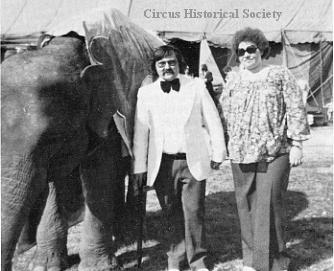
Miscellaneous
Selected to be enshrined in the Circus Hall of Fame in Sarasota were Gustino Loyal, retired bareback rider; Andres Atayde, circus owner who died in 1977; Terrell Jacobs, wild animal trainer who died in 1957, and Dorothy Herbert, retired equestrienne.
Two prominent circus performers died in the line of duty. World famed Karl Wallenda was killed March 22 in a fall of 120 ft. from a high wire between two hotels in San Juan, Porto Rica. He was 73 years old and his fall was attributed to strong winds. Eloise Berchtold, 52, animal trainer, was killed by an elephant on May 5 while performing at Rock Forest, Quebec, Canada.
Deaths of other noted circus personalities, including fans, in 1978 included Bert Pettus, Edna Curtis Christiansen, Eddie Dullem, Tim McCoy, Percy Rodemacher, Reb Russell, Larry Benner, Peter March, Jerry Bangs, Slivers Madison, Orval F. Lindeman, Gene Christian, Arnold Maley, L. M. Fleckles, May Wirth, and William H. Kasiska.
Final Observations
Circus business in the country generally is healthy. One of the biggest headaches, however, to a smooth operation which faces circus owners is the ever increasing amount of government regulation. This comes from all levels, federal, state, and local. Several owners have told Bandwagon staffers that operating a circus becomes more difficult each year, with much of the problem coming from the bureaucrats descending on the show with their regulations. Of serious consequence is the so called endangered species rules and regulations which conceivably in the near future could eliminate many of the traditional circus animals, including the Asiatic elephant. Both the circuses on the road plus the organized fans are in the fight in an attempt to assure reasoning by the Feds in this matter.
Various "do-gooder" organizations poking their noses into everything from animal "welfare" to the "welfare" of the young children of performers who are learning the traditional acts of their parents, create more headaches for the harassed circus owner.
Although there is a definite trend among the larger shows to go more and more to a shopping center format, still the tried and true method pioneered by the Mills brothers in the early 40's of using local sponsors, UPCs, and phones is well and kicking in 1978. Some shows, however, have found it is not as easy to set a strong route of sponsored dates as it once was.
One sure trend in 1978 was toward multi-day stands, whether shopping center, or sponsored dates. By the end of the year several smaller shows had indicated they would be playing longer stands in 1979.
The permanent, or semi-permanent circus which plays lengthy engagements in a single location, long a tradition in Europe, was fast becoming a major part of the circus world in the United States. The Circus Hall of Fame in Sarasota, Circus World near Orlando, and Circus World Museum in Baraboo, Wis. all had circuses along this line. The circus which played under the big top at the Circus World Museum in the summer of 1978 was one that will long be remembered by the traditional circus lover. A feature of the show was the live band of 10 pieces plus air calliope playing a repertoire of traditional circus type music. Another "goodie" of this circus set-up was the menagerie tent adjacent to the big top with four Curtis built working type animal cages formerly used by Sells-Floto and Hagenbeck-Wallace placed closely together with attached runway leading to the steel arena in the big top.
The Bandwagon staff wishes to thank the many individuals who provided both information and photographs for this review of the 1978 circus season.
List of Circuses 1978 Season, compiled by Don Marcks
Canvas Shows
Clyde Beatty-Cole Bros., King Bros.-Cole, Sells & Gray, Hoxie Bros., Great American, Roberts Bros., Carson & Barnes, Carson & Barnes No. 2, Big John Strong, Kelly Bros., Stebbing's Royal European, Happytime Circus, Circus Vargas, Fisher Bros., Circus Girard, Mix Bros., Kool Aid Circus, Dr. Pepper Circus, Gatini Circus (2 units) (Canada), Jungle Wonders, Martin & Downs (Canada), Puck's Circus (Canada), Franzen Bros., Dixiana, George Hanneford Family Circus, Vic Bros., Big Apple, Great Ron Morris, Dubski-Jordan.
Indoor and/or Outdoor Shows (Note: Some shows played both indoor and outdoor dates and some under canvas.)
Emmett Kelly Jr., American Continental, Hamid-Morton, Ringling-Barnum Red Unit, Ringling-Barnum Blue Unit, Royal Hanneford, Hubert Castle, California Circus, Garden Bros., Famous Hunt, TNT& Royal Olympic, Beck's Circorama, Carden-Johnson, Cole's All Star TV, L.N. Fleckles. Great Y Circus, Holiday Hippodrome, Sam T. Polack, Polack Bros., Bentley Bros., Europorama, Circus Carol, Funs-A-Poppin, Wenatchee Youth, M & M Circus, International All Star.

George Engesser was born in St. Peters, Minn, in 1889 and broke into show business in 1911 on a dramatic tent show playing that area. Hired as a piano player, he soon learned this included doubling in brass plus acting. During this period he met a lovely lady named Vates Lola Swenson and later that year they were married. Being of a thrifty nature, they saved their earnings and put out a 3 people tent show billed as "The Two Oles". It was an immediate success enabling the couple to also put out four more one night tenters, all using the very popular title Two Oles title. By the early twenties, the just-partly dependable Fords, Overlands and Mitchell automobiles were getting the farmers out and off the muddy rural roads and this meant a gold mine for shows in general. The public was entertainment starved. By now Engessers were the proud parents of a daughter named after her mother -Vates.
Carefully saving their profits, George and Vates got the circus itch and in 1925 began to mentally combine their five tenters into a nucleus for a circus. That late fall when in quarters, George and a small crew built up, from scratch, eight high blues, and Star Backs for reserves. As hit the fancy of troupers, these were also known as "Bible Backs", "turtle backs" etc. With a fairly good 60 ft. top, the best of their twenty "T" model Ford trucks, plus several more dismantled and carried for parts, the show opened with daughter Vates, the only family member in the performance. Mama Vates always handled the ducat wagon.
Some of the attractions of that first season included 76 year old Irwins doing a high wire head stand, Lady Godwins, neck loop swivel, Hall with a large troupe of goats, which incidently caused no end of problems for no matter where they were staked out, one or more managed to break loose and chew up the most expensive pair of tights hung out to dry. Dorey and the Kelly Millers did a tumbling act. The bull, Ruth, bought from the Hall Circus farm, had been on the Floto show. She was a good but playful critter. Nothing pleased her more than to extend her trunk straight out towards some towner's hat and let go with a blast that scared the daylights out of the victim and sent his hat sailing through the air. She knew many routines, one, taught her by Dolly Castle. Chief Keys and wife came on to work the concert and the show gradually took on a well run appearance. But in spite of first season trials, errors, mud, wind and dust storms, the show made money and plans began to jell to greatly increase its size the following season.
Baker Lockwood was ordered to make an 80x120 foot top and a palace style marquee. U.S. Tent and Awning were contacted to paint an outstanding double deck banner line and when news of these improvements trickled around the show world, troupers didn't wait for Engesser ads to appear for Help. They wrote in early hoping to get placed. The bull, Mary, was bought from Hagenbeck with Elwood Emery hired to handle both bulls. Other new personnel included a youngster, Matt Lorish, who was hired to work the 6 lion act, liberty horses and the pony drills. Later in early summer, a Bob Wing's Marlow Bros, circus folded in Dundee, N.Y. and he joined out bringing a fat gal pit show.
There is a rather humorous side story to their purchase of a Tangley (Baker made) calliope. Seems a chiropractor, a Mr. Baker, owned a radio station in Muscatine, Iowa and wanting to get fast publicity for his new 'air planner' advertised it would make its first appearance on the radio. Came the magic day and at the first ear blasting shriek, all tubes and equipment of the station were blown to pieces. Much later, very soft calliope music was heard - but always played extremely quietly.
One time George took a few hours away from the show to visit one of the Floyd King RR shows. Ducking into the side show, George got a real laugh to see Floyd, decked out in preacher's garb, shilling for the brod mob. Another time, he and Vates visited the other King show and as they hurried to the backyard for a good visit, they noted Floyd side walling "lot lice" for a mere two bits. Later on the opposite side of the big top, Howard King was likewise side walling, while Angel Face Howard's wife, stood in the marquee getting a hefty service charge on
With the show getting good reports wherever it played, other performers were anxious to join. Some of these included, Tiger McCue, Milt Herriott, Brooks the band leader, Devore 24 hour man, his wife Olive had the banners and Jack Hoxie joined with his entire movie gang, and the show began holding almost the entire big show patrons to see a real movie star. Hoxie couldn't stand this unexpected boost in popularity and it went to his head. In fact, he began taking over as general manager of the circus. George Engesser, never one to take a back seat in a donny brook, and Jack met at the back door curtain where Jack sat his horse waiting for his cue to gallop in. As Vates once told the story, with a grin, the argument grew into a two sided rage and poor George got popped in the eye, getting a beautiful shiner and incidently the only time he ever did get a black eye. As you can imagine Jack Hoxie was requested to depart, which he did to join Downie Bros. For some reason he refused to ever start his expensive LaSalle car in other than high gear. As a result he broke axles constantly and kept a huge supply of them on hand. Once he arrived on the Downie show his stock of axles ran out and in disgust, told Frank Loving he could have the damn car for $50. Frank and Ann Loving drove that car for several years.
Because the show was growing so rapidly, it was wisely thought to change the title and the Schell name was secured for a song, the printers shelves piled high with dead Schell paper. This meant more paper had to be used and one gentleman biller of color was joined out from the Atterbury circus. JellyRoll an all around trouper was very nervous having recently gone through the horror of being on the Rufas black and tan revue starring Bessie Smith. She was badly injured in making a jump, one arm was torn off and bleeding badly. She was rushed to a hospital in Miss, where she, being black, was refused admittance so she bled to death. Bessie had been the first black gal ever asked to sing for Victor and other record companies.
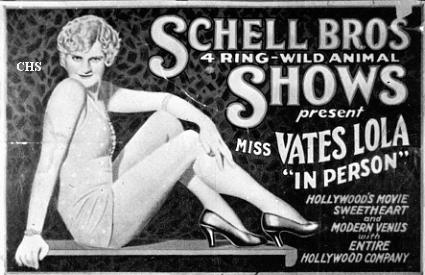 George Engesser's daughter Vates Lola was featured on this one sheet litho used by Schell in 1930. Circus World Museum collection.
Little Vates preferred to work menage horses while Gee Gee had become an accomplished iron jaw performer, and equally as good bare back pony riding, also doing cartwheels twice around the track. Milt Harriott had come on to work the bull punks due in from the orient and was soon busy whipping their routine into shape. I presume he still snickers over the incident but for a long time around that show you had to be mighty careful not to laugh and mention elephants to any of the bandsmen. At the Bulls first public appearance in the ring, the band blew a frightfully loud blast and these punks were not about to stand still for any such ear shattering noise, so, they bolted, right towards the band stand, trampling it to kindling wood. Bandsmen leaped, jumped and ran in all directions, to hell with their instruments. For the balance of the matinee, only sour notes were heard from the disgruntled bandsmen. George could only soothe Brooks and his men by promising to order the finest band suits available from De Moulin Bros. Uniform Company in Ill. But he could hardly keep a straight face while soothing the injured feelings of the bandsmen.
Others joining included Owen Hartzell, the Goodwins, Milt Taylor's funny Ford, Herbert Castle, later replaced by Manuel Macues, The aerial Moons, Gentry Pigs, The Kailus Hawaiian Troupe, to name just a few.
George's wife Vates always handled the ducat wagon and encountered no end of nuts in the course of a day. One time a tobacco chawing hick came to the window and inquired if she recognized the profession. 'Certainly' remarked Vates, What do you do? Well-1-1 now I don't do nuth'in, but my uncle used to drive team for Norris and Rowe.
Once the show played a cow pasture lot which boasted of an old and definitely not used, pitcher pump. The day was very hot and the troupers kept that pump handle working full time, eager to get another drink of that cold well water. Unfortunately, that water had a kick much like Epsom Salts and during the performance it was pitiful to see an act stop right in the middle, give a look of horror and rush madly out of the top. Even old Al F. Wheeler making an opening on the kid show, was seen to stop right in the middle of a sentence and race off the bally stand for unknown parts. Silver Tip Baker was supposed to join that very day but was delayed by a broken rod, so his troupe was thankful they had car trouble.
With the depression suddenly in full swing business became stagnant, and shows were the first to suffer. It was planned to swing east but rumor spread that there were three circuses and eighteen RR carnivals stranded in Illinois alone. Several troupers came on from Sam Dills circus with tales of no salary in many weeks, just a sack of 30 Stud tobacco every day, plus thin watery chicken neck soup and stale bread. They even told how, each morning, they would scan the lot hoping to find a pair of shoes still possessing part of the soles. George panicked and headed west, but things steadily grew worse and he took in a partner fully expecting the depression to only last a few months. The partner, one McAlaster, immediately put on grift, even the butchers were busy after supper time coating pennies with aluminum paint. The coach worked so strong the city fathers along the route were up in arms and after two weeks, George in disgust, gave the show to McAlaster, retaining only personal trailers and their first bull Ruth.
About this time Roxy, a third daughter was born and her trouping knowledge was gleaned on other circuses. Of late years, she and her husband and their two children have successfully operated a plaza free show in Florida. Daughter Vates has been gone many years, while Gee Gee is nationally known and always busy bringing enjoyment to the public. Her son Billy Powell, Jr. well up the road in outdoor amusement management was recently pictured on the front cover of Amusement Business. George is buried down in Texas while mama Vates spends her time visiting Gee Gee or Roxy enroute and no one would ever dream she is a grandmother. Good natured with looks and a figure to do credit to a Follies girl she calls Seagoville, Texas home.
Much more could be written about this very clean circus for it certainly was very popular back in yesteryear.
By Vates as told to Art Doc Miller.
No part of this publication may be reproduced in any form or means
Last modified February 2006.
without written permission of the author and the Circus Historical Society, Inc.