


Circus Historical Society
Bandwagon, November - December 1976
Back to Bandwagon Index
Bandwagon, Vol. 20, No. 1 (Nov-Dec), 1976. Note: Only some articles are included in this online edition. Many illustrations are not included. The Circus Historical Society does not guarantee the accuracy of information contained in the information in these online articles. Information should always be checked with additional sources.
Forward-Following nearly two years of research on human projectiles featured on circuses in Europe and the United States, it has become apparent that list of acts is long. Over the 106 years of circus history covered by acts in which human beings were propelled by various means through the air, it is interesting to note that all did not use the same type of apparatus. We shall explore some of the engineering incorporated into the appliances used by various performers.
In modern circus history the Zacchini family is at once thought of regarding cannon acts. This one family has done more in the field than others, but there were others, many others.
This article will be divided into two parts, one dealing with the over all history of cannon acts to date, and will deal with all acts other than the Zacchinis. A second installment will cover the complete history of the Zacchinis and all of their cannons.
Mechanical thrill acts have long been a part of the circus. Some years ago I wrote an article on loop the loop auto acts. There were many of these in different variations performed in circuses. But as I dug into the subject of human cannon balls I found that there were far more of these acts over a longer span of time than most any other mechanical thrill circus act.
An Englishman named George A. Farini appears to deserve credit for introducing the first act in a circus to propel a human through space. Parini was the manager of the Royal Aquarium, Westminster, London, and it was in this building the act originated. Parini was a well known freak-hunter, who was later to bring a tribe of Zulu natives to the United States.
The exact date of origin of Parini device is not known. However, on June 13, 1871 he was issued United States patent #115,837. The patent was titled "Improvement in Projectors." He stated he had invented a certain new and useful apparatus for projecting persons and articles into or through the air. The intended main object of his invention was to provide apparatus by which gymnasts and other persons engaged in public and private performances may be projected into and through the air at any required height or distance - as an illustration, to project a gymnast, say, thirty feet upward to a trapeze or platform. He stated in his patent that the apparatus possesses the following among other distinguishing features: First, the resilience or reaction of distended springs used as the projecting force. Second, the springs are easily adjusted and released. Third, the projecting platform, whereon the person stands, which is raised or moved by springs, is automatically released when at its highest or outward point and immediately thereupon left or caused to fall, it may be out of sight. He continued by referring to a drawing and describing the springs being made of india rubber. This is probably the key reference as heavy rubber springs and later shock cord continued to be the basic material used to project the human bullets in most other cannons that were to follow. The small platform on which the "bullet" stood was depressed placing tension on the rubber springs. By trial and error the amount of tension needed to project an individual of a certain weight to a given distance was determined. The Parini invention was not described as being placed in a barrel, or cannon like configuration. The placing of the springs in a gun or cannon was to come a bit later and be patented by another individual.
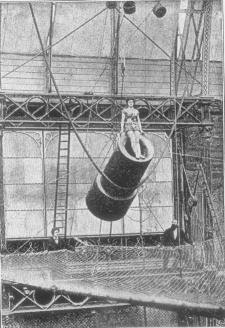 This photo of Zazel, the beautiful human cannonball, was taken in the Royal Aquarium, London, England, in 1877. This is without a doubt the earliest photo in existence of a cannon act.
The first time the act was performed in America was at Niblo's Garden, New York, in 1873. It was performed by Lulu, a young man of feminine face and figure, appearing as a girl. It was reported that Lulu was a brother-in-law of Farini. A report of the Lulu presentation described it as follows. Lulu stood erect in full view of the spectators, upon a small plate about a foot in diameter which was flush with the stage floor. At a given signal the lath was released, and Lulu was driven straight up into the air a distance of about thirty feet, where he grasped the ropes or bar of a trapeze. The plate on which he had stood was quickly withdrawn to its initial position and was scarcely noticed by the audience. In 1875 Lulu performed on the Howes and Cushing Circus, being featured as the "Queen of Trapezists."
That same season of 1875 the Yankee Robinson Circus advertised a "bewildering Howitzer Feat, shooting a live man out of a cannon." The afternotice in the Prairie du Chien, Wisconsin COURIER on June 15,1875, advised that the cannon act was indeed performed as advertised. This description indicates that the human projectile equipment had been fashioned into the form of a cannon. It is not known who the performer was on the Yankee Robinson show, but it may have been George Loyal, who was to perform as the "Human Projectile" at the Court Street Theatre in New York, on November 3,1879. Loyal appeared with Ella Zuila, the "Ethereal Queen." Loyal was shot to the top of the building and caught by Zuila, who hung by her feet from a trapeze. Should Loyal fail to be caught he dropped into a net.
About this same period another Englishman, William Leonard Hunt, applied for a U.S. patent covering an apparatus in the form of a cannon. A patent was issued to Hunt on April 22, 1879. The Hunt design consisted of a cannon or mortar which was suspended from the ceiling or was mounted on a carriage. In his patent Hunt states that his invention relates to the adaption of the Farini patent so as to use explosives as a means for releasing the catch, and that this invention had been patented to him in England on December 18, 1875. Hunt further stated that his invention consisted of combining the frame-work, inter platform and springs of the Farini patent with a cylindrical casing or chamber of a cannon or gun, and with a tube or cylinder containing a sufficient quantity of powder, and placed in such a manner and position with relation to a catch or lock for retaining the inner platform and extended springs that when the powder is ignited or discharged by means of a match, percussion, or electricity, the catch or lock will be opened, so as to release the platform and springs. This will then propel the performer from the cannon, and at the same time give a loud report, thereby creating a belief that a real cannon is employed and that the motive power is powder.
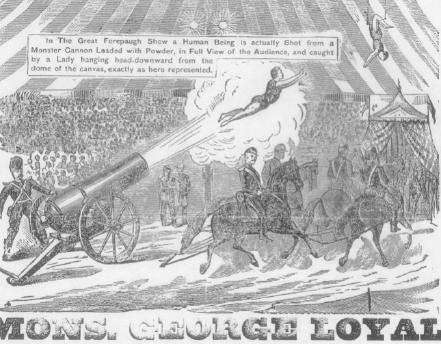 George Loyal may have been on the Yankee Robinson Circus in 1875. This illustration is from the Great Forepaugh Show herald of 1880, when he was featured on that show.
Loyal and Zuila appeared with the Great Forepaugh Show in 1880. The herald of that show states that Loyal was shot 60 feet in the air, midst fire and smoke and roar of artillery, to the extended arms of daring Ella Zuila. The advertising piece further states that Loyal and Zuila had secured world wide fame and that had brought into the field a host of imitators whose feeble attempts are but a burlesques of the Original Loyal and Zuila.
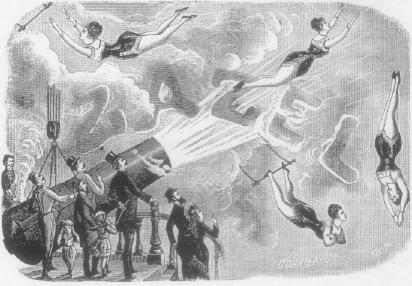 Zazel first appeared with Barnum in 1880, and this illustration was used in the Barnum Illustrated News that year. The same cut was also used by Batcheller & Doris and Cooper & Jackson in later years.
At this point in time a name nearly as famous as the Zacchinis entered the cannon picture in America. It was Zazel, and she had been brought from England by P. T. Barnum for his 1880 season. Zazel had first performed the cannon act in Westminster, at the Farini managed Royal Aquarium in 1877. A rare photo of Zazel shows a suspended cannon-barrel over a net at the Royal Aquarium. This apparatus is no doubt the one designed by Hunt, as Westminster, England, was his home.
Zazel was a young English girl named Rosa M. Richter, the daughter of Ernest Richter, an English circus and drama agent. The 1880 Barnum program lists Zazel as the final act in the performance. It says Zazel, in herdaring aerial dive, or Eagle Swoop, fired from the mouth of a cannon to the topmost height of the Pavilion, from whence she leaps head first through the air, a distance of nearly 100 feet. Actually, she caught a trapeze, same as Loyal, and then dove from that perch to a net. The "Zazel Galop" by F.W. Meacham was played by the band under the direction of Joseph Withers, during the act.
Following the 1880 season George A. Farini ran an advertisement in the February 12, 1881 issue of the New York Clipper. In brief it read as follows: "To circus and theatrical managers and all others concerned: I hereby notify you that I am the sole inventor and owner of letters patent issued to me, #214,663 (actually issued to William L. Hunt) and to #9374 dated September 7, 1880, which cover any mechanism to propel a performer out of a cannon, and at or about the same time, causing an explosion of gunpowder. I am reliably informed that certain managers propose to use my devices without obtaining the necessary authority from me. As my patents cover all forms and methods of firing a performer from a cannon, I hereby give notice that I shall prosecute any and all infringements upon my invention." It is clear that there were indeed "imitators" as "Zazels" were popping up on a number of shows during the 1881 season. Miss Rosa Richter, the "Original Zazel", performed with the Batcheller & Doris show that season. Another "Zazel" appeared with the Shelby, Pullman & Hamilton show. A Madam Tuila, the reigning queen of the air, "was shot through space like electricity, from a monster cannon, to be caught by Prof. William A. Forepaugh and Mons. Ricardo," according to the courier booklet published by The Grand Circus Royal, English Menagerie and Astley's Museum, Pogey O'Brien operation on tour in 1881.
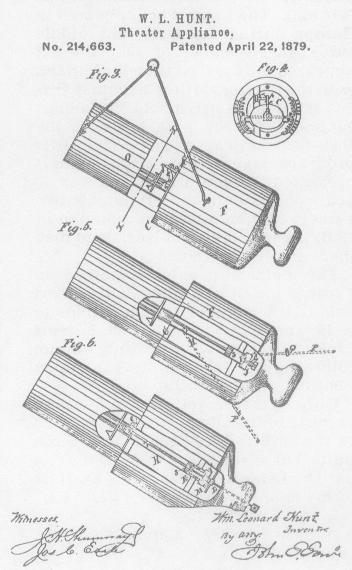 These drawings illustrated the design of the cannon patent issued to William L. Hunt in 1897. The India rubber springs are shown in fig. 4, around the sides, extending from the top to bottom of the barrel. The springs propelled the piston and plate on which the bullet stood.
W. C. Coup's New United Monster Shows combined with G. A. Farini's Great Paris Hippodrome - 1881 featured Lulu, the beautiful goddess of the air. Lulu was billed as a human being hurled through the air from a huge iron catapult, a distance of over 100 feet. The Englishman Hunt patented this rig on January 4,1881. In this case the performer laid flat on his back on a lever or pivoted arm. When the latch was released the springs swung the arm up and the human projectile was thrown through the air turning two somersaults in the air and landing in a net. Farini had his Zulu tribe on the Coup show that year also.
The Barnum & London show featured a similar act in 1881. This equipment was patented by William M. Davene. Lizzie Davene performed the act, also turning a somersault in the air before landing in a net. On May 3, 1882, in Wilkes Barre, Pa., she struck the net with her head and died a few days later. An acrobat, Harry Carey, took over the act and continued the season.
In 1881 Coup was licensed by Farini to present an act called "Bebe, the flying woman." This was probably a catapult act like the Lulu presentation. George Loyal and his cannon was on the Coup show that season also. Farini had returned to England, where he was exhibiting Karo, the wild girl from Laos, at his Royal Aquarium, according to the May 16, 1883 Clipper. Zola was "blown from a cannon's mouth" according to the 1882 Adam Forepaugh program.
Rosa Richter returned to the Barnum & London Show for the 1882 season doing her cannon and wire walking act. Lulu and his catapult and straight up jump act were also with the Barnum Show that year.
Others had infringed on Farini's patents, as it is doubtful that he had controlled all of the various cannon acts that had appeared on different shows the prior season. A cannon was advertised for sale in the August 15, 1882 Clipper. The Clippers of January 6 and March 24, 1883 carried ads for a cannon for sale that would shoot a 160 pound man across a circus ring. E. E. Orden, of New York City, was the seller. The same ad appeared in the May 12 Clipper, this time placed by E. E. Kennedy, at the same address.
A Zazel cannon act appeared with the Cooper, Jackson & Co. Circus in 1882 and again in 1883. Rosa Richter advised the Clipper on July 7, 1883, that she as the "original Zazel" was well and giving her performances daily with the John B. Doris Interocean Shows.
A key to who the other Zazel was turned up when the Clipper of March 21, 1885 advised that Mrs. Elizabeth Ann Roche, had died in child birth in Norfolk, Virginia, on March 12. The article stated that she had come to America in 1881 to join the Shelby, Pullman & Hamilton show as a human cannonball. She was no doubt the "Zazel" that was on Cooper, Jackson & Co. in 1882 and 1883. The death notice referred to her as Zazel.
Rosa Richter meanwhile had met and married George Starr, a handsome young press agent on the Barnum show. She discontinued her cannon act and did a 20 foot high wire act, the highest at the time. She fell while appearing on the Forepaugh show in 1891, and retired. Starr was sent to England with the Barnum show and the couple remained there.
The Barnum & Bailey show featured a somewhat similar act during the 1896 and 1897 seasons. In this one a performer named Alar was propelled by means of a large cross-bow. This equipment was patented by John Zedora, also an Englishman, on June 23, 1896.
By the late 1890s the cannon and projectile acts had run their course and were replaced by other mechanical thrill acts like loop the loop bicycle riders, and later loop the loop auto acts.
Cannon acts were not to appear in America again for 30 years. However, the forerunner of the cannons as we know them today appeared on the circus scene in Germany in the early 1920s.
Paul Leinert, a German circus performer, presented an aerial death ride on a bicycle around 1904. This was no doubt an inclined ramp jump much like that done by PeeJay Ringens in the 1930s in the United States. Our research through present day German circus historian Markschiess-van Trix suggests that Paul Leinert first built and used a cannon act in the early 1920s. Leinert's sons Karl and Erich worked with him, and in all they had six sensational trick acts. The Leinert unit resembled a large two wheeled howitzer artillery piece much like that used by the German army during World War One. The spoked wagontype wheels were five or six feet in diameter and the barrel was about 25 feet long. The Leinert act appeared in Europe during the early and middle 1920s. In December of 1927 the act appeared for the first time in England with the Bertram Mills Christmas Circus at Olympia, in London. The Leinert cannon was back with Mills for the 1929-1930 holiday season. The Mills program states that Erich Leinert presented the act in 1929, and was 30 years of age at the time. A number two Leinert cannon appeared in Japan in 1931, presented by son Karl, who died there of a heart attack.
The Leinert cannon remained in Japan through 1933 when Paul Leinert sold five acts, including the cannon to a Japanese. A Martin Brado-Leinert broke his neck when hitting the net following a flight from the cannon on February 4, 1933, in Japan.
Cliff Aeros, a well known German acrobat, built and owned three cannons in the 1926 to 1929 period. The Aeros units looked much the same as the one used by Leinert. In 1929 Aeros sent one of his cannons to the Sells-Floto Circus. More on this later.
A man named Weldanos performed a cannon act in Europe in the 1920s. This unit had a barrel mounted on a floor stand, not on wheels, and the man was shot into a large bell-shaped receiver. Another man billed as the ROCKET, (Karl Koppelkam) crashed in Budapest when he missed the net in a cannon act.
It was during the 1920s that another German entered the cannon act picture, a man who would become as well known in the United States as the Zacchinis. Willi Wiedrich was born in Dresden, Germany on December 13, 1902, the son of a coppersmith. In his youth he received training as a watchmaker, but became interested in acrobatics and began doing an aerial act using roman rings, later developing a trapeze and sway pole act. When playing in England he met Mrs. George Starr, the original Zazel, in 1927. This inspired him to build a cannon. Borrowing money from his sisters Wiedrich started construction, using a catapult cylinder inside a 25 foot barrel, and mounting it on wheels that were 5 1/2 feet in diameter. Developing the tension by use of a dummy the same weight as his, he felt he was ready to make a jump himself. He was performing with the Circus Busch in Berlin at the time, and the cannon and net were set up outside the building he then made his first shot. The act was then introduced into the Busch program, using the name The Great Wilno. Wilno appeared with other German circuses before going to France for a Paris date during the winter of 1927-1928.
During the Paris date he was seen by Frank Wirth, husband of May Wirth, who with George Hamid operated a booking agency. Wirth signed Wilno and arranged to bring him to the United States in the spring of 1929. The Wirth Hamid firm ran a full page advertisement in the May 19, 1929 issue of the Billboard, announcing Wilno as "the greatest and most stupendous gate attraction ever conceived for parks and fairs." Wilno and his cannon left Germany by boat and arrived in the United States on May 4, 1929. Wirth booked the act at a park in Boston that spring and later in the summer on fairs. John Ringling purchased the American Circus Corporation in 1929, one of the Corporation shows, Sells-Floto, had a cannon act in 1929 and Hugo Zacchini had been on Ringling Barnum that year. Being cannon minded the Wilno act was booked for the 1930 season on the Hagenbeck-Wallace Circus. Wilno remained on that show through the 1932 season. During these depression years Wilno saw his salary reduced each year. He felt he could do better on his own elsewhere. Wilno had settled and purchased a home in Peru, Indiana. Following the close of the 1932 season he purchased an Indiana truck and motorized his cannon. Wilno went to Hawaii with his new cannon truck and then returned to tour with the Cetlin & Wilson Shows as a free attraction. This was the first of his long affiliations with carnivals. He spent later seasons with Johnny J. Jones, Rubin & Cherry, World of Mirth, Penn Premier, Sheetley, and Endy Bros. carnivals. He later built a cookhouse which he operated on the carnivals he appeared with as a free attraction. Wilno appeared in 1937 with the Clyde Beatty-Cole Bros. Circus at the Chicago indoor opening stand, but did not go on the road with that show. He also appeared with the Hamid-Morton Circus in the late 1940s and early 1950s, and was on the Tom Packs show in 1957. In 1939 Wilno was elected as the seventh most popular performer in a Billboard poll, and first in the human cannon division. In 1943 while with the World of Mirth Shows Wilno made a shot over a #16 Big Eli Ferris Wheel going 60 feet high and a distance of 180 feet.
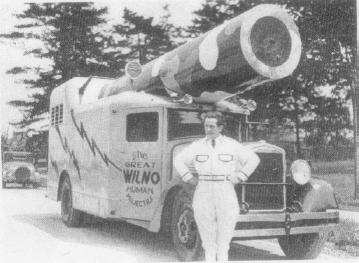 The Great Wilno is shown standing by his cannon after it was mounted on a truck in 1933.
Wilno performed the act himself for 20 years and then used Henry Duchone as the bullet for another 10 years. Following his retirement the cannon was parked in his Peru, Indiana, quarters for four years.
In 1960 he visited the Beatty Cole show and Frank McClosky offered to buy the cannon. Luis Munoz had served as the bullet for Zacchini on the Cristiani show in 1958 and 1959, and a deal was made with Munoz to present the act on the Beatty show, buying the cannon from the show over a four year period. Munoz used the name Capt. Astronaut.
Following his final season with the Beatty show Munoz took the Wilno cannon to Mexico to appear in a winter show. The cannon was sold there and last appeared on Circo Osorio, where a young man was killed while making a shot. The cannon was later lost in a wreck.
Luis Munoz returned to Sarasota, Florida, where he contracted with Bill Barr of the Sarasota Welding and Supply Co., for the construction of a modem semi-trailer cannon. A flat bed semi-trailer from the Beatty Cole show was used along with some parts from an unfinished cannon that had been started in Germany. Alva Johnson, Jr., of Sarasota, secured the following information about the construction of this cannon.
The barrel was 22 feet long with a traveling distance of 17 feet. The power was derived from 19 pieces of I inch round shock rubber cord, with each piece being doubled to give a total of 38 pieces. A gearhead motor operating on a 280 to 1 ratio was used to draw the tension, taking 12 minutes. The aluminum barrel was tapered and shaped like a rocket. A rocket fined nose was used as a cover and when the unit was traveling, it was sometimes mistaken for something connected with the space program. The catapult platform was guided by a double rail track extending the 17 feet of moving distance. The new cannon was booked for a Shrine date in Columbus, opening in late April of 1965. Nine weeks of double shift work were required to build the cannon. Munoz used his new X-15 Apollo cannon on independent circus dates before taking it to his native home of Spain. Around 1957 Munoz died of natural causes in Spain. The act continued using his 15 year old son. I saw the act appear as a free attraction in Barcelona in August of 1968, on Circo Americano. The act was working as late as 1975 in Europe.
Returning to Cliff Aeros. During the winter of 1928-1929 an agent of the American Circus Corporation arranged to bring the cannon owned by Cliff Aeros to America for the 1929 season of the Sells-Floto Circus. Since Aeros did not come to America, it would appear that he sent the cannon with operating instructions. This unit was of a howitzer construction, looking much like the Wilno unit.
The Aeros cannon opened with Sells-Floto in Chicago. It was a problem for the show from the start. First they did not have an experienced projectile, nor it appears anyone who really knew how to operate it. The job of cannonball was open, paying pretty good money. This appealed to the butchers in the concession department, and one by one they were used up, while working the act. In our files we have a Sells-Floto envelope with the notation on the front, "Boy shot out of cannon hurt in Chicago 1929." The envelope contains the claim from the Illinois State Industrial Commission dated April 26, 1929. It states that on April 3, 1929, one Fred Jones Reid, of Chicago, injured his head, neck and back after being shot from a cannon at the Chicago Coliseum, while employed by the Sells-Floto Circus. He was paid $100 a week. Reid was awarded $200 in medical claims and $15 per week for the period of his temporary total disability.
By the end of the season the show had had enough of the cannon problems and wished to sell the unit. We have a copy of the sales agreement between the show and Fred 0. "Fearless" Gregg, well known for his loop the loop double auto act. The agreement states that for $950 the show released from all contracts the cannon and all paraphenalia pertaining to same, belonging to one Cliff Aeros, and turned same over to Mr. F. 0. Gregg for his use. The $950 is to clear all demands, such as bonds, premiums, custom charges and same is sent by the Sells-Floto Circus to Tausig & Pilcher, 7th Avenue at 40th Street, New York City, for that purpose said Sells-Floto Circus receiving no part of this money for its own use.
Fred Gregg booked his newly acquired Aeros cannon on Robbins Bros. Circus for the 1930 season, advertising it as Cliff Aeros. Gregg at no time served as the bullet, but hired a number of men for the act. Using the name Cliff Gregg, one Waldyslaus Kruck, age 25, was killed on September 29,1931, while playing a fair in Oklahoma City. Kruck had worked the act on the Robbins show. Another man using the name Will Gregg, had been injured the day before in the act, suggesting some malfunctioning of the cannon mechanism. On another occasion a man was downed after being fired from the cannon into the Pacific Ocean. The Gregg cannon was at the Steel Pier in Atlantic City in 1931. Around 1932 Gregg mounted his cannon on a truck. The unit was rebuilt in Gregg's home town of Plymouth, Wisconsin. In 1934 Gregg joined with Denny Curtis to form the Curtis-Gregg Circus, and the motorized cannon was advertised as a free attraction on that short lived show. Gregg continued to use his loop the loop car act as well as the cannon in later years. A Bill Parent appeared with the Hagenbeck-Wallace Circus during the Chicago engagement in 1937. A newspaper article appearing in the spring of 1937 identifies Parent as Boysi Fendrick, and refers to the Aeros cannon on Sells-Floto as being the same one he is using, so it appears that this was really the Gregg unit. Wilno was across town with the Clyde Beatty-Cole Bros& Circus, giving the competing shows each a cannon act. An ad in a 1938 Billboard tells of Capt. Von Fendrick, with a cannon mounted on a huge Mack truck, shooting 200 feet. This would suggest that Parent had constructed a new cannon of his own.
In 1940 Gregg built a second cannon in Plymouth, and during the 1940 season both cannons were used. The newer cannon continued to be booked by Gregg until the early 1950s, playing mostly fairs. In 1955 he sold his number two cannon to Gus Bell, who had just finished opening and closing his Ward Bell Circus. Bell used the cannon for a few years using Grady Littlejohn as the bullet. After a couple of years Bell sold the Gregg cannon to Bill Atterbury. It seems that the cannon rotted away in the Atterbury quarters in Springfield, Mo.
In the spring of 1937 the Arlington and Hatch Hagenbeck-Wallace Forepaugh Sells Circus advertised a new cannon sensation for their opening date in Chicago. "The Human Rocket", one Anton Barker, age 44, failed to make the Chicago date. He was badly injured during the opening performance of the Hamid-Morton Shrine show in Buffalo, New York, on March 28, 1937. Barker had a different wrinkle in his act. He came out of the cannon barrel in a flimsy break-away shell, dropping the enclosure in mid air before reaching the net. The Buffalo Courier of March 29, 1937 reported that Barker, also known as Capt. George Wernesch, was to travel a distance of 84 feet to a net. However, he went only 64 feet and struck the hard floor of the Broadway auditorium and suffered spine injuries. The Gregg act with Parent was brought to Chicago for the Hagenbeck date on short notice following Barker's Buffalo accident. Nothing further is known about Barker.
In 1939 a Capt. Mars appeared with a cannon as part of the Capt. Frank Cushing Death's Holiday auto thrill show. Wilno suggests that this man may formerly have worked for him, and had built a cannon. This was a short lived act. No record can be found of Mars other than the one season.
A machine shop in a little town called Palm Bay Florida, was operated by Harry E. Pollak, Pollak had traveled with carnivals and had observed the Zacchini and Wilno acts presented as free acts on various shows. During the winter of 1940-1941, Pollak, a clever mechanic, built a cannon, mounting it on a White bus chassis. He booked the new cannon on the Mighty Sheesley Midway. A local boy, Alfred Kuechenberg, was recruited as the bullet. The act started on the carnival making a long shot over two ferris wheels, as was being done by Wilno and Emanuel Zacchini on other shows. Kuechenberg's brother Rudy was also used as a bullet during the early days of this cannon.
Pollak remained on the Sheesley show in 1942 until the middle of the summer, when he returned to Florida to open a restaurant, the cannon staying with Johnny Hawkins in charge. During 1942 Luckey Duane Jacobs served as the bullet. The Pollak cannon went back to the Sheesley shows in 1944, and Joe Hatfield and Richard Padget were broken in as bullets. At no time did Pollak or his wife go out of the gun. Harry Pollak joined the Army late in 1944 and his cannon remained parked in Florida during his service years.
Following his return in 1946, Pollak built a new cannon, this one appearing to be the first ever to be constructed on a semi-trailer. Padget was back being billed as Harry Pollak, Jr., as the bullet. The new unit appeared with carnivals, and in 1947 or 1948 joined the Jimmy Lynch Death Dodgers auto thrill show, operated by Earl Newbury. Pollak stayed with Newbury for a couple of seasons, during which time a new Dodge tractor truck was added to pull the semi-trailer. The show had a deal using all Dodge equipment. Pollak and his wife drove a new Dodge convertible during this time.
Following the war, used heavy duty autos were hard to come by for use in head on crashes. Pollak came up with the idea of saving the use of one car by smashing into a wall of ice, rather than another auto.
While on the Lynch show Pollak began using Chuck Beeler, an auto and motorcycle stunt driver, as a bullet. In 1951, the Pollaks adopted a daughter and retired from the road. The cannon was stored in their back yard for a number of years, being used for local celebrations on rare occasions in Palm Bay, Florida. In 1956 Chuck Beeler purchased the cannon from Pollak and rebuilt it. He advertised Beeler's Sensational Cannon Act, available for fairs and celebrations. Beeler had continued as a thrill show stunt driver prior to buying the cannon, appearing with the Aut Swenson show. Swenson had booked the Zacchini acts for special dates and this may have prompted Beeler to return to cannon flying. According to Mrs. Pollak, Beeler never used the cannon following its purchase. The cannon remained in Palm Bay, and a few years ago Beeler offered the unit to the Circus World Museum, but because of its deterioration, Museum officials felt it would be too expensive to restore for exhibition. Beeler removed the firing mechanism and moved the cannon to an auto repair yard. In the spring of 1976 the Palm Bay JayCees did some repair work and painting on the cannon and are now using it in parades and are thinking about making a concession stand out of it. Following his retirement, Pollak served as the first mayor of Palm Bay, following its incorporation.
Mr. Pollak was somewhat involved with another cannon to be used on carnivals by one Buster Gordon, who with his sister, Bubbles, had a high diving act. Pollak and Gordon drove to the New York-New Jersey area and bought a cannon that had been stored there. Photos of the Gordon cannon show it to be of the Howitzer type, very much like the Wilno and Aeros original cannons from Germany. Gordon mounted the cannon, wheels and all, on a flat bed Studebaker truck. He billed the act as "Buster Gordon Presents the Human Bullet." Mrs. Pollak suggests that Gordon and her late husband picked up the cannon in the early 1940s. The use of the name "Human Bullet" combined with the old German style construction suggests that this may well have been the cannon used by Anton Barker in 1938, as the "Human Rocket." The newspaper report on Barker's accident in Buffalo, New York, in 1937, stated that he had arrived from Berlin, Germany, shortly before the engagement. Because of the close resemblance to Leinert's cannons, this could have been the second Leinert cannon used after one was sold in Japan in 1931, or a second Aeros cannon. We have no idea what happened to this cannon following Gordon's use.
In 1960 another cannon act appeared with the Hamid-Morton Circus. One Igor Romero; using the name Capt. Sputnik, presented this act. Little is known about this cannon, other than the fact that it. was not too reliable and made rather short shots. Romero appeared with the Don Francisco PanAmerican Circus held in Roosevelt Stadium, Jersey City, N.J., in 1962. Chuck Beeler remembers Romero, as living near Coco, Florida. Beeler states that on one occasion he "took a mailman's holiday" shot out of the Romero cannon, with no audience. The Romero cannon may have been one owned by Johnny Ivonavitch, who used the name "The Great Ivan" and appeared with the Nate Lewis Circus in 1955. Mrs. Pollak remembers Ivonavitch as having a cannon.
In the middle 1930s smaller cannons were being used by various adagio dance troupes. Billy Rose's JUMBO, showing at the Hippodrome in 1936, in New York City, presented a girl shot out of a cannon about 30 feet and caught by two men. Photos of this cannon show it to be a small floor mounted unit. "The Rocket Girl" Bobby Jeanne and her international adagio dancers were listed in the 1938 Barnes Carruthers booking agency catalog. The photo of this act shows the girl in mid-air traveling a distance that looks to be around 50 feet in front of a fair grandstand. Another photo we have shows a Lillian La Brain going about 15 feet from a two wheeled cannon to be caught by two men. This act appeared in England.
Another take off on the cannon act was presented at fairs in the United States by the Flying Allens, a hot air balloon act. In 1940 this group featured Florence Allen being shot from a cannon suspended from a balloon and returning to earth by parachute.
In 1950 Irish Horan toured an auto thrill show under his name. He had formerly been press agent for the Jimmy Lynch Death Dodgers. Featured with his show in 1950 was the "torpedobile," which was a car launched from the barrel of a cannon onto a ramp. Buddy Toomey was the driver. The descriptions of this act suggest that an auto was propelled by the cannon from a standing start. However, it is likely that the barrel was fashioned as a tunnel on a semitrailer that was laid fifth wheel on ground making a ramp. This would have been a slight variation on the standard ramp to ramp jump. In later years the Joie Chitwood thrill show had such an act.
Following the Leinert retirement around 1931, there was no activity in the cannon field in Europe in the middle 1930s. A Spanish circus performer, Luis Raluy, built his first cannon following the Civil War in that country around 1938. He has continued in the field, building a number of cannons, one of which was used as late as 1973.
Mr. Raluy responded to my request about the history of his cannons, giving the following information. He built his first cannon when he was nearly broke, with the bullet being propelled with elastics (rubber cable) and the shot was no longer than 5 or 6 meters. In 1945, he constructed a new cannon in the shape of a Howitzer with spoked wheels, and using spring coils. The second cannon made a shot of 8 to 12 meters. This one was lost when it went over the side of a boat traveling in the Canary Islands.
Raluy's cannon activities stopped after this and he returned to his original horizontal bar act. But two years later he constructed a new cannon using compressed air, which was the first of that type to be used in Europe. He met with his greatest success with this unit playing with the larger Spanish circuses. But he suffered an accident with this one, breaking his back, in a faulty landing in the net. He explains that the accident was his fault, not a malfunction of the cannon. It seems that he sometimes did a double somersault in mid air. He delayed in deciding whether or not to do the somersault and this caused the accident bringing complete paralysis and a year's stay in the hospital. The cannon continued working with a friend who kept it in action to help Rainy out financially while he was unable to work. Other partners continued using this cannon until 1951. This cannon was sold to Chipperfield, who took it to South Africa. In 1955 Raluy built his cannon number 4, which he used to shoot a girl a distance of 30 meters. It was with this cannon that he first ventured out of Spain, going to the Circus Bouglione in France and Belgium. The Bougliones were so impressed with the Raluy act they asked him to build a double cannon. He replied that he could build such a unit, but lacked the money for construction. The cost was advanced by the circus and three months later the act debuted in the Cirque D'Iver, in Paris. The Cirque D'Iver circus building in Paris was owned by the Bougliones. Raluy himself and a girl performed the double. He returned to the Chipperfield Circus using the double cannon.
In 1955 he stopped using the cannon and built a triple somersaulting auto act. This was the first triple loop auto act ever presented. He took the auto act to Chipperfield in 1956. He continued with the auto and bar act using his sons. In 1973, he constructed cannon number six, a modern version of the double. This act appeared in Italy with the Moira Orfei Circus. Then late in 1973 Raluy opened his own Circo Moscovo in Portugal. He used the double cannon in his own circus, which is still on tour.
Another cannon was built by a Scandinavian named Leoni Wybierala. This man, using only his first name, had been well known as a sway pole artist. He also had a somersaulting auto act. The cannon, auto and sway pole acts were advertised in the 1958 Christmas issue of ECHO, an amusement magazine published in Copenhagen. In Leoni cannon act appeared with the Bertram Mills Christmas Circus in London in 1949.
Leoni later built a truly unusual cannon. Calling it the Torpedo Rocket, the cannon consisted of a track of two rails lifting from the back of a very modern shaped truck. A rocket with fins containing the human bullet traversed the length of the track and stopped, but the bullet continued from the original force. This cannon finally exposed the inner-workings of about all of the cannons ever constructed. The catapult principal that is the basis of all cannon acts is the same as used to propel aircraft from Navy ships. Various "springs, shock cord and compressed air" have been used to move the bullet on a platform over the track inside the barrels, out of the view of the audience. More detail of cannon construction and operation will be given in the second part of this article dealing with the Zacchinis.
No new construction of cannons occurred for a number of years. But in the 1970s, two cannons were constructed by individuals that had previously had no connection with cannon acts, or their construction.
The first of these new cannons came to our attention in the June 30, 1975 issue of PEOPLE magazine. It showed photos of Mary Conners loosing her bra while in mid air after being shot from a cannon. The article stated that Mary's act brought speculation that she was really a man. She was placed in the cannon clad only in her bra, brief pants and a crash helmet. Following her landing in a net there was no question about her gender. The full cannon was not shown and we were intrigued to learn about this act.
Through friends in London we tracked the act down. The cannon is owned by Joe Weston-Webb Unusual Outdoor Attractions, of Syston, Leicestershire, England. Mr. Webb responded to our request for information on this the only cannon act now in England.
Webb presented acts listed as Destruction Squad, Girls Mud Wrestling and Motorbirds. The Motorbirds was a motorcycle thrill show. Webb built the cannon in 1972 on a long straight truck chassis. It was originally designed to shoot a man around 40 feet. In 1974 Mary Connors, Webb's secretary and part-time motorcycle stunt rider with the Motorbirds, volunteered to be shot as a publicity stunt over the Avon River in Tewkesbury, providing the range of the gun was increased. The Avon was 100 feet wide and the safety net was erected on the far side. After four days of attempting to reach the far bank, she landed each time in the middle of the river. Following the publicity of her river attempt she was asked to work a three week engagement in Tivoli Park in Copenhagen, on condition that the range of the shot be increased and that a smooth looking cannon be used. The cannon and truck was rebuilt to its present design as shown in the illustration. She is now shot a distance of 120 feet at a height of 40 feet. The act has appeared on a British TV Circus and at festivals and fairs in England.
Webb says the cannon is now mounted on a 52 seat bus chassis. It has a 20 foot barrel that is elevated hydraulically, being fired by explosives, and does not operate with compressed air. Because of their lack of technical knowledge there was some problem in adjusting the power and Mary was forced to stop doing the act for a while in 1975 because of the shock. However, since hearing from Mr. Webb in October of 1975, we have received a clipping from England showing the cannon in action with Mary at the Beverly Transport of Yesteryear Festival and Steam Fair early in 1976.
Perhaps the most interesting cannon being used today is the one built and owned by David M. Smith, of Salem, Oregon. Smith received a masters degree in education, and taught last at the Utah State University. During college, he competed in NAAC gymnasts competition on the horizontal bars. His athletic interests had always been in acrobatics. Rusty Rock and Smith were enlisted by Bob Yerkes in forming a new flying act. Later they formed the Rock-Smith Flyers in 1969. This trapeze act has been active since. A few years ago, Rock left the act and Greg Friel joined Smith as a flyer. Because of his size, Smith had always been the catcher.
On various circus dates Smith had observed the cannons used by Hugo Zacchini and his father Edmondo "Papa" Zacchini. The reaction of the crowd following the cannon act impressed Smith. He began to think about a cannon act. Having seen the limitations of getting a large cannon truck into a building, he at first thought about a miniature cannon, small enough to get in small building doors, but one that would make a 40 or 50 foot shot inside. He felt too that he would like it to look like the old Howitzer cannons brought to America by Aeros and Wilno.
His background as a math teacher, would not have appeared to have qualified him as a cannon engineer. But he had always built things, one of which was an aerial rigging used in a cradle act with his wife.
Smith had not seen the inside construction of the Zacchini cannons, but knew the basic design was a track and catapult with a platform drawn down against rubber springs. He was good at asking questions to receive the technical answers to his design. He told Hubert Castle during an April 1975 date in Columbus, Ohio, that he was going to build a cannon act and would have it ready at the start of 1976. He built most of it on the road working between shows, and investing $20,000 in the construction. This cannon is unlike any other. It is on four wheels and is powered by an auto engine. The front wheels can be turned to line up with the net by use of hydraulic controls, much like a bulldozer. A hydraulic cylinder is used to raise the barrel for firing. An electric gear motor is used to draw the tension of the shock cord used on the catapult inside the fiberglass barrel. For over the road travel a fifth wheel attached to the end of the barrel is connected to a truck and whole rig is towed on its rear wheels, with the front wheels suspended in the air. When the barrel is in the low, traveling position the maximum height is no more than 7 feet allowing it to pass easily into any building.
Smith completed construction in October of 1975 and began testing the tension with sand bags, the standard procedure. After recording the distance of a sand bag his weight, he made the first shoot. Greg Friel had listened to Smith talk about the cannon and was not really sure it would be completed, going along with the talk that he would serve as the bullet. The cannon was completed. Smith had made test shots in a backyard. Friel became the bullet, as had been discussed all along. Friel is 24 years of age and weighs 145 pounds. The usual shot is about 100 feet, going about 30 feet in the air, and landing in a 50 foot net, 12 feet off the ground.
Dave Smith sees the cannon as an act requiring no other employees, with himself as the bullet, that he can fall back on should he decide to no longer continue his flying act. The 34 year old Smith is riding high in the trapeze business; the flying act is an outstanding one, with Smith catching Friel's 31/2 somersault, In November of 1976 the flying act was in London, England, as part of a circus competition of acts from all parts of the world. Dave Smith may not know it, but in the middle 1950s Papa Zacchini's two sons and a daughter also had a flying act, so the tying of a cannon and trapeze act together is not new.
One other cannon in recent years completes the history. In 1972 or 1973 the Circus Osario, the Mexican circus that had purchased the Wilno cannon from Luis Munoz in 1964, presented another cannon act. This cannon was built in Mexico, and used for the first time, auto springs to provide the tension for the jump. The springs were drawn down by use of gears driven by a bicycle peddle rig. When the act was observed by Bill Biggerstall and Bob MacDougal, a long net was used, as there was no way the bullet knew how far he was going to go. Sometimes it was only a couple of feet, other times 30 or 40 feet.
In the fall of 1975, the following cannons were in active use: Luis Raluy's Double, in Portugal; Mary Connors, single in England; The Capt. Astronaut (Munoz built), in Spain; Edmondo "Papa" Zacchini's super double, in Japan; Hugo (Edmondo's son) Zacchini's single, in the United States and David Smith's single, in the United States.
The following people provided research information for this article, and their extensive help is most appreciated. Joe Fleming, Joe Bradbury, Aut Swenson, Frank Mara, Harold Dunn, C. P. Fox, Bill Rhodes, Kent Ghirard, Alva Johnson, Jr., Mrs. Bette Gregg, The Great Wilno, Chuck Beeler, Mrs. Harry E. Pollak, Dean Jensen, Tom Parkinson, Bob Parkinson, Dick Flint, Luis Raluy, Joe Weston-Webb, Markschiess vanTrix, Albert Conover, Marvin Kreiger, Gordon Carver, Ralph Hartman, Tommie Randolph, David Smith, Dan Draper and John Van Matre.
By Joseph T. Bradbury. Bandwagon, Vol. 20, No. 1 (Nov-Dec), 1976, pp. 19-26, 28-30, 32-35.
The 1930 Season
Foreword: Many readers may recall that the author has previously written the history of the Cole Bros. Circus from the 1935 through 1940 seasons. This was done in a total of 14 installments and supplements which began in the May-June 1965 Bandwagon and was concluded in the Sept-Oct 1967 issue. Since that time many, many requests have been received urging the completion of the Cole story. It is now my intention to do just that; however the format will be somewhat different. Whereas the initial 1935-40 effort ran as a continuous article such will not be the case this time. Each installment will cover a single season, beginning with 1941 and on to conclusion. These yearly segments will appear in Bandwagon about twice, not over three times a year. It is planned that each such segment will be as detailed as possible and illustrated generously.
Of special significance will be the important information provided by means of an interview with Noyelles Burkhart, former executive of Cole Bros. in the 1940's and brother-in-law of the show's owner, Zack Terrell. Mr. Burkhart graciously granted this interview which was conducted by Wilson Poarch using questions provided by the author.
The original 1935-40 history will serve as background material but detailed information in that series will not be repeated. Unfortunately for those who may have joined CHS or subscribed to Bandwagon since then some installments of the original series are out of print and not available from the editor. However, these issues are available on microfilm and it should be possible to obtain many of them from the various circusana dealers. I still have a few copies of some issues which I possibly might be persuaded to part with in hardship cases.
The early months of 1940 had not been good for the show. The tragic fire in February which destroyed much of the Rochester, Ind. quarters had been devastating. The routing agreement the circus had to make with the Ringling-Barnum management as a result of that show furnishing replacement animals and equipment hurt early season business as Cole Bros. was restricted from playing certain cities in the path of the larger show. The death of Jess Adkins, co-owner, and partner of Zack Terrell in June seemed to be the final straw for the show. However Cole Bros. continued on the road playing to somewhat poor business until it reached Denver.
Noyelles Burkhart says that the fantastic business done in that city was the savior of the show. Helen Bonfils of the Denver Post gave the Cole Bros. Circus great publicity which helped immeasurably in bringing the huge crowds to the show's ticket wagon. From Denver the show moved on westward to the Pacific coast and enjoyed a highly successful tour for the remainder of the 1940 season.
Burkhart says that Jimmie Malone, a friend of Terrell, was on the show with $25,000 which he was prepared to loan in case the circus ran into serious financial difficulties but after the great Denver stand and the western tour that followed the money was not needed. From then on the show had a steady trend upward financially and the funds later won by Terrell during the successful World War II years enabled him to pay off his indebtedness to the Associates Investment Co. of South Bend, Ind. which had the show heavily mortgaged. I mentioned to Mr. Burkhart that a long standing tradition had it that Terrell borrowed money during the difficult days of 1940 from Col. Charles Consolvo, owner of the Monticello Hotel in Norfolk, Va. and a great circus fan. Burkhart acknowledged he was not privy to many of Terrell's financial deals during the years he was with the show but he said he doubted if any money was ever borrowed from Col. Colsolvo. He didn't think any would have been needed since the Malone money which was available at the time was never used. Burkhart recalled that Col. Consolvo was a great friend of Terrell and the Cole show and entertained the circus officials royally every time they were in the vicinity of Norfolk.
While the show was still on the road in 1940 a major problem was to secure new winterquarters as it would be impossible to use the old Rochester site without an expensive rebuilding project.
New quarters were acquired at the Kentucky State Fairgrounds in Louisville and upon conclusion of the season at El Reno, Okla., November 5, the show moved there for the winter. Burkhart says that since Terrell was an old Kentucky Boy from Owensboro he had a vast number of close friends throughout that state. He had a speaking acquaintance with John Wosley, manager of the Louisville fairgrounds, and it was through him that arrangements to quarter the show were made. Burkhart wasn't sure of the exact terms of the agreement but believes the fairgrounds got a percentage of the take at the show's opening stand (about 3 or 4 days) each spring in Louisville and also may have received 25 percent of receipts from admissions to the zoo exhibit set up by the show during the off season at the fairgrounds. In any event Cole Bros. began a pleasant association with the Louisville fairgrounds management and Terrell wintered the show there as long as he was its owner.
The actual quarters set-up in Louisville was improved during the years and various changes were made. Burkhart feels the Louisville quarters were comparable to those in Rochester but remarked that neither of the sites were elaborate. He said the bunkhouse at Rochester was probably better. Both sites had railroad spur tracks for storage of the cars in the immediate vicinity. Burkhart recalls that space under the grandstand at Louisville was initially used for a work shop while various existing buildings were used to house the show's other departments. In later years a number of structures were erected for primary use by the show. Although photos and general information on the Louisville quarters will be given throughout this series there is no plan for a separate article giving detailed information, sketch maps etc. as was the case of the Rochester quarters. This decision is made mainly because of the recent publication of a very fine article on the Louisville quarters by Bill Rhodes in The White Tops.
The first order of business after Cole Bros. arrived in Louisville was to make ready the display of animals so that the zoo could open as quickly as possible and revenue from same come in. It took only a week to accomplish this and gates to the zoo opened Sunday, November 17, with a crowd of about 3,000 on hand. Gates opened at noon and closed at 6 P.M. with admission of 25 cents for adults and ten cents for children. Plans were announced that the zoo would be open on Saturdays, Sundays, and holidays during the same hours with Orville "Curley" Stewart in charge. It was the first and only zoo in the State of Kentucky and the attraction proved popular and profitable.
The Nov. 30, 1940 Billboard said the zoo was in an ideal spot on the fairgrounds, being housed in a big building formerly used for poultry exhibits and located directly opposite the entrance for street car patrons at Cecil Avenue. The article said that extensive alterations were to be made, including the installation of permanent cages, dens, corrals, a modern lighting system, and all new heating plant. Cages lined one side of the building with elephants on the opposite side, while down center were especially built corrals and picket lines for hay eating animals. The hippopotamus and sea lions occupied spacious cement dens at the extreme end of the building. The piece concluded by noting the Cole management recently loaned animals for the Fall Festival parade in downtown Louisville.
In early December Zack Terrell purchased the half interest held in the show by Mrs. Jess Adkins in an agreement signed in Indianapolis. She had expressed a desire to dispose of her interest and a satisfactory settlement was made. Terrell had to assume all of the show's indebtedness and paid Mrs. Adkins a sum of money for her share of the show. The price involved was not made public at the time and Burkhart says he doesn't know what it was. In all probability it was not very much because at the time the show's indebtedness was still quite heavy and it was just beginning to come out of the slump it had been in for the past few seasons. In any event Terrell was now sole owner of Cole Bros. and his policies and people would rule the show. Many observers close to the scene have noted there was considerable difference in philosophy, personality, and methods of operation between Messrs. Adkins and Terrell but when questioned about this Burkhart says he did not note too much difference in the philosophy or mode of operation of the two men. He did say that Adkins was the more outwardly flashy of the two. Terrell was also flashy but in a more conservative manner. Others have opined Terrell was a more conservative showman than Adkins but in viewing developments in retrospect it seems that in many ways Terrell was the more progressive minded, willing to modernize etc., than Adkins. Adkins, of course, was an all time favorite of the organized fans, mainly because of his love of the oldtime street parade, but 1939 had seen the end of the Cole Bros. parades and this had not been an issue in the 1940 season just concluded.
The Dec. 7, 1940 Billboard told about Terrell's complete control of the show and quoted him as saying that Cole Bros. would be modernized throughout for 1941. It would be built along lines of a circus extravaganza and Terrell advised he would discuss this with producers, composers, designers, technicians, and lighting experts from Hollywood, all of which would be on hand at a meeting to be held shortly to discuss the 1941 show. Among those to be consulted at the meeting would be Helen Ainsworth, one of Hollywood's foremost artist scouts, Henry Russell, noted arranger, formerly with Horace Height, Ed Franke, costume expert who designed costumes for the Aquacade and Follies, and Larry Cebellos, well known director of stage and outdoor spectacles. The article concluded by stating that costume designs already submitted to Mr. Terrell for approval will be made in New York.
Very little was subsequently said about these grandiose plans for the circus extravaganza in which Terrell seemed to take a cue from John Ringling North, head of the Ringling-Barnum show. How many of the consultants got into the act or how they might have influenced the final production of the 1941 show is not known to the author. The very next week The Billboard reported that the wardrobe department at quarters had begun operation under direction of Mrs. Harry McFarlan, assisted by Mrs. Jack Biggers. As will later be shown the 1941 spectacle and performance was very beautifully staged but it appears it was primarily the work of the show's own staff and personnel, much on the order it had been in recent seasons. Some costumes for the spec did come from New York and Chicago.
For the remainder of the year the trade publications had almost weekly accounts of the activities at the new Louisville quarters. In early December it was announced that new animals in the zoo included a mother leopard with three cubs, three weeks old, an eight month old llama, and two more seals.
The Dec. 14, 1940 Billboard said that training had begun December 2, about a month ahead of schedule, in preparation for the winter dates which would start in January. Time was needed to break in several new recruits for the liberty horse line-up and the show planned to produce three new equine numbers. The horse show building at the fairgrounds was used to train the various equine acts to be presented at the winter dates as well as the regular 1941 show. Adolph Delbosq and Capt. John Smith were in charge of the three liberty displays being trained, one using 12 thoroughbred stallions. Several menage horses were also being worked. Jean Allen recently arrived with her horse, "Amber King" and was assisting in the training of menage stock as was June Russell. Other news said that Alonzo Dever was in charge of elephants and using the exhibition ring of the zoo building for the training of the bulls. James Belovocky was working seals, and Jack Wolff, high jumping horses. Performers now at quarters included Harold Voise, Eileen Harrold, Mayme Ward, and Jack Voise who will work aerial displays consisting of two bar acts and a flying return number. The article said that only the mechanical and paint shops remained unopened but they would get into operation shortly after the first of the new year.
The Dec. 28, 1940 Billboard gave the final reports for the year. It said the show was readying the stock and equipment for the winter dates, a number of new saddle horses had arrived and that five thoroughbred Palominos purchased by Terrell in St. Louis were expected shortly. The 14 elephants recently made an 8 mile trip downtown on a surprise visit to City Hall and put on a short routine for the mayor and city officials. A final note said that machinery recently removed from the former quarters in Rochester, Ind. had been installed under the grandstand and would be used by the mechanical department. New ring curbs were to be built and the paint shop would be set up in a nearby building.
The first of the winter dates began January 13 as the Cole unit worked the Orrin Davenport Winter Circus in St. Paul, Minn. Two steam heated baggage cars and a coach were used to transport the unit which travelled over the Pennsylvania Railroad to Chicago and then the Milwaukee Route to St. Paul. It was under the personal direction of general agent, J. D. Newman. After St. Paul the unit went to Grand Rapids, Mich, for a week, then on to Cleveland where additional Cole acts joined. The winter unit consisted initially of 10 liberty horses and 12 ponies under direction of Adolph Delbosq, five elephants worked by Alonzo Dever, two seal acts handled by Joe Belovocky, and 14 high jumping and menage horses under Charles Hunter.
In mid-January Rex de Rosselli arrived in Louisville to take up duties as director of performing personnel. All shops were opened by then and going full blast on the considerable work to be done to get the show ready for the 1941 season.
The Jan. 25, 1941 Billboard gave the happy news that business for the Davenport Indoor Circus in St. Paul was 20 percent ahead of 1940. A week later that publication said a second Cole unit had left Louisville to augment the stock for the Cleveland date. There the show had a total of 16 liberty horses, 11 menage and high jumping horses, 8 ponies, 6 rosinbacks, and 8 elephants.
A major decision made by Terrell in planning the 1941 show was to eliminate all baggage stock with the exception of four, 2 horse train teams, a total of only 8 animals. Actually the show had carried only 48 head of baggage horses in 1940 so much of the work of moving equipment to and from the runs and spotting wagons on the lot was already handled by the Mack trucks and elephants. The surplus horses were sold during the winter. Two caterpillar tractors along with a lowboy trailer to load one of them were acquired. Later one of the tractors would be replaced by a brand new machine when the show played Peoria, Ill. June 24. Ringling-Barnum had eliminated all baggage stock and gone to Caterpillars for the 1939 season and they had worked out fine despite old hostler's contentions that they would never do the job. Cole Bros. had carried three Mack trucks in 1940 and a fourth was added for 1941. One truck was painted blue, in contrast to the traditional red of the others. The late John P. Grace writing in the April-May 1941 White Tops said his observation of Cole Bros. operation showed that four 2 horse teams were used to unload wagons from the train, the Mack trucks hauled them to the lot, while elephants did most of the work of spotting them on the lot. Later in the season the Caterpillar drivers got the knack of it and began doing considerable work on the lot. Of course eventually the Caterpillars handled practically all of the lot work.
Because of the switch from equine to motor power it was necessary to change the train makeup. In 1940 the show had travelled on 25 cars, using 1 advance, 6 stocks, 11 flats, and 7 coaches. In 1941 the train also had 25 cars but the makeup now consisted of 1 advance, 4 stocks, 12 flats, and 8 coaches. This meant 2 stock cars were eliminated, one flat car, and one coach added. One of the two surplus stocks was cut down and rebuilt into the 12th flat car. The other stock car remained parked on the quarter's siding for several years. Gordon Potter says he was once told by someone on the show that when the circus hit the road each spring they loaded all tools, machinery, etc. that didn't go on tour plus any lumber, steel, that might be on hand in this extra stock car and left it on the siding at the fairgrounds. They welded the doors shut so it couldn't be broken into while the show was on the road.
According to The Billboard the show purchased two coaches from St. Louis during the winter. They were brought to Louisville and remodeled into sleepers suitable for show use. One car became the 8th coach carried in 1941 and evidently the other must have been used to replace an older car.
The show also put into use a different advertising car in 1941, replacing the former 1938 Robbins Bros. car which had been used in 1939 and 1940. Disposition of the old Robbins car is not known to the author. The new advertising car used in 1941 was the one which had been on the short lived Tim McCoy Wild West Show of 1938. After McCoy folded in Washington, D.C., Cole Bros. acquired the advertising car and had it shipped to their Rochester quarters where it had been in storage since then. It was sent to Louisville shortly after Cole Bros. arrived in that city. In all probability the shop equipment from Rochester was loaded in the car for its trip to Louisville. It was a very fine car, all steel, and Cole Bros. continued to use it as long as the show was in existence.
New flooring was installed in all flat cars and the stocks were thoroughly checked and repaired. All work on the railway equipment is believed to have been done by the show's own shop forces at the Louisville quarters.
The 12 flat cars carried in 1941 were really a conglomerate group. The lineup looked like this.
1. No. 38, cut down, rebuilt from a former stock car.
2. No. 39, Warren built.
3. No. 40, Mt. Vernon built, old style car with straight profile.
4. No. 41, Warren built.
5. No. 42, Warren built.
6. No. 43, Mt. Vernon built, new style car.
7. No. 44, Warren built.
8. No. 45, Warren built.
9. No. 46, Warren built.
10. No. 47, Mt. Vernon built, new style car.
11. No. 48, Mt. Vernon built, new style car.
12. No. 49, Mt. Vernon built, new style car.
Despite the variety of makes and models, the flat cars of the 1941 train were painted in a very attractive color scheme and color movies taken of all of the rail equipment of the show that season reveal the train to have been an object of pure beauty. The advance car was painted aluminum with marine blue trimming while the flats were aluminum with lettering in yellow-orange with blue trim. Stocks were aluminum with yellow lettering on a blue letterboard and coaches red with aluminum lettering on a purple letter-board. All cars were numbered and titled. Lettering on the flats and coaches was "Cole Bros. Circus" and on the coaches it was "Cole Bros. World Toured Circus".
A total of 11 cages were carried in 1941 and these likewise were a conglomerate group with most of them having seen former service on a variety of shows before coming under the Cole banner. The show had used 12 cages in 1940 which at the beginning of the season included four of the so-called "cross cages". These were only 8 1/2 ft. long and in former years had been loaded crosswise on the flats but in 1940 they had all been loaded lengthwise as were the other cages. When the show was in the Los Angeles area in the fall of 1940, the show swapped two of the cross cages to Louis Goebel for two former 1938 Hagenbeck-Wallace cages. These were the familiar 3 arch dens which had been built in Peru during the 1920's by Bill Curtis. Just prior to the start of the 1940 season the show had acquired two other cages which had seen service on Hagenbeck-Wallace as well as other American Circus Corporation units. One was the former John Robinson hippo cage which Hagenbeck-Wallace had used as late as 1937 and the other was a 12 ft. cage which Hagenbeck-Wallace had also used and at one time had housed the pygmy hippo, Jimmy. Cole Bros. used the latter for the Gnu and in the large hippo den was Chester, on lease from Ringling-Barnum. A new 12 ft. cage was built in Louisville quarters during the winter of 1940-41 to house Joe Daniels III, a large chimpanzee which became a menagerie feature and favorite over the next few years. Remainder of the 1941 cages included a 15 ft. former Ringling Bros. den which came by way of Christy Bros., a 14 ft. former Buchanan Robbins Bros. cage and four ex Christy Bros. familiar 12 ft. cages. One of the 12 ft. Christy cages had a large carved skyboard that had come off an old Buchanan Robbins Bros. den. During the winter of 1940-41 carnival type wheels with solid rubber tires were put on the old Hagenbeck-Wallace hippo den and the 14 ft. ex Robbins Bros. cage but the remainder of the cages still had the traditional steel tired sunburst wheels. Photos indicate the 1941 cages to have been very attractively painted and decorated. No particular color scheme prevailed, some being red, green, blue, etc.
The 1941 cage lineup was as follows:
1. No. 17 - ex Hagenbeck-Wallace, 3 arch, 15 1/2 ft. long.
2. No. 19 - ex Hagenbeck-Wallace, 3 arch, 15 1/2 ft. long.
3. No. 14 - ex Hagenbeck-Wallace, John Robinson, hippo den, 21 ft. long.
4. No. 15 - ex Hagenbeck-Wallace, 12 ft. long.
5. No. 8 - ex Christy Bros., 12 ft. long, with former Buchanan Robbins Bros. skyboard.
6. No. 9 - ex Christy Bros., 12 ft. long.
7. No. 11-ex Christy Bros., 12ft. long.
8. No. 12 - ex Christy Bros., 12 ft. long.
9. No. 10 - ex Ringling Bros. (Christy Bros) 15 ft. long.
10. No. 18 - ex Buchanan Robbins Bros., 14 ft. long.
11. No. 16 - newly built 12 ft. cage for chimpanzee, Joe Daniels III.
Animals housed in the 11 cages included the hippo, Chester, born in 1935 and leased from Ringling-Barnum, sea lions, the chimp, Joe Daniels III, monkeys, lions, tigers, leopards, hyena, gnu, deer, audad, and elk. It was an interesting array of animals, comparable to a 25 car show. There had been no steel arena type wild animal acts on the show since Clyde Beatty had departed following the 1938 season and would be no more as long as Terrell owned it.
There were 14 elephants carried in 1941. The herd consisted of Babe, Blanche, Carrie, Jean, George (male), Jennie, Joe (male), Little Babe, Little Jennie, Louie, Nellie, Tess, Tony, and Wilma. All were Asiatic. Other lead stock consisted of 4 camels, 5 zebras, including one hybrid, and a number of bison, Asiatic buffalo, llamas, zebus, etc. Also carried were about 40 to 50 head of ring stock.
The only parade type wagons on the show in 1941 were the Columbia tableau used as the reserved seat ticket wagon and the Mother Goose and Old Woman in Shoe pony floats which were used in the spec. The America steam calliope which had been on the show in 1940 for lot concerts was not taken but left in quarters.
The train loading order printed here shows a total of 52 pieces carried on the 12 flat cars. Photos indicate about half of the 1941 baggage wagons were equipped with steel tired wheels, with the remainder having solid rubber tired carnival type wheels. Many of the wagons with the carnival type wheels had been on Robbins Bros. in 1938, the No. 2 Adkins and Terrell show that season. However over the past few years the show was gradually equipping all vehicles with the hard rubber tired wheels. Color scheme for the 1941 baggage wagons was red with yellow lettering and numbering and blue trim. The lettering on the wagons that season was different from any other season the show was on the road, making photos taken in 1941 very easy to identify. The "circus" part of the title on many wagons was in script and lettering on some of the wagons was in an arch or curve. The appearance of all vehicles on the Cole show that season was very pleasing to the eye.
A major improvement in the show's physical appearance over 1940 was the acquisition of almost all new canvas for the major tents. Baker-Lockwood Co. of Kansas City was awarded the canvas contract for a new big top, menagerie, sideshow, padroom, horse fair top, cookhouse, and backyard canopy. The big top was a 140 ft. round with three 50's made of blue canvas trimmed in red and had a huge American flag done in red, white, and blue built into the underside of the canvas running the entire length of the tent. The show advertised it as the most beautiful big top in the world. It was the first blue colored top for Cole Bros. Ringling-Barnum had gone to a blue big top in 1940 and was well pleased with it as lighting could be more effective with the various color spots, etc. doing their job at the matinee as well as the evening performance. The new big top was smaller than the one used in 1940 which had been the 1938 top, originally a 160 ft. round cut down to a 150. Seating however was not affected greatly and capacity for the 1941 top was virtually the same as the previous year. The large backyard canopy was also blue.
The other tents delivered by Baker-Lcokwood were made of regular white canvas. The menagerie was a 6 pole top, about a 70 ft. round with five 30's and sideshow about a 70 with three 30's. The new horse fair tent, using 6 poles, was set up adjacent to the menagerie and could be entered from there by means of a canvas sidewall walkway. Ring stock and ponies were housed in 86 specially built iron stalls, arched in design. A new striped marquee plus new sideshow banners gave the midway an outstanding appearance.
The March 1, 1941 Billboard said that Terrell had recently purchased Lee Rose McAdams, one of America's foremost registered 5 gaited stallions, from C. L. Kerr of Lexington, Ky. and presented him to his wife. The horse, 7 years old, was the sire of Sweetheart on Parade, a national winner in 1938. Sale price was not made public. Terrell was quoted, "As motor power has superseded the horse in the field of transportation, circus horses have become greater attractions than at any time in history." At the present time Cole Bros. had 24 liberty horses and 22 menage and high school horses at the Coliseum in Detroit with the Orrin Davenport Shrine Circus, among them being Easter Cloud, Duke the Fourth, and Eleanor Du Barry, noted performing horses. Another note in the article said that H. H. Healey on a recent visit to the Louisville quarters said he saw 4 zebras pulling a chariot, a camel hitched to a chariot, and a llama pulling a cart, all being broken to appear in the show's opening spec. Ted White was credited with breaking the animals.
The March 8, 1941 Billboard said the Cole indoor units were back in Louisville after big engagements recently in Cleveland and Detroit. Shop activity was being stepped up and the wardrobe department under direction of Mrs. Harry McFarlan and Mrs. Katie Luckie was running full force. The zoo, open on Saturday and Sunday, continued to draw well and additional mention was made of the 4 zebra hitch and llama team practicing for the spec. Tommy Poplin, chief electrician, had purchased new electrical equipment from Chicago and was building an all new lighting arrangement.
In mid-March announcement was made that the new spec would be titled "Pan Americana" which was written and staged by Rex de Rosselli. It would have a South American atmosphere. There would be new lighting effects and Victor Robbins, bandmaster, was arranging special music. Ballet girls being assembled in Chicago by the Betty Jones School of Dancing were expected in quarters April 1. Machiew Co. of New York City and Lanquay Co. of Chicago were in the process of making some of the costumes. The remainder were assumed turned out by the show's own wardrobe shop. It was reported that seven cages plus the new specially built den for Joe Daniels III had left the paint shop and several other wagons were fast nearing completion.
The March 22, 1941 Billboard said that Harry Thomas, popular radio announcer, would be the Cole Bros. announcer and in charge of the radio department in 1941. Thomas, at present with Radio Station, KGGM, in Albuquerque, N.M., would assume his new duties with Cole on April 7. Arrangements were being made to record the sounds of animals at the zoo which would be used in broadcasts. It would be handled by Gennett Recording Division of the Starr Piano Co. of Richmond, Ind. Plans were also announced that the show would have a 12 page rotogravure job which would be one of two different styles of heralds to be used in advance of the show. A new program and magazine review was also being produced by the show's publicity office.
In late March information was released stating the sideshow would have a new style entrance and modernistic lighting. The interior arrangement of the stage would be new, with each stage having name of act in neon.
The April 5, 1941 Billboard said that the Cole opening spec, Pan Americana, would star Florence Tennyson, noted soprano prominent in opera and radio. In addition to the opening pageant, Miss Tennyson, would be heard in two other featured displays. Emmett Kelly had been signed to the list of clowns. Others in clown alley of recognized prominence included Otto Griebling, Bo Bo Barnett, Horace Laird, Freddie Freeman, Toby Tyler, and Arthur Borella. Verne Williams was engaged to manage advertising car No. 1. The same issue carried the traditional "Call" announcement which read as follows:
"Cole Bros. Circus Call. All performers, musicians, and sideshow people contracted with the above circus report at State Fair Grounds, Louisville, Ky. not later than April 23, 1941. Opening date April 25 at above location. Rehearsals April 23 and 24."
Zack Terrell, recognized as a national authority on horses, and a great lover of the four footed animals, purchased two more outstanding animals in early April. They were Rollin Rose and Silver Stomp, both registered 5 gaited stallions. Wanda Wentz and Ann Sutton, two of the show's expert horsewomen, were selected to ride them.
The April 12, 1941 Billboard carried the following advertisement. "Wanted, Canvasmen, seat men, riggers, and assistants. George Singleton, boss canvasman, Cole Bros. Circus, State Fairgrounds, Louisville, Ky."
As soon as Harry Thomas appeared on the scene he got things moving in a big way publicity-wise. He set up a nationwide radio hookup through WHAS and the CBS network for a 30 minute program the night of April 24, just prior to the official dress rehearsal. The program featured the governor of Kentucky and major of Louisville, officially welcoming the show to the Blue Grass State and interviews were conducted with Florence Tennyson, Emmett Kelly, Vic Robbins, and Dorothy Herbert. On April 26, Thomas set up a 15 minute program on the NBC network thru local station WINN. This program had interviews with Zack Terrell, Dorothy Herbert, Mayme Ward, and Paul Nelson.
Activity reached fever pitch the final week or so before the show's scheduled opening in Louisville, April 25-26-27. All canvas had arrived and was spread around the quarters and parafined. Terrell, on first seeing the new big top, said it was the most beautiful top ever constructed. Thousands visited the zoo on Easter Sunday and Adolph Delbosq and John Smith continued breaking the new stock until opening day.
The 1941 staff was now set and included: Zack Terrell, owner and general manager; Ira Watts, ass't. general manager; J.D. Newman, general agent and traffic manager; Fred E. Schortermier. general counsel; Robert DeLochte, treasurer; Lorne Russell, auditor; R. O. Scatterday, national advertising representative; Rex de Rosselli, director of performing personnel; Ora O. Parks, pressman; Curley Stewart, superintendent; Harry Thomas, announcer; Harry J. McFarlan, equestrian director; Victor Robbins, band director; Joe Hayworth and William Kellogg, legal adjusters; Noyelles Burkhart, in charge of front door; Herbert C. Leeman, timekeeper and commissary; George Davis and Irish Deedy, dining cars; D. D. Monarch, white wagon; Frank Werner, supt. of baggage stock; Frank Carl, cookhouse steward; Al St. Clair, head waiter; George Singleton, supt. canvas; Alonzo Dever, supt. elephants; Thomas B. Poplin, electrician; Ted White, supt. of animals; Charles Hunter, supt. ring stock; Art Windecker. sideshow; John Bigger, train supt.; Floyd Harvey, supt. of tractors; Fred Orman, tax box; Charles Luckey and Fred C. Walker, carpenters; Howard DeLonge, blacksmith.
The Roster of advance cars included. No. 1, Verne A. Williams, manager; Othel Cockrun, boss billposter; J. A. Gephart, boss lithographer; Bill Oliver, contracting press.
The final Sunday before the opening was designated "Owensboro Day" at quarters. Terrell, learning that 300 persons now living in Louisville, were formerly residents of his home town of Owensboro, sent each a special invitation to visit the quarters. Local newspapers gave it big coverage. Mellwood Dairy which supplied the show's milk printed 10,000 circus circulars at its own expense and wrapped them around milk bottles the week before the opening. The Ford plant distributed heralds to all employees in their pay envelopes plugging the show and two downtown ticket offices opened a week prior to the premier. After the tents were erected, hundreds of people visited the quarters. The Courier-Journal on April 21 had a major story with photos of the new big top, and proclaimed the show had $80,000 worth of canvas. The entire city and surrounding area had taken to its heart the Cole Bros. show. Publicity was great and the entire business community seemed willing to cooperate in making the show's opening a monumental event.
The 1941 circus season was now at hand and ready to hit the road were two railroad circuses, Ringling-Barnum on 90 cars and Cole Bros. on 25. Motorized circuses included Russell Bros., Wallace Bros., Lewis Bros., Al G. Kelly-Miller Bros., Mills Bros., Bud Anderson, Beers-Barnes, Kay Bros., Dailey Bros., Hunt's, Tiger Bill, Sparton Bros., and Bell Bros. Showmen were expecting a good season and had geared their shows to be ready for the take. Ringling-Barnum had a tremendous show ready to roll, one which the late Col. Bill Woodcock once said was the overall largest circus he ever saw. The nation's mood was one of patriotism and national defense mindedness. With the passage of the lend-lease act, call up of the national guard, and other defense measures in 1940, the nation's industry was gradually shifting to a semi war footing in preparing for the conflict which few doubted would soon be here. The first peace time draft soon began pouring recruits into dozens of hastily constructed army camps. Unemployment was at the lowest level in years and many citizens for the first time since pre-depression days had some extra dollars in their pockets. Outdoor showmen had their eyes on these dollars. They were expecting a good 1941 season and when it was over few would be disappointed.
Cole Bros. opened the 1941 season with a three day stand in Louisville with tents set-up right on the fairgrounds, April 25-26-27.
The May 3, 1941 Billboard in a brief article told of the event with headlines, "Cole Bros. Circus Breathing Spirit of Patriotism. Gets Big Sendoff at Louisville Inaugural". The article said in part, "The show opened in Louisville, Friday afternoon, after dress rehearsal Thursday evening — the new big top with red, white, and blue effects, gives a warm feeling of patriotism to the performers and audience as well — performance opens with a gorgeous pageant. Pan Americana, augmented with song, followed by 32 displays — show closed with a spectacular display, 'Your Land and My Land' with electrical effects and costumes magnificently displayed." The article concluded by stating that if the weather man gives Cole any kind of break this year's show should "bring home the bacon."
A week later the May 10, 1941 Billboard gave the full review of the new Cole show. Headlines read, "40,000 See Cole Opening. Capacity biz in Owensboro. Opened Louisville, April 25-27. Three night shows capacity." The article continued, "Rex de Roselli gave about the best exhibition of producing in his long career, combining circus, light opera, extravaganza, burlesque, in fact a little touch of almost everything in show business. Florence Tennyson contributed much to the theatrical color and class of the show with her beautiful voice in several numbers. Harry Thomas did the announcing. Harry McFarlan, equestrian director, and Victor Robbins, bandmaster, are deserving of much credit in their respective departments.
"The Program at the opening ran as follows -
1. Gorgeous Inaugural Pageant, Pan Americana, with beautiful costumes, music, dances, and electrical effects.
2. The Fete of the Garlands - a most intricate and thrilling display of saddle horses, well ridden.
3. The Gaydo Troupe, trampoline artists, in an amusing piece of somersaulting.
4. Ring 1, Voise Troupe; Ring 2, Harold Troupe. These comics of the air kept the crowd roaring.
5. Great Alonzo, who is carried around the track by his head in the mouth of an elephant.
6. Clowns, headed by Otto Griebling, Bo Bo Barnett, Horace Laird, Freddie Freeman, and Emmett Kelly. These boys do a good job and keep the crowd well entertained, but the bow must go to Kelly, who is not still one minute during the entire show. His comedy is not tiring and anyone that can pick at a head of cabbage for half an hour and keep the audience laughing has a perfect right to call himself a comedian. 7. Educated sea lions and ponies. Ring 1, sea lions, Joe Belvockey; Ring 2, Shetland ponies, Capt. John Smith; Ring 3, sea lions, Harry Roland. All worked in mid season form.
8. Great Weber, Side for Life, from the dome of the big top, a thriller.
9. Concert Announcement. Senor Juan Lobo and rodeo stars. They gave an aftershow that is different from the general run and very pleasing.
10. Bareback riding; Ring 1, Lola Reiffenach; Ring 2, Miss Lucy; Ring 3, Miss LaBell, Skilled horsemanship.
11. Mexican bullfight. Senor Jose Gonzales and company. A funny act for the kids.
12. Aerial ballet, featuring Misses Rich and Dearo and Misses Rich and Partello. Trazeze. Ring 1, Sergeant Shubert; Ring 2, Ernie White; Ring 3, Bert Dearo. A good display of hazardous feats, beautiful girls, and costumes.
13. Dorothy Herbert driving a 10 horse hitch of Palomino stallions. A great act with a great display of nerve.
14. Betty Rich. Aerial feats without a net that are certainly marvelous.
15. Clowns occupying three rings and offering a lot of tomfoolery and good comedy.
16. Three herds of ponderous elephants; Alonzo Deaver; Ring 1, Helen Partello; Ring 2, Jean Allen; Ring 3, Wanda Wentz. A very high class act with 'Blanche', three don dancer; well trained girls and a trainer who works hard to put this act over nicely.
17. Clown band. This act will undoubtedly be better with a little more rehearsing.
18. Living art creations, depicting paintings of the old masters. Rex de Rosselli didn't miss on this one. Florence Tennyson, soloist, added much to the success of this act.
19. Trixie, canine artist, presented by Bo Bo Barnett. A smart act that entertained the kids immensely.
20. Reiffenach Troupe with Clarence Bruce. These bareback riding marvels are excellent entertainment. Bruce adds much in the way of comedy to this act.
21. Ring 1, Aerial Shuberts; Ring 2, Famous Nelson Troupe; Ring 3, Misses Dearo and Delbosq. For juggler, hand-balancers, and acrobatic stars, this act is hard to beat.
22. Dorothy Herbert and Company of riding maids. Miss Herbert and 15 girls give a real exhibition of daring riding. Also the costumes and girls are good to look at.
23. Marilyn Rich and butterfly ballet. Miss Rich is practically new to the circus world but will not be long, for her act easily takes the top honors of this great show. The stunt she does by swinging in mid air on one arm, flopping her body up and down 82 times is a great feat. The act certainly puts first class into the whole affair. Florence Tennyson sings, 'You Are Free From Apple Blossoms', as a build up for the butterfly girls. She does this well. This is one of those acts that is not forgotten soon.
24. Clown fighters. A prize fight between Otto Griebling and Freddie Freeman. The slapstick timing was bad and the act appears to need some rehearsing before it will get many laughs.
25. Senor Juan Lobo, introducing champions that appear in the aftershow.
26. Slack wire artists. Ring 1, Senor Marojola; Ring 2, Webber Brothers and Chattita; Ring 3, King Harris, a clever slack wire entertainer that got much applause.
27. Liberty horses. Ring 1, Capt. John Smith; Ring 2, Adolph Delbosq; Ring 3, Richard Campbell. The training of these animals is outstanding and they are in mid-season form.
28. Clowns. The kids roar at this.
29. Continuation of Display 28.
30. The Six Flying Thrillers, featuring Eileen Harrold. The two and a half somersault in mid-air by Miss Harold receives applause for some time after this feat.
31. The hippodrome races. Plenty of thrills. A riderless horse and a tiny pony pull a clever stunt of racing.
32. Your Land and My Land. A spectacular display of grandeur closes a mighty good show. The display of thoroughbred driving horses and 5 gaited saddle horses must not go without mention. This display would surely do well in any exhibit of horses."
Senor Juan Lobo was in charge of the aftershow. He was billed as Mexico's top cowboy and although he headed a very fine show was not as well known as the popular movie cowboy, Ken Maynard, who was in charge of the Cole Bros. aftershow in 1940, as well as 1937 and 1938.
Arthur Windecker, manager of the sideshow, assisted by Chuck Gammon, had the following lineup of attractions. The Gibb Sisters, Siamese twins; Annette Loving, monster reptiles; Forrest Lewis, Popeye the Sailor; Marvin Smith, anatomical wonder; the Battens, novelty musicians; Larry Benner, magician, ventroloquist, and Punch and Judy; Thsisa Gardner, tiny movie queen; Ayesha, indestructible girl; Eldon D'Orlo, xylophonist; Earl Graham, European juggler; Rose Westlake, temple of knowledge; Leatha, lady sword swallower; Ani Kaivlonis, Hawaiian entertainers (2 musicians, 3 dancers); P. G. Lowry's Georgia Minstrels, troupe of 13.
The World's Fair Annex of the sideshow featured Ginger Benson, Lola Teo, Bibbie Wenzel, and Wanda Lee, dancers; Duke Kamukua and Bob Delph, oriental orchestra.
On the second day in Louisville Jimmy Reiffenach took a nasty spill in the big riding act and was rushed to the hospital where 10 stitches were taken in his right arm. His right shoulder and both legs were also hurt. He remained out of the program for two weeks.
Lady riders who took part in several numbers in the performance included Shirley Byron, Ethel Freeman, Rose Schenck, Hazel King, Wanda Wentz, Helen Partello, Ruth Weller, Patsy Nelson, Jean Allen, Ruth Clark, Betty Escalante, Diane Hutching, Mary Knowlton, Rose Ellers, and Eva Lang.
In the show's printed program as well as in the season's route book one display lists Shirley Byron as driving a 16 horse hitch of Palomino stallions in a Roman Standing Race around the hippodrome track. In the opening review Dorothy Herbert was listed as the driver. The show had billing paper with both of the girl's names on it as driving the hitch. Evidently Shirley Byron took over the act sometime after the Louisville opener.
The show posted a large amount of billing paper in 1941 using a variety of designs. Special lithos were used for Dorothy Herbert, 3 styles, Senor Juan Lobo, and Marion Knowlton, which the official route books lists as working elephants and also was a fine rider. A special sheet advertising Joe Daniels III, the chimp, known to have been posted in 1943 was probably designed and used as early as 1941. In addition to the special paper, the show had many very beautiful stock designs.
Following the opener the show moved to Owensboro for a stand, April 28, where it enjoyed capacity business. Next came Evansville, followed by Vincennes, which gave two, three-quarter houses, Terre Haute, half house in afternoon, capacity at night, Anderson, three-fourths matinee and capacity in evening, all very fine Indiana stands. While in Anderson, May 2, Betty Rich, 17 year old aerialist, narrowly escaped serious injury and possible death when she plunged 40 ft. to the ground while attempting a daring heel catch on a flying trapeze at the evening performance. She was taken to Home Hospital where it was learned she had suffered a broken wrist and minor strain of the lower spine. It was feared she would be out for a period of 6-8 weeks.
The show was in Indianapolis two days, May 3, 4, where it got excellent business with its tie in with the American Legion. Business for the first week on the road had been excellent and spirits were high.
The final Indiana stand was at Richmond, May 5. Then the show moved into Ohio for dates at Springfield, Columbus, Dayton, Middletown, followed by two days in Cincinnati, May 10-11.
The Billboard said that Cincy business was heavy for the show with capacity night houses continuing. There was ideal weather. Races on the hippodrome track were omitted at the Sunday matinee, May 11, because of the overflow straw house. A heavy shower in Dayton, May 8, shortly before the night show didn't hurt attendance as a straw house still turned out. The matinee in Dayton had been only fair. The concert with Senor Juan Lobo had been doing satisfactory business and the sideshow so far had been getting a fair take. Harry Thomas made a lot of radio broadcasts and the new blue top with the stars and stripes at the top merited much favorable comment in the Cincinnati press.
The show returned to Indiana for dates at Marion and Ft. Wayne, then moved back into Ohio for Toledo, Canton, Akron, Steubenville, Bridgeport, and Youngstown. The May 31, 1941 Billboard in commenting on Cole's business during this period said that 9 of 11 Ohio towns had given the show great night crowds, capacity at many places. The train was in early at Youngstown, May 19, the final Ohio date, but there was a two hour delay in spotting it and a four and a half mile haul to the lot just outside the city limit. The 3 P.M. starting matinee was light but the night house was a straw at both ends with patrons sitting on the ground up to the ring curbs. It was necessary to eliminate some acts because of the crowd. Two of the most disappointing stands were Bridgeport and Steubenville. A late arrival in the latter city hurt, the show getting in at 10 A.M. with matinee not starting until 5. Both afternoon and evening crowds were below expectations. The lot rental of $500.00 at Bridgeport, highest charge so far in the season, and protests from the ministerial association over the Sunday stand, May 18, hurt the show in that city. Both matinee and night houses were light. Next best business to Cincy was at Akron, May 16, which saw hundreds seated on the straw at night but the matinee that day was fairly light. The lot was soft and wet and mud was conspicuous on the new blue top for the first time in the season. The article concluded by saying the show was being routed cautiously with the future itinerary being known only about three weeks in advance. The show was usually off the lot at 1 A.M. but for the past two weeks, especially when moving on the Pennsylvania Railroad, frequent delays on side tracks during the night have caused late arrivals and tardy matinees. Zack Terrell had been remaining on the lot to see it off each night with Curley Stewart directing the tear down, and Fred Seymour getting it up in the morning.
The show next went into Pennsylvania at Erie, May 20, and after Meadville the following day, entered New York at Jamestown. A storm blew up just before spec in the afternoon at Jamestown and Freddie Freeman wrote in his Billboard column that all of the clowns in full makeup showed a good sense of loyalty by grabbing guy ropes with the rest of the canvas crew to quickly guy the top out during the sudden heavy winds. Despite the storm, business was good at Jamestown as it was at Bradford, Pa. the next day. Niagara Falls, N.Y. gave a three-quarter full matinee and full night house, May 25, after which the show departed for Buffalo and a three day stand.
Unfortunately, Buffalo produced only fair business. The show was the first circus of the season but somehow it just didn't go over as anticipated. It got off to a bad start, May 25, when it played two special benefit shows sponsored by the local police department. Sunday crowds were poor. Because of the wording of the city ordinance, the show had to be billed as Cole Bros. Show and Giant Zoo. Monday's matinee was also poor. Weather for the stand was alright but still the show just didn't draw.
After Elmira, N.Y. the show played Binghamton, May 29. George H. Barlow III wrote in the Billboard that the show had poor afternoon business in Binghamton and only a fair crowd at night. He attributed the bum take to a bus strike and the stand being the day before a holiday. Good business returned at Scranton, Pa. at the Decoration Day stand, May 30. The top was packed in the afternoon and a near capacity crowd was on hand at night despite competition from a local baseball game.
Winning ways continued at Wilkes-Barre, Pa. with a capacity matinee and near full house at night. Inclement weather during the day and occasional downpours at night might have prevented a banner stand. There was a lot of local newspaper publicity as there had been at most dates recently. Also there were radio broadcasts at nearly every stand.
At Butler, Pa., June 4, the show had a real battle with rain and mud with the elements winning the fight that day. It was too much and the date had to be cancelled with the show moving on to Ohio the next day at Warren. There were fair skies and early arrival with everything on the lot up by 10:30 A.M. The matinee crowd was light and night house a little better than half full. Wallace Bros. had played the town earlier and Ringling-Barnum paper was up advertising that show's stand in Youngstown, June 21. This may have hurt Cole's business. Much visiting took place in Warren with Russell Bros. personnel as that show was playing only 35 miles away in Alliance. Observers noted the underneath side of the big top was still a mass of mud but Curley Stewart said it would be given a good cleaning the next day in Elyria. A Billboard correspondent visiting that day quoted Gene Weeks and William Partello as saying that concession business so far had been better than in 1940 and the help shortage had eased some the past few weeks. Canvas, seat, and property departments were now up to full strength.
Cole entered Michigan at Jackson, June 7. A baby camel was born enroute. Next the show moved on to Detroit for a two day stand. It was on the Livenois Ave. and Oakman Boulevard lot in the northwest part of the city. First day, Sunday, gave O.K. business but there were only about 3500 at the matinee on Monday. However the night house was much better. Overall take for the stand was termed by show officials as fair with the circus pulling about 20,000 despite a cold spell. It was the show's first appearance in Detroit since 1938. A large number of visitors were on hand. Cole then played additional Michigan stands at Port Huron, Saginaw, Flint, and Pontiac before returning to Detroit for two additional days, June 14-15.
The Billboard commented on the show's trek through Michigan saying that at Saginaw the big top, thoroughly muddied the week before in Pennsylvania, was cleaned and parafined in the morning and set up in time for the afternoon show, a record time for this operation some on the show believed. Pontiac gave good business in spite of heavy rain, a three mile haul, and conditions overall so bad that some members of the staff were in favor of cancelling the stand. The second Detroit stand drew only 16,000 as rain and cold weather hurt. A near capacity Sunday matinee, June 14, was best of the four shows.
Lansing, Grand Rapids, and Kalamazoo completed the Michigan dates and next the show went into Indiana to play La Porte, South Bend, Hammond, and Gary. One of the biggest days so far in the season came at South Bend, June 20, where despite plenty of Ringling-Barnum "wait" paper, the show had a good matinee and straw crowd at night. Sideshow business was also good. It might be noted that Cole's routing agreement with Ringling-Barnum in 1940 was only for one year. Both shows were in competition with each other for many stands during the 1941 season. The larger show "waited" Cole and resorted to the billing tactics practiced by circuses over the years. At times unfair charges would be hurled at both shows and although the top management always remained friendly and level headed, at the ground level the boys on the advance car often livened things up a bit.
Moving on into Illinois the Cole show played Joliet and on June 24 was at Peoria where the Parkinson Brothers were on hand and a new Caterpillar tractor was delivered from the local factory. Moline was the final Illinois stand. Then the show played two dates in Iowa, Burlington and Cedar Rapids, and afterwards headed to Wisconsin for stands at Beloit, Racine, and Janesville, the latter coming on the last day of June.
As was customary the various trade publications informed their readers on the general state of business in the outdoor amusement world about this time of year. The June 28, 1941 Billboard said that the season's outdoor start was strong with defense spending sending grosses to high marks despite considerable rain. Business over 1940 with some shows was as high as 150 percent. Zack Terrell was quoted, "Business at this time last year was terrible. This year it has been spotty but good. Defense projects and increased business in all industries have put money into the hands of the working men who did not have it last year. I believe business will improve as the season advances."
Unfortunately, shortly after Terrell made his statement, Cole Bros. encountered some of the slowest business of the entire season. With July came very hot weather which extended to nearly every section of the country. Those of us who were around back then can well recall the summer of 1941 as being one of the hottest ever experienced. The heat was especially rough in the area the Cole show started moving into with the beginning of July.
Leaving Wisconsin at Janesville, the show returned to Iowa for stands at Mason City and Shelton, went into South Dakota for a single date at Sioux Falls, July 3, and was back in Iowa for the 4th at Sioux City. The show had to go into court in order to get a permit for Sioux City. After theater and other operators objected to sharing the July 4 holiday with Cole Bros. the city council denied the show a permit but officials of the show petitioned the District Court for relief from such discrimination and was granted it.
Nebraska stands at Norfolk, Omaha, Lincoln, and Fall City came next. Art Stensvad visited the show at Omaha, July 6, and said the matinee was well filled but extreme heat prevented a capacity crowd. At Lincoln, Neb. there was a fair matinee and capacity at night. Ora O. Parks, press representative, said the area had produced some good crowds despite rather spotty overall business. Parks denied the rumor of an acute labor shortage on the show. He said, "We're only about 75 short at present and are picking up many as we go along." Notes published in the Billboard said that Equestrian Director McFarlan has the performance running time down to an even two hours and that the performing personnel remains the same with the exception of Betty Rich who fractured an arm in Indiana and was still recuperating.
The show moved over into Missouri for a stand at St. Joseph, July 9, then went into Kansas with first stand coming at Topeka which gave a rather poor take. Only a handful turned out for the matinee and about 2,000 at night. Noyelles Burkhart told The Billboard that the lack of defense money in Topeka and a threatening sky just before the night performance was the main causes of the poor showing.
Following additional Kansas dates at Salinas, Hutchinson, and Wichita, where only the second Sunday off of the season came, the show moved into Oklahoma and found extremely hot weather. First date at Enid gave fairly good business but the hot weather in Oklahoma City resulted in a small matinee crowd but it was almost full at night.
Frank Doc Stewart writing in his column, The Sawdust Ring, in the Billboard said the temperature was 100 when Cole played through Oklahoma and resulted in disappointing business. He said, "The Southwest is no territory for a circus during July and August. Dates during these months play havoc with bank balances and the season's profits."
After the Tulsa stand the show went into Missouri to play Joplin, Springfield, a matinee only at Rolla, July 20, and East St. Louis. The show was saddened by the death in East St. Louis of Rex de Roselli at age of 68.
Springfield, Ill., July 22, was a big day for the show as it played during the annual convention of the Circus Fans Association being held in that city. On hand was a three-fourths full matinee and straw house in the evening. Unfortunately, Miss Lucy, one of the show's riders, fell at the evening performance, suffering fractured ribs and torn ligaments in her side. While at Springfield, show officials told the press they were receiving the first favorable break in the weather there in 21 days. They frankly admitted the tour through Iowa, Kansas, Oklahoma, and Missouri, ahead of the wheat harvest and made during intense heat, was all but disastrous, with scarcely a single good day chalked up in the first three weeks of July.
After the fine day in Springfield, the show played Bloomington, Ill. where tribute was paid to Rex de Roselli this being his home town. One additional Illinois date came at Danville. Then the show moved over into Indiana for Anderson, a repeat date, and Muncie, and on Sunday, July 27, the show played another repeat date in Dayton, Ohio. Because so many were turned away when the show played Dayton back on May 8, it was felt it should be booked again. The old McCook aviation field lot was used for the repeat date instead of the fairgrounds. Freddie Freeman didn't think too much of the new lot and wrote in his Billboard column that the weeds were so high that Emmett Kelly couldn't find the pongurs he drives in the spec.
Two more Ohio stands were played, Hamilton and Norwood. Then the show went across the river into Kentucky with the first date coming at Covington where the weatherman really put it to the show. The Billboard described the situation as follows, "Besides almost unbearable heat, the weatherman unleashed a windstorm that hit Cole Bros. at Covington, Ky., July 30. The six pole menagerie tent was lifted into the air and set down again almost intact. One of the center poles was splintered but the canvas was not damaged." At Ashland, Ky., the next day, a cloudburst began at the matinee and lasted nearly until time for the evening show, however, there was capacity business at night.
The show was at Huntington, W. Va., August 1, where it had a near capacity matinee and full night house. Logan, W. Va. the following day saw the show on a crowded lot with the cookhouse located two blocks down the street. Big top business was only fair but the sideshow reported a banner take. The third Sunday off of the season came at Charleston, W. Va., August 3, with performances scheduled the next day. Much repair work took place and all personnel were ordered off the train so that renovation work on the cars could be done.
An eleven day tour of Virginia began at Covington, August 5 with the show crossing the state. It was at Richmond, August 8, coming in ahead of Russell Bros. which would suffer a major blowdown there on August 12. Going into the Hampton Roads area where defense industries were really booming, Cole Bros. found excellent business, some of the best encountered so far in the season. It was the first circus in. There was a turnaway crowd on hand at Newport News, August 9. While assisting loading the elephants on the train that night, Willie Keller, one of the bull handlers, was seriously injured when Tony struck him with his trunk, knocking him against the side of the car.
Two days were played in Norfolk, then the show made Portsmouth, Petersburg, Lynchburg, and Roanoke to conclude the dates in the Old Dominion State.
Cole Bros. returned to West Virginia at Bluefield, August 18, and a most significant stand it was because on this date, Jack Dempsey, popular former world heavyweight boxing champion, joined for the remainder of the season. Dempsey was waiting in his private car on the siding in Bluefield when the Cole train arrived. The private car which was obtained for Dempsey's use while on the show was the "Loretto" which had been built for Charles Schwab, steel magnet, for a reported cost of $150,000. It became the 26th car in the Cole Bros. train. According to Noyelles Burkhart the Malone brothers aided Terrell in securing the car for Dempsey's use. Burkhart also confirms the Billboard story that Dempsey was hired for a straight salary of $3,000.00 a week. His duties on the show were to lead the opening spec riding the beautiful stallion, Lee Rose McAdams, and later to referee a wrestling match in the aftershow between Lord Albert Mills who traveled with the show, and a "local volunteer." Dempsey's appearance with the show was hoped to be dramatically felt at the ticket wagon for the remainder of the season. He was no first of May, having toured with Sells-Floto back in 1919. For the remainder of the season, the show's advertising heavily plugged the Dempsey name. A special one sheet date and title bill was used but it is believed no pictorial paper was designed, probably due to lack of adequate time to prepare same. All newspaper ads as well as multi sheet litho stands plugged the show's new feature.
The August 30, 1941 Billboard told the story of Dempsey's joining, in headlines, "Jack Dempsey Starts Off With Bang as Cole Circus Feature." After outlining his duties in the performance and concert, the article said the aftershow at the initial date in Bluefield pulled 50 percent of the matinee crowd and 60 percent at night. At Pulaski, Va., the following day, despite heavy rainfall all day the matinee was half full with 50 percent remaining for the concert and at night there was a turnaway with 80 percent of the crowd staying for the Jack Dempsey aftershow. Tickets were priced at 25 cents for the aftershow. At Bristol the original lot was scheduled on the Tennessee side of the city, five miles from the center of town. Arriving on the scene, 24 hour agent, Knudson, made a lot switch, securing the one Russell Bros. had used two days earlier. The new lot was much smaller, necessitating the placing of the cookhouse and other tents on separate lots a block away. However, the new site was only four blocks from the business section and undoubtedly contributed to a much better take.
As long as Dempsey was on the show, he participated in the many radio programs which Harry Thomas succeeded in lining up at almost every stand.
As the Cole show entered Tennessee for six scheduled dates, one of the most feared scourges of circus business in those days made its appearance — polio. A major outbreak of the dread disease was widespread in the south in the late summer and early fall of 1941, playing havoc with many shows. Especially hard hit at several stands were Cole Bros. and Russell Bros., which was providing considerable opposition in the area.
Cole played Knoxville, August 22, and he had been preceded by Russell. Health officials barred the attendance of children 12 years old and under because of the polio situation. At Chattanooga, Russell Bros. was scheduled for August 22, and Cole Bros. the 23rd. At first, Dr. F. Pearson, director of the city-county health department, barred the appearance of both shows in Chattanooga and it looked doubtful if the city could be played. The good doctor, however, was brought to task and asked why circuses had been singled out for his closing order when motion picture theaters, swimming pools, skating rinks, and baseball parks were not being closed. Dr. Pearson replied that it seemed wise to prohibit the circuses, "as they are generally patronized by a different class of people" and that other places of amusement would be controlled and closed if conditions warranted such action. However, the two circuses succeeded in getting the ban lifted on September 18 when a new order was given affecting only children under 12. The newspapers didn't give the ban lifting publicity and many didn't know the shows would be able to play until too late to attend. Local observers said that Russell Bros. got about 200 in the afternoon and 900 in the evening with Cole Bros. faring better with 400 for the matinee and around 6000 at night.
For the two day stand in Nashville, August 25-26, Cole got very good business in spite of rain the second day. A warning was given to the public by health officials to keep children away on account of polio but it was not heeded. Locals said the reason for the good business in spite of the situation was because Cole Bros. was the first big circus of the season (Ringling-Barnum later played in October) and Jack Dempsey was a great favorite in the city.
After the Nashville date, the show moved south into Alabama where it played Decatur, two days in Birmingham, and Anniston. During this period, Miss Lucy returned to the program after being out four weeks following her injury in Springfield, Ill. Although not mentioned in the trade publications, it is assumed Betty Rich was also back in the performance.
At the conclusion of the Alabama tour, the show was scheduled to play Atlanta, Ga. Labor Day, Sept. 1 and also on the 2nd, for what should have been one of the most lucrative dates of the season. However, by one of the rawest deals ever handed a circus by government officials, the show was denied the date. I, personally, was a witness to this event. I was working in Atlanta at the time, enjoying the air conditioned offices of the advertising department of the largest store in town, after recently putting in the hottest six weeks I ever experienced during army reserve training in South Carolina. After Cole Bros. booked the city and billed it well, I was indeed looking forward to seeing the show for the first time since 1935 and enjoying one final weekend before returning to the University of Georgia in Athens for my senior year. Polio had been quite bad in the area for several weeks but nothing like the cancellation of the show's permit was expected. True, health officials had warned about crowds and advised the locals to avoid them if possible. However, swimming pools, movie houses, and all other amusements were going on as usual. About the same time as it was announced a few days before the circus date that the city had cancelled the permit on account of polio and "crowds." I attended a dance at the city owned auditorium at which Count Basic's orchestra played. Talk about crowds, man, there was a mass of humanity packed to the rafters there, but nothing was ever said about banning the Count and the dance. When the ban came, it wasn't like the deal at Knoxville or Chattanooga where only the small kids were kept away. It included everyone. The circus just couldn't play Atlanta. Period. The local papers didn't like these developments and the decision was not popular, especially since the show had gone to considerable advertising expense. A south Atlanta suburb, Hapeville, then granted a permit to play the date, and everyone, including myself, expected the matter to be closed. I drove out to the Hapeville rail yards early on Sunday morning fully expecting to see the Cole train come in for a three day stay. It never appeared and the sizeable crowd on hand didn't know what the reason was at first. Soon, however, the word reached us that the permit had been revoked and the circus would not be there. Fortunately, the show at the last minute was able to book Toccoa, Ga. some 75 miles northeast of Atlanta for the Sept. 1 stand at Anderson, S. C. for the following day. But corning in cold with no time for advertising the results were not good. I have always regretted to this day that I didn't get on the phone, call the Southern Railway dispatcher, and learn the status of the Cole train. Had I known it would have gone on to Toccoa I would have surely made the journey.
The Sept. 20, 1941 Billboard told the story of Cole's trouble in Atlanta saying, "Cole Show Loses Atlanta Due to Polio — getting one of the rawest deals ever handed out to a travelling unit in years. Cole Bros. was refused permission to play Atlanta first, and after getting permission to play in Hapeville, had the license revoked at the last minute. State Board of Health director asked the mayor of Atlanta to cancel the appearance within a week of its Labor Day play date because of the raging epidemic of polio. Then the show got a county permit to play Hapeville, but Friday night after a protest of some citizens, Hapeville also revoked the license. The show then sought a court injunction on Saturday but later withdrew its petition when it discovered the judge was writing his decision while testimony was still being taken. The show went through Atlanta without stopping getting permission on Sunday to play Toccoa, Ga. on Labor Day, Sept. 1."
Lee Rogers, amusement editor of The Atlanta Constitution, was incensed over the shoddy deal given the show and wrote as follows, "Cole Bros. Circus took an unnecessary financial beating in Atlanta this past week. Dr. Abercrombie of the state health department asked Mayor LeCraw to ban the showing of the circus in Atlanta tomorrow and Tuesday on the ground that such an assemblage as the circus would attract would tend to increase the already rampant spread of dread polio. No one could object to such a safety move. Not even the circus. The bad and unfair part was that the circus was not advised earlier that it would be unwise for them to show in Atlanta. Circuses are booked long in advance and the department of health had a minimum of two weeks notice that the circus intended to play Atlanta. Yet no protest was made until less than a week before the circus was to open, too late to give the circus a chance to be rerouted to another town. And the day cancelled out on them was a Labor Day too."
The show played three dates in South Carolina and then moved into North Carolina for almost three full weeks. It experienced no further trouble from the polio scare. Little or no news about the show in the Carolinas was printed in The Billboard. Wallace Bros. which usually made an extended fall route in the area, closed in early September because of polio and returned to its York, S.C. quarters. A smaller show, Shelby Bros., later went out from York into the Carolinas but provided no competition for Cole. Russell Bros. had moved on through Alabama and Mississippi and was in some towns later to be played by Cole but the Carolinas were generally free of any kind of major opposition except for the dates Ringling-Barnum would later make in Charlotte and Greenville.
Fayetteville, Sept. 26, was the final stand in North Carolina. Then the show moved into South Carolina for stands at Florence, Charleston, and Columbia. A return to Georgia came at Augusta, October 1. The polio scare had abated and no further harassment came from health officials as the show crossed the state in three stands. Cole had a straw house in Macon, the fourth big day in a row. There was a late arrival from Augusta where the show had terrific business. The train had travelled on the Central of Georgia on a 150 mile trip rather than taking the shorter Georgia Railroad route. As a result it did not arrive in Macon until 10:30 A.M. with the first wagon getting on the Central City Park lot a little after 11. However, the matinee performance was only 30 minutes late. The afternoon crowd was fair but at night every seat was occupied and hundreds were on the ground. Charlie Sparks, former owner of the Sparks and Downie Bros. circuses, was a guest of Manager Terrell. Show officials said the week starting at Charleston, S. C. was one of the best of the season. They noted also that this section of Georgia was fresh for a railroad circus as it had been several years since one played here. Final Georgia stand was at Americus, Oct. 3, and then the show went into Alabama at Montgomery. Next came a 162 mile run to Pensacola, Fla. where John Gray, 50, of the elephant department suffered a badly mangled right arm when he was knocked down by one of the caterpillar tractors that was pulling wagons out of the deep sand on the lot.
Mobile, Ala., Oct. 7, was a record date of the season where the show gave three performances playing to an estimated 23,000. The good business was due to the many national defense industries in the area. Two night shows were given and it was midnight when the concert of the second performance was over. The show arrived that morning at 7:30 A.M. after the run from Pensacola. The new lot used in Mobile was a rough one for elephants, wagons, and other equipment as there was plenty of mud. The afternoon show drew better than a three-quarter house. The crowd was so great on the midway at 6:45 that Terrell ordered the doors opened at once and the first performance started at 7 P.M. The crowds continued to come and it required 50 police and highway patrolmen to keep them in check. The menagerie tent opened at 8:00 P.M. to hold part of the mass until the first show was over. Terrell ordered full performances to be given at both night shows. The sideshow packed them in three or four times during the night at this great stand. However, after the final performance was over, the fun was also over, and all personnel had to turn out to help get the show off the muddy lot and back into the runs.
Cole then went into Mississippi for dates at Gulfport, Hattiesburg, Meridan, and Brookhaven. It moved over into Louisiana for a Sunday date at Hammond, then returned immediately to Natchez, Miss, the next day. Natchez saw near capacity crowds for both performances despite the fact Russell Bros. had played the town a few weeks earlier. The Billboard said that Jack Dempsey was still going over big and his appearance had no doubt added to the good take the show was now getting.
Vicksburg, Oct. 14, was the final Mississippi town. Then the show moved to Louisiana to play Ruston and a night only date at Lake Charles before going on to Texas with the initial date in the Lone Star state at Port Arthur, October 14. It was at Goose Creek, Oct. 18, followed by two days in Houston, and then a night only date at Taylor, Oct. 21. Sweetwater, Texas, scheduled for Oct. 25, was lost on account of bad weather. It was only the second stand lost for Cole during the entire 1941 season. Final two weeks in Texas saw considerable rain but the show had excellent business when the weather was favorable.
Last stand of the 1941 season came at Longview, November 2. When the show completed its run to the Louisville quarters it had put in a total of 15,004 miles for the season. Longest run was 256 miles, shortest was 5. The show claimed a record home run of 776 miles from Longview to Louisville. The train left at 4 A.M. on November 3, arrived in Little Rock, Ark., at 11:45 A.M., two hours ahead of schedule where it stopped and consumed two hours in unloading, feeding, and watering of the stock. At 1:45 P.M. the train departed again for Louisville, arriving there at 11:30 A.M. on November 4. The train unloaded and most of the equipment was stored in the quarters by nightfall.
It should be mentioned that during the 1941 tour a wonderful movie was made and later released by Castle Films intended for home use which pictures primarily the performance, the spec, and various acts, with a few short scenes of the midway, sideshow etc.
The Nov. 29, 1941 Billboard said that the show's zoo at the Louisville fairground quarters would be opened every Saturday and Sunday. It drew 1000 the first day it was opened to the public. Some excitement occurred when Queenie, a lioness, escaped from the transfer cage and almost stampeded the 14 elephants until she was knocked into semi-consciousness by Tony, a five ton bull. The article said the shops were active with repair work already started for next season. About 100 men were at quarters. Horse trainers, Adolph Delbosq and John Smith, were busy with liberty and high school horses. Alonzo Dever had gone to Detroit to pick up some new animals. Orville (Curley) Stewart was in charge of the quarters, with office in charge of Robert deLoache, Lome Russell, and Herman Leeman. Jean Allen was working ring horses daily.
Dec. 7, 1941 saw the attack on Pearl Harbor and the United States entry into World War II. Although not altogether unexpected, the nation was stunned by the suddenness the reality of war came to the country. For several weeks everything was in confusion as the war effort of the government got into high gear. Showmen really didn't know what to expect, but were going on the assumption that the 1942 season would come off as usual.
The Dec. 20, 1941 Billboard said the Cole Bros. quarters were very active and the show was planning innovations for 1942. Training was going on. Ruth Nelson was working on new pony drills and Jean Allen working the elephants and gaited horses. Joe Belovoky was breaking two new seals for his act. The article said that Zack Terrell plans an elaborate spec in 1942 and has turned over production of the spec to Col. Harry Thomas who would handle the job formerly done by the late Rex de Rosselli.
As the old year neared its end, the reports from the circuses which toured were in. It had been a good season. The Dec. 27, 1941 Billboard in headlines said, "Circus Puts on Comeback." The article continued "Tis true that all shows did not have record tours but circus business on the whole was exceptionally good." It mentioned that Zack Terrell's Cole Bros. show was a big winner. Business in some sections was spotty but the better spots more than made up for it. The show did have some big days and it mentioned that in Mobile the show played to 23,000 in three performances.
The author would like to thank the following for help in the preparation of this article; Noyelles Burkhart, Wilson Poarch, Tom Parkinson, Bob Parkinson, Gordon Potter, Chang Reynolds, Kent Ghirard, and Fred Pfening, Jr.
Cole Bros Loading Order
Stock Cars -1 with 14 elephants
Stock Cars -1 with lead stock (4 camels, 5 zebras, and others) plus 8 draft horses.
Stock Cars - 2 with ring horses (about or 50)
Total 4
Flat Cars
No. 42
Towners . . . suckers . . . shakedowns . . . beefs . . . fakers . . . passes . . .accidents . . . tragedies. These are among the words that blink off and on in my mind as I recall the most fascinating friend of my life, "Judge" Herbert DuVal, the dean of all legal adjusters during the years when circuses were circuses. He was such a professional — so shrewd, so diplomatic and so tough when need be — that I refuse to refer to him as "the fixer" or "the patch". He, incidentally, did not disdain these terms for he was first and always a man of the circus.
My memories of "Judge" DuVal were vividly refreshed recently when his legal documents, daily diaries and correspondence were donated by his family to the Ringling Museum of the Circus. Although I frequently observed him at work in the white wagon of Ringling Bros. and Barnum & Bailey, it was not until I delved into his records that I realized the complications and complexities that came to him day in and day out during his long career with the Ringlings, the Corporation shows, the Tom Mix Circus, the Gentry Bros. and others.
A remark which he made to me not long before his death in 1959 perhaps best sums up what it was like to cope with the legal affairs of a circus. "My life has been a veritable 24-hour hubbub. Anything could happen around a circus. And sooner or later, it usually did.
Now that the legal adjuster as typified by "Judge" Du Val has vanished from the circus scene, let us look back at what was a fairly routine day in his life. Of course, advance agents made many of the arrangements necessary for the show's stand in this or that city. But, it was up to the legal adjuster to take care of a host of last-minute details to insure the show's protection and to promote good relations with a town's officials. His mornings were crowded with visits to mayors and sheriffs, license and tax authorities and representatives of traffic, fire, water and health departments. City and county attorneys were also contacted. Perhaps no other circus official came to know so many public servants as the "Judge" who crisscrossed the nation year after year in behalf of both truck and railroad shows. He knew where he would encounter "bad guys", as he called cheap politicians. And he knew where he would meet "good guys", his term for reputable officials.
After he had "fixed" a city or made sure that everything was in order for the day's stand, he would "soften-up" public officers with passes. They were either expected or demanded. Mayors and sheriffs usually got the biggest handouts of longs and shorts since they, in the event of trouble, could be most helpful to the show. In some cities, requests for passes were modest and gladly given. In others, they were outlandish and undeserved since the tickets went to people who had nothing whatsoever to do with the show's operation.
Here are some comments from the Du Val diaries about the everlasting problem of passes:
"This town is a touchy spot to play. But, passes and money work wonders with local officials. Everybody beefs for tickets, including the coroner."
"Big demands here for tickets and if we don't give 'em, we don't show. It is the only way to eliminate the bugs."
"A lot of passes demanded here. A pure stickup".
"Can't fix the license here unless the mayor and aldermen get what they ask for. Otherwise, they will stick us with a lot of extras."
"Gave sheriff's office 225 longs and shorts. Before night show, a self-styled representative of the office came to the wagon. Wanted 50 extras. I gave him the air and the razz."
In contrast to the ticket gougers, there were some public officials — rare ones, to be sure — who flatly refused passes. An entry in the Du Val diaries states: "The city manager and the city clerk will accept no passes nor will they allow their employees to do so. If requests are made, I'm authorized to refuse them. Gentlemen of this city, I salute you!"
Accidents were also a daily problem for the "Judge". And no matter how minor, compensation of some sort was generally demanded. Because there was always a possibility that an injury to a towner would lead to a costly lawsuit, an attachment on show property or a delay in the show's movement to tomorrow's town, "Judge" Du Val had to be ready "to do the needful", as he put it. Falls from the blues topped the list of circus-day accidents. If an injury so sustained was real and fairly serious, it was the policy of the show to meet its obligations on the spot including paying for medical or hospital care and settling damage claims. Only when unrealistic damage claims were made did the circus contest cases in court.
Sometimes it required only a little diplomacy on the part of the "Judge" to square an accident beef, as the following diary notation exemplifies: "Young boy fell from the blues during matinee. Small cut on right knee. Applied antiseptic myself. Took him to backyard to meet Tom Mix who gave him an autographed photo. Happy kid and pleased parents signed release."
The "Judge" also had to be on the alert for fake injuries. In a surprising number of instances, towners claimed that sprains, bruises and the like were sustained on the circus lot from falling or tripping over various objects.
Fortunately, the "Judge" could usually spot the fakers since he was an astute observer of human behavior. When confronted with an obvious shakedown of this sort, he abandoned niceties and legalities. The faker was simply subjected to a red-hot salvo of unprintable language and ordered off the lot.
Another diary notation of this nature reads: "Woman claimed she was pushed against a pole in menagerie top. Said it hurt her titties. Took her to a doctor who did a lot of feeling around. Squared for $5.00. Obviously a hard-up local broad."
There were almost constant complaints, too, about such things as broken eyeglasses and soiled or torn clothing. Breaks to glasses were blamed on butchers who dropped soda bottles or who spilled drinks or ice cream on suits or dresses that were always "brand new". So, along the route, the circus contributed its bit to the prosperity of oculists and dry cleaners.
All complaints against the circus were not registered at the white wagon. For instance, in the DuVal correspondence there is a very formal letter on engraved stationery from a spectator who threatened legal action against the show because his new suit was irreparably damaged by wads of chewing gum left on the seat which he occupied. A marginal notation by the "Judge" reads: "Another stuck-up sucker".
Lot snoopers also vexed Du Val. They usually called themselves "sanitary inspectors". They came to the lot to determine the composition of orange ade and other soft drinks sold by the show. If specifications for this or that ingredient in the drinks failed to meet local requirements, the inspectors had authority to ban all sales. With some smooth assurances from the "Judge" that deficiencies would be promptly remedied — plus a generous number of reserved seat passes — the inspectors were generally fixed.
Perhaps the most deplorable of all attempted shakedowns reported by "Judge" DuVal was this: a druggist whose store was near the circus lot and who detested the "riff-raff" with the show reported to the city's health agency that syphilis was prevalent among the candy butchers and other vendors of food. The druggist based his claim on the fact that some circus people had asked him for treatment. It was all a hoax by an anti-circus bigot. Of all the people with whom the "Judge" had to contend, pitchmen were his number one hate. Of them he said: "These hawkers are to a circus what sucker fish are to a shark. They travel in our wake and set themselves up as close as possible to us to ply their trade on circus-goers. We do our best to rid ourselves of them. But, often they are in cahoots with local officials and there's nothing we can do but tolerate the bums."
Among the more interesting notations in the Du Val records are his comments concerning various cities which the show played. Here are a few of them:
"This is a miserable spot to show. It's blackjack and gun all the way. Refused police chief his full ticket request. Was told that unless I did so we would not be able to get our equipment back to the train. The sheriff is equally raw. Demanded more tickets and said if refused he could make a few arrests that would cost more than the tickets. I hope we never play this dump again."
"This is one town that if the show ever makes it again, I hope I will have sense enough to quit the job. It's always the same — holdups. Gouges for passes. Gambling, houses of joy and slot machine joints everywhere."
"Three days here of shakedowns by petty would-be politicians. May I be spared the experience of ever again being with a circus when it makes this burg."
"This is the deadest old f----ed-up town I know of. Can't understand why the show plays it. Gambling, grafting and everything else goes on here. I hope I never make it again, and if I owned the circus I wouldn't. Lots of derelict gals around gumsucking with the property boys and ushers. Had to get police to chase the girls away."
In contrast, here is what the "Judge" had to say of other cities:
"The people here are tops. A pleasure to do business with them. Believe they are glad to have the circus come to town."
"This is a beautiful and lovely city. No suckers here with cunning ways. Gave us a fine day's take. Two near turnaways."
"Everybody here is on the level. They believe in live and let live. The sweetest and youngest lady appraiser I ever met called on the show here. Oh, for the days of my glorious youth again!"
"Judge" Du Val was admired and respected by the labor force of the circus because he befriended them so many times. He was especially solicitous of the show's veteran black employees. One of his favorites was "Pewee" about whom there is this diary entry:
"During the night performance, "Pewee" and some of his gang entertained some local gals in the backend outside the big top. All had been drinking. One female was found by her husband under a wagon with "Pewee" getting into position to do her bodily harm or good as the case may be. Upon seeing the approach of her husband, she cried out, 'he's doing something to me!' "Pewee" jumped up with razor in hand. Brawl ensued and poor "Pewee" was jailed on charge of 'raping a lady'. I left his fate in the hands of the city attorney, a decent fellow. I think I convinced him that the night's happening was just another brawl and that "Pewee" should be let off — which is what happened. The other gals, incidentally, admitted selling their favors to all comers but gave them to our boys because, as one of them said, 'we got stuck on them circus fellers'".
"Judge" Du Val carried on a voluminous correspondence and his letters were always welcomed for the gems of Du Val wit which they contained. Indeed, Roland Butler, who knew a thing or two about the use of words, once said that a collection of the "Judge's" letters would make one hell of a book.
Let us look at some of those letters. The following is my favorite. He had invited eight youngsters residing in a home for children to be his guests at a performance. After seeing the show, the youngsters sent him a note saying: "Thank you for taking us to the circus. We think you have a lot of fine actors and actresses. We are sorry to hear that one of your elephants died."
"Judge" Du Val replied: "Dear Kids — It was grand of you to write me that fine letter about our circus. Yes, it was too bad that one of our elephants died. But, we have 64 left and that's quite a few elephants, don't you think? Well, our gorilla, Mr. Gargantua, is to have a wife. She is scheduled to come to the United States February 15. I don't know when they are to be married. But, you kids keep well and if the wedding should happen to take place in your city, you can be the ring bearers. Now, wouldn't that be something? Keep your sunny sides up, Herbert Du Val."
When invited to speak to a civic club on a subject of his own choosing, he replied: "I accept your invitation with thanks. Since you are to have an all-male audience, I shall address your gathering on this subject: "The Influence of Female Gyrations Upon the Male Mind — As Performed in the Backend of a Circus Sideshow Tent."
In a letter to Nena Thomas upon becoming Mrs. Merle Evans, he extended his good wishes and added: "I hope you will be able to release the moths that have infested Merle's poke all these years."
In another letter he wrote: "Today is my birthday. The missus baked me a cake. I got one birthday card. From little Miss Frieda, the armless and legless girl in our sideshow. Signed by her, too. Could any other guy boast of that?"
The "Judge" always ended his letters to close friends and show cronies with unique expressions. Here is an example that is pure Du Val: "May the good Lord take a liking to you. Meantime, keep your fly buttoned and/or zippered up."
During his later years with "The Greatest Show on Earth", the "Judge" spent more of his time on the show's corporate business and less on its day-to-day problems. And it is an irony that his greatest legal contributions stemmed from tragedy — the disastrous circus fire in Hartford, Conn., on July 6, 1944, in which 169 people perished and hundreds more were injured.
He remained in Hartford two years, helping defend the show's officials and assisting in settling 676 claims for almost four million dollars. Not one claim went to court thanks to the arbitration board which Du Val and the show's corporate attorneys proposed. Separate trials were thus avoided in what "The Reader's Digest" called "one of the most civilized arbitration agreements in modern history."
There were two outcomes of the circus fire that caused "Judge" Du Val lasting bitterness and lasting sadness. He felt that jail sentences imposed on five of the show's key men were totally unjust and in large part motivated by political considerations. Nor could he ever reconcile himself to the death of a little girl whose body, though unblemished in the fire, was never identified or claimed. This mystified and saddened him throughout his life.
Some of my finest hours with "Judge" Du Val came after his retirement from trouping. During a visit with him at his home in Sarasota, we discussed certain shakeups that were taking place in top management and the financial and logistical problems which seemed to spell doom for the circus. I asked him if he thought the show could survive. His reply: "The circus has survived the movies, radio, television, disasters. It can survive anything save one — BUM MANAGEMENT!"
And who, I asked, was the top manager of his circus years. He pointed to an autographed photo on his desk. "That man. John Ringling. Period. But, I never really worked for an individual during my 25 years with the show. I worked for the institution. Ringling Bros. and Barnum & Bailey Combined Shows, Inc. And it sickens me to know that so-called efficiency experts are tinkering with that institution — replacing seasoned, circus-wise guys with men who couldn't run a mitt joint, much less a circus."
Aside from his work following the fire, I asked what other legal problem he had solved with pride. "Well, John North came to me one day in a flurry during our run in the Garden. Immigration officers were about to jerk some of our top acts from the performance. Johnny ordered me to do a quick fix and do it regardless of cost. I did and returned to tell him that everything was squared. When he asked what it cost, I told him two subway tokens. After that, I was a hero for a few days."
I asked his opinion, too, about what he considered the outstanding circus attraction during his years with The Big One. He replied: "Well, Gargantua was a dandy. But our number one attraction was the title — 'Ringling Bros. and Barnum & Bailey, The Greatest Show on Earth.' Of course, you had to have a classy performance, too. But, if you could put that title over the tent of a rag bag, it would draw."
Perhaps the most poignant day of "Judge" Du Val's life came when he watched the show train leave winter quarters for the first time without him aboard. Of that day he wrote:
"We drove out on the highway to watch the train as it left Sarasota on the run to New York and the Garden. I must confess that I was not stoic enough to watch it roll away without choking up with some indescribable nostalgic emotions. But, the show must go on. It is no place for those who have run out of mileage or have no cardiac reserve, as the croakers tell me."
Upon his death, his hometown newspaper in Little Rock, Arkansas, made this editorial comment about "Judge" Du Val:
"He was termed the best legal brain ever connected with the Big Tops and a man with a three-ring heart."
With that comment, all of us who knew him agree.
The Zouave, as a word and as a military figure, first came to the notice of the American public as a result of the Crimean War, 1854-1856. The three regiments of French soldiers bearing that designation were in the thick of the fighting in the Crimea and their colorful uniforms and exotic origin were the stuff that made dispatches from the front interesting to non-participants. In time, some paramilitary organizations in the United States adopted the name and a style of close-order drill said to be that of the Zouaves. In the Civil War there were Zouave regiments on both sides and the attachment continued in post-war drill teams. Eventually the genre came to rest in a most unlikely place, Jackson, Michigan and what is left of the movement rests there today in that industrial city of some 50,000 population.
The popularity of civic drill-teams in the period 1880-1920 was analogous to the popularity of Softball in the 1930's or of fire fighting teams in the 1870's. Carrying a town's name to competitions on the state and national levels, under the guise of citizen preparedness at a time of extreme nationalism, these drill teams, gaudily uniformed and well-sponsored were the embodiment of local pride. So famous did the movement become, so well-publicized were the outstanding teams, that in 1897 the Buffalo Bill Wild West Show contracted with the National Champions to travel with it and there was a Zouave drill team on the road with a circus or Wild West show from then until 1931.
The word Zouave comes from Zwawa (sometimes Zouaoua) the name of a tribe of the Kabyle people of Algeria. They were a warlike group who had served as mercenaries in the armies of the various deys of Algeria for generations by the time of the French conquest of Algeria in 1830. An infantry unit was recruited from among them, but they were apparently not up to the standards of military discipline of the time, for by 1840 the Zouaves, as the French wrote it, were wholly European. They did retain, however, the distinctive dress of the tribesmen, a turban, Greek vest, baggy trousers and canvas leggings. By 1852 there were three regiments of Zouaves in the French army and it was these who were responsible for the word passing into universal use.
In December, 1860 a company of French actors who had gained some celebrity by entertaining in the Crimea appeared at Niblo's Garden in New York. They presented a series of military melodramas bearing such titles as "La Marseillaise," "The Ambuscade in Inkerman" and "The Storming of the Malakoff." They were advertised as being Zouaves, but whether they actually were or simply dressed the part, cannot be determined. In any event, theirs was the introduction into America of theatrical Zouaves.
In 1861 there was a concert troupe of fifty women called the Zouave Operatic Concert Troupe travelling about the country. It appears from their advertisements that they danced in formation at a rapid pace. In 1862 the Carter Zouave Troupe, composed of six little girls presenting a Zouave drill, was available to American theatre owners.
The military drill team aspect of the Zouave phenomenon had its beginnings about 1850 with the organization of the Zouave Cadets in Chicago. The man responsible for this was Elmer Ellsworth (1837-1861), a Chicago patent attorney whom Bruce Catton referred to as, "a wearer of bright uniforms, a dedicated play actor." They featured a very fast, high-stepping drill done at a cadence near to three-hundred steps per minute. Ordinary infantry marching cadence is one hundred-twenty steps per minute. Shoulder to shoulder in tight ranks the Zouave Cadets wheeled and turned by twos, by fours, by eights, formed human pyramids and other acrobatic piles all the while carrying rifles with which they were presumably prepared to fall on the enemy. They became nationally famous and claimed, in 1860, to be the champion drill team of the United States.
Ellsworth was a friend of Abraham Lincoln and was among those who accompanied him to Washington at the time of Lincoln's inauguration. When the Civil War began Ellsworth raised a regiment of infantry among the volunteer firemen of New York City. He clothed them in Zouave uniforms and they went by the name "Fire Zouaves," their official designation being the 11th New York Volunteer Infantry.
Oddly enough, it was the Fire Zouaves who supplied the first connection between Jackson, Michigan and the Algerian tribal name. In the initial offensive movement of the Union Army in the Civil War eight regiments were sent, in May, 1861, to capture Alexandria, Virginia. Among them were the Ellsworth Zouaves and the 1st Michigan Volunteer Infantry. Company B of the Michigan regiment was from Jackson and was led by William H. Withington, the man after whom one of the early Zouave drill teams would be named.
Ellsworth, unfortunately, became the first Union officer to die in the war. During the Alexandria escapade he climbed to the roof of an inn to cut down a Confederate flag and for his pains was shot dead by the innkeeper.
There were several other Zouave regiments, on both sides, in the Civil War. The 5th New York, the Montgomery Guards of Indiana and the Louisiana Tigers are examples. There is no evidence that their bright uniforms and exotic name gave them any more panache than their plainly-dressed companion regiments, but it can be imagined that such accoutrements did not diminish esprit de corps. Entertainers, both on the stage and in the circus tent, took up the name Zouave to designate rapid drills of various types. A popular act was a lightning musket drill, which we take to be the manual-of-arms done at high speed. W.C. Burton offered such a turn in 1874 and Myles Gorman did the same in 1879. We mentioned that Ellsworth's Chicago unit used a high step, a raising of the knee. In time this was replaced by a mini-step at rapid cadence which produced a staccato rhythm on a drill floor or stage which heightened the effect of the rapid wheelings and turnings. Watching such a maneuvre is much like watching speeded-up film, the noise and constant, rapid action providing a false sense of urgency in the spectator.
In 1887 in Aurora, Illinois a man named G. Al Kurd organized the Aurora Zouaves, the group from which the modern form of Zouave drill may be said to descend. They were very proficient at the art and ended their program by scaling a twelve-foot wooden wall by means of hoisting each other on their rifles, the last man waving the flag as he disappeared from the audience's view. In 1897 they claimed to have been interstate champions of the country for ten years. It was in that year and again in 1898 that the Aurora Zouaves appeared in the program of the Buffalo Bill Wild West and Congress of Rough Riders of the World. In 1902 they were with Forepaugh & Sells Brothers.
The Wild West was a semi-military presentation. In addition to the cowboys and Indians and Arabs and Mexican vaqueros there also appeared units of cavalry from the United States, Ireland, Germany and France. The combination of the dusty West and the organized, uniformed military units was excellent showmanship - the horse being exploited to its fullest. Also, the stirring scenes, as the ads had it, fed the chauvinism of the audience at a time when nationalist feeling was very high. The winning of the West, the strength of arms, the waving flag, all fed this attitude and was amply rewarded at the box office. Salisbury and Cody reportedly grossed a million dollars in 1893.
The Aurora Zouaves proved to be a very popular attraction and the reason for this may be described in an article about another Zouave drill team:
Their appearance was breathtaking; the farmer boys and shop clerks had been touched by magic and looked like formidable warriors. They wore voluminous breeches of grey twill, blue and red Greek jackets, buttoned gaitors and red visored French caps. They gazed straight ahead, muskets exactly parallel, and marched like automatic heralds of doom. Their Captain's dark piercing glance was impressive, and his martial bearing was enhanced by sash, sword, epaulets. The crowd looked in silent awe, then split the welkin.
It was the Aurora unit that led to the Jackson, Michigan fascination with this unusual activity. In 1895 a drill team from Jackson, the Devlin Business College Cadets, went to a competition in Omaha. They presented a normal military drill, much like what one saw on army bases of the period. The Aurora Zouaves were in the competition and the leader of the Jackson team, Harry C. Devlin (1870-1927) was so taken with the Aurora drill and their uniforms that he returned home determined to convert the Devlin Cadets to a Zouave unit.
The Devlin Zouaves made their first public appearance in a Memorial Day parade in Jackson in 1899. Over the next few years they became very accomplished at the Aurora-type drill, including the wall climbing, and won many competitions. They were so well known by 1903 that they were hired to travel with the Buffalo Bill Show, which they did through 1909. In 1913 they were contracted to the Sells-Floto Circus, where they remained through 1916. In 1914 there were enough of them to present two troupes in the arena at the same time. Part of their duty was to serve as ushers as the public came into the big top. In 1917, their last year on the road, they were with the Buffalo Bill-Jess Willard show. At the end of the season they disbanded.
When the unit went off to travel with Buffalo Bill in 1903 they left behind the men who because of their families could not go wandering about in Europe for thirty dollars a month. On July 17, 1903 twenty-six men in Jackson formed the Withington Zouaves. As mentioned, the unit was named after William H. Withington, who had led Jackson's Company B, 1st Michigan Volunteer Infantry in Alexandria. Withington had returned to Jackson after the war and had begun the company that was to become the Sparks-Withington Company.
William Sparks (1873-1943), eventually the Sparks of that company title, accepted the captaincy of this new Zouave drill team. The Withington Zouaves became, in time, as well-trained a unit as the previous one and were the recipients of many honors over the following sixteen years. They performed in many eastern cities, including week-long engagements at the Jamestown Exposition in 1907, at the Palace Theatre in New York in 1909 and at the Toronto Exposition (now the Canadian National) in 1914. They had the distinction of being the first non-military group to present a drill before the cadets at West Point.
During World War I (as in World War II) the absent National Guard was replaced by the Michigan State Troops, composed of men too young, too old or draft-deferred and so not inducted into service. Jackson was assigned Company 18 of this organization and many of the Withington Zouaves joined it, William Sparks becoming the company commander. In 1919 the Michigan State Troops were disbanded and the Withington Zouaves became a representative drill team for the Jackson Elks Lodge, B.P.O.E.#113. In 1926 the group went out of existence.
In 1921, the Richard F. Smith Post #29 of the American Legion, perhaps jealous of the Elks, asked Harry Devlin to form a Zouave drill team which they would sponsor. It is this unit that is still in existence today and appears at fairs and festivals around the midwest, presenting the original Aurora Zouave drill. In 1925 the group appeared at the first national convention of the American Legion in Omaha, just thirty years after Devlin had seen the Aurora Zouaves there and been so impressed by them. Devlin died at the age of 57 in 1927.
Upon Devlin's death William Sparks was asked to take command of the American Legion Zouaves and in that same year led them to Paris for the International American Legion convention. While in Europe the Zouaves performed in all the Allied capitals and were well received. Sparks made his last appearance as captain of the troupe on Labor Day, 1942. He died on May 13, 1943 at the age of 70.
Possibly the strangest performance the Jackson American Legion Zouaves ever gave was their part in the motion picture "The Court Jester," which starred the comedian Danny Kaye. The troupe made a three week trip to Hollywood in 1954 for the purpose. During the 1950's they appeared several times on the "Ed Sullivan Show" a popular television program of the period. They marched in President Kennedy's inaugural parade in 1961.
In 1925 at the revival of the Miller Brother's 101 Ranch Wild West a member of the Jackson Legion Zouaves, Richard Swift, contracted to provide a Zouave troupe for the show. They performed for the seven seasons that the 101 Ranch lasted in its second incarnation, disbanding when the show closed in 1931.
Civic competition is almost limited, in these days, to high school athletics. Military uniforms the world over are the same olive-green the Philadelphia Quartermaster Depot has been supplying since the 1930's. Buffalo Bill and the Wild West are gone. There are no more Zouaves in the French army, in fact no more Algerians; descendants of the Zwawas herd goats today unmindful that in a gymnasium in Jackson, Michigan farmer boys and shop clerks keep alive the Zouave tradition. If the Wild West Shows go out again, they'll be ready.
Bibliography:
George C. D. Odell, Annals of the New York Stage, 15 vols. (New York, 1927-1949), Vol. VII.
Bruce Catton, The Coming Fury (New York, 1961), p.390.
Irving McKee, Ben Hur Wallace, quoted in Indiana History Bulletin, XLV, 4, p. 50.
Jackson Citizen Patriot articles in "Zouave" file, Jackson Public Library.
Performance programs, Buffalo Bill's Wild West and Rough Riders of the World, Sells-Floto Circus, Miller Bros.' 101 Ranch Real Wild West.
No part of this publication may be reproduced in any form or means
Last modified February 2006.
without written permission of the author and the Circus Historical Society, Inc.