


Circus Historical Society
Bandwagon, November - December 1971
Back to Bandwagon Index
-
Scroll down for the article you are looking for in this issue.
- Mr. Jenks (E. L.) Dog and pony act. (Dog riding pony's back in ring. Band played "Margie". (Jenks was from Pawtucket, R.I.)
- Clowns - base ball game gag.
- Callahan Brothers, single trapeze act. (Joe and Tom, not real brothers, were from Lowell, Mass.)
- Dolly La Toe - rolling globe act.
- Clowns - King Bee.
- Eddie McDougald - straight jacket escape act. (Hanging head down from top of the tent)
- Dolly La Toe - iron jaw act.
- Clarence Wood - doing hoop rolling act.
- John Tunello, high ladder act. Standing on his head and sitting on hind legs of a chair. Jim White (billed as Joe White) was clowning with Tunello during the act.
- Concert announcement - by Charles Curran.
- Clarence Wood (also called Francis Wood) doing juggling. Uses 3 sticks, keeps one in air, other two, one in each hand. Also throws stick in air landing on string and rolling from right to left etc.
- Clowns - hot water bottle gag.
- Callahan Brothers, double trapeze act.
- Second concert announcement by Charles Curran.
- E. L. Jenks, pick out act, using brown horse.
- John Tunello, slack wire act, with Jim (Joe) White clowning. Tunello wears too large dress suit, red wig, top hat. White is in girl's clothing. Tunello follows White on track until they come to the wire. White gets on wire and Tunello stands on his shoulders.
- Doc Whitman song - "I Would Walk A Million Miles For One of Your Smiles - Mammy".
- Clarence Wood, clown juggling act.
- Jim Dailey, Scotch bag piper, songs, and jokes.
- Jim (Joe) White, Italian act, songs and jokes.
Bandwagon, Vol. 15, No. 6 (Nov-Dec), 1971. Note: Only some articles are included in this online edition. Many illustrations are not included. The Circus Historical Society does not guarantee the accuracy of information contained in the information in these online articles. Information should always be checked with additional sources.
Lincoln Bros. Circus, Season of 1921
Joseph T. Bradbury, Bandwagon, Vol. 15, No. 6 (Nov-Dec), 1971, pp. 4-11.
The Lincoln Bros. Circus was organized early in 1921 by Harry S. Palmer at Pawtucket, R. I. and went on the road that season as a small overland show. It was out exactly three months before closing suddenly in Athens, N. Y.
According to Jim White, (known in showbusiness as Joe, or Jo-Jo White) now 86 years old, who was a clown on the 1921 Lincoln show, there was an earlier wagon show using the Lincoln title but this one had no connection with Palmer's show. The first Lincoln show was operated by Charles F. Curran out of New York, who incidently did serve on the 1921 show as the sideshow manager. Likewise, Harry S. Palmer is not to be confused with Doc Palmer who also had a circus on the road in 1921, the 10 car Palmer Bros. Circus.
Harry S. Palmer was born at Neligh, Neb. in 1882. He was the grandson of P. A. Older, a prominent 19th century circusman. Older, who was born in 1809 and died in 1908, was connected with a number of shows in which he served as manager or was a partner or proprietor. The Sturtevant files list the following data on Older. He was a partner in Older & Mabie 1852-53, operated Older & Older 1858-59, was manager of Yankee Robinson 1865-69, and was proprietor or partner in these shows - P. A. Older's, 1870-72, Older & Chandler 1873, Older, Crane & Co. 1874, and Older's in 1879.
Palmer decided to get into circus business and put out his own show in 1921 after many years experience in other forms of showbusiness. Palmer organized the Remlap Amusement Co. which was the operating company for the circus to be framed and placed on the road for the 1921 season. It is estimated Palmer had about a third interest in the show, maybe more. Jim White says that the owner of the Plaza Hotel in Pawtucket, R.I., a Mrs. Nix was an investor in the show as well as a Mr. Baker, although neither travelled with the show. Palmer was president and treasurer of the company and general manager of the circus. Title selected for the new show was Lincoln Bros. Circus, with several variations appearing in the advertising material. Wagons were lettered "Lincoln Bros. Famous Shows".
First notice of the new Lincoln Bros. Circus appeared in the Jan. 29, 1921 Billboard under heading, "NEW SHOW, CALLED LINCOLN BROS. CIRCUS. To be Launched about May 1 at Pawtucket, R. I. by H. S. Palmer, Descendant of Well-Known Circus Men."
"Pawtucket, R. I., Jan. 21 - The coming spring will see the launching of what is intended will be one of the most complete overland circus organizations ever playing this territory. This will be under the title of Lincoln Bros. Circus and Trained Animal Shows and under the general management and principal ownership of H. S. Palmer, grandson of the late well-known circus man, P. A. Older, and nephew of Robert W. Fryer, for years a prominent circus owner. Mr. Palmer is by no means a novice in the show business, as he has been connected with various enterprises and was formerly in partnership with the late Chas. J. Banks, an owner and manager of Lincoln Bros. Theatrical Attractions.
"Mr. Palmer has purchased the entire Van Arman wagon circus outfit, which paraphernalia arrived in Pawtucket from Northville, N. Y. on January 11. He also purchased Van Arman's trained ponies, and these will be added to his other stock, which has had a competent trainer the past ten weeks. This new show is to be first-class in every detail, and will consist of circus, menagerie, and sideshow. The spread of canvas will present an imposing appearance, and the arenic display will be of such an interesting nature that the management will have no difficulty in playing the big stands as well as the small towns. The outfit will include about twenty wagons, six cages of animals, one elephant, fifteen head of ring stock, the latter being in charge of E. L. Jenks. The winter quarters of the show is located on Williams Street, this city, and where a number of acts can now be seen daily "working out". The show will have ten acts, in addition to the animal acts. The season starts about the first day of May, the initial stand being in this city.
"Mr. Palmer is making the Wendell Hotel here his headquarters, where he is fast whipping the final details for his organization into shape, as well as overseeing the work of construction. Charles F. Curran, last season with Howe's Great London Shows, has signed to manage the sideshow."
The Van Arman wagon circus which Palmer purchased provided the bulk of the physical properties as well as many of the animals. According to the Sturtevant files the Van Annan show was on tour only in 1920 but conceivably could have been on the road earlier.
Palmer purchased 3 wagons, one being a bandwagon, from Walter L. Main and in early April The Billboard reported these had arrived in Lincoln quarters from Geneva, Ohio. These wagons had formerly been used on some of Main's shows.
A regular auto painter was engaged to paint and letter the Lincoln wagons and he had them looking in great shape by opening day. Color scheme was red with yellow lettering and trim. One report said the show had a total of 32 wagons and trucks which is probably a fairly accurate count if all wheeled typed vehicles, advance and back on the show, are considered. Jim White said, however, there was only one truck and it was a large open job which had long benches facing each other and was used to transport bandsmen and performers on the jumps between stands. Jim says it could seat as many as 30 to 40 people.The show had around 40 head of baggage stock back with the show and also present were about a dozen ring horses and approximately same number of ponies. Although the Billboard article quoted earlier said the show would have an elephant this seems to have been in error. Eyewitness accounts indicated the show had no elephant.
During the early months of 1921 the Billboard columns frequently reported on activities of the Lincoln show in it's preparation to make it's initial season. The Feb. 5 issue stated, "the ring barn is a busy place - horses and ponies being rounded into shape by E. L. Jenks - new equipment arriving daily. Ten head of horses arrived this week and more expected daily. Two fine bears just arrived and will be broken into an act at once."
A week later the Billboard said, "Mr. Palmer recently purchased 14 more head of draft horses and will add some more in the course of a few weeks." It was also reported that Palmer had left for the West to look at some elephants, lions, and camels, and on his way back would stop at Ringling-Barnum quarters in Bridgeport, Conn. to look over some show property. Most of the canvas is presumed to have come from the Van Arman show although some of it may have been purchased new. In any event Jim White says all of it was in good shape, was clean, and looked like new. Photographs taken on opening day bear this out.
The big top was a 70 ft. round with two 30 ft. middle pieces; the menagerie was an 80 with one 40, and the sideshow a 60 with one 30. The show had a pad room top which served as performers dressing room and for housing the ring stock. Marquee, cookhouse, and a No. 2 pit show completed the canvas layout.
The show had starbacks on the sides for reserve seats, termed "cushioned seats" in it's publicity and plank seating or "blues" on the ovals for general admission. Calcium carbide gas lights were used to illuminate the show and Jim White says that two such lights were sufficient for the big top during an evening performance. Inside the big top was one ring with canvas "curbing" and a platform where the performance was presented.
Although initial reports said the show would have a total of 6 cages witnesses say there were only four and usually only three would go in the daily street parade. Caged animals consisted of a wild cat, monkeys, and bears. The over-all menagerie was rather weak compared to size of rest of the show. Lack of an elephant or large cat type animal, lion or tiger, didn't help the word of mouth advertising which the small overland shows used to depend on quite heavily.
Palmer lined up a competent staff of experienced showmen and the roster of officials and department heads was as follows: Harry S. Palmer, general manager; H. F. Stonin, secretary; C. P. Farrington, general agent; Doc Whitman, equestrian director; L. L. Loeb, supt. priviledges; Fred Melvin, band director; P. T. Jones, supt. reserve seat tickets; George Kennard, supt. canvas. Also W. Smith, boss canvasman, big top; Henry Hamlin, boss hostler; Harry Mitchell, supt. concession dept.; Fred Cannon, supt. lights; E. L. Jenks, supt. ring stock; R. J. Smith, supt., animals; Lester Miller, manager No. 2 sideshow; C. F. Curran, manager sideshow; C. H. Johnson, head ticket seller, sideshow.
Changes in both staff, department heads, and performers were numerous throughout the short life of the show. Prior to opening day it was announced that Steve Lloyd would be equestrian director and that his wife, Helen, would work ponies and horses but both of them had departed before the initial stand. Likewise a Prof. W. A. Whitney was slated to be band director but he never appeared and Fred Melvin took over the job. Sam Freed had a variety of jobs around the show. He handled the publicity back on the show and later took over part of the general agent duties, sold reserves, and numerous other management duties.
The Lincoln show advertised and presented a daily street parade at noon. This was the custom of most shows in those days. John Cutler, long time circus fan in Rhode Island, caught the Lincoln Bros, show on opening day in 1921, and has listed the order of march of the parade based on his memory and that of Jim White, who was on the show.
Bandwagon (Diamond shaped mirrors on each side), pulled by 8 horse hitch of grays. Carried 6 piece band. Open cage, containing a wild cat, pulled by 2 horse hitch. Man on horseback; Pony, with dog on his back; Lady rider; Man rider; Cage (closed) pulled by 2 horse hitch, and Cage (open), containing small bear, pulled by 2 horse hitch. Also two buckskin colored ponies, named Jack and Jill; Mule (jackass) (colored black) with clown rider; Red tableau wagon pulled by four horse hitch. Wagon ridden by 5 or 6 clowns; Pony with dog on it's back; Horse, ring stock (colored brown); Mule (jackass), ridden by clown; Man rider, and Bandwagon, pulled by 6 horse hitch, carrying 5 piece band.
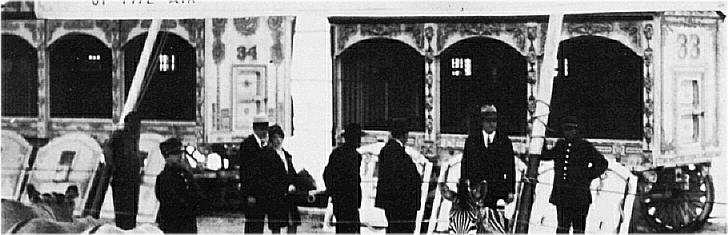
The units in the parade were kept about 40 feet apart to create length. The big show band which had 10 pieces was split into two sections riding bandwagons at beginning and end of the parade. The ring master played a bass drum in the second bandwagon giving a total of 11 musicians in all. There was no type of calliope or other musical device in the parade. Unfortunately no photographs of the Lincoln parade have turned up. Jim White remembers that the lead bandwagon had large diamond shaped mirrors on the sides and that the wagon had come from Walter L. Main. Photographs used here show a couple of large box-type tableau wagons which were used for parade purposes. These appear to have been lettered with the show's title and well decorated with carvings and painted designs. One seems to have had dragon paintings on the sides. The cages were all similiar to the one shown in photo no. 4.
Charlie Curran's sideshow was fronted by a beautiful bannerline consisting of 10 banners plus an entrance banner bearing the show's title. These were new and were painted in New York City and especially designed for the Lincoln show. It made a great flash and gave true class to the midway. There were a number of typical sideshow acts, some handled by regular big show performers. For example Dolly La Toe, who did iron jaw and rolling globe acts in the big show performance doubled as a snake charmer in the sideshow. Other attractions included a Hindu act, fortune teller, Bertina, handcuff escape artist, and Manager Curran and his wife with a mind reading act. Joseph Hall led the sideshow band of 6 pieces and Charles Cameron had a 3 piece Scotch bag pipe band. Some 12 different acts were presented in the sideshow.
Photo No. 8 - Sideshow bannerline used by Perry Bros. Circus. Note it is same as the one used by Lincoln Bros. Circus in 1921 (see Photo No. 3) only change being the Perry Bros, title has been tacked over the former Lincoln name. This is presumed to have been the Perry Bros, wagon circus owned by A. O. Perry which was on the road in 1925. Photo courtesy of Mrs. Harry S. Palmer.Ticket prices for the big show were 50¢ for general admission with reserves going for an additional 25¢. Tickets for the after-show concert were a dime with the same price for the sideshow.
Jim White says as a clown his salary was $15.00 a week, which was the same as paid bandsmen, but later when Jim took over as producing clown he got an additional five bucks.
The 1921 Lincoln Bros, performance changed frequently due to acts coming and going but generally there were about 16 displays. John Cutler caught the opening performance and with his recollection plus that of Jim White he has listed the big show program.
The Performance
Grand Entrance, Band Playing A March. Equestrian Director, Doc Whitman.
Other acts which were on the show part of the time included the Leahy Brothers, Jerome and Charles, who did Roman rings and clowning. White also recalls that "Dave", a negro, rode a bucking mule in the performance. Mule would let no one but Dave ride him. Doc Whitman also worked 12 liberty ponies and some reports say at times Bertina, the sideshow artist, worked them. The Billboard also mentions the following acts at times being in the performance, Lucerne sisters, wire walkers, Welsh, Farrell, and Lavoy, casting act, and Fred Walters and his 3 dancing bears. White mentioned that both Eddie McDougald and John Tunello were clowns and doubled as such when not performing their acts. Buck Leahy began the season as producing clown and was later succeeded by White. Other clowns on the show at times during the season included Eddie Leahy, Tom Callahan, Charles Happy Johnson, and Bill Barry. The show always had from 6 to 8 joeys.
The after show concert was listed by Jim White as follows:
White says sometimes the concert featured a wrestler, billed as "Samson", a former navy man, who would meet all comers. White says a little twist was added to this once popular concert feature in that a girl wrestler, Bobby Miller, would be in the blue seats and when they would call for someone to wrestle Samson she would be right there, and White recalls she knew how to handle herself well.
The Lincoln Bros. Circus opened the 1921 season on April 28 at E. Greenwich, R. I. and the Billboard reported the event as follows: "Lincoln Bros. Circus and Trained Animal Shows opened the season at East Greenwich, R. I. last week to good business at both performances. The enormous spread of canvas gave the appearance of a small Barnum show. The street parade was given at 12 o'clock and was viewed by thousands of people in the downtown streets. A large crowd followed the parade to the showgrounds where the sideshow and pit shows were opened and did a thriving business. The sideshow is under direction of Chas. F. Curran who has double decked pictorial banners."
This article sent in by Sam Freed of the show's press department filled it with some of the exaggeration bally which was typical in those days. Sam summed up the report as follows - "Lincoln Bros, is one of the largest wagon shows that has toured this country in a number of years . . . H. S. Palmer, the genial manager, has worked untiringly to make the show the success it is proving to be. If he has overlooked anything it has not been discovered."
Freed was correct in that it was a good looking show on the lot and that Palmer had taken a lot of pride to put out a fine wagon show. Jim White, who was with it, sums up his observation of the Lincoln show by saying, "it had a good show in the big top and Palmer had experienced circus men on the show. The parade was small but playing in rural areas mainly meant there would be no large crowds to see it."
Recently at the request of the author CHS Steve Sullivan researched local libraries and newspaper files in the Providence area to see if he could find any Lincoln Bros, advertisements or stories about the show. Fortunately he did and we are pleased to reproduce two. He located one advertisement in April 21, 1921 edition of the Rhode Island Pendulum. (Incident-ly these files were actually located at the Providence headquarters of the Rhode Island Historical Society) and also in the same edition he found what was probably the first press release of the Lincoln show. The article read as follows:
Rhode Island Pendulum, April 21,1921 -"LINCOLN BROTHERS CIRCUS to exhibit at East Greenwich. The Famous Lincoln Brothers Circus and Trained Animal Shows combined, which will exhibit at East Greenwich, Thursday, April 28th. has some of the finest trained ponies and horses ever exhibited by any show according to C. P. Farrington, the general agent of the shows, who was in East Greenwich with the advance men this week.
"While men and women and children are always much interested in the animal acts, it is a well known fact that the majority of the circus goers prefer the acts where the performers' lives seem to hang by a mere thread. In the Lincoln Brothers Circus the patrons will see many acts that will excite the apprehension of the beholders lest the performers shall be killed. The daring feats of the aerialists high up in the dome of the big top without a bit of netting beneath the slides for life; the daring acrobats, turning one and two complete revolutions in mid air all abound in hair-breath scares of one form or another. Aside from the marvelous feats of strength and skill of the performers the incredible stunts performed by the famous Lincoln Brothers ponies, horses, and mules will bring forth limitless praise and admiration.
"The grand free street parade will move over the principal streets at noon and two performances will be given at 2 and 8 o'clock. The doors will be opened one hour earlier to permit the patrons to view the menagerie and listen to the concert given by the Lincoln Brothers Famous Circus Band."
While perusing the newspaper files Sullivan also noted that competing for the populace money on opening day were the local movie houses showings of Pola Negri in "Passion" and Tom Mix in "Road Demon". Sullivan says that neither of the two Providence dailies mentioned the Lincoln show.
General agent C. P. Farrington had six assistants on the advance, which included several billers, who according to White "put up a lot of paper". The show also used newspaper ads and stories and generally had adequate advertising for a show of this size and nature. White says that Farrington was a competent general agent and that had he not left the show very soon in the season it is his opinion the Lincoln circus may have been able to make it.
Leaving the opening stand at East Greenwich the Lincoln show started on it's season's tour, following mainly an old Sig Sautelle wagon show route. Jumps were rather short, around 5 to 10 miles, with the longest being 26. Lincoln Bros, travelled and operated in much the same manner as did all wagon shows of that period. White recalls that the circus supplied meals and hotel rooms at times - at other times merely floor space and blankets in an empty hall, but this was only for performers, bandsmen and executives. A workingman slept under the stars, or maybe under a wagon all season long. He'd never get inside a building. White says the guy who had charge of the reserved seats (most of the season, Sam Freed) had the task of getting the hotels or halls to sleep in. The heavy equipment usually moved overland at night with the executives, band, and performers travelling in the early morning. Roads in well populated New England in which the show was routed usually were in pretty fair condition but of course heavy rain and mud would complicate the moves at times.
Farrington, who knew his job, was quite frank in his opinion of business the 1921 season would bring when he wrote in the April 9 Billboard - "Have looked over New York state and New England area pretty well and can see a very lean season for all shows. I know the majority of show people try to make ourselves believe that business will pick up and that it will be a great year. I don't expect to make much money this season, but one thing that I will do is to show the natives what I think is the finest wagon circus that has been out in 20 years." Farrington's prophecy turned out to be all too true for many shows, including Lincoln Bros. The 1921 season was a rough one for most shows as the recession which had set in following the lush postwar seasons of 1919 and 1920 made slim pickings in much of the nation.
Opposition from other circuses hurt Lincoln's business from the very beginning. Steve Sullivan noted in the local newspaper files that when the show opened there was a "Whizaling Circus" playing the Pawtucket Armory. From accounts it seemed this was some kind of annual indoor show put on to raise money for the Y.W.C.A. Jim White recalls that heavy opposition was encountered from the Hathaway & Lombard Circus, a wagon show, owned by George Manchester. This one would often be pulling off the same lot when Lincoln Bros. would be moving on. Another factor which must be considered in case of a circus the size of Lincoln Bros. is that the territory it played was heavily populated and the large railroad shows would play the bigger towns and consequently cover the surrounding countryside with it's paper. Many potential patrons of the smaller overland shows would take off the few miles to the big city and spend their money on the railroad show and as White pointed out it was hard to then sell the natives on Lincoln Bros. after they had seen Ringling-Barnum or Sells-Floto.
The 1921 Lincoln route put the show into mainly small rural towns but also it was in some pretty big places and a number of suburbs, such as the next two stands after the opening in which it played Thornton and Central Falls, both in Rhode Island, before moving then into Massachusetts where it was at North Attleboro on May 2.
White says that the first sign of trouble on the new Lincoln show came on May 5 at Foxboro, Mass. when it couldn't get on the lot as the place was under water due to heavy rains and consequently the entire day was lost. It was also at Foxboro when Farrington quit as general agent, although White doesn't know the reason why. He was succeeded by Jack Lowery and Sam Freed but it was said neither had Farrington's ability. However, this change of general agents wasn't the only factor for the show's subsequent failure. Main point was that the show was just not drawing as it should due to the economic recession, heavy opposition, and possibly a new title in an area which was covered by other better known shows all competing for the patrons dwindling dollar.
The Lincoln show remained in Massachusetts until June 23. At Amesbury on May 28 the Leahy brothers left and joined the Hi Henry Minstrels. Jim White took over the job of producing clown. The show continued to claim good business all thru Massachusetts in printed accounts in the trade publications. Sam Freed, newly appointed general agent, wrote to The Billboard that while in Ayers, Mass. on business for Lincoln Bros. he paid the Cole Bros. Circus a visit and had dinner with "Governor" E. H. Jones and shook hands with many old timers. Sam wrote that Cole Bros, operated by Jones, was a fine two car show but mentioned that Lincoln Bros, was getting it's share of business in the Bay State.
Joe Thayer, a Billboard correspondent, visited Lincoln at Saugis, Mass. on June 8 and wrote - "I found the show larger than any wagon show that had been that way in years. The outfit, tents, etc., is nearly all new - everything about the show and on the lot is neat and clean. They have an excellent "all American band" of 12 pieces and the parade is a feature. Business has been good despite much opposition." (Author's note. In researching material in the immediate post World War I years concerning circuses such terms as "all American band" which nowdays seem strange is a reflection on those particular times. With anarchy and communism spreading thru much of Europe and fear of same here in U.S. present in many of the populace minds, there was much suspect of anyone of immediate European origin, especially Italian or Eastern European or just "foreigners" in general. Shows would often pride themselves of having "all American performers, band etc.")
The show entered Connecticut June 24 at Stafford Springs and played an additional nine stands in the state before entering New York at Millerton on July 6. An advertisement in the July 2 Billboard read as follows: "Lincoln Bros, wants slide and cornet for Big Show Band, performers doing two or more acts, good team, man, and wife, doing trap, rings. Want workingmen in all departments."
Considerable turnover of personnel and performers had recently taken place and the July 16 Billboard mentioned some of them. The aerial Callahans left at Plainville, Conn. on June 29 and were replaced by the Aerial Walters, who in addition to their regular act did a concert turn. Clarence (Francis) Wood, novelty hoop juggler, was now equestrian director replacing Doc Whitman who had left, and was also doing two acts in the performance. Prof. Bertina was now working the ponies. Acme and Smith, comedy acrobats, joined at Winsted, Conn. on July 4. This rather large number of personnel turnovers would indicate that things were not going well on the show despite the continued claims of "big business". Sam J. Banks wrote in the July 23 Billboard that Harry Palmer was doing well with his little overland circus, and Banks noted this was Harry's first experience in circus business.
Real trouble hit the show in New York state when the Watch and Ward Society, an organization forprevention of cruelty to animals, claimed the Lincoln Bros. horses were overworked and succeeded in haulting the show until the matter was reconciled. However four days were lost, July 12 thru 15, when the show was idled. Loss of the potential business was another blow to the already strained financial position of the show.
The sixteenth stand in New York state was at Athens on July 28 where two performances were given. Although there was no prior notification that the show would close, Athens was the final date. Jim White doesn't know the details as to the reason of the show's sudden closing other than it is presumed to have been caused by poor business and no further funds to keep it operating. He says the show remained "anchored" on the Athens lot four days and then was taken down and shipped off to an unknown destination and stored in a barn. Jim says Palmer was not around the show and no more dates were lined up so he left after staying around for two and a half days. Jim recalls bringing a bucket of hot water from a hotel nearby and also sticking eating utensils in the sand to rough clean them off while the show was stranded.
Very little was said about the Lincoln show's closing in the trade publications. The August 6, 1921 Billboard had only the following short paragraph - "Lincoln Bros. Circus Closes at Athens, N.Y. Sam Freed, who was business manager and legal adjuster, of Lincoln Bros. Circus writes that the show closed July 28 at Athens, N.Y. after a tour of three months thru Rhode Island, Conn., Mass., and New York. Everyone with the show was paid."
A thorough search of the Billboard files failed to turn up any further information on the show. This past summer (1971) Steve Sullivan made a trip to Athens, N.Y. to attempt to get some info on the demise of the Lincoln show. The only newspaper actually published in Athens in 1921 had gone out of business some years back and the party who scrapped it said files etc. went for junk value. The local library yielded nothing and searches in nearby libraries likewise produced nothing. No "oldtimers" could be found to recall the death of the Lincoln show. Steve did take a photo of the Athens Hotel and Jim White upon seeing it prounced it had changed little in the half century since he stayed there following the close of Lincoln Bros. White said he had heard that the barn containing the Lincoln equipment had later burned and all was lost.
John Cutler, who met Mr. Palmer fifty years ago on the lot at the Lincoln Bros. opening stand, said that after Palmer retired from show business he settled in DuQuoin, Illinois and was in the printing business until his death some years ago. Fortunately John had an address so the author contacted Palmer's widow, Mrs. Gladys Palmer of DuQuoin. Mrs. Palmer very graciously furnished considerable information about her late husband's career in showbusiness and also kindly loaned a number of photographs and illustrations which are printed with this article.
Mrs. Palmer says she did not meet Mr. Palmer until 1932. They were married in 1942. She is not sure of just what show activities Mr. Palmer was engaged in up until he took out a minstrel show in 1927. It is her understanding his circus equipment was lost when a fire destroyed the building in which it was stored. She believes this fire was in Boston about 1924, maybe earlier. A most interesting photo which she sent is no. 8 which shows the same sideshow bannerline Lincoln Bros. used in 1921 but with the title of Perry Bros, tacked over the Lincoln name. The only Perry Bros. listed in the Sturtevant files is the wagon circus by that name which was put out in 1925 by A. O. Perry opening at Bassett, Neb. on May 2. A search of the Billboard files and Perry Bros. roster failed to turn up any information as to whether or not Harry S. Palmer was connected with it. In any event he must have sold the sideshow bannerline to Perry, at least somehow it got there. A perusal of photos no. 8 and no. 3 will show that the bannerlines are one and the same despite some of the individual banners being in different order of location. It is presumed the bannerline was on the 1925 Perry Bros. show.
In 1927 Harry Palmer organized and put on the road under canvas the J. C. Lincoln's Sunny South Minstrels. It was motorized and travelled on probably half a dozen trucks. It is not known whether or not Palmer had the show out every season but photos indicate it was on the road at least for 1930 and 1931 seasons. Mrs. Palmer says that Harry's last show was also a minstrel show under canvas and went out of Dothan, Ala. in 1934. It was motorized and also used the J. C. Lincoln title. Photographs indicate the tent was about a 60 ft. round with three 20 ft. middles most of the time but at others it seems a square end tent was used which was usually customary for minstrel or dramatic shows. Mrs. Palmer said the minstrel show had 87 people connected with it and that J. W. Foster, known as "Jockey" was the advance man for several years. Palmer's show was one of the last old time minstrel shows under canvas to tour the country. He closed the show in Centralia, Illinois in 1938 and retired from show business for good. He moved to DuQuoin, 111. where he started the Palmer Press, a printing firm, which he operated until his death Nov. 3, 1958.
Recording of the Lincoln Bros. Circus in print has long been a desire of CHS members living in Rhode Island and the surrounding area. Ed Tracy began gathering material on the show some years ago and recently turned over his files to the author to complete the article. John Cutler was most helpful in providing all kinds of data on the show plus photographs. Steve Sullivan and Tom Kulbasky aided the cause greatly by conducting interviews and Steve made field trips to local libraries and newspaper offices in search of Lincoln material and as mentioned previously went to Athens, N.Y. in search of information on the closing of the show. But Jim White, former clown who was on the show in 1921, should be credited with making the greatest contribution with the detailed information so necessary for an article such as this. His recollections, notes, and overall helpful attitude were invaluable to the author. In fact John Cutler says the credits given to him should in reality all go to Jim White. Thanks also go to Fred Pfening Jr. for providing photos and finally we must express our appreciation to Mrs. Harry S. Palmer for providing valuable information on the minstrel show and Mr. Palmer's life after the 1921 Lincoln Bros. Circus and for her generous loan of the splendid photographs which are reproduced here.Route of Lincoln Bros Circus. Season of 1921
|
April
|
|
June
|
July 12-15 did not exhibit due to charges by Watch and Ward Society claiming that the horses were overworked. Show resumed it's route on July 16
St. George and the Dragon Telescoping Tableau
Richard E. Conover, Bandwagon, Vol. 15, No. 6 (Nov-Dec), 1971, pp. 13-15.
Unlike the Five Graces, no controversy has arisen over the suitability of the names that have been associated with this wagon. In its original configuration the top-mounted figure of St. George in the act of slaying the fabled dragon well described its predominate theme, while its latter-day name of the Lion & Mirror Bandwagon accurately reflects all that this generation has ever seen of it. The earliest references that I have found of this Forepaugh parade wagon date no farther back than 1881. It was originally a true telescoper similiar to the 1871 Howes Great London Circus examples.
In my 1956 pamphlet, The Telescoping Tableaus, I introduced some non-conclusive evidence (that will be updated herein) which strongly indicated that this tableau was imported from England. Nothing really substantial from which to further resolve this facet of its history has been added to the information that was at hand in 1956. We can only speculate now, since it has been resolved that the Five Graces did not have a telescoping mechanism and since the Graces was the only one of the four towering tableaus definitely known to have been made in the States, the likelihood of the St. George coming from the same foreign source that built the 1871 Howes tableaus is a bit more plausible. Living on this side of the Atlantic, it is virtually impossible to get any further leads because none of my British contemporaries have any knowledge whatsoever in their long-gone parade wagons or the manufacturers thereof, nor do they know of a single authority on the subject. It would even help to know if the limeys of the last century were accustomed to seeking gastromomic relief from Hostetter's Celebrated Stomach Bitters or if this engraving, which obviously was the inspiration for the theme figure of this tableau, was used to pitch some other product in their domain. Here in America it had been doing it since as early as 1863. There has, however, been one additional minor item turn up since 1956 that gives some, although weak, support to the old evidence. This is from a review of the Ringling parade in the Columbus, Ohio, Dispatch of 11 September 1893 which read: "- their bandwagon is of English manufacture - " referring, of course, to the Lion & Mirror which at that time was Ringling's lead bandwagon. It would only be a little less logical to dismiss this as pure propaganda.
The only available photograph of the St. George Tableau in its original configuration, one of a set of three logically important ones for the immediate purpose, was made in Lansing, Michigan, on 28 May 1887. A second photograph in this set shows the Five Graces after its top-mounted globe-lion group had been removed and the third of the set is of this same globe-lion group on its first set of running gears. While this Lansing picture is the earliest one of the Five Graces that we have, it has been omitted because, besides being photographically inferior to others, it is believed that its logical importance can be adequately introduced without displaying the actual photograph.
Sometime between the 1887 date of the Lansing pictures and the fall of 1890 another set of significant pictures were made at the Forepaugh winterquarters in Philadelphia. One of the set is of a small float carrying what had been the top and theme figure of the St. George Tableau in the 1887 picture. The upper limit of the 1887-1890 allowable span of years in which this top could have been removed can be set by three items that appeared in the Clipper in the fall of 1890, the date that fixes the sale of the main body, the St. George Float, and another tableau to the Ringlings. The earliest of these Clipper items is also our best evidence to support the possibility of its foreign origin; it being a Forepaugh advertisement that appeared on 22 November 1890. The second item was another ad that was run on the 27th of December. Examination of the fine print in these sale offerings will reveal that the "2 Big English Chariots, one suitable for a bandwagon" appeared only in the 22nd of November insertion. This coupled with a news item in the December 20 issue, which placed John and Otto Ringling at the Forepaugh quarters in Philadelphia, recently, where they acquired several chariots, accounts for the ommission of these items from the second advertisement.
Photo No. 2. Lion and Mirror bandwagon on the lot of the Ringling Bros. World's Greatest Show, Algona, Iowa. 1894. Notice the new, lighter undercarriage. Circus World Museum Collection.A long-standing tradition, crediting the Moeller Brothers with rebuilding the St. George into the Lion & Mirror Bandwagon, can now be explored as being 99% myth. This story, generic from the late Henry Moeller, has been that the St. George arrived intact in Baraboo in 1890 and that it was the Moellers who dismantled it, set the St. George figure on its separate platform-gear, performed the necessary modifications to the main body to convert it to the bandwagon, and built another float (unidentified) out of the parts surrounding the rectangular well through which the telescoping figure had operated. Since 1956 two more photographs, definitely know to be Ringling in the 1890's, have been made available. One of these is of the St. George Float on exactly the same gear that it was on in the Philadelphia picture. The other is one of the best of several available showing the rectangular well still in place on the Lion & Mirror. Actually, the railing for this former well was still in place until shortly before 1900; so other than possibly decking in the opening it is certainly not apparent just what this "major" Moeller conversion job could have amounted to. Still it will always be pleasant to remember the convincing twinkle in Henry Moeller's eye when he told the story. That is the way he was living the event so many, many years later.
Pictures of the St. George Float in Ringling parades seem to be practically non-existent. Either from route books or from newspaper accounts its presence there can be traced through 1896. Between then and 1900 when we begin to get substantial photographic coverage of the Ringling parade there is almost a void of any information. So far the St. George has not appeared in any vintage 1900 photographs, and since by then there were several new floats in evidence, it can be surmised that it had been retired. In 1913 it, plus two tableaus and two cages from the 1912 surplus list, were sold to J. H. Garrett for his second try at Rice Brothers. That attempt lasted for most of the season but for the next year and a half its chattels were shuttled about the country while Garrett and W. E. Franklin (erstwhile general agent, partner in King & Franklin, John Robinson & Franklin Brothers, etc.) who held the mortgage fought it out in the courts. Franklin finally won out and in September 1915 sold all that had not been stolen off to the Wortham Carnival. Only two fragments of this property have ever turned up in subsequent pictures; one of the cages that was purchased from Ringling that dates back to the Forepaugh-Sells turns up on Mugivan and Bowers' Howes Great London and an old Campbell Brothers cage was still at the Wortham quarters in San Antonio in the 1920's. The trail of the St. George Float, at the moment, is still cold.
From 1891 and until 1905, when the new Swan Bandwagon with its twenty-four horse hitch was brought on, the Lion & Mirror was the Ringling No. 1 Bandwagon; after which it became the second or sometimes the side show bandwagon. In January 1915 it was in the Moeller shops for its yearly repair work for the last time, the year corresponding with its last mention the parade list. At this juncture it joined the Swan Bandwagon in the storage shed, which as mentioned before had been there since 1912. There they remained until George Christy bought them on 14 November 1925. In this purchase Christy acquired the two bandwagons, two unidentified cages, and three of the allegorical pony floats for $4,000. Christy did not route his show to Baraboo until 30 May 1927 when he picked up both the bandwagons, and one or both the cages. He did not get the pony floats because, meanwhile, Fred Buchanan had been there, bribed the attendant of the abandoned quarters for the key, stole the floats, and attached them to his Robbins Brothers Circus. George Christy's revelations about this incident sure clears up the unlogical tradition that Buchanan acquired these floats from Bridgeport because it has been unlogical for them to have been there since they did not leave Baraboo with the Ringling train in 1918.
The last year for the Christy Brothers Circus was 1930. George Christy retained all of the property at his Houston, Texas, quarters until late in 1934 when he sold a parcel, including the Lion & Mirror, to the newly organizing Cole Brothers Circus with headquarters at Rochester, Indiana. Cole used it in 1935, '36, and '37 and returned it because it was no longer servicable. For almost a decade, it sat in a wagon shed in Rochester. By early 1948 it had been moved to a farm near Rochester where it was left outside exposed to the elements. That would have been the finish of it if the Block & Kuhl Department Store of Peoria, Illinois had not acquired and restored it for use in their annual Thanksgiving Day parades. After the 1961 parade it was presented to the Circus World Museum in Baraboo, Wisconsin where it is at this date this is being written.
The Corporation Cages
Stuart Thayer, Bandwagon, Vol. 15, No. 6 (Nov-Dec), 1971, pp. 20-24.
The American Circus Corporation began a program of wagon building in the winter of 1921 that lasted through the winter of 1928. It might have gone on beyond then except that the Corporation was sold to John Ringling in 1929. One result of this program was a group of cages that are probably the best known such vehicles in circus history. Certainly they were the most photographed, and it is quite possible such a large, homogenous group was never before produced.
The equipment on the Corporation circuses was wearing out by 1921. Much of the Sells-Floto equipment dated back to 1907; Hagenbeck and Wallace still had Great Wallace wagons from before 1900 and Carl Hagenbeck equipment from 1904 and the John Robinson Circus was using vehicles from the Howes and Sanger shows that had carried the flag since 1910 or thereabouts. Illustrative of this situation is the letter quoted by Albert Conover (John Robinson's Circus, Season of 1928, Bandwagon, May-June, 1970) from Louis B. Chase, manager of the show, to Jerry Mugivan in which he says that the cage wheels were crumbling, the floors warping and the bars rusting.
William H. "Cap" Curtis (1873 - 1955) was in charge of the shops at the Peru, Indiana winter quarters of the Corporation shows and it was under his direction that the new baggage wagons and cages were built. Curtis is best known as the inventor of the canvas spool wagon and the automatic seat wagon. His baggage wagons were square, squat and built for heavy use and a long life. These cages could well be defined the same way for they are really baggage wagons with bars.
As they came out of the shops the cages most likely went first to Sells-Floto and then to Hagenbeck-Wallace. The John Robinson production was the last of the effort. Known since as the Curtis or Corporation cages they are the circus to many people as, aside from the Ringling-Barnum property, these were the chief railroad dens one saw throughout the 1930's. Three of them are still bringing pleasure to the public as part of the collection at the Circus World Museum.
Of the twenty-three wagons identified in this research one was divided into four sections, four into two sections and eighteen into three sections. The other was the hippopotamus den. Over the years modifications were made in the interior divisions so that the number of exterior sections did not always indicate the number of separate compartments. The carvings used to decorate the cages were of the simplest, machine-made type often used in the interior decoration of dwellings. They consisted mostly of roundels, circles, diamonds and fluted squares. With only a dozen to fifteen different carvings the shop was unable to make each cage's embellishment unique. In time, the carvings were changed, usually removed so that careful analysis is necessary in tracing individual units.
The John Robinson group, the ones built in the winter of 1928-1929, differ from the others in that their roofs curve sharply and their skyboards are uniformly scalloped. Of the lot, these are the most pleasing to the eye.
The John Robinson Circus went off the road after the 1930 season and Sells-Floto after the 1932 season. These cages piled up in Peru and the Hagenbeck-Wallace management took its pick of them every season the show went out until the last one in 1938. After that the wagons that trouped were to be seen on Ringling-Barnum, Cole Brothers and Arthur Brothers. In 1941 a large group of them were burned in Peru in order that the scrap metal might be salvaged for the World War II reclamation drive. Cecil B. DeMille destroyed several more of them in 1951 in the production of his motion picture, "The Greatest Show on Earth".
In the following catalogue of these wagons the initials and numbers indicate the circus on which the earliest number identification was made. The John Robinson group is listed together at the end so as not to confuse the numbering sequence. Duplicate numbers are the result of renumbering from season to season and show to show. The range of photographs of these wagons on Sells-Floto in the 1920*8 is very limited so the list is heavy with Hagenbeck-Wallace numbers. All the photographs are from the Pfening Collection though research was also done in the Conover Collection and at the Circus World Museum.
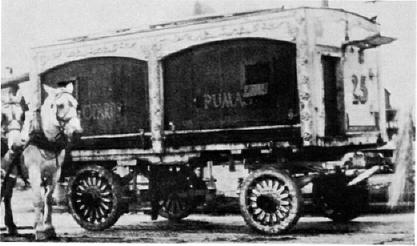
Hagenbeck-Wallace #3. This two sectioned cage was one of the earliest supplied to Hagenbeck-Wallace. It was probably built in 1922 or 1923. Still numbered 3 in 1933, it appears here as 25 which it was in 1934, but by 1937 it had become number 26. It was burned in Peru in 1941. Photo, Thayer Collection.
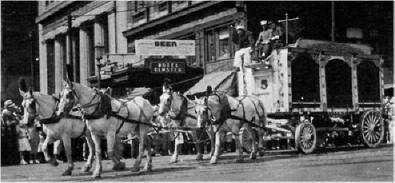
Hagenbeck-Wallace No. 5. This cage appears on Sells-Floto in 1924, but its number at that time is unknown. Within a year or two it replaced the old Carl Hagenbeck kangaroo cage (numerically speaking) on Hagenbeck-Wallace and went out with that circus at least through 1934. Photo, Pfening Collection.
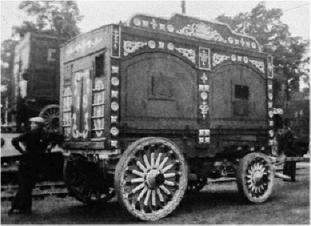
John Robinson No. 12. This was the pygmy hippo den on Hagenbeck-Wallace in 1924 and could have been number 50 at that time. By 1927 it, with the pygmy hippo, had moved to Sells-Floto and in 1929 and 1930 it was on John Robinson where it was number 12. In 1934 it was number 9 on Hagenbeck-Wallace. It was left in Peru in 1938 and Cole Brothers bought it in 1940 after their fire at Rochester, Indiana. As number 18 it was ten years with Cole Brothers and went into the Kelley Farm in Peru in 1950. Presumably, it rotted away. Photo, Thayer Collection.
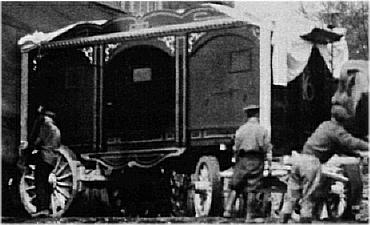
Hagenbeck-Wallace No. 16(A). It is possible that this wagon is not properly part of this construction. The carvings and shape of it, however, identify it as Curtis-built and it may have served as a pattern for the others. It was a cat cage on Hagenbeck-Wallace in 1922, 1923 and 1924. It may have been retired by 1935. Photo, Pfening Collection.
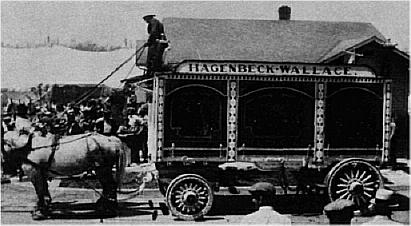
Hagenbeck-Wallace No. 19. Sells-Floto had a cage numbered 19 from 1924 through 1930 and this may have been it. It definitely carried the number on Hagenbeck-Wallace from 1932 through 1937. It probably was burned in 1941. Photo, Pfening Collection.
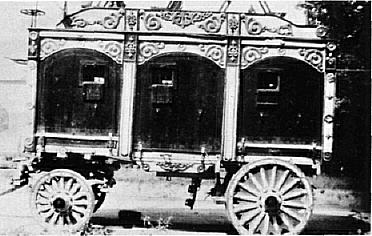
Sells-Floto No. 20. On Sells-Floto by 1930 this one was very likely there earlier. It stayed with the show through 1932 and went out with Hagenbeck-Wallace as number 31 from 1933 through 1937. It stayed in Peru in 1938 and was possibly one of those burned in 1941. Photo, Thayer Collection.
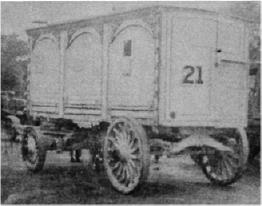
Hagenbeck-Wallace No. 21. One of the four survivors of all these cages, this one is now at the Circus World Museum where it retains its Hagenbeck-Wallace number. It was on that show in 1937 and 1938 and went to Louis Gobel's animal farm in Thousand Oaks, California when the Bary-leased Hagenbeck show folded in 1938. It went to Baraboo in 1964. Photo, Pfening Collection.
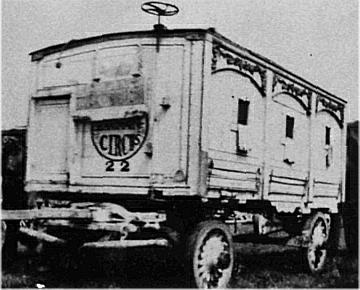
Hagenbeck-Wallace No. 22. This wagon went the route Howard Bary, Louis Gobel, Cole Brothers. It was left in Peru in 1937 and in Thousand Oaks in 1939. Cole Brothers bought it in 1940 and it was still on the show in 1950, having survived the California train wreck of September, 1946 in photos of which it is prominent. It apparently came to grief on the Kelley Farm. Photo, Pfening Collection.
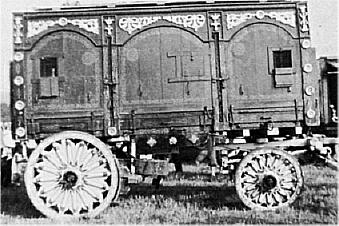
Hagenbeck-Wallace No. 24. Another survivor, this one is now number 24 at the Circus World Museum. It was on Hagenbeck-Wallace as early as 1933 and rested with Louis Gobel from 1938 to 1964. Photo, Al Conover Collection.
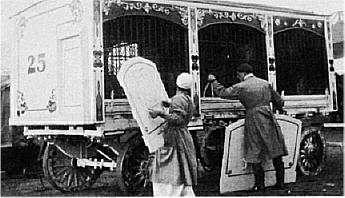
Hagenbeck-Wallace No. 25. This one and Hagenbeck-Wallace No. 22 are alike, but for the carvings on the first of the three sections. On Hagenbeck- Wallace possibly as early as 1931 it was still there to travel west with Howard Y. Bary and end up with Louis Gobel. In 1945 Arthur Brothers Circus leased it from Gobel and numbered it 85. After that unsuccessful season it became the property of a private collector. Photo, Pfening Collection.
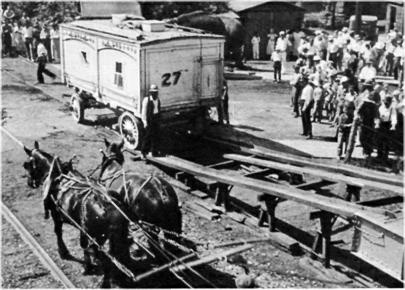
Hagenbeck-Wallace No. 27. The earliest photograph that could be found for this cage is dated 1934. It, too, went to Gobel and Arthur Brothers where it was number 95. Returned to Thousand Oaks after the 1945 season it remained there until 1951 when it was bought and destroyed as a prop in the motion picture, "The Greatest Show on Earth." Photo, Pfening Collection.
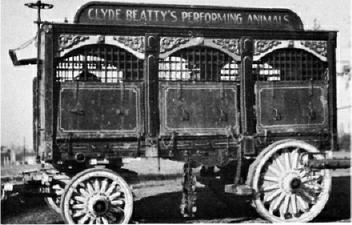
Hagenbeck-Wallace No. 28(A). Two vehicles in the group carried this number on Hagenbeck-Wallace, though at different times. This three-section cage was there in 1933 and 1934. The show didn't go out in 1936 and this one must have remained at Peru until the burning in 1941. Photo, Pfening Collection.
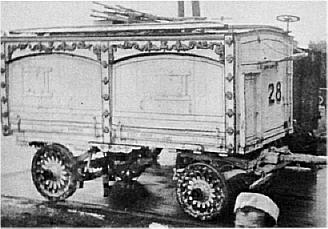
Hagenbeck-Wallace No. 28(B). On Sells-Floto in 1929, where its number could not be determined, this den was 28 on Hagenbeck-Wallace by 1935. It went to Thousand Oaks and from there to the Circus World Museum. It is now number 25 at the museum. Photo, Pfening Collection.
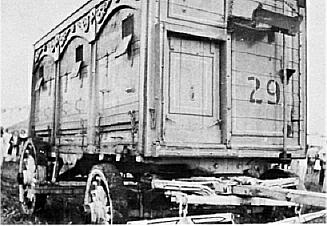
Hagenbeck-Wallace No. 29(A). As with the number 28 there were two separate number 29's on Hagenbeck-Wallace. One is listed below with the John Robinson group. This cage carried the number in 1937 and 1938. It ended up at Louis Gobel's and was one of those destroyed for the movies in 1951. Photo, Pfening Collection.
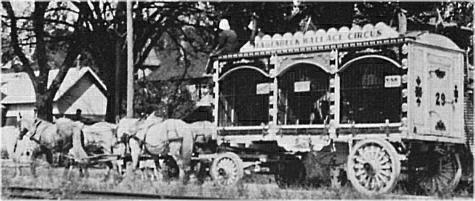
Hagenbeck-Wallace No. 29(B). This wagon was so numbered for the period 1931 to 1934, but may not have been on the road each of those four seasons. It appears not to have been picked from the surplus in Peru for either 1937or 1938 and must have perished in the fires of 1941. Photo, Pfening Collection.
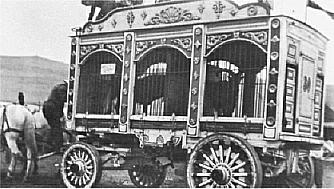
Sells-Floto No. 30. One of the examples of the same number being continued between shows this was on Sells-Floto in 1929. In 1933 it moved to Hagenbeck-Wallace with no change in number and went out through the 1935 season. It apparently never left Peru again and must have been burned in 1941. Photo, Pfening Collection.
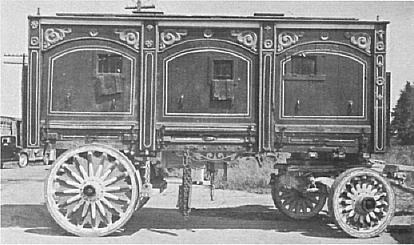
Sells-Floto No. 31. Sells-Floto carried this one at least by 1932, probably much earlier. It went to Hagenbeck-Wallace in 1933 and was numbered 20. On the road through the disastrous 1938 season it stayed at Thousand Oaks until 1951. In that year it became one of those in the movie wreck scenes. Photo, Pfening Collection.
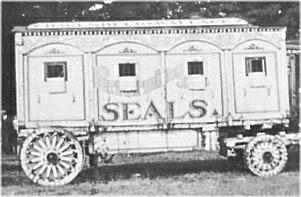
Sells-Floto No. 32. This was the only four-arched cage in the subject group. Fitted with a tank for seals it was on Sells-Floto as early as 1928. In 1933, 1934 and 1935 it was number 32 on Hagenbeck-Wallace. Since it doesn't appear again after the 1936 interruption the assumption must be that it was burned in 1941 in Peru. Photo, Pfening Collection.
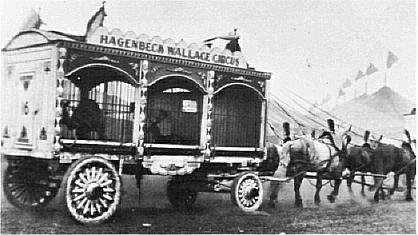
Hagenbeck-Wallace No. 16(B). These were all built in the winter of 1928-1929. It is assumed they were numbered 33 through 37, excepting the hippo den, and that the Sells-Floto seal den number 32 was the last of the others built. This one was on Hagenbeck-Wallace by 1932. In 1938 it went to Ringling-Barnum to house Terrell Jacobs' cat act and was numbered 83 at that time. Photo, Pfening Collection.
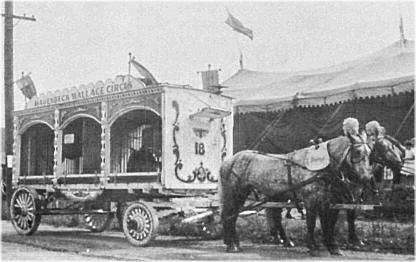
Hagenbeck-Wallace No. 18. A twin of number 16 but for the carving on the mudboard this cage was on John Robinson in 1929 and 1930, as were all six of these. By 1932 this was on Hagenbeck- Wallace. The possibility exists that either this one or number 16 was numbered 30 in 1937. Transferred to Ringling-Barnum for 1938 this was numbered 88. It had no front chute opening. Photo, Pfening Collection.
Hagenbeck-Wallace No. 29(B). This wagon was so numbered for the period 1931 to 1934, but may not have been on the road each of those four seasons. It appears not to have been picked from the surplus in Peru for either 1937or 1938 and must have perished in the fires of 1941. Photo, Pfening Collection.
John Robinson No. 33 (right). This cage does not appear to have gone out with Hagenbeck-Wallace after the John Robinson Circus was taken into Peru after the 1930 season. It went out with Ringling-Barnum in 1938. Photo, Al Conover Collection.
John Robinson No. 34 (left). This one went out with Hagenbeck-Wallace in both 1932 and 1933. It went with Ringling-Barnum in 1938 where it was numbered 92. Photo, Al Conover Collection.
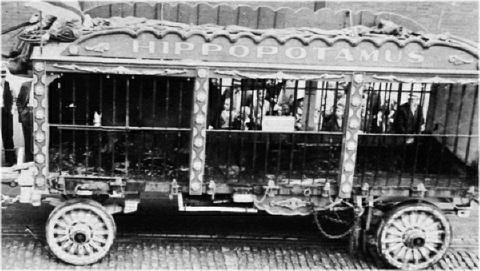
Hippo Den Numbered 30 in 1929 this was the John Robinson hippo den in 1930, also. It went to Hagenbeck-Wallace for 1931 through 1937 and bore number 80 in 1933 and number 14 in 1934. Left in Peru during 1938 and 1939 it was acquired by Cole Brothers, along with its famous occupant "Chester," in 1940. The Cole show gave it number 19.
Tompkins Wild West Show, Supplement II
Joseph T. Bradbury, Bandwagon, Vol. 15, No. 6 (Nov-Dec), 1971, pp. 26-28.
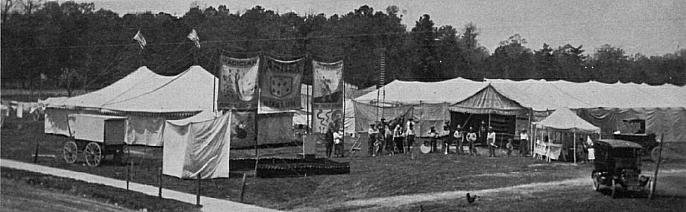
Photo No. 1. Tompkins Wild West Show set up on the lot, season of 1917. From left to right shows the sideshow top and bannerline, the ladder rigging for the high diving dog free act, marquee with arena in background, and concession stand. Automobile on right is probably Col. Tompkins' Maxwell. Chick Varnell Collection.
As a direct result of the publication of the history of the Tompkins Wild West Show 1913-17 in the March-April 1971 Bandwagon and Supplement I in the May-June 1971 issue two former Tompkins troupers have contacted the author and have supplied much additional information on the show as well as interesting photographs.
Chick Varnell, who was on the Tompkins show all five seasons as a performer as well as handling many administrative duties, was one of the former Tompkins men contacting us, the other was S. J. "Tex" Arnold who served as boss hostler on the show in 1916.
Varnell, now retired and living in Greensville, Ohio, first brought to our attention several errors in photo identification in the initial article in the March-April issue. He says that photo No. 6 on page 8 is not Mrs. Mabel Tompkins but instead is Dixie DeVere, a great cowgirl rider. The photo on page 9 showing the sideshow was taken in 1916 instead of 1913. Col. Tompkins is on the ticket box on the left and Varnell on the ticket box on the right. Mal Bates is making the opening and on platform with him is Chief Running Deer and Owasso. Doc Dill is at the entrance doorway. Chick Varnell writes of Col. Charles Tompkins and the Tompkins Wild West Show as follows:
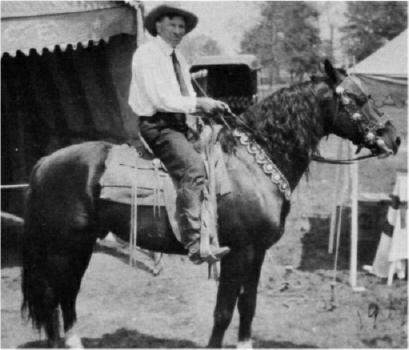
Photo No. 2 - Col. Charles H. Tompkins on his Arabian stallion in front of his show's marquee, season of 1971. Tompkins never allowed anyone else to mount the horse and he never rode it except in parade. Chick Varnell Collection.
"I was particularly interested in your story of the Tompkins Wild West Show. It was probably the best ever written on that show and there was and is an awful lot to be written regarding that outfit. It was one of the best of the time and I should know as I was on the show probably longer than anyone associated with it. I was very closely associated with Col. Charles H. Tompkins, both as a friend and employee. I corresponded with him up to his death. Have been on many outfits from the biggest to the smallest, starting my career back in 1903 on the Hargreaves Circus out of Chester, Pa. (Joe E. Brown also started there) but for some reason the Tompkins show was outstanding. There was a feeling of loyalty that seemed to develop as soon as a performer stepped on the lot. Why this was so no one ever seemed to know.
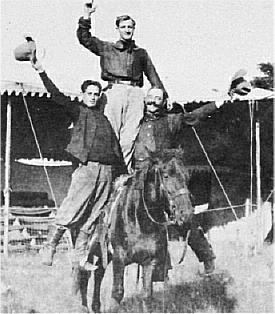 Photo No. 3 - From left to right Augustine Octevero, Chick Varnell, and Hank Drake "showing off" in arena of the Tompkins Wild West Show at a stand in the Shenandoah Valley in Virginia, season of 1916. Photo by S. J. "Tex" Arnold.
"During the life of the Tompkins show there were many of the really big names on the show. To mention just a few Wild West performers - Milt Hinkle (South American Kid), probably the oldest living cowboy of these early days (he's 91 now), Ed Bowman, world's champion trick rider; Lafe Lewman, champion bulldogger; Frank Meany, bronk rider; Augie Ontevares (Gomex), who worked in every picture that Tom Mix made; E. F. "Buck" Moulton, Frank Scott, the great black trick rider; Hank Drake, Jim Pidcock, Shorty McGee and many, many more.
"As the circus portion of the show seems to be in doubt at times here are just a few of the circus attractions on the show at various times, not all by any means at any one time; Chick Varnell, Roman rings, slack wire, also the double act of The Varnells; Flossie Totten, swinging ladder; The Dehoman Bros. acrobatic act; The Emswilers, rings, balancing traps, swinging ladder; Mons. (William) Tessir, wire and head balancing traps; Mal Bates, trick bicycle rider, one of the greatest ever; Eddie Acker, controtionist and clown; Kitty Acker, swinging ladder. There were many others. Some circus acts could not adapt themselves to this type show and would not linger long but at practically all times there was circus representation on the show. This in addition to the trained animal acts. The Parker Anderson dog and pony act was company owned.
"Everybody on the show doubled and sometimes tripled. As for myself I did almost everything on the show that could be done. Beside selling reserved seats and concert and sideshow tickets sometimes I rode in parade in the band, sometimes on a horse, and at times in the clown wagon. At times I would make up from four to six clowns to ride in the parade. These clowns were from the cookhouse and canvas hands. Also I was one of the best rope spinners on the show so often worked in the arena. Other rope spinners were Augie Onteveros, Pete White Cloud, Milt and Helen Dill, and they were all great performers. There were also many Indians at times on the show, also Russian Cossack riders.
"One day on one of his infrequent visits to the show about 1915 Al F. Wheeler asked me why I didn't develop an aerial act to enlarge the show. So when Col. Tompkins asked me to try and break in Flossie Totten in an act I did and found her to be very well fitted and developed a wonderful act. I also broke Flossie in on swinging ladders. She was a protege of Mrs. Tompkins. "Al F. Wheeler was not connected with the Tompkins show during it's final two seasons, 1916 and 1917.
"As far as the motorized part of the show. It never was motorized. First motor on the show was Col. Tompkins' personal car (a Maxwell). Next the ticket wagon was put on a model T. chassis and one advance wagon was put on a truck. Carl Mitchell also later had an auto. That was the extent of the motorization on the show. I drove the ticket wagon over the road, but unfortunately I have not been able to find a photograph of it when it was motorized.
"Upon closing of the 1917 season the show was stored in Union town, Pa. It was scheduled to go out the next year but war conditions were asserting themselves so the plans for 1918 were scratched. I stayed in Uniontown until all canvas was dried and put away. Later some stock was sold, some had been contracted out, and some was shipped west accompanied by the boss hostler who was joining the cavalty at Ft. Sill, Okla. I lost my rigging during the sell off.
"Regarding Col. Tompkins, to give you an insight into the kind of man he was - during the 1915 season in West Virginia a "Hey Rube" broke out during which a towner was killed. The boss hostler was arrested and charged with homicide and held for trial. When the trial was set Col. Tompkins came to and asked me to look after the show while he attended the trial. He stayed away supplying the money and all the legal help until the man was cleared. During that time I did everything from selling big show tickets to keeping the show running. When the Colonel returned he not only paid me but reimbursed me for any commissions I might have lost on concert and reserved seat ticket sales. When I first joined the show I did not drink any coffee. The Colonel asked me what I did drink. I said milk so for the balance of the season there was milk for me at dinner every day."
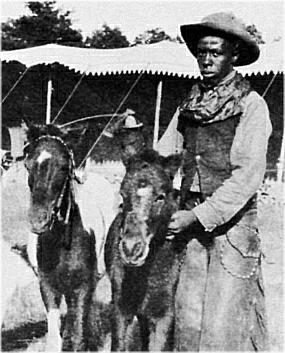 Photo No. 5 - Baby White pony was born earlier in the morning this photo was taken, Oct. 3, 1916 at Tompkins Wild West Show stand in Wardensville, Va. "Bathless" Spivens, pony boy, is in attendance. Photo by S. J. "Tex" Arnold.
S. J. "Tex" Arnold, now retired and living in Orlando, Florida, also provided some most interesting information on the Tompkins show. He writes as follows: "I was boss hostler on the Tompkins Wild West Show in 1916 from March until we went into winterquarters at Warsaw, Va. November 1 after playing Virginia and West Virginia for 7 months with the show on wagons. "There were NO TRUCKS on the show during season of 1916. Charlie and Mabel Tompkins had a 1915 Maxwell touring car with curtains that he drove over the road and carried, "Circus," Mabel's white bull dog with them. The advance had one 1915 Ford single sealer with folding top and Carl Mitchell, bandmaster, drove a 1914 Ford roadster over the road and among his chores was to take me in the car to look over for moving the night train.
"Our local feed contractor was generally our source of information as to the shortest and best road to the next town of showing so Carl Mitchell and I took the 1914 Ford roadster and drove to the next town and back and I carried a small bucket of air slacket white lime dust to mark the roads for the night train. Sometimes we drove as much as 20 or 30 miles over the mountains thru rain all night. All wagons were equipped with a kerosene oil dash lantern that slipped down over the front tail gate of the wagon and the beam shown between the two horses to light up the road for about 300 or 400 feet. And we had a red lantern hung under the axle of the rear wagon.
"If the wagons were loaded we pulled out at 11 P. M. with me in the lead riding a white Indian pony and 9 night baggage wagons following. We sometimes had rain and then again bright moonlight to travel in. We sometimes tipped a wagon over in the mountains and that delayed us getting into town. I kept the tires on the wagons in number one shape and we had very little trouble with the harness. Most of our night trouble was with horses. Some of the older stock just could not take it pulling heavy wagons up and down mountain roads and when a horse gave out we stripped the harness off and rolled the horse out of the road put a new horse in his place and went on toward town. The day train would come leading the horse in the morning.
"Dr. M. C. Turner of Lambertville, N.J. came into the winterquarters at Warsaw, Va. about six days after I arrived and he was very much put out about the condition the horses were in, having been turned into scrub oak brush all winter with no shelter and there were four dead horses and four laid shivering in the morning cool air. Dr. Turner told me he held a mortgage on the horses. During the previous winter the show had wintered on one of his farms in Lambertville, N.J. but in the fall of 1915 cold weather caught the show in Warsaw, Va. so they wintered on the Wallace one hundred acre farm two miles out of Warsaw. The only way to get into Warsaw was to go to Baltimore and take passage on the Maryland, Delaware & Virginia steam packet line and go on a boat down the Potomac River and up the Rappahannock to Wellsford Wharf and then drive through three miles of sand to Warsaw.
"Mrs. Hackney's two horses were kept in the Wallace livery stable back of the Wallace Hotel and were exercised, groomed, and well fed every day. They were Vardius and Fancy.
"When I arrived in winterquarters in early spring of 1915 Charley Tompkins and I walked down thru the scrub oak hills and he showed me parts of four dead horses and four sick horses lying on the wet hillside shivering in the morning cool air. On their feet were 12 night baggage horses, 10 mules, 1 saddle pony, 6 ponies, and 12 bronchos.
"In 1916 the Tompkins show had the following vehicles: 9 night baggage wagons, 1 light ticket wagon, 1 bandwagon, 1 hotel wagon, 1 hotel covered wagon, 1 surry, 1 buggy, 1 candy covered wagon, one 1915 Maxwell touring car with curtains, and one 1915 Ford roadster."
The Bandwagon staff appreciates very much the additional information and photographs so kindly furnished by Messers Varnell and Arnold which has thus become a part of the published history of the Tompkins Wild West Show.
The Flying Deislers
Mary K. Hoppe, Bandwagon, Vol. 15, No. 6 (Nov-Dec), 1971, pp. 29-31.
One of the most beautiful and popular acts in the modern-day circus is the flying-return act. While many of the circus acts have ancient and foreign origins, the flying-return act is a late nineteenth century development and distinctly American in character. The United States has always been the undisputed leader in the production and exportation of this type of circus act.
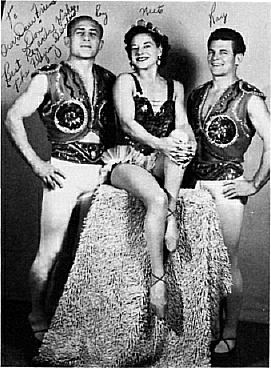
Roy and Juanita Deisler, a husband-and-wife team, rank high among flying-return act artistes. Like many of their peers who succumber to the intrigue and challenge of the flying trapeze, neither came from a show-business family. But, in just a few years, Roy became one of the great catchers and teachers of the act. Juanita, in a phenomenally short time, became one of the great leapers or flyers. Few women have achieved this status.
Royal Raymond Deisler was born in Paulding, Ohio in 1907 to Simon A. and Margaret Deisler. The family mover to Fort Wayne, Indiana where Roy grew up to be a handsome, athletic and adventuresome youth. Two cousins, Paul and Allen Garee, came to visit one day in 1919. They had a casting act on the Red Rowen Shows and invited Roy to join them. Fascinated by show business, Roy lost no time in accepting. With Allen Garee as his teacher, Roy quickly fitted into the casting act routine.
In 1920, Roy joined the Melzoras' flying act for a two-year period. Then he signed up with the Harry La Van troupe. At first, the troupe performed a bar-to-bar act. This was later developed into a flying act, and Roy began his career as a catcher. Augmenting his catching experience, Roy teamed up with Frank Shepherd in a flying act on the Bob Morton Circus in 1925. Roy, together with his brother-in-law Jess Detwiler, later produced his own act named the Flying Royals. They worked parks and fairs for the Barnes-Carruthers Fair Booking Association.
In 1931, Roy began catching for Harold R. Voise and Delbert H. Doss in the famed flying-return act known as the Flying Thrillers. Voise hailed from Saginaw, Michigan and Doss came from Bloomington, Illinois. Both flyers were former pupils of the late Eddie Ward who had operated a celebrated school for flying acts in Bloomington, Illinois, The Flying Thrillers headlined the Sells-Floto Circus, and were the toast of the town! Their mid-air somersaults and twists brought raves from the critics. Billboard magazine featured them on the cover of its July 11, 1931 issue.
In the 1930's between circus seasons, Roy spent much time in Hollywood engaged in movie stunt work. The new Tarzan series at Metro-Goldwyn-Mayer Studios with Johnny Weismuller required the skills of flying act performers for the giant leaps of Tarzan and the swinging apes. Besides Roy, Alfredo Codona, Bert Doss and Harold Voise were among those engaged in movie work. The first Tarzan movie with Weismuller called "Tarzan the Ape Man" was released in 1932 and brought raves from the critics, both circus and movie reviewers. Roy also worked with other cinema stars, including Bruce Cabot, Noah Berry, Jr., and Paul Muni.
In 1932, the Flying Thrillers disbanded and formed new aerial trios. Bert and Agnes Doss, with young Eddie Ward as their catcher, named their new trio "The Flying Bertons" and opened the season with Sells-Floto Circus. Voise, with Roy as the catcher and Mitzie Sleeter as the other leaper, named his trio "The Harolds". (Mitzie later became Mrs. Murray Fine; is now deceased). The Harolds debuted with Ringling Bros, and Barnum & Bailey Circus at Madison Square Garden, appearing in the same display along side the Flying Codonas and the Flying Concellos. Variety magazine rated their flying as the best seen on the show in ten years. Circus critics all concurred that Roy was one of the outstanding catchers of the day. In 1933, the Golden Anniversary Year of the Big Show, Eileen Larey (she later became Mrs. Harold Voise) replaced Mitzie as a leaper in the Harolds troupe.
In 1935, Roy was back in Hollywood working for Alfredo Codona in movies requiring flying act skills. Codona had quit flying, due to a shoulder injury. At this time, Roy met a petite, talented and pretty coed from U.C.L.A. by the name of Wanda Juanita Bell Sturgis. A romance developed, and the good-looking couple was wed that year in Los Angeles. Many celebrated friends attended the ceremony, including Alfredo Codona. Juanita hailed from Leedey, Oklahoma where her parents, William S. and Margaret Sturgis had a farm. Mr. Sturgis, a U.S. Marshall, claimed that his merry-go-round was the first one, west of the Mississippi River. Highly adept at acrobatic dancing, swimming and diving, Juanita had earned a "Miss Corpus Christi" crown in Texas and a dramatic bit part in a United Artists movie entitled "One Rainy Afternoon." The Jesse L. Lasky production released in 1936 featured Ida Lupino, Francis Lederer, Mischa Auer and others.
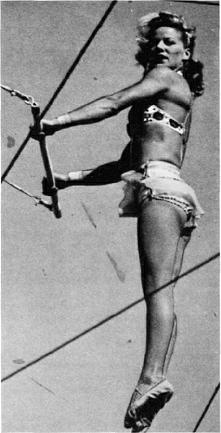 Photo: Juanita Sturgis Deisler is shown in a publicity photo used by the Ringling Barnum Circus in 1945. Pfening Collection.
Touched by circus fever, the versatile young woman decided to become a leaper in the flying-return act business. In December, 1936 when Roy rejoined The Harolds troupe as catcher in the act, Juanita began an accelerated training program. The troupe was in rehearsal at the old Ward flying school in Blooming-ton, Illinois. Art Concello was the owner of the school at the time. Both seasoned and neophyte flyers practiced there and competition was always keen. Ray was a strict teacher and insisted on repetition of any trick that Juanita, nicknamed "Neets", would happen to miss. Her progress was phenomenal. She quickly mastered the basic tricks of the flyer, and in just 6 weeks performed double somersaults to the net.
The Harolds were scheduled to open with Cole Bros. Circus, whose management heads had decided to inaugurate their third annual tour at N.Y.C.'s famed Hippodrome. This was the first time in nearly 30 years that a major circus other than a Ringling-owned one had played an indoor spring date in Manhattan. Cole Bros. bannermen had plastered the Hermitage Hotel at 41st and Broadway with 700 sheets covering 14 of the hotel's 17 floors. The 50 sheet high display at the Park Central Hotel at 56th and Broadway was believed to be the deepest ever seen by veteran billposters and bannermen.
On the day of the big opening, March 18, 1937, Neets was ready for her debut in the flying-return act. Alfredo Codona was in the audience for her first performance, and he remarked that she executed the most beautiful half-pirouette he had ever seen a woman leaper accomplish. He predicted a great future for her. By 1938, Neets performed double somersaults to the catcher.
In 1940, Roy and Neets joined the Concellos on the Ringling Bros, and Barnum & Bailey Circus. Concello had three troupes on the show: the Con-cellos, the Comets, and the Randolls. Some years, the program listed one of his troupes as the Artonys. Roy and Neets worked in the Randoll troupe, with Roy as the catcher and Neets as one of the leapers.
Neets continued her fast pace of flying trick mastery. At the opening of the Big One in Madison Square Garden in 1943, Neets debuted her two-and-a-half somersault. She had perfected the difficult trick after just two weeks practice in winter quarters, injuring a foot in the process. Undaunted, the plucky flyer performed the trick the first ten days of the Garden date, wearing a foot splint. With a schedule of two performances a day, she ran up a total of 33 shows without missing the two-and-a-half. At that time, no other woman flyer featured this trick in an act.
In 1944, Roy formed his own act "The Flying Royals." Neets and Buster Melzora were the leapers and Roy was the catcher. Ringling circus-goers viewed some first-class flying by the troupe. Neets performed the most difficult tricks of the trade including the double somersault (both forward and backward), the two-and-a-half somersault, the flifus, and even the elusive triple somersault. However, the triple somersault was not a regular feature of the act. Neets' trade-mark was a flawless two-and-a-half somersault to the catcher.
The Royals presented a spectacular "passing leap," in which Buster Melzora went over the top to the catcher with a high drive somersault, while Neets passed below from the catcher to the fly-bar in a "bird's nest." In another variation, Neets went over the top with a "forward over" somersault to the catcher, while the returning leaper passed below with a straight jump" to the fly-bar. In still another variation, Neets went over the top to the catcher with a straight "shoot over," passing above the returning leaper. Going over the top in the mid-air exchange requires more strength, concentration, and exact timing than passing below. No other woman leaper performed the "passing leap" in either of these fashions in an act at that time.
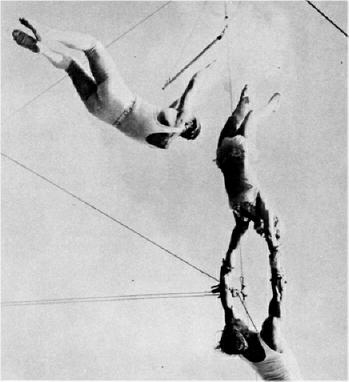 Photo: Juanita Deisler and her husband Roy are shown with catcher Joe Siegrist as the Flying Thrillers on the Ringling Barnum Circus in 1944. Pfening Collection.
After the tragic Hartford fire in the summer of 1944, Buster Melzora left the act and Joe Siegrist joined as a leaper. For the balance of the season, the Big One gave tentless exhibitions in stadiums, fairgrounds and baseball parks. Despite the hazards of outdoor riggings and varying wind conditions, Neets continued to garner flying laurels. In Kansas City, Mo., Neets missed a two-and-a-half somersault and fell into the net. The net collapsed on impact. Circus president Robert Ringling was sitting nearby with his hands resting on his canes. When he saw the net collapsing, he forgot the canes and dashed forward in an effort to break Neets' fall, and fell himself at the ringside. It was the first time anyone on the show had seen Mr. Ringling walk without his canes. The physicians thought Neets would never fly again. The fall activated a chronic ear condition that proved to be quite serious, but in just a short time, Neets was back on the fly-bar.
When the Ringling show opened in New York in the spring of 1945, the feature of Neets' performance was a two-and-a-half somersault to the catcher with a double pirouette return to the fly-bar! No other woman flyer had mastered double pirouettes well enough to offer them as a regular feature of an act.
The svelte, attractive and gracious flyer was favorite copy for the press. The White Tops magazine ran a photo of Neets and clown Paul Jerome on the cover of its March-April, 1945 issue. One of Roland Butler's favorite photos showed the pretty star shooting over the top in the mid-air exchange of the "passing leap." Those Amazing Ringlings And Their Circus by Gene Plowden contains an excellent photo of Neets going over the top in the "passing leap." Unfortunately, the photo title "High Above The Crowd" does not name Neets, or the other leaper, Joe Siegrist, or the catcher, Roy Deisler. In 1945, a bronze plaque in Neets' honor was placed in the Photographers Hall Of Fame in New York City. It was inscribed "A Tribute To The World's Most Famous Aerialist — Juanita Deisler."
Tragically, at the zenith of her career, the old ear trouble reasserted itself and worsened. Treatment and more rest were called for, and so Ray and Neets retired the act in 1946.
They returned to the flying-return act business in 1949, and accepted an invitation from Wayne Larey to come down to Australia and frame an act for Wirth Bros. Circus. Larey had scouted a young trapeze performer named Ray Humphreys who showed great potential for developing into a first-class leaper in a flying-return act. Under Ray's coaching, the young flyer progressed rapidly. Together, Roy, Neets and Ray performed as "The Flying Deislers" in Australia, Tasmania and New Zealand for the next five years. Neets' performance featured the double somersault, and the straight "shoot over" in the "passing leap." She was the only woman in that part of the world that performed these tricks. The Deislers gave a command performance for young Queen Elizabeth II in Sidney, Australia in 1954.
Roy and Neets returned to the U.S.A. in 1954 and brought Ray Humphreys with them. For the next 5 years, the Flying Deislers worked coast-to-coast in the U.S.A. and Canada. The Tom Packs Circus, Rudy Bros. Circus, Orrin Davenport Circus, and TV's "Big Top Circus" featured the troupe as headliners. In 1957, Denny Pinson replaced Ray Humphreys in the act. Young Ray (Slick) Valentine and Billy Woods joined as leapers later. In 1959, the Deislers retired the act. Later, they sold their rigging to Victor Gaona who wanted to frame a flying-return act with his sons, Armando and Tito and his daughter Chela. And so, the heritage passed on.
In 1961, the Deislers stepped back into circus life for several weeks when they went to Brazil and Argentina with a Ringling-framed unit called "Ringling Bros. Barnum &Bailey Circus International, Ltd." Trim and poised as ever, Roy and Neets make their home in Florida, a few miles outside of Tampa. Retired from circus life since 1961, they nevertheless give the appearance of being able to fill a catch-trap and swing out on a fly-bar in the true classic style!
Copyright © 2008
Circus Historical Society, Inc.
No part of this publication may be reproduced in any form or means
Last modified October 2008.
without written permission of the author and the Circus Historical Society, Inc.