


Circus Historical Society
Bandwagon, March - April 1971
Back to Bandwagon Index
Bandwagon, Vol. 15, No. 2 (Mar-Apr), 1971. Note: Only some articles are included in this online edition. Many illustrations are not included. The Circus Historical Society does not guarantee the accuracy of information contained in the information in these online articles. Information should always be checked with additional sources.
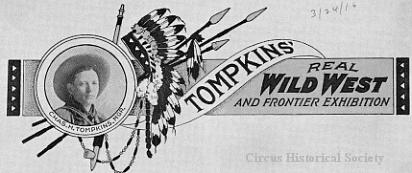
Foreword: In 1913 a seventeen year old youngster got his first taste of outdoor show business, being a "First of May" on the Tomkins Real Wild West Show combined with Cooper & Whitby's Circus which was also making it's initial season. He stayed with the show only a year and didn't get back into outdoor show business until 1931. We are referring to CHS Denniston "Denny" Berkery of Llanerch, Pa. Denny was so impressed with the show and in particular with Charles H. Tompkins, the manager and part owner, and one of the most famous wild west show performers of all time, that he planted the idea that the story of the Tompkins Wild West Show of 1913-17 should be told in the pages of The Bandwagon. Digging into his files he came up with a wealth of information on the show, including his own notes and penciled route he had put down while with it, also some excellent and very rare photographs and examples of the Show's advertising material. He even produced the contract he signed with Tompkins.
Most of the information used in this article came from Denny himself who summarizes his experience with the show thusly.
"I saw the show put together at Lahaska, Pa. and was with it and for it from the opening stand at Newton, Pa. on April 26, 1913 until it closed for the season at Vienna, Md., Oct. 22, 1913. I was 17 years old that year but this was none of that crud about "running away with the circus". My family knew Mr. Wheeler and Col. Tompkins and knew where I was all of the time. In fact, anytime I got 'biggety’ Mrs. Tompkins would threaten to ship me home and that kept me in line."
Denny, a friend of ours for many years standing, convinced the author that indeed he did have a great story which needed telling and so it is with fond affection for our old friend and fellow CHS member that we dedicate this article to him and thus preserve for posterity the story of Charles H. Tompkins and the Tompkins Wild West Show.
Charles H. Tompkins was born in Round Rock, Texas in 1873 and began working as a ranch hand at 12 years of age. In 1886-87 he drove trail herds from Abiline, Texas to Dodge City, Kansas and in the years 1888-89 worked on the range as an "outside man". Later Tompkins worked for the X.I.T. Ranch near Dalhart, Texas. This ranch was said to be the largest in the world under fence with it's three million acres covering several counties in the Texas panhandle. During 1892-93 Tompkins participated in one of the last really "big" cattle drives in history as the X.I.T. Ranch drove 25,000 head of steers from Dalhart to Montana.
Tompkins won a roping contest in Chicago in 1895 and this was the beginning of his career in the entertainment field. The wild west show was entering it's heyday and was to become one of the most popular of all outdoor amusements in the years from the mid 90's until the end of World War I. Tompkins was a top notch rodeo and wild west performer and his talents covered the entire package, being equally versatile as a rider and roper.
In the late 90's he became associated with organized shows as a wild west performer and was with the Forepaugh-Sells Circus for several years. In a speech Tompkins made at the time of his election as a life member of the Oklahoma Historical Society in 1951 he mentioned that he had been with Forepaugh-Sells in 1903.
In 1904 he headed a Congress of Champion Ropers and Riders at the St. Louis world's fair and that same year he married Miss Mabel Hackney, who was featured equestrienne with the Buffalo Bill Show for a number of years. According to many, including Tompkins himself, Mabel was the greatest rider of them all, better even than Lucille Mulhall. She took premiums from Maine to Florida in equestrian exhibitions and before her career was over had been accepted throughout two continents as one of the great horsewomen of the world. She rode horses, chariots, and excelled as a jumper. During her years with Buffalo Bill her favorite horse was named "Skyrocket" and in 1898 she began making table jumps of twenty-two and a half feet. Over the years she won more than fifty prize ribbons. Tompkins said she could tell more about the nature and power of a horse than anyone he had ever known. Mabel Hackney Tompkins from the day she and Charles were married became his lifelong partner in all of his excursions into show business.
In 1905 Charles and Mabel became associated with McCaddon's Great International Circus as featured performers during that show's ill fated tour of Europe. Charles was billed as "The King of the Cowboys" and his wife "The World's Greatest Equestrienne". The short lived six month tour of France of the McCaddon show ended up a nightmare for many and stranded scores of performers and workingmen. Joseph T. McCaddon, a brother in law of James A. Bailey, purchased the 1904 Sig Sautelle Railroad Circus and shipped it to France to tour the 1905 season under the McCaddon title. Heavy competition from the Buffalo Bill show which was also in Europe at the time plus stringent and often harrassing local regulations coupled with poor business put the show into involuntary bankruptcy in six months.
Returning to the U. S. Tompkins and his wife played fairs and celebrations with their own Western Troupe from 1906 thru 1912. In the winter months they were with a famous stage western melodrama of the time, "The Round-Up".
During the winter of 1912-13 Tompkins decided the time was right to organize his own wild west show which would make daily stands framed along lines of about ten other such shows, large and small, playing typical circus type routes. He formed a partnership with Dr. Henry Wilson Turner, a veterinarian with considerable circus experience, of New Hope, Pa. and Al F. Wheeler, a current circus owner of Oxford, Pa. to frame such a show and put it on the road for the 1913 season.
Wheeler had operated a medium sized overland circus titled Al F. Wheeler's New Model Shows from 1904 thru 1910 seasons and for the 1911 and 1912 seasons had been part owner with Andrew Downie in a railroad circus titled Downie & Wheeler and he would again be associated with the show for the coming 1913 season. Stored at Wheeler's quarters in Oxford, Pa. was considerable equipment of his overland show.
Dr. Turner, shortly after his graduation from the University of Pennsylvania in 1893, set up practice in Lahaska, Pa. and soon began looking after the baggage stock of several shows which wintered their horses in Bucks County farms near Carversville. These shows included at times Adam Forepaugh, Buffalo Bill, and Frank A. Robbins. In 1903 Dr. Turner joined Barnum & Bailey as a regular. In 1905 he went with the McCaddon show to France and it was during this time he first became acquainted with Tompkins.
No details of the partnership arrangement have been uncovered but Dr. Turner in a newspaper interview in The Philadelphia Sunday Bulletin in 1951 said that when the Tompkins show was first organized that he (Turner) owned the horses (baggage stock), Wheeler owned the wagons and equipment, and Tompkins the wild west stock. Dr. Turner did not travel with the show at all nor did Wheeler regularly but Wheeler did make periodic visits when he could get away from his larger show. Tompkins was named manager and ran the show in his own fashion.
Dr. Turner's farm near New Hope, Pa. served as the quarters where the show was framed and consequently wintered for the next couple of years.
It was decided that the new show would be a medium sized overland (mud) show which would tour the general area of eastern Pennsylvania, New Jersey, and New York in the spring and summer and dip down into Maryland and Virginia in the fall. New England and other areas could be very easily added if desired.
It was also planned to use a few standard circus type acts to blend in with the wild west numbers. Official title of the new show was "Tompkins Real Wild West and Frontier Exhibition combined with Cooper & Whitby's European Circus." Just how the Cooper & Whitby portion was chosen is not known. The name Cooper was well known in American circus annals, James E. Cooper having been a showman of considerable statue in the 70's, 80's and early 90's. In years 1892-94 Ben E. Wallace used the title of Cook & Whitby on the equipment of his Great Wallace Shows, but so far I have been unable to discover any Cooper & Whitby before it's use by Tompkins in 1913. Possibly there was a small show by that name, or possibly some paper house reworked old Cook & Whitby paper, or maybe Tompkins and his partners just thought up the title as a good sounding one to denote the circus part of the show.
The circus world got it's first official report of the new show when the following appeared in the March 29, 1913 Billboard.
"Tompkins - Cooper - Whitby Shows. At the winter quarters of the Tompkins-Cooper-Whitby Shows at New Hope, Pa. the wagons, seats, and equipment of the shows are rapidly being got in order under the careful eye of James Pidcock, general supt.
"There are forty head of draft horses, with eight head of light draft for the advance wagons, thirty-eight head of arena horses, nine head of outlaw horses, twelve head of ponies for the pony acts, and three comedy mules.
"The wagons will be painted white and trimmed with gold and lettered in green and red.
"The show will open near New Hope, April 26, and will play practically the same territory that Mr. Tompkins has played in the past four years at fairs.
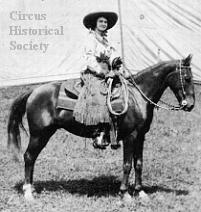 Photo No. 6 - Mabel Hackney on "Vardius," her five gaited "haute ecole" menage horse, show on the Tompkins Wild West Show season of 1913. Mrs. Tompkins has on western dress but during her act in the arena she wore traditional riding habit with top hat and rode side saddle. Denny Berkery Collection.
"Some of the very best acts in wild west and circus have been engaged for the arena. The acts will be well balanced, half circus and half wild west. Among some of these acts will be The Duncans, the Shooting Savages, Miss Mabel Hackney and her dancing horse, vardius, Ed P. Barlow and his trained ponies, Happy and his trained donkey, Pete, and many others. Twenty displays in all will be presented. Spencer Williams' cowboy band will be one of the features.
"Charles H. Tompkins will be manager of the show, assisted by George J. Bass, who served in the same capacity for four years for Al F. Wheeler, who is associated with Mr. Tompkins. George M. Forepaugh will be general agent; with J. E. Pettit, as special opposition agent.
"Neither time nor money has been spared to make the show as complete as possible."
Although details in the Billboard were often exaggerated the numbers of stock etc. given above appear to be about correct for a show of this size. Possibly the number of arena horses was a little high.
The April 19, 1913 Billboard carried the following advertisement.
"Wanted for Tompkins Wild West Combined with Cooper and Whitby Shows".
"Hurdle mule rider, outside attractions, sideshow manager who can furnish several acts. Circus act, especially ground and comedy acts, talking and energy clowns, man to handle untameable lion. Workingmen in all departments. Can place first class boss canvasman. All wild west and musicians report New Hope, Pa. April 21. All circus and sideshow people, April 23. Chas H. Tompkins, New Hope, Pa."
The wagons used by the show are all presumed to have come from Al F. Wheeler and had been used in the past by his overland show. Seat planks, jacks, stringers, poles, canvas etc. were hauled in plain flat bed drays with no fancy painting nor title on them (see photo 10), but other baggage wagons were painted and decorated very nicely (see photo 11). The Tompkins part of the title was painted on one side with Cooper & Whitby on the opposite.
The ticket wagon was one which had the titles on opposite sides. It was painted basically bright red with lettering in gold leaf and had raised carving of an eagle on each side. Although the photo of it in parade (photo no. 2) might lead one to think it was formerly a cage it never was. It had been the "office" wagon on the Wheeler overland show and was nicely fitted up inside for such a purpose. It was not very high inside and a six foot man could not stand erect. However, it was mostly occupied by Mrs. Tompkins who handled all correspondence and records of the show, and the treasurer, George Gass, who played trombone in the band and was ticket seller. He sat down while selling tickets from a window which opened in the rear of the wagon. A door in the center of the side opposite one which shows in the photo opened and there was a little rail along the side of the floor onto which a short ladder or flight of steps hooked. Nearly all business with employees or townspeople could be thus transacted without them coming inside the wagon at all.
The big show bandwagon (photo no. 1) had likewise been used on the Wheeler mud show. It was very plain with no carvings but was painted in decorative scrolls but had no title on it. A short wagon which had been the clown bandwagon on the Wheeler show was used by Tompkins as the "chandelier" or light department wagon. The exact number of wagons used by the show in it's initial season is not known but it was around 25.
Tompkins had the typical wild west show open arena for the performance. Plank seating was on three sides of the arena. A canvas cover was used over the seats and a sidewall in the rear. The sidewall extended on past the end of the seats and then closed in the rear of the arena. Fronting the arena was a neat marquee. The show could probably seat around a thousand with space available for additional seating or "straw" if necessary.
A conventional two pole sideshow top was used, about a 40 ft. round with one 20. Two large canvas banners fronted the top. A rather small, about 30 x 20 cookhouse top was carried but the dressing room top from photos appeared to be fairly large, a 5 pole tent, about a 40 with four 20's. A number of minor tents on the midway and backyard completed the canvas layout.
The show had no electricity. The arena was lighted by acetylene flares. Some of these devices can be spotted behind the horses on the picket line in photo no. 8. Berkery describes the lighting of the Tompkins show as follows:
"The devices were iron or steel tanks, in the bottom of which a container was placed holding lumps of carbide. The tanks were nearly filled with water and when the water reached the carbide a gas was formed which was caught in a length of pipe reaching up about six feet above the top of the tanks. At the top of the pipe a burner called a "lime" was affixed. When light was desired a blow torch was applied to the lime and the gas which was in the pipe ignited, this heated the lime and the gas which was in the pipe ignited, this heated the lime and it glowed with an intense white light which was guided thru a funnel shaped cone and formed a huge "spotlight". This, incidently, is where the expression "in the limelight" comes from as this was the first form of theatrical spotlight. It was safe enough when used more or less in the open as in a wild west arena, about the worst that could happen was to have one of the tanks knocked over. In this event the gas would be cut from the lime and the water in the tank quenched the flame. A number of tanks spotted around the arena lighted it up with great brilliance and it was perfectly adequate. In the sideshow and around the front door and midway gasoline banjo or pan flares were used, also kerosene lanterns were used extensively. For some reason the man who handled these lights was always called the "shandy" man or "Frenchy", the latter because the lights originally were used in France."
Milton Zedna was the sideshow manager in 1913. His name actually was Milton Vandez and he was from Costigan, Penobscot, Maine. He did punch and magic and with his wife did a simple type of "second sight" act. Zedna made all openings and was inside lecturer. Feature of the sideshow was Capt. McKibben and his untamable lion act. The act was similiar as to what has persisted even to this day. The lion was in a cage wagon with vestibule. "The fearless trainer, Captain McKibben will fight his way into that cage containing that black-maned untameable Nubian lion and close the door behind him", so proclaimed Zedna in his openings. The lion was broken to charge the door to the vestibule when McKibben had gone out again. In addition to the Zednas and the fighting lion, a Mrs. Hamilton worked big snakes and Denny Berkery worked a "talking" (pickout) pony and a trained monkey. Denny says there was no blowoff, grift, and no heat connected at all with either the sideshow or regular show operation.
The only menagerie type animals on the show were the lion, monkey, and snakes in the sideshow. So far as is known Tompkins never had an elephant on the show although it was customary for many wild west shows of that period to carry elephants, camels, and other lead type stock.
A street parade was given each morning on show dates. It was headed by a six horse hitch drawing the big show bandwagon. Also in the line of march was the colorful ticket wagon pulled by a two horse hitch, the lion cage, a clown "January" cart drawn by a mule, the chandelier wagon with a family of Indians riding, and the entire company of performers mounted on their horses, some carrying flags of various descriptions including Old Glory. Sometimes when the parade couldn't be put on due to late arrival or other reasons the band would march into the center of town and put on a concert.
As a "grand free outside exhibition" on the midway immediately after the parade returned to the lot to lure the crowd to the lot the show had the ever popular "high diving" dog attraction. A little fox terrier would climb to the top of a very tall ladder and then jump into a blanket held by Berkery and several others.
Carl Mitchell's Cowboy Band was a good one and consisted of Carl Mitchell (cornet and leader); Carol Mitchell, cornet; Claude Hamilton, trombone; George Bass, trombone; Adam Gillespie, tuba; Cecil Mitchell, tuba; "Pop" Ferguson, baritone; and George Brown, drums.
Key staffers on the 1913 show included Hugh McGowan, boss hostler and wagon master, and Dell (Dixie) Adams, boss canvasman.
The 1913 performance, despite the heavy ballyhoo of the "circus" angle, was 90 percent wild west. There were a few ground type circus acts, trained dogs, and a four pony drill, but no aerial acts of any description. The wild west portion was excellent with Tompkins and his wife playing major parts in it. Denny Berkery gives the following interesting account of how he became associated with Tompkins and consequently trouping the 1913 season with him.
"The first I ever heard of Tompkins Wild West was in Atlantic City, N.J. in the summer of 1912. In those years, during summer vacation from school, I worked for relatives who were in the dairy business there.
"Sometime in mid-summer of 1912 ads appeared in the papers and on billboards announcing the coming engagement of Tompkins Wild West at the Inlet Ball Park. Performances were given every evening and on those afternoons when there was no ball game.
"I had no interest in baseball but I was "crazy" about animals in general and horses in particular. After the show arrived I took to spending a lot of my free time around the ball park. Just being around and running an errand now and then I got to know Mr. and Mrs. Tompkins and many of the troupe. I learned of the plan to put out a road show doing one day stands the following season and of course I asked Mr. Tompkins if I could be with it. He told me to keep in touch with him through the winter and if I still wanted to go and could get my parents permission I could.
"Back in Philadelphia after school began in the fall I would visit the large horse markets near my home. Several times during the fall and winter I met Tompkins at the Bulls Head Bazaar, one of the large horse markets. This was also when I first saw Dr. Turner and Al F. Wheeler, one or both of whom were usually with Tompkins since they were looking for likely animals to buy. At these encounters with Tompkins and his partners, once my father was with me, and my status of traveling with the show was confirmed. In March 1913 Tompkins sent me a "contract" and I was notified to report on April 20th.
"I got a train out of Reading Terminal at 9 A.M. and reached New Hope at noon. Tompkins was at the station, not just to meet me - some other people came up on the same train - and he sent us all out to the quarters in a two horse "buckboard" vehicle.
"The show's winter quarters was mainly a big flat meadow on Dr. Turner's farm. Some tents were erected. The cookhouse and sideshow tops were up and the arena was laid out but the side-wall was on the ground so a crew could work on it. All of the stock, horses, donkeys, ponies, were on a picket line and from then on until we closed they were never under any kind of a roof, canvas or otherwise. The over-all appearance of the quarters was that of a combination circus lot and cowboy camp. A number of circus type wagons were spotted around, plus a motley array of carriages, buggies, and a reasonable facsimile of a Western stage coach. All of the stock was in prime condition - this was a "thing" with Tompkins. Mistreat an animal and he was on your neck, but hard.
"Dr. Turner's farm was always referred to as being at Lahaska, which was then and still is, a place on Route 202 just before you come to New Hope. The farm was not along the highway but was back along the Delaware River. From the spot where the show was quartered you could see men working and plowing in fields quite a distance away and I was told they were working at the Mercer County, N. J. Reform Farm across the Delaware. If you can find out where the Mercer County Reform Farm was in 1913 - Dr. Turner's farm was directly across the river on the Pennsylvania side. His home, barns, and other outbuildings were not far from the field where the show was being shaped up. The wild west stock had been kept indoors during the hard winter months."
Berkery described Tompkins as a "legitimate western" personality, a splendid horseman, champion trick and fancy roper, and bucking horse rider. He was a close fried of Will Rogers and in 1913 was in his early forties. He was a first class gentleman in every respect. His wife was a lovely lady - a fine equestrienne - and a very good business woman too."
Tompkins was of the highest moral character. He didn't smoke, drink, nor use profanity. That he demanded the same high standards of conduct and behavior of his employees can be determined by a look at the "Rules and Regulations" which were printed on the reverse of every contract signed by those associated this his show. These read as follows.
Rules and Regulations
Rule 1 - Rising Call. Each and every member of Company, will be given a rising call 15 minutes before breakfast hour. All passenger wagons will leave promptly 45 minutes after rising call, and in no case will be allowed to wait for tardy ones. Such must reach next town (at their own expense) on time for their duties, or be subject to fine or immediate dismissal.
Rule 2 - Irregular Days - On days when Show may arrive in town late, all must remain on lot ready for immediate calls for parade or openings.
Rule 3 - Openings and parade. Any member who shall be late for, or detain parade, act, concert, or opening will be subject to a fine of $1.00 for each offense.
Rule 4 - Stalling. All musicians must play (all the time) when an act is on, and in no case shall they leave their seats in Band during the performance, unless called upon to seat people.
Rule 5. Smoking. No smoking will be allowed on parade, or during openings or performances. Any one caught smoking during such hours will be fined $2.00.
Rule 6. Swearing. No profane or indecent language will be tolerated either around lot or hotels, under a penalty of $2.00 for each offense.
Rule 7. Gambling. No poker playing or gambling will be allowed at any time or place, by members of this Company. If you must gamble, you cannot stay here. Such will be dismissed without notice.
Rule 8. Drinking. Any member who shall become intoxicated, while in the employ of this show, whether it be during working hours or not, will be subject to a fine of $5.00 or immediate dismissal, and any employee so discharged shall forfeit his hold back salary.
Rule 9. Chasing. No member will be allowed to publicly associate with improper characters at any time, and no mashing will be allowed around the lot. Fine, $2.00.
Rule 10. Stealing. Any employee who shall steal the most trifling article, will be immediately discharged and turned over to the proper authorities.
Read these rules carefully and often, as they constitute a part of your contract and will positively be enforced.
The shows modus operandi and moving procedure from town to town on it's route was basically the same as the many overland (or mud) shows on the road at that time. Berkery describes it this way.
"Daily jumps averaged 10 to 15 miles, with 15 to 25 over Sunday. The heavy train moved at night leaving right after the tear down and since the teams rarely could go faster than a brisk walk it took all night to make most moves. The executives, musicians, and "star" performers slept in hotels or rooming houses, and made the moves in carriages in the early morning. The performing stock, parade wagons, chandelier wagons, cowboys, Cossacks, Indians, and workingmen also made the moves in the early morning after sleeping on the lot. Everyone ate on the lot.
The show employed a strong advance and put up colorful paper in style and quantity typical of an outfit of this size. A very colorful herald was used (which is reproduced here), a sheet 22 x 28, which was folded in the center making four sides or pages. In those days the show's agent would stuff them in the mailboxes along his route, a practice later prohibited by the post office department.
When late April rolled around the framing of the new Tompkins show had been completed. The 1913 season was at hand. A total of at least nine large, medium, and small wild west outfits making daily stands were ready to roll. Heading the list was the large railer, Buffalo Bill and Pawnee Bill Combined, which unfortunately would be making it's last tour as before the season could be completed Bonfils and Tammen (owners of the Sells-Ploto Circus) would foreclose on the mortgage they held on the Two Bills Show (as it was commonly called) and put it out of business. Other large railers included Miller Bros, and Arlington's 101 Ranch, Oklahoma Ranch (owned by Arlington and Beckman), and Kit Carson Buffalo Ranch. Smaller shows included Buckskin Ben's, Irwin Bros., and Jones Bros. Fully twenty-five large and small circuses were also on the road and were always considered prime competition for wild west outfits such as Tompkins.
Opening date for the new Tompkins show was Sat., April 26, 1913 at Newtown, Pa. Stands for the remainder of the first week, all in Pennsylvania included Hatbor, Jenkintown, Lansdale, Ambler, Souderton, and Doylestown.
On May 4 the show went into New Jersey for a stand at Frenchtown. In mid-June the show had moved up into New York state. During the latter part of June Denny Berkery was "elevated" from cookhouse flunkey to pony punk and very shortly to "dog and pony" man because the regular man, Parker Anderson, walked off without warning. Denny knew the routines and cues so he took over for the balance of the season.
The show never had a printed route card. It was posted periodically in the cookhouse where those who wanted to could write it down. At times the route was carried in the Billboard but more often it was not.
Ever now and then the Billboard would run articles informing the rest of the show world what was new with Tompkins such as this story which appeared in the July 26, 1913 issue.
"The Tompkins Wild West & Cooper & Whitby Shows have been doing fine business thru New Jersey and New York states. Capacity business ruling most of the time since opening date. The combination of wild west and circus seems to meet with great favor in the smaller towns as endorsed by the over-floying business nearly every night in towns that heretofore have been considered matinee standouts.
"Al F. Wheeler, one of the proprietors of the enterprise, visited the show last week and it is now rumored that the season of 1914 will find this concern on rails as a 14 car aggregation. Since the show left winter quarters it has been greatly enlarged, 10 lengths of seats and two sections of canopy having been added to the outfit and 8 large head of heavy draft horses purchased.
"Among the acts that are meeting with favor are the Famous Barlow Ponies, Miss Mabel Hackney with her dancing horse, Vardius, and the Donetta Brothers, acrobatic act.
"The bare fact that Charles H. Tompkins personally directs the wild west end of the performance is a guarantee that it will be of the "gilt edge" order.
"The show will make a very long season, lasting until the snow flies. If the first half of the season is criterion, this show is among those to be figured in seasons to come."
By the end of June the show was still in New York and up along the St. Lawrence River and Lake Ontario and by the end of July was in the vicinity of Buffalo and near Lake Erie. At Avon, N.Y. on July 17 the team on the lion cage ran away but no damage was done. At Caledonia N.Y. the next day Mike Welsh of the Welsh Bros. Circus visited.
A typical weeks route showing distances travelled each day is as follows:
July 21 - Perry, N. Y. - 6 miles
July 22 - Castille, N. Y. - 7 miles
July 23 - Pike, N. Y. - 14 miles
July 24 - Arcade, N.Y. - 15 miles
July 25 - Springville, N. Y. - 16
July 26 - Holland, N.Y. - 10 miles
On August 1 at Gowanda, N.Y. a large group of Indians from the Cattaraugus Reservation visited the show.
Woodhull played on Sat. August 23 was the last stand in New York and the following day the show moved into Pennsylvania for a stand at Westfield.
The show rarely every played a stand without some kind of competition from other shows but opposition was never closer than when Tompkins played Canton, Pa. on Sept. 1 and was followed the very next day by the Frank A. Robbins Circus, a medium sized railroad show.
Tomkins continued working it's way down thru Pennsylvania as fall approached and entered Maryland Sept. 25 at Manchester. On Friday, Oct. 3, at Sykesville, Md. a blowdown after the matinee leveled the arena canvas but everything was up again before the night show. Continuing on southward the show was in the Baltimore area with a stand at Cockeysville on Oct. 4.
The final weeks were spent in Maryland and the season came to a close on Oct. 22 at Vienna. Business had been good throughout the season despite the pre-world War I depression the nation was then in, and the 1913 season was not generally considered very good for most outdoor amusements.
The day following the closing Berkery returned to his home in Philadelphia. He said there was talk around the show that the baggage stock was to be sold off in Vienna with exception of a six horse hitch of white horses and the arena stock, ponies, donkeys, carriage stock, wagons, and all gear shipped back to New Hope quarters by rail. It is doubtful this occured. In any event the show returned to New Hope to winter.
Denny says he saw Tompkins, Wheeler, and Dr. Turner at the horse sales a few times during the winter of 1913-14 and it was his firm intention to return to the show for the 1914 season, however when he got home he was given the choice of returning to school or going to work. He chose work and got a job in a newly opened moving picture theater near his home as an usher and after a few months got a chance to move up to the projection room as an apprentice. He said he didn't know whether he should continue with this job or return to Tompkins but finally decided to stay in the motion picture business for a while and then return to the outdoor field. A lot of things intervened, including two years in the army during World War I, and it was 17 years before he ventured again into the outdoor field in 1931, incidently with Al P. Wheeler.
The Jan. 17, 1914 Billboard mentioned that the Tompkins show was in winter-quarters at Lambertville, N.J. This is just across the river in New Jersey where Mr. and Mrs. Tompkins established a home. The equipment and stock in all probability remained at the same location on one of Dr. Turner's farm but possibly the quarters site was moved. Anyway, the show's quarters were henceforth said to be located at Lambertville in all of the trade publications.
Any plans for putting the show on rails were cancelled, however for the 1914 season Al F. Wheeler terminated his partnership with Andrew Downie and taking his part of the equipment framed a 14 car show which went out under the Wheeler Bros, title.
The March 21, 1914 Billboard had this interesting article about the winterquarters activities of the Tompkins show and plans for the 1914 season.
"Repairs have practically been completed on the Tompkins Wild West and Cooper & Whitby Circus equipment and the painters are nearly through with the wagons. The new bandwagon and tableau have arrived at Lambertville, N. J., the winter quarters, and are real circus wagons in every respect. All the wagons will be uniform in color.
"The show will have a number of new animal acts this season and more circus acts and the Wild West will be improved over last season.
"Frank Scott will be with the show as fancy and bucking horse rider, making his fourth year with this outfit (Authors note - including the fair unit Tompkins had prior to 1913). Milton Zednay is expected to arrive at the winterquarters in a few days to lay out his sideshow. He has a feature this season which he says will be original and the first time with any show. He has made some illusions for the show and says that sideshow will be so strong that the people will return on the comeout to see the house of mystery. All stock with the show has wintered well and will be in shape for the opening.
"General Agent George M. Forepaugh is still in charge of the winter-quarters and is busy laying out the route and planning ways to get up the best showing with his new line of special paper. The concert will be one of the best given with a circus. There will be five features, one of which will be George Asplund, the bull whip cracker. He is now on the big Vaudeville time in the West."
No details have turned up on the new bandwagon and tableau mentioned, and since no photos have appeared we can only speculate about them. It was evident the show needed a little flashier bandwagon and an additional tableau wagon to beef up the parade. Best source of these wagons would have been from the Al F. Wheeler equipment at Oxford, Pa.
Despite the heavy ballyhoo shows have always given at start of each new season that they were "bigger and better than ever before" there is no indication that the Tompkins show of 1914 wasn't about the same as the previous season, both in physical layout and quality of performance. In fact the show is believed to have changed very little in this respect during the five years it was on the road.
The list of wild west shows going out in 1914 had dwindled somewhat from the previous year but there were still several strong outfits headed by the Miller Bros. 101 Ranch Wild West and Young Buffalo Wild West, both fairly large railroad shows, and then there was Kinnie Bros., Irwin Bros., and Wyoming Bills, the latter a new title and format for the Welsh Bros. Circus.
Tompkins opened the 1914 season, April 25, at Lambertville, N. J. and remained in the state until late May when it went into Connecticut on. May 27 for a stand at Lakeville. After a couple weeks in the state the show preceeded on to Massachusetts with first stand coming at Palmer on June 9. Back into Connecticutt on June 17 at N. Cleavenorville and a few additional stands the show next headed into Rhode Island where stands were played in period June 22-26 at Hope Valley, Wakefield, Shamrock, and Ashaway. Then followed a few more weeks in Connecticut and after crossing the state the show entered New York at Millbrook on July 15.
Tompkins did not elect to make another extensive tour thru upstate New York and after only eleven stands headed into New Jersey at Sussex on July 30 and remained in the state thru September 15 with exception of a single stand in Pennsylvania.
Several notices of the show's stay in New Jersey appeared in the Billboard. The Sept. 5, 1914 issue reported the show at Belmar, N. J. on August 23 and mentioned that after a week of good business it was staying near the ocean and many of the arena folk were enjoying the bathing. An advertisement appeared in the same issue with the show wanting a good circus drummer, cornet and clarinet players to strengthen the band, good circus acts with ground acts preferred. Ad said show planned to stay out until late in the fall.
The Sept. 19, 1914 issue carried this story.
"Tompkins-Cooper-Whitby Shows by Dixie DeVere. Glassboro, N. J., Sept. 6 - We are stationed this Sunday just 21 miles from Philadelphia where most of the folks went this morning. Charles Forepaugh, only living brother of Adam Forepaugh, visited the show at Berlin, N. J. where he makes his home. He presented Uncle Jim McPherson with some stakes and pins which were used on the Adam Forepaugh wagon over 30 years ago."
The show soon headed south and entered Maryland on Sept. 16 at Rising Sun, then played four additional dates in the state and went into Pennsylvania where it remained until returning to Maryland October 1 at Sandy Springs. Moving further south the show entered Virginia at Waterford on Oct. 7 and after a number of stands came back into Maryland Oct. 15 at Poolesville. It remained in Maryland until the season ended at Manchester on Oct. 21.
A story in the Oct. 31, 1914 Billboard told of the show's closing and summarized the 1914 season very nicely as follows.
"Manchester, Md. Oct. 22 - The closing (yesterday) for the Tompkins Wild West and Cooper & Whitby Circus in this city was a bright and sunshiny day (as they have been lately) with people coming from far and near by the hundreds. Tompkins was scheduled to close the 20th but Manchester was added making the season one day longer. Business thru Maryland and Virginia was exceptionally good and the show goes into winter quarters with a record seldom achieved by larger outfits.
"The season opened April 25 at Lambertville, N. J. (Col. Tompkins' winter-quarters) in a heavy rainstorm, in spite of which packed houses were played both afternoon and evening. From there the show went through New Jersey, New York, Connecticut, and Rhode Island meeting with much opposition but holding its regular prices all season. Four turnaways were recorded. Show covered 1956 miles. The longest jump was 26 miles and the shortest 3. Only one stand was lost - Little Falls, N. J. on account of the bad conditions of the lot. The sideshow however opened and did a big business.
"With few exceptions personnel at close was about same as opening. Carl Mitchell, band leader, was away for awhile during summer but returned and closed with the show. There were no accidents of any kind. Show left for Lambertville, N. J. quarters where it will open in 1915. Col. Tompkins expects to enlarge the outfit and add more "circus" for next season. Capt. Jim McPherson will have full charge of getting show into shape."
War in Europe was now a reality having begun in the summer and although no sense of crisis had yet come upon the American government or people showmen did have some apprehension on the effect of business during the coming 1915 season. Canada was already in the war and with the sharp dropoff of European trade, business conditions in the States which had been considered rather dull for all of 1913 and 1914 didn't appear would get any better.
Still fewer wild west outfits answered the call of the 1915 season. The Sturtevant files lists only three regular touring wild west shows in addition to Tompkins, Miller Bros. 101 Ranch, Texas Bill's and Tiger Bill's. No doubt there were a few other smaller shows on the road.
The May 8, 1915 Billboard carried the following excellent article with many details given concerning the opening of the Tompkins show.
"Tompkins Wild West Show. Opening Takes Place at Lambertville, N. J. - No Delay at First Performance. Lambertville, N. J. April 28 - The Tompkins Wild West Show opened it's 1915 season in this city, it's winter quarters, last Saturday, and to use an old expression, 'the show is bigger and better than ever'. It was an ideal circus day and the attendance at both the afternoon and evening performances was exeptionally big.
"The show is one of the cleanest and best outfits of its size on the road, and the opening performances were given without a hitch. Several of the performers received beautiful bouquets. Col. Tompkins' roping was warmly received. Mabel Hackney, with her dancing horse, Vardius, could easily lay claim to Equestrienne Queen.
"The Cowboy Band of fourteen pieces, lead by Clinton B. Ogden is "some" band and makes a flashy showing in the parade with the boys bedecked in bright red shirts and snaps and Stetson hats. And, by the way, the parade rivals those of a great many larger shows. The cowgirls, for ability and appearance, are hard to be excelled.
"The ring stock is in the pink of condition, as is the baggage stock, which is due to the excellent care taken of them by Frank Scott and Perry Camp, respectively.
"The big show is under the capable management of Col. Charles H. Tompkins, assisted by Mal Bates, and gobs of credit must be given them for the successful opening. Uncle Jim McPherson is general supt. and Harry Hargreaves is boss of props. Del Adams (Dixie) has charge of the cookhouse.
"The sideshow under the management of Milton Zednay, is without a doubt one of the most up to date sideshows on the road today. Among the features are: Capt. Hargreaves and his hand to hand battle with Wildfire, the untamable lion; Hilary, the handcuff king; Mr. and Mrs. Iram, mental telephathy; Parker Anderson's educated ponies, featuring Daisy, the "talking" pony; Mlle. Lorain, with her den of reptiles, introducing Big Ben, the monster python; Milton Zednay's Punch and Judy.
"The program runs as follows: Display No. 1, grand entry; No. 2, garland drill; 3, pony express; 4, Chick Varnell, on the silver wire; 5, pick-ups by cowboys and girls; featuring Dixie Devere; 6, clown specialities; 7, Parker Anderson and his troupe of dogs; 8, quadrille on horseback; 10, garmeque wheel; 11, roping by cowboys; 12, Chick Varnell, on the Roman rings; 13, chase for a bride; 14, clown number; 15, military drill by Anderson's ponies; 16, Frank Scott and Augustine Onteverio, riding act; 17, sharp and trap shooting, Howard Savage: 18, The Buckers, featuring Wild Spot; 19, Miss Mabel Hackney and Vardius, dancing horse; 20, horse thief, featuring "Circus", the horse-thief catching dog; 21, grand finale. Mal Bates, official announcer.
It appears the Cooper & Whitby portion of the title had been dropped and nowhere is it mentioned again in the trade publications in conjunction with the show. Likewise it was omitted from the letterhead used by Tompkins in this period.
Information on the 1915 route is very skimpy, but it appears the show spent the first weeks of the season in New Jersey. On June 11 it was in New York at Hamilton and from the few dates available seems to have been in that state for many weeks, evidently making another extensive tour as it did in 1913. As late as August 19 the show was still in New York at Avoca.
Billboard coverage of the show's activities was also very light, however the following did appear in the June 26, 1915 issue in the column, Under The Marquee by Circus Solly.
"The following are excerps taken from The Windsor (N.Y.) Standard - "Tompkins Wild West & Circus which sojourned in Windsor Sunday and Monday, is composed and managed by the sort of people whom we enjoy meeting. The total abstinence from profanity and roudyism was particularly noticeable and remarked upon by citizens of the village who visited the circus grounds during the raising of the tents and while preparations for the circus were in progress. Everything was clean and wholesome, nothing to offend anyone. Should Col. Tompkins return to Windsor at some future time he would be assured the best patronage our town could afford."
Leaving New York the show went south, in all probability thru Pennsylvania but maybe thru New Jersey, on down thru Maryland and the next positive date we have puts the show at Beaver Dam, Va. on October 28. Closing date of the season was Nov. 20 at Warsaw, Va. making this the longest season so far for the Tompkins show.
The Dec. 4, 1915 Billboard carried the following story under heading, "Tompkins Show Closes." "Lambertville, N. J. Nov. 25 - Mr. and Mrs. Charles H. Tompkins of the Tompkins Wild West Show, arrived at their winter home in this city this week. The Tompkins show closed the season at Warsaw, Va. last Saturday and the stock and equipment were placed on a large farm near there for the winter. Clarence Hanagan is in charge of the quarters. The season just ended according to Mr. Tompkins was the longest he has ever had the show on the road, exactly seven months, covering 2700 miles. Mr. Tompkins broke his arm on Nov. 11, otherwise the show would not have closed until Dec. 1 as scheduled."
During the winter of 1915-16 several important developments took place at the show's new quarters at Warsaw, Va. Two automobiles were purchased to be used by the show's advance in 1916 and at least two, possibly three, trucks were acquired to help move the show from stand to stand. Several shows were new using a few trucks to augment their regular wagons and plans were even being discussed for totally motorized shows.
Whether or not Al F. Wheeler and Dr. Turner remained associated with Tompkins in the ownership of the show during it's entire life is not definitely known. From Dr. Turner's interview in 1952 it appears that he was but probably Wheeler was out by 1916. No further mention is made of either Wheeler nor Dr. Turner being associated with Tompkins in the trade publications.
The 1916 season saw a much larger list of wild west shows going out. In addition to Tompkins there were 101 Ranch, Texas Bill's, Carlisles Frontier, Harry Hill's IXL Ranch, Irwin Bros., Montana Belles, and California Frank's. All of these were travelling type shows. Pawnee Bill had a wild west unit playing for celebrations and in parks.
Tompkins had planned to open the 1916 season at Warsaw, Va. on April 15 but postponed the opening until April 22 due to bad weather.
Although the show's route was carried in the Billboard for a goodly portion of the season, few, if any, reports on the show were published. However, the show still had the same type performance with a number of circus acts in it as before. Other than the addition of the motor units the physical layout changed very little.
The show spent the first part of the 1916 season entirely in the state of Virginia and finally entered West Virginia on August 2 at Mailington. It remained in that state for the rest of August with last known stand August 30 at Star City. No other dates are known until the closing stand at Nomine Grove, Va. on November 11. It is believed the show spent the entire season in the states of Virginia and West Virginia.
The Dec. 23, 1916 Billboard carried the following story under heading "Tompkins Wild West Show. Mr. and Mrs. Tompkins off for West. Three New Barns built at Quarters.
"Warsaw, Va. Dec. 16 - Col. and Mrs. Charles Tompkins have just returned from New York and Pennsylvania and then go on a trip to Oklahoma and Texas.
"Carpenters have finished three nice barns at the farm, two of which are being used for the stock, and one for the wagons. A paint house is also to be added. Nearly all the wagons are new ones, having been purchased the latter part of the past season while the show was on the road.
"Augustive Onteverio has charge of the ring stock at the farm, while Rudel Tibbs has charge of the draft horses.
"The new car on which the ticket wagon will be mounted is expected to arrive shortly. This will make the fifth car with the show, beside the two in advance. (Author's note, later reports indicate only a total of 3 trucks were used back with the show with two autos in advance). Carl Mitchell has been bandmaster for past four years. Charles Hackney of El Reno, Okla. has been engaged as second agent of the show for 1917."
"Tompkins Wild West Show roster - Charles H. Tompkins, prop; Mal Bates, asst. mgr.; M. H. Tompkins, treas. and secy.; M. A. Turner, auditor; C. O. Hackney, gen agt; H. W. Turner, local contractor; Chas. V. Hackney and Roy Atkins, special agts.; M. A. Turner, contracting press agent; G. Weldo Gregory, mgr. sideshow; Ray Jones, equestrian dire; John Costello, gen. supt.; M. H. Tompkins, supt. privileges; Carl Mitchell, musical director; Chick Varnell, supt. reserve seat tickets; John Thomas, supt. canvas; Dell Adams, supt. commissary dept.; Red Richardson, supt. lights; Ben Ray, supt. props; Augustine Onteverios, supt. ring stock; George Thompson, supt. working crew; D. Williams, supt. animals; H. B. Lee, blacksmith; Roy Atkins, mgr. auto No. 1; Charles V. Hackney, mgr. auto No. 2; Mal Bates, checker-up; Doc Deming, announcer; twenty-six wagons and three machines (trucks). Show opens at Warsaw, Va. April 21."
What relationship, if any, the H. W. Turner, local contractor, or the M. A. Turner, auditor, was to Dr. Henry Wilson Turner, who was a partner of Tompkins when the show was organized is not known. Charles V. Hackney is presumed to have been a relative of Mrs. Tompkins.
Approximately the same number of wild west shows were on the road in 1917 as the previous year. The list included Buffalo Bill - Jess Willard (new title for the 101 Ranch show), Montant Bill's, Carlisles Frontier, Clay Sisters, Dakota Max, Texas Bill's, Boones, and of course, Tompkins.
Tompkins opened the 1917 season April 21 at Warsaw, Va., it's quarters town. On April 6 the United States had declared war on Germany and the nation was now in World War I; industries were cranking up and very shortly employment would be full, factories booming, and generally the populace would have more money to spend on amusements than in many years. Showmen were expecting a good season. There were adverse factors which would get progressively worst towards the end of the year and much worst the following season. Government restrictions would be forthcoming but these would affect railroad shows much more than overland shows such as Tompkins. The draft would also take more and more men as the months went by and all shows would feel this pinch before the 1917 season was over.
Tompkins began the season with an extensive tour of the states of Virginia and West Virginia and experienced the best business ever for the show. The show was popular in the territory thru which it played and although the routes never took it too far from it's home base due to the limited territory that could be covered by an overland show Tompkins was a well known personality with a reputation for putting on a top notch wild west show. Had the show ever gone on rails and made an extensive tour of the country there is no doubt Tompkins and his show would have ranked right at the top of the wild west field.
The 1917 season closed somewhat earlier than in the past few years on October 13 at Masontown, Pa. The show then went into quarters at Uniontown, Pa. despite earlier announcement it would winter in Masontown.
The Oct. 6, 1917 Billboard carried a nice article on the show as follows.
"Tompkins Shows Have Banner Year -Season Closes October 13 at Masontown, Pa., Where Winter Quarters will be established.
"Good weather has been the rule for the past three weeks with the Tompkins Wild West Shows, and business has been excellent, in fact this has been the banner year for the Tompkins Shows. Virginia and West Virginia both gave the shows fine patronage from June 1 until the present time. There were three complete turnaways in one week in West Virginia, the moves making only 18 miles on the week (moving every day).
"The show will close Oct. 13 at Masontown, Pa. where it will winter. The draft horses will be put to work there for the winter and the ring stock will be placed at a riding academy in Pittsburgh in charge of Frank Meany, chief of cowboys.
"Col. Tompkins will take the show out again next year under his own management. He expects to use motor trucks exclusively. The three trucks that have been used the past two seasons amply prove that trucks can do the work as well as horses, and at less expense.
"Mr. Tompkins received a visit from his mother and sister from Western Texas during the season. They spent six weeks with the show.
"Clarence Hackney, contracting agent, has reported to the New Jersey troops and is stationed at Wrightown, N. J. Floyd Trover, general agent says he misses "Hack" up front.
"Harry Stocker (Old Stock) makes a hit with his Roman riding act each performance. Helen and Milt Dill are back with the show, having closed with the Jess Willard Shows. Carl Mitchell's Cowboy Band is a big hit in the mountains. Carl has not lost a man all season. There are four Mitchells in the band - Carl, Cecil, Charles, and Nellie, and all are real troupers.
"Chick Varnell is the mainstay in the (circus) dept. this being Chick's fifth year with the Tompkins Shows. Mal Bates is a big hit with his comedy cycle act, one of the best in the business. Mal's fourth year with the show.
"Wild Spot still holds the limelight as a real bucking horse, and makes such riders as Meany and Stalker ride every time they try him. He is only 18 years old.
"Cecil Mitchell expects to put out a tab show opening soon after the close of the season. Mr. and Mrs. Tompkins will spend the winter at El Reno, Okla. where they have purchased an elegant home. Walter McClain, draft stock boss, goes into the Quartermaster Dept. of the U. S. Army.
At this point there is every indication that Tompkins planned to tour his show again in 1918 and even decided to try it as an all motorized show. The Dec. 29, 1917 Billboard told of his plans for the next season as follows.
"Tompkins Wild West Shows. To move by Motor Trucks Next Season.
"El Reno, Okla., Dec. 22-Next Spring Tompkins will be an all motor truck show with the exception of the arena horses. No baggage horses will be carried at all. Eight trucks will be used to transport the tents, seats, etc. The arena stock will be used over the road to pull light rigs as before. In this way the show will be able to make bigger jumps and at the same time will cut down the carrying of at least one extra load, the baggage stock tents. Col. Tompkins tried out the truck idea the past season with good success. For the advance the same number of cars as were used the past two seasons will be used, with the exception that one of these will be a one ton truck. The ticket wagon as the past season will be mounted on a truck.
"The show is stored at Uniontown, Pa. Mr. and Mrs. Tompkins motored to their home in El Reno, Okla. Walter McClain brought a car of stock to El Reno then joined the army."
The above article is the last one that appeared in the Billboard concerning the Tompkins show. Sometime prior to start of the 1918 season Tompkins decided not to go out. There does exist some confusion on this matter. The March 30, 1918 Clipper listed Tompkins as going out and Charles Hunt in the book, "The Story of Mr. Circus" says that his show (Hunt Bros.) had stiff competition from the Tompkins show in Virginia in 1918 but it is believed that Mr. Hunt was mistaken on this and had in mind either the 1916 or 1917 seasons at which time Tompkins did play extensively thru Virginia. This is only mentioned in case it might cause confusion to some readers. Both Tompkins and Dr. Turner in interviews in the early 50's stated that 1917 was the last season for the show. I made a thorough search thru the entire 1918 Billboard file to see if perhaps the show did make a few dates but as indicated before no mention at all is made of the show.
The reason for closing the show was purely due to World War I conditions. Tompkins was still under 50 years of age and had he so desired could have kept the show out for many seasons to come. But he evidently read correctly the handwriting on the wall that 1918 and the remaining war period would pose many difficult problems for traveling shows. Showmen throughout the country by the spring of 1918 were feeling the strong pinch of World War I. Help was scarce and getting scarcer and the draft was playing havoc with show's personnel. When George W. Christy, who owned a two car circus, got drafted himself he had to sell his show. Mugivan and Bowers realized difficult times were ahead for showmen and even for the 1917 season they cut down operation of two shows to one. And for 1918 they reduced the number of cars on their John Robinson Circus from 45 to 28. Tompkins felt it was time for him to retire from show business and he did.
He and his wife established permanent residence in El Reno, Okla. where they had built a home earlier. Just how the show was disposed of we don't know. There are no reports of it having been sold intact so probably it was just sold off in bits and pieces. Tompkins opened an automobile agency in El Reno and operated it until 1933. During the time he lived in El Reno he served at one time as mayor and also was on numerous local, state, and federal projects. Mrs. Tompkins died March 29, 1950.
On Jan. 15, 1951 Charles H. Tompkins was honored by being made a life member of the Oklahoma Historical Association. At ceremonies held at the time Tompkins presented to the Association all of the momentos, trophies, photographs etc. he and Mrs. Tompkins had acquired during their long years in show business. The events including Tompkins' speech the evening of these ceremonies have been duly recorded in The Chronicles of Oklahoma published by the Oklahoma Historical Society.
Charles H. Tompkins died at Glen Rose, Texas May 29, 1957. El Reno had lost it's most distinguished and beloved citizen. Tributes from all over the nation poured in. The Tompkins collection mentioned above can be viewed in the Library of the Oklahoma Historical Building in Oklahoma City.
The author acknowledges the assistance of the late Richard E. Conover who furnished him the Tompkins routes from the original Grace collection, and also of Denny Berkery who's idea and immense help made this article possible.
Over the years a number of short lived shows have appeared upon the American circus scene. One of these was St. Leon Bros, in 1931. It was organized by and featured the Wirth Family of riders from Australia.
The patriarch of the clan was Marizles Martin Wirth, daughter of John Wirth, founder of the Wirth Bros. Circus, the largest and oldest circus in Australia. Marizles was born in Dalby, Queensland, Australia in 1870, and died in 1948 in Flushing, New York. She married John Martin, who took the Wirth name. John Martin Wirth died in 1907.
Mrs. Wirth started her active career at the age of 13 and soon acquired renown as a rider. With her brothers, George and Philip, and her husband she toured the world with Wirth Bros. Circus. "Auntie" Wirth, as she was familiarly known, was a globe trotter, her tours with the Wirth circus took her throughout Australia, South Africa, South America, England, Europe, India and the East Indies.
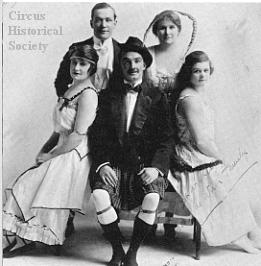 Photo: The Wirth family in 1913. Seated are Stella, Phil and May, with Frank and Mrs. Wirth standing. The photo was taken a year after they arrived in America from Australia.
With her two daughters, May and Stella, top-notch riders, and their husbands Frank and Philip Wirth (adopted sons of Mrs. Wirth) she came to America in 1912 to appear with the Barnum & Bailey Circus. The Wirths remained with the Barnum show the following season. They later returned to the Ringling fold and were featured on Ringling Bros, in 1917 and 1918 and with the combined shows in 1919 and 1920. The family appeared with the Walter L. Main Circus in 1921, 1922 and 1923, and returned to Ringling Barnum for the 1924 to 1927 seasons. During this entire period May's single riding turn was the real feature of the family, she was featured in a special lithograph that originated on the Ringling show and has been rehashed with various names as late as on King Bros.
In the late 1920s Frank Wirth, May's husband, became associated with George Hamid in the booking business. Wirth was one of the early producers of Shrine sponsored circuses.
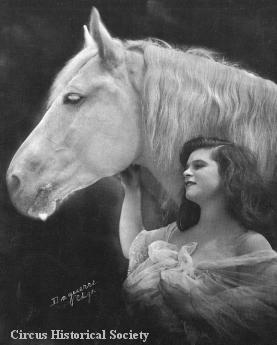 May Wirth, one of the great lady riders of all time, in a 1919 photo. Pfening Collection.
During the winter of 1930-31 Frank Wirth decided to frame a tented circus using a European one ring format, with really first class acts to play one week stands under Shrine auspices. The Shrine circuses of that period booked only the featured top acts of the big circuses, playing winter dates in the off season.
Stella Wirth's husband's family name was St. Leon and this was the origin of the unusual title.
Frank Wirth was president; Larry Boyd, associated with Frank Wirth in the booking business, was managing director; James Sullivan was secretary and Phil Wirth was treasurer. The well known Fred Bailey Hutchinson was hired as general manager.
Other staff members were; Harry C. Fitzgerald, publicity director; Jimmy Victor, band master; Tommy Poplin, electrician; George Pappas, cook house; and Fred Meers, Auditor. Many outstanding acts were booked, they will be listed in the program. The John G. Robinson elephant act was a feature.
We have been unable to determine the exact number of show owned trucks, but a guess would put the number at around ten. The big top was a 120 foot round top with one 40 foot middle. There were chairs on the front and back side of the ring and star backs on the ends.
Lew Dufour had an "unborn" show on the midway and the side show was owned by Mamih Salih and managed by Max Kassow, and contained the usual Hawaiian Troupe, a sword swallower, a fat lady, snake charmer, scotch piper, half and half, a female giant, and "Woof-Woof", the immune man.
Mrs. Birdie Boyd and Mrs. Jackie Sullivan handled the concessions, keeping the income in the family of the owners. Max Gould had his "arctic delight" soft ice cream wagon on the midway also.
Opening date was set for Bridgeport, Conn. on May 5, 1931. Johnny J. Kline, publisher of the “Greater Show World” was on hand at the opening and reported it in his May 16, 1931 issue. The Billboard also covered the opening and from time to time during the season articles appeared in the Billboard concerning the show and its progress.
The Wirth's were sucessful in creating the atmosphere of a European show with box seats and draps around the arena. Opening nighters were dressed in evening clothes. Following an overture by Jimmy Victor and the band a horseshoe bouquet of flowers was brought into the arena and placed near the box where the mayor of Bridgeport was seated. The Potentate of the local Shrine paid Frank Wirth a tribute and wished the show good luck. The Bridgeport Police Commissioner accepted a dare to ride Tillie, the elephant into the tent and that was the signal to start the premier performance.
Jorgen M. Christiansen, equestrian director, blew the signal and the show was on. The program follows.
Grand entry, all personal.
Display No. 1. Indian fantasy of tumbling and balancing with tom toms in the background.
Display No. 2. Mique Cahill, cloud swing and endurance turns on rope.
Display No. 3. The Four Freemans, (Mickey and Ethel and family) clown acrobats and chair balancing.
Display No. 4. Phil Wirth and pony.
Display No. 5 Osaki and Taki, Japanese equilibrists, balancing and juggling.
Display No. 6. The John G. Robinson elephants, with Curley Noonan, trainer.
Display No. 7. Wirth Family. May, Phil, Stella, Mrs. Marzles Wirth, and Wellby Cooke. The big riding act.
Intermission
Display No. 8 Golda Honey, slack wire.
Display No. 9. Emil Pallenberg bear act.
Between the displays clown offerings were presented by Paul and Cristoffo. These two were from Russia and presented typical European clown routines.
Display No. 10. Jeanette May, aerial rings and web. Finished with a Lillian Leitzel routine of arm planges.
Display No. 11. The Honey Family, eight people in tetterboard act.
Display No. 12. Jorgen M. Christiansen and his eight Creamoline Stallions, a truely outstanding liberty act.
As the author reviewed this program it is clear that the European traditional performance was presented. Each act was allowed to give its complete routine and there was no doubling, allowing twelve acts and an intermission to fill a program of a little over two hours.
The opening stand in Bridgeport ran from May 5 to the 9 under the auspices of Pyramid Temple. The schedule of playing five and six day stands with one day off to move continued throughout the season.
The route took the show to Yonkers, N. Y. May 11-16; Utica, N. Y. May 18-23; Binghamton, N. Y. 25-30; Rochester, N. Y. June 2-7; Erie, Pa. June 8-13; Niagara Falls, N. Y. June 15-20.
The show moved into Canada for a series of dates starting in Toronto, Ontario June 22-27. During the Toronto date Curley Noonan suffered a stroke and John Robinson came on to handle elephants himself. The show then played Hamilton and Guelph and perhaps one additional city in Ontario before moving to Medina, N. Y. July 20-22. Lockport and Geneva, New York followed.
During the Geneva date the Billboard carried a story that the show was doing fine but would close on August 25 due to commitments of the acts for fair dates, but would reopen for a fall indoor tour in October.
Williamsport, Pa. was played August 3 to 5th. The show closed in Williamsport and was stored in a foundry building there. Bloomsberg, Pa. was booked for August 6 to 8, but Frank Wirth stated that he felt it best to close a week or so early do to a lessing of business.
The program remained basically the same during the season with the exception of Jack Joyce replacing Jorgen Christiansen and Mickey King replacing Jeanette May in July.
Following the closing of the show Wirth announced that a fall tour was booked and that it would open in Utica, N. Y., a city that had given the show a warm reception during its stand in May.
Surprising enough Wirth again used the St. Leon title in Utica where the show played from October 24 to 31.
Acts used on the fall dates included May Wirth; Mabel's 2 Elephants; Mickey King; Cooke's Ponies; Mickey and Ethel Freeman; Gene Dekos Trio; Otto Greibling and the Flying Concellos. A Billboard note stated that Otto Greibling was working in the riding act.
The show play Oneida, N. Y. Nov. 4-7 and Schenectady Nov. 9-14. And that was the last that is known of St. Leon Bros. European Circus Ltd.
A careful search of the Billboard gives no clue as to the disposition of the tents and trucks. They could have been leased, however an early season report stated that the equipment was purchased new.
The Wirths played various fair and indoor dates but were not identified with any full season tour with an outdoor show following the St. Leon tour. Phil and Stella Wirth were with Hunt Bros, in 1945.
In 1943 Frank Wirth in association with Harry Saltzman organized the Gilbert Bros. Circus. This show also was offbeat by all normal standards. It was framed on trucks but the Terrell Jacobs wild animal act was on rail show circus wagons and had to be moved by system flats. Jacobs carried four or five cages as well as a regular steel tired baggage wagon for the arena. The author visited the Gilbert show in Elizabeth, New Jersey, the day some of the Jacobs lions escaped, but that is another story.
The names of star performers have appeared many times in circus titles, a practice more prevalent before 1875 than later. When framing a show was a relatively simple operation and the day to day business not complicated a good rider or clown could build a performance around himself and take to the road. He could do this with an expectation of some success whether or not he had any business acumen. Such performers as Levi North, Richard Sands and Charles Rogers were circus proprietors in the mid-nineteenth century and men with famous acts such as Van Amburgh and Driesbach had shows named after them. But as the capitalization increased so did the importance of the capitalists and it became the rule to name the show after the man with the money.
In modern times a handful of performers names grace titles. Buffalo Bill, Clyde Beatty, the Cristianis are some. And perhaps the greatest name - in terms of public familiarity - to be at once start and proprietor is that of Tom Mix. Excepting only Buffalo Bill there is no circus owner who began his tented career so well known and liked by the public.
As the pre-eminent western movie star of the 1920's Mix had a ready made audience for his personal appearances that might have numbered in the millions. The limited operation of a circus denied all of them the chance to see their hero, but he needed little advertising of his name to attract an audience and only in the most isolated areas might he have been unidentified.
The big truck circus that bore his name was on the road five seasons, four of them with financial success, and during its existence it was one of the best received shows in America. This article and one other will delineate some of the history of the Tom Mix Circus.
Mix had wild west show and circus experience prior to becoming a movie actor. In 1904 he worked on the Zack Mulhall Wild West Show at the St. Louis Exposition. In 1908 he was in charge of ring stock for the 101 Ranch. In 1909 he had his own short-lived wild west show at the Western Washington Fair in Seattle. He was with the Kit Carson Buffalo Ranch and Vernon Seaver's Young Buffalo show for short periods and then helped in motion pictures as a stunt man and stock handler. His expertise at western ranch techniques led to his becoming an actor for the Selig Company in 1910.
He was immensely popular as a cowboy movie hero, projecting a more humorous and humane image than did the great William S. Hart and injecting showmanship into the genre. He wore fancy costumes - for the day - and featured much Douglas Fairbanks-type leaping and derring-do. Later movie cowboys dressed more flamboyantly and had more bizarre special effects, but they were adding to what Tom Mix had done and not another western star had his film charisma until the advent of John Wayne.
In 1929 the American Circus Corporation offered Mix the huge salary of $10,000 a week to appear with their Sells-Floto Circus and for three years he was the premier attraction of that aggregation. His movie career was near an end at the time - he was forty-nine years old and had been before the public fifteen years - and the studios were grooming actors such as Buck Jones and Tim McCoy to take over from the master.
He appeared in the wild west after-show for Sells-Floto, astride his famous horse Tony, Jr. and surrounded by harder working western types who rode bucking horses and picked up handkerchiefs with what teeth were left them. Mix liked circus work, he had a feel for people that the movies denied him. He said several times that there was nothing like seeing an audience in person.
As at footnote to the salary Mix received from the American Circus Corporation in 1929 and the Ringlings in 1930 and 1931 he was defendant in a suit brought by Zack T. Miller in 1933. Miller claimed that Mix had broken an oral agreement to appear with 101 Ranch for 1929. On the stand Mix admitted he wasn't worth $10,000 a week and said he'd done more work for Miller at $7 a week in 1908. Mix was defended by John M. Kelley, probably at the behest of the Ringling interests. The case was tried in Erie, Pennsylvania and ended in a $60,000 verdict in favor of Miller.
Sells-Floto went off the road after 1931 as part of the Ringling retrenchment during the depression. Mix made movies in 1932 and went out in 1933 with a theatre group called the Tom Mix Roundup. The show consisted of Tony, his movie horse, two liberty horses, some rope tricks and the Ward sisters aerial act. This group later constituted the "Mix" faction in the circus. It consisted of Dail Turney, John Agee, Herman Nowlan, Joe Bowers, Jack Knapp, Carl Robinson and a six piece band and Irma and Mabel Ward. The latter was the fourth Mrs. Mix.
In Shreveport, Louisiana, Mix told Carl Robinson that he was going into partnership with Sam B. Dill in a circus in 1934. Later, in Spartanburg, South Carolina he told Boots Sallee, the trick rider, the same thing. She had been in the after-show on Sells-Floto with him and Mix hired her for the circus that fall. The public announcement came in the Billboard on January 1, 1934. Thus was born the Sam B. Dill 3 Ring Circus combined with the Tom Mix Roundup. The equipment was Dill's and had been out in 1933 as the Sam B. Dill Circus. Winter quarters were in Dallas, Texas and opening day was April 20 in Hot Springs, Arkansas.
The 1934 Season
Most of Dill's equipment was starting its fifth year. Fifty trucks moved the show, thirty-eight of them being semis. The first additions for 1934 were 26 show-owned house trailers. These were uniformly banded red, white and blue and had Mix's distinctive signature painted on them. (Mix, incidently, had a very attractive hand from the evidence of surviving letters from him). Those who owned their own trailers had them painted in the same pattern which made a fine lot display. Larger trailers housed some workmen and the ticket takers and staff, but most lived in two, three or four man house trailers. Only the band had to sleep in tents. The canvas consisted of a new big top, 120 with three 40's, a new menagerie top, 90 with three 30's and a new kid top. Both big tents were replaced during the season as the crowds proved too big for the size of the hall.
The weakest part of the show throughout its history was the menagerie. In 1935 there were five truck-mounted cages and it doesn't appear that there were ever any more. One elephant was always enough for Sam B. Dill as he believed they all looked alike. Babe, was its name, a very popular bull, spoken of with fondness by personnel of the show. She was later with Bud Anderson and Arthur Brothers and still later the property of Gene Holter in Norco, California. One of the whimsical habits by which she is remembered is that of reaching through between the top and sidewall of the cookhouse when the chance occured and swinging her trunk about until given a loaf of bread. Other stock on the show included fifty head of horses, counting mules and ponies. They were displayed in the menagerie tent.
Dill provided Mix with a bus-like automobile, a sort of land yacht on a GMC chassis that was transportation, home and office for the cowboy. The thing cost $3400 and Mix was so fond of it he wouldn't let anyone else drive it when it was new.
Sam B. Dill had plenty of circus experience. He had been both manager and assistant manager on the John Robinson show in the twenties. In 1928 he was assistant manager on Hagenbeck-Wallace and in 1929 held the same position with Sparks. In 1930 he took out a forty truck show titled Gentry Brothers. The same title in 1931 drew complaints from the Gentry family and he retitled in late season to Robbins Circus. In 1932 the title was Sam B. Dill.
Business was good from opening day in 1934. They went up into Tennessee and through Kentucky and day and dated Russell Brothers two days running, at Harrisburg, Illinois on April 26 and at Carmel, Illinois next day. East Ohio proved excellent with Canton, Akron and Youngstown among the better stands. Mix got some bad news about this time in that the appeal of Zack Miller's judgement against him had been denied by the Pennsylvania Supreme Court.
It was soon apparent that Mix' name was filling the tent so by May 2 newspaper advertising was titling the show Tom Mix and Tony heading Sam B. Dill's Big 3 Ring Circus.
The local ministry in Laporte, Indiana succeeded in getting the show's license cancelled there for June 24, a planned Sunday date. On July 10 in Jacksonville, Illinois the menagerie tent was worsted by a tornado. The matinee was on at the time but there were no personal injuries. Everyone on the show, man, woman and child, pitched in to sew up the tent the next day and not a show was missed. A new top was ordered from U.S. Tent & Awning, a 70 foot round with 6 poles, narrower but longer than the old one.
Twenty-four new Ford V-8's were delivered to a wet, soggy lot in Davenport, Iowa on July 15. The show made an arrangement with the Ford Motor Company and the Gilmore Oil Company in the first half of June that obviated the necessity to solicit any banner advertising. All trucks purchased from then on were Fords and even the clown number where the car is packed with Joeys used a Ford.
The weather remained wet until July 18, when it began to be oppressively hot. The first good day, at Kewanee, Illinois, the show took delivery of the new menagerie top and a new cookhouse top. A new big top was ordered about this time.
This outlay for new equipment was typical of the early days of the Mix show. There was never any hesitation about spending money to spruce up the appearance. Mix had his name on it and wanted it to be first class. Joe Ford was upbraided once when he bragged about repairing a truck cheaply with used parts; he was told he should buy new parts. This may be an area that caused trouble later when the crowds were not as thick as they were in 1934. One advantage, of course, to new equipment was that the show moved well.
The 1934 performance was not as strong as it was to be in later years, but it was by no means the weakest on the road that year. Besides Mix, who appeared in the spec and a high school act and the concert, it featured Walter Jennier, who had a great seal act, the Hobson family riding act and the Ar-baugh's and Bell's flying act.
The program opened with a pageant featuring girls, Indians and Romans.
2 dogs and monkeys (Helen Ford, Roy Hilbert, Mrs. Hilbert)
3 acrobats (Arbaugh troupe, Jordan troupe, Bell Brothers & Wanda)
4 Hobson family number two riding act
5 single traps and muscle grinds (Joy Meyers, Ethel Harris)
6 Ford packed with Joeys
7 Herbert Beeson wire act
8 Concert announcement (Tom Mix, Tony Jr., cowboys, cowgirls)
9 elephant (Mrs. Hilbert) ponies (Roy Hilbert, Helen Ford)
10 Clown baseball turn
11 Walter Jennier and Buddy, trained seal
12 lady menage act
13 Hobson family feature riding act
14 Tom Mix high school act, three horses
15 Arbaugh's and Bell's flying act - lengthwise of tent
Wild West Concert featuring Tom Mix, trick riders Boots Sallee and Frank Gusky, with Herman Nolan, Ralph Clark, Ed Hendershot, Helen Hendershot, Augie Gomez and Ruth Gusky.
From July 18 to 28 Illinois lay under a heat wave of such proportions that it began to affect matinee business. During most of this time the show was a week behind Barnett Brothers and Harry Carey, their western star, and it affected the take. Other cowboys contributing to the 1934 season were Jack Hoxie on Downie Brothers and Montie Montana with Al G. Barnes.
The first accident of the season occured enroute from Bristol to Kingsport, Tennessee on August 11 when one of the semis was forced off a mountain road by a bus. Two employees were killed and four others injured. The dead men, roustabouts, were buried in Kingsport.
1934 was the only year the show owned its own side show and it was the smallest ever carried. W. E. DeBarrie was the manager and magician, Rex Omar the lecturer, Ada Moore had snakes, noma Estelle the mentalist act. Others were Jerry Adkinson, cabinet; Mrs. DeBarrie, bird circus; Perkins Company, dancers; Harold Riley, hillbilly; Marie Martino and Dorothy Voss, fan dancers; Simmons, Regan & Company, minstrels.
A mixup in Johnson City, Tennessee caused the show to put it up outside the city limits. Billboard reported that city officials attempted a holdup on the license fee. East Tennessee was not suffering from the drought that was plaguing most of the nation. Crops were good and produce prices were high. It was predicted by the show that Tennessee, north Georgia and northern Alabama would be good that year.
Chattanooga, Nashville and Memphis contributed turnaways. Heavy rain interfered with business at Morristown and Paris was skipped when the lot was discovered to be under water. Coming through the Smokies two more trucks were damaged in accidents. Motor discipline on the show dictated a maximum speed of 35 and Denny Helms, the superintendant, drove back and forth on the route every day keeping an eye on things. Joe Ford brought up the rear of the column to perform any roadside repairs.
The circus moved into Arkansas twenty days ahead of Al G. Barnes on August 30 and stayed ahead through five stands. On September 29 Barnes flipped the situation, going ahead at Galveston by two weeks. Barnes was to do this again in 1935. This time they went on to Brownsville and McAllen ahead of Mix. The Texas stand of the Dill-Mix show lasted nine weeks and business was excellent. By October 13 it was decided that the show would winter in California as Mix was going to make one last movie. Sam B. Dill did not want to go into California, preferring to end the season at Big Springs, Texas, but was overruled somehow. As it turned cut, his course would have been the wiser one.
The banner stand for the season was at Amarillo, a full week at the Amarillo Fair cheek-by-jowl with the Johnny J. Jones carnival. It was not a popular stand with the performers being a long parade accompanied by dusty winds off the Texas plains. By October 27 the show was being billed as Tom Mix Wild West and Sam B. Dill Circus Combined. Dill was not well for the last two months of the season but refused to quit smoking. He was to die of lung cancer in February, 1935. By November 3, the title was Tom Mix Wild West and Circus Combined indicating that Dill had sold out, though it may actually have occured later.
Ex-rangers, ex-soldiers and ranchers were constantly on the lot in Texas renewing real or imagined acquaintance with Mix. On November 17 it was announced that Compton, California would be the winter quarters. The outfit went into New Mexico and Arizona and business declined sharply. The State of Arizona demanded the purchase of 1934 license plates for the whole fleet despite the fact that it was November. For the 32nd week the show went into California and played 13 stands at most of which only a portion of the seats were erected, thus proving Dill's contention that there was no profit in California. The show closed at Riverside on the 29th of November.
They had been out 33 weeks, covered 12,895 miles to play 222 stands in 16 states. Business had been very good; one report indicates that the owners split $130,000 on the season. Winter quarters were established at the Oil Exposition Company property in Compton and put in charge of Denny Helms. On January 19 Sam B. Dill announced that he would frame a new Sam B. Dill Circus for 1935. Eleven days later he was dead.
The 1935 Season
Plans for 1935 included new grand stands, eleven new trucks (see equipment list), all new paper from Donaldson Litho and a determination to parade. The staff was printed in Billboard in its March 16, 1935 issue and it included Dail Turney as general manager. He had once been Mix's chauffeur and later the announcer for the theater tour. In 1934 he was Sam Dill's assistant and was to manage the show from 1935 on. Other staff members were Robert Brown, treasurer; C. A. Lawrence, general agent; Pierce N. Williamson, advertising manager; Al Oaks, contract agent; Harry Paine, press; Duke Lee, press back and announcer; H. C. Baker, adjuster; John Agee, equestrian director; Denny Helms, superintendent; Howard Payne, boss canvasman; Jack Burslem, priveleges; Nathan Alberts, connection; Joe Ford, maintenance; Ed Hendershot, stock; J. Reece, elephants; Ray Garrett, menagerie; Russell Kelly, props and J. C. Schnare, electrician.
William D. Heney [William P., see below] was bandleader, though the band was still under contract to Carl Robinson. Robinson was a drummer so he had to have a trumpet player do the actual leading. Ted Metz owned the side show and it was a strong one. He brought his own tent on the show, an odd shaped, carnival-type, pit show top that confuses historians looking at photographs. George White did openings and Frank Stratton was the lecturer. Among the platform attractions were an armless, legless illusion, fat girl, pinhead, skeleton, midget, frog boy, tattooed man, 3 legged illusion, and Roberta-Ray the half man, half woman. It was more of a traditional sideshow that the 1934 edition had been. Correction, December 2006: My father was the band director for the Tom Mix Circus Band for the 1934-5 season. I believe he got the job in 1933 when, according to his account, the then Band Director either failed to show, or showed up drunk, also according to my father, his regular state. In the article, my father's name is given as "William D. Heney" which is incorrect. His middle initial was "P", as is mine. I am his son, WPH Jr., and many times enjoyed his stories about travelling with the Mix show. - William Peter Heney, Jr.
Rehearsal call went out for March 1 with opening day to be March 6, so early as to be possible only in California. The advance cleared quarters and headed north on February 22. Opening day was the quarters town of Compton and the response was a fine one. Walter Jennier's seal, Buddy, died just before the opening performance, as hard luck as a trouper might have. He was unable to go out with the show and as consequence for the rest of his career he always carried two seals, both trained to the same state.
Cold and rainy weather was the feature of the first week on the road. Pasadena, Glendale and Hollywood were wet and chilly. In Hollywood, a five day stand from March 13 to 19, the show suffered a new lot at LaBrea and Fairfax and lost some business when patrons went to the historic lot at Fairfax and Wilshire Boulevard. By the fourth day of the stand business was very good. The 1935 nut was $1200, a little high in comparison with other truck shows.
The performance jelled to an hour and forty minutes and was presented in the following order:
1 110 people in historical pageant from covered wagon to automobile
2 trouping of the colors
3 dogs (Homer Hobson, Sr., Joe Bowers)
4 cloud swings, swinging traps
5 principal acts (Herbert Hobson, Juanita Hobson, Ella Linton)
6 Tom Mix and Tony, Jr., gun spinning and marksmanship
7 aerial revolves (Miss Zermer, Joy Myers)
8 trapeze headbalance (Charles Arley)
9 comedy acrobats (Ashton trio, Jordan trio, Howard Bell trio)
10 concert announcement
11 Irma Ward, arm-over planges
12 perch act (Charles Arley)
13 whirl revolves (Mildred Asher, Inez Hubbard)
14 menage (John Agee on Gowan in center ring)
15 comedy mule (Jack Knapp)
16 jumping dogs (Homer Hobson, Helen Ford)
17 Babe the elephant (Inez Arlene)
18 Tom Mix and liberty act
19 acrobats, gymnasts, tumblers (many people doubling)
20 Riding Hobsons
21 Arbaugh's flying act
22 Finale, Spirit of Progress (a la Chicago World's Fair)
As can be seen this was good, strong program and one any truck show would have been proud to present. The outstanding acts were Irma Ward, who was well received in her 100 or so planges. Those who saw her consistently feel that her act was the equal of Lietzel's in prowess, but that she lacked Lietzel's consummate grace, the comedy acrobat numbers and the Arbaugh's who again performed lengthwise of the top. Mix' appearances were always popular, though they were more a measure of his fame than of his circus skill. In his liberty act, as an example, the horses were not well trained and it was Mix' habit to go sit on the ring curb and wait when a horse temporarily forgot his lessons.
The show played San Francisco March 28 to 31. Al G. Barnes was due in May 2, over a month later, but Barnes put up wait paper with a vengeance. It was the beginning of a billing battle that would go over part of two seasons. The Barnes aggregation, owned by Ringling, was a native California show and considered Mix an interloper in territory Barnes had mined for years.
Despite the opposition paper business remained good for Mix. The lot in Salinas was underwater for the March 23 date so the show played Monterey a day ahead of the billing, then went back to Salinas a day behind. Both towns gave good business in spite of the mixup.
San Francisco contributed a turn-away at the new lot at Oakdale and Bayshore. The downtown parade was the first one in many years. San Jose was a double turnaway. Nathan Alberts, connection ticket boss, described the California business, "like the Floto show in '29".
The battle with Barnes heightened through Santa Monica, Santa Barbara, Salinas and Modesto until one night in Fresno there was a hand-to-hand battle between the billing crews which was of such magnitude as to necessitate police interference. The fracas was settled by jailing everyone involved. An agreement was then made between the shows not to cover any paper, but a Mix man said it lasted all of two days.
Mix was ahead 33 days in Fresno, 20 days in Modesto but Barnes kept chipping away at the lead, as would be natural with a rail show following a truck show. By the time Mix reached Portland, Oregon he was 11 days ahead and dropped to a 5 day lead in Seattle. Then, in Tacoma, Barnes forged ahead by a day. All this time landlords with empty stores were enjoying unusual popularity.
Tom Mix presented a night show in Eureka, California on April 27 and two shows on April 28 to the best business they had had to that time. A new water truck and a bus-sleeper (#77) were added that week.
Oregon was entered April 30 and Washington May 10 and both had intermittent rain and lumber strikes. Still, there were capacity houses again and again. Astoria was two straws, Tacoma and Spokane turnaways. In Spokane the night ticket sales were stopped at 7:30 as all seats were sold, but the crowd wouldn't leave the lot so another show was scheduled for 10 p.m. and the windows opened again.
Mix received invitations almost every day to speak before luncheon groups or similar gatherings. His personal popularity was immense and it occurs to the student that he could have fronted something much less in the way of a circus and still made money. But here was a strong show combined with a national celebrity, a difficult combination to oppose, as Barnes was learning. For no other reason could a truck show hope to survive a billing war of the intensity of that one in the west in 1935. It is difficult to say who bested whom, but certainly Mix' business suffered little from the contention.
Many towns wrote asking to be included in the itinerary. Children worshipped the cowboy and, unlike most shows, this one played to very heavy matinees. Until the weather became extremely warm the matinees equalled or bettered the night performances in date after date. With this circus, more than any other since Buffalo Bill's Wild West, the personality of the star performer was the great drawing card. Unlike a pure circus personality - such as Clyde Beatty - it was not what Mix did in the arena that drew the crowds; it was what he had done before.
Other western movie starts were under canvas that season - and all through the thirties - encouraged by Mix' success on Sells-Floto. Tim McCoy was with Ringling-Barnum, Hagenbeck-Wallace had Pawnee Bill's Buffalo Ranch (but not Gordon Lillie), Bill Cody was on Downie Brothers. Almost universally they were concert features, only on the Mix show did the cowboy appear as part of the regular performance.
In 1935 the parade was dropped early in the season. It was gone by the May 18 Seattle date. In the west, with long hops and a heavy show, it was difficult to work the parade into the daily schedule. The show sat overnight on the lot and moved in early morning to the next stand, setting up the big top by 9 a.m. as a rule.
The billing fight with Barnes was renewed in Montana. This one was milder than Fresno, but Billboard still described it as a "darb". Mix billed Helena for June 5 and Butte for June 6. Barnes reversed the towns. Barnes placarded Helena first and the Mix crew had to do with what was left. Barnes claimed they ignored the Mix show, but their newspaper advertising pointed out that they had twenty elephants to Mix' one. "Wait for the show you know", Barnes said. The crowds were about even, Al G. Barnes winning Butte with their best business there in seven years. They created some trouble of some sort and Mix had a "Hey, Rube" as a result of it. Babe, the elephant, cleared the grounds by swinging a heavy chain. This was the last confrontation between the shows until opening month in 1937. The Barnes show went north into Alberta and Mix headed east into Wyoming.
A new big top was ordered, 130 with three 50's. Manager Turney said it would save the cost of a lot of straw. Every Montana stand was good. More straw was spread in Missoula. Double capacities were scored in Bozeman, Livingston and Hardin. It became very hot by July 1 in Lincoln, Nebraska and subsequent matinees began to suffer. Iowa was spotty as a result. The show went into Illinois and Indiana.
Rhoda Royal, the old showman, came on the show the week of July 20. He was to stay two seasons and contribute a liberty act for 1936. The weather kept Michigan matinees light, but night business was good. In Sandusky, Ohio the Mix and Cole Brothers shows day and dated on August 6. There was no paper pulling or covering and much visiting back and forth. Cole had a slight edge in attendance. They were to come within ten days of each other in September in Oklahoma.
On August 10 Turney announced the show would not go into the east as planned; instead they sloshed through six foggy, wet stands in Ohio on the way to Kentucky. An infantile paralysis scare in Virginia caused several shows to charge their routes at this time and suddenly Hagenback, Downie and Mix were all headed toward Kentucky where Haag Brothers had just played. Barnett Brothers were in southern Indiana with the same goal in mind.
The Mix show's Kentucky idyll lasted just one stand. They moved into Covington on Sunday morning August 18 and set up for the Monday date. After the evening performance the police informed management that all the drivers were under arrest because none of the vehicles had rear view mirrors. It was not common in 1935 to have such equipment, but Kentucky law required them on trucks. Management soothed the police by agreeing to correct the defects on Tuesday and the show tore down and sat on the lot until late and then made a rush for the Indiana line. Separating into columns, each assigned to a separate bridge, they made a successful exit from the state, abandoning nineteen days paper in the process.
The wildcat stands involved four Indiana dates, one in Illinois and five in Missouri, using only radio and newspapers until September 7 at Wellington, Kansas when they caught up with their billing.
It rained in September all through Missouri and Kansas. The show skipped Atchison and drew a very wet lot in Lawrenceville. The week of September 16 was just the opposite, very hot in Oklahoma and the roads were in bad condition. Business was reported good, however. They made ten stands in Colorado and then a two day, 634 mile run from Grand Junction to Las Vegas and closed at Barstow, California on October 23. Wintering once again in Compton the announcement was made that they had played 216 stands in 19 states and driven 13,275 miles. Receipts had been 35% over 1934.
The circus business had been generally good in 1935, through the weather had affected every show on the road. Had there been less rain and less heat the season would have been better. Billboard announced optimistically that, "now that we're over the depression" business should improve.
No part of this publication may be reproduced in any form or means
Last modified February 2006.
without written permission of the author and the Circus Historical Society, Inc.