


Circus Historical Society
Bandwagon, September - October 1967
Back to Bandwagon Index
Bandwagon, Vol. 11, No. 5 (Sep-Oct), 1967. Note: Only some articles are included in this online edition. Many illustrations are not included. The Circus Historical Society does not guarantee the accuracy of information contained in the information in these online articles. Information should always be checked with additional sources.
After closing with the Gollmar Brothers' Circus, season 1905, at Mowauka, Ill., on October 12th, I returned home by way of Des Moines, Iowa. While there, I was told that Fred Buchanan of Des Moines was planning to open a wagon circus the next spring. I met Mr. Buchanan, who operated the Bijou Theatre, a small store room picture house playing some vaudeville, and Ingersoll Park, in a summer theatre there. He was planning to build the new Majestic Theatre to handle Orephium Vaudeville. I made arrangements with him to handle the ticket wagon and the treasurer's job, as well as the press agent and Legal Adjuster, known on the circus as the fixer.
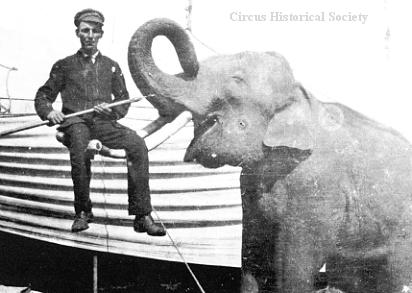 Photo No. 2. John Keller with Tom-Tom bull elephant. Tom-Tom died on Buchanan's circus at Cumberland, Wisconsin, on June 30, 1911. Author's Collection.
The circus was to be known as the Yankee Robinson Circus and to be a wagon show, known to circus people as a mud show. Lonnie Buchanan, Fred's brother, was to be the circus manager on the road. The show's baggage wagons would move from town to town after the evening performance to be in the next town in the morning. The menagerie, which consisted of four cages of small animals, one large elephant called Tom-Tom, and three camels, would also move after the evening performance.
The band men, performers and agents would stay at the local hotel and drive over in the early morning arriving in the next town in time for the street parade. A band wagon and large hacks were provided for the transportation, as were some single buggies.
The band wagon we used was the original band wagon built about 1895 and used by the Terry's Uncle Tom's Cabin Company when they moved overland before going on rail in two cars. The wagon was a very fine band chariot.
The big top was a 70 ft. with two 30 ft. middles, and the menagerie was a 40 ft. with two 20 ft. middle pieces. The horse tents were 40 by 80 ft. each and the cook house was 30 by 60 ft. The dressing top was 30 ft. round.
 Photo No. 4. Part of the staff of the Yankee Robinson show in 1906 is shown here. Standing from left to right are: Jim Secerest, ticket agent; Adrian D. Sharpe, ticket wagon; Evert Hays, assistant manager. Seated on the left is C. W. Buchanan, road manager and on the right is the rarely photographed Fred Buchanan. Author's Collection.
I arrived at Des Moines, Iowa the next spring about May 5, 1906. The show was to open at Adel, Iowa, on May 10, a Thursday. The show was framed up at Valley Juction, Iowa, a small town about five miles west of Des Moines. The drive from Valley Juction to Adel, our first stand, was 22 miles. We left for Adel in the evening of May 9, about dark. The cook house wagon had stopped at a small place of Waukee, Iowa, to serve us with coffee and sandwiches, as we left before the evening meal. When Buchanan bought the horses for the show, his horse buyer let the sellers dump about all the balky horses in Iowa on the show. We had plenty of horses that would not pull a pound; or if they did start, they would go on the run. We had our first catastrophe as we were leaving Valley Juction; the band wagon with all the men was in front of the hack and they had the bass drum tied on the back end. The man that was driving the hack was of the very poor variety. We were on the main street of the town when the hack team made a lunge and the driver, instead of going around the band wagon, ran the hack tongue right through the bass drum. Well, I took over the driving of the hack the next morning for the rest of the tour. There were many things of that nature that happened during the summer. As the summer moves along I will mention a few, but that was the last one for the hack.
As for salaries on the show, they were very low in those days as compared with today's. To name a few: I drew $10.00 a week, Billie Devan, a bare back rider, was listed at $40.00 a week, but he had to furnish his own horse.
The band was a contract band of ten men of the Webb Brothers out of Waterloo, Iowa; they received $104.00 a week for the entire band. I might add here that the band was originally managed by a man named Chase and his three boys. He did not prove to be a good bandmaster for a circus, and the Webb brothers were sent to take his place. A couple of men had rented a twenty-car circus that spring from Bill Hall at Lancaster, Missouri; it was titled Cook and Barrett with some equipment from the ill-fated Wm. P. Hall Shows of 1905. The Webb brothers had furnished the band on this show, but for some reason, the venture did not turn out successfully and the men ran the Cook and Barrett show into Des Moines on a Sunday and wired Hall that if he wanted his show to come and get it. They left the show people stranded, and then they were seen no more, so the Webb brothers came on Yankee Robinson for the remainder of the 1906 season.
J. J. Buckley with his trained dog act was paid $35.00 a week. Most single acts were paid about $10.00 to $15.00 a week; everybody getting board and lodging. The working men were paid from $3.00 to $5.00 a week, except the Stewart and horse boss, who were paid $10.00 a week. The working men slept on the ground, or anywhere they pleased. Had the show furnished sleeping tents with folding cots, they could have kept a lot of good men that left the show. We had one man named Mons Joseph, an old weight lifter. They called him "old cannon ball Mons" because he would balance three balls on his chin that any man from the audience could not even pick up when in a light box. He was a marvel at his age, then about seventy. One morning when I was leaving for the lot about 5 A.M. to get the hack, Mons was on the hotel porch and he said, "Sharpe, I want to show you something." He took me down the street where the Forepaugh Sells circus had some paper for a local advertising and there was a lithograph of Mons Joseph when he used to work for the Sells Brothers' Circus. It, of course, showed him in his younger days, but they were still using that same lithograph twenty years afterwards.
Another old timer we had was an old woman named Nellie Texanan. She was a crack shot; I think as good as Annie Oakley. Her salary was $15.00 a week. She would stand a man up against a steel backed board and shoot wax balls from around his head and body. It was a real shooting act; she used a 22 repeating rifle for the act in the show, but a 16-gauge shot gun for her outside act as she did a free act before each show in which she shot wax balls from high in the air. Nellie was an expert horse trader and she had her own horse and buggie. Her only trouble was to keep a man to stand up against the board for a target in her act. About one performance was enough for most men. There is always somebody in this world for every job, and we had a fellow we called Blink who was too lazy to hold a job on anything so she got Blink for a dollar a week and the circus gave him his board. He stood up against the shooting board for her act and groomed her horse and went up town in the mornings and dug up horse trades for her. He slept on the lot in her buggie; but when she drove from town to town, Blink would stand on the back end of the buggie and hold on to the cover. Nellie was one woman that did not need a male escort as she carried two big revolvers in her belt. One day the old lady was taking her nap in her dressing tent, as was her daily custom, in a hammock. That day one of the canvasmen had tied a guy rope from her tent to a wagon wheel instead of driving a stake, and when the driver hitched up a four horse team and started off for the parade, it brought her tent down flat. Well the old lady came out on her hands and knees and her vocabulary was not too good when she got mad, and was she mad! She was still with the show when we pulled into winter quarters.
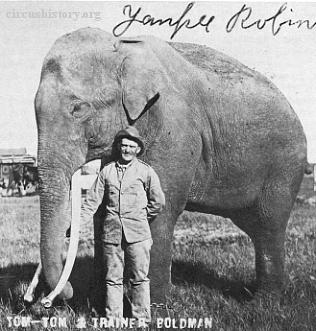 Photo No. 7. Another view of Tom-Tom the elephant. This elephant was famous on the Yankee Robinson show that for a few years after his death in 1911, the Yankee show's elephant troupe was called "its herd of Tom-Tom elephants" Also shown is the trainer Boldman. Fred Pfening, III Collection.
The weather was nice for the opening at Adel. We moved to Redfield, Iowa, on the 11th of May and on to Dexter for the 12th. Then we moved to Stuart, Iowa on the 14th, the 13th being a Sunday we spent that day at Stuart. We ran into rain on the 14th at Stuart, then we had to make a drive from Stuart to Panora, 23 miles North. As was the custom, the baggage wagons left Stuart after the evening performance. That particular trip was where I found out why they called a wagon circus a mud show. We left the hotel early in the morning of the 15th from Stuart and about five miles out we came upon the baggage wagons. We had a stretch of timber roads and up hill there were red wagons stuck in the mud as far as I could see and some of the drivers had unhitched their horses and the horses were eating grass along the side of the road and the drivers were lying down on the grass asleep. There were eighteen wagons and four cages. The horses were pulled down until they could pull no more so we told the horse boss to hire what farmers he could get to pull the show into Panora. We drove on into town with the hack. We got into Panora about noon and the cookhouse wagon, that had left early the evening before, was all ready in, and the cook tent was up. The elephant and camels got in a little after noon, and that held the people in town at least for the evening show. I had accumulated quite a bag of money and I had began to think that a wagon show was a gold mine. But, in the next few hours I had that taken out of me. The farmers came in all afternoon with four horses on a wagon and our circus horses tied on behind and I sat on a bench in the cookhouse and dug the bottom of my money bag to get that show into Panora so we found out why it was a mud show and we had many more such days during the first part of the season. We got the tent up "and put on a show in the evening to a big crowd, and did that money look good. It seemed that it was just impossible to get ahead; it was just take in some money and then pay it all out, and that lasted until, I think, the 23rd of June at Weldon Iowa. When I got into town I told the boss that I was about broke and unless we got in some money I could not pay the day's bill. Buchanan said that there was a good crowd in town and perhaps we would get a good day's business. So we did just that and that day was the breaking even point for the season. I soon sent in money to Des Moines, but we had many muddy roads and hard luck after that.
We moved from Panora west to the Missouri River towns and then South to the corner of Iowa playing the next two weeks. We arrived in Glenwood, Iowa, on Memorial Day and as the town was planning on a speaker on the street in the morning and a parade to the cemetery and we had a circus parade to put on, we at once got together with the city fathers and the circus band went to play for the town people and then we put on the circus parade and everybody was happy and we had a good day.
We moved to Sidney, Iowa, for the first day of June. Sidney was the county seat town of the south west corner county in Iowa. The weather was fine and the town was alive with people. When we made the parade, the people followed it to the show grounds a couple of blocks away, and it was a real mob. It was the first fast day ticket selling I had run into. We had two men taking tickets on the front door. When I opened the ticket window to start selling tickets there was a little woman that had made a dive to be first to the window. She had red flowers on her hat and the people made a mad rush for tickets. They pushed the little lady up against the wagon so tightly that they rolled the wagon. She looked up at me and said, "My God, they're killing me!" As I write these lines I can see her yet. I begged the people to quit pushing, but to no avail. There was a big farmer right behind her that put his hands on the window ledge and held the crowd back until she could get her ticket. She dove down and crawled out from under the wagon. When finished selling tickets there was at least fifty or more people who were not able to get through the gates. I had sold tickets faster than two men could take them. We had two big full houses at Sidney, but there always seems to be something to mar a good day's business and it happened at Sidney. In the evening while the concert was going on some town guys pulled the back jacks out from under the reserved seats and a couple of hundred people fell down with a crash and several of them were somewhat hurt. Only one girl, about fifteen, was looked after by a doctor. The doctor said that she was hurt very badly, and the next morning we tried to make a settlement with her father, but he asked too large a sum so we drove off. They sued the show, but the trial was held off until fall and by that time the doctors could not find anything wrong with the girl. All we got was the expense of the court.
During June and July we crossed Iowa from the Missouri River to the Mississippi River towns playing the smaller places. In those days Iowa was local option. About one town out of ten had open saloons. The rest were dry. We had a very good bunch of men on the show; no drinkers to speak of among the performers, but the working force was mostly a bunch of floaters and would get drunk if they had the price. Out of the entire working crew that left with the show in the spring, only four were on the show in the fall - they were the dry ones. We had a man that came on the show as an agent and all he did all summer was to go to nearby cities and get working men. When he would arrive with a half dozen men, there would all ready be that many gone. I might add here that on the 11th of June, when we were driving into Blockton, Iowa, the first thing that caught my eye was a big saloon sign across the street. We paid off the working men on the lot in the evening on a Sunday and the performers and others Monday morning. That Sunday evening as we were sitting in the hotel, I said to the assistant manager "Let's not pay off the working men until after we get out of this town. They have a saloon here and that will mean a bunch of drunks in the morning," and he said that was sure all OK. He usually helped me pay off Sunday nights, but we passed this one up. But, just before bed time, about 10 P.M., Buchanan came along and went down to the lot to see that everything was alright and the men jumped him there for pay and he came back and said, "Sharpe, why didn't you pay off?"
I said, "You see that saloon sign?"
"Yes," he said, "I know one or two may slop over, but better give the boys their money."
So we went down and paid off. The saloons in Iowa were not allowed to open on Sunday, but this one opened the back door and the entire working gang, with the exception of four or five drys, were in there and they really had a ball. We took a look in there as we went back to the hotel to confirm that. The next morning we had a drunken brawl with half the gang in jail and the rest no good. Our five drys did not even come in for their pay. We had a Chinese cook and when he got drunk, he just let everybody else alone. Woe be tied the man that did not let him alone! I was sitting in the cookhouse above five in the evening waiting for the evening meal when a drunk came along on the outside of the cook tent and put his face up against the canvas and said something to this cook. That Chinaman let drive with something that did glisten as it went through the canvas; he then went right on with his work.
I knew he hit the man and I thought that man had a big knife. I waited a few minutes and then went out to see and the drunk was walking on down the way and I looked and there was a big spoon next to the tent. I was relieved not to see a dead man there.
Well, that was not ten percent of what happened that day, but it is enough to tell here. For the next three or four weeks we had nothing but rain and mud roads, drunks, and trouble every time I got in a few dollars. I paid it out to get the show in town, which it seems was somewhat characteristic of wagon show days.
I went up town one morning to pay the license. We had a contract for $5.00 for a city license that included a parade. The old mayor told be that we had to pay more than $5.00. I told him that was the contract, but he said nothing doing. I sent the assistant manager to try his luck, but he did no better. About time for the parade to start I went back and told him that $5.00 was the contract and that was all I would pay and that if he would not issue a license we would wait on the lot until midnight and then drive on to the next town. I also told him that he and Fred Buchanan in Des Moines could settle it in the courts. So after some talk he did issue me a city license and we went ahead with the parade and show. That evening they rounded up a bunch of toughs to run the show out of town. We had got onto what was going on and were ready for them. When they arrived during the evening show we had a real old-time "Hey Rube" and when that was over the wire fence in the front of the lot was all torn down by the toughs going out. When we went to the hotel that night, we had to cross some railroad tracks. There were some fellows there, and I had a big bag of money and a bright lantern. Bill Loyd carried a big gun. They gave us a big "ha ha," but that was all. Well, so much for that day.
There were some funny things that happened from time to time. One morning we drove into a small town and the lot was right in the middle of town right across from the Post Office. There was an old chin-whiskered man that owned his cow pasture there and could not be moved out as he was there when the town was built. He had one square block and would not even allow anyone to walk on it. In some way our advance man acquired a lease from him for $3.00. When the show moved in during the night we just about filled up the block. When the old man got up in the morning, there wasn't even room for his cows. Our men had taken down the wire fence in front of the lot. When I sent up to pay the license, the mayor said, "How in the world did you ever get in on that old man's lot?" I said that I didn't know, but I found out when I returned to the lot. The old man was there and he said for me to get that stuff off the ground, quick. I said that we had a contract, but he said that the advance man said that the show was only a little wagon one. He went up town and got a lawyer and the lawyer came down and tried to bluff me. He said, "Move off at once or I will get out a paper to move you."
I said, "Well under the laws of Iowa, it will take 24 hours any way you fix it, and we will be gone by that time." I had a signed contract so they went away, but after a while the old man came down and took his three dollars. The town people all got a big laugh over the matter as they had tried to buy him out, but no one ever could.
It was nearing the Fourth of July and we had been booked into Buxton, Iowa, a mining town of 4,000 Negroes and nine white people. Needless to say, it was considered a rough town. The town had only one city marshal and Buchanan said that if we were going to show there we would have plenty of police and he sent a man over the day before we were to show and made arrangements for sixteen special police. We had played Melrose on the 2nd, and I had the money I had taken in for the night show. Then we played Hitman, a coal mining town that had no bank, so I had all the silver I had received there on the 3rd. When I reached Buxton for the Fourth of July, I was loaded down with a bag of silver, which was a lucky thing for the city of Buxton as the man who owned all the mines as well as the town paid off all his help in gold instead of checks. As we had a big day's business, I used all the silver to break up the five, ten and twenty dollar gold pieces for the ticket sales and when I left Buxton I had a bag of gold coins. We were sitting in the timber quite a distance from the hotel where I had to go after the show. I said to the front door man, who usually went up with me at night, that I wasn't going to go up this timber road alone and he said that he would ask the old marshal to walk along with us. He did and the marshal said to wait a minute and he would get a couple of other fellows to walk along too. There were three each with a big "44," so I was safe and arrived at the hotel safe. When I was over at Eddieville, the next day's stand, I was walking down the street with that bag of gold and I met Buchanan and he said, "Sharpe, how much money do you have in the bag?"
I said, "I don't know."
"Well," he said, "You have too much to be packing down that street. If Jessie James had known you had that he would have made a special trip up here just for that."
Well, old Jessie James didn't know it anyway, but if a fellow had a bag of gold like that as I am writing these lines he would have the F.B.I, after him and the police after him for having a gun to protect himself with. This is modern times?
The weather got better by the fourth and roads were also better and one morning soon after that date we were driving and came to a river that took a large steel span of bridge to cross, as well as a long span of wood pile bridge at the end. When the baggage wagons came along in the dark of the night, the driver of the reserved seat wagon drove the side wheel right off the bridge and the wagon, driver, and four horses went off in a foot or so of muck, and was that a mess, but to someone's luck no one was hurt, not even the horses. The horse boss said that it happened because the driver was asleep; that sure woke him up. It was not uncommon for some of the drivers to go to sleep and just let their team follow the wagon that was ahead.
One morning I went down to get on a cage wagon to go in the parade and I found that one horse had been tied back with a chain from the single tree to the wagon body so that the fast horse would pull all the load. I took the chain off and told the horse boss and he said that he would look after it that night as it was a big fat cage. That night when the wagons left for the night, the driver of the cage had the horse tied back again and had made himself a bed on top of the cage and went to sleep. Well, the horse boss had a black snake whip and he took one big spank across the fellow's bottom and he went off the wagon in one jump. The boss stopped the wagons and put a new driver on and when I paid off the next Sunday there was one that I didn't have to pay. That fellow was just a sample of some of the drivers we had that summer.
We still had some trouble with drunks at times. One in particular occurred when I came into town and the Stewart came to me and said, "Sharpe there will have to be something done with that Negro driver; he is drunk and has a big gun in his pocket and is dangerous." I went down town and found the city marshal and told him that we had a drunk man at the circus lot that I wanted to put in jail. He came down to the lot and got the Negro without any trouble and instead of putting him in jail, the marshal took him down to the city office on Main Street and held a little court. We went in the room; it was a little, long, narrow room with a long desk at one side and three city guys behind it. They began to quote all the city laws and the Negro looked on for a few minutes then took off his old hat and slapped it down on his leg and called them all the names in the book. He had plenty of names, and then he walked out and back down to the circus lot, and the old mayor jumped up, shut his book, and said to the marshal to take him in again. The marshal would not go down after him alone until they got another man to help him. Then they came down again and the fellow went along with the marshal without any trouble, but I saw that gun in his hip pocket and told the marshal to take the gun. When he reached for the gun, the Negro said, "Keep your hands off me," and they did and they put him in jail, gun and all.
Well, that took care of that day's excitement as by that time we had a big crowd on the lot. We made quite a trip up in the eastern part of Iowa and then started West toward South Dakota and when we were making a night drive from Story City, Iowa, to Ames, Iowa. We had to drive at night since we could not get hotel accommodations in Story City. I was driving the hack with ten people. We made a long drive in the timber where it was so dark and the road winding, but I was told in the evening that Ames could be reached by driving down to the first cross roads and turning South. I did that, but the people in the hack all said that I was turning the wrong way and that I was going North where I came from. They made me stop and we all got out in the road behind the hack, and I said, "Show me the North Star and there was not one of those old troupers could show me the North Star. When I showed them the North Star right out of the back end of the hack they one by one got back in the hack and we drove on into Ames.
When Fred Buchanan was on the show at Ames, Iowa, he said that he was going to put on an animal act and he sent for a young lady a few days later to work the act; her name was Martha Florene. She was on the circus for a few days and I guess that Fred must have figured that it was too hard to get the equipment over the road; so they gave up the idea. There was a young man named Charlie Cook that came on with her and they both left and, I was told, went over to the Al G. Barnes show.
When I was making a morning drive one Sunday morning and the roads were very muddy, I drove up quite a steep hill and the three camels and the elephants were ahead of us. As we came to the crown of the hill we met two traveling men with a livery buggy. They ran head-on into that big elephant. I have heard of turning around on a nickel. Well, those fellows did it in half that time. I thought they would upset but they leaned to the starboard side and landed on all four wheels and did they go back where they came from! A few days after that we came into a town where our lot was in a ball park. We had a contract with the cashier of the bank for the lot and early in the morning the banker came down and collected his rent of $5.00 as he was leaving town for the day. After a while three men came down and wanted to know why we moved in on property without making some arrangements. I showed them the contract and they said that the cashier had no right to the property and that there were several town lots and they owned them. I settled with two of them with tickets, but the third held out for ten dollars. I said, "Show me the corners of your lot," and he did. The horse tent was on his lot so we just moved the horse tent off and that settled him.
A few days later we were in Wall Lake, Iowa, Fred Buchanan was sitting in the front entrance and asked the name of the little short fellow who drives a cage. I told him and he said, "That is just who I thought it was." Fred Buchanan and his brothers were all raised in Sioux Falls, South Dakota, where his father was a newspaper man. Fred was a graduate of the State University at Vermillion, South Dakota. Fred said, "That fellow was in my class at the University when we graduated and he was a smart fellow. Go over and call him down, I want to talk with him." I went over to the horse tent and told the man, "Fred Buchanan wants to see you." The man came over and they had quite a talk about school days. The next morning, the fellow came to me and said that he wants his money and that he is quitting. I said, "Get an order from the boss and I will give it to you." He said nothing, but went downtown and got a lawyer. The lawyer came down to the lot and told Fred that unless he paid off at once he would file a claim for labor and Fred called me and said to go downtown and pay that fellow. Fred said that the man wouldn't work for us since he found out who he was.
One morning, I don't think it was many days later, I went uptown in the morning to pay the license and I met the mayor who was a nice fellow. He said, "I understand that Fred Buchanan owns this show," and I told him that he did. He said, "How is he getting along?" I said that he was fine. He said, "This is the town that Fred closed up in June of 1897 when he was here with a wagon show and could not get out and I sent feed down for his stock until it could be sold." We had a nice business there and the mayor came down and had a long talk with Fred and then he came back down in the evening with his family.
We moved up into South Dakota for a few days and then back into Iowa. When we were at Hudson, South Dakota, we had two small boys come to the show that wanted jobs. The boss canvasman told them that they were too little, they being only about 12; but the Stewart took them on to wash dishes around the cook tent. When the cookhouse wagon left in the evening for the next town the kids sat on top in a great glee, but the next morning over in Rock Valley, Iowa, one of the boys' fathers with an officer came over after his boy. When the kid left, he was crying and said that his parents would always take him back. The other kid said that his folks didn't care where he went and that he was going to stay until the show went in for the winter. He did stay for a couple of weeks and one morning after we had a few wet days he came to the ticket wagon and asked if he could go home. He had had enough of the circus, I could see. I said, "Sure, you can go sonny," but he had no money as he had spent what little the show had given him. So I told Buchanan the problem and Fred got him a ticket and gave him a little money and sent him home. He stayed on for another few days until we could get him on a train that went back home and he left in the same great glee as that when he came on the show.
We were now on our way back to winter quarters in Northwest Iowa. We were having quite a bit of rain and mud roads and lost a couple of days with it. When we hit Layrens, Iowa, on September 25, we had a nice morning crowd. We had a tent full of people and just as the show was starting a bad storm came up and we had to turn the people out and all went on the run to the downtown part of the city. The cook tent was blown down and some horse tents also, but we kept the circus tent up and without much damage. By the time the evening show came off the weather was good again and we had a big night house. Most all the same people came back again that were run out in the afternoon.
One day when the cook house wagon arrived in town, they found the lot we had contracted under a foot of water. We had the city marshal help us find another lot and we then moved on it. I paid for the lot we had used and thought that was all taken care of. After I had gone to bed I was informed that we had to pay for the lot under water as the owner had placed an attachment on a horse for his pay of $10.00. I had to get up and pay for the second lot, the unused one. Not much more out of line happened on our way into Des Moines on November 10th.
The even five months I was on the road with the show we played 131 stands, had two blow downs, and lost eight performances mostly on account of rain. All but three stands were in Iowa as we reached all four sides of the state. Some performers left the show during the season and some came on; there were only four working men on the show when we returned that left with us in the spring of 1906 on the Yankee Robinson Circus.
Route of Yankee Robinson Circus, 1906 - a Wagon Show
All In the state of Iowa except three
|
Adel - Thursday, May 10
Redfield - Friday, May 11 Dexter - Saturday, May 12 Sunday Stuart - Monday, May 14 Panora - Tuesday, May 15 Guthrie Center - Wednesday, May 16 Casey - Thursday, May 17 Adair - Friday, May 18 Anita - Saturday, May 19 Sunday Cumberland - Monday, May 21 Grant - Tuesday, May 22 Elliott - Wednesday, May 23 Griswald - Thursday, May 24 Carson - Friday, May 25 Henderson - Saturday, May 26 Sunday Emerson - Monday, May 28 Melvern - Tuesday, May 29 Glenwood - Wednesday, May 30 Tabor - Thursday, May 31 Sidney - Friday, June 1 Riverton - Saturday, June 2 Sunday Coin - Monday, June 4 College Sp - Tuesday, June 5 Clarinda - Wednesday, June 6 New Market - Thursday, June 7 Gravity - Friday, June 8 Bedford - Saturday, June 9 Sunday Blockton - Monday, June 11 Clier Field - Tuesday, June 12 Lenx - Wednesday, June 13 Diagonal - Thursday, June 14 Mt. Ayr - Friday, June 15 Kellerton - Saturday, June 16 Sunday Lomoni - Monday, June 18 Davis City - Tuesday, June 19 Leon - Wednesday, June 20 Garden Grove - Thursday, June 21 Humeston - Friday, June 22 Weldon - Saturday, June 23 Sunday Oceola - Monday, June 25 Woodbern - Tuesday, June 26 Lucas - Wednesday, June 27 Lacona - Thursday, June 28 Chariton - Friday, June 29 Russell - Saturday, June 30 Sunday Melrose - Monday, July 2 Hitman - Tuesday, July 3 Buxton - Wednesday, July 4 Eddie Ville - Thursday, July 5 Fremont - Friday, July 6 Hedrick - Saturday, July 7 Sunday Richlan - Monday, July 9 Keota - Tuesday, July 10 Wellman - Wednesday, July 11 Riverside - Thursday, July 12 Lone Tres - Friday, July 13 Nichols - Saturday, July 14 Sunday West Branch - Monday, July 16 Cedar Bluff - Tuesday, July 17 Mechanicville - Wednesday, July 18 Clerance - Thursday, July 19 Oxford - Friday, July 20 Olin - Saturday, July 21 Sunday Spring Ville - Monday, July 23 Central City - Tuesday, July 24 Center Point - Wednesday, July 25 Walker - Thursday, July 26 Quashgeton - Friday, July 27 Winthrop - Saturday, July 28 Sunday LaMont - Monday, July 30 Strawberry Point - Tuesday, July 31 |
Arlington - Wednesday, August 1
Maynord - Thursday, August 2 Fairmark - Friday, August 3 Jessup - Saturday, August 4 Sunday LaPort City - Monday, August 6 Dysart - Tuesday, August 7 Trace - Wednesday, August 8 Gladbrook - Thursday, August 9 Conrad - Friday, August 10 Union - Saturday, August 11 Sunday Hubbard - Monday, August 13 Jewel Junction - Tuesday, August 14 Story City - Wednesday, August 15 Ames - Thursday, August 16 Cambridge - Friday, August 17 Madrid - Saturday, August 18 Sunday Ogdon - Monday, August 20 Grand Junction - Tuesday, August 21 Gowrie - Wednesday, August 22 Laurville - Thursday, August 23 Rockwell City - Friday, August 24 Lake City - Saturday, August 25 Sunday Wall Lake - Monday, August 27 Odebolt - Tuesday, August 28 Schaller - Wednesday, August 29 Holstin - Thursday, August 30 Washington - Friday, August 31 Kingsley - Saturday, Sept. 1 Sunday Remsen (Sunday) - Sunday, Sept. 2 Orange City - Monday, Sept. 3 Ireton - Tuesday, Sept. 4 Akron (Iowa) - Wednesday, Sept. 5 Alchaster (S.D.) - Thursday, Sept. 6 Beresford (S.D.) - Friday, Sept. 7 Hudson (S.D.) - Saturday, Sept. 8 Sunday Rock Valley (Iowa) - Monday, Sept. 10 Doon - Tuesday, Sept. 11 George - Wednesday, Sept. 12 Sibley - Thursday, Sept. 13 Ocheyedan - Friday, Sept. 14 Hartley - Saturday, Sept. 15 Sunday Earley - Monday, Sept. 17 Everly - Tuesday, Sept. 18 Sandborn - Wednesday, Sept. 19 Primghar - Thursday, Sept. 20 Paullina - Friday, Sept, 21 Sutherland - Saturday, Sept. 22 Sunday Sioux Rapids - Monday, Sept. 24 Laurens - Tuesday, Sept. 25 Rolfe - Wednesday, Sept. 26 Gilmore City - Thursday, Sept. 27 Pocahontas - Friday, Sept. 28 Pomeroy - Saturday, Sept. 29 Sunday Churdan - Monday, October 1 Scranton - Tuesday, October 2 Glidden - Wednesday, October 3 Coon Rapids - Thursday, October 4 Bayard - Friday, October 5 Jamaca - Saturday, October 6 Sunday Lindon - Monday, October 8 Earlham - Tuesday, October 9 Season Ends |
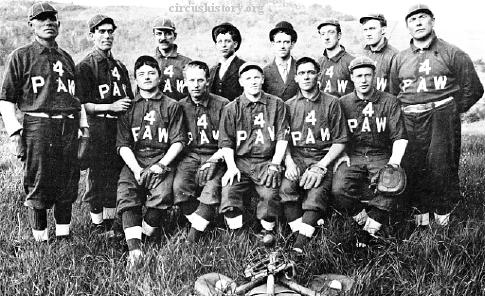
The personnel of circuses were baseball fans, just like anyone else, over the years. This thought was brought to mind while watching a game between the working men and the performers on the Beatty-Cole show this season in Springfield, Ohio. The show played the fairgrounds and not far from the midway was a baseball diamond with a backstop. It looked like any sand lot game with all of the players in comfortable clothes.
But in years gone by baseball was a very organized activity on many circuses. The show provided uniforms and a place on the team came only after tryouts by all that felt they were good enough.
The Barnum & Bailey show during many seasons had more than one organized team on the show at the same time. The Barnum Circus had a Moose Lodge on the show and the Lodge team would take on other show teams. These were very special occasions with score cards being printed. One Sunday, August 1, 1915 in Grand Island, Nebraska, the Barnum Moose Lodge team, with Burns O'Sullivan as manager, took on the performers' team whose manager was Tony De Koe. On the performers' team were: Charles Siegrist, short stop, Orrin Davenport, catcher, Pat Valdo first base and Fred Derrick, substitute. The score card states that music was provided by Mr. Brill and his Barnum & Bailey Concert Band. Many of the acts took small ads on the card to pay for its printing. On Sunday, July 8, 1917, in Minot, North Dakota, the B & B Moose team played the show's ''Happy Jacks Giants" for the benefit of the Barnum & Bailey Red Cross Chapter. For this game a 10-page score card was printed bound with red ribbons. Some of the players on the Moose team for this game were Alfredo Codona, left field, Ira Millett, first base and Orrin Davenport, who had joined the Moose team and moved to short stop. On the back of the card the Moose ran a pitch for members, stating that the charter was open for only a short time. Initiation $5, dues 75c a month. Pays a weekly sick benefit of $7 and each member received a $100 death benefit.
One of the great games of all times was held on Sunday, June 11, 1911 in Kalamazoo, Michigan between the Barnum & Bailey All Stars and the Hagenback-Wallace Big Leaguers. The B & B team journeyed to Kalamazoo from Toledo, Ohio where the show had played on Saturday the 10th. Following the game they went on to join the show for the June 12th date in Detroit. The Hagenback show played Kalamazoo on the 12th. The Barnum & Bailey team fans were responsible for the printing of the score card for this great contest, as evidenced by all of the ads being taken by Barnum show acts.
It is too bad that the final scores of all these and many other contests have not been entered in the Circus Baseball Hall of Fame. The day by day records in route books fail to show any results and a quick check of Billboards does not reveal anything either.
But this is a part of circus history that is little known by most historians.
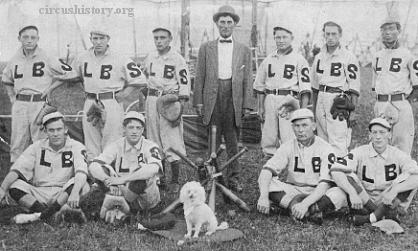
Photo: Lemon Bros. Circus team was probably taken during the 1905 season.
Researcher note: This photo is LaMont (La Mont) Bros. Baseball Team Season 1914, C. R. LaMont, Manager; Frank Satiro, Captain. - Chuck Finley
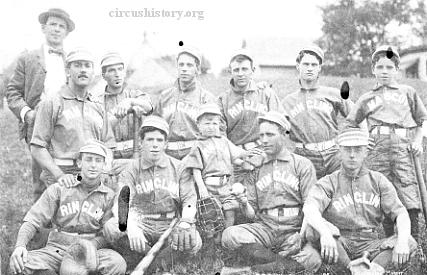
Photo: The 1905 Ringling Bros. team is shown with its manager Doc. Kealey. Reno McCree, second from right, first row, was captain and pitcher. Pfening Collection.
Part XIII, The 1940 Season About the only thing good the Cole show could say for the 1939 season just ended was that at least it survived. Early season gains had enabled the show to get its feet on the ground" and make the payments on time for the equipment leased from Associates Investment Corp. Adkins and Terrell had wisely closed the show earlier than anticipated rather than risk additional losses caused by the slump which set in after beginning of World War II on September 1. During the summer a new holding company, Hoosier Circus Corporation, was organized which functioned similar to the original but now bankrupt parent company, Indiana Circus Corporation. As the owners gradually paid off the debts to Associates and again acquired title to some of its equipment this equipment became the property of the Hoosier Circus Corporation and it was reported by an observer in June 1940 that various wagons, tents, etc. were stenciled "Hoosier Circus Corp. - J. Adkins."
A string of unusually strong winter dates gave the show enough money to make it through the winter okay. As had been customary since the beginning a winter unit of various acts, animals, and props was organized to play many of the large indoor circuses in the mid-west.
Except for an announcement in early January that J. D. Newman would be in charge of the entire Cole Bros, advance in 1940 little or nothing appeared in the trade publications concerning Adkins' and Terrell's plans for the coming season.
The winter of 1939-40 was one of the coldest in many years and extremely cold weather hit the Rochester quarters in early February. It was so severe that elephants at the quarters were kept moving so they wouldn't lie down and possibly get pneumonia.
A rumor made the rounds in early February that Terrell Jacobs would have a wild animal act with Cole Bros, in 1940 but Jess Adkins killed it by saying Jacobs intended to play parks and fairs during the season. Adkins said no plans would be made until after Feb. 15 but he was optimistic over the slight upturn in business and said he thought the Spring would see good circus business. From all indications the show planned to continue in 1940 on pretty much the same basis as 1939 with retention of the street parade and program about same calibre as the previous season. Just when the decision was made to increase the size from 20 to 25 cars is not definitely known. Probably it came early in the winter about the time Adkins was expressing his optimism for the coming season but possibly the decision was not made until later in the Spring. Winter quarter work began in February and as was customary in the past the parade and cage wagons were repaired and painted first before work started on the baggage wagons and other properties. So it was that the parade wagons and cages were in the shops at the time of the tragedy to be related here.
On the early evening of Feb. 20, 1940 a major disaster struck the show when fire destroyed the greater portion of the winter quarters. The loss was not total as the large wagon shed at rear of the quarters as well as the wardrobe and canvas barn and the small two story office building were saved but the main series of buildings, the old bridge company foundry plus the additions made to it by the show was a complete loss. This area had housed the blacksmith, carpenter, and paint shops for both wagons and the train. Also kept in these buildings were the elephants and caged animals. The March 2, 1940 Billboard told the story of the tragic loss which is printed here intact.
"Cole Fire Loss $150,000. All cage animals and lead stock and 2 elephants perish in blaze." "Big top, 9 cages, ticket wagon, several trucks, and all props and harness destroyed when main building at Rochester, Ind. quarters burns - show will go on."
"Rochester, Ind. Feb. 24 - Two elephants, all the lead stock, and cage animals, the big top, nine cages, one ticket wagon, two big Mack trucks, all the trucks used by the advance, all props and harness, winter cookhouse and workingmen's bunkhouse were destroyed in a fire at winter quarters of Cole Bros. Circus here Tuesday night. Some of the equipment and animals had been with Robbins Bros. Circus season before last. Managers Jess Adkins and Zack Terrell estimated the loss at more than $150,000. It was one of the worst fires that ever occurred at a circus quarters. Everything burned in about an hour. There was a 40-mile wind, which was blowing right for the flames to sweep the main buildings.
"The fire originated in the blacksmith and paint shop. Circus employees were at supper when it was discovered. They lost all of their personal belongings in the bunkhouse as they led elephants, numerous horses, camels, mules, ponies, and other animals to safety. The animals wandered around the highways and streets for several hours and then were rounded up. Residents joined in the hunt for the animals. The bulls were led to a special railroad car as they were rounded up for shipment to other quarters at near-by Peru.
"One of the elephants that escaped was struck by an auto and injured. A pony was led to safety but later was struck by an auto and killed.
"The animals lost were two bulls, two zebras, two llamas, 100 monkeys, two tigers, two lions, two lionesses, two lion cubs, a hippopotamus, two leopards, a sacred Indian cow and moniolon and two oudads, described as being types of gazelle. None of the dangerous animals escaped.
"The roaring of the wild animals and the screaming of the monkeys trapped in the burning building drowned the noise of the crackling flames during the height of the fire.
"The fire will have no effect on the Cole show taking to the road, Managers Zack Terrell and Jess Adkins saying the animals lost would be replaced in time for the opening."
Immediately upon hearing about the fire the North brothers, John Ringling, and Henry wired Adkins and Terrell to ship the stock to Peru and use the quarters there in getting the show ready for the road, and rendered them every assistance in their hour of trouble.
After being housed in the cars for two days the 9 remaining elephants and horses which had been quartered in Rochester and survived the fire were moved to Peru where they remained until just prior to start of the 1940 season.
The two elephants lost in the fire were Ding and Katie. Fortunately 5 of the show's elephants were out with the winter unit, and these plus the 9 that survived gave the show a total of 14 in the herd. Stories of the heroism of Cole employees during the fire continued to come in. Johnny Sullivan and his assistants entered the smoke filled bull barn with planks and cinders dropping all around them and unshackled the elephants. Earl (Irish) Greer had to be pulled away from the pigmy hippo tank in the bull barn after nearly losing his life in an attempt to save his charge.
Zack Terrell sent the following letter which was printed in the March 23 Billboard expressing his appreciation for the heroism and loyalty of his employees during the recent tragedy, and a public thank-you to the Norths.
"Zack Terrell Has a Word to Say. Editors, The Billboard."
"I have seen many sides of circus business and circus life. Most of us have. I have seen opposition that would almost melt iron men with the heat of its battling. I have seen the men engaged in it seemingly to hate one another with a hatred everlasting. Then a month or so later, after the shows had returned to quarters, I have walked into a Chicago or New York hotel to find these same men again bosom friends.
"It takes circus people to fight that way for their own troupe and then forget it all when the battle is over. Also it takes the circus to make people that way.
"But aside from opposition, which is business, there is a family feeling among all big top folks. Quarrel we may and do as does any family, there is a tie among us all. I have seen examples of this feeling of kinship in the past between owners, managers, staff people, performers, department heads and forces. Most of us recall these in the cases of by-gone disasters and tragedies.
"But I think our own disaster - thank God there were no human lives lost - at the Cole Bros, winter quarters in Rochester, Ind. brings out the finest example of this feeling of circus kinship I have ever known. I refer to the magnificent manner in which John Ringling North, president of the Ringling Bros, and Barnum & Bailey Combined Circus has come to our aid with the Peru quarters, equipment of all kind, in fact everything we need.
"On behalf of the Cole Bros, show, my partner, Jess Adkins, the show personnel, 1 wish to express our deep gratitude for this great and generous gesture, backed up by genuine and material helpfulness. We shall never forget it. Signed, Zack Terrell."
It was also announced in the trade publications that the Loyal Repinski's riding act lost all of their paraphernalia, costumes, auto, and baggage trucks in the recent Rochester fire but were able to save their valuable horses.
No official list of wagons and equipment lost in the fire has ever been published. The Billboard account lists general losses in way of equipment and other stories were a little more detailed. From many reports of eyewitnesses and by process of elimination we can put together a fairly accurate list. The parade equipment was the biggest lost in way of wagons. Destroyed were the United States, Great Britain, Africa (also called India or Hippo), Belgium, Corner statue tableau (former Christy air calliope) the new steam calliope built a year ago, and the Palm Tree tableau wagons. All of these wagons had appeared in the 1939 street parade and we can assume would have again been present in the 1940 parade. The former Buchanan Robbins Bros, air calliope which was also in the 1939 parade as well as the ex-Ringling commissary tableau were saved. The older parade wagons which were stored some distance away under the wagon shed were also spared. These included Lion and Mirror, Asia, America, Columbia, and France wagons.
Also destroyed in the fire was the red ticket wagon, formerly on Christy Bros. Gordon Potter says photos he has shows a stake driver, 2 Mack trucks, a steel wagon probably a light plant, and at least two of the 12 ft. ex-Christy dens were destroyed. Cages known to have been destroyed included the rubber tired Springfield den, the pigmy hippo and seal dens, both of which were 12 ft. dens built in 1937, and through the process of elimination and fact they did not appear in 1940 these additional cages are assumed to have been lost - two 12 ft. dens built in 1937, one cross cage, and five ex-Christy 12 ft. cages. On the latter there is a possibility some of these assumed to have been lost might have been previously sold. There is new evidence which shows that World of Mirth Carnival purchased an ex- 12 ft. Christy den from Cole Bros, in 1939 and was used by that show for several years. (Full story on this will appear in the final supplement). Only cage known to have survived the fire and which was not carried in 1940 was the former Buchanan Robbins Bros, hippo den which had not been used since 1938. (This cage has now been restored and is currently at the Circus World Museum in Baraboo).
There is no evidence of any baggage wagons being lost in the fire other than the possibility the show lost two of its canvas wagons. This is based on the fact the show purchased two former Al G. Barnes-Sells Floto canvas wagons from Peru a short time thereafter. The official accounts in the trade publications mentioned fact the show lost all of its canvas but this is not true. Ordinarily the canvas would have been stored over in the large wardrobe and canvas barn. Possibly the story referred to the canvas wagons being lost rather than the tent-age itself. Fortunately there was no loss of railroad equipment. The advance car was scorched but was repaired in plenty of time before the season opened.
No mention was ever made of how much, if any, insurance was paid. It is a virtual certainty some insurance, possibly adequate, was carried because of the fact that the Bank in Rochester had previously taken title to the quarters property due to default of the bankrupt companies and surely they would have adequately protected their property with insurance. The same can be said of Associates as they likewise had title to all of the physical properties, other than the small portion the show might have taken title to during the 1939 season. It has often been said that it was amazing that Adkins and Terrell were able to survive the fire and ever go on the road again, however, fact is that they actually had very little equity in the property destroyed still being in dire financial distress due to the recent bankruptcy and rather lean 1939 season. In any event the show did survive and was able to open the 1940 season as originally planned, but not without the greatest of difficulty in readying the circus for the road. It can be said with assurance, however, that showmen of lesser stature than Adkins and Terrell would have faltered due to all of the recent adversities and that would have been the end of Cole Bros. Likewise had not the Ringling management offered them use of the Peru quarters as an emergency measure it is possible the show could not have made it.
As soon as the fire damage could be fully assessed and the management aware of what it would take to get the show out in 1940 work began immediately to prepare the show for the road. Fortunately there were funds coming in from the strong winter dates and of course from what insurance was on the damaged property. The March 23 Billboard reported that the winter units had come back from a very successful tour and went into Peru quarters to remain until opening date.
Zack Terrell took off shortly after the fire to visit John R. North in Sarasota and see what could be worked out in replacing some of the equipment and animals from the Ringling surplus in Peru. His mission was successful and he was able to purchase one Mt. Vernon built flat car loaded with two canvas wagons, a former Hagenbeck-Wallace sea lion den, and the old John Robinson hippo den. Loaded in the hippo den was Chester, a female, which had been born in 1935 at Chester, Pa. on the Hagenbeck-Wallace Forepaugh Sells Bros. Circus. Chester was on lease only but remained with the Cole show through the 1943 season. The flat car and the two canvas wagons had been used on the Al G. Barnes-Sells Floto Circus and had been sent to Peru in mid-season 1938. Both car and wagons still had that show's title on them when they arrived in Rochester shortly before the 1940 season began. As part of the consideration paid for the equipment plus use of the Peru quarters Cole Bros, agreed to stay out of certain mid-western towns for the first few weeks of the season as Ringling-Barnum planned to make an early sweep through the territory. This routing agreement hurt the Cole show somewhat, however, the new equipment plus the use of the Peru quarters for the housing of elephants, horses, and lead stock plus use of practice arenas was of incalcuable value to the show.
It was first indicated that perhaps some of the Peru rail and wagon shops would be used in transportation costs made this unfeasible so temporary shops were constructed at Rochester. Plans were now in operation for launching the 1940 show and the April 6 Billboard announced the good news that there would be no delay in the Cole opening as it would begin the season as originally scheduled, May 3, at Rochester. It was also announced that Ken Maynard who was on the show in 1937 and part of 1938 would be back for the new season and that 100 men were working in quarters rushing to get the show ready. Blacksmith and paint shops had been rebuilt and crews were working day and night. Over at Peru training activities were in full swing. The Billboard article also said that since practically the entire Cole menagerie had been wiped out by the fire a shipment of wild animals was expected next week. One new menagerie attraction was said to be Joe Mendez, trained chimpanzee, which had been at the Detroit Zoo for several years.
The decision was made to increase size of the Cole show from 20 to 25 cars adding 2 flats, 2 stocks, and 1 coach to the 1939 train. As mentioned earlier one Mt. Vernon built flat car came from Peru while the other cars were obtained from the surplus at Rochester. The 1940 train when ready for the road consisted of 1 advance, 11 flats, 6 stocks, and 7 sleepers, making a total of 25. The 11 flat cars consisted of 6 Warren built cars, 1 old style Mt. Vernon car, 3 new style Mt. Vernon cars from the Cole pool and 1 new style Mt. Vernon car from Peru. Al Halpern's fine set of 1940 Cole color slides indicate the advance car was painted red with silver lettering; flat cars aluminum (silver) with blue lettering and red shading; coaches red with aluminum lettering; and stocks aluminum with silver lettering on a red letterboard.
The 1940 train loading order was as follows:
Cole Bros. Circus Train Loading Order, Season of 1940
Note; Wagon wheels are designated "s" for steel tires, "c" for carnival type hard rubber.
Flat Car No. 39 -
Note: Flat cars are listed in numerical sequence. They were not necessarily placed in the train in that order. Even though certain cages are listed as "cross" all were loaded lengthwise. Those designated as "cross" were 8 1/2 ft. cages that in past had been loaded crosswise. Some photos indicate the two pony floats were loaded lengthwise, other shots show them crosswise. Flat cars in 1940 were lettered "Cole Bros. Circus and Ken Maynard's Wild West." Advance car and coaches were lettered "Cole Bros. World Toured Circus," and stocks were lettered "Cole Bros. Circus" with a disc at each end of the letterboard reading "CB" and "KM". On opening day only a few of the cars were fully lettered and work on this continued for the first few weeks of the season.
As mentioned before fortunately the rail cars had not been damaged to any extent although the advance car was scorched but was newly painted and decorated so that it looked great by time it took to the road. Four new brigade trucks had to be obtained, however, to replace those lost in the fire.
Due to loss of so much of the parade equipment as well as considerable harness it was decided that no street parades would be staged in 1940 although this decision was not officially announced until just before opening date. Actually had the management persisted in putting on a parade regardless of the cost many of the older parade wagons which had been used in 1937 and earlier could have been pressed into use although it would have been quite costly and funds were extremely limited.
The steam calliope instrument which had been severely damaged when the wagon which housed it was consumed in the flames was sent to the factory and reconditioned and the old America tableau wagon was fitted up to house it. Part of the roof and side panels was removed and the wagon generally remodeled but the finished product was a beautiful steam calliope wagon which was carried in 1940 with lot concerts being given before each performance. The wagon was painted red, blue, and white, with carvings in gold.
The only other parade type wagons carried in 1940 were the Columbia tableau painted white with gold carvings and was used as the grandstand ticket wagon, same purpose it had served in the years 1935-38, and the ex-Ringling wagon which had come by way of Christy Bros, and had been used by Cole for the first time in 1939. This one became No. 51 in 1940 and was used to load light dept. supplies and the commissary. It was painted red with silver title and carvings. The Mother Goose and Old Woman in Shoe floats were also carried in 1940 for spec purposes. Next to parade wagons the greatest loss was in the menagerie as all cages in the repair and paint shops were burned and animals unable to be freed from their permanent cages perished. The Billboard reported that 9 cages were lost which is about right although as indicated before there is the possibility two others were burned. Despite the loss of so many cages there still remained enough that were parked back in the wagon shed and consequently survived the fire to make an adequate menagerie for 1940. Ten cages all of which had been used in the past by Cole were readied and the two that came from Peru gave the show a total of 12. Fans who saw the Cole Bros, menagerie in 1940 witnessed cages and dens that had previously served on 8 or 10 of the best known circuses of all times. It was a real conglomeration.
The 1940 cage list was as follows:
1. No. 8 - former Christy Bros., 12 ft.
2. No. 9 - former Christy Bros., 12 ft.
3. No. 10 - former Christy Bros., 12 ft.
4. No. 11 - former Christy Bros., now equipped with the skyboard off former Buchanan Robbins, den (Cole Bros. No. 19 formerly) 12 ft.
5. No. 12 - former Ringling hay animal cage (was No. 10 in 1937) 15 ft.
6. No. 13 - former Buchanan Robbins den, 14 ft.
7. No. 14 - former Christy Bros, cross cage, 8 ½ ft.
8. No. 15 - former Christy Bros, cross cage, 8 1/2 ft.
9. No. 16 - former Christy Bros, cross cage, 8 1/2 ft.
10. No. 17 - former Christy Bros, cross cage, 8 1/2 ft.
11. No. 18 - former Hagenbeck-Wallace cage, painted orange and gold in 1940 and contained sea lions, 12 ft.
12. No. 19 - former John Robinson hippo pen, painted green in 1940 and carried the leased hippo, Chester, 21 ft.
Note: According to information taken from a wagon list posted on the old Rochester quarters wagon shed walls by Chalmer Condon, Cage No. 9 was an original Christy 12 ft. den which was remodeled into a wagon to transport an air calliope on Cole Bros, in 1938 and was numbered No. 78 that season. For 1940 the wagon was converted back into a cage and become No. 9. Another interesting item on this wagon list were plans to make a cage out of No. 75, the air calliope carried by Cole Bros, in 1939. However, this was never done.
Please note on this list that the probable cage number is given when the actual number is not known. Photos showing the 1940 cages without the canvas tarps on them are quite rare, hence it is difficult to get the cage number in some instances. Likewise since the show did not parade it is difficult to find photos showing the cages open so as to note the. animal contents. Unfortunately no cage list showing contents is available. Observers and printed accounts say the show had a nice variety of caged animals in 1940 including lions, tigers, leopards, monkeys, birds, and various collection of bears and deer. The hippo, Chester, was a major feature as was the chimpanzee. Color photos taken in 1940 indicate that most of the cages were painted red with gold leaf carvings with a few being white with red painted scrollwork. Hippo and sea lion den color is indicated in the list. All cages were equipped with sunburst wheels and made a great flash in the menagerie.
The show had a larger canvas layout in 1940 than it had the previous year. All of the canvas had been used before but most of it was in fairly good shape at least in early part of the season. Toward end of season photos indicate much of it was pretty well worn. The 1938 Cole Bros, big top was used, however it was cut down from a 160 ft. round to a 150 but retained the three 60 ft. middle pieces. Menagerie top was a 70 ft. with five 30's, and sideshow a 70 ft. with three 30's. Other tentage carried included a pad room, baggage stock top, dining and cook tops, and numerous smaller tents. The midway was given added flash by a brand new sideshow bannerline.
Actually the layout in 1940 was more like the 1938 Cole show rather than the 1939 show which was more along lines of the enlarged 1938 Robbins show. This is true especially in the seating arrangement also. Whereas the 1939 show had a seating arrangement on lines of the 1938 Robbins enlarged show, in 1940 the seating was basically that of the 1938 Cole show due of course to the larger big top.
Very little wagon remodeling or construction was done in the Spring of 1940, just the necessary repair and paint work. The only new wagons the show had were as mentioned before, the two former Al G. Barnes-Sells Floto canvas wagons, the Hagenbeck-Wallace cage, and John Robinson hippo den. The two canvas wagons became Nos. 87 and 88. A roof was added to the No. 73 wagon carried in 1939 and the remodeled job became No. 74 for 1940. The show used mainly the steel tired baggage wagons Cole had used in 1938 rather than those of the previous season which were predominantly the 1938 Robbins wagons with the carnival type hard rubber tired wheels. The baggage wagons in 1940 were much more pleasing to the fans and purists who preferred the traditional wheels rather than some of the rather crude monstrosities placed on most of the Robbins Bros, wagons. Just what the reason was for using the older steel tired wagons in 1940 is not known other than the show was using the 1938 Cole seating and probably preferred using the wagons that had transported it at the time. Baggage wagons in 1940 were painted red with yellow wheels and gears trimmed in black. Title was in yellow and numbering was done in silver on a shield design painted on side of the wagon.
A total of 3 Mack tractors were carried on the train and also there was a Packard convertible and Ford station wagon. A total of 48 pieces loaded on the flat cars which considerably lighter loaded than in 1939. There was ample space for a change. The cross cages were all loaded lengthwise occupying 8 1/2 ft. rather than the 6 ft. when loaded crosswise. Photos indicate the two floats, Mother Goose, and Old Woman in Shoe were at times loaded lengthwise, at other times crosswise. The show probably had to purchase another Mack truck or two to replace the two lost in the fire although possibly enough old ones were available to press into service.
The show carried only 48 head of baggage stock which occupied one and a half stock cars which was the fewest ever carried by Cole. The reduction was due mainly to abandonment of the street parade. At most stands the baggage stock were used only for unloading the flats and for work on the lot spotting wagons. Many eyewitnesses say that the Macks were used to haul wagons back and forth between runs and lot almost exclusively. This was the last year any railroad circus carried baggage stock in any sizeable numbers. Ringling-Barnum doned baggage stock in favor of trucks and caterpillar tractors in early season 1938.
A number of camels, zebras, sacred cows and other lead stock were obtained to replace those lost in the fire before the season began and others were added after show was on tour.
All of the show's 14 remaining elephants were carried in 1940. The herd included Babe, Blanche, Carrie, Jean, George, Jennie, Joe, Little Babe, Little Jennie, Louie, Nellie, Tess, Tony, and Wilma.
A goodly number of performing and menage horses were carried, however, since no parades were to be given, the number of ponies was reduced.
Work continued on preparing the show for the new season at an accelerated pace and by late April it was announced that all Cole departments were ahead of schedule and that all costumes and other properties destroyed in the recent fire had been replaced. Makeshift facilities had proven okay and necessary work had not been greatly delayed. Milt Carl, steward, had used a sleeping car which was converted into a "come and get it" kitchen to feed the personnel at quarters. Car had seating accommodations for 64 and it required several seatings 3 times a day to get everyone fed. The second floor of the administration building was transformed into a dormitory. Shortly before opening day the elephants and lead animals were brought back from Peru and housed in the menagerie top which was erected for that purpose.
As usual the show lined up a competent staff of capable and experienced circus people. Staff and department heads for 1940 consisted of Jess Adkins and Zack Terrell, managers; Robert De Lochte. treasurer; Lorne M. Russell, secretary; Noyelles Burkhart, auditor; J. D. Newman, general agent and railroad contractor; L. B. Greenhaw, William J. Lester, local contractors; Jack Grimes, Raymond B. Dean, and Rex de Roselli, press agents; Lou Delmore, manager of sideshow; Harry J. McFarlan, equestrian director; Fred Seymour, general supt.; Gene Weekes, supt. of privileges; Vic Robbins, bandleader; Harlan Burkhart, supt. reserved seats; Charles Young, canvas; Jack Bigger, trainmaster; Joe Wallace, boss hostler; L. W. Funk, commissary dept.; Tom Poplin, lights; Leo Loranger, props.; C. H. Hunter, ring stock; Joe Kuta, working crew; Al Hoffman and C. F. Stewart, 24 hour men; Lonzo Dever, elephants; and Roland Hebler, animals.
Lou Delmore had a good array of sideshow attractions which included Duke Kamakua's Hawaiian Revue (Kamakua also doubled in the Broadway Brevity Revue, assisted by Stanley Morton); Anna Loring, snakes; Mary and Margaret Gibbs, Siamese Twins; Joe Grendol, sword swallower; Hermes, magician; Al Tomaini, giant; Jeanne Tomaini, half girl; Popeye Lewis, Jean Darrow, Leona Lola, Madeline Gammon, and Marie An- P. G. Lowry's Band and Minstrel's completed the lineup.
Again as in 1939 Cole did not have an indoor opening stand in Chicago as had been customary for the 1935 thru 1938 seasons. The Greater Olympia Circus played a date in the Chicago Stadium in April but reported to the Billboard that business had been below expectations.
The Cole advance car left in late April to begin billing the 1940 route. It was announced officially in the May 4 Billboard that the show would not parade and also gave the first hint that early season routing plans were affected due to an agreement with Ringling-Barnum. It was stated that the routing of the Big Show in Ohio earlier than in former years is said to have prompted the Cole management to alter its original route and defer playing territory until after June 1. Later in the season Terrell told of the routing agreement with Ringling-Barnum. A few weeks earlier it had been announced that Cole Bros, would not play Indianapolis because of the indoor stand there of the Greater Olympia Circus and also that Ringling-Barnum was due in for an early date.
The 1940 season was now at hand. The amusement world waited for the first reports of business with marked anticipation hoping that somehow the good days of 1937 would return after a disastrous 1938 season and a not so hot 1939 season. The rapid events of the European War and the German successes in Norway, the Low Countries, and finally France had aroused the nation which began cranking up its defense mechanism. War production plants were being put into operation as rapidly as possible. Although at first it was a slow process the economy was gradually gearing itself to a semi-wartime basis and the new defense plants were absorbing some of the nation's unemployed. Gradually the nation was getting out of the economic doldrums it had been in since the severe 1938 recession.
The long awaited good news finally came when Ringling-Barnum announced it was doing terrific business at Madison Square Garden. The April 27 Billboard in an editorial noted the great increase in business of the Big Show over the past two years and asked these questions - Are conditions sharply improved? Is the European War causing a loosening of purse strings? Is New York indicative of the rest of the country? Is the circus due for a comeback as are amusements in general? Is fact of a presidential year reversing the theory of minimum spending? (Note, election years had always been thought to be bad years for amusements). The entire amusement industry awaited answers to these questions.
Again in 1940 only two railroad circuses took to the road; Ringling-Barnum which was back up to 90 cars again, and Cole Bros, which had increased to 25 cars. The fewest number of motorized shows in many years were on the road in 1940. Some of the larger ones included Russell Bros., Wallace Bros., Lewis Bros., and Bud Anderson. Two shows were out which were destined to remain on the road for many years. One was Mills Bros, in its second season but first for that title it having been called Richards Bros, in 1939 and the other was Al G. Kelly-Miller Bros.
Everything was now set for the Cole opening and the local Rochester-News Sentinel in its April 19 edition ran a page one editorial headed "Sympathy vs. Support" and appealed to local citizens to support the show with their patronage when it opens on May 3. The editorial went on to say that the continuance of winter quarters in Rochester is squarely up to the public.
Cole Bros, opened its 6th seasort on a cold day in Rochester, Ind. May 3, 1940 to fair business. Cold weather which had gripped the nation all winter persisted on until late Spring and even early summer. The May 18 Billboard told of the Cole show opening and reviewed the 1940 performance in the following article printed here intact.
"Cold Opening, Fair Biz for Cole in Rochester: Marion Good: Cincinnati Starts Well. Cincinnati, May 6 - After opening in Rochester, Ind. May 3 in freezing weather, with only half houses and playing a date in Marion, Ind. on the 4th in warmer weather to a near-capacity matinee and a three-quarter house at night, Cole Bros. Circus came here, arriving late at the Fourth and Smith Streets lot yesterday morning. Weather was ideal, but the matinee, which did not begin until 4:50 o'clock because of the late arrival and a further delay caused by a wagon becoming stuck between two flat cars, drew little better than a half house. Night performance was only a few minutes late, with the house about two-thirds full. After playing May 5 and 6 here, the show will go to Covington, Ky. across the river from Cincy for May 7. It is moving on 25 cars.
"The show ran smoothly under the direction of H. J. McFarlan. Vic Robbins band of 13 pieces adds greatly in the presentation. Show is presented in three rings under the Cole show's big top, a 150 with three 60's.
"Performance runs two hours, with Jack A. Ryan doing the announcing. The spec, "La Habana," a pageant in song, music, and dance, produced by Rex de Rosselli, displayed magnificent wardrobe, designed by Josephine McFarlan. Among the features are the Loyal-Repenski riding troupe, the Escalante troupe, flying return; Frank Shepherd, single traps, and Cyse O'Dell, aerialist.
"Managers Jess Adkins and Zack Terrell are presenting very good straight circus entertainment, there being no wild animal acts. The show has 14 elephants.
"Jack Grimes handled publicity in the Queen City and landed some nice stuff in the dailys. General Agent J. D. Newman and Raymond B. Dean, who joined the press staff, were on the lot.
The Program
"The performance opens with a colorful spec entitled. La Habana, staged by Rex de Rosselli, who has done a swell job. Music arranged by Vic Rabbins, wardrobe designed by Josephine McFarlan, electrical effects by Thomas M. Poplin, dancing numbers directed by Betty Jones School of the Dance.
"No. 2 - Comedy acrobats, the Loyals. Four are in the center ring and three in each of the end rings. A snappy number.
"No. 3 - Elephant head carry on the track by Sully Sullivan.
"No. 4 - Roland Hebler, with four seals in center ring, one of them doing a rollover to a big hand. John Smith and Adolph Delbosq had ponies in the other rings, the former with six and latter with seven. Well trained.
"No. 5 - Principal riding acts by the Misses Loyal and Estrina. One of the Loyals did a somersault. All performed nicely.
"No. 6 - Foot slide by Sen Riveira.
"No. 7 - Girls on swinging ladders, always an interesting number. The participants Helen Partello, Hanna Griebling, Jo-Jo Coefield, Marta Tonga, Lucille Justine, Ethel Freeman, Golda Gray, Wanda Wentz, Lorina and Betty Escalante, Rose Schenk.
"No. 8 - Concert announcement.
"No. 9 - Marie Delbosq does some nifty foot juggling and the Three Gasco Brothers some fine work on the rolling globes. The latter also do some clever acrobatic stunts.
"No. 10 - After performing on the web, Cyse O'Dell presents one-arm swings doing 43 at the matinee. She is an accomplished and graceful artist.
"No. 11 - Firecracker number by the clowns.
"No. 12 - Two first class aerial bar numbers, the Four Escalantes, two doing comedy and the Three Brocks, two clowning. The boys work fast and received a good hand.
"No. 13 - Otto Griebling's auto gag is always sure-fire. One wonders how all the joeys can be put in a car.
"No. 14 - A novelty with the show, the Six Skating Rockets, all girls, who work fast and furiously, finishing with an ankle breakaway.
"No. 15 - The elephant number is one of the best, with Marion Knowlton having five in the center ring, and Helen Partello and Rose Schenk with three in the other rings. Mount on the track followed.
"No. 16 - A fine display of horseflesh, the Liberty equines, 24 of them, eight in each ring. Adolph Delbosq was in the center ring and John Smith and Clarence Canary in the others. A beautiful number, the animals working perfectly.
"No. 17 - Burlesque bullfight, presented by Senor Lobo, assisted by Freddie Freeman, was good for many laughs. Dog used in act was only recently broken.
"No. 18 - A great riding act, the Loyal-Repenskis, six women and two men. Both individual and group work are outstanding. Act is well dressed.
"No. 19 - Concert announcement with ballet girls and Indians.
"No. 20 - Three wire numbers, with Weber Brothers and Chatita in center, and Senors Gascas in the end rings. All are very good on the steel threads.
"No 21 - Otto Griebling and Freddie Freeman in a comedy boxing number wowed 'em.
"No. 22 - Frank Shepherd, on the flying trapeze is a great artist, his heel and toe catches being remarkable. Worked solo and was roundly applauded.
"No. 23 - Strip number by the clowns.
"No. 24 - An excellent manage number, the riders being Rose Schenk, Ethel Freeman, Cyse O'Dell, Georgia Sweet, Wanda Wentz, Jo-Jo Coefield, Golda Gray, Ann Sutton, Marion Knowlton, Helen Partello, and Marta Tonga.
"No. 25 - High-jumping horses, the riders being Clarence Canary, Mack McGrath, Ann Sutton, and Jack Wolff.
"No. 26 - Acrobatic number, the feats being mostly teeterboard. In the display are the Florence, Brannock, and Savoy troupes. All finish with a two-and-a-half from springboard to chair.
"No. 27 - Clowns crazy number, big heads, etc.
"No. 28 - The Escalantes, four men and two girls in a flying return act that is among the best. Two catchers are used.
"No. 29 - Races.
"Clown numbers are presented throughout the program, the joey line-up including Otto Griebling, Freddie Freeman, Lou Walton, working come-in, Ted Tosky, Jimmy DeCobb, Lee Smith, Mel Bates, Harry Holes, Harold McEvoy, Harold Conn, Horace Laird, Jack Kippel, Harold Hull, Graver Nitchman, and Huffy Hoffman.
The Wild West
"In keeping with the big show, an excellent Wild West concert is offered with Ken Maynard at the head. In the lineup are Auvil Gilliam, Jack Wolff, Josephine Tatum, Georgia Sweet, Ann Sutton, Clarence Canary, Alvin Parshall, Ralph Clark, six Sioux Indians from Pine Ridge, S. D. and a ballet. The acts consist of shooting, whip-cracking, trick riding and roping, shoot, etc."
Covington, Ky. on May 7 had ideal weather with matinee fair and night house almost filled. At Lexington the next day the show also had two good houses. Louisville saw only a fair matinee but it was packed at night. Cole left Kentucky after a stand May 10 at Owensboro. home town of Zack Terrell, and then moved for a date at Evansville, Ind. and then went into Illinois to play Decatur on May 12 and then it was back into Indiana for stands at LaFayette, Muncie. Ft. Wayne, South Bend, Kokomo, and Richmond.
Ohio was next with stands at Springfield, Middletown, and Newark after which the show went into West Virginia for stands at Parkersburg and Wheeling and then back into Ohio at Dover on May 26 before proceeding north and eastward through Pennsylvania where it remained for the rest of May with the final stand in the Keystone State coming June 5 at Scranton.
Reports of business from other circuses were now coming in. Wallace Bos. in May in the Upper Ohio Valley reported good business while Al G. Kelly-Miller Bros, opened its season with a big two day stand at Joplin, Mo.
Reports of Cole Bros, business were very skimpy in pages of the trade publications for a few weeks but the June 8 Billboard gave a good account of recent happenings on the show and for the first time made public the routing agreement with Ringling-Barnum. The article said that the first month's business for the Cole show had been off. Routing was difficult and the first month had not only been unprofitable but discouraging. Rains, muddy, lots, and cold weather had curtailed business at nearly every stand. On Sunday, May 25, at Dover, Ohio the matinee was nearly two-thirds but night show had less than a half house. Rain threatened but weather cleared in time for the performance. One happy note was that the concert was holding a large percentage of big show customers, Ken Maynard again proving his value as a top notch drawing card. Sideshow business however had been off at most stands. It was mentioned that the show was being routed under difficulty due to an arrangement with Ringling-Barnum to avoid stands played by the Big Show. This setup officials said was taking a lot of good regular Cole Bros, towns away, and some which have been substituted were not very good. The short West Virginia tour proved disastrous. Rain spoiled Parkersburg and a heavy downpour came at noon at Clarksburg. Business was slim at Athens, Ohio. The show's management mentioned that truck shows which are usually in before rail circuses give school students matinees at 15c and are hurting the larger shows. In some towns there is a school board ruling to dismiss schools for the first circus only and usually the motorized show gets in early. The article also said that absence of the parade has been a contributing factor in Cole's slim take so far this season. Future routing plans were given stating the show was headed east and likely would get to New England in three weeks. Last half of the season's route was said to depend on business conditions throughout the Middle West. A final note according to the Billboard correspondent on the lot at Dover, Ohio said that there was a noticeable absence of country billing with no paper in evidence 15 miles from the stand.
This gloomy report was rather unusual for Cole despite its adversities in recent years, as usually the show tried to reflect optimism most of the time. Weather had hurt all shows in the area and as brought out in the report many motorized shows were playing extensively thru the Cole territory. Lewis Bros, was in Ohio as also was Russell Bros, and both were complaining about the rain and cold weather. Bud Anderson was in Iowa and said its business had been affected by cold weather.
The very cold, wet, and generally bad weather in the late Spring of 1940 had a very depressing effect on circus business and this coupled with the news of the fall of France and melancholy days throughout the free world made it tough on all amusements during that time. The Billboard said that night clubs, ballrooms, restaurants as well as theater and outdoor amusements were feeling the effects of the European War. True the depressing news of the surrender of France, the evacuation of the British Army from Dunkirk, and the soon expected invasion of Britain dampened spirits of the amusement going public in the States but even so things were happening rapidly which in effect would improve conditions as the summer wore on. President Roosevelt had asked for billions for defense, the lend lease act was passed and war material began flowing to Great Britain in great quantities. New war plants were getting into operation weekly and their employees were soon finding themselves with welcomed dollars to spend, some of it going for amusements. Within a few months the nation had moved rapidly to a war footing. The national guard was called into Federal service in August 1940 and reservists were being called up rapidly, and it would only be a matter of time before the first peace time draft would be passed. As has always been true soldiers spend heavily for amusements and stands close to the newly opened training camps became good money winners for outdoor amusements. Within only a couple months after these gloomy June reports things had improved for circuses and other amusements greatly.
It might be mentioned here that although Cole Bros. still had the traditional color for its big top, 1940 had seen some new innovations in the color of tentage. Ringling-Barnum came out in 1940 with a blue colored big top while Russell Bros, had a green big top. These were strictly new gimmicks as the canvas shortage due to defense requirements had not yet come into being.
Cole's nine stands in Pennsylvania produced spotty business. Ray Dean of the press staff told the Billboard that the show did big in Erie on May 30 despite cold and rainy weather, and had capacity on June 1 at Lock Haven and June 5 at Williamsport. At Butler the show had only fair business at both performances on account of rain which fell most of the day. Business was okay at Wilkes-Barre on June 4 and Cole was the first circus to hit this anthracite region. Exceptionally good weather attracted 3,000 for the afternoon show with still larger attendance at night.
The show entered New Jersey June 6 at Middleton and the next day at Patterson. Guy Magley, an organizer of Circus, Carnival, Fair, and Rodeo International Union was on the lot attempting to unionize the show but didn't get far with his efforts. Circus unionism so far as attempting to organize rousterbouts and laborers had generally been discredited since the 1938 fiasco which closed the Big Show.
After five New Jersey stands the show went back into Pennsylvania for stands at Reading and Allentown. Weather was threatening at Reading and hence business was light. It was then back into New Jersey for stands at Trenton and Long Branch enroute to New England. Major opposition was encountered in Trenton from the New Hamid-Morton Circus which opened with a three day stand beginning June 10 with Cole due in June 14. The Hamid-Morton show was using canvas and equipment leased from the Wallace Bros. Circus and was featuring a strong program headed by Clyde Beatty's wild animal act and Lee Powell, the Lone Ranger of radio fame. Cole was the first big circus to play Long Branch in recent years, the last one being Hagenbeck-Wallace. The show was moving very smoothly now with it getting off the lot nearly every morning by 12:30 a.m.
The show moved into New England and after two Connecticut stands it went into Massachusetts for seven dates. Most stands were only fair but there was a big take June 19 at Attleboro, Mass. At Gardner, Mass, on June 25 the Cole show suffered another major tragedy in the sudden death of Jess Adkins, who had a heart attack while on the lot. He was rushed to a local hospital but was dead before the show train left town that night. This was another blow in the series of disasters which had hit the show over the past two years, beginning with the bankruptcy, then the fire, and finally the death of Jess Adkins. The latest of the disasters struck hard at the show as it was struggling along to mediocre business trying to make a go of it. The show world was stunned at the sudden death of Adkins and tributes poured in from all over the nation. His body was moved to Peru, Ind. where his funeral was held on June 29 followed by burial in the local cemetery where so many famous circus greats had found their final resting place. Adkins was buried within a few feet of Bert Bowers and Ben E. Wallace.
Zack Terrell speaking for himself and the Cole show told the Billboard in its July 8 issue that - "The show world lost a friend when Jess Adkins passed on. Everyone was shocked when the news was flashed that he had been taken suddenly. He was liberal to a fault, and I have lost a pal and a great partner. I shall never feel toward anybody as I felt toward Jess. We had been together five years and in that time a bond between us was formed that linked us together as brothers. The show will go on but Jess will be missed by me, everybody with our organization, and a host of real friends all over the country." The same issue also contained scores of tributes from showmen, fans, and laymen alike.
Jess Adkins was the most beloved circusman who ever lived in the eyes of the organized circus fans. The CFA publication, White Tops, was filled with tributes to Adkins in its June-July 1940 issue. Adkins was a circus fan's circusman, and Adkins in turn loved the fans, always welcomed them, and was never too busy to talk with those visiting on the lot. The fans never forgot that it was Adkins who had brought back the street parade to them in all its glory beginning with the Hagenbeck-Wallace parade of 1934 and then the Cole parades of 1935-37-39 and Robbins of 1938. He gave them the type of circus they loved best and to this day they have never forgotten him. Although Adkins and Terrell were always equals during their business association it had been Adkins who had been mainly in the spotlight and seemingly made the major decisions. Terrell by nature was more reserved than Adkins and did tend to remain more in the background and although he didn't have the outgoing personality toward the fans as did Adkins nevertheless he never failed to do what important favors he could for them. Don Smith, founder and first president of CHS, recalls that when he requested some lithos to decorate the rooms during the CHS convention in Peru Terrell very kindly furnished all the lithographs and printed matter needed for the occasion.
Terrell was no less a competent showman than Adkins, even though their personalities and methods were somewhat different. He had a grouchy disposition at times and could ignore and brush off people quite easily. Also he could be harsh on working men if necessary. He was more financially conservative than Adkins and probably was the better of the two businesswise. He had been the long-time manager of the financially successful Sells-Floto Circus back in the 20's. Terrell later mellowed considerably during the big money years of World War II and post war seasons and took to the fans very much as Adkins had done earlier. During his last years at the helm of Cole Bros. he was very popular both with his staff and employees and circus fans and public alike.
After Adkins death Terrell took over many of the duties Jess had personally looked after and the show gradually took on a Terrell flavor. By 1940 many of the old Adkins men had already departed and soon Terrell's men (the people who had been around him in former years and came with him to organize the Cole show) took over the important positions on the show.
North Adams, Mass, on June 26 was the last stand the Cole show would ever play in New England. The next day it moved into New York and across the state with stands at Troy, Rome, Geneva, and Jamestown. Jamestown was very good for the show and the matinee saw all but a small part of the reserved seats and one section of general admission filled and at the evening show all but a section of unreserved seats was filled. While a cold wind blew it was still the warmest day the area had seen in some time. In keeping with the patriotism now flooding the country a new closing spec was added in which two Indians marched into the center ring each carrying an American flag while the band played the new Irving Berlin classic, "God Bless America."
In New York despite heavy rains at some stands business continued to be fair. At Rome on June 28 there was a late arrival on account of train being held up behind a railroad wreck but there was a three-quarter house in the afternoon and tent nearly full at night.
The show entered Pennsylvania again July 2 at Sharon with five additional stands in the Keystone state to follow. There was a big matinee, capacity, July 4 at Altoona with many people sitting on the straw. During the day the steam calliope and four elephants were in the local Independence Day Parade. The show told the Billboard that the week in New York state and western Pennsylvania had been spotty. Greensburg, Pa. was termed light, New Kensington was a bloomer, and business fair at Johnstown and Sharon. Altoona was said to be one of the biggest days of the season. Mills Bros, in its first season was in Ohio and reported in the Billboard the show had light business at Malvern.
On July 8 Cole was at Steubenville, Ohio and then came back into Pennsylvania the next day at New Castle, and then back to Ohio for stands at Mansfield and Sandusky and then it was on to Indiana. Business at Mansfield was light for both afternoon and evening and show officials said that with the exception of Steubenville, Ohio had proven to be poor territory for Cole.
The July 27 Billboard noted that with the passing of Jess Adkins, Zack Terrell remains on the lot at night to oversee getting off the lot and has assumed many of the duties of Adkins. O. F. (Curley) Stewart who had been alternating as 24 hour man with Al Hoffman was recalled to the show to act as general supt. in place of Fred Seymour who had been ailing for some time.
A long time observer of the circus world wrote in the same issue, "at this writing. July 12, Cole Bros, is in the 10th week of its tour, one of extraordinary experiences. Everything has happened to discourage business and the personnel. There has been more rain and cold weather than the oldest trouper can remember but with it all the show has carried on admirably, never missing a performance."
Three stands in northern Indiana: Elkhart, Gary, and Indiana Harbor, took the show across the state and into Illinois where it rapidly proceeded westward stopping for stands only at Joliet and Rock Island. At Rock Island on July 16 Thomas Price of the show was gored by an elephant at the night performance and sent to the hospital with multiple injuries. The show was now headed westward fast and moved rapidly across Iowa. Cole was in Des Moines July 18 with Ringling-Barnum scheduled for Aug. 2, and had a half house in the afternoon and better than three-fourths in evening. Council Bluffs saw a slim crowd due to terrible heat and Atlantic, Iowa was very light.
Nebraska was next with stands at Omaha, Lincoln, Hastings, Grand Island, Kearney, and North Platte before entering Colorado luly 27 at Sterling, Cole, papered to extent of 1,000, played to 11,000 customers at Lincoln which was the best date in the past two weeks. It was the first major show in Lincoln since Hagenbeck-Wallace was there in 1938. Omaha's turnout on Sunday, July 21 was much lighter with only about 6,700. Normal opposition had now returned between Cole and Ringling-Barnum and the Big One put up "Wait" paper in Des Moines, Omaha, Lincoln, and Grand Island by a crew two days before Cole's scheduled arrival. Ringling was scheduled for Lincoln on Aug. 21 but that did not affect Cole's business apparently.
At Lincoln the evening performance was marred by an accident when the rigging holding the lights over Ring No. 2 suddenly broke loose during Cyse O'Dell's aerial spotting in the center ring. Lights plunged to the ground within two feet of Phil Escalante and the bulbs exploded. Nobody was hurt but Miss O'Dell halfway through her turn called to be let down and refused to continue. The ring ran dark for about two numbers but eventually got in action again. Frank Shepherd, about to do his forward somersault to a heel catch on the trapeze, pulled one of the guy wire stakes and refused to go on with his act when the rigging went slightly out of line.
Circus Solly wrote in the Aug. 3 Billboard that most of the big tops were now doing very well and that some have had big days. The nation's economy because of heavy defense requirements was picking up almost weekly. Although Cole Bros, had picked up better good days lately than in the early part of the season the success of the show was far from settled. The show was it had back in 1936 was again playing an important two day stand at Denver, July 29-30, with the future routing and status of the show depending on the results. Denver was the former home of the old Sells-Floto Circus and it had wintered there up through 1921-22 and Zack Terrell was still well remembered in the city.
The Denver stand was tremendous and again was a show saver, as it had been in 1936. The show drew four capacity houses in the Mile High City on a lot broken in in 1937 at 38th and York Streets. Adjacent railway tracks made this an ideal lot. Beautiful weather prevailed and the local press carried stories that Terrell was contemplating wintering in the city. It soon became evident the show would not return to Rochester but would seek new quarters and from here on to the end of the season speculation as to the location was frequent.
Terrell and his staff were elated over the big Denver business and he gave full speed ahead to general agent Newman to take the show through the old Sells-Floto territory to the Pacific Northwest and then down the coast into the California towns that were so good to the show in 1936 and 1937.
Long rail moves were of course a necessity in this part of the country but Western railroads had long had a reputation for giving circuses good service. A few matinee only stands were played to break the long jumps, the first coming Aug. 2 at Glenwood Springs, Colo, as the show moved across the state toward two Utah stands at Price and Salt Lake City. At the latter the show had a fair matinee and a sellout at night. Opposition since leaving Nebraska had been practically non existent. However, at Colorado Springs the show played a day and date with Polack Bros. Indoor Circus.
The show next went into Iadho for stands at Idaho Falls, Pocatello, Twin Falls, Boise, and Weiser, then moved into Oregon to play Baker and LaGrange, and went northward along the Idaho and Washington border to Walla Walla, Wash., and over into Idaho for Lewiston and Moscow and back into Washington August 17 at Colfax from hence it moved across the state. At Lewiston, Idaho, the Bud Anderson Circus played one day before Cole but relations were very friendly and many of the Anderson personnel stayed over to see the Cole show.
Spokane gave a full matinee and the jam at night was so heavy the races on the track had to be eliminated in the first day of a great two day stand, Aug. 18-19. The show moved across Washington and into the large cities in the Western part of the state. Business was termed generally satisfactory in Oregon and Washington. The grassy lots of Washington were a welcome relief from the dusty ones in Idaho and Colorado.
The August 24 Billboard asked J. D. Newman about reports the show would winter on the West Coast and he replied it was not likely as Cole Bros, had some very lucrative contracts for winter dates in the Mid-West which would not permit wintering in Southern California. The same issue gave news of the first circus casualty of the season, Haag Bros., which was attached at Dasmascus, Va. and was sold off.
The show played a very successful three day stand at Portland, Ore. beginning August 31 coming up to expectations and close to the record set there by Cole in 1936. Business at Corvallis and Eugene were fair. Klamath Falls was the last Oregon stand, Sept. 8, and then the show went south into California for a matinee only stand at Alturas. A date at Reno, Nev. came the next day and then the show went back into California for a stand at Maryville and would remain in the state through Oct. 21.
Business was big at Fresno with night show full and extra chairs placed on the track in front of the grandstand. Although not getting as large a take in most stands as in 1936 still it was the best business the show had done since 1937 when it was in this same territory. The show moved on down the state and played a good two day stand at Oakland, Sept. 14-15. There was no opposition whatsoever in many of the old Al G. Barnes towns which had not had a circus since that show went off the road in 1938.
As September drew to a close Cole was now in the Los Angeles area and began a 7 day stand on the Washington & Hill streets lot Sept. 28, which upon conclusion then moved to a new lot in the Beverly Hills-Hollywood district for three days. Stands then followed at Santa Monica, Inglewood, North Hollywood, Huntington Park, Long Beach (2 days), Pasadena, and San Bernadino. A swing out to Riverside, then Pomona and Santa Ana, and down to San Diego tor two days Oct. 19-20 followed with the final stand in California being a matinee only at El Centre on Oct. 21.
The Billboard was filled with news from the show's stands in the Los Angeles area which is always a great event for major circuses. Zack Terrell summarized the business done by the show by stating that the 7 days on the Hill and Washington lot had seen good weekend matinees with other matinees not as large but all night houses had been good. The sideshow had done very good business. The press staff got heavy publicity in the area and show cashed in on a great amount of good will promoted with the newspapers and big names of the movie colony during its visits in 1936 and 1937.
At Glendale, stand immediately preceding the L. A. engagement, the show had a fair matinee and good night house. Business at Hollywood on a new location was somewhat affected by poor transportation facilities. The first two days, Saturday and Sunday had fair matinees and good night houses. Santa Monica saw two good houses. At North Hollywood the show was on one of the worst lots imaginable and the stand gave a light matinee but packed night house. Inglewood had a badly located lot and produced only a fair matinee but good night take. Sideshow continued to do well at each stand. Long Beach, Oct. 12-13 gave a bit disappointing business. The Saturday matinee and night were very good but Sunday matinee was only fair and there was a light night house. San Bernadino, Riverside, and Santa Ana gave Cole very good business but Pomona was a near bloomer due to following so closely the closing of the local fair. Extreme heat also hurt at Pomona.
At San Diego the show had real freakish weather, Sat., Oct. 18, saw the highest temperature of the year, 97 degrees, which hurt the matinee somewhat. It was still hot on Sunday, however, there was a fair matinee and good night house. Zack Terrell told the Billboard there that the show had a definite pickup in business at Denver and from there on fine business had been encountered.
While in the Los Angeles area the show purchased from Louis Goebel who operated the Goebel Lion Farm, two zebras, a camel, and a zebrula. Also included in the deal the show swapped two of the 8 1/2 ft. cross cages for two fine 3-section cages that had been on the Hagenbeck-Wallace Circus which was stranded at Riverside, Calif, in September 1938. The added cage space was used to take care of a pair of leopards the show purchased a few days later from the San Diego Zoo. A llama was also purchased from the zoo. Gradually the show's menagerie had built up to pre-fire strength.
In September it had been announced that Cole Bros, had made formal application for use of the former Sparks and Downie Bros, winter quarters at Central City Park in Macon, Ga. Dodson's World Fair Shows, a major railroad carnival, also made application to winter there. The speculation on the new Cole quarters finally ended when Terrell officially announced the show would go into new quarters at the Kentucky State Fairgrounds in Louisville.
An interesting comment appeared in the Oct. 19 Billboard in which a correspondent wrote.
"If anyone doubts just how much there is in a show carrying baggage stock, one should see the old time early morning crowds and at the runs at night. Several of the major dailies have referred to this in a special way. The long string drivers and 6 and 8 ups were the center of attraction." It seemed that baggage stock was determined to go out of existence with flying colors.
After leaving California the show moved rapidly across Arizona with stands at Phoenix, Tucson, and a matinee only at Bisbee before playing El Paso, Texas on Oct. 25. A matinee only followed at Las Cruces, N. M. and then came stands at Albuquerque, a matinee only at Vaughn, Roswell, and Clovis after which the show entered Texas Oct. 31 for a date at Lubbock. The show moved next to Amarillo and then up and through the Panhandle for stands at Pampa and Borger. Oklahoma was the final state to be visited in 1940 with stands Nov. 4 at Clinton and the final one of the season the next day, Nov. 5, at El Reno. The closing day saw cool weather but good business. Following the evening performance the show moved immediately to its new quarters in Louisville, Ky. Total mileage for the 1940 season was 15,025.
Zack Terrell wrote the Billboard in its Nov. 8 issue and said:
"Our season beginning at Denver and continuing to the West Coast has been splendid. All our people are happy and satisfied. Workingmen will not only be paid in full but will also receive a bonus." It was a happy ending to the season, a vast contrast to the previous two. In December 1940 Terrell purchased Mrs. Jess Adkins interest in the show as she had been anxious to get out since the death of her husband. Just how much was paid her is not known, however, it probably was not very much because neither partner had built up much equity in the show since its recent adversities. During the years Terrell made several loans from the late Col. Charles Consolvo of Norfolk, a close personal friend of his, and in all probability he obtained the funds from this source with which to purchase Mrs. Adkins' interest.
As 1940 came to a close Terrell was now in complete control of the show. Things were looking better. A goodly portion of the indebtedness due Associates had been paid off and the show was gradually getting clear title to much of its equipment. With another good season or so things should be back to normal. The show now entered into a new era. Modernization began the next year which saw the elimination of baggage stock which were replaced by trucks and tractors. A program was begun to equip all of the wagons, even cages, with carnival type hard rubber tired wheels and by 1942 virtually every vehicle would have these unsightly discs. Gradually the old time baggage wagons took on the appearance of unaesthetic looking utilitarian trailers and the show lost much of its flavor to wagon purists. Cole following the example of Ringling-Barnum came out in 1941 sporting a fancy, brand new, blue colored big top. After a so-so season in 1941 the Cole show then went into the big money years of World War II and the immediate post war era. It remained practically the same size, more or less standardized on 25 cars, with menagerie, elephant herd, and performance being on par with that of 1940 for the next few years. In 1946 the show was enlarged to 30 cars and remained that size until Terrell sold it following the 1948 season. Terrell, after so many set-backs, finally came into the big money invisioned when he and Adkins organized the show back in 1935. But all of this is another story for another day.
I wish to thank Dick Conover for providing the 1940 route, Tom Parkinson for the loan for research and illustration of the splendid set of photos, and Don Smith, Gordon Potter, Wes Herwig, Paul Horsman, Richard Reynolds, and Al Conover for general help in the preparation of this final installment.
Epilog
An so this narrative finally comes to a close. Several hundreds of pages of text and a like amount of photos have been used to give this historical account of one of the great railroad circuses of our day. This has been a massive project which dwarfs all other similar undertakings in this or any other circus publication. This has truly been a joint effort on the part of many CHS members, former showmen who were on the show, and other fans or observers who were on the scene. Without their help it could have never been accomplished. 1 trust we have not overlooked giving proper credit to those who aided in the cause of furnishing data and documents, photos, or other material. I have tried to acknowledge this help at the conclusion of each installment. This project has taken 13 installments, two supplements, and over two years of hard work and much burning of the midnight oil, and as we come to the end I must again mention the tremendous help given by Bob Brisendine who conducted the initial taped interviews with Floyd King and Arnold Maley and tirelessly typed the entire transcript for me which actually launched this project into orbit. Many of the official documerits used here are now the property of Brisendine and for their use we are most grateful. Also I would again like to thank those who did so much to help illustrate the articles with photos, Tom Scaperlanda, S. V. Braathen, Tom Parkinson, Al Conover and many, many others. My final thanks must go to Gordon Potter who had the foresight at the time to record in detail the physical characteristics of the show and who has so generously furnished the same for my use here. Although pretty much behind the scenes I trust the reader appreciates the vast amount of work done on this series by my colleagues, Editor Fred Pfening and Associate Editor Rick Pfening. They have done the tedious work of making the layouts, making the photos fit, listening patiently to my suggestions, and putting up with my eccentricities in the preparation of this series of articles for publication.
This has also been an expensive project as the photo cuts and the top quality paper of the magazine do not come cheaply. Possibly this long drawn out account has been boring to some who wished for other material in the Bandwagon. We trust though that our efforts to record for posterity the history of the Cole show in the pages of our publication have been appreciated by those who have read it. We are certain that the circus historians who shall come after us will be thankful for our efforts.
I appreciate the urgings of many of you that I continue the history on past the 1940 season, however at this time that will be impossible. It is necessary that I return to long neglected projects. The original assignment given me was to write the history from 1935 thru the 1940 seasons and this has now been accomplished. Perhaps in time the rest of the story can be told.
A general supplement containing both new and vital information plus photographs will be printed in the next issue. All who might have items which should go into this supplement are urged to contact me prior to November 15. Also there will appear later a separate article on the Rochester quarters which will be run in conjunction with our current series of Famous Circus Landmarks. Several photos loaned by members are being reserved for that project.
Official Route, Cole Bros. Circus Season of 1940
|
May 3 - Rochester, Indiana
May 4 - Marion, Indiana May 5 - Cincinnati, Ohio May 6 - Cincinnati, Ohio May 7 - Covington, Kentucky May 8 - Lexington, Kentucky May 9 - Louisville, Kentucky May 10 - Owensboro, Kentucky May 11 - Evansville, Indiana May 12 - Decatur, Illinois May 13 - Lafayette, Indiana May 14 - Muncie, Indiana May 15 - Ft. Wayne, Indiana May 16 - South Bend, Indiana May 17 - Kokomo, Indiana May 18 - Richmond, Indiana May 19 - Springfield, Ohio May 20 - Middletown, Ohio May 21 - Newark, Ohio May 22 - Parkersburg, W. Va. May 23 - Athens, Ohio May 24 - Clarksburg, W. Va. May 25 - Wheeling, W. Va. May 26 - Dover, Ohio May 27 - Washington, Pa. May 28 - Butler, Pa. May 29 - Meadsville, Pa. May 30 - Erie, Pa. May 31 - Kane, Pa. June 1 - Lock Haven, Pa. June 2 - Sunday June 3 - Williamsport, Pa. June 4 - Wilkes Barre, Pa. June 5 - Scranton, Pa. June 6 - Middletown, N. Y. June 7 - Patterson, N. J. June 8 - New Brunswick, N. J. June 9 - Sunday June 10 - Camden, N. J. June 11 - Bridgeton, N. J. June 12 - Reading, Pa. June 13 - Allentown, Pa. June 14 - Trenton, N. J. June 15 - Long Branch, N. J. June 16 - Sunday June 17 - Stamford, Conn. June 18 - New London, Conn. June 19 - Attleboro, Mass. June 20 - New Bedford, Mass. June 21 - Fall River, Mass. June 22 - Newport, Mass. June 23 - Sunday June 24 - Lowell, Mass. June 25 - Gardner, Mass. June 26 - North Adams. Mass. June 27 - Troy, N.Y. June 28 - Rome, N.Y. June 29 - Geneva, N.Y. June 30 - Sunday July 1 - Jamestown, N.Y. July 2 - Sharon, Pa. July 3 - Greensburg, Pa. July 4 - Altoona, Pa. July 5 - Johnstown, Pa. July 6 - New Kensington, Pa. July 7 - Sunday July 8 - Steubenville, Ohio July 9 - New Castle, Pa. July 10 - Mansfield, Ohio July 11 - Sandusky, Ohio July 12 - Elkart, Ind. July 13 - Gary, Ind. July 14 - Indiana Harbor, Ind. July 15 - Joliet, Ill. July 16 - Rock Island, Ill. July 17 - Iowa City, Iowa July 18 - Des Moines, Iowa July 19 - Atlantic, Iowa July 20 - Council Bluffs, Iowa July 21 - Omaha, Neb. July 22 - Lincoln, Neb. July 23 - Hastings, Neb. July 24 - Grand Island, Neb. July 25 - Kearney, Neb. July 26 - North Platte, Neb. July 27 - Sterling, Colo. July 28 - Sunday July 29 - Denver, Colo. July 30 - Denver, Colo. July 31 - Colorado Springs, Colo. |
Aug. 1 - Pueblo, Colo.
Aug. 2 - Glenwood Springs, Colo. (night only) Aug. 3 - Grand Junction, Colo. Aug. 4 - Price, Utah (matinee only) Aug. 5 - Salt Lake City, Utah Aug. 7 - Idaho Falls, Idaho Aug. 8 - Pocatello, Idaho Aug. 9 - Twin Falls, Idaho Aug. 10 - Boise, Idaho Aug. 11 - Weiser, Idaho Aug. 12 - Baker, Oregon Aug. 13 - LaGrande, Oregon Aug. 14 - Walla Walla, Wash. Aug. 15 - Lewiston, Idaho Aug. 16 - Moscow, Idaho Aug. 17 - Colfax, Wash. Aug. 18 - Spokane, Wash. Aug. 19 - Spokane, Wash. Aug. 20 - Wenatchee, Wash. Aug. 21 - Everett, Wash. Aug. 22 - Bellingham, Wash. Aug. 23 - Mt. Vernon, Wash. Aug. 24 - Seattle, Wash. Aug. 25 - Seattle, Wash. Aug. 26 - Seattle, Wash. Aug. 27 - Tacoma, Wash. Aug. 28 - Aberdeen, Wash. Aug. 29 - Longview, Wash. Aug. 30 - Vancouver, Wash. Aug. 31 - Portland, Oregon Sept. 1 - Portland, Oregon Sept. 2 - Portland, Oregon Sept. 3 - Corvallis, Oregon Sept. 4 - Marshfield, Oregon Sept. 5 - Eugene, Wash. Sept. 6 - Klamath Falls, Wash. Sept. 7 - Alturas, Calif, (matinee only) Sept. 8 - Reno, Nevada Sept. 9 - Maryville, Calif. Sept. 10 - Stockton, Calif. Sept. 11 - Fresno, Calif. Sept. 12 - Visalia, Calif. Sept. 13 - Modesto, Calif. Sept. 14 - Oakland, Calif. Sept. 15 - Oakland, Calif. Sept. 16 - Santa Rosa, Calif. Sept. 17 - San Rafael, Calif. Sept. 18 - Vallejo, Calif. Sept. 19 - Burlingame, Calif. Sept. 20 - Palo Alto, Calif. Sept. 21 - San Jose, Calif. Sept. 22 - Santa Cruz, Calif. Sept. 23 - Salina, Calif. Sept. 24 - San Luis Obispo, Calif. Sept. 25 - Santa Barbara, Calif. Sept. 26 - Ventura, Calif. Sept. 27- Glendale, Calif. Sept. 28 - Los Angeles, Calif. Sept. 28 - Los Angeles, Calif. Sept. 29- Los Angeles, Calif. Sept. 30 - Los Angeles, Calif. Oct. 1 - Los Angeles, Calif. Oct. 2 - Los Angeles, Calif. Oct. 3 - Los Angeles, Calif. Oct. 4 - Los Angeles, Calif. Oct. 5 - Hollywood, Calif. Oct. 6 - Hollywood, Calif. Oct. 7 - Hollywood, Calif. Oct. 8 - Santa Monica, Calif. Oct. 9 - Inglewood, Calif. Oct. 10 - North Hollywood, Calif. Oct. 11 - Huntington Park, Calif. Oct. 12 - Long Beach, Calif. Oct. 13 - Long Beach, Calif. Oct. 14 - Pasadena, Calif. Oct. 15 - San Bernadino, Calif. Oct. 16 - Riverside, Calif. Oct. 17 - Pomona, Calif. Oct. 18 - Santa Ana, Calif. Oct. 19 - San Diego, Calif. Oct. 20 - San Diego, Calif. Oct. 21 - El Centro, Calif, (matinee only) Oct. 22 - Phoenix, Ariz. Oct. 23 - Tucson, Ariz, Oct. 24 - Bisbee, Ariz, (matinee only) Oct. 25 - El Paso, Texas Oct. 26 - Las Cruces, N. M. (matinee only) Oct. 27 - Albuquerque, N. M. Oct. 28 - Vaughn, N. M. (matinee only) Oct. 29 - Roswell, N. M. Oct. 30 - Clovis, N. M. Oct. 31 - Lubbock, Texas Nov. 1 - Amarillo, Texas Nov. 2 - Pampa, Texas Nov. 3 - Borger, Texas Nov. 4 - Clinton, Okla. Nov. 5 - El Reno, Okla. (show closed here for season and went into new winter quarters at Louisville, Ky.) |
Q. What was the disposition of the Col. Tim McCoy Wild West Show equipment after it folded? John Corson, Monroeville, Penna.
A. The McCoy show closed on May 4, 1938, in Washington, D. C. A public auction was held on August 1, 1938 at the B & O Freight Depot, in Washington. The show had been parked on a siding in that location since the closing.
A number of the major suppliers of wagons, rail equipment and canvas were on hand to bid their various items in at a low price to protect their interest. Most of the wagons went back to the Springfield Wagon Co., of Springfield, Missouri. It is not known exactly when a few of the wagons got to other shows, but the white ticket wagon was first seen on the Ringling Barnum show in 1942, being used as a record playing studio, furnishing the music in place of a live band. This wagon remained on the Ringling-Barnum show until it closed in 1956, being used as a commissary wagon and is now at the Ringling Circus Museum in Sarasota. The blue ticket wagon appeared on the Royal American Shows in 1939, remodeled as a photographic darkroom. It was used for a few years and has since remained parked in Tampa, Florida. The Royal carnival also purchased a couple of light plant wagons from Springfield that had been on the McCoy show. These were remodeled over the years and one of them was presented to the Circus World Museum in June of 1967. The Museum used it as the power plant for the train to the Milwaukee parade. It is generally understood that Frank Fellows, owner of the Springfield firm, sold a number of other McCoy wagons to various contractors building military camps and defense plants just prior to World War II.
A Washington attorney representing the Warren Tank Car Co. bid $11,100.00 for 12 steel flat cars, but his bid was rejected. E. Lawrence Phillips, owner of the Johnny J. Jones Exposition (the only showman recognized at the sale) was successful in purchasing the pie car, two flats, a Mack water tank truck and 250 uniforms.
Two weeks after the sale Orville W. Hennies flew into Washington and purchased the ten remaining flats which went to his Hennies Bros. Shows carnival. The Hennies equipment is now the Olsen Shows and it is assumed that at least some of the McCoy flats are still being used by that show. During the last year it has been learned that a couple of McCoy flats are now on the Foley & Burk Carnival on the west coast. Jim Herschberg, F & B manager, was informed by the Warren people that some of his cars had the same serial numbers as the McCoy equipment. There was little interest in the stock cars and it is not known where they went. The all steel advance car later turned up in Kokomo, Indiana. From there it went to the Cole show in Rochester and was used by that show starting about 1939 or 1940. The private car used by Col. McCoy also went to the Cole show and was used by Jess Murden during the 1939 season.
The Baker-Lockwood Manufacturing Co. of Kansas City, Missouri, held a mortgage on all of the canvas and foreclosed on this property prior to the auction. Baker-Lockwood returned all of the canvas to its plant and later sold parts of it to other shows. The Bud E. Anderson Jungle Oddities Circus used two blue and white striped tents from the McCoy show during the 1939 season. The short lived Terrell Jacobs Wild Animal Circus of 1944 used part of the McCoy canopy.
Q. An article in the Nov.-Dec. 1962 issue of the Bandwagon concerning the Arthur Bros. Railroad Circus of 1945 carried a wagon list stating that the show carried Mack Bulldog trucks. I have been unable to substantiate this. Does any member have photos or other information on these trucks? John Corson, Monroeville, Penna.
A. Indeed the Arthur show did carry Mack Bulldogs. A photo showing them on the Arthur train is shown here.
Q. What was the number of cars used on the Dailey Bros. Circus in 1949 and 1950? Mike Sporrer, Redmond, Washington.
A. Joe Bradbury helps with this one. Joe visited the show on October 4, 1949 in Augusta, Georgia. He advises that the show had 25 cars, 12 flats (numbered 50 through 61), 5 stock cars (numbered 80 through 84) and 8 coaches. There were 39 pieces of rolling stock loaded on the train including 5 trucks and 2 caterpillar tractors.
Q. A bank president in Warren, Penna. is writing a comprehensive history of the oil boom in the town of Tidioute, Penna. Sketchy records indicate that on June 15, 1906 the Sig Sautelle-Welsh Bros. Consolidated Shows played the town. The event is remembered because an all-out "hey rube" developed. Anyone with information may write Pete Pepke, North Warren, Penna.
Length of Circus Trains
Member C. C. Day writes that he knows ot three shows that traveled on 23 cars each during the 1920s. He states that the charge for moving the shows from Des Moines to Atlantic, Iowa was $5.00 per car. This was on the Rock Island line between Des Moines and Omaha, so many shows used the line. Mr. Day also comments that one of the first tractors was used by the S. W. Brundage Carnival in 1918 for unloading its train.
More on Havirland-Smith Wagons
Paul Horsman, of the Circus Farm, Fryburg, Maine came up with this additional information on the Havirland wagon. He writes as follows:
"I thought everyone had the enclosed photo (of Col. F. M. Smith's Stupendous Aggregation) and it should be a clincher on the question in the Q & A column. I had never seen a picture of the Havirland wagon, nor knew of the show. My opinion is that the Smith photo was taken in quarters, and that one person operated two units, one wagon per unit at the same time in different locations.
They are supposed to be downtown wagons. Floyd King did this in the 1950s and I understand other shows did it much earlier. Many, like Charlie Campbell's Marie O'Day and the Hitler car played a regular route, not connected with any other show, just parking on the main street of a city for several days or in small towns for one day. These were usually "ding" shows. A Jap sub played my home town of Middleboro, Mass.
For that matter Franko Richard's Ring Bros. Circus was framed on these things, he had about five out at once, playing separate routes, one even had a side show style front. He still had at least three trucks on the show in 1955 from this operation. (Perhaps Charlie Campbell can shed a little light on these "downtown" shows.)"
Correction on Recent Photos
The photo of the Al G. Barnes train shown in the Culver City, California winter quarters article in the last issue was identified as about 1926. This is in error, from the looks of the wagon styles it would appear to have been taken around 1934 or 1936.
The photo of the Sullivan & Eagle calliope shown in the Walter L. Main article in the last issue is not the one that was used on the Floyd King Main and King shows. A careful look at the carving over the rear wheels shows that this is the wagon owned by Mugivan & Bowers and used on a number of their shows and last used in 1934 on the Hagenbeck-Wallace show.
Regarding Carnival Wheels
In the last issue's question and answer column we misquoted Joe Bradbury concerning the wheels on the baggage wagons used by the Mighty Sheesley Shows in 1928. What we should have said was that this show used all steel tired wheels that season. However, Joe says that he saw the Rubin & Cherry Shows in 1936 and noticed that all of the wagons were equipped with hard rubber tired wheels.
No part of this publication may be reproduced in any form or means
Last modified February 2006.
without written permission of the author and the Circus Historical Society, Inc.