


Circus Historical Society
Bandwagon, May - June 1967
Back to Bandwagon Index
Bandwagon, Vol. 11, No. 3 (May-Jun), 1967. Note: Only some articles are included in this online edition. Many illustrations are not included. The Circus Historical Society does not guarantee the accuracy of information contained in the information in these online articles. Information should always be checked with additional sources.
The following article was written by Louis E. Cooke in 1922. Cooke was a very well known advance agent for many famous shows including W. W. Cole, Adam Forepaugh, Buffalo Bill, Barnum & Bailey, Miller Bros. 101 Ranch, and Frank A. Robbins. He had some money in the ill-fated U.S. Motorized Circus in 1919, a show on which he was the advance agent for the three days it lasted. After retiring from the circus business he became connected with a hotel in Newark, New Jersey. Cooke died in 1923. At the time of his death his famous history of the circus was nearly completed; had he lived he, and not Earl Chapin May would have been the first author to write a history of the American circus.
This biography of Walter L. Main was written with extensive cooperation from Main, as well as help from many employees of the Main show.
After Cooke's death his daughter, Viola Cooke kept her father's large collection intact, and recently the collection passed into the hands of CHS member Harold Dunn. The Bandwagon staff thanks Mr. Dunn for kindly making this rare piece of circus history available to the Circus Historical Society. Mr. Dunn also owns other manuscripts from Louis E. Cooke's typewriter, including the final draft of his "history." Some of these may be printed in the “Bandwagon” in the future.
The sentences marked "note" were inserted by the Bandwagon staff.
The Life Story of an Eventful Career. True Tales of the White Tops. As Related by one who knows the Facts
True to tradition and historic data, Walter Lee Main, the subject of these records and a man of affairs in the amusement world, first became imbued with a love for the circus and its surroundings long before he had an opportunity to witness its wonders or know the exact definition or real meaning of its name.
As a country boy, a farmer's lad, sitting by the fireside or in the field, he heard his elders tell of a certain kind of show given in the nearby towns; under tents in lieu of an opera house, where fine horses with fair riders, daring trapeze performers, acrobats and clowns in gaudy attire, with sawdust and spangles as a part of the decorations and adornment of the small tented concerns that passed from town to town by night or at early dawn in caravans drawn by horses and tents that were often pitched by the wayside, on some vacant lot or common in the villages through which they passed.
Vague stories of those wandering performers and their Gypsy-like lives reached the ears and heart of young Walter L. Main, who longed for the call of the white tents, the open roads and fields that afforded a free life and an opportunity to furnish amusements for the masses.
Looking backwards to trace the line of his ancestry, we find that his paternal grandfather, Alexander Main, was born in Aberdinshire, Scotland, May 13, 1807, and died July 17, 1870. He was one of a family of thirteen children - six girls and seven boys - thus disproving that there was anything bad luck about the number thirteen when it came to a point of natural law or consequences. The elder Main was raised a farmer, but together with his six brothers learned the stone mason's trade, and he delved among the rocks for their learning and livelihood, following that calling indefinitely and long after coming to America. In sturdy youthful days he earned a living by carrying passengers across the river Doe on his back by walking on stilts to ford the stream and keep his human cargo above the tide. One day a very lordly individual came along and gruffly ordered Alexander, in a most pompous manner, to make haste as well as to use caution in carrying him across. Somewhat irritated, when in mid-stream, the stilt walker deliberately stepped in a hole, and slipped on the wet stones and gave his haughty passenger a good dunking as a part of the reward that was due him, and so far as we can learn, was his first and only attempt at a clown's play in or out of the circus.
Mrs. Elizabeth Wilson Main, the grandmother by that marriage and maternity, was born July 22, 1809 and died June 23, 1900. They were married at Cleonic, Scotland in the year 1829. This couple emigrated to America in 1835, coming over seas in a sailing vessel, requiring six weeks to make the trip. Four children were the result of this union; one of whom, William W. Main, was the father of Walter L. Main, who was born at Chatham, Medina County, Ohio, July 13, 1862 - again defying the unlucky omen by the inexorable laws of nature. Walter's mother, nee Morib A. Mihills, also came from a refined, moral race; she was well trained and graduated as a teacher from the public schools. When Walter was two, his parents moved to Trumbull, Ashtabula County, Ohio, and there engaged in the hotel business at Trumbull Centre. When he was ten years old, his parents moved into a private house adjoining a church where the young man had the advantage of listening to the sermons and songs through the open windows, which as he says, beat crawling under the circus tents in later life.
Walter's first recollection of the circus, by the way, was by hearing his father and the neighbors gathered about the village tavern tell of seeing several small wagon shows traveling through that section of the country and some of the wise ones had even been as far from home as Cleveland, where the bigger shows had stopped for two or three days. All of this excited his boyhood curiosity to such an extent he often found himself lurking in the shadow of the evening candle listening to the wonderful tales or the old clowns and their capers or the still more remarkable tricks and feats of the performers on the trapeze or on horseback. His father, who was a sort of non-professional veterinarian or "horse doctor" for the neighborhood, and a horse trader by profession.
A deal of the quick trade variety is recalled by a horse deal with D. E. Colvin, an old time circus man then traveling with the Van Amburgh show. It was at Paynesville, Ohio, in 1885. This trade was transacted while the circus men were eating dinner in the cook tent. The animal that was offered for sale was led up to the opening where he could be seen, and he looked fat and sleek, as a good specimen of baggage stock which just took Colvin's eye, as the purchasing agent of the circus. A price was agreed upon and a bargain struck in short order, as the showmen were enjoying a good dinner and did not want to be further disturbed at that time. The attendant was told to lead the animal back to the stable and turn him over to the boss hostler. Dinner finished and the diners feeling well satisfied with themselves, the cash was paid over and nothing further thought about the horse or his qualities until the teams were hitched up for the night haul to the show train when it was discovered that the glousy looking equine was so wind broken he wheezed like a porpoise and panted like a lizard when he stuck his head through the collar.
By this time young Main became so impressed with the circus and its calling that he induced his father to get a job with Hilliard & Skinner's Variety and Indian show in 1872; the young man (Note: The "young man" was ten years old. This statement appears rather farfetched.) doing most of the talking and negotiating a contract for his father and team of horses at $50.00 a month and findings. The show opened at Orwell, Ohio, May 1, 1872, and after he had spent a day with the show Walter got a chance to ride home, a distance of fifteen miles, with an old friend by the name of Cobb Curtis, who seemed to be very proud of the fact that he was able to give the young adventurer his first lift in the show business.
In 1873 William Main traveled with Hamilton, Blanchard & Carver's Wagon Circus; furnishing his own services and four horses to haul the bandwagon and there were about forty horses with the outfit all told. The show opened in Windsor, Ohio, and Walter walked from Trumbull to Windsor and returned to see that show which had no riding acts. The season continued with varied success and closed at Ft. Scott, Kansas. The panic of that year caused a sudden change of plans, and the show was shipped home to Windsor, by rail to Cleveland, and then driven overland "back to the farm."
In the spring of 1874 the father, William Main, branched out as an "impressario," with Brown's Concert Company, the "Co." consisting of just three people including the manager who also acted as advance agent and advertiser, using a horse and sulky with saddle bags to carry his bills, and the company following in a buggy, playing in school houses, hotel dining rooms and dancing halls where found. The leader, Mr. Brown, being totally blind, was accompanied by his daughter from Burton, Ohio. Walter may be said to have put his first season on the road with this organization, spending his vacation term with his father, riding on an improvised seat attached to the axle of the sulky and distributing bills, advertising the concerts, announcing where the entertainments were to be given, and the tour was more or less successful as the expenses were almost nil.
The spring of 1875 once more found "Doctor" Main on the road, again with four horses hitched to the bandwagon of Hilliard & Hamilton's forty horse circus. The show was billed to open at Orwell, Ohio, May 1, 1875, but the tents blew down, preventing a performance. They packed up and drove on to the next stand, Clarindon, and thence to Chardon, Ohio, where Walter left the show with his mother to return to the farm for the summer - which may be said to have been the saddest day in the life story of the young showman who had hoped to emulate Barnum. The feature of the show that year was Robert Hunting, the clown, who later became one of the most popular performers of his day and finally branched out with his own circus which he successfully managed for several seasons, leaving a clean, marl record everywhere, thus establishing a name throughout the country both for his professional talent and managerial ability.
About that time several shows and showmen seemed to hover about Ashtabula and Osange counties and they included such men as Elwood Hamilton, or Professor Hamilton, and the Newton Brothers, who made a specialty of breaking and training horses. Hamilton broke and trained a valuable animal called Sir Henry which made him famous and gave the farmers in that vicinity the circus fever which became epidemic and caused several men in that part of the country to set out and follow the trail of horse training. Among the most proficient showmen were the Newton Brothers, Lime and "Vet," who featured the renowned Levi J. North, one of the most famous bareback riders of his day and one of the greatest of all time. Professor Hamilton's two brothers, Morgan and Blank, next followed in the wake and were successful from the start. Another brother, Seam, was interested with Elwood in some of his enterprises. Mile Skinner and brothers of Windsor Mills also started a wagon show using many spotted horses which were very attractive and considered the proper thing for show purposes in those days. Many sons and daughters of that family are now (1922) living in or near Geneva, Ohio, but most of the old time, practical showmen of that period have passed over the great divide and gone down into the shadow of the valley. Mrs. M. M. Hilliard, of Orrville, Ohio, is still living, but at one time it seemed that all the young men of that section were in the lightning rod or circus business and an essay written and read by Miss Adell Stewart, one of our best known and most popular lady teachers in that vicinity, and who established the reputation of being able to cope with the biggest boys in school and bring them into subjection in a hand-to-hand struggle, when necessary, incorporated this little stanza in one of her addresses:
"And there is Bill Main, who lives on the hill,
He owns a farm which he dislikes to till.
So he travels with a circus all the summer
And lets his farm be still."
This little skit cut to the quick and worried Main to such an extent that he resolved to remain at home and show his neighbors that the next season he could run a farm, therefore the Main family moved from the four corners to the 105 acre farm on a by-road and lived in true farmer's style for one season at least, and it is said the gross receipts from all kinds of products from the farm that season were exactly $300, as compared with the net profits of the show a few years later, under the management of his son, Walter L. Main, which amounted to something over $100,000. That spring, while on the farm, Walter got kicked in the face by one of their colts in a playful mood, which might have been more serious and disfiguring, but motherly attention and good care soon healed the scars and as the doctor looked him over he remarked in his dry way: "Well, Walt, you won't look quite so well, but you will know a gol darned sight more."
In 1877 the show started out with Dwight Clapp as the general agent and Walter L. Main as assistant agent and boss billposter. This was the first Windsor show or circus to present riding acts and use 50 head of horses. The show opening in Windsor, Ohio, May 1, 1877, and closed the season at Sigerny, Iowa that October. It is one of the memories of that season that Walter rode a pony to the opening and had to sleep in a hay mow for lack of other accommodations.
During the season of 1878, William Main was employed as a boss hostler with Hamilton's & Sargent's New York Circus at a salary of $40.00 a month and keep. Walter retired to the farm with his mother. It was here that young Walter heard many more interesting stories of circus life and its opportunities and most of his day dreams were of the circus and the white tops. As might be expected, the farming venture was a failure. The cheese spoild in the factory, the weeds outgrew the corn, the potatoes rotted in the hill and Walter grew so disgusted with his farming experience that he resolved to abandon the project and start a circus on his own account. His mother tried to induce him to study law or teach school. That fall Walter traded the cows for horses and farm wagons to start a circus and he formed a partnership with Ephram Burdick and his own father, William Main, who had just finished the season his show. Burdick was a slick horse trader and a close neighbor of Main's on the old State Road. Here they began operations by cutting and making their own stakes, poles, and seats. In other words, they built the whole outfit themselves. Burdick furnished the little cash capital required to form this "Great Quadruple Combination." The show opened the season May 10, 1879, at Trumbull Center, Ohio, with four fat, plug horses and a new 50 foot round top. Everything was painted up fresh and fine, but the tent proved too small for the excellent performance presented that included such people as Pettit, Roy and White, Leopole and Harry Wentworth, Billy Wise, Tom Nichols and one performing horse, Herald. Mrs. Main sold tickets while Walter was the boss and only property man on the show, as the two owners devoted most of their time to horse trading and speculating on the outcome of the season. The outfit was "kidded" and jeered by the neighbors and was given just a week to last-three days to get out and three days to get back home - but contrary to all predictions the show remained out the entire season and returned with a net profit of $1,000 in cash and a vast improvement in stock and show property. The last stand of the tour was Woodsfield, Ohio, but the proprietors feared that they might lose some of that money, so they decided to close the show before they reached the last stand and thus saved their capital intact.
It is a notable fact that the show started out with a man by the name of Seth Hill as an inexperienced general agent, and the outfit lost money until a change was made in the advance and Walter became the official representative with the skillful advice and association of Dewight Clapp, who gave him some practical lessons as an agent and everything went well thereafter. But, instead of playing the last stand, as stated above, the proprietors turned their horses heads homeward and drove back to Trumbull for winter quarters, where William Main sold his half interest to Burdick, who in turn sold that interest to Dan Allen of Ashtabula, and they enlarged the show to a twenty-horse outfit. The new circus opened at Ashtabula, May 1, 1880, with Geneva and Rock Creek immediately to follow. Walter Main was general agent of this show and his assistants - Charley Chappell and Henry Rich - were the work-horses of the bill wagon that belonged to Rich. At Barngor, Pennsylvania in August, Burdick wanted to cut young Main's salary, but he spurned the proposition, and packed his grip and went to New York, where for the first time he saw Broadway. By riding, walking and breaking some of the long jumps by rail, he managed to reach Trumbull, which he was willing to admit was far different than New York. Walter consulted with his father and afterwards formed a partnership with F. W. Sargent, of Windsor, for the season of 1881. The show started out with 22 horses with the show and three in advance. Walter drew $50.00 monthly pay and expenses, with only two men as assistants in doing all the work ahead of the show.
The tent that season was an 80 foot round top with a small dressing room and no side show. The horses were kept in livery stables and the people fed and lodged at hotels. The 1881 season of the William Main & Company Circus was very pleasant and profitable from the opening at Orrwell, Ohio to the closing at Brookville, Pennsylvania on October 1. Sargent was treasurer, William Main door tender, and Mrs. Main in charge of the stands and auditor of the books. The performers were the DeAlma family, Pettit and White, Albert Denneier, Kelly the Irish comedian, Winfield's dogs, Dick Vino, Jack Russell, Fred Sylvester and Charley Diamond, the famous harpist and dancer. Frank Griswold was the boss canvasman and built his own canvas, including horse and cook tents which were the best to be made. At the finish of the season Main bought Sargent's interest and in casting up the books it was found that the big show had cleared a net profit of just $5,000 - and these were happy days when we were young and poor and contented, says Walter. The winter of 1881-1882 was most enjoyable as it was the first time the Main family had ever been living on Easy Street.
In 1882 William Main was sole proprietor; Walter L. Main, then not of age, was the youngest manager in the business, and his mother was treasurer of the show; Dwight Clapp was the general agent. The show had 40 horses, an 80 foot round top, a side show, horse tent and a performance that compared favorably with anything ever presented up to that time. Some of the performers were: the DeAlmas, Perry and Lulu Ryan, Sam Romer, John Quigley, the Fisher Brothers, Little Victor, Pettit and White, a wonderful performing horse called Dan Rice, and a pair of trick ponies - Grant and Toney - worked by R. H. Blanchard. The season opened with snow on the ground at Trumbull and moved on to Geneva, thence toward Pittsburgh and eastward to New Jersey, Connecticut, Rhode Island, Massachusetts and New York. The show closed the season at Unia Villia, New York and wintered on the fair grounds at Oneonta, New York. The baggage horses worked in the lumber woods during the winter and more than paid for their board and keep. The season of 1882 was a grand success for the William Main International Circus. With the exception that Clapp's health failed in the middle of the season and he had to resign, and Walter took charge of the advance, the tour was a round of pleasure and at the close Walter and his mother returned to Trumbull for the winter while the father remained with the show at winter quarters.
In 1883 William Main joined hands with M. M. Hilliard, of Orwell, Ohio, to combine their two shows with 114 head of horses and mules, a menagerie of one elephant, two camels and several cages of wild animals. The owners were equal partners, except in the matter of the elephant, and Walter's services were placed against the elephant as an offset. The Hilliard and Main Circus opened on April 28, 1883, and closed on December 1, and went into winter quarters at Chetopia, Kansas.
Up to this point most of this information was furnished by Mr. Main off hand from memory, but he has in his possession, and from which the writer has occasionally made many notes, while in friendly conversation with Walter, on these subjects and jotting down the notes upon which the basis of all facts are founded. The records show that at the age of twenty-one, he became the general agent of the then largest wagon show on the road, although at that time, George Castello, one of the most experienced men of the day, was engaged as an instructor in the matter of laying out routes and advertising, but his services did not prove satisfactory and he was dispensed with before the season was over and Dwight Clapp was re-engaged as an assistant and local contractor for the balance of the season. M. M. Hilliard was manager, William Main was door tender, Add Relley was treasurer, Mrs. Hilliard and her father had charge of the candy stands, Mrs. William Main was in charge of the reserved seats, Frank Griswold was boss canvasman, Harry Mack was the equestrian director, Al Martin was in charge of seats and connection tickets, George S. Cole was manager of the concert, his son, Bert Cole, was the assistant of the concert, and Tom Mack was manager of the side show. P. O. Satchel was the band leader. He later became famous as an "Uncle Tom" manager, as did C. G. Phillips and Frank Griswold, all graduates of the Main school. Among the performers that year were: William Amar, Ed Billings, Fred Runnels, the O'Brien Brothers, Hilliard's famous trick horse White Hawk, Babe, the performing elephant, and Walter Main's trick horse and ponies. The Main horses were all trained by Elwood Hamilton, who educated Sir Henry, one of the most versatile and renowned horses of his day, and a monument erected to his memory now stands at Windsor Mills, Ohio.
During the season matters became somewhat complicated and trouble began when Hilliard withheld much of the money to which he was not entitled, and left his partner, William Main, to look out for many obligations which had been incurred at home in wintering and promoting the show. It was also discovered that several mistakes had been made in routing the show, so that it might play into the hands of the light fingered gentry, where the "open games" could be run, and this necessitated numerous changes in the routing and working arrangements for the balance of the season. As a matter of fact it took many years to readjust affairs and again get the show sailing in clear waters as events will disclose. (Note: Obviously the Hilliard and Main Circus had grift, and created a good deal of "heat" at some of the stands.)
The next spring a third interest was sold to Harry Mack and Giles Pullman, the latter becoming general agent of the show. The Hilliard, Pullman, and Mack opened at Chetopa, Kansas in May 1884, and this proved to be the first loosing season in the history of the Main show. Walter was made contracting agent in advance and the elder Main was left to the tender mercies of his partners. Conditions became unbearable and at the end of the season Walter resigned and returned home to look after his own affairs and determine upon his next move. The equipment on the show went out on the Pullman, Mack and Company Circus.
In the spring of 1885 Walter started a "Tom Show" on wagons, with six horses and two bloodhounds, with a cash capital of $800.00 to start the organization. After a few weeks he sold the entire outfit to his friend Phillips, who continued the business with great success. (Note: Cooke is certainly right here. G. C. Phillips, operating out of Cortland, Ohio, had possibly the largest Uncle Tom's Cabin Shows of all time. He featured a fine street parade that included "gabled" cages.)
During this interval in 1885, William Main was in Chetopia, and was persuaded to sell his interest in the Hilliard. After taking notes for the amount, he left without any menas except three private horses with which he joined a wild west of which Billy Monroe was the manager. (Note: The title of this show has not been ascertained.) Soon after that Main started out with his three horses, riding one and leading two, on the trail for his home in Ohio, making his way as best he could, he reached home just in time to join the first show Walter ever owned outright and in his own name. (Note: However, the show was titled William Main and Company.) It consisted of four cheap horses, two wagons and a carry all, to which the three performing horses and ponies were added, making a total of seven of stock all told. Martin, the tent maker of Boston, trusted him for a tent and took his notes for it. The entire cash investment did not exceed $600.00. The show opened in Wellington, Ohio, at the first fall fair in August and following at other fairs, closing at Canfield, Ohio, in October. The net profit was $200.00 for two months' work and they drove back home quite encouraged by their success. The real feature of this show was the famous Commodore Perry, who was engaged to make up and appear as the "Wild Man of Borneo" which he did to more or less perfection and especially to the satisfaction of his friends who were delighted with the humorous action and talent of the "Commodore" who was considered the real comedian of that locality. The best fair and business done was at Ashtabula, Ohio, where the eccentric "Commodore" was well known and the natives were eager to see their prime favorite in his wonderful make-up and do his comedy stunts as the wild man, and it is said that he slept in the wagons in order to get the hay on his clothes so that it would look more realistic when he did a war dance and gnashed his teeth in the height of his frenzy before the audience. The Burton and Conneauteville engagements were also profitable as the "Commodore" was well known in those counties and his reputation as a "village cut-up" had extended to that part of the state as well.
After her husband's departure, Mrs. Main, Walter's mother, was left behind to follow the old show in the west, trying to collect the notes given for the property as they became due. The proprietors failed to send any money to the Geneva banks as they had promised to do. As fast as these collections could be made she sent the money forward and canceled all of her husband's obligations, but when she got through there was nothing left from the financial wreck of the ruined show.
During all this distressing period Mrs. Main made and paid most of her expenses by selling corsets and ladies underwear. She often walked from town to town, to put in time and sell her goods as she went along, stopping at the farm houses both for rest and prospective sales, arriving home the same day the fair ground show got to Shelton and there was a happy reunion of the Main family.
After consultation it was decided that the mother would back Walter for a circus of his own in 1886 and she immediately mortgaged the farm, which was left to her by her father to raise $1,000.00 to start with. The first winter quarters, an old cheese factory, was purchased for $300.00 which was paid for by a note, and the building commenced. Fourteen new horses were acquired for the show. This gave the show twenty-one horses. It opened in Geneva, Ohio, on April 30, 1886 titled Walter L. Main's Circus, and closed at Rock Creek, on October 9th, with forty horses, all debts paid, and $5,100.00 in Post Office orders.
The father, William Main, started a show on his own account the next spring, 1887, taking in as partners F. W. Sargent and Dwight D. Clapp. After meeting his financial losses Clapp retired at the end of the season. He took some horses for his interest in the show. Main, senior, and Sargent struggled along for three years until the show was worn out and they had to quit. All the years the show was titled William Main and Company Circus.
In 1887 Walter reorganized the Walter L. Main show with forty horses. His mother casted new features with Walter. The show opening in Geneva on April 28th and close in Kinizne, Pa., October 19th, all debts paid and a balance of $10,000 in the treasury.
It must be understood that all these facts, so far, are taken from memory, but authentic reports and well documented books are referred to in future reports, etc.
In 1888, the show started as a sixty horse wagon show. It opened in Geneva on April 28, and closed at Green Back, N.Y. on October 20th with a net profit of $12,000. This was the first season the Walter L. Main show ever had an elephant which was rented from Adam Forepaugh for $500.00 for the season, and a note given for that amount, payable August 1st, was promptly paid at maturity. On closing day everything deteriorated or not in first class order was sold at auction, and the balance was shipped to Geneva. Among the discarded equipment was a pair of lions, one of which was subject to fits, from over feeding; she fell as a legacy to other shows. All the old, broken-down, blind, kicking and heavy draft horses fell under the hammer of the highest bidder.
It is worthy to note that from time to time various performers were added to the list of employees already mentioned, constantly swelling the roster, and among them were such people as Caster and Carriea, Gorman and Webb, Curley Potts, Jack Russell, John and Charley Sparks (Note: Yes, they were the John and Charley Sparks. The next year John went into business for himself), Durand and Regan, and the DeAlma Family. Clark Daugherty was the bandmaster. Also around the show in 1888 were: William Harbeck, Dot Pullman and partner, Sig. Dawn, Joe Berris, Pop Quinett and family, the Gregory Brothers, Delia Gregory, George Bickle, Jessie Fusner, H. Platner, and George S. Cole, the old, experienced showman.
On New Years Day in 1889, Main purchased all new horses in Chicago, and while absent on this mission complete changes were at the winter quarters in Geneva where a practically new show was organized, with animals rented from Adam Forepaugh. Others who were eager to take his notes which indicated that his credit was good which enabled him to start out with a seventy horse show. He closed the season with ninety. This was the first season with a regular parade and a real circus all the way through. The lay-out consisted of a 110 foot round top big top, a 60 foot top side show, and dressing room, open tent and "push-pole" horse tents, making it the biggest wagon show of its time. The season closed with a net profit of $25,000 at twenty-five cents admission. (Note: Some of the figures for season profits seem open to question.) That year all the reserve funds were placed in the banks for safe keeping, and it made a nice tidy sum but not visible to the naked eye like the post office orders. The 1889 season opened at Geneva, April 28th, and closed at Summerville, Mass., on October 10th from where the show was shipped home. The tour covered Pennsylvania and most of New England with ten weeks in the state of Maine where the show became "The Main Show" and established a reputation. In many of these towns, not available for railway shows, they had not seen an elephant for fourteen years. Business was capacity most of the time and the performance applauded to the echo, daily. The new people added that year were: the Marietts, Oscar Lowande, Clarence Richardson, the treasurer, and Sam Scribner, manager of the side show.
In 1890 the show shipped to Pittsburgh and opened on the south side on April 19th, giving three shows. It closed in Geneva, October 23rd, with a profit of $17,000. The show had 120 horses, ten cages of animals, but was still a wagon show. (Note: In 1890 the show was titled, "Walter L. Main and Van Amburgh Circus." Hyatt Frost did not die until 1895, and it is all but certain that Main leased the title directly from him. In 1889 Frost leased the title to the Ringlings and in 1894 to Frank A. Robbins. It is strange that Cooke would not mention this fact.)
In 1891 the show was put on the railways for the first time. It started with eleven and ended with thirteen cars. This, of course, increased the expenses, but the circus showed a net profit of $32,000. The season opened at Geneva and closed at Havre de Grace, Maryland on October 24th. The show was shipped home to Geneva, and was housed in the old skating rink which had been purchased during the summer and was located just opposite the L.S. & N.S. Railway Station, and it was a conspicuous object of interest for all tourists passing through the city. The horses were always wintered on the Main group of farms at Trumbull, about seven and a half miles from Geneva, where this writer once purchased a fine string of small western ranch ponies from Mr. Main for the Buffalo Bill Wild West; they proved one of the best bunches we ever had for the Indians to ride bareback, as they were light, quick, and sure of foot and could make a turn on a horse blanket if required to do so. (Note: Again Cooke skipped over a rather important part of the Main Circus history. After the 1890 season, the wagon show equipment was sold to the Scribner & Smith Circus. Scribner was on the Main Circus in 1889 as the side show manager.)
The first season by rails was a pleasant experiment and it was resolved to continue that mode of transportation and build up the show on these lines. The Forepaugh animals had been leased for that season, but in the meantime Forepaugh had died and the show was sold to Barnum, Bailey and Cooper, who insisted that Main either purchase or return the animals. They forced him to pay cash to close the deal on time which he did, and Mr. Bailey was so pleased with the transaction that he sold and leased some other animals to Walter. It is remembered that in the lot was a pair of tigers that had been somewhat disfigured by having their tails chewed off by some hyenas confined in an adjoining cage when they were young.
In 1892 the show started with sixteen cars back with the show and two in advance. George W. Aiken was the general agent that season and continuously thereafter up to and including the season of 1894. He proved a very efficient man in many respects. Walter Fisher was the contracting agent, Oliver Scott was manager of advertising car number one; Perry Cooke, manager of car number two; Frank Train, treasurer during 1891-1893; and Hugh Harrison was manager of the side show from 1891 until 1901. (Note: Harrison should be well known to wagon historians because he acquired the Cinderella pony float and the Cleopatra Barge from the Forepaugh Sells Circus sometime between January 1905 and March 1906. He was on the Forepaugh Sells show after leaving the Main show. Both the wagons he acquired disappeared after being offered for sale by Harrison in a March 1906 Billboard.)
The season of 1892 opened at Geneva, April 23rd, and closed at Paragold, Arkansas, on November 19th. The show was shipped home and arrived in Geneva just in time for a Thanksgiving dinner. New people were: the four Walton Bros., Chas. W. Fish, Joe Cousina, F. Mont Long (band director), Fisher Bros, and others.
That season was the first year the show used two rings and a stage. Another elephant, Lizzie, was purchased from George S. Cole for $3,000 on a note. Main also purchased a ticket wagon and some other animals from Cole, and some animals were acquired from the Cincinnati Zoo. Needless to say the show had a very impressive menagerie. The season was profitable, but not as much so as the year before.
The 1893 season opened in Geneva, April 22nd in a snow storm. The show traveled on seventeen railway cars with fifteen back and two ahead. The flat and stock cars were all sixty feet long, and the sleepers were seventy feet in length. The menagerie had two elephants, three camels, an ox and other lead animals. The big top consisted of 140 foot big top and three fifties in the center, the menagerie had a sixty foot end with five thirties in the center, the dressing tent had a fifty with one thirty, the cook tent and horse tent were sixties with two thirties in the middle.
New on the management staff in 1893 were D. R. Colvin, assistant manager; and Charles Bolus, boss canvasman. New performers were: Mrs. James Stow, Stirk and Zeno, Alexander Seabert and wife, Parrell and Mareno, J. A. Barton as Col-vin's assistant, Jim Rane, Judge Palmer, Annie Sylvester, and "Dutch" Rice who was in charge of tickets.
Everything went along as merry as a wedding bell and business was measured only by the capacity of the tents until the fateful morning of Decoration Day - May 30th, 1893, when without warning and with more than customary precaution, the circus train, loaded with its animate and inanimate freight, started gradually down the grade over the hills into Tyrone, Pennsylvania, where the show was to exhibit the next day. But man proposes and God disposes, and as the massive train glided down the steep incline, for some unaccountable reason, with breaks on, it got beyond the control of the engineer and train crew and kept speeding on down the grade, rocking and reeling in its mad course, sweeping around the curves, swaying on the steel rails made slippery by the morning dew, until the train struck an abrupt curve and toppled over like a house of cards, throwing the heavy laden cars off the track on their sides and grinding their grist of human and animal lives into a gruesome mass of horrible, unsightly forms beneath the shapeless mill stone, thus illustrating Longfellow's immortal lines:
"There is a Reaper, whose name is Death,
And with his sickle keen,
He reaped the bearded grain at a breath,
And all the flowers that grow between."
And there on the dew-damp grass and grinding sand lay the mangled forms of all who met their fate in the awful plunge into eternity on the runaway train that came tearing down the mountainside like a tornado in its path of destruction. But to better describe this terrible calamity we will quote a well written report of the scenes by an eye witness, as the records show that the destruction stands unparalleled in all history:
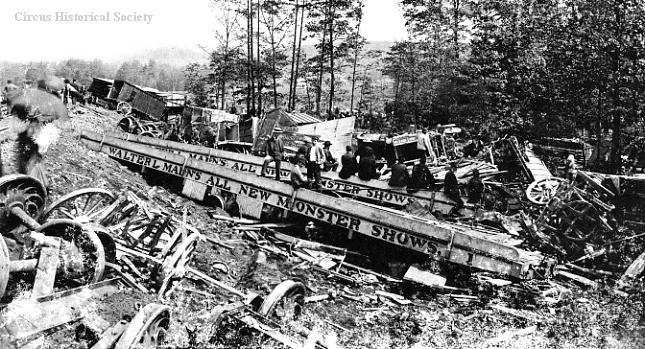
The Tyrone Wreck
The engineer of Walter L. Main's Circus train lost his grip on the locomotive when going down the mountain on the Tyrone & Clearfield Railroad Tuesday morning, May 30, 1893, about 5:30 o'clock, and there was a wild ride at flying speed, and then nineteen cars filled with people and animals from all parts of the world leaped from the tracks and were crushed to splinters. Five men were dead and a dozen more badly injured. Lions, tigers, leopards, elephants and beasts from African jungles and Indian plains bellowed, roared, screamed, and either lay helpless with shattered limbs or sprang forth to liberty. Forty-nine horses were killed, others wounded groaned piteously and suffering men cried for help. One lion, a tiger and a panther are still roaming about in the forests.
The following persons were killed outright: William Henry, brakeman, of Tyrone; Frank Train, of Indianapolis, Ind.; William Multainy, of Geneva, Ohio; James Strayer, of Houtzdale; Charles Lock, of Newport, Ky.
The following persons were injured, several of them so terribly they cannot recover: Willie Brannon, the cook, still alive, but in a critical condition; Louis Champaign, Rochester, N.Y., hurt internally, unconscious and cannot live; John Chambers, colored, Chambersburg, bitten severely by lion; Willis O'Brannan, Chambersburg, wound of scalp; Arthur Richards, of Peachville, wounded about the face; George Corten, of Hollidaysburg, contusion of chest; Frank Barnett, of Tarentum, contusion left arm; David Jones, of Harrisburg, sprained right leg; Frank Morse, of Rochester, N.Y., wounded about the head; William Evans, of Williamstown, right ankle injured; William Patchel, DuBois, contusion of left knee; James Haney, Alberton, badly injured about the body; William Jenks, keeper, left knee-cap torn off by lion.
The Engineer Was Powerless
Main's Circus was going from Houtzdale to Lewistown, and set out in a train composed of three passenger coaches and nineteen circus cars. The route lay over the Tyrone & Clearfield branch of Pennsylvania Railroad, and when descending the steep grade near Vail Station, five miles north of Tyrone, the engineer became powerless to abate the train's rapidly-increasing speed. At the station the train was going at a forty-mile-an-hour gait and jumped the track, owing to a broken axle. The locomotive and passenger coaches remained on the rails. Many of the men slept in the cars under the wagons containing the animals. Sixteen animal cages, along the cars, were flattened into small pieces, and pandemonium reigned. The dead and wounded people were taken from the wreck and the latter were removed to the hospital. When the wild beasts were freed a strange spectacle was witnessed. The head of one of the elephants was fastened down by one of the cars. As soon as released the huge beast struggled to his feet, shaking off the heavy timbers like straw, plowed through the balance of the wreck to freedom, seemingly happy of his escape. One of the tigers got out, and immediately began looking around to see what he could devour. He pounced upon the sacred ox, which had been badly wounded and tore it frightfully, killing it. The untamed monster started out in the country, looking for new fields.
Terrifies A Farmer's Wife
He came to the farm-yard of Alfred Thomas, where a woman was milking a cow. The woman left suddenly and the tiger sprang upon the cow and killed her. He was devouring his quivering meal, when the farmer appeared with his rifle and shot the tiger. Pleased with his royal sport, Farmer Thomas shouldered his rifle and started in pursuit of a panther that he knew was cavorting on the mountain-side. He failed to find the wily forest cat, and it is still at large. One lion is roaming the woods, but the other lion was captured easily by its trainer. He first cowed it, and then tied a rope around its neck and secured it to a log, where it has been quietly lying all day, viewing the turbulent scene below. Keeper Jenks was endeavoring to subdue a king of the forest, when the ferocious king seized the keeper and tore off his kneecap. All the animals that were saved roamed around loose, seemingly content with their freedom, and not caring to abuse it by running off. The water buffalo, two camels, a dromedary, two elephants, a zebra, yak, hyena and many small animals from different parts of the world did not wander far from the wreck, although unrestrained. Many of the smaller animals were not injured, though their cages were crushed about them. None of them seemed at all nervous or excited, but browsed contentedly or wallowed in the creek nearby as through it was an every-day occurrence.
A Famous Horse Badly Injured
A great many monkeys escaped chattering to the trees, where they looked down in wonderment, but were soon calmed by sweetmeats and tied. The dying groans of some of the trained horses were piteous. Most of them were pulled out only to be shot, the limbs being broken or otherwise fatally injured. Five horses, pure white with pink nostrils, all elegant performers, representing years of patience and teaching, had to be slain. "Flake," the famous fire-jumping horse, and leader of the trained horses, was badly wounded. He lay carefully bedded and covered by an awning, breathing heavily. Every once in awhile he made an effort to rise, when the attendant would place his hand on the horse's head and it would lay back again. The alligators were stretched on the ground as if dead, but a rub along the nose with a stick would show them wide awake.
Treasurer Train resigned Saturday, May 27, but was asked to continue until the show reached Lewistown, May 30. He always slept in the wagon, and was the first person looked after. He was still alive but pinned down, and the men worked faithfully to release him. He died before taken out. He was well known among circus people. All the wrecked cars are a total loss. The proprietor's money loss in the smash up is placed at $150,000.
Engine No. 1500 was selected to draw the circus train. Stephen Croswell, engineer and Harvey Meese, fireman. When Osceola was reached, in order to make the ascent of the mountain, another engine in charge of Engineer Reeder, was attached as a pusher. The ascent was made in safety. When the summit was reached, and the pusher left the train on its trip down the mountain, it is reported that the train containing its charge of human lives, and stock and equipment to the value of $200,000, seemed to shoot right off, and someone then remarked that it would be a miracle if it was not wrecked before Vail was reached.
The train rounded the dozen or more short curves, including the one at the big fill, at a high rate of speed, and when it passed Gardner's one who was on it informed the author that it was going so fast that it would have been impossible to count the telegraph poles, that the train seemed to be literally flying down the mountain. A mile or two below Gardner's there is a reverse curve, and then follows a mile of straight track to Vail. It was at the Tyrone end of the reverse curve where the appalling and fearful accident occurred.
The Rails Spread
Just what occasioned it an investigation will likely prove. There seems to be no doubt that the train ran away and was beyond the power of the engineer to control. Whether the brakes would not hold, or whether the fault was not in furnishing another engine, remains to be determined. One report has it that a wheel on the tender bursted, but a gentleman who has constructed many miles of railway informed the author, after a carefully examining the wreck, that it was caused by the rails spreading; that the fast running of the train, when the engine left the curve, and struck the straight track, did so with such force as to cause the rails to spread, leaving the tender to drop on the ties, thereby bringing about the disaster which followed. The engine remained on the track, but following the tender, over the 15 or 20 feet embankment on the left-hand side of the road going towards Tyrone, in the twinkling of an eye came every car in the train, except the four coaches, which were in the rear.
Passenger Coaches Saved
Horrible as the accident was, it was not so bad as though it had occurred at night. By some good fortune the passenger coaches were brought to a sudden stop as soon as the engine separated from the tender. From the first coach Mr. Main himself was the first to see the work of destruction that had taken place, and with his entire force went at once to work rescuing those who were pinned beneath the wreck. The fifteen cars were a mass of kindling wood, and in length the debris occupied a distance equal to about five car lengths.
Six People Killed
Four persons were instantly killed. These were William Ebberly, head brakeman, of Tyrone; William Mutterly, showman, of East Liberty, and two other show attachees, names unknown.
Frank Train, the treasurer of the company, occupied his usual place in his ticket wagon, which was on a car near the center of the train. He was buried beneath a mass of wreckage, and it was two hours before he could be reached. At times he would urge his rescuers to hurry if they wanted to get him out alive. He died just as he was being conveyed from the wreck.
James Strayer, son of the widow Strayer, of Houtzdale, lived an hour after the accident occurred. He was thrown to the open ground where he was found. He and John E. Eddings, also of Houtzdale, had obtained permission to ride to Lewistown. Eddings says that when he and Strayer found the train running so fast, and the wagon on which they were seated vibrated so fearfully, they scrambled down from the seat and prostrated themselves flat on the canvas. A moment after the car left the track, and the next he knew he was on the ground, so close to Strayer that he could touch him. He says Strayer was able to speak but did not know anything and died in about an hour. Eddings' face was scratched and he complained of a slight sickness of the stomach, but was otherwise uninjured. He returned to his home by the first train, the train that carried the corpse of his companion back to Houtzdale.
Those injured seriously enough to require medical attention were sent to the Altoona hospital. They numbered eleven. Names and addresses as follows: Frank Barnett, Tarentum; George Corton, Hollidaysburg; John Chambers, colored, Mercersburg; Louis Champaign, Rochester, N.Y., fatally injured; James W. Harry, Alberton; William Eavans, Williamstown, perhaps fatally; David Jones, Harrisburg; Frank Morse, Rochester, N. Y.; W. O'Brannan, Chambersburg. In addition to these were to be seen around the wreck many persons having slight wounds, and it is safe to say that few, except those occupying the passenger coaches, escaped without being to a greater or less extent scratched or bruised.
The dead were taken to Tyrone as soon as all the railroad men and show attachees were accounted for, the supposition being that all the bodies had been recovered. As in the case of young Strayer, there may have been others on the train unknown to Mr. Main, in which case it is possible other bodies may be found.
Two More Victims
William Evans and Louis Champaign, who were taken to the hospital, have died of their injuries. It is said their bodies will be sent back to Tyrone and interred by the circus people.
Another Man Killed
Another fatality has occurred at the scene of the disaster. While working with a wrecking crew, in the effort to remove debris, a rope broke which was attached to a tank for the purpose of pulling it up the bank, and struck Robert M. Gates on the chest. His injuries proved serious and he died within an hour of the accident. The unfortunate victim was single, aged 28, and lived at Tyrone.
Every Show Wagon In Splinters
To show the completeness of the wreck, there was not one of the show wagons to be seen - all were broken into thousands of pieces, and the same is true of the nineteen cars, the only one retaining even the shape of a car being the one containing the elephants, and this was cut to pieces in order to release the huge animals. The car laid on its side and through the two openings the elephants and their attendants were taken out, all more or less bruised, cut and bleeding, but not seriously injured. Later information is that one of the elephants had one of its fore legs broken.
Animals Turned Loose
Sixteen cages of animals were crushed and the animals either killed, maimed or set loose. Three lions escaped. One was speedily caught and caged, another was seen captured and chained to a tree, and the third roaming the mountains, as are tigers, hyenas, bears, panthers, several huge snakes, a man-slaying ape (very dangerous), with many birds, monkeys and small animals.
There were three sacred cows in the animal exhibition. Two were killed and the other escaped. One of the tigers spying the cow made a savage attack on her, was driven away, and immediately sprang over a fence into a field and attacked a lot of cattle belonging to Alfred Thomas. Mrs. Thomas was milking at the time the tiger put in an appearance and running to the house informed her husband, who, seizing his 38-55 Piker rifle, soon dispatched the tiger.
Sixty-eight horses are known to have been killed, including nearly all of the valuable ring and trick horses, among the number being the trick horse "Chicago" and "Flake", the white leader of Joe Berris' six-horse team, together with all the valuable horses ridden by Toney Lowande.
A Woman Races A Lion
For a short time after the wreck strange and wild animals were to be met with at every turn. Mrs. William Lyson, wife of the telegraph operator at Vail, on learning of the wreck, started to walk to the wreck and met a lion, and on turning to run was horror struck at seeing a large hyena within a few feet of her. She stood stock still and screamed when the animals left. When the wreck occurred the engineer and fireman started to walk back to the wrecked cars, and meeting two lions hastily made their way back to the locomotive.
The Loss About $150,000
Mr. Main was too busily engaged looking after the comfort of his men, and trying to save whatever of his property he could, to talk about the wreck. He places his loss at upwards of $150,000.
The Coroner's Inquest
Coroner Michael Poet was summoned, and arrived in town at noon, and immediately got together the following jury of inquest, who, being duly sworn, examined the remains of those killed which were lying at the undertaking establishment. By special train the jury went out and viewed the wreck. The jury were: Captain D. R. Miller, David Adams, A. A. Smith, R. G. McLanahan, F. J. Haverly and D. T. Caldwell, foreman. After their return they adjourned to meet Wednesday evening. The jury held a session in Herald Hall on Wednesday evening. Lawyer A. A. Stevens, Esq., represented Mr. Main, and J. D. Hicks, Esq., of Altoona, represented the Pennsylvania Railroad Company.
Not Running Over 30 Miles An Hour
The evidence of the trainmen was heard, and they all stated that the cars were not running over 25 or 30 miles an hour when the accident happened, and at no time was the train beyond their control. The jury here adjourned to meet on Thursday evening at 7 o'clock in the Sheridan Troop armory, a larger building.
"Nearer, My God, To Thee"
The body of Treasurer Train was shipped to Indianapolis on the Pacific Express Wednesday morning, May 31. Tyrone lodge of Knights of Pythias, the Elks, and representatives of Tyrone lodge of Masons, headed by Mr. Main's fine band, escorted the body from the undertaking establishment to the station, and while the body was being placed on the cars and the train pulled out, the band played the grand old hymn, "Nearer, My God, To Thee." Many of the circus people stood by with bowed heads and tears in their eyes, and the women wept aloud; while Mr. Main stood by and wept like a child for the departed companion and esteemed assistant.
Burial of the Dead
At 4 o'clock Wednesday afternoon, May 31, the funeral of William Ebberly took place. The procession was headed by Mr. Main's band, and followed by the Tyrone order of the Brotherhood of Railroad Trainmen, the friends, and more than 100 employees of the circus. At 5 o'clock a special train brought in 100 canvasmen from the wreck, and the colored band of the circus proceeded to the undertaking establishment of Barley & Graham, from where they accompanied the bodies of the two unfortunate companions to the Tyrone cemetery, where the funeral ceremonies were conducted by Rev. R. H. Gilbert. In the funeral the march to the cemetery was a sad scene, and each one seemed deeply affected.
Notes of the Disaster
Mr. Main himself was the first one out of the cars. He took in the situation at a glance. The efforts and achievements of patient years of toil, industry and frugality, lay scattered on every hand, a complete mass of irreparable ruins; but, heedless of his own personal loss, he immediately ordered everyone out of the cars, and took entire charge of the whole affair. He allowed no one to speak, except his different heads of departments, to whom he issued his orders in a calm, cool, but decisive judgment, and with the precision of a general directing the movements of a vast army, and it was only at the earnest entreaties of his employees that he was induced at the end of three hours to retire to his private car to habilitate himself, having all the while been working like a Trojan, with nothing on but a night shirt, bare-headed and shoeless, the sharp stones and splintered wreckage having lacerated his feet until they bled profusely. In this hour of distress there was no distinction, but from the high-salaried aerialists, riders, gymnasts, clowns, down to the lowest paid workingman, all were on an equal footing, each doing his utmost to free his fellow-man from the wreck. All the while Mr. Main remained as cool as if the wreck was a part of their every-day programme.
Countless telegrams and letters of sympathy have been received by Mr. Main from all parts of the United States and proffers of financial aid were numerous, proving Mr. Main's standing to be of the highest order. All seemed to remember the adage, "A friend in need," etc.
Thanks are hereby extended to the citizens of Tyrone and Altoona, Pa., for their hospitality, and also for their liberal patronage when the show again opened. By his calm demeanor and wonderful generalship, Mr. Main saved many human lives, and those of some very valuable horses.
E. C. White, of the show management, makes mention of his luck in escaping death as follows: On Sunday, May 28, the day before the accident, Treasurer Train resigned and handed over books, papers, etc., to him. After the transfer Mr. Main and Mr. Train came to an understanding, by which Train was to continue as treasurer; a re-transfer was made of the papers, etc., and Train, when the train left Houtzdale, took his accustomed place in the ticket office to guard the money, etc., in consequence of which arrangement Mr. White claims he escaped the fate that was in store for Train.
Especial mention must be made of the ladies connected with the circus, who lent a kind and loving hand to soothe the pain of those who were injured, and administered comforting assurances and with tender and loving hands held the demon of death at bay until the last victim succumbed.
Especial praise is due to keepers Reed and Jenks, who secured a great many of the valuable animals which had escaped. In the capture of the lioness, keeper Jenks had his left knee-cap torn off, but heedless of his pain kept right at his work of capturing every other animal he could locate.
Rohelio Judge, a young acrobat 17 years of age, captured and held at bay a huge royal Bengal tiger. For five hours young Judge stood within ten feet of the wiry animal, and with stick in hand completely subdued him.
The wreck occurred at McCann's crossing, the scene of so many wrecks on the mountain.
The young man Craig, who left Houtzdale with Strayer and Eddings, and who was reported as in the wreck, arrived home Tuesday evening, May 30. He says he was in one of the passenger coaches.
A long ditch, seven feet deep, is being dug, in which the horses and other dead animals will be buried. Later investigation shows 47 horses dead, with the probability of a number more of the more seriously injured dying.
It is not true that the engineer, fireman and conductor of the wrecked train have left for parts unknown. They went to Vail, the nearest station, and telegraphed the disaster to the railway officials at Tyrone, and during the afternoon were at the scene of the wreck.
After a long and tedious investigation, accompanied by several postponements, the coroner's jury rendered a verdict in accordance with the facts, and that the train was running too fast, which caused it to jump the track, causing the several deaths.
And this ends our description of the worst wreck that ever occurred in the history of circus business, or even in the annals of the world. It stands without a parallel, and has attracted the attention and sympathy, not only of the people in America, but of the world at large. It marks an epoch which will never be forgotten by the friends and patrons of America's greatest and most instructive source of pleasure and amusement, the circus, whose coming is ever hailed in village and city with enthusiasm and delight by young and old.
In conclusion, we pause to reverently place a garland of sweet remembrance upon the bier of those who perished in the awful disaster, and to that add our most ardent hope, that out of the dire calamity there may arise a mighty amusement enterprise that will cater to the pleasure of the numberless friends of the noble, heroic Walter L. Main, who, by inherent courage, and true grit, surmounts the fearful blow of fate, and, Sphinx-like, arises from the dark clouds into the sunlight of greater and brighter success than that which he has achieved in the past.
(From the 1894 Main Route Book written by Edward Arlington) To be continued.
Foreword. During the summer of 1966 I visited the old Alf T. Ringling mansion and estate located on Lake Swannanoa near Oak Ridge, N.J. The buildings on the grounds served as the quarters for the R. T. Richards Circus of 1917 and the photos I took during my visit picture them as they are today. The estate can be reached by turning left off Highway 23 (going west) at the West Milford First Aid Station. The mansion and buildings are located at Lake Swannanoa and you experience no difficulty in finding them. I call this little story the "Saga of Oak Ridge."
Although the magic name of Ringling is the basis for this story, there is a slight variation from the family fame in this case. It seems quite evident the brothers Ringling favored land in the garden state of New Jersey. John had a palatial home at Alpine, and Charlie owned property at Oakland. Alf T. and his son, Richard, however, are the main characters in this saga of Oak Ridge.
I am indebted to Mr. Joseph W. Headly who is now 82 years old, for many of the facts presented here. Joe still actively participates in running his own lumber yard at Oak Ridge. As a carpenter he served both Alf T. in building the estate which started approximately back in 1915, and later supervised the construction of the wagons for Richard when the show was framed in the spring of 1917. It is interesting to note that laborers were engaged for $1.25 per day and craftsmen earned $2.50. Mr. Headley pointed out that Richard salvaged a lot of fire engine wagons from the New York City Fire Department for his original rolling stock. However, when the spokes went through the bushings most of the wagons had to be rebuilt from the ground up. Incidentally, Joe went on the road with the circus for the 1917 tour.
My next bit of information came from a trip across the Hudson River to the Library of the Performing Arts, which is housed in Lincoln Center in New York City. Quoting from an article published in The Newark Evening News, June 8, 1955, I found this most complete summary of the history of the Alf T. Ringling estate. "At periods in its 38 year history the mansion, at Lake Swannanoa in northwest Morris County, has been successively a country home and angler's paradise, winter headquarters for a circus, and exclusive country club.
The house, a solid sprawling structure of reinforced concrete with native field-stone facing, has walls 2 feet thick and fourteen fireplaces. It was built by Alf T. Ringling in 1917. Its low ceilinged 30' x 45' living room includes a $10,000 walnut-and-ebony fireplace mantle imported from Italy. A cupid freize tops off the walnut-and-ebony paneled walls of the adjoining large dining room. The rest of the house is in proportion in size and appointments. A two-storied, sunken walnut paneled room, in the south wing of the home, formerly housed Ringling's $26,000 electric organ, an instrument first played at the circus magnate's funeral. The organ room adjoins a spacious concrete porch overlooking the major dam of Lake Swannanoa, now a summer lake resort and formerly part of Ringling's 600 acre estate. On the second floor and past the lavish bedroom suites to "the garret," a playroom with orchestra dais which forms a major part of the third story and once was the center of club activities at the mansion.
The mansion is understood to have cost Ringling $500,000. Its sale price was reported at $25,000. The house was sold with its immediate grounds of 4 1/2 acres. The rest of the estate now is in plots and used for summer and year-round cottages. Ringling, an ardent fisherman, owned all land around the 100 acre lake, which he stocked regularly with bass. Among his guests at the estate were Doug Fairbanks, Sr., and Geraldine Farrer, Metropolitan opera singer.
Ringling Manor, Inc., bought the estate in 1928 and turned the house into a club.
Another excerpt from the New York Times dated June 9, 1955 in part states: "Ringling Mansion to House Anti-Reds" - Oak Ridge, N.J. The great Ringling mansion, once a circus winter quarters, will become the nerve center of a Roman Catholic organization dedicated to aiding the "Church of Silence" behind the iron curtain. The Rev. Marion Wojick, a Franciscan Polish editor priest who escaped from Warsaw in 1941, announced that the old Ringling house has been purchased by the Spes Foundation, in which he is active. The Spes Foundation - the name is taken from the Latin word for hope - was formed last year to aid Roman Catholic churches and religionists in Poland and other iron curtain countries.
For the last fifteen years the mansion has been vacant. The foundation will use the twenty-six room structure as headquarters for the radio-monitoring, compilation of reports on events behind the iron curtain, publishing and other activities.
With the exception of the ring barn, all of the original buildings are standing and all are in reasonably good condition. Although the main house will need about $60,000 worth of fixing. As the accompanying pictures show, building #1 was used for a wagon shed and blacksmith shop. Directly across the road, buildings #2 and 3 were utilized as a power house and garage. The power plant had a 35 h.p. generator and a 50 h.p. turbine. There is no picture of building #4, the boat house, because of my lack of ability as a photographer. Building #5 housed the animals and is currently up for sale. Building #6 was the Ringling residence which boasted a huge leaded glass window showing an Indian paddling about in a canoe. According to Joe Headley, young Richard tried his marksmanship on the redskin much to Alf T.'s dismay. Building #7, the ring barn, I missed seeing as well as photographing. This originally had a glass roof which eventually collapsed, and what remains of it is used for a field office for some type of contracting firm. At least the buildings stand as tangible evidence of a once great circus power and its off shoot-the R. T. Richards Supreme Show of the World.
The late George Chindahl provided the (Sept.-Oct.) White Tops issue with a complete rundown on this show back in 1949. According to this gem of information, R. T. Richards was framed in the spring of 1917 by Richard Theodore Ringling who was twenty-one years of age at that time. As stated previously, Joe Headley had charge of the building of the wagons, Dick Muller the motor vehicles; Harry Gibbons and Ernie Anderson looked after the painting; and Tom Campbell supervised the cookhouse.
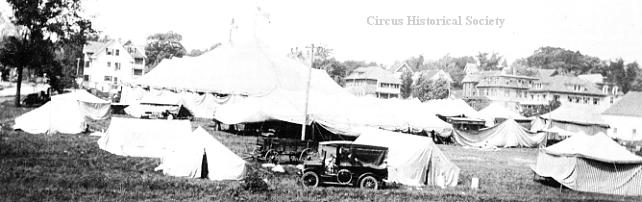
The show opened at Dover, N.J. on May 10, 1917. During the season it played 121 cities and towns, closing on October 6 at Media, Pa. and returned to winter quarters at Oak Ridge.
The show paraded and gave two exhibitions each week-day. Other personnel for the season included: William Backell, contracting agent; Bernie Head, press agent; "Little Erwin," the smallest advertising agent in the world; Art Eldridge, general superintendent; Eddie Delevan and Bill Conin on the front door; Steve Lloyd, superintendent of baggage stock; Roy Eldridge, superintendent of stock during early part of season; Keys, reserved and concert ticket seller; James McCusker, steward; James Baker, chef.
A two-ton truck and a smaller panel truck served the advance. The show carried 116 head of horses at the opening, but most of the draft stock was replaced by motor equipment before the end of the summer. The show, according to reports, equalled any ten-car show in size and carried five bulls in charge of Jimmy Dooley. The cookhouse went over the night before in squadron fashion, with everybody sleeping on the lot.
The big top was a 90-foot round top, with one 50-foot middle piece, the performance being given in one ring and a steel arena. The menagerie top was a 70-foot round top with four 30-foot middle pieces. The five cages were placed in the center of the tent. The five elephants and two camels were at the far end from the marquee. The remainder of the space along the sides was devoted to horses, constituting the advertised horse show. There were also the regular horse tents.
The day the show closed in Media, Alf T. informed the folks that if the war was over that winter the show would go out in 1918, but that if hostilities still continued the show wouldn't go out. However, in April, Samuel McCracken took over the show and placed it in Luna Park, Coney Island, in May.
The show was to have sailed on Oct. 26th for Havana, but these plans were cancelled on account of the flu epidemic. In March 1919, it was reported that the elephants had been sold to William P. Hall. In the winter of 1918-1919, an indoor circus was framed, using the title, "R. T. Richards' Mammoth Indoor Circus," William Conway being the contracting agent and Fred Bradna the general manager and equestrian director.
Early in January, 1920, the show played the Mayflower Theatre in Providence, R.I., followed by the week of January 12th at the Worcester Theatre, Worcester, Mass. Many of the acts being contracted for the Ringling-Barnum show, the season terminated in Amsterdam, N.Y., March 6th. The R. T. Richards title was not used after the 1919-1920 winter season.
In addition to his circus interests, Richard Ringling owned and operated an immense ranch in Montana. He departed this life on August 31, 1931, at his home in White Sulphur Springs.
I am deeply indebted to Joe Bradbury and Fred Pfening for their assistance and guidance in the preparation of this article.
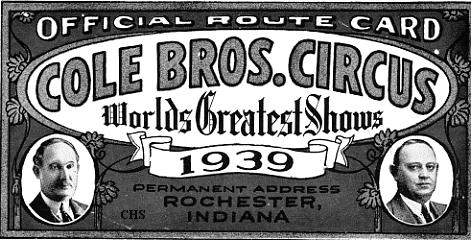
As the new year, 1939, appeared on the scene the affairs of Messrs. Adkins and Terrell and their circuses were still completely muddled due to litigation in the courts over the apparent bankruptcy of the parent company, Indiana Circus Corporation, and one of the operating companies, Robbins Bros. Circus Inc. The other operating company, Cole Bros.-Clyde Beatty Circus Inc. had previously been adjudged bankrupt by the Federal District Court on Sept. 30, 1938. Since the financial affairs of the two showmen were all entwined among the three companies nothing definite could be planned for the future until the court's final ruling came forth. All physical assets of both shows had been taken over by Associates Investment Co. of South Bend and local banks and businessmen now held title to the winterquarters due to forfeiture on the loan due them.
However, months before the courts finally settled the financial difficulties caused by the disastrous 1938 season, Adkins and Terrell were hoping to be able to open and tour some sort of circus in 1939. A new corporation, Cole Bros. Circus Inc. was organized and on January 18 three petitioners, Jess Adkins, Zack Terrell, and Jess Murden, filed incorporation papers at Indianapolis. Purpose of the new corporation was to operate and lease circus equipment. Capital consisted of 1000 shares of no par value stock. The Jan. 28 Billboard which broke the news concerning the formation of the new corporation stated that F. E. Shortemeir, who was one of the original incorporators in 1935, was backing the new show. If true, Shortemeir remained completely in the background and his name was not publicly mentioned again as being active in the formation of the show. The same Billboard article stated that the new Cole show would definitely open under canvas on May 1 at Rochester and would be on 20 cars. This announcement was premature and the following week The Billboard stated that plans for the new Cole show would be withheld for a month and that nothing was definite as yet. It was stated that Associates Investment Co., which took over the Cole property, and Jess L. Murden, one of the incorporators of the new show, would not be ready to announce any definite plans until March.
The most important man on the scene was Jess Murden and it was mainly through his influence and efforts that Cole Bros, was able to go on the road again. Murden was a prominent person in Indiana political, financial, and business circles and it had been through his influence that funds had been obtained from Associates to launch the initial show back in the winter of 1934-35. Murden of course had also been an incorporator of the original Indiana Circus Corporation and had been closely associated with the management of the show since then.
Murden now took on a dual role. He was retained by Associates to look after their interests. They were footing the bill for feed and other expenses at the winter quarters. Associates was also anxious to dispose of much of the circus property they now held which consisted of 45 railroad cars and equipment for both a 30 and a 15 car show. Murden was given the job of selling off the surplus circus equipment for Associates but likewise as an incorporator of the new show he was the moving factor in obtaining the subsequent lease of equipment in order to get the new show organized and on the road for the 1939 season.
Sale of the surplus circus equipment came early in the year and the following advertisement appeared in the Jan. 14 Billboard.
"Surplus Circus Equipment. A complete line of circus equipment for 10, 15, or 20 car show with exception of baggage horses and canvas. Passenger coaches, stock cars, flat cars, elephants, camels, hippopotamus, liberty horse acts, circus wagons, cook house equipment, dining room equipment, the Tim McCoy all steel stock cars, advance cars, private cars. Call or address, J. L. Murden, Rochester, Ind."
This ad leads to an interesting question concerning the Tim McCoy stock cars which were also listed for sale. Were the Tim McCoy stock cars actually available for sale by Murden? It is a fact that the McCoy advance car had been purchased and sent to Rochester earlier and this car was used by Cole later in the 1940s. Murden also personally purchased the Tim McCoy private car, "Cheyenne" and it was renamed "Owensboro", painted With the Cole title and was part of the Cole Bros. 1939 train for at least part of the season. Best explanation on the stock cars is that Murden acquired them and handled their sale on the side. Whether or not the cars ever got to Rochester is not definitely known. The January 21 Billboard said that a number of the McCoy stock cars were still on a siding in Washington while others were now in Kokomo, Ind., being painted a Pullman green. Probably the cars remained in Kokomo until disposed of by Murden. None of them were ever used by Cole Bros, or any other circus but possibly they did get to a carnival.
The trade publications early in January told of the plans of Glen J. Jarmes of Owatonna, Minn, to frame and put on the road in 1939 a new 15 car railroad circus. It seemed for a while that Jarmes would get all of the equipment for his proposed show from the surplus Cole property and in February Jarmes and D. C. Hawn went to Rochester and picked out equipment, including advertising car, for a complete 15 car show. The property was set aside for Jarmes and he gave a check for $20,000 dated a week ahead as a down payment, however, when the check was presented on the date given it was returned "not sufficient funds" and that was the end of that. Jarmes said that his backers had changed their minds at the last minute and had not come through with the promised funds.
A sizeable sale of animals and equipment was made to Bud Anderson of Emporia, Kan. for the new 18 truck show titled "Bud Anderson's Jungle Oddities and 3 Ring Circus" which he was putting out in 1939. The Feb. 28 Billboard stated that Anderson had gone to Rochester and purchased 3 baby elephants, 2 young camels, 8 liberty horses, 3 menage, and 3 wild west horses, harness, saddles, and props for same.
During the winter of 1938-39 a number of elephants were sold. The sale of at least 8 can be documented and no doubt there were a few more. Clyde Beatty got Mary, Sidney, and Anna May. Tommy was sold to the San Diego Zoo. Bamma went to the Buffalo, N.Y. zoo, and as mentioned previously Bud Anderson purchased Judy, Little Modoc, and Empress, the three young elephants the show had obtained in the spring of 1937. By April 1939 the bull herd was down to 16, which was slightly more than half of the all time high of 29 in the fall of 1935. The 16 remaining elephants in all probability were; Big Babe, Blanche, Carrie, Jean, George, Jennie, Joe, Little Babe, Little Jenny, Louie, Nellie, Tessie, Tony, Wilma, Ding, and Katie. The last two named were the ones later lost in the February 1940 fire and the first 14 named were ones carried by the show in 1940.
The spring of 1939 was a bad time to sell any kind of circus equipment, especially railroad show property, due to the extremely bad season of 1938 and its depressing effect on future circus business. Likewise there was an abundance of surplus circus equipment being offered for sale by other parties. Early in the year Ringling-Barnum had announced its plan to tour only the Big Show in 1939 and that Al G. Barnes-Sells-Floto would not go out and they had no plans to operate or lease the Hagenbeck-Wall ace Circus. Although the market for surplus circus equipment to other circuses was practically non-existent there was a pretty good market for such by railroad carnivals. Ringling sold a number of Al G. Barnes-Sells Floto rail cars to the Amusement Corporation of America, a combine which operated Royal American Shows, Beckman & Gerety, and Rubin & Cherry, all large railroad carnivals. Most of the Hagenbeck-Wallace rail cars were sold to the Art Lewis Shows, carnival.
In late August 1939 Associates sold 7 steel Mt. Vernon built flat cars to the Strates Shows and they were delivered to that carnival at its stand in Elmira, N.Y. This is the only documentation we have of sale of surplus Cole Bros, or Robbins cars by Associates but there were probably more. There were a total of 20 flat cars used by Cole and Robbins in 1938. At least 10 flats were not sold and remained in quarters. When Cole left Rochester for good in the Spring of 1940 the train had a total of 25 cars, 1 advance, 6 stocks, 7 sleepers, and 11 flats, one flat having been purchased in the early spring of 1940. All of the excess cars at Rochester were disposed of either prior to Cole leaving in the spring of 1940 or shortly thereafter. It is certain none of these cars went to other railroad circuses as the only other rail show on the road was Ringling-Barnum. However it is highly probable some cars went to carnivals. Stock cars especially could easily be converted into use by the many gilly type rail carnivals on the road at that time.
So far as I can determine no wagons were sold by Associates, the reason being there was just no circus market at the time for them and the baggage wagons offered for sale were not of the type generally used by carnivals. Gordon Potter says that a friend of his who had a small show at the time told him they were asking $600.00 each for the 12 ft. cages at Rochester, which was a pretty steep price even in times when a market for same existed.
There is no doubt there were other sales involving small animals, horses, ponies, lead stock, and miscellaneous properties to motorized circuses, carnivals, or zoos but I have no detailed information on them.
According to Richard J. Reynolds III, leading hippo and rhino historian, the large Nile hippo, "Pinkey" which Cole Bros, had exhibited in its menagerie from 1936 through 1938 seasons was swapped to the Washington, D.C. Zoo in the spring of 1939 for a young pigmy hippo which the show named "Little Nemo". According to the zoo's records this pigmy hippo was a female born in the zoo on May 8, 1938 and was sent to Cole Bros, on April 26, 1939. As a result of this swap the show was able to house the new pigmy in a 12 ft. cage and retire the longer den they had used for Pinkey.
As had been the custom each winter a number of Cole performers and animals were engaged to play several of the annual indoor Shrine circuses. In March a unit left Rochester to play the Minneapolis Shrine Circus and afterwards played the Shrine Circus in St. Paul. In early April the show sent 3 baggage cars of elephants, horses, performing animals, paraphernalia, and equipment to the St. Louis Police Circus which was the final indoor engagement using Cole animals and performers of the winter season.
Litigation over the show's financial affairs which had begun in late summer 1938 continued and by early March was beginning to reach a climax. The March 18 Billboard reported that petitions had been filed in U.S. District Court at South Bend on March 8 to force the other two circus corporations, the Indiana Circus Corporation, and Robbins Bros. Circus Inc. into bankruptcy. According to the article one suit against Robbins was filed by 3 creditors who were identified as Floyd King, who sought judgment of $1,302.89; Eugene Scott, who claimed $141.41, and John H. Smith, who asked $306.06, all claims being for back salaries. In a second suit Edward Rowe and Ford Johnson, doing business as Johnson Dairy in Rochester, Ind. and Val Zimmerman, also of Rochester, claimed to be creditors of the Indiana Circus Corp. Amount asked by Rowe was $386.00 and by Johnson $236.00, while Zimmerman claimed $138.25 was due him for services. On March 14 the Indiana Circus Corp. and Robbins Bros. Circus Inc. were adjudged bankrupt and as previously stated Cole Bros.-Clyde Beatty Circus Inc. had been adjudged bankrupt on Sept. 30, 1938.
On April 1 Alvin F. Marsh, referee in bankruptcy, issued notices to all creditors that the first meeting of creditors would be held at the courthouse in Rochester at 1 p.m. on April 5 at which time they would be permitted to prove their claims, appoint trustees, and committees, examine the bankrupts, and transact such other business that might come up.
In the meantime the newly formed Cole Bros. Circus Inc. (Jess Adkins, Zack Terrell, and Jess Murden) with a paid in capital of $500.00 had made definite arrangements to lease from Associates Investment Co. equipment for a 20 car circus out of the former Cole and Robbins equipment which was taken by foreclosure in the fall of 1938. The board of directors indicated they were willing to obligate the new company to pay off part of the indebtedness of the old corporations by passing the following resolution. "Resolved that Cole Bros. Circus Inc. issue 5 year non-interest bearing notes in an amount equal to 10% of the unpaid indebtedness to all general creditors of the Indiana Circus Corp., Cole Bros.-Clyde Beatty Circus Inc., and Robbins Bros. Circus Inc., said notes to be discharged before any dividends are paid on the capital stock of Cole Bros. Circus Inc."
This plan to organize and put on the road the new show and to pay off 10% of the old indebtedness was presented to the referee and creditors at the general meeting of April 5. Adkins and Terrell announced at the meeting that they believed with this leased equipment and with what money they could obtain from friends they could get the new circus on the road and because of the general upturn of business operate it at a profit.
The April 15 Billboard related the referee's decision and the results of the creditor's meeting by stating that Alvin Marsh, referee in bankruptcy for Northern Indiana U.S. District Court, held the 3 Indiana circus corporations in bankruptcy with $415,338 in claims and declared the bankruptcy as a "no assets" case. At the final hearings Adkins and Terrell had testified that 1938 season was the worst in circus history. They blamed the poor season on the business depression, adverse weather conditions, and labor trouble. Both men cited figures on gate receipts in some cities for 1937 and 1938 and in every instance the difference was a drop of from 50 to 75 percent. The new corporation's plan to pay off 10% indebtedness seemed to meet with approval of attorneys for the creditors and a later meeting was scheduled on the matter. Marsh stated that "while the liabilities of the 3 circus corporations are large, I have been unable to find any suggestion of fraud on the part of the circus owners. The liabilities are for unpaid labor, material, and loans."
At the next meeting of the creditors the plan for payment of 10% of the claims was approved and thus all legal obstacles for the launching of the new show appeared to have been removed. Final objections to discharge of the bankrupt corporations had to be filed by May 22 but none were expected and no further legal action came up to halt plans for the new show.
Conflicting stories arose in the trade publications on the size of the new show. At the time the 10% plan was submitted to the referee and creditors it was announced the new show would be on 15 cars. Later it was claimed that rail contracts for the new show called for 25 cars, but by time opening day on May 1st came around it was officially announced the show would be on 20 cars, same number as was in the premature announcement back in January.
During the months of March and April plans had been going forward steadily to launch the new show on assumption no legal difficulties would arise. By April 15 Supt. Fred Seymour announced that all baggage wagons had gone through the shops and were now in the paint shops with Ernie Sylvester in charge. Also by mid-April Joe Wallace, boss hostler, had brought in the baggage stock from the show's farm near Rochester.
The April 22 Billboard stated that Cole Bros, would open the 1939 season under canvas May 1 at Rochester. The show would follow its regular spring route, however, there would be no indoor engagement in Chicago as had been the custom since the first season in 1935.
In framing the new 20 car show several basic considerations were first given. First, the show would be quite similar in size, loading, menagerie, big top, and seating arrangements to the Robbins Bros. Circus after its enlargement to 20 cars in late season 1938. Secondly, with the departure of Clyde Beatty there would be no feature wild animal acts and the performance would be built around standard circus type acts. The departure of Beatty's cats which were always the mainstay of the menagerie would make it necessary to adequately stock the menagerie with other caged animals. Thirdly, the show would retain the daily street parade utilizing mainly the parade wagons Robbins had used in 1938.
At the beginning of the season the 1939 train consisted of 20 cars which included 1 advance, 6 stocks, 8 flats, and 6 sleepers. The show used its 6 Warren built flat cars plus 2 Mt. Vernons. The 1938 Cole advance car was used and the stocks and sleepers were the best from the available pool of former Cole and Robbins cars. The 6th sleeper was the private car of Jess Murden, who traveled with the show for most of the season to look after the interests of Associates in seeing that payments on the leased property were made on time, etc. and also to help guide the show through the first difficult weeks in which the show had to get it if it was to survive very long. The car had been the Tim McCoy car, "Cheyenne" and was a beautiful car equipped with an open end observation platform. It was painted and titled in the 1939 Cole color scheme and was numbered 59 and named "Owensboro". It was placed at the end of the train, traditional location for such cars.
Train color scheme in 1939 was basically the same Cole Bros, had used since the beginning. Flats were aluminum titled in red, stocks also were aluminum with title in white on a red letterboard, and the sleepers were red titled in white. Advertising car was red.
The train loading order was as follows:
Loading Order, Cole Bros. Circus, Benton Harbor, Mich., Aug. 24, 1939
Five Stock Cars
Flat Car 44 -
Cross cage bodies are 8 1/2 ft. long but each one occupies only 6 ft. when loaded cross wise on the flat car. 1 advance car, 5 stock cars, 8 flat cars, 6 coaches, total 20 cars. 2 tractors, 8 cages, 29 wagons, total 39 pieces loaded on 8 flat cars. From Gordon Potter files.
It might be expected that due to the dire financial condition of the show that little or no wagon construction or renovation would be done in order to assemble the new show as there were ample wagons, cages, of all descriptions in the pool at Rochester to choose from. Actually, a considerable amount of new wagon building and remodeling took place, more than would ordinarily be expected under the circumstances. Just what the reason for it is not known but possibly work on the wagons started earlier than thought and back when it seemed a certainty that Glen Jarmes would take 15 cars of equipment which was set aside for him until after it appeared the deal with him had fallen through for good it was felt some work would have to be done on other wagons to get enough ready for the 20 car Cole show to go out. But regardless of the reason a good bit of work on the wagons took place.
The following work took place in preparation for the 1939 season.
1. A wagon which had come with the original Christy purchase but had not been previously used was renovated and put into use for the first time in 1939. It appeared on the Christy list as the "yellow tableau, drop frame wagon". It was fixed up and became No. 22, the commissary wagon in 1939. See photo No. 1.
2. A completely new wagon was built for the steam calliope. This was necessary as the old wagon was about gone. Quite a few of the old carvings were put on the newer and larger wagon. The new wagon became No. 68.
3. The Palm Tree Tableau wagon which had served as wardrobe wagon on Cole Bros. 1935-38 was slightly remodeled and became No. 62, white ticket wagon. They changed the wagon's rear end to get in the ticket selling doors. As the old Palm Tree carving on both sides was now dry rot they were just removed but most of the original side carvings remained in place. The wagon was painted and the show's title placed in vacant spot of the old tree carving and it became a very attractive vehicle.
In 1938 Robbins had used the France tableau as the reserve seat ticket wagon and Cole had used the Columbia wagon for that purpose but for 1939 both of these wagons remained in quarters and the show elected to convert the Palm Tree wagon into a reserve ticket wagon. This decision to replace the France wagon ultimately proved to be the reason the latter is still around today, being preserved in the Circus World Museum in Baraboo, rather than being consumed in the fire at Rochester to be related later.
4. Canvas wagons No. 94 and 95 which Cole had used in 1938 were remodeled, both being cut down to about 14 ft., and became the big top canvas wagons used in 1939. They were renumbered 86 and 87.
5. Cole stringer wagon No. 109 was remodeled so it could also load ring curbs.
6. Robbins Bros. No. 87 wagon had a re of added to it and became Cole No. 82 for 1939.
In addition to the above there were other minor modifications made such as the cage fitted up to house the pigmy hippo, cage for the sea lions, etc.
A total of 8 cages were carried at the beginning of the 1939 season with an additional cage added on Sept. 1. Included were 5 cross cages, Nos. 10, 11, 12, 14, and 17. Cage No. 19, one of the four new 12 ft. dens built at quarters the winter of 1936-37 was used to house the new pigmy hippo, Little Nemo. Cage No. 15, used for the sea lions, was one of the former Christy 12 ft. dens, and No. 18 was the 10 ft. cage equipped with pneumatic tires that Springfield had built for Cole Bros, in the winter of 1937-38. On Sept. 1 Cage No. 16, another of the 4 new 12 ft. dens built at quarters the winter of 1937-38 was added. This cage was used in the opening day parade in Rochester but did not leave with the show.
When the wagons, cages, and tractors were finally assembled there was a total of 39 vehicles as shown on the list of rolling stock printed here.
Cole Bros. 1939 Wagon List
No.; Description; Status in 1938
10; Cross cage, audads; See Note No. 1
11; Cross cage, deer & antelope See Note No. 1
12; Cross cage, puma & leopard; See Note No. 1
14; Cross cage, tigers; See Note No. 1
15; Cage, sea lions; Robbins Bros.
17; Cross cage, monkeys; Remained in quarters
18; Cage, leopard & lions; Cole Bros. (Springfield built)
19; Cage, pigmy hippo; Robbins Bros.
20; Cookhouse baggage; Robbins Bros.
21; Steam boiler wagon; Robbins Bros.
22; Commissary wagon; Used for first time in 1939
30; Horse tops & blacksmith; Robbins Bros.
40; Menagerie canvas & poles; Cole Bros. (No. 61)
50; Light plant wagon; Robbins Bros.
61; Sideshow canvas & poles; Cole. Bros. (No. 75)
62; Palm Tree Tableau (white ticket wagon); Cole Bros, (remodeled)
63; Red ticket wagon; Cole Bros.
64; Frozen custard wagon; Cole Bros.
65; Concession dept. wagon; Cole Bros.
68; Steam calliope; Built new for 1939
70; Pad top & trapping wagon; Cole Bros.
71; Belgium tableau, trunks; Robbins Bros.
72; Great Britain tableau, trunks; Robbins Bros.
73; Prop wagon; Cole Bros.
74; Statue corner tab, wardrobe (ex air cally); Robbins Bros.
75; Air calliope; Robbins Bros.
80; Pole wagon; Robbins Bros.
81; Stringers & ring curb wagon; Cole Bros. (No. 109) remodeled
82; Big top stake & chain; Robbins Bros. (No. 87) remodeled
83; Seat planks & jacks; Robbins Bros.
84; Seat planks wagon; Robbins Bros.
85; Seat planks wagon; Robbins Bros.
86; Big top canvas wagon; Cole Bros. (No. 94) remodeled
87; Big top canvas wagon; Cole Bros. (No. 95) remodeled
89; Africa tab (India or Hippo) seat planks; Robbins Bros.
90; Stake driver; Robbins Bros.
- ; United States tableau, chairs; Robbins Bros.
- ; Mack Tractor; Robbins Bros.
- ; Mack Tractor; Robbins Bros.
On Sept. 4, 1939 Cage No 16, bears added to show at South Bend, Ind. Note No. 1-Two cross cages were on Robbins Bros, in 1938 and three remained in Rochester quarters. From photos alone it is almost impossible to tell which of the cages were on the Robbins show. As indicated above No. 17 cross cage was definitely left in quarters. It was fixed up, painted with Robbins title, but due to tight loading had to be left in quarters.
The show put together a very fine and colorful street parade in 1939. Although it had fewer vehicles and lead stock than Cole Bros, parades in the past it was stronger than the Robbins parade in the first part of 1938 and with a few more cages in the line of march would actually have been on par with the Cole parades of 1935 and 1936.
For the No. 1 lead bandwagon the beautiful United States tableau was used. From all accounts and photos available the big show band was not split into two sections for parade purposes. The reduced number of bandsmen in 1939 would have made such a split impractical. The Belgium tab was used for the clown bandwagon while the sideshow band rode the Africa (India or Hippo) tab in parade. Great Britain tableau and the No. 62 remodeled Palm Tree tab, now the white ticket wagon, were used in the parade as tableau wagons being ridden by costumed performers. Another tableau wagon was No. 74, the former Christy Bros, air calliope, that had been used as such in the Cole parades of 1935 through 1937 but had been used as a tableau wagon in the 1938 Robbins parade. The air callope in the 1939 parade was No. 75, the former Buchanan Robbins Bros, wagon and the steam calliope was No. 68 the new wagon built at quarters. At times the steamer was pulled by a 6 horse hitch while on other occasions it was pulled by a Mack truck.
There was considerable variation in the 1939 parades as indicated by the two separate parade lineups printed here. Photos indicate at times the No. 22 commissary wagon was used in the parade as a tableau, see photo No. 9. Other photos show that on occasions the Great Britain wagon was used for the sideshow band and also to carry the No. 1 band. One shot shows the United States wagon being used as a tab and ridden by costumed performers. The number of cages appearing in parade often varied with one or more being left on the lot. Switching of parade units were due to repairs being made to various wagons, temporary shortage of draft stock, drivers, etc.
Through a rare and remarkable set of color photos of the 1939 Cole parade equipment in the Fred Pfening Jr. collection I was able to record the color scheme of most of the wagons carried by the show that year. The United States tab was red, white, and blue with gold carvings and paintings. Africa (India or hippo) was red with gold carvings. Great Britain was red with blue trim and gold carvings. Belgium was white with green and gold carvings. Corner statue tab No. 74 was red with gold carvings and had red title on white background. The corner figures were red and blue. The commissary wagon, No. 22, was red with silver carvings and title.
In this same set the color scheme for the cages showed that Cross Cage No. 11 was white with green trim and red title. Cage No. 19 was red with gold carvings, Cage No. 18 (Springfield) was red with silver carvings; Cage No. 15 (ex Christy 12 ft.) was red with gold carvings, and Cross Cage No. 14 was white with red trim and lettering.
Although not shown in this photo set the other cross cages were white with red lettering and the new steam calliope and remodeled Palm Tree wagon were white with gold carvings. The air calliope was red with white lettering. Baggage wagons in 1939 were red, titled in white, and had white wheels and gears trimmed in red and blue.
Cole Bros. Circus opening day parade lineup, Rochester, Ind., May 1, 1939 (from Gordon Potter files).
1. 1 horse pulling buggy
2. 2 girls (on horses)
3. United States Bandwagon (No. 1 band) pulled by 8 horses
4. 4 girls (on horses)
5. Cross Cage No. 17 (10 monkeys) pulled by 6 ponies
6. Clown buggy pulled by 1 donkey
7. Cross Cage No. 11 (2 deer, 1 antelope) pulled by 6 ponies
8. Cross Cage No. 12 (2 pumas, 1 leopard) pulled by 4 burros
9. Cross Cage No. 10 (4 audad) pulled by 4 burros
10. Cross Cage No. 14 (2 tigers) pulled by 6 ponies
11. Clown buggy pulled by 1 donkey
12. No. 75 air calliope pulled by 2 horses
13. Cage No. 18 (Springfield built rubber tires) 2 lions, 1 black leopard, pulled by 2 horses
14. Cage No. 16 (12 ft. cage) 3 bears pulled by 4 horses
15. 4 girls on horses
16. Belgium tableau No. 71, clown bandwagon, pulled by 6 horses
17. Cage No. 15 (12 ft. cage) 3 sea lions, pulled by 4 horses
18. Cage No. 19 (12 ft. cage) pigmy hippo, pulled by 4 horses
19. 4 girls on horses
20. No, 74, Statue corner tableau wagon (former air calliope) pulled by 4 horses
21. Africa tableau, No. 89 (India or Hippo) sideshow bandwagon, pulled by 6 horses
22. Palm Tree Tableau, No. 62, pulled by 4 horses
23. 4 girls on horses
24. Great Britain tableau, No. 72, pulled by 6 horses
25. 8 cowboys and cowgirls on horses
26. 4 camels
27. 13 elephants
28. No, 68, Steam Calliope pulled by Mack tractor.
Parade Totals
8 tableau wagons
9 cage wagons
3 buggies
4 camels
13 elephants
26 riders
1 Mack tractor
8 burros, 2 hitches of 4
18 ponies, 3 hitches of 6
50 baggage horses, 1 hitch of 8; 3 hitches of 6; 5 hitches of 4; 2 hitches of 2.
Note: That Cage No. 16, bears, made opening day parade in Rochester but was left in quarters until rejoining the show Sept. 4 at South Bend.
The show carried 13 elephants in 1939 and all made the opening day parade.
The canvas arrangement of Cole in 1939 was essentially the same as Robbins in late season 1938 after its enlargement from 15 to 21 cars. The big top was the same one Robbins had used late in 1938 and was a 140 ft. round with three 50 ft. middle pieces. Likewise nearly all of canvas used in 1939 had been used by Robbins the previous year and consisted of a menagerie top, a 70 ft. round with five 30's; sideshow, a 55 ft. round with three 30's; padroom 55 ft. round with two 30's, and a dining tent which was a 4 push pole type, poles about 30 ft. apart, and about a 60 x 150. Show carried two horse tops, gable ends, with 5 poles for push pole type tents, which were about 34x56.
The big top seating consisted of grandstand chairs, 10 tiers high all on the stringers, with 6 sections on the long side and 2 1/2 sections on each side of bandstand on the short side. Blues were at both ends.
The show was again equipped with the outstanding interior and outside lighting which Cole had perfected and used in recent years. The sideshow had a large and colorful bannerline and for the fifth season Prof. Agnew had his Petrified Man pit show on the midway.
Clyde Beatty, who was now on his own with his trained cat act, left Rochester quarters for good about the time Cole was getting ready to open to play a lengthy engagement at Hamid's Pier in Atlantic City. Earlier in the year Beatty had announced his act would be at the Golden Gate International Exposition in San Francisco but his plans were later changed. It just didn't seem right that Beatty's act, which had constituted the feature attraction of the Cole program from the beginning, would be no longer with it. A void would be created in the performance which would be most difficult to fill. Besides, the regular cities on the established Cole route through the mid-west had come to associate Clyde Beatty and his lions and tigers with the show. It was certain his act would be missed in many places during the season.
The 1939 season was now at hand. Whereas 6 railroad circuses had answered the starting bell in 1938, now only two were left, and both had made considerable retrenchment from the previous year. They were Ringling-Barnum on 80 cars, 10 fewer than used in 1938, and Cole Bros, on 20 cars, also 10 cars less than the total carried the previous year. There was an attempt to launch a third railroad circus, a 15 car show organized on the West Coast, using equipment from the ill fated 1938 Hagenbeck-Wallace Circus and titled the Great American Circus but the show lasted only a few days and really never got started. A small 4 car railroad circus, Baddeley Bros., operated in Western Canada during the 1939 season. Although the number of rail shows in 1939 was greatly reduced there was no great reduction in total number of motorized circuses in 1939 but still it was the smallest number of shows going out in several years. Many of the better known mud shows such as Tom Mix, Seils-Sterling, Harris Bros., and Mighty Haag had been killed off in 1938 but several new ones such as Bud Anderson's, Matrello Bros, (later called Ham & Eggs), and Dodge Bros, took to the road in 1939 bringing the total number of shows up somewhat. Only two major circuses paraded in 1939, Cole Bros, and Parker & Watts, a large motorized show now in its second season.
Although the annual indoor opening stand in Chicago for Cole was ruled out it was felt that the best route for the show to follow during the early critical weeks would be through its proven territory in Indiana and Ohio which had never failed to produce for the show with exception of 1938. Since Hagenbeck-Wallace was off the road there would be little opposition from railroad shows in the area although Ringling-Barnum would play some of the Cole stands a few weeks later in the season. It was expected that many motorized shows would operate in the territory but the Cole management felt no apprehension about them but hoped that if business conditions had improved enough for the populace to have a few extra amusement dollars in their pockets that Cole would be able to get its share and make a go of it in the midwest towns that were traditionally good early season stands.
As usual the show lined up a competent staff of seasoned showmen and there were few changes from prior years. Likewise a strong and pleasing performance was put together featuring several holdovers from previous years. The only major loss from earlier years was the absence of the Beatty act. The show opened the 1939 season under canvas in Rochester, Ind. on May 1. The May 12, 1939 Billboard told the story of the Rochester opening, listed the performance and staff, and gave general comments on the show. This article is printed here essentially in its entirety.
"Cole Has Two-thirds House at Rochester, Ind., Debut: Parade Draws: on 20 Cars. Rochester, Ind. May 6 - The reorganized Co]e Bros. Circus, again under the management of Jess Adkins and Zack Terrell, opened its season Monday on the 'home' lot under favorable conditions. A sunshiny day, just a trifle cool, brought out a large crowd to see the parade, and the matinee performance drew about a two-thirds house. Parade, led by John Smith, presented an excellent appearance. All parade wagons and cages have been completely redecorated with plenty of gold leaf being used. Big-how, side-show, and clown bands, along with three calliopes, were in the line-up. Last year's Robbins Bros, big top is being used for this year's show. The excellent indirect lighting system introduced last year is again being used.
"Most of the former staff and many of last season's performers are with the show. Floyd King is again general agent. Rex de Rosselli and Ora O. Parks are handling the press. Rosselli also produced the spec, 'La Argentina,' nicely costumed, pleasing and colorful. Music for the spec was arranged by Vic Robbins, bandwaster, and wardrobe was designed by Josephine McFarlan.
"After playing nine days in Indiana and one in Illinois the show heads into Ohio and eastward, moving on 20 cars.
Art Mix Has Concert
"Art Mix and Jackie Lee Mix are featured in the concert, which consists of a Wild West performance. The Loyal-Repenskis, big riding act that close last Sunday at the Chicago Stadium are feature attraction of the big show. They also do a teeterboard act. Otto Griebling heads the clown contingent, which at present numbers 15 but will be increased.
"Sterling (Duke) Drukenbrod, has the side show with a nice line-up of attractions and a new and flashy banner line.
"At opening matinee the show gave a smooth performance, running two hours. Pleasing throughout, it is better than last year's show.
"Vic Robbins, bandmaster, has 15 men and under his practiced leadership they dispense excellent music.
The Program
"Program, directed by H. J. McFarlan and capably announced by Jack Ryan, ran without a hitch. Line-up at opening stand was as follows:
1. Rex de Rosselli's spec, "La Argentina," in which all of the performers and animals appeared.
2. Comedy acrobats in the three rings - Yale Trio, Bedell Troupe, and Base Brothers.
3. Center, seals worked by Albert Fleet; Rings 1 and 2, ponies, worked by John Smith and Mike Doro.
4. Foot slide, the Great Rivera.
5. Center, double traps, the Marlows; Rings 1 and 2, single traps, Jean Evans and Lucille Madero; ladders, etc. Josephine Tatum, Eva Hill, Frances Widener, Josephine Cofield, Nina Maschino, Billie Cooke, Pat Lindsey, Helen Partello, Cyse O'Dell, Golda Grady, Malee Harding, Stella Cronin, Ethel Freeman, Miss Bedell, Miss Moreen.
6. Principal riding acts, members of the Loyal-Repenski troupe in three rings.
7. Heel and toe catch, Frank Shepard.
8. Elephants, worked by Helen Partello, Stella Cronin, and Marian Knowlton; ending with long mount on track.
9. Web and one-arm planges, Cyse O'Dell.
10. Liberty horses, well trained groups worked by H. J. McFarlan, John Smith, and Mike Doro.
11. Perch acts - The Taketas, Melrose Duo, and Carlo Brothers.
12. Loyal-Repenski riding act. A pleasing, fast-moving performance by this large group of accomplished riders.
13. Auto and clown stunt, in which some 15 clowns come out of one auto. A new twist added this year; clowns have their band instruments with them in the auto.
14. Wire acts - Case Brothers and Marie, Waters Duo and Webber Brothers and Chitta give an excellent performance.
15. Menage and high jumps. On track and in rings a score of well-trained high-school horses were expertly put through their paces. Featured were Cloud, ridden by John Smith, in a truckin' number, and Josephine Tatum on a waltzing an rearing horse.
16. High wire, the Great Gretonas in usual thrilling stunts.
17. Teeterboard - The Repenskis, the Moreen Troupe and the Bedells. Especially good were the Repenskis, featuring Justino Loyal in a three to the chair.
18. Crazy clown walkaround.
19. The Flying Behees, two men and a woman, in a very good exhibition of flying.
20. Roman standing races.
The Staff
"Staff of the show, as given by Manager Jess Adkins is as follows: Managers Jess Adkins and Zack Terrell; treasurer, Early Lindsey; auditor, Harry Harrel; general agent, Floyd King; supt. advertising and concessions, Jess Murden; in charge of front door, Harlan Burkhart; supt. of tickets, Stanley F. Dawson; legal adjuster, Dr. K. F. Partello; bookkeeper, Loren Russell; press, Rex de Rosselli and Ora O. Parks; downtown tickets, Ed Burbank; 24 hour men, Orville (Curley) Stewart and Harold Nicholson.
"H. J. McFarlan is equestrian director; Mrs. H. J. McFarlan, wardrobe mistress; Vic Robbins, bandmaster; Jack A. Ryan, big show announcer.
"Supt. of canvas, Charles Young; Boss props, Charles Luckey; lights, Tommy Poplin; trainmaster, E. A. McGrath; steward, Mitt Carl; concessions, Gene Weeks; boss hostler, Joe Wallace; boss porter and in charge of dining car, Joe Becker; sideshow canvas, Scotty Dunn; supt. menagerie, Eugene Scott, who also is in charge of the elephants."
The article went on to list Sterling (Duke) Drukenbrod's fine lineup of sideshow attractions which included H. Allen Brown, 16 people minstrels; Barbara McIntosh, Scotch lassie; Oriental musical act; Anna Loving, snakes; Maurice Eugene, sword swallower; Ethel Morey, futures; Frances O'Connor, armless girl; Gottlieb Fischer, giant; Frieda Fischer, giantess; Yosef, midget; Jolly Joe, fat girl; Sir Guy's Punch and Judy; Tom Oliver, magician; African Pinheads. Annex, Girls From Baghdad.
Also listed were Art Mix's Wild Contingent of 10 cowboys and cowgirls and clown alley headed by Otto Griebling, Freddie Freeman, and 13 other joeys.
William Backell was manager of the No. 1 advance car and Allen J. Lester handled contracting press with the car. A total of 18 billers were carried with the advance.
As mentioned in the above Billboard account the opening day matinee was good and there was a near capacity crowd at night. The second stand at Marion was considerably stronger than two years ago and the Ft. Wayne date was satisfactory despite cool nights in both places. A good two-day stand came at Indianapolis with the show having a straw house at night on the 8th after rain during the afternoon had resulted in only a fair matinee.
It must be again emphasized that the accounts of business done at various stands enroute come mainly from the Billboard or in some cases from eyewitnesses who were present at a particular date. These accounts do not come from official financial records of the show and on several occasions the author has pointed this out and they are not guaranteed to be absolutely correct. Some Billboard accounts such as the Cincy stand where an official reporter was physically present on the lot then we can be assured the article reported the true events as to business done as well as other facts about the show which were given. At other times the reports in Billboard have come directly from sources on the show and experience has taught us sometimes these reports are correct while at other times they are not too correct. The various accounts of business done at certain stands in this article must be understood by the reader that even though at times they possibly were not correct still they were the reports which appeared in the publication and were read by those interested in circus business at the time. I mention this matter again at this time only because some readers have questioned the accuracy of reports of business done at some stands in the past and evidently have not understood my earlier explanation of these various accounts.
An important two-day stand came at Cincinnati on May 15-16 which indicated that the show was probably going to be able to make it okay. Understandably the management had been apprehensive as to the success of the show which had opened with a very small bankroll and had to get it during the first couple of weeks if she show was to survive. The show got a major concession from the Cincy city fathers by getting their okay to stage the first street parade in the Queen City since Hagenbeck-Wallace had last put on the march April 28, 1924. Although the Cole parade avoided the downtown congested district it was a tremendous success. Newspapers and various local committees had been quite vocal to get the parade permit. The show had two big days aided greatly by the parade and good publicity. Ideal weather on Sunday resulted in a matinee with tent almost filled and at night there were only a few vacant seats. On Monday there was a four-fifths house in the afternoon with capacity at night. Sideshow business was very good. A few days before the engagement Ringling-Barnum had put up "wait" paper for its June 11-12 stand but apparently this didn't hurt the Cole show's business at all.
After two weeks the new season had given Cole far better business than the year before. It was able to meet its first payroll and payment to Associates. Jess Murden was traveling with the show keeping an accurate tab on the ticket wagon and concessions and seeing that payments were made to Associates on time and that the assets of the lessor were being properly looked after. As mentioned before Murden was the key man on the scene looking after the interests of both the show and Associates.
By mid and late May business reports were coming into the Billboard from other shows on the road. Ringling-Barnum, which had a fair take at Madison Square Garden, reported that its opening in the Boston Garden had been light. The new Bud Anderson show claimed good business at its opening in Emporia, Kan. and Parker & Watts said it had found Illinois territory profitable. Russell Bros, in Ohio also had no complaints but Downie Bros., also in Ohio, which had been sold by Charles Sparks to William Moore and associates during the past winter, claimed that so far the show had only 3 big days. A short time later Barnett Bros, reported its take was ahead of last year while Lewis Bros, said its Ohio business was 100 percent over 1938. Parker & Watts, which completed the list of shows playing Ohio, termed its business as satisfactory.
Although this gang up of shows in Ohio was bound to have created some opposition for Cole Bros, it was mainly mild and of not too much consequence. The first opposition paper appeared at Canton, Ohio from Barnett Bros. There was major opposition from Ringling-Barnum at the Columbus stand with the Big One scheduled on June 10. While Cole was at Steubenville on May 21, Russell Bros, was at East Liverpool only 19 miles away, in fact the Russell trucks passed the Cole lot in Steubenville that morning enroute from Washington, Pa.
In the May 20 Billboard William Backell, advance car manager, gave a good account of the new Cole Bros, billing policy for 1939. The reduced nut on which the show was forced to operate caused it to set a precedent by using no "daubs" on the country routes. Instead lithographers were making the country routes as usual hanging paper in windows available in the smaller communities and cross roads stores and this was supplemented by a special banner at conspicuous roadside locations plus attractive window cards that could be placed in many locations where the store owners would not permit lithographs. Backell said the new policy not only was saving the show plenty of money but was giving far better advance exploitation to the circus. Daubs in the country, Backell contended, are too short lived due largely to the elements and fact that as soon as the car leaves town another attraction easily can obtain the same location and cover the paper. It was pointed out that Cole Bros, advance was doing a fine job on lithographing and was billing every town heavily, not only in the business district but in the outlying communities and shopping centers. Heralds went out the same day the car was in, house to house, by Western Union delivery service. Trucks working from the No. 1 advance car remained a day or two behind the car in towns where heavy billing was deemed necessary.
Beginning the first day at Rochester reduced matinee prices at 5 cents for adults and 25 cents for children went into effect and was felt by the management to have stimulated business. Night admission remained the same at 75 cents for adults with additional 75 cents for reserves.
The twelve days spent in Ohio was termed very satisfactory although business was spotty. Canton, as always, was good with matinee big and the straw was down at one end at night. Management termed Toledo as good and Warren as very satisfactory. Mansfield, Lima, and Columbus proved somewhat disappointing but there were no loosing days, a vast contrast over 1938.
After leaving Ohio at Warren on May 24 Cole played a single stand in Pennsylvania the next day at Meadsville, then entered New York at Jamestown on May 26 for seven stands. General agent Floyd King was back on the lot at Niagara Falls and Buffalo consulting with Adkins and Terrell over the upcoming Canadian route and future routing plans for the season. The show's two-day stand at Buffalo, May 29-30, which saw only fair business, was a real disappointment. The 1500 for the matinee and 3500 in the evening on the 29th were not considered good crowds and the slightly better attendance on Decoration Day did not make up for the disappointment. The weather was mainly fair with cold winds and storm clouds changing to sunshine on and off.
So far the trade publications had not reported any major circus casualties of the new season with exception that the new 15 car Great American Circus on the West Coast using Hagenbeck-Wallace equipment couldn't get going due to an early strike by the AFA. Dodge Bros., a new motorized circus, didn't last long but otherwise most shows were moving along without too much difficulty, not setting the world on fire but at least were making a decent season.
Cole entered Pennsylvania June 5 at Scranton, scene of the 1938 Ringling-Barnum strike and subsequent closing. Eleven stands in the Keystone State followed. The next day at Wilkes-Barre was a good one with excellent weather, good publicity, and all around cooperation from the community. Capacity crowds were on hand with many sitting on canvas around the track. Only thing which marred the circus from a perfect day were clouds of dust over the lot but by noon a crew of city park workers came and sprinkled the lot which helped considerably.
The July 1 Billboard commented on the Cole show's recent tour of New York and Pennsylvania by stating that there were some big days while others were not so good. Several of the New York state stands were not up to expectations. Williamsport, Pa. was a big day and Altoona gave two good houses in the rain but Johnstown proved a disappointment as did McKeesport. There was more than a half house at Butler in the afternoon and a near capacity at night. The show's officials expressed themselves as being well pleased with the first six weeks of the season and stated that Wilkes-Barre had been the biggest day so far while the most consistent business was experienced in Ohio.
There was still some opposition at many stands. Cole's stand at Courtland, N.Y. on June 3 had seen Lewis Bros, in just four days earlier on May 31. Erie, Pa. which Cole played on June 17 had seen Russell Bros, on June 10 but Cole had posted no "wait" paper and continued to follow its 1939 program of confining most of its advertising to windows and omitting all outdoor daubs in the rural areas. In recent weeks the weather had been pretty good and the show had no complaint on its rail service and made a special point to commend the Erie for a wonderful run from Olean, N.Y. to Corning.
Erie, Pa. on June 17 was the last stand in the states prior to the Canadian tour and Lester Rogers, peanut concessionaire, and several other trucks which traveled overland, left here as commercial trucks, were not permitted to enter Canada. These vehicles were scheduled to rejoin the show when it returned to the states.
Cole entered Canada at St. Catherines, Ont. on June 19, the first of 20 stands in the Dominion. Little or no news appeared in the trade publications concerning the show's Canadian tour. There was no opposition but business was nothing to brag about. The world was fast moving toward World War II and war jitters in Canada were considerably higher than in the states and this consequently had an adverse effect on all kinds of amusement business. As always rail service was excellent and the Canadian National Railroad was highly complimented by the management for the splendid runs. After a few stands in familiar southern Ontario territory, which had seen the show on several occasions in the past, Cole then moved up into northern and western Ontario making two stands in Quebec on the way. At Val D'Or, Que. on July 5 the lot was so small that Freddie Freeman wrote in the Billboard's "Dressing Room Gossip" that the clowns had to dress in a coal shed. After making a giant western arc the show played its final Dominion stand at Saute St. Marie on July 11 then returned to the states the next day for a stand at Newberry, Mich.
The week in the Upper Peninsula of Michigan was the scene of perhaps the bitterest opposition ever encountered in the history of the Cole show as it clashed in a name calling battle with the Parker & Watts Circus with the main fight coming at Escanaba where P&W played on June 30 and Cole on July 15. In addition to a regular billing war both shows put rat type ads in the local papers and a modern low in name calling tactics were reached. Cole Bros, ads began, "Was Barnum Right? Does the American public want to be humbugged" and then went into a tirade against "synthetic truck shows traveling about the country via auto, trucks, house trailers, bicycles, wheelbarrows, and roller skates". Parker & Watts ads were equally vicious and read, "Do Not Be Deceived, the Only Real Circus Coming is the Parker & Watts. P&W carries no graft or gambling games. P&W pays its employees in cash, not promises. P&W does not have to take bankruptcy to avoid honest obligations to its employees and other creditors." This last slap was so vicious that Billboard editorial writers took it up in their columns chastising both shows for such low name calling tactics. This "war" was especially distressing to the organized circus fans who witnessed their two favorite shows, the only ones still featuring the daily street parade (Parker & Watts had a marvelous horse drawn street parade also) getting into this kind of thing and trying to kill off each other. Actually there was really no grudge or "bad blood" between the management of the two shows. In recent weeks both had suffered a slump in business and they were just jealously guarding any stand where they felt they could make a decent take. It was quite similar to the billing war the previous fall in Florida between Robbins Bros, and Al G. Barnes-Sells Floto. Michigan business was fair at most stands. Ironwood was one of the better stands with a near capacity crowd at night.
Cole's "war" with Parker & Watts didn't last long as the shows soon separated with Cole moving into Wisconsin for ten stands. The show's business, which had inched downward steadily after the first month or so, was now termed as very poor through Wisconsin. Many rumors began flying concerning the status of the show. One in the Billboard attributed to Floyd King had it that the show had been cut to 15 cars. This was in error and was corrected by King in a statement to the Billboard a couple weeks later. Crazy Ray Choisser, the steam calliope player, had to leave the show due to illness at Eau Claire, Wis. on July 26 to return to his home for a while.
After three Minnesota stands the show then played two dates in South Dakota, two in North Dakota, back to Minnesota for three more stands, and then a return to South Dakota for stands at Sioux Falls, Mitchell, and Yankton. Floyd King told the Billboard that business in the Dakotas had been very satisfactory.
Ten stands in Iowa came next and somewhat better business was encountered. Some Iowa stands were big including Ft. Dodge on Aug. 12 which had a full house in the afternoon and about 2/3 at night. Sioux City was another big one.
After Iowa the show moved eastward with three stands in Illinois, a single stand in Indiana at Gary, Aug. 23, then went into southern and central Michigan for nine stands. Opposition from other shows had now become insignificant. Ringling-Barnum, which ordinarily would have been playing in the area visited by Cole Bros, in recent weeks, had taken off on a jaunt into Western Canada and then on to the Pacific Coast for its first visit since 1934. This left Cole Bros, as the only major show in most of the territory it was now playing.
At the first stand of the show's second visit to Michigan during the season on Aug. 24 at Benton Harbor, Gordon Potter again visited Cole Bros, and made notes on the street parade presented that day as well as taking down other valuable data. As can be seen from the parade lineup at Benton Harbor printed here there had been practically no retrenchment in the parade and it was still as large and imposing as it was on opening day.
Cole Bros. Circus Parade lineup, Ben-ton Harbor, Mich., Aug. 24, 1939 (from Gordon Potter's files):
1. Buggy pulled by 1 horse
2. 2 girls on horses
3. United States Bandwagon (No. 1 band) pulled by 8 horses
4. 4 girls on horses
5. Cross Cage No. 11 (2 deer, 1 antelope) pulled by 6 ponies
6. Clown buggy pulled by 1 donkey
7. Cage No. 18 (Springfield rubber tired) 2 lions, 1 black leopard, pulled by 2 horses
8. Cross Cage No. 12 (2 pumas, 1 leopard) pulled by 4 ponies
9. No. 75 air calliope pulled by 6 ponies
10. Clown buggy pulled by 1 donkey
11. Cross Cage No. 14 (2 tigers) pulled by 4
12. Palm Tree Tableau, No. 62, pulled by 4 horses
13. 4 girls on horses
14. Great Britain tableau, No. 72, clown bandwagon pulled by 6 horses
15. 4 riders on horses
16. Cross Cage No. 17 (10 monkeys) pulled by 6 ponies
17. Cage No. 19 (12 ft. cage) pigmy hippo pulled by 4 horses
18. 3 girls on horses
19. Belgium tableau, No. 71, pulled by 6 horses
20. No. 74 corner statue tableau (former air calliope) pulled by 4 horses
21. 3 girls on horses
22. Africa tableau, No. 89 (India or hippo) sideshow bandwagon pulled by 6 horses
23. 7 cowboys and cowgirls on horses
24. 2 camels
25. 11 elephants (Note: 2 elephants left on lot that day)
26. No. 68 Steam Calliope pulled by 6 horses
Parade Totals
8 tableau wagons
6 cage wagons
3 buggies
2 camels
11 elephants
27 riding horses
30 baggage ponies; 3 hitches of 6; 3 hitches of 4.
42 baggage horses; 1 hitch of 8; 4 hitches of 6; 2 hitches of 4; 1 hitch of 2. (Note: 7 head of baggage stock left on the lot during the parade, making total of 49 baggage stock on show. There was room for 64 head in the 2 baggage stock tops).
Lead Stock in the Menagerie
13 elephants
3 camels
2 zebras
2 zebus
2 yaks
2 cape buffalo
1 llama
Note: Cross Cage No. 10 (4 audads) and Cage No. 15 (12 ft., 4 sea lions) were left on the lot during parade. At Benton Harbor the show had five cross cages; Nos. 10, 11, 12, 14, 17; and two 12 ft. cages, Nos. 15 and 19, and a 10 ft. cage equipped with rubber tires, No. 18.
Michigan stands were spotty, some good, and some only fair as was Kalamazoo on Sept. 2.
World War II began on Sunday, Sept. 3, 1939 when England and France declared war on Germany. The threat of war which had hung heavy over the world for over a year had been blamed by many observers for much of the troubles in the outdoor amusement industry. Now with war a reality a definite detrimental effect was noted especially in the business done by Cole Bros. This is mentioned by Jess Adkins later in this narrative.
Following Michigan Cole Bros, entered its home state of Indiana at South Bend for a stand Sept. 4, first of four stands in the Hoosier state. At South Bend a flat car from Rochester quarters was added to the train while Jess Murden's private car, "Owensboro" left and was moved to Peru where it was parked on a private siding. Loaded on the flat coming from Rochester was Cage No. 16, containing bears, which was one of the four 12 ft. dens the show built in the winter of 1936-37. Also there is a distinct possibility one or more automobiles were loaded on the flat. Possibly these autos had traveled overland prior to this. The added train space now permitted the cross cages to be loaded lengthwise which greatly facilitated the loading and unloading of the flats.
Five Ohio stands came next and Richard E. Conover, well known circus historian, visited Sept. 9 at Hamilton, Ohio. Conover furnished us with some notes he took that day which indicated the show had 57 head of baggage horses, 30 ring stock, 18 ponies, 4 mules, 3 camels, and 10 head of miscellaneous lead stock. Conover talked to Adkins that day, who complained that business had been off since the start of the war. Adkins said that it looked like the natives were saving their money to hoard sugar as per the first world war days.
On Sept. 10 the show played a repeat stand in Cincinnati. Back on May 14-15 the show had been on the downtown Fourth and Smith streets lot but this time played the Cummingsville lot. The following day the show played at Norwood, the first show to play there in 10 or 11 years and W. J. (Bill) Lester, Cole contracting agent, said he had a hard time in cracking the town. Weather conditions in the Cincy area were ideal and business was fair. At the matinee in Cummingsville there was a little better than one-half house and about 3/4 at night. The Norwood matinee was extremely light but there was a full house at night with folks sitting on the ground in front of the blues.
A reporter from the Billboard's Cincinnati office visited the show to make observations and interview Adkins. Jess told him that the season's business had been spotty, some stands big, some not so hot, but since the declaration of war on Sept. 1 business had been quite a bit off. The correspondent wrote that not many changes had occurred since he had seen the show earlier in the spring. The Bill Boreen troupe of acrobats and Georgia Sweet, rider, were no longer with it. Newcomers to the performers were the Walter Guice troupe of bareback riders, the Three Walters, who present a fast excellent comedy bar number, Flora Bedini of the Guice troupe, equestrienne, and the Fray troupe of acrobats. Art Mix had left the show and Jack Wolfe was now handling the Wild West concert. Tiger Tigerson, wrestler, was an added attraction in the after show.
Cole next moved southeast through West Virginia and entered Virginia Sept. 16 at Wytheville, playing several of the stands enroute that had been good to Robbins Bros, the year before. Another stand in Virginia was at Bristol the next day and then the show entered Tennessee at Johnson City on Sept. 19. The following day, Sept. 20, the show played Greenville, Tenn. which was the final stand of the season. After the evening performance in Greenville the show closed suddenly, loaded the train, and moved directly back to Rochester quarters abandoning a route into the tobacco country of North Carolina of which nine stands were already booked and heavily billed. Although North Carolina had already been pretty thoroughly covered by Russell Bros., Downie Bros., and Parker & Watts, Adkins and Terrell had felt the tobacco market would provide some good takes for the Cole show but with the definite slump in business they were unwilling to risk it any further and felt it was best to call it a season.
The Sept. 30, 1939 Billboard told the story of the Cole closing with the following article: "Drop in Gate since European War Started Causes Cole Bros. To Close; Back to Quarters. Greenville, Tenn., Sept. 23 - Due to the unsettled business conditions following the recent declaration of the European war, Cole Bros. Circus closed the season here Wednesday night. Shortly after midnight the special train carrying the show departed over the Southern Railway to Cincinnati, thence Big Four Railroad to Indianapolis and the Nickel Plate Road to its winter quarters at Rochester, Ind.
"Since the European war began, there has been a sharp drop in receipts due to the unsettled rest of the people who have been hugging the radio and avidly reading newspapers as they followed the progress of foreign hostilities. Conditions in the circus world have been very much akin to those in 1914 following the start of the World War when the circus business was pretty well shot for the remainder of the season.
"Business for the Cole show this season since the opening at Rochester, Ind. has been very spotty. The show, however, netted a nice profit until Labor Day. Jess Adkins and Zack Terrell put up a brave fight for the show to run through its scheduled season, but continued losses led to the decision to bring the show to an abrupt close.
Cities which were to have been played following Greenville, as shown on the last route card were Asheville, N.C., Sept. 21; Hickory, 22; Shelby, 23; Charlotte, 25; Greensboro, 26; Raleigh, 27; Fayetteville, 28; Wilmington, 29; New Bern, 30."
The final stand at Greenville, Tenn. took on historical significance as it turned out to be the site of the last regular scheduled railroad circus street parade until Clyde Beatty Circus, a 15 car railroad show, in 1954 put on a rather lean daily parade for several weeks during that season. The other parading show in 1939, Parker & Watts, gave its final parade and closed for the season Oct. 5 at Guthrie, Okla. and this turned out to be the very last circus parade given by any show as a regularly scheduled daily feature until King Bros.-Cristiani Circus revived the street parade in 1952.
As the Cole show was enroute to Rochester five elephants under the direction of Jack Spencer were dropped off in Indianapolis for the GOP parade scheduled for Sept. 28. Fred E. Shortemeier, former Secretary of State, who was now acting as attorney for the show, arranged with Adkins and Terrell for use of the elephants. The group of elephants later played the Akron, Ind. fair.
And so the 1939 season came to a close. Cole Bros, had survived but things were far from rosy as indicated in the following letter Dick Conover loaned from his collection which was written by Adkins to the late John P. Grace of Kokomo, Ind. thanking him for a recent loan of $500.00.
(Copy of original letter on Cole Bros. Circus Inc. letterhead written from Jess Adkins to Mr. John Grace, Oct. 5, 1939. Original letter from Grace Collection now owned by Richard E. Conover.)
Rochester, Indiana
5 October 1939
Mr. John P. Grace
Kokomo, Indiana
Dear Mr. Grace:
Yours received including check for Five Hundred Dollars ($500.00) and want you to know we do greatly appreciate this favor. Inclosed herewith you will find note for like amount due June 4th, by the Hoosier Circus Corporation. Minutes of meeting of Board of Directors gives to Mr. Terrell and myself full authority to transact any and all business for said Corporation, and note enclosed is signed accordingly.
Maybe the old World isn't as dark as it looks sometimes. We have contract with Detroit Shrine for their date. This is the governing factor in all the winter dates played by Mr. Orrin Davenport, and Chicago, Cleveland, Grand Rapids, Lansing, and Rochester, N.Y. dates are to follow. The dates will net us around Thirteen Thousand Dollars, so that will go a long ways towards financing the winter quarters. Will put us through until around April 1st, and it won't be difficult to get from there out.
Again we wish to thank you and trust you will drop over when you find time. With best wishes,
Sincerely yours, Jess Adkins
Note in this letter that Adkins mentions the "Hoosier Circus Corp." This possibly is a reorganization of Cole Bros. Circus Inc. or it might be a new operating company to function under the parent company.
Very little appeared in the trade publications concerning the Cole show for the remainder of the year. The Nov. 11 Billboard did tell of a recent wind storm which had damaged the quarters on Nov. 4 causing damages of $18,000 when several roofs were damaged and two smoke stacks to furnaces supplying heat for the buildings were blown down. It was also mentioned that Jess Murden motored daily from his home in Peru to the quarters. The show's entire herd of 16 elephants were currently in Rochester but very shortly a group would leave along with other acts and animals to work a number of winter circuses, the first being at Cleveland.
Another circus year was now ending, and 1939 would soon be history. Business for most shows was much better than the previous year although the ones that made a real haul were few and far between. Ringling-Barnum had put in a very good season and the year had been pretty good to Russell Bros, and several of the smaller shows. Although they had made a full season two of the largest motorized circuses, Downie Bros., and Parker & Watts were unable to go out again and were sold off during the winter and following spring. Cole Bros, had made its payroll and payments on the leased equipment and it was planned to tour the show again in 1940. Slowly but surely the nation's defense mechanism was getting oiled up and it was generally believed if the European war continued into 1940 as surely it would next season would be better.
Again, my thanks go to the contributions Gordon Potter, Dick Conover, Don Smith, Richard Reynolds, and Al Conover made to make this installment complete.
Official Route, Cole Bros. Circus Season of 1939
|
May
1-Rochester, Indiana
June
1-Corning, New York
July
1-Penbroke, Ont., Canada
|
July
12-Newberry, Michigan
August
1-Aberdeen, South Dakota
September
1-Battle Creek, Michigan
|
Photo: This Knox three wheeled tractor served Sells Floto Circus in 1915 and 1916. Among other duties it pulled the steam calliope in the parade. We cannot establish for sure that it was the first work tractor on any circus, but surely it was among the first. Circus World Museum photo.
Mechanization was a tough cross to bear for most circus lovers. It inched upon the circus industry from isolated beginnings in the teens. Even then there were some who warned that the truck was an ogre to circuses; and, today, there are those who will argue that the demise of the railroad-canvas shows can be directly measured by the advance of the motor vehicle.
Few fields clung to horses longer than circuses. Horses could still be found in use by loggers and some dairies even in the 1950's. Even today, farmers of certain religious sects can be found using horse power in the fields. The horse cavalry was retired from the U.S. Army about the same time that circuses surrendered to tires and treads. Motor power achieved a complete take-over of Ringling-Barnum in 1939. By 1941 the baggage horse was gone from Cole Bros. Circus except for a train team that also pulled "America" calliope in downtown bally as late as 1948.
The circus industry gave way grudgingly to mechanization. Even the bosses who gave the order to fire the blacksmith and hire a tire superintendent did so with gritted teeth and a deep sigh. Nothing was quite the same to circuses as the grand dapple gray teams; nothing that is, except - well, with the perspective of 1967, we must confess that one thing with a motor has pulled almost abreast the baggage horse in circus nostalgia. If it is not now equal to the horse, it is certainly close, and inspires fond memories.
It is the Mack truck, although just any Mack truck won't do. It is the crushed-nose, chain-drive, Bulldog Mack of the early 1920's. Their ponderous power seemed to be symbolized in the grease-muffled grinding of their chain drive slowly but unflichingly mounting grades with long strings of loaded baggage wagons.
Circuses experimented with other makes from time to time but inevitably returned to the reliable Bulldogs. By the 1940's both the big shows, Ringling and Cole were resting upon the proven laurels of the 25 year old Bulldogs for over-the-street pulling power. The Cats were good on the lots, and would pull some wagons on their initial run to the lot; however, it was unmistakably the Mack which came to serve in the roll of the baggage teams. Of all forms of motor vehicles, it is only the Mack which can today stir the cockles of nostalgia in the hearts of circus fans. The Bulldog Mack is the only thing with a motor that can stand anywhere near the horse and calliope in circus annals.
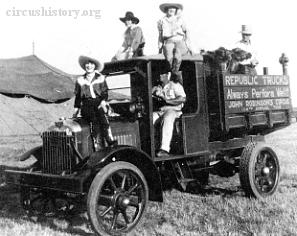
Photo: John Robinson Circus used this Republic in 1927. There was obviously some commercial tie-in with its use. Circus World Museum photo.
Circus World Museum records establish that in 1929 the American Circus Corporation used 6 Mack trucks. Sparks Circus had 2, Al G. Barnes 2, John Robinson 1 and Sells Floto 1. There were no Macks on Hagenbeck-Wallace in 1929.
In 1936 Ringling-Barnum licensed the following vehicles: One Plymouth bus, 5 Chevrolet trucks, 4 Dodge trucks, 3 International Trucks, 2 Pierce tractors and 10 Macks. The Chevy and Dodge trucks were the lighter vehicles used on the advance. This list covers vehicles that bore the Ringling-Barnum title. It does not include anything used by Barnes, nor any Hagenbeck equipment stored at Peru (Hagenbeck did not tour in 1936.)
The term "One horse show" has long been used derisively when one meant to belittle a circus. Perhaps it is significant, however, that in very recent years the highly regarded and universally recognized largest canvas circus in America was, in fact, a "No horse show." On this thought-provoking comment, we will close these scattered remarks on mechanization.
No part of this publication may be reproduced in any form or means
Last modified February 2006.
without written permission of the author and the Circus Historical Society, Inc.