


Circus Historical Society
Bandwagon, July - August 1967
Back to Bandwagon Index
Bandwagon, Vol. 11, No. 4 (Jul-Aug), 1967. Note: Only some articles are included in this online edition. Many illustrations are not included. The Circus Historical Society does not guarantee the accuracy of information contained in the information in these online articles. Information should always be checked with additional sources.
After the wreck the show remained at Tyrone eight days while repairs were being made at Altoona and such work as could be done at Tyrone, while horses were bought in Philadelphia, as only four out of the wreck were able to work and the citizens of Tyrone helped to load the wagons on the flat cars.
Had Mr. Main followed the bent of his own inclinations and judgment he would not have tried to reorganize and continue the season, as the disaster was so complete the case looked hopeless, but all of the performers and other employees were so earnest in their pleadings to go on and not leave them stranded so early in the season, he was persuaded to proceed and make repairs and additions as he went along under all sorts of handicaps and closed the season at Conneaut, Ohio, October 14th, but no performance was given on that day because of high water and the show was shipped back to winter quarters. By this time the show had a new brick building, formerly occupied as a foundry, but better adapted and larger than the old skating rink which the show had outgrown.
During the winter the show was practically rebuilt and it opened the season of 1894 at Geneva, April 21st, and closed at Greeneville, Alabama, December 5th. This was the first southern trip for the show and was highly successful, but the show decided to winter at Louisville, Kentucky instead of returning to Geneva, and went into quarters with eighteen cars with the show and two in advance, making a total of twenty cars. After mature deliberation it was determined to make the show for the season of 1895 one of the best, if not the biggest, on the road, and to that end a liberal loan was negotiated with and through W. E. Franklin, who was appointed general agent with his own selection of the advance staff and permission to route the show, with such assistants as J. P. Fagan, railway contractor; W. C. Boyd, excursion agent; Clay Lambert, contracting agent; M. B. Raymond, contracting press agent and manager of advertising car number one; and C. A. Clark, manager of car number two with Frank Purcell, a brother-in-law of Franklin's. (Note: Yes, W. E. Franklin was the man mixed up with Robinson and Franklin. He was later involved with the Rice Brothers Circus and the Wortham Carnival.)
The season of 1895 opened at Louisville, Kentucky, April 15th, and when the show was delivered on the lot it disclosed the fact that it had been fitted out to perfection with no expenses spared in every detail of the equipment. The wagons, cages, tableaus, harness, flags, banners, plumes - everything to the last stake and pole on the lot was brand new or better after having passed through a rigid inspection and made perfect. The tents were also new, having been ordered by Mr. Main, from Chicago, and when erected it fitted like a glove on a lady's finger and looked like an ocean of white tops as the billowy sheets danced in the breeze. Thus the tenth annual season of the show opened with a parade which was really a street spectacle on review and was admired by a throng that filled the thoroughfares from curbstones to house tops in the "Gate City" of the sunny South. At the opening the tents were packed to capacity, and the program, which was an extensive one, passed off without a flaw or mishap, so careful had been the rehearsals under the direction of W. Fred Amar, the equestrian manager. Henry Watterson's paper, "The Courier-Journal," devoted over two columns to a review of the show and pronounced it "the gem of the tented world." (Note: At this place in the original manuscript, Cooke intended to reproduce from the 1895 Main route book the complete roster of the show; however, it is not important, and would just be a repetition of information in other parts of this article.)
After the auspicious opening the show continued on the route with such triumphs and success that it was able to meet all obligations and pay off the loan, which it did at Ravenna, Ohio, on Saturday, June the 15th of that year. The show continued on, with varied success and more or less opposition, touring Texas and the South and closing the season at Glasgow, Kentucky, November 16th, and was shipped directly to Geneva for the winter.
The 1897 season opened at Ashtabula, Ohio, April 17th, in a snow storm and continued along the lake towns to Toledo, Ohio, where it was still cold, and thence went into Indiana, Illinois, Missouri, Kansas, Colorado, Utah, Idaho, Oregon, Washington, and Vancouver B. C. for three days by boat. The show returned to the United States and played Portland on July 26th, where it was found necessary to make some material changes in the advance management before starting on the coast trip over the Southern Pacific railway to California, Arizona, New Mexico, Texas, and Kansas, closing the season at Rolla, Missouri, November 6th and was shipped home to Geneva.
Apropos of this extensive trip it may be cited how easy it is to make mistakes on the judgment of others, and to be misled in placing too much confidence in those whose reputation has not stood the test of time and reliability; and in this connection, while it is not pleasant to relate the facts, Mr. Main, the season before, was induced to secure the services of Mr. Dan Vernon, a man who was reputed to know the Western country from end to end and had often visited that section with the John Robinson show and others and he was dispatched to the coast on a tour of inspection, to look over the country, and to get rates from the railways and report progress as he went along. This he failed to do and the omission was not discovered until the next season when the show reached that territory or approached it from the East.
The first error was encountered in Colorado, where it became necessary to transfer to a narrow-gauge railway to make some of the side trips to towns that had almost entirely disappeared since Vernon had visited them in years gone by. No special provisions had been made for a change from their own broad gauge cars while on this side journey. The delays were something hard to encounter and the business was worse than bad. The circus showed a loss of over $1,000 a day while in that section. As investigation proved Vernon had not been up in that territory at all and knew nothing about the conditions as they existed at that time. The result was maddening, and it was then discovered that the wiley agent had made some of the contracts with the Western railroads without notifying his employer the season before and they could not be changed without a great deal of expense. The same conditions prevailed in the far Northwest and up in British Columbia, which he did not visit at all until it was about time for the advance force to reach that point, and some of the towns were almost a total loss. Again while he had reported that he had made a tour of Mexico, (as his expense account showed), he had never been there and railway contracts were impossible. The season, so far, had many ups and downs and business was universally bad while the weather proved unusually, out of season, and the third advertising car was cut off to save expenses. On arrival at Portland, Oregon, a consultation was held and Vernon's services were dispensed with. Clay Lambert was made railway contractor; Ed Knupp, then treasurer, was made general agent which was his first experience in that line; and Charles Bernard who was the bookkeeper, made treasurer. (Note: Bernard later became a circus historian and wrote many articles for the Billboard and Hobbies Magazine.) Walter then went to San Francisco to take charge of the advance which he continued to do for the balance of the season. Strangely enough the business began to pick up at Portland, and ran remarkably good for the balance of the tour, while the San Francisco engagement proved very profitable and satisfactory. As a feature they had the first group of performing wild animals ever in that part of the country with a circus.
At the close of the regular season of 1897, nine cars with their contents were leased to the Stowe Brothers for a Southern trip, but it was a failure and Main had to go to New Orleans and bring back the show at his own expense. It is also worthy of noting that long before the fact had been established that it never paid to split or divide a show for the South or at the end of a season. The first show that ever went South under the Barnum name, met with its Waterloo, at New Orleans, and part of it was shipped home while the balance continued on for a few weeks under the management of P. A. Older, and it came to grief at Sheveport, La. where it was quarantined on account of the yellow fever and never was reorganized. The same was true of several other shows and history repeated itself in this instance, but Rhoda Royal, who was boss hostler at the time, took the "tip" for a nine car show and afterwards put one on the road with great success. It was this season that Lucius Foster acted as boss canvasman, and John Corria, wife and child, and William O'Dale traveled with the show.
In 1898 the show opened in Geneva, April 23rd, and was to close at Burton, Ohio, October 22nd, but because of a severe storm it did not unload and continued on the train to Geneva. The dining car was omitted in 1898, leaving nineteen cars with the show train and two in advance. The territory covered was Pennsylvania, New York, Connecticut, Massachusetts, New Hampshire, Maine, Vermont, Maryland, West Virginia, and Canada. The season was a grand success and a baby elephant arrived by purchase with its foster mother who took kindly to the little fellow and nursed it with a jealous care, and he was christened Admiral Dewey. With a big new canvas, new people, and William Sells, son of one of the famous Sells Brothers, who was in his boyhood days one of the most graceful riders of his time, and known as the Chesterfield of the arena, was general agent. I. V. Strebig was traffic manager; while in the arena were the Wallett family, the Werts family, Tony Lowanda, the Eddy family and the Livingston family, which made a strong array in the dressing room and in the rings. The Spanish-American War was on and the show opened the same day that war was declared. On the closing day all of the animals and horses were sold to the Orrin Brothers of Mexico City, Mexico, and were shipped to that point.
The season of 1899 was a rather eventful season that opened at Geneva, April 29th and made another Pacific coast trip which proved exceedingly profitable, as the previous journey to that country served to establish a good reputation and being well routed and advertised made a tremendous hit everywhere. The feature was the great sixty-three horse act in a concentric ring, trained and performed by R. H. Dockrill, the well known equestrian director, who also had charge of the performance. There were twenty-two cars with the show and two in advance. Upon arrival in San Francisco some extra people were engaged. The tents were erected at 12th and Market Streets, and extra lights were put in and the tents were profusely decorated with flags, banners, flowers, plants and palms, making them look like a tropical garden on a festive holiday.
It may be mentioned that the baby elephant was injured while being taught some performing tricks at the winter quarters and died from the effects, but the season and tour was still a great success, and the profits crowded close on to $75,000.
In January 1900 Main determined to retire from show business, or at least take a long vacation and much needed rest, and the show was advertised and sold at auction. With the exception of eight cars and their contents which were leased to Rhoda Royal for a show owned by himself, Joe Berris and I. V. Strebig, the show was sold at auction, and Walter took his long-promised trip to Europe where he spent most of the summer. While in Europe he visited the Barnum and Bailey Greatest Show on Earth.
On returning home from his splendid vacation, Walter found $40,000 in the bank at Geneva which had been deposited by Rhoda Royal and his partners as a rental for the show that he had not seen but once or twice all season long. The management concluded that they could cut down the equipment and reduce the show to four cars, and play some of the smaller towns and remain South all winter; but again, this experiment was a failure and they went broke on the proposition.
Feeling greatly rejuvenated and fresh from his foreign trip, Walter resolved to re-organize and re-fit the show and start out in the spring of 1901 with an entirely new, up-to-date, circus, copied somewhat after the style of the best shows in Europe, and what everybody argued "was just what they wanted in this country." But again, the public would not "stand for it," and to use a vulgar, but common phrase, and wanted to see the big tents with a display of animals, the side shows, and all that to convince them that it was really the Walter L. Main show and this is exactly what happened to the old Adam Forepaugh show after his death when they tried to make it a big, one ring circus and menagerie, with a splendid performance, which was well worth the money, but most of the people seldom reach the lot and when they did they would throw up their hands and exclaim: "What! That ain't the Forepaugh Show; he had more tents than that." (Note: Cooke has over-played the one ring Forepaugh show that was only out in 1894, the last year of the show, on only twenty-one cars; certainly it was not a "big" show as he infers.)
Soon after starting, with sixteen cars and one advertising car, it was discovered that the outfit would not do and ten cages of animals, a drove of camels, and six more cars were added.
During the summer an entirely new winter quarters was built one mile west of Geneva on a new farm adjoining the L. S. & M. S. and the Nickel Plate railroads with switch connections right on the grounds. The show opened in Geneva, May 4th, 1901, and its route lay through New England and on Long Island for eleven days, which proved five days too much, and thence back to Vermont, New Hampshire, New Jersey, and South to Baltimore, Washington and other southern cities. The season closed at Tennile, Georgia, December 7th and was shipped home. The new people that year were the Judge Brothers, the Bylvia family, Wm. J. Doris, and Ed. Kennedy. W. W. Powers was treasurer, and afterwards was owner of the famous Power's Elephants that for the last years have been one of the principal features at the great New York Hippodrome.
The season of 1902 opened at Geneva, April 19th, and closed at Roxboro, North Carolina, November 11th. The show was on twenty-five cars with two in advance. It had three rings, a stage and the great hippodrome track. This was the first time the show ever played Boston, and they made a tremendous hit in establishing itself as a big show for the New England country, where the Barnum and Bailey and the Adam Forepaugh shows had always held sway. After Boston all of the eastern territory was played to a greatly increased business over former seasons and on the whole the tour was highly successful. The new people that year were Warren A. Patrick, treasurer; Wen W. Dowd, secretary; Mdlle. Louise Tounier, the Boise Family, Olga Reed - a granddaughter of old Dan Rice, William Devan, Lizzie Rooney, Blanch Hilliard, Essie Fay, William Melrose, and the Martel Family. They made up an exceptionally strong programme and presented it in such a manner as to command the attention of the public everywhere.
In 1903 the show was increased to twenty-nine cars with three advertising cars. The tour opened at Springfield, Ohio, April 18th, and closed at Tazwell, Virginia, October 31st. The circus played Ohio, Pennsylvania, New York, New Hampshire, Maine, Massachusetts, Vermont, New Jersey, Maryland, Washington, D. C., and Canada. The layout was the finest the show had ever used and consisted of a 150 foot big top with four thirty-foot middle pieces and all other tents in that proportion. There were twenty-five cages, five elephants, eight camels, 200 horses and ponies, all loaded on this one train which demonstrated that it is not always the cars than count when you come to give a good show. The feature that season was a spectacular production of "Savage South Africa" staged by Bolossy Kiralfy and presented with a number of real warriors from the Congo. At Oxford, Pennsylvania, lightning struck one of the stable tents and eighteen big, fat, fine draft horses were killed. But on the whole the season was pleasant and profitable, with good weather, and practically no opposition.
The season of 1904 opened at Geneva, April 23rd, and closed at Charleston, West Virginia, October 18th. The show played the longest, crookedest route on record for the show; the tour went through Pennsylvania, Ohio, New York State, Vermont, Michigan, Wisconsin, Minnesota, North Dakota, Montana, Idaho, Wyoming, Nebraska, Iowa, Indiana, West Virginia, and Virginia. The pictorial printing alone that year amounted to exactly $26,689.98, which shows that some advertising must have been as a great deal of opposition was encountered and it is noted that there was some misplaced confidence on the part of the agents, especially in Idaho where they met the old McMahon and Norris and Rowe shows which had left a bad reputation behind them on account of faking and other crooked work. Hugh Harrison was the manager up to Labor Day that year, but Mr. Main took charge after that for the balance of the season. Among the new people were: the Nelson family, Victor Hugo, Marino Lowande, Jr., and wife, and others which are not on the records at hand.
During the winter of 1904-1905 everything was fully repaired and placed in good order and the show was sold to William P. Hall with the exception of eighty head of horses which were leased to the new Carl Hagenback show; and while Main's name was not used, he furnished many of the ideas for that concern and assisted in putting it on the road as a traveling organization. The elephants went to the parks and in vaudeville under Power's management and training until 1910 when they were sold to Powers and became one of the principal features at the great Hippodrome, where they are performing at this writing. (Note: "This writing" was in 1922.) Mr. Main remained at home that summer enjoying himself. After seeing his property well placed and earning good money without any effort on his part until some trouble with Hall arose through business complications which were afterwards adjusted amicably. (Note: The history of the trouble between Hall and Main is covered in the November-December 1966, Bandwagon,) It is a notable fact that whenever Walter Main handled his show in his own way, under his own management everything went as merry as a marriage bell, but when he turned it over to others or left it to run itself on the automatic plan, it was disastrous, as the next transaction will show.
In 1906 a company was formed with Fred Cummins and Sig. Sautelle to be known as "Cummins' Wild West Exhibition Co." with Walter L. Main as one of the principals, although his name was not to appear or be used for advertising purposes as he proposed to use it for circus work only. At the beginning it was agreed that it would take from $75,000 to $100,000 to put this outfit on the road in good shape, and while it was understood that Cummins, himself, had no capital, Sig. Sautelle, (whose real name is George C. Satterly) declared that he was amply able to take any part of fifty percent of the stock, to furnish the required cash to put the show on the road and they went ahead on this basis. Cummins brought on about $2,600.00 worth of wild west material, and Sautelle shipped on some cars, cages and wagons which went immediately into the shops for repairs and were put in good order at once; but all the capital he could or did furnish amounted to $800.00. The Sautelle material was all rushed through and loaded on the cars ready to run out. In the meantime things began to look suspicious, and the Erie Lithograph Company made an attachment against the Sautelle property, on an old account, and for safety took up the switch so the cars could not be moved and finally Main had to pay Sautelle $18,000 for all of his property then in Geneva to get rid of him and end the trouble. (Note: Sautelle was in trouble with the Erie people for the failure of the Sig. Sautelle and Welch Bros. Circus in 1905. Most of the equipment on the Cummins show in 1906 came from the Sautelle and Welch show the year before.) Up to this time Cummins, who was noted for his irregularities, behaved nobly, but he then got good and drunk, to put it plainly, and never did recover from his spree and left Main to hold the bag and get the show out as best he could. In the original deal, Main was not to travel, but with Sig. decamped and Cummins on the blink, Walter had to assume all obligations and he put W. W. Powers in as manager of the outfit which consisted of twenty-seven cars, wild west and menagerie, with no circus. Much against the advice of friends and his attorneys, which resulted in a loss of over $1,000 per day until the season was two-thirds over, when Main took charge, adding circus features in the wild west arena, adding his own name to the title, and the show made money every day thereafter to the close of the season with all people paid at the last stand, Andover, Ohio, October 1st. But many bills had accumulated during the season, amounting to over $63,000. After the outfit arrived at Geneva and the horses sent to the farms, D. C. Hawn, superintendent in charge, was instructed by Mr. Main not to unload or put anything in the buildings until the next day when proper arrangements would be made for insurance and everything put in its right place; but contrary to those orders the material was unloaded and placed in the winter quarters in the afternoon and that night a fire broke out which swept everything before it, including the buildings, with a total loss of over $50,000 and nothing left but the ashes. The only thing that escaped was the Powers elephants, which were easily led from the holocaust. (Note: There was a tableau wagon that appeared on the Cummins show and later turned up on the Martin Downs' Cole Bros. Circus, which would make Cooke's statement about the fire open to debate. There is a chance that the picture of this tableau wagon on the Cummins show was mislabeled and could have been another show.)
Cummins then demanded that Main should purchase all of the company stock or he would throw it into the hands of a receiver, which he did, and all of the cost of the proceedings were thrown upon Main as he was the only party who had any means or within the jurisdiction of the court. The trial proved to be something of a farce and a hold-up as L. A. Gilmore, Cummins' attorney from Chicago, was found to be an ex-convict and disbarred from the profession, and for this reason was not allowed to participate in the attorneys' fees which were allowed by the court, and thus Cummins beat himself with nothing left but a tarnished name and a bankrupt pocket. School was out and no pitch hot, and Main was out over $125,000 before all debts and costs were finally settled. He then determined to sell out and retire from the circus business permanently or lease his name and show property to some good, responsible party who would keep up its established reputation, or rent the property without the use of the name. He accordingly leased twelve car loads of material to the Fashion Plate Circus, a stock company which opened the season at Geneva, May 4th, and closed at Medina, N. Y. in September 1907. (Note: W. E. Ferguson and D. C. Hawn were in charge of this outfit. Main traveled with the show part of the season.)
The year of 1908 was rather uneventful although Walter loaned some money to the Cooke and Robinson Dog and Pony Show, and he was glad to get it back without interest or any expense.
In 1909 he leased a nine car, one ring outfit to Howard Damon, of which Mike Welch was the general agent, but the show was never properly organized and it started out short of horses and short of funds; and it closed the tour on July 6th, and returned the show to winter quarters at Geneva. (Note: Surprisingly enough, Damon's show was titled the Howard Damon Circus.)
In 1910 a lot of the property was leased to the Dan R. Robinson Show Company, which they purchased later or just previous to going into winter quarters at Nashville, Tenn. Robinson then had two partners, L. L. Dougherty and brother, of Wabash, Indiana.
In 1911 three cars of equipment were leased to L. G. Gillett, Joe Berris and D. C. Hawn, opening in Hubbard, Ohio, April 22nd, and closed the regular season at Green Cove Springs, Florida, January 20th, 1912, and shipped the material back to Geneva. They continued on with a two car show which was a failure and Main had to go to Guthburt, Georgia, to get the balance of the property at his own expense, again demonstrating what I have already said in regard to cutting down a show and trying to prolong the season. (Note: Although one report places the size of the Cole and Rice Circus at eight cars; it is fairly certain that that was the title of the Hawn show in 1911.)
In 1912 he rented a small wagon show to Joe Berris and George Handle of Newark, Ohio. Handle was the ticket seller and furnished the horses as well as the bank roll, but the horses were not properly cared for and the show lost money at the start, opening in Austinburg, Ohio, June 12th, and closed at Bowling Green, Va., October 14th, with some profit at the end of the season. (Note: This show may have been titled Rentz Bros.)
In 1913 Main fitted up a neat little two-car circus, which he leased to W. D. Schneider, Mrs. Main's brother who with his sister Elizabeth, assisted him for two years, opening the season at Geneva, April 26th, and closed at Bossett, Va., November 29th with an average business of $100.00 a day profit. Mr. Main routed the show and prospected the country thoroughly, and at the close of the season returned to Geneva as usual. (Note: This show was titled Rentz Bros.)
The same show in 1914 but under different management lost money, but there were a number of unusual conditions that contributed to this; some of them very peculiar. As it ever will be remembered the World War broke out (remember this article was written in 1922) with the raid on Belgium and France, and while this outbreak did not take place until August 1st, there was a general depression throughout the country and a very ill feeling against anything German, and it so happened that the year before the small show was re-christened "The Rentz Great German Circus:" this being a very popular name and circus in Europe and it was thought that it would appeal to the German element everywhere as well as to avoid the use of the Walter L. Main name with a small show in this country. When war was declared everything German was taboo no matter what it pertained to. (Note: How right Cooke was! The Ringlings printed many a rat-sheet between 1914 and 1918 that played up the fact that the Hagenbeck in the firm of Hagenbeck-Wallace was a German, although Carl Hagenbeck had died in 1913.) The show did not draw and was shipped home to Geneva.
In the spring of 1915 a number of animal acts were rented Frank Kanjackety, an Indian from Salamanky, N. Y., who ran a wild west show starring his daughter and giving a good show at a small expense, traveling by wagon and doing a good business up to July 6th when he took a notion to close and go home and nothing could stop him from taking his own property - and some of Main's - leaving the rest on the lot. Main then rented the property to King and Kelly, two men who had been with the Indian show. They played the Ohio fairs to a nice little profit and at the close of the season returned the outfit to Geneva.
In 1916 the animals were rented to Heuman Brothers, starting from Chicago, but petticoat government closed the show in three weeks and all of the material was shipped back to Geneva, and later leased to the Pollock Brothers Big Shows until December when they closed and shipped to New Philadelphia, Ohio. They finally worked their way back to Geneva.
The next year the same animals were leased to the Pollock show again. Mr. Main was engaged with the company to look after their interests and auditing the book which showed that the season had been highly successful. The Pollock Brothers ran two shows that season and Walter L. Main worked on salary, as a general representative, doing almost everything, and finishing the season making railroad contracts for both shows. The number two show was known as the "Rutherford Shows," both of which did a big business. Harry Pollock was an apt pupil of Main's in his early days, and some interesting tales of his early career could be told had we the space to relate them.
The Pollock Brothers had three shows in 1917 and Main was traffic manager for all of them, but an epidemic of the flu cut the season short and they had to close very early. Because of this they missed some big fair dates.
In 1919 the performing animals were leased to different shows, and in the fall they returned to Geneva. In the meantime Main put in a pleasant season collecting accounts for the Norfolk Tent and Awning Co., who had interests in several concerns, such as carnivals, minstrels, circuses, pony shows, and other outdoor amusement enterprises many of which purchased a great deal of their canvas and other material on time and they often had to be followed up to collect the balance when due.
In 1920 Main was back with the World at Home Shows in an advisory capacity as Harry Pollock had died the year previous which called for someone to take his place as far as possible during the summer, and that winter Walter again took the job of collecting for the Tent Co. which kept him in the South most of the winter, but he managed to get back to Pittsburgh where he met his wife and friends in time for a good Christmas dinner.
The season of 1921 was rather uneventful and Main remained at home nearly all summer, peddling show property and making occasional excursions as an advisor to other shows throughout the country.
When the season of 1922 rolled around it found Walter engaged with the Pollock Brothers big carnival company for a while, but the surroundings did not prove to his liking and he soon retired to private life, and, among other things, he came over to Newark, New Jersey, on a visit to this writer, where many pleasant hours were spent, from day to day, and often long into the nights, discussing old times and making notes for these reminiscences which have been woven into a story of a life well spent and now enjoyed as a gentleman should, in while yet in the full vigor of faculties.
It should also be recorded that during the last few years, from 1918 to the present time (1922) his well known name and title has been leased to Andrew Downie, a showman of distinction who has conducted it on progressive lines, as he was obligated to do under his contract which existed from year to year, at a satisfactory rental which enabled Mr. Main to enjoy a fair share of the profits without any worry as to the details of the show although he took as much pride in keeping up its well founded name, fame and reputation as he ever did, and it would be no surprise to see him again in harness with a bigger and better show than he or anyone else ever ran, as he has developed many ideas and is prepared to astound the world.
Main's Activities After 1922
Andrew Downie McPhee continued to operate the Walter L. Main railroad circus through the 1924 season. At the end of that tour the Main equipment was sold to the Miller Bros, and became the new Miller Bros. 101 Ranch Wild West in 1925.
In 1925 Floyd and Howard King moved into the "flat car" circus class with a ten-car show. The King Brothers arranged for the use of the Main title for their show and continued using the title through the 1928 season.
The Main title was inactive during the 1929 season, but in 1930 William "Honest Bill" Newton used the title on a truck circus. This was interesting because it was one of the few times in circus history that a circus title had been used on a wagon show, a rail show and a truck show.
James Heron operated a truck show in 1931, and called it Walter L. Main. The famous Hanneford Family was featured with the Heron show that year. At the beginning of the 1932 season the Heron show was titled Walter L. Main featuring Bill Cody. Later in the season the show used the Bill Cody Ranch Wild West title, and still later in 1932 it was called Bostock's Wild Animal Circus and Cody Wild West.
Main was anxious to make a deal with any circus operator and in 1933 he arranged for the use of his title on a truck show operated by Tom Gorman. During part of the 1933 season Gorman also used the World Bros, title.
No record can be found of the Main title being used in 1934, but in 1935 Bill Newton came back into the picture, using the Main name on a show that Newton had called the Honest Bill Circus. Walter L. Main served as general agent for Newton that season as he did in 1936 and 1937. The 1937 Main show is best known today for the fine old style lithographs used from the Riverside Litho Co.
The final use of the famous old title on a traveling tented circus was in 1939. Frank A. Ruttmann opened a show in Canton, Ohio, on May 20, 1939 using the Main name. This show was framed using equipment owned by Bill Myers. Ruttmann's show lasted two weeks. Myers reopened the show later in the season and at once became tangled with Main about unauthorized use of his title. Myers claimed he was only using some paper left over from the Ruttmann show, but this show lasted only a few stands in any case.
(Bill Myers operated the Barr Bros. Circus in 1941 and the Bandwagon Editor was on the advance of this show during its tour of Ohio.)
The last known use of the title was in the 1940's on a fair grandstand circus unit booked by the Boyle Woolfolk theatrical agency in Chicago.
Walter L. Main attended the 1947 convention of the Circus Historical Society, held in Jamestown, New York. He was an honorary member of the CHS.
One of Main's last appearances was at the raising of the Walter L. Main Tent No. 58 of the Circus Fans Association, in Uhrichsville, Ohio, on March 12, 1950.
The famous old showman died at his home in Geneva, Ohio, on November 29, 1950, at age 88.
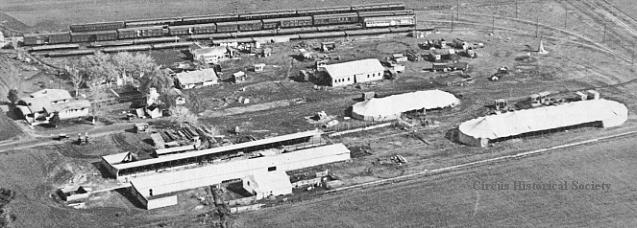
During the winter of 1919-20 Al G. Barnes purchased 300 acres of ranch land west of Culver City, Calif, in three separate locations. A portion of a tract consisting of about 100 acres was selected as a site for a new winter quarters for the Barnes circus.
The area for the quarters had the following dimensions and boundaries. It was 768 ft. along Washington Boulevard, 860 ft. along Purdue, 470 ft. along the Pacific Electric Railway track (a parallel street was later established called Culver Boulevard), and 950 ft. along Washington Boulevard to Culver Boulevard on the west side of the lot. This was close to what we now call Sawtelle Boulevard but was then known as McLaughlin Road. All of this area at that time consisted of ranches and most of the roads were those leading up to ranch houses. Washington was one of the few through roads and even it was only 25 ft. wide.
Mr. Barnes got a contractor to build the new quarters and construction was begun at once. The first contractor left the job and another was secured to finish it. Everything was not built at once but over a period of three years.
During the winter of 1919-20 while construction of the new quarters was underway the Al G. Barnes Circus was in quarters in Phoenix, Arizona. Ordinarily Barnes had wintered his show in California, having used sites in San Francisco and Venice in the past.
When the show came into the Culver City quarters for the first time following the 1920 season there were 5 existing ranch buildings on the property and the contractor had built some of the cat cages, ring stock stables and other structures. The ranch house was used by Barnes and his family and is still standing, currently being owned by the West Culver City Baptist Church and used as their Sunday School. The only difference between now and the time Mr. Barnes owned it is the direction in which the house faced. Originally it faced north but now has been turned so that it faces east. It stands at the corner of Corinth and Nutmeg Streets.
By the time the show came to the quarters in the fall of 1920 four team tracks had been constructed along the Sawtelle side running off the Pacific Electric's Del Rey line in rear of the quarters. The sidings provided ample storage space for the 30 car train.
This quarters used three different names - Culver City, Barnes City, and Palms. It was about as close to the post office in Palms as it was to Culver City. In 1926 Barnes decided to incorporate the quarters and call it Barnes City. An election was held on the show and every one of the personnel voted with Mr. Barnes' brother, Capt. Stonehouse, to be elected mayor. Los Angeles County authorities later checked the quarters for people and all they found were a couple of workmen and a few animals so "Barnes City" was declared unincorporated again.
The show again returned to the Culver City quarters following the 1921 season, however, the next winter, 1922-23, the show did not return to California but instead wintered at Dallas, Texas. Some have said the reason Barnes did not return Culver City that winter was because of his marital difficulties and was fearful of legal action his wife might take. However, Barnes told the Billboard he was wintering in Texas rather than returning to California because of the widespread railroad strikes at the time and was afraid the show might get stranded somewhere in route. (This was a real possibility).
Following the 1923 season the show did return to Culver City for the winter and by then the quarters had been fully completed. The large wagon shop with canvas loft had been completed in 1921 as had the rest of the cat cages and ring stock stables. In 1922 the large panel facade which fronted the quarters and Tusko's pen were built.
When the public visited the completed quarters the first thing they saw was the seal den, then pens of lead stock. Wild animals were housed in cages in the panel front. At the Barnes Culver City quarters there were more animals that the public could see free than most circuses carried in their menageries.
Baggage stock was always kept about two miles west of the quarters on some pasture property that Barnes had purchased at the same time he bought the quarters site.
During the mid 1920's the Barnes quarters was a popular place during the winter and great numbers of visitors would come all during the week. The Feb. 23, 1924 Billboard commenting on the activities at the Barnes quarters said as follows:
"The Al G. Barnes winter quarters at Palms continue to draw large crowds every afternoon and especially on Sunday. Manager Charles Cook has had some stages erected where several attractions are placed. The Barnes Midget City is a sensation and eleven of the perfect little doll people entertain the folks with song and dances. Mr. Barnes attracted a great deal of publicity by driving two elks hitched to a cart down to Venice."
The show continued to winter at Culver City during the winters of 1924-25; 1925-26; and 1926-27.
The winter of 1926-27 was the last for the show at Culver City as Barnes who liked to dabble in real estate as a sideline to his circus activities sold the quarters site to a developer shortly after the show left for the 1927 tour. Following the season the show went into new quarters at Baldwin Park, Calif.
Today, nothing remains of the old Culver City quarters with exception of the Barnes residence as mentioned before. Presently located in front of the Barnes home on Washington Boulevard is the California Motor Vehicle Dept. and the entire area in front of the old quarters is now business.
Many thanks are due to the following who helped me with this article - Walt Mathie, George Perkins, Bob Mathew, Paul Eagles, and many others who were on the Barnes show.
The search for detail in a circus history project is frustrating at best, as all whose avocations lead in that direction will agree. It seems that the best way to find the correct information is to publish the uncertain or erroneous. This was the case with the story of the hippos that traveled with Ringling Bros. Barnum & Bailey between 1938 and 1965.
In the Christmas 1965 issue your writer attempted to present the story of the river horses that traveled with the big show during those days. The paper had no sooner been published than errors began to appear and uncertain points started clearing up. In the interests of historical accuracy the writer would like to up-date his "biographical sketch" of the hippos in light of new information.
Before beginning the writer would like to express special thanks to Dr. William Y. Higgins, C. R. Montgomery, Doug Lyon, John Sabo, and Albert House.
Dr. Higgins was a veterinarian with the big show between 1952 and 1956 and in 1960-1961. He is currently a member of the staff of the Grant Park Zoo, Atlanta, Georgia. In addition to providing valuable information from his own recollections, Dr. Higgins introduced the writer to Mr. Montgomery who was superintendent of the Ringling-Barnum menagerie in the 1950s. Mr. Montgomery now lives in Sarasota, Florida, and provided the writer with a wonderfully informative interview in August, 1966. Fellow historian Doug Lyon of Burbank, California, generously assisted by interviewing John Sabo, long time Ringling-Barnum menagerie man and superintendent in the 1940s. Mr. Sabo now lives in North Hollywood, Calif.
The new information has not revealed any individual hippos that were not described in the previous article, but does show much more data about the four 1938-1965 Nile hippos and the lone pigmy hippo, to-wit:
August (No. l). Henry Ringling North told the writer that this big male hippo was purchased by his uncles in 1902. He appears to have traveled with Barnum & Bailey, Ringling, and perhaps the 1910-1911 revived Forepaugh-Sells show. John Sabo remembers that "August" was at Bridgeport with the Barnum & Bailey show and that he had come from Forepaugh-Sells (probably the 1910-11 editions). As stated previously, the late W. H. Woodcock remembered "August" as a Ringling attraction in the days before the 1919 merger of the big shows.
"August's" career with Ringling Bros. Barnum & Bailey, Frank Buck, and Clyde Beatty between 1938 and 1940 is reported in the earlier paper. Readers will recall that the writer speculated that "August" died shortly after returning to Sarasota from Clyde Beatty's Fort Lauderdale zoo in 1940. While it is not certain that he made any more under canvas tours, "August" lived at least until 1950.
C. R. Montgomery says that during the winters of the late 1940s all three big hippos, "August", "Lotus", and "Chester" shared the facilities in the big animal building. The animals could be separated by alternating them between the indoor cage and outdoor pools, i.e., one of them could be kept inside while two enjoyed the pool.
When the show came off the road at the conclusion of the 1949 season, it immediately made preparations for its first winter engagement at Havana, Cuba. C. R. Montgomery said that "Chester", who had made the 1949 season, was unloaded from the big cage wagon when the show got back to quarters and "August" was put in for the trip to Cuba. Keeper Blackie Barlow was assigned to care for the old hippo in Havana. At the conclusion of the island engagement in January 1950, "August" was sold to a Cuban circus, and the cage wagon, which must have been No. 85, was returned to Sarasota. C. R. Montgomery recalls that "August" did not live long with the Cubans. Assuming that the old hippo died in the Caribbean later in 1950 and that he first "joined out" in 1902, we see that he lived at least 48 years as a circus animal. This is one of the best hippo longevity records in the world.
Chester. This hippo was previously reported as a male. This is wrong; "Chester" was a female. The name referred to Chester, Pa., her place of birth and was not intended to suggest the masculine gender.
"Chester's" career from birth on the Hagenbeck Wallace show in 1935 until she was loaned to Cole Bros, in 1940, appears to be correctly reported in the previous article. Cole Bros, bought its own hippo from the Cincinnati zoo in 1943, a youngster that had been born there. Hence, "Chester" was returned to Sarasota during the winter of 1943-44. With an easing of war time transportation restrictions, the Ringling-Barnum show decided to carry its menagerie in 1944, after a one year lay-off for the big traveling zoo. To spruce things up, the show's master mechanic, Bill Yeske, built a new big hippo cage for "Chester" (Billboard, Mar. 11, 1944, pp. 42 and 57). This was cage wagon No. 85.
With her return to the big show, "Chester" appears to have become a regular trouper. C. R. Montgomery says that "Chester" was always the Nile hippo carried on the road during his tenure as menagerie superintendent, in the early 1950s.
Mr. Montgomery cleared up the mystery about "Chester's" whereabouts during the 1955 season. It seems that at the conclusion of the 1954 season, the management decided to purchase a male Nile hippo as a mate for "Chester". "Lotus" had died at winter quarters during the summer of 1954 and "August" had passed away even before that, so there was plenty of room in the hippo cages at winter quarters. In any event, an adult male hippo was purchased abroad and was to be delivered in New York during the show's 1955 stand at the Garden. Also being sent on the same ship was a pair of African black rhinos. The plan was to take the hippo and rhino cages empty to New York and finish the season with the new animals. Hence, "Chester" stayed at Sarasota when the show went north in 1955.
The ship bringing the new animals was met by Mr. Montgomery, Dr. William Y. Higgins, and Mr. McCormick Porter Steele, the latter being the agent commissioned by the Norths to obtain the new animals. Both Mr. Montgomery and Dr. Higgins vividly recall this event. All three went aboard to see the animals. The hippo was in a deplorable condition. It was an old, scarred, and emaciated example, obviously on the verge of death. Fearing that the insurance covering the hippo's ocean voyage would be jeopardized if he accepted delivery of the hippo only to have it die within a few hours or minutes, Mr. Montgomery decided to wait as long as possible before unloading the animal; and, sure enough, it died in short order. Dr. Higgins recalls they finally located a rendering plant in the northern part of the city that took the hippo carcass.
The rhinos successfully joined the show, but the tour had to begin without a Nile hippo. This is why fans visiting the show during the early part of the 1955 season and being told that the hippo had died, may have thought "Chester" was the unfortunate river horse.
Mr. Montgomery believes "Chester" went out again for the ill fated 1956 season. She remained with the Ringling-Barnum show during the tragic years (for menagerie fans) when the wild animals were sold, except for a mere handful farmed out in the New York City area and used only for the spring engagement in the Garden. "Chester" was one of these. Her last appearance was at the Garden in the spring of 1960. Dr. Higgins supervised the menagerie at the Garden that year, and at the conclusion of the stand "Chester" and other animals were shipped to an animal farm in Virginia. She died there in 1960 or early 1961, thus ending some 26 years as a circus animal.
Lotus. It now appears that this old girl not only holds the record for long life as a circus hippo but also holds the world longevity record for a female of her species.
In his excellent book, My Father Owned a Circus, Judge Robert H. Gollmar says "Lotus" was purchased by Gollmar Bros. Circus from the Hagen-beck firm in 1903. Judge Gollmar was born the same year, and he relates that his father used to jokingly say he was much cheaper than "Lotus". She arrived at the Baraboo quarters of the Gollmar show on Sunday, April 26, 1903. For this information, the writer is indebted to the noted circus historian, Sverre O. Braathen of Madison, Wisconsin, who extracted the exact date from the Sauk County Democrat of Thursday, April 30, 1903.
Now the writer knows from personal experience that "Lotus" died in Sarasota during the summer of 1954, meaning that she spent 51 years and about two months as a circus animal. The total life in captivity would probably be about 53 years, assuming the animal was captured in Africa, sent first to Europe, and thence to America, as was usually the case with the animals bought from Hagenbeck.
The last time "Lotus" appeared on the hippodrome track as a regular "walk-around" attraction was on the Ringling show in 1939. Her last tour was in 1944. As previously reported, the big show did not carry a Nile hippo in 1943. However, the next season, the revised menagerie carried "Betty Lou", the pigmy hippo, and two nile hippos, "Chester" and "Lotus" (Billboard, Mar. 11, 1944, pp. 42 and 57). Thus, the ill fated 1944 tour began with no less than three hippos in three separate cage wagons, Nos. 73, 85, and 88. At the special 1944 preview show at Sarasota quarters, just before the show left for New York, these three cages were freshly painted and lined up in the open air menagerie with a hippo in each (see Robert Good photos in previous article).
As far as the writer knows, 1944 was the only time a circus menagerie featured three hippos in three separate cage wagons. Of the Ringling-Barnum hippos only "August", the big male, remained in winter quarters for the 1944 season, a state of retirement he seems to have enjoyed since about 1938.
At Sarasota quarters, in either 1946 or 1947, "Lotus" gave birth to a baby who was sired by "August". Both John Sabo and C. R. Montgomery recalled this blessed event. The show was on the road in New England at the time, and unfortunately, the baby only lived three days. It seems that an attendant left too much water in the pool and the youngster drowned. The event is noteworthy because both "Lotus" and "August" were more than 40 years old at the time.
C. R. Montgomery says he never took "Lotus" on the road during his tenure as menagerie superintendent in the 1950s. "Chester" always made the trip because she was a younger animal and could better withstand the rigors of travel. Hence, the 1952 route book is erroneous when it says "Lotus" was the hippo exhibited on the midway that year as a free attraction.
The old girl's last starring role was in Cecil B. DeMille's movie, "The Greatest Show On Earth". It was "Lotus" who went lumbering alongside the train during the Sarasota loading scene at the beginning of the picture. The scene was filmed in the spring of 1951, and from that date until her death during the summer of 1954, the old girl apparently never left her comfortable cage and pool in the big animal building at Sarasota quarters.
August (No. 2). As noted previously, the adult male hippo originally destined for the big show in 1955 died before being unloaded from the boat in New York. C. R. Montgomery said that an order was placed with a dealer for another male Nile hippo and, in the meantime, the show went forward minus a hippo to fill big cage wagon No. 85.
While the show was out in the mid-west, the new hippo arrived at an eastern port along with a young male African elephant named "Diamond" that the show had also arranged to acquire for the 1955 season. Mr. Montgomery left the show to pick up the animals and rejoined the show with them in Detroit, Mich., July 1-3, 1955.
As stated in the previous article, the new hippo was also named "August" and was installed in cage No. 85 which it shared with the pigmy hippo "Betty Lou" for the remainder of the 1955 season. In the earlier paper, the writer erroneously assumed that "August No. 2" made the 1956 season and died in 1960 or 1961. Mr. Montgomery says "Chester" was the hippo involved with these events. "August No. 2" is very much alive today at the Jackson, Mississippi zoo where he has grown into a fine breeding male. Ringling-Barnum sold him to the zoo in 1958.
Lady. This is the correct name for the hippo previously identified by the names "Lilly" and "Eva". Bob Dietch, who boarded her for Ringling-Barnum at his Kiddie Zoo in Fair Lawn, New Jersey, told me that he had kept only two Ringling-Barnum hippos under the show's plan whereby the Madison Square Garden menagerie was "farmed out" in the New York area. The first of these was "Chester"* who went to Virginia in 1960 where she died. The second was "Lady", born in New York's Central Park Zoo and sold as a youngster to Ringling-Barnum in 1961. This is the new hippo referred to by Bill Elbirn in his articles about the Ringling-Barnum menagerie in Bandwagon, May-June and Sept.-Nov. 1961. *In his conversation with the writer, Mr. Dietch identified the first "farmed out" hippo as "Lotus". However, this cannot be correct since "Lotus" died in 1954. I asked Mr. Dietch if "Chester" was the correct name but he did not recognize it. Obviously, Mr. Dietch was given the wrong name. Mr. Dietch's first hippo just had to be "Chester"
"Lady" is the only Ringling-Barnum hippo that never traveled with the under-canvas show. She was exhibited only at Madison Square Garden and spent the rest of her time under the care of Bob Dietch. During the summer of 1965, Mr. Dietch exhibited her at the Dorney Park Zoorama, Allentown, Pa.
Mr. Dietch says that in September, 1966 he delivered "Lady" to the huge zoo at Busch Gardens, Tampa, Fla. where she is living at present. Her companion at the big Anheuser-Busch attraction is "Eva", a hippo that belongs to Pete Cristiani and who also arrived there in September, 1966. Mr. Dietch says that 1967 was the first season Ringling-Barnum did not exhibit a hippo at Madison Square Garden.
Betty Lou LOU (pigmy hippo). The previous paper contains all the data about the career of this female, the only pigmy hippo ever exhibited by Ringling-Barnum. She is still living in the Overton Park Zoo, Memphis, fenn. to which she was sold by the circus in 1958.
C. R. Montgomery says that during the winter he sometimes removed "Betty Lou" from the moat around monkey island, her usual winter home, and put her in a cage wagon. The concrete floor in the monkey island was rough on her feet, and this problem could be alleviated by occasionally putting her in a cage wagon for exhibition to the Sarasota visitors.
Before closing there should be some comment about hippo cage wagons. In the earlier paper I said that four and perhaps five cages were used between 1938 and 1967 and that two of them, Nos. 73 and 78, may have been one and the same. This is completely erroneous as was pointed out in the "Readers' Comments" section in the May-June 1966 issue (p. 17). Members Gordon Potter, Don Carson, and Bob Sams have provided information which together with that at hand shows that Ringling-Barnum used no less than six different cages for hippos during the period under consideration. These were Nos. 71, 73, 77, 78, 85, and 88.
Numbers 73 and 78 were definitely different cages. No. 78 was originally built as a rhino den in 1924, and a hippo tank was added in 1939. In 1940 it was spotted in the backyard and housed the alligators and props for Tanit Ikao's concert show. In 1941 and 1942 it carried the pigmy hippo after which it seems to have been retired for several years. It was last used as the rhino cage in 1948. No. 73 dates back to the days of the old Ringling Brothers World's Greatest Shows. It had been used for lions or other animals up until 1942, when it was badly burned in the menagerie fire at Cleveland. Sent back to Sarasota, it was repaired and outfitted with a tank to house the pigmy hippo "Betty Lou". It was used for this purpose from 1943 through the 1947 season, after which it was retired. No. 73 may now be seen at the Ringling Circus Museum, Sarasota, Florida.
Don Carson's notes show that No. 71 was the cage housing the pigmy hippo in 1948. That season "Betty Lou" was used in the spec (see accompanying photo) and her cage stayed in the backyard. I do not believe No. 71 was used as a hippo den before 1948; and the next year, 1949, the pigmy hippo was put in No. 77, one of the new cages converted from ex-World War II Army ordnance trailers. Thus, No. 71 was apparently used on the road as a hippo cage only in 1948.
The earlier paper gave the details about big hippo cages Nos. 85 and 88. C. R. Montgomery said loading and unloading the Nile hippos from these wagons was a tough job. This operation had to be accomplished inside the old animal building as the moated bathing pools prevented loading from the outside. The area inside the building, available for storing cage wagons and backing them up to the permanent dens, was so narrow that the big hippo cage wagons could not be maneuvered into the loading position by ordinary backing-up procedures. Instead, the floor had to be soaked in water so that the pneumatic rubber tires would slide. Then two crawler-type tractors would have to push, pull, and slide the big cage wagons into position so that their loading doors would be flush against the gate of the permanent den.
While No. 88 apparently rotted away or was destroyed at Sarasota, No. 85 is still in existence. Bob Dietch told me he still has it in Fair Lawn, New Jersey.
I hope to write a similar paper about the Ringling-Barnum hippos prior to 1938 but this presents more of a challenge. This was before my day, and detailed records of specific menagerie animals are almost non-existent. Very few of the old menagerie men of those days are still around and all too often their personal recollections are dimmed by the passage of many years. Thus, the story must be put together from a clue here and a tiny squib there, a most exhausting job. Therefore, the writer would be most appreciative of any information about pre-1938 hippos that any reader could provide.
Don F. Smith, CHS's founder and first president, has generously loaned from his collection some extremely valuable original correspondence which Jess Adkins gave to him in early 1940.
The first letter, written Jan. 12, 1937 from Adkins to Sam W. Gumpertz, General Manager of Ringling-Barnum, indicates that Adkins was extremely anxious to lease the Hagenbeck-Wallace title. It is assumed that had this effort been successful the title would have been placed on the huge 40 car show which Adkins and Terrell put on the road in 1937. Others were also interested in obtaining use of the Hagenbeck-Wallace title and of course the title and equipment for a 35 car railroad show were leased by Gumpertz to Ed Arlington and J. Frank Hatch, who after a few weeks on the road sold out to Howard Y. Bary. Adkins and Terrell, of course, continued to use the Cole Bros, title in 1937 after their unsuccessful try at the Hagenbeck-Wallace title. Adkins knew the value of the H-W title and what he was able to do with the huge 50 car 1934 show which made more money that season than Ringling-Barnum. No doubt Gumpertz also had that in mind when he turned Adkins down in favor of Hatch and Arlington.
The second bit of correspondence is a telegram and subsequent reply from Adkins to John Ringling North on Jan. 31, 1938 who had by now replaced Gumpertz as head man of Ringling-Barnum. This telegram indicates Adkins' great desire and most generous offer to use the John Robinson Circus title and a few pieces of equipment at Peru. Adkins wanted the Robinson title to go on the No. 2 show being framed to go out in 1938. Again his attempt was unsuccessful as indicated by North's short and scholarly reply.
The letter from John Robinson IV to Adkins is in conjunction with the No. 2 show being framed to go out in 1938 and the part Robinson would possibly play in the new show. It may be recalled the new show did rent the group of John Robinson elephants for a short time in 1938.
Don Smith wrote the following interesting bit of explanation concerning this correspondence.
"The letters are in regard to Cole Bros, efforts to obtain Hagenbeck-Wallace title in 1937 and the John Robinson title in 1938. It would appear that the Robbins Bros, title was arranged for, but only used as a last resort when deals for the larger show did not materialize in time for the 1938 season. Jess Adkins was so certain that he could get the John Robinson title that he held out until the very last minute before announcing the Robbins name and had leased the John Robinson elephants as further proof of the name being "real". His telegram shows that he hoped to obtain the remaining cages of the John Robinson Circus then stored at Peru to further enhance the illusion. The loss of these wagons and cars may also account for the cutting in size of the new show as Adkins had already drained the supply of equipment in former quarters of Christy, Hall, Buchanan, 101 Ranch, etc. and there was not much else to choose from unless built from the ground up.
"In explanation of the letters, the one from John Robinson IV referred to the individuals concerned - Not - the actual name of the new show.
"When I saw the reply from North, I remarked that it seemed an odd answer to the earlier telegram requesting immediate reply, Jess Adkins laughed and said, 'That is only John's educated way of stating that I twisted his arm, and he was surprised at my nerve, but the answer is No'. During my visit at the home of Roland Butler in 1956 I asked his opinion of the above correspondence. He said that Jess had it figured exactly right and that the deal would have been a good one for all concerned especially. with Adkins in charge, but Ringling was afraid of the added opposition. This probably hastened the destruction of all usable equipment at Peru a few years later, although Adkins had passed away in the meantime and there were no more American showmen with the audacity to twist the arm of a Ringling for a few wagons with which to build a show."
Another interesting letter from the Pfening collection is reproduced here and is from Mrs. Frank A. Robbins and her son, Milton A. Robbins to Adkins and Terrell on Feb. 16, 1938 concerning the status of the Robbins Bros, title. When the John Robinson deal fell through then final arrangements were made with Mrs. Robbins and Milton for use of the Robbins Bros, title for the No. 2 show in 1938.
Don F. Smith has also loaned from his collection an important letter written by Baker-Lockwood tent manufacturers to Jess Adkins on April 26, 1938 concerning the shipment of his canvas order for Robbins Bros, in 1938. This letter from the Rochester quarters files clears up the matter of the exact size and specifications of the big top and other canvas Robbins Bros, used on opening day 1938.
The penciled sketch reproduced here was made by Adkins himself and later given by him to Don Smith who has generously loaned it to me tor inclusion in this series of articles. The sketch shows the size and tents and layout for Robbins Bros, in 1938 and is a most valuable document to be studied by circus historians, model builders, and fans in general.
Jess Adkins and Zack Terrell
Amusement Enterprises
Cole Bros. Circus
Rochester, Indiana
12 January 1937
Mr. S. W. Gumpertz, General Manager Ringling Bros.-Barnum & Bailey Circus Sarasota, Florida
Dear Mr. Gumpertz:
The subject on which I am writing you may or may not be of interest to you, and in case it is not, will ask that you just tear this letter up and consider the matter confidential.
I have of course read all the published reports in regard to you leasing to Mr. Sparks, the John Robinson and the Sparks Circus titles, which I consider very good judgment on your part, as it will keep the titles alive & before the public, at same time giving you some revenue thru the use of the titles. Now, what I have in mind is the Hagenbeck-Wallace title. What would you say to leasing us this title, keeping it alive before the public until such time as you might want to use it yourself, as I am sure you are looking well into the future in circus business. I have been told you were considering a lease to private parties for this season, parties who are not in the circus business at present, thereby creating another show in the circus field. If you would consider favorably a lease to us, the title would be used on a reputable show, as large as the title has been accustomed to, a show that is already on the road, leaving the number of circuses in the field the same as now. At the same time if leased to us you and ourselves could get together on route, so the routes at no time conflict & eliminate any opposition whatsoever, and there are in my opinion many things which could be better accomplished by working together. A deal of this kind would also be little encouragement for others who may contemplate entering the circus business. There are so many features in a deal of this kind which would be mutually advantageous that it is not possible to cover them in a letter, so if you are at all interested, I would be very glad to arrange a meeting with you and go further into details.
Thanking you for a reply at your early convenience, with best wishes and personal regard, I remain,
Cordially yours,
- s -
Jess Adkins
(The above is copy of original letter on Adkins and Terrell letterhead, now in the Don F. Smith Collection, 18612 Dale Ave., Detroit, Mich.)
Rochester, Indiana
January 31, 1938
Mr. John Ringling North,
General Manager, Ringling Bros. & Barnum & Bailey Combined Circus
Sarasota, Florida
The limit of time has arrived to order paper for our number two show. Rather than use the title we have arranged for, which is similar to Robinson, I am making you herewith another offer for the John Robinson title together with a few wagons and cars now available at Peru. Stop. We will give you ten thousand dollars a year for a period of five years, five thousand down on signing of contract and five thousand July first, and fifteen percent of the road profits. This should give you at least twenty-five to thirty thousand dollars a season for the use of this title and small amount of property and you know that I would put on such a performance that would build up the title and make it worth more money at the end of the five year period than at present. For this reason would want clause in contract we would have first option on title at end of five year period. You know that we are reliable and experienced showmen. I personally received my first schooling under the Ringling Brothers and I believe you will find my first schooling has been reflected in any circus performance I have put together. So you need have no fear of the organization not being properly handled. Your representative could check these wagons and cars to us. We would move them here to Rochester so would not bother your Peru winterquarters in the least. Further the small amount of property we are asking with this title is not five percent of the amount of physical property you are furnishing to Mr. Bary with the Hagenbeck Wallace Circus. Stop. You have several thousand dollars worth of John Robinson paper on the shelf at Erie, for which your company is responsible and we would of course take this paper off your hands. Stop. All in all I really cannot see any way but what an arrangement of this kind would be mutually beneficial. Will you please give the matter consideration and advise me by wire at your earliest, final decision in the matter. With best wishes and regards.
Jess Adkins
(Above is exact copy of telegram from winterquarters files in Rochester. J. R. North replied by personal letter three weeks later as follows.)
Sarasota, Feb. 21, 1938.
Mr. Jess Adkins,
c/o Cole Bros. Circus, Rochester, Indiana
Dear Jess:
Thank you very much for your thoughtful wire. I am glad to report that I am quite recovered by now, with the exception of a strained arm. With best wishes for a successful season, I am
Very truly yours,
- s -
John Ringling North
(The above telegram and letter are now in the Don F. Smith Collection, 18612 Dale Ave., Detroit, Mich.)
(Below is portion of letter from John Robinson IV to Jess Adkins.)
Feb. 3, 1938
Mr. Jess Adkins
Cole Bros. Circus
Rochester, Indiana
Dear Jess:
Will be passing through Rochester late Sunday afternoon. If you are not busy, would like to chat with you late Sunday. Maybe we can set up the Robbins-Adkins-Robinson new combined circus.
Very truly yours
- s -
John Robinson IV
(Above letter now part of the Don F. Smith Collection.)
(Below is exact copy of a letter in the Fred Pfening Jr. Collection.)
Miami, Fla.
16 Feb. 1938
Messrs. Adkins & Terrell
Rochester, Ind.
Gentlemen.
In regard to the name Robbins Bros. Circus, Robbins Circus or Frank A. Robbins Circus. The name Robbins is the actual title. The modification of that name by adding the word brother or famous does not in any way alter the name of Robbins.
It is the Robbins Circus that the public since the 1880 remember.
In order however to further clinch this title than the right of first and former usage the Robbins Bros. Circus Inc. (Illinois) has registered its name in the bureau for the purpose in Washington, D.C. with the U.S. Government. Also copyrighted through the U.S. patent office different forms of advertising matter.
We therefore are positive that we have the right to the use or to keep others from using this name in connection with a circus, and will do all in our power to keep those who have no right from the use of this name.
Very truly yours,
-s-
Mrs. Frank A. Robbins (Widow of Frank A. Robbins)
-s-
Milton A. Robbins (of the Robbins Bros. Circus Inc.)
Baker-Lockwood
America's Big Tent House
Kansas City, MO.
April 26, 1938
Robbins Bros. Circus
Rochester, Indiana
Attn: Mr. Jess Adkins
My dear Jess:
I am pleased to advise you that we have shipped by Roadway twenty-seven bales of tents, and the shipment consisted of the following:
140 ft. round top with three 50 ft. middle pieces
12 ft. high sidewall for the 140 ft. top
9 seat and masking curtains
2 back door curtains
1 20x40 kitchen tent with 7 ft. high sidewall
1 leanto for the cookhouse wagon
3 ring carpets 30 ft. in diameter
Marquee for dining tent
274 ft. lineal feet of 8" sun border
12 chafing cloths that were on the 140 ft. top.
The first has gone forward and the balance will keep firing right at you repeatedly.
Hoping you are enjoying the best of health, and with best regards, we are.
Yours very truly,
Baker Lockwood Mfg. Co. Inc.
Jimmie Morrisey-Sales Dept.
(Above is exact copy of correspondence confirming shipment of tent canvas to Robbins Bros. Circus as ordered. From the Don Smith Collection.)
Q. Would like information about this show, or shows: Col. F. M. Smith's Stupendous Aggregation and Haviland's Stupendous Aggregation. Harve Poe; Columbus, Ohio. Ralph Hadley of Lowery City, Kansas also asked this question.
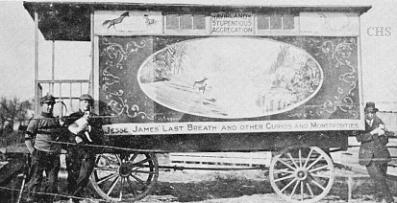
A. An exhaustive search of reference files, Billboards, Clippers, White Tops, Bandwagons, and pictures has turned up very little of either of these shows. The only piece of concrete information located by the Bandwagon staff was this photo of a wagon from the Haviland show; or perhaps this wagon was the Haviland show. This photo was reputedly taken on Fred Buchanan's Yankee Robinson Circus in 1913. It has been ascertained that the man in front of the wagon is the late John Haviland, former CHS member. It appears that the Smith and Haviland outfits were one in the same as Mr. Poe suggested. It also appears to have been a pit and fair attraction rather than a full-fledged circus; neither the Sturtevant or Chindahl works make any mention of them.
Q. Give some information about the Cole Bros, one ring, three car circus of 1922. Wes Herwig; Randolph Center, Vermont.
A. This small circus was owned by Elmer H. Jones, "the king of the two-car circus." If information in the March-April 1958, Bandwagon can be considered accurate, the show was actually one or two cars, rather than three. Jones operated two cars, usually one ring, circuses from 1904 until 1934. He used the Cole Bros, title from 1918 to 1924. The next year the title was changed to Cooper Bros. His brother, J. A. Jones, was also an active circus manager on a larger scale. In 1916 and 1917 J. A. Jones operated the Cole Bros. Circus on 17 and 20 railroad cars.
Q. Before the use of truck tires circuses used wooden wagon wheels with steel rims. Carnivals seemed to prefer metal wheels with solid rubber tires. Why the difference? Robert Raupfer; South Bend, Indiana.
A. Actually, it appears that carnivals used wooden wheels, and converted to rubber tires about the same time circuses did. Unfortunately, there are too few carnival pictures before the mid-1930's to confirm this. Joe Bradbury remembered that the Mighty Sheesley Carnival in 1928 was on rubber tires, indicating that they may have switched a little earlier than circuses. In 1933 the Ringling show began to switch to rubber tires. In earlier days some carnivals used the wooden wheels. The O. J. McCart Fairyland Shows in 1928 had wooden wheels. Perhaps some Bandwagon reader can help resolve this matter better than it is here.
Q. I also noted in the March-April 1967 issue of the Bandwagon that with the closing of the Cole Circus in 1938, Robbins Bros, train was brought up to 21 cars. I thought the railroads charged in multiples of 5 for the number of cars they hauled. If so, why wasn't the train held to 20 cars or enlarged to 25 cars. Robert Raupfer; South Bend, Indiana.
A. Author Joe Bradbury was consulted on this question. His reply:
"... I can't give a positive answer to this. We are basing this assumption entirely on the Billboard accounts, old E. W. Adams notes, etc., that 6 cars were added making a total of 21, but as carefully pointed out in the text there is a drough of photos taken of Robbins after the enlargement and we just have not been able to photographically prove if 6 cars were added or not, however, in several BB references 6 cars are mentioned and old Adams always said it was 6 and he was with it. It is true in later years railroads charged in multiples of 5, however, I am not convinced this was always the case all the time and with all railroads. Certainly in the period 1900 to present there were many 17, 22, 11 and various non 5 multiple trains. In fact I'm rather sure H-W didn't travel in a multiple of 5 as late as 1938, and in 1937 they started on total of 35 cars and later shipped back 2 to quarters (maybe 3) but anyway it wasn't a multiple of 5. Just what the Robbins answer was I don't know. However, I am reasonably certain an arrangement was made whereby they were NOT paying for 25 cars but only carrying 21."
A check of the series of articles titled "Circus Railroad Contracts" by Sverre O. Braathen in the White Tops in 1957 shows that although some shows did travel with a multiple of 5; many did not. Evidently the railroads gave circuses a special rate.
[Note: the final question, regarding a photo, has not been included in this online edition.]
No part of this publication may be reproduced in any form or means
Last modified February 2006.
without written permission of the author and the Circus Historical Society, Inc.