


Circus Historical Society
Bandwagon, September - October 1966
Back to Bandwagon Index
Bandwagon, Vol. 10, No. 5 (Sep-Oct), 1966. Note: Only some articles are included in this online edition. Many illustrations are not included. The Circus Historical Society does not guarantee the accuracy of information contained in the information in these online articles. Information should always be checked with additional sources.
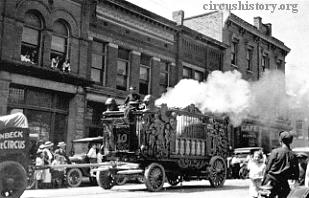 Photo No. 5 - In period 1922-24 covered by the author's three articles the Hagenbeck-Wallace steam calliope wagon was heavily carved with various musicians, cupids, and animals, was No. 10, and was ordinarily pulled in parade by a truck. This photo was taken about 1924. Side panel carvings from this wagon are currently preserved in the Peru, Ind. museum. Joe Bradbury (Melvin) Collection.
When the Hagenbeck-Wallace Circus reached quarters at the end of the 1924 season it had toured from New Jersey to Arizona; traveled 14,558 miles; been exposed to a tornado and given two performances in a snowstorm; encountered quantities of rain; lost part of its train as a result of a fire; and had been supervised by five different managers. In spite of these rather startling events this circus had a successful season and was brought into the Peru quarters (instead of its usual West Baden home) for reorganization for 1925. Apparently the owners of the American Circus Corporation believed that an emphasis on wild animal acts was necessary at this point in their growth for all three of their shows stressed this type of act in the performance. Fans of the Corporation will recall that the John Robinson Circus was heavy with wild animal acts for the 1923 season. Sells-Floto emphasized performing animals in 1924 in contrast to the type of program featured before that time, and the Hagenbeck-Wallace Circus had been strong on wild and domestic animal acts for several years and promised to become stronger with this feature in the seasons to come.
In the late fall of 1924, Jerry Mugivan picked up some fine performing wild animal groups from the Ringling Bros, and Barnum & Bailey Combined Show. This sale was completed at the end of the big show's tour at Greensboro, North Carolina. The plans for the new 1925 Hagenbeck-Wallace program were released by Billboard on Dec. 13, 1924, when the paper stated that, "The steel arena will be left in place during the entire performance and animal acts will be on view for the major part of the time."
The strong leadership of the superintendents on the Hagenbeck-Wallace Circus was illustrated during the 1924 season when the circus changed managers five times. This is, of course, a tribute to the ability of Bert Bowers in the selection and training of personnel. The circus was directed by Bowers for the first weeks of the season but he had scheduled a trip to Europe with Ed Ballard during the summer. The Ballards left on June 21 and Mr. and Mrs. Bowers were to leave about the middle of July. However, Bowers was restrained by his physician. He had been under the doctor's care for several weeks, but did get permission to leave toward the end of the month. Jerry Mugivan took over the reins for a few weeks and then Fred Hutchinson handled the task. Dan Odom, manager of the John Robinson Circus, was shifted to the Hagenbeck-Wallace job on October 10, and Sam Dill, assistant manager of the Robinson Circus, became manager of that outfit. J. H. Adkins joined the Hagenbeck-Wallace Circus in Coleman, Texas, on October 27 and took on the job of assistant manager. He came from the Gentry Bros.-James Patterson Circus, but had worked for Mugivan, Ballard, and Bowers at an earlier date. His last assignment with this group, in 1922, was with the Gollmar Circus. Adkins actually managed the Hagenbeck-Wallace Circus for a time near the end of the 1924 season, but Odom returned a couple of weeks before the end of the tour and took the outfit back to the barn. Plans for 1925 called for Odom to be the manager with Adkins as his assistant.
Edward C. Knupp, general agent of the Hagenbeck-Wallace Circus for the past five years, died in the Chicago offices of the Corporation on September 23, and was replaced by J. C. Donahue, another veteran of the organization. Donahue was manager of advance car No. 1 for the 1924 season and had held this same position for the past three years. He and the advance crew of car No. 1 had one of their biggest thrills and narrowest escapes from injury, or possible death, at Lorain, Ohio, on June 28. This city bore the full brunt of the sudden tornado which hit Attica, then Sandusky and Lorain, and spent its fury across West Dover and Avon. The carnage reminded observers of the Flanders battlefields as they gazed at the uprooted trees, tangled heaps of lumber that had once been homes, impassable roads, toppled church steeples, and (buried in the debris) the injured and dead. The death toll climbed to 94 on July 1 and an estimated five thousand people were homeless.
The Hagenbeck-Wallace advance car was in the Lorain yards when the storm hit. Only a few men were in the car as the billposters had not returned from the county routes, the lithographers were still on the city streets, and a few had stopped in town to eat their supper. The tornado struck with such sudden fury that the bannermen were barely able to climb down from their ladders. Every ladder was smashed and the pieces hurtled down the streets with the rest of the flying lumber from the town.
Donahue was in the car when the storm struck, but he and James Gephart, boss lithographer, decided to fight their way up-town to try to reach the stranded men. After a two-hour struggle, sloshing through water, climbing over crumbled buildings, dodging flying timber, and ducking smashed tree limbs, the pair reached what had been the State Theatre. Two of the bannermen, Chaplin and Brannigan, had been working on the side of this building and had sought refuge in the lobby. When the building collapsed they ducked out with only Chaplin suffering a minor injury. Two additional bannermen, Markham and Bidwell, were located, drenched but uninjured. Reed, the fifth bannerman, was also located, uninjured, in a store.
As the seven men worked their way down Broadway, they were again forced to dodge and twist through the ruined buildings. Injured people were screaming and calling to them, and the bodies of many persons, killed by the fury of the storm, were visible. Donahue and his party returned to the car six hours after they had left it and considered themselves fortunate to be alive. The advertising car did not lose a day despite the confusion brought to the railroad by the storm. Lorain and Sandusky were canceled and Marion and Kenton were substituted for the devastated cities.
The weather had been a negative factor all spring and this same storm which caused such grief at Lorain, gave a great deal of trouble on the lot at Kittanning, Pa., where the Hagenbeck-Wallace Circus was making its Saturday night performance. Some tents were blown down but the menagerie and the big top withstood the blow even though the poles jumped and lurched dangerously. Bob McPherson was working his tiger act as the wind screamed to its highest velocity . . . then the lighting plant flickered and failed. The big top was black. What McPherson did with the nine tigers during the moments of darkness has not been recorded. When the lights came on, the trainer and all of the cats were intact, but the animals were immediately hurried back to their cages.
Much of the information on the equipment of the Hagenbeck-Wallace Circus during these years comes from work done by Mr. Havirland. Unfortunately he did not include a train loading order for the 1924 season although he did compile a wealth of other material which will be of interest to the circus historian. It can be assumed that this 30-car show loaded in approximately the same order as in the previous years. It had been traveling on 14 flats, 7 stock cars, 8 coaches, and one advance. A compilation of the wagons mentioned in other lists indicates that most of the rolling stock used since 1921 continued in use for the 1924 season. A great amount of the Havirland material provided by Jim Mc-Roberts and Fred Pfening will be included in this report for reader interest. These lists provide insight into the great quantities of supplies and equipment needed to operate a circus forty years ago. At the risk of boring some readers with extreme detail the author has decided to include all of the materials furnished by these helpful historians.
Big Top Equipment
5 Long Cable Guys
9 Short Cable Guys
1 Bull Cable Guy
28 Small Quarter Poles
20 Large Quarter Poles
4 Center Poles
4 Mud Blocks
4 Bail Rings
4 Light Falls
3 Main Falls
4 Ridge Ropes
1 Bull Rope
6 Guard Ropes
5 Pole Jacks
78 Blue Stringers
81 Big Jacks
81 No. 2 Jacks
86 No. 3 Jacks
90 No. - Low Jacks
660 Blue Planks
6 Blue Ticket Boxes
2 Red Ticket Boxes
8 Seat Wagons
74 Eight Back Planks
16 Seven Back Planks
56 Short Stringers (Yellow)
7 Connect Stringers (Red)
14 Connect Posts (Red)
10 Long Stringers
56 Short Low Posts
4 Green Nets
55 Red Nets
5 Blue Nets
10 Seat Curtains
14 Red Aisles
14 Number Signs
13 Letter Signs
25 Net Irons
2 Toilet Signs
16 Silver Posts
80 Sidewall Poles
In addition to the above equipment extra supplies for the big top were carried on the train. The following list (furnished by Fred Pfening) was loaded on the train on April 11, 1924.
Stock Car No. 22 carried 70 blue planks; 4 long stringers (timber); 6 short stringers (timber); 3 flag poles; 7 short stringers; 16 side poles; and one stake puller handle.
Flat Car No. 40 held 2 big quarter poles and one menagerie center pole.
Flat Car No. 33 carried one big quarter pole; 2 small quarter poles; and 2 stringers.
Flat Car No. 38 held 4 blue stringers; 1 small quarter pole; wooden stakes; and 150 seat backs in addition to its regular load.
Flat Car No. 37 carried stake bands; 25 toe jacks; 40 head blocks (B.T.); iron and wooden stakes.
Flat Car No. 36 (first on the list are the names "Brady's and O'Day." Brady undoubtedly refers to Chas. Brady, Superintendent of Properties. Bill O'Day was the side show boss canvassman.) The extras on this flat car were one center pole and iron and wooden stakes.
Flat Car No. 39 also carried an extra supply of wood and iron stakes.
Menagerie Tent Equipment
5 Main Falls
5 Short Falls
10 Long Guys
4 Guard Ropes
58 Side Poles
24 Quarter Poles
5 Pole Jacks
5 Mud Blocks
5 Bail Rings
5 Light Falls
2 Marq. Poles
4 Connection Ropes
2 Connection Poles
Additional extra supplies are detailed in a list entitled "Extra Material For Road Black Shop," dated April 10, 1924.
Flat Car No. 37 carried 50 Single Tills; 2 Extra Cage Poles; 6 Large Wagon Double Trees; 2 pr. Balster Plater; 6 Extra Wagon Boxes; 6 Extra Spring Seats.
Flat Car No. 38 contained 50 Lead Bar Double Trees; 25 Extra End Irons Body Poles; 25 Extra End Irons Double Trees; 6 Extra Body Pole Chains; and 1 Extra Large Wagon Pole.
Stock Car No. 21 held 50 Body Poles Timber; 5 Pole Timber 3x8; 5 Ripped-out Poles; and 2 Extra Cage Springs.
Four wagons also carried supplies for the big top. These were Wagon No. 54 with one menagerie bail ring, 6 flag irons, 6 pole pins, and 3 fork irons; Wagon No. 53 with 100 seat backs, 4 jack irons, one stake puller chain, and 2 sprocket wheels; Wagon No. 56 with one extra falls, 2 bail rings, 2 cable guys, and 15 net irons; and Wagon No. 55 with 12 stake puller bolts, 2 stake puller chains, 12 packages brads 5/8, 2 pounds of 3/16 washers, and one package each of 10 x ½ carriage bolts, 12 x 1/2 carriage bolts, and 9 x 1/2 carriage bolts.
Car No. 41 carried a great deal of blacksmith material, including the horseshoes, in a possum belly. Included in these supplies were 2 kegs of No. 5 hinds, 3 kegs of No. 5 fronts, 2 kegs of No. 4 fronts, 2 kegs of No. 4 hinds, 3 kegs of No. 6 hinds, 1 keg of No. 7 hinds, 1 keg of No. 2 hinds, 1 keg of No. 3 hinds, 1 keg of No. 3 fronts, 1 keg of No. 2 fronts, 4 boxes of No. 4 toe calks, 1 box of No. 5 toe calks, I keg of single tree clips, 12 doz. single tree end rings, 1 doz. body pole goose necks, 1 doz. body pole end irons, 18 center irons for lead bars, 72 lead bar center rings, 6 boxes No. 8 shoe nails, 5 boxes No. 6 shoe nails, 3 boxes No. 5 shoe nails, 2 boxes of No. 9 shoe nails, 1 box No. 4 shoe nails, 3 crates of sledge hammer handles, 2 cases Giles medicine, 2 pails of axle grease, 4 picks, and one extra Presto tank.
The last bit of detail on the big top and menagerie tent consists of a review of the side wall canvas of the two tents. This list was compiled on April 12, 1924. The big top side wall consisted of 5 pieces of 13 pole side wall, 5 pieces of 9 pole side wall, and 1 piece of 6 pole side wall. The menagerie side wall was made up of 2 pieces of 14 pole side wall, 2 pieces of 11 pole side wall, 1 piece of 10 pole side wall, 1 piece of 5 pole side wall, and 1 piece of 7 pole side wall.
An inventory of the animals and cages made on April 16, 1924 gives an idea of the size of the menagerie. Of great interest is a second list compiled on November 1, 1924 when the circus was in Stamford, Texas. In April, Cage Nos. 1, 6, and 19 each contained three tigers which composed McPherson's group of nine animals. The tenth tiger, which was featured riding an elephant, was housed in Cage No. 11. Nine lions (three to a cage) were contained in Cage Nos. 16, 17, and 18. Cage No. 5 held four kangaroos and five bears. In 1922 this cage housed five kangaroos only which indicates that the 1924 tour must have been rather uncomfortable for the nine animals, if it was still the same fifteen foot cage.
Cage No. 7 started the season with twenty monkeys. (It held 36 at the beginning of the 1922 tour). Cage No. 8 contained three bears, owned by the Corporation, and five additional bears belonging to John Helliott. (This made eight animals to a 16 ft. 6 in. cage). Cage No. 9 held the Nile hippo and the pygmy hippo, "Jimmy," rode in Cage No. 12. This cage held the four sea lions in 1922. "Jimmy" had an interesting tour in 1924. He left the Hagenbeck-Wallace Show in early September to become the first pygmy hippo to travel on a truck show. This was Honest Bill's epic. At some point between September and November Jimmy was sent back to the Hagenbeck-Wallace Circus. He appears on the November 1, 1924 inventory. He is also advertised for sale in the November 22 issue of Billboard so one would assume that Dan Odom didn't want "Jimmy" around. Billboard (September 13, 1924) and Col. William Woodcock confirm the transfer of the pygmy hippopotamus to the Honest Bill Show.
Cage No. 50 on the April 16, 1924 inventory is designated for the sea lions belonging to Fred Seals. Also listed on the animal inventory, compiled ten days before the show opened the season, are one extra lion, 4 camels, 1 zebra, 12 elephants, 1 grey fox, and 2 red foxes. I doubt that this lion toured that season since there is no cage listed for it. The other animals were probably on the show since they are accounted for in the research.
The November 1, 1924 animal list, which was made in Texas, shows some attrition among the stock and some changes in housing. Cage No. 1 held three tigers, as it had in April. Cage No. 5, which held the four kangaroos and five bears in the spring, contained one tiger in November. Cage No. 6 remained the same as it was in April with three tigers. Cage No. 7 had lost two monkeys and was still used for this species of animal. Cage No. 8, instead of housing the eight bears, contained two black bears in November. Cages No. 9 and 12 still held the two hippos in the fall. Cage No. 11 contained three kangaroos in November. The riding tiger that had been in the cage in the spring is probably the animal in Cage No. 5. Cage Nos. 16, 17, 18 and 19 contained the same number of animals and the same species as in April. Cage No. 50 (sea lions) is not listed on the November inventory. The lead stock is the same and the 2 red foxes are still with it. The grey fox is missing and five monkeys have been added. Three of these are in the pad room and two, a mother and a baby, are in the pit show.
The September 13 issue of Billboard states that "Bert Noyes is disposing of animals in order to provide room for new additions." It is at this time that "Jimmy" went to the Honest Bill Show and the elephant, "Topsy" is supposed to have been sold to the Zoological Gardens at Jackson, Mississippi. However, Havirland's lists state that there were 12 elephants in April and an even dozen in November. So whether "Topsy" left in September or not is open to question. The animals listed in the November 22 "For Sale" advertisement included "Jimmy," camels, leopards, pumas, tigers, male and female lions, Russian brown bears, black bears and polar bears. Several tents and other equipment were also listed. The advertisement stated that the tents were in use on the Hagenbeck-Wallace Circus and could be inspected there. It did not indicate that the animals were with the circus and obviously they were not.
The parade list furnished with the Havirland research material was dated April 10, 1924. It almost duplicated the parade lists of previous years since it included the same equipment and formations. The parade began with two flag bearers (P. Etz and C. West) who were followed by the four buglers (George Enos, C. Barnett, Walter Goodenough, and C. Earl). The third entry was the No. 1 Band Wagon (No. 20, Lion and Snake). Eight ladies dressed in red and white followed the bandwagon. They were Louise LeDoux, Margaret Crandall, I. Conner, Mary Enos, L. Etz, R. Delevan, V. Arcaris, and P. Cobb. They were ahead of the No. 6 tiger den, and Cage No. 5 came next.
Clown, Dick Pinkney, and his mule preceeded Cage No. 16 (lions) and the den (No. 11) holding the riding tiger followed it. Four men and four ladies, dressed in hunting suits, were in the next group. They were J. Potter, one of the Eugene Troupe, one Borella, and E. Trueblood (men) and Louise Grieble, Lottie Shaw, Alma DePuy, and E. Harris. Cage No. 18, the Queen's Den, was next. I. Bennett was the Queen in 1924 with B. West and J. Duggar, the guards. Tiger Den No. 1 followed the Queen's contingent and the air calliope (No. 31) came after it.
No. 17, a lion cage with Miss Carlyle aboard, followed the air calliope and the No. 25 tableau followed with ten Japanese performers riding it. The seal den came next and it was trailed by the snake den, in which rode the reptile enchantress, M. Gilmore. The clown tableau, No. 26, followed the snake den and Kid Kennard, B. Hart, A. Borrella, E. Shipley, L. Plomondon, J. Thomas, A. Flemm, A. Aronson, and R. McDonald rode on top. This display preceded eight ladies dressed in black and yellow. They were J. Goodenough, L. Earl, O. Powell, E. Lawler, D. West, and Mrs. Teramae.
No. 21 Tableau (Elk and Buffalo), the monkey cage, and the Carl Hagenbeck Lion Tableau (No. 14) with girls aboard were next in line. Tableau No. 22 with its elaborate side paintings came next and carried the second band. Behind it rode a dozen men - Three Eugene men, A Potter, Two Powell men, B. Potter, W. Cobb, one Borrella, Bill Gardner, Billy Henderson, and Jack Schultz.
The bear cage, a tiger cage, and the side show band on tableau No. 27 (paintings on the side) were in line ahead of the Wild West delegation. This group included T. Bowman, L. Faulk, D. Stanfield, E. McCracken, E. Bowman, A. Faulk, Mrs. Stanfield, W. McCracken, L. Ford, B. Cavanaugh, B. Davis, C. Flemm, and A. Gomez.
The hippopotamus den rolled ahead of the elephants and camels and the steam calliope, the last of the rolling stock, preceded the four Marshalls (G. Conners, J. Cavanaugh, F. Crandall, and C. Lowande, who wound it up.
After the Jan.-Feb. 1966 Bandwagon was published, the author received a letter from Jack McCracken who drove the team pictured on page 10, (Photo No. 5) of that issue. Mr. McCracken wrote, ". . . if you look clearly you will see it is in reality a 10-horse hitch, all matched sorrels and a beautiful team. The leaders, Pedro and Prince, and the near wheeler, Chief, were three head of the same 10-horse hitch that was first put together in 1916 by Jake Posey, who first put the 12-blacks, 10-sorrels, and 10-dapple grays together on the Hagenbeck show in his last season (1916)."
This correction is gratefully acknowledged. Jack McCracken also calls attention to the fact that Geo. Stumpf was not the boss hostler during the 1923 season as this author stated. "He was not on the show in 1923 as he took sick and went to Indianapolis along with his wife, Hattie, who was a wardrobe woman the year before (1922) when George was boss hostler. He never came back to any of the Corporation shows," relates McCracken. "George Law came from Chicago and took the stock in the latter part of February, 1923."
The correspondence with Mr. McCracken has been very pleasant over the ensuing months and he has helped this historian's efforts a great deal. The Havirland material contains two lists of baggage stock which were taken on April 2, 1924, and November 11, 1924. These two lists created a great deal of confusion due to the obvious errors in them. Each list included age, sex, color and hoof number but the information provided in the fall did not agree with that taken in the spring. Questions asked of Mr. McCracken did not solve the problem but he did provide additional information.
"The team I drove (the ten sorrels) in 1924 were Prince and Pedro, the leaders. Pedro was the near-leader (left) and Prince was the off-leader (right). Waxie and Buster were the eight-horse body team. Frank and George were the six-horse body team. Birk and Bennie, the four-horse body team. Chief and Indian were the wheelers. I did not have a horse named Dear in the team."
The Havirland material lists this ten-horse sorrel team as Pedro, Frank, Dear, Bene, Waxie, Birk, Buster, George, Chief, and Inda. The Havirland notes also list a six-horse sorrell team in 1924 as Pedro, Waxie, Bennie, Brit, Chief and Indian. In reply to a question regarding this team, Mr. McCracken reports, "There was no six-horse sorrel team on the show in 1924. But in 1926 they had a six-horse sorrel team. It was the old ten sorrels, cut back to six on account of losing some of the older sorrels. Old Jim Peppers drove the six sorrels but that was 1926."
Rather than present confusing information regarding the baggage stock, additional data from Jack McCracken will be presented about these teams. He mentions that there were the Bert and Fred, eight-horse team, and the Peacock and Joe, eight-horse team. These two teams of eight horses were dapple greys. The Havirland notes do include a Fred and Bert gray, eight-horse team. The rest of the horses in this team are listed as George, Eagle, Badger, Bob, Boots, and Jumbo. In the November list Whitey has replaced Eagle who is in another team. No team headed by Peacock and Joe appears in the Havirland lists which are divided according to teams.
Mr. McCracken continues, "There were two horses on the show that had the same names, one was Indian, a sorrel in the wheel of the ten sorrels, and the other Indian was one of the team of pull-up horses of the train team, Indian and Duke. They were roan horses and in 1917 and 1918 they were the leaders of an eight-horse team of roans that were first put together in 1916 by Jake Posey as a hookrope team. That was the best eight-horse team I ever saw as far as pulling was concerned. Really was a good team. After the wreck in 1918 and the change over to the American Circus Corp., the roan team had lost a few of the horses so they made it a four-horse team and used Indian and Duke as a pull-up team."
"I pulled the menagerie spool, picked up the canvas, and dropped the wagon in the street for the tractors to take it to the train," reports McCracken. "My other trip was the big top pole wagon to the train at night. Tommy Rogers also drove the ten sorrels in 1924 before I took them."
"In show business the draft horses, (baggage stock) as we called them, the long line teams tapered. The leaders weighed around 1500 or 1600 - and the wheelers about 1800 to 2100. The idea was that a team that tapered looked much sleeker than a team of all the same weights, and also that a lighter lead team is much faster on their feet when making turns and the wheelers being heavier were able to wheel a wagon around those short turns in many of the streets in those towns we used to show and parade in.
"I drove 10 sorrels on Hagenbeck-Wallace in 1924. The lead team, Pedro and Prince, weighed around 1600. The wheel team weighed around 2140 and 2160. Big horses and a beautiful team. We weighed them at Louisville, Ky., the day before we showed there."
In summary, the list dated April 24, 1924 included 126 head of baggage horses and three saddle horses, one of which, Spot, was the elephant pony. The November 11, 1924 list includes 124 head of baggage stock and two saddle horses. One horse, a gray, died on November 1, and ten names are marked with a check indicating that they were sold to Floyd King on December 12.
The inventory of ring stock, made on March 28, 1924, totals 61 horses, 10 ponies, and 3 mules. Two small mules (Jasper and Zeb) and Trixie, a high jumper, are included in this list. There are also four rosinbacks, two horses for the riding lions, eighteen menage, five high jumping, two liberty horses, and nine race horses in the list. There were ten head of Wild West stock and four bronks. Miscellaneous horses included one broad jump horse, two tandem body horses, two tandem lead horses, and one tandem wheel horse, and one elephant horse, named Montgomery.
An additional note states that twenty-one ponies, three horses, seven hybrids, one trick mule and one zebra were left on the Georgia farm. Also included with this list, without names or numbers, are the farm stock at the Georgia and Lane Farms. The former included fourteen mules and six horses and the latter nine mules and one horse.
Billboard announced the opening date as Louisville, Kentucky, Saturday, April 26 in its March 22 issue and indicated the staff organization. Mugivan, Bowers and Ballard were the proprietors with Bert Bowers as manager of the Hagenbeck-Wallace Circus. R. W. Woodward, Treasurer and H. E. Sarig, Secretary and Treasurer, handled the office chores. Ed. C. Knupp was the General Agent and Railroad Contractor, while A. L. Sands and John Nevin were the Local Contractors. L. J. Lewis was Special Agent and Herbert Kelly was the Advance Press Agent. Department heads included Arthur Hoffman, Manager of the Side Show; George Connors, Equestrian Director; Wm. H. Curtis, General Supt. and Supt. of Canvas; George Davis, Supt. of Privileges; Rodney Harris, Musical Director; Edward Dowling, Supt. of Reserved Seat Tickets; George Brown, Trainmaster; Frank A. Regan, Press Agent with the show; George Law, Boss Hostler and Supt. of Stock; Charles Davis, Supt. of Commissary; W. B. Curtis, Supt. of Lights; Chas. Brady, Supt. of Props; J. L. Reynolds, Supt. of Ring Stock; Al Hoffman and E. E. Goodell, 24 hr. Agents; Bert Noyes, Supt. Elephants and Menagerie Animals; Fred Walton, Carpenter; Edward Keifer, Blacksmith; J. C. Donahue, Mgr. Advance Car #1 and Mike Payne, Mgr. Advance Car #2; W. R. Kellogg, Legal Adjuster; and Bert Cole, Announcer.
The advance car left West Baden on April 9 and headed for Louisville. The circus train pulled out of quarters on April 22 and headed for its first lot of the season and opening preparations in the Kentucky city. This was the only stand in this state until September.
Cincinnati was the second date of the season on Monday, April 28, and initiated a two week tour of Ohio. Only two performances were given in this city since the Norwood lot was no longer available to the big tops. For many years circuses had been able to add a second day in this city due to the availability of the space in Norwood. The H.-W. train arrived in Cincinnati shortly after noon on Sunday. It was immediately unloaded and the canvas was in the air when a heavy rain descended upon the town that night. The weather continued to bring periods of cloudiness and sunshine on Monday but the muddy lot dried thoroughly enough to permit the patrons to attend without discomfort. The parade went out on time, shortly before noon, and the streets were lined by citizens staring at the bright costumes, the sparkling, clean tableau wagons, and gilded cages.
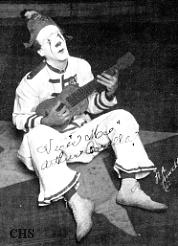 Photo: Arthur Borella clowned with Hagenbeck in 1924 and later appeared with the Cole show in the 1930's. He died in 1946 while performing at a Shrine crippled children's hospital in St. Louis. Wilson Collection.
The performance was introduced by the elaborate Far Eastern tournament which was very similar to those of previous years. Leading the various groups, which were all garbed in the costumes of Arabia and the Orient, were four trumpeters, George Enos, Arthur Borella, Chester Barnett, and Kid Kennard. The twenty-four members of the big show band covered their white uniforms with Oriental robes from the prop wagon and marched after the trumpeters. Mr. Etz and Mr. West in similar robes, but carrying American flags followed the band and behind them were three mounted flag bearers with Arabian flags and robes. These were Three Eugene men. The fifth group consisted of Mary Enos, Irma Conner, Louise LeDoux, Lula Davenport, B. Costello, and Irene Bennett - all mounted, costumed as demure ladies from Arabia, and ringing bells. They preceded six men who walked around the track pounding tom-toms at every step. These Oriental-garbed individuals were two Eugene men, C. Stokes, B. Lawler, H. Jackson, and Walter Goodenough.
The Far Eastern flavor was broken by the next entry which was made up of the clowns, Joe Coyle, Billie Hart, (on mules) and Louis Plomondon, Chas. Flemm, Earl Shipley, and Dick Pinkney.
The ten members of the Japanese troupe returned the audience to its concept of the Asian continent and the six ladies following them (Victoria Davenport, Louise Grieble, Mrs. Goodenough, Margaret Crandall, Mrs. Harris, and L. Etz) continued the theme. This group was mounted but they were followed by six men (Albert Powell, B. Bardner, A. Flemm, J. Schultz, B. Henderson, and A. Onzo) who walked and banged tom-toms. Six men riders followed the pedestrian Orientals. They were two Borellas, James Duggar, C. Earl, E. A. Trueblood, and Augie Gomez.
The 13th entry involved nine ladies beating drums. Lottie Shaw, Mrs. Powell, O. Powell, Mrs. Earl, E. Lawler, Pauline Cobb, D. West, Mrs. Teramae, and M. Stanfield made up the group.
Before returning to an American motif an entry of six mounted men (Three Potters, James Thomas, B. West, and W. Cobb) reined their horses in lively steps behind the lady drummers. The United States was then emphasized by a group of nine cowboys bearing American flags. Headed by Mr. McCracken, they were: "Billie" Cavanaugh, Bill C. Davis, Drew Stanfield, Mr. and Mrs. Bowman, Al and Lena Faulk, and Lee Ford.
A return to Africa for the final entries brought on eight Zulus and their gongs, and camels and elephants (Asian) sporting robes of rich color. Behind the last group of animals in the tournament came Abe Aronson, clown. He preceded the show's Nile hippopotamus, Alice, which cleared the track for the first display.
Before presenting the performers who took part in this circus entertainment, a list of those engaged for the season of 1924 will be offered. The reader will note that the contracts called for tournament and parade appearances as well as performance in the rings. This material is from the Havirland collection.
Abe Aronson was engaged to do general clowning, use an elephant and rabbit dog, and be in the parade and tournament. Chester Burnett - general clowning, drum in clown band, ride mule, stilts, and do walk-arounds, bugle in parade and tournament.
The Arthur Borella Trio - you and two assistants to do general clowning, walk-arounds, clown band, parade and tournament. Irene Bennett - ring and web act, ladder and double rings with Alma DePuy, parade and tournament.
Mr. and Mrs. Jack Cavanaugh - Mr. Cavanaugh to work domestic animal acts, ride menage, double in wild west concert, ocean wave horse catches, trick riding, rope spinning, spin six ropes at one time, Roman riding. Mrs. Cavanaugh to ride menage, bugle in parade, make wild west line ups, swinging ladder, both parade and tournament.
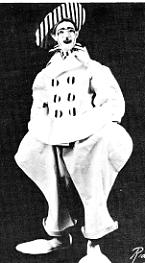 Photo: Joe Coyle, a member of the 1924 clown alley, was on H-W as late as 1938, and then appeared with Ringling Barnum. Wilson Collection.
Joe Coyle - General clowning and comedy bicycle in parade, to go in tournament and make himself generally useful. George Conners was signed on as Equestrian Director and to make himself generally useful.
Mrs. Crandall was to do ladies principal on Dick horse and both Mr. and Mrs. Crandall were to work in jockey act or Indian act. Fred Crandall was to ride menage and both were to go in parade and tournament.
James Duggar - single traps act, and to do general clowning, furnish walk-arounds, and to go in parade and tournament. Alma DePuy - swinging ladder, ride menage and go in parade and tournament, work elephant act, and otherwise make herself generally useful. Bill C. Davis - trick riding, bronk riding, fill in wild west, also hunting scene, and to go in parade and tournament.
The Orrin Davenport Troupe - three lady principal act, one gent somersault principal act, three ladies and yourself comedy act. Horses and people excused from parade.
The Aerial Earls - double traps and rings, also parade and tournament. The Bob Eugene Troupe of eight people - to furnish two aerial bar acts and four men in parade, and all personnel in tournament. Gene and Mary Enos - acrobatic rolling globe act, high carrying perch act, Mr. Enos bugler in parade, and both in parade and tournament.
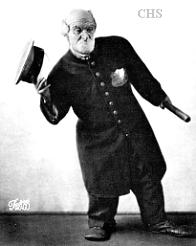 Photo: Charles (Shorty) Flemm was with the 1924 Hagenbeck show, and was with Ringling Barnum in the 1930's. Wilson Collection.
Chas. A. Flemm - to work in wild west concert, trick riding, boxing kangaroo, clown through big show, parade and tournament, and generally useful. A. C. Flemm - general clowning, parade and tournament.
Al Faulk and wife - Al Faulk, broncho rider, trick rider, and pony express; Mrs. Faulk to do trick roping and straight riding; both to do general wild west work; to furnish saddles, chaps, six shooter, flashy parade shirts, etc.; Mr. Faulk to do announcing if necessary; Mrs. Faulk to ride menage and races; both parade and tournament.
Fred Seals to furnish five seals; show to furnish cage, cart, ice, and ice box; cage to go in parade.
Lee Ford - ride bucking horses, pick up in trick riding, fill in wild west, parade and tournament. Augie Gomez - to go in wild west, to do trick riding, make big horse catches (5 or 6 horses in catch), to ride high jumping horses and to make himself generally useful, also parade and tournament.
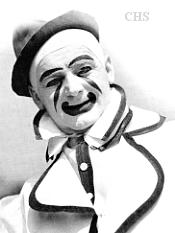 Photo: Walter Goodenough, a featured clown with Hagenbeck-Wallace in 1924. He was later with the Cole show. Wilson Collection.
Walter Goodenough and wife - general clowning through the show, ride Roman races; Mrs. Goodenough swinging ladder, menage, hunting act; both to go in parade and tournament and make themselves generally useful.
Billie Hart - to do comedy policeman, to work boxing kangaroo act, to play bass horn in clown band, to work mule on track, and to do general clowning.
John Helliott - during road season to work riding tiger and elephant act, work riding lion and horse act, work large lion group, work puma act, to furnish four bears and work same, and to make himself generally useful.
Rodney Harris - Musical Director. Mrs. Rodney Harris - ride menage, hunting act, trapeze act, sing, parade and tournament.
Irma and Conner - tight wire act lady, lady does single contortion on revolving pedestal; gent to ride menage and work domestic animals; both parade and tournament.
Jackson and Lawler - to do log chopping act and to furnish logs; both parade and tournament; show to furnish clown for act. Kid Kennard - to lead clown band, to work in boxing kangaroo act, to work mule on track and to do general clowning, to go in parade and tournament.
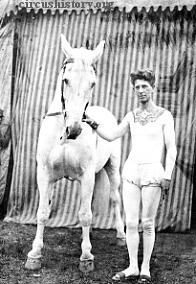 Photo: Cecil Lowande, a bareback rider on the 1924 show, is shown in a 1920 photo on the John Robinson circus. Wilson Collection.
Cecil Lowande - gents principal somersault act, a combination Jockey carrying or comedy act, ride menage, to go in parade and make himself generally useful.
Ernest LeDoux and wife - to do double wire act, ride Roman races, ride mule and jumps, Marshal in parade; Mrs. LeDoux lady's principal act; both parade and tournament and make themselves generally useful.
Bob McPherson - To break and train wild animals in winter quarters, and work wild animals on road. Roy McDonald - furnish clown walk-arounds, general clowning, furnish props for stops, ride Roman races, fill in comedy or straight riding if needed, fill in wood chopper act, parade and tournament. Alice McAllister - swinging ladder, ride menage, hunting act, parade and tournament.
Three Potters - Three Harddig Hatters - furnish two or more walk-arounds, straw hat act, general clowning, parade and tournament. Dick Pinkney - general clowning, furnish clown stops, also walk-arounds, parade and tournament. Louis Plomondon - general clowning, walk-arounds including one extra walk-around from those produced in season 1920, pigeon gag and play snare drum in clown band, (show to furnish drum), parade and tournament.
Paul and Louise - double trapeze act, ring act, parade and tournament.
Albert Powell Troupe - five people wire act, double tight wire act, lady swinging ladder, two people comedy acrobatic, parade and tournament (except Mr. and Mrs. Powell). Lottie Shaw - ride menage, do trick riding, do pick ups, ride and dance for roping, work any place in wild west except bucking horse riding, parade and tournament. Earl Sutton and wife - Mr. Sutton to work in wild west, trick ride, trick rope including big loop, big horse catch, boomerang-throwing, ride jumping horses, general wild west. Mrs. Sutton to ride menage, high jumps, to ride for roping, trick ride, flat races, general wild west; both parade and tournament and wild west line ups.
Earl Shipley - three walk-arounds, dancing dummy, long pants-umbrella, (another one to be decided later but something new), one entry swimming gag, principal stops, crazy number, trombone in clown band, assist on kangaroo, parade and tournament.
Drew Stanfield and wife - Mrs. Stanfield to trick ride in concert, ride for roping in dance, ride menage, hurdles and jumps; Mr. Stanfield to trick ride, pony express, snub horses, in big show to ride jumps and work domestic animals, ride Roman if necessary; both parade and tournament. E. A. Trueblood - ride menage, jumps, hunting act, assist on ring stock, go in parade and tournament and make himself generally useful.
James Thomas - general clowning, furnish two walk-arounds, play in clown band, parade and tournament.
Joe Taketa Troupe - consisting of five people, two high perch acts, one lady single wire act, big tub act, three people Risley act, two single tub kicking act, aerial head balancing act, one man to work in double barrel kicking act, all to parade and tournament. J. Teramoi, Kame Tetsuwari, Kame Ueyda - Risley act, foot ladder balancing, double barrel kicking, screen door kicking, one more act, all parade and tournament. Mrs. I. Teramae - to do swing ladder, parade and tournament.
Aerial Wests - double traps, perch act, lady top mounter, both parade and tournament and make themselves generally useful. Charles West - furnish three walk-arounds, white wardrobe, assist on kangaroos, parade and tournament.
Jimmie and Houma Yamamoto - High perch act, Jim and Houma to work in double barrel act, Houma single wire act, both parade and tournament.
Additional names on this list but without job description are Emley Lawler, W. Cobb and wife, E. Bowman and wife, Mr. and Mrs. Wm. McCracken, B. Henderson (clown), J. Schultz (clown), A. Ouzo (clown). Under an entry entitled "People that didn't show up" are the names of Earl Sutton and wife, Lottie Shaw, Bill Gardner, Chas. Flemm, and Alice McAllister. (Note: Flemm came on later having been with Sells-Floto for its Coliseum engagement). The reader will note that the tasks for which the performing employees were signed are accurately carried out in the descriptions of the tournament, parade, and performance presented in this article.
Following the tournament, which was Display No. 1, came the riding tiger and riding bear acts. Mr. Conner and Jack Cavanaugh worked the bears and horses in the end rings, while Ethel McCracken and John Helliott presented the tiger and elephant in the steel arena. The pachyderms were brought in for Display No. 3 and Alma DePuy and Bert Noyes presented five elephants in each end ring. Carnivores again pleased the crowd in Display No. 4 with bears in Rings 1 and 3. Harold Harris and John Morrison wrestled them while Robert McPherson invaded the steel arena which contained nine tigers.
The two top riders of this circus, Cecil Lowande and Orrin Davenport, entertained the crowd with their athletic feats of horsemanship in Display No. 5. Clowns concluded this effort with crazy displays on the track. Display 6 returned the performing animals. Jack Cavanaugh worked dogs, ponies, and monkeys in Ring 1 while Drew Stanfield presented the same species of animals in Ring 3. In the arena, John Helliott was occupied with lions riding a horse.
The aerial display came next and involved double and single trapeze artists, swinging ladders, Roman rings, and web exhibitions. The trapeze performers were the Aerial Wests, James Duggar, Aerial Earls, Paul and Louise, Louise Grieble, and Ella Harris. Ladder performers were Alma DePuy, Mrs. Cavanaugh, Mrs. Goodenough, E. Lawler, O. Powell, Mrs. Teramae, and Pauline Cobb. Irene Bennett worked with the ring and web rigging.
John Helliott's act of nine lions was the only number in Display 8. It was followed by the big clown number.
Display 10 brought forth a variety of offerings with Ring 1 occupied by Irene Bennett and Alma DePuy (double rings), the Two Earls (rings), and the Powells (comedy acrobats). The center ring was filled by the Japanese members of the circus (barrel and tub kicking), while Ring 3 contained the Taketa Troupe (juggling), Paul and Louise (Roman rings), and Irma Conner (acrobat). The Three Potters (hat sailing and juggling) were on the track during this display.
Bareback riders, Lula Davenport, Victoria Davenport, and Margaret Crandell, performed in the three rings for Display 11.
The clown band was brought out for Exhibit 12 while the next display offered John Helliott (boxing kangaroos) in Ring 1 and Robert McPherson (boxing kangaroos) in Ring 3. Each concluded with a presentation of bears. In the center ring, Fred Seals presented his group of sea lions.
The Wild West announcement followed the sea lions and a hippodrome walk-around number came next as Display 15. The Yoshida-Yamomoto foot-balancing act and Mary Enos (globe rolling) appeared in Ring 1 and the Joe Taketa Troupe (Risley and ladder balancing) in Ring 3 followed the Jackson and Lawler woodchoppers for Display 16. The clown police patrol number was next and the three rings were filled with tight-wire performers for Display 18. The Albert Powell Troupe was in the center ring and Miss Kewana and Irma Conner were in one end ring with Miss Houma and the Le Doux Duo in the other.
The clowns came on for the next display. Then the aerial bar acts above Rings 1 and 3 were presented by the Bob Eugene Troupe and the Stokes Troupe. In each of these groups two men worked straight and the third provided the comedy. Mr. Yoshida did head balancing in the center ring.
Display 21 was the menage number with the riders Billy Cavanaugh, E. A. Trueblood, Fred Crandall, John McCracken, George Conner, Mrs. Cavanaugh, Pauline Cobb, Alma DePuy, Lena Faulk, Louise Grieble, Ethel McCracken, Jessie Goodenough, Margie Stanfield, and Ella Harris displaying their mounts in the rings and on the track. The horse ridden by Ella Harris performed a hind-leg walk to conclude the exhibit.
High jumps followed the menage. Participating were Margie Stanfield, Augie Gomez, Ethel McCracken, Jessie Goodenough, E. A. Trueblood, John McCracken, Bill Davis, and Ernest LeDoux.
The carrying act with the Crandalls appeared in Ring 1 and the LeDoux-Lowande carrying act appeared in Ring 3 to flank the Davenport riders (center ring) in Display 23. The 24th Display featured perch acts with the Taketas and Kewanas in Ring 1, Gene and Mary Enos in the center ring, and the Two Wests and Two Yamomotos in Ring 3.
The fox hunt, as an introduction to the hippodrome races, was continued in the program during 1924. Originated in 1923, it consisted of two foxes, hounds, and riders in costumes associated with the sport. The races concluded the program. Their order was as follows: tandem race, three riders, each with a lead horse; ladies' flat race with three competitors; four monkeys riding ponies; men's flat race with five riders; horse running free competing against a horse and rider; and the Roman standing race (LeDoux, Goodenough, and Cobb).
(Note: The information concerning the program was taken from two lists by Mr. Havirland compiled from the Peru files and from Billboard. Differences in schedule do exist and where agreements could not be ascertained the Billboard review was followed since the author was present at an actual performance..
The Annex was housed in a seventy with two fifty-foot middle pieces and included the Sig. Acaris Troupe of knife and battle-axe throwers; Grace Ringling, novelty act; The Waldroes, physical culture experts; Mayme Gilmore and her den of large reptiles; Mlle. Carlisle, bag puncher; Carrie Holt, fat girl; Sam Skinner, skeleton dude; Chief Yetero, South American fire eater; Little Alright, Japanese wonder worker; Jim Taver, the Texas giant; T. White's Jazz Band and Minstrels; Prof. Charles Mack, Punch and Judy; Miss Artorian, the California tattooed lady; Seminole Indians, musical novelty; Virginia Acaris, mental telepathy. Harry L. Moore was the assistant manager and made the inside lectures and George Ringlin made second openings. Bill O'Day was the boss canvass-man.
The No. 2 Side Show used an 80 x 24 top and was under the direction of Lew Delmore. It featured William Kreiger, Punch and Judy and magic; Bobbette, novelty escape act; Flossie LaBlance, strength exhibition; Madam Kay, mind reader; Six Syncopators, jazz band; the Halloa Hawaiians; fighting baboon and mother and baby monkey. Kreiger was lecturer, Joe Wilkes made second openings, and David Helpbert was the boss canvasman.
This concludes the list of performing personnel and bosses with the circus on the opening date except for Ed and Tillie Baldwin of the Wild West outfit and the two clowns, Friday Wright and Joe Gould. These people were omitted from the list of personnel signed before the season opened.
The ten-day tour of Ohio which opened the 1924 tour gave a satisfactory entry to the season's activities from an economic standpoint but the weather left a great deal to be desired. The Cincinnati opening (May 28) was followed by stands in Springfield, Columbus, Newark, Zanesville, and Cambridge. This show was the first at Springfield and had capacity crowds but the advance crew was running into heavy opposition with the Sparks' billers in Youngstown, Akron, and Canton.
Sparks was scheduled to play Akron on May 5 and Hagenbeck-Wallace came on to the lot at Beaver and Exchange Streets on May 8. While there was much jousting between the opposition brigades, Ringling's brigade entered town (on the date of the Sparks' performances) and covered that show's paper before the Hagenbeck-Wallace men could take this advantage. Doc Sinclair (Ringling Bros.) had been in, and around, Youngstown and Akron for six weeks waiting for this opportunity.
During the second week of the season the Hagenbeck-Wallace Circus played Steubenville, Newcastle (Pa.), Youngstown, Akron, Canton, and Alliance. All towns were in Ohio except the Tuesday stand. The weather was fine on the first two days of the week but the other four dates were marked by rain and cloudy skies.
Two dates in Pittsburgh, Pa., opened the third week of the tour. Continued wet weather gave soft lots and the mud caught up with the show on Wednesday, May 14, and it was impossible to get on the grounds at Greensburg, Pa. Johnstown, Altoona, and Lewistown (all Pennsylvania) concluded the week.
Week number four opened with two Maryland stands (Hagerstown and Frederick), returned to Pennsylvania for two dates (Hanover and Westchester) in the middle of the week, and concluded with performances at two New Jersey cities (Bridgeton and Atlantic City).
Heavy rain at Hanover caused the management to pull the equipment off the lot before the evening performance was presented. Large audiences watched the show in Atlantic City and Trenton the following Monday.
Plainfield, Long Branch, and Perth Amboy (all New Jersey) followed the Trenton opening of the fifth week. Easton and Pittston (both Pennsylvania) concluded a week of foul weather conditions.
Hoping for clear skies, the circus entered New York state for four dates beginning June 2 at Binghamton. It rained. On Tuesday, the show moved to Oneonta. It poured. On Wednesday the show was in Schenectady and it drizzled. Clear, sunny skies greeted the circus personnel at Glenns Falls on Thursday and two large audiences arrived on the lot. Bert Bowers told a reporter on this date that the Hagenbeck-Wallace Circus, since opening in Louisville, had experienced only four days of pleasant weather. The week's activities concluded at Rutland and Bennington, Vermont.
Burlington, Montpelier, and St. Albans (all Vermont) were the first stands of week number seven and Plattsburg, Malone and Ogdensburg (all New York) concluded the week. In Ogdensburg the lot was only two blocks from the yards and this, plus the best weather of the season, gave a pleasant day to the circus employees. However, the attendance was not as good as the weather. It was reported at this time that the show had experienced twenty-eight days of rain since the season started. The remaining time had included a very few days of sunshine and a majority of cloudy, threatening weather.
Fair weather and big business greeted the circus at Watertown, New York, on June 16. The team of ponies pulling the air calliope ran away during the parade at this stand. The calliope careened wildly and passed all other parade units until one of the ponies stumbled and fell. That put an abrupt end to the wild ride and eradicated a good deal of hide from the downed pony. Oswego, Geneva, and Corning (all New York) brought the show to Pennsylvania again. Wellsboro was the Friday stand and Lockhaven concluded the eighth week. At the Saturday performance in Lockhaven, Robert McPherson was attacked and badly injured by one of the tigers in the big tiger act. He was taken to a local hospital. He returned to the show in time to have another eventful Saturday night in Kittanning a week later when, during the big blow described earlier in this article, the wind put out the lights while he was in the arena with the nine tigers.
The ninth week was completed with all stands in the Quaker State. Clearfield, DuBois, Indiana, Punxsutawney, Butler, and Kittanning comprised the stands for the week.
The Hagenbeck-Wallace Circus played New Kensington and Connellsville, Pa., on Monday and Tuesday of week number ten; moved to Cumberland, Md., for the Wednesday stand; turned back to Somerset and Uniontown, Pa., for Thursday and Friday; and concluded the week at Fairmont, West Virginia.
The Pennsylvania dates for 1924 were concluded at Washington on July 7 and then the show returned to Ohio for stands at Uhrichsville, Coshocton, Mt. Vernon, Wooster, and Ashland.
Week number twelve opened with four additional Ohio dates at Marion, Kenton, Findlay, and Piqua. This concluded the tour of that state for the season and a route through Indiana began on Friday with a stand at Marion. Kokomo concluded the week.
Columbus, Martinsville, Vincennes, Linton, Bedford, and Bloomington were the towns of the thirteenth week while Lafayette and Michigan City temporarily ended the tour of Indiana on Monday and Tuesday of the 14th week. Caesar, one of the performing lions, put John Helliott out of the act at Bedford on Friday. He was hospitalized for several days. Fifteen dates in Michigan began with the stand at Benton Harbor on Wednesday of week number fifteen. Muskegon, Manistee, and Traverse City concluded that week.
Petoskey, Cadillac, Mt. Pleasant, Owosso, Bay City, and Saginaw provided stands for week number sixteen. Jerry Mugivan was acting as manager during this period since both Ed Ballard and Bert Bowers had departed for Europe.
The week of August 11 was opened at Lansing with Port Huron, Ann Arbor, Jackson and Hillsdale ending the tour of Michigan. The circus returned to Indiana to play Auburn for the Saturday stand of this week.
On August 18, the circus moved to Gary, Indiana, to open two weeks of fair business and poor weather. During the ten days, rain and muddy lots hindered the movement of the circus and caused several late arrivals. Some parades were cancelled. This occurred during the tour of Illinois which began on the 19th at Kankakee. Streator, Joliet, Elgin, and Freeport concluded that week, the seventeenth of the season.
During the following week, with the season more than half completed, the show continued to battle the weather in Illinois. Pontiac, Bloomington, Lincoln, Champaign, Centralia, and Marion were the stands of the week. During this two week period, Dr. A. E. Roberts left the show to resume his practice and May Gilmore, snake enchantress, and Lillian Maloney, the Albino girl, joined the side show. Clarence Stokes, aerial performer, fell during a performance and was out for two weeks.
On September 1, the circus found magnificent business in Memphis, Tennessee. It played a lot on the fair grounds which caused a cancellation of the parade since it was more than thirteen miles round trip to the downtown district. Dyersburg was the second, and last, stand in Tennessee for the season and the circus moved to Kentucky to give performances at Mayfield and Paducah on Wednesday and Thursday. Cairo and Harrisburg, Illinois, concluded the week.
The twentieth week began with dates at Alton, Carlinville, and Jacksonville (all Illinois), and concluded with stands at Mexico, Columbia, and Moberly, Missouri.
Sedalia and Clinton terminated the Missouri stands on September 15 and 16. A series of twelve dates in Kansas began at Fort Scott on Wednesday, September 17. Paola, Kansas City, and Manhattan concluded the week. Topeka, Newton, Larned, Dodge City, Liberal and Pratt made up week number twenty-two. The Kansas dates were ended on the following Monday and Tuesday when the show played Winfield and Anthony. On Wednesday and Thursday the circus was in Alva and Woodward. Oklahoma, and October 3 and 4 finished the week when it played Canadian and Amarillo in the Texas panhandle.
Over Sunday the circus moved west to Albuquerque for the Monday stand. Gallup was the Tuesday date and Winslow, Flagstaff, Clarksdale and Prescott (all Arizona) followed. The performance in Flagstaff, October 9, was accompanied by snow - a form of precipitation that the circus had not experienced thus far this season. Continuing south in Arizona, Hagenbeck-Wallace played Phoenix, Tucson, Nogales, Bisbee and Douglas in Arizona for the major portion of the twenty-fifth week. It concluded with a Saturday stand at Deming, New Mexico.
About the first of October, Dan Odom was moved from the position of manager of the John Robinson Circus to that of manager of the Hagenbeck-Wallace Circus. Sam Dill, who was Odom's assistant on the Robinson show, replaced him on that show.
The twenty-sixth week included two stands in New Mexico (Roswell and Clovis) on Wednesday and Thursday. The first two days of the week were spent at El Paso and Pecos, Texas, and Friday and Saturday brought the show to Lubbock and Plainview in the same state.
Fourteen stands in Texas occupied the tour for the next two weeks. Coleman, Brownwood, San Angelo, Sweetwater, Abilene, and Stamford made up week number twenty-seven and Wichita Falls, Gainesville, McKinney, Ennis, Bryan, and Tyler filled the following week.
J. H. Adkins left the Gentry Bros.-James Patterson Circus in October and joined the Hagenbeck-Wallace Circus as assistant-manager at Coleman, Texas. Another change of staff occurred in early November when J. C. Donahue was promoted to general agent in place of E. C. Knupp who had passed away earlier in the fall.
The last two dates in Texas were played on Monday and Tuesday of the twenty-ninth week when the show made stands in Palestine and Longview. Two sleeping cars were damaged by fire at the Longview stand. Shreveport, Alexandria, and Monroe (all Louisiana) brought the show to its last Saturday date of the season at El Dorado, Arkansas. This concluded the last full week of the 1924 season. Hot Springs, Pine Bluff, and Little Rock on November 17, 18, and 19 concluded the tour. The Hagenbeck-Wallace Circus traveled 14,558 miles in 1924 and played 177 cities in twenty states. Pittsburgh, Pa., was the only stand of more than one day. However, it did give performances at three different cities named Marion during the tour.
One last item from the Havirland collection may prove to be of interest to the collector of circus detail. It is the standing order used on the show this season. Each day of the week is accounted for, except Sunday.
Monday - 125 lbs. Beef Livers; 50 lbs. Dry Salt Bellies (18-20 lb. avg.); 250 lbs. Beef Ribs (40 lb. avg.); 150 lbs. Corned Beef Briskets, lean light; 1 1/2 bbl. Pork Tongues, E.O.W.; 30 lb. Box Oleo, 1 lb. prints; 500 lbs. Bull Chucks, Bone in; 125 lbs. Frankfurters, No. 1 C 1, E.O.W.
Tuesday - 225 lbs. Casco Link Pork Sausage, H.C.; 325 lbs. Boston Butts; 100 lbs. Hamburger Loaf, E.O.W.; 30 lb. Box Oleo, 1 lb. prints; 500 lbs. Bull Chucks, Bone in; 75 lbs. Liver Sausage Ring, E.O.W.; 3 Twin Cheese Double, E.W.
Wednesday - 350 lbs. Smoked Southern Style Butts; 350 lbs. Beef Ribs, 40 lb. avg.; 250 lbs. Shield Bacon, 8-10 lb. avg.; 30 lb. Box XXX Oleo, 1 lb. prints; 500 lbs. Bull Chucks, Bone in; 1 1/2 bbl. Lamb Tongues, S.C. E.O.W.
Thursday - 400 lbs. Pork Loins, 14-16 lb. avg.; 250 lbs. Veal Saddles; 150 lbs. Short Ribs Beef; 30 lb. Box XXX Oleo, 1 lb. prints; 500 lbs. Bull Chucks, Bone in; 1 bbl. Pickled Pigs Feet, 200 lb.; E.O.W.
Friday - 1 cs. 12-6 lb. V.B. Canned Corn Beef; 200 lbs. Lamb Legs; 200 lbs. Fresh Ham Hocks; 30 lb. Box XXX Oleo 1 lb. prints.
Saturday - 300 lbs. Loin Ends; 400 lbs. Fowls, 4-5 lb. avg.; 30 lb. Box XXX Oleo, 1 lb. prints; 500 lbs. Bull Chucks, Bone in; Frenched Tenderloin Steaks, 10-22 lbs.
No author is able to write this type of material without the great assistance of other researchers. My heartfelt thanks go to Jack McCracken, Joe Bradbury, Fred Pfening, Jim McRoberts, Don Carson and Gordon Borders for furnishing information with which it was possible to complete this, and the earlier articles, on the Hagenbeck-Wallace Circus of 1922, 1923, and 1924. As indicated in this story, Billboard was also used as a reference.
Foreword: As previously announced both of the Adkins and Terrell 1938 shows will be covered. Although it would be impossible to separate the story of the two shows that season since so much of the equipment, personnel, route, and events of the season were intertwined, for practical purposes it is my plan for this installment to cover the physical aspects and performance of Cole Bros. with the following article to do the same for Rohbins Bros., and the third to relate the season's events for both shows.
The plans were made in the summer of 1937 to put out a second railroad show for 1938. This news was hailed in all quarters of outdoor showbusiness except perhaps within the confines of some of the opposition shows. The trade publications, showmen, performers, and fans were all highly excited about this great news. As many put it, another railroad show in the field would indicate to all that the great depression was at last over and that circus business was making a firm comeback.
Before getting into the physical formation of the two rail shows for 1938 several points should be discussed in order to fully acquaint the reader with the reasons in the owner's minds for framing the second show. Actually both shows in number of railroad cars had only 5 more than was carried by Cole Bros, in 1937. The fact that Cole Bros, would be cut down from 40 to 30 cars was never mentioned. The trade publications as well as their readers naturally figured Cole would remain at its present size of 40 cars and would retain its magnificent street parade and performance. In their minds they felt the "second" show would be all new, built entirely from the ground up, and would go on the 25 cars as frequently mentioned in the Billboard. But when opening day rolled around for both shows, Cole was on 30 cars and the second show, Robbins Bros., was on 15, which as just mentioned was only a total of 45 cars, 5 more than Cole carried in 1937. So in reality it was not a pure expansion as originally announced but more or less the formation of two separate shows out of the one large one. So with this in mind, then why was the reason for creating the other show.
Some have speculated that Adkins and Terrell perhaps didn't get along too well together with both of them back on the same show and both of them acting as "the boss." Sources closest to both men say there is no foundation whatsoever to this kind of speculation. The simple fact was that both men were highly capable and proven circus managers and that the sum total of their talent was being wasted with both of them running a single show. It was felt that by formation of a second show, each managed by one of the partners, it would be better for business, would insure against possible disaster to a single show, and would put them into a wider range of territory and consequently tap more of the total circus market in the country. Main reason for cutting down size of Cole show was to reduce the total capital outlay necessary to frame a second show, and then a smaller show could move easier and not encounter some of the problems that always faced the larger multi-section rail shows.
It was agreed between them that Terrell would be road manager for Cole Bros, and Adkins would manage the new show. Also, no doubt by mutual agreement, it was left up to each one to set the particular character of his show. Terrell was never the street parade enthusiast as was Adkins, so it was decided to drop the Cole parade but that the new show would feature a daily parade as had Cole for the past three seasons.
The plans for the two shows were to reduce Cole Bros, to 30 cars and put the new show on 15. However, this fact was not announced until both shows opened and the Billboard reporters picked it up. Heavy press flew freely from Rochester all through the winter and early spring months making it appear the second show would be considerably larger than it was. It was repeatedly said the show would be on 25 cars and there was no hint whatsoever that 10 cars were being dropped by Cole. This was just good business policy.
The name of the second show wasn't officially announced until the Feb. 19, 1938 Billboard broke the news that the title would be "Robbins Bros. Big 3 Ring Circus."
The winter of 1937-38 gave the Rochester shops their greatest task, that of readying one 30 car show for the road and framing another 15 car show with both of them scheduled for April openings. By mentioning the fact that only 5 additional railroad cars were needed to transport both 1938 shows it is not intended to minimize the tremendous effort needed to launch the second show. The task was great, both the physical and the human. A complete new layout had to be built, tents, seats, rigging, the entire works. Likewise a second set of staffers, department heads, bosses, performers, and workingmen had to be acquired. Competent circus people were more at a premium now than at any time in years due to heavy new and enlarged circus activity. It was announced that Col. Tim McCoy was framing a new 30 car railroad wild west show to be built from the ground up. Hagenbeck-Wallace was planning improvements for 1938 and the two Ringling owned shows, Ringling-Barnum, and Al G. Barnes-Sells Floto, now back in the hands of the Ringling family, were planning big things for 1938.
The quarters shops in Rochester started up right after the Christmas holidays. The Jan. 8 Billboard stated that Charlie Luckey, master mechanic, would have a great task and that he planned to build 14 new baggage wagons, as well as recondition the other baggage, cage, and tableau wagons. All quarters were as usual, under the general supervision of Fred Seymour.
The Billboard kept the anxious circus world advised of developments at Rochester. The Jan. 29 issue stated that Henry Brown had purchased 24 heavy Clydsdales and Percherons to replace old draft stock. Same issue said work was going well with 30 wagons having already cleared the carpenter and blacksmith shops and delivered to the paint department. Various trainers continued work most of the winter. Clyde Beatty received several new Bengal tigers and Nubian male lions for his act.
Circus personnel shifting began early in the year and the Jan. 8 Billboard said that J. D. Newman had resigned as general agent of Al G. Barnes-Sells Floto and the next issue said he was back with Cole again and would act as general agent for the show in 1938. Later, in February, the announcement was made that Floyd King would be general agent for Robbins Bros, and the two men began maping out the 1938 routes.
As was customary the show framed a circus unit that played several of the winter circuses, including the good Shrine dates at Minneapolis and Indianapolis. Three baggage cars were used to transport the elephants, ring stock, and properties used by the winter unit.
Although Cole Bros, was reduced to 30 cars for the 1938 season the cut of 10 cars was not as noticeable as you would expect. Main cut was in the parade vehicles and menagerie cages. The lot layout was almost as large as 1937 and little if any retrenchment could be noted in the performance. The two top headliners, Clyde Beatty and Ken Maynard, were both back.
The ten cars Cole dropped for 1938 included 5 flats, 2 stocks, and 3 sleepers. The 1938 train, consisting of a total of 30 cars, had 1 advance, 14 flats, 7 stocks, and 8 sleepers. The 6 Warren flats used in 1937 were turned over to Robbins with Cole using the 13 Mt. Vernon flats carried in 1937 plus an additional Mt. Vernon flat that was surplus and had been stored at Rochester. The 14 flats carried in 1938 were all matching Mt. Vernon cars and were painted in the same color scheme as 1937, aluminum with red lettering and light green shading. They were stenciled "Cole Bros. Circus with Clyde Beatty and Ken Maynard." Stock cars were painted aluminum with gold lettering on a red letterboard and carried the same stenciling as a year before. Coaches were again red with the same lettering as in 1937 done in gold. The advance car was the one used the year before. All excess cars not used in the 1938 Cole train were made available to Robbins Bros.
Although Cole Bros, planned no regular street parades in 1938, the show was still pretty well equipped with parade vehicles and could parade should the necessity arise, as it did on one occasion.
The steam calliope, the former Christy Bros, air calliope, and the ex-Fred Buchanan Robbins Bros, unafon wagon, all used in the 1937 parade, went to Robbins Bros. Also the France Tableau which was on Cole in 1937 went to Robbins. The Lion and Mirror bandwagon was not used on either show in 1938 and remained in quarters, but Cole continued to carry in 1938 the America, Asia, Columbia, and Palm Tree tableau wagons. Palm Tree was painted in a new color scheme for 1938, orange with silver carvings, but Columbia remained in white with gold leaf, and America and Asia continued with their traditional colors they had had while on the Cole show.
Robbins Bros, put into use several tableau wagons that had been acquired with the purchase of the Fred Buchanan Robbins equipment but had not been previously used, making it unnecessary that any other parade wagons be transferred from Cole to Robbins. All of the tableau wagons remaining on the Cole show were of the box type that were able to carry a full baggage load. Their presence on the show meant that the parade could be restored at any time deemed necessary. Everything was there with exception of calliopes, and the ex-cage wagon which carried the calliope used with the band could be fixed up for parade purposes if required.
Most of the new baggage wagon construction during the winter of 1937-38 were for Robbins Bros, although there were a few new wagons built for Cole and made their first tour with the show in 1938. Several former Cole wagons were sent to Robbins Bros, but these will be mentioned in the next installment.
One new wagon, No. 61, was built in quarters for Cole and was used to carry the sideshow canvas and poles. It was a nice looking wagon with exception of the crude looking wheels. The rear wheels were regular spoked wheels but the front two were hard rubber solid disc type carnival wheels. As Gordon Potter so aptly put it, "it was a mess."
Since the Lion and Mirror wagon which had loaded the elephant dept. props did not go out in 1938 it was necessary to put into service a new wagon to haul this load. The new wagon was No. 84 and it was built mainly new, however no doubt some steel tired wheels, gears, and parts from older wagons were used. The show still had a goodly number of old baggage wagons from the original Christy and Robbins purchases that could provide these things.
Cole needed a wagon to house the air calliope that was used to play with the band during performances so one of the former Christy Bros. 12 ft. cages that had been used as a cage in 1937 was remodeled to carry the instrument and various other band props. Bars were removed and the sides were enclosed with plywood. The wagon was numbered 78.
In 1938 baggage wagons were painted red with wheels and gears white with red and blue striping. Titling and numbering was in silver.
In 1937 Cole had used a total of 22 cages, all time high for the show. For 1938 a new 10 ft. cage equipped with pneumatic tires was delivered from the Springfield Wagon Co. in December. The former Ringling hay eating animal den which was No. 10 in 1937 and carried a gnu was not fixed up and did not tour on either show in 1938. As mentioned in the preceding paragraph one of the 1937 cages, a former Christy 12 ft. den, was converted into a wagon to carry an air calliope. With this one new addition and two subtractions from the pool of cages a total of 21 cages were available for use in 1938 and from this number both Cole and Robbins were equipped with their necessary menagerie cages.
In 1938 Cole Bros, carried the following 14 cages as listed here.
1. No. 24, new Springfield built cage, 10 ft., used to carry monkeys.
2. Hippo Cage No. 20, carried Pinkey, 18 ft. den, was No. 28 in 1937.
3. Sea lion cage, 17 ft. long, was No. 20 in 1937.
4. Former Robbins 14 ft. cage, was No. 19 in 1937, used to carry bears.
5. Former Robbins 14 ft. cage, was No. 26 in 1937, used to carry Beatty's cats. New No. 15.
6. Former Christy 12 ft. cage, used to carry Beatty's cats. No. 18.
7. Former Christy 12 ft. cage, used to carry Beatty's cats.
8. Former Christy 12 ft. cage, used to carry Beatty's cats.
9. Former Christy 12 ft. cage, used to carry Beatty's cats.
10. Former Christy 12 ft. cage, used to carry Beatty's cats.
11. Former Christy 12 ft. cage, used to carry Beatty's cats.
12. Cage, 12 ft., built new in 1937, used to carry Beatty's cats. No. 14.
13. Cage, 12 ft, built new in 1937, used to carry Beatty's cats.
14. Cage, 12 ft., built new in 1937, used to carry Beatty's cats.
This left 7 cages available in the pool for Robbins Bros, which included 3 cross cages, 3 former Christy 12 ft. cages, and one 12 ft. cage built new in 1937.
Cole's 1938 cages were painted basically in the same color scheme as before although darker colors (red, and orange) seemed to predominate. Lettering on the hippo den's skyboard was changed from "Hippopotamus From River Nile" to "Cole Bros. Circus," and this is a good aid in identification of photos as to what season it was. This den's number was changed from 28 to 20. Other cages possibly were also renumbered. Regrettably a complete list of cage numbers for 1938 has not turned up.
Cole Bros, carried 17 elephants in 1938 with 7 others from the 1937 herd carried by Robbins. The Robbins herd will be listed by name but the names of the 17 Cole carried are not known. Details of individual elephants and even total number of the herd became somewhat skimpy after the acquisition of the 3 punks in mid-season 1937. At least 24 elephants were still owned and actually carried on the two Adkins and Terrell shows in 1938 but whether any others remained at quarters is not known. It is rather doubtful they did because of the fact that for a few days at the beginning of the 1938 season the 3 John Robinson elephants were rented for the Robbins show, giving that show a total of 10 to start the season. Had other elephants been available probably the 3 Robinson bulls would not have been obtained, but this is only speculation.
Other lead stock carried by Cole Bros, in 1938 according to Potter's notes included 5 camels, 3 zebras, 1 llama, 2 sacred cows, 3 Cape buffalo, 1 bison, 1 zebu. Clyde Beatty had a total of 21 lions and 11 tigers.
Although Cole Bros, had about 20 fewer pieces of rolling equipment to move in 1938 the show retained most of their 1937 baggage stock with only a few head going over to Robbins. This number was needed to move the show efficiently, plus the fact only three Mack tractors were on the show in 1938, the fourth going over to Robbins Bros.
Cole's 1938 canvas spread was still impressive and the lot visitor didn't notice the cut down from 1937 too much. The big top was smaller, but it was still a brand new 160 ft. round with three 60 ft. middles, same size as used in 1936. There was a new marquee and new candy stands but all other canvas had been used by Cole the previous season. With the reduction in number of cages, bulls, and lead stock the menagerie top was cut down from 8 to 6 center poles. Basically the tentage size was almost the same as it had been in 1936, or before the 1937 enlargement.
As April approached the Cole show was ready to go. The annual press day was held at the Rochester quarters on the first Sunday in April and this year it was a double event as they could observe the two fine railroaders almost ready to hit the road for the new season.
This year there was no plan for a New York City indoor engagement. Cole Bros. was scheduled to open the season at the Stadium in Chicago on April 15 for a 16 day run. Robbins Bros, would open under canvas April 27 at Kokomo, Ind.
Cole faced a different type of opposition in Chicago in 1938. Hagenbeck-Wallace, which had played the Chicago Coliseum a year ago at the same time Cole was in the windy city, decided against a similar stand this year and scheduled its opening for Indianapolis on April 16. The Chicago opposition in 1938 came from the brand new, beautifully framed, Tim McCoy's Wild West Show which opened at the International Amphitheater for an April 14-24 run. Colonel McCoy had spent a small fortune building his 30 car show and while the money lasted it flowed freely and his advance boys plastered the city with paper and the press boys spared no expense in the dailies.
While the entire circus world was living it up for the last few days before what was felt would be the greatest circus season in a decade to begin, few, if any, circus managers foresaw the economic disaster lurking quietly in the background for most of them. A rather insignificant item appeared in the April 16 Billboard which could have been easily taken as a solemn omen for things to come. It reported that the Art Mix Circus had folded April 6 at Hobbs, N.M. and manager Joe B. Webb remarked that the show had gotten only two days business during the four weeks it had been out. The Art Mix Circus was the first of a long line of circuses which would falter before the season was over.
A total of 6 railroad shows took to the road in 1938, largest number since 1931. The list included Ringling-Barnum on 90 cars, Cole Bros, on 30 cars, Al G. Barnes-Sells-Floto on 30 cars, Hagenbeck-Wallace on 28 cars, and Robbins Bros, on 15 cars.
Several large motorized circuses including Tom Mix, Downie Bros., Russell Bros., Seils-Sterling, Parker & Watts, stood at the list of fully 30 large, medium, and small mud shows.
Street parades were getting scarcer in 1938 with only two major shows parading. These were the railer, Robbins Bros., and the new motorized show, Parker and Watts. Possibly one or more of the small mud shows did parade in 1938. Haag Bros., which had paraded in 1937, dispensed with it for 1938, and likewise the Dan Rice Circus which also paraded in 1937, now known as Harris Bros., in 1938 cancelled its daily parade.
The staff and department heads for Cole Bros, in 1938 included Zack Terrell, road manager; J. L. Murden, special representative; J. D. Newman, general agent; Earl Lindsay, treasurer; Victor Robbins, bandmaster (with 16 men); Carleton George, comptroller; Dr. E. F. Partello, legal adjuster; Rex de Rosselli, production manager; Ray Dean, Jr., equestrian director; Noyles Burkhart, manager front door; George Cutshall, supt. tickets; Lou Delmore, manager sideshow and annex; Mike Michaels, big top announcer; Orville Stewart, lot supt.; Eugene Weeks, supt. concessions; Charles Young, supt. big top canvas; Eddie Allen, supt. of elephants; Henry Brown, supt. baggage stock; Malcolm Campbell, supt. ring stock; Al Dean, steward; and Jack Biggers, trainmaster.
Lou Delmore again had a good lineup of sideshow attractions which included Gibb Sisters, Siamese twins; Joe Grendol manager of Punch and Judy and sword and neon tube swallower; Annette, trained pythons; Cliff Thompson, giant; Forest Layman, armless wonder; Betty Green, Koo-Koo, the bird girl; Anderson Sisters, tiger girls; Thelma Williams, fat girl; Nova Talbert, sword box; Alice Morse, futures; Morey Schayer, Hawaiians; Najeeb Assaf, Oriental band; Broadway Vanities, revue with Leona Theodora, Jean Darrow, Mildred Dare and Dorothy Barrs; Joe Browne had his colored review in the sideshow for the Chicago engagement but went to Robbins Bros, when that show opened.
The April 23, 1938 Billboard reviewed the Cole Bros, opening at the Chicago Stadium April 15 as follows: "Chicago, April 16 - Cole Bros. Circus' fourth season got underway this week at the Stadium when its first performance was given in the form of a dress rehearsal on Thursday evening to an audience composed of newspaper people and invited guests. Show was received with enthusiasm.
"Despite a few minor drawbacks the performance ran smoothly, an accomplishment considering that the show did not unload here until Wednesday morning and gave the dress rehearsal the next day. Two of the biggest acts did not show due to shortness of time to erect their rigging. These were the Gretonas and the Great Florenzo, a European importation.
"Vic Robbins again leads the band and his musical selections enhanced the value of each act. At the last moment H. J. McFarlan, who was to go with the new Robbins Bros. Circus, was brought in as equestrian director and much credit is due him and his assistants for whipping up a crack performance in very little time. Ray Dean is master of the p-a system and his announcements are of the clear, clean-cut order.
"First show ran a little long, but by the time this appears in print the program will have been cut and rearranged into a fast-moving performance.
Detailed Review
(Due to editorial deadlines this review is incomplete and is of the show as caught at the dress rehearsal Thursday evening.)
Display 1 - Program got off to a flying start with the spec "La Seville," a colorfully brilliant display of pageantry, written and produced by the fine hand of Rex de Rosselli. Skillfully blended into pictorial magnificence, the combination of bright new costumes and beautiful lighting effects, the Spanish dance numbers produced by Betty Jones and a finale climaxed by a display of fireworks proved to be a dazzling opener.
Display 2 - Rings 1 and 3 were occupied by Carr Brothers and Moreen Troupe, comedy acrobatic groups, while clowns cavorted on the track. Slapstick prevails in each act, with the tier of balancing tables being the Moreens' best bit.
Display 3 - In the circular steel arena Harriet Beatty did her riding lion and tiger act, putting the animals thru their paces with apparent ease. Climax of the act when animals jump thru burning hoop onto back of elephant was signal for much applause.
Display - Ring 3 had the Harddig Trio, clown jugglers, with hat and Indian club manipulations, and in Ring 1 Nelson's Animals, a clever group of ponies, a dog and a bucking mule, went thru a pleasing routine of tricks.
Display 5 - Small aerial number participated in by the Misses Voise doing loops; Misses Cutshall, Kestler, Teeter and Mosak, iron jaw; Atlantis Brothers, perch; Jean Evans, Bessie Hollis and Esma Wilson, muscle grind, and the Millettes, Sr. and Jr., who took the spotlight for their upside-down revolving globe trick.
Display 6 - Educated seals, worked by Roland Hebeler and Captain Bernadi, doing the usual seal routines of ball balancing, hoop catching, and ladder climbing. Outstanding was Smoky, the musical seal.
Display 7 - Clyde Beatty is doing the most spectacular act in his career as a wild animal trainer with possibly the largest number of cats (43) ever used in an act of its kind. From the start it is filled with thrills and daring fearlessness. Beatty colors his work with dramatic showmanship and is master of the situation at all times. He has two rearing lions this year instead of one, and the roll-over tiger is still one of the highlights of the offering.
Display 8 - Three groups of Japs, the Osaka, Tokio, and Omata aggregations, in a display of typical Oriental barrel juggling, foot work and acrobatics, while Ernie Wiswell's crazy Ford did antics on the hippodrome track.
Display 9 - Cyse O'Dell, petite aerial gymnast, was in top form with an exhibition of strength and endurance in mid-air that thrilled the audience, doing as her share of the evening 80 planges.
Display 10 - The Misses Zoeppe, Rose Wallet and Juanita Hobson, all graceful equestriennes, in a novel and pleasing bareback-riding stint. Clowns on track.
Display 11 - Clown band, directed by Otto Griebling, with a burlesque dance interlude, was one of the comedy hits of the show.
Display 12 - Three rings of elephants, worked by Jean Allen, Wanda Wentz and Betty Stevens, went thru formations and various stunts, climaxed by mass salute under direction of trainer Eddie Allen.
Display 13 - Big clown number, with all joeys taking part in the grotesque tomfoolery. Some new gags and makeups were noted here and there.
Display 14 - A galaxy of balancing acts, with the Zoeppe Family working in the center ring. These unsupported ladder stars have an amazing routine and work very smoothly. Highlight was a three-high on unsupported ladder and the trapeze - on - shoulders trick. The Rink Wright Duo in Ring 3 has a very fine balancing act, using a teeter-totter piece of equipment. Casca Brothers, in Ring 1, did their stuff on rolling globes, with some upside-down stilt walking added.
Display 15 - Menage. Array of high school and dancing horses led by Dorothy Herbert, whose superb riding ability is well known in the circus world. A sweet routing of horseflesh, Miss Herbert's cakewalking horse and Jorgen Christiansen's cariocaing steed were tops.
Display 16 - The automobile surprise with 18 clowns piling out of a coupe.
Display 17 - Hal Silvers, slack-wire artist in a very good routine. His swaying wire stuff and antics as a drunk were received with plenty of applause. He is an expert in his line. Senor Casca in Mexican attire, also did good work on the slack wire in Ring 1.
Display 18 - Ken Maynard and assemblage of Wild West stars. Maynard did a bit of lassoing and rifle shooting and his company entertained with rope spinning, trick and fancy riding, whip cracking and other Western oddities. Turn was preceded by a short Indian ballet by the Jones Dancers, in which the girls wore beautiful Indian costumes and feathered head gear.
Display 19 - Acrobatic acts. The Freddysons, with teeterboard and table work; Tayama Japs, contributing juggling, balancing and Risley, and the Picchianis, with their marvelous teeterboard and cradle tricks, filled this spot.
Display 20 - Senor Jose Gonzales and Company amused with their comedy bullfight, a burlesque using dogs dressed as bulls.
Display 21 - Zoeppe Family, in the center ring; Hollis Troupe, in Ring 1 and Hobson Riders, in Ring 3, showed superb horsemanship in their routine of bareback artistry. The Zoeppes are a spectacular group of master equestrians, doing their numbers in mass formation most of the time, six people riding four horses at a time. Their tricks as well as those of the Hollis and Hobson troupes, were a delight.
Display 22 - Clowns featured in a comedy fire department scene.
Display 23 - Liberty horses. Under direction of Jorgen Christiansen, one of the country's foremost horse trainers, this exhibition of training skill is one of the most beautiful sights of the show. Christiansen's group of 24 Palomino horses is probably one of the finest set of equine beauties in the business. Their maneuvers, besides the groups worked in Rings 1 and 3 by John Farthing and James Foster, are excellent, and the finale in which all the animals rear at one time is a magnificent sight.
Display 24 - The Great Gretonas were scheduled for this spot but did not appear due to their rigging not being set in time. (Ed's note: This act, of course, was a featured attraction of the performance and appeared the next day.)
Display 25 - Parade of clowns with many fantastic and grotesque costumes.
Display 26 - Flying acts. Flying Harolds over Ring 2, Peerless Illingtons over Ring 1 and Voise Flyers over Ring 3 comprised this department. The Harolds are featuring Eileen, with a two and one-half somersault to a catch in mid-air. All performed admirably and were responsible for many of the thrills of the show.
Display 27 - Dorothy Herbert returned for more dare-devil riding and led a group of riders thru feats of high jumping and hurdling.
Display 28 - The Great Florenzo was to close the show with his daring somersaulting automobile but his equipment was not ready.
The Great Florenzo, whose somersaulting automobile is feature of the show was injured Friday night when auto made an extra half turn and landed bottom up. Extent of his injuries not known."
The author wants to especially thank Albert Conover and Gordon Potter for their help in the difficult task of placing of the equipment for the two Adkins and Terrell railroad shows of 1938. Next installment will deal with the Robbins Bros. Circus.
Cole Bros. Circus 1938 Train Loading Order
from files of Gordon Potter
Flat Car No. 60
Flat cars numbers run from 51 to 64 inclusive. Total 30 cars. One ahead and 29 back, (14 flat cars, 7 stock cars, 8 coaches). 57 heavy pieces. 5 light pieces (2 chariots, gilley wagon, 3 wheel motorcycle, farm Style tractor). 62 total pieces loaded on 14 flat cars.
All of us who are so upset when we hear that another tented city has left the road, wonder why. Why can't we have a circus on the railroad again with the success of fifty years ago? Recently three monied men, who should have more sense, thought that they would put a 20 car show on the road. A look at the Barnum and Bailey Show figures of 1910 changed their minds.
That show, under Ringling Bros, ownership and management, had a clear net profit of $477,674.59. Their total expense of the season was $1,130,184.61 on an income of $1,607,859.20. It is interesting to note that almost $284,000 was spent on the advance; these people certainly believed in advertising. A study of other figures show how "times have changed." The cook tent supplies were only $64,829 for the whole year and the hay, straw, oats and bran were $62,673. The meat and vegetables for the animals was $4,711. These figures would be multiplied many times today. The greatest expense of today would, of course, be in wages and transportation. For the whole season the performers cost $224,656 and the band wages were $17,525 for 33 weeks. (How large a band could you get today for $85 a day?) Wages were correspondingly low for ushers, ticket takers, working men, etc. The wages of men today would be astronomical, even if you could get the help to move the show.
Probably the greatest expense today would be transportation. In moving all the cars and trains of this great show of 1910, and it must be remembered that this show traveled from coast to coast, the total cost was $106,536.54. In that year it only cost $500 to move all the cars from Austin to San Antonio. From Portland, into Salem, Medford, Redding, Chico, Sacramento, Santa Rosa and Napa, seven movements and spotting, for $3500. (Maybe Don Francis could figure this today.) When the show closed at Clarkesdale, Mississippi, November 5, 1910, and took that long trip home to Bridgeport, Conn., the cost was only $1664.
Yes, you dreamers, it would be wonderful to see a Railroad Circus like Al G. Barnes or the beautiful Sells Floto Show pull into town at four a.m. and unload in the early dawn! But this is a new day and our kids will never know that delight.
The Ham and Eggs Circus of 1939 was one of the most unusually promoted circuses of all time. Although it was standard circus put on by circus men, the promotional angle was unique in the annals of American circus history.
The 1938 season had been rough on circuses and rougher on the performers. Both the Ringling Bros, and Barnum & Bailey and Cole Bros, shows closed early, one by strike, the other by bad business. The new Tim McCoy Wild West Show opened and closed within a few weeks. Many circus performers did not like the prospects for the coming 1939 season.
During the winter of 1938-39 a group of performers in the Southern California area banded together by mutual unemployment and no relief, did 20 shows for the Parent and Teachers Associations Benefits and did so well that Frank Chicarello and W. H. (Skinny) Matlock purchased equipment from the stranded Hagenbeck-Wallace Circus that was in the Barnes quarters at Baldwin Park, Calif, to organize a motorized circus.
The title of the new show was Matrello Bros. The MAT was the first three letters of Matlock's name and the RELLO was the last 5 letters of Chicarello's name, so a new title was born.
The show was built in Baldwin Park and both owners had been so very busy it was only two days before the opening when they discovered they didn't have a light plant. Ed (Whitie) Versteeg was at quarters to see how they were making out when Chicarello told Whitie he was short a light plant. The next day Whitie was back with a 30 K.W. plant.
The big top was a 60 ft. round with three 30 ft. middles. They had 19 acts in the performance and the show was on 6 trucks. It opened at Baldwin Park, April 14, 1939.
Circus people around the Los Angeles area turned out to wish the new owners luck. The little circus had good business around the southern part of the state and then started north. The further north they got the worse business got.
When hit with a high license in Oakland, Mr. Chicarello told the license collector that they couldn't pay that kind of license so all he could do was to close the show and all of the employees would sit on the steps of the City Hall until they had gas money to get out of town. The collector told them to do it and they did just that. The circus personnel, from canvas man to performer, every man, woman, and child went to the City Hall.
The newspapers took it up. Pictures were taken of the group at the City Hall, also of the lot that the show had set up on. They had publicity that they couldn't buy. The license collector told them to go ahead and show, that the license was free, but to get out of town and never come back. Business was very good there. The show then started south.
Chicarello had rented some seats for a 4th of July celebration at Lincoln Park in Los Angeles. The show was playing in Lone Pine when Chicarello came down to collect his money. When he reached the park he saw all of the seats full and they were passing the hat to pay for the entertainment. Mr. Chicarello told me that he had never seen so many 5 and 10 dollar bills in a hat before. The odd thing about it was there was no advertisement around. The Coliseum was having a big show and fireworks display and so was the Rose Bowl in Pasadena. The two events were well advertised but here was a big crowd with no advertising.
Chicarello made himself known and told them he was there to collect for the seats and the reply he received was, "You a circusman? We want to talk business with you." Chicarello said he had been drinking so he told them, "Not today but I will tomorrow."
The next day Chicarello went to the Long Beach office of The Retirement Life Payment Association. A Dr. Francis Townsent had been working for a retirement plan and had opened an office in Long Beach, Calif, under the name of "Retirement Life Payment Association. $30.00 every Thursday." This was known as the Ham and Egg Plan.
They couldn't have found a better city to start in as at that time Long Beach was made up of retired people. The Association built up enough power that they had enough signers to get the bill on the ballot for the fall elections. This bill was a retirement bill which at age 50 a person would draw $30.00 every Thursday. The organization had a membership of 400,000 people that paid dues of 50 cents per month.
The next problem was to get the plan before the voters. Time was short so they had to work fast. They decided the best way to reach them was with a circus.
Mr. Chicarello was there at the right time to get in a deal that just doesn't happen in show business. When he left he had a contract to furnish a circus and he was to get a guarantee of $1,000 a week and was also allowed to keep the sideshow and concessions. The Association was to take care of publicity, lots, and licenses. How could he lose?
Chicarello went to the United Tent and Awning Co. with his contract and made a deal for a big top, a 110 ft. round with three 40 ft. middles, seating 4000 people. This was to include all the insides for this top and a 22 K.W. light plant to add to their 30 K.W. All this was furnished for $500.00 a week.
The menagerie top was a 50 ft. round with two 30 ft. middles and sideshow top was the same size. A cookhouse top was also carried. All equipment had Ham & Eggs Circus painted on it with the number 30, for the $30.00 a week deal. No other numbers were on the trucks. Color scheme for the motorized equipment was yellow with blue trim.
Publicity was to be written at the headquarters in Long Beach and sent to the committees in towns along the route. Lots and licenses were taken care of by the local committees. This let the show operate at a very low cost.
Admission prices were 30 cents for adults, 10 cents for children, and reserved seats 10 cents. Willis Allen, campaign director of Ham and Eggs, was manager of the show. Fred Lenhart was auditor. The show's staff consisted of the following:
Art Windecker, advance; G. Lehman, biller; Frank Chicarello, front door; Dr. George Boyd, announcer; G. McSparrow, inside tickets; Ed (Whitie) Versteege, electrician; George Takacs, asst. electrician; C. Owens, boss props; Homer Cantor, advance; S. Stone, biller; W. H. (Skinny) Matlock, equestrian director; Dave Stump, concessions; George Singleton, boss canvasman; Eddie Quarles, asst. canvasman; H. Ellsworth, ticket wagon; and Joe Purdy, rigger.
The show's band had Charles Post, director; Walter Harris, trumpet; Phil Smith, trumpet; William Taggart, euphonium; George Sternau, trombone; Al Mitchell, trombone; George Thomas, bass; Allen Torrensen, clarinet; Joe Scales, clarinet; and Maley Thomas, drums.
The cookhouse had Charles Cardero, chef, with 2 cooks and 6 waiters.
Outside stands were run by Frank Beaumont, candy floss; Irvin Cohen, candy floss; Herman Ebert, popcorn and drinks; M. Smiley, popcorn and drinks, and Ed Hazel wood, lunch.
Inside stands were operated by F. Lenhart, Morris Smedley, and H. Garwood.
Seat butchers were Chas. Frank, Ed Confer, Jack Myers, and Joe Cooper.
The Ham and Eggs Circus opened at Pomona, Calif. July 21, 1939 to a packed house at night. The matinee was good.
They stayed around the Los Angeles area until August 4 and then started up the coast. At Santa Barbara the Association asked the City Council to waive the $100.00 a day license fee as it was a nonprofit organization. The city attorney pointed out that only religious, schools, or charity affairs are exempt and that Ham and Eggs is a semi-political organization. The council denied the exemption.
The Ham and Eggs also had opposition from all state, county, and city officials.
The show went as far north as San Luis Obispo and inland to Tulare, down to Porterville working its way south to San Bernardino, and then back up thru Corona into the Los Angeles area again. On Oct. 28-29 they showed in the Shrine Auditorium. The show then worked down into the San Diego area, closing Nov. 6 at San Diego.
The election was Nov. 7th and the Ham and Eggs bill lost.
The Ham and Eggs Circus program of 1939 was as follows:
Band concert in the center ring before the show started.
Display No. 1 - Spec, Ham and Eggs on the Glory Road.
Display No. 2 - All rings, Five Matlocks on tight and slack wires.
Display No. 3 - Ring 1, Ruth Conrad, flying rings; Ring 3, Martha Oliver, flying rings.
Display No. 4 - Ring 2, Dietrich's ponies.
Display No. 5 - Ring 1, Joe Perez, iron jaw; Ring 3, Great Calvert, contortionist.
Display No. 6 - Clowns, Fay Walcot, Fay Avalon, Charles Bathe.
Display No. 7 - Ring 1, Beatrice Beeson, aerial ladder; Ring 3, Florence Knight, trapeze head balance.
Display No. 8 - Ring 1, Whites Leaping Greyhounds; Ring 3, Dietrich's Scotties.
Display No. 9 - Ring 2, Fay Avalon and Fay Walcott on revolving ladders.
Display No. 10 - Ring 2, Scotty Hamilton telling the story of the Ham and Eggs Bill and what it would do for the retired.
Display No. 11 - Ring 2, Gentry riding dogs.
Display No. 12 - Ring 2, Senor Alexander, high wire.
Display No. 13 - Clowns.
Display No. 14 - Ring 1, Bertha Matlock, looping the loop; Ring 2, Babette Thomassen, one arm planges; Ring 3, Martin Owens, walking loops upside down.
Display No. 15 - Ring 2, Frank Chicarello, whip cracking, knife, and axe throwing.
Display No. 16 - Ring 2, Acevedo Family, jugglers.
Display No. 17 - Ring 1, Chico and Ringo, hand and head balancing; Ring 2, Rice, Baldwin, and Ball, acrobats; Ring 3, The Quinettes, Arab tumbling.
Display No. 18 - Ring 2, Roy Rudy and his elephant, camel, pony, and boar hound.
Display No. 19 - Finale - The Spirit of Ham and Eggs.
The show had a printed program using a single sheet of paper about 12 inches long and 8 inches wide. The performance was printed on one side and all about the Ham and Eggs Bill was on the other. It was given to everyone that came in the tent.
My thanks go to Frank Chicarello, without his help this article could not have been written.
No part of this publication may be reproduced in any form or means
Last modified February 2006.
without written permission of the author and the Circus Historical Society, Inc.