


Circus Historical Society
Bandwagon, November - December 1966
Back to Bandwagon Index
Bandwagon, Vol. 10, No. 6 (Nov-Dec), 1966. Note: Only some articles are included in this online edition. Many illustrations are not included. The Circus Historical Society does not guarantee the accuracy of information contained in the information in these online articles. Information should always be checked with additional sources.
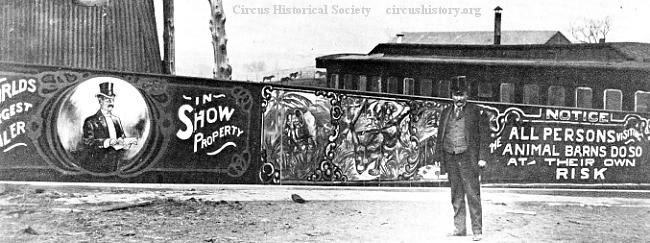
A visitor to the 1904 St. Louis World's Fair had a chance to see numerous outdoor exhibitions. He had his choice between Mulhall's Wild West, Gabriel Bros. Wild West, Cummins' Wild West, Kale's Fire Fighters, Hagenbeck's Zoological Paradise and the Boer War Show.
The Boer War Spectacle was by far the most popular and successful of these ventures. The idea for the show was originated by one Captain A. W. Lewis. With the financial backing of some St. Louis businessmen, he left early in 1904 for South Africa to procure the original cast for the show. He returned with the Dutch hero, General Piet Cronje, along with approximately 650 other veterans of the Dutch-English conflict. When the troup reached St. Louis they were in need of horses in order to refight the war. Lewis placed an order for 350 horses with a forty year-old animal dealer in Lancaster, Missouri. This was William P. Hall's start in a twenty-eight year career in show business.
William Preston Hall was born in Schuyler County, Missouri, near Lancaster, on February 29, 1864. His great knowledge of horses became evident soon after the death of his parents in 1876. Out on his own, he obtained work from a farmer for a dollar a week and board. Young Hall saved his money and soon acquired a black horse for the small fortune of eleven dollars. Soon he successfully traded this beast for another. Using his youth to his advantage, Hall soon had a team of horses and several dollars. Not bad for a fellow who had spent less than six weeks in school!
Using his natural aptitude for horse flesh, William P. Hall built up a good sized horse farm while still in his teens. His first big account came in 1882 when he furnished all the horses for the streetcars in the city of Philadelphia. In 1884 he reached the big midwestern market in Chicago.
One of his biggest customers was the American Express Company. Hall furnished all the horses for that firm west of the Mississippi River.
Hall's dealings expanded little by little and in 1895 he had opened a sales barn in Richmond, Virginia. The big European markets opened to Hall by this move. He was a pioneer in trans-oceanic shipping of animals.
He spent one year in the 1890's in Germany receiving his shipments.
In 1899 the Boer War started and Hall sold all types of horses and mules to the British government for the war effort. During the war, which lasted from 1899 to 1903, Hall established a sales barn in Cape Town, South Africa to handle the incoming horses. We can conjecture that Louis Hall was placed in charge of the Cape Town outpost. Needless to say, the war made William P. Hall a rich man.
It was in this period that his famous title, "Horse King of the World," was first used. Self proclaimed or not, he certainly did deserve this title.
William Hall had two other nicknames, the Colonel and Diamond Billy. I would assume his rank was just a title and not commission, but he deserved the name Diamond Billy.
Early in his life he bought $20,000 worth of diamonds. From then on, they usually could be seen on Hall's vest. One report even went as far as to say that he even slept with his diamonds on.
All the prosperity Hall enjoyed in the early 1900's did not effect his love of children. He considered it his greatest achievement to be able to show his animals to the children of Lancaster City. He often held open house for them and let the youngsters enjoy the fun that he missed as a boy.
He regularly surprised his own three children with rare and unique pets. I don't know if this has any connection or not, but he did own elephants with the same names as his children. One can imagine the time his children had growing up.
The only thing that challenged his love of children was his love for animals. He loved them all - horses, mules, lions, tigers, camels, and elephants. Hall once said, "The more animals I have around the better I like it." He never let any maltreatment of the animals take place and if an employee was caught striking an animal for no good reason he was quickly discharged.
Although he loved all animals, the horses were his favorites. This was because he had more contact with them. He did some training of horses and in this way came to know their habits intimately. He had a personal friendship with each horse and one of his great pleasures was showing one of the steads off. The horses seemed to have an almost strange affection for William Hall.
He also liked the lions and tigers. A 1921 Billboard reported that the lions and tigers were "chummy" with him. The same issue stated that there were several lions which Hall would not part with for any amount a circus or zoo would offer. He once was quoted as saying this about the lions and tigers: "They can do everything, but speak."
He was a mule breeder of note and is considered to be the developer of the Missouri Mule. He was in the mule skinning business almost as long as the horse business.
In later years Hall became famous for his elephant herd. Although a number of his elephants came in circus deals, the majority were imported from India. Large orders for Indian elephants were placed in 1905, 1913, 1914, 1915, and certainly some other years.
I do not have an exact tabulation on the number of elephants at the farm during the early years, but do for some of the later ones. In 1927 the farm had twenty bulls, seventeen in 1930, twenty-nine in 1932 and 1933, and twenty-five in 1934.
William P. Hall was married around the turn of the century to a Lancaster doctor's daughter. He had three children: Wilma and Sidney, daughters; and a son, William P. Hall, Jr. One report indicates Hall married to get someone to take care of the books, but we'll give Diamond Billy the benefit of the doubt on this matter. It is true that he was close to illiterate.
I have been unable to determine just when Hall built his famous farm, but the best bet is that the horse and mule barns were built in the late 1890's and the elephant and wagon barns were constructed about 1905. By 1913 all the buildings were built.
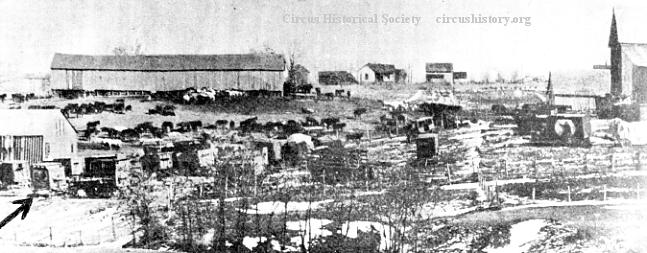
From a study of photographs I have been able to make the map of the farm shown elsewhere in this article. On the front road, which ran into the city of Lancaster, were two horse barns, a mule barn, a wagon and horse barn, and the famous big three storied barn for horses, elephants, canvas, and wagons. The big barn's top floor was for tents, second for wagons, first for horses, and the basement for elephants. It may seem odd that the wagons were stored on the second floor, but this was possible because of the sloping terrain of the area. A rather steep hill came down directly behind the row of front buildings; thus making what was the first floor on one side the second on the other and visa versa. The big barn was also a winter home for razorbacks and elephant men around the farm. In 1923 a training ring was installed in the barn.
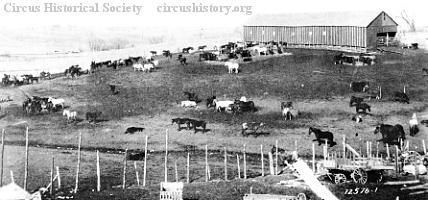 Great picture of the big horse barn in the rear of the farm in the late 1920's or early 1930's. This picture is doubly valuable for it gives an excellent idea of the terrain of the Lancaster area. In earlier days, wagons were stored out in the open along the picket fence in the front of the picture. P. M. McClintock Collection.
The big horse shed was up on another steep hill in back of the farm. One other horse barn was in the rear of the farm down the hill. In 1946 all the buildings except the front horse and wagon barn were torn down by William P. Hall, Jr. A home now stands where the big barn was, but bull rings can still be seen on the concrete floor behind the house.
About a half mile northwest of the farm the less elegant wagons and railroad cars were stored out in the open. Most of the good wagons were stored in and around the two big buildings on the front road. Nothing remains of the railroad siding today.
The entire farm consisted of 160 acres, most of which was used as grazing pasture for the more than 2,000 horses that roamed the farm.
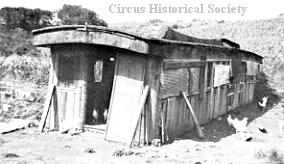 Classic picture of the old Yankee Robinson advance car used as an office by William P. Hall. By the time this picure was taken in 1954, the car had been moved down the hill behind the spot where the buildings had formerly been. As can be seen in the picture, the advance car is now used as a chicken coop. J. Beardsley Collection.
Of particular interest to historians was Hall's office. It was an old advance car purchased from Fred Buchanan in 1913. This car, which was used on Buchanan's Yankee Robinson Circus, was reputed to have been part of Lincoln's funeral train. But, by comparing pictures of the Lincoln train and the advance car it can easily be seen that the Robinson car was definitely not part of the President's funeral train. A huge carved elephant adorned the top of the car. The office was between the big barn and the big horse and wagon barn along the front road. The car still remains, but has been moved down the hill and is now used as a chicken coop.
William P. Hall, Jr. still owns the farm and leases parts of it. The federal government rents two acres for storage bins. Mr. Hall, Jr. works for the Missouri Highway Department and commutes between Lancaster and St. Louis.
Now that the reader has an introduction to William P. Hall's life, I will attempt to cover the circus phase of it. Regrettably, this section will be very incomplete and possibly even inaccurate. Naturally Mr. Hall sold literally thousands of horses to various circuses, carnivals, etc. over the years that will never be recorded. This narrative will try to cover all known transactions that are of some importance in regard to the history of the circus. For this reason all known deals involving elephants have been included.
It is a shame that our departed member, Col. William Howard Woodcock, is not still with us as he knew much more about the Hall Farm and circuses in general than I. He was in Mr. Hall's and the Hall family's employment on and off from 1925 to 1935. His son, Buckles, was born in Lancaster. Most of the notations in this section indirectly came by way of the late Col. Bill.
Hall's first connection with circuses was in 1904 when he purchased two camels, Duke and Mary, from the Carl Hagenbeck show at the St. Louis World's Fair. Hall was at the fair to deliver his horses to the Boer War show.
After the fair, the Boer War Show was taken into Lancaster for the winter. It went out on rails in 1905. Hall may have been one of the St. Louis businessmen who had an interest in the show since it wintered in his quarters.
Although the Boer War Show had a successful 1905 tour, the show did not take the road in 1906 because of quarreling between the Dutch and English soldiers in the troupe.
In the fall of 1904 William P. Hall purchased his first circus. It was the old Harris Nickel Plate show that had gone broke in Sebree, Kentucky on August 28, 1904. Hall bought the circus from Charles C. Wilson, W. H. Harris's son-in-law, who had been managing the show since the death of Harris in 1901.
The Harris Circus was held by Hall less than two weeks when he sold the ten cars of equipment to M. S. McGrew, who was an intermediary for the Schiller brothers, Robert and Richard. The Schillers took the Harris show out as the Cook and Barrett Circus in 1905. The show was organized at Lancaster and spent the winter of 1905-1906 at the Hall Farm.
An enlarged by six cars Cook and Barrett Circus started the 1906 season. At mid-season the show folded and was sent back to Lancaster where it was reorganized. Hall obviously picked up the mortgage on the Cook and Barrett Circus at this point. The show was soon sold to the firm of Weaver, Cannon and Gun, all employees on the Cook and Barrett show. The new Cook and Barrett Circus left Lancaster on July 21, 1906.
Weaver and company couldn't make a go at the show either, and the property was back in Lancaster in Hall's hands by 1907.
Early in January of 1905 Hall bought the twenty-five car Walter L. Main Circus. Hall acquired all of the show except the baggage stock and the elephants, both of which were sold to the newly formed Carl Hagenbeck Circus.
The first negotiations with Main took place at the "auction" of the Forepaugh Sells Circus in Columbus, Ohio on January 10, 1905.
Floyd King recently gave me this classic description of the proceedings. I don't know if it is true or not, but it certainly reflects the attitude of showmen in the early 1900's. Mr. King writes, "Late in 1904 ads started appearing in the Billboard saying the Forepaugh Sells Show was for sale and in January of 1905 it went on auction at Columbus, Ohio. Big and little circus men from all over the country were there. Included in this group were Walter Main and William P. Hall. When the auction started the auctioneer said, 'Does anybody want to buy the whole show?' Well, James A. Bailey did, and he bought the whole works without having anyone bid against him. All the other showmen knew Bailey could top anything they could bid.
Soon after the sale Hall and Main got to talking. Hall said to Main, 'Hell, I came up here to buy some equipment and now there isn't anything to buy.' Main then told Hall something like, 'I've got a pretty good show up in Geneva, Ohio and maybe we can work something out.' Now old Pumpkin Main was about as slick as they came and he thought Hall was just some dumb farmer with a little money. Hall worked out a deal in which he would pay Main $10,000 down on the circus. Walter figured Hall would never come up with the rest of the money, which amounted to about $20,000. Old Main never thought he would see Hall again, and that he could just pocket the down payment and make $10,000.
Well, a couple of days later, much to Main's surprise, Hall showed up at the Geneva quarters with the rest of the money. Walter told William P. Hall that he had decided not to sell his show after all. Main went to see his lawyer, but the lawyer said, 'Walter, you dumb SOB, you sold the show when you took the down payment. This man is here with the rest of the money and you can't back out.' Hall undid his money belt and the Walter L. Main Circus became the William P. Hall Circus."
As Mr. King said, Hall used the Main equipment and his own horses and elephants to form his only circus, The Great William P. Hall Shows - Double Menagerie - Colossal Circus - Elevated Stages and Real Roman Hippodrome. The equipment was shipped from the Main quarters in Geneva, Ohio, to Lancaster on April 4, 1905 and the show opened in Lancaster on May 6, 1905.
Some key positions on the Great William P. Hall Shows included: W. P. Hall, sole proprietor; Phil Ellsworth, manager; W. R. Musgat, head of advance; W. R. Rice, auditor; Ben Hall, treasurer; Al G. Gilligham, privileges and legal adjuster (an interesting combination); R. J. Parvin, Jr., press representative; Tom Fay, boss canvasman; Tom King, boss side show canvas; Whitey Lykens, boss hostler; Mark Monroe, boss animal man; Frank McCormack, lot superintendent; George Atkinson, concert manager; Will Coxey, superintendent of lights and announcer; Charles Mitchell, train master; J. F. Brennan, general agent; C. R. Coleman, manager of the advance car; Prof. Mayo, equestrian director; and Bert McLain, chief ticket seller.
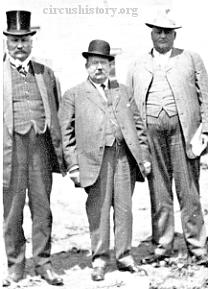 Priceless photo showing, left to right, William P. Hall, Ed. L. Brannan and Bert McClain behind the big barn in about 1915. Brannan later was the general agent for the ill-fated Campbell, Bailey and Hutchinson Circus and the Robbins Bros. Circus, McClain had been associated with Hall since the Great William P. Hall Circus days in 1905 when he was head ticket seller on the show. Burt Wilson Collection.
This was the start of a life long association with Hall for Bert McLain. After the Hall Circus days, McLain worked at the Hall Farm until after the Colonel's death as the head horse buyer.
The New York Clipper for June 17, 1905 had a partial list of performers on the William P. Hall Circus. They included: the St. Leons, acrobats; Orrin Hollis, bare back rider; Kitty Kruger (the future Mrs. Otto Floto), equestrienne; the DeNova Family, aerial act; LaBelle Leona, four horse rider; Bert Mayo, and Burns & Burns, slack wire; and the Millette troupe featuring Master Millette, the original boy wonder.
Those having access to the July 8, 1905 New York Clipper can see a complete roster of the Hall Circus along with rosters of most other circuses.
After the Lancaster opening, the show moved on to Iowa and Illinois and then swung back into Missouri. After playing in Hall's home state the show headed west into the Oklahoma Indian Territory and Kansas. It then returned to Iowa and Missouri. The show closed where it began, Lancaster, on August 30, 1905.
Although the show reported good business early in the season, receipts tapered off as the tour progressed. The show train was involved in a wreck, the tent was blown down at least twice, and the stock was rebellious. As evidenced by the relatively early closing, the whole venture turned out to be a dismal failure.
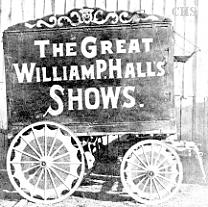 The only known photo of a lettered wagon used on the Great William P. Hall Circus in 1905. This picture was used to advertise the wagons for sale at the farm in about 1907. Original cabinet photo in Richard E. Conover Collection.
Hall would never admit the show had lost money, but his associates said it did. It has always been generally agreed that the 1905 tenting season was a poor one, especially in the central states due to a crop failure.
Hall didn't travel with his show during the entire tour. One occasion was reported in the Clipper of July 22, 1905. It reported that Hall had left the show to go to his farm to oversee the shipping of 2,000 head of horses to South Africa.
When he was with the circus he always rode in a special boss car. It was reported in the Kansas City Star, April 2, 1933, that Hall took his wife with him on the show - to keep the books.
The Great William P. Hall Circus never trouped again, although references to the show going out in 1906 "bigger and better than ever" appeared in the trade journals over the winter of 1905-1906.
The Hall Circus and the Cook and Barrett Show were to be combined after the 1905 season, but this deal fell through, probably because the Schillers couldn't come up with the money. Had the Cook and Barrett and Hall Circuses combined the result would have been one of the finest thirty-five car shows ever to take the road.
As it turned out, some of the W. P. Hall Circus was sold to the Schillers. Six cars of equipment from the Hall Circus were used on the Cook and Barrett Circus in 1906. The new equipment brought the size of the Cook and Barrett Circus up to sixteen cars in 1906. Some of the equipment that was not sold to the Schillers was sold to the Smith Greater United Shows Carnival. The remainder of the property stayed at the farm and was leased out during the subsequent years.
In the Billboard of January 28, 1905 is a notation that Hall had purchased a thirty-two whistle calliope from Andrew Downie. However, in 1905 the Downie Circus was still in the dog and pony class and wouldn't have had a calliope of the thirty-two whistle size. Probably the Billboard reference was exaggerated, or completely false.
Starting in 1906 and continuing until the final season in 1913, Gordon Lillie leased four elephants for his Pawnee Bill and Two Bills Wild West Shows.
Hall was continually selling horses to circuses. One of the few specific examples was in 1908 when he sold 100 head of horses to Ben Wallace. Hall and Wallace were great friends.
In 1909 a Louisville, Kentucky saloon keeper, Ed Beaumister, decided he wanted to own a wild west show. Early that year he went to the Hall Farm and leased ten cars of equipment. Beaumister's offering was titled Cherokee Ed's Wild West. Floyd King, who was with the show, remembers seeing the old Harris Nickel Plate title on some of the wagons. A heavy grafter, the Cherokee-Ed show failed at mid-season and was shipped back to Lancaster.
In July of 1909 John H. Garnett's Rice Bros. Circus went on the auction block in East St. Louis, Illinois. Hall was there and definitely acquired the show's two elephants, Gyp and Pollock, and two lions. He may have purchased a couple of tableaus from the show.
The year 1909 probably marked Fred Buchanan's first purchase of property from William P. Hall. We definitely know Buchanan bought the old Cook and Barrett bandwagon sometime before the 1910 season and the winter of 1909 is the most logical date, although it is quite possible Buchanan used some Hall cars when he switched his Yankee Robinson Circus from mud to rails in mid-season 1908. The tableaus off the Rice Bros. Circus may have been purchased at the same time as the Cook and Barrett bandwagon, but we do not know for certain if Buchanan bought the Rice tabs from Hall or from another source. This was the first known deal of a large number of mysterious ones between Col. Fred and Col. William.
Hall swung his biggest deal of the year in the fall of 1909. From the firm of Frank Smith and A. O. Perry he purchased the old Lemon Bros. Circus. Perry and Smith had acquired the Lemon show the previous February.
In 1910 Hall traded some baggage stock to the John Robinson Circus for two elephants, some other animals, and one of the famous Robinson cottage cages. According to Richard E. Conover in his excellent book, Give 'Em a John Robinson (Conover, 1965), "the cage never toured again and rotted down at the Hall Farm." One of the elephant's names was Tommy.
The same year Albert Monroe Cauble decided it was time to enlarge his little circus. He went to the Hall Farm for equipment. Hall sold Cauble a little punk called Baby Bill and some other property. Baby Bill became a white elephant on the Cauble Circus, a la Adam Forepaugh. Mr. Cauble had the following interesting and informative comments about Baby Bill and Hall in the January-February, 1962, Bandwagon. "Baby Bill was a spoiled brat, and he would not let anyone feed or care for him except one roughneck and myself. Bill was happy when one of us was near, but if we walked away he would carry on something awful! I sent Hall word about what trouble Bill was giving me and he sent word back to return Baby Bill and he would let me have any bull in the barn.
When we arrived in Tupelo, Mississippi, we gave the railroad company a lot of grief. I wanted heated transportation for Bill and the rates were three times first class for elephants, crated or uncrated. As it was against the law for anyone to ride in the baggage car, they would not allow me to ride with my baby. They decided to crate him as they could not furnish a heated car for anything less than 300 pounds. I told them Baby Bill would not live through the night away from me, so they might as well knock Bill in the head and give me four thousand dollars. We kept them waiting eight hours wiring the big shots of the road, but finally they loaded Bill and me into the baggage car. I loaded milk, cheese and crackers for food, hay and blankets for bedding, and soon we were on our way and sound asleep."
Mr. Cauble said he would never forget his arrival in Lancaster, Missouri. He continued, "It was eleven o'clock at night and cold as the devil, so you can imagine my surprise to see W. P. Hall, himself, at the station. He had his car and driver there and ordered me to turn Bill over to the boys and get into his car. It was hard for me to turn it down, but I persuaded him to let me stay with the baby until I had bedded him down in a warm, comfortable place. He handed me a quart of Yellow Stone liquor and said that he would see me the next morning." Hall must have been quite a person to go to the trouble to assist Mr. Cauble, considering Diamond Bill had no chance of making a profit from Cauble's visit.
After the failure to make the show go with a big parade, the Norris and Rowe Circus went bankrupt and was sent to the Wallace Circus Farm in Peru, Indiana for auction. This auction turned out to be the biggest gathering of circus men since the 1905 Forepaugh Sells auction. Most of the equipment was purchased by Ben Wallace and William P. Hall. The horse king bought the three big tableaus of the show, a battleship tableau (possibly off the John Robinson Circus, see Give 'Em a John Robinson, pages 64-65), cage No. 31, the elephants, Hero and Dutchess, and some other animals. The big auction took place on June 18, 1910.
The big male elephant, Hero, was either leased or sold to the Lucky Bill Wagon Show in 1911 by Hall.
In 1911, A. M. Caubte returned to the Hall Farm to purchase the elephant Tommy along with some other animals. Tommy was one of the bulls Hall had acquired in the trade with the John Robinson Circus the previous year. This elephant died on the Atterbury Circus in 1919.
Wade H. Coulter brought his wagon circus, Coulter and Coulter, into the Hall Farm after the 1910 tour. Coulter purchased six flats, four stocks, three sleepers and an advance car from Hall that winter and took it out as the W. H. Coulter Circus in 1911.
Coulter, who had been an agent on the Lemon Bros. Circus in the 1890's, started the management business in 1907 when he and Wade Clark had the Coulter and Clark wagon show. The title was the same in 1908, but after that season Coulter bought out his partner, in 1909 and 1910 the show was the Coulter and Coulter Wagon Circus. When Harper Joy visited the farm in 1933 he noticed a Coulter and Clark wagon. This could mean some of Coulter's earlier ventures were organized or wintered at the Hall Farm.
Bill Woodcock once told Richard E. Conover that William Hoogenwoning, Woodcock's brother-in-law, was the angel of the 1911 Coulter Railroad Circus. This is correct because of a note in the Billboard of June 13, 1911 that states Coulter had bought out Hoogenwoning's share of the Coulter Circus.
The 1911 W. H. Coulter Circus opened in Lancaster, Missouri on April 29, and on July 26 was combined with the Boyd and Culbertson owned Indian Pete Wild West Show, a ten car outfit. Hall was probably not involved in this transaction. Most of the Indian Pete equipment was built by the Beggs Wagon Company in Kansas City.
After the Coulter-Indian Pete show finished the season early in September, the show went into winter quarters in Lancaster.
Hall, always in the market for elephants, bought two bulls from Jerry Mugivan early in 1911. He immediately sold them to Tom Wiedamann along with some baggage wagons, a pair of flats, a camel and eight head of baggage stock for the first season of the Kit Carson Buffalo Ranch Wild West.
The Bulger and Cheney Circus, out of Sparta, Wisconsin, purchased four car loads of parade equipment and some ring stock from Hall in April, 1911. As were most of the shows using Hall show equipment, the Bulger and Cheney was a one year circus. The firm of Barrett and Zimmerman acquired the show after the closing, but it appears the Bulger and Cheney Circus finally ended in one of William P. Hall's barns.
The Bulger and Cheney case brings up an interesting point that Floyd King recently elaborated on. He told me how Hall acquired so many shows. He said that when Hall leased horses or elephants to a show he would ask for the mortgage on the whole show to back up the difference between the down payment and the final balance. Mr. King remembered that Charlie Sparks was almost trapped into giving a mortgage on his two car show to Hall when he leased some horses from him. But, Mrs. Hall told William just to take Charlie's word on the rest of the money. By getting the mortgage on a circus, Hall would acquire the mortgage on a dollar's worth of equipment for leasing a dime's worth of animals.
The idea of picking up the mortgage on the show must have been a common practice. When Mr. King was framing his never-to-be-forgotten railroad circuses in 1925, he leased some equipment from the American Circus Corporation and gave them the mortgage on his complete show to back up the down payment.
William P. Hall reached his peak in the circus world in 1911 when he came very close to buying the big fifty car Forepaugh Sells Circus from the Ringling brothers. The information for this comes from a hand written letter from Hall to Charles Ringling dated October 10, 1911. My father now holds this valuable document. The letter reads: "In regard to show property, what will it take to buy me Forepaugh Sells. Show as it stands today - if the price was right, so I could see it out, I might buy it. I do not want to run any show. I would only buy to sell again. If you care to send me an itemized (sic) statement of it with price. I will not give my price away if I do not trade with you. Yours truly, W. P. Hall."
The deal went as far as having a contract drawn up. The original contract is now in the collection of S. O. Braathen. Obviously this deal did not go through. Mr. Braathen also has a letter in which Hall wanted to trade some land for the Forepaugh Sells Circus.
As near as I can determine, Hall purchased no equipment used on the Forepaugh Sells Circus directly. Parts of the Forepaugh Sells show were transferred to the Ringling Circus in 1912 and some equipment was. sold to Andrew Downie and Fred Buchanan.
The letter to Charles Ringling is doubly important because it disproves that Hall was illiterate, a fact that had been generally agreed. It does prove, however, that Hall couldn't have passed the Oxford Scholarship test.
In 1912 the Coulter and Indian Pete Show left the Hall farm as Cole Bros. Al. G. Campbell was now Coulter's partner. It was the same show that came into Lancaster after the 1911 tour with the addition of sixty head of Hall horses.
The Cole Bros. Circus opened in Lancaster on April 27, 1912 and closed in Siloam Springs, Arkansas on November 2, 1912. The show was brought into Lancaster for the winter, where Hall repossessed it. The Billboard of December 29, 1912 gives the last rites of the Cole Bros. Circus.
A minor deal in 1912 occured early in the year when Hall sold the elephant, York (later Babe) to the Toledo, Ohio, Zoo. York was an old circus bull, but regrettably I know nothing about her early life.
Early in 1913 William P. Hall acquired the twenty-six car Campbell Bros. Circus from a Fairbury, Nebraska, bank. There are some reports in the Billboard late in 1912 stating Al. G. Campbell purchased the Campbell Circus, but evidently was just the usual Billboard chatter.
Al. G. Campbell, Fred Hatfield, and Lee Greer took out a fifteen car show with Hall equipment titled Cole Bros. This circus had no connection with W. H. Coulter's Cole Bros. Circus in 1912. The 1913 show used mostly equipment off the 1912 Campbell Bros. Circus and possibly some property from the 1912 Cole circus.
The 1913 Cole Bros. Circus had an unsuccessful season and was back in Lancaster after the season.
On July 22, 1913 the Buffalo Bill-Pawnee Bill Wild West Show went bankrupt in Denver, Colorado. The show was auctioned off at the winter quarters of the Sells Floto Circus. Hall was there to repossess his four elephants, which had been on the Gordon Lillie's shows since 1906. Hall may have purchased the bandwagon used on the Two Bill Show in a special parade unit in 1913. Hall also may have purchased the Sells Floto Rhino wagon while in Denver. The Sells Floto Circus was in Canada during the auction and the Rhino Tableau would have had to have been left behind that season. This sale is probably the most logical time Hall acquired the wagon. For those interested, a history of the Rhino wagon appears in the January-February, 1966, Bandwagon. Sig Sautelle and his partners, George Rollins and Oscar Lowande, decided to put the Sautelle wagon circus on rail in 1913. They went to the Hall Farm and purchased twelve cars of property. Probably the two finest pieces of parade equipment included in the sale were the old Walter L. Main calliope and a small tableau used on the W. H. Coulter Circus in 1911.
Sometime in 1913 the Miller Bros, and Arlington Wild West Show purchased the three big Norris and Rowe tableaus from Hall. The May-June, 1957, Bandwagon has a history of one of these Norris and Rowe tableaus.
One other event happened in 1913 that merits mention. Floyd King told me that when he worked for the American Circus Corporation he remembered typing out a letter to Hall inquiring about buying a large number of horses - to replace those lost in the infamous 1913 Indiana flood.
About this time Fred Buchanan purchased the Norris and Rowe elephant, Dutch, from Hall. Again I apologize for the lack of information on elephants, but as the reader can easily surmise, I am not an elephant historian and can not use logic in elephant matters.
Late in 1913 Fred Buchanan entered into the first of three extremely mysterious deals with William P. Hall. In the Billboard of November 29, 1913 appears an item stating that Buchanan had sold Hall his old equipment. The only two pieces of equipment I have been able to identify in this deal are the previously mentioned advance car and the old bandwagon used on the Yankee Robinson Circus. It seems certain, however, that much more equipment was involved in the deal.
Hall bought two fairly large shows in 1914. The first one was the Sig Sautelle Circus. The 1914 season had been a poor one for the Sautelle show. On August 1, 1914 Sautelle and associates sold out to Louis D. Thilman. Thilman couldn't make the show go either, and the Erie Lithograph Company took over the Sautelle Circus. The Erie firm put the show on sale and on October 22, 1914 William P. Hall bought back the circus that had been organized at his farm the previous year. Hall did not buy the Sig Sautelle title, however. Old Signor held on to the rights to his monicker.
The other show acquired in 1914 was Vernon C. Seaver's Young Buffalo Wild West. Hall got all of the show's property except the railroad cars. Included in the equipment was the old Sells Bros, shell band chariot and the three fine parade tableaus.
In the early part of 1914 Al. F. Wheeler purchased some equipment from Hall for his Wheeler Bros. Circus.
One other event of some importance centered around the Hall Farm in 1914. That season George H. Embree and Art Eldridge attempted to reincarnate the W. H. Coulter Circus out of Lancaster. Wade H. Coulter had been dead since February 1, 1913. After the preparations for the show were completed, Hall decided he didn't want to lease the equipment and the deal fell through.
In the probable, but not certain class appears another circus in 1914. It is most likely Hall leased or sold some equipment to the Gillespie Wagon Circus that year. The equipment ended up in Lancaster after the season. There was a small Gillespie circus in 1909, and it is possible that was the year that Hall acquired the show.
In January, 1915, J. H. Eschman and D. C. Hawn purchased some equipment from Hall. The Billboard of February 6, 1915 reports they bought a fifteen car show, but this is incorrect since the Eschaman Circus was on only seven cars in 1915. The only identifiable piece of parade equipment in the sale was an old Young Buffalo mirror tableau.
The year 1915 was a big one for the Hall Farm. That year Thomas F. Wiedemann and John A. Barton leased seventeen cars of equipment from Hall and put it on the road as Barton and Bailey World Celebrated Shows. This circus was the largest ever framed at the Hall Farm. Barton and Bailey opened at Lancaster and headed north into Nebraska and then west where the show ran into flood trouble. It closed in late July and was shipped back to Lancaster.
In 1915 a circus titled Cole Bros, left Lancaster for the third time in four years. This one was owned by the firm of Eldridge and Dickey. The Cole Bros. wagon show opened in Lancaster with a reported "sixty wagons, three elephants, ten miniature cages, one hundred and forty head of baggage stock, and forty-five head of ring stock." A reasonable figure could probably best be reached by cutting the above listing by two-thirds. The show failed and Hall put it back in his barn at the end of the season.
At mid-season 1915 the Hugo Bros. Circus acquired some of the equipment Hall had leased to the Barton and Bailey Circus earlier in the season. The Hugo Bros. Circus became the nucleus for the Coop and Lent show the next year.
In 1915 George Rollins, who had been connected with the Sig Sautelle failure in 1914, purchased an animal act and a pair of elephants from Hall. Rollins used the animals for a vaudeville act.
About this time R. Z. Orton purchased the elephant, Juno, from Hall. Juno returned to the farm after the failure of the Orton rail show in 1916.
In my research for this article I could find only two examples when a showman purchased equipment from Hall to enlarge a show, not to frame it. One of these was in 1911 when Tom Wiedamann bought some equipment and the other was in 1915. That year J. A. Jones purchased two tableaus, three cars, some cages, and an elephant from Hall. The equipment was used on the Jones Bros. World Toured Shows. An old Campbell Bros, cross cage is the only wagon I have been able to identify in this deal.
Rhoda Royal bought two small elephants from William P. Hall for a vaudeville act in 1915.
Con Kennedy and John Backman visited the Hall Farm in 1915 and probably bought some elephants and some other animals. This deal, along with the Royal and Rollins ones, is an example of the type of transactions that I am sure happened dozens of times without being recorded.
Hall had many dealings with carnivals. One of the first was over the winter of 1914-1915 when the Allmann Bros. Carnival wintered in Lancaster. The Allmann show probably spent some other years at the Hall Farm. Sometime before 1921 Hall acquired the show.
Unlike his circus dealings which are all fairly definite. Hall's carnival transactions are surprisingly vague. Sometime before 1933 the Litts Carnival and Heinze Bros. Carnival were purchased by Hall. I know nothing more about these two shows.
Sometime between 1921 and 1933 the Gifford Bros. Carnival leased some Yankee Robinson railroad cars from Hall. The cars returned to the farm, as probably did the rest of the Gifford equipment.
Hall acquired a Rice Carnival sometime before 1921.
In 1914 the World War started and by 1915 all the European powers were involved. Hall sold horses to the allies and more than one source reports that the war made him a very wealthy person.
The year 1916 also brought a great deal of activity to the Hall Farm.
That season R. Z. Orton and family left their usual wagon show in winter quarters and decided to try it on rails. They went to Lancaster and bought thirteen cars of equipment from William P. Hall. I presume most of the equipment purchased by the Ortons had been used on Barton and Bailey the previous year, but we do not have enough pictures of either show to make a definite judgment. The two finest pieces of parade equipment the Ortons bought were the old Sells Bros, bandwagon and the Lemen Bros, calliope.
The Orton Railroad Circus opened in Glenwood, Missouri on April 29, 1916, but from the start the show ran into trouble. Mrs. W. H. Woodcock, whose father owned the show, described the closing this way: "My father didn't keep enough money to back the thing, and with the weather so bad, they closed it July the 4th at Mora, Minnesota. My father bought too big a show." Hall foreclosed on the show and it was sent back to Lancaster.
The never-say-die Ortons then brought their wagon show out of cold storage and continued the season, using some Hall horses.
Art Stark and Art Elridge purchased some of the finest wagons at the Hall Farm and combined the new equipment with the Hugo Bros. Circus to form the Coop and Lent Circus in 1916. They also leased four elephants from Hall.
In 1916 Al. G. Campbell and J. W. Beattie framed a two car show in Lancaster and sent it to San Antonio to open. I haven't been able to determine the title of Campbell's circus. It may have been the Cooper and Robinson Circus of Lancaster, Missouri that advertised in the Billboard in June of 1916. If not, then four circuses were framed at the Hall Farm in 1916.
Bob Parkinson has an ad for a Cooper and Robinson Circus, 1909, that may have had some connection with Hall or the 1916 show of the same name.
Hall swung two big elephant deals in 1916. Early that year he sold the five elephant herd used on the Barton and Bailey Circus in 1915 to Van Leer Black for the big twenty-seven car Wheeler Bros. Circus. The other deal was when Hall sold at least three elephants to Ed Ballard for the Hagenbeck Wallace Circus. When one considers the price of an elephant is about fifteen hundred dollars, it can be seen these two deals involved quite a large amount of cash.
A large sale of property took place early in 1916 to the Wortham Carnival. Included in the deal were at least one of the big tableaus off the Young Buffalo Wild West, and the elephant, Tillie. The bull was sold to the ACC the next year by the Wortham organization.
Sometime after the 1916 season the Wortham show returned to Lancaster and purchased the old Sells Bros. Bandwagon and possibly some other equipment. It also seems logical that the first sale to the Wortham show included more equipment than I have listed.
During the winter of 1916-1917 the Coop and Lent show returned to Lancaster and bought a few more items On May 12, 1917 Hall got a real windfall. On that date three of his elephants on the Coop and Lent Circus were lost in a fire in the stock car. One of the elephants survived the fire. The Coop and Lent show was forced to pay Hall $8,000 for the loss of the animals. To top the deal off, Hall leased two more elephants to the show. They were the famous pair, Jenny and Nellie Lockhart, that Hall had recently acquired from the Ringlings, possibly in a trade for horses. The addition of the Lockhart pair brought the Coop and Lent herd up to three.
After the Coop and Lent show folded at mid-season, the three elephants and Hall's trainer, Al Langdon, were sent to the Cook Brothers Circus, owned by D. C. Cook.
The Lockhart elephants were on the Yankee Robinson Circus in 1919 and probably in 1918.
Hall had no connection with the 1918 Coop and Lent Circus. The elephants on the 1918 show were leased from Rhoda Royal.
In September of 1917 Hall purchased the big twenty-four wagon LaMont Bros. Circus out of Salem, Illinois. The LaMont show was probably the last really first class mud show. The Billboard reported that C. R. LaMont sold out because of poor health and that he planned to rest two years and take out another mudder in 1920. But, the itch got to C. R. sooner than he expected and in 1919 the LaMont Circus took the road again.
Hall leased the elephant, Mabel, to LaMont that year, and probably some other equipment. Mabel was returned after the 1919 season.
In February of 1917 the J. E. Henry Circus purchased the elephant, Toddles, from William P. Hall. She died in November of that year. Hall had acquired Toddles from the Selig Moving Picture Company.
The year 1918 was a slack one, circus wise, for Hall. The only transaction I have been able to find for that year was the purchase of three elephants from the widow of J. A. Jones. J. A. had been killed by a horse kick during the early part of 1918.
The Atterbury Bros. Circus, owned by Robert L. "Uncle Bob" Atterbury, spent the winter of 1919-1920 at the Hall Farm. The show was outfitted with Hall equipment including the famous killer elephant, Diamond.
In the winter quarters list in the Billboard of January 17, 1920 is listed Wild Bill's Wild West & Old Cheyenne Frontier Days Combined, Hall and Roby managers, winter quarters Lancaster, Missouri. The Hall is not William, but a Doc Hall, who may have been part of the Wisconsin clan of Halls. There is some question if the show actually toured.
This question arises because of an ad in the Christmas, 1920, Billboard, giving Yuletide greetings from the Hall and Roby Carnival out of Lancaster, Missouri. One way or the other, I would say the firm of Hall and Roby had a show of some type on the road in 1920. This matter is one of many that should have been resolved before publication.
In 1920 William Newton, Jr. (Honest Bill) bought an elephant, a trained bear and some horses from Hall. Although this is the only recorded deal between Hall and either of the Newtons since 1911, I am sure some others took place in the interim time.
In February, 1920, Hall made another big sale to Mugivan and Bowers. This one consisted of three elephants and one hundred head of horses. The animals were used on the Howe's Great London Circus that season.
A big sale of parade equipment by Hall in 1920 was to Rhoda Royal and D. C. Hawn. The two most elegant items in the sale were the old Great Wallace calliope and the famous Van Amburgh band chariot. After the 1922 season all the Royal equipment disappeared.
Also in 1920 Hall sold the elephant, Texas, to William Newton, Sr. for his Lucky Bill Circus. Naturally, Lucky Bill was the father of Honest Bill. Texas was shot on the Atterbury Circus in 1927.
Al G. Barnes bought the elephant, Mabel, from Hall in 1920. Her name was changed to Jenny by the Barnes show.
That year was one of the biggest for elephant deals at the Hall Farm. Early in 1920 Hall purchased the four elephants used on the R. T. Richards Circus in 1920. They were the same four that were part of the group sold to the Wheeler Bros. Circus in 1916.
The Campbell, Bailey and Hutchinson Circus purchased thirteen pieces of Hall equipment and leased two elephants for the 1920 season. Some great old titles appeared on the equipment sold to the CB&H Circus. Wagons used on Orton, Young Buffalo, Campbell Bros., and Walter L. Main were acquired from William Hall. It is probable there was no interim use of these wagons except for the calliope.
I've always felt that most fans think that two or three shows were framed at the Hall Farm each year. This is completely incorrect. In all, really only about twenty shows were organized or wintered in Lancaster. Of the twenty shows only about ten were above the two-car class.
The winter of 1920-1921 was the busiest of them all at Lancaster. That winter two big and one moderately sized shows were brought into the Hall Farm.
It all started when William P. Hall bought the twenty-five car Yankee Robinson Circus from Fred Buchanan. At this point a number of historians will charge that Mugivan and Bowers, not Hall, purchased the Yank show. I am well aware of this generally agreed "fact" that appears in print in the September-October, 1964, Bandwagon. To back up my claim, I refer them to an interview with Jerry Mugivan in 1921 in which he said, "We bought from William P. Hall, Jr., the Yankee Robinson Circus." Why Hall's son's name was used, I do not know, but still the fact remains that it was from one of the Halls that Mugivan acquired the Yankee Robinson Circus. From a usually reliable source comes the information that Hall purchased the Yankee Robinson Circus from Buchanan on November 11, 1920. Unless some new information is discovered, I will be of the opinion that Hall, not Jerry Mugivan and Bert Bowers, bought the Yankee Robinson Circus from Fred Buchanan.
That same winter Mugivan and Bowers brought the fifteen car Howe's Great London Circus into Lancaster instead of the usual winter quarters in Peru.
In a prearranged deal Hall sold a large amount of the Yankee Robinson equipment to Mugivan and Bowers. A few pieces of property from the Howe's Great London Circus may have been sold to Hall. The Yankee Robinson equipment, along with some off the 1920 Howe's Great London show, were combined to form the twenty-five car Howe's Great London Circus in 1921.
The third show in Lancaster during the winter of 1920-1921 was the Palmer Bros. Circus. The owners of this show were Doc Palmer, John Backman and Al Tinish. The latter two had the Backman and Tinish Circus on the road in 1920 and there is some question whether it was brought into Lancaster or the regular quarters in San Antonio after the season. The Backman and Tinish offering was only a two car outfit and it really isn't of too much importance which one the show went into that winter, although San Antonio seems a little more likely.
Some of the equipment that Mugivan and Bowers didn't get was sold to Backman and company by Hall. The show, titled Palmer Bros., was framed at Lancaster and sent to San Antonio, Texas, to open.
Some of the Buchanan property was held by Hall and not sold at that time. Some was later leased to the Gifford Bros. Model Shows Carnival. A few pieces of equipment may have even been sold back to Buchanan when he returned to the circus game in 1923.
The Howe's Great London - Yankee Robinson deal was the last big one between the American Circus Corporation and William P. Hall.
Two minor elephant deals occurred at the Hall Farm in 1921. One of them was the acquisition of the elephant, Jap, from the Ringling-Barnum show. Jap was soon sold to Honest Bill Newton.
The other transaction in 1921 was when Hall sold the elephant, Burma (original name, Virginia), to Louis Ruhe, another leading elephant importer, who in turn sold the bull to the John Robinson Circus.
The Campbell, Bailey and Hutchinson Circus spent the winter of 1921-1922 at the Hall Farm and left there in 1922 with one more bull leased from Hall than the year before. The season of 1922 was the last for the CB&H Circus. The elephants were returned to Hall after the season, but the wagons were never in Lancaster again.
The Honest Bill and Lucky Bill Show spent the winter of 1922-1923 in Lancaster instead of their usual quarters in Ada, Oklahoma.
The Billboard of January 13, 1923 has the details of an interesting agreement concerning the Honest Bill and Lucky Bill Show. "Honest Bill has sold the Lucky Bill Show property to A. B. Campbell, who in conjunction with his brother (probably Al G. Campbell), will operate it under the title of Campbell Bros. Shows. It will be an overland (mud) circus." The Billboard is at its gossiping best in this issue. It turned out the Lucky Bill and Honest Bill Overland Circus toured as usual that year, but both Newton, Jr., and A. B. Campbell were listed as the owners.
A Campbell Bros. Circus did tour in 1923, but neither Hall or the Newtons had any connection with it.
In 1923, after spending the previous year as manager of the James Patterson Circus, Fred Buchanan returned to the ownership field with his World Bros. Circus. Even though the show was framed at the Buchanan quarters at Granger, Iowa, some equipment came from Hall. This property did not include any railroad cars. The three elephants leased to the Campbell, Bailey and Hutchinson Circus in 1922 were leased to Buchanan the next season and remained on his show until 1926.
The rest of the parade equipment used on World Bros, was either built new for the show or purchased from the Ringlings.
After the 1923 season World Bros. came into the Hall Farm instead of the usual home at Granger. I have no answer as to why this move was made, however, Ben J. Kubly, who was with the World Bros. Circus part of the 1923 season, advises why he thinks Buchanan took World Bros, into Lancaster. He writes, "I don't know the real reason for taking World Bros, into Lancaster in 1923, except perhaps it could be that William Hall's Farm was better equipped to work over the equipment and paint and letter all the wagons and train from World Bros, to Robbins Bros, for the 1924 season."
The World Bros. Circus, enlarged a bit with Hall railroad cars, opened in Lancaster as the Robbins Bros. Circus on April 26, 1924. The next winter Buchanan took his show into Granger.
In March, 1925, A. O. Perry purchased thirty wagons from William P. Hall and put it on the road as Perry Bros. Way back in 1909 Perry had sold the Lemon Bros. Circus to Hall. I have always thought the equipment used on Perry's show was off the Coulter and Coulter wagon show that was deposited at Lancaster after the 1910 season. The little bandwagon used on the Perry Circus first appeared on the Indian Pete Wild West in 1911.
After the circus failed, Perry put it in his barn in Dannebrog, Nebraska for the next three seasons and returned it to the road as Camel Bros, in 1929. The equipment was finally sold to Jimmy Woods.
In his unsuccessful attempt at a railroad circus in 1925, Frank J. Taylor, Jr. purchased some railroad cars from William P. Hall and leased two elephants from him. The cars never returned to Lancaster, but the bulls were returned to Hall after the season. In those days an elephant was a pretty expensive item, especially for a small circus.
In 1925 Hall bought five baby elephants from Louis Ruhe. The next year six more punks were purchased from Ruhe.
William Hall purchased the elephant, Major, from the American Circus Corporation controlled John Robinson Circus in 1925. The ACC sold him because of an injury to his foot in 1924. Major holds the lofty position of being the first elephant ever owned by the firm of Mugivan and Bowers. Like most males, Major turned bad and was executed on the Cole show in February of 1936.
The case of Major brings up an interesting point. A number of Hall elephants were either cripples or bad ones. In an interview in 1944 Spencer Huntley, who worked at Lancaster, confirmed this fact when he said, "A fellow in Lancaster, Mo., would buy the outlaws nobody else would have. Then we'd work over them and kind of straighten them out. In the summers we'd rent them out to circuses and carnivals." The list of bad bulls owned at one time by Hall is headed by the infamous Black Diamond.
Hall acquired another elephant from the American Circus Corporation in 1926. This bull, Toto, was a tough young male that had been leased to Heritage Bros. Circus in 1926 by the ACC. After Mugivan and Bowers had the Heritage show back in Peru, they sold Toto to Hall. Toto was to be sold to William H. Woodcock in the fall of 1927 but the elephant died before Woodcock took charge.
In 1926 Hall bought the big bull, Bingo, from the Overton Park Zoo in Memphis, Tenn. Hall soon sold him to Fred Buchanan for his Robbins Bros. Circus.
Leo Crook and Arthur Hoffman leased four elephants from Hall for the Cook and Cole Circus in 1927. In this herd were two famous elephants, old Major and Boo. Boo was originally Baby Baraboo on the Ringling Bros. Circus in 1903. She was sold to Hall about 1917, along with the Lockhart pair. When the Cook and Cole show closed after playing twelve dates, the four bulls were shipped back to Lancaster.
In 1927 and 1928 the Orton Bros. Circus leased two elephants from Hall. Sometime before this date the Ortons purchased the old elephant, Jenny Lockhart, from Hall. The Orton herd was three elephants in 1927 and 1928. After the 1928 season the two leased elephants were returned to Hall, and Jenny Lockhart died in December of 1928.
Hall purchased the elephant, Burma, from the E. E. Coleman Circus in 1929. Hall leased her to the Gordon Bros. Circus in 1930.
In 1929 the Miller Bros. Wild West Show reached the big time by playing the Chicago Stadium. Hall sent nine bulls under the direction of Bill Woodcock to Chicago for this one stand. The Hall elephants, along with the Ranch's herd of four, brought the total number of elephants at the engagement to thirteen.
Though it would appear Bill Woodcock was the head elephant man at Lancaster at this time, George Stretch was in charge of the Hall herd in the late 1920's and early 1930's. Over the years many famous elephant men worked at Lancaster. Besides Woodcock and Stretch, Al Langdon, Spencer Huntley, Jack Lorenzo, Bernie Houston, C. H. (High Pockets) Baudendistel, and Elvin (Sheriff) Walsh all worked elephants for the Colonel over the years. Langdon and Baudendistel are still alive with the former living near Chicago and the latter near Los Angeles.
The biggest show to be deposited at the Hall Farm since Yankee Robinson was the Buck Jones Wild West in 1929. The show was framed in California and was sent to Lancaster after its failure. I asked William P. Hall, Jr. why the Jones show came into his father's farm and he had this reply: "After the show folded it came into Lancaster supposedly to quarter. When it became obvious the show was broke, Dad had to take it over." I do not know how long the Buck Jones show was at the Hall Farm before Hall picked up the mortgage, but I would assume it wasn't too long.
In 1930 when Sam B. Dill was framing the Gentry Bros. Circus at West Baden, Indiana, he leased three Hall elephants and some other animals for the duration. In 1931 Dill rented three more elephants from Hall for his Robbins Bros. Circus. The title had been changed because of trouble with the Gentrys. At mid-season 1931 three of the six were taken off the show. Sam Dill's Circus, now bearing his name, leased the same three bulls for the 1932 tour, but they were finally returned to Lancaster after the season was completed.
Two of the Dill elephants were soon sold to the Snake King in Brownsville, Texas.
One of the strangest events of all happened at the farm after the 1930 season. For some reason Fred Buchanan's Robbins Bros. Circus came into the Hall Farm for the winter, just as he had done in 1923. William P. Hall, Jr. had this comment on the Buchanan matter: "My father had no interest in the Robbins Bros, show when it came into quarters at Lancaster in 1930. It is possible that Fred Buchanan owed him money for some horses or something like that. I suppose the reason it wintered in Lancaster is that we had the room and would make some money on the wintering, and it would be convenient to deal with Fred Buchanan - sell him horses, animals, etc. I think Fred Buchanan was hard up and looking for something like that. He wouldn't have to advance too much money for a while." Mr. Hall's conjecture seems valid since there are some reports indicating that Hall did send Buchanan some money to get Robbins Bros, back from the West Coast. It could be possible that Buchanan owed too much money in Granger and would be greatly to his advantage to steer clear of Granger. The Robbins Bros. Circus was not even in the state of Iowa during the 1931 season.
It is generally agreed that Hall held a mortgage on the Robbins show in 1931.
By going a bit further we can fit some more pieces into this historical jigsaw puzzle. In mid-season 1930 ten cars of equipment were cut off the Robbins train and sent back to Buchanan's quarters in Granger. This fact, along with the knowledge that even the always optimistic Billboard reported poor business for the Robbins Circus, shows that the 1930 season was somewhat less than spectacular for Fred Buchanan.
I had thought possibly Hall and Buchanan went into some sort of partnership during the winter of 1930-1931, but Mr. Hall, Jr. disproved this idea when he told me, "My father never owned a part of anything. He wasn't that type. He had told me many times that he wouldn't go into a partnership in a peanut joint. He either owned it all or nothing."
In any case, the fact remains that the Robbins Bros. Circus spent the winter of 1930-1931 at the Hall Farm in Lancaster, Missouri.
There was no great shuffling of equipment over the winter except for a major change in the show's elephant make up. When Buchanan came into Lancaster after 1930 he brought ten elephants with him. Hall took four Robbins elephants off the road and replaced them with three of his own, thus bringing the show's total to nine in 1931.
The Billboard carries very little news of the Robbins show that winter and not until early April, 1931 was it finally known the Robbins Circus would tour. For a while it was thought the title would be changed to World Bros., but the show opened in Lancaster on April 27, 1931 as Robbins Bros. To the last statement Mr. Hall adds, ". . . with Buchanan owing Dad a sizeable amount of money."
Although the show reported good business most of the season, it suddenly closed in Mobile, Alabama and was sent home to Lancaster. Some employees of the circus were kicked off (red lighted) the show train going back to Lancaster. Buchanan got into trouble with the law over the train matter, and he laid low the rest of his life until he finally died in May of 1959 at the age of eighty-seven.
Mr. Hall, Jr. remembers the famous train incident and recalls that his father picked up the tab on getting the show train back to Lancaster. Obviously Buchanan was broke.
In February of 1932 the Billboard reports that Hall had bought the Robbins Bros. Circus at auction. I would think this auction was the same sort as the Forepaugh Sells auction in 1905. Hall paid about $3,000 for the property. Of course this "auction" confuses the matter even more. If Hall had held the mortgage on the Robbins Circus in 1931 he wouldn't have to buy it at auction in 1932.
The Robbins Circus was the last show ever deposited at the Hall Farm. Hopefully some day the true facts of the Robbins deal will come to light.
Some of the Robbins equipment that was sent back to Granger at mid-season 1930 did end up in Lancaster. Over the winter of 1930-1931 someone took out a Christmas parade unit using the three of the old Barnum and Bailey pony floats that Buchanan had acquired in 1923. The unit was formed at Granger and terminated in Lancaster at the Hall Farm. Hall may have had some connection with this show.
In the early 1930's Hall reached new markets for his elephants. From 1930 to 1934 Hall had a three elephant act on the Barnes-Carruthers Booking Agency's list. He also rented elephants to Hollywood for the large number of circus movies made during the depression. Mrs. W. H. Woodcock told me that she and her husband went to Hollywood late in 1932 to work some Hall elephants with Mae West in the picture, I'm No Angel.
William P. Hall was a sick man at this time. He had been ill for some time with a stomach disorder. Mrs. Woodcock said that Hall wouldn't sit down to eat and would eat on the run. Death finally came, to William Preston Hall on June 29, 1932 at the age of 68.
Hall must have foreseen the end because of an ad in the Billboard in May, 1932. It reads, "For Sale - elephants, cat animals, bears, camels, railroad cars, wagons, cages, tableaus, canvas, seats, etc. Will sell cheaply for cash. W. P. Hall, Lancaster, Missouri." This was the only ad in the Billboard I have ever seen for Hall. From this ad, it appears Hall was trying to turn as much of his property as possible into cash before his death. I seriously doubt if he had many offers from the list since 1932 was one of the darkest years of the depression.
Hall was reportedly $50,000 in debt at the time of his death, although he did own a great deal of land. William Hall, Jr. verified this report somewhat when he said, "My father would probably have been better off if he had not become interested in shows." A large number of businessmen, including my father, would have been better off, also, if they had not become interested in shows.
Circus business at Lancaster did not end with the Colonel's death. His widow, son, and old friend, Bert McClain, attempted to run the farm. Mrs. Hall became the owner of the farm. They did not have the success W. P. had since they didn't have his connections.
After a slack year in 1932, things picked up in 1933. That year Bud Anderson bought an elephant from Mrs. Hall when his circus, Seal Bros., played Lancaster. While the show was in Lancaster some of the performers visited the grave of William P. Hall and a small memorial service was held by a local minister. A wreath was placed on the grave by Joe Webb, the assistant manager of the show.
In September of 1933 Charles Webb purchased three elephants for his Russell Bros. Circus out of Rolla, Missouri.
In 1934 when Zack Terrell organized his Standard Oil Live Power Show for the Chicago World's Fair, he purchased three Hall elephants.
In the summer of 1934 the old Barnum and Bailey calliope that Hall had acquired with the Robbins Bros. Circus, was sold to R. J. Reynolds, the tobacco magnate.
By 1934 a great amount of equipment had accumulated at the Hall Farm. The Hall family was trying to end the circus business and return to the selling of horses, the original purpose of the farm. An effort was made to sell the property, but the depression was still going strong and no one had the cash to finance a new show. There was an attempt to lease small plots to farmers. The Hall family really wanted to sell the circus equipment.
The big break the Halls had been hoping for finally came in December of 1934 when the new Cole Bros. Circus purchased probably the biggest single amount of property at one time from the Hall Farm. The purchase consisted of fifteen railroad cars from the Robbins Bros. Circus, seven cages, twenty baggage wagons, eight tableaus, six elephants, five camels, a group of high school horses, some zebras, and a sacred cow. The wagons were also from the Robbins show.
We have no exact record of how much the Cole Circus paid the Hall estate for the property, but we do know about a thousand dollars each was paid for the seven elephants.
Adkins' and Terrell's Cole Bros. Circus toured in 1935 using the Hall equipment along with property from George Christy and the Miller Brothers. While the show played Detroit in 1935, nine more Hall elephants were sent to the circus. When the Cole show went into winter quarters that winter they took fifteen former Hall elephants.
After the 1935 season the Cole show returned to Lancaster and bought nearly all the remaining usable property. This purchase included most of the Buck Jones Wild West, the final three elephants at the farm (including old Major), and the three old Barnum and Bailey pony floats.
As near as I have been able to determine, the old wooden railroad cars and mud show wagons were either destroyed by the family or sold to farmers in the area. Just recently an old Buck Jones wagon turned up around Lancaster.
Of course, a few other sales went on in 1935 besides the Cole deal. In April of that year, William Hoogewoning, who had been connected with the W. H. Coulter Circus twenty-five years before, bought two elephants from the Hall family for the Atterbury Bros. Circus.
The last dealing between the Hall Farm and a zoo was in 1935 when the Villas Park Zoo in Madison, Wisconsin purchased three camels and six ponies from the Halls.
Thus ends a twenty-two year history of circus transactions at the Hall Farm. I must admit it isn't nearly as complete as I had originally intended it to be. Some day, I hope some energetic historian attempts to resolve the many unanswered questions and fill in the gaps in this article. A complete perusal of the Billboards should have been done in the preparation of this paper. Only about a third of the Billboards for the years 1904-1936 were used in research.
Many CHS members have visited the Hall Farm. Back in the 1930's Harper Joy and P. M. McClintock visited the farm. In 1952 Don Smith was there as was Orlo Rahn. The next year Dick and Albert Conover viewed the farm. J. Beardsley was there in 1954 and took some of the pictures used here.
Orlo Rahn returned to the farm in about 1956. He kindly described his visit to me this way: "At the farm we (Troy Scruggs and Mr. Rahn) found the old house (the one standing where the big barn formerly did) and it was rented to someone. In back of the house the foundation still stood with bull rings in the cement where they tied the animals, mostly elephants. This was all that was left of the big barn. Then down in the field back of the house was what was left of a shed. We walked down there and found a sky-board. It was all rotten and only partly there. After moving a few boards from the shed we found parts of some old pink heralds of the William P. Hall Circus. They were all wet and stuck together, but after looking at them we could make out what they were.
Then up the hill and to the east of the house about a half block was an old covered barn. It was like a livery stable of years ago. But, before we went to the barn, down the hill was the old Buck Jones Wild West railroad coach, (this car is the Hall office shown in one of the Beardsley photos, the fact that it was from Yankee Robinson, not Buck Jones, is irrelevant) just the frame of it. It had been used as a chicken shed. The title was no longer visible on it.
We found the barn locked up, but we went around and got in through a window. The inside of it was full of dirt and chicken manure, as this building had been used to raise chickens.
We went through this entire building and it was very old and falling apart. There was some old harness there, but we couldn't tell if it was from the Hall Circus or not. In the barn was one large cage wagon, with the running gear inside it. There was also a 3/4 size cage wagon with a number 20 on it. This wagon was complete, but the paint was faded and peeled off. Parts of this wagon and the other were full of dry rot."
Mr. Rahn then told about an unsuccessful attempt to acquire some photos of the Hall Farm he saw in the Lancaster Court House. After visiting the court house, he went to see the railroad yards. He continues, "Then we went out west of town to the railroad station to see if anything was left of the yards. Nothing - but an old gentleman was cutting grass at a house near the station. We went over and talked to him. He wanted to know if we were interested in the old Hall Circus and we told him we were circus fans. Then he started to jiggle something in his pocket and said, 'I got something here you would like to see.' He pulled out two pieces of brass from the Campbell Bros. Circus. I think they were 25 cent pieces. We asked if we could buy them, but he said, 'No.' He said that he had found them in the yards where they once parked the train. It was now a garden and he had dug them up some years ago. He wouldn't sell them and we left for home."
Probably the last CHS member to visit the Hall Farm was Alex Irwin in 1964. While he was there, Mr. Irwin purchased the last two cages from William P. Hall, Jr. These are the same cages Orlo Rahn described in his letter. The number 20 cage has been completely restored and looks the same as when it trouped. Mr. Irwin said that he feels both the cages were originally from the Robbins Bros. Circus. A little article about Mr. Irwin's fine wagon appears in the May-June, 1965, Bandwagon.
I am indebted to Harper Joy, P. M. McClintock, Robert Hickey, Sverre Braathen, Chang Reynolds, Ben Kubly, and J. Beardsley for their help.
Special thanks are due Mrs. W. H. Woodcock for answering a number of questions about the Orton Circus and the Hall Farm in general, Orlo J. Rahn for his very interesting letter about the farm today, Alex Irwin for his general help and valuable information, Floyd King for his priceless comments on the Forepaugh Sells auction and the Cherokee Ed Wild West, and Richard E. Conover for access to his unpublished bibliography on the Hall Farm and use of his 1905 New York Clippers.
I would like to give William P. Hall, Jr. special recognition for recalling some of the incidents of his boyhood. His comments were invaluable.
Author's Note: For those few that are interested, excellent pictures of William P. Hall and his farm appear in the following issues of the Bandwagon: January-February, 1958; September-October, 1958; November-December, 1958; December, t1961; September - October, 1964; May - June, 1965; and November-December, 1965. A little article on the Hall Farm appears in the July, 1957, Bandwagon. I'm sure the Hall Farm is a subject of interest to many fans. If you have any comments on this article, any extra information, or corrections, I would appreciate hearing from you.
Epilogue
After this article had been set in type, Mr. Alex Irwin gave me the address of Mrs. W. F. Bunch of Keokuk, Iowa. Mrs. Bunch is the daughter of William P. Hall. She has some comments that merit mention here. She writes, "My father was married on July 28th, 1894. Their early married life was spent in Richmond, Va., also in Cape Town, South Africa, and in Hamburg, Germany.
My father died of cancer.
My mother died in 1957."
My thanks are extended to Mrs. Bunch for her help. She filled a few gaps in the article and corrected another.
Some more information of the 1920 Yankee Robinson deal has come up since the type for this article was set. One document states Mugivan bought the show from Buchanan, and the other states that Hall bought it.
The Billboard of November 20, 1920 has the following quote: "Edward M. Ballard startles the circus world with new move - buys Yankee Robinson Circus from Fred Buchanan." Ballard was a secondary partner with Mugivan. Of course, this statement does not support my feelings on the matter. However, I have found another reference that backs up my opinion. In his famous tax report, Brief, John M. Kelley writes, "At the close of 1920 season Wm. P. Hall as agent for Mugivan, Ballard & Bowers purchased the show (referring to Yankee Robinson) from Fred Buchanan." This statement could mean that Hall acted as McGrew did in the 1905 sale of the Cook and Barrett.
In a letter on December 1, 1966, Richard E. Conover expressed his opinions on this question. He writes, "I have always heard that ACC bought the show (Yankee Robinson) and took it and their 15 car Howes Great London into Lancaster to reframe it as a 25 car HGL for the following year. However, I have no documentation to support this and to outsiders looking (at) it, it could appear one way and actually be the other way around."
Southern California has not been the promised land for all ambitious performers, managers or individuals with a bag of money all anxious to own a show of some kind, especially a circus.
Few new ones framed out there have played a season out returning to the home base with enough folding money in the Red Wagon to winter and rebuild for another tour.
One, however, did make the grade. That was the Yankee Patterson Circus of 1945. It played the entire season in California. Many a circus owner thinks he must have an elephant. That show didn't have one. It came in to the good.
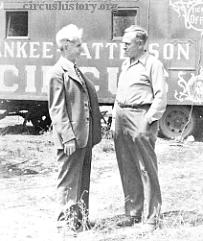 Bob Thornton, at left, long time Al G. Barnes equestrian director, shown with Jimmy Woods in front of the former Cronin ticket wagon. Photo by Harry Quillen.
Jimmy Wood, the promoter of the tour, made enough to launch the 101 Ranch Wild West Circus the following year.
Three others that Spring hit the road from the land of sunshine and oranges only to close in a few weeks or not to return with enough to go out again.
Not many show people off the big time circuit can adjust themselves to a small circus. Most all on this outfit had come off the Al G. Barnes show that was taken off the road at the end of the disastrous 1938 season. They were able to adjust themselves to the change.
Mr. Wood had spent time on other large and small shows in the middle west. He started with Hagenbeck Wallace in 1925 as a singer in the spec, became assistant announcer, bought Camel Bros, at Dannebrog, Nebraska from A. W. Perry in early Fall of 1929. He operated the show until the snow fell. It featured Obert Miller's dogs and ponies. The show closed at Henry, Nebraska, and was trucked to Anderson, Indiana and put in the barn.
He then left to join Jack "Cookhouse" Walsh in organizing a tab show. Enroute he stopped to visit Fred Buchanan who had his Robbins Bros, at Popular Bluff, Missouri.
While chatting with him Mr. Fred suggested a title. He had done well with the Yankee Robinson name and knew the Gentry Patterson title drew business suggested Yankee Patterson. It was thus created.
The title was first used in connection with sponsored circuses around Los Angeles during the off season of 1936. The dates were in summer and winter. They afforded work for big time performers during their off-season as well as some out of work during the summer. Among those filling in were the families of Ernest and Charlie Clarke in aerial and ground numbers. Then there was the Canestrelli family, the DeWayne troupe of acrobats, Poodles and Gracie Hanneford, Fay Avalon and clowns off the Barnes show.
For use at these sponsored dates Mr. Wood accumulated some circus property. He supplied motion picture studios with paraphernalia needed in filming circus and carnival pictures. During 30 years he has supplied equipment for more than 150 motion pictures and TV shows being filmed.
Naturally it was not too big an undertaking to frame the Yankee Patterson Circus for a road tour in 1945. Good thing he had the nucleus with which to start as many needed items were being rationed during this war period.
Cronin Bros, opened for a few weeks. It was the second attempt of S. L. Cronin, who had been manager of the Al G. Barnes Circus after purchase by the American Circus Corporation and the Ringling interests.
The show had been foreclosed for failure to pay their tax bill. Mr. Wood attended the tax sale held by the Department of Internal Revenue. He offered $3,500 for the show, raising it to $4,300. E. K. Fernandez, the Honolulu circus operator, bid $7,500. It went to the United Tent & Awning Company of Los Angeles for $8,100. They had been on the end of furnishing tents, the marquee and other canvas items.
The Billboard reported in the following issue that the Cronin management had been delinquent about $12,000 in tax money. The government had to write off approximately $4,000.
Hagenbeck-Wallace had closed in a bankrupt shape at Riverside, California in the Fall of 1938. The equipment was scattered, most going to Thousand Oaks after remaining at the old Barnes quarters in Baldwin Park for a while.
Two almost new 75 KW light plants used on Hagenbeck the season before were obtained. This gave Yankee Patterson more illumination than often was available to light some of the towns played that year.
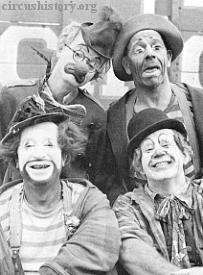 Four of the clowns featured on the Yankee Patterson show. Top row, Frankie Cain and Fay Avalon, Lou Kish and George Perkins, producing clown, shown below. Photo by Harry Quillen.
The new circus was framed at the Wood Circus rental quarters in Venice. The actual assembling of everything was delayed because some of the equipment to be used was on location at the 20th Century Fox studio where a carnival story was being filmed. This was released as Nightmare Alley.
It was completed one week before the show was scheduled to start.
There was a grand rush to get all in readiness for the opening in North Long Beach. By getting a little bit here and a little bit there they opened with a 70 foot round top with two 30's and 40 foot middle. Some with it say it was a tough one to erect because of the way things worked out. An attractive ticket wagon off the Cronin show served as the office. Some trucks came off the Sparton show that had been out a short time. Mr. Wood took back a couple of trucks of his that had been with Cronin. The war was not over and no surplus army equipment was available. As for spec wardrobe each performer produced what they had and Mr. Wood had a little salvaged from old movie sets.
It moved on 10 trucks. There was a combination pole and canvas vehicle, a sleeper and a cook house on wheels, saving the erection of a cook tent. Performers had their own transportation. Mark Smith, who had his horses and riders, obtained an old Greyhound sleeping bus for the girls to live in.
It was a fast moving show from the first stand on the parking lot of Dr. Ewart's Farmers Market for two days. Every merchant in the big market issued free cut rate tickets with a purchase. That was the first attempt on the Pacific Coast to promote that way.
The show got off to a flying start with four good houses in the two-day stand. From then on the little show was in the right spot at the right time all season.
The staff included Jimmie Wood, owner-manager; Jack Laughlin, secretary and ticket superintendent; Harvey Walters, general agent; George Winslow, side show manager; Tex Orton, supt. of props; Ruby Wood, treasurer; Harry Melon, legal adjuster; Herb Wilson, brigade manager; Frank Chicarello, supt. and front door man after he came on in mid-season; John Guttierez, boss can-vasman; Leroy Conkey, band leader and calliope player. There were three furnishing the music. Ishmael Escalante, boss seat man; Frank and Gene Yagla, concessions; Jovita Gutierez, cook house; George Perkins, purchasing agent; Bob Gailbrith, mechanic; Clifford Henry, electrician; Ruby Wood was in the Red Wagon; Blackie Kohler, inside tickets.
Mr. Walters, the general agent, had never been ahead in such a capacity. After a little briefing he went ahead by three weeks with one assistant. They would contract the towns, hang paper and put out window cards. Only stock lithos were used.
When they got through in a town the natives knew Yankee Patterson was coming. The advance was terrific, Mr. Wood remembers.
Walters had been a legitimate actor, associate picture producer and did some promotional work for the Kenney firm, big operators on the fun zone in Venice.
Harry Mellon, legal adjuster, came out of the district attorney's office in Los Angeles.
Ralph Steffen, who served as equestrian director part of the season, had been in California show business. He is now in business at Fontana, not far from where Dr. Ewart has a factory making items for the carnival and circus trade.
Frank Chicarello joined the show at Manteca, August 29. He had started in show business with Miller Bros. 101 Ranch Wild West, going to the Barnes show in 1926 as a wrestler, knife thrower in the concert. Later he became assistant manager under S. L. Cronin after serving as back yard policeman.
Mark Smith had been a horse trainer on the Barnes show. He brought along much know-how. He remained 8 weeks and was equestrian director while there.
Toni Madison, on the program with her dog act, was the wife of Clifford Henry. There had been seven of the Henry family of versatile performers. By adopting the name of Toni Madison she got individuality.
Everyone doubled several times around the show. Even the owner-manager made side show openings. Jimmy, as he was known to those on the show, had a persuasive power, often turning 90% of the tip. His son, Alan, took over after the opening.
George Perkins, producing clown, and some others went for a publicity promotion one day. They didn't return in time for George to present his performing dog. So his son, Terry, 10 years old, substituted for his dad. The act went over in a big way, they tell me.
The cook left in a hurry one afternoon. He saw somebody throw a home made bomb at the tent and was seriously injured in trying to get away from the tent when the bomb exploded. Mrs. Gutierez took over and the bill of fare was Mexican style from then on.
The big day of the tour was at Escondido, where four shows were necessary to accommodate the crowds. The gross was a little over $3,500. Not bad with a nut daily of around $550.
They had a seating capacity of around 1,000. Prices were: adults $1.20, children 60 cents. Half of the seats were reserves with an additional charge of 60 cents for any one.
Tex Orton came on to do several acts with his whips, knives and rope spinning. He suffered a heart attack at Vista and was out for a few days.
The route was along the Pacific Ocean making small towns that had not had a circus in years. Business was generally good.
The July Fourth date was at Paso Robles. As was customary in the old times a party was held in the back yard between shows. It was the idea on this occasion of George Perkins. He purchased enough pop and watermelons to serve a much larger circus group, so there was plenty to go around on that hot afternoon. An unexpected event was when one of the Mark Smith girls chased Clif Henry up one of the center poles.
Clowns on the show were George Perkins, producing clown, Lou Kish, Fay Avalon, Bernie Suggs and his funny car was on a while.
One spot long remembered was Monterey. This fishing village was played on July 6th. The lot was a dry weed-covered one across from a cemetery. At the rear of the field fishermen were in the morning drying their fishing nets and left them in the hot sun after being treated with some chemical. Supposedly spontaneous combustion started a fire that threatened the tents.
Though the fire was extinguished before it reached the tent that had been lowered, the town fire department ordered all weeds cut for 50 feet around the site of the top before it could be re-erected. Business at night was fair.
The route continued north along the Redwood Highway across the mountains to Redding. The saying in California since the days of the 49'ers has been, "There is gold in them thar hills." The Yankee Patterson Circus found it on that mountain tour of towns, played years previously by the pioneer circuses of the west. Placerville, called Hang Town in the early days of the mother lode country, gave the show big business. For some reason. Sonora was off. Angels Camp, Tuolumne and San Andreas were good.
Like all truck shows this one had a few accidents. The most serious was en-route from Westwood to Susanville on the morning of August 9. Two circus trucks crashed on a short curve. A performer came along, parked by the side of the road to help. A fire truck enroute to check a blaze hit the parked car, overturning it in a ditch. Only casualty: one driver got a scratched head. The driver causing the wreck got his walking papers. Despite all this the matinee started at 5 o'clock. The customers were on the straw at night.
August 14 and 15 were days youngsters then on the circus will long remember. It was the ending of World War 2. When the gas man filled the trucks on the afternoon of the 14th no gas stamps were needed as gas rationing was off at Nevada City.
The next morning on arrival at Grass Valley, the big celebration ending the war days was on with the blowing of horns, wild auto drivers showing off in their cars. Despite the hilarity, business was good that day.
Poodles and Gracie Hanneford closed about that time.
The show then worked south through the San Joaquin Valley, where the grape and cotton harvest was under way, with resulting good business.
Ruby Wood had started saving silver dollars when the show played close to the Nevada border. On getting back into farming country the car was sagging so badly because of the weight of $13,400 silver dollars it was thought best to turn these in at the bank.
The closing stand was October 20 at Santa Monica, a few miles from the opening and two miles from quarters. It had been out 21 weeks, playing only in California. Not a drop of rain fell on the canvas.
A matinee was lost at Soledad on account of a blow down. El Cajon was lost because of a long jump over the mountains from Holtville. The biggest day was at Escondido; smallest at Monterey. One truck was lost in the wreck near Susanville.
In telling of the never-to-be-forgotten season the manager described it as one happy family. The show was torn down and packed away not later than 11:30. That was the time till after midnight when all gathered around a campfire to enjoy an hour of relaxation, singing to the accompaniment of music furnished by a Mexican orchestra.
No phone crews were used, however, the telephone operator in the small towns told families on the party lines about the coming circus. That was an old time publicity stunt that originated in the early days of the telephone.
Every circus program is subject to change and this show was no exception. Here is what was offered in the ring:
Grand Entry
Trampoline, Guttierez Troupe
George Perkind and the Hollywood canine, Lady
Ponies - Clifford Henry
The Clowns
Perch - The Ortons
Toni Madison and her dogs
Clowns
Principal bareback riding - Gracie Hanneford
Aerial ladders
Riding dogs and monkeys
Clowns
Rolling globes (both the Hendy duo and the Ortons had such)
Comedy riding act - Poodles and Gracie Hanneford
Concert Announcement
Slack wire - Johnny Guttierez
Judi Powell and her motion picture lion, Tony
Spanish web - Toni Madison
Tight wire - Guttierez Troupe
Mark Smith's horses
Clowns
Patriotic closing number
The after show or concert was presented by Tex Orton, the Hannefords, Frank Chicarello, George Perkins and Fay Avalon.
The route was as follows for the 1945 Yankee Patterson tour:
|
June
2-3-North Long Beach, Calif.
July
1-Santa Maria
August
1-Williams
|
September
1-Firebaugh
October
1-Corona
|
Because of long jumps over mountainous roads with sharp turns and long, stiff grades, no matinees were scheduled for Westwood, Woodlake, Tehachapi and Colton.
This route discloses the fact that this little show played many of the towns the Al G. Barnes show had exhibited in over a period of 28 years.
Information in this article has been possible through the cooperation of Mr. Wood, George Perkins, Terry Perkins and Frank Chicarello.
The decision of Adkins and Terrell to launch a second railroad show in 1938 was related in the previous installment and it was mentioned that the title of the new show was not officially announced until the February 23, 1938 Billboard broke the story.
There were many reasons for the selection of Robbins Bros. Big 3 Ring Circus as title for the new show, however, the specific reason that swayed the decision in favor of Robbins over other possible titles is not fully known. Milt Robbins, who was brought on to head the sideshow of the new circus, had considerable influence in the selection. Other factors considered were availability of the title, territory the new show planned to play, size of towns to be played, use of billing and art work of the new title, and the same general considerations that had led the two showmen to select the Cole Bros, title three years earlier.
The name of Robbins had long been associated with circuses in the United States. It was a familiar name. Burr Robbins operated both mud and railroad circuses bearing his name in the 70's and 80's. Frank A. Robbins operated circuses using his name for the titles off and on from the early 80's until 1915. His last show, which was out in 1915, was on 15 cars. Frank A. Robbins' son, Milt, was well known in show business and was active in various circuses all through the 20's and early 30's. Milt was in charge of the sideshow on Fred Buchanan's show in the years 1924 through 1931 during which time the title of the show was Robbins Bros. Circus. This was the only time prior to 1938 that this particular version of the Robbins title was used, however, all through the early and mid 30's there were motorized shows on the road using different versions of the Robbins title, usually that of "Famous Robbins Shows." In fact in 1931 while Buchanan still had his 15 car Robbins Bros. Circus on the road, Sam B. Dill was operating a truck show titled Famous Robbins Circus and the two shows actually engaged in a billing war with each other in North Carolina during the season. As late as 1937 James Heron had a motorized Famous Robbins Circus on the road.
Milt Robbins, in 1938, claimed ownership of the Robbins Bros, title (and still does) and when I interviewed him in May 1966 he said that both Fred Buchanan and later Adkins and Terrell made arrangements with him for use of the title. As it was when the two showmen decided to use the Cole Bros, title in 1935 they first made certain that they had a full and clear right to use the title.
The old Frank A. Robbins show, which was usually on about 15 cars, played extensively in eastern territory and was most familiar to the residents of Pennsylvania, New York state, and New England, and generally this was the route the new Robbins show planned to travel in 1938. When Buchanan operated Robbins Bros, in the years 1924 through 1931 his show primarily played in the Middle West and rarely came east of the Mississippi, however, during the final season of 1931 the show did make an eastern swing and while in New York state that year did some of the best business of any of them during that bad depression year.
So, the decision was made that Robbins Bros, would be the title of the new No. 2 show. Some art work and pictorial paper designs of the old Buchanan show was used. However, some newspaper cuts the show used had the Famous Robbins Circus title and designs. A familiar art design of the old Buchanan show pictured the mustached "Robbins brothers."
As mentioned in the last installment a steady stream of show propaganda came out of Rochester indicating the new Robbins show would be on 25 cars, carry 20 elephants, and generally be considerably larger than it actually was. I have wondered if perhaps a larger show was originally planned and then later decided to keep it down to 15 cars when it appeared economic conditions in 1938 would not be as good as at first expected. Some have indicated that Adkins and Terrell seriously considered shelving plans for the new show, however there is no real basis for this belief. Gordon Potter doesn't believe there was any hesitancy in putting out the show, nor does he believe it was cut down from the size originally planned, but thinks the show was framed in accordance with the plans made in late summer of 1937. Potter believes the severe and swift economic recession of 1938 caught the two owners completely by surprise as it did virtually every other showman on the road in 1938. Potter recalls that in an article he wrote for Bandwagon a couple years ago concerning the Cole and Rob-bins shows he mentioned an incident in which Terrell and Adkins expressed bewilderment that Robbins Bros, from the beginning of the 1938 season was not drawing like they felt it should. From all indications the show was planned from the start to be on 15 cars and the propaganda from Rochester was just from the press boys living it up.
Building the show from the ground up in the winter of 1937-1938 was a major task. The burden was lessened somewhat by the fact that the Cole Bros, show was being cut down from 40 cars to 30 for the 1938 season and the excess equipment would be made available to Robbins. Fortunately there were almost enough excess railroad cars for the new Robbins train and a very considerable number of wagons used on the Cole show came over to Robbins. A number of wagons on hand but which had not seen prior service were put through the shops and readied for the new show. The remaining number of wagons required to transport the show were built in the quarters shops.
Although Billboard stories said that Adkins had given an order to the Warren Tank Car Co. for a complete new train of flats and stock cars and had purchased new sleepers from various railroads, such was not the case. It is believed that only two additional cars were purchased. These were two system coaches from local railroads, probably the Monon or Big Four. One was remodeled to serve as the advance car and the other was used for a sleeper.
The six Warren flat cars used by Cole in 1937 were turned over to Robbins which gave the new show six matching flats. Two stock cars Cole had carried in 1937 were now excess in 1938 when that show cut from 9 to 7 stocks and these were given to Robbins. Also there were two other stock cars already excess and on hand in quarters. These four became the four stock cars in the Robbins train. Robbins had 4 sleepers in 1938, one purchased from a local railroad as mentioned above and 3 came from the 1937 Cole train when that show cut down from 11 to 8 sleepers for 1938.
When the Robbins train was fully assembled and ready to roll it consisted of 15 cars, which included 1 advance, 4 stocks, 6 flats, and 4 sleepers.
Color scheme for rail cars was aluminum with red lettering and green shade for flats; aluminum with silver lettering on a red letterboard for stocks; and light orange with tan trim and silver lettering for the coaches.
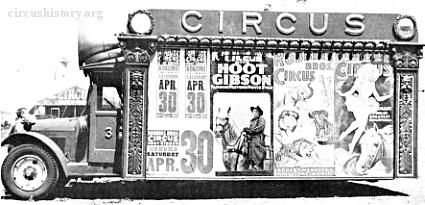 Photo No. 19 - Sound truck bringing up rear of opening day street parade Kokomo, Ind., April 30, 1938. Photo by Koford.
Flat cars were lettered "Robbins Bros. 3 Ring Circus with Hoot Gibson, The Screen's Most Popular Western Star." Stocks were lettered "Robbins Bros. 3 Ring Circus," while coaches had on the upper letterboard, "World's Premier Amusement Enterprise," and on the bottom, "Robbins Bros. 3 Ring Circus with Hoot Gibson, the Screen's Most Popular Western Star." The advance car was also painted in light orange and tan and lettered appropriately. The entire train was a beautiful sight to behold by opening day.
Although Cole Bros, dropped its street parade for 1938 it was decided that Robbins would make the daily parade one of its primary features. A total of 8 parade wagons were used. Coming from the 1937 Cole show were the former Christy Bros, steam calliope, the ex-Christy air calliope which had corner statues, and the former Buchanan Robbins Bros, unafon wagon. The Christy air calliope was converted to a tableau wagon for parade purposes and also carried the concession department. It became No. 32. The unafon wagon had its instrument removed and instead was installed an air calliope. The wagon was given the number 72. The France tableau also came over from the 1937 Cole show and was used as a tableau in parade and served as the grandstand ticket wagon on the lot.
Four tableau wagons that had come with the purchase of the Buchanan Robbins Bros, equipment but had not been previously used were renovated for use as parade wagons by Robbins in 1938. These were all part of the former U. S. Motorized Circus set (see my article in Jan.-Feb. 1962 Bandwagon for full and complete history of these wagons) and consisted of the United States, Great Britain, Belgium, and Africa tableau wagons. The Africa tab has often been erroneously called India and commonly referred to as the "Hippo Tableau" because of the carvings on its sides.
All of the parade wagons were beautifully painted and decorated. Great Britain was basically red as was Africa. Belgium, United States, and the No. 32 tableau (former Christy air calliope) were white. The air and steam calliopes were red. France was a stunning wagon with paintings depicting that country's history and landmarks. Gold and silver leaf were used lavishly on the carvings of all wagons. Since four of the Robbins parade wagons had not been seen on the streets of the country since 1931 these gave the 1938 Robbins street parade a great "new look." The former Spellman set wagons probably weren't as elaborate as the wagons used by Cole in the years 1935-37 but they still looked very good, were well built, box type, and could carry a full baggage load.
In the opening day parade at Kokomo the show used a finely decorated sound truck which brought up the rear of the parade following the steam calliope. Evidently it was designed to travel overland as there was no room on the train for it. It is believed that it was only used for a few days, possibly only at Kokomo, because it shows up only in photos taken at the opening stand.
A total of 6 cages were used by Robbins on opening day, however one cage went back to quarters after the stand and was evidently swapped for a baggage wagon, probably No. 40. The show train was so heavily loaded that it was difficult not only to put everything on the train but also to load up all equipment into the wagons themselves. The loading caused considerable difficulty and some shifting of loads had to be done immediately. The cages carried were all from the 1937 Cole show and included cross cages No. 12 and 18, former Christy 12 ft. dens No. 10 and 14, and one of the new 12 ft. dens built in 1937 which was number 15. On opening day at Kokomo the show had No. 16 loaded with deer, which was an ex-Christy 12 ft. wagon. After No. 16 went back to Rochester the show continued with only 5 cages which made the show have a rather weak menagerie in contrast to being so strong in other departments. Four of the cages had the show's title painted on the letter-board above the bars and the fifth had the lettering, "Trained Wild Animals."
Robbins put into service as many of the excess Cole baggage wagons as possible and then built what additional ones that were needed at the quarters shops. The new wagons were all equipped with the hard rubber carnival type wheels the show had acquired on the West Coast in the fall of 1936. New wagons built in the shops included No. 20, dining dept; No. 21, steam boiler; No. 30, red ticket wagon; No. 80, pole and stringer wagon; No. 82, baggage and miscellaneous props wagon; No. 83, seats, biblebacks.
Wagons coming over from Cole Bros, (but renumbered by Robbins) included No. 40, sideshow; No. 50, light plant; No. 71, menagerie canvas and pole wagon, and No. 89, stake driver. Other wagons which probably had seen service on Cole Bros, but on which some modifications were made (such as equipping with carnival type wheels) included No. 86, big top canvas wagon; No. 88, stake and chain wagon; and No. 87, big top canvas wagon which probably had a new body built for it. Wagon No. 61 was either extensively rebuilt from an older wagon or possibly was built new. Robbins used one Mack tractor which had a water tank body on it which came from the 1937 Cole show. Another farm type tractor which had a cab built over the seat was also used by Robbins. This was really an odd ball looking rig, a "leaping hyena" kind of thing.
Although many of the baggage wagons now were equipped with carnival type wheels several did have the traditional steel tired wheels. All parade wagons and cages had the old time sunburst wheels.
Baggage wagons were painted a deep rich orange and had silver lettering with light blue shading. Wheels and running gear were red with black and yellow striping with more black than yellow being used. The wagons had a handsome new looking appearance when ready for the road.
Compiling a complete and accurate list of loads carried by the 30 pieces of Robbins rolling equipment in 1938 has been a difficult task. This is because the show had so much equipment to be loaded on relatively few wagons and it was necessary in some cases to split departments on wagons. This particular problem did not exist on the larger Cole show when it was on 30, 35, and 40 cars, but for very compact loading of the Robbins show it was a real problem. Some loads were shifted around early in the season, for example the ring curbs were moved from one wagon to another. Gordon Potter and Albert Conover have been especially helpful in helping me attempt to compile a wagon list as accurate as possible. The list printed here is a composite and possibly the astute reader might spot some slight inaccuracy, however it must be borne in mind that loads did shift from one particular stand to another. Anyway the list is reasonably correct with any errors being minor and existing mainly because of split departments, shifting of loads, etc.
In the weeks proceeding the opening the Billboard kept the show world informed on the progress of building the new circus. In February it was announced that Robbins had signed Hoot Gibson, the famous Western film star, to be one of the feature attractions. The management realized the great value of having a famous cowboy film star on the show. With Ken Maynard on the Cole show Adkins and Terrell had corraled two of the biggest Western film stars in the business.
Robbins ran several "Wanted for 1938 Season" ads in Billboard advertising for department heads, performers, sideshow and wild west performers, and working-men. Orders were given to Erie Lithographing Co. and Enquirer Job Printing Co. for the season's billing needs. A large and colorful courier, similar to that used by Cole Bros., was designed and ordered. A number of draft horses were purchased from Jack Morris who obtained them in Iowa and Missouri. As indicated earlier Cole Bros, retained most of their 1937 baggage stock so it was necessary for Robbins to get new horses.
In March articles of incorporation were filed with the Indiana Secretary of State by Robbins Bros. Circus Inc. with principal headquarters in Rochester, Ind. to operate circuses and other amusement enterprises. The new corporation had 1,000 shares of no par value capital stock and incorporators were listed as F. E. Schortemeier, Robert K. Eby, and Joseph G. Wood. The financial and organizational structure was similar to that of Cole Bros. A separate corporation was formed to operate the show and it came under the parent holding company, the Indiana Circus Corporation. There was no change in financial ownership or management at the top.
On opening day Robbins had 10 elephants in the herd. These included 7 from the Cole show, four of them large bulls, Ding Dong, George, Katie and Barney, and other 3 were the punks imported during the 1937 season, Modoc, Empress and Judy. For the first few days of the season the famous John Robinson elephants, Clara, Pitt and Tony were on the show making a total of 10. The count and type of other lead stock varied during the season but one list shows 3 camels, 1 zebra, 1 donkey, 18 ponies, and 26 head of ring stock. On opening day the show also had a bison and a large horned antelope type of animal which either loaded into a cage or was loaded with the lead stock but was staked out on display in the menagerie top with rest of the lead animals.
A complete new canvas spread was acquired from Baker-Lockwood Co. of Kansas City. The big top was a 135 ft. round with one 50 and two 40 ft. middles. Other canvas included a 4 pole menagerie top, a sideshow, horse top, dressing room, cookhouse, and dining tent. Later in the season photos indicate the show used both a ring stock and a baggage stock tent. This was after the enlargement to 20 cars, but it is possible even before then two horse tops were used. No exact sizes for the menagerie top and sideshow top are available. Menagerie appears to be about a 70 ft. round with three 30's, and sideshow about a 60 with three 30's. The sideshow was equipped with a beautiful new bannerline and the midway employed the new light standards that were so popular on the Cole show in 1937.
New seating, both grandstand and blues, were built in the quarters shops. Likewise the shops readied new props and rigging, cookhouse equipment and the other thousand and one little things necessary to launch a brand new show. Much of the old equipment on hand, such as cookhouse ranges, etc., was pressed into service after a thorough renovation.
The show had a staff of experienced showmen that included Jess Adkins, road manager; Fred H. Seymour, legal adjuster; Floyd King, general agent and traffic manager; Harry Harrel, treasurer; Harlan Burkhart, auditor; Stanley Dawson, supt. of tickets; Harry McFarlan, equestrian director; Fred C. Kilgore, general contracting agent; Bernie Head, contracting press; Al Wilson and Raymond B. Dean, advance press agents; Arnold Maley, white wagon; Rodney Harris, bandmaster; R. J. Lawell, advertising agent; Harry Mills, banners; Mrs. H. J. McFarlan, wardrobe mistress; Charles Luckey, supt. of canvas; Leo Loranger, boss property man; Joe Wallace, supt. ring stock; P. H. McGrath, trainmaster; Manny Maiman, supt. concessions; John Bolcourt, light supt.; Charles Land, supt. ushers; Clarence Adolph, lot supt.; Bert Googins, commissary and dining cars; Milt Carl, supt. cookhouse; William Backell, manager Advertising Car No. 1.
Milt Robbins was manager of the sideshow, P. G. Lowery had the band, and Bill O'Day the canvas. Sideshow attractions included Karl Kartwright, lecturer, also working illusion and ventriloquism; George Durkish, fire eater; Katherine Durkish, illusion; Baby Thelmer Williams, fat woman; Sadie and Victoria Anderson, tiger-spotted girls; Col. H. H. Parks, giant; Larry Leuthold, tattooed man; Anthony Sanchez, knife thrower; assisted by Luana Sanchez; Duke Kamakua's Hawaiian musicians and dancers.
The show moved from Rochester quarters expecting a day to get the kinks out but the new big top was late in being delivered and as a result the show was unable to have any kind of dress rehearsal but was ready to go and opened as scheduled for its initial stand at Kokomo, Ind. April 30, 1938.
The May 7, 1938 Billboard told of the new show's opening as follows: "Robbins Bros. Circus Gets Hearty Send-Off at Kokomo." "Matinee light but house three-fourths full at night - thousands greet parade."
"Kokomo, Ind., April 30 - Several thousand people gave the new Robbins Bros. Circus a hearty sendoff here today when the show made its debut to the accompaniment of clear skies and chilly breezes. Business was only fair, a light house at the matinee and about three-quarters at night, but those who came were highly pleased with the performance and went away singing its praises.
"On the lot the show looked like a 30 car outfit. A beautiful spread of canvas, laid out in the old John Robinson style. Physical equipment splendid. Wardrobe is colorful and makes a great flash. Performance at night show ran remarkably well for a show that had not had a single rehearsal, and in a few days should be working smoothly. There is lot of show, excellent talent, and the general opinion is that the Robbins Bros. Circus is going to be a "money show" that will give its larger competitors something to shoot at.
"Show arrived here in good time and the parade reached downtown about 12:30 and was greeted by thousands of people who thronged the line of march. Led by Esma Maley and Cyse O'Dell on horseback and with many brightly painted and gold-leafed wagons in line. The parade was extremely colorful and beautiful making a great flash. It is going to be a great asset to the show.
"Jess Adkins, manager of the show, was on hand for the opening and well pleased with the way the show worked. The spec, "La Argentina," produced by Rex de Rosselli, with dances by Betty Jones, is lively, full of color and beautifully dressed. Big top is well lighted.
Many Showmen Present
"Many showmen were present and congratulated Manager Adkins on the splendid showing of both performance and physical equipment. Show opened for the matinee with absolutely no rehearsal, which naturally caused a rough performance, but the night show moved with speed and precision except for a few rough spots, which will be quickly ironed out. A big high-school rally in the afternoon undoubtedly kept many away. The town is in the midst of a hot political fight and there were a number of political meetings Saturday night. In view of these handicaps the circus made an excellent showing.
The Program
"Display 1 - Inaugural pageant, La Argentina, staged by Rex de Rosselli; music arranged by Rodney Harris, wardrobe by Josephine McFarlan; dances by betty Jones; electrical effects by Louis Scott; H. J. McFarlan, equestrian director. Done in Rosselli's usual brilliant style, the spec was a pleasing potpourri of music, song and dance, colorfully costumed and nicely presented. Excellent vocals by Ella Harris, prima donna. The announcements by Milt Robbins, in both the spec and the show proper, were clear and distinct.
"Display 2 - In Ring 1 the Velarde Trio, comedy acrobatic act in pantomime and gymnastics; Ring 2, fast comedy juggling by the Marcellis; Ring 3, the Nippon Troupe in characteristic Jap acrobatics.
"Display 3 - Educated seals in Rings 1 and 3, presented by Albert Fleet and Richard Entley. The usual juggling, ladder-climbing, etc. (Author's note - this act appeared in this review and also in the show's printed program, however it is believed the act did not show. This is due to fact that there was no cage carrying sea lions and the Bob Danner set of several hundred photos which covered completely the performance at Kokomo as well as all phases of the show that day does not picture any sea lion act. Evidently the reporter seeing the act listed in the printed program figured for some reason it did not work that particular performance but would work later so he went ahead and included it.)
"Display 4 - Aerial Bars. The Alpine Brothers gave a pleasing performance of straight and comedy bar work.
"Display 5 - Equilibristic number. Ring 1, the Oriental Wongs; Ring 2, the Karljos; Ring 3, the Aljos Troupe. Clever balancing feats.
"Display 6 - Lady principal riding acts, Juanita Hobson, Rose Wallet and Georgia Sweet. Graceful and agile riders. Miss Hobson was particularly good in her spectacular fire jumps.
"Display 7 - Parade of clowns on track in the usual tomfoolery.
"Display 8 - Aerial numbers. In center ring the Great Moreens, double trapeze. In end rings Esma Wilson, Ella Harris, Jean Evans and Ida Voise, single traps. On swinging trapeze Senorita Velsea and Armita Velarde, doing a specially announced heel catch. On the swinging ladders Marie Harding, Edna Sullivan, Doris Swisher, Jeannie Teeters, Ida Mills and Mabel McGrath. Altogether a highly entertaining display.
"Display 9 - High pole acts in end rings.
"Display 10 - Elephants. The John Robinson troupe of elephants presented a series of entertaining tricks. Feature was elephant in center ring walking a plank and making front and hind-leg stands on the plank. Acts are paced more slowly than usual circus elephant acts. Result was a much better opportunity for the audience to appreciate the tricks and many favorable comments were heard.
"Display 11 - Clown band on track and in center ring.
"Display 12 - Wire acts. In center ring a clever bounding rope routine. In end rings Mexican tight and slack-wire artists.
"Display 13 - Mlle. O'Dell, aerial gymnast, in graceful and pleasing feats of strength and endurance.
"Display 14 - Center ring, an entertaining Liberty horse act, worked by John Smith, trainer, who skillfully put the equines thru their paces. In end rings educated ponies, worked by Clarence Canary and Frank Schmidt.
"Display 15 - Iron-jaw acts. The Sisters Rita, Sullivan Sisters and Tacoma Sisters.
"Display 16 - The Hobson Family of riders, seven people in a varied display of bareback riding skill that was nicely received. Herbert Hobson does some spectacular jump-ups and the entire troupe gives an excellent performance.
"Display 17 - Gymnastic exhibition. The Moreen Family in equilibristic balancing; the Toyama Troupe, difficult hand balancing and the Arcadian Family, clever Risley work,
"Display 18 - High-school horses. Robbins Bros. Circus has some splendid stock and excellent riders, and the display of skill on the track was exceptionally good. Special feature was a high jump by Mrs. John Smith, whose mount cleared an unusually high hurdle with the greatest of ease. Riding the high school horses were Jeanne Teeters, Ella Harris, Peggie Leonard, Jean Evans, Frances Gilbreath, Doris Parker, Ida Mills, Louise Swisher, Edna Sullivan, Marie Harding, Anita Veldes, Juanita Lopez, Esma Maley, Cyse O'Dell, Mabel Kline, Else Graham, Mabel McGrath, Alliston Love and Shelby Bruce.
"Display 19 - Clown walkaround. Toonerville Ganda Dancers on parade.
"Display 20 - Flying acts. The Flying Thrillers and the Aerial Behees. An excellent exhibition of flying.
"Display 21 - Finale; Races. Jockey race and riderless horse against jockey rider.
The Concert
"In the concert or after show Hoot Gibson and his band of cowboys and cowgirls gave an entertaining exhibition of trick and fancy riding, roping, bucking and shooting." (A total of 21 wild west performers were listed.)
Robbins Bros. Circus 1938 Parade Lineup (from Gordon Potter notes)
1. Two riders (flag bearers leading parade) (on horses)
2. No. 85, United States Tableau with big show band pulled by 6 horses
3. Four riders (on horses)
4. No. 10, cage, deer, pulled by 4 horses
5. No. 32, corner statue tableau, pulled by 4 horses
6. Two riders (on horses)
7. No. 41, France tableau, pulled by 6 horses
8. No. 15, cage, deer, pulled by 4 horses
9. No. 18, cross cage, leopards ana pumas, pulled by 6 ponies
10. Four riders (on horses)
11. No. 70, Belgium Tableau, clown band-waeon, pulled by 6 horses
12. No. 12, cross cage, monkeys, pulled by 6 ponies
13. Two riders (on horses)
14. No. 81, Great Britain tableau, pulled by 6 horses
15. No. 14, cage, lion and tiger, pulled by 4 horses
16. Two riders
17. No. 84, Africa tableau, sideshow bandwagon, pulled by 6 horses
18. Clown cart, pulled by donkey
19. No. 72, air calliope, pulled by 6 ponies
20. Ten riders, Wild West (on horses)
21. Lead stock, 1 zebra, and 3 camels
22. Elephants (10)
23. No. 31 steam calliope, pulled by 4 horses. Note, the farm style tractor often pulled the steam calliope in parade.
Parade Totals
8 parade wagons
5 cages
50 head of baggage stock
18 head of ponies
26 head of ring stock in parade.
Other Parade Notes: On opening day Cage No. 16, containing deer, was in the parade pulled by 4 horses. (Steam calliope that day pulled by farm style tractor). The sound truck was also in opening day parade bringing up the rear. There was only one big show band in parade. It was not split into two sections for parade purposes as was usually done. This was because it was too small, having only about 9 pieces. A couple of musicians went with the clown band during parade, rest of big show band rode the No. 1 bandwagon, the United States tableau. All performers had to make parade in costume. Those not mounted rode tops of the tableau wagons.
Robbins Bros. 1938 Wagon List
1. No. 10, cage (painted white) carried deer (ex Christy) (on Cole 1937); 12'
2. No. 12, cross cage (white) carried monkeys (on Cole 1937); 8'
3. No. 14, cage (red) carried lion and tiger (ex Christy) (on Cole 1937); 12'
4. No. 15, cage (white) carried deer (built new 1937) (on Cole 1937); 12'
5. No. 18, cross cage (white) carried leopards and pumas (on Cole 1937); 12'
6. No. 20, dining dept. wagon (built new) (carnival wheels); 18'
7. No. 21, steam boiler wagon (built new) (carnival wheels); 10'
8. No. 30, red ticket wagon (built new) (carnival wheels) (had some gears from Cole No. 83 dog
wagon used in 1937); 14-15'
9. No. 31, steam calliope (on Cole Bros. 1937); 15'
10. No, 32, corner statue tableau (air calliope, Cole 1937), concessions ; 12'
11. No, 40, sideshow wagon (probably on Cole in 1937); 12'
12. No. 41, France tableau, white ticket wagon & sideshow trunks (Cole 1937); 18'
13. No. 50, light plant wagon (Cole 1937) (carnival wheels); 16'
14. No. 61, Padroom, canvas, poles, blacksmith (carnival wheels); 16'
15. No. 70, Belgium tableau, trunks (used first time in 1938); 16'
16. No. 71, menagerie canvas, poles (steel tired wheels) (probably on Cole Bros. in 1937); 16'
17. No. 72, air calliope (ex Buchanan Rob-bins wagon) (was unafon wagon on Cole Bros, in 1937); 9'
18. No. 73, seats (carnival wheels); 14-15'
19. No. 80, pole and stringer wagon (carnival wheels) (built new 1938); 18'
20. No. 81, Great Britain tableau, seats, props (used first time 1938); 18'
21. No. 82, baggage, misc. props (built new 1938) (carnival wheels); 14-15'
22. No. 83, seats, biblebacks, (built new 1938) (carnival wheels); 14-15'
23. No. 84, Africa tableau (sometimes erroneously called India) carried seats, (used first time in 1938); 16'
24. No. 85, United States tableau, chairs, (used first time in 1938) (note, wagon actually not numbered 85, but known as this number by the show for loading and baggage purposes); 18'
25. No. 86, big top canvas wagon, (steel tired wheels) (probably on Cole Bros. in 1937); 12'
26. No. 87, big top ganvas wagon, (steel tired wheels); 14'
27. No. 88, stake and chain (carnival wheels); 14'
28. No. 89, stake driver (carnival wheels) (on Cole Bros. 1937); 12'
29. Mack Water Tank Tractor (on Cole Bros. 1937); 14'
30. Farm style tractor (cab built over seat); 10'
Robbins Bros. Circus 1938 Train Loading Order
Stock Cars
Stock car No. 30-carried 10 elephants
Stock car No. 31-Carried 30 head of baggage stock
Stock car No. 33-Carried 24 head ring stock, 10 ponies, 1 zebra, 1 donkey
Stock car No. 32-Carried 20 head baggage stock, 8 ponies, 3 camels.
Coaches
No. 51; No. 57; No. 59; No. 54 (combination coach, pie car, and diner)
Flat Cars (Note, length is approximate space taken on car)
Flat Car No. 45-
Note: Generally each flat car loaded the particular wagons as shown above but not necessarily in the same order. The two cross cages were actually loaded cross-wise.
No part of this publication may be reproduced in any form or means
Last modified February 2006.
without written permission of the author and the Circus Historical Society, Inc.