


Circus Historical Society
Bandwagon, September - October 1965
Back to Bandwagon Index
Bandwagon, Vol. 9, No. 5 (Sep-Oct), 1965. Note: Only some articles are included in this online edition. Many illustrations are not included. The Circus Historical Society does not guarantee the accuracy of information contained in the information in these online articles. Information should always be checked with additional sources.
Part III. The 1935 Season Continued
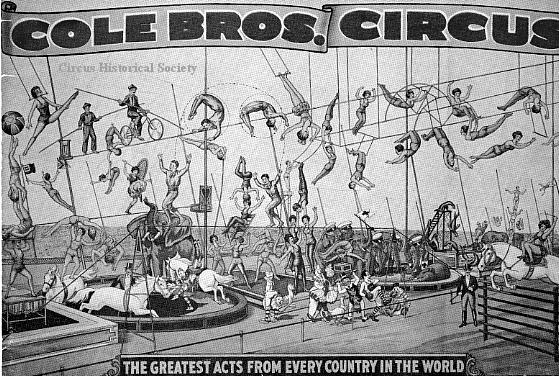
Measures to reduce the show's expenses were taken at the conclusion of the two performances given at Cumberland, Md., July 27, 1935. The show was cut off from 35 to 30 cars and 5 cars of equipment were sent back to Rochester quarters the next day. They included Stock Cars No. 44 and No. 46; Flat Cars No. 63 (Mt. Vernon built) and No. 66 (Warren built), and Coach No. 73, Buffalo. Wagons loaded on the flats which went back to Rochester included the Lion and Mirror Bandwagon; No. 79 corner statue air calliope; Cross cages No. 8 and No. 11; former Christy Bros. 12 ft. cages No. 21, No. 22 and No. 23, a couple of chariots and no doubt a few baggage wagons in order to fill out the remaining space, however, there is nothing definite on just which wagons these were. The train was loaded so tight that is was probably necessary that the two flats carry a full load. A major move in the performance was the elimination of Allen King's animal act and the ballet girls from the spec and other numbers. King left the show at Cumberland and his animals occupied the three 12 ft. cages. Other animals sent back to quarters included 9 elephants, some ring stock, ponies, and other lead stock. There was no change in the physical layout of the show. The train now traveling on 30 cars had one in advance and 29 back, which included 7 stocks, 14 flats, and 8 coaches. Train moves from then on were made in a single section.
Although the printed program still listed King's act as did some advertising matter the show's title painted on the flat and stock cars was altered to extent that the word "Allen" was erased and the word "Animal" added so that the title now read "Cole Bros. World Toured Circus with Clyde Beatty Animal King."
Allen King, who like Clyde Beatty had his name prominently displayed in the show's billing and painted on the railway equipment, actually had no financial interest in the show. He and Beatty both were only salaried performers and had no monetary interest in the show and held no managerial position.
The show arranged to rent Allen King and his animal act, 3 elephants, George, Katie, and Barney, ten ponies, several ring horses as well as a steel arena and other props to the Bays Bros. Circus which was currently in quarters at Sullivan, Indiana, being reorganized. Fred F. Bays had opened his motorized show bearing his name earlier in the season and toured it a few weeks before going back into quarters. He took Ray Marsh Bryden into the management to help reorganize. The show, augmented by Allen King and his wild animals and the other animals and props sent over from Rochester, reopened on August 15 under the new title of Rice Bros. Circus. A note in the Sept. 14 Billboard stated that Fred Bays had sold the show to Ray Marsh Bryden and Allen King. Adkins and Terrell had no interest in the show with exception of renting of the animals and equipment. At the conclusion of the 1935 season the animals and props were shipped back to Rochester. King left Rice Bros. at end of the season but never returned to the Cole show. Later in 1942 he had his own motorized show, King Bros. Circus, on the road for that season.
The Cole animals that went back to Rochester with the 5 cars of equipment and didn't join Rice Bros. remained in quarters.
There was no further reduction in the Cole performance and it remained pretty much the same for the rest of the season.
The parade, of course, was shortened somewhat with absence of the Lion and Mirror bandwagon, No. 79 air calliope, and the five cages. Just prior to the equipment going back to Rochester the air calliope instrument was placed in the No. 78 unafon wagon remaining on the show and the unafon instrument put into the No. 79 wagon returning to quarters. It was necessary that the air calliope remain on the show for use with the band during the performance. The No. 1 band now rode the Columbia bandwagon in parade and the No. 2 band the America wagon.
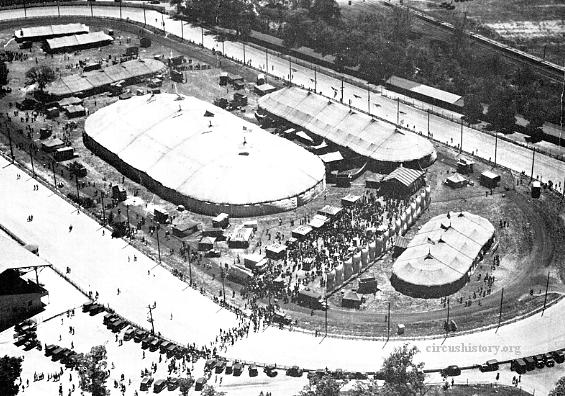
Gordon Potter caught the show again on Aug. 12, 1935, at Benton Harbor, Mich., and the notes he made that day give us a good look at the revised train loading order and the parade lineup. He also made other notes of interest concerning the baggage and ring stock, menagerie animals, and seating equipment. Potter's train loading order used here is complete as to total number of vehicles loaded, however, he says that the train was loaded so tight he was unable to see the individual number on the wagon front of some units that day. The load order is as follows:
Cole Bros. Circus, Benton Harbor, Mich., August 11, 1935.
7 Stock Cars:
No. 40 - baggage stock
No. 41 - baggage stock
No. 43 - baggage stock
No. 42 - elephants
No. 48 - lead stock
No. 45 - ring stock
No. 47 - ring stock
14 Flat Cars:
Flat Car No. 57 (run car)
Total of 29 cars in train. One car in advance. total Of 30.
Potter made mention in his notes taken that day that the big top was 145 ft. round top with three 50 ft. and two 40 ft. middles with 6 center poles. There were 17 sections of grandstand chairs, 10 rows high, 16 wide each section, giving total capacity of grandstand 2720. Performance was given in three rings and on two stages. Potter noted that the show had only gained 224 grandstand seats by adding two center poles and two middle pieces after the show opened as two rows were taken off the grandstand to make the hippodrome track wider. A feature of the general admission seats (blues) was the provision of foot rests which greatly added to the comfort of the patrons. Unfortunately the foot rests were discarded after the 1935 season.
Potter's full and complete parade notes are printed just as be made them that day in Benton Harbor and which provide an outstanding historical record of the show.
"Complete street parade line-up and other information on Cole Bros. World Toured Circus and Clyde Beatty's Gigantic Trained Wild Animal Exhibition at Benton Harbor, Michigan, August 12, 1935, A little cloudy at parade time, slight rain just before. Sun shining before it returned to the lot.
2 Riders (on horses)
4 Horses pulling Buggy
6 Horses pulling No. 62 Columbia Bandwagon (No. 1 band)
6 Ponies pulling Cross Cage with birds
4 Ponies pulling Cross Cage with monkeys
4 Ponies pulling Cross Cage with leopard
6 Ponies pulling Cross Cage with hyena
4 Horses pulling No. 16 Cage with lions
4 Horses pulling No. 17 Cage with lions
6 Horses pulling No. 71 Asia Tableau
Wagon (sideshow band)
3 Riders (on horses)
4 Horses pulling No. 24 Cage with lions
4 Riders (on horses)
4 Horses putting No. 78 Air Calliope wagon
4 Horses putting No. 25 cage with lions
2 Donkeys pulling Buggy
6 Horses putting No. 70 Palm Tree Tableau wagon (clown band)
2 Riders (on horses)
4 Horses pulling No. 27 Cage with tigers
4 Riders (on horses)
4 Horses putting No. 19 Cage with lions
6 Horses pulling No. 72 America Tableau (No. 2 band)
3 Riders (on horses)
4 Horses pulling No. 26 Cage with lions
12 Wild West Riders (on horses)
4 Horses putting No. 18 Cage with tigers
2 Zebras
4 Camels
15 Indian elephants
6 Horses putting No. 116 Steam Calliope (Note: The 4 cross cages were numbered 7, 9, 10, and 12)
Parade Itemized
66 Head of baggage stock
20 Head of baggage ponies
30 Riders (on horses)
6 Tableau and calliope wagons
8 Large cages
4 Cross cages
15 Elephants
6 Head of menagerie lead stock
2 Buggies with 6 horses and donkeys
26 Head of baggage stock left at the lot during the parade
Menagerie List
9 Large cages. (Note the sea lion Cage No. 15 was left on lot and did not make parade)
4 Cross Cages
16 Indian elephants
1 African elephant. (Note the African "Jumbo II" and one Indian elephant did not make parade)
Potter also made the interesting observation that the show now had a total of 92 head of baggage stock with the 30 car show compared to only 76 head with the 35-car show he caught on opening day at Rochester which emphasizes how desperately short the show was on baggage stock at the beginning of the season.
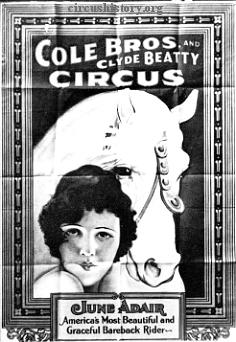 Cole Bros. & Clyde Beatty Circus. June Adair, bareback rider.
The first stand for the reduced Cole show was at Marietta, Ohio, which was played with only five days billing made necessary by the sudden switch of route caused by the infantile paralysis scare in Virginia. The Billboard reported that the stand in Marietta and the one the next day at Athens were good. Other Ohio stands were fair. The parade at Springfield was cancelled which created some local heat.
At Sandusky on August 6 the Cole show, which had been plagued with heated opposition most of the season, now found itself playing a day and date with the Tom Mix Circus. However, the meeting of the two shows was actually more by accident than design. There had been no planned opposition and both Mix and Cole had merely scheduled the stand only recently due to route changes in both shows. Both Lewis Bros. and Russell Bros. had been in Sandusky earlier in the season. The opposition was friendly between Cole and Mix and there was no covering of paper or pulling of bills by either show. Both shows paraded and both claimed good business despite rain. Cole claimed a 60 percent matinee and 90 at night while Mix claimed 60 percent matinee and 85 at night.
After several weeks the show was about back to normal. At Benton Harbor Gordon Potter said he remembered that the show used billing paper originally printed for Virginia and North Carolina stands and he could see the initial printing showing under the new stand sheet pasted over the old. Business was now fairly good and Benton Harbor and Hammond, Ind., both gave good business with the latter producing a straw house at night. Harriet Beatty was now working the cats with one feature having "Nero" an African lion jump through a series of fire hoops.
From August 12 through 31 the show played continuously without the usual Sunday break. A lot of territory was covered as the show moved on through Illinois to six stands in Iowa, two in Nebraska. one in Missouri, three in Kansas. and to Ponca City, Okla. on August 31. The Sunday stand in Quincy, Ill. produced good business and the next day at Burlington, Iowa saw a good turnout. A real battle for advertising space and tough opposition with Hagenbeck-Wallace took place at Peoria. The show said in the Billboard that the heavy one section train had received some good service by the Monon, Nickle Plate, Burlington, and Rock Island railroads of late.
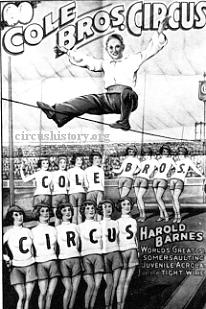 Cole Bros. Circus. Harold Barnes, juvenile acrobat.
The Sept. 7 Billboard said that Cole's business in the Mid-West had been good and that several towns had not had a rail show in several years. Falls City, Neb., was the smallest town played so far but turned in nearly a capacity matinee and a good night house. St. Joseph, Mo., had capacity houses and saw its first street parade in ten years.
Labor Day, Sept. 2. found the show at Ardmore, Okla.. where despite an all-day rain a capacity matinee and 85 percent night house was claimed.
A slight route change took place as the show cancelled two Texas stands, Ft. Worth for Sept. 6. and Dallas for Sept. 7, and substituted two additional stands in Arkansas. The reason for the show not entering the Lone Star state is not known. Hagenbeck-Wallace later moved into the state for a series of stands.
Cole Bros. now entered an extensive tour of the South and would remain for the final nine weeks of the season taking advantage of the cotton and tobacco crop harvest now coming on in Dixie.
Rain hurt at Little Rock and other Arkansas stands. From a weather standpoint Little Rock was the toughest day of the year as the lot was almost impassable at night.
At Sikeston. Mo., Clyde Beatty had a narrow escape when "Detroit," a huge African lion, and "Alice," a performing Siberian tiger, started a battle that didn't end until the tiger was killed.
The stand at Memphis on Sept. 16 was well advertised and the show posted nearly 10,000 sheets of paper and banners. The result of the heavy advertising was a turnaway at night and a surprisingly large afternoon house.
The Sept. 28 Billboard announced that 6 elephants and 12 menage horses which Cole had earlier sent to Rochester were booked and leaving to join the Edward Fernandez Circus for a ten-week tour of Hawaii.
A few weeks earlier the Billboard mentioned that 3 more elephants and the former Barnum & Bailey pony floats, Cinderella, Old Woman in Shoe, and Mother Goose had been purchased by Cole from the Hall Farm and shipped to Rochester and it was noted that the show now owned a total of 29 elephants although only 17 were currently on the road with the show. It may have been December before the elephants and floats actually were shipped to Rochester as this was again mentioned in the Dec. 3 Billboard. The 3 elephants were Major, Trilby, and Alice and were the last elephants owned by the Hall Estate. The 3 pony floats had been used on the Robbins Bros. Circus in 1930 but were not a part of the chattel mortgage Hall held on the 1931 Robbins Bros. equipment and which was sold to Cole Bros. the previous December.
After the big Memphis stand the show spent the rest of that week in Mississippi in the cotton country. Two Alabama stands, Selina, and Montgomery followed and then the show entered Georgia at Columbus. Adkins announced that the three named towns gave better business in 1935 than a year earlier to Hagenbeck-Wallace. Georgia towns, Albany, Thomasville, Valdosta, and Waycross had not seen a railroad circus in years. Generally most of the medium sized towns in the South welcomed the show with a reasonable license and parade fee but at Greenville, Miss., no parade was given on Sept. 18 due to excessive license demands for a $200.00 parade fee.
At Waycross, Ga., the show used the Atlantic Coast Line Railroad grounds right at the depot and business was good. At Savannah it was capacity crowds both afternoon and night. The rest of the week after Savannah found the show making South Carolina and Georgia stands and then headed into North Carolina and was at Charlotte for the coldest Oct. 7 on record. Despite the chilly weather there was a good turnout in afternoon and nearly capacity at night.
The show remained in the North Carolina and Virginia region for four full weeks taking advantage of a good tobacco crop and picking up many stands that had been cancelled back in August. Raleigh, Goldsboro. Rocky Mount, Norfolk, Newport News, and Richmond were all good. At Norfolk the show packed them in both afternoon and night. The C & O ferries used on the move from Norfolk to Newport News. The Sunday at Norfolk on Oct. 13 was paint day and all stakes, poles, and properties were given a fresh coat of paint. Ringling-Barnum was in keen opposition at Norfolk and Richmond.
Winston-Salem was good, as was Hickory, a small town. Ashville was a big day for the big show, sideshow, and concessions. High praise was given the Southern Railway for the show's moves of late.
The Oct. 26 Billboard in mentioning the show's business in the Carolinas and Virginia noted that so far Cole had experienced 64 days of opposition with railroad shows, notably Hagenbeck-Wallace and Ringling-Barnum; had played day and date with Tom Mix; followed Downie Bros. on a number of occasions, and that Russell Bros. and Seils-Sterling had offered opposition in Kansas, Nebraska, Arkansas and Missouri. It again noted that general agent Floyd King's idea had been to be first in every town against railroad circuses and in this he had been successful.
Very sparse Billboard accounts appeared concerning the show's final two weeks of the season. After leaving North Carolina on Nov. 1 at Fayetteville two stands were played in South Carolina at Florence and Greenville, and then the show moved into Georgia at Athens on Nov. 5 and closed the next day at Macon, Wednesday, Nov. 6, from which it moved then directly to the Rochester quarters.
The author caught the show at Athens, Ga.. on the next to the final stand. The day was cool and cloudy and a late arrival forced cancellation of the street parade. An extremely long haul plus the late arrival made it necessary to press into service a number of trucks from a local dray hauler as two trips by baggage stock was out of the question. As was true of the stand at Athens Floyd King had routed Cole into many of the stands in that region which had proved so profitable to Hagenbeck-Wallace a year earlier. Notes I took that day listed the following menagerie animals: 19 lions, 5 tigers, 1 jaguar, monkeys, baboons, macaws, and sea lions as caged animals. Lead stock consisted of 4 camels, 1 zebra, 1 buffalo, 1 yak, and 17 elephants.
An important member of the Cole publicity staff was Miss Klara Knecht, sister of Karl K. Knecht, one of the early leaders of the organized circus fans. Miss Knecht held the title of educational director and worked primarily with school and radio publicity. She was highly successful in getting schools closed or dismissed early on circus day. She often gave as many as two or three radio broadcasts a day and was once mentioned by Robert L. Ripley's Believe It Or Not feature for her remarkable feat of speaking over so many radio stations in the country in her job as a circus educational director.
And so the initial tour of the new Cole Bros. Circus came to a close at Macon, Georgia, the winter home of the large motorized Downie Bros. Circus, and a city long prominent in circus history. Business throughout the South had been spotty as was true for the season as a whole. The maiden season had its rough spots with heavy opposition, numerous breakdowns and delays caused by inadequate renovation of some of the rolling stock, a big top size and shape and seating arrangement which was not too desirable for this size show, plus a heavy nut which at times outweighed the money coming into the wagon, and although the profit was not large for the season, only about twenty thousand, there was no cause for pessimism and the management looked forward toward the next season. The show had been very well received by the public and the future looked encouraging. Cole had fared as well as most of the other large circuses in 1935. Ringling-Barnum had experienced a much better year than 1934 but the reverse was true with Hagenbeck-Wallace. Al G. Barnes did fair on its season which included a long tour through Canada.
On arrival in Rochester the show was put in the barn for the winter. The baggage stock were sent out to one of Bradley's farms about 5 miles from town while the ring stock and elephants were housed in newly remodeled quarters.
On November 20 a baggage car arrived in Rochester bringing back Allen King's trained cats and other animals and equipment which had been rented to Rice Bros. Included were 11 lions and tigers, 2 black leopards, 2 elephants, 4 menage horses, steel arena, and other properties according to the Nov. 30 Billboard. The same issue said that the show had purchased 3000 ft. of railroad trackage for new storage yards at the quarters and that the grading was underway and the laying of tracks would be completed rapidly. The new side tracks would make it unnecessary to continue to store the rail cars on Nickle Plate Railroad sidings.
The Dec. 7 Billboard stated that the first 10-car section of the new Cole rail yards had now been completed. It was also mentioned that a crew of workmen were converting the antiquated Robbins Bros. sleepers purchased last year into storage rooms for equipment. Other improvements at quarters were the removal of the cooking and dining rooms from the office building to a space formerly used by the commissary adjacent to the cat barn. This shift was done in order to provide necessary office space which previously had been inadequate. This issue also mentioned about the 3 elephants from the Hall Farm arriving at quarters.
The Dec. 14 Billboard mentioned that 20 baggage wagons formerly on the Buck Jones Wild West Show of 1929, which had been stored at the Hall Farm, had arrived in Rochester. A rumor, which later proved to be unfounded, had it that the wagons would be used to replace parade wagons and that the street parade would be cancelled for 1936.
The late Col. Bill Woodcock once told me the story about the acquisition of the Buck Jones wagons. He said that after Cole closed for the season in 1935 that Adkins and Terrell went to Lancaster and cleaned out all usable equipment. They got the 3 final elephants, the 3 pony floats, and the parts of the Buck Jones wagons that were worth saving. These wagons were dismantled, loaded into system baggage cars, and shipped to Rochester. Only the worthwhile parts were taken. Usable wheels, gears, hardware, and parts were used in the extensive rebuilding of the Cole rolling stock during the winter. The main point Woodcock wanted to bring out was that the wagons were not shipped to Rochester intact and on flat cars. Most of the Buck Jones wagons had been former carnival vehicles and not too well suited for regular circus daily moves.
The final couple weeks of 1935 brought the latest news of developments at Rochester quarters through the weekly Billboards. The Dec. 21 issue stated the new cookhouse was now ready for use and that a new sign had been erected at quarters reading "Cole Bros.-Clyde Beatty Circus" replacing the old sign reading "Indiana Circus Corporation." A new animal barn to house cats and elephants was being constructed which would be 250 ft. long x 60 ft. wide and would house all cage and menagerie animals. A new housing arrangement called for the removal of the repair shops in the building now used as a cat barn, directly to rear of the new cookhouse and the conversion of the present animal barn to a wagon storage and paint shop and the inclusion of all ring and menage stock under one roof. The horse barn was located adjacent to the newly appointed menagerie animal barn and housed all ring stock. Baggage stock continued to be quartered at the farm.
With the winter quarters improvements made the scene was now set for the coming of 1936 and the next few months would see an extensive program of renovation of all rolling equipment. This program was a major one and was vital and there would be little rest for the quarters personnel during the winter.
Special notes: Chang Reynolds and Bob Bernard, noted elephant historians, have clarified by name, number, and time of arrival the elephants coming to the Cole show by way of the Hall Farm. Of course the 3 elephants coming to the new show by way of the Standard Oil Live Power show at the Chicago World's Fair were originally from the Hall Farm and were named Tony, Big Katie, and Juno, however. we are concerned here with the 18 purchased from the Hall Estate after the show was organized. The initial 6, which came with the purchase of the Robbins Bros. equipment in December, 1934, were Blanche, Little Babe, Big Jenny, Tommy, Ding, and Boo. The first three named were part of the Robbins Bros. property held by Hall and the latter 3 were owned and sold by Hall's widow. After the 1935 season opened nine more were purchased and added to the show at Detroit. These were Mary, Sidney, Wilma, Little Katie, George, Nellie, Little Jenny, Anna May, and Tessie. The final 3 elephants purchased from Hall late in 1935 were Major, Trilby, and Alice.
A special word of thanks goes to member Bob Brisendine, who furnished the tape recorder, conducted the interviews, and typed the complete transcript of the interviews with Floyd King and Arnold Maley last winter which provided so much of the research material for this series of articles. To be continued.
Within the lifetime of the present generation the American circus has almost been replaced as an entertainment medium by the films, radio, and television. The boys and girls of early rural Missouri were more fortunate than our sons and daughters in regard to the circus. They saw many wagon shows and show boats, and they saw the best circus performers in America. At least sixty-one circuses and menageries, under thirty-one different managements, toured rural Missouri before the Civil War. Between 1838 and 1861, circuses appeared in the state in every year except possibly 1839 and 1844; and in 1856, ten different circuses entertained Missourians beyond St. Louis. During the 1850's Missourians living near either the Mississippi or the Missouri River could see at least one circus each summer, and in several seasons they could take their pick of two or three sawdust shows.
Whether traveling in wagons or on boats, the circuses exhibited almost entirely in the populated river counties and performed in at least one hundred and twenty Missouri towns and hamlets before 1861. The wagons journeyed westward into the Boon's Lick Country and on up the Missouri River as far north as St. Joseph - sometimes even to Savannah and Oregon - performing in the towns on one side of the river on the westward trek and in the communities on the other side when returning east. They also toured the west bank of the Mississippi from Cape Girardeau to Hannibal and Palmyra. The circus boats stopped at almost every landing along both rivers, occasionally performing in two or three different towns in a day's time. Apparently few, if any, pitched their tents in the central regions of northern and southern Missouri. Only one is known to have exhibited in Springfield, in Southwest Missouri. The shows therefore traveled where the population was dense enough to insure profitable audiences.
These early circuses and menageries were, of course, small organizations, compared with the big-top shows of the twentieth century. The circus was then young, for the modern rolling show had only been born in 1815. (2) Therefore, the equestrian company which performed in St. Louis in 1823 (3) probably contained little more than a few horses and riders, with perhaps an acrobat and a clown as added attractions. By the 1830's the American circus had been elaborated by the addition of menageries, animal acts, parades and even a twenty-four horse hitch to the bandwagon - all made possible by better roads. which permitted heavier wagons and stock. (4) Thus by the time it reached rural Missouri in the late thirties, the American wagon show had already taken shape, developed and enlarged its various acts, and consequently increased its number of personnel. Wagon shows of 1840 and 1841 contained horseback riders. jugglers, and clowns. The horses were already richly garbed in "sumptuous trappings" for their dancing and posing. A menagerie advertised the following animals: a rhinoceros, Asiatic serpents, lions, tigers, camels, and an elephant. In the mid-forties, buffalo, reindeer, monkeys, leopards. wolves, hyenas, bears, small wild animals, and exotic birds had been added to the exhibition. An elephant pulled the band-car in the parade. By mid-century the animal trainer had appeared, and soon he could perform before as many as two or three thousand rural Missourians crowded under a tent to see a one-ring circus performance. Although P. T. Barnum and Dan Rice advertised that their tents would accommodate ten or fifteen thousand persons “comfortably," the early tents probably never seated more than four thousand in any one audience. Compare these with modern tents, in which audiences range front five to fifteen thousand. The big top measures as much as six hundred by two hundred feet; Van Amburgh and Raymond's tent of 1852, only three hundred by one hundred feet. The modern circus has hundreds of performers, but the claim of a pre-Civil War show that it had “200 men and horses" undoubtedly seemed large to the early audiences. Even so, the circus was growing Lip.
Circuses undoubtedly exhibited in rural Missouri before 1840. The American Arena Company, traveling by steamer on the Mississippi, performed in Davenport, Iowa, in 1838. (5) It almost certainly stopped at many landings along the river, wherever it could take in a few dollars. Probable stops in Missouri, aside from St. Louis, were Cape Girardeau, Ste. Genevieve, and the newly incorporated Hannibal. Furthermore, it is likely that this was the circus which visited Jefferson City (6) and probably other Missouri River towns.
The Seeley circus of 1840 is the first wagon show definitely known to have exhibited west of St. Louis. It appeared in Fayette and Glasgow and undoubtedly other Boon's Lick villages. (7) The following year, the Johnson, Fogg, Stickney concern, featuring a trick horse named Champion, sixteen equestrians, a juggler, and a clown who sang Negro songs and played a banjo, also journeyed up the north bank of the Missouri, supposedly as far west as the Platte country, returning on the south side of the river. (8) This circus charged prices typical of the tent shows throughout the pre-Civil War period: fifty cents for adults; half-price for children and servants. Advertisements for the Waring, Raymond, Weeks Menagerie and Circus in 1841 reveal a portion of its itinerary: Maysville, Salem, Mount Vernon, Lebanon, and Edwardsville, Illinois; St. Louis, St. Charles, Cottleville, Hickory Grove, Warrenton, Pinckney, Loutre Island, Danville, Williamsburg, Fulton, (probably Millersburg and Columbia) and Fayette. Consistent with the customs of the period, the circus did not perform on Sundays. Four years later the Great Philadelphia Zoological Garden advertised its itinerary through the middle of the state as: Richmond. Liberty, Platte City, Westport, Independence, Wellington, Lexington, Arrow Rock, Boonville. and Palmyra. Many intermediate stops, at small towns now extinct, were also made. The Philadelphia show was the first of several menageries to reach the area before the Civil War. The advertising claimed that as the menagerie approached Boonville its elephant would be pulling the handcar, followed by a retinue of horses and twenty-one wagons. The animal trainer would entertain Boonvillians by harnessing and driving a large Nubian lion. (9)
The most famous wild animal trainer in the world, Van Amburgh, honored Missouri with his performances during the 1850's. In 1852 a Hannibal editor referred to Van Amburgh as "the most renowned of all Lion conquerors." (10) The journalist was correct, for this daring trainer had already become the titular king of trainers in America and Europe. A song about him became popular:
Van Amburgh is the man,
who goes to all the shows,
He goes into the lion's den,
and tells you all he knows;
He sticks his head into the lion's mouth,
and keeps it there awhile,
And when he takes it out again,
he greets you with a smile. (11)
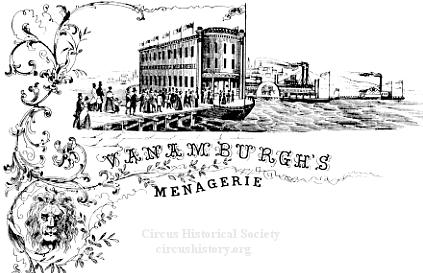 Rare letterhead of the Van Amburgh Menagerie dated 1853.
Van Amburgh was not only a brave performer but a shrewd promoter is well. In spite of their popularity, circuses were considered by many persons to be immoral, degenerate forms of amusement. They often assured their audiences that their clown's jokes would not offend "even the most fastidious." A writer to the Columbia Statesman in 1848 was shocked by the way in which “virtuous, orderly and soberminded" persons so readily lent themselves to the "carnal impulses of the moment" as to attend circus performances, which he called "traveling abominations." (12) It was to such critics that Van Amburgh's publicity appealed. The "Lion King" emphasized that he was carrying out a religious responsibility in his exhibitions of taming wild animals. He quoted the Bible to the effect that God created man superior to the animals, and stated that he, like the early Christians, collected menageries in order to demonstrate his superiority over wild beast. (13) Therefore when this great showman forced animals to kneel at his feet and lick his hands, his audiences felt that they were witnessing a moral and instructive performance rather than a mere cheap and tawdry circus. He undoubtedly attracted many righteous persons, as well as the usual circus audience, to his show. Tradition has kept Van Amburgh on the throne, at any rate, and he is given credit for having originated most of the stunts still in use by animal trainers. (14)
Van Amburgh's progressive showmanship was demonstrated in 1854 when he returned to rural Missouri on a huge showboat, the Floating Palace. The Palace, which furnished the arena for the animal trainer's acts, was an immense barge towed by the steamer James Raymond. The possession of these boats was of great advantage to Van Amburgh, for he could now give many more performances, in fewer days, than he had been able to while traveling on land. For example, in one day he exhibited at Douglassville. Illinois, opposite Hannibal, at ten in the morning, and twice at Hannibal, at two in the afternoon and again at seven in the evening. (15) Water travel enabled him to move rapidly and easily, and the large interior arena on the Palace not only could be lighted artificially for night performances but was also always ready for use.
Another well-known animal trainer, but one who traveled in Van Amburgh's shadow, was Herr Driesbach, who visited the state in three different seasons: 1853, 1857, and 1859. During the first tour he exhibited in approximately thirty different towns in the Missouri River counties. His animal cage was described as weighing over ten thousand Pounds. (16) That such a weight could be transported over the poor western roads was a fact which might have impressed his audiences.
Anyone who has ever attended a performance of a tent-circus in early August will understand the feelings of the St. Joseph newspaper man who gave his readers a full account of the Driesbach-Mabie show. The reporter admitted that he had gone to see the circus in spite of the oppressive heat rather than miss it for another year. And so, “carried away by the prevailing spirit of the day," he soon found himself under the hot canvas tent with some two thousand others. He looked at the animals, watched the equestrian and gymnastic performances, laughed at the clown's jokes, "some of which indeed, were suspected of being a little stale," saw "the fearless Driesbach . . . play with the lion and the leopards," and then went home. (17) Perhaps some of the two thousand in the audience enjoyed Driesbach and the other performers more than the unknown reporter did; perhaps not.
Driesbach returned in 1857 with his own menagerie and circus, claiming to have the largest such enterprise in America. Among his animals were Hannibal, the elephant, and the "only" living giraffe in America. Van Amburgh, who said that he brought "Old Hannibal" to America in 1824, described the animal as being twelve feet, four inches in height and one-third larger than any other elephant ever brought to the country. (18)
No name is so well known in the history of the American circus as that of P. T. Barnum. One of his most successful pursuits was the exhibition of the midget Tom Thumb. The great promoter discovered Tom Thumb at the age of five, in 1842. (19) The boy was talented and did prove to he a dwarf as the years passed, but all through his boyhood, Tom Thumb was publicized as being twenty-one years old. Thus he was advertised in St. Louis in 1844, when he was actually seven, and thus he was publicized in Hannibal in 1853, when he was actually sixteen. (20) Unreliable but efficacious advertising had already been adopted for the circus by Barnum. "General" Thumb was a talented boy, who put on quite a show by himself. In Hannibal he was to sing, dance, pose as Grecian statues, and give his famous impersonations of Napoleon and Frederick the Great. Accompanying the dwarf was a "Museum" such as one might expect from P. T. Barnum, containing the usual variety of freaks, wax figures, wild animals, and a band. (21) A popular song eventually described Barnum's museums:
If you want to have some fun,
I will tell you where to go
To see the Lion stuffed with straw,
At P. T. Barnum's Show. (22)
The editor of the Messenger, a local paper, had little to say about Barnum's show, except to remark on the effect of a summer shower upon the bonnets in the audience. (23)
One of the most interesting bits of fakery in the annals of the American circus occurred in 1850 and succeeding years, and it is quite probable that the audiences in rural Missouri were fooled as were audiences over most of the country. This trickery was conceived by S. Q. Stokes, of Cincinnati, an expert teacher of horseback riding and a well known circus owner and manager. Stokes had trained his own daughters to be accomplished equestriennes, but he had finally given up in despair in the attempt to develop women riders who could do the difficult riding that men could. Women have never been as daring riders as men, yet audiences prefer to see women ride. Eventually Stokes found an effeminate Crole boy who was an expert rider. Stokes dressed the boy as a woman and billed him on the circus programs as "Mademoiselle Ella Zoyhara." The boy's spectacular riding made him one of the most famous riders of the age. Even after he acquired a wife and children, Ella continued to please circus audiences.
For fifteen years and on three continents, as Ella Zoyhara, poised on the back of a loping resinback, kissed "her" hands to hosts of admirers, pirouetted with poetic grace, leaped through papered hoops and over banners nonchalantly and was a big-top sensation, liberally advertised. (24)
The deception was so successful that persons who heard rumors that Ella Zoyhara was a man refused to believe them after seeing "her" perform. Mrs. Sam Cowell, wife of an actor, who had heard the rumors, was impressed with Ella's riding:
. . . Ella Zoyhara - whether he or she - was about the most astonishing rider I ever saw. Her pirouettes, leaps, and attitudes were given with the most graceful ease, figure, and feet were handsome, and dress perfectly modest without being prudish. (25)
Mademoiselle Ella was performing with the Stokes circus in 1850, when it exhibited in New Madrid and Cape Girardeau. (26)
The most famous masculine horseback rider of the day was Levi J. North, who appeared in rural Missouri on more than one occasion and in more than one season. Thirty years before he brought his National Circus to Missouri in 1856, he was a boy circus rider. He toured the West Indies and South America before executing "the first known somersault on the back of a running horse, during an 1839 engagement in London." (27) These somersaults, which North learned to throw sixty and seventy consecutive times, were from feet to feet on the back of a horse galloping about the ring. (28) North was not only the greatest equestrian of the century, but he was also a circus and theatrical manager. During the winter before he toured Missouri, he opened an amphitheater in Chicago, presenting equestrian shows, the famous horse-drama Mazeppa, pantomimes, and performances by visiting actors. (29)
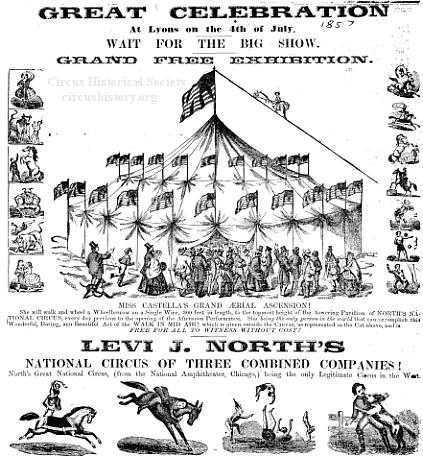 1857 Levi J. North Circus newspaper advertisement. Bob Parkinson Collection.
In 1858 North featured his new calliope, an instrument already used by showboats, but probably a novelty none-the-less in a wagon show. In addition to providing music, the calliope could be used for pumping water onto the dusty ring, as an emergency fire-fighter, or for wetting the canvas on hot days. This manager should receive credit for his many efforts to link the circus and the legitimate theatre. His circus bills usually included ballet and pantomimes.
Apparently the 1858 season was a poor one, in spite of Levi North's extensive advertising. A month after appearing in Elkhorn, Richmond, and Carrollton in early June, North's circus was reported to have broken up in Huntsville in favor of a retreat to St. Louis. "The bad roads, etc. made the country trip a dead loss," commented a Liberty newspaper. (30) In April of the following year the Hannibal paper carried the following postscript: "The calliope, wagons, etc., belonging to L. J. North's Circus, were sold at Sheriff's sale at Burlington, the other day . . .” (31) And so the bad season had apparently forced North to sell his equipment. Temporary misfortune however did not prevent him from being one of the outstanding figures of the nineteenth century circus.
Without much doubt, the most popular performer in the early American circus was Dan Rice. However, if Rice had impressed all his audiences as he did one citizen of Hannibal in 1848, he would never have been a success. This Hannibalian wrote a letter to the Journal, signing it "A Looker On.” (32) He was very unhappy about his experience at the Dan Rice circus, referring to Rice and his company as a "motley gang of Bacchanalian mountebanks." “Looker On” reported that the performers had “exhibited, or rather exposed themselves" in Hannibal, and he admitted that he had been a bit gullible in going to see them. "As to Dan Rice, the 'great Shakspearian (sic) clown'," he wrote, "we think the title Sheakspearian black-guard would suit him much better." The critic complained about Rice's lack of true wit and common decency and bewailed the sickening prostitution of Shakespeare's beautiful language and sublime ideas. Yet he conceded that Rice's performance was popular with many persons who prided themselves on being moral.
Four years later Dan Rice returned to Hannibal and received the praises of the editor of a different local newspaper:
In days "yore," Dan was the most incorrible (sic) wretch we ever knew, but then he was young and Verdant - now, since he has cut his "wisdom teeth," a more modest clown never convulsed his audience with laughter. (33)
Rice was one of the most fabulous individuals in a most fabulous business. Almost every study of the American circus or of Negro minstrels contains much praise for Dan Rice the performer, along with both praise and condemnation for Dan Rice the man. A few phrases from various sources refer to him as "one of the most famous circus clowns America has produced," "the greatest circus clown who ever lived," and "King of Clowns." (34)
Rice was known as a Shakespearian clown, a phenomenon one would not expect to find in a circus today. He looked like Uncle Sam, in whiskers and costume. He spoke in Shakespearian language, and quoted the Bard for almost any purpose. He was considered very funny a hundred years ago, but he would seem very much out of place in a three-ring circus of our time. Whereas now the modern clown frolics in silence in a large tent where use of the voice without amplification is fruitless, the old-time Merry Andrew exchanged witty remarks with his audience and seared the ringmaster with blasts of wit and perhaps coarse humor. He was the comedian of the day, but if he were Dan Rice, he was more than just a comedian, for he could enter any act of the circus bill and perform well.
Rice appeared in Hannibal at the time Sam Clemens was indulging in the famous dog controversy - August, 1852. Although Mark Twain never stated that he had attended a Dan Rice performance, it is quite possible that his description of a circus performance in Huck Finn was modeled after the Rice show. Certainly Rice is given credit for originating the drunken-rider act so vividly portrayed in Twain's book.
The two circuses which appeared most often in rural Missouri before the Civil War were both midwestern firms: one owned by the Mabie brothers of Wisconsin, and the other by "Dr." G. R. Spalding of Cincinnati, Ohio. The Mabie circus toured Missouri in nine seasons between 1843 and 1859; Spalding and his partner Rogers also sent shows into the state during nine summers between 1848 and 1860.
The Mabies were independent operators who had no connections with the great eastern circus syndicates. (35) They were possibly never a top-notch organization, yet they offered some of the best performers in their bills, such as Waterman, Rockwell, Puss Horner, Beasley, Den Stone, Frank and Tony Pastor, and Driesbach. The Mabies toured extensively, from Wisconsin to Texas, and were always a wagon show. In 1846 their organization, combined with Howes', gave the first recorded night circus performances in rural Missouri. During the 1840's their shows were largely equestrian in nature, and in 1847 particularly, their advertising stressed their large and beautiful stud of horses.
Combined with their menagerie and Den Stone's circus in 1856 was Tyler's Indian Exhibition, which used Indians in spectacles portraying buffalo hunts, corn gatherings, various Indian dances, and Pocahontas rescuing Captain Smith.
During these early days of the American circus all performers had to have one talent in common: the ability to defend themselves, to fight for their lives whenever a certain signal was given. That signal was, of course, the call "Hey Rube!" Local rowdies for one reason or another - often because of an excessive consumption of alcohol - would decide to clean out the circus. Circus men had no desire for such fights. The fracases meant a loss of money and perhaps of life and equipment. For example, Bill Lake, one of the most popular clowns of the period, was later killed by a local bully during a stand at Granby, Missouri. (36) One circus veteran, speaking of his years with the Mabie outfit, said that it seemed as if all the rubes ever wanted to do was to clean up on the circus, sometimes resulting in fights two or three times a week. (37) Perhaps the Mabies had more than their share. They at least had some trouble in Missouri in 1855. The Brunswick paper, while actually carrying a Mabie advertisement, reprinted articles from Westport and Parkville claiming that the Mabie firm was an "abolition concern." (38) According to the western journalists, the elephant trainer had tried to run-off a slave near Westport.
Ed and Jerry Mabie are credited with having created the after-show of negro minstrels. Rather than have minstrel acts in the big show these managers realized that a separate show with separate admission fees would be profitable.
Spalding and Rogers helped modernize the circus with innovations in management and operation. In about 1850 they originated the knock-down seats which enabled the wagon shows to set-up and pack-up the show in rapid time. These managers also introduced quarter-poles between the center and side poles, inclined runways for loading the circus railroad trains, and the rise of the Drummond light and gas works for night performances. (39) This development took the circus out of the whale oil, tallow candle period.
Besides being the first to put a circus on rails - in 1856 - Spalding is also credited by one authority as having put out the first "big" boat show, (40) meaning the combination of the Floating Palace, and the James Raymond, boats already mentioned above. Stokes, Rice. Washburn, and others had found steamboats convenient for the transportation of smaller shows and minstrel entertainments. Apparently Spalding and Rogers had the Palace constructed for large circus exhibitions. This huge barge was constructed in Cincinnati in 1852. It had an amphitheatre for equestrian performances containing two tiers of boxes - the first with armchairs, seating, according to the advertising, twenty-five hundred persons. (41) The cost was supposedly $45,000. (42) The dress circle contained 7,500 square feet, as compared with only 5,000 square feet in the dress circle of the St. Charles theatre in New Orleans. The St. Charles was at that time the second largest theatre in the United States. The Palace had 4,000 square feet in the gallery, and about 2,000 in the ring. It surpassed the St. Louis theatres in size and elegance. (43) The barge was two hundred and fifty feet long and had a beam of fifty feet. (44) It contained, in addition to the circus ring. a stage and auditorium, offices. museum, greenroom, dressing rooms, stable. and a pipe organ. (45) Thus the Floating Palace could truly accommodate large audiences comfortably. Besides being able to travel efficiently, it could often give exhibitions without having to pay license fees by presenting its entertainments outside town limits. The roof of the barge was undoubtedly more waterproof than an ordinary circus tent, and the constant fear of a tent blowing down was avoided by the owners. Less than a month before the Palace exhibited in Hannibal in August of 1852, Spalding and Rogers' other circus, the North American, had trouble there in a storm. To guard against a disastrous blowdown the managers lowered the canvas until the storm blew over. (46) Several blowdowns occurred in various Missouri towns before the Civil War.
With many advantages to its credit the Floating Palace was used by Spalding and Rogers for several years during the 1850's. It appeared in Missouri in 1852, 1853, 1855, 1856, and 1859. Van Amburgh used it in 1854. During the Civil War it served as a Confederate hospital.
The Palace had one serious disadvantage: it was apparently too large to be towed safely up the Missouri River. Although the James Raymond, its usual towboat, steamed up that river in some seasons, the Palace was never taken along.
The Raymond was more than a mere towboat, for it also contained an auditorium called the "Ridotto." which was used for minstrel performances. The side-wheeler had crew's quarters, galley and a mess hall for one hundred entertainers and deck hands. (47) After parting with the Palace, Spalding and Rogers continued to use the Raymond for transporting circuses which pitched tents on land or for carrying minstrel entertainments.
Many other circuses and menageries appeared in rural Missouri before the war. Among them were those managed by Rockwell, June and Turner, P. A. Older, and "Yankee" Robinson, who started the famous Ringling brothers on their circus careers. (48) Orton's Badger Circus exhibited in Kansas City on April 26, 1856, the earliest known theatrical performance in that city. (49) Other early circuses were managed by Davis and Crosbie, G. F. Bailey, H. M. Smith, Antonio, Washburn, Sands and Nathan, Carroll, L. B. Lent, and Satterlee and Bell, whose circus had the longest run during the period - seven performances during a forced two-weeks stay in Columbia in 1858. One unusual form of circus must be mentioned: the Great Monkey Circus and Burlesque Dramatic Troupe, managed by Colonel J. H. Woods for Spalding and Rogers. This circus, which traveled on the steamers Banjo and James Raymond in 1858, featured acts by monkeys, dogs, and goats.
Probably no newspaper editor ever succeeded in putting into print what the ordinary person feels when he sees a circus performance. Human thrill is rarely described adequately. The pre-Civil War newspapers sometimes did say complimentary things about circus exhibitions, but the general absence of comment on any form of entertainment in the columns of the old newspapers can be attributed to at least two things: the inadequacy of words to express the feelings of the observer and the common attitude among some Americans that entertainment is fine but hardly an essential factor in life. Complimentary press notices usually stated only that the show was worth seeing. Adverse criticism was even rarer, possibly because the editors wished to hold on to advertising accounts.
Circuses sometimes did antagonize the local populace. They were not entirely innocent in their continual struggles with the rough elements of the communities in which they exhibited. Sometimes grafters, whose business was to fleece the local populace, were tolerated or even promoted by the managements. But as a rule the newspapers reveal approval of the circus and the usual excitement awaiting its arrival in town. Two outstanding complaints appeared in the press: one in Carrollton, the other in Columbia. The Carrollton editor complimented his readers for not patronizing the Satterlee, Bell Circus in 1858. saying: “it demonstrates that they can put their half dollars to better use." (50) He extended his remarks by observing that circuses were an evil because they took money out of a community. Such arguments were probably not rare even though they did not often appear in the papers, for at that time, just following the panic of 1857, money was scarce in the West. The other complaint, made in a vociferous letter to the Columbia newspaper, (51) revealed the feelings of a not inconsiderable group of citizens who believed that all such entertainments were downright immoral. The article referred to the circuses as "travelling death and moral ruin."
Circuses, as well as most other forms of entertainment, were compelled to pay taxes in the form of license fees. In 1856 Columbia required the payment of a fee of twenty-five dollars, a rather typical fee for the time. (52) St. Joseph charged the highest sum, fifty dollars for each day. (53) Liberty and Springfield were much more lenient, charging only ten and five dollars, respectively. (54) While it is surprising that St. Joseph charged so much and Springfield so little, such differences should not be taken as an indication that the one city liked circuses less than the other. The St. Joseph authorities probably knew that circuses would exhibit there before relatively large audiences whatever the tax might be, while Springfield, being so far away from the main concentration of Missouri's population, did not wish to discourage circuses from making the longer and less lucrative tour into southwestern Missouri.
Neither newspaper editorials, letters to newspapers, nor city laws can tell us what the circus of one hundred years ago meant to its audiences. The evidence points to two significant facts: many of the best circuses in the country laid their itineraries across rural Missouri; Missourians of pre-Civil War days saw more circus performances than any other form of professional entertainment.
This article originally appeared in the October 1952 issue of the "Missouri Historical Review." Elbert R. Bowen is associate professor of speech, Central Michigan College of Education, Mt. Pleasant, Michigan. He received the A.B. degree from DePauw University, the M.A. from the University of Denver, and the Ph.D. from the University of Missouri. From 1946 to 1950 he was instructor in speech at the University of Missouri.
2. Earl C. May, The Circus from Rome to Ringling (New York, Duffield and Green, 1932), p. 28.
3. William G. B. Carson, The Theatre on the Frontier; The Early Years of the St. Louis Stage (Chicago, The University of Chicago Press, 1932), p. 78. The month of the performances is given as August.
4. May, op cit., p. 34.
5. Joseph S. Schick, The Early Theater in Eastern Iowa: Cultural Beginnings and the Rise of the Theater in Davenport and Eastern Iowa, 1836-1863 (Chicago, University of Chicago Press, 1939), pp. 32-33. The date of the performance was August 31, 1838.
6. “The first circus visited the city May 18, 1838.” - Jefferson City Tribune, January 18, 1888.
7. Fayette Boon’s Lick Times, July 11, 1840.
8. Ibid., July 17, 1841.
9. Boonville Observer, June 24, 1845.
10. Hannibal Tri-Weekly Messenger, August 3, 1852.
11. Sigmund Spaeth, Read ‘em and Weep: The Songs You Forgot to Remember (New York, Halcyon House, 1939), p. 76.
12. The (Columbia) Missouri Statesman, August 18, 1848.
13. A Brief Biographical Sketch of I. A. Van Amburgh and an Illustrated and Descriptive History of the Animals Contained in His Menagerie . . . (New York, Printed by Samuel Booth, 1860), pp. v-vi.
14. M. B. Leavitt, Fifty Years in Theatrical Management (New York, Broadway Publishing Co., 1912), p. 381.
15. Hannibal Tri-Weekly Messenger, August 19, 1854.
16. Columbia Missouri Statesman, July 8, 1853.
17. St. Joseph Weekly Commercial Cycle, August 12, 1853.
18. Sketch of Van Amburgh, pp. 25-27.
19. P. T. Barnum, Struggles and Triumphs; or, Forty Years’ Recollections of P. T. Barnum; Written by Himself (New York, Macmillan Co., 1930), p. 106.
20. St. Louis Democrat, April 1, 1844; Hannibal Tri-Weekly Messenger, August 18, 1853.
21. Hannibal Journal, August 25, 1853.
22. Spaeth, op. cit., p. 77.
23. Hannibal Tri-Weekly Messenger, September 15, 1853.
24. May, op. cit., pp. 206-09.
25. M. Wilson Disher (ed.), The Cowells in America; Being the Diary of Mrs. Sam Cowell during Her Husband’s Concert Tour in the Years 1860-1861 (London, Oxford University Press, 1934), p. 137.
26. Cape Girardeau Western Eagle, April 5, 1850.
27. May, op. cit., pp. 33-34.
28. Isaac J. Greenwood, The Circus: Its Origin and Growth Prior to 1835; With a Sketch of Negro Minstrelsy (New York, William Abbatt, 1909), pp. 134-35.
29. Robert L. Sherman, Chicago Stage: Its Records and Achievements (Chicago, the Author, 1947), I, 269, 276, 278, 404.
30. Liberty Weekly Tribune, July 9, 1858.
31. Hannibal Daily Messenger, April 13, 1859.
32. Hannibal Journal, June 29, 1848.
33. Hannibal Tri-Weekly Messenger, August 24, 1852.
34. Carl Wittke, Tambo and Bones; A History of the American Minstrel Stage (Durham, N. Car., Duke University, 1930), p. 241; Gil Robinson, Old Wagon Show Days (Cincinnati, Brockwell Co., 1925), p. 44; Greenwood, op. cit., p. 135.
35. Ayres Davies, “Wisconsin, Incubator of the American Circus,” The Wisconsin Magazine of History, 25 (March, 1942), 288-90.
36. Jefferson City Missouri State Times, September 3, 1869.
37. May, op. cit., pp. 54, 57.
38. The (Brunswick) Weekly Brunswicker, July 28, 1855.
39. May, op. cit., pp. 57, 239.
40. Ibid., pp. 39, 129.
41. A conservative estimate of 1800 persons was made by the Davenport Gazette , June 9, 1853, cited by Joseph S. Schick, “Early Showboat and Circus in the Upper Valley,” Mid-America, 32 (October, 1950), 217.
42. Louisville Journal, date unknown, quoted by the St. Joseph Adventure, March 26, 1852.
43. Margaret Blackburn, “The Stage in St. Louis, Missouri, after 1850,” (unpublished Master’s thesis, State University of Iowa, Iowa City, 1927), p. 35.
44. Louisville Journal, date unknown, quoted by the St. Joseph Adventure, March 26, 1852.
45. Schick, “Early Showboat and Circus in the Upper Valley,” Mid-America, 32 (October, 1950), 216.
46. Hannibal Tri-Weekly Messenger, July 31, 1852.
47. Schick, Early Theater in Eastern Iowa, p. 28.
48. May, op. cit., pp. 147-48.
49. Kansas City Enterprise, April 5, 1856. This advertisement appeared almost two months before the May 31 circus advertisement in the Enterprise which Reitz mistakenly terms the “first reference to a public performance in Kansas City,” - Louise Rietz, “History of the Theatre of Kansas City, Missouri, from the Beginnings until 1900" (unpublished Doctor’s dissertation, State University of Iowa, Iowa City, 1939), I, 11. Harold and Ernestine Briggs make this same error. - “The Theatre in Early Kansas City,” Mid-America, 32 (April, 1950), 90.
50. Quoted from the Carrollton Democrat, date unknown, by the Liberty Weekly Tribune, September 17, 1858.
51. The (Columbia) Missouri Statesman, August 18, 1848.
52. Town ordinance, dated June 15, 1856, Book A, Proceedings, Board of Trustees, Columbia, Missouri. Other towns charging twenty five dollars per day were Boonville and Hannibal.
53. City ordinance, No. 84, relating to revenue, dated August 22, 1851, St. Joseph, Missouri.
54. Liberty city ordinance, dated June 12, 1851, published in The Weekly Tribune, July 11, 1851; Springfield city ordinance, dated March 12, 1846, published in the Springfield Advertiser, April 4, 1846.
Installment No. 10. Important Trivia, Part II
Having disposed of the "errors of omission" regarding the flying trapeze, presented in previous installments, we must, of course, also correct the "errors of commission."
In Installment No. 2, Part 1, of the Flying Trapeze, for those of our readers who may be interested in the picture of the "unidentified" catcher appearing with Arthur and Antoinette Concello on page 19, his name is Francis "Gootch" Reiner. And what a splendid catcher he was!
In the same issue, page 16, referring to the last paragraph, "With the Clarkonians, it was. etc. . . ." We can't account how the names of Charles and Ernie ever became transposed. With the transposition of the two names, the text makes it appear that it was Charlie who kept prodding his older brother. In fact, it was the reverse, with Charlie wanting to give up and Ernie keeping the prodding. Anybody who knew the Clarkonians will tell you that Ernie, as the oldest of the family, was always the "leader" who brooked no interference from his juniors. He was the "boss" - Until his death.
In Installment No. 3, Part II, Flying Trapeze, in the last paragraph of column 1, page 17, 1 transposing of names makes it appear that Bob Yerkes had been catching triples of Tony Steele with a 70% average. We can't account how this ever occurred, either.
We know that Bob Yerkes never caught any triple from Tony Steele and the name which should have appeared in that spot is Lee Stath, who, with his wife, Mary, subsequently became known as The Marilees. Please forgive us, Lee, Bob and Tony.
In the same issue, next to the last paragraph of page 18, and referring to Reggie Armor, was printed: "Considering that he didn't become a professional performer until he was 25 years old, etc . . .”
This was faulty writing, which conveyed the impression that Reggie Armor didn't become a circus performer until the age of 25 - which is incorrect. Factually, Reggie did start his acrobatics on "Muscle Beach" at Santa Monica, California, during his early teens. What we meant to convey was that, as a virtuoso of the fly-bar, unlike most of such remarkable performers, he wasn't born-and-bred of the circus - and did not learn acrobatics from circus parents in his early childhood. Factually, Reggie Armor did start early enough, first as a risley and teeterboard performer with the Ted Dewayne Troupe. Later, with various other acts. But it wasn't until he was 25 years of age that he grasped a fly-bar for the first time.
Incidentally (inasmuch as we have had to refer to the names of Armor and Yerkes), since the previous installments were written, mentioning that Armor and Yerkes had split their partnership, we are now delighted to be able to report that Bob Yerkes (who for years had been catching those master triple leapers, Fay Alexander and Reggie Armor) is again catching triples with his new young leaper, Don Martinez.
Before concluding this topic of "the triple from the fly-bar," we'd like to comment on an article which was published in a "slick" mag more than a decade ago. Its author is a well-known writer, highly esteemed by the circophile fraternity for his many articles and books on circus life. In deference to his reputation, we shall withhold his identity and merely quote ad-verbatim from a section of the printed article which reads:
"The first triple attempt, in 1835, ended fatally, and for the next 63 years. only one man successfully completed the trick (chap named Armor, in 1860), and it gave him such a jolt he never tried it again. There were five more fatal tries in that time - four men and one female with the engaging name of Pospischell. In 1898 an English flier named Ernie Clarke performed the stunt with ease, kept on doing it for thirty-five years and managed to die in bed instead of in a net."
Now we don't know whether some of those specified dates are the result of misinformation, inadvertent typographical errors or faulty mathematical computations. Could be either - or all three. Whatever the cause. the data presented in that article is rather contrary to most of the authoritative reports priorly presented by most of our circus historians. Inasmuch as this particular writer is regarded in such a high esteem by most of our circophiles (who would he naturally predisposed to accept his report at face-value), we'd like to indicate a few salient points which may guide the reader in determining for himself whether the data is fiction or fact.
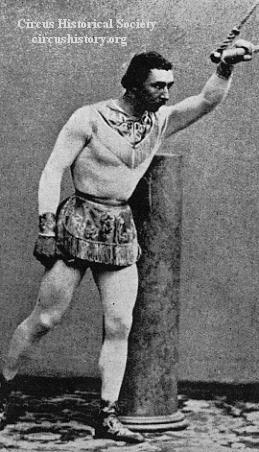 Jules Leotard. Photo from the Henry Thetard book, "La Merveilleuse Historie Du Cirque."
It did seem rather strange to us when we read: "The first triple attempt, in 1835, ended fatally . . ." - especially inasmuch as it is a documented fact that Jules Leotard, creator of "the flying trapeze" did not present his spectacular innovation until 1859 - or more than two decades later!
It also doesn't quite add up that the “chap named Armor" could have succeeded in completing a triple in 1860 - only 1 year after the first presentation of Leotard. It's most doubtful that the evolution from Leotard's simple passes to the execution of 1 single and to a double somersault could possibly have come to pass with such rapidity! As a matter of fact, Eddie Silbon, who was the first fly-bar performer to execute a double, did not present this feat until 1879, at the old Paris Hippodrome. How the "chap named Armor" could possibly have even thought of executing a triple in 1860 certainly taxes our credulity!
The section of the article further states that during an interim of 63 years (1835 to 1893) ". . . There were five more fatal tries in that time - four men and one female with the engaging name of Olga Pospischill."
Well, it's true that Olga Pospischill did get killed in a net - but it certainly wasn't while attempting to turn a triple! As far as the other four men, we wouldn't know for sure about these. But that would have to be substantiated before it could be accepted. Not utterly impossible, but highly improbable!
The general "martyrology" of the circus, which dates back to 1830, is fairly accurate in its listing of the countless performers who lost their lives in the line of duty to their profession. It gives a brief account of who, when. how and where each met his death in action. Yet, a close scrutiny of the long list fails to reveal the names of any one of four "trapezists" who might have lost their lives while attempting the triple from the fly-bar between the years 1835 and 1898!
Regarding the death of Olga Pospischill in the net, there is ample documentation to confirm the fact that this was not as a result of attempting the triple, but merely an unusual accident. A detailed account of the true circumstance is given by Henri Thetard in his "Merveilleuse Historie du Cirque," which is as follows:
"The fatal accident took place in Barmen, Germany, on June 21, 1889, at the end of a practice session. Olga was ready for her final plunge into the net, but as she was leaving the platform, her costume caught on the trapeze "retrieving hook." The costume tore, of course, but the jerk had thrown her off balance - which made her realize that she was about to land into the net face first. Instinctively, she quickly lowered her head - but too late. Her spine was broken, she died three days later, fully conscious and without suffering."
Now we can appraise the last section which reads: "In 1898, an English flier named Ernie Clarke performed the stunt with ease, kept on doing it for 35 years and managed to die in bed instead of in a net."
To state that Ernie Clarke "performed the stunt with ease" is about the greatest understatement ever written! Anybody who is familiar with Ernie and Charlie's long struggle to master the triple will know that this was finally accomplished only with a lot of sweat and tears!
And as far as the time elements presented (1898 as the date of Ernie's first triple and his death 35 years later), these represent either typographical errors on both counts - or gross miscalculations in simple arithmetic. Documentation has irrefutably established that Ernie Clarke presented the triple for the first time in 1910; also that he died as the result of a heart attack in 1941.
In conclusion, it seems that an appraisal of the various points in question should enable any reader to determine for himself whether that portion of the said article is fiction or fact. Personally, we are of the humble opinion that it is more legend than truth.
Having disposed of the topic on the flying trapeze, we can now proceed to:
The Three Bars
Once more, we were guilty of an error of omission in the previous installment pertaining to that specialty. Once more, somehow or other, a page of the text was excluded from the copy we sent the editor.
This was an interesting sidelight regarding The Dumitrescu Trio, who during the 1900 decade was performing in many circus rings and vaudeville stages in the States, Australia and Europe. Legend has it that one member of this famous trio of barrists used to execute the "pass" from the first to third bar, over the middle bar - On Which Were Planted a Series of Daggers!
To this day, you will run into sonic old-time circophile who had witnessed the Dumitrescu Trio's Performance and who will swear that those daggers were so sharp that any miss of the performer's execution would have spelled his death! Indeed it would have! That is, if true. But the fact is: These were not daggers sticking up from that middle bar but actually more of a picket-fence made of wood and fastened on a base containing hidden springs.
In the case of a "miss" of timing and/or execution. if the body of the barrist happened to touch or brush as he flew over that middle bar, the so-called "knives" merely sprung down and quickly sprung back into place. From the spectator's seat, the illusion must have been perfect, for some people are still convinced that these were dangerous daggers over which flew the dauntless performer!
Circus performers may be fearless - but not senseless. A "pass" from the first to third bar over the middle one is dangerous enough! No performer would be so foolish as to create an additional danger with daggers planted on that middle bar!
Nick Machedon who, with his brother, Alex, and "Mittu" Dumitrescu, was a member of the trio, can attest to the constant dangers which every barrist faces at each performance - for his own brother, Alex, lost his life during the course of such a performance.
When the two brothers were members of the act known as The Haas Bros., presenting a 5-bar-rigging number at the R.K.O. Theater in Auburn, Maine, Alex missed either his timing or execution while in a series of "fly-overs" between the two high bars - and crashed to his death as a result of hitting the lower bars.
While on the subject of the three bars, we'd like to mention mother error of omission regarding one team of famous barrists named Marlo and Marlo. Except for a passing mention of the names of “Dunham & Marlo," we had failed to include the name of this famous team of barrists in the installment. Again, it was inadvertently - for we have always been fully aware that Marlo & Marlo were as great a pair of performers on the three bars as any of their contemporaries - and greater than any of the present day barrists.
Risley
At long last (after the installment on this subject was already in print), we have finally come across the origin of the word "Trinka." According to a Slavonian lexicographer, "trinka" is a Slavonic word which (like "troika" in Russian) means "trinity" or "reunion of three."
That, I can buy. Actually, risley is, in a way, a "trinity" consisting of the "kicker," his top-mounter - and his trinka.
Whether our Slavonian lexicographer is correct regarding the adoption of the word by the risley fraternity, we're not prepared to say. Personally, we are willing to accept this - until somebody comes up with a better answer. Meanwhile, if it is not correct, sue the lexicographer - not us.
There is one point of discussion which should have been included in that risley installment but the thought came to us too late for its inclusion at the time. That is: 1900 risley vs. 1960 risley.
Much has been made over the fact that, at the turn of the century, there were a number of risley acts who could execute the triple - but today, one never sees any of the existing troupes presenting the triple.
While this is true, we think that our readers should be made aware that there is a valid reason why risley performers of 50 years ago could execute triples - and the present day performer does not. In the installment on the subject, we had expounded two specific reasons for the difference, i.e.: (a) the lighter weight of top-mounters of the 1900 period as compared to the heavier weights of present day top-mounters; (b) the handicaps presented by the laws of most countries regarding "compulsory education."
But there is a third factor which we neglected to propound: The difference in the "technique" that prevailed at the turn of the century as compared to that which is prevalent today.
By "technique," we refer to the different method of propulsion and timing used by both the "kicker" and his top-mounter in the execution of the routines.
At the turn of the century, risley performers focused their endeavor towards fast whirlwind routines. To accomplish these, the "kicker" imparted his "push" and the top-mounter timed his "throw" in a manner that would produce a maximum of "spin" within a minimum of distance. It was due to this "technique" (coupled with the small size of the top-mounters) that it was possible for them to execute the triple.
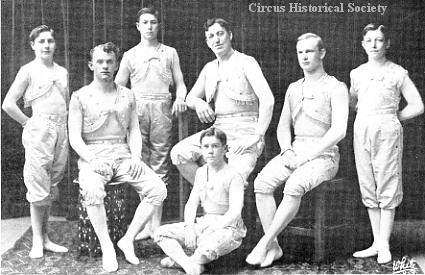 The Seven Belfords, a famous risley act. Photo from Don Howland Collection.
However, with the advent of "Belford Risley" in the 1920's, a new "technique" was introduced - which was soon adopted by most of the risley performers. This new approach in risley consisted of executing the same basic routines - But with Higher and More Lofty Gyrations of the top-mounters. Basically, instead of a tightly "tucked" and quick spinning somersault, the top-mounter was "kicked" up high, turning his somersault with much less of a "tuck" - and alighting in a much more open position of the body - both of which were naturally a much more aesthetic display!
Moreover, it can also be pointed out that, in the early 1900's, the average height of the customary "trinka" (or cradle) stood at anywhere between 16 to 18 inches high at the point of the hip-rest. Today, the highest point of the hip-rest in the "trinka" is rarely more than 12 inches high. Sometimes (like with The Belfords) the "kicker" may be using only a "roll" (like a bolster-pillow) which holds the hips only 6 to 8 inches at the highest point.
That difference in height at the point of the hip-rest - as insignificant as it may seem - does make a difference. With the higher point of hip-rest that prevailed in the 1900's, this enabled the kicker to give his "push" from a higher level and to bring his feet further down to a lower level for the catch, thereby increasing the range of space between the "take-off" and "landing" of the top-mounter.
While on the subject, we must also point out an example that would seem to refute the contentions of our modern risley performers regarding the difference of the weights of the present day top-mounters as compared to those of the past.
It's true that some of the old risley acts such as the Kremos, Schaeffers, Lorches, etc., seldom had top-mounters exceeding 60 to 65 pounds. But when one witnesses a performance of the modern Akeff Trio, one begins to wonder which of the two "techniques" offers the greatest enjoyment: the old or the new?
Today, there is "kicker" Akeff, 5 foot 7 inches and weighing 170 pounds, executing routines with his top-mounter son who stands at 6 foot 3 inches and weighs 185 pounds! - and another top-mounter (a nephew) who stands at the same height as the "kicker" - and weighs a large 180 pounds!
That's certainly a lot of weight for any "kicker" to be tossing in the air! Of a consequence, it's obvious that father Akeff is never going to be able to toss his son into a triple - or even a double! And it makes one wonder if the Akeffs are using judicious judgment in keeping that giant of a son as a top-mounter? Would not the act be more attractive to an audience by the inclusion of a smaller top-mounter who could perhaps be propelled into some routines with doubles? - or even maybe a triple?
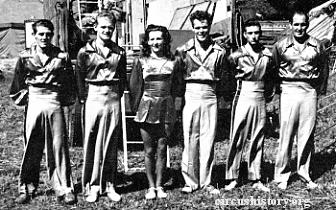 The Ted DeWayne Trampoline and Risley Troupe is shown in the back yard of the Clyde Beatty Circus in 1948. Burt Wilson Collection.
Now, and inasmuch as the basic differences between 1900 and 1960 risley have been presented, it comes to mind that perhaps it might be interesting to mention a trick performed by The DeWayne Troupe, which gives an illustration of the existing contention regarding the lightweight top-mounters of the 1900 period vs. the heavyweights of the present day.
As mentioned in some of the previous installments, before Fay Alexander was to become a master of the triple from the fly-bar, his earlier apprenticeship in acrobatics was with the DeWayne Troupe, with Ted DeWayne as master teacher, the "kicker" in risley, and the catcher in teeterboard. With the troupe at that time was also another unknown acrobat named Billy Snyder, who also was to become a master on the flying trapeze.
Subsequently, after both Fay and Bill had become proficient in the science of acrobatics, their teacher naturally put both of them through more and more difficult routines until the boys could execute some tricks which (considering that the "technique" was "modern" risley) can be appraised, relatively, almost as difficult as a triple.
Also to be considered as one important factor is the fact that Fay Alexander weighed his present weight of 135-140 pounds - but Billy Snyder went as high as 162 to 165 - which is a lot of weight for any risley top-mounter. But even more incongruous is the fact that Fay, the lightweight, was acting in the position of "middleman," while Billy, the heavyweight, was the top-mounter!
Be that as it may, in one routine Fay took a "kicker's" position, with his back on Ted DeWayne's feet; from this double risley position, Billy stood on Fay's feet. Now, from that position, Billy was thrown into a full twister while, simultaneously, Ted kicked Fay into a forward to alight on the feet of a second "kicker" - while Billy alighted on Ted's feet!
Now this might not be quite the equivalent of a triple. However, considering the fact that the middleman (Fay) was a mere 140 lbs. and the top-man (Billy) 165 lbs., it's quite an achievement!
Another routine worthy of mention is this one: With Fay on DeWayne's feet and Billy on Fay's shoulders, Fay would "throw" Billy into a double back, while he leaped off - to allow Billy to land feet-to-feet on DeWayne!
The main and only reason for mentioning those two astounding feats is that they serve as an illustration of the difference between ancient and modern risley. The point that we're trying to make is that, given a small 100 lbs. top-mounter and taking advantage of the "faster spin in lesser space" technique, there is no doubt that a "kicker" of Ted DeWayne, Bob Monahan or Papa Akeff's caliber would be able to execute the triple in risley - and with the same degree of proficiency as the old German troupes of yore.
So much for risley. Now, for some additional comments on:
The Teeterboard
No doubt there is a lot more to be said on the subject than was written in the previous installment covering this phase of acrobatics. And no doubt there will be a lot more to be said even after this addendum has been written. No doubt, too, we will get gripes in the mail because we failed to mention a number of acts which deserve honorable mention for their artistry in this specialty.
On that last count, we beg the forgiveness of readers and the performers, on the grounds that either: (a) no one can claim to know all that's to be known on any one subject; and (b) even if we did, lack of printing space would preclude the inclusion of it.
With the teeterboard - and with so many acts using the device in combination with other forms of acrobatics, there were also some instances where it was rather difficult to determine in which category a particular act should be classified.
For instance, The 5 Tokoyas. This Hungarian troupe of 3 men and 2 women are splendid performers. But, inasmuch as they perform an act which combines the teeterboard with risley in about equal proportions, how do you classify such a number?
The same would apply regarding The 2 Freddies (not to be confused with the 5 Freddies), whose routines combine the teeterboard with a high trampoline. Where does this act belong? In the teeterboard classification? - or the trampoline?
In the previous installment on the subject, we wrote at some lengths about the laments of the circophile "purists" who are still griping over the decadence of that ancient standard called "ground-and-shoulders" acrobatics. Because those "purists" still contend that the teeterboard is a form of "trickery," we made comparisons between the artistry of such famous old troupes as The Millettes, Glincerettis, Montroses, etc., and the spectacular performances of such modern teeterboard troupes as The Stanecks, Putzais, Magyars and many others.
Briefly, our aim was an attempt to convince those obdurate "purists" that the present day teeterboard performers are at least as great - if not greater - artists than his "ground-and-shoulders" predecessors. Also that the teeterboard performers must possess all of the same attributes and qualifications which were those of the "ground-and-shoulders" acrobats of the 1900 period.
We cited many examples, but we had neglected to mention one which might induce some of those "purists" to change their minds on the subject.
Those same "purists" who might have witnessed a teeterboard performance of either The DeWayne Troupe or the Faybray Troupe at one time or other a decade or so ago, probably evinced their contempt for this so-called "trickery" with the usual snort - and without being aware that two of these performers were every whit as proficient in "ground-and-shoulders" acrobatics as most of the vaunted predecessors of past generations.
We again refer to Fay Alexander, of modern fly-bar triple fame, and the equally talented Billy Snyder, now also specializing on the flying trapeze. But when those two artists were with the Ted DeWayne Troupe, they performed two "ground-and-shoulders" routines which were outstanding, especially considering the respective positions of Alexander, as the middleman, and Snyder, as the top-mounter.
A 140 lb. "middleman" is a rather incongruous position to be in - under a 165 lb. top-mounter! Nevertheless. with Alexander standing on DeWayne's shoulders, and Snyder standing on Alexander's shoulder into a 3-high column, Alexander would "throw" Snyder into a full back twister-to a landing on DeWayne's shoulders! Even more astounding, from those same positions in a 3-high column, Alexander would "throw" Snyder into a “back-spotter" - to land back on Alexander's shoulders!
The obvious question is: Why didn't Alexander and Snyder transpose their positions? The answer is: Billy Snyder could never get the hang of "catching" while Alexander, though actually much too light for the position, had the knack for it. But it doesn't take an expert to conclude that if Alexander had weighed 160 lbs. and Snyder had scaled only 135 lbs., such artists could have been the equals of the best of the "ground-and-shoulders" performers of past generations!
The above was presented merely in the hope that our obdurate "purists" might reconsider and give due credit to the capabilities of our modern teeterboard performers as true artists - and worthy of their plaudits instead of their contempt. We can only hope that it wasn't in vain.
As stated before. we know that much more could have been written on all of the subjects. However, since space precluded. we now must conclude the series - fully cognizant of its many shortcomings. No doubt it still contains many errors of omission and commission, for which we must beg the reader's forgiveness.
Before putting the last period to this final installment, we wish to express our deep appreciation to the many friends whose invaluable help and co-operation made it possible for us to present this series. We are especially grateful to Fred Valentine, Fay Alexander, Ray and Buster Melzora, Leonard Farley and the many others who supplied us with some of the data and photos which made it possible to bring out "Fact or Fiction?" To Editor Fred D. Pfening, Jr., also our sincere thanks - for "needling" us into writing it.
And, even though there were times when we griped plenty loud at having to meet those irritating "deadlines" and about the countless "typo" errors which appeared in the final print, we must confess that we enjoyed the experience and the end-results.
No part of this publication may be reproduced in any form or means
Last modified February 2006.
without written permission of the author and the Circus Historical Society, Inc.