


Circus Historical Society
Bandwagon, November - December 1965
Back to Bandwagon Index
Bandwagon, Vol. 9, No. 6 (Nov-Dec), 1965. Note: Only some articles are included in this online edition. Many illustrations are not included. The Circus Historical Society does not guarantee the accuracy of information contained in the information in these online articles. Information should always be checked with additional sources.
Probably the most fascinating aspect of circus history during the handful of years just preceding 1925 was the skillful maneuvering for position among the circuses owned by the Ringling brothers. Al G. Barnes. Andrew Downie, Charles Sparks, and Jerry Mugivan (in association with Ed Ballard and Bert Bowers.) A study of this strategy brings to this historian a thrill seldom found in the chronology of wrecks, fires, blowdowns, or other catastrophes. This managerial skill illustrated the intelligence and judgement needed for success in a most difficult business venture - that of tented showmanship.
As Joseph T. Bradbury has stated in his description of the 1921 story of the Hagenbeck-Wallace Circus (White Tops, Nov.-Dec., 1964) these, for the most part, were quiet seasons as far as disaster, great excitement and breath-taking incidents are concerned. They were far from quiet years, however, from the standpoint of business competition. and only a study of the routing of these circuses will give an insight into the skillful management possessed by these circus owners.
During these years. 1921-1924, the citizens of the United States suddenly awoke to the fact that they were in the midst of a great economic boom. The tensions and the fright of the Great War had passed and the "scares," which had clouded the thinking immediately following the Peace, had disappeared. Industry was moving at a successful pace for the most part. The people of this nation were able to obtain facilities that made living more pleasant. Money was available for recreation and entertainment. To capture this "entertainment dollar" was the prime purpose of the circus owners. To accomplish this they routed their outfits into areas of economic success, avoided depressed areas, and sought agricultural harvests. In addition, the circus equipment was modernized and the performance up-dated. Mr. Bradbury has referred to the modernization of equipment in his fine article in White Tops. The student of circus history will recall many changes in the performance presented during this period which were designed to capture greater audiences.
At this point it is necessary to move from the generalities to details and take a close look at the circus routes of the 1922 season in order to illustrate the thinking that lay behind this strategy. No attempt will be made to give every detail of the circus routes, but, it is hoped that enough evidence will be presented so that the reader will understand the maneuvering that took place. The role of the Hagenbeck-Wallace Circus in the plans of Mugivan, Bowers, and Ballard will be emphasized.
For the circuses under discussion, the 1922 season opened, of course, with the Ringling Bros. and Barnum & Bailey Circus in Madison Square Garden, New York, and the Sells-Floto Circus at the Coliseum in Chicago, Illinois. At the end of April the excitement started. The Ringling owned show was still in the Garden, when Sells-Floto left Chicago and headed east into territory usually played by the Ringling-Barnum outfit following their New York City stand. On May 1, when the "Big One” was in Brooklyn with dates scheduled for Philadelphia, Washington, and Baltimore immediately following. Sells-Floto moved into Philadelphia for a week. The Ringling show came into that city on May 8-13, after Sells-Floto's stand during the first week of May. Then Sells-Floto moved to Washington, D.C., for May 8-9. and Ringling landed in the Capitol on May 15-17. Sells-Floto played Baltimore, Md., on May 10-11, while Ringling came to that city on May 18-20. Sells-Floto made Newark. N.J. on May 15 and Ringling came in on May 22-23. The two circuses were but two days apart at Allentown and Scranton, Pa. This pattern, which developed so early in the season, continued throughout the entire tour as the circuses played from the east to the west coast and back into the South.
Now it is time to take a look at the other two large circuses of the Peru, Indiana, magnates. Hagenbeck-Wallace opened its road tour before Sells-Floto left the Coliseum and before the John Robinson Circus made its first road stand. The Hagenbeck-Wallace route apparently was planned to pull the "circus dollar" out of Ohio and some parts of Pennsylvania, while the John Robinson show made a more complete tour of Pennsylvania before moving west. This combination of routes of the two circuses made the advance brigades of Ringling Bros., the Sparks, and the Walter L. Main circuses scramble. The events of the spring went in this pattern. Hagenbeck-Wallace opened in Louisville, Kentucky, on April 22, and spent its first four weeks in Ohio and Pennsylvania with four stands in West Virginia. The John Robinson Circus opened at Peru, Indiana, on April 26, spent the week of May 1-6 in Ohio and then toured Pennsylvania for over two weeks before moving back to Ohio and into Michigan. All three of the Indiana circuses played in and around the steel center of Pittsburgh. Pa., before four weeks of the season were completed. Sells-Floto played near that city on its way east during the first week of the season; Hagenbeck-Wallace spent two days there on May 1 and 2; and John Robinson was in for two days on May 15-16. Obviously the Ringling-Barnum show did not see the need for a stand in that city during the 1922 season.
The Sparks Circus, which opened in Macon, Georgia. on April 1 had reached Ohio by the end of the month. Sparks did some fast moving to be the first to show in some of the eastern cities. It moved into Charleston, West Virginia, on April 22 with Hagenbeck-Wallace arriving in that town on the 25th of the month. Sparks was also in Clarksburg five days before Hagenbeck-Wallace. Akron, Ohio, was visited by the Sparks Circus on May 3, with Hagenbeck-Wallace due in on the 12th, and Ringling-Barnum plastering the city with paper that screamed, "Wait." When Sparks turned back into Pennsylvania on the 5th of May with a stand at New Castle. the Hagenbeck-Wallace Circus was at Altoona. This route allowed the Sparks Circus to play Butler. Pa., on May 6, and scoop the John Robinson show which was due there on the 18th.
During all this activity the Walter L. Main Circus was in eastern Pennsylvania and New Jersey with a move into Connecticut on the horizon. Downie no doubt estimated that it was wiser to pull the money out of the small towns and avoid a major conflagration with the bigger outfits. It would seem probable that this much circus activity would have hurt the attendance of these circuses, but all of them reported wonderful business. They could have done very well, for a study of this period reveals an abandon marked by the throwing-off of the shackles of thrift and virtue that had been demanded before the blood-bath of 1914-18. This was the Jazz Age.
After following Sells-Floto into Newark, New Jersey. the Ringling Bros. and Barnum & Bailey Circus made a westward swing through New York State and played Cleveland, Ohio, before returning east to New England. The Big Show was scarcely the "harbinger of spring" for the plans for the Hagenbeck-Wallace tour now became evident. When Ringling played Rochester, N.Y. on May 29, and Buffalo on Memorial Day, the management was faced with the fact that the Hagenbeck-Wallace Circus had been in Rochester on May 24. and Buffalo on May 22. In fact. Hagenbeck-Wallace had spent two days in Cleveland, Ohio, about a week and a half before the Ringling show came in on June 2-3.
This skillful blanketing of the eastern territory by strategic moves of their three circuses was not an easy task for the Indiana proprietors because factors other than the movement of the opposition had to be considered. One factor, causing some changes in plans, was the miner's strike in the coal country of West Virginia and parts of Pennsylvania. Conditions were poor in New England, also, due to strikes in the textile industry which lasted for several weeks. Conversely, it is true that the Ringling management had the same conditions to battle, plus the fact that they were opposing three circuses, not just one. Sparks, it seems, did surprisingly well to enter the engagement, but probably did confuse the issue to the extent that the Ringling circus did get a little - very little - breathing space.
In spite of these labor troubles, the war between the circuses playing the northeast continued to be waged. Sells-Floto left the Boston Garden after an extended stand on June 4 and the Ringling-Barnum show moved in for a six-day stand on June 12. The Sells-Floto tour through New England, undoubtedly aimed at getting the money out of that section before the Ringling organization could sweep it up, brought the show from Peru into close proximity with the “Big One." Sells-Floto played Springfield. Mass., on June 17 and Ringling moved in on the 19th. By this time Sells-Floto was leaving New England and was heading west while the Ringling-Barnum show was moving into Maine in preparation for entry into Canada. The Big, Show played Manchester, New Hampshire, Worcester. Mass., and Portland, Maine, after the Sells-Floto circus had made a stand in each of those cities and then it moved into Montreal, Quebec, for a two-day stand on July 3-4 they were aware that Hagenbeck-Wallace had been there on the 5th and 6th of June. In fact, of the eight eastern Canadian cities played by the Ringling-Barnum circus at this time, Hagenbeck-Wallace had played six of them before the "Big One” arrived. This member of the Indiana clan had spent the first three weeks of June in Ontario.
By the middle of July (a study of the routes indicates) the Sparks Circus was touring New York State; Sells-Floto was west of the Mississippi River in the central states; Hagenbeck-Wallace was moving through Iowa and Illinois; John Robinson was in the same area; Ringling-Barnum was in Michigan; and the rival from the Far West, the Al G. Barnes Circus was also in Illinois.
The Barnes show toured all the cast to Maryland playing many dates that were included in the spring routes of the other circuses. This may account for the August tour of the Hagenbeck-Wallace Circus which returned east as far as West Virginia. The John Robinson Circus returned to the area of Indiana and Illinois in August and probably helped to confuse the Barnes' route. The Sparks show at this time was in Michigan but guided toward Indiana and Ohio.
One of the highlights of the Hagenbeck-Wallace season occurred on Sunday, August 13, when its baseball club defeated the Sparks Circus nine by a score of 8-6. This event occurred at Albion. Michigan, where the Sparks show was scheduled for the l4th. Hagenbeck-Wallace was making a stand at Jackson, Michigan, that same Monday. Almost every member of the show made the trip to Albion and the Sparks' management furnished dinner to the guests in the cook tent after the game.
The route of the Barnes Circus at this time leaves the impression that for the most part it was playing stands already made by the other circuses earlier in the year. However, on some occasions it had a date which made it the first circus of the season. On these stands, however, it was usually followed within a month by either the John Robinson or Hagenbeck-Wallace circuses. To cite an example: the Barnes show played Kokomo, Ind., on July 20 and John Robinson was there on August 16. Barnes played Wheeling, West Virginia, on July 26 with Hagenbeck-Wallace returning to its first week of the season territory to play Wheeling on August 22.
The observer at this date can only draw the conclusion that the Corporation circuses were routed to get into territory ahead of the opposition; to play the towns at the same time, if necessary; and to sweep up the crumbs after the others had left. This may be too harsh a critique of their movements, but it is obvious that the Ringling, Sparks, Main and Barnes circuses were well aware that they had to rustle to beat down the opposition from Peru and West Baden.
When the Ringling Bros. and Barnum & Bailey Circus left Canada and entered the mid-west it was in territory that had already been played by Sells-Floto, Hagenbeck-Wallace, and the John Robinson circuses. On August 1, when Ringling played Madison, Wisconsin, the Sells-Floto Circus was in Bozeman, Montana, and headed west to anticipate the Ringling's proposed route down the Pacific coast. Hagenbeck-Wallace was in Xenia, Ohio, and scheduled to play the mid-western states in depth, and the John Robinson show had toured Nebraska and Kansas, and was in Enid, Oklahoma. The only route to the Pacific that had not been played was through Canada and the Ringling show took it. This brought the Greatest Show On Earth into Spokane, Washington, on August 18. However, Sells-Floto had played that stand on August 5th. This representative of the Indiana circuses played several Washington cities and Portland, Oregon, and moved east to Idaho and Utah, and was back in San Francisco for four days, August 24-27, before Ringling came into the Bay city on September 1-3.
Sells-Floto was ahead of the Ringling-Barnum Circus by about a week as they both moved down the coast. On September 18, both shows played Phoenix, Arizona. Sells-Floto had a contract for a lot in town, and the "Big One" was just outside the city limits, but both lots were located quite close together. They remained in the same southwestern desert for a few days with Sells-Floto moving into Albuquerque on September 21 and the Ringling show arriving there on the 23rd. After this date the Ringling-Barnum outfit moved into Texas and found itself in territory which had already been played by the John Robinson Circus in mid-September.
The fall tour of the south was marked by the same characteristics. Sells-Floto played through Arkansas, Tennessee, and into Alabama early in October. Hagenbeck-Wallace moved into the south for an extended tour about the first of September, and John Robinson proceeded east ahead of the Ringling show into Louisiana and Mississippi. Ringling-Barnum made its Little Rock, Arkansas stand on October 3. Sells-Floto, scheduled for October 2, shipped out of that town as the Ringling trains arrived. Al G. Barnes had cleared this city after a rewarding date on September 14.
The John Robinson Circus closed its 1922 tour at Centralia, Illinois. on October 12; Hagenbeck-Wallace called it a season at Trenton, Tennessee on November 2, Sells-Floto headed for the barn after the November 8th date at Ardmore, Oklahoma and the Ringling-Barnum Circus shipped to quarters after the November 1 stand at Greensboro, North Carolina.
The Hagenbeck-Wallace executive and business staff for 1922 was almost identical with that of 1921. Bert Bowers was president and manager with Louis Chase as assistant manager. Others were H. E. Sarig, secretary and auditor; R. W. Woodward, treasurer; William H. Curtis, superintendent: W. R. Kellog, attorney; E. S. McCaffrey, officer; and Bert Cole, advertising solicitor. John T. Warren had replaced Frank L. Wright as press representative, and Albert Hoffman and E. E. Goodell were 24-hour agents instead of John Nevin and Goodell as in 1921. Ed C. Knupp remained as general agent and traffic manager and W. E. Haines was replaced by John Nevin as contracting agent. The second contracting agent in 1922 was A. L. Sands, J. C. Donahue was still the manager of advertising car No. 1. Morrison Koerner was the new contracting press agent. Manager of brigade No. 1 was L. J. Lewis and Frank Van Miller, who had been manager of advertising car No. 2 in 1921, was manager of brigade No. 2 in 1922.
Department heads were: George Conners, equestrian director; Gordon Orton, assistant equestrian director; George Davis, superintendent of candy stands; Charles Davis, superintendent of cookhouse; George Brown, trainmaster; George Stumpf, superintendent of baggage stock; Spot Conners, superintendent of ring stock; Charles Brady, superintendent of props; Bert Noyes, superintendent of animals; Charles Krick. superintendent of electric lights; Edward Keifer, master mechanic; Mrs. Wm. H. Curtis, superintendent of wardrobe; Wm. H. Curtis, superintendent of canvas. All of these department heads held the same position in 1921.
Earl Moss had relinquished the post as Bandmaster which he held in 1921. Park B. Prentiss was in charge of the band at the Louisville, Ky., opening, but by the end of July an advertisement for musicians in Billboard listed Harry G. Armstrong as Bandmaster. The route book for the season listed William Matthews as director. Professor T. E. White was in charge of the Side Show Band. The Side Show was managed by Arthur Hoffman who also had the 1921 "kid show" under his direction. Featured were: Sylvia Andrews, snakes; Sig Acaris and Nellie Brad, impalement; Little Alright, wonder worker; Viola Barton, fat girl; Nena Appleby, Small Lady; Florence Carlyle, novelty; Clayton Johnson, swords; Milly DeArcey. swords; Cleve Morris. Tall Girl; Dolly Eisenberg and Grace Ringlin, novelty; J. G. Tarver, giant: S. M. Yatero, fire eater. Barton, DeArcey, Andrews, Acaris, Johnson, Ringlin, and Appleby had been on the 1921 circus.
The 1922 train duplicated the train of the year before with one advance, seven stock cars, fourteen flat cars, and eight sleepers.
Car No. 20 carried twelve elephants: Tess, Nellie. Eva, Babe. Pinto, Joskey. Jennie, Diamond, Trilby, Louis, Mama and Topsy; four camels; and one bay saddle horse.
Eva was a venerable, old pachyderm on the Greatest Show On Earth in the 1950's to conclude a career which began on the Ringling Bros. Circus about the turn of the century. She was sold to Frank A. Robbins in 1910 and sold, or leased, by this owner to Santos y Artigas for a period of years. This circus sold her to the American Circus Corporation in 1922. She was assigned to Hagenbeck-Wallace for three years and then went to the John Robinson Circus at the end of the 1924 season. It should be noted here that the entire herd of the Hagenbeck-Wallace Circus was switched to the John Robinson Circus in December 1924 and the Robinson elephants went to the Hagenbeck-Wallace Circus.
Babe was purchased from Bartels of New York City by Frank A. Robbins in 1911. She went with Eva to Santos y Artigas in 1916 and was purchased by the American Circus Corporation in 1922 and assigned to the Hagenbeck-Wallace Circus. The arrival of Eva and Babe in 1922 is documented by Billboard, March 18. 1922, in which the journey made by Bert Noyes to Havana, Cuba, to bring back two elephants and two tigers is described.
Bill Woodcock placed Diamond on the Hall farm in 1913 with a group of elephants brought from India. Just when he went to Hagenbeck-Wallace is not known but this young male with a single tusk did not tour with this show after 1922. He was sold back to Hall and then placed with the Newton shows. In 1923 he toured with the Honest Bill show. He died in 1927 on the same show while pushing trucks out of the mud on Route 1 near Orick. California.
Louis was another young male on the 1922 Hagenbeck-Wallace Circus that may have come from the Hall farm. He, too, was sold to Hall during the winter of 1922-23 and died at the farm in Missouri before spring. The same Billboard report which describes the arrival of Eva and Babe states that Noyes went to New York City to bring to quarters at West Baden an African elephant, and twelve crates of wild animals which had arrived from Germany through the efforts of John T. Benson. Just which elephant with the herd was an African remains a mystery, even if it toured at all. The only possibility is Louis, for which there is no background information.
Joskey, still touring with Carson-Barnes in 1965. is a W. P. Hall elephant that was sold to Ed Ballard in 1916. She remained on the show until the switch to John Robinson, and then later became a member of the Sells-Floto herd. In January, 1933, she went to the Al G. Barnes herd and remained there until it was absorbed by the Ringling show in 1938. Her tour with the Ringling organization ended in 1958 when she went to Carson-Barnes. This elephant, in all probability, is the bull with the tiger on its back in the 1921 photo published with Joseph Bradbury's article in White Tops.
Jennie was another in the group imported by Hall and sold to Ed Ballard in 1916. She left the Hagenbeck-Wallace Circus at the end of the 1924 season to go to John Robinson. Later, while on Sells-Floto, she was transferred to Al G. Barnes in January, 1933, and then was absorbed by the Ringling show in 1938. This elephant is not the famous Barnes Jennie.
Pinto was brought to the United States in 1895 by Hagenbeck and sold to Wallace in 1900. She went to Mugivan and Bowers in 1919 and was on Hagenbeck-Wallace until the end of the 1924 season. She went to the John Robinson show and was back with Hagenbeck-Wallace in the early 1930's. She later became a member of the Ringling herd but should not be confused with the Ringling Pinto.
Tess is unrecorded in my files before 1922. However, I think it reasonable to assume that she was a member of the Hagenbeck-Wallace herd before that year. Woodcock has written that she was sold to a resort in Colorado Springs and Don G. Davis, Director of the Colorado Springs Zoo, has written to me that she was the zoo's first elephant in 1925.
Trilby was imported by W. P. Hall in 1914 and sold to Mr. Ballard in 1916. She went to the Mugivan and Bowers shows in 1919 and followed the usual tour: John Robinson at the end of 1924; back to Hagenbeck-Wallace, early 1930's; then to Ringling. I believe that she is the Trilby on the Ringling show during the past few years.
Topsy probably dates from the 1907 Van Amberg Circus, although I am not positive of this. In September 1924 she was sold from the Hagenbeck-Wallace Circus to the Jackson (Mississippi) Zoological Garden. She was later purchased by Nellie Dutton and was with this owner as late as 1931. Col. Woodcock has written that she died on one of Mrs. Dutton's trips to South America.
Nellie was imported by Hagenbeck in 1895 and sold to Wallace in 1898. She was sold to Mugivan and Bowers in 1919 and was transferred to the John Robinson Circus at the end of the 1924 season. She was back on Hagenbeck-Wallace in the 1930's and then went to the Ringling show.
Mama (or Moms) came to the United States with the Carl Hagenbeck Wild Animal Show and was exhibited at the St. Louis Fair with a small elephant, Monte, reported to be her baby. In the winter of 1906 she was sold to Howe's Great London Circus, Jerry Mugivan, owner. She was a Mugivan elephant on various shows through the 1922 season. Col. Woodcock reports that she was sold to the King brothers and died on the Rice Bros. Circus in 1923. Woodcock says that, "Moms was a big, one-eyed bull that was noted as a runaway." She was well along in years when he knew her with the Mugivan and Bowers show. The Colonel continues, "She didn't work in the ring and was not the type to panic but deliberately sneaked away when opportunity offered. She escaped on a Monday night in Wilmington, N.C. and wasn't recovered until Thursday." The route book reveals that Woodcock's memory was amazingly accurate. Wilmington, N.C. was played on Monday, October 9, 1922, and the Thursday date was at Florence, S.C. This elephant could easily be confused with Mama Mary of the early days of the Sells-Floto Circus but it is a different animal.
Car No. 21 contained 34 horses of which 4 were black; 8 were sorrell; 7 were bay; 2 were white; 3 were dapple grey; seven head belonging to the Davenport act were grey; and the others were a single dark bay, a black and white, and a chestnut sorrell.
Car No. 22 contained 10 bay horses; 4 sorrell horses; 7 black horses; 2 dun horses; 2 roan horses; one dapple grey; 2 white horses; one dark bay; one spotted; and a black mule, a mouse colored mule, and the six hybrids.
Car No. 23 transported 10 sorrell horses; 8 white horses; 10 grey horses; 2 roans, a bay and a black.
Car No. 24 held 32 horses. Eight of these were bay color and the rest were grey.
Car No. 25 contained 32 horses, all of which were grey.
Car No. 26 carried 30 horses of which 6 were black and the rest were grey.
Car No. 27 transported wagon No. 37 (the stable wagon with harness shop, blacksmith shop, horse tents and poles); Wagon No. 40, (sprinkler); Wagon No. 36, (stake driver); Wagon No. 34, (cook house tents, dishes, tables and poles); Wagon No. 33, (cook house steam wagon).
Car No. 28 carried Wagon No. 32 (cook house, groceries and refrigerator); Wagon No. 39. (menagerie spool with canvas and poles); Wagon No. 21, (menagerie wardrobe); Wagon No. 41 (ticket wagon).
Car No. 29 transported Wagon No. 20 (parade and tournament wardrobes); Wagon No. 14 (refreshment stand, boxes, boards, jacks, tents); Wagon No. 26 (performers dressing trunks); Wagon No. 38 (side show canvas, poles and stages).
Car No. 30 carried Wagon No. 51 ( big top seat wagon); Wagon No. 35 (water wagon); Wagon No.. 53 (big top spool with canvas).
Car No. 31 transported Wagon No. 54 (Big lop spool with canvas); Wagon No. 25 (Performers trunks); Wagon No. 42 (big show props); and one buggy.
Car No. 32 transported Tractor No. 1; a Dodge auto truck; Wagon No. 55 (stake and chain); and Wagon No. 27 (side show performers trunks).
Car No. 33 held Wagon No. 56 (big top poles); Tractor No. 2; and Wagon No. 52 (equipment used for erecting the big top and seats).
Car No. 34 carried Wagons No. 103 and No. 104 (both electric plants); Wagon No. 22 (electric light globes, cables and fixtures); and Wagon No. 43 (Big show props and steel arena).
Car No. 35 held Wagon No. 23 (harness trappings); Cage No. 9 (one hippopotamus); Cage No. 7 (thirty-six monkeys); Wagon No. 10 (steam calliope).
Car No. 36 transported Cage No. 19 (two llamas); Cage No. 12 (four sea lions); Cage No. 6 (one lion and three pumas); Cage No. 2 (three leopards and four pumas); and Cage No. 11 (three tigers).
Car No. 37 carried Cage No. 8 (six bears); Cage No. 5 (five kangaroos); Cage No. 18 (three lions); Cage No. 16 (one lion and two tigers); Wagon No. 31 (air calliope and musicians' instruments).
Car No. 38 carried Cage No. 1 (four zebras); Wagons No. 45 and No. 46 (both big top seat wagons).
Car No. 39 transported Wagons No. 47, No. 48, and No. 50 (all big top seat wagons).
Car No. 40 carried Wagons No. 49 and No. 44 (both big top seat wagons); and Cage No. 17 (three lions).
Cars numbered 41, 43, 45, 46, 47, and 48 were sleeping cars while No. 42 and No. 44 were combination sleeping and dining cars.
Joe Bradbury was asked for help with the details concerning the wagons listed above. His statement follows: "Hagenbeck-Wallace used seven band or tableau wagons, a steam calliope, and an air calliope for parade purposes during the 1922 season. Three of the tableau wagons had carved sides and had been in use on the show for many years while the remaining four featured full length canvas paintings tacked on their sides. All of these parade wagons were used by the show in the years 1922, 1923, and 1924 although it is possible some of the paintings may have been changed during this three year span.
"The wagon used for the No. 1 bandwagon in parade was the well-known Lion and Snake Tableau often called the "Lion's Bride." It was built by the Bode Wagon Works in Cincinnati in the winter of 1904-05 for the Carl Hagenbeck Trained Wild Animal Show and was on that show for the 1905 and 1906 seasons. Since 1907 it had been on the combined Hagenbeck-Wallace Circus and had been used for the lead bandwagon for the past few seasons. Detailed history of this wagon appeared in Circus Wagon History File. Sept.-Oct.. 1963, Bandwagon. The wagon is currently preserved in the Ringling Circus Museum in Sarasota.
"Wagon No. 14, the Carl Hagenbeck Lion Tableau, which loaded the refreshment stands, was in the parade and usually ridden by the side show dancing girls. This was a 13 1/2 ft. wagon that was also built by Bode in the winter of 1904-05 for the Carl Hagenbeck Show and had gone the same route as had the Lion and Snake wagon. The detailed history of this wagon was also covered in the Sept.-Oct., 1963, Bandwagon. It is currently preserved at the Ringling Circus Museum in Sarasota. (See Photo No. 6).
"The third carved wagon was the Elk and Buffalo Tableau which was a short 13 ft. wagon. It was No. 21 and carried the menagerie wardrobe. It was used as a tab wagon in parade being ridden by costumed performers. The wagon was also built by Bode in the winter of 1904-05 for Carl Hagenbeck and had the same history as did the other two carved wagons. Both sides of the wagon are now preserved in the Miami County Museum in Peru, Indiana. (See Photo No. 3).
"The No, 2 band used Tableau wagon No. 22, a 17 ft. wagon which had full side paintings depicting flying horses in pursuit of a maiden soaring through the air. This wagon was used to load light department properties and was first utilized as the No. 2 bandwagon in 1922. In 1921 the old Carl Hagenbeck Elephant tableau had been used. It is difficult to determine just when No. 22 was built but, like the rest of the tabs with the paintings, had probably been constructed by the show's own shop forces sometime in the period 1916-22. (See Photo No. 1 ).
"The sideshow band used Tableau No. 27 in parade. This wagon was 19 ft. long and was used to carry sideshow trunks. It had a full side painting of a lion hovering over the prostrate form of a maiden, a sort of "Lion's Bride" type of thing. (See Photo No. 2).
"Another of the painted tabs, No. 26. was used for the clown bandwagon. This was also a 19 ft. wagon which carried performers trunks.
"The fourth of the painted tabs, No. 25, was a 19 ft. wagon also used to load performers trunks. It sometimes was called the Japanese tableau mainly because a group of Oriental performers usually rode it in parade.
"Due to a scarcity of photos it cannot be determined for certain what paintings the sideshow and clown bandwagons had in 1922 because, as indicated earlier, it is possible these paintings were changed during the years. Photos taken of the painted tabs in the period 1921-24 show paintings of the "Spirit of '76" which was used on a wagon in 1921 and which was probably also used the following year. Other shots picture a tab with an arctic scene and possibly there could have been other paintings involved.
"The familiar Harp and Jesters wagon was used for the air calliope. This was No. 31 and was a short 10 ft. wagon which had originated on the show about 1916, probably having been built by Bode. A hybrid zebra hitch pulled it in parade. The wagon is currently at the Ringling Museum in Sarasota. (See Photo No. 4).
"The steam calliope was a beautiful, 20 ft., heavily carved wagon, No. 10. The wagon is believed to have been on the show in 1919 and may have been built by Bode. It was usually pulled by a truck in parade. Detailed history of this wagon appeared in Circus Wagon History File, Sept.-Oct., 1958, Bandwagon. The dismantled sides of the wagon are currently preserved in the Miami County Museum in Peru, Indiana.
"The late Col. Bill Woodcock was at the West Baden quarters in the winter of 1921-22 and went out on the show for the 1922 season. Most of the above information came from notes he had provided historians during his lifetime. One interesting Woodcock item was that the show gradually replaced most of the older parade wagons and cages in the period after Mugivan, Bowers and Ballard got control of the show in the winter of 1918-19. The large, roomy tableau wagons with the paintings were especially designed for baggage purposes as well as parade and could carry a large and heavy load. Woodcock says that while he was in West Baden he saw the old Carl Hagenbeck "India," or "Ceylon," wagon which had been retired and he was told that a pile of burned junk was the remains of the old Eagle chariot wagon which had recently been destroyed. Woodcock also observed three of the large, ornate dens once a feature of the show's parade which now had their wheels and gears removed and were serving as permanent cages in the animal barn."
Note: All of the wagons mentioned above will be pictured in one of the installments of this series which will cover the Hagenbeck-Wallace Circus for seasons 1922, 1923, 1924.
The Hagenbeck-Wallace Circus arrived in Louisville, Kentucky, to make its first under-canvas stand of the 1922 season on April 18. Rehearsals were held for four days on the new lot at Fourth and K Street. Under pleasant skies, the first two performances were presented on Saturday, April 22. The performance opened with "An Arabian Night." Display No. 2 was the Garland Entry with Fred Crandall, Vance Gill, Arnold Kruger, Cecil Lowande, Sam Carroll, J. P. Jackson, Gordon Orton, E. Raymond, Harry Allen, Walter Goodenough, Roy McDonald, and L. Kipp.
The third display featured Dolly Castle in the steel arena with a puma act. The hippopotamus walked around the track and two rings contained bears riding horseback. These were under the direction of Capt. Sharpe and George Conner.
Eight elephants appeared in the rings for the fourth display, and the clowns made their first appearance. The bulls were worked by Marion Drew and Alma Wood.
In No. 5 display a tiger rode an elephant and wrestling bears worked the end rings. John Helliott and Dolly Castle worked the cat and bull and James Deag and Will Mayon wrestled the bears.
Bareback riders, Cecil Lowande and Orrin Davenport worked the end rings and clowns performed in the center ring for display No. 6.
A lion rode a horse under the direction of John Helliott in the arena and Fred Crandall and Capt. Sharpe worked the zebras in the end rings during display No. 7.
Display No. 8 was composed of aerial acts. The performers were Miss Drew, ladder; Miss Moore, ladder; Mr. Dugger, traps; Miss Moore, ladder; Mr. Powell, traps; Two Allens, double traps; Two De Longs, double traps; J. Jackson, traps; Louise Grieble, traps; Gordon Orton. cloud swing; J. Marnella. rings; Miss Goodenough, ladder; Miss De Long, ladder; Miss Nicholson, ladder; Alma Ward, ladder.
John Helliott worked five lions in display No. 9, and the clowns followed for No. 10.
No. 11 featured hand balancing with Marnella; the big tub act. Japanese; Two Nicholsons, contortion; Miss Irma, contortion; J. Jackson, contortion; and the Three Phillips, juggling.
The Wild West Announcement came on as display 12 with the ladies principal act (Misses M. Crandall, Victoria Davenport, Lula Davenport, and Bessie Costello) following as No. 13.
The clown band was display No. 14; Danny Ryan with five pigs; Capt. Tieber and wife, seal act; J. Helliott with a bear act and boxing kangaroos, were No. 15; and the clowns repeated for No. 16.
Display No. 17 featured the Australian Woodchoppers (Jackson and McLarin); the Australian Waites, whip crackers; three Japanese risley acts; Japanese tub kickers; Mary Enos, on a rolling globe; and the Yong Wang Troupe of Chinese jugglers.
Display No. 18 filled the rings with wire walkers: the Japanese troupe; the Jack Moore Troupe; and Erma & Conner.
Displays No. 19 and 20 were the bucking horse announcement and the return of the clowns. No. 21 was the Brock Troupe and the Stokes Troupe, bar acts; and head balancing and trapeze by the Japanese.
The menage number was presented as the 22nd display, with Sam Carroll, Dolly Castle, John McCracken, Mrs. McCracken, Gordon Orton, Mrs. Le Doux, George Conner, Mr. Le Doux. Harry Allen, Rita Montieth, Capt. Sharpe, Rosie Ryan, Louise Grieble, Alma Wood and Marion Drew.
The Yong Wang Chinese Troupe, Shultz Trio, Four De Longs, and Three Phillips (all acrobats) comprised the 23 number. This was followed by the carrying jockey acts by Lowande and Ryan, The Riding Crandalls, and comedy riding by the Davenport Troupe. Number 25 was the high perch groups of the Two Allens, Two Japs, Gene and Mary Enos, Two Joes, Two Brooks, and the Japanese.
The performance was concluded by a three horse tandem race; a four horse boy's flat race; four ladies flat race; two horse liberty race; and a three teams Roman standing race.
The clowns, who appeared often during the performance, were Joe Coyle, Kid Kenard, Bill Hart, Louis Plomonden, Ed Raymond, Ray Glaum, W. E. Gray, W. Goodenough. F. Lindsay, Jerry Alton, Chester Barnett, Charles Flemm, Jack Reese, Arnold Kruger, Charles Barth, James Dugger, Dick Pinkney, Roy McDonald, Vance Gill, Danny Ryan, W. H. Tadlock, Leo Munroe, Irwin Kipp, Jas. Thomas, and James Horrick.
The Wild West performers with the show in 1922 were John McCracken, Ethel McCracken, Ed Bowman, Tilly Bowman, Al Faulk, Lena Faulk, Earl Sutton, Mary Sutton, Charles Flemm, John Davis, and Sam Carroll.
The Sunday run from Louisville to Huntington, West Virginia, was undoubtedly the worst of the season. The first part of the trip, to Lexington, was comprised of a fast, easy run on the Southern Railroad. When the C. & O. took over a nightmare developed. The train was stationary on several grades and stalled in a tunnel for nearly half an hour. The stack gas was sufficiently obnoxious to cause several performers to faint and others to become ill. The train reached Huntington late on the 23rd after taking 17 hours to travel 225 miles. Cold, rainy weather was encountered during the first week and the coal country of West Virginia was avoided because of the strike in the mines. After the Monday date at Huntington, the show moved to Charleston, W. Va.; then back to Ohio for stands at Athens and Marietta; and then returned to West Virginia to play Clarksburg and Morgantown on Friday and Saturday. A total of 689 miles had been logged since leaving West Baden, Indiana. Railroads used were the Southern, C.&O., K.&M., and B.&O.
The second week of the season opened with two days at East Liberty on the eastern edge of Pittsburgh. The rest of the week was spent at DuBois, Clearfield, Altoona, and Johnstown, all in Pennsylvania. The Baltimore and Ohio and the Pennsylvania railroads were used to move to Pittsburgh. The Pennsylvania road furnished the power for the rest of the week except for the haul from DuBois to Clearfield when the B.R. & P. was used. An additional 348 miles were added to the log during the week.
To open the third week the Hagenbeck-Wallace Circus played Steubenville, Ohio, and then moved into Pennsylvania to New Castle for the Tuesday stand. The rest of the week was spent in Ohio at Youngstown, Canton, Akron, and Mansfield. The Pennsylvania railroad made all the moves and 470 more miles were logged. The weather was favorable and Canton was the hottest day yet encountered. A railroad delay frayed the dispositions of the personnel after leaving Canton and it will be noted that this early in the season the railroads were having trouble moving this circus. These problems were to continue and several other circuses encountered these delays which by mid-season were to give general distress.
On Sunday, May 14. the Hagenbeck-Wallace Circus ran 210 miles on the B. & O. into Cincinnati, Ohio, for a two-day stand. The John Robinson Circus had left this city just two weeks earlier. Attendance was not as good for the West Baden organization as it had been for the Peru circus. (It is difficult to understand why these two shows under the same ownership played so close together at this time.) The Cumminsville and Norwood lots were used with heavy rain at the night performance at Norwood. The rest of the fourth week was spent in the state of Ohio with dates at Piqua and Marion on Wednesday and Thursday, and a two-day stand at Cleveland on Friday and Saturday. The show used the B. & O. for the first three moves of the week; the Pennsylvania for the move to Marion; and the Big 4 and New York Central for the move into Cleveland. Five hundred and twenty-eight miles were added by these moves.
From Cleveland the show moved to Buffalo, Mount Morris, Rochester, Ithaca, Elmira, and Cortland, all in New York State. The New York Central. D.L. & W., B.R. & P., and Lehigh Valley railroads combined to move this circus 609 miles during the fifth week. This was the longest week's mileage for the season up to this point.
The show continued its New York State tour during its sixth week on the road while Walter L. Main, Sells-Floto, Ringling-Barnum, and Sparks were all engaged in touring New England. This, in spite of the strike in the textile industry which had lasted for over four months. Monday's stand was Syracuse, N.Y., where the Hagenbeck-Wallace Circus was the first of the year. Binghamton, Oneonta, and Glenn's Falls in New York occupied the days through Thursday. On Friday, June 2, this show was in Rutland, Vermont, and moved to Plattsburg, N.Y., for Saturday. The first two moves of the week were by the D.L. & W., and the rest of the transportation was by the D. & H., with 461 miles covered.
The first six weeks of the season had been played without a serious injury to personnel but, during the first week in Canada, two severe accidents occurred. On June 5, the Hagenbeck-Wallace Circus opened its Canadian tour with a two-day stand at Montreal. Ottawa, Cornwall, Brockville, and Belleville comprised the week's tour. The show used the D. & H., C.P., and Grand Trunk railroads and moved 401 miles. Louise Stokes, aerialist, fell and was hospitalized in Ottawa. Rita Montieth, rider, was injured when her horse reared and fell on her, and she joined her fellow performer in the Ottawa hospital. The aerialist remained in serious condition for several weeks and, within a month, it was reported that Rita Montieth might never ride again.
During the eighth week, also spent in Ontario, Canada, the circus covered 455 miles while using the Grand Trunk railroad for all moves, except to Woodstock when the C.P. was the means of transportation. Excellent business was encountered at all towns. The stands were: Hamilton, St. Catherines, Brantford, St. Thomas, Chatham, and Woodstock.
The following week the circus opened in Toronto for two days and followed this with dates at Kitchner, Owen Sound, Stratford, and Sarnia. The C.P. was used for the first two moves; the Grand Trunk for the last four. An additional 470 miles were logged into the record books, and after the Sarnia date on June 24 the circus moved into the Detroit environs for three days.
The move to Hamtramck (June 26) required that 70 miles be covered over the Grand Trunk. The June 27 stand at the Grand River-Mackinaw lot involved a 4-mile move and the Wednesday stand on the Fort Green lot was a seven-mile hop. Although Sarnia, Ontario, had given capacity crowds, the Detroit turnout was much better. There were big crowds at all matinees and capacity at the night performance at Hamtramck. Tuesday and Wednesday nights were turnaways. On the 29th the show moved to Battle Creek, Michigan. Kalamazoo, Friday, and La Porte, Indiana, on Saturday (July 1 ) concluded the week. All moves after arriving in Detroit were by the Michigan Central except the run to La Porte when the New York Central was used. Three hundred and twenty miles were added to the tour during this, the tenth, week of the season.
Reports from the Ottawa hospital during the first week of July indicated some improvement in the condition of Louise Stokes, but were gloomy on the progress of Rita Montieth. Meanwhile, the Hagenbeck-Wallace Circus opened its eleventh week on July 3 at Freeport, Illinois, Dubuque, Manchester, Iowa Falls, Waverly, and Charles City (all Iowa) followed. Except for Iowa Falls, both performances on all dates were extremely well-attended, including several turnaways at some stands. The circus used the N.Y.C. and I.C. to move to Freeport, and the I.C. was used for all other runs with 473 miles added.
Echoes of June, 1918, rocketed through the minds of some of the personnel when the Hagenbeck-Wallace train, traveling south on the Milwaukee Short Line from Austin, Minnesota, crashed into the rear coaches of a north-bound Rock Island passenger train at Plymouth Junction, Iowa. The circus had made its Monday stand at Austin on July 10, and its train was traveling through a dense fog at 3 a.m. on July 11, when the accident occurred. The Rock Island train was just clearing the intersection when the circus train hit the next to the last coach. Railroad traffic was a tangle for five hours and the show didn't arrive at the next stand until 9 a.m. There were no serious injuries, fortunately, but the bulls did get out when the doors of Car No. 20 were burst open. They put away a considerable amount of Iowa corn, according to reports, before they were rounded-up. Mason City, Hampton, and Oskaloosa (all Iowa), occupied this portion of the week, with Monmouth and Streator, Illinois, closing-up the seven days. The C.M. & St. Paul made the first two moves; the M. & St. Louis, the next three; and the C.B. & Q., the last. A total of 491 miles was covered.
The New York Central pulled the Hagenbeck-Wallace Circus into Gary, Indiana, for the July 17 stand. This was on Monday of the 13th week. The Pennsylvania lines moved the circus to Plymouth, Logansport, and Hartford City. Connersville was reached via the L.E. & W., and the Big 4 moved the show to Anderson. The entire week was spent in Indiana and 405 miles were added as the circus headed east toward Virginia and the Carolinas.
The 14th week was marked by more railroad trouble. As indicated, the circus was moving toward the Eastern Seaboard and, in fact, opened this week with stands on its eastern route. Springfield and Newark, Ohio, were played on Monday (24) and Tuesday (25). Wednesday the circus was in Lancaster, Ohio, and scheduled for moves to Chillicothe, Portsmouth, and Ironton over the Norfolk & Western railroad. This road, however, was unable to furnish its facilities because of a railroad strike and a fuel shortage which occurred at this time. The circus was within the closing jaws of a trap with its advance car in Virginia and itself unable to move. Luckily, quick thinking and rapid action pulled it out of its dilemma. The scheduled stands to the east were canceled and the show spent an extra day at Lancaster while the management persuaded the Pennsylvania railroad to move it to Washington Court House for a two-day stand to conclude the week. In the meantime, Jack Warren, press representative, and Al Hoffman, 24-hour man, were dispatched to Washington C.H. to bill the show for that date and the advance car left Roanoke, Va., and was hurried to Sturgis, Michigan, where the circus planned to play the following Saturday.
The other circus in the area, Al G. Barnes, couldn't get the Baltimore & Ohio to move them from Zanesville to Cambridge, Ohio, that same week. The road did get the Barnes show into Steubenville for the Wednesday stand, although Barnes was booked for Wheeling. The Hagenbeck-Wallace Circus did manage to make 360 miles (some of it in the wrong direction) during the week of July 24-29. The show was in four towns: Springfield, Newark, Lancaster (two days), and Washington C.H. (two days).
Using daily newspaper advertising only, the show worked through the first week of August toward Sturgis. The Pennsylvania road was still moving the show as it had the week before when the Norfolk & Western had struck out. Wilmington and Xenia, Ohio, were played on Monday and Tuesday. Richmond, Winchester, and Kendallville (all Indiana) filled in the middle of the week, and the show caught up with its billing on Saturday at Sturgis, Michigan. Attendance was fair as the show limped through the 276 miles of this disastrous week.
Big Rapids, Traverse City, Petoskey, Cadillac, Mt. Pleasant, and Saginaw (all in Michigan) made up the stands of the following week. The Pennsylvania line did the moving and 540 miles were covered. A report from the show stated that, although things looked dark for the future regarding railroad hauls, the fact remained that it moved every night. At least the weather was perfect and business continued to be fair. Gordon Orton was kicked by a horse during the parade at Saginaw and was taken to the hospital with a brain concussion and internal injuries.
Week number 17 opened at Jackson, Michigan. Hillsdale was the Tuesday date and two Indiana stands, Auburn and Columbia City, followed. The Michigan Central hauled the show train to the first stand and the N.Y.C. furnished the power for the next two dates. The Pennsylvania railroad took the circus to the last three stands of the week: Columbia City (Ind.), Van Wert and Bucyrus, Ohio. This week was marked by the ball game and entertainment on the Sparks show on Sunday, the 13th, and a performance at the Michigan State Penitentiary at Jackson, on Monday, the 14th. Three hundred and forty-one miles were covered.
With the 18th week of the season, the show was almost back to normal except for missing some of the parades. With the exception of the Tuesday stand, in Wheeling, W. Va., all dates for the week were in Ohio and all moves were over the Pennsylvania railroad. Monday's stand in Alliance, Ohio, brought out a large attendance at both performances. At Wheeling there was a late arrival and the parade was omitted but the attendance was good at each show. At Coshocton, on Wednesday, there was a fair attendance and no parade because of a late arrival. At Zanesville. on Thursday, it rained and the parade was delayed but there was a turnaway at the afternoon performance and a fair house at night. Mt. Vernon and Urbana, Ohio, concluded the week and another 487 miles of travel.
Bedford, Indiana, began the 19th week and on the next day the show arrived several hours late at Bloomington in a heavy downpour. The parade, of course, was delayed but the crowds were good for both performances. Vincennes on Wednesday was noted by the arrival of four tigers (one Bengal and three Sumatran) from Louis Ruhe. Evansville on Thursday, August 31, concluded the Indiana stands and the show moved into Princeton and Mayfield, Kentucky for Friday (Sept. 1) and Saturday (Sept. 2). Moves during the week were by the Monon., Penna.. C.&E.I., and I.C. Miles totalled 558.
The I.C. took the Hangenbeck-Wallace Circus to Memphis, Tennessee, to begin week number 20. Tents were packed at both performances. (Sells-Floto was scheduled to play Memphis on October 23.) Gordon Orton, although not fully recovered from his injuries, rejoined at Memphis. From Memphis, the Southern railroad moved the circus to Corinth, Miss., and Florence, Jasper, Birmingham, and Anniston, Alabama. Five hundred and five miles were covered during the week.
The next week opened with two days of very poor business at Atlanta and Rome, Georgia. Rain, which fell in quantities during these two days, could have caused some of the problem. At Chattanooga on Wednesday the circus had its biggest day of business for the entire tour. It was followed by capacity houses at Knoxville on Thursday. Johnson City, Tenn., was the date for Friday, September 15, and the show played Bristol, Virginia, on Saturday. All moves were by the Southern Railroad, and 496 miles were covered.
Weeks number 22 and 23 were spent in North and South Carolina and all moves were by the Southern Railroad. The stands for the 22nd week were Asheville, Hickory, Winston-Salem, Statesville and Gastonia in North Carolina, with a Saturday date at Columbia, S.C. The week's tour encompassed 576 miles. The circus began the twenty-third week in South Carolina with stands at Anderson, Greenville and Spartansburg. The last three dates of the week were spent in Charlotte, High Point, and Burlington, North Carolina. Another 422 miles were added during this week's tour.
Week number 24 was spent in North Carolina and the Southern, Norfolk-Southern, and Atlantic Coast Line were used for traveling the even 200 miles. Stands were made at Durham, Raleigh, Wilson, Greenville, Kinston, and Goldsboro.
Two additional North Carolina dates were played on Monday and Tuesday of the following week. These were Wilmington and Fayetteville. That concluded the 1922 tour of that state for Hagenbeck-Wallace. The circus then picked up Bennettsville, Florence, Charleston, and Sumter, all South Carolina, to wind up its tour of that state. This week added 449 miles to the season's total.
Week number 26 was spent entirely in Georgia with dates at Augusta, Washington, Milledgeville, Macon, Tifton, and Brunswick. Tifton was a matinee only to allow time for the 130-mile run to Brunswick. Three times during the tour the Hagenbeck-Wallace Circus made a run of 130 miles in the middle of the week: from Pittsburgh to DuBois, Pa., on a Tuesday night; from Kitchner to Owen Sound, Ontario, on a Wednesday; and the Tifton-Brunswick run between Friday and Saturday. The total mileage for this week in Georgia was 546. The Macon date brought memories of the spring opposition against Ringling-Barnum as the Hagenbeck-Wallace Circus beat the "Big One" into that town by five days. Both Hagenbeck-Wallace and the Sparks Circus were operating close together in North and South Carolina during October but very few towns were played by both circuses.
The last full week of the season opened in Jacksonville, Florida, on October 23. Tuesday, Wednesday, and Thursday dates were Waycross, Thomasville and Albany in Georgia. The Atlantic Coast Line was used for all three moves. Friday, the circus played Eufaula, Alabama, and on Saturday it was in Troy, Alabama. Both of these moves were by the Central of Georgia Railroad. Troy was slightly unusual in that two carnival companies were in the town with the circus. One, the Littlejohn Shows, was at the county fair, and the second, the Heth Shows, was transferring from the Central of Georgia to the Atlantic Coast Line. Five hundred and twenty-six miles were covered during this 27th week.
Hagenbeck-Wallace moved 238 miles to Columbus, Mississippi, to open the last partial week of the season. Aberdeen, Miss., was the Tuesday date and Okolona, on Wednesday, was an afternoon stand. The show then jumped 153 miles for its longest week-day run of the season. The location of Thursday's town, and the last stand of the season, was Trenton, Tennessee. The M. & O. was used to move the show 467 miles for these four dates.
From Trenton the circus moved 88 miles to Cairo, Illinois, on the M. & O., and was picked up by the Illinois Central for the 115-mile haul to Centralia. From this point the Southern Railroad moved the show 166 miles to the West Baden, Indiana, winter quarters. A total of 13,203 miles was logged during the season. The Hagenbeck-Wallace Circus of 1922 was out for 27 weeks and 5 days and gave performances on 168 days during that period. No stands were lost and on only two days were single performances given. It played nineteen states and two Canadian provinces.
The two significant aspects of the 1922 circus season that effected all circuses were the extreme competition between the outfits belonging to the big circus organizations, and the very earnest attempt to clean all tented organizations from the taint of cheating the public with gambling devices and other sharp practices. This last aspect, not treated in this article, apparently got some momentum in 1922 but reached its maximum effort the following season.
A great deal of credit for this article belongs to Joseph Bradbury who suggested that it be written and encouraged me by furnishing a great amount of material. Credit is also shared with Gordon Borders, Don Carson, and Fred Pfening who also furnished material. Of special help, was the route book for the season furnished by Don Carson. Information fiom the Peru files, compiled by J. A. Havirland, was furnished by Jim McRoberts of Topeka. Kansas. The Billboard for the year was also consulted. Much of the wagon and elephant information was recorded when Bill Woodcock was present to help us. We should be very thankful that he so kindly shared his information.
By F. D. Pfening III. Bandwagon, Vol. 9, No. 6 (Nov-Dec), 1965, pp. 14-15.
As early as 1880 a calliope is known to have existed on the Adam Forepaugh Circus. The earliest definite date for the calliope this history deals with is 1887. This unit remained on the Forepaugh Show until its final season in 1894.
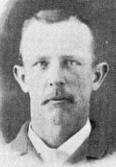 Photo No. 5, Fred R. Castle is shown in 1880 when he was a leaper on the Adam Forepaugh Show. Richard E. Conover Collection.
During the winter of 1894-1895 Fred R. Castle bought the Forepaugh Calliope. Mr. Castle had appeared on the O'Connor Circus in 1870, the Sells Bros. Circus in 1878. and the Forepaugh Show in the early and middle years of the 1880's. He was a noted leaper and did a double somersault over 14 elephants while on the Forepaugh Show.
Castle rented his twenty whistle machine to circuses, carnivals, wild west shows, and Uncle Tom's Cabin shows during the years 1895-1911. In 1895 he rented it to the Stetson Uncle Tom's Cabin Company owned by Leon W. Washburn. In 1896 it appeared on the Leon W. Washburn Circus. It is not known to this writer what shows Castle rented his calliope to for the years 1897, 1898, and 1899. but it can be conjectured that the Washburn Circus or the Stetson Show was using it.
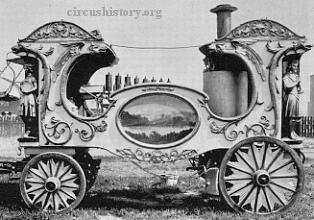 Photo No. 1, The best known photo of the Forepaugh Calliope. This shot was probably used by Fred Castle in advertising the unit after he bought it. Taken about 1900. Burt Wilson Collection.
In 1900 and 1901 it was rented to the Campbell Bros. Circus. Nineteen hundred and two found the calliope on the Buckskin Bill Wild West Show. In 1903 Castle rented it to the Cole Younger and Frank James Wild West Show. It is not known to whom Castle rented his calliope to for the 1904 tour, but there is an excellent possibility it was on either the Parker Carnival or the Buckskin Ben Wild West Show.
In 1905 Castle was assistant manager of the Hulburd Wild West Show. This was a newly formed show using the equipment of the 1904 Buckskin Bill Wild West Show. Since Castle always traveled with the show his calliope appeared on; it can be assumed that the calliope was on the Hulburd Show in 1905. Castle and his calliope may have appeared on the Cosmopolitan Carnival in the latter part of the 1905 season. I hope to prove or disprove this in an article at a later date.
In 1906 the calliope appeared on the Cosmopolitan Carnival. The calliope was badly burned in a fire at Kansas City, Kansas on October 20 of that year. This Kansas City fire was one of the worst fires in carnival history. Over $400,000 worth of damage was reported. The calliope was repaired and put on tour again after the Kansas City fire. It may have been on the Cosmopolitan Carnival after 1907, but nothing has come to light to prove this.
A haze falls over the calliope's history for the years 1907, 1908, 1909. and 1910. It is, as already stated, known that the calliope at one time appeared on the Parker Carnival and on the Buckskin Ben Wild West Show. This 1907 through 1910 period seems to be the only time when it could have been on these shows. If it was on the Buckskin Ben Show during this period it would have been 1908 or after.
The last show Castle and his calliope appeared on was the Herbert A. Kline Carnival in 1911. Castle became ill soon after the 1911 tour and after two years of lingering illness he passed away on December 29, 1913, in Hot Springs, Arkansas. So ended the life of Fred R. Castle, but what happened to the historic Forepaugh Calliope? The only answer I have to this can be found in the January 10, 1914 issue of the Billboard. This issue, which contained Castle's obituary, told how his house was destroyed by fire on December 26, 1913. If Castle still had the calliope at the time of this fire it may have been destroyed in it. The Billboard article also mentioned that Castle was planning to take out a small wild west show for the 1914 season.
Over this past summer Tom A. White of Jacksonville, Florida, built a wagon similar to the Forepaugh Calliope. The John Pawling Ring Circus of the CMB also built a calliope that is somewhat like the Forepaugh Calliope.
This article contains every known picture of the Forepaugh Calliope including three very rare pictures previously unknown. The writer would like to have included a picture of the letterhead Castle used to advertise his calliope, but one could not be located, and he would like to see a picture of this letterhead. Charles Bernard listed one of the letterheads in his old-time showmen photos.
I would like to thank T. A. White, Richard E. Conover, J. T. Bradbury, and Leonard Farley for their help in preparation of this article.
Bibliography
April 9, 1880 Clipper
1880 Forepaugh Route Book
January 7, 1933 Billboard
March 25, 1905 Billboard
January 10, 1914 Billboard
November 3, 1906 Billboard
December 21, 1905 Billboard
By Richard J. Reynolds. Bandwagon, Vol. 9, No. 6 (Nov-Dec), 1965, pp. 19-23.
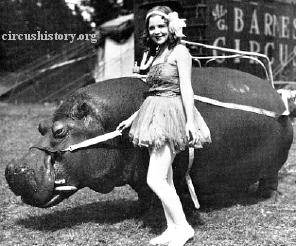 Photo No. 1, The Nile hippo "Lotus" hitched to the cart she pulled around the hippodrome track. Photo taken on Al G. Barnes Circus around 1935. Pfening Collection.
Traditionally, the big three among circus menagerie attractions have been (1) the giraffe, (2) the hippo, and (3) the rhino. Of these the hippo has been the most commonly exhibited and has been worked" or used in the performance far more frequently than the other two.
The importance of the hippo to the circus is reflected in the wide spread use of lithos and newspaper ads featuring the famous "blood sweating behemoth of holy writ." Because of this prominence the writer has undertaken to learn something about the individual hippos that have been exhibited by the shows of recent years. The Ringling Bros. and Barnum & Bailey hippos of the period 1938-1965 have been chosen as the subject for this article for two reasons. First, the writer is more familiar with the hippos on the big one, and second, 1938 was the beginning of the North era and constitutes a convenient starting point.
It would be appropriate to say a word or two about hippos generally. The word hippopotamus is Greek in origin and means "river horse." There are two kinds of hippos. The most familiar is the common or Nile hippo (hippopotamus amphibius) which was quite familiar to the ancients, so that it is literally the behemoth of holy writ. This is the hippo usually exhibited by circuses. It inhabits most of the rivers and lakes of Africa. In captivity it breeds well and will commonly live twenty or thirty years, with some individuals doing better than forty. The world record for life in captivity belongs to a famous breeding male, "Adonis," who was captured in Africa in 1912, arrived at the Overton Park Zoo, Memphis. Tennessee in April, 1914, and died there in January, 1965, for an overall life in captivity of some 52 years, more than 50 of which were spent at Memphis.
The other kind of hippo is the pigmy (Choeropsis liberiensis) which has a very limited habitat in West Africa. It is a much smaller and very much rarer animal than its large cousin. A fully adult pigmy hippo will weigh only 500 pounds as compared to 3,000 or 4,000 pounds for the Nile hippo. Although a pigmy hippo lived for a short time at the Dublin, Ireland zoo in 1873, it was not until 1912 that the animal really became established in captivity. In that year Carl Hagenbeck obtained five examples, three of which came to the Bronx Zoo, New York, the first for the U.S.A. (Crandall, Lee S., Management of Wild Mammals In Captivity, Chicago, 1964, Page 539). Although there have been very few pigmy hippos exhibited by American circuses the species has now become well established in zoos, and breeding is no longer uncommon. Like the big hippo, the pigmy commonly lives 20 or 30 years in captivity. It is interesting to note that the pigmy hippo is currently listed by the International Union For Conservation of Nature as one of the seventy odd species of hoofed animals that are truly rare and threatened with extermination. (For a good discussion of hippos in captivity, see Crandall's book, pages 530-543).
As far as your writer can determine, the Ringling-Barnum show has exhibited four and perhaps five Nile hippos and one pigmy hippo since 1938, to wit:
Nile Hippos
August (No. 1) male. By 1938 this hippo was a veteran trouper. According to the late Col. W. H. Woodcock, "August" dated back to the days of the Ringling Brothers show prior to 1919. Just when he was acquired by the Ringlings is uncertain. After the merger of the shows in 1919, "August" probably alternated with other hippos for the annual under canvas tour, "Fatima" and "Martha" to name two. I would venture to say that he was used regularly in the late 1930s and was most likely the hippo that made the short ill-fated 1938 season. He was definitely at Sarasota quarters in September, 1938 (Billboard, October 1, 1938, p. 29) but was loaned to Frank Buck in late 1938 or early 1939. The famous wild animal trapper took the hippo to his farm in Amityville, Long Island and may have used him for a short time in his jungleland exhibit at the 1939 New York World's Fair. Later that year Buck sub-leased the hippo to Clyde Beatty who wanted the big animal for his Jungle Zoo at Fort Lauderdale, Florida. This attraction was opened to the public on December 2, 1939, and "August" generated quite a bit of publicity by escaping from his regular enclosure and sporting about for several days in a small lake in the park. When Beatty's zoo closed for the summer of 1940, "August" was returned to Ringling-Barnum's Sarasota quarters (see: Beatty, Clyde, Jungle Performers, New York, 1941, pages 11-14 for a detailed account of "August's" adventures at Beatty's zoo). Ringling-Barnum wanted "August" returned not only because of the publicity he had obtained but also because the show needed a reserve hippo. "Lotus" was trouping with the big one, and, as we will see in a moment, "Chester" had been loaned to Cole Bros. Just what became of "August" after 1940 is unknown to me. However, it is my belief that he never trouped again and died at Sarasota between 1940 and 1944. Based on information at hand "August" lived at least 23 years as a circus animal.
Chester, male. Unlike most circus menagerie animals, "Chester's" first years in captivity are precisely known. He was born to "Alice" with the Hagenbeck Wallace-Forepaugh Sells show on August 10, 1935 at Chester, Pa. (Thus his name. See the 1935 photo of the hippo cage in Bandwagon, Nov.-Dec. 1964, page 26). The sire was "Victor" the famous breeding male of the Peru hippo herd. "Alice" and her baby finished the 1935 season as features of the Hagenbeck Wallace-Forepaugh Sells show. In March, 1936 "Victor," "Alice," and "Chester," the last of the Peru hippos, were leased to the Detroit zoo because no show went out of Peru that year. (Billboard, Apr. 11, 1936, page 46). "Victor" went back to Hagenbeck Wallace in 1937 and "Alice" remained at the Detroit Zoo until her death in 1960. "Chester" left Detroit for Sarasota on March 5, 1938 (letter from Keith F. Cline, Ass't. Curator, Detroit Zoological Park, Oct. 8, 1965). I do not know whether he made Ringling-Barnum's short lived 1938 season, but he was definitely at Sarasota in August, 1938. According to Billboard (Aug. 20, 1938, p. 28) "Chester" was permitted to roam the quarters at will creating quite a thrill for the patrons. In 1939 Ringling-Barnum carried two Nile hippos, "Chester" and "Lotus." In April, 1940 "Chester" was loaned to Cole Bros, to replace the pigmy hippo destroyed in the disastrous fire at Cole's Rochester quarters on February 20, 1940. He stayed with Cole. Bros, through about the 1943 season, when he was returned to Ringling-Barnum. I am not sure if "Chester" was the hippo carried by the big one in 1944, but I am fairly certain that he made every season from 1945 through 1954. I saw him at Sarasota in March, 1955, and he was frisky and full of life. His big cage No. 85 was painted and ready to roll. However, when the show got to Atlanta on Nov. 11, 1955 he was not with it. His cage No. 85 was occupied by the pigmy "Betty Lou" and a young Nile hippo. What happened to "Chester?" There are several possibilities: (a) he was sold while on tour to make way for the young hippo, (b) he died early in the season, or (c) he was sent back to Sarasota and sold when Ringling-Barnum got rid of its menagerie in 1956-1959. Perhaps some reader will know the true story. In any event, "Chester" lived at least 20 years, two in the Detroit zoo and 18 as a circus attraction.
Lotus, female. This was the most famous and possibly the longest lived of all circus hippos. Most of her notoriety arose before she became a Ringling-Barnum animal. "Lotus" was acquired by Gollmar Brothers around 1912 and traveled with that circus through 1916. She remained with the show when it was sold to James Patterson and went out as Gollmar-Patterson in 1917. In 1919 "Lotus" was sold by Patterson to the Al G. Barnes Circus. With the Barnes show she became a featured attraction. Broken to pull a small cart she was slowly led around the hippodrome track during each performance of the Barnes show. (See photo No. 1). Even after Ringling-Barnum added so many acts to Al G. Barnes-Sells Floto in mid-1938, the big hippo's ponderous waddle around the hippodrome track remained a feature of the show. "Lotus" went to Sarasota quarters with the rest of the Barnes show following the close of the 1938 season. From the 1939 through the 1942 seasons "Lotus" traveled with Ringling-Barnum. The big one did not carry a Nile hippo in 1943. Photo No. 6 was taken by Robert Good in Sarasota on March 26, 1944, and "Lotus" may be the hippo in cage No. 88. I have always believed that the old hippo was retired from active duty following the 1942 season and spent the rest of her days in Sarasota quarters. However, the 1952 route book says "Lotus" was the Nile hippo carried that year. In 1952 the big hippo and rhino cages were spotted on the midway and opened to the public as a free attraction. (See photo No. 7.) I saw "Lotus" at Sarasota quarters in early [unreadable date] and again in 1954. On the latter visit her keeper told me she was getting very feeble, hardly able to get out of her pool. "Lotus" died at Sarasota during the summer of 1954, having lived with circuses for at least 42 years. As far as I can determine, this is the longevity record for a circus hippo.
August (No. 2), male. For some reason, Ringling-Barnum sometimes named a new animal after a previous one of the same species. Such was the case of "August No. 2." This young hippo was acquired by Ringling-Barnum during the stand at Detroit, Mich., July 1-3, 1955. He and the pigmy hippo were moved into the big hippo cage No. 85 and finished the season sharing that den. It is presumed that "August No. 2" was the hippo carried in 1956, the last season under canvas. In 1957 the big one took its menagerie, including hippo den No. 85, to Madison Square and Boston Gardens, returning it to Sarasota after those engagements. Hippo den No. 85 and a Nile hippo (presumably August) went to Madison Square Garden in 1958, but afterwards the hippo was sent to the Pawtucket, Rhode Island zoo along with other menagerie animals under an arrangement whereby the show paid $1.00 per year for the privilege of boarding the animals between engagements at the Garden. After the 1960 New York stand the Nile hippo and other animals were moved to the Bob Dietch Kiddie zoo in Fairlawn, N.J. In late 1960 or early 1961 the hippo died, and I believe this was "August" ("Ringling Animals to Remain near New York," White Tops, May-June, 1958, page 18 and Elbirn, Bill, "Operation Followup," Bandwagon, May-June and Sept.-Nov. 1961).
Lilly, female. Purchased by the show around March, 1961 and used each year in Madison Square Garden through 1964. In between engagements at the Garden it is farmed out to various zoos or parks in the vicinity of New York. As far as I know this hippo is still living although as we shall see in a moment, Ringling-Barnum may have acquired another example.
Eva, female. According to Robert Good this five year old hippo was at the Dorney Park Zoorama, Allentown, Pa., in the summer of 1965 and is the one that has been used for the past few years by Ringling-Barnum at Madison Square Garden. This is somewhat confusing information in view of the fact that "Lilly" was said to have been at the Garden in 1964. Unfortunately your writer cannot shed any light on this apparent conflict.
Pigmy Hippo
Betty Lou, female. This is the first and only pigmy hippo ever exhibited by Ringling-Barnum. According to a sign that was painted on her cage in 1954, "Betty Lou" was born in the wilds of Liberia in 1938. She was given to the Norths by Harvey Firestone whose company operated many rubber plantations in that West African nation. "Betty Lou" was delivered to the show during the stand at Washington, D.C., on May 15-17, 1941. She never missed a season thereafter and was sold to the Overton Park Zoo, Memphis, Tennessee in July, 1958, where she is still living. "Betty Lou" was used in the 1943 and 1948 specs. In 1943 her den was pulled by a 4-horse team in the street parade replica "Hold Your Horses" (see photo No. 4). In 1948 her cage was spotted in the back yard and "Betty Lou" was led around the hippodrome as part of the spec, "Twas The Night Before Christmas." She was always a favorite of the circus folk.
During the period 1938-1965 Ringling-Barnum apparently used four and perhaps five different cage wagons to transport its hippos, to-wit: Nos. 88, 85, 78. 73 and 77. Wagon enthusiasts will quickly recall hippo den No. [unreadable text] destroyed by a fire at Bridgeport winter quarters in January of that year. As far as I can determine No. 88 was used by Ringling-Barnum every year from about 1924 until 1942. It was not used in 1943 as the big one did not exhibit a Nile hippo that year. This was probably the first time since the turn of the century that the big one failed to carry a Nile hippo. The pigmy "Betty Lou" was on the show in 1943, traveling in cage No. 73. There was no menagerie as such for that season. The show had been reduced from 90 cars in 1942 to 76 in 1943, and the menagerie cages were used for the spec "Hold Your Horses." In order to arrange this, all cages used in the "parade" were spotted in a roped off area in the backyard, as were the elephants and three or four bactrian camels. Between the marquee and big top was a small push pole tent for exhibiting the gorillas. As I recall, there were two cages in this gorilla tent, one for "Gargantua and Toto" and the other for orangutans and chimps. This was the first year the gorillas shared a single cage. There was no giraffe, and I would venture to say that 1943 was also the only year since about 1900 that the "big ones" failed to carry this animal.
However, to get back to hippo den No. 88, why was it not carried in 1943? We can only speculate, but there are two possibilities, to wit: (a) it was not carried because of the reduced size of the 1943 show or (b) it was too heavy or too long to be pulled twice a day around the hippodrome track in the "parade."
I do not know whether No. 88 was used on the road for the 1944 season, but it was definitely carried in 1945-1946 and for the last time in 1947. Up until about 1940 the sideboards of No. 88 were painted with the colorful title shown in photo No. 8. Another distinctive feature of No. 88 is the pretty scroll that was always painted along the side of the splash board that covered the side of the bathing tank. No. 88 was retired after the 1947 season and eventually disappeared in the decay of the famous Sarasota wagon graveyard.
In 1944 or perhaps in 1943 a new "big hippo" den was built for Ringling-Barnum. This was No. 85, and it was almost a duplicate of No. 88. It can be distinguished from No. 88 by the vertical ribs along the side of the water tank. These ribs were apparently never covered with a splash board, and thus there was no scroll along the side of the tank, another feature by which to distinguish it from No. 88 (see photos Nos. 5, 9. and 10).
No. 85 was definitely used in 1944 for the open air tour following the Hartford fire. From 1945 through 1947 the bathing tank was planked over and No. 85 was used to carry the male African black rhino "Robert" that Ringling-Barnum purchased from the Brookfield zoo in 1945. In 1948, the wagon was returned to use as a den for the Nile hippo and has been used in this manner ever since. During the 1955 season No. 85 was divided into front and rear sections to accommodate both the pigmy hippo and a young Nile hippo that arrived in mid-season. To give both animals a bathing area, the separating bars were placed out in the tank. By this device Ringling-Barnum carried two hippos in a single cage, the only time this was ever done by that show as far as I know (excepting a mother and baby).
At last information No. 85 is still used by Ringling-Barnum to exhibit a Nile hippo in Madison Square Garden, although it has been renumbered as No. 6. In between engagements at the Garden the cage and its occupant are farmed out to various zoos or parks in the New York area.
In 1939 Ringling-Barnum carried two Nile hippos in separate cages, the only time this ever occurred, as far as I can determine. "Lotus" was in No. 88 and "Chester" in No. 78. I am not sure of the exact origin of No. 78. It was a 16-foot long den, and was apparently originally built as an "all purpose" cage. In the early 1930s it was used to transport one of the show's black rhinos, but 1939 is apparently the first time it was used as a hippo den. Presumably No. 78 had to be modified for this job by the addition of a water tank. It was not carried in 1940 but in 1941 was used for the newly acquired pigmy hippo "Betty Lou." From 1943 through 1948, however, the pigmy used No. 73. As shown in photos 3 and 11 this was about a 16-foot den with a shallow bathing tank, suggesting, like No. 78, that it was not part of the original equipment on the wagon. It is my belief that No. 78 of the 1941 show and No. 73 of the 1943 edition are one and the same, the wagon simply being renumbered in 1943. This theory is supported by the fact that No. 73 of the 1940 and 1941 shows had no tank and was used as a lion cage. It seems unlikely that the show would convert the 1941 lion cage to a hippo den when it had just done this for No. 78 a few years before. Researcher note: it is not true that No. 78 of the 1941 show and No. 73 of the 1943 edition are one and the same.
For the 1949 season Ringling-Barnum replaced most of its old menagerie cages, including "Betty Lou's" No. 73, with all metal 12 foot long dens. These wagons were converted ex-World War II Army ordnance trailers. One of them. No. 77, was equipped with a tank to accommodate the pigmy hippo "Betty Lou." No. 77 was used for the pigmy through 1957. When the pigmy was moved into No. 85 in mid-season 1955, No. 77 was used for the remainder of 1955 as a meat and forage wagon ("Last Loading Order for Big Show With Instructions to Train Crews," White Tops, July-August, 1959, page 16).
Although the old Al G. Barnes hippo den went to Sarasota winter quarters at the close of the 1938 season and would have been available for Ringling-Barnum, it was never used by the big one. This huge old den, that Jake Posey once said was the heaviest wagon he ever moved, was destroyed in one of the wagon burnings at the Sarasota quarters around 1945.
It would be appropriate to describe the facilities for housing hippos at the Sarasota quarters during the period under consideration. The main animal building at Sarasota had indoor and outdoor cages that were apparently constructed specifically to house two hippos. It may have been possible to accommodate a third, but there would have been some crowding. As far as I can determine, the bathing tanks were always located outdoors only. Around 1940-1941 Erich Hagenbeck, grandson of the original Carl Hagenbeck, was commissioned by the Norths to build new hippo pools and a monkey island using the barless, natural barrier principles which the Hagenbecks pioneered and which have revolutionized zoo architecture. It seems that Erich Hagenbeck was the American representative of his family's famous animal firm. When hostilities began in Europe the business of wild animal dealers quickly dried up, and Erich Hagenbeck went to work for Ringling-Barnum as a sea lion trainer. While associated with the show he designed the new animal facilities. In April, 1942 he was interned as a German alien and sent to Fort Tennessee, North Dakota for the duration of the war. He is now active in his family's business in Hamburg (Hagenbeck, Lorenz, Animals Are My Life, London, p. 214).
The two barless hippo pools were attractively constructed with artificial rock-work as was the monkey island. Since the hippo pools housed the show's Nile hippos the pigmy "Betty Lou" generally used the moat around monkey island as her winter home (see photo No. 2). In the winter of 1954-55 she was housed in a hippo cage in the main animal building, a move caused by the 1954 death of "Lotus."
The Sarasota quarters are now gone as are all but one of the hippos that lived there. "Betty Lou" is the only survivor of the river horses that trouped with the big one under canvas.
The writer would like to thank Joe Bradbury, Robert Good, Gordon Potter, and Chang Reynolds, without whose kind assistance this article would not have been possible.
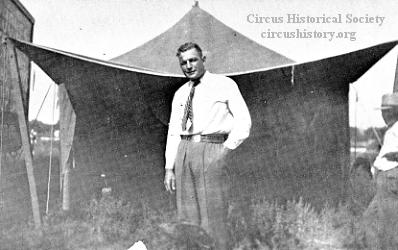 Photo: A very rare photo of Buck Jones standing in front of his dressing tent. Burt Wilson Collection.
A number of famous western motion picture personalities have been featured with, or actually owned circuses and wild west shows.
Photo: A very rare photo of Buck Jones standing in front of his dressing tent. Burt Wilson Collection.
A number of famous western motion picture personalities have been featured with, or actually owned circuses and wild west shows.
Tom Mix was the best known Hollywood actor, the highest paid and most likely the most financially successful in outdoor show business. Mix was a highly paid feature with the Ringling-Barnum owned Sells-Floto Circus in 1929-1930 and 1931. In 1934 he was featured with the Sam B. Dill motorized circus, with his name combined with Dill's in the title. In 1935 Mix took complete ownership of the show and it became the Tom Mix Circus. The show was successful and made a trans-continental tour from California to New England in 1936. The show closed at the end of an incomplete season in the disastrous circus year of 1938.
Ken Maynard framed a railroad wild west show in the spring of 1936, in Van Nuys, California. Most of the equipment came from George Christy, in South Houston, Texas, and had been used on the Christy owned Lee Bros. Circus in 1925 and 1926. The show operated over a couple of weekends, set up on Maynard's Ranch, but did not go on tour. Maynard was later featured a couple of seasons on the Cole Bros., Arthur Bros, and Biller Bros. Circuses.
Col. Tim McCoy presented the wild west concert on the Ringling-Barnum Circus in 1935, 1936 and 1937. During the winter of 1937 and 1938 he framed the finest new railroad show to open in circus history. The show, equipped with all-steel cars and wagons, opened in Chicago in April 1938, but closed three weeks later, in Washington, D.C., where it was sold at auction. McCoy was featured 20 years later by the Kelly-Miller and the Carson & Barnes shows.
Buck Owens appeared with Robbins Bros, in 1930, Downie Bros, in 1932, Lewis Bros, in 1935 and then operated his own show in 1946. The Owens show lasted one season and became Rogers Bros, in 1947.
Jack Hoxie was another popular western figure that appeared with probably a greater number of different circuses than any other movie personality.
Hoxie and his wife, Dixie Starr, were with the Miller Bros. 101 Ranch Wild West in 1930. He was featured on Charles Sparks' Downie Bros, in 1933, 1934 and 1936. In 1935 he was with Harley Sadler's show, and in 1939 he was on Lewis Bros. In 1937 he operated the Jack Hoxie Circus, lasting part of the season. Ten years later he appeared with Mills Bros.
A number of other Hollywood western stars have appeared with circuses. Bill Cody was with Walter L. Main in 1932 and Downie 1935. Buck Steele appeared with Sam B. Dill in 1933, Beverly Bros, in 1934 and Kay Bros, in 1935. Hoot Gibson was with Wallace Bros, in 1937 and the Adkins and Terrell Robbins show in 1938. William Desmond was with Barnett Bros, in 1938 and Harry Carey had been with that show earlier. Art Mix was with Kay Bros, in 1937 and 1941 and was featured with the Cole show in 1939. In 1947 Mix operated the Buffalo Ranch Wild West, which opened and closed in one stand at South Bend, Indiana. Lee Powell, the Lone Ranger, was a big name with Barnett Bros, in 1939 and with Wallace Bros, in 1940 and 1941. Lash LaRue, a minor Hollywood personality, was on Dales Bros, in 1949. Duncan Renaldo, the Cisco Kid, appeared at the Chicago indoor engagement of Cole Bros, in 1953 and for a few weeks with Clyde Beatty early in 1946. William Boyd, "Hopalong Cassidy," was a big feature with Cole Bros, in 1950. Just this last summer, Jack Moore's Carson & Barnes show featured Sky King, a western TV star.
This article, however, concerns yet another western motion picture actor, one Charles Frederick Gebhard, better known as Buck lones. He was born in Vincennes, Indiana, in 1889, but was reared on a small ranch in Oklahoma. He served in the Army as a sergeant in the Philippines and as a member of the cavalry remount service in World War I. Around 1922 he began making western films and by the late 1920s he was extremely popular with the youngsters across the United States. He was ripe for a promotion by a fast talker, who suggested that the Buck Jones Wild West Shows and Round Up Days could make a lot of money.
Al W. Copeland was the individual who suggested the show and who served as manager in building the show and running it during the early part of what turned out to be a short season. Copeland was a former carnie who, at one time, had operated a pit show on the Al G. Barnes Circus. In the middle 1920s Hollywood started a cycle of circus films (actually more carnival than circus) and Copeland began renting outdoor show equipment to the studios. It was in this way that he became connected with Jones.
Mr. Copeland was an interesting individual, well steeped in fast "business arrangements," typical of some "carnies." He is quoted as saying his motto was, "Take a little and leave a little."
Jones sent Copeland to El Paso, Texas, to purchase equipment from a carnival that had gone broke there. The show, Fairyland Guaranteed Shows, a railroad show owned by J. O. (O for Ordway) McCart, used typical carnival style wagons as contrasted to many of the carnivals of that period that carried circus style wagons; some carnies even carried bandwagons and animal cages and presented parades.
The McCart equipment consisted mainly of wagons, although a couple of coaches may have been in the deal.
The show purchased six new 70 foot flat cars and three new stock cars from the Warren Tank Car Co. There were three coaches, one system stock car and one advance car. The 14 car train was painted red and white. All of the rail equipment was mortgaged to D. T. Pilchard, indicating that Jones was not the only investor in the enterprise.
Winter quarters were set up at Studio Ranch, in North Hollywood, California. The McCart wagons were brought to the quarters along with a few old Al G. Barnes wagons. They were all nicely lettered, but there were no carvings or pictorial work on them. Each wagon carried the full title as well as Hollywood, Cal. The show carried an air calliope, which was loaded in a baggage wagon. Harry Wills played the calliope in the parade.
The performance was presented arena style with a canopy covering the seats. The tents probably came from the Downie Tent and Awning Co. in Los Angeles.
The midway contained an Underworld Show, operated by LaMarr and Fan Toy. The side show was managed by Bob Cunningham, who also did the big show announcing. The attractions in the annex included a 10 piece Mexican orchestra; Honey, the fat girl; Indian Village; Cynthia Adams, sword box and Oriental stocks; Fred A. Boelme, tattoo artist; John Louman, six piece-one man band; Margaret Dewey, snakes; Fred Wolf, giant and Hawaiian village and orchestra. Sonny C. A. Berg managed the shell game.
The June 15, 1929 Billboard contained an extensive article listing the full personnel. It follows:
Al W. Copeland, general manager; H. I. McGlathery, treasurer; Red Fowler, ticket seller; Sky Clark, Tom Wilson and Edward Behman, front door. Col. Frank Small, who had formerly trouped with Buffalo Bill, was press representative with Thoman (Skinny) Dawson handling advance publicity. Charles Hatt had the privileges. George Schwartz had the cook house and B. Griffin was stock boss.
The lot superintendent was Bill Warner. Robert D. Thatcher was superintendent of reserve seats, assisted by S. D. Wells. Gordon Jones was arena director and Ben Dobbins was chief cowboy. Judd Bullock was trainmaster with F. (Boston) Rowe as head porter.
Clint W. Finney was general agent and Ed Hale was the 24 hour man. A 20 piece cowboy band was under the direction of George Atterbury.
The show arena was 130 feet by 400 feet and had a seating capacity of 10,000 (reported in BB, but doubtful). One hundred spotlights flooded the performing area during the night shows. There was a total of 102 performers and a total payroll of 267.
The performance as reviewed in San Francisco ran one hour and 45 minutes. The program was as follows:
1. Grand entry, headed by Buck Jones on his movie mount, Silver Buck, and Mrs. Jones on her horse, "Clown."
2. Introduction of performers; cowboys from Wyoming, Montana, Texas, Arizona and California; Indians from Navajo, Cheyenne and Sioux tribes.
3. Trick roping, with Buck Jones, Gordon Jones, Vinegar Roan and Monte Mickel.
4. Pony Express, with Earl Dobbins and Indians.
5. Balloon (push) ball game by cowboys on horseback.
6. Exhibition of movie stunt work, seven studio falling horses.
7. War dance by Indians.
8. Trick and bucking mule act.
9. Bareback riding, featuring Bill Kieffers, Charles Kieffers, Bob Taylor and Billy Mack.
10. Steer bronco riding.
11. Challenge push ball game with visiting cowboys.
12. Deadwood stage coach attack, by outlaws and Indians.
13. Buck Jones' trained horse exhibition.
14. Trick roping and lassoing.
15. Chase for the bride.
16. Quadrille on horseback, by cowboys and cowgirls.
17. Prairie schooner, depicting the Days of '49.
18. Roman riding with Ben Dobbins and Tim Irwin.
19. Horse thief act.
20. Trick riding by cowboys and cowgirls, Bill Kieffers, Earl Dobbins, Buck Brown, Bud Brown, Gordon Jones, Ike Lewin, Stella Kieffers and Dell Jones.
21. Indian war dances.
22. Trick revolver shooting.
23. Races by cowboys, cowgirls and Indians.
24. Bucking bronco riding.
25. Clown act by Ike Lewin, Rib Del Roy and Rube Miller.
26. Bucking Funny Ford.
27. Grand Finale with entire company. The above program is considerably longer and more extensive than that listed in a small four page printed program issued for the opening in Ventura on May 16th. It listed only 10 acts.
When the show had loaded out in North Hollywood for the run to Ventura, it was discovered that there were not enough berths for the personnel. A Pullman sleeping car was rented from the Pullman Co., complete with porter. Red Sonnenberg, having joined the show after going to the coast and not getting placed on the Barnes show as planned, slept on this fancy system sleeper. He relates that probably never before, nor since, has the Pullman Co. had so many dirty towels daily. All the show bums thought they had reached the promised land finally sleeping in a Pullman, that did not have side doors. Everybody was laughing and scratching on the trip to Ventura. A Sunday matinee was given in North Hollywood and then the show layed off for a few days before moving to Ventura. North Hollywood was a big day, it turned out to be the first and last big day of the season.
Following the May 16 Ventura date the show moved up the coast and began a four day stand in San Francisco on May 30. The full route between the 16 and 30 is not known, but Salinas and Stockton were played.
San Francisco was heavily billed and the show played the lot at 16th and Bryant, where the Seals ball park was later built. Business was bad and the attachments started coming in. Jones and Copeland came to a parting of the ways in Frisco over a padded bill for some cowboy hats. Copeland was succeeded by another Hollywood first-of-May as manager.
Oakland followed for a two day stand on June 3 and 4. Business here was poor also. Sacramento was to follow on the 5th, however the train kept right on going, with the show blowing Sacramento and moving fast to get out of the state and away from the California attachments. Reno was papered for the 6th but the show pulled in a day ahead.
Jones drove a fancy "Hollywood" Packard auto with steer horns on the radiator. A sheriff came on the lot in Reno and showed Buck some papers, and Jones said nothing, he just handed the keys of the car over and the law official drove away.
Winnemucca, Nevada followed on the 7th of June, with Elko on the 8th for a Saturday stand. The show moved to Ogden, Utah for Monday the 10th.
As Red Sonnenberg puts it, "The show limped in to Salt Lake City on the 11th, coming on the lot on the heal and toe, the lot was jammed, and it looked like the show was finally going to get a big day, the tip was all around the red wagon." "But lo and behold our joy was short lived, as they were all shysters trying to get their attachments in first. As fast as the scratch came in that day somebody snatched it." One of the Indians said he had $600 in the wagon for safe keeping, and this went along with all other cash during the Salt Lake onslaught.
The show then moved on to Provo, Utah on the 12th, Price the 13th, and Grand Junction, Colorado on the 14th. Montrose and Glenwood Springs followed on the 15th and 17th. The city played on the 18th is unknown. Salida, Colorado was the stand on the 19th with Canon City and Pueblo on the 20th and 21st.
The Jones organization, such as it was, made Colorado Springs on the 22nd and moved on to Denver for a two day stand on the 24th and 25th. The show folded in Denver.
One thing the show did have was blankets, the vestibule of one of the sleeping cars was loaded with them. Two industrious employees took their pay in blankets, helping themselves and selling them to a group of Mexican Gandy Dancers working on the Denver and Rio Grande.
The equipment was moved on to Kansas City, Missouri where it was reorganized for a reopening.
The July 6th Billboard reported that Clint Finney had left Kansas City for Chicago to negotiate railroad contracts. Finney stated that the show had been reorganized and would open again at Sedalia, Missouri on July 1st. While in Kansas City, Finney had engaged Bill Penny to go to an Indian reservation in the Black Hills and secure 30 Indians. He purchased two trucks for the advance and placed Howard Hendricks as manager of the No. 1 advertising car and Charles McCurren as manager of the No. 2 car. Jack Lynch joined as special agent and Ora Parks came on from New York to handle Press work.
D. T. Pilchard, who turned out to be the angel for the show took over as manager and may have pumped some additional money into the show to attempt to save his earlier investment.
The July 2nd stand is unknown. Marshall was played on the 3rd and Mexico was the July 4th date. The July 13th Billboard reported that Mexico gave two good houses. Bill Penny was back on the show with a score of Indians from the Rose Bud and Pine Ridge reservations. James L. Kerwin had joined as a special press agent and J. O. Baynhour had come on as contracting press agent. A big dinner was served in the cook house on Independence Day, and a new privilege car opened that day.
Moving into Illinois the show made Carlinville on the 5th, Granite City the 6th, Alton the 8th, Springfield on the 9th, Bloomington the 10th and Champaign the 11th.
Even though the show was moving, after reopening, with a fair amount of success, the creditors in Los Angeles were hot on the show's trail. A temporary injunction was issued in the L.A. court halting the show at the July 12th stand in Danville, Illinois, according to the Billboard. Clint Finney reported later in the Billboard that the show had not closed due to bad business, and that actually business had been satisfactory since the reorganization in Kansas City.
However the Danville Commercial News reported another story. Its version in substance was as follows: DeWhitt T. Pilchard (previously mentioned as the angel), filed an injunction against the Jones show and asked that a receiver be appointed. He stated that he had invested $25,000 in the show. Of this $15,000 was secured by a note against the Dell Holding Corporation, of Los Angeles, a Buck Jones company. The evening show had been completed when the papers were served.
The July 17th issue of the paper reported that attorneys for Jones fixed the damage at about $12,000 after the injunction had been dissolved by Judge Charles Shuey. The sheriff's department had men on hand at the fairground to guard the property of the show. They were paid $347.50 for one week's work.
During the hearings Buck Jones and his wife testified that his salary was $1,000 per week and he had been making movies for 12 years, and that he had been with Miller Bros. 101 Ranch as well as Ringling-Barnum. He further stated that some of his people were under contract and some were working under verbal agreements.
Jones told a newspaper reporter that the show would reopen and that he was in full charge, that Pilchard had claimed that he wanted a hand in the management but was told that he was not wanted.
Buck Jones did reopen the show for a performance on Friday the 19th. Two additional performances were given on Sunday the 21st. All proceeds from these shows went to employees to cover part of their back wages.
At this late date it might be assumed that Jones came up with some cash and squared Pilchard. The train was loaded and pulled out on the Wabash at 6:15 p.m. on July 23rd for St. Louis. Jones private railroad car remained in Danville. The rest of the show was moved to the William P. Hall farm in Lancaster, Mo. Bill Woodcock was working for Hall at the time and helped unload the equipment.
After word of the closing spread through outdoor show business a number of circus owners and others went to Danville trying to sign the western star to appear with their show. Those reported to have been in Danville were Fred Buchanan, Jerry Mugivan, Bert Bowers, Col. Zack Miller, R. M. Harvey, California Frank Hafley, P. N. Branson and J. D. Newman. Fred Buchanan was the successful bidder and Jones and his private railroad car joined the Robbins Bros. Circus in Fremont, Nebraska on July 24, 1929.
A number of the working men, left broke in Danville, were picked up by the Sells-Floto show which played there on July 30th. Bill Penny returned the Sioux Indians to their homes, having arranged with Fred Buchanan to carry them on the Robbins show as far as Valentine, Nebraska.
The newspaper ads ahead of the Buchanan show started using the title Robbins Bros. Circus and Buck Jones Wild West Combined. Some of the Jones advertising cuts were incorporated in the Robbins ads. Jones remained with the Robbins show until October, when he left for California taking his private car and 15 head of horses.
For over two years, while researching material for this article, the author has attempted to find out if any of the Jones equipment was sold by Hall for use on other shows. From the photographs taken at Lancaster by Bill Woodcock, which are used to illustrate this article, it is evident that most of the wagons and coaches rotted away in a field. However one tally-ho wagon did go to the Cole show with the Robbins equipment in the fall of 1934. It was not used by Adkins and Terrell. The author observed it on the Bradley farm outside of Rochester, Indiana, in April of 1955. The Jones title was very faded but could be seen.
There was some thought that the flat cars, along with the new stock cars, which were the only first class units on the show, may have been divided between the Robbins and the 101 Ranch shows. This has been discounted, however.
The six Warren flats and three Warren stock cars were shipped out from Lancaster. Since they carried a plaque on each reading, "Warren Savings Bank and Trust Co., Trustee, Warren, Penna., Owner and Lessor," this suggests that the rail equipment reverted back to the original manufacturer.
In any case it appears that four of the flats were shipped to Southern Pacific shops at Oakland, California in the fall of 1929. The SP was building 10 flats for the Foley & Burk carnival at the time. An old SP employee advised Don Marcks that he remembered the cars arriving and that they had the Jones title painted on them. These cars are still in use by the Foley & Burk shows. And so the end of the story of the Buck Jones Wild West and Round Up Days. Although the show toured six states for 41 stands, it has not been possible to locate photos of the show on the lot. Reference was made a number of years ago to a set of Buck Jones pictures in an album being offered for sale by A. Morton Smith, however, we have been unsuccessful in finding any prints of these photos.
Perhaps a Bandwagon reader may have photos of the Jones show, if so we would like to publish them in a future issue.
As for Mr. Jones, he did not return to outdoor show business after leaving Robbins Bros, in 1929. He continued making western films, mostly for Monogram Pictures. He was the idol of small boys throughout the country and it was estimated that 3,000,000 of them joined the Buck Jones Rangers.
In the fall of 1942 Jones was on a War Bond selling tour. During a stop in Boston, Massachusetts, he was guest of honor at a party given by Monogram Pictures and the New England exhibitors of his pictures, at the Cocoanut Grove night club. Fire broke out in the club and Jones suffered third and second degree burns. He died on November 30, 1942 in the Massachusetts General Hospital at the age of 53.
The following were most helpful in providing information for this article: Joe Bradbury. Richard Conover, Don Marcks, and Leonard Farley. C. A. "Red" Sonnenberg was a key to many "inside" facts about the show, having traveled with it. Johnny Fulghum checked the Danville newspapers and supplied important information on the closing there.
Part IV, The Winter of 1935-36
Work continued in earnest after the beginning of the new year, 1936, on the numerous improvements made at the Rochester winter quarters. Although the trade publications continually spoke of "new" buildings, "new" quarters, etc. actually no additional structures were erected but only a thorough remodeling of the interiors of some of the buildings took place. Everything had been more or less helter-skelter the previous winter in order to quickly get the new show together in time to open in the Spring but now a complete transformation of the former foundry buildings was taking place putting them into suitable winter quarters facilities for the show.
Most of the winter work was on the animal quarters which were being installed in the building farthest east on the side and adjacent to the north-south railway line. All cage animals and elephants were to be put into the new facilities as soon as they were completed. The training arena was to be 40 ft. in diameter.
The Jan. 4, 1936 Billboard reported that Cole had received a shipment of animals from the West Coast consisting mostly of tigers to replace aged cats in Beatty's act. Clyde Beatty using 24 cats in his act opened at the Fox Theater in Detroit on January 17 for the first of his winter engagements. Bobby McPherson remained in Rochester to help train the newly arrived cats.
General Agent Floyd King resigned, effective January 1, and left the show to serve in the same capacity on the Ringling owned Al G. Barnes Circus. He was replaced by J. D. Newman. Other than the King shift there was no other major change in personnel.
The Billboard dropped a real bombshell in early January by announcing that the Ringling interests would not put the Hagenbeck-Wallace Circus on the road in 1936 and that it would remain in Peru quarters. It was mentioned that the H-W show had lost heavily in 1935 and that at the Board meeting the members of the Ringling family had been persistent in their efforts to have Sam Gumpertz shelve the show. This move of course eliminated the major source of Cole's opposition in 1935 and would leave only three railroad shows on the road in 1936, Cole, and the two Ringling owned shows, Ringling-Barnum and Al G. Barnes. The shelving of the Hagenbeck-Wallace show greatly influenced Cole's plan for the coming season.
In early February a severe spell of sub-zero weather hit, taxing the heating facilities at the Rochester quarters beyond their capacity. The show had to use every possible means to protect the animals from the cold. Cats were bedded down in deep straw and salamander heaters were added to augment the heating in the cat and bull quarters. Elephants were not permitted to lie down for fear of chill or pneumonia. The transfer of the animals to the new quarters was delayed because of the extremely cold weather.
The Feb. 8 Billboard said that the new animal barn was ready and it was hoped the cats and bulls could be transferred shortly and would be just as soon as the weather moderated. The article said that the new remodeled building had cage blocks sufficient to handle 60 cats and floor rings for 35 elephants. A direct tunnel ran from the dens to the training arena. An elephant ring would be located in the adjacent horse barn along with several circles where ring and menage stock are now being worked. The elephants for the time being were located about a quarter of a mile away from the main buildings at the site purchased from the Chicago Nipple Co. last winter. After the transfer of the elephants to their new home the present bull barns will be converted into a wagon storage area. During the previous winter much of the painting of wagons took place at this location.
There was a slight break in temperature about Feb. 15 and the cats were moved into their new quarters, however the bulls were not moved as planned and remained at their present location. They may not have actually gone to the new bull barn until after the 1936 season at which time the show closed the site obtained from Chicago Nipple and located all winter quarters activities at the main location.
The quarters shops opened about Feb. 15 and it was claimed a crew of 250 men was put to work readying the train, wagons, and other equipment for the 1936 season. Ernest Sylvester, after serving 12 years as superintendent of the paint department at Peru with Hagenbeck-Wallace, Sells-Floto, and John Robinson circuses, joined Cole and was placed in charge of the paint shop. Fred Seymore was in overall charge of the shop activity with Charlie Luckey directing the carpenter work. W. A. Dyke was in charge of the harness shop and reported the show had purchased considerable new harness in addition to repairing the old leather.
As was customary the previous winter Adkins and Terrell passed up no opportunity to put various acts and animals to work during the winter months. Clyde Beatty and his animal act was originally booked for eight weeks of theaters but closed at the Cleveland Palace, canceling Pittsburgh and Philadelphia due to insufficient stage room. A Cole unit was booked into a number of winter circuses. Harry McFarland was in charge of the unit which consisted of Eddie Allen with trained elephants. Capt. John Smith with 12 menage horses, and Albert Fleet and Jack Joyce with sea lions. One sea lion died in transit to the Minneapolis Shrine Circus. Later if was announced that for the Omaha Ak Sar Ben Indoor Circus the Cole unit also had trained dogs and monkeys.
On February 8 the show found it necessary to execute Major, a large tusker, and one of the last elephants obtained from the Hall Farm. The animal had attacked and injured Walter Powell on January 18 and again on February 6 had charged J. E. Smith, who had handled him on several shows. The huge bull was dropped by a single shot, a 30-30 steel bullet being used. The tusks were salvaged and the carcass went to a local fertilizer plant. The death of Major reduced the Cole elephant herd to 28.
In early March the show sold a truck-load of animals to Ray Marsh Brydon for his Rice Bros. Circus which was in quarters at Jackson. Tenn. Included in the deal was a large lioness. Cole purchased two new jumping horses from the Culver Military Academy Black Horse Troop and by late March it was announced that Jack Joyce had the liberty acts running smoothly and John Smith had broken 10 new menage horses. Through the years Zack Terrell, who was a great lover of horses, consistently purchased the best that could be obtained for the show.
The March 21 Billboard reported that Floyd King had resigned as general agent of the Barnes show and was returning to Cole Bros., being replaced on Barnes by Arthur Hopper. J. D. Newman, who had joined Cole as general agent after King left in January, remained in that position while King became general press representative, handling all of the show's newspaper work. Newman, in addition to being general agent, handled everything pertaining to the advance outside of the newspaper work.
An event of publicity importance took place on March 17 with the birth of a baby camel, who was named Patrick Rochester.
The show's rail equipment was placed in good shape and the March 21 Billboard stated that the No. 1 advance car had returned from the Monon Railroad shops at Lafayette, Ind., where it was completely overhauled and new trucks added. It was fitted with new paste making equipment and equipped with a 110 volt Delco light plant. For the 1936 season William Backell was the car manager and Clyde Williard the brigade manager. The car was painted red omitting the cream window band it had in 1935 and was lettered above the windows "Cole Bros. World Toured Circus" and underneath, "Featuring Clyde Beatty, Greatest Wild Animal Trainer of All Time." The show claimed in the Billboard that six new stock cars were received in the Spring of 1936 but this report is believed to be in error. Gordon Potter, who was a frequent visitor to the Rochester quarters in those days, lists in his notes that one new stock car did arrive in quarters in the Spring of 1936 and although he was not positive, he believed the car was brand new. At least it had the appearance of being completely new.
For the 1936 season the show traveled on 30 cars with one in advance and 29 back. Cars back consisted of seven stocks, 14 flats, and eight coaches. Potter says he observed a Warren built flat car, No. 34, painted orange and titled "Dodson's World Fair Shows" at the quarters in the Spring of 1936 and although he doesn't know the fully story on it he was told that the car which had been returned to Rochester in mid-season 1935 when Cole cut the train from 35 to 30 cars, was rented to Dodson. It seems somewhat unusual that a carnival would rent a flat so late in the season, however it is possible. Conceivably there could have involved a switch of flats between Cole and Dodson for some reason. In any event, Potter lists in his notes that after Cole departed for the 1936 season, there were a total of six cars left in quarters, three stocks, one coach, and two flats. These six cars, in addition to the 30 on the road, would make a total of 36 show owned cars. The new stock car would add one to the original 35 the show had used in 1935. Another note Potter made in the fall of 1936 was that Cole had rented one flat and three stocks to a carnival, evidently from the excess cars left in quarters.
The same color scheme of aluminum for the flats and stocks and red for the coaches was used in 1936, however the lettering on the flats was now red with light green shading rather than the blue with orange shading used in 1935. Title on cars now read "Cole Bros. World Toured Circus with Clyde Beatty." Coaches were painted solid red omitting the cream window band used in 1935. Some of the numbers on the flats, stocks, and coaches were switched around for 1936. Likewise some of the names on the coaches were changed. Potter noted when he was in Rochester on April 6, 1936, that there were two No. 75 stock cars, one newly painted to go on the road, the other car bearing its 1935 number and paint scheme not scheduled to go out. No detailed train loading order for 1936 has been obtained but photos indicate that both of the Warren built flats were in the train and it was loaded similar to the train in late season 1935 after the cut from 35 to 30 cars. The new stock car was numbered 41.
In contrast to the previous winter when the show was only able to give a minimum of repair to the newly obtained wagons which in several instances were in pretty poor condition the show spared no effort to get the rolling stock in first class condition. Primary attention was given to the cages and tableau wagons and all of these were put in excellent condition by time the show opened. Many of the wheels were sent to St. Mary's to be repaired and the America wagon was equipped with a new set of rear wheels. Considerable repair work was also done to the baggage wagons. Charlie Brady, the wagon repair boss, reported in the March 21 Billboard that all baggage and parade wagons had been equipped with new drawbar and brake equipment for tractor hauling.
The 1936 Cole Bros, wagon list printed here is an official show document which Gordon Potter got directly off the wall of the paint shop in Rochester. Some of the notes on it are not completely clear, particularly when it refers to a wagon as "new." Certainly the two generator wagons listed as new were not new as they had been built only the year before. In other instances where the word "new" is mentioned it is not known for sure if it means the wagon was built completely new from the ground up as many would be done within the next couple years or if it was only an extensive rebuild. It is believed the latter is probably true in most cases. The show's shop force extensively rebuilt a former Robbins Bros. 14 ft. cage, which was not used in 1935. Some three feet was added onto it, making it actually 17 ft. in length rather than the 12 ft. listed on the cage list. This was No. 20 which was painted white and used to house sea lions in 1936. The No. 28 den, which had sea lions in 1935, was reserved for the hippopotamus which was to be added at the show's stand at South Bend. The high sunboard was removed and replaced with a lower board on which was painted "Hippopotamus From River Nile." A total of 15 cages were carried in 1936. Nos. 12 and 14 were cross cages and loaded that way on the train and were the only two of the four cross cages used that had been carried in 1935. In reworking the cross cages practically all of the former carvings were removed. Cages No. 19 and 26 were the two 16 ft. dens formerly on Robbins Bros, and cages No. 16, 17, 18, 21, 22, 23, 24, 25, and 27 were all ex-Christy Bros. 12 ft. dens. With the exception of the two cross cages used to house monkeys, No. 20 for sea lions, and No. 28 for the hippo, the cages were all used for Clyde Beatty's performing lions and tigers. The color scheme for the cages was similar to that of 1935 with the cage panel boards listing the supposedly animal contents painted somewhat more attractively but front and rear cage decorations were probably not as extensive as that of the previous year. Some of the cage cover boards were painted "Trained Pumas," "Trained Grizzly Bears," "African Lions," "Tiger Riding on Back of An Elephant," and "Trained Black Panthers." The panel boards directly above the cage bars were again lettered "Clyde Beatty's Trained Wild Animals" but the layout is just slightly different with that of 1935. This difference can be seen by comparing 1935 and 1936 cage photos and this very slight different arrangement of the lettering is a key for identifying the year of undated photos.
As can be noted on the wagon list many wagon numbers were changed with the general trend to more uniform numbering and the use of lower numerals.
No. 64, now used as the Frozen Custard wagon, was the wagon originally outfitted to carry Jumbo II, the African elephant.
Only one stringer wagon. No. 106. was carried in 1936. It was very heavily loaded and when lots were too soft it was spotted on the street and the load carried over to the big top. In 1935 the show had two stringer wagons. No. 93 and No. 104. The latter was renumbered 106 for 1936 and it is believed No. 93 was dismantled with the gears, wheels, and other parts used on another wagon or either was rebuilt into a shorter wagon for other purposes. Potter says he never saw the other stringer wagon around the quarters after the 1936 season began and in 1937 when the show again used two stringer wagons it was necessary to build a new one.
Old No. 83 wagon was extensively remodeled to contain a dog compartment at the front end of the vehicle.
Baggage wagons for 1936 were painted red with the title in yellow and gears and wheels white with red and blue trim. They looked very good and were in much better condition than a year earlier although the paint job the initial season was probably a little fancier.
All of the show's parade wagons that were used at the beginning of the 1935 season were carried in 1936 with exception of the short unafon wagon. Incidently this unafon wagon was listed in earlier articles as being No. 78 in 1935. This is incorrect. It was actually No. 118. There was a No. 78 baggage wagon carried in 1935 which was used as the performers rigging wagon and loaded various props, pulleys, cables, etc. for various acts. Most of these props were put into cloth bags with the name of the act stenciled on the outside.
On the official 1936 wagon list the No. 70 wardrobe wagon is the tableau commonly called the Palm Tree and the No. 80 big band wagon is the Lion and Mirror. The paint and decorative scheme for the parade wagons used in 1936 was generally the same as for the year before, an exception being that the Palm Tree Tableau in 1936 was painted light blue over most of the sides with edges trimmed in red and the carvings in gold leaf. The huge Lion and Mirror wagon was again stunning in white with gold leaf carvings. Asia and America were painted about the same as the year before as were the steam and air calliopes.
The three pony floats which originated on the Barnum & London show in the 80's, "Mother Goose," "Cinderella," and "Old Woman in Shoe," and were obtained by Cole Bros, from the Hall Farm became important additions to the street parade in 1936. These had been used on Fred Buchanan's Robbins Bros. Circus from about 1928 through 1930 and had originally been obtained by him from the old Ringling-Barnum parade plunder at Bridgeport quarters. For the reader interested in the fascinating early history of these wagons I would refer him to Richard E. Conover's article "Those Diminutive Tableaus, The Allegorical Pony Drawn Parade Floats," Sept.-Oct. 1960 Bandwagon.
The show obtained all new canvas for the 1936 season. The big top was a 160 ft. round with three 60 ft. middles and was considerably more adaptable than was the one used in 1935. Other tent sizes were about the same as for the previous year, however Potter believes the cookhouse may have been a little larger.
Seating in the big top was adjusted to the different size big top put into use in 1936. There were 8 sections of chairs on the long side (16 lengths, 8 chairs to each length) and 3 1/2 sections of chairs on each side of the bandstand on the back side. Grandstand chairs were all 12 tiers high. There were about 40 lengths of blues located on both ends of the big top.
With Hagenbeck-Wallace now out of the picture Cole Bros, was able to obtain the Stadium in Chicago for the 1936 opening indoor stand. The building was newer and had a larger seating capacity than the Coliseum which was used by Cole in 1935 while Hagenbeck-Wallace was in opposition at the Stadium at the same time. Opening date for the 1936 season was set for April 11.
The new press staff for 1936 was a strong one and was headed by Floyd King, general press agent. Other members included Earl Sissom, contracting press agent; Robert E. Hickey and Ora Parks, story men; Rex de Rosselli, special exploitation.
A large press banquet and preview was held at the Rochester quarters on April 6 and was widely attended by Chicago and mid-western press, wire, and feature services. Several newsreel companies were also on hand. The press department announced that the parade would again be a feature in 1936 with four bands, three pony floats, the huge Lion bandwagon, and it was promised that the entire herd of 28 elephants would be carried, however, as it will be later related, only 20 were taken on the tour. Although the opening Chicago stand would be free of competition this year the show nevertheless billed the Windy City very heavily. No parade was planned for Chicago and the show announced that neither the menagerie nor sideshow would be used at the Chicago indoor stand but that these features would be picked up at the opening stand under canvas.
And so the 1936 season was at hand. Only three railroad shows were on the road, Ringling-Barnum on 90 cars, and Al G. Barnes and Cole Bros, both on 30 cars. Major motorized shows included Tom Mix, Downie Bros., Russell Bros., Seils-Sterling, Barnett Bros., and Rice Bros. The season had the greatest number of circuses on the road in many years. There were fully 30 large, medium, and small motorized circuses out that season. Ken Maynard's Diamond K Ranch Wild West Show, which would have been the fourth railroad show to go out that season, never got going. Elmer H. Jones had a two car show, Cooper Bros., on the road in Canada in 1936. The street parade was getting to be more of a rarity all the time. The previous year, 1935, was the last year of a goodly number of circus parades but for 1936 both Tom Mix and Downie Bros, discontinued the daily parade. Bailey Bros., under new management, also cancelled the parade. Although Rice Bros., Seal Bros, and perhaps a few more of the smaller motorized shows continued to parade, the street parade was fast becoming a great rarity and the popularity of the huge Cole Bros, railroad show parade couldn't have been greater wherever the show played in 1936.
(Special Note: I am greatly indebted to the following persons for help in preparing this series of articles, Homer Walton, Gordon Potter, Frank Pouska, Fred Pfening Jr., Tom Scaperlanda. Sverre Braathen, Dick Conover, Bob Bernard, Chang Reynolds, Richard Reynolds, Floyd King, Arnold Maley, and Bob Brisendine. The original copies of the documents used in the first installment were given by Arnold Maley to Bob Brisendine and are a part of his collection. The next installment will cover the staff, performance, parade, route, and events of the 1936 season.)
Wagon List - Season 1936
Cages
Lights
Menagerie
Old No. 81, No. 81 Baggage wagon, 19 ft.
Big Top
This was a season of mixed results in circus business. A number of smaller shows went home early or couldn't make it at all. But Ringling, Beatty and certain others reportedly did well.
Agents, booking and sponsors continued to be a major bugaboo for all but a few shows, and it was this department that caused the closing of some and the stalling of others. A growing development, especially in the East, has several smaller tented shows turning to circus fans for agent's work. A fan would book a show for a week or so, then perhaps take on another for a few days.
Phone room operators who want to keep their exact location somewhat of a secret took to signing their ads with telephone area codes rather than town names. This designates a region rather than a city for their competitors.
While billing seemed to be less important to shows, some billposters discovered that urban renewal projects, with dozens of deserted buildings, provide good places for posting show paper. Perhaps the most significant thing about the present status of circus business is that while the nation is enjoying great prosperity, a good number of circuses are having financial troubles. In a time of plenty, many circuses are still on short money.
Other observations:
Many performances ran from 75 to 90 minutes.
Most tent shows seated about 1600 people.
Hippos were nearly as numerous on truck shows as elephants used to be, and they probably outnumbered the camels.
Ringling-Barnum made major changes in the performance, with dozens of newcomers, particularly from Iron Curtain countries, among its 185 people. Buddy, Rudy and Tuffy (North, Bundy and Genders) again were the kingpins, and they rolled it on 22 cars. This included five tunnel cars, four stock cars and 13 sleepers, using some of the five New York Central coaches recently purchased to augment last year's train.
Opening at its own new arena in Venice, with Sarasota's New College as benefactor, the show advertised four shows and did five full ones January 9-10, then pulled out on the 11th. The numerous pre-Garden towns included Greensboro, N.C., and Charleston, W. Va. (both big) in February and Baltimore and Philadelphia in March.
New York (April 1-May 9) drew excellent mail orders and grossed a reported $2,000,000. There were no Monday performances except in Easter week, a fact that recalls John Ringling's balk against such a schedule in 1929. Show times differed in Easter week and other times, but several night shows a week were either early or replaced by twilight or morning performances. Several reasons were cited but back of it all undoubtedly was the reluctance of New York families to venture out into crime-ridden subways and streets after dark. Crime was brought home April 21 when clown Paul Jung was brutally murdered in his hotel room.
Show played Boston in a split-shift schedule again. After Toronto it cancelled Rochester, Buffalo and Toledo to make a 1500-mile, $18,000 jump to Houston's new Astrodome. There it played to a sensational gate count once of 42,000, but on other days it had 8,000 customers rattling around in the 54,000 seats. The date was a big grosser.
Another big jump took Ringling from Houston to Chicago, 1,073 miles, followed by Milwaukee and the Circus World Museum's parade plus Schlitz's buy-out of a performance. Ringling and Museum trains were side by side in the Milwaukee yards in a rare concentration of circus rolling stock.
A third long jump in quick succession took Ringling 1,643 miles to the Calgary Stampede. From Edmonton is was 1,084 to Portland. Business was changeable. Chicago weekends were good, Milwaukee fair, Calgary big, Edmonton fair, Portland weak, Seattle strong. There was a sandwich stand in the Bay area, with San Francisco played on weekends at either side of a midweek stay in Oakland. The Los Angeles Sports arena was deep in the race riot area of Los Angeles and Ringling was where the action was. The stand was August 11-24. A morning show was given on Saturday, August 14, but the riots caused cancellation of two more that day plus two on Sunday and two on Monday.
Eastward trek was routine until a bull car derailed en route to Cleveland October 14. The show was hours late, moved into the arena while the audience watched, and finally got the show underway at 10 p.m. Show closed with three days ending November 28 at Tampa.
Throughout the season there were reports that Madison Square Garden Corporation would buy the show. Early 1965, Art Concello had indicated such a purchase would be tried and that if it failed the Garden would seek to frame its own new show. Either way, the story went, Concello would be the Garden's choice for manager.
The offer was made. The Forty-Miners quoted a price. John North said his 51 % would cost 5.1 million, whereupon the Forty-Niners said their price had gone up to 4.9 million. This was several times the price the Garden had paid earlier for Holiday on Ice (and its Ringling-built train). In July this much was stake and chain talk everywhere in the business, but it died out. In November Garden stock suddenly came to life and publication in both financial and show business fields reasoned this must mean the Ringling deal was on again. A late version had the total price at 9 million, with the stipulation that the Norths would be hired to run it.
Through Ringling's finale at Tampa there was no further word on a sale. Meanwhile, the trade rocked to rumors that Concello was buying the Beatty-Cole-King-Sells & Gray entente, also unconfirmed. A late report strongly suggests that Concello has purchased shares owned by Bonnie Kernan, and perhaps Jerry Collins.
Even if everyone goes out next season with the same shows they had in this, the rumors showed that the old business still had its life and remarkable capacity for generating intriguing possibilities. You could even find those who believed plans were afoot for a new rail show.
Biggest of the tented shows, Clyde Beatty & Cole Bros. Circus, trouped a 150 with three 50s, band of eight, hippo, 11 bulls, 3,800 seats, Sealo, a bagpiper, and a new performance on its 36 trucks. But most important was what wasn't there - Clyde Beatty. He was at quarters and worked the act in Long Island Arena and a few more spots. But illness overtook him again in Pennsylvania and he left it all in the good hands of those who owned his title and worked his cats. Beatty went home to Ventura, where death came July 19. He left a mark as one of circusdom's all-time big time greats. His name is one of perhaps no more than six, including that of Ringling, which the general public recalls.
The Beatty-Cole show trucked out of DeLand, Fla., to play at Long Island Arena, Commack, New York, April 15-25. The next day it was under canvas at Woodbridge, N. J. In another month it was breaking in a new lot at Philadelphia in conjunction with Amusements of America carnivaland in direct opposition to the combination of Christiani-Wallace and Hamid-Morton with the Strates carnival, all on the established Lighthouse lot. George Hamid had Harriet Beatty's cat act under the Cristiani top, just to keep the Philadelphia pot boiling. And Von Bros, stuck its nose into the Philly area at the same time.
In fact, Pennsylvania in May was an arrow-follower's nightmare. Beatty-Cole, Cristiani-Wallace, King Bros., Sells & Gray, Earl and Von Bros, were among those around at the time.
The Philadelphia thing was all three-sheet and little business for anyone. After that Beatty-Cole played New York, Connecticut and Massachusetts in June, including Syracuse, June 19, the day Clyde Beatty died. The show made the Great Lakes states in August. Michigan was spotty and a day-and-date matter with Cristiani at Indianapolis, August 7-8, was harmless to all concerned. Elsewhere business was good until rains hurt suburban stands around Chicago.
Texas came next. Dallas was circused out and business was light. Opposition included that of a Gus Bell show. Beatty-Cole played Houston October 1-3 and repeated at New Orleans before scurrying across the South to close at St. Petersburg November 7. The 209-playing days of the season include a raft of Sundays with two matinees.
Back in DeLand the show could relax in the knowledge that it moved along well despite changes made necessary in many of the operating departments this season. Experienced department heads were fewer and fewer; replacements were harder to find.
During the winter there would be many a guess about the show's future. Would Concello really buy in? Would Bonnie Kernan sell her share this time around? Would the Beatty name stay in the title indefinitely?
A key replacement was not a staffer but performer Joe (Red) Hartman, who filled Beatty's shoes. He'd been at it most of the time for a year. But after Philadelphia one truckload of Beatty cats went to a zoo and what was left was the Hartman act. It was up to him from that critical moment on.
Beatty-Cole's performance included Lucio Cristiani's riding act. Oscar Cristiani had elephants out with Tom Packs and other shows. But most of the Cristiani family gravitated to Pete's show, the new Cristiani-Wallace Bros. Circus, sequel to last year's Dailey Bros, shopping center outfit.
Main thing about the Cristiani show was its one ring. The strong performance was under a 120 with a single 50-foot middle. Billing stressed the European style made more familiar by televised circuses, but the layout wasn't European.
There were four seat trucks with 2400 spots, including reserved chairs. The 90-minute performance included riding, leaps, hippo walkaround and dressage. There were 13 trucks back, three bulls, no cages, pit shows, and three rosinbacks.
Show opened March 17 at Clearwater, Fla., played Philadelphia May 21-31 with Hamid and Strates to light business, reached Illinois and Wisconsin in July (and loaned the hippo to the Milwaukee parade), then dropped down to Kentucky, Mississippi and Texas before playing New Orleans September 18-20, and then headed for Florida quarters.
Joe McMahon had the advance and phones all season, but reportedly closed his connection there at the end of the tour. The circus was very short handed at mid-season, when McMahon, Paul Pyle and some others were out of action at the same time. At that point Paul Cristiani took over the bill crew while Pete and Norma Cristiani kept the show on the move.
For Mills Bros, the season followed a familiar pattern. Canvas included 120 with three 40s. The new foreign acts arrived March 26 and April 6. The 26th tour opened April 24 at Jefferson, Ohio, with a party for fans and guests between shows. The brothers were on deck as usual. Paul Nelson worked a single liberty act and camel-llama combo under the new canvas. Harry Dodge worked the four remaining elephants.
They played Ohio in April and May, Michigan next, Illinois and Indiana in June. For the first time in many seasons the show played downstate Illinois as well as Chicago suburbs. On July 8 the show was a free act at Cedar Point park, Sandusky. In July Mills played Ohio the 12th, Pennsylvania the 13th and New York the 14th in a fast move to reach New England territory. It was all out and over for another season after October 11 at Evans City, Pa.
Al G. Kelly & Miller Bros. Circus succeeded in staying out of the limelight this season. During the winter D. R. Miller had bought some horses from William Heyer in Sarasota and reclaimed some other animals in Mississippi, then opened his show out of Hugo, Okla., as of old. He trouped his unique entrance wagon, two of his seat wagons, and an 80 foot round top with three middles. Obert Miller was back with the show, having sold his Fairyland trick. They moved on 16 trucks.
Fred Logan worked the lion act and the elephants. Dory was back in the ring with a pony drill. The total performance was much like last year's and the equipment had not changed much. It was routed in Kansas during May, Missouri in June, and Indiana and Illinois in July. The management works hard. One wishes it well in fully recovering from the awful clout that it has been dealt.
Apparently one of the big winners of the season was Carson & Barnes. It rolled out of Hugo after performances on April 18. It worked westward through Texas and New Mexico, reached California and worked up and down the Coast, aboard 18 trucks.
This show featured Sky King, TV serial star played by Kirby Grant. The act seemed to draw kids and the show reportedly did good business. Its midway was strong. Only a few sponsors were used.
Carson & Barnes had a cannon act, manned by Hugo Zacchini III, who made a debut shot as a free act on April 17 while the original Hugo looked on at Hugo, Okla. The cannon was used regularly as a free act on the lot rather than in the top. In March the show had picked up a new tent made by Leaf in Sarasota, loaded it in a former hippo den bought from Pete Cristiani for the jump to quarters. September 8 at Antioch, Calif., three lions escaped from a truck. In the fall, Jack Moore had his circus bedded down for the winter, on October 19 at El Centro, Calif., implying an early spring start in California next season.
Back east, Hoxie Bros. Circus - purple trucks and all - was in its fifth season and doing okay. Opening April 12 at Cairo, Ga., the show had a 60 with a 40 and two 30s, with new canvas ordered for August delivery. It started with a spec, like a show should, and gave them 80 minutes worth of performance. Admission was $1 and 50c. It used no phones but had auspices and tried not to repeat towns. There were six ponies, two horses, an organ, 1,000 seats, the Dime Wilson Family and two elephants. The Hoxie show moved on eight trucks back and was routed to Tennessee in May, Ohio in June, Pennsylvania in July and then back South.
Von Bros. Circus had agent trouble enough to force it to miss a few days during the summer. But it got in 23 weeks between opening day in Muncy, Pa., April 24, and closing day in the same state September 30. At its Sweet Valley, Pa., quarters, Von had added a third elephant, which came from Hunt like the other two. It had cages on a semi. There were 2,000 seats, including reserved chairs. The Conleys closed in mid-season because of the health of one. Phones were used where possible, and the circus gave a few street parades. There was a band of seven pieces. The canvas was replaced with a new U.S. Tent layout in mid-season. This show played New Jersey, New York, Connecticut, Massachusetts, and Maryland. Business was reported to have been big, with tickets at $1.50 and $1.
This was high dollar season for Sells & Gray Circus. The show had two bulls, 12 trucks, a hippo, cat act, phones, 1,600 seats including reserved chairs, organ, drums, and a 75-minute performance. The five-lion act was an important addition this year.
Sells & Gray opened April 4 at Sarasota quarters and tapped strong business in the South. By May it was in Pennsylvania, and on June 1 it had a blow-down at DuBois. It used the side show top the next five days. The show was in Ontario all of July and returned to the states at Massena, N.Y. August 22. The tour of 12 states and two provinces ended October 2 at Statesville, N.C.
Its sister show, King Bros., started April 10 at Sandy Springs, Ga. It, too, had 12 trucks. There also was a used 90 with three 30s, new canvas banners, two bulls, phones, reserved chairs, and a band of three. The performance ran 90 minutes.
Birnam Bros. Circus came out of San Antonio to open at Pleasanton, Texas, March 6 with three bulls and a 70 with three 30s. There were six trucks and a new lighting system. It continued strong use of printed advance material. The route took it to Kansas and Missouri on the way to Chicago territory, and then western mountain territory. The show used sponsors but no phones. Admission was 75c to all and the performance ran 80 minutes. There were 1600 seats. Two of the elephants were bought from Little Bob Stevens.
It was a struggle for Beers-Barnes to stay out, largely because of booking. It came through the Carolinas in May and the Virginias in June. About July 1 it was laying off at Canfield, O., because it had no route. Family members went up ahead to book and then resumed the tour. It got out of such pressure when Agent Gene Christian came back to this, his home show, after the closing of Famous Cole.
Bob Couls' Famous Cole was one of several shows that took it on the chin this year. It opened March 24 at Clarksville, Texas, with 10 trucks back and two ahead. The show used auspices. Business was weak most of the time. In July there were reports that wages had been cut. It had then played Tennessee and Kentucky, Indiana and Illinois. The show closed July 25 at Lamar, Mo., and returned to Hugo quarters. It moved to open in August with a shopping center outfit, and some animals were sent to the Atayde's second unit in Mexico.
Similarly, Clark & Walters closed early. This Herb Walters show came out of Hugo April 19 and headed for Kansas and Nebraska. It had three bulls and got a fourth when Famous Cole closed. In June the show was out of route and the owner went ahead to book towns in North Dakota. A 50% wage cut was rumored at about the same time. It closed September 5 at Trenton, Texas, and got back in Hugo on Labor Day.
Still another loser out West was the Fairyland Circus. Obert Miller sold it to Sonny Noel. Opening was March 6 at LaGrange, Texas. It was routed in Texas, Kansas and Nebraska, but reportedly closed in mid-season.
Robert Earl Circus opened April 7 and played in Florida, Georgia, Alabama, Kentucky, Ohio and Pennsylvania. It was in Pennsylvania in May. But by August it was reported closed, a loser.
Robbins Bros, was a Hugo show in the spring and a Sarasota show by late summer. It had a new 85 with three 40s, ten trucks, 1600 seats, and high hopes for playing shopping center lots. Milt Robbins turned up in March and asked payment for use of his title. Jack Smith got his outfit underway April 9 at Hugo and went to the Dallas area first. Donnie and Ione Mclntosh had the concessions. Don Basham fell from his aerial rigging April 19. Ten days later they were in Norman, Okla. But three weeks was the whole story. After that it went back to Hugo intact and tried to raise new money. During the summer it moved everything to Sarasota, and Charlie Campbell joined out as general manager. The show made a pitch to fans and others for the sale of both stock and reserved chairs, and it was planning 1966 action.
Still another hardluck show was Graham Bros., which under that name or the Wallace & Clark title, had played several partial seasons by now. Pat Graham opened it out of San Dimas, Calif., quarters, with the first shows at Montclair, Calif., April 2. It moved on ten trucks and had some animals from Gene Holter. But once again the route was short.
Polack Bros. Circus opened well at Flint, Mich., in January. In March it appeared in Chicago with Hamid-Morton opposition. After Akron in April, Mac and Peggy McDonald retired to Texas, with hopes for training an act of African bulls. The Woodcocks took over the Polack herd.
Hamid-Morton's Chicago stand was in lieu of its usual Milwaukee run. It went to the old Coliseum February 19-22 and few observers gave it any chance of winning. But it drew 57,000 people in 11 performances, thanks in part to the Polk discount store's heavy promotion and ticket buying. Later Hamid had his annual opposition with the Frank Wirth show at Montreal. At Dallas, Hamid, like others there, found business was off. He set a fall route to include Jacksonville, Boston, Miami and Washington. For 1966 he signed up the Minneapolis stand, but had lost a second recent shot at Milwaukee, when Al Dobritch took that one again.
Rudy Bros. Circus moved on five trucks to play its western route, using 21 performers, a trained hippo, and Ray Grant, an illusionist who made a baby elephant disappear.
Howard Suesz's Clyde Bros. Circus started at Oklahoma City April 7-11, got to Atlanta for April 23-29 and after two more Georgia dates through May 2, jumped all the way to Sault Ste. Marie, Ont., to open May 6. June brought it back to Minnesota. The show made Iowa in July, Kansas, Missouri and Oklahoma in August, Texas in September and Georgia again in November.
Frank Wirth Circus played its usual dates in the East during the spring. At West Hempstead, N.Y., Jenny Wallenda Anderson was unhurt in a fall from the high wire. Karl Wallenda was the show superintendent. After the death of Frank Wirth, Wallenda headed up the new Wirth-Wallenda Associates and continued operation of the Wirth dates.
Wallenda resigned from his AGVA board position to turn to show management. In the new firm he is associated with May Wirth, the famous rider and widow of Frank Wirth. Their show will have a close working relationship with the Tom Packs Circus, where Jack Leontini and Mrs. Tom Packs continue operation.
The Packs show announced this was its best season since its 1939 debut. Among the stands were St. Louis, Warren, O., Pittsburgh, Wheeling, Birmingham, Baton Rouge, Wichita and New Orleans.
Harold Bros, played Lansing and Lexington.
Gil Gray played an extended run at Six Flags Over Texas, the theme park between Dallas and Fort Worth, in June, July and August. Clif Wilson had it at the Mid-South Fair in Memphis, September 24-October 2, with auspices of Pepsi Cola and Fritos, and at the State Fair of Texas, Dallas, October 9-24, for Dr. Pepper and Morton Foods. Gray's regular season began April 19 at Springfield, Mo.
James Bros. Circus, always before a West Coast fixture, cut loose this time and played the middle west as well. The show opened out of Martinez, Calif, in March. By April it was in Texas. Then it made Little Rock, Louisville, Terre Haute, Springfield, Peoria, and more, including Davenport, where the lot was flooded, and Des Moines. It was in the Chicago area in early September and at Denver's Lakeside Amusement Park for September 10-11. Then it went back home. It featured the Chet Juszyk cat act and the Hartzell's flying act. Moreover, it had a troupe of ponies painted to be the African Zebra Fantasy.
Ken Jensen opened March 20 out of Norco, Calif, quarters and played Oregon, Washington, California, Nevada, Utah, Idaho, Montana and the Dakotas, before coming home in early October. It was the show's llth tour.
Among the other circuses:
Hubert Castle Circus, booked well from April to September, playing fairs, Shrines and other auspices. It encountered cold and snow at the Blackfoot, Idaho, fair in September.
All-American Circus, which continued under direction of Thelma Gosh after the death of owner-manager Byron Gosh in March.
DeWayne Bros. Circus, with three trucks and a 70 with two 30s, making eight weeks of shopping centers as a starter on the season.
DeBord Circus, adjunct of a Canadian carnival and seeking to become the national circus of French Canada.
Ben Davenport's shopping center show, which was continuing court action started against it by Arumi Singh.
Gene Cody & Kipling Bros., which came from Sarasota to play Canada, home grounds for the Bill Garden ownership. They did alright in eastern Canada, but flattened in the west and had a poor season.
Hunt Bros., which layed off another year at New Jersey quarters, but declared it would troupe in 1966.
M & M Circus, indoor outfit that is a continuation of old Orrin Davenport dates.
Big John Strong, which played a Las Vegas hotel as a "baby sitter" for gambling parents.
Aut Swenson's Thrillcade, which passes as an auto thrill show but continues to present circus acts in numbers.
Animaland, shopping center show.
Hagan-Wallace, rides and acts.
Clowntown Circus, for shopping centers, and several others.
Significant deaths during the year included these:
Clyde Beatty, Frank Wirth, Paul Jung, Fred C. Gollmar, Ellsworth Sommers, Roy Bible, Mickey Blue, Harry Bert, Hester Ringling Sanford, Francisco Zoppe, Frank Ketrow Peters, Fearless Gregg, M. D. (Doc) Howe, Lloyd Stoltz, Lillie Strepetow, Gene Weeks, Eddie Jackson, Byron Gosh, Billie Rice, Charlie Luckey, Richard Miller, Red Larkin, Roy Barrett, Jack Hoxie, Jack Arnott, Leon Pickett, Sam Price, Bob Bullock, Stan Laurel, Edward Graves, Iona Cooke, Willie Hagenbeck, Charles Glasscock, Elvin (Sheriff) Walsh, Frenchy Durant and Walter Rairden.
This article, written at the beginning of the tenting circus season, March 1965, sees fewer circuses on the roads of Great Britain than at any time in post war years, but whilst the position is a sad one, it is by no means a hopeless one.
Most significant of the missing big shows are those of Bertram Mills' and Chipperfield's, but there are also Harry Coady's, Walter Lucken's, Raymer's and Pinder's, small circuses all, but dear to the heart of the circus historian, amongst 1965's absentees.
The absence of Bertram Mill's tenting circus should have caused no surprise to any student of their balance sheets for the last couple of years, but the announcement that the show would tent no more (although the annual Christmas season would still continue at Olympia, London) still came as a numbing shock; it was hard to believe that this most meticulous of European tenting circuses would never be seen again. Falling receipts, increased operating costs and, especially, impending higher railroad rates all helped to make the decision. Also, in my opinion, Bertram Mills' Circus had lost some of its appeal to the general public in recent years. When I was a boy and Mills' came to town, everyone went to the show as a matter of course. Not to have visited Bertram Mills' Circus carried something of a social stigma! Mills' style and standard of programme (always a very high one) remained largely unchanged in changing years and did not seem so attractive to some dazzled by the glitter of more modern circuses. Last year Bertram Mills' Circus made a real effort to modernize their show; production numbers, dancing girls, stage and lighting effects all made their initial appearance, whilst the core of the show was still solid, classical circus - horses, elephants, tigers, dogs, chimps, riders, aerialists and clowns. It was ironical, therefore, that whilst this splendid new style "Supershow" Circus succeeded in attracting more patrons, their numbers were not sufficient to warrant a further tenting season in 1965. There is some slight prospect of the show going out again on the road in some future year, but the recent sale of all animals, equipment and rolling stock is a significant one.
The departure of Chipperfield's Circus for South Africa also came as a shock, but once again, to any one who knows this adventurous circus family a move of this kind could have been anticipated. Chipperfield's big sprawling wild animal show has long been a popular circus, but the very nature of this circus tended to make the programmes, over the years, somewhat similar in style, and the directors, always innovators, have often hinted at their intention to take their show to fresh fields and pastures new where they might attract newer and larger audiences. Chipperfield's announced that they would be leaving England "forever," but some of us believe that this show, which has travelled the roads of England in one form or another for 300 years, may be back on these shores in a few years. Certainly the return of this unique circus, perhaps the most endearing of Britain's "Big Three" would be welcomed by our native circus lovers. I was present at the last night of Chipperfield's Circus in England; there was no sadness in the air; rather an optimism and a renewal of faith in the future of the circus. The trip to South Africa seemed to be an extension of the Chipperfield activities rather than any curtailment.
The smaller circuses of Harry Cody, Walter Lucken, Raymer Bros., and Mrs. Pinder, have found it harder to attract audiences, sophisticated by contact with television spectaculars, and I have often wondered how they managed to carry on at all. It says much for the pluck and the optimism of these splendid British circus families that they have managed to survive, and it is sad to see them joining the poignant circus parades of Lord George Sanger, Rosaire, Paulo, Barrett, Kaye and Duffy's which have wended their way into oblivion during the last few years.
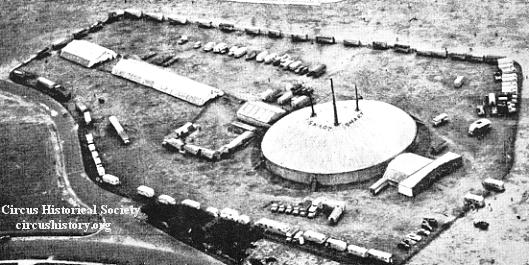
And so to happier matters. The classical Bertram Mills and the wild animal Chipperfield's having departed from our scene, we still have Billy Smart's Circus, one of the world's greatest shows, with us. This vast, gleaming circus with its spectacles "a la Ringling" and its superbly produced displays still dazes the British public, whom now automatically think of "Billy Smart" whenever "Circus" is mentioned. Smart's have adapted their circus programmes to the modern idiom. Animal acts are concentrated into three big groups; polar bears, elephants, horses and ponies, although camels, zebras, llamas, chimps and a few other animals make "walking on" appearances during the course of the show. The rest of the programme consists of three Spectacles: the Opening Parade; the Fairyland or Four Seasons Fantasies; and the Wild West Show or the Carousel of all Nations. Interspersed are big clown acts, flyers, jugglers, cyclists, wire act and the "riding machine." It will be seen that beneath all the sparkle of this show are plenty of good honest circus acts, and the mixture as presented by Billy Smart seems to appeal to the Great British Public. There are no passengers on this circus. Directors work as hard as any grooms, and the many members of the Smart family are seen in a variety of roles. Smart's circus moves by road, although elephants and led animals travel by rail. Stands vary from one to three weeks. It has been discovered that three-day stands are an uneconomic proposition.
Next in order or size are two sturdy British circuses of ancient lineage, namely Sir Robert Fossett and the Robert Brothers. Both are strong family shows and both hail from the celebrated Fossett family with bearers of that honoured name appearing in the ring in the good company of quality animal acts and a couple or so imported Continental acts. Each show carries about a half-dozen elephants, score of horses, a good wild animal act, chimpanzees, dogs or seals and the usual traditional circus acts. Either show is one which could be safely recommended to the visitor as a good example of an English family circus. Being cousins, there is a good natured rivalry between the Fossetts and the Roberts, with much "ribbing" whenever they cross each other's route.
Fossett is a name impossible to get away from when writing about English circuses. There is a circus, Fosset Bros., owned by Claude Fossett, and one, James Bros., owned by Jimmy Fossett, both small shows with less than a dozen people in each which visit the small towns, and also show at galas, country fairs, etc. A bigger Fossett Circus (the Big Top Circus) is directed by "Big" Bob Fossett, who puts on a season of circus under canvas each summer at Skegness, a seaside resort. Big Bob usually gets some good continental and British acts and has announced his intention of travelling with his circus for a few weeks prior to, and after the resident season this year.
In Ireland more Fossetts, brothers, run an extremely good circus each year. Not many animals, but always some imported acts of an extremely high standard for a one-day stand circus. I travelled with the Fossett Brothers for several weeks last summer and can testify to their enormous popularity and the unfailing big business which they always obtain. The "Big" Duffy Circus is no more to be seen in the Emerald Isle these days, but "Little" Duffy's still travel around with their boisterous family show, a very cheerful small circus worth going a long way to see.
An interesting English circus is that run by Billy Mack under ever-changing titles. This year it is "Broncho Bill and Bailey's Two Ring Circus." Like its title the programme changes often, but there is usually some good talent in the programmes presented by Mr. Billy Mack, who has been associated with circuses for a long time.
Two more small ones in the shape of Joe Gandey's International Circus, which is always a neat tidy one-pole entertainment, unpretentious but worthwhile; and Winship's Wild West Circus, which always puts on a good family programme headed by young Geoffrey Winship, who is a most talented all-rounder.
Permanent circus buildings in England comprise the Blackpool Tower and the Great Yarmouth Hippodrome. Both circuses provide excellent programmes of a classical standard in elegant settings and are amongst the world's best. Another most attractive resident circus is that run by members of the Paulo and the Thompson families at Chessington Zoo in Surrey. Some of the best riding acts to be seen in this country are always to be found in this green-and-white two-pole tented circus.
One more circus, maybe the world's smallest in the shape of Fred Abel's "One-Man" Circus. This living link with the past travels the country roads of the English midlands with his three donkeys and a few dogs and gives shows wherever he goes and whenever he feels like it. I have yet to catch up with the elusive Mr. Abel, but I am still hot on his trail.
That as I see it, is the scene set for the British Circus in 1965. What will have transpired by the end of the season is anybody's guess, but the general opinion is that like England, "there'll always be a circus."
No part of this publication may be reproduced in any form or means
Last modified February 2006.
without written permission of the author and the Circus Historical Society, Inc.