


Circus Historical Society
Bandwagon, May - June 1965
Back to Bandwagon Index
Bandwagon, Vol. 9, No. 3 (May-Jun), 1965. Note: Only some articles are included in this online edition. Many illustrations are not included. The Circus Historical Society does not guarantee the accuracy of information contained in the information in these online articles. Information should always be checked with additional sources.
Forward
This initial installment on the history of the Cole Bros. Circus begins the most ambitious project ever undertaken by the author and The Bandwagon. It is planned to cover the history of the show from its beginning in 1935 on through the 1940 season in this first series of articles. Later the story may be carried on through the final season of the show, 1950.
The list of credits for those assisting in the preparation of these articles will be long. Many members of the society have aided in the research and have provided valuable information and data from their files. Other members have loaned photographs and other illustrative matter. Those lending their aid from the beginning include Tom Scaperlanda, Gordon Potter, George Piercy, Sverre Braathen, Frank Pouska, and Fred Pfening. Outstanding showmen such as Floyd King and Arnold Maley who were in on the organization of the show and served in key positions for several years have given taped interviews during the past winter. Maley furnished several original and official documents of great historical interest which will be reproduced in these articles.
Many have expressed their enthusiasm for this series of articles and pronounce the history of the Cole show a worthy and necessary project. It is our plan that this history will be most complete. It will take a lot of space and a lot of funds to provide the engraving cuts but we hope the finished product will be worth the cost and effort gone into it.
The organization of the new Cole Bros. Circus from the ground up to a 35 car show in a matter of a few months is one of the great epics in circus history. This beautiful show which revived the street parade in all its former glory was a great favorite of the fan of that day and the vast interest it created everywhere gave more impetus to the development of circus modeling, circusiana collecting, circus history and especially the history of circus parade equipment, and even to the organized circus fan movement itself than any other single event. This is the great reason that we desire to present in this single historical document the pooled research, documentary evidence, and eyewitness accounts of many historians as well as the use of a large and varied number of photographic and other illustrations from the great collections in this country so as to preserve for posterity the authentic account of one of the great railroad circuses of the past.
The Organization of the Show
On April 20, 1935 a brand new major railroad circus opened in the Chicago Coliseum. The organization and building of this 35 car show by the late Jess Adkins and Zack Terrell from the ground up in a period of a few months was a miracle of management genius never surpassed in the annals of circus history. These two showmen took an idea and transformed it into reality in only six months. With their new Cole Bros. Circus they broke the monopoly the Ringling interests had held on railroad circuses and became the first show on rails to tour since 1931 that wasn't under the Ringling banner.
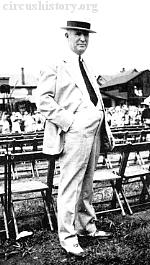
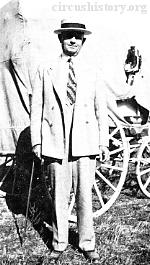
Both Adkins and Terrell were experienced showmen. They were alike in many ways but different in others. Neither had ever owned his own show before but both had held important managerial posts for others. Adkins was the organizational genius of the pair. After varied experience with many circuses he was called on by Floyd and Howard King to organize and manage for the 1926 season their new Gentry Bros. Circus. Adkins took the physical property the Kings had obtained by purchase of the Gentry-Patterson Circus in the fall of 1925 and built it into an excellent money getting 10 car rail show. Adkins is given credit for much of the success of this show in 1926 and 1927 of which he was the manager. In 1929 and 1930 Adkins managed the 25 car John Robinson Circus for the American Circus Corp. until they sold it in September 1929 and then for the new owner, John Ringling, until the show was shelved after 1930. In 1931 Adkins went over to the Hagenbeck-Wallace Circus as manager and guided that show on through the 1934 season. Adkins was a great believer in the value of the street parade and in 1934 with the approval of the Ringling owner enlarged the Hagenbeck-Wallace show to 50 cars and staged one of the largest and most colorful street parades of all time. In 1934 the show netted over $450,000 surpassing even Ringling-Barnum in profit.
Zack Terrell's experience had been mainly in management rather than in organization. He took command of shows for their owners and successfully piloted them through many winning seasons. He had managed the Sells-Floto Circus for the American Circus Corp. from 1921 until it was sold in 1929 and then continued as manager for new owner, John Ringling, until the show was taken off the road following the 1932 season. In 1934 Terrell managed a small one ring free circus at the Chicago World's Fair operated by the Standard Oil Company. This show had 3 elephants, a variety of acts and had as its feature attraction noted wild animal trainer, Allen King, who worked a mixed act of lions, tigers and leopards billed as the "Red Crown Cage of Fury." The show was all tied in with Standard's Live Power advertising theme.
As the great depression gradually eased and circus business became profitable again the idea of putting out their own show came to both of these showmen. Just when the idea hit either one of them is not definitely known but it is believed that Adkins got it when he observed the tremendous profits being gathered by the Hagenbeck-Wallace show which was being operated according to his own plans and methods. Terrell saw the nucleus for a show on hand at the Chicago Fair which would be available to help frame a new circus at the close of the fair after the 1934 season. Although both men later joined forces in a joint effort such was not the case in the beginning. It was only after certain developments that the two men got together. Each was making his own plans at first.
Adkins had developed plans during the 1934 season to frame a 20 car railroad circus with street parade as a feature to tour in 1935. Arnold Maley, who had been associated with Adkins since 1926 as a staff assistant to him, helped prepare detailed plans for a 20 car show. Maley recently gave me a copy of these outlined plans for the proposed show and it is one of the most complete documents of this nature I have ever seen. It is most complete and covers all details to the finest degree. (At a later date these plans may be published in Bandwagon to show the exactness and completeness of them.)
Adkins needed financing for his proposed show and sought out Donald Harter of the Wabash Valley Trust Company in Peru, Indiana who showed interest in the plan. This firm was the one that B. E. Wallace and later Mugivan and Bowers were interested in. Although the company did not go along with Adkins in financing his show it did later do so for Howard Y. Bary when the latter operated the Hagenbeck-Wallace show in 1937 and 1938. Floyd King says that the company had insisted on 51 percent ownership of the stock which was not acceptable to Adkins.
Meanwhile Terrell had interested A. N. Steele, advertising manager for the Standard Oil Co. of Indiana, in a proposal that Standard finance the framing of a new circus to tour in 1935 using the animals and equipment already on hand at the fair and adding what additional equipment would be necessary to put it to rolling. This proposed show was to have an advertising tie-in with Standard and the company would be in effect the "sponsor" of the show The plan was that tickets to the show would be obtained through service station dealers similar to the present day merchants tickets deals. Similar plans had worked fairly successful for smaller motorized shows during the early 30's.
According to Floyd King, Terrell paid a visit to Adkins on the Hagenbeck-Wallace lot at a stand near Pittsburgh and outlined his plans to him and proposed that the two men join forces in putting out one or more new shows for 1935. Of course Adkins already had done serious planning for his own show. Clyde Beatty had agreed to go with Adkins as the feature act in his new show and other key acts and officials had been contacted when Terrell entered the picture. Terrell already had lined up Allen King and his act. A meeting of minds on both plans took place and Adkins and Terrell agreed to merge their efforts.
The next move was to organize a company to finance and frame the now shows. It was felt that with the amount of equipment that could be obtained reasonably and fact that two top notch feature wild animal trainers were already committed that two separate shows should be framed, one a 20 car show with Adkins as manager and Clyde Beatty as feature act, and the other a 15 car show that Standard Oil would sponsor with Terrell at the head and Allen King as feature performer. Although later there was much news and speculation in the Billboard in early 1935 that the show sponsored by Standard would be a motorized show such was never in the plans. Adkins personally told Gordon Potter in 1938 that both proposed shows in 1935 were to be on rails, one on 20 cars, one on 15. (See Potter's article in Mar-Apr. 1964 Bandwagon.) At no time was a motorized show planned and it can only be assumed that the boys speculating on such things just naturally figured any show Standard Oil would sponsor would have to be motorized for advertising purposes.
The first concrete move was the organization of the Indiana Circus Corporation in the fall of 1934 and this news broke in the Oct. 13, 1934 Billboard, although at the time no details concerning the plans for the new shows were given nor were Adkins and Terrell's names mentioned. It was prudent that Adkins' name did not leak out until Hagenbeck-Wallace had closed for the season. The new corporation was to act as holding company for the new shows. Articles of Incorporation were filed with the Secretary of State of Indiana for the Indiana Circus Corporation. Incorporators were Jess L. Murden, of Peru; F. E. Schertemeier of Indianapolis; and R. A. Hendrickson of Indianapolis. Directors named were A. C. Bradley of Rochester and Indianapolis; Jess Murden, and Schortemeier. It was not until the appearance of the Nov. 24, 1934 Billboard was it announced that Terrell was president and Adkins treasurer of the new corporation.
Adkins and Terrell very wisely had associated themselves with several very prominent Indiana citizens in launching the new show. Schortemeier, formerly the Secretary of State for Indiana, was a prominent attorney and did the legal work in organizing the new corporation. Jess Murden was formerly Highway Commissioner for the State of Indiana and was prominent in business and financial circles in the state. He and Adkins had been very close personal friends for years and it was in Murden that Adkins first confided his desire to organize a new major circus and asked Murden to aid him in framing and financing the show.
A. C. Bradley of Rochester, Ind. had long been a good friend of Terrell and owned the Ford agency in Rochester and was president of the local bank. He also owned numerous farms around Rochester as we'll as a nearby lake resort and operated a food brokerage establishment in Indianapolis. So in Schortemeier, Murden, and Bradley, Adkins and Terrell had excellent associates to aid them in establishing their new show.
In November the new firm purchased for winter quarters the land and buildings of the Rochester Bridge Company in Rochester, Ind. The Billboard said some 52 acres adjoining the buildings were included in the deal. The site was located in the section of town where the Erie and Nickel Plate railroads crossed. The site was just north of the east-west tracks and just west of the north-south tracks. Sufficient trackage adjoined the site to be used for rail car storage until sidings on the property itself could be built. The property included three large foundry buildings, two were each 250 ft. long and a third 180 x 60, and a two story brick office building. Possession of the new quarters took place immediately and a force of men were put to work putting them into shape. The Nov. 24, 1934 Billboard described how the buildings were being used stating that the second floor of the office building was being fitted up as sleeping quarters for employees while the first floor contained the offices, dining room, and kitchen. The large foundry building at the cast end of the grounds was being fitted to house cats, elephants, seals, hippo, and various other wild animals. Adjoining the north end of the building a large training arena was to be built. In the large building west of the main animal building will be located the blacksmith shop, wagon repair dept., painting shop, etc., and the west section will be quarters for the ring stock. Three large training rings were to be constructed. It was claimed then that a number of lions, tigers, and elephants were already on hand. A number of baggage stock and ponies had been acquired and were quartered at one of A. C. Bradley's farms nearby. Through the years the show's baggage stock was kept at the farm during the winter months.
As mentioned earlier Adkins had been unsuccessful in getting the Wabash Valley Trust Co. in Peru to provide financing. In the meantime the new corporation contacted the Harris Bank and Trust Co. of Chicago to negotiate a loan. Mr. Harris, the founder of the bank, had once handled the investments of the late Charles Ringling and was very friendly toward circuses. Although the bank itself ordinarily did not make loans to circuses Mr. Harris seemed interested in the proposition and gave serious consideration to making loan from his personal funds although did not go through with it. The Harris Bank's Board of Directors also turned down the loan request stating they could not comply with the loan regulations of the Federal Reserve or the state banking department as far as security. Prior to contacting the bank the show prepared a financial prospectus outlining plans for the new show. Arnold Maley very kindly gave us a copy of this original document as it had been prepared for submission to the bank. I asked Mr. Maley if the figures on the brochure as to number of seats, admission to be charged, estimated income and expenses could be considered to be accurate and he replied they were 99 percent accurate in accordance with the plans for the show. This brochure is printed herewith.
Cole Bros. Circus with Clyde Beatty, Greatest Wild Animal Trainer of All Time
General Offices and Winter Quarters, Rochester, Indiana
Zack Terrell, President; Jess Adkins, Treasurer
Indiana Circus Corporation Presenting Cole Bros. Circus. Featuring Clyde Beatty, Allen King
Estimated Income and Expenses
26 Lengths Grand Stand seats 12 high - 2808 Chairs 32 Lengths Blue seats 15 High - 2880 [total] 5688
70% Adults, 3981 Admissions @ .68 - $2707.00
30% Children, 1707 Admissions @ .25 - 426.75
2808 Chairs @ .50 - 1404.00
Capacity receipts in one performance - $4537.75
Capacity in two performances - $9075.50
Average Daily Side Show receipts - 300.00
Average daily concert receipts - 100.00
Average daily profit on candy stands - 200.00
[total] $9675.50
A circus season is ordinarily figured as 180 days. Capacity receipts on 180 days as per above - $1,741,590.00 Estimated operating cost of a twenty-five car show during the road season, including a reserve set up for wintering, would be approximately $3100.00 per day, making the total gross expense - 558,000.00
Based on a capacity business each day there would be a possible net profit for the season of - $1,183,590.00
NOW, if show only did one half capacity - $870,795.00
Expense the same - 558,000.00
Profit on Half Capacity Business - $312,795.00
Personnel
Mr. Zack Terrell, President of our Corporation has been actively engaged in the circus business the past thirty years. Was Manager of the Sells-Floto Circus from 1921 up until 1934 when same was taken off the road by the Ringling interests.
Mr. Jess Adkins, Treasurer, has been in the circus business the past twenty-nine years. Was Manager of the John Robinson Circus until this circus was retired by the Ringling interests at the close of the season of 1930, and has been Manager of the Hagenbeck-Wallace Circus since 1931 up to and including 1934, when he resigned to become a part of the Indiana Circus Corporation. Mr. Adkins took the Hagenbeck-Wallace Circus in 1931 as a 30 car show and built it up to a 50 car show in 1934.
Mr. E. Fred Schortemier, Secretary, is now a prominent attorney in Indianapolis, Indiana, with offices in the Circle Tower Building. He has handled all matters pertaining to the organization of the Indiana Circus Corporation in accordance with all Federal and State laws governing such a Corporation.
Exclusive Attractive Features
Mr. Clyde Beatty, greatest wild animal trainer of all time, is under contract for the season of 1935. During the season of 1933 the Hagenbeck Wallace Circus, with whom Clyde Beatty was the star, had a very profitable season. The same is also true of the circus season of 1934. It is a known fact that the drawing power of Clyde Beatty was largely responsible for the business done by the Hagenbeck Wallace Circus during the two seasons just past.
Mr. Allen King, Star of the Standard Oil Live Power Show at the World's Fair, Chicago, during the season of 1934, is also under contract for season of 1935. It is estimated that seven million people attended the Live Power Show in Chicago during the past season of 1934; so that Allen King is as well, or better, known in the Central States than any Circus star that has ever appeared in this territory, while Clyde Beatty is a Nationally known star in the circus world. In this combination we have the greatest outstanding circus stars in America today.
We have at the present time contracts to furnish acts, props, etc., to the Shrine Circus, Grand Rapids; Moslem Shrine Circus, Detroit; Grotto Circus, Cleveland, Ohio; Elks Circus, Omaha, Neb., and to the Shrine Circus, Denver, Colo., the total amount of these bookings showing a net profit of about twenty thousand dollars.
We have contracted for our opening April 20th, Chicago, Illinois, the Coliseum Building. Our engagement there being for sixteen days. The Hagenbeck Wallace Circus during the spring of 1934 for a like period, with no outstanding star, with the exception of Mr. Beatty for the last seven days, showed a net profit of about forty thousand dollars. The Manager of the Coliseum, Mr. Charles Hall, states with the improved business conditions now existing in Chicago that we should, with our star attractions, show a profit of at least fifty thousand dollars.
The above Outstanding amusement features and the very desirable bookings are exclusive with the Indiana Circus Corporation for this season.
Conservative Reasons for Success
During the season of 1929, just five years ago, there were in operation in the, United States a total of twelve railroad shows. Last year, 1933, there were but three railroad circuses in this country, the Ringling Bros. Barnum & Bailey, the Hagenbeck Wallace, and Al. G. Barnes. In the fall of 1929 the Ringling Bros., purchased the American Circus Corporation comprising the Sells Floto Circus, The Hagenbeck Wallace Circus, the Al. G. Barnes Circus, the John Robinson Circus and the Chas. Sparks Circus. The Ringlings have since retired the Sells Floto, Sparks and John Robinson Circus. Thereby reducing the total number to three circuses in the United States. It will readily be seen that the territory for a new circus is unlimited.
Circuses have enjoyed a profitable business during the years of the present depression and with every indication toward improved business conditions it is most certain that these will reflect in a greater profit to a properly managed and attractively featured circus such as this.
With the prospects we have for business and success the coming season, two of the greatest circus stars in America today, Mr. Clyde Beatty and Mr. Allen King, the winter circus bookings which will net us around twenty thousand dollars; the contract for opening in the Coliseum Building, Chicago, for sixteen days, which engagement should show a profit of about fifty thousand dollars; the immense territory open for a new circus of the size we are building, made possible by the taking off the road of nine railroad circuses during the past five years; the fact that general business conditions have greatly improved within the past few months, we are confident and feel conservative in our statement that any investment in our corporation will show a net return of twenty per cent to the investor.
After Harris turned down the loan application it was then decided to submit the brochure to the general public for a stock subscription sale but upon examination by government officials the stock sale was not permitted as federal securities regulations could not be met.
It was finally through Jess Murden's influence that adequate financing was secured. Murden's friend, a Mr. Norris, head of the Associates Investment Co. of South Bend had his company make sufficient financing available to launch the new show taking as security a chattel mortgage on the equipment to be purchased. Arnold Maley mentions fact however that the large amount of funds expended to repair the newly purchased equipment and last minute expenses before the show's scheduled opening in April made it necessary for Adkins and Terrell to make an additional loan from A. C. Bradley's bank in Rochester in order to get the show rolling.
The use of the Cole Bros. title for the new show is an interesting story. At first no title had been selected and the name Indiana Circus Corp. was painted on the signs at the new quarters buildings in Rochester and on all documents. The show's first letterhead had printed on it, "Jess Adkins and Zack Terrell's Amusement Enterprises". Floyd King, who had been press agent on the Ringling owned Al G. Barnes Circus in 1934, arrived in Rochester on Christmas Day in 1934 to become the show's general agent. King says when he arrived that no title had been definitely decided on although the name Cole had been used in various Billboard releases back in November. King said several titles were being thought over. Murden wanted to use the title of "Adkins & Terrell" but that idea was discarded. As the discussion continued King finally told them that in his opinion the show should use the title of Cole Bros. World Toured Circus. Terrell said, "Why that show has played every 2 car town in the U.S." but King reminded him that with a large circus you won't be playing two car towns and further reminded him that the title of Cole had made a fortune for two people, W. W. Cole, and Martin Downs. King said the owners then decided to use the Cole title. Martin Downs who had secured the title from W. W. Cole back in 1906 had used it through 1909. Since then a number of others including Floyd King himself had used the Cole title on the road. Terrell went to see a son-in-law of the late Martin Downs in Toronto about use of the title because of the new show's size and importance they wanted to make sure they had a clear use to it. Down's son-in-law, his wife, and another sister gave Mr. Terrell permission for use of the Cole title.
King says another interesting development occurred a little later when the official word on use of the Cole title was out. A letter was received from John Pluto saying that the title belonged to him and warning the owners not to use the title without his permission. Back in the 20's Pluto had purchased some equipment from Elmer Jones, who had also used the Cole title on a 2 car show for some years. As the deal was being consummated in Hot Springs, Pluto told Jones that he also wanted the Cole title. Pluto had been connected with Martin Downs in earlier years and knew the value of the Cole title. Jones later related the incident to King and said that he knew he didn't own the title to sell but that he wasn't going to let Pluto get out of Hot Springs with all that money so he "threw in the title" in the deal. Pluto must have been convinced that Adkins and Terrell now had clear use to the title as no more heat developed.
Beginning in November 1934 new purchases of animals and equipment began arriving in Rochester. Coming from the Chicago Fair's Standard Oil Circus that Terrell had managed in 1934 were three elephants, Tony, Big Katie, and June, the first to arrive. The three elephants had been purchased by Terrell from the Hall Farm in January 1934. Adkins, incidentally, had accompanied Terrell to Lancaster to buy them and helped him pick them out. Also coming from the Fair show were Allen King and his wild animal act consisting of about a dozen lions, tigers, and leopards. In November all of the animals of the Birmingham, Ala. Zoo were purchased for $750.00, a real bargain. Animals included bears, leopards, tiger, and an elephant named "Bamma" as well as some smaller beasts. A shipment of sea lions came from San Diego and 22 ponies were purchased from the Cooper Pony Farm at Kankakee, Ill. A large male lion was purchased from the Philadelphia zoo.
A major problem was the necessity for quick acquisition and breaking of new animals for Clyde Beatty's act. Animals used by Beatty in his big mixed act on Hagenbeck-Wallace were of course owned by that show so he had to start from scratch in acquiring new animals and rebuilding an act. Two tigers came from Frank Buck in New York and sufficient lions and tigers were purchased elsewhere. Beatty's finished act used somewhat fewer animals than his giant act on Hagenbeck-Wallace but still he had about 20 lions and 5 tigers available before the end of the 1935 season.
The new show felt it necessary to have some sort of revenue coming in as quickly as possible so a number of winter dates at Shrine and other indoor circuses were contracted. New acts were put together rapidly. Jorgen Christiansen, famed trainer of horses, was signed and he put together a liberty act. High school horses, dog and pony drills, trained sea lions, high jumping horses, and later Beatty's wild animal act became the nucleus of the acts the show placed at the winter shows.
From the beginning the Standard Oil Co. of Indiana's plan to sponsor a circus for Terrell was somewhat confusing. Actually Al Steele, the company's advertising manager was the man behind it all and it seems he let his enthusiasm get the best of him by making plans for the show before securing approval of the Board of Directors. Mr. Steele was very circus minded and had a complete miniature circus with tents, seats, wagons and all set up in a room in the Standard Oil building on Michigan Avenue in Chicago. Floyd King says that Steele contacted the directors one by one and tried to sell them on the circus sponsorship deal. Steele felt it would be a great publicity deal. The free circus tickets to be given by gasoline dealers with purchases of certain amounts of fuel would be beneficial to both the company and the circus. Some reports have it that all directors were sold on the idea with exception of one who killed the deal. Other reports claim the directors had no idea at all that any such plans for a sponsored circus were being made and killed the idea at once upon being informed about it. Anyway, Steele's dream of a new show fell through but the final word didn't reach Adkins and Terrell until way into the winter after most of the large equipment purchases had already been made.
Some idea of the confusion about the Standard Oil show can be given by excerpts from the following article that appeared in the Jan. 26, 1935 Billboard.
"Standard Oil Show Likely - but it will not be the 'Live Power Circus' a company official stated." Extensive activity at winter quarters of the Cole show leads visitors to believe there will be a truck circus in addition to a rail show going out of Rochester, Ind. this spring.
"Standard Oil of Indiana will probably put out a circus according to Al Steele, advertising manager of the company. Rumors to this effect have been around for some time. It seems certain Allen King, animal trainer, would be the feature act of this show. Zack Terrell spiked rumors lately on the Standard Oil show but there is too much activity and the amount of equipment indicates two shows are going out of Rochester, one on rails, the other motorized. It is extremely unlikely both Beatty and King would be used on the same show for obvious reasons.
"A release sent out by Conger Reynolds, director of public relations dept. of Standard stated, 'Two recent reports in the trade press that Standard Oil Co. (Indiana) is going to tour a three ring circus over the Middle West this spring and summer as part of its 'Live Power' advertising campaign are entirely unauthorized and without foundation. A. N. Steele, the company's advertising manager stated, "The origin of these reports is a source of mystery". Mr. Steele declared, "for no one connected in any capacity with the company was consulted about them before their publication. They are entirely unwarranted. No plans are underway for such a circus at present nor have negotiations of any sort been conducted."
Finally all rumors about a second show died out, and it became evident no Standard Oil show would be launched and only one show would go from Rochester. However for the record let it be said that two shows were most definitely planned in the beginning, one to go on 20 cars, the other on 15. Had not Adkins believed the Standard Oil deal would consummate probably only his originally planned 20 car show would have gone out in 1935 and the large amount of equipment would have never been purchased. It was in late Spring 1935 when it was finally decided to utilize most of the equipment already on hand and to go out with a large 35 car show.
The Rochester quarters were quickly made ready to receive the new equipment. Fred A. Seymour, formerly with Miller Bros. 101 Ranch Wild West Show, was placed in charge of all construction. An 80 ft. wide concrete road was built from State Highway 31 running directly to the quarters to aid the traffic flow. J. P. McGrath was named trainmaster and was placed in charge of readying all rail equipment; Jim Brady was in charge of the blacksmith shop; Charlie Luckie, the carpenter shop; and Vic Peralta, the paint shop. These department heads were soon to have before them one of the greatest tasks ever presented anyone in their line of work. A force of 180 men would be at work in the quarters by early Spring.
In December 1934 the new show made its first major purchase of equipment. Adkins and Terrell went to Lancaster, Mo. and purchased from the Estate of the late William P. Hall, 15 cars of equipment of the Robbins Bros. Circus that Fred Buchanan had last toured in 1931. Hall, who held a chattel mortgage on the equipment had it stored at his place in Lancaster after the show folded in 1931. Equipment purchased by Cole included 15 railroad cars which consisted of 5 all steel Mt. Vernon built flat cars; an elephant car, two stock cars, and 7 coaches. The 7 coaches included the 5 sleepers that were on the road in 1931, the advance car and an open end observation type sleeper named "Rover". The last two cars were on the road in 1930 but did not tour in 1931. "Rover" was Fred Buchanan's private car and was said to have been originally used by President Theodore Roosevelt. At least one system flat car was needed to help move all of the Robbins wagons to Rochester. All of the cages, baggage wagons, and tableau wagons Robbins had used in 1931 were present with exception of the steam calliope which had been sold by Hall to R. J. Reynolds in 1934. Also included were a few wagons that Robbins had used in 1930 but had not carried on the road in 1931 due to train being cut from 20 to 15 cars for the final season. Animals included 6 elephants, 5 camels, a group of high school horses, zebras, and a sacred cow. The train arrived in Rochester about December 20. The late Bill Woodcock was in Lancaster at the time and photographed the train as it was being loaded for Rochester on a cold day with snow on the ground. No detailed equipment list of the purchase is available but an estimate would say in addition to the parade wagons there were about 7 cages and 20 baggage wagons or about 35 vehicles in all.
Later in the season more elephants and other equipment would be purchased from the Hall family. Arnold Maley says he doesn't recall just how much was paid for the Hall equipment but does recall some of the elephants were priced at $1,000.00 each.
The show acquired a major menagerie attraction by the purchase of a huge African elephant from the Detroit zoo. The elephant's name was Safari but was quickly changed to Jumbo II for publicity purposes.
In January the show purchased the 5 elephants commonly known as the 101 Ranch Elephants from the trustees of the Ranch. This group of 5 included females Big Babe, Carrie, Louie, and Jean, and one male, Joe. After the 101 Ranch Show closed in 1931 the elephants were rented or leased out to various shows. In 1934 they had been on Ray Rogers' Barnett Bros. Circus and were quartered with that show in York, S.C. when Eddie Allen, who had been engaged as Cole's supt. of elephants went to get them.
Another elephant named Moton was purchased from Black's Trained Animal Show and its name was changed to Barney. By opening day Cole had a total of 17 elephants in the herd, 16 Indians and 1 African. The names of the first 6 elephants purchased from Hall with the Robbins equipment are not known; however, before the year was over, a total of 17 elephants would be purchased from Hall. A complete list of the entire 17 that came from Hall will be printed elsewhere in this article. The first 6 that arrived were of course part of the group.
The Jan. 5, 1935 Billboard stated that Cole had obtained the Chicago Nipple Co. building in Rochester which was located adjacent to the Nickel Plate Railroad tracks for use as a camel and elephant barn. This building was about 2 or 3 blocks south of the main quarters. A small wooden building adjacent to the large one was used for the wardrobe department. The show used these buildings for two winters and then after additional structures were erected at the main part of the quarters this location was abandoned and everything was centered at the main quarters. A special section of this series of articles will deal with the winter quarters using a diagram showing buildings and rail sidings and a complete description of all structures, old and newly added, will be given.
By mid-January the full title of the show was lengthened to read "Cole Bros. World Toured Circus and Clyde Beatty's Gigantic Trained Animal Exhibition"
Top notch staff members and department heads were being signed almost daily. H. J. McFarland came on as equestrian director and Robert E. Hickey signed as general press representative. Other press men included Ora Parks, Rex de Rosselli, and Earl DeGlopper, all experienced veterans.
The winter show was now ready to go and left for the Canton, Ohio Shrine Circus which had been signed as the first of the stands. Following Canton the unit was to go to Grand Rapids, Mich.; Detroit Shrine Circus, Cleveland Grotto Circus and several other dates. Acts included for the first date were Jorgen Christiansen's Arabian stallions, the show's performing elephants directed by Eddie Allen, 3 sea lion acts in charge of Ernest Firth, and Harry McFarland's ponies and dogs. Clyde Beatty's new cat act made it's debut Feb. 4 at the Detroit Shrine Circus.
New animals arriving in Rochester in February included a shipment of goats from San Angelo, Texas and 6 additional sea lions from Los Angeles.
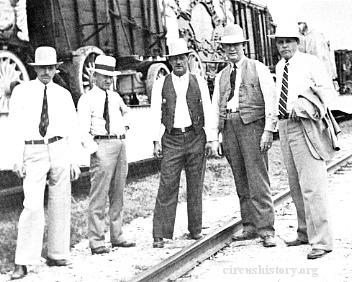 Photo No. 9, Christy equipment train all loaded and ready to roll to Rochester. George W. Christy, holding coat, is at right with Jess Adkins next to him and other members of their staffs. Tom Scaperlanda Photo.
The Feb. 16, 1935 Billboard announced another large purchase of equipment. Adkins, accompanied by trainmaster, P. A. McGrath, went to South Houston, Texas and purchased from George W. Christy six Mt. Vernon flat cars, a steel Mt. Vernon stock car, and 40 wagons, including bandwagons, tableaux wagons, cages, air calliope, steam calliope, two tractors, and baggage wagons that had been formerly used on the Christy Bros. Circus. The equipment had been stored at the show's winter quarters in South Houston since the show went off the road in July 1930. Arnold Maley has furnished us with the official descriptive list of the Christy property. This list was prepared describing each vehicle in detail and was later attached and made part of the bill of sale. This is one of the most remarkable official documents ever made available to historians and for the vast interest it is sure to create the document is printed here in its entirety.
Christy Show Property
Baggage Wagons
Electric Light Wagon
Extra well built high inside steel lined floor both sides open half up for awning half down for work platform has new eight inch tired wheels and new axles - screw brakes.
Pole Wagon
Eight inch wheels, screw brakes, extra well ironed, thru-out center pole hooks on outside to allow loading, International or Fordson tractor between poles on flats. Has outside racks for menagerie and side show poles.
Canvas Wagon
Extra wide and extra low drop bottom. Eight inch wheels. Screw brakes. Equipped with canvas leader, steel boom type.
Water Wagon
Wood body with steel invisible tank built in so load pots, boilers, seat jacks etc. - on top new six inch wheels. Is now loaded with set of cookhouse jacks, tables, etc. Has table racks on each side. All like new.
Cook House Wagon
Has large ice box on front end. Six or eight inch tires. Stove pipe racks on side, drop bottom type, very roomy, screw brakes and tin roof.
Dog Wagon
Three tiers of dog kennels bottoms for large dogs, six inch wheels (new) next two for smaller dogs and monkeys. About sixteen feet long. Center tunnell downstairs for goats or very large dogs, or baby Ponies, upstairs for greyhounds. Sides equipped with platforms to stand on when removing dogs. And this is also used to load dog kennels. Kennels go with wagon 4 ft. x 12 ft. wire pens specially built for use with doors and heavy frames.
Stringer Wagon
A great wagon with eight inch new wheels, three and half inch axles, screw brakes, part of sides removed for unloading. About 26 ft. long.
Blacksmith Shop and Stable Wagon
Front end equipped for blacksmith on one side, and harness maker on other side. Back end for stables. Hauled two 30 x 60 ft. horse tops and equipment. Eight inch wheels, screw brakes, drag shoes.
Plank Wagon
Six inch new wheels. Top had half moon iron sides equipped to load ring curbs.
Plank Wagon #2
Same as No. 1 (Number one) wagon.
Property Wagon
Large drop tail gate with chain. Screw brakes eight inch wheels. Sides equipped with steel arena loading arrangement.
Jack Wagon
Built like prop wagon drop end tail gate, large roomy wagon built high. (All property wagons same height.) Account want to look uniform on train. Ring curbs on side. Loads.
Menagerie Wagon (Canvas Wagon)
Eight inch drop bottom very roomy wagon arena loads on side or all hay animals pens from menagerie.
Tractors
Bulldog Mack Truck Tractors
Built short so load pole wagon, light wagon stake and chain Mack Truck and Fordson Tractor or one cross cage between pole on last flat, Has nearly all new tires. Needs nothing but gas to go - hardly necessary to paint it. Equipped with pat. spring coupler that fits all wagons.
Fordson Tractor with Coupler
Equipped with coupler to haul wagons, has heavy rubber tired wheels. This is the only piece of property that needs any repairs - must be overhauled.
Stake & Chain Wagon
Eight inch tired new wheels. Screw brakes drop bottom low wagon. Very modern looking wagon. Side pole racks on sides takes all side poles for 120 ft. R. T. with 5 forties. Set heavy oak chocks for all wagons. Set of train plates. Pull up cable. Snatch block. New Snub rope. Run Jacks. Steel runs.
Tableaux Wagons
America - Eighteen foot. Mass of carvings very flashy. Formerly Ringling Brothers. Our standard gear pole screw brake coupler.
Asia - Mate to America - Ringling Bros. All sills are semi-steel that is an angle iron bound along wooden sills. Has our standard gear-fifth wheel screw brake.
Columbia - Mammoth wagon over twenty ft. gorgeous carvings extra high riser boards, our gear screw brakes - Ringling wagon.
Lion Tableaux
Twenty feet, our type wheels and axles, our gear and pole screw brake. Very deep heavy carvings. Ringling Bros. No. 1 Band Wagon. Chas. Ringling paid $2000.00 for this wagon and then we built new gear and new axles, and wheels cost $442.00.
Brown Tableaux
Extra high roomy trunk wagon, nice carvings, new wheels and axles, screw brake, etc. We used for clown band wagon, about 16 feet. Ringling wagon.
Steam Calliope
Think it is 32 whistle, with boiler key board, complete to play, nicely carved wagon, and screw brakes.
Air Calliope
Beautifully carved wagon about 12 feet has life size images on corners, center panel now closed and picture painted on it to use as small trunk or musicians wagon. Screw brake, etc. Ringling wagon.
Yellow Tableaux Wagon - Drop bottom type, very roomy trunk wagon.
Cages
All cages, tableaus, and baggage wagons are equipped with the same size pole gears and fifth wheels.
All baggage wagon wheels are alike and fit any wagon.
All cage wheels are alike except one, I think.
All the new tableaux wheels are alike also.
All the nuts on any baggage wagon fit any baggage wagon.
All tableaux wagons except one have good canvas covers, look alike.
Paint very good on all wagons right now.
Six cross cages, for ponies, all complete, no repairs needed.
Ten Christy arena cages, 12 feet 6 inches, carved riser boards and corners, all alike each with chute door to arena tunnell, five load on one flat built to load close without rubbing tunnells to protect them. Each has screw brake all alike, each has same fifth wheel and gear all alike, any pole fits any cage. Wheels are all uniform, axles all same, wheels are practically new, all sunbursted and do not need painting for this season. Three of these cages have tunnell thru them for spotting next to arena to handle next animal group. All bars are built fool proof, so animals cannot get paws thru to claw patrons. Spaced close. Positively not one cent to spend on any of these cages for any kind of repairs, they are ready to parade after washing with soda. Each cage has a one inch mesh cast iron ventilator window at each side in back end hot bars. Animal cannot scratch thru them when kids climb up to look in. Also big ventilator and light dome in roof of each. All equipped with flag holders, all poles are ironed from one end to other. All have trailing iron and goose necks. Each cage has three compartments.
Ringling hay animal cage with massive carvings. Now in cat animal building.
Ticket Wagon
Original Christy show three window ticket wagon with new eight inch wheels, steel hub, and bronze boxings, screw, brakes, side door split in center with counter. Front half used for candy stand has door to lock. Independent from ticket wagon end. All ticket racks money drawers. Wash room with toilet and ice cooler. Wired for lights very low and convenient wagon, the three windows are in the end and wagon is very wide drop bottom type. Screened in cage. Axles new and standard with all other big wagons on show, also gear and center plates all alike.
Harness
Six steel seventy foot Mt. Vernon flat cars - Double fish belly.
One seventy foot Mt. Vernon baggage stock car steel.
About fifty sets heavy baggage harness, every set complete with collars.
About thirty sets pony harness all complete except five bridles short, collars for all above harness.
Animals
Two Persian leopards. Two spotted hyenas. One puma.
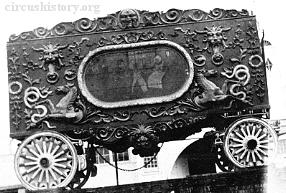
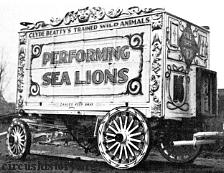
Tom Scaperlanda was present in South Houston when the property was loaded out and shipped to Rochester and very wisely recorded on film this important transaction. Several of Tom's photos are used in this article.
The Christy property needed at least one, maybe more, system flats in addition to the 6 show owned flats to help transport it back to Rochester. The train traveled over the Missouri Pacific to St. Louis and then the Nickel Plate to Rochester.
A total of nine coaches were purchased by the show to use in the 1935 train. These were other than those that came from Robbins. None of the sleepers coming from Robbins were used in the train. Four of them had their wheels removed and the interiors stripped and were placed on the quarters grounds where they were used for storage of grandstand chairs, seat jacks, and planks. What happened to the other Robbins sleeper, the Rover car, and advertising car is not definitely known. Gordon Potter says they were gone from Rochester by the time he made his first visit there in March 1935. Perhaps they were traded in to Hotchkiss-Blue Co. of Chicago when Cole purchased four sleepers from the firm in February. All of the cast iron wheels on the four sleepers received were replaced by steel discs. Additional sleepers were purchased from the Nickel Plate and Monon railroads. All of the show's 9 sleeping cars were fairly modern vestibule type cars of semi-steel construction. All were equipped with the supporting truss rods typical of wooden cars. The March 9 Billboard said that the arrival of 4 new sleepers had practically completed the train equipment.
The Feb. 23 Billboard carried an ad that the show wanted to purchase 4 Mt. Vernon 70 ft. flat cars, also an air calliope and unifon instrument in good condition. As the show already had on hand 11 flat cars (5 from Robbins, 6 from Christy) this ad wanting 4 more indicated the show planned to use a total of 15 flats in the train, This number corresponds with the 15 shown in the official planned train load order printed in this article.
The show advertised for sale in the March 16 Billboard two 1926 model Pierce-Arrow trucks each with 20 ft. bodies fully equipped for moving horses or elephants. These trucks are believed to have been part of the equipment coming from the Chicago Fair circus.
Rex de Rosselli produced the opening spec to be used in 1935. He titled it Serenade of Spain and designed all of the wardrobe, some of which came from New York, but most of it made at the show's quarters. Parade and other wardrobe was also made in the quarters' shops. Vic Robbins was signed as musical director and composed some special music for the spec.
Allen King worked daily in the spring months perfecting his act which now contained lions, tigers, pumas, leopards, and black leopards. He had a real fight on his hands one day when a black leopard attacked a new tiger being worked into the act. Another leopard also got into the fight and all three animals were injured.
Clyde Beatty had put together his act very rapidly so it could go with the winter unit. He gradually added more cats as they were acquired and broken. By early April he had added 8 more male lions and 2 tigers.
Lou Delmore was named sideshow manager and began lining up attractions. In February he announced he had purchased $1,000.00 worth of beautiful velvet for stage covers, draperies, and curtains to beautify the interior of the sideshow.
During the winter complete new seating for the big top was built at quarters. Reserves using grandstand chairs were constructed 12 high for the long and short sides and the blues were 15 high at both ends. An outstanding feature of the blues was the comfortable foot rests with which all were equipped. This was quite an innovation and Cole used them only for the 1935 season, then discarded them in 1936 and following seasons but, while they were in use, they brought raves from the customers in the blues.
New baggage stock, ring horses, and ponies were arriving all the time and the March 23 Billboard said that the show had 100 head quartered at a farm (A. C. Bradley's) one mile from the main quarters. Roland "Blackie" Diller was signed as boss hostler.
The new show contracted for a beautiful line of paper from Erie Lithograph & Printing Co. and Enquirer Job Print Co. The show claimed more than 70 lithograph bills of various sizes and designs featuring stock and special paper were ordered. The contract for a colorful souvenir magazine and program was given to the Louisville Color Gravure Co. The Cuneo Press of Chicago was given an order for one million couriers to be distributed free during the season. This was a beautiful 24 page publication printed in 3 colors with plenty of gold leaf in evidence. The courier had the Floyd King touch to it and was as attractive as any ever printed. It was filled with photos, many of the large Hagenbeck-Wallace show of 1934 with the Cole title dubbed in, as well as regular press publicity type shots. The show put up a great amount of outdoor advertising throughout the season and newspaper advertising featuring several well decorative cuts was liberal.
In early April the last of the large equipment purchases was made. The April 20 Billboard revealed that the show had recently purchased an all steel advance car and 25 baggage wagons together with considerable miscellaneous equipment from the Miller Bros. 101 Ranch Wild West Show property stored at Ponca City, Okla. The Billboard did not say whether or not any Ranch flat cars were included in the deal. I asked Arnold Maley about it and he said he didn't recall too much about the equipment the show got from the Ranch but did remember that the show had been negotiating with the trustees of the ranch for some time to purchase some. Maley said he thought about 5 flat cars came from the Ranch but was not positive. He remembered mainly about getting the 5 elephants the Ranch owned and said that about $10,000 was paid for the elephants and equipment.
After it became certain that Standard Oil did not intend to sponsor a circus for Adkins and Terrell it was decided to shelve the idea of two smaller shows and to go with a single large 35 car show. A big top already ordered from U. S. Tent & Awning Co. was only a 145 ft. round with three 50's which would evidently be too small for a 35 car show but at the time of the order it was anticipated the top would be used for the planned 20 car show. It was impossible to change the order at this late date.
The 35 car train consisted of 1 advance, 9 stocks, 16 flats, and 9 coaches. I feel quite certain that only 15 flats were planned at first as the official train load list shows only 15. The 16th flat was added at the last moment, either just before the show left Rochester or a day or so later on the road after the canvas opening. Photos taken at the third stand at Covington, Ky. where the CFA held its annual convention with the new show that year picture on an adjacent track next to Cole lettered flat cars a Warren built flat car with just enough of the title showing to see that it is Brundage Shows, a rail carnival on the road a few seasons earlier. It is believed that this flat was either added to the Cole train at Covington or at Rochester at a date too late to have it painted and lettered with the Cole title.
The advance car was all steel and painted red with white lettering and had a large white band running the length of the car. Its origin is not certain but assuming the Billboard article is correct then perhaps it did come from the Ranch show. Some have speculated if the Ranch in 1931 had that modern an advance car. Gordon Potter once visited the interior of the car and it appeared to him to have seen use as an advance car before.
The 9 stock cars were numbered 40, 41, 42, 43, 44, 45, 46, 47, and 48. Car No. 42 from Christy Bros., and No. 43, from Robbins Bros. were used for elephants, and the rest were for ring, baggage, and other lead stock. Two of the other stock cars of course came from Robbins but origin of the others is not known. Color scheme for the stocks was aluminum with title in gold on a red letter board. All stocks appear to have been built by Mt. Vernon.
The 16 flat cars were numbered 51, 52, 53, 54, 55, 56, 57, 58, 59, 60, 61, 62, 63, 64, 66, and 69. Numbers 66 and 69 were built by the Warren Tank Car Co. and the rest by Mt. Vernon Car Mfg. Co. Of the 14 Mt. Vernon flats we know that 6 came from Christy, and 5 from Robbins Bros. and the remaining 3 probably from the 101 Ranch Wild West Show. Gordon Potter who furnished us most of the train data we are using doubts that more than 3 came from the Ranch because if so the show would probably have used all 16 of the matching Mt. Vernon flats rather than 14 Mt. Vernons and 2 Warrens. One of the Warren flats is believed to have come from the Brundage Shows and source of the other is unknown but probably it was from some carnival. One of the Mt. Vernon flats from Christy was of the old style design the firm used only for a short time about 1920 with the bottom profile straight across as the top rather than the more familiar later "pot bellied" design. Flat cars were painted aluminum and lettered in bronze blue (a dark shade) shaded in orange. Both flats and stocks were lettered "Cole Bros. World Toured Circus with Clyde Beatty and Allen King."
The 9 coaches were numbered and titled as follows: 70, Memphis; 71, Chicago; 72, New York; 73, Buffalo; 74, Boston; 75, Cincinnati; 76, St. Louis; 77, Rochester; and 78, Detroit. They were painted red and lettered in gold, "Cole Bros. World Toured Circus with Clyde Beatty and Allen King." The spacing between the car windows was painted in a cream color and this band ran completely across the side of the car. All cars appear to be of the wooden semi-steel variety with supporting truss rods.
Biggest task for the quarters' blacksmith, carpenter, and paint shops was the repair and painting of the baggage wagons, parade vehicles, and cages. A selection of the wagons to be used had to be made at first. About 75 pieces of all type rolling equipment were carried out of about a hundred available. Of the major acquisitions from Christy, Robbins, and 101 Ranch some wagons were never used, some not put into use until one or more years later, some were dismantled with parts going into other vehicles, while the others selected to be used were fixed up with as little repair work as necessary, given a fresh coat of paint and put on the road with the show for the 1935 season. Some of the painting was still going on the night before the canvas show was to open in Rochester. The indoor unit to open in Chicago on April 20 was readied first and the additional wagons to be used with the canvas show after that. Especially was there a rush to finish the Ranch wagons which arrived late on the scene. It must be remembered that although Christy, Robbins, and 101 had very fine equipment all of these wagons had been idle for several years. The Christy equipment hadn't rolled since an early closing in July 1930 and both Robbins and 101 Ranch closed following the 1931 season. Many of the wagons were rusty and had a lot of dry rot in them. Their generally poor condition caused a lot of headaches that first season and it wasn't until the following winter that they were all really given a thorough overhaul. Some of the wagons had the familiar St. Mary's wheels but many had the style wheel with the large hubs and wide spoke gaps which were common to those used by Christy and Robbins in the 20's.
It became customary for the show in the spring each year to repair and paint the parade and cage wagons first and then the baggage wagons.
Arriving at Rochester with the Robbins equipment were the following band or tableau wagons; Russia, United States, Great Britain, France, Belgium, and Africa, or hippo, which as also been commonly but erroneously called India. Also present was the air calliope wagon. Of this group of parade wagons only the air calliope was used in 1935, however the wagon was actually equipped with a unifon instead of air calliope for the first part of the season. The Russia wagon was never used but kept parked at Rochester as long as the show was there. France was not used until 1937 and United States, Belgium, Great Britain, and Africa didn't go on the road until 1938 when they were on Adkins and Terrell's No. 2 show, Robbins Bros. This Russia wagon had been built by Bode for Ringling Bros. in 1903 and used by the show through 1918 and then on the combined Ringling-Barnum show in 1919 and 1920. Floyd and Howard King bought it about 1927 and used it on their 15 car show through the 1929 season. It was on Gentry Bros. in 1929 when that show went bankrupt and the equipment taken over by the Donaldson Lithographic Co. and sent to the old West Baden quarters for storage. Fred Buchanan bought it and used it on Robbins on his Robbins Bros. Circus in 1930 and 1931. Why it was never used is not known unless it would have cost too much to put it in good shape. Plenty of other parade wagons were available of course without it. (Note: It is my plan to present the detailed history of each of the show's parade wagons during these articles, however not in any one particular section.) Actually the Belgium wagon was on the lot at the canvas opening at Rochester in 1935 but had merely been used to transport certain properties over from the winter quarters about a mile away but it wasn't carried on the road that season.
The Christy parade wagons are fairly well documented in the list printed here. America, Asia, Columbia, Lion Tableau (commonly called the Lion and Mirror and formerly St. George and the Dragon in its early days) were well known wagons. All were used in 1935. The wagon on the Christy list shown as "Brown Tableau" was the old Sells Bros. wagon commonly called the Palm Tree Tableau because of the large palm in the center carvings, see photo No. 10. It was used in 1935. The wagon on the list shown as "Yellow Tableaux Wagon" was a large drop frame wagon that had a carved circle on the side and a clown head carved in the sunboard, see photo No. 11. This one was stored at Rochester and not used until the 1939 season when it became No. 22, commissary wagon. The steam calliope was the one that was built by Sullivan & Eagle for the Louella Forepaugh Fish Wild West Show and later used by Gollmar Bros. and Christy. (See article on the Sullivan & Eagle calliopes, Nov.-Dec. 1960 Bandwagon.) It was carried in 1935. The air calliope was originally a Barnum and Bailey tableau den built in 80's or early 90's. It served on that show until about 1918 and then was stored at Bridgeport until Christy bought it about 1927. He converted it into an air calliope and Cole used it as an air calliope for the first part of the 1935 season.
Cole used a total of 18 cages at the beginning of the 1935 season. The show picked these 18 out of about 24 which were available from the Robbins and Christy purchases. Only 3 cages from Robbins were used the first season. Another was remodeled and used in 1936 and the others were never put on the road. Of the Christy cages the show used the 6 cross cages on the equipment list and 9 of the 10 arena cages in 1935. One of the so-called "arena cages" which had "Racing Ostriches" painted on the cover boards was not used until 1937. The Ringling hay animal cage on the list was a heavily carved tableau-den that had originally been on Ringling Bros. in period from about 1900 to 1918. Christy had purchased it about 1927. Cole did not use it until it was remodeled and became Cage No. 10 in 1937, see photo No. 12.
The Christy 12 ft. arena cages had been built by Tom Tucker at the old Christy quarters in Beaumont about 1924. They had on the cover boards painted in large letters the names supposedly depicting the varmits housed within, however these were for effect rather than accuracy and den's contents didn't necessarily correspond to the cover board names. Cole continued this practice of lettering the cover boards with the names of various wild beasts in 1935. These 12 ft. cages were all alike except for slightly different carvings on the sunboards and down each end bordering the cage bars. Cole used a letterboard at top of the den reading "Clyde Beatty's Trained Wild Animals" on most of them with a couple using Allen King's name. All of the show's cages were equipped with sunburst wheels and a beautiful paint job was done on the wheels as well as the cages themselves. The front and back of the wagons had colorful painted designs and the paint job in general on the cages the very first year was probably the best ever.
The detailed cage lineup at beginning of the season was as follows:
1. Cross cage No. 7 (from Christy).
2. Cross cage No, 8 (from Christy) cover board painted "Performing Wild Bears".
3. Cross cage No. 9 (from Christy) cover board painted "Educated Black Bears".
4. Cross cage No. 10 (from Christy) cover board painted "Children's Menagerie".
5. Cross cage No. 11 (from Christy) scroll carvings on cover boards.
6. Cross cage No. 12 (from Christy) cover board painted "Performing Kangaroos".
(All of the above cross cages were probably part of the group of Gentry Bros. cages that Christy had purchased from James Patterson winter of 1922-23. In 1935 several of these cages still had attractive corner and sunboard carvings painted in gold or silver leaf but by 1936 nearly all of the carvings had been removed as the cages were extensively reworked.)
7. Cage No. 15 (from Robbins) 15 ft. carried sea lions, cover board painted "Trained Seals".
8. Cage No. 16 (from Christy) 12 ft.
9. Cage No. 17 (from Christy) 12 ft.
10. Cage No. 18 (from Christy) 12 ft.
11. Cage No. 19 (from Robbins) 14 ft. (painted red).
12. Cage No. 21 (from Christy) 12 ft.
13. Cage No. 22 (from Christy) 12 ft.
14. Cage No. 23 (from Christy) 12 ft.
15. Cage No. 24 (from Christy) 12 ft.
16. Cage No. 25 (from Christy) 12 ft.
17. Cage No. 26 (from Robbins) 14 ft. (no lettering on cover board)
18. Cage No. 27 (from Christy) 12 ft.
Appearing on the cover boards of the 12 ft. Christy cages were "Performing Sea Lions", "Educated Polar Bears", "Trained Jaguars", "Performing Nubian Lions", "Educated Leopards", "Performing Bengal Tigers", "Trained Black Panthers", "Educated Nubian Lions", and "Educated Bengal Male Tigers". The cross cages carried animals for exhibition only, No. 15 had the performing sea lions, and the rest were used to house the performing cats of Beatty and Allen King.
The sea lion cage was the former Robbins Bros. hippo den used to house their famous hippo, Miss Iowa until the animal was sold to the Swope Park Zoo in Kansas City following the 1930 season. The cage wasn't on the road in 1931.
Red with gold leaf carvings or white with gold leaf was the predominate color scheme of the cages. My notes on the cage color scheme made Nov. 5, 1935 list them as red and gold, white and gold, green and gold, and orange and blue. (Note, cage contents will be given later in the parade lineup.)
At the beginning of the 1935 season Cole had two huge Mack trucks, one from Christy and one from 101 Ranch. The Ranch truck had a large winch frame mounted on the back. A smaller Fordson tractor from Christy completed the heavy motor equipment. Also loaded on the flats at the start of the season was a gilly truck and an automobile. For parade and performance purposes the show carried a surrey, tallyho, a couple of buggies, and several chariots.
In addition to the parade wagons, cages, calliopes, and smaller vehicles the show had about 35 heavy baggage wagons in use. Some were from Christy, some from Robbins, some from 101 Ranch, and some had been constructed new for the show in 1935, either built by the quarter's shops or by others. Unfortunately we do not have an itemized list showing where each piece of equipment came from but from evidence available it is easy to speculate on most of it. Generally the 101 Ranch wagons were the heavy, many of them drop frame type, similar to the huge wagons the American Circus Corp. units had. The Christy and Robbins wagons were generally shorter and lighter and had a somewhat different profile. The Ranch wagons nearly always had larger wheels in the rear than in the front. Some of the Christy and Robbins wagons were of this type but many had the same size wheels on front and back.
From the Ranch came the cookhouse wagons, No. 30, 31, 33, 34, and 29. No. 81, menagerie canvas and poles; No. 32, concessions, and No. 131, properties, were typical of the heavy Ranch wagons. A number of wagons with big heavy wooden hubs and only 12 or 14 spokes in the wheels used mostly for seat planks also probably were of Ranch origin. A light plant from the Ranch was never used. The wheels and gears were removed and put on another wagon but the body itself remained at Rochester for several years with the orange paint and white 101 Ranch Wild West title still visible.
It is very difficult to determine for sure which baggage wagons were actually from Christy, and which were from Robbins due to scarcity of photos of those shows in their final season. The dog wagon was from Christy and the pole, one stringer wagon, and one canvas wagon were probably from that source. Robbins furnished one canvas wagon for sure.
Wagon No. 50 was a new steel wagon built for the show to house 4 Ford V-8 electric power generators. No. 51 was built new to house lights, cables, and fixtures. By placing 4 generators in a single wagon the show required only two vehicles for the entire light department. Shows of the past few years in the 25 to 35 car class had needed at least 3 light department wagons as only two generators per wagon had been standard on most shows. Both No. 50 and 51 were equipped with hard rubber tired carnival type wheels which was a forerunner of what was to come as by 1942 all Cole wagons would have this type of wheel. The rear wheels of No. 92, stake driver, had hard rubber tired wheels and No. 132 had them all around.
No. 50 had a large sign that raised up on the top of the wagon when it was in use that read "Ford V-8 Engines furnish electric light for the big top". On the side panels appeared a Ford emblem and wording "The Universal Car, See It at the Circus".
Another steel trailer type wagon was used to house the Ford display having the company's emblem on the side. It was equipped with regular steel tired wheels.
A white painted wagon housing the midway Frozen Delight stand had pneumatic tires.
One of the most interesting wagons on the lot was a trailer type wagon with hard rubber tires which was built by the Kingham Trailer Co. of Louisville. It was built to house the huge African elephant, Jumbo II, and the sides were highly decorated with the show's title and featured a large center painting of the elephant. It was felt the animal would be difficult to handle and it would be necessary for him to ride in a special wagon but he proved so docile he just went with the rest of the herd and loaded in the elephant cars. When Jumbo joined the rest of the bulls this wagon was then used to carry stakes, sledge hammers, and was like another stake and chain wagon.
The show ordered a brand new spread of snowy white canvas from U. S. Tent and Awning Co. The size and number of tops made an impressive sight on the lot. The big top was a 145 ft. round with three 50 ft. middles. Menagerie top was about a 60 ft. round bale ring type with five 40 ft. middles. It had 6 center poles and one row of quarters. Side show top had 4 center poles and was about a 50 ft. round bale ring with three 30 ft. middles. It was equipped with a large and colorful canvas bannerline. The pad room (used for ring stock and had two dressing rooms) was about a 50 ft. bale ring top with 3 middles of about 30 ft. with 4 center poles. Dining tent was a 5 pole, push pole type, top, about 50 ft. wide with two 30's and two 40's. There were two push pole tents for baggage stock and a number of smaller tops on the lot.
The show experienced difficulty in purchasing baggage stock and by opening day had only 76 head on hand. This number was far short of the 150 the show claimed it would have and about 25 short of what was really necessary to move the show adequately to and from the runs and in parade. Additional baggage stock was purchased during the season as it was available.
In April a new operating corporation was formed. Cole Bros.-Clyde Beatty Circus Inc. filed incorporation papers with the Indiana Secretary of State. The company listed 1000 shares of capital stock having no declared par value. Incorporators were Jess L. Murden, F. E. Schortemeier, and Robert A. Hendrickson. Earl Lindsey of Rochester, Ind. was named resident agent.
Press day was held in April at the Rochester quarters and Fox, Movietone, and Pathe newsreel cameramen as well as numerous newspapermen were on hand for the buffet luncheon at noon and preview of the program.
The No. I advance car left for Chicago in early April and the bill crew started billing the Windy City for the show's opening on April 20 at the Coliseum. A tremendous amount of paper was put up. A total of 514 sheets of cloth banners were tacked on a wall at Madison Ave. and Franklin St. in the biggest single hit tacked in Chicago in many years. Opposition was heavy as the Hagenbeck-Wallace-Forepaugh-Sells Circus was scheduled to open the same day at the Chicago Stadium for an identical run through May 5, same as Cole.
After feverish last minute activity the Cole train left for Chicago on April 15. Only the equipment actually needed for the indoor engagement was taken and the rest of the equipment to be used on the canvas tour remained at Rochester.
Arnold Maley has generously furnished from his files a copy of the official train loading order for Cole in 1935. This was the planned load order for use of 15 flat cars. It is printed here exactly as it appeared in the show's document. As mentioned earlier another flat, the 16th, was added at the last moment. Possibly a couple more wagons were added. No. 29 was definitely carried in 1935 although it is not listed here by number although it may be one of the unnumbered wagons. The Lion and Mirror bandwagon is not listed by name but is shown as the 20 ft. trappings wagon. Probably the very tight loading as shown here made it necessary for another flat to be added. Photos taken later indicate that additional space had eased the tight loading somewhat.
So the new Cole Bros. Circus was ready. A sum of approximately one hundred and fifty thousand had gone into the building of it. A miracle of organization, team work, and circus know-how had been accomplished in only a few months.
(The next installment will include the 1935 circus program, parade lineup, and events of the show's first season.)
Cole Brothers Circus Train Load 1935
No., Flat Car Load, Space in ft.
116, STEAM CALLIOPE, 16
34, COOKHOUSE, 15
33, BOILER, 12
40, STABLE, 16
30, WATER TANK, 12
[total] 71
31, COOKHOUSE, 19
81, MENAGERIE, 19
92, STAKE DRIVER, 13
32, CANDY, 19
[total] 70
- ARENA, 14
- PROPERTY, 14
98, PLANK, 14
96, BIBLES, 14
55, PROPS, 15
[total] 71
99, BIBLES, 15
97, PLANKS, 15
100, PLANKS, 13
- DOGS, 14
51, LIGHTS, 14
[total] 71
62, S-SHOW "COLUMBIA", 22
61, SIDE SHOW, 16
70, WARDROBE, 16
94, B. T. CANVAS, 17
[total] 71
95, B. T. CANVAS, 16
- , CHARIOTT, 6
93, STRINGER, 30
93, PROPS, 20
[total] 72
2, TRACTORS, 34
50, LIGHTS, 17
- , TRAPPING, 20
[total] 71
104, STRINGER, 30
115, TICKET, 15
1, CHARIOTT, 6
1, GILLY TRUCK, 20
[total] 71
91, POLE WAGON, 40
90, STAKE & CHAIN, 15
69, D. R. CANVAS, 16
[total] 71
1, LONG CAGE, 15
1, TALLYHO, 10
80, RING CURB, 16
79, AIR CALLIOPE, 16
- , ELEPHANT TRUCK, 14
[total] 71
19, CAGE, 15
SURREY, 10
3, CROSS CAGES, 18
101, CHAIR, 17
1, CAGE, 12
[total] 72
1, BUGGY, 6
1, CAGE, 12
3, CROSS CAGE, 18
1, SEAL DEN, 20
1, PIT SHOW, 15
[total] 71
2, CAGES, 25
3, CAGES, 38
1, BUGGY, 6
[total] 69
1, FORDSON, 8
1, CAGE, 13
1, CAGE, 12
1, UNAFON, 6
102, CHAIR, 18
1, AUTOMOBILE, 15
[total] 72
72, AMERICA TAB, 19
71, ASIA TAB, 19
1, CHASIS, 14
120, CUSTARD, 79
[total] 71
(Note: This document is reproduced intact. Two No. 93 wagons are shown, one obviously is a typographical error. A total of 15 flat cars are listed with vehicles loaded requiring 1065 ft. of space.)
Peru Special Issue, July-Aug. 1964 Bandwagon
Member Gordon Potter writes with most interesting information concerning the burning of the wagons at Peru as follows:
"I went to Peru the Sunday before Pearl Harbor was attacked in 1941 and the remains of the wagons were still smoking and a blue cloud hung over the field. Several fans who were there said that they had been there the week before and tried to get a wagon or a couple of wheels but the men in charge of burning told them they had strict orders to see that all was burned. These fans felt bad about this and so did I. I was most interested in the official wagon inventory that was printed in this issue. In my notes concerning my visit there, Nov. 30, 1941, I put down that about 125 wagons were destroyed in the burning which was an estimate at the time. Of the 137 wagons on the inventory list 10 went to Sarasota, 1 to Terrell Jacobs, 4 to Cole Bros., and the Hagenbeck-Wallace giraffe wagon No. 34 to Ringling-Barnum leaving 121 that were burned so my guess of 125 at the time was about right.
"In addition to the 137 wagons on this list there were about 40 others left in California when Hagenbeck-Wallace closed in 1938. This would make around 160 wagons for the three Peru shows after subtracting the 16 Barnes wagons sent to Peru in mid-season 1938. When the three shows, John Robinson, Sells-Floto, and Hagenbeck-Wallace, were each on about 30 cars each show had about 50 wagons. But they always had some unused wagons left at quarters. I was surprised to see only 6 John Robinson wagons an the list but as indicated this is due in part to so many of them being used an Sells-Floto and Hagenbeck-Wallace later. I believe some wagons in bad condition were broken up and disposed of sometime before the large lot were burned in November 1941. This is also true of railroad cars as I remember seeing them dismantling coaches especially, maybe 8, 10, or 12 in the railroad yard before the big wagon bon fire. Also I have a picture or two showing quite a few skeletons of stock and flat cars after all wood had been removed and I suppose then the steel was cut up for scrap.
"Regarding the four cages Terrell Jacobs used on Ringling-Barnum in 1938 these four were personally selected by him on a trip through the wagon sheds for this purpose. They all matched and were just alike, 17 ft. long, with three arches on each side. I believe two had been on Sells-Floto and two on Hagenbeck-Wallace originally.
"On the items Jacobs got from Peru for his own show, besides the Sells-Floto No. 29 cage, now located at Baraboo, he got two other former Sells-Floto cages, both with center statues. One was the famous "Queen's Den" having a crowned queen statue in the center, and the other had a statue of a wrestler. These two cages were completely dismantled and the carvings and some of the hardware were used in building the first two long cages he made. He never used the four center statues but kept them in the hayloft of his cat barn. Jacobs also got a baggage wagon from the old Peru quarters. It was Ringling-Barnum No. 154, later Sells-Floto No. 101. It had a water pump in a 'house' on the front with the rear two thirds of the wagon having stakes along the sides. The sea elephant "Goliath's" canvast water tank was loaded on this wagon. Jacobs took the house off the front and used the wagon to load his steel arena and props."
Researcher note, photo not in online edition: bottom photo p. 20, Terrell Jacobs was standing in the backyard of the Hagenbeck-Wallace show in 1937, not Ringling Barnum in 1938. Wagons in photo, left to right, No. 28, No. 25, No. 24.
Welsh Bros. Bandwagon, March-April 1965 Bandwagon
Ralph Hartman offers the following on the Welsh Bandwagon:
I noted the photo of the "Welsh Bros." calliope in the last Bandwagon. Your facts are right but since I know a bit about the origin of the wagon, I thought I might enlarge on them.
This wagon was built in Janesville, Wisconsin, for the Burr Robbins Show, probably during the winter of 1874-75. I quote part of an article from the Janesville Daily Gazette of Tuesday, April 13, 1875, describing the new wagons for the Robbins Show.
The Band Chariot
Which forms the head of this brilliant display, is acknowledged to be more majestic in form, more artistic in construction, more elegant and dazzling in design, and more costly than any similar chariot in the country. It is of the largest size, and has for its ornaments more fascination and interesting subjects than ever decorated the chariots of other shows. On either sides are the representations - full size - of the lion and the serpent, carved out of solid wood by a master hand, and overlaid with gold. There are also on the sides and ends several highly executed and interesting paintings of heads, landscapes and marine scenes. The combination of these carvings and the paintings, together with the imposing form of the chariot, make it the richest in the land.
(The article then includes descriptions of the other parade wagons. It concludes with the following statements:)
The chariot, cars, and many of the cages and wagons, are from the well known and extensive factory of Hodge & Buchholz of this city, who have done themselves great credit, and have added much popularity to the firm, by the superiority of their work, Mr. F. A. Lydston, of Milwaukee, a portrait and landscape painter of considerable repute, who is a thorough artist, executed the paintings, and Mr. Charles H. Voorhees, of this city, a most skillful painter, who adorns whatever he touches with the brush, did the general paint work.
This wagon stayed with the Burr Robbins circus during its tours, and later become one of the first bandwagons on the new Ringling show. If I recall correctly, it was used as the number two bandwagon and was also known as the "Green bandwagon". A photo of this wagon, complete with musicians, appears on page 82 of Fox' book "A Ticket To The Circus". I have seen another photo complete with hitch but can't seem to locate it right now. From Ringlings it went to Welsh Bros. and was converted into a steam calliope wagon. That's the last I know of it.
M. L. Clark Show, March-April 1965 Bandwagon
Inadvertently a couple of paragraphs were left out of this fine article by Homer Walton. They are added here as a follow up to the story.
Bill Woodcock mentioned on several occasions, that he wished he had a photo of the band-organ used to head the Clark show parade. Lee Clark says it was a military band organ ordered by his father from Paris, France. It was made especially for the Clark show. The organ had a trap drum and cymbals on one side and a bass drum on the other side. Originally a hand organ, it was later converted and assembled on a wagon built by the Thompson Brothers of New Orleans, and was drawn by four horses. Sometimes it was used in the side show, and sometimes when members of the band got drunk, it was placed in the big top and used as a finish for the program. The Clark show also had a mounted band on spotted horses in the parade and special paper was used for this feature.
Late in the fall of 1909 on the way back home, the show arrived on a lot at Collinston, Louisiana, on a Sunday for a Monday stand. That night it turned cold and for some reason, perhaps for lack of help, they watered the elephants without first warming the water, to take the chill off, as was the usual practice. After the show pulled out and headed for Harrisburg, Tony took a chill and laid down in the road. A vet was called and they forced whisky into him, but in less than two hours Tony was dead.
"Appearances are deceptive" - Aesop
The Trampoline (Le Tremplin Elastique)
 Photo: Pierre Couderc, author of this fine series of articles, is a producer of television films in Hollywood, California.
Each time I happen to catch a trampoline performance it reminds me of the above quote from one of Aesop's fables, "The Wolf in Sheep's Clothing." Not too long ago, I was seated within earshot of a couple of muscularly built young men watching Walter Patterson doing a long series of left and right "arabs" (side somersaults) in swing time on the trampoline, and I could hear one of those two spectators deprecate: "Aw, that trampoline's kid stuff ... Betcha I could do that within a week!"
Even when Patterson concluded the routine with some "Double Arabs", our deprecating young man didn't consider that feat worthy of his applause. Which brought to mind that the ageless fable of Aesop is as applicable today as it was when the Greek fabulist wrote it during the 500's B.C.
Aesop's fable is indeed applicable to many things - including the trampoline, a most deceiving "trap" for the unwary amateur who ventures into it! It’s understandable that, after seeing the performance of a professional bouncing so effortlessly from a trampoline, anybody with two sound legs would come to the naive conclusion that "there's nothing to it!" Which proves the moral of Aesop's fable.
Just like the sheep in Aesop's fable, little does the brash upstart know about a trampoline! More often than not, that seemingly innocuous contraption turns out to be a "wolf in sheep's clothing" - and our rash amateur with two sound legs off-times winds up flat on his back in traction on a hospital bed!
As a matter of fact, some few years back, for a period of about 24 months, the trampoline probably accounted for as many casualties as the automobile! About a decade ago, everybody from kids to oldsters (who should have known better) seemed to feel some irresistible urge to try their feet on a trampoline. This craze became so widespread that soon there were literally countless "trampoline-courts" mushrooming all over the landscape. For anywhere between 75 cents to $1 an hour, there was a trampoline available for anyone willing to bounce up - but with no guarantee how he would come down!
It was a veritable "bonanza" for the trampoline manufacturers and the court owners. Also a "bonanza" for the doctors, hospitals and ambulance chasers! Within two years, there had been so many people landing on their heads out of a trampoline and so many lawsuits instituted as a result of injuries and deaths that the various local authorities had to enact legislation to stop the "crippling craze" by closing the trampoline-courts.
By then, anybody with an ounce of common sense had learned that when it comes to that seemingly innocuous contraption called a trampoline - appearances can be as deceptive as the proverbial "wolf in sheep's clothing!"
The above preamble is not to be construed as implying that performing on a trampoline is more dangerous than any other type of circus equipment. To be sure, any and all circus performances are always fraught with danger. With the trampoline, the seemingly effortless "ease" with which routines are executed on that webbed "bed" are conducive to the misconception that any school kid could duplicate them and that there is no danger involved.
Obviously, landing on a trampoline bed will always be less dangerous than landing on terra-firma. However, just as the flying-return leaper knows that he can cripple himself and even get killed by landing incorrectly in the net, so does the trampoline performer know that he can suffer crippling injuries when landing in and/or out of his trampoline. Obviously, too, the trampoline (like the teeterboard) can provide an effortless propulsion, making it possible to execute spectacular routines which would be impossible to achieve from sheer muscular strength. However, that doesn't mean that the trampoline performer is any less gifted artist than his colleagues in other acrobatic fields.
When Tito Gaona executes a triple forward or a double twister to the shoulders of his brother, Armando, on the trampoline, you can be sure that both are accomplished artists. The fact that Tito can also execute a triple from the fly-bar to a wrist-to-wrist catch to his father, Victor, is sufficient proof that performing on a trampoline is not especially a mark of inferiority. And when a performer like Joe Monahan (who can also turn a double twister off the feet of his father, Bob, from the risley-trinka) can turn 7 different types of triples from his trampoline, that, too, stamps him as a remarkable artist no less gifted than any of his colleagues in other fields.
In short, a trampoline performance may look "simple and safe" to the uninitiated circus buff, but "appearances are deceptive." Even if it doesn't appear difficult and/or dangerous, nevertheless, both factors are there. And anyone who thinks that performing on a trampoline is "kid stuff" should be made to witness the sweat and travail and the countless hours of practice that are necessary for the final presentation of a first class trampoline number!
From circophiles, historians, chroniclers and plain circus buffs always come the questions: "Who was the first to use a trampoline? When? Where? What is the origin of the term?"
Let's take the last of the questions first. How the term "trampoline" ever got into the circus lexicon is a mystery in itself! According to lexicographers, the root of the word is from the Italian "trampoli" - meaning "stilts". Just how anyone could ever relate "stilts" to a piece of canvas and/or webbing suspended within a frame by heavy cords of elastics or steel springs, is beyond comprehension!
A circus chronicler of the early 1900's period credits a French performer named Trampolin with its creation and the origin of the term during the 1870's. That could be. But, inasmuch as he never stated any of the details as to exactly where, how and when, this would have to be considered as more fiction than fact. Moreover, whether in French or any other language, the name "Trampolin" as a family surname would have to be a pseudonym - for it can't be located in any phone book or directory.
The "big six" of the trampoline manufacturers (3 in Australia and 3 in the States) spent years and untold amounts of cash in researching the origin of the word and in trying to determine the identity of the creator. Their long quest has been for naught. Up to the time of this writing, they've drawn a blank. It's unlikely that, as of this late date, anybody is ever going to come up with the right answers.
Pertaining to the origin of the term, other lexicographers are of the opinion that "trampoline" is a derivative of the old middle English word "trampelen", an early form of "trampen", the root of "tramp" from which came "trample". That could be, too. With sufficient imagination, one could conclude that the creator of the contrivance - if he happened to be an Englishman - may have considered that bouncing up and down could be called "trampling" - from which could have evolved "trampoline."
However, there is a much simpler explanation. The French have the word "tremplin". It simply means "springboard". Because of differences in pronunciations, an Englishman or American reading "tremplin" would naturally pronounce it "tramp-lynn." From "tramp-lynn" to "trampoline" is a simple corruption - a somewhat similar process experienced when the term "boroni" became gradually corrupted to "borany", "branny" and subsequently to "brandy".
This makes more sense than anything advanced by our lexicographers thus far. Most terms in the circus lexicon can easily be traced as originating from either one of two sources: (a) the names of creators of some innovations, such as "Boroni", "Risley", "Leotard", "Banola", etc.; or (b) the names of certain appliances or equipment which describe their uses or actions from them, such as "fly-bar", "casting cradle", "rosinback", "scissors", "pad", "catch-bar", etc.
The only two exceptions seem to be "trinka" and "trampoline" - neither of which can be traced to its origin; and both of which cannot be ascertained with any degree of certainty.
When it comes down to state who was the creator of the "trampoline"? - this is the $64,000 question which has baffled circus historians for a long, long time and which may remain unanswered forever. To be sure, the extensive research instigated by the trampoline manufacturers elicited many answers. Too many which must be considered pure fiction - and none of which can be established as fact.
That last would also apply regarding the question: "When? - and where?"
Some researchers have speculated that the creator must have been an American, then performing in France. They base their contention on the fact that, during the early 1900's, French circus programs usually listed a trampoline number as "La Batoude Americaine" - the American Elastic Springboard. Their deduction seems logical enough - but not quite sufficient to be declared a fact.
Actually, credit for the creation of the first trampoline really belongs to the Eskimos. From time immemorial, they've been using a form of trampoline-tossing one of their own high into the air from a large blanket. Who knows? Maybe the first circus performer to build a trampoline merely decided to improve on the Eskimos' model by simply substituting a piece of canvas for the blanket and either coil springs or elastic cables for the arm-power of the Eskimos!
As to the date of the first appearance of a trampoline in a circus ring, no matter how crude its first concept, it couldn't possibly have taken place much earlier than the mid-1800's - for the simple reason that the first practical use of rubber products did not take place until 1832, elastic webbing until 1834 and the coil springs were not manufactured until 1845.
Obviously, the first trampoline must have been a far-cry from the present-day elegant chrome models which can be either dismantled and/or folded into a neat compact bundle. But then, time and evolution always bring refinements and multiplicity of uses! By the early 1900's, the trampoline had already been adopted and adapted by more circus performers than could be counted!
By 1910, the circus rings were fairly teeming with performers who'd built trampolines of all sizes and shapes! - using them in a multitude of variations!
Among these were many barrists, who raised the height of their three bars and stretched a long trampoline (some as much as 35 feet in length) under their rigging, thereby making it possible to execute the same routines while lessening the dangers of that hazardous speciality. Among such barrists were the famous American Loretta Twins and, later, the Russian Zementovs, to name just a couple of the many.
At the beginning, some of the hardiest of the barrists expressed a deep contempt for the trampoline being put into use by some of their contemporaries. The best of the barrists, the Luppus, Dionnes, Egeltons, Shevette and many others, considered the use of such a "contraption" below the dignity of their talents. But for the few handfuls of barrists who remained "purists", countless of the others adopted the trampoline.
Why any barrist should have scorned the advantages offered by the trampoline is difficult to understand. With performers such as Shevette, Court, Atayde and many of the great ones who rarely ended any of their routines with less than a double, a layout twister, and sometimes even a triple "fly-away", it would seem that anyone would have welcomed the trampoline. Landing on terra-firma (even on a pad) on those "fly-aways" is always a rugged shock for the ankles and knees to absorb. Over the years, those brutal landings exact a toll from any performer regardless of his physical endowments and/or condition. Obviously, those barrists who held so much contempt for the trampoline must have been filled with more pride than common sense. Common sense would have dictated that the trampoline didn't preclude any of their usual routines - but would have saved a lot of wear and tear on their ankles and knees.
But, while some of the barrist fraternity chose to hold the trampoline in utter contempt, numerous other types of performers leaped at the opportunities offered by the trampoline. Among these were the "casting acts". Most of these wasted no time in replacing their "pads" with that new "bouncy device." For the "casting numbers", the advent of the trampoline was even a greater blessing than for the barrists - for it now permitted performers to attempt greater and more difficult routines which could never have been attempted without it. In a way, the leapers of a "casting act" looked upon the trampoline in the same light as the flying-return leaper looks upon the net. It was, in a degree, a form of insurance against sudden death in the case of a "miss".
With a trampoline under the cradles, outstanding leapers such as Jess Detweiller, of the Casting Wonders; Tommy Davis, of the Casting Stars; and Roy Luckens, of the Casting Luckens, were able to launch themselves from one of their catchers to the other without fear of fatal injuries and to execute such previously considered suicidal feats as double "cut-aways", triple pirouettes, and triple back somersaults from hand to hand!
With the exception of the flying-return trapezists, it can be safely said that, at one time or other, the trampoline was adapted to every branch of circus acrobatics. In instances it was done advantageously; others not too judiciously. On various occasions, it's been combined with the tight-wire, bareback riding, juggling, risley, and just about every phase of circus acrobatics - even including the teeterboard!
But it was with the "humpty-dumpty" performers that the trampoline became a boon! - for the very nature of the device lends itself admirably to countless comedy routines which could never be derived from any other piece of circus equipment. Imaginative performers have disguised trampolines to represent beds, tables, bath-tubs, billiard-tables, drums of various sizes, a grand piano, ping-pong tables, chairs and other objects. Unlike the teeterboard which catapults a top-mounter with a sudden sharp detente, the trampoline impetus is a slow tempo which allows the performer to turn in the air in a seemingly leisurely fashion. By comparison, to the action of the teeterboard, the trampoline performance gives the illusion of a slow-motion film in which one can almost analyze every move and twist of the performer's trick.
Larry Griswold, who has been labelled "the father of the trampoline", used it to execute hilarious routines in combination with a diving springboard. With the edges of the trampoline disguised as the coping of a miniature swimming-pool, Griswold used to dive from a 9 foot high springboard onto the trampoline - executing sundry comedy routines, some of which brought him back to the springboard.
Alfred Fredonia deemed it advantageous to use a small trampoline in his risley number. With the trampoline, the top-mounters can make spectacular and graceful mounts and dismounts onto and from the "kicker's" feet. Almost as important from the "economic" point of view, in some instances, that small trampoline practically takes the place of an extra "kicker" for certain routines.
George Bodo made about the "wildest" and most dangerous use of a trampoline ever conceived by anyone! As a famous "archer", Bodo would shoot arrows at his feminine partner - while in the process of executing somersaulting routines from his trampoline! How the feminine partner survived such dangerous routines is the wonder of the ages!
Paul Bouchard built a series of various size trampolines in the shape of drums spaced about the ring and/or stage, from which he executed a variation of routines from one drum to the other.
Bobo Zoppe, of the famous Zoppe Family, made use of the trampoline disguised as the roof of his "crazy-car", enhancing his comedy routines with spectacular and hilarious bounces on and off the vehicle.
The Ward-Bell Troupe, reknown flying-return number, had a second number in which they used a combination of the trampoline with a teeterboard.
Bob Peary even went to the extreme of conceiving an act with a ski-slide from which to take off and land onto a trampoline!
Now the Austrian Hansels-Wandruchska Troupe have put one into the frame of a sulky and use it for routines to and from their rosinbacks!
Also "unorthodox" in its use are: The 5 Freddies, whose trampoline is constructed in the form of a cross, from which the leapers bounce to catchers hanging down from two cradles at each end of the trampoline.
There are also The Hasleve Bros., sometimes also billed as The 2 Freddies (no relation to the above named), who use a high 24 inch trampoline from which the leaper bounces to the conventional size trampoline and from this to a catcher in a cradle - the latter not hanging head down from it, but standing on a platform and leaning forward in an awkward and unaesthetic position to catch his leaper!
Also to be included as unorthodox, but not quite as "odd-ballish" as the previously mentioned, would be the Roumanian Krecus Troupe, who perform from a round trampoline and execute fantastic leaps, with Alexander, the youngest, turning triples.
Yes, indeed, the trampoline has been put to many uses! To list all of the various acts which have been in existence since the creation of this device would fill volumes! Strangely enough, to list those worthy of mention could be done in less than a page. As one "waggish" professional once remarked: "There are more bad trampoline acts in the business than any other kind!"
There is more truth than humor to that quip. A real first-class trampoline number has become a rarity. The welter of the others are a dime a dozen. Perhaps the reason for this condition is that so many of our topnotch performers have chosen the trampoline as the easiest expedient for a second "fill-in" number. Any top-notch acrobat can take to a trampoline and master a sufficient number of tricks in short order. Presentation of this type of act doesn't necessitate the width and height of a circus ring such as is required by a flying-return, rosinback, perch or high-wire number. It can be presented within the confines of a small stage - or even a smaller night-club floor. This is an easy way to pick up extra cash. If the #1 act has been engaged in a big show, there's additional renumeration for the presentation of the #2 act. During off-season, the smaller act can always pick up a few dates in night clubs.
Walter Patterson, catcher for The Flying Armors, has been filling in engagements with his outstanding trampoline act. Under the name of The 4 Oakleys, the outstanding risley performers known as The Amazing Monahans also have a remarkable "fill-in" number with the trampoline. And so do The Flying Gaonas, altering their name to "The Great Titos."
There is no question that the few above named are great artists in their respective fields - while also magnificent performers on a trampoline. But these are not the run-of-the-mill type of trampoline numbers. Speaking strictly in terms of truly good trampoline acts, there are indeed only a few. As a matter of fact, this is rather puzzling to many circus buffs who often attend gymnastic meets at high schools and colleges - and are surprised to see quite a number of amateur athletes performing on the trampoline and presenting flawless routines superior to those of most of our present day circus acts!
During some of the championship meets and Olympic games, such amateurs as Jimmy Garner (*l), Danny Millman, Jim Bussaloti, Frank Schmitz and a host of others too numerous to list, have performed amazing routines - including triples, which only very few of our professionals have been able to duplicate. (*l) - Footnote: A.A.U. Champion Jimmy Garner became a professional during the middle 1940's, first becoming a member of The 4 Oakleys; later, Garner and his wife formed their own act, appearing with the Globe Trotters show.
How come?
Well, to be sure, the amateur trampoliner has one or two big advantages over the professional. First, when the amateur performs, he is working under ideal conditions. There are no stage-rafters, rigging guy-wires, cables, or sundry paraphernalia encumbering him - or blinding lights and spotlights to blur his vision. His performance is done at his leisure, without any pressures regarding time or elements. Secondly, he needs only to execute a series of 10 to 12 turns during his competition routine. This is far different and less exerting than that of the professional act which must furnish a minimum of 6 to 8 minutes of performance. Obviously, the latter requires a "variety" of routines, incorporating practically everything in the book! That makes it quite a difference! The amateur need not exert himself - except for that short span of time during which he can give his best. On the other hand, the professional has to conserve his stamina in order to execute various routines which cover a six or seven times longer duration, saving his most difficult ones for his finale. It does make a difference!
Obviously, our circus pros must be as capable as the amateurs. If not, they would not be pros. Perhaps the circophiles may be wondering why they see so many amateurs executing a triple from the trampoline and so few circus performers presenting it. Well, he should be reminded of a similar anomaly which exists today concerning the acrobatic feat in which a tumbler executes the round-off, flip-flap and double back somersault on the ground.
Going back to 1910, the circus annals list only 6 circus performers who were capable of executing this feat. These were: Maurice Colleano, Charles Seigrist, and Panlo (Pipifax & Panlo). Decades later, in 1955, came two Russians of the Devoeiko Troupe and Today, Don Martinez, who doubles as leaper with the Flying Artons and as top-mounter in the teeterboard number named The Braytons.
Today, except for the last 3 named above, the circophile never sees any circus performer turning a double on the ground. Yet, among the amateur tumblers in our colleges and high-schools there are galores of them executing this feat! During 1963, in the Venice high school, California, the coach had as many as six youngsters under 18 years of age who could execute the round-off, flipflap and Double Back Somersault!
Again the circophile may ask: "How come?"
Perhaps a guess could be ventured. Inasmuch as most of the present day trampoline acts and tumbling routines are "fill-in" numbers, it's quite possible that most of the performers who already excel in their respective specialties, whatever that may be, feel that there is no need to exert themselves to the utmost in their "secondary act" with the trampoline. If so, what a pity!
Be that as it may, from among the countless professional numbers which have been presented over the years in circus rings and/or on stages throughout the world, the following should be cited as worthy of mention:
The Shaller Bros., whose comedy routines have delighted circus fans of three continents for more than a decade and a half. The Hotley Trio, also masters of comedy routines for a similar span of time. And the Altos Trio, likewise. That would also apply to the Les Johns, who use bars in a combination with the trampoline.
From among the "straight" performing numbers can be mentioned The Massino Truppe, who back in 1955 had one of their trampolinists executing 120 back somersaults in swing as a finale. Also, The 6 Coronas and The Arriolas Family. Back in 1953, these latters were indeed one of the very best, with Enrico also turning 120 backs in swingtime. Today, all the members of the troupe are married and the act has been disbanded.
Among some of the outstanding numbers of this kind have been the Aragon- Allegrias, Almos, Ryans, and Adriana & Charlot, the latter having been at this specialty prior to 1947 - and one of the very best in their combination of hand - and - head - balancing on and from the trampoline.
In turn Came The Astoris and The Kovacs. Actually, the latters, consisting of 3 English girls and 1 man, are far from outstanding - but because the 3 girls are charming and comely, the audience never fails to applaud loudly. The 5 Folcos, Italian number of 4 men and 1 woman, are far better jugglers than performers from the trampoline. The 4 Germans, Soranis are listed only because one of their members, Klaus, executes a finale routine consisting of a series of mixed boronis, doubles, twisters, etc., which seem endless and thereby triggers the audience into loud applause, not because the execution of the tricks, per se, deserves it, but only because the audience doesn't know any better.
Also to be cited are: The Alcatraz Troupe, the Wizards, Jordans, Victors, Alcarez, Kelroys, and the 2 1/2 Windowneys - this last intriguing name due to the fact that one member of the act is only a child. Hence, the half-denominator!
But when the chips are down - and speaking strictly in terms of sheer acrobatic artistry on the trampoline - today there are less than a handful of professional acts which stand out above all others. Mentioned previously are:
Walter Patterson, who does an amazing series in swing time - a mixture of everything named in "trampolinese". To name some of these terms without a glossary would surely confuse the reader. In "trampolinese" are such technical terms as "barany", "cody", "fliffis", "porpus", "pike", "jonah", "rudolph", "randolf", "adolf", "kaboom", "corkscrew", and many more - which only a trampoliner can understand! How and why some of these terms came into being is as much of a mystery as the origin of "trampoline"!
For example, a forward somersault with a 1 1/2 twist is a "rudolph"; with a 2 1/2 twist it becomes a "randolph"; and with a 3 1/2 twist, it's an "adolph". A "barony" is actually a "boroni" as on the ground (a forward with a half -twist).
The term which has already been corrupted to "borany", "branny" and "brandy", in "trampolinese" is now further altered to "barany". A "cody" is a back somersault from the stomach, and a "porpus" is a forward somersault from a back drop position to a back drop position. A "fliffis" is a turn consisting of at least two complete somersaults with a half or more twist. A "kaboom" is a somersault done from either the back or stomach, but where the initiation of the somersault is derived from the feet immediately striking after the body contact. Etc., etc.
The above is but a small sample. A full glossary of the many terms would fill pages. To understand "trampolinese" is almost like having to learn Chinese. One time, a friend was watching Walter Patterson do one of his many superb routines in swing time and couldn't refrain from exclaiming: "It's amazing how he can do that series of right and left "double - arabs" without missing a beat!" Mickey Monahan (of The 4 Oakleys) who is an expert in "trampolinese", quickly corrected my friend. "Those are not side-somersaults, sir . . . They look like it to you, but each really is a "branny out fliffis"!" Mickey was right. There's quite a difference. To execute a series of right and left double-arabs in swing time is something which no performer has yet accomplished. With a true "arab", the performer must land on the bed with arms to the sides and feet at a square angle from the length of the trampoline bed. But landing in such a position would preclude the performer from being able to bounce into his next turn in the counter-direction - due to the fact that the natural "follow -through" of his body would carry him off past the vertical center-point of the landing.
Therefore, Patterson had not been turning true "arabs", but a series of "branny out fliffis" (which is a forward-double somersault with a half twist on the second turn), permitting him to land on the bed in a position for his take-off in the opposite direction toward the center of the bed.
If anyone reading the above got "lost", it's understandable! The point remains that Mickey Monahan was correct. With forward somersaulting routines, the half-twist before landing is a necessity. Hence, also why so many of the forward trampoline routines in swing often include either 1/2, 1 1/2, 2 1/2 and even 3 1/2 twisters rather than even numbers of such - for that extra half-twister brings the performer around where he can see the bed for his landing.
But even if Walter Patterson didn't turn true "double- arabs" in swing, such a series of "branny-out-fliffises" still remains a remarkable feat!
Parenthetically, it should be mentioned that, besides being an artist of first order on a trampoline, Walter Patterson is also a catcher of the first order on the flying-return. Currently, the catcher for Reggie Armor (who executes the triple at every performance), Walter has also been catching such famous leapers as Eddie Zacchini, Billy Ward, Ignacio Ibarra, Juan Rodriguez, Don Johnson and Lalo Palacio, Not satisfied with such accomplishments, Walter Patterson also performs as the "human-missile" in the Zacchini Cannon which shoots him 60 feet into the air before landing into the net! Considering Walter's size (only 5 foot 8, and 160 pounds), that's a lot of athlete wrapped up into a small package!
Not to be forgotten is Mike Pickering, once a member of The All American Boys number. No longer active as a trampolinist, Mike Pickering has now turned his talents to juggling. But his outstanding performances on the trampoline will always be remembered.
However, when it comes to the acme of trampoline performance today, as great a number as ever seen before are The Great Titos! with Tito Gaona and Brother Armando as the chief exponents of this phase of acrobatics, executing galores of back and forward triples! Some of their routines include every combination of sundry gyrations in the book! Besides their various triples, The Gaonas, with sister Chela as middle-man (?), execute a series of 5 different doubles caught to the shoulders to a two-high and three-high. One of these, not to the Shoulders, But On Chela's Head! And that's not a "roll-over" landing either!
Perhaps the term "roll-over" should be explained. Used by professionals, it means that the second somersault is actually not a full turn to a straightened out landing, but only approximately 2/3s of a turn of the last somersault, whereby the top-mounter is still in a tucked position as he lands (either on the shoulders or the head of a middle man and/or understander) from which he straightens out to a standing position, after landing.
This makes quite a difference! To the uninitiated, this is still a double. To the professionals, it's only a "rollover." Professionally, this is a "cheat". In the "roll-over", the topmounter need not have the height necessary from which to land squarely on the middleman's shoulders or head after coming out of his "tuck". He merely rolls to the position - and the catcher finds it much easier to do the catch, to say nothing of the shock being negligible to absorb. With a true double, the leaper must gain sufficient height to break from his tuck and land squarely in an upright position - increasing the difficulty of the routine for both, the leaper and the catcher. In short, many a top-mounter and middleman are capable of executing a "roll-over", either to a three-high or even a four-high column - but only a few artists can execute the same routine in what is truly called a stand-up landing. And The Great Titos are such!
Even more astounding about the Titos is the performance of Ricardo, 7 year old brother, who doesn't stand higher than a table. Sister Chela divulged that when Ricardo was only 2 years old and still sucking on the bottle, they found him bouncing up and down the trampoline. Today, 7 year old Ricardo executes a series of "double-lay-out" somersaults in swing! As many as 12 to 15 in series! An incredible feat for a 7 year old! It makes one wonder what super-performer Ricardo may become by the time he reaches the age of 13 or 15! His father reports that he's already had him swinging from the fly-bar and he can execute a lay-out-back to a catch! We hope everybody is around to see that youngster perform when he reaches the height of his career!
Equally stupendous is the performance of The 4 Oakleys, featuring Joe Monahan, considered by professionals one of the greatest trampoline performers today! Besides being capable of executing any and all of the routines ever performed from a trampoline, Joe has the distinction of being able to turn 7 different kinds of triples, 5 of those feet-to-feet! - and he is the only performer to ever execute a forward triple with a "branny out"!
To give a complete description of all of his routines would take more space than allowed. Among his many routines is a hilarious comedy one in which he appears from the audience dressed as a girl trying to break into the act. For a finish of the comedy bit, Joe executes a forward with a 2 1/2 twist, a back with a full twister, followed by another back with a double twister, then another back with triple twister before bounding out of the trampoline to land - with wig, skirt and hand-purse flying in all directions - on top of his father, Bob!
Indeed a great artist! Unfortunately, by the time this comes off the press, Joe Monahan will no longer be a member of The 4 Oakleys - for he was called into the armed services to serve a two year hitch. Exactly what this will do to his promising career is a moot question. It is seldom that acrobatic performers can ever take a two year lay-off from steady and assiduous practice and come back to resume where they left off. Let us hope that Joe may be the exception to the rule.
Let us also hope that other professional trampolinists will follow the examples set by The Oakleys, the Titos and the Pattersons, whose pride of professional achievement drove them to become great artists of the trampoline!
(To be continued. In the next issue: "unclassified odds and ends")
No part of this publication may be reproduced in any form or means
Last modified February 2006.
without written permission of the author and the Circus Historical Society, Inc.