


Circus Historical Society
Bandwagon, January - February 1965
Back to Bandwagon Index
Bandwagon, Vol. 9, No. 1 (Jan-Feb), 1965. Note: Only some articles are included in this online edition. Many illustrations are not included. The Circus Historical Society does not guarantee the accuracy of information contained in the information in these online articles. Information should always be checked with additional sources.
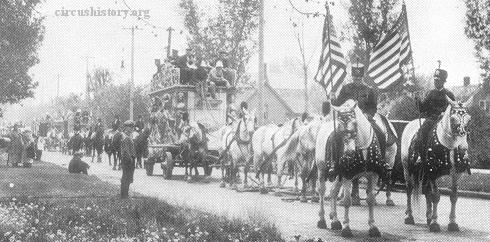 Photo No. 6 - Gollmar Bros. 1922 parade forming on street headed by mounted flag bearers and the No. 1 Bandwagon. McClintock Collection.
The following account can be considered a continuation of the article on the 1921 season of the Howes Great London Shows and Van Amburg's Trained Wild Animals which appeared in the Sept-Oct 1964 issue of Bandwagon. This article begins with the arrival of that show into winter quarters at Vandiver Park, Montgomery, Ala. following the 1921 season.
No indication was given for several weeks that a change of title would take place for the 1922 season, however rumors were in the air about a possible return to the circus field of the Gollmar Bros. Circus and in December the Billboard carried an account that Fred C. Gollmar was planning on putting out a 25 car show in 1922 using the old family name. At that time there was no connection mentioned between Fred Gollmar and the American Circus Corporation which owned the Howes Great London Show.
In early January 1922 an agreement was made between the Corporation, by Jerry Mugivan, Bert Bowers, and Edward Ballard, and the Gollmar family of Baraboo, Wisconsin to lease the title of Gollmar Bros. Circus for a period of five years for an undisclosed amount. Fred C. Gollmar was hired as general agent to pilot the show that would bear that title.
The Jan. 21, 1922 Billboard gave the full details and stated that the Gollmar Bros. title would be used on the circus property now in Montgomery quarters which had toured in 1921 under the Howes Great London title. It also stated that the Howes title had been leased to Mike Golden for use in 1922 on the property of Palmer Bros. Circus which he had recently purchased at a sheriff's sale at Palo Alto, Calif. Golden planned to add 5 additional cars and would go out in 1922 with a 15 car show using the Howes title. Also sold to Golden was all of the unused Howes-Van Amburg paper and other printed matter on hand at the Riverside Printing Co. The article remarked that Fred C. Gollmar who would be general agent and traffic manager in 1922 was regarded as one of the most capable general agents and railroad contractors and would be entirely at home in that capacity during the season. It can be easily seen by studying the season's route that Fred Gollmar's talents and contacts were used to the utmost as the show played extensively through the old Gollmar territory and especially in the show's former home state of Wisconsin.
The Gollmar name was felt to be quite valuable in the territory planned to be played by the show in 1922 and Mugivan and Bowers had followed their policy of using old or current titles of value on their several circuses, never their own names.
The original Gollmar Bros. Circus began as a wagon show out of Baraboo, Wis. in 1891 and transferred to rails for the 1903 season. It grew to be a very prosperous and well liked 22 car show. Following the 1916 season the Gollmar family sold the physical property of the show to James Paterson and gave him one year's use of the title as part of the deal. Patterson toured the show in 1917 using the title of Gollmar Bros.-James Patterson Combined Circus. Patterson operated the show for that single season then took it off the road while he concentrated on his various carnivals. Since 1917 the Gollmar title had been dormant in the hands of it's originators. One interesting sidelight to the James Patterson angle was that for the 1922 season Patterson returned to the circus field and put out a 20 car show using the title of James Patterson's Big 4 Ring Wild Animal Circus and although he had sold off some of the original Gollmar property to Al G. Barnes and others he still used quite a few of the old Gollmar wagons on his 1922 show. At many stands during the 1922 season Patterson's show using much of the original Gollmar equipment but without the title was in competition with the American Circus Corporation's Gollmar Bros. Circus which was using the title on their former Howes Great London Show property.
Some personnel changes were made in the new Gollmar show in the spring of 1922 and the performance was somewhat different from the one presented a year earlier but in so far as the physical equipment of the show itself was involved very few changes at all took place. To all extent and purposes the 1922 Gollmar show was merely that title painted on the equipment that bore the Howes name in 1921. That being true, much of the detailed account of the physical equipment, tent sizes etc., will be omitted as the reader if interested, can find it listed in the former article.
In January it was announced that the show had purchased 3 new sleepers from the Pullman Company in Chicago to replace older wooden cars and the show now claimed a solid steel train but as pointed out in the previous article the stocks and flat cars were still of the wooden and semi steel variety.
Several new animals were obtained during the winter. Major acquisitions included 4 male and 6 female lions and a puma, most of them coming from the Johnny J. Jones Shows (carnival). During the early 20's carnivals which had first featured the trained wild animal act and made it popular with the show going public were discarding them while the trend in circus performances was to the use of more and more of this type of act. Hence a ready market was available for these animals once featured by the carnivals. The show also claimed it already had in quarters 7 lions and 12 tigers before the new animals arrived.
Supt. Tom Tucker with a crew of 9 men did quite a bit of rebuilding on the wagons during the winter. All of the older outside type sunburst wheels on the cage and tableau wagons were replaced with the new St. Mary's inside type sunbursts and gears. The Jan. 21 Billboard claimed that Tucker had built 10 new cages but this is an exaggeration. It is true many of the cages were probably rebuilt and Tom did build some new baggage wagons to replace older ones but photographs indicate only two new cages to have been built new from the ground up that winter. These were rather plain working type dens and are shown in the illustrations used here. The steam calliope was rebuilt and although the same carvings were used the profile of the finished product is somewhat different from the previous one.
During the winter much noise was made in the Billboard by the show about the large trained wild animal acts that would be a feature of the 1922 performance. Louis Roth was still there as head trainer but he soon left. Other trainers who were working out new acts and would give the show a very strong wild animal display during the season were John Guilfoyle, Hugh Stewart, Charles Allinger, Fred Palmer, and Clyde Beatty. New acts being broken included a 10 female lion display and a balloon lion routine.
The Montgomery quarters were quite adequate and provided ample room for storage, repair, and paint work and for rehearsals of acts. Three rings were set up in a barn for acts to work out daily.
In the early spring some new baggage stock was purchased from Wm. P. Hall in Lancaster to replace older horses. The same number of baggage stock plus the Mack tractor were used again in 1922 to move the show on and off the lot and for parade purposes. Witnesses say the tractor pulled the steam calliope in the daily street parade.
Yellow Burnett and Joe Smith painted all of the wagons and were told by the management not to spare any gold or silver leaf on any of the parade wagons. Color scheme for baggage wagons was again orange with the cages appearing to be a variety of colors. Cage cover boards were highly decorated and lettered. Photos indicate the parade wagons generally to have had the same color schemes as they had a year earlier.
There were no changes in the parade wagons carried in 1922 and they were the same as listed in detail in the previous article. The new cages, new type sunburst wheels on the parade wagons, and the rebuilt steam calliope appear to be the only visible changes.
C. D. "Danny" Odom was retained to manage the show in 1922 and was in charge of the overall repair work and plans for the season. A note in the Billboard stated that Danny Odom Jr., son of the manager, visited his parents at Christmas while on vacation holidays from Notre Dame University where he attended school.
An advertisement appeared in the Feb. 11 Billboard signed by the Gollmar Brothers explaining recent events and their status as follows:
"Notice Is Hereby Given that Gollmar Brothers of Baraboo, Wisconsin have leased the right to the use of their show and circus name for a period of years to Howe's Great London Show Company, an Ohio corporation, and that said right so leased carries with it only the right to the use of said name in the show and circus business. Neither the said Howe's Great London Show Company nor any other person, company or organization, is authorized to contract any debts or obligations so as to be binding upon the said Gollmar Brothers, or either of them, and Gollmar Brothers will not assume any liability for any debts or obligations so contracted by anyone using their name. Notice Is Further Given that all persons and organizations, other than the said Howe's Great London Show Company, are hereby warned to refrain from the use of the said Gollmar Brothers' name in any manner in connection with a show or circus business, or otherwise, and that any attempt to wrongfully use the said name will be prosecuted.
Gollmar Brothers"
Winterquarters news from Montgomery seemed to appear nearly every week in the Billboard. Gollmar continued to play up their wild animal acts and the March 11 issue stated that all animal acts were now under John Guilfoyle, indicating Louis Roth had departed, and said that John had recently finished breaking an act of five male lions featuring the "untamable lion" Brutus. Many animals were born during the winter and the show claimed it would have the largest collection of young animals of any circus on the road stating that the new arrivals included 3 leopards, 6 lions, 2 pumas, 2 monkeys, and a fine baby camel. The show had a great publicity hit in the Montgomery papers when the baby camel was christened "Alcazar" in impressive rites conducted with all of the uniformed bodies of the Alcazar Shrine Temple participating on Sunday afternoon, Feb. 22, before a large crowd.
The official title used by the show to begin the 1922 season was Gollmar Bros. America's Greatest Shows with somewhat different versions appearing in various printed matter. Later in the season the show added the Yankee Robinson title and the title appearing on the official route book published was Gollmar Bros. and Yankee Robinson's Combined Circus.
No photos showing the rail equipment have been found, however the late Bill Woodcock reported it to have been very well painted and lettered. He said that all of the cars were painted orange. The advertising car was a combination car with little decoration and on the baggage end appeared the title in white or silver using the script letters like that used on the show's letterhead. Stock cars were well lettered and also had painted on them very glaringly such things as "Blue Ribbon Horses", "Trained Elephants", "Performing Camels" etc. John Robinson as well as Christy Bros. used this kind of thing on their stock cars later in the 20's. The show probably used the same color scheme for lettering on the rail cars as was used in 1921.
The 1922 Gollmar Bros, show traveled on 25 cars, using one for advance, 6 stocks, 12 flats, and 6 sleepers. So far as is known there were no further changes in the rail equipment.
As was true with all of the American Circus Corporation units a competent staff of seasoned circus men was assembled. The complete list of the executive staff, advance staff, and heads of departments as appeared in the official 1922 route book are as follows:
Executive Staff: C. D. Odom, general manager; J. H. Adkins, treasurer; Theo Forstall, auditor; Frank O. Davis, press agent (with the show); S. F. Harris, front door; W. H. "Billy" Miles, legal adjuster; Gordon D. Calvit, asst. legal adjuster; Ray Daley, sideshow manager; George W. Ross, banners.
Advance Staff: Fred C. Gollmar, general agent; Frank J. O'Donnell, contracting press agent; W. J. Lester, local contractor; Emory D. Proffitt, manager Advance Car No. 1; Josh Billings and E. C. Heume, special agents; W. B. Barid and A. B. Bennett; 24 hour agents.
Heads of Departments: Charles Berry, equestrian director; Fred Collier, asst. equestrian director; Bert Rickman, announcer, Tom Tucker, lot supt; John S. Hickey, supt. of canvas; Jack Feinberger, supt. side show canvas; Joe Metcalf, supt. of elephants; John C. Guilfoyle, menagerie; Tex McCracken, supt. of baggage stock; L. D. Baker, ring stock; August Christ, trainmaster; Charles Herman, master of transportation; Fred C. Smith, supt. of wardrobe; E. L. Kelley, supt. of props; Mark T. Kirkendall, supt. of inside tickets; Mel Burtis, supt. of privileges; B. L. Wallace, cashier of candy stands; Otto Reenstjerna, supt. of dining car service; A. W. Keller, manager No. 2 side show; H. W. Wingert, bandmaster; H. T. Carey, supt. of commissary dept; Adolph Tilden, head porter.
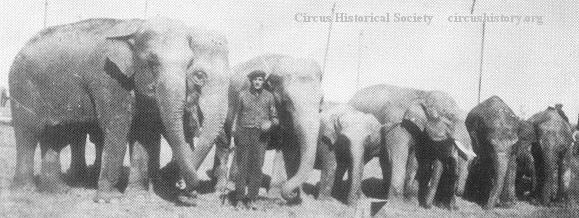 Photo No. 7 - Elephant herd early in the 1922 season showing the 7 bulls carried the previous season. Tom Parkinson Collection.
There were some changes in the elephant herd during the season. The season began with the same 7 that had comprised the 1921 Howes herd; Alice, Lizzle, Nellie Lockhart, Toto, Mary, Katie, and Babe. All were Indian elephants and all female with exception of Toto, a tough little male. Sometime later in the season Babe was sold. She was a cripple and the smallest of the herd. She ended up on Christy Bros. but by way of I. S. Horne so Bill Woodcock believed. During 1922 the American Circus Corp. imported a number of small Indian elephants. These were green and unbroken animals and they had to be worked with considerably before they were ready for the ring. Arriving on Gollmar Bros. during the 1922 season were Modoc, Jewel, Pearl, Judy, all females, and Danny, a male. These names were those later given to them by Cheerful Gardner when he got them into his herd. Woodcock said that Gardner changed the names originally given the animals by Joe Metcalf. Danny of course was named after the show's manager. Late in the season Nellie Lockhart was sold and taken from the show where she died enroute to her new owner, a wholesale grocer who had a private zoo.
The show had 12 cage wagons including a glass enclosed snake den in 1922. Approximately the same number of lead stock, ring stock, and ponies were carried as has been a year earlier. The caged animals consisted mainly of the working acts, lions, leopards, tigers, pumas, and polar bears, plus a cage of monkeys and the male hippo, Victor, who was growing rapidly into a big one.
Ray Daley operated the main sideshow and as was customary with Corporation units in those days a No. 2 sideshow was carried, nearly always of the "strange girl" type.
A strong street parade was again a feature of the show in 1922. All of the flat car type railroad shows as well as most of the gillys and mudders paraded in 1922 with the exception of Ringling-Barnum. The Big Show had dispensed with the parade in 1921 but there were rumors in late season the parade would be restored in 1922 but these proved to be false.
The summer of 1922 was one of turmoil as labor unrest was rampant in many industries. Crippling strikes in the coal mines and on many railroads occurred making perilous times for many shows. Poor business was experienced in many mining towns where the mines were shut by strikes and the business of trying to route and move the show on rail lines that were not affected by strikes and not knowing for sure if and when the train could move caused the circus manager many an anxious moment. However, in localities unmarred by labor turmoil circus business generally was good. Bad weather was not of too great concern although Gollmar Bros. arriving rather early in Colorado and Wyoming experienced some very cold and wet weather and late in the season had a wet spell in Missouri.
Competition among circuses was very strong and was about the same as a year earlier. There were a couple of new railroad flat car type shows and about the same number of gilly and mud shows. Christy Bros. graduated from the gilly and tunnel car class to the flat car field in 1922 and James Patterson returned to the road with a circus. On the road in 1922 in addition to Gollmar Bros. there were in the railroad flat car type field the following shows; Ringling-Barnum, Sells-Floto, Hagenbeck-Wallace, John Robinson, Al G. Barnes, Sparks, Walter L. Main, James Patterson's, Rhoda Royal, Campbell-Bailey-Hutchinson, Howe Great London, Gentry Bros., and Christy Bros. Other shows owned and operated by the American Circus Corporation in 1922 were Hagenbeck-Wallace, managed by Bert Bowers, John Robinson, managed by Jerry Mugivan, and Sells-Floto, managed by Zack Terrell. All were on 30 cars according to the Havirland lists but there is some evidence that 10 cars were later added to Sells-Floto in mid-season and some historians believe the show continued the tour on 40 cars.
During the winter of 1921-22 the American Circus Corp. which had just recently been organized by Mugivan, Bowers, and Ballard spent a large sum of money improving their circus holdings. In the fall of 1921 they purchased the Peru quarters from the B. E. Wallace heirs and started immediately to improve and enlarge them so as to accommodate the Sells-Floto Circus as well as John Robinson following the 1922 season. New all steel stock and flat cars were purchased prior to the 1922 season from the Keith Railway Car Equipment Co. for Sells-Floto thus equipping another of their shows with new 70 and 72 ft. cars. Hagenbeck-Wallace had received new Mt. Vernon cars for the 1921 season.
The 1922 season was a milestone in circus history in one respect in that it was the last season that standard forms of grift were carried on the Corporation units. Later in the season a dispute over grift was to result in the tragic killing of Billy Miles, the Gollmar legal adjuster. In 1922 the circus and carnival industry became aware that it's public image was being ruined by many grifting shows and a concerted effort led by Charles Ringling and others resulted in shows being called upon to denounce all forms of grift. Grift of course had been the accepted practice on many shows for a great number of years. The early coarser forms of grift such as the pickpocket, stealing from clothes lines etc. had disappeared. Likewise certain concession rackets were gone such as the seat cushion racket which Sells-Floto had discarded a year earlier. The main forms of grift still used included the gambling games such as 3 card monte, shell, etc. in the sideshow, the "for men only" sideshow cooch dancers performing immoral dances with the ever present vulgar blowoff, and the connection racket in which ticket sellers operating in the connection between the menagerie and big top were taking short in the rush for reserve seats. The first two rackets operated openly and had to be fixed with local authorities in communities which frowned on such practices. The connection racket was the roughest and had to be used with discretion at times, places, and upon characters not likely to create any heat. After 1922 grift among the major circuses would be the exception rather than the rule. Some of the forms of grift in use in 1922 seem somewhat crude by today's standards but as many observers have pointed out really weren't too much worse than some present day phone rackets and others still practiced by some shows.
The 1922 Gollmar performance was a good one. It leaned heavily toward wild animal acts but still achieved almost perfect balance between the caged acts and traditional circus type track and aerial displays. The steel arena remained up throughout the performance and a total of seven outstanding wild animal acts were staged including performing lions, pumas, tigers, leopards, polar bears, and concluded with the "aerial lion" being raised high in the tent on a platform amongst a colorful fireworks display. John Guilfoyle was the principal wild animal trainer and his wife, Harriet, was also a trainer of no small measure. The traditional Wild West Concert that followed the performance included some of the top riding and roping performers in the business.
Charles Berry served as equestrian director and Henry W. Wingert was the bandleader. The Billboard failed to carry its usual opening day review of the performance and its candid comments on the show's overall appearance; however, the publication during the season from time to time did comment on various acts, quality of the performance etc. The official program for the 1922 season is reproduced here just as it appeared in the songster booklet sold by the show. [Note: the official program of Gollmar Brothers, 1922, has been omitted from this online edition.]
Long time historian, Joe Fleming, of Trenton, Neb. saw the Gollmar show in 1922 and has very kindly furnished several observations he made on his visit to the show. Joe is an expert on horses in general and on circus baggage and ring stock in particular. He is also a top notch authority on circus music and although he never played in a circus band he was once a member of a local band that played for rodeos and other celebrations and is well acquainted with the music played for circus performances in that day. Naturally Joe's observations include something on the show's stock and music played by the band. Joe's description of the opening spec is most interesting. He says,
"The spec moved around the track while the band played "The Shiek of Araby". All participants marching either rang a bell, beat a little drum, or marked time by striking a piece of steel with a mallet. It was a most colorful, musical, and 'loud sounding' spec."
He continues, "I considered the entire show very nice, the equipment was well painted, the stock was fat, the performance well dressed and fast moving, and the show had a good band. There was one four horse team of black baggage stock while all other baggage stock were gray Percherons. It runs in my mind that on that particular day in the parade the team of blacks pulled a glass enclosed snake den, which I'm positive was painted blue. The show had played Eastern Nebraska before coming to McCook, where I caught it, and I had read a review of the parade which mentioned a ten horse hitch on the leading band wagon. However they got on the streets of McCook with only an 8 horse up on the No. 1 bandwagon. I was disappointed because I'd never seen a 10 horse team and was counting on it. It was possible the dream had dwindled down to an 8 due to accident or death of either a horse or even a driver. Gollmar's ring stock were very nice. I was particularly enthused with a cream colored horse which was in the Wild West department and with the 5 beautiful black and white spotted ones. A couple of these spotted horses appeared in an act with a couple of camels, which was a new act to me at that time. There was a 4 hog hitch which I liked. They were hitched two on the wagon and two ahead just like a horse team and went tearing down the track hell bent for leather. The Morals family made a big hit with their tight wire act and looked fine with a beautiful pink wardrobe. They were featured with special paper on the big daubs that appeared on the livery barns and board fences over the town."
"The baggage wagons were orange if I'm not mistaken. The steam calliope was pulled by a Mack truck and the air calliope by 6 ponies in the street parade. I recall that the steam calliope played "Dardenella" and "Last Night on the Back Porch" during the parade march. I didn't see the show's train except for a fleeting glimpse of the flats in the distance as we were leaving town."
Gollmar opened the 1922 season with a two day stand at it's winter quarters town of Montgomery on Sat. April 15. Two performances were given that day, none were scheduled the following Sunday, but two more were given on Monday and then the show departed for Birmingham, the second stand of the new season.
The show headed north through Alabama and into Tennessee. A rail accident occurred early in the morning of April 22 as the train was preparing to leave Florence, Ala. for Columbia, Tenn. The rear Pullman sleeper uncoupled and rolled back down the track for about 25 blocks or more before derailing and the car plunged into the dirt at an angle of 45 degrees. Thirty-five occupants of the car were badly shaken up but none were seriously injured. Two extra coaches were furnished by the railroad in order that the circus could reach Columbia in time. So far as has been recorded this was the only railroad accident of the season.
The circus moved rapidly northward thru Kentucky, Indiana, and Illinois. There were no particular incidents of note in the first weeks of the season in the Billboard. An afternoon performance only was given at Hopkinsville, Ky. due to heavy rains.
The show had a three day stand at St. Louis, May 5-7, then played another week in the state including a two day stand at Kansas City. The first opposition stands came at Kansas City and St. Joseph and also at Leavenworth and Topeka, Kansas, all with the Al G. Barnes Circus. However the show was over a month ahead of Barnes in all of these towns so the opposition was not considered as close and hot as it had been a year earlier with Barnes at many stands.
Gollmar moved rapidly across Kansas and entered Colorado at LaJunta on May 23 for 8 stands in the state. The show was in Denver for two days, May 29-30, with Al G. Barnes due in June 16 and 17th. Following Colorado the show played Cheyenne, Wyo. on June 1st, then headed eastward at Sterling, Colo. the next day and then across Nebraska. The show was in Colorado quite early in the season and as is usually the case ran into some rough weather at times. The June 17 Billboard covered the show's activity in the area by stating that Gollmar had encountered much rain in Colorado but still did fair business. While in Denver on Memorial Day the cookhouse was highly decorated for the event with a special menu being served at dinner with cigarettes on the house. Visitors at Denver included H. H. Tammen, former owner of the Sells-Floto Circus. At Cheyenne the show experienced snow with the temperature dropping to 27 degrees. The article said that the menagerie had a new baby Afghan pony named Denver, the city of his birth. New faces in clown alley that had appeared recently included C. E. Morenberg, George Wayman, Friday Wright, and Rube Stone, who was doing his own peculiar act. Columbus, Neb. was announced as the banner date so far.
Following Nebraska the show moved eastward across Iowa and back into Illinois. Opposition dates which were to see the Al G. Barnes Circus from two to three weeks later included Greeley, Colo. Cheyenne, Wyo., the Nebraska cities of North Platte, Kearney, Grand Island, Lincoln, and Omaha, and Iowa towns of Sioux City and Des Moines.
The June 24 Billboard reported that the Gollmar advance car did good work at Elgin, Ill. by securing space that no other circus had heretofore obtained and it was also mentioned that billing along the country routes was going well. Also recounted in the same issue was that the show had a fair matinee and a good night house in Omaha. The Ak-Sar-Ben race meet in that city was a big opposition and no doubt had its effect on the circus attendance. Some of the usual reports furnished by the show's press stated that the animals were the best ever seen in Omaha, with circus acts being equally good, the menagerie had a splendid collection of animals, and the parade attracted thousands.
A prime piece of typical show propaganda put out in those days appeared in the same issue as follows: From William DeMott, "after seven weeks viewing Gollmar Bros. Circus and paying strict attention to every detail I believe I am justified to make the following known. A finer equipped show in all it's branches is hard to find. It's executive staff under the personal observation and management of Dan Odom, is most complete, fast, and in perfect harmony. The stock and rolling stock bring forth the most flattering comment, the parade is excellent and the show's appearance on the lot cannot be surpassed for cleanliness. The program offers two hours of novelty animal acts and high class circus acts combined that bring forth remarks of approval for all that is claimed and that accounts for the remarkable good business and grand record the Gollmar show enjoys. Also wish to add that the treatment and comfort enjoyed cannot be surpassed. At this writing Columbus, Neb. is giving the show a turnaway afternoon house."
It may be pointed out that it was completely true that Dan Odom was a splendid and efficient manager. The late Bill Woodcock told me often that he considered Odom the best circus manager he ever served under. Although a fair man to his employees Woodcock said that Odom would absolutely tolerate no foolishness from anyone. He was tough, no doubt about it, and Woodcock said that Zack Terrell who managed the Sells-Floto Circus for the Corporation that year was a "Casper Milktoast" compared to Odom. Later in the 20's as all of the old Corporation executives mellowed Odom became a great favorite of the organized circus fans.
The show entered Wisconsin at Racine on June 19 and before the season was out would play a total of 22 stands during two visits to the home state of the old Gollmar show. Fred Gollmar was now putting the show into many of the towns on the old show's route in the states of Wisconsin, Minnesota, and the Dakotas. Business during the first visit to Wisconsin was fair. The Billboard reported that the Patterson Circus did light business while playing the state and the rumor was out that all shows playing in Wisconsin were hard hit. Gollmar reported good dates at Stevens Point and Duluth, Minn. and claimed the show made a big hit at the two day stand in Milwaukee, June 24-25. Ringling-Barnum was scheduled for that city on July 31.
After several Wisconsin stands the show moved into Minnesota for 6 dates followed by two in North Dakota and then back into Minnesota for 3 more days. A single stand in South Dakota was played at Sioux Falls on July 14 which was then followed by a day at Hawarden, Iowa, and the show then moved through Nebraska and into Kansas. Several stands played had seen the James Patterson Circus a few weeks earlier. The Patterson show was generally in the same area being played by Gollmar and was in opposition at nine stands. Gollmar played Breckenridge, Minn. July 11 with Mike Golden's Howes Great London Show scheduled for August 15th.
The July 22 Billboard covered the recent weeks of the show with an article under heading, "Gollmar Bros. Faring Well in the Middle Northwest.” The piece claimed the show was meeting with fine business everywhere. Performance notes said that the spec entitled "Peter Pan in Animal Land" featured Harriet Guilfoyle as Wendy with Julien Rogers as Prima Donna. Harriet works the first of the lion acts at the conclusion and as part of spectacle. Other notes said that Jack Lorenzo was working the polar bears and the female lions, John Guilfoyle worked the Royal Bengal tigers, and his wife Harriet handled the riding lion. Charles Berry the equestrian director worked the camel and horse act. It stated that Joe Metcalf recently added two new baby elephants that arrived from East India. (Note; as mentioned earlier it is not known definitely just when during the season the new elephants arrived, nor if they all came at the same time. A note on the official route states that 4 baby elephants were added to the menagerie at Stevens Point, Wis. on June 28).
While the show was at Devils Lake, N. D. the District Court was in session trying several bootlegging cases with Indians the principal witnesses. When the Gollmar parade passed by the Indians and other witnesses, and court officials left the courtroom and business came to a standstill. The judge with some humor adjourned the court from 11:30 until two in the afternoon. This made good front page copy in the local papers. Many Indians attended the afternoon and evening performance as they had established a temporary camp in town for the court trials.
The July 29 Billboard had interesting comments on recent Gollmar activities also. It said that Minnesota had treated Gollmar exceedingly well and the weather had been good. At Breckenridge, Minn. a large number of the show's personnel went out to Wahpeton to see graves of the men killed in the storm of 1897 when lightning struck Ringling Bros. Circus. The feature of the concert was now the wrestling matches engaged in by Herman Hackenschmidt. Joe Metcalf was progressing well in training the new elephants.
While the show was playing Concordia, Kan. on July 22 a strong wind and rain storm struck and played havoc with the menagerie tent, two horse tops, and the dressing room. The show got good after notices in the Maysville, Kan. paper. After the short Kansas tour the circus moved back thru Nebraska enroute to Iowa for two stands. Poor railroad service caused the show to arrive at Nebraska City 12:30 p.m. causing cancellation of the parade although two performances were given. The same thing occured the next day at Wahoo where the show didn't arrive until 1:30 p.m. and both parade and matinee had to be cancelled.
Widespread labor unrest was now hitting the country. Railroad strikes were occurring in many places and soon the coal industry would be plagued with strikes. Actually Gollmar lost no stands due to the strike as they made every effort to try and move on roads not strikebound. However, the show did have to substitute New London, Wis. on Aug. 14 for Antigo which had been originally booked due to the rail strike.
Ida Grove, Iowa on July 31 gave the show a very big afternoon business.
The Aug. 26 Billboard said that the Mercer County Fair of Aledo, Ill. was attempting to get Gollmar Bros. to change their date of Sept. 2 as it would interfere with the expected banner date of the fair. If they were unsuccessful the fair board would attempt to have Aledo refuse the circus a license to play or parade within the corporate limits. The circus did play the stand as scheduled and were located on the fairgrounds opposite the Gold Medal Shows (carnival). The fair association charged the regular 50c gate fee until 5 p.m. but it didn't affect the matinee business and the show had good business again at night.
After Iowa the show played a stand at Spring Valley, Minn. and then entered Wisconsin for the second time at Tomah on August 10 and remained in the state thru August 26. The single Minnesota stand gave very poor business but Merrill, Wis. produced two big audiences and Wausau the next day had a huge matinee.
The Sept. 9 Billboard said that Wisconsin was provided good territory for Gollmar. Berlin was particularly good with people sitting on the grass on the track soon after doors opened. Many prominent circus people visited in Wisconsin including Walt Gollmar while the show was at Stoughton. Many of the towns in Wisconsin were rather small for a 25 car show but it was evident the circus was trying to squeeze out every dollar of value it could on the famous Gollmar name in that territory.
At Beloit on August 24 the show participated in the big parade held during the American Legion State Convention in town at the time. CHS member Charles Kitto has a convention program that was printed by his father's firm that lists the circus stand as part of the festivities. Charlie recalls that he was not very impressed by the show and felt it did not measure up to the original Gollmar Bros. show he had seen in earlier years. He also recalled that the grifters were making their play in the sideshow and even though he was quite young at the time he was able to recognize the luckey boys at such. Charlie said that one older gentleman remarked to him that the high pitched blowoff performance of the sideshow cooch dancers was a fake and not to waste his money.
Back in July the Billboard contained the interesting news to effect that the Yankee Robinson title would be combined with Gollmar Bros. and the show would be enlarged to 30 cars beginning August 1st under title of Gollmar Bros. and Yankee Robinson Combined Circus. Part of this news proved to be correct. The show did begin using the Yank title in its billing and other printed matter but there was no enlargement of the show. The territory the show was playing was also that which was well covered by the Yankee Robinson show which Fred Buchanan had operated until he sold it to Mugivan, Bowers, and Ballard following the 1920 season. It was felt by the management that the show should attempt to capitalize as much as it could on both of these well known circus names that were popular in the mid west.
Leaving Wisconsin the show went into Illinois Aug. 28 at Rochelle and then swung back and forth between Iowa and Illinois until Sept. 9 when it entered Missouri. Gollmar was the first circus of any size to play Whitehall, Ill. in 16 years and business was encouraging at the stand, however the show now entered into several weeks where the rail and now widespread coal strikes had telling effects on the show's take. At Albia and Charlton, Iowa the coal and rail strikes were more apparent than other places played recently because a large part of the population depend on these two industries. Business at Albia was the worst of the entire season. Rock Island, Ill. on Labor Day, Sept. 4 did come thru with big crowds at both shows. At McComb, Ill. the show entertained a group of orphans.
The Sept. 23 Billboard summed up recent Gollmar happenings by saying that business had also been affected by abnormally hot weather and late arrivals due to train difficulties in parts of Illinois and Iowa. Three out of ten parades had been missed lately and this affected business.
During the late summer and early fall a strong campaign against grift in the circus and carnival business was getting underway being led by a group of showmen who were given encouragement and space by the Billboard. The magazine publicized the campaign which was to lead to a definite organization of showmen pledged to operate griftless shows in 1923. Great moral strength was given the movement by Charles Ringling who contributed two remarkable essays condemning grift and grift shows. An organization known as the New York Civic League was one of the leaders in the fight against grift and would make inspections on various shows and publish their findings in the Billboard. The League reported that they visited John Robinson, Sells-Floto, and Hagenbeck-Wallace circuses and found gambling tables in sideshows and immoral "for men only" shows in operation. One scribe wrote to the Billboard claiming that it was grift that caused the James Patterson Circus which was managed by Fred Buchanan to close early. Sources on this show itself wrote saying such was not the case but that it was the coal and rail strikes that forced the early closing. The heavy publicity given to the anti-grift movement in the Billboard led to all kinds of charges, countercharges, denials, "testimony" etc. One informant who's letter was published said there were 15 grifters alone with the Cole Bros. Circus operated by E. H. Jones. Another wrote to completely deny that charge. And so it went for the rest of 1922 and on through 1923. Much good did come from the movement and as mentioned earlier all of the Corporation units dropped all forms of grift for the 1923 and following seasons. The move was a wise one and as the show got over the rather turbulent years of the early 20's the money began flowing in during the mid and late 20's in amounts never realized before as the shows grew in statue and reputation with the American circus going public.
As the Gollmar show left Iowa for a two week tour of Missouri it experienced the most prolonged period of bad weather of the entire season. The Oct. 7 Billboard summarized the struggle with the elements under a headline of “Gollmar Bros. Experiences Storms and Rainy Weather.” The article continued - "The early part of September proved an unfortunate period for Gollmar Bros - Yankee Robinson Circus for starting at Chariton, Iowa, Sept. 8 rain hit the show the first of a 10 day period of stress with mud and bogs being the lot of the staff and management. On Sept. 9 at Albany, Mo. a terrific storm hit the show and town and it was feared the tents would be blown down but all hands to the guys saved the situation. Rain fell in torrents for hours. No parade could be given but the afternoon show was given to a fair house, and then the management decided to tear down and move to the next stand but the water logged lot and mud made this almost impossible and it was 3 a.m. before the last wagon left the lot. At Louisiana the weather lifted a little and business was fine and the usual cookhouse top was dispensed with for the lot had a fine bunch of trees. Tables were set up under these and the novel and delightful atmosphere made a bright day for all. Going to Fulton on Sept. 16 there was engine trouble on the branch line and although the show was late in arriving two shows were given. It was the first show in the town in over 4 years. From Fulton to Marshall there was a long delay at Mexico owning to one of the stringing rods on one of the flats breaking. The train arrived in Marshall about 7 on Sunday evening Sept. 17. Monday broke fine, parade was given to the biggest crowd in town in years, but the parade had just returned to the lot when rain started falling again. The lot and town became flooded in less than an hour. The afternoon show was given a little after three but the downpour continued and the evening show was cancelled. At Lexington the only lot available had to be made up on a mud hill and 2 and 3 horse teams had to be utilized but everything was made and two shows were given. Since then weather has been fine but Missouri with Gollmar in 1922 will be long remembered."
After the nightmare experienced in Missouri the show moved into Kansas and dipped back and forth between that state and Oklahoma for the next twelve stands. Some of the best business of the season came during this period. Oklahoma towns of Blackwell, Ponca City, and Sallisaw gave very good business. Pawnee Bill visited at Blackwell. At Sallisaw Messers Mugivan, Bowers, and Ballard came on the show for a visit and conference with Manager Odom.
A report broke in the Sept. 30 Billboard that the City of Montgomery might sell Vandiver Park to the Corporation for wintering purposes. The Chamber of Commerce was active in the deal and it was said that if it went through John Robinson or Hagenbeck-Wallace might winter there. Nothing further developed although it was arranged for Gollmar to go into quarters there following the season.
The only bad business in the area came at Ozark, Ark. Texarkana played on Oct. 12 gave very big business. The John Robinson Circus had played the town on Sept. 13 and evidently found the place would also support another circus in a month. Although the four Corporation shows never were in active competition with each other, many cities throughout the country would often have at least two of the shows visit during the season. Usually at least a month or longer would separate the dates. If one particular area was found to be very good by one show then oftentimes another of the Corporation's shows would be routed in later to take advantage of the prosperity there. In some localities where very bad weather killed the take for one show another would be routed in later. In some locales two shows would be routed in at different times on the belief that the towns would support two shows a season. This was true in 1922 when in July Sells-Floto played many of the towns in Colorado that Gollmar had played two months earlier.
The next couple weeks saw the show playing stands mostly in Arkansas, with one in Tennessee, and two in Louisiana. At Farmerville, La. Gollmar was the first railroad circus ever to play the town. The next day at Bastrop, La. the lot was far out from the downtown area and as a result business was nil. Generally, business in this area was only fair. An odd lot location in McGehee, Ark. had the show set up way out and literally in the woods. On a small lot in a barnyard at Warren, Ark. the show did big business. A very dusty lot far removed from the downtown at Clarendon, Ark. produced only fair business.
As Earle, Ark. on Oct. 23 the show suffered a tragedy in the slaying of well liked Billy Miles, the show's legal adjuster, by a deputy sheriff. Conflicting accounts of the shooting appeared in the Billboard. One report had it that the deputy was drunk at the time, while others denied that. It was said that Miles was called to the sideshow to quell a disturbance that had occurred over objectionable shows and gaming devices. An argument between Miles and the deputy took place with the deputy finally drawing his gun and shooting Miles was taken to a hospital in Memphis where he died the following night.
The late E. W. Adams, former trouper, and well known circus collector and historian, was on the Gollmar show in 1922 and was a witness to the tragedy. He related this story to me many times. He said that Miles had it "fixed" with the authorities for the gambling games to operate and the cooch girls to dance. All was going normally when a deputy sheriff appeared and began raising a commotion in the sideshow over the games and dances. Miles was called in and he tried to reason with the deputy quietly advising him to go and consult his superiors and that they would assure him everything was okay. Purely without any justification as Miles had done nothing out of line the deputy drew his gun and fired point blank at Miles. The man was tried some months later and Adams appeared as a witness but the deputy was acquitted of all charges. This incident may also have been another factor considered in the decision made by the American Circus Corp. to drop the grift the next season on all shows.
Walnut Ridge, Ark. gave the show the biggest business done in the state and Paragould was also good. Charleston, Mo. gave bum business on a lot too far out. The final week of the season began at Union City, Tenn. where the show again used a lot far out in the woods resulting in a long haul and a long parade route. The next day at Humbolt, Tenn. the show was on the negro fairgrounds and had big business. Boonville, Miss. had a railroad lot with no haul and despite rain the parade went out anyway. Tupelo and Starkville, Miss. gave big business and then the show moved to the final stand of the season at Blocton, Ala. on Sat. Nov. 4. The final day saw the show make a long haul up a hill to the worst lot of the entire season. No parade was given and the matinee started at 3:30. Immediately following the evening performance the show tore down and loaded for the last time and the train moved to Montgomery where the show went into winter quarters at Vandiver Park.
No official details are available as to the success of the show during the season. It is believed to have been fair. The late E. W. Adams was of the opinion that it came home a winner although it was evident business was spotty and no great amount of loot was realized. Overall the 1922 season for most circuses was better than the previous year but the labor unrest and numerous strikes kept many from making any great amount of money.
The show published a route book but it is silent concerning the success of the season. The book contained a nice tribute to Manager Odom which indicated he was generally liked by the show's personnel. It read:
"To 'Danny' Odom: - Soon the members of your huge circus family will scatter to the four corners of the earth. Some will return to serve you once more, others will not. Nevertheless, we want you to know that the kindness and generosity which you have manifested towards each and every one of us, will always be remembered with deep appreciation.
"With watching eyes and hoping hearts we shall watch your progress in the years to come and whether it is our good fortune to again be serving you, or tho we are engaged elsewhere; you can rest assured that to each and every member of the Gollmar Circus Family of 1922 you will always be "Danny" of whom no more fitting phrase can be found than "A Prince There Was". Au Revoir, and Good Luck, Frank Davis."
The decision was made by the Corporation officials not to return the Gollmar show to the road in 1923 but just when this decision was made is not definitely known nor is the reason for doing so, but the Corporation decided to cut down on the number of circuses operated from four to three for the 1923 season. In all probability it was to conserve funds and concentrate on the three other shows which had done considerably better during the past two years. The Corporation had made heavy outlays of cash during these years by purchasing the Peru quarters and for providing Hagenbeck-Wallace and Sells-Floto with new rail equipment. Both John Robinson and Gollmar Bros. still had the old wooden and semi steel cars and no doubt if both continued considerable funds would have to be expended to upgrade their equipment. Another possible factor may have been that the Corporation wanted to conserve their key executives by concentrating them into fewer shows so that both Mugivan and Bowers could retire from active managers of John Robinson and Hagenbeck-Wallace respectively. Mugivan did retire following the 1922 season and Bowers after the 1924 season. Ballard of course never did actively manage any of the Corporation shows. Regardless of the real reason for cutting down on the number of shows the decision was made to take the Gollmar show off the road in 1923.
During the winter of 1922-23 the elephant car that Sells-Floto had used was sent from Peru to Montgomery bringing with it the elephants, Dutch, Betty, and Blanche in charge of Larry Davis. Davis took back with him Toto and Danny. Evidently the trip back to Peru was made in system car as the Sells-Floto car remained in Montgomery. Several weeks later the Gollmar elephant car and Alice, the largest bull in the 1922 Gollmar herd were sold to Christy Bros. Circus, as well as some other miscellaneous equipment. Sidney Rink was sent over from the Christy show to take the purchases back to quarters.
The Corporation's plan was for the John Robinson show in 1923 to use the best equipment of both the Robinson and Gollmar 1922 shows. The former Gollmar equipment predominated as it was generally in better condition and the show had better cages and more attractive parade equipment. Repair work went on as usual in Montgomery on the wagons and cars that were scheduled to be used on the John Robinson show.
On the morning the show was scheduled to leave Montgomery for Peru where the John Robinson and Sells-Floto shows were wintering a fire broke out in the elephant car. This caused a delay in the train's departure as the car had to be repaired before it could leave. The interesting eyewitness account of this incident as related by the late Bill Woodcock who accompanied the train on the move from Montgomery to Peru is found in Chang Reynolds article on the 1923 John Robinson Circus which appeared in the Sept.-Oct. 1962 issue of Bandwagon.
Woodcock once gave me the following account of the train's appearance as it moved from Montgomery to Peru. "The Gollmar bill car was in the train as well as cars intended for John Robinson which had been painted with that show's title. Also included were cars with the Gollmar title still on them as well as a couple of Sells-Floto flats. There were wagons with both the Gollmar and the Howes title on them and one cage had Yankee Robinson on it. Natives along the route remarked that all shows in the world were combining and going out together." It never occurred to me at the time to question Woodcock on how Sells-Floto flat cars had gotten to Montgomery.
It is possible I guess for them to have been sent there in mid-season 1922 or conceivably had been sent there during the past winter coming from Lancaster bearing various wagons that were excess of the Howes and Yankee Robinson 1920 plunder for storage and possible use with Gollmar. Please note this is only a theory. During the time when the Corporation maintained as many as four separate winter quarters sites as they did in the winter of 1921-22 (Peru, West Baden, Denver, and Montgomery) there was oftentimes considerable traffic in cars and wagons, animals etc. between the various locations.
The Corporation had four more years to go on the Gollmar Bros. title lease but they never used it again. In 1924 and 1925 they sub leased the title to Chester Monahan for use on his show. An interesting observation has been made that despite the fact that literally scores of "brothers" titles have been used by circuses over the years Mugivan and Bowers never used a brothers title but once, that being Gollmar Bros. in 1922.
1 would like to thank several members for their aid in making this article possible, Bob Bernard, Joe Fleming, Charles Kitto, Tom Parkinson and Fred Pfening.
Gollmar Bros. and Yankee Robinson Combined Circuses Itinerary for Season 1922
Season officially opened at Montgomery, Alabama, Sat., April 15th.
|
April 17 Montgomery, Alabama
April 18 Birmingham, Alabama April 19 Decatur, Alabama April 20 Huntsville, Alabama April 21 Florence, Alabama April 22 Columbia, Tennessee Sunday April 24 Nashville, Tennessee April 25 Hopkinsville, Kentucky April 26 Central City, Kentucky April 27 Owensboro, Kentucky April 28 Evansville, Indiana April 29 Vincennes, Kentucky Sunday May 1 Terre Haute, Indiana May 2 Decatur, Illinois May 3 Springfield, Illinois May 4 Granite City, Illinois May 5 St. Louis, Missouri May 6 St. Louis, Missouri May 7 (Sun.) St. Louis, Missouri May 8 St. Charles, Missouri May 9 Mexico, Missouri May 10 Columbia, Missouri May 11 Moberly, Missouri May 12 Chillicothe, Missouri May 13 Kansas City, Missouri May 14 (Sun.) Kansas C., Missouri May 15 St. Joseph, Missouri May 16 Leavenworth, Kansas May 17 Topeka, Kansas May 18 Emporia Kansas May 19 Wichita, Kansas May 20 Hutchinson, Kansas Sunday May 22 Garden City, Kansas May 23 La Junta, Colorado May 24 Trinidad, Colorado May 25 Pueblo, Colorado May 26 Colorado Springs, Colorado May 27 Boulder, Colorado May 29 Denver, Colorado May 30 Denver, Colorado May 31 Greeley, Colorado June 1 Cheyenne, Wyoming June 2 Sterling, Colorado June 3 No. Platte, Nebraska Sunday June 5 Kearney, Nebraska June 6 Grand Island, Nebraska June 7 Hastings, Nebraska June 8 Lincoln, Nebraska June 9 Columbus, Nebraska June 10 Omaha, Nebraska Sunday June 12 Sioux City, Iowa June 13 Denison, Iowa June 14 Boone, Iowa June 15 Des Moines, Iowa June 16 Marshalltown, Iowa June 17 Cedar Rapids, Iowa Sunday June 19 Sterling, Illinois June 20 DeKalb, Illinois June 21 Elgin, Illinois June 22 Waukegan, Illinois June 23 Racine, Wisconsin June 24 Milwaukee, Wisconsin June 25 (Sun.) Milwaukee, Wis. June 26 Sheboygan, Wisconsin June 27 Appleton, Wisconsin June 28 Stevens Point, Wisconsin June 29 Ladysmith, Wisconsin June 30 Superior, Wisconsin July 1 Duluth, Minnesota Sunday July 3 Litchfield, Minnesota July 4 St. Cloud, Minnesota July 5 Long Prairie, Minnesota July 6 Fergus Falls, Minnesota July 7 Ada, Minnesota July 8 Devil's Lake, N. Dakota Sunday July 10 Fargo, N. Dakota July 11 Breckenridge, Minnesota July 12 Willmar, Minnesota July 13 Pipestone, Minnesota July 14 Sioux Falls, S. Dakota July 15 Howarden, Iowa Sunday July 17 York, Nebraska July 18 Holdredge, Nebraska July 19 McCook, Nebraska July 20 Red Cloud, Nebraska July 21 Superior, Nebraska July 22 Concordia, Kansas Sunday July 24 Salina, Kansas July 25 Junction City, Kansas July 26 Maryville, Kansas July 27 Fairbury.Nebraska July 28 Nebraska City, Nebraska July 29 Wahoo, Nebraska Sunday July 31 Ida Grove, Iowa |
Aug. 1 Sac City, Iowa
Aug. 2 Carroll, Iowa Aug. 3 Tama, Iowa Aug. 4 Maquaketa, Iowa Aug. 5 Monticello, Iowa Sunday Aug. 7 Postville, Iowa Aug. 8 Cresco, Iowa Aug. 9 Spring Valley, Minnesota Aug. 10 Tomah, Wisconsin Aug. 11 Merrill, Wisconsin Aug. 12 Wausaw, Wisconsin Sunday Aug. 14 New London, Wisconsin Aug. 15 Shawano, Wisconsin Aug. 16 Menominnee, Michigan Aug. 17 Chilton, Wisconsin Aug. 18 Hartford, Wisconsin Aug. 19 Berlin, Wisconsin Sunday Aug. 21 Burlington, Wisconsin Aug. 22 Monroe, Wisconsin Aug. 23 Plattsville, Wisconsin Aug. 24 Beloit, Wisconsin Aug. 25 Richland Center, Wis. Aug. 26 Stoughton, Wisconsin Sunday Aug. 28 Rochelle, Illinois Aug. 29 Clinton, Iowa Aug. 30 McComb, Illinois Aug. 31 Whitehall, Illinois Sept. 1 Rushville, Illinois Sept. 2 Aledo, Illinois Sunday Sept. 4 Rock Island, Illinois Sept. 5 Washington, Iowa Sept. 6 Mt. Pleasant, Iowa Sept. 7 Alibia, Iowa Sept. 8 Chariton, Iowa Sept. 9 Albany, Missouri Sunday Sept. 11 Trenton, Missouri Sept. 12 Milan, Iowa Sept. 13 Brookfield, Missouri Sept. 14 Macon, Missouri Sept. 15 Louisiana, Missouri Sept. 16 Fulton, Missouri Sunday Sept. 18 Marshall, Missouri Sept. 19 Lexington, Missouri Sept. 20 Warrensburg, Missouri Sept. 21 Butler, Missouri Sept. 22 Nevada, Missouri Sept. 23 Yates Center, Kansas Sunday Sept. 25 McPherson, Kansas Sept. 26 Larned, Kansas Sept. 27 Kingman, Kansas Sept. 28 Alva, Oklahoma Sept. 29 Woodward, Oklahoma Sept. 30 Anthony, Kansas Sunday Oct. 2 Mlackwell, Oklahoma Oct. 3 Ponca City, Oklahoma Oct. 4 Freedonia Kansas Oct. 5 Nowata, Oklahoma Oct. 6 Sallisaw, Oklahoma Oct. 7 Ozark, Arkansas Sunday Oct. 9 Clarksville, Arkansas Oct. 10 Conway, Arkansas Oct. 11 Arkadelphia, Arkansas Oct. 12 Texarkana, Arkansas Oct. 13 Nashville, Arkansas Oct. 14 Hope, Arkansas Sunday Oct. 16 Farmersville, Louisiana Oct. 17 Bastrop, Louisiana Oct. 18 Crossett, Arkansas Oct. 19 Warren, Arkansas Oct. 20 McGehee, Arkansas Oct. 21 Clarendon, Arkansas Sunday Oct. 23 Earle, Arkansas Oct. 24 New Augusta, Arkansas Oct. 25 Batesville, Arkansas Oct. 26 Walnut Ridge, Arkansas Oct. 27 Paragould, Arkansas Oct. 28 Charleston, Missouri Sunday Oct. 30 Union City, Tennessee Oct. 31 Humbolt, Tennessee Nov. 1 Boonville, Mississippi Nov. 2 Tupelo, Mississippi Nov. 3 Starkville, Mississippi Nov. 4 Blockton, Alabama |
Circuses traditionally used horses for pulling wagons from the runs to the lot. This continued until the late 1930s. But with the advances made in motor trucks just before World War I, circus owners began experimenting with the use of motorized units.
The first record of a motorized unit with a circus, in my files, is the inventory of the Buffalo Bill & Pawnee Bill Wild West Show, taken in Denver, Colorado, in 1913. This list shows two Studebaker sprinkler trucks. It is not known if these trucks were heavy duty enough for pulling wagons. But it is interesting to note that 20 years later the pulling trucks doubled as water wagons and many had pumps allowing spraying or sprinkling of the show grounds.
The first heavy duty tractor is generally acknowledged to be the three wheeled Knox unit on the Sells-Floto show in 1914. But in 1915 the Floto show used a four wheeled "tractor" made by the Knox Motor Co. The Knox trucks began appearing on other show in the late teens, including Barnum & Bailey, The Knox units were used by the Corporation shows in the 1920s and continued to be used as late as 1935 on the Hagenbeck-Wallace-Forepaugh-Sells circus.
A 1921 photo of the Ringling Barnum circus shows a Mack truck with a van body. Other shows also were impress with the rugged design of the Mack trucks and began purchasing them to supplement the Knox trucks. In 1923 Macks were used on two Corporation shows. The Mack "Bulldogs" proved to be ideal for circus use and they became the standard of circusdom.
Although our files do not contain loading orders for every year of the Ringling Barnum show we have pieced together a history of the gradual growth of Mack trucks over the years to a maximum of 17 in 1940.
The records show the Ringling Barnum show having three tractors in 1921, of which at least one was a Mack. By 1932 the show was using 8 short Mack trucks for pulling wagons and carrying water. Up to four wagons could be pulled in one string and this speeded the unloading. In 1934 the big show began a modernization program of converting from steel rimmed wagon wheels to hard rubber and pneumatic tired wheels. The hard rubber tires on the Macks were converted to standard corse tread pneumatic tires. In 1935 the show purchased four new Mack cabover trucks with duel rear wheels. These were equipped with baggage wagon style bodies and were used as canvas loaders. They had an overall length of 31 feet, compared to 16 and 20 feet for the short jobs. Two of the new trucks carried the big top canvas and one was used for the menagerie ten. The fourth was used for big top side poles. By 1937 a total of 13 Macks were used by the show, the four new long units and 9 of the short jobs. In 1939 one of the long trucks, was not taken on the road, but three additional short trucks were added making a total of 15. In 1939 the frozen delight and the midway diner were also using cabover Macks.
David "Decon" Blanchfield, king of truck superintendents, advises that in 1940 officials of the White Motor Co.. prevailed upon the Ringling management to try one of their trucks. In 1940 a White truck was purchased and equipped as a canvas loader and was used to carry the menagerie top. This brought the total of long trucks again to four and two additional short Macks were used. Three of the short Macks that appeared in 1939 probably came to the show with the Barnes equipment in 1938. The other additional units probably came from the Peru quarters and may have been used on the Hagenbeck, Floto and Robinson shows. No trucks, Knox or Mack, appear on the 1939 inventory of equipment at the Peru quarters. The total number of trucks on the show in 1940 was 17, including 13 short Macks, 3 long Macks and 1 long White.
In 1941 two of the short Macks were retired, as additional Catapiller crawler tractors came to the show. Eleven short Macks, three long Macks and the one White were used in 1941. Blanchfield states that the transmission on the White truck gave the show problems. It was retired after a couple of year's service. During this period some of the retired Mack short trucks were sold to the Royal American Shows. One of the Ringling Barnum Mack tractors is now at the Circus World Museum, having been given to the Baraboo showplace by the Royal American carnival.
In 1953 six short Macks were used by the Ringling show with three long Mack canvas loaders, one used for rigging. In 1954 there were 7 short Macks and 2 long jobs. In 1955 the official loading order, as printed in the route book, listed 6 short Macks, and 4 long ones. Two of the 30 footers were used for the big top canvas, one for the menagerie canvas and one for the big top side poles. In 1955 a total of 17 Catapiller, Case and International tractors were used in addition to the 10 trucks.
In 1957 when the Ringling show was converted to trucks the four long Macks were used along with a number of other new Chevrolet semis.
Records indicate that the Sells-Floto show used one Knox tractor in 1919 as well as in 1920. There were two Knox units on S-F in 1922. A Mack was added to the two Knox jobs in 1923 and the same three units were used in 1924. In 1929 the Floto show used one Knox and two Macks. John Robinson used 2 Macks in 1929.
The Sparks circus used two Mack Bulldogs each year from the early 1920s until it closed. Most of the smaller 10 to 20 car shows of the 1920s did not use trucks. However the Walter L. Main show used a Knox with a van body about 1922.
When the Miller Bros. 101 Ranch show was formed, using the Main equipment a number of trucks were added. The Ranch used five trucks in 1925, and six each of the following years until it closed. Many of the Mack trucks on the Ranch in 1929, 1930 and 1931 had van type bodies with carvings on the sides. These were used in the parades.
When the Cole Bros. Circus was organized by Jess Atkins and Zack Terrell in 1935 they purchased equipment from the Ranch, Robbins and Christy shows. The Robbins show had used at least one Mack and some probably came with the Ranch purchase. In 1935 Cole used three and perhaps four short Macks. In 1936 three were used and in 1937, the big year of the Cole show. there were four. One of the Cole "Bulldogs" was used on the 1938 A & T Robbins show, and probably two on the scaled down Cole unit. Two were used by Cole in 1939. Two of the Macks were lost in the Cole winter quarters fire in 1940. However there were three Macks on the show in 1940. In 1941 a total of four Macks were used by the Cole show, and one of these may have been a new model. In 1942 there were 4 Macks and probably that number were used through 1949.
The Hagenbeck-Wallace show used two Knox tractors in 1922 and added a Mack in 1923. In 1934 there were two Knox trucks and two Macks on the Hagenbeck show.
There were either three or four trucks on the Hagenbeck show in 1935, some of both makes.
In 1937 the show opened using Mack trucks. But Howard Y. Bary purchased new Chevrolet heavy duty duel wheeled units during the season. Three long canvas loaders were added as well as two short dual tired Chevys. These were again used by Bary on his 1938 H-W show, and at least one Mack may have continued with the show, as two Macks show up on the 1945 Arthur Bros. Circus, which used the old Hagenbeck equipment.
The year 1945 was the last big season for railroad shows. The Austin show used a White and an International short truck for pulling wagons to the lot. The Russell Bros. Pan Pacific 1945 show used two Mack Bulldogs. When the Russell equipment went to Clyde Beatty in 1946 the two Macks continued with the show. Beatty added a truck shortly there after and in 1950 and 1951 there were three used. The Macks were later retired and replaced by Chevrolets on the Beatty show.
The Al G. Barnes show used all Macks in the 1930s. There were two in 1930 and three when the show closed in 1938.
When the Tim McCoy show was organized and built in 1938 it purchased four used Macks in Chicago. Two of these were van bodies, two were short jobs, one with a water tank and one with a hoist.
"The faculty of imagination is the great spring of human activity, and the principal source of human activity, and the principal source of human improvement . . .” - Dugal Stewart
Installment No. 6
Risley
(Jeux Icarians)
Perhaps "necessity is the mother of invention", but quite often hunger for fame and fortune can be the stimulus which triggers a man's imagination. Such was the case with Jules Leotard when he created "The Flying Trapezes." Before him was Richard R. Carlisle, to whom circophiles are indebted for what subsequently became known as "Risley" acrobatics - a circus tradition.
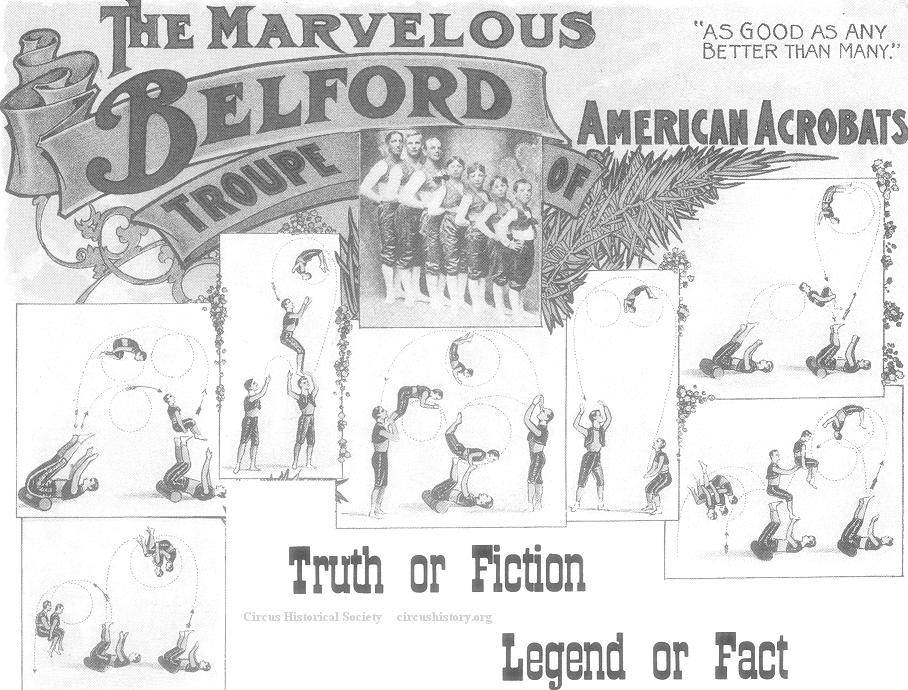
Not very much is known about Richard R. Carlisle's earlier life - except that he was born in 1814, in Salem, New Jersey. Little of interest can be found between the time of his birth and 1840, by which time he had become a rather obscure acrobat. Why he discarded the family name of Carlisle and adopted the professional name of "Professor Risley" has never been established - the only connection being that "Risley" was his middle name.
Be that as it may, by 1844, the once unknown acrobat who possessed the faculty of imagination had created a sensational innovation and, when only 30 years of age, was being given the wildest ovations wherever he presented his novelty act, now commonly known as "risley" among English-speaking circophiles - and "jeux icarians" among Europeans.
To be sure, Oriental performers had been practising the art of "foot-juggling" at least a couple of centuries before the birth of Richard Risley Carlisle. But such "antipodists" were merely propelling and spinning inanimate objects such as Malta crosses, barrels, table and such things, with their feet. Risley's inspiration must have come as the result of one simple question: "What if, instead of objects, one would substitute human beings? - like another acrobat who could be launched into the air and land back onto the feet of another acrobat?"
It must have been a fascinating thought! Probably the more Risley pondered over the idea, the more he became convinced that it was worth trying!
Documentation is too fragmentary to pinpoint the exact date on which Risley's obsession was finally put into practice and presented to an audience - or whether it took place in the States or in Europe, though there is evidence that his first success took place in November of 1841, at the New York Bowery Amphitheatre.
Some circus historians are inclined to credit one Signor Colpi as the originator of this phase of acrobatics, on the grounds that some old gravures from the 1790 decade present the Italian performer balancing boys on his feet. Inasmuch as this places Colpi 70 years before Risley's time, it is quite possible that the American's inspiration could have stemmed from viewing such gravures. However, no amount of research has yet unearthed any evidence that Signor Colpi ever did anything else - except balancing youths on his hands and feet, as depicted in the gravures.
There is also a contention that in 1840 a French clown-acrobat named Leroy, then performing at the Cirque Olympique in Paris, did some sort of an act from "his Spanish trinka" (*1). Obviously, Leroy must have been performing some form of "antipodism". But again extensive research fails to reveal whether this performer was juggling inanimate objects of human beings with his feet.
(*1): TRINKA. Although the word "trinka" has been in the circus lexicon for more than a century, no historian has yet come up with a valid explanation of the origin of the word. Some content that it stems from the Spanish, others from the Hungarian or Russian. But a diligent search through ancient and current dictionaries of such languages has failed to unearth anything near it. And, inasmuch as no early risley performer was of Spanish, Hungarian or Russian origin, such contentions don't hold. If anyone reading this should happen to know the origin of the term, most historians would appreciate being enlightened.
Another gravure of 1866 also depicts one certain Nagles and his children, then at the Cirkue Imperial (now the famous Alhambra) of Paris. But again, there is no text which tells us exactly what the said Nagles did with his children.
Obviously, it is quite possible that other performers besides Professor Risley may have attempted such a novelty. But the circus annals fail to record any one presenting such an act prior to 1844, when in February of that year, Professor Risley and his "two sons", Masters John and Henry, were appearing at he Theatre Royal in Edinburg, Scotland to display their artistry in a number labeled "Classical Gymnasia."
According to a handball of the period, Professor Risley's performance consisted of: "Tourbillion and vaulting of every description, but executed with such grace as to render it the most interesting performance ever witnessed.” Also: "Among the feat performed . . . namely: Standing on the feet of his father, he throws from thence a somersault, and alights in the same position again! He will also throw a lofty circle in the air, and alight in his father's hands!"
From this it can be deducted that in 1844, Risley was capable of tossing one of his top-mounters at least into a feet-to-feet back and/or forward somersault and also a one-an-a-half from the feet to a hand-to-hand stand. The latter has to be assumed, because if the second routine had been merely a half-flip from the feet, this would not have been worthy of mention after the one describing a feet-to-feet somersault. It must also be assumed that the "Masters John and Henry" were Risley's pupils, rather than his own flesh and blood - for no record can be found, either in the States or abroad, to indicate that "The Professor" had ever been married.
Nevertheless, it must be considered authentic that Richard "Risley" Carlisle is the creator of this form of acrobatics. This is not only due to the simple fact that countless imitators duplicated the innovation, but, more to the point, because those imitators unwittingly credited him with the creation by labeling such acrobatics: "Risley"!
It is impossible to ascertain whether this is legend or fact, but it has been reported that Richard Risley Carlisle, after a rather riotous life, during which he had managed to gain a number of rascally friends, died on May 25, 1874, in a lunatic asylum, penniless and friendless. If so, it was a rather ignominious ending for any performer whose creation continues to endure.
With so many imitators flooding the various circus rings throughout the world, it was inevitable that the art of "risley" would spread and become a traditional circus act. By the time the "golden era" of the early 1900's was in full bloom “risley", like the flying trapezes, had become a "standard" and no self-respecting circus would have considered presenting a program without an act performing risley feats.
Inasmuch as it would be impossible to list all of the countless risley artists who appeared in our circus rings and theatre stages since 1844, the commentaries of this installment will have to be confined to a rather succinct report on only the “cream of the crop."
When Professor Risley created this innovation, little did he dream that, within such a short time, his imitators would surpass him. Had Risley been alive during the first part of the 1900 decade, he would have been astounded by the amazing feats being performed by his successors! By then there were German "ikarischers" whose routines were indeed incredible! No risley act of any stature ever presented less than a double-twister and some even executed the seat-to-seat triple!
That some of those imitators endured longer fame than the originator is beside the point. At the time, Professor Risley's innovation brought him sudden fame and fortune. Within a few years, he had not only reached the height of professional success in all the circus rings and theatre stages of two continents - but his countless off-stage adventures in various European metropolises also made him a legendary character!
Just as Leotard's flying trapezes had gradually evolved to higher riggings and more complicated passes, Risley's original concept of the one "kicker" juggling two top-mounters had evolved to as many as seven top-mounters twirling and spinning from 3 and 4 trinkas. For the one trinka on the floor, 2 and 3 trinkas were gradually elevated to higher and higher pedestals - until in 1907 The Mizza-Golem Troupe, then appearing at the Paris Hippodrome-Palace, mounted their 3 trinkas on the backs of as many camels, from which they executed their various risley routines!
To be sure, the Mizza-Golem routines could never be compared with those of such greats as the Kremos, Lorches, Sheffers and others of that same period. But the "exotic" presentation and the height of their performance atop those camels stamped the number as a most spectacular innovation!
As early as 1896, the troupe of The 5 Daytons, after 3 years of assiduous practice, was the first to succeed in mastering the seat-to-seat triple somersault, which they presented publicly at every performance. But that same year, The Kremos Family also started tossing their 8 year-old top-mounter, Anton, into a seat-to-seat triple - and the following year European audiences saw 7 year-old Franziska, duplicating the feat; then in 1900 brother Viktor was doing it at the age of 9! - and finally, in 1913, Albert Hoffman also executed the triple in the traditional Kremo fashion!
During the interim, the Bonhair-Gregory Troupe had also succeeded in executing the triple. But so had The Sheffers and The 11 Lorches! In their wake came the 10 Allisons (also Germans) and The Davies Family (Belgian-French) who, with Georges Davies as "kicker" and Jean Baudin as top-mounter, were the first to present the risley-triple in the States.
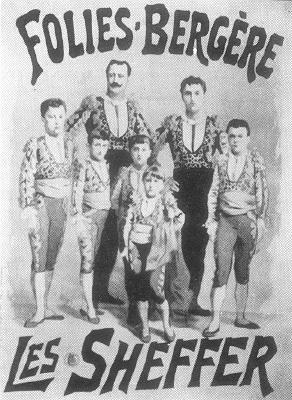 Photo: The Les Sheffer act is shown in the litho advertising the Paris Folies Bergere in 1903. The tall older gentleman is Sverus Sheffer, next tallest is Sylvester, who became famous throughout the world with his two hour presentation during which he presented nine different types of acts. Jean Biberon Collection.
In risley, perhaps every whit as difficult as a triple seat-to-seat is a double feet-to-feet. In such days prior to 1914, the Bonhairs, Sheffers, Kremos, Lorches and Allisons all performed the double feet-to-feet at every performance!
Perhaps even more difficult than the triple was a routine executed by the Kremos, which consisted of a "double-pass". With Sylvester and Katy as "kickers" from two separate trinkas in a line, Karl would propel Viktor into a forward somersault to Sylvester's feet while, simultaneously, Sylvester would send Albert from a feet-to-feet stand into a back somersault - the latter passing over Viktor - to land with his seat on Karl's feet!
Eventually, The Allisons created a "double-passing leap" even more difficult than that of the Kremos, wherein "Kicker No. 1" from one trinka propelled one top-mounter into a back standing to "kicker No. 2", while simultaneously "kicker" No. 2, sent another top-mounter into a back "gainer" under the other top-mounter - to land with his seat on the feet of "kicker" No. 1!
Between the years 1927 and 1940, to add a little spice to their ground tumbling routines, The Allisons also had Ernst Rast (Seppel) who would turn a rondade, flip-flap and a Back-Double!
Those German risley troupes of that period didn't reach their status of greatness merely because they were Germans. They became great simply because they practiced their art with intensity and constancy. German "banquistes" of that era were hard task-masters. They practiced and practiced - until they reached their state of perfection. For example, the Kremos, not satisfied to be able to execute the triple seat-to-seat flawlessly, went on to practice the feet-to-seat triple - and even dreamed of the day when they could master a feet-to-feet triple! No doubt so did the Lorches and others. But then the eruption of World War I came to disrupt all plans of mice and men! - including circus performers.
During that July 1914, most of those famous risley numbers of German origin had to give up their current engagements in a hurry. At the time, the Lorches were appearing at the Doncaster Palace in England; the Kremos at Cirque Ancillotti-Plege in France; the Allisons at the Yard Establishment in Moscow; the Daytons at the Palace of Islam in England. Obviously, anyone of German origin wasn't welcome in such countries as England, France or Russia.
Looking at it in retrospect, it can now be said that the bugle call of that First World War was also the clarion call announcing the end of the seeming German monopoly on famous risley acts.
When Sylvester Sheffer, Jr. came to America to present his famous “one-man-show" on the Keith-Orpheum Circuit during 1915-16, that spelled the end of the famous Shaeffer name as a risley unit. The Kremos, being Swiss citizens, couldn't be interned by French authorities nor mobilized by the Germans. Thus, they continued to perform as a family unit in Germany and the Scandinavian countries until December of 1915. By then, with most of the brothers and sisters being married, the big act was dissolved. Sylvester formed his own risley number with his two daughters and a young apprentice; Karl did likewise with his brother Mark and two apprentices; Leon also formed his own risley act, while his twin, Viktor, went on alone with a trampoline number. But the splintering of the family act spelled the doom of the once illustrious family name. Today, except for Bela Kremo (son of Karl) who broke away from risley to become a famous juggler, the Kremo name is no longer seen on circus marquees.
After the 1919 armistice, the 11 Lorches resumed their interrupted career, once more displaying their risley artistry in the various capitols of Europe, in the States for 4 years with Ringling, and throughout South America with the Sarrasini Circus. But shortly after Papa Louis died in 1939, at the age of 78, in Palermo, Argentine, the Lorches returned to their native Germany. Eventually, Julius abdicated his self-bestowed crown of "King of the Ikarians" and disbanded the act to retire to the family's ancestral estate in South Germany. Thus, another illustrious risley name disappeared from the circus billboards.
The Allisons also resumed their career to headline the programs of countless circuses and music-halls in Europe - until 1941 when again the bugle call of World War II sounded the toll for the famous Allison name. Both Otto and Max Eimer, the founders of the troupe, died in 1947. Since the descent of the "iron curtain" that reknown German risley number name has also disappeared from our circus programs.
Gone is the once famous German monopoly on risley. Today it has been replaced by the Egyptians who, beginning around the late 1940's, started flooding our circus rings and music-hall stages with their own brand of risley.
To be sure, there has always been and always will be a sprinkling of other nationalities which have also given remarkable performances in the art of risley. Australia produced The 7 Ashtons, executing "double-passes" over and under; Czechoslovakia, The 5 Berosinis, also doing double-passes between trinkas and various routines from and to the trinka and the teeterboard; The 6 Biros from Hungry also combine the teeterboard with their risley routines; from Spain came The 2 Rios Bros. and The 5 Salvinis; from France The 5 Castors (Moustier Family); from Italy; The 4 Boginos and The Bedinis (once 5, now reduced to 3); and from Germany are The Fredonias, formed in 1945 by a former member of the Allisons, Alfred Fullgrapp, who during 1949 practiced the triple with Dietrich Havemann.
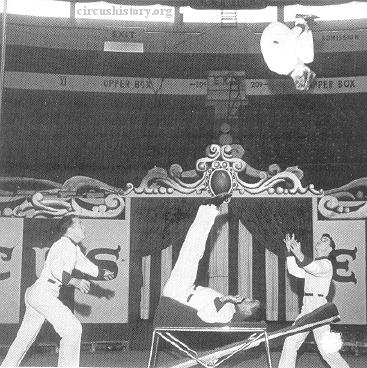 Photo: The Amazing Monahans. Bob Monahan in the trinka, as Joe hits with a full twisting back as Mickey does a double front to sit. Author's Collection.
The States also produced its quota of risley performers. There were The 7 Belfords, once perhaps the most outstanding of the risley numbers-until the death of George Belford in 1937, after which the act was disbanded in 1939; Ted DeWayne (*2), who had started his risley career with the Belfords in 1928 and formed his own risley number which is still currently appearing in the States; The Amazing Monahans, with Bob Monahan (*3) and his three sons, Joe, Mickey and Dean, have been displaying their risley artistry since 1945, both in the States and the European Continent.
(*2) DeWayne. The famous artist, Fay Alexander, who started executing triples on the flying trapeze in 1952, learned his basic acrobatics from Ted Dewayne, serving his apprenticeship as a risley top-mounter and also as a risley top-mounter and also as a middleman in the former's act.
(*3) Monahan. Besides being a master of risley, Bob Monahan is also renown as the foremost teacher of the trampoline. Among his many pupils were Jim Garner, first NAAU champion, and Dan Millman, the last U.S. champion. The Monahans also present a trampoline act under the name of The 4 Oakleys, in which 20 year old Joe Monahan currently executes 7 different types of triple somersaults feet-to-feet.
But when one starts comparing these with the list of Egyptian risley numbers performing these days, it becomes obvious that the latters now dominate the field. Among the best to be mentioned are: The Bogdadis (also known as The Sammyes) consisting of father, son and Daughters; The 3 Akeffs, related to the Bogdadis and The Icarian Stars; The Iran Boys, father and sons, also known as The Asia Boys; The Anim Bros., also related to the Akeffs and Ramseses. Yes, indeed, it would appear that when it comes to risley, the Egyptians have taken over where the Germans left off!
However, of all the acts listed above, it is doubtful that any one of these could be singled out as comparing favorably with such past masters of risley as The Allisons, Remos, Lorches, Sheffers, or Belfords.
Today, one of the very best risley numbers, The Amazing Monahans, specializes in twisting somersaults in every conceivable manner, including a full twisting spotter feet-to-feet and a double-twister seat-to-sea - but no triple. The Spanish Rios Bros., also one of the best, execute a series of consecutive seat-to-seat doubles - but no triples. The Berosinis of Czechoslovakia can also do a seat-to-seat double - but consider the triple an impossibility.
Yes, indeed, today triples are not even talked about in risley!
However, it must be noted that there are two valid reasons for this existing decline in the are of risley (1) Compulsory academic education, (2) Unavailability of young small top-mounters - the second being a consequence of the first.
Prior to 1914 and the advent of "compulsory education" in most countries, circus families and troupes wasted no time on the academic education of their children and/or apprentices. In those days, "education" of a youngster was a relatively simple process. It consisted mostly of teaching the child the art of acrobatics in order that he may successfully follow his parents and/or teachers in the circus tradition. By the time a youngster had been made to devote 16 years of his life in such rigorous and arduous training, he was an accomplished performer. In many instances, he was inserted in one number or another to perform at the tender age of 6 or 7. Often when only 9 or 10 years old, sometimes weighing not more than 50 pounds, he could execute astounding routines and feats which naturally would be physically impossible for a 20 year old weighing 140 pounds.
For example, it becomes obvious that a risley "kicker" such as Bob Monahan, 5 foot 7 and 173 pounds, can never be expected to propel his 16 year old son, Mickey, 116 pounds, into a triple somersault with the degree of ease and assurance as could Karl Kremo, 6 foot and 210 pounds, with his 7 year old, 44 pound sister, Franziska.
The above commentary should not be construed as a depreciation of the Kremos' feat - nor an appreciation of the Monahans' abilities as risley performers. It is merely a simple statement of facts indicating why it was possible for the latter to execute the feat - and physically impossible for the former. The very fact that The Monahans are capable of executing a full twisting spotter feet-to-feet and a double-twister seat-to-seat in sufficient testimony to class them as superb artists in the art of risley especially considering the relative size and weight of the "kicker" and his top-mounters.
To add another nail to the coffin, came the legislation prohibiting any youngster under the age of 16 from working in any gainful occupation without a "working permit". With such two mandatory edicts, how and where could one ever train a top-mounter to turn a triple? Risley, like the three bars, ground tumbling, shoulder-work, or juggling, requires constant and diligent practice. What with a youngster spending from 6 to 8 hours daily in school, what time does that leave for training and practice? And with legislation precluding his working into the act until he reaches the age of 16 - by then he's become too heavy to execute certain routines.
Again, the above is not to be construed as an approbation of the past and/or a disapprobation of the new sociological order regarding "education", per se. It is merely another statement of facts indicating the basic reasons for the marked decline which has taken place in certain phases of acrobatics, especially risley.
Among the circophiles, "old-timers" keep bewailing that they no longer see the same spectacular risley numbers as those which appeared in the circus rings during the first three decades of the century. That's true. But the prevailing sociological order of today precludes risley performers from being able to duplicate the feats of former greats, simply because it is no longer possible for them to reach and train young top-mounters in the art.
Given the same opportunities as their predecessors, there is no doubt that such remarkable "kickers" as Alfred Fredonia or Ted DeWayne, Bob Monahan, Berosini, and many others could have equaled the performances and feats of the once famous Daytons, Kremos, Shaffers, Lorches and Allisons.
Perhaps the one reason why Egyptian performers dominate the field of risley today may be due to the simple fact that "compulsory education" and "working-permit" laws are much less stringent in Egypt than in most other lands.
It is deplorable that it is not possible to give due credit to the many artists who, in the past and present, have contributed to the art of risley. Unlike individual achievements from the fly-traps or the 3 bars, where an act usually consists of only two or three artists, risley troupes (except for a few rare exceptions) usually consist of at least 4 performers - and sometimes, as with the Lorches, as many as 11. Because of such a multiplicity of numbers over the spread of the years, individual identities have a tendency to get lost. Usually, many of the younger performers were pupils rather than members of the family. If they remained with the act, they usually lost their own identity and adopted the name of the troupe. Thus, Charles Patterson became Charlie Seigrist; Albert Hoffman became Albert Kremo - and countless other young acrobats who had served their apprenticeship with some of the big risley troupes of the early 1900's were only identified as Eric, Jacques, Ivan, Pedro or Luigi.
For that matter, the same condition still exists today. How often can be heard: "I saw ‘The So-and-so Troupe' doing their teeterboard number last week. They have a top-mounter who does something I never saw before. He . . ." The circophile relating the feat can give an accurate account of some stupendous trick - but can never identify the name of the individual who'd performed it. And so it goes? - countless identities that will always remain anonymous!
Whether or not the next generations of circophiles will ever see another performer executing a triple in risley is a moot question. Considering the modern trends, the odds are against it. To quote from the English historian, Anthony Hippisley-Coxe: "A good risley acts means really hard work, and perhaps that is the reason why today the act is not seen as often as it should. Here the marked rhythm and dexterity of the juggler are combined with the suppleness and strength of the ground acrobat to produce a number which contains the best qualities that one finds in the circus ring."
There is more truth than poetry to that statement. It is doubtful that the art of risley can ever be restored to its former grandeur of the early 1900's, but it is to be hoped that a renaissance will soon occur - and that, sometime in the future, risley will again occupy its place of honor in our circus rings.
(To Be Contined. In the next issue: The Triple from the Teeterboard).
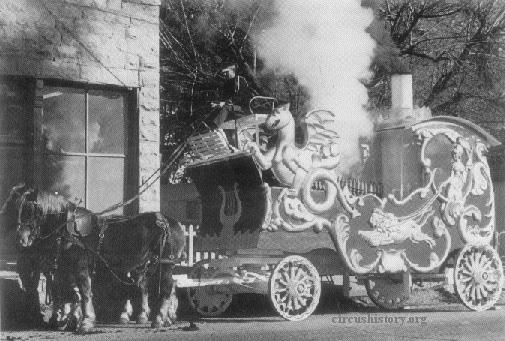
Several years ago, Mr. George Roose, President of Cedar Point, Inc., a summer resort and amusement park on Lake Erie, at Sandusky, Ohio, purchased the steam calliope instrument that was originally on the Goldenrod Showboat.
Mr. Roose retained Lee Gaeke, of Bucyrus, Ohio, to completely recondition the instrument. Gaeke, has reworked a number of steam units of various kinds for the Ford Museum, of Dearborn, Michigan.
The instrument had 32 whistles, but one was missing. Mr. Gaeke built a new whistle, reconditioned the key board and had a new boiler built. After the job was completed CHS Member Edward S. Starr, a former associate of Mr. Roose suggested that it be mounted in a circus wagon. The two men looked a various calliope wagons shown in Chappie Fox's Circus Parades book and finally selected the Ben Wallace calliope for reproduction.
With only the photo in the book to work with the order was given to Winfield Hubbard, of Morrison, Colorado, for construction. Hubbard, formerly with the Metro-Goldwyn-Mayer studios, operates Special Effects Company. He produces all types of animated scenes. The scenes of the Cedar Point Cruise Boat Ride and the Cedar Point and Lake Erie Steam Train ride were built by Hubbard earlier.
The design of the calliope was laid out in scale on paper. The various carvings were then molded in clay, a cast was then taken of the mold. The actual carvings were then cast from plastic, with gold powder mixed as the coloring. The body of the wagon was built of wood and is painted green. The under carriage is white and the sunburst wheels are naturally in full color. The photo reproduced here is a Kodacolor print and the colors are striking. The wagon will be on display this summer at Cedar Point.
The full history of the original Wallace calliope appeared in the May-June 1958 issue of the Bandwagon. However since many of our present readers do not have this issue we will review the history briefly. The wagon was built by Sullivan & Eagle wagon works in Peru, Indiana, around 1899. It was used through the 1906 season. After merging with the Carl Hagenbeck Circus, Wallace selected the best equipment from both shows and sold the rest. The Wallace calliope was sold to Campbell Bros. and appears in the panoramic photo of the Campbell parade. The Campbell show folded in 1912 and went to the Hall Farm. A new show, using much of the Campbell equipment, was organized in 1913, using the Cole Bros. title. This calliope was probably on that show. But it definitely appears on the 1915 Barton & Bailey show as shown in the photo here. The wagon continued to be owned by Hall and was also on the short lived Orton Bros. circus in 1916. The final known home for the old Wallace steamer was the Rhoda Royal show from 1919 to 1922.
Sells-Floto, Season of 1924, Mar.-Apr. 1964 Bandwagon
Member Don Marcks sent in some interesting information and three photos from his files. Don's father, the late Isaac Marcks, was one of the early circus fans who actually recorded in his notes information about the many circuses he visited. These files which Don generously makes available to The Bandwagon go back to 1900 and contain a wealth of information that often was not recorded in the trade publications, the N. Y. Clipper, The Billboard etc, such as lists of menagerie animals, wagons, train makeup, color schemes, tent sizes and a great variety of other data.
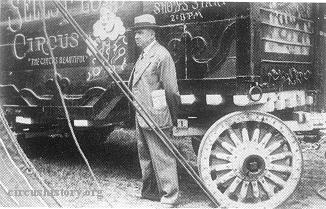
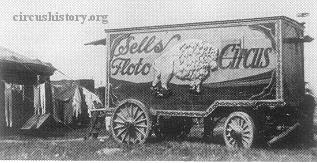
The first photo shows Isaac Marcks standing beside the Sells-Floto ticket wagon in 1932. Tom Mix had left the show and his name did not appear on the wagon as it had the two previous years. Instead, paintings of clowns were used on the sides and front of the wagon. The next photo shows the Buffalo Tableau wagon that was carried on Sells-Floto for baggage purposes up until the late 20's. This shot was taken about 1929. The final photo was also taken in the late 20's and shows the color scheme for Sells-Floto baggage wagons after 1925 when they were painted red and lettered in white (as here) or yellow.
Ringling Ticket Wagons at Barboo, Nov.-Dec. 1964 Bandwagon
Gordon Potter writes concerning the two Ringling ticket wagons recently added by the Circus World Museum at Baraboo. "When the Shows were combined in 1919 the White Ticket Wagon from Ringling Bros. became No. 122 White Ticket Wagon for the combined shows (high narrow windows, rounded on top, rather like church windows). The Red Ticket Wagon from Ringling Bros. became No. 121 Yellow Ticket Wagon (but painted orange, although called yellow). These two remained with the combined shows until they were replaced by the steel Springfield wagons in 1936, carrying the same numbers and names (but the yellow steel wagon was painted yellow, not orange). The scrolls on the corners of the steel wagons were red.
"In 1919 they used the Red Ticket Wagon from the Barnum and Bailey show for the No. 123 Red Ticket Wagon on the combined shows. It probably dated back to about 1903 at least. The White Ticket Wagon on Barnum and Bailey was older and of lighter construction, very much like the Buffalo Bill Ticket Wagon and it may have been the identical wagon as Barnum & Bailey had access to the Bill Show equipment because very little, if any, of it was taken to Europe. Then during the early 1920's (by '22 or '23) a wagon building program was begun at Bridgeport that was to gain momentum and continue to 1927 and 1928 at least. But well known circumstances slowed it down very much after that. At any rate during the early 1920's a new steel No. 123 Red Ticket Wagon was built for the combined shows and it is the one just sent to the Baraboo Museum from the Ringling Show at the New York Fair. It is 18 ft. long. The Springfield wagon built in 1936 is 16 ft. long. I am sorry I don't have the exact date the No. 123 wagon was built but the earliest picture I have showing it is from 1925 and it possibly was built a year or two before. When the No. 123 Red Ticket Wagon had wooden, steel tired wheels, the under side of the body at the front was 36" off the ground. The front wheels were 32" in diameter and the rear wheels 35", both with tires 61, wide."
Howes Great London Shows, Season of 1921, Sept.-Oct. 1964 Bandwagon
Member L. A. "Dude" Schrack writes an interesting account as follows," I was a biller on the advance car of Howes Great London in 1921 until about mid-season. I find in my Billboard day book my notes which said that the advance car left Lancaster, Mo. at 5:30 p.m. Monday, March 7, 1921 and arrived in Albuquerque, N. M. mid afternoon, Thursday, March 10. We billed the town the next day and arrived in El Paso on Saturday in time to do some billing that afternoon. The show only gave members of the crew 2 or 3 dollars each week for "tobacco money" until at the end of the fifth week at Richmond, Calif. when all were paid up in full. There were 27 men on the car when it left Lancaster, this included a cook and a combination porter and paste maker. Incidently the food and meals on the car were excellent. If you missed dinner or supper due to excursion billing you were paid 75c per meal. In California I did considerable excursion billing and notice in my book that I made as many as three towns a day, all by train. The 27 men on the car presented a problem whenever we made a train move or when there was a change of train crews and the conductor came around to count heads. The show had bought only 25 tickets to move the car so we had to hide two of the smallest men in the paper bins.
"I remember some of the men that had been on the show in 1920 saying that we had a bigger and better advance car in 1921." (Ed note: Dude is contacting old friends of his who were also on the advance car in 1921 in an attempt to find a photograph of the advance car. If one is found it will be printed in Bandwagon.)
No part of this publication may be reproduced in any form or means
Last modified February 2006.
without written permission of the author and the Circus Historical Society, Inc.