


Circus Historical Society
Bandwagon, September - October 1964
Back to Bandwagon Index
Bandwagon, Vol. 8, No. 5 (Sep-Oct), 1964. Note: Only some articles are included in this online edition. Many illustrations are not included. The Circus Historical Society does not guarantee the accuracy of information contained in the information in these online articles. Information should always be checked with additional sources.
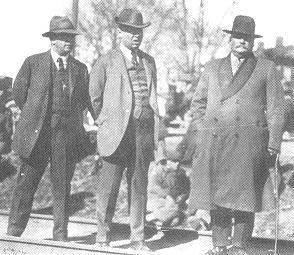 Photo No. 2 - Classic photo showing (left to right) Dan Odom, Jerry Mugivan and William P. Hall watching the Howes Great London Circus train load at Lancaster, Mo., to begin the 1921 season. Woodcock Collection.
The beautifully equipped 25 car circus put out in 1921 by Jerry Mugivan, Bert Bowers and Edward Ballard under the title of Howes Great London Circus and Van Amburg's Trained Wild Animals has long been a favorite of circus photo collectors. Very few shows, if any, ever surpassed it in photogenic appeal and today it stands near the top as an all time favorite of collectors and historians. No doubt the widely circulated prints from the Langer and other negatives has whetted interest in this show.
Like so many other famous old titles in American circus history the names of Howes and Van Amburg were two that were perpetuated and used by operators long after the originators had passed from the scene. Seth B. Howes died in 1901 but he personally had not been connected with circuses bearing his name in over 25 years. His brother, Nathan, and Isaac Van Amburg had been dead for some years before that. The titles of Howes and Van Amburg were two in the depository of old circus names held by Mugivan, Bowers and Ballard. An interesting fact to note is that in 25 years of circus ownership Mugivan and Bowers never once used their own names for the title of any show they operated but continually followed their policy from their earliest days of using some contemporary well known circus title or a name of value that had been popular in days gone by. When they sold their holdings to John Ringling in September, 1929, this transaction, in addition to the physical properties of five active circuses, included almost a dozen of the best known circus and wild west titles of all times.
Mugivan and Bowers' first show which was put out in 1904 was called the Great Van Amburg Show. The physical property for this show had come from the purchase of a railroad circus owned by Bill and Frank Smith of Kansas City using the Howes Great London Show title in 1903. In mid season 1908 the name of the show was changed from Van Amberg to Howes Great London Show and the former title was not again used until 1921 when it became a part of the lengthy title of the show in this article.
The Howes title was used continuously through the 1916 season at which time it was then travelling on 21 cars, 1 advance, 6 stocks, 8 flats, and 6 coaches. In 1916 Mugivan and Bowers also operated the John Robinson Circus on 30 cars.
For 1917 the Howes title was shelved and a single 45 car circus titled John Robinson was put on the road using the best equipment from the two 1916 shows.
In 1918 again, only a single show was put out by the duo, John Robinson, with the number or cars reduced to 28. For the seasons of 1918 and 1919 they leased the Howes title to Herbert Duvall and Chester Monahan for a two car circus.
The post war boom year of 1919 was tremendous for nearly all shows and Mugivan, Bowers, and Ed Ballard, now a partner, reaped a small fortune with their two fine 30 car circuses, John Robinson, and Hagenbeck-Wallace.
For 1920 they framed a third show to go out which was on 15 cars (1 advance, 4 stocks, 6 flats, and 4 coaches) using the Howes Great London Show title and named C. D. "Danny" Odom as manager. The Don Marcks notes lists the 1920 show as having 4 elephants, 4 camels, 1 sacred cow, 7 cages of wild animals, a good lineup of sideshow attractions and canvas consisting of a 4 pole big top, 3 pole menagerie, 3 pole sideshow, dressing and ring stock tent, 2 baggage stock tents, cookhouse, kitchen, Strange Girl pit show tent, hot dog stand, and candy stand. A further note stated that all wagons, train, etc., were painted orange.
The post war boom hit its peak in 1920 and the 3 Mugivan, Bowers and Ballard shows, John Robinson, Hagenbeck-Wallace, and Howes Great London were all big winners. In late season 1920 this trio purchased from Fred Buchanan, the Yankee Robinson Circus and a few weeks later the Sells-Floto Circus including the Buffalo Bill title and the show's winter quarters at Denver from the Bonfils-Tammen interests. After these purchases Sells-Floto was quartered at Denver while the Yankee Robinson 25 car show (1 advance, 6 stock, 12 flats, 6 coaches) was sent to the William P. Hall Farm at Lancaster, Mo. The Howes Great London Show was also sent to winter at the Hall Farm.
During the winter of 1920-21 Danny Odom was directed to frame a top notch 25 car show which would take to the road in 1921 with Odom as manager. The best equipment of the Yankee Robinson show and the Howes show would be used with the surplus property sold. Full title given to the new show according to the letterhead was Howes Great London Circus and Van Amburg's Trained Wild Animals. The word "Shows" was used instead of "Circus" on the sideshow banner and in the lettering on some of the wagons. In general the Howes portion of the title was more predominate especially in the newspaper advertising and other printed matter.
Noted wagon builder and mechanic, Tom Tucker, was placed in charge of getting the physical properties ready for the new show and the Feb. 26, 1921, Billboard reported that Tom lost two fingers in a rip saw accident while doing this job.
The best rail equipment of the two shows was chosen and the 25 car train on opening day was a beauty consisting of 1 advance, 6 stocks, 12 flats, and 6 coaches. Although the show claimed an all steel train such was not the case. The cars were the wooden and semi steel type in common use by circuses then. The new 70 and 72 ft. all steel Mt. Vernon flat cars were just making their appearance and the first ones had been delivered the previous season to Hagenback-Wallace with Al G. Barnes and Sparks scheduled to have the same ones that had been used by Hagenbeck-Wallace. In fact the Howes opening in 1920 had to be delayed until the cars arrived from Hagenbeck Wallace. That show had planned to have the new Mt. Vernon cars at the beginning of the 1920 season but due to a slight delay in receiving them had to go ahead and start the season on the old wooden cars and of course Howes couldn't move until they got the H-W cars.
The Billboard reported the 1921 Howes cars to be painted orange with dark brown lettering. Photos indicate the flats and stocks to have been painted this way while the coaches seem to have been orange with the title in white on a dark brown letter board. It was an attractive sight. I have been unable to determine from which of the two 1920 shows each individual car came. The late Bill Woodcock and I discussed this situation at length last year and he was able to shed some light on it but not give the entire story. Bill said that he wasn't certain if the Howe 1920 advance car was used in 1921 or not but suspected maybe a larger car was used. The Yankee Robinson advance car was one of 8 cars of surplus equipment sold to the newly organized Palmer Bros. Circus and shipped from Lancaster in the spring of 1921. Woodcock said he saw the 1920 Howes advance car and that it was a rather short combination car, probably used on an earlier Howe show and was not repainted for 1920. On sides of the baggage end of the car was painted a pictorial - that business of hunting tigers from backs of elephants.
The 6 coaches in the 1921 train were numbered 60-65 and were all of the vestibule type and although the show claimed to have all new Pullmans it is rather certain they came from the Howes or Yank trains.
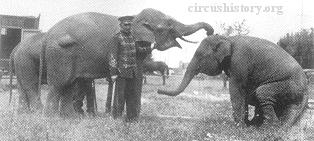 Photo No. 9 - Ed Davis with Toto, a very tough little male elephant, in center. Woodcock Collection.
There were nine Indian elephants accumulated at Lancaster from the herds of the two shows. Howes in 1920 had 4 bulls, Alice, Nellie Lockhart, Lizzie and Toto. On Yankee Robinson in 1920 were five, Rubber, Billy, Mary, Katie and Babe. Rubber was sold to Palmer Bros. and Billy, a male, was shipped to the Sells-Floto Circus in Denver where his name was changed to Young Snyder. Mary and Katie were also shipped to Denver but later they were returned to Lancaster before the season opened. For the 1921 season the 7 elephants making up the herd were, Alice, Nellie Lockhart, Lizzie, Toto, Mary, Katie and Babe. All were females with exception of the tough little male, Toto.
Other lead stock consisted of several camels, a sacred cow, and several zebras including the Yankee Robinson "Atlas."
The show's official 1921 route book listed three 8 horse drivers, six 6 horse drivers, six 4 horse drivers, and three 2 horse pull up drivers. Since the helpers were named separately under the same classification it can be assumed the show carried the number of teams as listed which would give the show a total of 90 head of baggage stock which would be about correct for a 25 car show in those days. A huge Mack tractor was carried to assist in moving wagons to and from the lot and at times pulled the steam calliope in parade.
Photos indicate [missing text] show to have carried about ten [missing text] in the menagerie, most of them being painted a dark color, presumably red or dark orange. I don't have the exact number of cages carried by Yankee Robinson in 1920 but Bill Woodcock saw the show in 1919 and reported 6 cages were present and in all probability that was the number of 1920. If so, this six plus the 7 from Howes would give the show an ample number to equip the menagerie. Neither show had a cage suitable for a hippo so when the young 600 lb. male hippopotamus, "Little Vic" was purchased from the Washington, D.C., Zoo in Feb., 1921, an adequate cage had to be sent from Sells-Floto in Denver to Lancaster to house the new menagerie prize animal. This "Little Vic" in later years grew into the giant "Victor" who sired many an offspring at the Peru quarters in the late 20's and early 30's. When I saw this behemouth on the John Robinson Circus in 1929 1 thought then and still do that he was the largest hippo I ever saw.
Caged animals in 1921 included the performing leopards, pumas, lions, tigers, polar bears and monkeys. A glass enclosed snake den was carried which went back until at least 1907 on Mugivan and Bowers units. Most of the ex Howes cages had inside type sunburst wheels while the Yankee cages had the outside type.
An outstanding parade led a magnificent bandwagon was a major asset of the enlarged Howes show. Ringling-Barnum made circus history by dispensing with their daily street parade in 1921 but all other major railroad flat car type circuses as well as most of the smaller gilly railers and mud shows continued the time honored tradition of the march.
As was true of the rest of the equipment all of the parade wagons with one exception came from either the Howes or Yank show.
The massive, heavily carved, No. 1 bandwagon was one of the most elaborate tableau wagons ever built and the late Bill Woodcock often proclaimed it one of his all time favorites. It featured carved statues on the corners and deep, finely carved, angels and a faced disc on the sides. It was painted white with the carvings in gold leaf. At times it was hauled by a special 10 horse hitch while other times an eight was used. This wagon (see photo 10) inaugurated the Circus Wagon History File and was pictured on the cover of the May-June, 1957, Bandwagon, the first issue of the enlarged size. The wagon was built by the Leonhart Wagon Works of Baltimore with carvings by Spangers as one of a set of wagons built in the winter of 1909-10 for Norris & Rowe. At the receiver's sale of that show held in August, 1910, the wagon was purchased by Wm. P. Hall. It was later sold to the Miller Bros. 101 Ranch Wild West Show and was definitely on that show for the 1913 thru 1916 seasons. In 1917 it was on the Buffalo Bill-Jess Willard Wild West Show and from 1918-20 on Yankee Robinson.
A large wagon with three panels of paintings was used as the No. 2 bandwagon. This one originated on the Dode Fisk Show in 1910 and was pictured extensively and covered in Circus Wagon History File, Mar.-Apr., 1962, Bandwagon. It had been owned by Mugivan and Bowers since 1911 and appeared on their Great Sanger Shows, Robinson's Famous Shows, and was on Howes Great London as the No. 1 bandwagon in 1920. An eight horse bitch pulled it in parade.
The clown band rode a large drop frame wagon featuring a full side painting of a polar bear and hunter in an arctic setting with the Howes part of the show's title painted on the sunboard. A six horse hitch pulled it. This wagon (see photo 11) was quite similar to several of the same general type owned by Mugivan and Bowers in that period. Two wagons which appear to have practically the same profile as this one and the 1921 sideshow bandwagon are pictured in a lineup of newly built wagons by Moeller Brothers for the Dode Fisk Shows in 1909. Since Mugivan and Bowers purchased the Fisk show following the 1910 season and retitled it Great Sanger Shows for the 1911 season, I am of the opinion that this wagon came to them at this time. It had a series of different paintings through the years while on Sanger, Robinson's Famous, but in 1920 on Howes Great London the beautiful polar bear painting was present.
The sideshow bandwagon was likewise a drop frame wagon which had a full side painting of a lion hovering over the prostrate form of a maiden and was commonly called "The Lion's Bride" by Woodcock and other early wagon historians. A six horse hitch pulled it in parade. This wagon (see photo 13) is believed to have gotten to the show by the same route as the clown bandwagon. It was the Howes sideshow bandwagon in 1920 and the Howes portion of the title was painted on the sunboard.
The only other tableau wagon used by the show in 1921 that we have been able to determine from photos and eyewitnesses is shown in photo No. 14, while the wagon was on the John Robinson Circus in 1924. Enough of the wagon shows in one of the 1921 Langer photos to positively place it on the show that season despite some earlier doubt if it was there. It is shown in a line of other parade wagons unmistakably Howes 1921. This was the oldest and most traveled of the parade wagons. It originated as a tableau-den on the Forepaugh show in the late 80's or early 90's and later it was on Forepaugh-Sells from 1896 through probably the final season of 1911. In 1913 it was a part of a group of wagons sold by the Ringlings to Rice Bros. Colossal Railroad Shows which lasted that one season. Mugivan & Bowers got it after that and it was used by them on one of their shows in the period 1914-16. Woodcock placed it on Howes Great London about 1916 for sure. Evidently it was on Howes in 1920 although photographic evidence has failed to show it. If not there then it must have been sent to Lancaster from Peru quarters in time to join the 1921 show.
In 1920 Howes did not have an air calliope and although Yankee Robinson had one, for some reason it did not figure in the sale and was retained by Fred Buchanan, so therefore no air calliope was available at Lancaster. It was necessary to obtain one elsewhere so an air calliope that Sells-Floto had used at one time was shipped from Denver. It had a large keyhole type opening in the center and two eliptical shaped mirrors surrounded by raised carvings on either side of the opening. This wagon (see photo 1) was pulled in parade by a 10 pony hitch. In the late teens Sells-Floto had quite a few musical type parade wagons. Bill Woodcock told me that when he caught the show in 1917 the parade had in it two air calliopes, one steam calliops, a unifon and a large organ wagon.
The steam calliope had a large lion and clown riding mule carving on the sides and was on the Yankee Robinson Circus from about 1917 thru 1920. The wagon, see photo 12, was covered in Circus Wagon History File, Sept.-Oct., 1958, Bandwagon.
Photos show that fancy harness and plumes were worn by baggage stock in parade, drivers and helpers were uniformed and helmeted, cages had colorful banners, and in general the parade picture was one of beauty and neatness. Numerous mounted people, the lead stock, and Wild West Section completed the march lineup.
Baggage wagons appear to be dark colored, presumably the same shade of orange the Howes wagons had in 1920. That was a common color for baggage wagons on some Mugivan and Bowers units in those days. The Mack truck was titled but none of the baggage wagons appear to have been. Undergear and wheels were white.
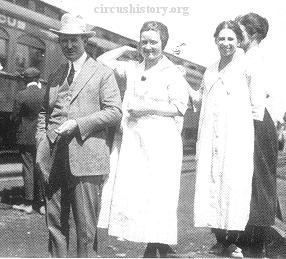 Photo No. 6 - Treasurer Jess Adkins and Mrs. Adkins on left. Langer Photo.
The show's executive staff included Dan Odom, mgr. and gen. director; Fred Asal, asst. mgr.; Jess H. Adkins, secy.-treas.; Louis R. Dobson, auditor; George W. Ryan, legal adjuster; Frank B. Miller, equest. director; John F. Dusch, bandmaster; Ray Daley, sideshow mgr.; Frank W. Braden, press agent on show; Charles Mugivan, front door; H. W. Wingert, supt. inside tickets; Jack Beach, advertising solicitor; Chas. W. Sweeney, wardrobe; Tom Tucker, lot supt.; Harry Sells, supt. canvas; Jack Phiffenberger, supt. sideshow canvas; Louis Roth, supt. menagerie; Joe Metcalf, supt. elephants; Eddie Snow, supt. of baggage stock; Earl Greer, supt. of ring stock; R. H. King, supt. electric lights; Harry V. Miller, supt. of gas lights; August Crist, trainmaster; Wm. B. Baird, and John Hickey, 24 hour men.
The advance staff was headed by Burt Rutherford, gen. agent and traffic mgr.; Frank O'Donnell, contr. press agent; W. J. Lester and Emory Proffitt, local contractors; Clyde Williard and C. L. Westlake, special agents. Sixteen men handled the duties in the advance car.
The big show band listed 24 musicians and the sideshow minstrel band 12.
Ray Daley's sideshow had a good lineup of attractions including Elizabeth Shropshire, mind reader; Queen Pearl, world's smallest soprano; Big Ed, giant; Eleanar Kissell, bag puncher; May Bell, snake charmer; May Clark, sword walker; Prince Bo Bo, Cannibal chief, and dancers, Scotty, Montague, Princess, May, Eva, Goldie and Lucille. The minstrel section had seven comedians, singers and dancers, in addition to the band.
Ray Daley owned the No. 2 pit show which featured Irene. Eddie Watson was manager.
The official route book listed 19 men as big top performers plus the Gene Hamil Troupe of 10 Arabs, and there were 24 lady artists. Joe Greer managed the Wild West concert unit which had seven cowboys and cowgirls in addition to himself.
A top notch performance was presented featuring a good balance between wild animals and regular circus type acts. Louis Roth and Chubby Guilfoyle were outstanding wild animal trainers and a number of acts, all under the general direction of Roth, were featured. The steel arena remained in place throughout the performance. During the years 1921-24 trained wild animal displays reached their peak in the U. S. and practically every major circus was now filling its program with them. Strangely enough it was during this period that major carnivals generally dispensed with theirs entirely after having featured them for so many years. From 1925 on a gradual decline in the number of this type of act on circuses set in.
In the list of animal department personnel the route book mentions the name of a young man by the name of Clyde Beatty. Likewise the list of clowns, headed by Kenneth Waite, contains the name of one Emmett Kelly.
For the first time ever the Mugivan-Bowers-Ballard combine put four railroad circuses on the road in 1921. In addition to Howes Great London they had out Sells-Floto, managed by Zack Terrell; Hagenbeck-Wallace, managed by Bert Bowers, and John Robinson, managed by Jerry Mugivan. All of these shows were on 30 cars. The trio of owners would soon form the American Circus Corporation which would control a major portion of the circus business in the country.
Other railroad circuses, flat car type, on the road in 1921 in addition to the four mentioned were Ringling-Barnum, Al G. Barnes, Gentry Bros., Rhoda Royal, Walter L. Main, Sparks, Campbell-Bailey-Hutchinson and Palmer Bros. In the gilly railroad class was Christy Bros., a top flight 3 car show, one operated by Floyd and Howard King, several by E. H. Jones and a few more. Fully two dozen medium and small mud shows were on tour.
With four shows now on the road Mugivan and company could now go after nationwide business, and it was soon rumored in the Billboard that the enlarged Howes show was headed for California and the lucrative business that had been pretty well gathered in each spring exclusively by Al G. Barnes. The March 12 Billboard reported that a circus war was imminent and that brisk warfare would be carried on between Howes and Barnes. It was stated that Mugivan was reported to have signed contracts with Southern Pacific RR that would duplicate the Barnes route and that Al G. and his flock were busy perfecting their defensive plans. The same issue of Billboard said that the two shows would clash in 32 California towns. For example, in Los Angeles Howes would be there April 11-12 following Barnes' week stand of March 21. Barnes opened the season early, March 8, at Pomona and got into the territory first.
The March 5 Billboard had contained the official Howes "call," advising that the train would leave Lancaster, Wed., March 16, to open in Albuquerque, N. Mex., on March 26. Performers were advised to report either to Lancaster and ride the train west or to be in Albuquerque by the time it arrived. Thus the show was making an expensive 1100 mile run to put it into territory to take on the Al G. Barnes show in a battle for patronage. Albuquerque was a favorite opening stand for Sells-Floto while it was quartered in Denver, especially when it was headed for the west coast in early spring.
Jerry Mugivan came to Lancaster to personally watch the train load and leave for its opening stand.
The initial run was made in good time but a suspected act of sabotage occurred when four large performing lions were found dead in their cages at Wellington, Kan., when the show stopped for food and water. A baby camel born in Kearny, Mo., March 18, died in Albuquerque the day before the show opened.
The following article appearing in the April 16 Billboard is quite complete in listing the show's performance on opening plus giving other interesting data as to tent sizes, parade lineup, and general physical layout of the show.
"Howes London Show. In the Major Circus League Class - Show a sight to Behold, the parade a Beauty, We Are Told."
"Phew! That was some 'run' from Lancaster, Mo., to Albuquerque, N. Mex. but what is a railroad movement involving more than twelve hundred miles and thousands of dollars to a complete combination circus and trained animal exhibition such as Howe's Great London Circus and Van Amburg's Trained Wild Animals.
"No writer can do justice to an article dealing with the Howe circus, for everything from the performance down to the physical equipment is that which the most astute showman might desire. Trained wild animals, trained by Louis Roth; performers that have gained a reputation in their individual lines; splendid ring stock; baggage stock in abundance of well known 'dapple gray' variety that would do credit to their owners in any heavy draft horse exposition; a complete new canvas which causes the veteran, Harry Sells, to swell with pride. All this coupled up with a perfectly balanced program of mixed circus and trained wild animal acts surely makes the Howe show one of the best in the major circus league. It is one of the most wonderfully painted shows on the road.
"The big top is 140 with three fifties, the menagerie is a ninety with three 40's, while the sideshow is a seventy with three 30's. There are three rings and the big steel arena in the big top, twenty-four cages in the menagerie (Ed. note: Not to be construed as that many separate vehicles as old time reviewers often considered an individual den compartment as a 'cage') and seventeen platforms in the sideshow under the management of Ray Daley. Daley deserves credit for framing up a perfect 'satisfaction money getter.'
"The parade is considerably more than a mile in length. Old showmen who have ‘caught' the parade join in with spectators in speaking of it in the most glowing terms.
"The color schemes of the magnificent trains are a solid orange with dark-brown trimmings. Every Pullman sleeper, every flat, stock and box car is as plumb as the master builder can turn them out. No gilt was used on any wagon with the Howe Circus.
"The show made three 'feeding stops' during its run to Albuquerque which was the opening stand. The stops were made at Kearney, Mo.; Wellington, Kan., and Canadian, Tex. The movement was made in three days and a half, allowing six and eight hours each at a 'feeding stop.' Not a single mishap was registered.
"The season opened March 26 in Albuquerque. In spite of cold weather a practically capacity audience looked the big show over for the first time and in the evening, despite the cold rain, sleet and snow, a good sized 'house' greeted J. F. Dusch and his twenty-five musicians as they headed the big grand entry. The audiences roared forth their approval of each act, and as the trains departed for El Paso, the next stand, they were still 'whooping it up' for the Howe circus. The two daily newspapers devoted liberal space to the show."
The following program is the one now being used, but it is not the set program for the season. Other big acts will be added:
No. 1 - Tournament by entire company.
No. 2 - Garland entry. Sixteen gentlemen riders.
No. 3 - Elephants in rings one and three. Joe Metcalfe trainer; Jack Kelly, assistant; Kenneth Waite, producing clown with many clowns.
No. 4 - Six pony drill in ring one; six Polar bears in arena; six pony drill in ring three.
No. 5 - Song and pigeons featuring Miss Hickey, the lady baritone; clowns walk around.
No. 6 - Six horses worked by Mr. Sabel in ring one; four horses worked by Mr. Barry in ring two, and four horses worked by Roy Thompson in ring three.
No. 7 - Aerial number; bounding rope; Will Langer, single trapeze; Miss Maud Hickey, balance traps; Mr. Benson, Howard Sisters, Mrs. Knight and Son, Mrs. Smith, Mrs. Bell, The Kesters, Mr. Loyd, swinging ladders.
No. 8 - Dancing lions, worked by Mrs. Guilfoyl.
No. 9 - Principal lady riding act. Miss Sweeney in ring one and Miss Wallet in ring three. Mr. Sweeney, ringmaster.
No. 10 - Dog acts. Troupe of ten dogs worked by Mr. Martini, and riding dog and monkey on pony worked by Chas. Berry.
No. 11 - One hundred foot head slide featuring Hap Hazzard; concert announcement.
No. 12 - Statue act. Mrs. Dusch, Miss Hickey, Miss Clark, Mrs. Bell, Mrs. Kester, Mrs. Kleinpeter, Miss Lowell and Miss Smith.
No. 13 - Wild animal act. Elephant and pony in ring one, worked by Chas. Berry; pumas and leopards in arena worked by Miss Nelli Northrup; elephant and pony in ring three, worked by Joe Metcalfe.
No. 14 - Two camels and horse in ring one, worked by Mrs. Sabel; six pigs in ring two, worked by Chas. Berry, and two camels and pony in ring three, worked by Mr. Burns; clown wedding.
No. 15 - Tight and slack wire acts, Hap Hazzard, The Four Knights, Mr. Burns; contortion act, Mr. Loyd.
No. 16 - Wild Animal Act, The riding tigers and elephant in arena, featuring Mr. Guilfoyl and assisted by Mrs. Bell.
No. 17 - Aerial iron jaw, Howard Sisters and Mrs. Jose Greer; Clown band.
No. 18 - Menage acts. Riders; Jose Greer, Mrs. Carreon, Mrs. Smith, Mrs. Clark. Miss La Belle Clark, Miss Hickey, Miss Northrup, Miss Daily, Miss Burns, Ray Thompson, Chas. Berry, Mr. Sabel, Frank B. Miller. Second concert announcement.
No. 19 - Gents principal bareback riders.
No. 20 - Animal Act. Six Royal Bengal tigers, presented and worked by Louis Roth.
No. 21 - Jumping horses, presented by Mr. Greer and Ray Thompson.
No. 22 - (omitted).
No. 23 - Clown mule hurdle. Mr. Clark and Carlos Carreon.
No. 24 - Feature wild animal act. The four riding lions in arena worked by Louis Roth; Frank B. Miller, equestrian director: Wild West Concert; Silver Jose Greer's Wild West with Carlos Carreon, Jose Greer and Bill Mossman, rope spinners; Carlos Carreon and Joe Greer, spinning a ninety foot loop; six horse catch by Jose Greer; trick riding presented by Bill Mossman, Harry Greer and Mrs. Carlos Carreon; bronc riding by Bill Mossman, Carlos Carreon and Mrs. Carlos Carreon. The concert closes with a wrestling exhibition in which Herman Hackenschmidt challenges any wrestler to stay with him fifteen minutes or forfeit $100.00. (Doc Stuart, Show Representative).
The show next moved to El Paso and then a week of long runs which took it across New Mexico, Arizona, and into California, April 4, at El Centro.
A total of 28 stands were played in California with Barnes opposition at 18 of them. Billing was very heavy, opposition heated, but if any physical clashes between the two shows advance took place the Billboard is silent on that score.
The April 16 Billboard broke the story about the death of the lions during the initial run stating the animals were poisoned and that Pinkerton detectives had been assigned to the case. Although show officials jealously guarded details of the losses it was mentioned that the poison was done by a disgruntled employee who is alleged to have been "red lighted" to get even. Mugivan attempted to purchase a number of cat animals from the Los Angeles Zoo.
The show claimed good business during the three day San Francisco engagement. Two parades were staged. The Billboard reported several details of the show and said that the featured act of the Hamid Arabs (added since the opening) was a fast tumbling presentation. A reviewer praised the wire acts of the Arthur brothers, Hap Hazzard, and the Knight Troupe. A. H. Knight didn't appear in Frisco because of falls in Visalia and Santa Cruz. The colored sideshow band, under leadership of Montell Proctor, drew raves on its appearance in the parade, and the reviewer remarked that the show's clowning was very good, the wardrobe neat and expensive.
Marysville on May 4 was the last stand with Barnes opposition in California. The show played Colfax the next day and then entered Nevada at Reno and moved across the state to Idaho. Which show won the battle for the California business has never been fully documented but Barnes men have traditionally claimed victory. For certain Mr. Mugivan and company became highly interested in obtaining the Al G. Barnes show and made numerous efforts over the next few years to purchase it, finally succeeding on Jan. 5, 1929.
Barnes continued on up to the west coast going into Oregon and Western Washington and the battle was temporarily halted as the two shows moved away from each other but it was destined to flare again a few weeks later in Canada.
Howes moved up through Idaho. Shoshone papers gave a splendid after-notice especially praising the band. The show was at Pendleton, Ore., on May 16, at Walla Walla, Wash., the next day, and then came back into Idaho for three more stands. Spokane was played May 21 and the show entered Canada the next day with the first stand scheduled at Cranbrook, B.C., on the 23rd. Howes then moved eastward through British Columbia, Alberta, Saskatchewan and Manitoba. May 25 at Lethbridge, Alta., saw the first of ten Canadian stands with Barnes opposition. In California Barnes had been about 10 days to two weeks ahead of Howes but now Howes was going in first. Barnes came into Lethbridge 12 days later on June 6 and Howes was generally about this much ahead of Barnes in the Canadian stands.
Ft. Francis, Ont., on June 16 ended the Canadian tour and the show entered the States for a stand the next day at Virginia, Minn. A rail wreck occurred enroute to Virginia. The accident was minor and no damage resulted but the delay caused the loss of the matinee.
The June 18 Billboard stated that Frank (Doc) Stuart, press agent, in 49 stands so far had landed 39 two column front page stories, besides 15 box stories and incidents, two A.P. and one U.P. story. Doc left the show at Winnipeg and was replaced by B. Brown, a newspaper man. Same issue of Billboard claimed capacity business at Edmonton on May 30-31 and said the parade contained 18 cages of wild animals, 4 bands, 2 calliopes and 54 mounted people and that Louis Roth, Nellie Northrup and Hattie Guilfoyle who were working the wild animal acts were making a big hit with the fans.
Duluth, Minn., on June 20 was the last Barnes opposition stand for about a month. Howes played a week in Minnesota then went into North Dakota for nine stands. R. Cromwell wrote to the Billboard that he visited Howes at Minot and was pleased with the animal acts, especially Louis Roth's presentation of a 2 year old lion riding the back of a splendid 1600 lb. horse. The traditional July 4 dinner was held at Fargo.
July 6-9 saw the show back in Minnesota with a two week tour of Iowa following. Four Illinois stands were next with Barnes in opposition at two of them, Bloomington and Champaign.
The July 30 Billboard summarized the recent weeks of the Howes show as follows: "Since return from Canada Howes Great London business has been up to expectations. In Minn. and the Dakotas the show did exceptionally well. Louis Roth has his riding lion working. John (Chubby) Guilfoyle is working the polar bear act and his wife is working the pumas. The menage number of 12 horses is one of the big hits of the program, likewise the high jumping horses worked by Silver Joe Greer, Etta Carreon, Hazel Hickey, Nellie Roth and Charles Berry. Silver Joe Greer has charge of the Wild West and Herman Hackenschmidt, wrestler, is meeting all comers. The sideshow, under direction of Roy Daily, is getting good patronage daily."
The Aug. 13 Billboard said the show arrived in Mommouth, Ill., early Sunday morning and the parade was out the next day promptly at 11 A.M. There was a parade license of $75.00 but merchants agreed to pay $50.00 and the show the remaining $25.00. Business was fair. The article continued giving the following summary of stands. Mendota, Ill., everything on time but the customers. Poor business there. Bloomington, Ill., arrived late, lot far out, parade at 1 o'clock, Messrs. Mugivan, Bowers and Ballard visited here, business good. Champaign, Ill., arrived early, lot close in, parade on time, rained on matinee, but had good business at night, Crawfordsville, Ind., arrived early, beautiful lot, parade on time, business good. Lafayette, Ind., arrived early, long haul to lot, parade at 12, showed at Ball Park, Barkroot's Carnival here, business good at both performances. William P. Hall visited at Fairfield, Iowa, where the show placed an order with him for 8 black horses, which arrived at Bloomington and are now making a splendid showing in parade. The baby hippo, Vic, is making a hit and is probably the only hippo in the world to do an act.
Seven Indiana stands from July 29-Aug. 5 came next with Barnes opposition at Logansport and Richmond. The next week saw the closest competition of the season with Barnes at Cincinnati and Lexington and Louisville, Ky. Howes was in first by only 5 days. The off and on season long battle with Barnes came to an end at Louisville. Howes then headed eastward into Ohio and West Virginia while Barnes went westward through Illinois, Mo., and on the long trek back to California quarters.
The Aug. 27 Billboard summarized quite thoroughly the recent Howes activities and said that the show had its top money day of the season at Hillsboro, Ohio. Business had been exceptionally good in the middle west but it was not until the week of Aug. 1 that it became necessary to seat the overflow customers on the straw as was the case at Cummingsville, Norwood, Lexington and Louisville, which had two capacity audiences. At evening performances in Louisville people were packed to the ring curbs and a late arrival was all that stopped a huge afternoon turnaway. Business on this day was just a few dollars short of the banner date at Winnipeg. At Hillsboro, the top money date so far, saw an afternoon turnaway and a capacity night house. Town was show hungry being four years fresh. Good reviews appeared in both Cincy and Louisville papers with latter having a three column pictorial layout. At Cynthia, Joe Greer purchased a beautiful bluegrass thoroughbred named "Golden Glow," said by papers to be the most horse in America.
The show began its southern tour Aug. 27 at Manasas, Va. Although shows in their Billboard letters usually claimed good business regardless, it was generally known that the sharp recession that set in following the post war boom was hurting all outdoor show business very badly. The Sept. 3 Billboard reported that conditions in the south for show business were not good but that North Carolina seemed to be best and that nearly every town in the Tarheel state was to have a circus with Howes Great London, Sparks and Cole Bros. making a bid for business.
The Sept. 10 Billboard summarized Howes business in Ohio and West Virginia, stating New Lexington was big despite a cloudburst, Uhrichsville and Cambridge packed the big top twice, Clarksburg, W. Va., had a jammed matinee and a real dyed in the wool turnaway at night. No show had paraded there in years due to the narrow, hilly and bridged streets but Dan Odom made three trips over the parade route and decided to parade. Good business was also experienced Aug. 25 at Hancock, Md.
The show played extensively through Virginia and North Carolina before entering South Carolina Oct. 11 at Mullins. The second and last of the season's rail accidents took place between Washington, N.C. and Plymouth, N.C., on a Sunday run. Only a few hours delay with only minor damage to the show's equipment. The Sept. 24 Billboard reported it as follows:
"Howes Great London Circus train encountered a spread rail Saturday night, Sept. 10, backing onto an ACL siding at Parmele, N.C., to permit the passing of a passenger train and a king pin on one flat broke wrenching the car bed from the trucks and hurling the electric light plant wagon, the jack wagon, and a seat wagon into a ditch. The perfect rolling equipment averted a serious catastrophe as the train stopped instantly upon the application of the air. That and the rate of speed being low saved the piling up of several flats and coaches."
Mullins, the first stand in South Caroline, offered the show nothing extraordinary in the way of business but will be remembered by the troupe for Louis Roth's operation on a broken tooth of one of the lions, Brutus, so was reported by the Billboard correspondent. He also stated that Ray Daley's sideshow had been doing good business with the minstrel show now using 21 people and the correspondent faceously mentioned that Ray's ballyhoo stand resembles the ensemble of a big Broadway review - slightly sunburned.
A later Billboard report said the night stands in South Carolina were picking up and that at Union the crowds especially were delighted with the show. On the run from Union to Aiken, a jump of 142 miles, the Howes show passed the John Robinson trains enroute. Each troupe was travelling in two sections, but the Howes trains, because of the longer haul, had the right of way. Greetings were called as the shows passed. Howes arrived in Aiken at 10 A.M. but parade was made promptly at 12:30 and the afternoon show began at 2:30 to a three-quarter house. Night business was comfortably capacity with only one short section of reserves on the back side "out." The same report said that Eddie Walton, formerly with the balloon concession, was now managing the No. 2 "Irene" pit show with much success, that the horse and camel acts have become feature offerings.
The show was in cotton country and moved into Georgia for five stands before heading for Florida. The boll weavil had made cotton crops bad throughout the south and although the Howes correspondent still reported good business and sounded optimistic. the John Robinson show, also playing in the same territory, frankly wrote that conditions were poor in the south.
In those days the State of Georgia had an especially harassing blue law for circuses and carnivals in that no show train could get underway in the state from midnight Saturday until midnight Sunday. However, if the train was already on the road and travelling prior to midnight Saturday it was not required to halt. To avoid the absurd and vicious law and the inconvenience it caused, the Nov. 5 Billboard reported what the Howes show did to avoid it, as follows:
"One of the prettiest runs in the annals of show business was registered Saturday night, Oct. 22, when Howes Great London Circus gave a complete night performance, tore down, loaded, and pulled out of Eastman, Ga., with such dispatch as to reach Helena, Ga., 20 miles away before midnight, thus complying with the law in respect to Sunday movements. The show, which left Eastman on the Southern, was moving over the Seaboard line at Helena at 11:45 P.M. Great credit for the feat must be given Tom Tucker, supt. and Dutch' Christ, trainmaster. The run from Helena to Americus, the Monday stand, was made in two sections."
Thirteen stands were played in Florida and to better business than that which had been experienced lately. The Billboard said that Florida was giving the show splendid night houses with matinees fair. At Jacksonville rain began at 1 P.M. and hurt a matinee which was plainly to be the banner one of the season. It had a three-quarter house but the rains stopped later and at night the show had a packed house. Messrs. Mugivan and Ballard came on the show that day to discuss winter and 1922 plans with manager Dan Odom.
The big business came at Tampa where the show did three shows, two of them at night, in order to satisfy the overflow crowds. The correspondent remarked that Tampa seemed to be the most prosperous town in the south.
Three more Georgia stands were played before the closing stand at Opelika, Ala., on Nov. 14, with the traditional big feed in the cookhouse. The show then moved into winter quarters at Vandiveer Park in Montgomery, Ala.
The official route book issued by the show gave the season's statistics and highlights. The show travelled 17,437 miles, exhibiting in 25 states and 5 provinces of Canada. Longest run of the season was 1100 miles from Lancaster, Mo., to the opening stand at Albuquerque, N.M., which was one of the longest runs on record. Longest Sunday run was 365 miles from Winnemucca, Nev., to Ogden, Utah, and longest week end run was 185 miles from Emporia, Va., to Greensboro, N.C. Shortest run was 4 miles from Cumminsville, Cincinnati, Ohio, to Norwood. Sunday show dates were four, Yuma, Ariz., parade and one show; Richmond, Calif., San Francisco, Calif., and Lancaster, Calif., the last named town with one show and no parade. No days were lost. Half days lost were nine. Five parades were missed. Half show days were seven.
Actual figures as to how the 25 car show fared as compared to the smaller 1920 show are not available, but in general business on nearly all shows was considerably less in 1921 than a year earlier due to the business recession and the bad cotton crop in the south.
Thus ended the big season in which tradition has held that Mugivan purposely went out to get Al G. Barnes. Other opposition dates would be played with Barnes in the next few years but they were mainly in the mid-west. Although Mugivan sent Sells-Floto westward and into the Pacific Coast area in the late summer and fall several seasons, never again did he send a show directly into the Barnes territory in California in the early spring for a direct clash with that show.
Next season there would be a concentrated effort for the show to gather business in the old Gollmar and Yankee Robinson territory. A subsequent article will appear concerning the Howes Great London Circus in which the title of the show was changed to Gollmar Bros. for the 1922 season.
The late Bill Woodcock furnished much of the information used in this article as well as the majority of illustrations. I would like to thank Don Marcks for the special help he rendered in researching material in the official route book and for providing information from his files.
Official Route. Howes Great London Circus and Van Amburg's Trained Wild Animals - Season of 1921
|
March
26 Albuquerque, N.M.
April
1 Tuscon, Ariz.
May
2 Santa Rosa, Calif.
June
1 Vermillion, Alta.
July
1 Jamestown, N.D.
|
August
1 Logansport, Ind.
September
1 Goldsboro, N.C.
October
1 Apex, N.C.
November
1 Deland, Fla.
|
In the January-February, 1962, issue of the Bandwagon Joe Bradbury wrote an article about the tableau wagons originally built for the Frank Spellman U. S. Motorized Circus. When additional photos turned up he later wrote an additional article on the show. The second article appeared in the July-August issue, 1962.
Following our policy bringing Bandwagon readers additional new material as it is discovered this third installment on the show is being published.
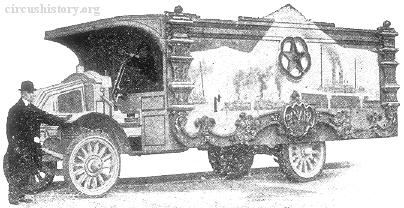 Photo: The Panama float in its original state, on a Kelly Springfield truck.
In his original article Bradbury referred to a huge stock (security) promotion launched by the show. "Huge" was the word for it. The opening blast was a full page ad in the Sunday edition of the Toledo, Ohio, Blade, June 3, 1917. This was followed with half page ads a week or so later. Harold J. Packard was the fiscal agent and was in charge of the stock sale. The price was $10 per share. The theme of the ads suggested 30% dividends to stockholders, through the savings of the "exorbitant" charges of railroads. The ads continued with such statements as "The United States Circus Corporation is the first circus to offer stock to the public." "All the leading circuses have made millions of dollars for the private owners. Tremendous profits will be made by this, the First Auto and Motor Truck Circus, which has had more nationwide publicity than all other circuses combined." The lucky residents of Toledo were allowed a quota of only $100,000, that being the amount set aside as the rightful due of whatever city that captured its winter quarters. The city of Toledo was to benefit further by the large amount of money that would be spent in building the winter quarters and in constructing the show. Drawings of the tableau trucks appeared at the top and bottom of the full page ad. These drawings are shown here.
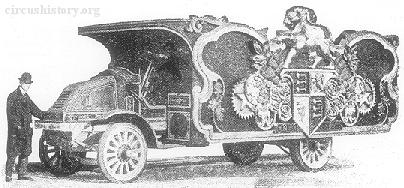 Photo: The Great Britain tableau, which was last seen on the Cole show in 1939, is shown on the truck.
By August of 1917 one of the trucks had been delivered to the show and appeared on the streets of Toledo, to let prospects know that the show was getting started in a material way. The August 13 issue of the Blade stated "the first motorized circus float ever built is ambling about the streets of Toledo." Three days later the truck was taken to Fostoria, Ohio, to pep up the sale of stock in that city. The August 16 issue of the Fostoria Times identified it as the "United States." This article continued by stating that all the major nations of the world would be depicted on wagons, with the exception of Germany. It further advised that a float representing Germany had been built in the form of a great Zeppelin, but that it had been cut out and would not be used.
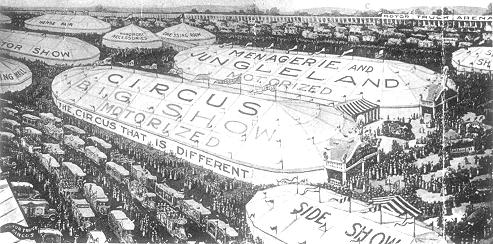
In October an article appeared in the Blade stating that five motor floats from the United States Circus Corporation would make their first public appearance October 4 in the National Red Cross Pageant in New York City. Things were moving well and another full page advertisement appeared in the Toledo newspaper. This ad advised that strict embargoes had recently been placed on the moving of outdoor shows by a group of the large trunk line railroads, and thus more than likely the U.S. show "in every human probability will be the only circus traveling next year." We conservatively estimate that this stock - now selling at par - $10.00 a share - will yield 100% dividends." "On May 6, 1918, the Million Dollar Motorized Circus will open its first season in Toledo." This ad was illustrated with a fine drawing of the full lot as shown in the reproduction here (below right).
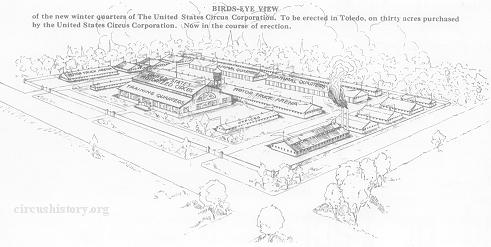
A tract of land was purchased at Monroe Street and Secor Road in Toledo and it was announced that construction would start in September of 1917, with the main building 800 square feet in size. A drawing of the proposed winter quarters was used in a promotional circular (above left). This drawing is shown here. A different drawing showing another artists conception of the building layout appeared in the newspaper.
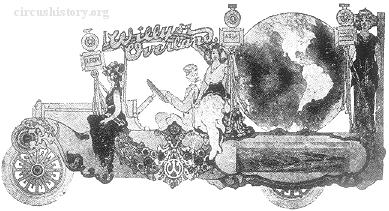 Photo: Could this be the 16th float? Perhaps because it was on a Willys-Overland truck and not a Kelly Springfield, it was not recorded with the other 15.
In one of the larger circulars, printed in two colors, three of the trucks were shown. These are reproduced here. This is the first photo found of the Panama float mounted on a truck in its original state. But the real discovery is the illustration of a float that was "emblematic of the motor mastery of the entire world." This body was mounted on a Wills-Overland truck, and was a bit like the famous Two-Hemisphere bandwagon. The question is, could this have been the 16th tableau made by Bode for the show. It is logical that a "world" float would have complemented the designs representing various countries. Perhaps in time this question will be answered.
"Not only are these circus performers fine technicians; they are also creative artists of a rare type . . . each individual act is a new creation - a new birth.'' - Irving K. Pond
Part III, the Flying Trapezes (Les Volants)
At the time of Alfredo Codona's forced retirement it was presumed that, with so many Mexican flying acts flooding the circus rings of the world, sooner or later one of the King's compatriots would inherit the crown. But more than three decades have already elapsed and no Mexican leaper has yet taken over the throne. As a matter of fact, of the many Latin-American leapers performing during the last three decades, only a few could be considered in a class with such contemporaries as Fay Alexander, Tony Steele or Reggie Armor.
Already mentioned in the previous installment were Roger Rodriguez and Lalo Palacio. Among the best today are Tito Goana, Cicente and Ignacio Ibarra, and Thomaceses Luna. But whether anyone of these will ever become heir to the crown is a moot question.
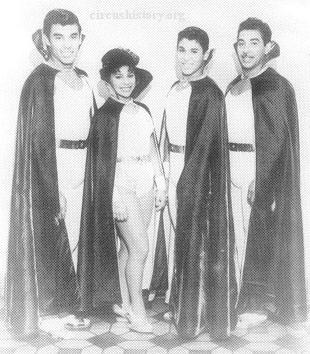 Photo: The Great Gaonas left to right, Armondo, chela, Tito, the 17 year old flyer, and Victor, the catcher. Photo from the Gaonas.
Looming as perhaps the strongest contender is Victor "Tito" Goana who, with Papa Goana as catcher and brother Armando and sister Chela as additional leapers, is the featured artist of The Flying Goanas. Like Codona who grasped his first fly-bar at the early age of 10 (which is about 5 years earlier than usual) Tito also climbed the paternal fly-traps rigging at the same tender age. Today, only 16 years of age, 5 foot 5 and 135 pounds, Tito is already turning the triple with ease and elegance - and with a 60% average of catches. Which is indeed a promising average for any 16 year old!
Interesting is the fact that the very first triple he caught in 1960, when only 13 years of age, was with Fay Alexander at the catch-trap. Since then, Tito has been improving steadily and swiftly and with the assurance and grace of an Alfredo Codona. If one is to accept the appraisal of such an expert as Fay Alexander, Tito Goana and Reggie Armor today are the two most promising flyers who, by virtue of their aesthetic form and elegance of execution, could reach the heights of a Codona - "if their shoulders hold out!"
Naturally it is impossible to make any comparisons between these two splendid artists at this time, for Tito being only 16 years old has a long time to go before reaching his peak capabilities, while Reggie, already 34, has the advantage of a fully developed muscular strength, but also the disadvantages of becoming more prone to sprains and tears with each progressive year. We can but earnestly pray that "their shoulders will hold out" and that they both will reach the heights of greatness.
Parenthetically, it should be mentioned that by the time this is in print, Reggie Armor will have dissolved his partnership with Bob Yerkes. Henceforth, Armor's new catcher will be Walter Patterson and the act will be known as The Flying Armors. In the meanwhile Bob Yerkes, who retains the title of The Flying Artons, is practising with a most promising leaper named Don Martinez - whom be feels will be doing the triple within a year! Considering that Bob Yerkes, at one time or other, was on the catch-trap with such masters of the triple as Alexander and Armor, his appraisal of this new leaper must be accepted as more than just an idle boast. May their shoulders also "hold out" - and their fondest expectations become a realization!
Among professionals there are some who contend that either Vicente or Ignacio Ibarra should become rightful heir to the crown - if only because both are the only leapers besides Tony Steele to execute the triple-and-a-half. To be sure the Ibarra Bros. are indeed outstanding artists on the flying traps. With the oldest brother, Juan, now 40, as catcher, and Vincente, 35, and Ignacio, 38, as leapers, today the Ibarras present as great a flying traps number as can be seen over any circus ring.
The Ibarras' achievements are not too surprising, considering that those Mexican artists are descendants of an old circus dynasty and related by marriage to another old circus dynasty named Los Ataydes, also "barrists emeritus" and now proprietors of the famed Circo Atayde.
The Ibarras, renowned the world over for two decades as the "ne plus ultra" of all barrists, didn't take to the air until 1958, when Art Concello prevailed upon them to move from their 5 bars on the ground to a 3 bar rigging high above the net. Then, in 1959, Concello again prevailed upon them to give up the aerial bars and switch to the fly-bar and catch-trap. It didn't take long for those masterful artists to make the transition. Compared to the arduous grind of the horizontal bars, the fly-bars came relatively easy. So much so that by 1962, not only Ignacio but also Vicente were turning triples to Juan's hands!
By now the triple has become “almost" routine for the Ibarras. In December of 1963, at the Circo Atayde in Mexico City, they not only executed the triple daily, but also went all out for the triple-and-a-half! At the time, some chroniclers reported that they were presenting it at every performance - and catching it with a 70% average. But that was more fiction than fact. The 70% average report was actually on the triple - and NOT the triple-and-a-half. Like Tony Steele and Billy Woods, the Ibarras are the first to modestly admit that the triple-and-a-half presents too many difficulties to attempt publicly at every performance. When in good form and prevailing conditions permit, they will attempt it publicly - but they readily concede that the day may never come when they can attempt it at every performance.
No one will question that, with or without the triple-and-a-half, the Ibarra Bros. today present just about as great a flying trap act as any ever seen over a circus ring. But whether or not either Vicente or Ignacio can ascend the throne is a moot question - for time is against them. Had either one started his career on the fly-traps instead of the bars, there is no doubt that one or the other could have become another Codona long ago. By now already 35 and 38 years of age respectively, it become doubtful that either one can reach such heights - for each passing year will increase the odds against "those shoulders holding out." But even if neither Vicente or Ignacio never wear that coveted crown, they shall always remain great fly-bar artists!
No doubt during that December of 1963 some of the spectators attending the Circo Atayde must have blinked their eyes in utter disbelief, for on the same program were also The Luna Bros. - who, too, were catching triple at every performance, also with an average of 70%!
Never seen outside the confines of Mexico, this act should be more properly named "The Luna Family," for it consists of three brothers and two sisters, all of which are splendid performers - not only on the fly-traps but every other phases of acrobatics. Oldest of the clan at 24 is Jose, working from the catch-bar, then Ricardo, 22 and Francesco, 20, after which come sisters "Fue," 10 and Berta, 18.
Papa Luna, who taught them, can certainly be proud of all his ninos and ninas, for it is seldom that one can find such finished performers at such an early age. To be sure, the Luna Bros. haven't yet acquired the "finesse" of the Ibarras, but if one is to judge from their present performances and form (and if their "shoulders hold out") they could soon equal the Ibarras and - given a few years - even surpass them!
Though all three of the Luna Brothers are slightly shorter in height than the Ibarras, the verve, grace and elegance of their spectacular passes make for a magnificent performance. At 24, Jose is about as fine and reliable a catcher as ever swung from a catch-trap, and Francesco, only 20, is about as great a leaper as seen today. By now his average of catches for the triple is already up to 80% - and soon it should soar to 90%. More important is the assurance, ease and elegance with which he literally "flies" through the air, which stamps him as a truly great performer who, within a few years, could very well challenge all other aspirants to the crown!
It is to be hoped that, upon the termination of their long term contract with Circo Atayde, American and European circophiles will be given an opportunity to see these splendid artists outside their native Mexico.
Not quite in a class with the Ibarras and Lunas should be mentioned The Flying Gibsons, currently with the Ringling Show, where they have been performing for the past 4 years, featuring Francisco Navas as the leaper, and Helio Marcazzo on the catch-bar. Francisco, a diminutive Equadorian, only 5 foot high and weighing 110 pounds, started on the fly-bars when 16 years of age, participating in his father's "bar-to-bar" number, then touring with various circos through the Latin-American countries.
After switching from bar-to-bar to a catcher, Francisco Navas started catching his first triple during 1960 - gradually bettering his average until now, at age 33, he is presenting the triple at almost every performance and catching it 6 times out of every 10 attempts.
Obviously a 60% average is not very spectacular. No doubt his average will continue to improve. But even if Navas should ever reach a 90% average, it is doubtful that the little Equadorian can ever reach the heights of a Codona or even an Armor - not because he lacks the ability or determination, but because he lacks the physical attributes that make for the grace and elegance of an aesthetic performance.
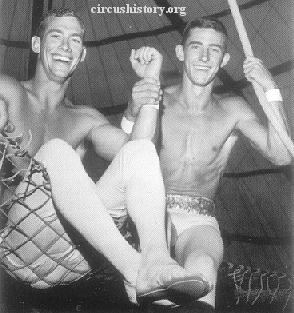 Photo: The flying act with the Florida State University Circus features the triple by flyer Adrian Catarzi, on right and catcher Ivan Williams on left. Photo courtesy of Callaway Gardens.
The latest to be admitted to that exclusive "Triple Club" is Adrian Catarzi, of the Flying Seminoles - a flying act born out of the Florida State University. It would be difficult for any fiction writer to come up with such two strange oddities as are intertwined in Adrian Catarzi's life and his final execution of the triple from a fly-bar!
To be listed as oddity number one is the fact that Adrian is a descendant of one of the oldest dynasty of performers in the circus world. Both his father and mother were members of that famous troupe of bareback riders, The Loyal-Repinskis, whose ancestry dates back umpteen generations! Traditionally, children of such families learn their acrobatics from their parents during early childhood - and usually follow in the same specialty. By tradition Adrian should have become an outstanding rosinback rider and voltiger. But he did not. Instead of learning the intricacies of acrobatics, he went to school to learn the intricacies of an education.
Oddity number two is the fact that the man who taught Adrian how to turn a triple from the fly-bar is not even a professional in the full sense of the term. Basically, his profession is education. And though he can perform on a fly-trap, his activities as a performer are limited to the summer vacation months, during which he sometimes shares the spotlight with some of his students presenting various acts under the auspices of the University. His name? Addison Gilbert, 36 years old, teacher by profession, performer by avocation.
Adrian was 15 years of age when those two oddities came together in a Sarasota high school and the young man climbed up to a fly-bar for the first time. That was 1958. Addison Gilbert was only 30 - but had already been "summer-performing" on the fly-traps since 1950, including the summer of 1957. Together Catarzi and Gilbert learned the intricacies of the triple - from high school to the Florida University.
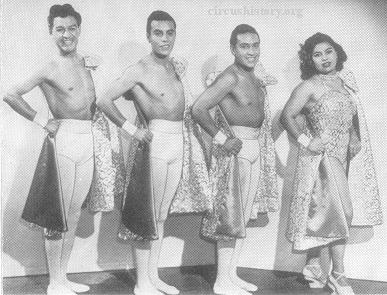 Photo: Lalo Palacio on the left, with the Palacio Flying Act, when they appeared with Polack Bros. Circus in 1957. Burt Wilson Collection.
Among professionals there were many who insisted that Adrian, regardless of his background and/or natural adaptability and physical endowments, could never execute the triple - because he was too tall. Actually his 5 foot 9 1/2 inches is the tallest of all flyers to date. Wayne Larey and Reggie Armor, at 5 foot 7, and Lalo Palacio at 5 foot 7 1/2 were considered freaks! Young Catarzi at 5 foot 9 1/2 simply didn't have a chance!
Fortunately neither the pupil or his teacher thought it impossible. Their final answer came in the form of a triple perfectly executed by Adrian in July of 1963, with a fellow-student named Ivan Williams on the catch-bar.
Since then, during the 9 weeks when The Flying Seminoles were performing through Florida and Georgia under the auspices of the University, Adrian Catarzi's average ran better than 50% - a remarkable score considering that the feat was attempted at every performance and that his first triple had been realized only a few weeks previously.
It seems ironical that a descendant of such an illustrious dynasty of rosinback riders as the Loyal-Repinskis should have chosen to display his artistry on the fly-traps rather than on a rosinback. But even more ironical is the fact that, though endowed with the talents of becoming a great circus star, Adrian Catarzi has no intention of following family tradition and continue as a performer. As of now he has no immediate answer regarding a professional career - except that he's looking for some sort of "creative" type of occupation. We can only hope that he will change his mind so that all circophiles can continue to appreciate his artistry on the fly-bar!
By now some readers might wonder: How come there has been no mention of such great flying acts as the Alizes, Zemgannos, Cardonas, Croneras, Codreanos, Cutanos, Clerans, Escalantes, Leotaris, Ward-Bell, Fishers, Hartzells, Valentines, Meteors, Jarzzes - and a host of other fine flying acts of the past and present eras. To be sure, such leapers as Pierre Alize, Jean Barret, Luciano and Romi Jarzz and many others were and/or are splendid fly-bar artists. But inasmuch as this series of articles is devoted exclusively to the accomplishment of the triple, the names of many great performers had to be omitted in order to keep within the confines of the subject matter.
In reviewing the achievements of the many artists of the fly-bar who performed during that century which elapsed between Leotard's first and Catarzi's and Francesco Luna's last presentations, it becomes obvious that while legend would nominate many to the Hall of Fame, the facts would reduce the list to only a few. It certainly would be presumptuous for any one individual to take it upon himself to publicly list those artists whom he thinks qualify for the honor. That would just about start an international controversy - even greater than the one which occurred in the early 1930's regarding the leapers from the big springboard!
However, if anyone is to nominate some of our fly-bar leapers to be listed as "immortals," there are others, seldom mentioned by our historians and chroniclers, who should be entitled to a place of honor with them. Such sterling catchers as Charlie Clarke, Ed Ward, Sr., Lalo Codona, James Crocker, Lee Stath, Bob Yerkes, Billy Woodes and a few others should not be forgotten - for without them many a flyer may never have basked in the glory that belongs to both, the leaper and his catcher.
This report cannot be concluded without an expression of thanks and appreciation to the many friends who contributed to the sifting of the facts from the legends. We are specially indebted to Fay Alexander and Fred Valentine* - without their invaluable assistance it would have been impossible to wade through the overwhelming mass of fiction and come up with a semblance of the facts.
*Footnote: Born in 1910, Fred Valentine learned the fly-traps from his older brother, George, when the latter was a leaper with Paul Sullivan's "Flying Sullivans" during the middle 1920's. Subseqently, Fred and four other brothers formed their own flying act; then in 1932 he went on his own. Today Fred Valentine is the "Dean of the fly-traps leapers. At age 54, he is still performing the double-and-a-half and full twisters over the net with that same act known as "The Flying Valentines."
Inasmuch as no circus account can ever be 100% accurate, it is quite possible that the names of some past or present performers may have been omitted inadvertently. It is also inevitable that, in the future, other names will have to be added to the roster of that exclusive "Triple Club" - for as time marches on, there always will be new generations of performers dedicating themselves to greater achievements than those of their predecessors.
Just how many more, like Ernie Lane and Genesio Amadori will be killed in action is not for any mortal to predict. How many others, like Alfredo Codona, Wayne Larey and Cesare Togni will have to give up promising careers as the result of torn shoulders or crippling injuries also remains a moot question. Only one thing is certain: There will always be circus artists who will continue to risk life and limb in their dedication to excel in their art!
And may God bless each and every one of them for the thrills and pleasures they have given us. Perhaps it was only for a fleeting moment. But during that short spell of awe and wonder as we watched their performances, they made it possible for millions of us to forget our personal troubles and worries - and for such fleeting spells of release, we all owe them our sincere gratitude.
(To be continued. In the next issue: The Triple from the three bars).
Jorgen Christiansen Article, May-June, 1964 Bandwagon.
Charles H. Johnson of Los Angeles writes that he trouped with Mr. Christiansen on Arthur Bros. in 1944-45 and on the Russell Bros. Circus in 1942-43 commenting that he knew him well and that Christiansen was one of the very best with his wonderful liberty horse acts. Of special interest Johnson says that he has a printed program that was used when Christiansen presented the big act at the Los Angeles Coliseum during the "American [undreadable text] Motion Picture Exposition and Monroe Doctrine Centennial," July 2 to August 4, 1923. The act was listed as "Famous 30 Horse Equi-Curriculum, composed of horses from the Myaczkwiski Circus, Warsaw, Poland - positively the first appearance in America of these greatest of all highly educated equines in the world." The performance was given nights only in the front end of the Coliseum which seated about thirty thousand.
Cole Bros., 1935-38, Mar.-Apr., 1964 Bandwagon
Donald H. Shepard of Ho-Ho-Kus, N.J., gives an interesting piece of information in a letter in which he writes: "I read with great interest Gordon Potter's article about the Cole Bros. Circus. You speak of the time that the train was cut back five cars in mid-season 1935 and you add that you believe Allan King left the show at that time. I caught the show that year at Cumberland, Maryland, Saturday, July 27, 1935, and I can verify that both Allan King and the five cars left at the conclusion of that date. The show had played Altoona, Pa., on July 26, the day before Cumberland, then after the Cumberland stand made a Sunday run of 219 miles to Marietta, Ohio, for performances on Monday, July 29."
Sells-Floto, 1924, Mar.-Apr., 1964 Bandwagon
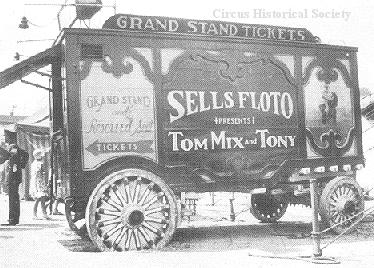
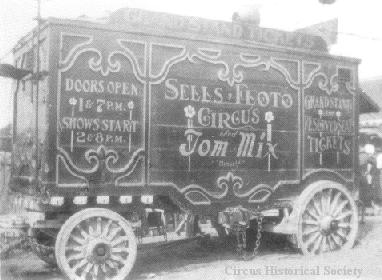
Warren H. Wood of Hillsdale, N.J., remarks that he saw the tableau wagon with the running lioness carving on the side which was pictured on page 11 of the above mentioned article, in 1930 and 1931 while it served as a ticket wagon on the Sells-Floto Circus. The carving itself had been removed and the wagon had been painted and lettered to advertise the show's great feature attraction those years, Tom Mix and Tony. Wood also sent two superb close-up photos showing how the ticket wagon was painted for those two seasons. They are printed here. (Ed. note: Although no specific elaboration was made in the caption text a photo of the Running Lioness Tableau in its original form when it was on the Great Wallace Shows was printed on page 6 of the July-August, 1964, Bandwagon. It was later remodeled at least once and probably twice before it took on the appearance as shown in the Wood photos).
RBBB Cage No. 75 at Circus Hall of Fame, Mar.-Apr., 1964 Bandwagon
Gordon M. Potter of St. Joseph, Mich., who has furnished Bandwagon with several excellent articles in the past and nearly always is able to furnish additional historical information on various material used in the publication, has come forth again with some very highly interesting comments. He writes as follows: "I have some further information concerning the R-B No. 75 cage and the use of rubber tired wheels in general which may be of interest to Bandwagon readers. This No. 75 cage of course was the first cage to be equipped with rubber tires. It was built for the 1935 season and was built with rubber pneumatic tires on it. It never did have steel tired wheels. It was not painted until after the North boys had made a lot of changes on the show. The first few years it was just left aluminum with no paint. There is a story about the No. 75 cage in that it was supposedly built from blueprints and the aluminum fabricator was to have pre cut all pieces for its construction and sent them to Sarasota to be assembled. But Bill Yeske, the boss wagon builder, got disgusted when things didn't come out right and in the end threw away the blueprints and put the wagon together to suit himself. He was a rugged individualist who really knew wagon building and this story sounds plausible.
"The first wagon to be put on rubber on Ringling-Barnum (or any show I believe) was the No. 12 baggage stock trapping wagon. In mid-season 1934 the axles were turned down and steel truck wheels on roller bearings were put on it with pneumatic tires. It just had four tires, not the 8 duals as later used on most wagons. Then in 1935 the light plant wagons were equipped with dual pneumatics, No. 110, 111, 112 and 126. However, No. 110 did not have only singles, just like the No. 12 wagon. Also 1935 was the year they got the big top Mack canvas trucks. These included No. 250 loader, and No. 251 and No. 252 for canvas. The show added a flat car and dropped two cars of baggage stock.
"The Cole hippo den at Baraboo reminds me that 18 ft. long was not excessively large for a hip den. Ringling-Barnum built a second hippo den in 1946 (I think) and it was numbered No. 85 and was built the same size as their older one, No. 88. Both dens were 20 ft. long by 8 ft. wide."
No part of this publication may be reproduced in any form or means
Last modified February 2006.
without written permission of the author and the Circus Historical Society, Inc.