


Circus Historical Society
Bandwagon, May - June 1963
Back to Bandwagon Index
Bandwagon, Vol. 7, No. 3 (May-Jun), 1963. Note: Only some articles are included in this online edition. Not all illustrations are included. The Circus Historical Society does not guarantee the accuracy of information contained in the information in these online articles. Information should always be checked with additional sources.
The following narrative may seem like a hodgepodge to the reader and true it is just that but it also represents the cooperation and collective effort of many of our members in the finest tradition of the Circus Historical Society. Actually several proposed articles are combined into one. This author had planned an article for some years covering only the F. J. Taylor 11-car circus of 1925. After the acquisition and restoration of the old No. 1 bandwagon that Taylor used in 1925 by the Circus World Museum, director C. P. Fox prepared a news release to be used in this publication. In the meantime Member William Temple of Des Moines researched the files of the old Creston, Iowa, Daily Advertiser for information on the earlier Taylor shows of the late 80's and 90's for the Museum's history file and prepared an interesting resume of his findings. Member William Johnson of La Crosse, Wis., in 1962, made a special trip to Fairmont, Minn., to gather data concerning the finish of the short-lived Cook & Cole Circus of 1927 which used the equipment of the 1925 Taylor Show, including the bandwagon, which is now preserved in Baraboo.
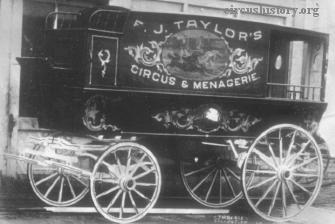 Photo No. 1 - Overland advance wagon newly built by Beggs Wagon Co. in 1890 for F. J. Taylor's Circus & Menagerie. At that time the Beggs Plant was located in Creston, Iowa. The space at the rear of the wagon has seats for billposters to ride and the closed space is used to store paper and supplies. This wagon was well decorated with gold scrolls and pictorial designs. Beggs Collection.
It was then decided to tie together into one article the entire Taylor story, both father and son's efforts in circus business spanning a period of almost 50 years which included first a rail show, later a mud show, and after a lapse of about 20 years, another rail show and finally a small circus unit playing fairs that traveled first by rail and later by truck that finally passed into oblivion in the years of the great depression. The Temple and Johnson notes, plus the press notices of the Circus World Museum concerning the finding and restoration of the Taylor wagon, were turned over to me to attempt the job. Many other members furnished valuable data, photos and other illustrations and they are credited at the end of the story.
The circus historian is faced with great difficulties in piecing together the complete story of a small rail or mud show of 75 years ago. While the old N. Y. Clipper and other trade publications of that day were filled with news of the large names like Barnum, Bailey, Forepaugh and Sells, very little information can be found on many of the small and medium sized shows like the first F. J. Taylor circus. Often an entire year's volume would record only a line or two concerning the show and it was often indefinite and of little value. William Temple went to the only real source available, the old newspaper files of Taylor's home town. Fortunately the 1886 and 1887 files were available. This is a painstaking and often times unrewarding task, but in this case Temple found a real jewel of a piece of information. Most historians were aware of a wagon circus Taylor had out in the 90's but practically all were ignorant of the fact that Taylor's first circus was a railroad show put out in 1886.
Frank J. Taylor Sr. was a prominent resident of Creston, Iowa, and operated a successful grain business before, during and after his experience in circus business. He served as mayor of Creston, evidently on more than one occasion.
All available evidence says that his first circus was a railroad show that was framed in Creston in early 1886 and toured from April until mid October of that year before being closed by creditors in Kentucky. The exact size of the show is not known although it is mentioned in a news item that 20 railroad cars would be used. It is believed to have been a rather small show, probably on about 10 cars, but quite possibly on the 20 as indicated. Cars in those days were much smaller than those later used by circuses and couldn't carry as much equipment. The mention of wagons in the following newspaper account would indicate it to have been of the flat car type, although some type of baggage or tunnel car could have been used.
As will be noted later it seems this was a one season show and that it was never again revived by Taylor. No evidence can be found that any of the original circus equipment that left Creston in April, 1886, ever returned to that city. Taylor, himself, returned to Creston and resumed his regular grain business but careful perusal of the 1887 files indicate him not engaging in any kind of show business that year and it is believed he didn't again put out a circus until several years later, about 1890.
Title for the 1886 show was F. J. Taylor's Creston City Railroad Circus, and a short note in the April 17, 1886, Sporting and Theatrical Journal states that a show of that title will be one of those touring the country that season. The same publication in its June 12, 1886, issue makes the following remark, although a few months premature, "The Creston, Iowa, railroad show has taken down its canvas and like others of its ilk has passed into oblivion." It would seem the show was shaky from almost the start and from following newspaper notes it appeared Taylor was about ready to close the show early in the season.
So far no photos, printed matter, or other documents of the 1886 railroad show have turned up and we have only the word picture as given by the local Creston newspaper to acquaint us with that show. These news items are most interesting and actually give a great amount of information about the show even though not as complete as we would desire at times. The complete notes that William Temple gathered plus his introductory paragraph to them are herewith published intact. These show what can be gathered on an almost completely unknown circus by a careful perusal of old newspaper files.
When F. J. Taylor, ex-mayor of Creston, Ia., formed his own circus in his home town in the spring of 1886, the day to day story in news items in the Creston Daily Advertiser tells with pride the progress being made and what it meant to the town. Some of the items may or may not have been reader ads as there were no display ads concerning the opening of the circus and its first performances. The editor might have gone overboard a little more than could be expected because it was a home town project.
Here are day to day dated items in the Creston Daily Advertiser as they appeared in the paper:
April 12, 1886: Circus bill boards on which the elaborate paper advertising Creston's own show, Taylor's circus, were being erected opposite the Summit house today.
April 13 (Tuesday): It is rumored that F. J. Taylor will give a free exhibition with his circus on Friday before his regular performance for the children of this city.
Wed., April 14: Taylor's circus was the chief attraction today, and the unloading of a car load of goods on Elm Street crossing this morning, furnished amusement for the small boys and all the idle loungers about the city. In the car that arrived this morning was loaded with a lion, the canvas, poles, etc., for the tent, several fine new baggage wagons, bill paper, and lots of other truck, which was unloaded and removed to his place on south hill.
By express he received a tiger, wild cat, badger, two silver gray foxes, two coyotes, a bald headed eagle, four coons and a hyena. While the boys were "monkeying" around the wild cat's cage, she tore the skin, flesh and nail off the finger of one who poked it inside to stir her up.
Mr. Taylor is going to start out on the road with a most creditable show in every respect worthy of the patronage of the public. A fine bill car and a coach are expected to arrive for his use soon.
April 15: Taylor's circus boards are covered with fine paper and his show is billed for Creston the 24 and 26.
April 16: A fine coach and a baggage car for Taylor's new Creston Railroad shows were shipped from Chicago yesterday and were expected to arrive today.
April 17: F. J. Taylor received a side show by the morning's train, containing a large number of curiosities for his circus, and his eight-legged horse, bill car and one sleeping coach last night.
The bill car went south to Maryville this morning to overtake his advance brigade.
Mr. Taylor is going to have a most creditable circus, when completed, and is deserving of great credit for his enterprise, especially from people of this city, his home, where he has been a valued and respected citizen for years, and where his heaviest interests are located. In preparing for taking the road, he has expended a large amount of money in Creston, which has been felt in the business channels, and for which he is deserving of credit and a most liberal remembrance from the people of his home. His show is billed to give entertainments in Creston two different days, April 24 and 26, when his tent should be crowded, as it most likely will at every performance, not with dead heads, but with citizens who show their appreciation of an enterprising, open hearted citizen by each and everyone paying their way. Let Mr. Taylor be accorded a rousing benefit as a send off, by his home people on his opening days. Saturday and Monday, April 24 and 26.
April 19: The Advertiser job department is getting up 5,000 tickets for Taylor's Creston Railroad show on which a cut of Mr. Taylor will be worked.
April 19: Yesterday was a beauty, a regular summer day and was enjoyed by our people, nearly everybody being out walking or riding. Taylor's new circus tents were up, south of his residence on South Hill, and were the center of attraction and were visited by hundreds of people from the city during the day, a continual stream coming and going. Our people are manifesting a great interest in Mr. Taylor's enterprise, Creston's own circus, which shall spread her name far and wide over the west during the coming season, and are all anxious for the day to arrive when they can contribute their quarters to give Mr. Taylor a rousing benefit on his opening days.
April 20: Mr. George Creighton is practicing with Mr. Taylor's circus band.
April 21: The Coming Event. Preparations for Taylor's grand show still go on and new attractions am arriving daily. Four monkeys and a cargo of twenty odd parrots, arrived yesterday and were added to his already excellent collection.
He will have 6 cages of birds and animals, when he gets ready to start, making a very credible menagerie. Two excellent performers now engaged in a theatre in Kansas City will arrive Saturday.
Aside from these and other attractions which are constantly to be added, the combination and corps of performers, band and employees are all here, and are now rehearsing daily at their tent on South Hill.
Mr. Taylor is going to have a most creditable exhibition, deserving of success, and should be given a grand benefit on his opening days in this city, Saturday and Monday, the 24 and 26. Let his tents be crowded full at each entertainment.
Our people will probably not get the opportunity of seeing a better show in Creston during this season, and then, it is a home enterprise, to bear Creston's name with it over the country. Mr. Taylor has expended considerable money in Creston and should be liberally remembered.
April 21: Christie Rider, one of Taylor's advance force of bill posters, was brought home on the south branch train from St. Joe, and conveyed to his home on a stretcher last night. While in the bill car of Taylor's circus in St. Joe, yesterday, the car was thrown back on a switch in the yards with such violence as to break the bumpers off and jam things up pretty seriously. He was jammed between two boxes in such a manner as to disable his legs and one arm. His injuries are reported quite serious, but it is supposed and believed they are not of a dangerous nature.
April 22: James Berris, of Frankford, Penn., with his kennel of trained dogs for Taylor's Circus, is registered at the Revere.
April 22: As a rule Creston and vicinity always furnishes immense crowds at circus performances. This year the first attraction in this line is to be wholly a home enterprise, a splendid, new, complete, elegant and gorgeous circus and menagerie put on the road for the first time by our respected townsman, ex-mayor F. J. Taylor.
His tents are new, wagons, horses and all apparatus is new, his performers are all professionals, experts in their respective lines, and have no superiors in the business anywhere.
He has a very large corps of performers, and it is safe to say that no better one-ring performance will be given in Creston this year than will be seen underneath his tents.
The celebrated iron-jawed woman, who pulls against a team of horses, with her teeth, accompanied by all the apparatus, arrived this morning. A trained dog show also arrived this morning.
The tents were today moved to the common south of the west brick school house, where they will be raised, and the show will probably exhibit before starting out on the season's business.
April 23: The school children and teachers were given a free entertainment by Taylor's circus this afternoon. It was largely attended by his little friends of which he has a host in the city. The regular performance will be given tomorrow afternoon and evening.
April 23: Up to last accounts the twenty cars to be used to haul Taylor's circus over the road had not yet arrived though they are daily looked for.
April 23: A 1,000 pound extra tent and other canvas, a complete duplicate of Taylor's circus tents, was expected to arrive today. These will be kept in reserve for use should the circus meet with disaster from cyclones, rain or wind storms.
April 23: By an oversight, the Advertiser failed to note last eve that Taylor's circus would give a free dress rehearsal for children and school teachers, in their tent south of the west brick school house this afternoon.
April 25: Creston's Gala Day: At 10 o'clock this morning the grand street parade occurred, and was as fine a one as is generally seen. There were two band wagons drawn by 4 horses each; 2 fine bands. The usual ladies and gentlemen on horseback were there, and "Happy Jack," the inimitable clown, on his donkey, brought up the rear. The procession stretched over five blocks. Never were finer horses shown in a circus parade.
April 24: The children who attended the dress rehearsal of Taylor's circus yesterday, and who have attended Sells Bros. and other circuses, pronounced Taylor's equal, or better than any of them.
April 26 (condensed): The museum had a real live 8-footed horse, with 8 natural legs, fully shod; a two-headed boy . . . 9 years old; DeAlma, beautiful Circassian woman; Prof. Montague, magician, and the half lady, Miss Mille, and an educated dog. The show was in charge of Mr. Rehn, father of the 2-headed boy, and there was the usual hand organ.
In the menagerie were lions, tigers, wildcats, mountain goats, deer, antelope, monkeys, coons, birds, parrots, wolves, foxes, coyotes, ant eater, and of course, a peanut stand near the elephant. The admission price was 25 cents; reserved seats were 10 cents for lazy back opera chairs.
The grand entry was made by 8 lady and gentlemen riders. C. C. Matthews was equestrian director. A leaping act followed.
"Happy Jack Lorton," clown, favored with a splendid song, and during the evening furnished amusement with funny sayings, and hits on local persons, firms and topics.
Followed Prof. Barris' dog riding a horse; a chair and table pyramid and tumbling by Firman Bros.; Japanese wire walking by Winfred; principal riding act by Master Frankie Harris; single and double trapeze act by Mille Lotta and the Quinnette children; horizontal bar act by Winfred and Winterset led by the champion, Jordan.
Also a goat riding act from Barris' combination; the Charet family, walking, performing and riding the bicycle on the high wire. Charet also walks the wire over the top of the tents at free exhibitions. The performance ended with Marques, the Indian hurled rider.
In the concert was Montague, the fire eater; the Quinnette children, single and double turns; a sketch artist and serio comic business.
Today's parade was dispensed with on account of bad weather. From here the show goes to Bedford, Maryville and then through Kansas, Nebraska and Missouri.
Tuesday, April 27: Mr. Taylor's circus, the Creston new railroad show, did a fair business in the city yesterday and last evening, though the weather was very cool, and went south to Bedford last night.
April 28: Taylor's circus drew a large crowd at Bedford yesterday, but rain began before the doors opened. 50 cents admission is charged outside of Creston. Today they showed at Hopkins.
April 29: Rain hampered Mr. Taylor's show at Hopkins. Mr. Taylor told a reporter he was prepared to stand a month of bad weather.
April 30: Mr. Taylor's circus did not unload at Maryville yesterday. Instead, the show played at the opera house in the evening. The clown, Happy, got full and was discharged. The circus plays Savannah today.
Monday, May 3: F. J. Taylor visited the city yesterday and returned south to join his circus this morning. He reports discouraging weather and poor business this week.
May 13: Mr. Ed. Colygan, the efficient driver of the Babcock, will not join Mr. Taylor's circus as boss hostler.
May 17: The Brookfield, Mo., Argus, of the 8th says of the Taylor Creston Railroad show:
The Creston RR Circus has come and gone. They gave a very clever show, especially their trapeze and tumbling. They had a fair crowd both in the afternoon and in the evening. The town people turned out en masse. The management is the most gentlemanly we have ever met. Mr. O. F. Gould, the cashier, from Creston, is a gentleman, sure. Newly organized this season, we hope they strike Brookfield again when we expect to see them larger and more perfected.
May 17: Driver Ed. Colygan departed this afternoon on the south branch train for Shell City, Mo., where he joins Taylor's Circus as boss hostler for a month. The mayor and council agreed to let him lay off a month from the tire department.
Mr. Taylor shows in Appleton, Mo., today, and Shell City, tomorrow.
May 27: Master Charley Taylor departed yesterday to join his father, F. J. Taylor with his circus at Kansas City. Mr. Taylor has not been doing well, and if business does not improve, he will return to Creston. He has let his manager, Mr. Stephens, go, and has got rid of as many crooks as possible.
May 26: T. H. B. Beach, of Creston, passed through Council Bluffs yesterday. He says the Taylor Show, of which he was advance agent, will shortly return to Creston.
June 7: F. J. Taylor's Circus was at West Point, Neb. He is doing well and has not struck a bad town since leaving Missouri.
June 9: J. H. Gwin, boss property man for Taylor's Circus, arrived in town yesterday from Scribner, Neb. The show met with rather tough times down in Missouri, but when they struck Kansas things began to look bright, and now they are doing well. Mr. Taylor has purchased more horses, painted the wagons, added more freaks to the side show, and remodeled his company. Mr. Taylor is negotiating with the Nickel Plate Show, and when the two are consolidated, they will make one of the best on the road.
July 1: O. F. Gould, treasurer of Taylor's Creston RR Show, outlines the route of the company to July 20. In one of the towns recently visited there was a runaway by which one of the cages was badly broken and some of the animals killed.
The show is billed for the following dates and places:
Waterton, Dakota, July 1
Clark Center, Dakota, July 2
Redfield, Dakota, July 3
Aberdeen, Dakota, July 5
Miller, Dakota, July 6
Pierre, Dakota, July 7
Blunt, Dakota, July 8
Huron, Dakota, July 9
Brookings, Dakota, July 10
Tracey, Minn., July 12
Sleepy Eye, Minn., July 14
New Ulma, Minn., July 15
St. Peter, Minn., July 16
Waseca, Minn., July 17
Zumbrota, Minn., July 19
July 7: By a letter received from Mr. F. J. Taylor we learn the Creston Show had a $1,200 business Saturday, with good weather and prospects bright ahead.
Oct. 2: F. J. Taylor has left for Centerville, Ky. He said he had travelled in 10 states and nowhere found such hospitality as in the Corncracker State.
Oct. 13: Ed. Lederquist, who left with the Creston Circus, has sent his box home by express and will follow. (The item went on to say Ed was quite a poet, his poem followed in ten lines of agate type. It revealed that the show busted in Mayflower, Ky., and creditors had foreclosed).
Oct. 7: O. F. Gould, who has been with Taylor's Circus since it left these parts, returned to the city yesterday on No. 3.
Oct. 28: F. J. Taylor returned this morning from his sojourn in Kentucky.
Oct. 30: The Advertiser is glad to welcome our townsman, F. J. Taylor, who has been absent several months, back in active business life in our city. It looks like old times to see his familiar form and features upon our streets again.
(A careful check of the newspaper through and up to Dec. 1, fails to reveal that any equipment of the circus was returned to Creston).
During November, the newspaper ran a number of small reader ads by F. J. Taylor that he had grain, wood and coal for sale.
- from the Creston Daily Advertiser, the spring of 1887.
- F. J. Taylor was mayor of Creston in the spring of 1887.
April 12: An item indicated F. J. Taylor was busy hunting water for his stock farm. He had dug a well.
Through April 20 there were no notes. Resumed check on May 15.
May 16: There was a one-column ad that King and Franklin's Colossal Shows and Wild West would play Creston on Monday, May 23. Free street parade. Admission, 25 cents.
There were several legal notices regarding streets, alleys and garbage signed by Taylor as mayor.
May 23: Circus attendance was quite large at the King and Franklin Circus this afternoon. "Likely the only circus our people will have a chance to see this season."
May 24: There was good attendance at the King and Franklin circus yesterday. The reserved seats were boards covered with carpet. The performance was excellent.
May 25: From a man who should know: F. J. Taylor, mayor, considers the King and Franklin circus the best 25 cent show on the road.
Checking through the paper to Thursday, June 10, there were a number of personal items about F. J. Taylor and no mention of him being connected this year with a circus. He was quoted on the condition of crops, the weather and general business.
There were items where he had callers: show people going through who stopped to reminisce, and some thinking he still might be in the biz.
F. J. Taylor's next circus venture was a wagon show. The date it started is somewhat obscure as the newspaper files are not available for the years after 1887 but the best bet in 1890. Member J. W. Beggs, whose father operated the Beggs Wagon Company, first in Creston, Iowa, and later in Kansas City and during the 90's and early 1900's built wagons for a great number of circuses, says that the firm built a number of mud show type vehicles for F. J. Taylor in 1890. Two of these are shown in photos Nos. 1 and 2. The new Taylor mud show should have started operations in either 1890 or 1891 at the latest.
Bill Woodcock furnishes information that in the 90's the Taylor show leased from Ben Wallace an African elephant, Jeannette; 2 camels, and a den of lions. In 1893 the show had 47 wagons, 2 elephants, 5 camels, 9 cages, 110 head of stock, a 12 piece band, under leadership of Add Vrandinkey, and 14 canvasmen. Ed Shipp was equestrian director and did jockey riding. His wife, Julia Lowande, was the principal rider. That same year the Stone Brothers were featured as acrobats. Fred Stone later became a Broadway star.
The reproduced letter from Taylor to John L. Davenport, a noted horseman of the day, written Dec. 2, 1892, mentions that his show next season will have 2 elephants, 4 camels, 6 cages, and concludes it to be the best ring show in America. Taylor named his mud show after himself and note the flowery title as shown on his letterhead.
Taylor's show became quite well known around its home and surrounding states in the 90's and from all indications was a fairly large sized mud show that featured a good performance and menagerie.
Only scattered and generally meager accounts of the show continue in the trade publications but evidently it was out continuously through the 90's and was on the road at least through the 1902 season. The May 31, 1902, Billboard reported that the great Taylor Show opened May 6 at Murray, Iowa, and that Taylor informs that "thus far business has exceeded even the sanguine expectations of the management. Turn-away crowds have been the rule."
The final season of the wagon show and its disposition are not known but it probably operated until about 1904.
F. J. Taylor died in Creston, July 28, 1917, after being in poor health for several years. It was noted in his obituary that he had previously been mayor of Creston and had been honored by being elected as representative from Union County to the State Assembly at Des Moines. Surviving him were his widow, four sons and one daughter.
A featured article appearing in the Creston News Advertiser, May 25, 1953, mentioned that the old Taylor family home was on New York Ave. It said that F. J. Taylor attracted attention. He resembled General Grant and was pleased to be likened to him.
Frank J. Taylor, Jr., who had learned both circus business and the grain business first hand from his father, continued a very successful grain buying business in Creston and later moved to Omaha where he conducted his operations. Frank, Jr.. Had loved the old circus his father had operated and always said he wanted to own his own show some day. That dream came to full realization in 1925.
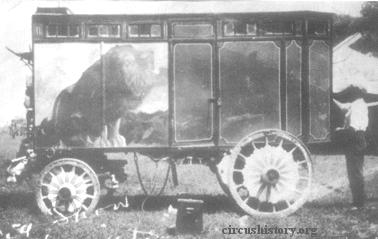 Photo No. 7 - Ticket wagon on Taylor lot in 1925, features large lion painting and outside type sunburst wheels. Note: Late information from Bill Woodcock says that when Al G. Barnes played Kansas City in 1920 the show received some new wagons and in turn just left old wagons on the lot. One of the wagons left was the yellow ticket wagon which presumably was picked up by Horne Zoological Arena Co. Woodcock says he was later told this ticket wagon was used by F. J. Tayler in 1925 and Cook & Cole in 1926. It is possible this ticket wagon shown here is the one from Al G. Barnes. If so, then it offers a good explanation of how possibly the two decker tableau wagon from Barnes also got to the Taylor show. Chipman Collection.
Taylor organized at South Omaha a 10-car railroad, flat car type, circus in the early months of 1925. He is reported to have sunk $80,000 into the venture, including the cost of the initial equipment plus the losses suffered during the ill fated tour of a few weeks. The first notice of the new show plans appeared in the Feb. 14, 1925, Billboard as follows:
"F. J. Taylor Will Have 10-car Animal Circus. Outfit being organized in Omaha, Neb., and will be managed by Ray Taylor."
Omaha, Neb., Feb. 6 - Frank J. Taylor, former president of the Omaha Grain Exchange and owner of the Taylor Grain Co. of this city, is organizing a circus. At his farm in Bellevue Boulevard, south of Camp Brewster, Mr. Taylor already has assembled the nucleus for a 10-car animal and Wild West Circus similar to the kind operated by his father, F. J. Taylor, 30 years ago when Fred Stone, noted stage star, played in the band, did an acrobatic act, was a clown tumbler, and gave a free exhibition of high tight rope walking. Taylor and Stone worked together in the old Taylor show when the former was 13 and the latter 18 years of age.
Mr. Taylor is acquiring railroad cars and recently purchased an eight horse team, the animals being all white and beautiful specimens. In a down town garage is parked a steam calliope. He went to Lancaster, Mo., to confer with W. P. Hall, veteran circus man, and in an effort to lease two or three elephants. At his farm Mr. Taylor has a crew of men working daily painting and decorating a dozen circus wagons and caring for a small menagerie which already has been acquired. This includes a bear, a small kangaroo, and a cage of trained monkeys. A shipment of lions is expected shortly.
Mr. Taylor is not planning to manage the circus personally, but he may go out with it occasionally. He has arranged with his brother, Ray Taylor, of Creston, Iowa, to manage the show, and the first stand is expected to be South Omaha."
The show train was assembled from several sources. When finally ready for the road it consisted of 2 stocks, 5 flats, and 3 sleepers, for a total of 10 cars back. Records of the late E. W. Adams indicate the show had an advance car which made a total of 11 show owned railroad cars. The train was painted yellow with red lettering and black shade.
Member Harry Chipman, who was on the Taylor show in 1925 working press back on the show and selling banners in the morning on arrival, says that several of the flat cars came from the C. W. Parker Carnival, of Leavenworth, Kansas. Taylor got them for practically nothing and although they were in bad shape and needed replanking, all that was done to them was repainting and Harry recalls that while loading the show for the first time the pole wagon went down through the floor of a flat causing a delay and repairs to be made before the train could move.
The Feb. 28, 1925, Billboard mentioned that Fred Buchanan, owner of the Robbins Bros. Circus quartered at Granger, Iowa, sold two stock cars and a new big top which had been held in reserve last season to the new F. J. Taylor Circus being organized in Omaha.
In addition to the cars obtained from Buchanan and C. W. Parker the rest of the cars may have come from W. P. Hall of Lancaster. Most of the wagons and other property used by the show came from Hall or Buchanan.
The April 11, 1925, Billboard reported the progress of the Billing of the new show as follows: "Frank Taylor's Circus to Open Early in May.
Omaha, Neb., April 4 - The Frank Taylor's Circus winter quarters, located on the Taylor farm, about four miles from Omaha, is a scene of activity in all departments. The mechanical department is in charge of Jim Babcock, an old-timer. He was with Taylor's Great American Circus 30 years ago and has been connected with the white tops for more than 40 years.
The work of rebuilding the entire equipment is progressing at a rapid pace and the show should be ready for the rails early in May. The color scheme of the wagons will be red with plenty of gold leaf. About 70 head of large gray horses and several manage horses have been purchased and are now on the farm. The animals for the menagerie have been secured but only a few received up to the present time.
The cars are in the railroad shops undergoing necessary repairs. Harry Johnson, for many years connected with circuses, will have charge of the advance car with eight billposters. The show will be one of the best equipped 10 car circuses on the road, but the name of it has not yet been made known."
The above mention of 70 draft horses is somewhat exaggerated. Some old penciled notes that appeared on equipment lists of the Taylor show that was furnished by Member C. C. Day show 36 horses with the show and that number is probably correct. Harry Chipman recalls that the show was somewhat short on baggage stock and that the Fordson tractor the show had certainly was put to good use in moving the wagons on and off the lot.
The Jim Babcock mentioned in the Billboard article was an old Buchanan man that had served on Yankee Robinson and other shows and he was given the job of superintendent of the show and the task of getting it ready for the road. So far as can be learned all of the wagons, cages, etc., had been used on other shows and no new vehicles were purchased or built for the show.
The Consolidated Circus Company was formed with Frank J. Taylor Jr. as principal stockholder to operate the new show. Staffers included Ray Taylor, manager; Pearl N. Branson, contracting agent and contracting press; Harry Chipman, press back on the show and banner agent; Frank L. Bennett, sideshow manager: H. L. Steele, boss canvasman; Jim Wilson, supt. of baggage stock; Harry Johnson, in charge of advance car, and Jim Babcock, general supt.
The show ran several ads in the Billboard in the spring of 1925 wanting various performers and workmen such as the one that appeared in the May 9 issue, "Want performers who do two or more acts, sideshow people, bag punching act, drivers and canvasmen, etc."
Only one elephant, Freda, which belonged to Charles LaMont, was carried. Eight cages, probably of the cross cage type, were carried. Some ponies, a trick mule, and several saddle, high jumping, and menage horses completed the list of animals.
A very fine performance, which was consistently reviewed as a fine one, was assembled. The feature acts were the Wrights (Rink and Bessie), sensational novelty equilibrists; the Edwards, novelty trapeze and ring artists; Charles Celest, international wire walker billed as "The Great Swing;" George Kirtch and his cowboys and cowgirls in the concert; Charles LaMont, former owner of LaMont Bros. Circus, brought on his trained elephant, ponies, monkeys, dogs and birds. Fred Gay was producing clown, and Prof. Frank Doto had the band.
The show had a good spread of canvas for a 10 car circus with most of it being new or in very good condition. From later for sale ads by Taylor after the show folded we can get an indication of the size of the various tops. Big top was a 110 ft. round with three 40 ft. middles manufactured by Baker-Lockwood; menagerie was a 70 ft. round with two 30's, and sideshow a 50 ft. round with one 40 ft. middle. The marquee was a 30x30 and cook house top 30x70. Some photos of the big top show only two middles being used.
Seating in the big top consisted of 15 lengths of blues and 10 lengths of starbacks used for reserves. Three electric generators furnished power for the lighting.
The sideshow used a large center canvas banner titled "Great American Circus Museum" and six attractively painted banners advertised the wonders on the inside.
From the list of equipment of the Consolidated Circus Co. printed elsewhere in this article there appears to have been about 26 vehicles with the show including the Fordson tractor, 2 chariots, a stage coach, and possibly a water truck. Despite the mention of the color of red for the baggage wagons in the Billboard article, Harry Chipman recalls the color scheme to have been yellow with the title in red and certainly the titled baggage wagon in photo No. 14 showing a darker color title on a lighter colored wagon would indicate Harry's memory is correct on this.
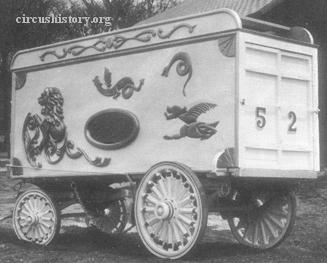 Photo No. 16 - Rear view showing the old F. J. Taylor No. 1 Bandwagon at the Circus World Museum, Baraboo, Wis., in 1961 after complete restoration by Ernie Zimmerly and the museum staff. Photo courtesy of Circus World Museum.
The show featured a daily street parade and from the Chipman collection of photos taken on the circus at least 4 wagons are shown that could be classified as tableau or parade wagons. Of course the big No. 1 bandwagon now at Baraboo was the pride of the show and evidently why it alone was saved. It was used as the sideshow wagon and featured a circular mirror in the center with gold leafed carvings of dragons, lions head, serpents, and winged creatures on the sides. Chappie Fox's further description of it is listed elsewhere. Just exactly what was the origin of this wagon is not known. Perhaps there is some sentiment that it goes back to an earlier Taylor show but there is no logic in this. It is definitely a railroad show wagon and probably under no stretch of the imagination could it be a survivor of the 1886 rail show or even a rebuild of a mud show wagon of the 90's. My best guess is that it was a wagon obtained either from Buchanan or Hall and rebuilt to serve as a bandwagon with the carvings being added at Taylor quarters by Jim Babcock.
The most significant tableau wagon on the show was the old Forepaugh 3 decker wagon that was later converted to a two decker and served on Ringling Bros., Gollmar Bros., and was on the Al G. Barnes Circus up until the early 20's., Just how it got to F. J. Taylor I don't know. This wagon was covered extensively in the Sept.-Nov., 1961, issue of Bandwagon in the Circus Wagon History File. At that time a photo showed it in a line with titled Cook & Cole wagons and a notation was made that it was not definite if this wagon was actually on the Taylor show of 1925 as the author did not possess photographic evidence. Such evidence has now arrived as per photo No. 12 showing it in 1925 on the Taylor show. Al G. Barnes quit parading in mid season of 1924 so the wagon would have been available to Taylor for 1925 but I don't have evidence of the wagon on Barnes after 1922. It seems odd that a wagon would be shipped from California to Omaha for the Taylor circus. My wild guess is that in the various trades Barnes made for wagons in the Kansas City and other mid-western areas with Horne and others this particular wagon might have been taken off the Barnes show and stored in this section and from hence it later went to Taylor. Anyone's ideas on this would be appreciated.
There are two other wagons shown in illustrations here that were no doubt used for parade purposes. Photo No. 9 shows a wagon with a full side painting of a lion trainer in a den of lions with carvings in the corners of the painting. Photo No. 5 shows a tableau with a full side painting of an Indian buffalo hunt in a western setting. The latter wagon's profile is almost identical to that of the No. 1 bandwagon and both closely resemble the profile of several similar type wagons featuring full side paintings that were used as parade wagons by the American Circus Corp. in the early 20's. Taylor's ticket wagon had a large painting of a lion and was very attractive and possibly could have seen parade service. Lack of any parade photos or accurate eyewitness accounts make it almost impossible to reconstruct any reasonable idea of the parade with any degree of certainty. The exact origin of any of the tableau wagons with the exception of the 2 decker wagon is unknown to me but again would assume them either from Hall or Buchanan. Remnants of several shows were at Lancaster while Buchanan, who was constantly adding new wagons to his Robbins Bros. Circus, had excess equipment at Granger.
The steam calliope that Taylor had in 1925 has baffled wagon historians for many years. Plenty of evidence, both in print and from eyewitnesses prove that he had one. Just what it looked like and from where it came creates the problem. No photo, nor any reliable account of what it looked like has come forth as yet. Most wagon historians, including Bill Woodcock, who has no peer in that field, strongly suspects the steamer came from Fred Buchanan and was the same one that was used on World Bros. in 1923 and Robbins Bros. in 1924 as shown in photo No. 15. The origin of this calliope has long been a mystery and the only photos of it that have ever turned up picture it on World Bros. in 1923. Just where Buchanan got it is not known. It may be recalled that Fred Buchanan, after operating the Yankee Robinson Circus for several years, sold that show to Mugivan and Bowers in late season 1920 and the new owners moved the property to the Hall Farm where they used the best equipment to enlarge their Howes Great London Shows from 15 to 21 cars for 1921 and sold some of the remainder to Palmer Bros. and others. In the winter of 1922-23 Buchanan framed a new 15 car show that went out in 1923 under title of World Bros. Circus. Much of the equipment used came from the Hall Farm with some baggage wagons being built new. The steam calliope he obtained from World Bros. was not from any old show that ended up at the Hall Farm, or at least one we are aware of. Whether it was built new for World Bros. or came from some carnival or other type show we don't know. It would have been available for Taylor in 1925 as it was not used by Robbins following the 1924 season. The Jan. 22, 1925, Billboard mentions that Robbins Bros. would have a new steam calliope for the 1925 season, the instrument having been installed in a wagon using the sides of an old Forepaugh-Sells bandwagon. Most historians are familiar with this calliope that had a huge carved lion in the front. It had been the No. 1 bandwagon on World Bros. in 1923. Although the Billboard details Buchanan selling other equipment to Taylor not a word can be found about any sale of the steam calliope. Harry Chipman says he was on World Bros. in 1923 and Robbins Bros. in 1924 as well as F. J. Taylor in 1925 and he feels sure the same calliope was used by all three shows. Unfortunately the Chipman file of photos used here does not show the steamer. Harry also says that in 1925 on many stands there was no one to play the instrument but that they fired it up and it made parade and he was given the task to make the excuses why it wasn't playing.
If Taylor had an air calliope in 1925 that fact can't be established in our existing photos. He did advertise that he wanted to purchase a used air calliope in a Billboard ad in which he also wanted sideshow people, snake charmer, Scotch band, etc. There is a notation on the equipment list in pencil that there was an air calliope but it isn't listed with the rest of the wagons. C. C. Day is sure there was an air calliope instrument in any event as it later was carried on the Taylor fair unit.
From the photos of the known tableau wagons that Taylor had and the fact he had 8 cages of animals and a steam calliope he could have put on a very creditable parade for a ten car show which certainly would have been a welcome sight for the small Nebraska and Iowa towns he played.
The official title of the 1925 show was F. J. Taylor's Great American Circus, Museum, Menagerie, Hippodrome. Other titles appearing on one sheet found in the old No. 1 bandwagon when it arrived in Baraboo included Taylor Bros. Great American Circus, Museum and Menagerie; F. J. Taylor's Great American 3 Ring Circus, and F. J. Taylor Jr. Great American Circus. Some of these may have been variations later used on the Taylor fair units that toured until the early 30's.
According to the official route printed elsewhere that came from the late E. W. Adams collection the show opened Sat., May 23, 1925, at Albright, Neb., and after a Sunday off played its home city of South Omaha on the 25th followed by a two day stand at Omaha itself on the 26th and 27th.
After Omaha the show played Iowa stands at Glenwood, Griswold and Sidney, and then went back into Nebraska for the rest of the short lived tour. It didn't last a month and closed the season June 20 at Wahoo and immediately moved back to South Omaha quarters.
The causes of the show's failure were many. First, all observers agree that extremely bad, wet and cold weather ruined all chances of doing any business. Business was bad from the start and never improved and some claim it never had a winning day. Harry Chipman also says that the advance was very weak on the show with little paper being put up, no advance press, and in general just "no advance." Some claim the route was all wrong and that the show was attempting to play an old Taylor mud show route with a railroad circus. The charge has been thrown that Fred Buchanan actually sold Taylor on this particular route with an ulterior motive in mind, knowing it was bound to fail. Regardless of all the reasons given the weather was probably the greatest factor for its failure. The year 1925 was one of the worst weather wise of all circus seasons.
The Taylor property was stored in South Omaha and remained idle until the spring of 1927 when a new circus bearing the title of Cook & Cole's 3 Ring Circus was organized by a partnership consisting of Leo E. Crook, Arthur Hoffman and R. M. Harvey. Crook has previously been connected with Ringling-Barnum, in the concession department and was the heaviest investor in the new venture. He is reported to have spent $40,000 in the new circus they organized. Arthur Hoffman was widely known in circus circles and was a part owner of the 1926 Heritage Bros. Circus. R. M. Harvey was one of the top advance agents in the business and was given the job of routing the new show. Numerous advertisements the new show placed in the Billboard in the spring of 1927 wanting circus performers and personnel were signed, Arthur Hoffman and Leo B. Crook, managers.
The new show made a deal to obtain the Taylor equipment and used his South Omaha quarters to prepare it for the road. The equipment Taylor had used on his 1925 show was the nucleus for the Cook & Cole outfit, however it is entirely possible that some of the Taylor cars which were already in pretty bad condition were not used but were replaced by others. Other cars came from the Venice Transportation Co. and Fred Buchanan. The train when assembled consisted of 4 stocks, 6 flats, 4 sleepers and 1 advance for a total of 15 cars, or four more than Taylor used. A few new wagons were constructed at quarters to load on the additional flat car that Cook & Cole acquired. C. C. Day recalls that just flat bed wagons with skeleton posts sides were built. These were similar to some showing in the accompanying illustrations.
Eyewitnesses say that Cook & Cole paraded using the old Taylor No. 1 bandwagon to lead it and also that a steam calliope was carried as well as a sizable menagerie. It is assumed the Taylor tableau wagons and cages were placed in the parade and that an adequate march was staged.
As Cook & Cole had four stock cars, double the number carried by Taylor, considerable more horses and lead stock were added. Clyde "Highpockets" Baudendistil had four elephants on the show that were leased from W. P. Hall. They were Tommy, Ding, Boo and the tusker, Major.
The Taylor canvas spread was used by the new show and the general lot appearance greatly resembled the 1925 show.
Leo Crook leased most of his property but F. J. Taylor once told C. C. Day that Crook paid cash for a lot of equipment obtained from him when time payments would have been perfectly satisfactory with him. The heavy outlay of cash which exhausted the shows funds almost before opening date was one of the prime reasons for the shows early failure. This business of the money being spent before the show really gets rolling has been the sad story told at many a circus funeral. It was true of the Frank Spellman U. S. Motorized Circus of 1919 and the Tim McCoy Wild West Show of 1938 to mention a few.
Staffers of Cook & Cole were capable circus people and consisted of J. C. Ryan, legal adjuster; C. H. Bauther, contracting agent; E. S. Patterson, lot supt. and in charge of quarters shops; Jack H. Nation, sideshow manager; Frank P. Meister, bandmaster; Con Colleano Sr., privilege car manager, and John Burns, steward.
A good performance was featured highlighted by the Joe Hodgini Troupe of riders. Jimmy Keating and Billie Burke, well known circus female impersonators, were contracted. Keating did a single contortion act and danced in the sideshow while Burke worked the comein and did a swinging ladder number in the big show and danced in the sideshow. "Highpockets" Baudendistil presented an outstanding elephant act.
R. M. Harvey headed a strong advance and used a special line of paper printed by National of Chicago and Standard of St. Paul.
The new show moved to Manning, Iowa, and all personnel were advised to report there May 16 for final rehearsals. The show opened the season in Manning, May 21, 1927.
Bad weather, such as plagued F. J. Taylor in 1925, hit the new Cook & Cole show immediately and the result was poor business. The show's funds were expended by opening date and there was nothing left in the sock to take care of the situation so the show lasted only eleven stands with the finish coming June 2 at Fairmont, Minn.
The show's personnel became stranded in Fairmont as funds to move to the next stand were not available. J. C. Ryan, legal adjuster, went to the town's merchants and solicited food for the circus attaches and animals. The City of Fairmont opened up its heart to the plight of the circus people and a committee of prominent city officials, including the mayor, chief of police, editor of the paper was formed and organized a benefit performance. This was held on June 6 with tickets selling at $1.00 each. A relief fund of $1200.00 was raised and all employees were paid 25% of their wage claims. This enabled most of the personnel to leave town, although a few of the workmen secured employment in Fairmont. A small percentage of the benefit funds was retained to pay local claims.
At Fairmont the train had first been loaded after the June 2 stand and then unloaded again for the benefit. During the first loading John Blakeman, one of the train crew, was crushed between two wagons and suffered critical injuries.
The final disposition of the circus property from Fairmont has long been a mystery to circus historians. We knew some property was returned to South Omaha and later advertised for sale by Taylor but for years there were rumors that circus wagons and property of Cook & Cole were stored in Fairmont and perhaps remained to the present time. Last summer, member Bill Johnson made the trip from La Crosse to Fairmont to see what information he could uncover on just what did happen to the property. Bill talked with the present editor of the local paper who indeed remembered the show's folding in 1927, however, he could add very few additional facts but did say that it was true some wagons were stored at the fairgrounds for about two years but later they were all moved from Fairmont by parties unknown to him. He assumed some of the show's creditor's took the property. At the courthouse Bill was unable to get any information on any legal action or repossession claims that might have been taken against the show by various creditors. However, a search of the newspaper files enabled Johnson to come up with some good information.
One story mentioned that Leo Crook had lost his life savings of $40,000 in the show and although both Harvey and Hoffman were partners, only Crook had money in the show and one article referred to Crook as the man that had been taken to the cleaners. A later article said both Harvey and Hoffman were also heavy losers indicating they, too, had money in the show.
One story quoted Harvey as saving that the late season opening and the continued rainy weather kept the audiences away from the show, and he continued, "since we left Omaha we had only 3 days when it didn't rain. We didn't reckon with the weather, the worst in years, and were mired in town after town. The roads were so bad that the crowds could not come." The article mentioned that all the circus partners were well seasoned with Crook spending 18 years with Ringling, R. M. Harvey with Barnum & Bailey for 9 years, and Art Hoffman was with Hagenbeck-Wallace.
Harvey was also quoted on saving that it cost money to move a circus train with the run from Wells to Fairmont over the Milwaukee Railroad costing nearly $300.00. The afternoon show on June 2 in Fairmont had 200 with the evening show a little better and rain came again as the show loaded that night before they found they would be unable to move.
One interesting news account said that creditors were in a scramble for the show's cars. Mr. F. J. Taylor is seeking to ship his property to Omaha and Mr. Buchanan would like to ship his to Granger, Iowa. A story a few days later said that Mr. Taylor's three cars had left and the remaining 11 cars in Fairmont belonged to the Consolidated Circus Co. of Omaha and Fred Buchanan, owner of the Robbins Bros. Circus. A further story said that Robbins Bros. played Fairmont on July 6 and picked up the cars belonging to that show and also the show had two big houses on that date. A check of the official 1927 season route of Robbins confirms the Fairmont date.
The show's plight continued to make news in the Fairmont Daily Sentinel and a few days later it said the four elephants were returned to W. P. Hall at Lancaster, Mo. The few days the show was setup for the benefit had many unusual incidents. One recorded was that a circus laborer and a farmer were taken to jail on complaint of one of the show's bosses who alleged that the workman had sold some of the show's rope to the farmer. The laborer said that he had money coming from the circus and he was going to get it while the getting was good. A later story said the farmer returned the rope and charged were dropped against both of them.
The three cars mentioned above belonging to F. J. Taylor that had left Fairmont were used to transport a circus unit Taylor organized to play fair dates. This small train unit, managed by Bert Taylor, continued for several years and in the early 30's the cars were discarded and the unit was transported by truck. About 1934 Taylor took the unit off the road and disposed of the remaining property.
The Billboard in an excellent story recorded the rise and quick fall of Cook & Cole and is printed herewith in its entirety to give the official trade publication account of the entire affair.
"Two Benefits Given for Cook & Cole Folk, Fairmont, Minn., June 11 - "The Cook & Cole Three Ring Circus has closed, as was briefly mentioned in last week's issue. Its career was brief, its bankroll short and its finish sad.
On Monday two benefit performances were given in behalf of the stranded showfolk, the performers participating in the program. One dollar admission was charged and $1,200 was realized. The local committee consisted of J. E. Haycraft, F. J. Edwards, H. E. Wade, C. F. Gaarenstroom and A. M. Nelson.
Performers write that, although the benefit was supposed to be given entirely by the city people, when it came to paying off they were requested to sign a Cook & Cole Circus receipt in full.
With the Frank J. Taylor outfit at Omaha, Neb., as a nucleus, other property leased from Fred Buchanan, Col. Hall and the Venice Transportation Co. in addition to much property bought and owned by Leo E. Crook, the Cook & Cole Circus made a most formidable showing on the lot, being a very inspiring piece of show property. The performance was extremely creditable and the array of bosses and heads of departments very capable men of experience. An electric light plant was carried, in fact it was a modern, up-to-date outfit.
Leo E. Crook, formerly connected with the Ringling Circus in the concession department, was the financial sponsor. He is reported to have invested upwards of $30,000, apparently ambitious to have as good an outfit as there was on the road. His investments in show property and the cost of repairing the Taylor property exhausted his bankroll sooner than was anticipated by him. Consequently when it came time to launch the advance department and to provide means for the publicity department to invite the public to the show, the funds it is said, had so depleted that at no time was the advance equipped with the necessary ammunition for its use.
In spite of these handicaps, Mr. Crook was enthusiastically optimistic and continued ambitious. Arthur Hoffman, the other manager of the show, worked his best and struggled to make his associates hopes come true, but with continued cold, wet weather, and other obstacles, the show was forced to close here June 2.
All local bills were paid in every town. The only indebtedness is to the people on the payroll and to a few others with the show who very loyally and generously advanced cash to the show to help it along until it got an even break. The territory being played was all fresh and the Robbins Bros. Circus was in the same territory at the same time and doing a most profitable business, but at no time were the stands of the two shows closer together than 40 miles.
Fred Buchanan, of the Robbins Show, visited the Cook & Cole Circus at Wells, Minn., and when the show closed at Fairmont he sent Robert Schiller over to look after his interests, and Bert Taylor, who was on the show, is looking after the interests of his brother, Frank J. Taylor.
The Cook & Cole Circus was pronounced by the several hundred people with it as comprising as neat a 15 car show as was ever seen anywhere. It was moving well, the people with it were loyal and hopeful to the very last. The train consisted of four sleepers, four stock and six flat cars and one advance car. Much of the property and stock will be stored for a few weeks at Fairmont.
Arthur Hoffman is returning to his home at Peru, Ind., before he decides what he will do for the rest of the season. Mr. Crook expects to rejoin his family in New York, and R. M. Harvey is likewise going east."
Just what happened to any circus property Crook may have personally retained is not known, but the rest of the Taylor property was returned to South Omaha sometime later, perhaps after remaining in Fairmont for a year or more as the old editor remembers. It is assumed Taylor repossessed the property.
Beginning in November, 1928, ads appeared in the Billboard advertising circus property for sale by the Consolidated Circus Co. of Omaha. Some ads read, "Ten car circus for sale, offering it for cash or terms, or would exchange for good farm or income property. On account of other business cannot devote time to operate this show."
The ads continued on into 1929 listing various size tents, a baggage car 58 ft. long with wooden underframe, 2 coaches, 60 ft. and 58 ft, wooden underframe, a 60 ft. flat car, and other items of equipment. It was stated complete property for a 10 car show was available and would be sold as a unit or piecemeal. Evidently all animals had been sold early as later it was specified that no animals were available.
C. C. Day furnished the following list of equipment that was listed for sale by the Consolidated Circus Co. Penciled notations on the original list were referred to earlier and there is one further note that the list omits one stock car.
List of equipment of the Consolidated Circus Co.:
1 stake and chain wagon, $ 300.00
1 electric light wagon, 200.00
1 side show wagon, white for parade, 400.00
3 electric plants and cables, 1000.00
1 Fordson tractor, 500.00
2 plank wagons ($200.00 each), 400.00
1 cookhouse, complete, 500.00
10 sets of harness, 600.00
1 menagerie top, 600.00
1 side show top, 500.00
1 cookhouse top, 125.00
15 lengths blue seats, 600.00
10 lengths reserves (Starbacks), 400.00
1 wardrobe, 500.00
3 flat cars, 1200.00
1 advance, 1 sleeper, 1 coach, 1500 00
1 canvas wagon, complete, 300 00
1 pole wagon, complete, 250.00
8 cages $200.00 each, 1600.00
1 candy wagon, 300.00
1 ticket wagon, 300 00
1 trunk wagon, 400 00
4 (double) sets of pony harness, 130.00
2 chariots, $175.00 each, 350.00
1 stage coach, 500.00
1 marquee, 50.00
5 English saddles, $20.00 each, 100.00
1 high jumping horse, 500.00
4 menage horses, $225.00 each, 900.00
2 white saddle horses. $100.00 each, 200.00
1 trick mule, 100.00
2 baggage horses, $100.00 each, 200.00
1 pinto horse, 100.00
Side show staging, curtains, 300.00
Stakes, 200.00
60 chalks, 180.00
Runs, 125.00
Rope, blocks, falls, etc. (cost $500.00), 200.00
Sledges, laying out pins, 100.00
Paper, pictorial, 500.00
Torches, 25.00
$17,185.00
Subject to sale and further confirmation.
C. C. Day also recalls seeing the Taylor equipment that had come back to Omaha after service on the Cook & Cole Show and that the rail cars were painted yellow, evidently using same color scheme that Taylor had used in 1925.
Just how much circus property was sold by Taylor is not known. There is no record in the Billboard of where it went. It was generally believed by circus historians that a lot of the equipment, especially the wagons, were not sold but were either stored or eventually destroyed in the old South Omaha quarters. For years there have been rumors that wagons remained in that area. In general listings of remaining circus wagons by this author in 1950 and later in 1953 I attempted to get some line on the reported Omaha wagons but to no avail. I felt it strange that none of the older organized fans or fans living in the area I contacted seemed to have any information at all concerning these wagons. It was not until 1961 when Chappie Fox, director of the Circus World Museum, got on the trail of the long rumored Taylor wagons in Omaha, that some definite information on these come to light.
Fox worked closely with CHS V. P. Tom Parkinson and Floyd Henton, director of the Riverview Park Zoo in Omaha, and they contacted Mrs. E. G. Larson, a daughter of F. J. Taylor Jr. Surely enough, the old No. 1 bandwagon Taylor had used in 1925 was still stored in a shed at the old farm in South Omaha, and through the gracious generosity of Mrs. Larson this beautiful old wagon was given to the Circus World Museum. It was transported to Baraboo by Frank Van Epps of Portage, Wis., and W. W. Deppe of Baraboo.
The discovery of this old Taylor wagon astounded circus wagon historians throughout the country. This author still considers this to be the most significant "find" the Circus World Museum has made. It was as if the dead had come to life, the lost had been found, and it proves that through diligence and cooperation between the many circus wagon lovers the impossible can often be accomplished.
Chappie Fox says that one of the most unusual features of this wagon is the canvas covered sides. The canvas hides the crude, box like construction of the vehicle and Chappie says it was an ingenious way to take a plain baggage wagon and make it into a fine looking bandwagon.
I have often wondered what became of the rest of the Taylor wagons. Best guess is that they just rotted away. Chappie says that the men that went to South Omaha to get the bandwagon noted old pieces of iron work from wagons embedded in the earth in a grassy field near the shed where the wagon was stored. This indicated quite a few wagons had evidently just disintegrated into the ground. It is hoped that some day some light will be shed on the disposition of the Taylor steam calliope. C. C. Day says he feels it was sold to someone, and although it is fairly certain it never appeared on another circus after Cook & Cole it could have gone to a carnival or some other type show or park, or even to some individual.
I would like to thank the many people who have helped on this article: Harry Chipman, Bill Woodcock, Fred Pfening, C. P. Fox, Bill Johnson, William Temple, C. C. Day.
Official route F. J. Taylor's Great American Circus, season 1925:
May 23-Albright, Neb. 24 - Sunday 25 - South Omaha, Neb. 26 - Omaha, Neb. 27 - Omaha, Neb. 28 - Glenwood, Ia. 29 - Griswold, Ia. 30 - Sidney, Ia. 31 - Sunday June 1 - Plattsmouth, Neb. 2 - Ashland, Neb. 3 - Oakland, Neb. 4 - Walthill, Neb. 5 - Fremont, Neb. 6 - Scribner, Neb. 7 - Sunday 8 - West Point, Neb. 9 - Stanton, Neb. 10 - Wayne, Neb. 11 - Norfolk, Neb. 12 - Neligh, Neb. 13 - Albion, Neb. 14 - Sunday 15 - Fullerton, Neb. 16 - Genoa, Neb. 17 - Madison, Neb. 18 - Columbus, Neb. 19 - Schuyler, Neb. 20 - Wahoo, Neb. (Show closed here)
The last in the series of three articles covering one season rail shows that operated during the World War II era concerns the Russell Bros. Pan-Pacific Circus. The Russell title had toured as a truck show under C. W. Webb since 1928 and had survived the depression years of the 1930's to emerge as one of the largest and finest truckers of that era.
Arthur Concello had during this same period of time been one of the top notch circus name performers. With an eye toward the future, he purchased the show from Webb during the winter of 1942-43 and toured it under his direction that season. Clyde Beatty, who during the 1943 season, was connected with the Clyde Beatty-Wallace Bros. Circus, joined with Concello and the 1944 season saw the title become Clyde Beatty-Russell Bros. Circus. This was a fine show with an outstanding performance and had a successful run. Following this season, the partnership dissolved with Beatty purchasing the Wallace Bros. Circus from Ray Rogers and taking out this truck show as the Clyde Beatty Circus for the 1945 season. Concello tried to buy the Mighty Sheesley carnival train, but this fell through. Concello then joined with Jack Tavlin and purchased from Barney Gerety of the Beckman & Gerety Carnival 15 rail cars and enough carnival wagons to frame a rail show for the 1945 season. The 1944 truck show had closed into temporary quarters at the Waxahachie, Texas, fairgrounds.
The big top pole semi, the canvas semi and a stake driver truck were moved to Shreveport, La., where the new rail show was being framed and some of the remaining truck equipment was sold locally. It has been reported that the Selig Zoo in Los Angeles was used for storage for some additional time as this site had been used in some previous seasons as the Russell winterquarters. Actually two quarters were maintained and one at Waxachie for the trucks and the Shreveport fairgrounds for the rail equipment.
All wagons and trucks were painted red with either white or aluminum lettering. The flats and stocks were painted aluminum with red lettering and the coaches painted orange with aluminum lettering. All cars and wagons carried the show title in full. When completed, the show loaded in the following order:
Flat No. 51
A total of 25 horses and 8 ponies loaded in the two stock cars in addition to the elephants but the loading order is not known.
Sleeper No. 65 - 76 ft.
Sleeper No. 64 - 76 ft.
Sleeper No. 63 - 76 ft. Carried light plant for coaches
Sleeper No. 62 - 76 ft. Combination sleeper and pie car
Sleeper No. 61 - 80 ft.
Sleeper No. 60 - 76 ft. Concello's private car "Randy"
The Pie Car was named "Trocodera." The spelling was incorrect, however, this was the way "Yellow" Burnett had lettered it. Jack Tavlin took a special interest in the construction of this car and it was undoubtedly the fanciest and most expensive car used on modern day circuses. It was outfitted with stainless steel cooking fixtures and a fancy linoleum floor. An interior decorator selected special drapes and color combinations. Needless to say, the fancy decor took a beating when the show's working men came in at night after being on a muddy lot. The car served between 100 and 125 people three meals a day during the trip from the Shreveport winter quarters to Los Angeles.
Careful photographic study has revealed that all flats were Warren's but contradicting statements on the lengths has caused the omission of the exact length of each flat. The possibility of a mixture of 70 ft. and 72 ft. flats is very evident, The flats were all steel, the stocks were steel with wood slated sides and the coaches all steel frames with wood bodies. The seven flats, two stocks and six coaches made a smart appearance when completely repainted and ready for the road. The show did not use a rail car for the advance, this department being completely motorized. Other motorized equipment going overland included two concession semi's, one concession straight job, a bus used to carry personnel from train to lot and a large dining department semi housing the cooking equipment.
Arthur Concello bought Barney Gerety's private car and renamed it the "Randy," after his son who was born in February of 1945. This car is still owned by Concello and is currently parked on a siding near the Sarasota airport.
One coach came from the Al Wagner Cavalcade of Amusements.
Concello and Tavlin gathered together a very capable staff that in cluded some former Ringling-Barnum department heads. The official lineup listed Frank McClosky, Manager; Waldo T. Tupper, General Agent; Roland Butler and William Antes, Press and Radio; Orrin Davenport, Director of Personnel; Vander Barbette, Director of Productions; Henry Kyes, Bandmaster; Wallace Love, Auditor; Vern Arbuckle, Assistant Auditor; Francis Kitzman, Supt. of Outdoor Advertising; Dee Aldrich, Sideshow; George Werner, Lot Supt.; Robert Reynolds, Props; Dan Fast, Electrical Dept.; Mac MacDonald, Menagerie; Wm. McGough, Tickets; Joseph Kuta, Ushers; Ray Maxwell, Front Door; John Staley, Cookhouse; Albert Ansonia, Trainmaster; Elvin Welsh, Purchasing Agent; Edward Ward, Transportation; Dan Dix, 24 Hour Man; C. A. "Red" Sonnenberg, Concessions; D. Goebler, Supt. of Porters.
The show's five bulls had all been on the Russell truck show and a brief history shows the following background on each.
Margaret can be traced back to about 1926 at which time as a punk she was sold by Snake King to the Robbins Bros. Circus. There is a possibility that she was owned at this time by Wm. Hall and was on lease to the Robbins show. She remained on this circus until it closed and stayed at the Hall farm until 1933 at which time she came to the Russell show. In later years she has been with Kelly-Miller and is still living.
Myrtle came on the Christy show in the spring of 1925 and remained there through 1930. Christy leased her out after this until 1943 when she, too, joined Russell.
Daisy was on the Gollmar show in 1916 and then became part of the James Patterson herd that traveled about under various titles owned and operated by Patterson. She was sold to Christy in 1924 and remained there until coming to Russell in 1943.
Dixie joined Christy in 1925 along with Myrtle and Venice. The rest of her career is like that of Myrtle and Daisy. She died on the Kelly-Miller show during the 1954 season.
Elsie was sold to Wm. P. Hall by Louie Ruhe in 1926. Hall sold her to Criley Orton in the winter of 1926-27 and she remained on the Orton show for three years but wound up back at the Hall farm when Orton become delinquent in his payments. Hall leased her to Robbins Bros. for two seasons and finally sold her to Russell. She later became part of the Kelly-Miller herd and stayed there until joining Hagen Bros. in 1955. She died June 9, 1959, while touring with Hagen.
Word was released through the Billboard of March 3 that the Russell show would open the season with an 18 day stand, March 29 through April 15, at the Pan-Pacific Auditorium in Los Angeles. It can be assumed that Russell, as with Arthur, had been shut out of the traditional Washington and Hill Sts. lot when Buster Cronin tied up this spot for his Cronin Bros. Circus. This 6000 seat house provided excellent facilities and downtown ticket agencies were attained to help in the advance sale. Ticket prices for this stand were announced as ranging from $1 to $2.50 plus tax with special weekday bargain matinees.
The same issue of the Billboard announced the call for all help wanting to ride the train west to be in Shreveport, La., ready to leave on March 8. Help wanted at this time included working men in all departments. In Los Angeles, the billing war took on the appearance of a real old time donnybrook with Cronin and Russell billers using every trick in the book to corral prize locations for their paper. Since Arthur Bros. was opening March 26, and Cronin March 24, this made Russell the last of the three to get a crack at getting the patronage and Russell didn't spare the wait paper. Adding to the billing battle was a knock down drag out political fight in the area that used up much valuable billing space that would have been available otherwise. Cronin encountered the wait paper by buying additional newspaper space in the Los Angeles Times comic section to appeal to the youngsters, with special sketches being made up by Forrest Freeland, Cronin press man. The Cronin ad is the only four color circus ad ever known to be used.
The trip to Los Angeles required six days and was equivalent to a "Cook's Tour." Stops were made in Houston, San Antonio, Sanderson and El Paso, Texas, as well as Tucson and Phoenix, Arizona. At the border towns, a number of show people made visits to Old Mexico.
Arriving in Los Angeles, Russell met the usual difficulties when a tent show plays in an arena. Tons of dirt had to be trucked in to cover the floor for the stock to work on. The show's big top was set up on the parking lot to house the menagerie and the sideshow was erected on an adjacent lot across the street.
Opening night found the bugs still not all ironed out with lighting problems in the sideshow and menagerie and a two-thirds house greeted the show. The next day's paper were lavish with praise for the production which utilized the lights built in for ice shows and was backed with an 18 piece band under Henry Kyes. Opening night performance was 30 minutes late but well worth waiting for, and running time was 2 hours and 45 minutes including a 10 minute intermission.
The program reviewed on opening night is reproduced here complete with all remarks as published in the Billboard:
Display 1 - The spec, Circus on Parade, a walk-around with 12 ballet girls marching much too slow. Could have been speeded up to the advantage of the entire show. Frank Buck is presented and takes bows.
Display 2 - Ring 1. Clown Dick Lewis assisted by Brownie Gudath doing a table rock for good laughs. Ring 3. Aerial Dyers, clown and fem in Roman ring swings and some fun provoking antics.
Display 3 - Center Ring. Dick Clement's five lion act. Radio broadcast slowed up the act with Frank Buck making a much too long announcement. Clements puts plenty of noise into the act. Lions respond well to cues, with cat doing a roll over. Crowd eats it up.
Display 4 - Ring 1. The Four Cadets shapely gals doing trap and ladder work: Ring 3. The Gibson Sky Ballet. Gibson works with three gals; trap, Roman ring, ladder and breakaway featured.
Display 5 - Clown stop, a cannon gag.
Display 6 - This is Concello's baby. Eighteen gals out for a one-two-three on the track while the bareback acts take over in all three rings. Misses June, Corcaita and Hortense ably handle the Percherons.
Display 7 - Perch acts. The Excellos, Part of the Christiani's, in Ring 1. Using off balance rigging on the perch with neat blonde performing upside down walks and trap work. Conchita and Pape in Ring 3. Sways, iron jaw swivels and springs. Both acts good.
Display 8 - Clown walk around.
Display 9 - Center Stage. Pallenberg's bears, handled by Emil Pallenberg, Jr. Act is well presented.
Display 10 - Cloud swings and break-aways around the track. Vander Barbette trained this turn. Act is well done
Display 11 - Menage. Nine horses ably handled.
Display 12 - Arturo and Donita Konyot and their high school horses. Good stock.
Display 13 - Center Ring. The Ortons. Seven people, the Cristiani's, doing teeterboard tricks. Ring 1. The Freehands and Ring 3, Coty and Sue do good work.
Display 14 -Wild West turn. There is no after show but the rodeo people put on a turn. Ring 1, Chief Sky Eagle featured in some boomerang throwing that's okay. Ring 2. Otis with his trick mule, Abner. Good for laughs. Ring 3. Whip cracking. On track, Rex Rossi, Princess Sunbeam, Myrtle Compton Goodrich in trick riding that clicks.
Display 15 - Ring 1. Arturo Konyot and a well trained Shetland. Center Ring. Morales Dogs, Canine capers that is a natural for the matinee. Ring 3. three ponies to perfect satisfaction.
Display 16 - Center Ring. Dick Lewis and Brownie Gudath in hokum prize fight.
Display 17 - Aerial Ballet. Around the track with Miss Cristiani in the Center Ring. Lavish costumes for the performers and rope attendants.
Display 18 - Center. Miss Cristiani doing a single trap bit. Toe catches with a rope rolldown, effective.
Display 19 - Arturo Konyot and his eight liberty horses. Smooth and effective.
Display 20 -Ring 1. Clown stop. Marriage, Dick Lewis and Lulu's house fire.
Display 21 - Center. 12 ballet girls under special lighting introduce Ala Ming, who performs on the tight wire under Concello's personal direction. Ring 1. John Guitterez and Ring 3, Frank Guitterez. Only kids but excellent performers on tight wire and bounding rope, respectively.
Display 22 - Center Ring. Cristiani Family (9) riding act. Plenty good and serious stuff is enhanced by good comedy.
Display 23 - Clown stop.
Display 24 - Center, five elephants well handled by Mae MacDonald with Norma Rogers as elephant girl.
Display 25 - Over center, the Flying Concello's. A smooth working act with some good catches. Antionette Concello is missed.
The above review was done by Sam Abbott, Billboard rep on the west coast at the time and represents his views. The under canvas Official program shows that Dick Clements, Art LaRue, Myrtle Goodrich, The Cadets and Gibson's Sky Ballet did not make the road tour.
During the Los Angeles Pan-Pacific opening stand, the show had a small poster printed that read "The location of the Circus has been changed to the Pan-Pacific Auditorium." This was posted on the Cronin Brothers paper all over Los Angeles.
Business was good on week-ends and average throughout weekdays considering the fact that two shows were in the area with a combined seating in excess of 11,000. Cronin showed signs of fading toward the middle of the three week engagement and by the end was in serious financial trouble although they did switch to a conventional big top and make a few road stands. Both shows closed on Sunday, March 15, and Russell headed for Riverside, the first stop of its under canvas trip. Some equipment was loaded early and trucked overland for this stop. Although only an 8 mile move was involved, a tie up in the yards caused a late arrival and the show made a late matinee.
As viewed on the lot at this first under canvas stand, the show made an impressive appearance. The big top, although not new, was a large spread with the round ends being 120 ft, three 45 ft. centers and one new 50 ft. center piece. This gave the show a five pole big top with the front end curtained off to house the bulls and lead stock much as Ringling did in the last few seasons under canvas. Later in the season, one center piece was omitted and the animals were then housed in the sideshow. The big top used 45 ft. center poles and two rows of quarters. Other canvas sizes are not known but from available photographs it is estimated that the marquee is about 30 x 30, the sideshow housed in a new top that is about a 60 ft. with one 30 ft, a padroom top and a striped cookhouse top located in the backyard. All canvas was white except the cookhouse and the padroom.
The sideshow was fronted by eight double decked banners plus the entrance banner. Inside features included Prof. DeBarrie, Bird Circus; Flamo, fireater; Flippo, frog boy; Prof. Gilman, vent; Prof. Langdon, Punch; Mlle. Leatrice, giant reptile, and Mlle. Leona, mentalist.
The inside of the big top had the professional look with reserved chairs arranged in lettered section. The long side had thirteen sections "A" to "N" with chairs 10 high and 1040 chairs on the side. The short side had the bandstand centered with ten sections of chairs totaling 800. Both sides had aisles every eight chairs. Blues were twelve high on both ends but the total seating is not known.
The midway featured the sideshow and bannerline, the red wagon No. 16 and several small concession stands and tops.
Road advertising continued big as many spots had already been made by Arthur Bros. The Cristiani family and Frank Buck headed up the billing with special paper liberally used. 43 stands were booked in California with Pasadena, Long Beach, Salinas, San Jose, Fresno, Bakersfield and Stockton all being two day stands. Expected competition from Cronin Bros. did not materialize as this show folded at Long Beach on the 22nd, one week ahead of Russell's showing there, and moved into Baldwin Park for reorganization. The band was reduced to twelve pieces but really formed a solid unit with an organ and Mike Doyle on the air cally giving it plenty of background. The late Bill Antes is credited with talking Concello into this novel deal and apparently it made everyone aware that a circus band is a credit to the show when properly organized and using the appropriate music.
Business for the first week on the road was reported as big but all hands were doing Chinese to get it up on time with the men handling the trunks and the gals working chairs. No late arrivals other than the first day at Riverside were reported.
Ventura, Santa Barbara, San Luis Obispo and Monterey all gave good matinees and straw nights. Trick rider Hope McLennon took a bad fall and left the show for the season with a severe shoulder injury. At Santa Cruz on May 8, Russell played to half and three-quarter houses and San Jose gave four fine houses on the two day stand despite chilly nights. Modesto had a real billing war with Russell using "Wait" and Arthur Bros. using "Why Wait?" Taft had a late matinee on May 14 when an engine had trouble getting the 15 cars over the hump but two straw houses came out. Many other spots in the state did not come up to expectations due to being second in. However, the show reported that it was still on the right side of the ledger. Newspaper praise in most spots was outstanding. A Sunday at Lodi gave moderate business despite being two miles from town.
Closing out the California tour on June 6 at Redding, Russell moved into Oregon for two weeks including a two day stand at Eugene and another at Salem plus a six at Portland. The latter had been hit four weeks earlier by Arthur to a bang up four days and Russell got the leavings. On into Washington with good business at Seattle for a week, and Hoquiam, Olympia and Tacoma coming through in fine style. Ellensburg, Everett and Wenatchee also were winners although lots were not the best. The worst of the lots was reported at Pasco. Spokane proved the biggest winner with an estimated 41,000 paying customers sitting on the boards at this four day stand. Local officials closed the wagon when straw houses turned in to turnaways.
Moving into Idaho, Russell was hit with an injunction as reported in the Arthur Bros. Circus review in the Nov.-Dec., 1962, Bandwagon. No holds had been barred in the fight for patronage through the first half of the season. On the day that Russell was slapped with the injunction at Boise, the show reported one of the best one day stands of the season.
Heading for the south, the show took an unusual route through Idaho, Utah, Wyoming and Colorado. Rawlings, Wyoming, was a big one and Denver came up with six capacity houses on the three day stand.
A late arrival at Boulder the next day was caused by a truck colliding with the train but no injuries were reported. Matinee was strong but night house was about half. The following day at Colorado Springs the show played to a strong matinee and straw night house.
Entering Texas at Wichita Falls, the show now began a series of moves that continued through Oklahoma, Arkansas and three stands in Kansas. At this point the competition for towns caused more than a passing interest as Cole Bros. was routing through the same general area. Here again wait paper began to show and newspaper ads ran side by side in many dailies with both shows using two column 8 in., 10 in. and 12 in. ads. Another injunction hit Russell at Tulsa, Oklahoma, when the billing crew papered a temporary board wall around some construction work. The circus was forced to post a $1000 bond. Show dates here were September 7-8 with Cole following on September 16-18.
Walsenburg, Colorado, had given the show a walloping in a driving storm that cancelled both shows but the damage was quickly repaired and at Amarillo, Texas, the show again had four packed houses in two days. Bill Antes reported here that business had been on a steady increase since V-J Day. Ringling was also nearby at some stands and much visiting took place. Cole Bros. wait paper was now almost a daily feature and although it had to take a certain amount of customers away, business continued big. Fort Smith, Muskogee, Okmulgee and Bartlesville all came through big and at the latter stand, the show day and dated the World of Today carny. Ada, Oklahoma, was almost a complete bust with a lost matinee and the night show being cancelled just after starting due to a severe rain storm. Ponca City also came up rain and business was held to so-so houses. Independence, Kansas, was another wet one and a muddy lot but attendance was just under capacity. Leland Antes reports that Austin, Texas, was a real dilly. It had rained for several days prior to the date. This made for a very soft lot. Dodson's Worlds Fair Shows, a railroad carny, was using the traditional 1st and Chalmers Ave. lot so Russell booked the old Riverside Show Grounds at the foot of the Congress Avenue Bridge. This lot had not been used for several years and was an old gravel pit. The last show to use it had been the Tom Mix Circus in the spring of 1938. The cookhouse semi came in overland early and got on okay. George Werner arrived on the lot soon after the train was spotted and started to lay out the big top. The fun began when the big top canvas semi bogged down and had to have an assist from a four-up bull hitch to get it out of the mud. Concello took one look and barked out the order to load up and move on to San Antonio. Leland reports that he relayed the message to his uncle, Bill Antes, and Mrs. Antes started refunding money at the advance sale store in town. Ordinarily, the reloading job would have been routine but one of the wagons ditched the flats while crossing a bridgeplate and knocked the poler off the flats although not seriously injuring him. This delayed the loading and the train did not get out of town until almost dark.
San Antonio followed with three excellent days business and the lost day was recouped to an extent. Cole Bros. followed here by one week and also reported outstanding business. Nine more Texas stands followed with the season coming to a close with a three day stand at El Paso on Oct. 8-10. Reportedly scheduled but cancelled were Douglas, Ariz., 11; Bisbee, 12; Tuscon, 13-14, and Phoenix, 15-16.
The total mileage for the season was 10,160 with 136 stands being made in 11 states. Following the closing, Concello moved his equipment into the Live Stock Coliseum in El Paso.
No further news was forthcoming until the Billboard of December 29 reported, "under a Los Angeles dateline of December 22," trade winds, fanned by the buzz of an unusually large circus colony here, indicate that it will not be long before Clyde Beatty and Art Concello announce some kind of a deal for the coming season, in all probability a partnership.
Beatty traversed the eastern and southern territory on trucks last season, while Concello, then a partner with Jack Tavlin, toured the Pacific Coach and southwest on rails.
Beatty announced last summer that he would go on rails in 1946 if he could arrange for the equipment and he has spent a good portion of his time the past seven weeks in conferences with Concello. He even made a trip from Houston after closing with the Shrine Circus there, to El Paso to inspect the Russell Bros. equipment in winter quarters. Friends of Beatty's announced that he had not closed with Concello at that time, but shortly after Concello told a confidant at the Wichita Shrine Circus he had made a deal with the wild animal trainer.
Concello was in Los Angeles last week-end for a conference with the McCarthy Brothers, owners of the choice Washington and Hill St. location, and he intimated his spring tour would include this city. However, McCarthy stated that the lot has not been leased to any circus and no lease will be executed until after further conferences with the local softball promoters.
Meanwhile, the Billboard of December 22 hit the streets with an advertisement offering a good share of the Clyde Beatty Circus for sale, including trucks and trailers.
Louis Goebel, who has a lien on the Arthur Bros. Circus train and wagons now on the siding at Baldwin Park, reported that Beatty had turned down a chance to buy that train and as Concello has the only other train available, it is logical to assume these fellows will get together on something. As one wag put it, "Clyde can't carry those lions and tigers around under his arm."
Another report from Beatty's attorney at Macon, Ga., indicates that Beatty and Concello are in a huddle at Clyde's zoo at Fort Lauderdale, Florida. This ends the Billboard quotation of this date.
No further news was forthcoming until the Billboard of Jan. 12, 1946, issued a report stating that Beatty had completed negotiations for acquiring the use of the train and equipment of the Russell show and that all new canvas from U.S. Tent & Awning Co. of Chicago had been ordered.
The all new Clyde Beatty Circus opened for business on March 23 at the quarters city of El Paso to three houses. No mention was made at that time or during the season of Concello's connection with the show. However, his private car, "Randy," remained on the train throughout the season. The circus made an extended tour of Canada to one of the most phenomenal tours in show history before closing on Oct. 16 at Brunswick, Ga., and made a rail move of almost 1000 miles into the new winterquarters at the Nacogdoches, Texas, Fairgrounds.
The final episode was written when the news was released in the Nov. 16 Billboard: "Clyde Beatty confirmed this week a report that he is about to become sole owner of the Clyde Beatty Circus.
He admitted he was negotiating to purchase from Art Concello the train, wagons, canvas and other equipment used by the show this season.
Money for the deal was placed in escrow, he said, and only a few legal details remain to be completed. Beatty expects the transaction to be closed within a few days.
Equipment is in winterquarters at Nacogdoches, Texas, in charge of Ira Watts, who will continue as general manager.
The show will continue to use 15 cars but Concello's private car is to be replaced by a new flat. This, Beatty said, will provide space for some of the stuff previously transported by truck and permit enlargement of the menagerie. Seven new animals are to be put into Beatty's own act, calling for another cage. A monkey cage and a bird cage are to be added. Menagerie will also be augmented with two zebras and other lead stock.
Beatty already owns most of the animals carried on the show this year including the 8 elephants, one of the liberty horse acts and a pony drill, as well as his own cat act.
Beatty also revealed that he had purchased five former Hagenbeck-Wallace wagons from Louis Goebels in California. These, he said, are mounted on rubber and in excellent condition. Considerable building in quarters is planned."
The Pie Car was sold to Al Wagner at the Out-Door Convention in Chicago in 1946. Wagner had the car shipped to his quarters in Mobile, Alabama, where it burned before he had a chance to use it.
Concello, along with many of his key staff people, returned to the Ringling-Barnum Circus the following season and at this writing he is still connected with that organization as the General Manager.
The Billboard files have produced many facts entailed in this article and help has also been received from Chang Reynolds, Don Marcks, Gordon Borders, Jos. Bradbury, Wm. Woodcock, Leland Antes, Jr. and Red Sonnenberg. The author would also like to thank Leonard V. Farley of the Hertzberg Circus Collection of the San Antonio Public Library for furnishing some of the factual information.
Russell Bros. Pan-Pacific Circus 1945 Route (Unofficial)
|
March-April
March 29 thru April 15 Pan Pacific Auditorium, Hollywood, Cal.
May
1 Ventura
June
1 Stockton
July
1 Seattle
|
August
1 Twin Falls
September
1 Ardmore, Okla.
October
1 San Antonio
|
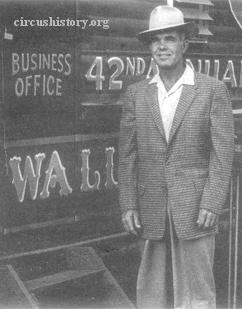 Photo: Pat Graham, owner, Wallace & Clark Circus, 1962. Photo by Doug Lyon.
Late in 1961, MGM began shooting "Jumbo" in Culver City, Calif. The motion picture involved the use of most of the equipment from the Wallace & Clark Circus. The show's tents, seats, ring curb, and other physical equipment were thus leased to MGM for the movie, and because of various delays in the production schedule, the equipment was not returned to the show until late May. This caused the show several weeks delay in its scheduled opening. As equipment was released from the studio, Tuesday, June 19, 1962, was settled on as the opening day for the show in San Dimas, California, home of the winterquarters.
As soon as the opening date was known, agent C. B. Badger started setting the show's route, with the guidance of some of the circus people in the Los Angeles area. Pete Reeh, boss canvasman, went over all the canvas, while Clyde Graham overhauled all the rolling stock along with Yellow Burnett, who was giving it a good paint job when it assembled.
On the Saturday before the show was to open, equipment started arriving on its downtown San Dimas lot at Bonita and San Dimas Avenues. By early Monday the canvas was in the air, and the cookhouse functioning. At three in the afternoon, the show was blessed by Father Thomas Cassidy, with most of the show personnel taking part.
With the arrival of the DeWayne Troupe and equipment on Tuesday, everything was ready for the afternoon's opening performance. The excessive number of inspectors from Los Angeles City, County and San Dimas City governmental functions delayed the show from starting until 3:15, and then okay it only after all the stringers had been nailed to the seat jacks. Because of this late start, and the scorching weather, the afternoon was held down to about a half house, but the evening show well made up for it with a strawhouse. Both shows produced a good gate for the American Legion.
Mr. and Mrs. Ken Jensen of the Ken Jensen Circus, Paul Eagles and George Emerson were among the honored guests at the opening performance. An arrangement of flowers was sent to Mr. and Mrs. Pat Graham from Mr. and Mrs. Pete Sutton of Sutton's Pacific Coast Shows, along with wishes for a successful season.
Cookhouse steward, Freddie Guinup, posted the cookhouse rules and the show got off to a good start.
Ted DeWayne produced the performance, and Ben Myers announced it. The program presented at the opening performance was as follows:
Organ
Nally Nate - Pre-show
Display 1 - Ring 2 - Cliftons Trampoline
Display 2 - Ponies. Ring 1 - Dietrict’s Ponies, Bill Dietrict. Ring 3 - Disneyland Military Ponies, Ted DeWayne.
Display 3 - Ring 2- Clowns, Atomic Hairgrower
Display 4 - Ladders. Ring 1 - Miss Loretta, Ring 2 - Miss Carol, Ring 3 - Miss Paula
Display 5 - Ring 2 - Clowns, Revolving Ladder
Display 6 - Dogs. Ring 1 - Bill Dietrict. Ring 3 - Nally Tate and His Poodles
Display 7 - High School Horses. Ring 1 - Loran Edwards. Ring 3 - Dale Petross
Display 8 - Risley. Ring 2 - Russ Sanders Troupe
Display 9 - Web. Ring 1 - Miss Loretta. Ring 2 - Miss Paula. Ring 3 - Miss Carol
Display 10 - Ring 2 - Clowns - Boxing
Display 11 - Liberty Horses. Ring 2 - Dale Petross and Loran Edwards
Display 12 - Juggling. Ring 2 - Ben Myers
Display 13 - Clowns - Balancing
Display 14 - Elephant. Ring l - "Bimbo, Jr." with Bill Maynard
Display 15 - Teeterboard. Ring 2 - Russ Sanders Troupe
The program had a little variation throughout the season, but primarily stayed the same.
The Wallace & Clark Circus is owned and operated by Pat Graham. Other members of the show's personnel are:
Harlon Dewitt - Legal Adjuster
Col. Claude Cox - Office
Wm. M. Arthur - Front Door
Vivian Graham - Front Door
C. B. Badger - General Agent
Douglas Lyon - Press Representative
Clyde Graham - Supt. of Transportation
Eddie Say - Contracting Agent
Charles Sullivan - Lot Superintendent
Frank Chicarello - Boss Canvasman
Pete Reeh - Boss Canvasman
Mrs. Reeh - Reserves
Thomas Handforth - Organist
Freddie Guinup - Cookhouse Steward
Margie Hester - Cook
Cliff Moseley - Concessions
Jerry Moseley - Wardrobe
Sunny Leroy - Concessions
Al Dixon - Banners and Concessions
Paul Tate - Novelties
William Maynard - Stock
Bill Dietrick - Ponies and Dogs
Loran Edwards - Horses
Dale Petross - Horses
Clowns included Ben "Boxcar" Myers - Producing; Dana "Pancake" Smith, Fred "Hands" Smith, Berry "Duckie" Friedman, Terry Fergerson and Nally Tate.
The pony ride was owned by Dale Petross and Loran Edwards and run by Homer Dixon, Bill Brantley and Ric Egbert. The workmen on the show included Philip Romaro, Alfred Jim, Robert R. Bayard, David M. Berrson, Mark A. Lafferty, Donald E. Nickelson, Dalphon M. Baldwin, Roger Kimber, Robert Byrd and several others.
The canvas on the show consisted of four pieces. The big top was of the bail ring variety and was a 90 foot round with three 40 foot middle pieces. The Sideshow-Menagerie was a 40 by 60 foot tent and this was at times interchanged with a 20 by 30 foot tent that DeWayne used. The big top marquee was also a 20 by 30 foot tent. The cookhouse was a 22 x 28.
The side show personnel consisted of Ben Myers, who was the manager, and also did the bally with Ted DeWayne, Dan Dix on Doors and Harriet Beatty. The side show acts were Ben Myers, Magician; Barry Friedman, Fire Eater; Dana Smith, Clown, and Harriet Beatty's Lion Act.
The menagerie exhibited in the side show tent included two monkeys, in cage wagon No. 21, a kangaroo and a black bear in cage wagon No. 22, a llama, elephant and Harriet Beatty's two lions, Pam and Tam. Tickets sold for 25c each. It was planned to add two more black bears and Dietrick's Pickout Pony in the near future.
The big show tickets went for $1.00 for adults and 50c for children and 50c for reserves.
Show owned rolling stock was painted red with yellow lettering and orange scroll work. Show owned trucks were: (-s- denotes semi)
-s-No. 11 - Office and Living Quarters
-s-No. 112 - Poles and Canvas
No. 114 - Stake Driver
-s-No. 105 - Light Plant
No. 83 - Seat Truck
No. 84 - Seat Trailer
No. 99 - Side Show Truck
No. 95 - Cookhouse Truck (white and silver)
- Cookhouse Trailer (cream)
No. 3 - Advance Truck (yellow)
- Two Rest Room Trailers
In addition to the above Wallace & Clark rolling stock, DeWayne had the following vehicles which were integrated into the show's rolling stock: (painted blue and white)
Stock Truck
Cage Trailer No. 21
Cage Trailer No. 22
Concession Trailer
Sleeper Trailer No. 20
Prop Truck
Office Trailer
Long Bed Trailer (Cages No. 21 and No. 22)
Long Bed Trailer (Concession and Office Trailer)
Besides the above mentioned units DeWayne also had a couple of trailers which he used for sleeping his performers. There were also numerous other privately owned rolling stock on the show.
After the show's opening in San Dimas, Wallace & Clark next appeared in Glendora/Azusa on Wednesday, June 20; for the Elks. The lot was located at 5th and Alosta between the two cities. No afternoon performance was given because of the sponsor's failure to acquire a city license, and the tents weren't erected until two in the afternoon. But with the good billing and strong advance, the evening performance was slightly under a full house.
On the 21, the show exhibited in Corona, under the auspices of the American Legion. The lot was located just off the freeway at West Grand Blvd. and Third Street. A strong wind blew constantly throughout the day, hampering the erection of the big top, and the attendance. One of DeWayne's trucks broke down en route to Corona, consequently he had to double back to Azusa four times for all his equipment.
Friday and Saturday (22 and 23) was a two dater under the American Legion at San Bernardino. Billing was good in the outlying area, but very little downtown, and the advance was below normal for a two day stand, but the show welcomed the rest. A little less than half houses resulted for all performances. Saturday evening, John A. Strong, Jr. and Cecil Kestler of the John A. Strong Circus visited the show. Cecil had previously been with Wallace & Clark in 1960. The show was off on Sunday, and the workmen took their time in taking down the big top and everything was cleaned up for their Monday date at Redlands.
The show played Redlands on the 25 without a sponsor, but with the strong backing of the Redlands Daily Facts. Here the show had some labor trouble, and planned to skip their Fontana date and go on to Rubidoux on Wednesday, because of the strong advance there, but it was eventually decided to return to quarters and try it again later on in the season.
The tour never became a reality, because the Gra-De Corporation bought the show and started leasing out the show's equipment for various motion pictures and television shows and other functions for the rest of the season. But they plan to go out again this year, possibly under another title and out of the Los Angeles area.
Route card No. 1 lists the show's route as being:
June 19 - San Dimas, Calif.
20 - Glendora-Azusa. Calif.
21 - Corona, Calif.
22 - San Bernardino, Calif.
23 - San Bernardino, Calif.
Sunday
25 - Redlands, Calif.
*26 - Fontana, Calif.
*27 - Rubidoux, Calif.
*28 - Chino, Calif.
*29 - Pomona, Calif.
*30 - Pomona, Calif.
Sunday
July
* 2 - Baldwin Park. Calif.
(Dates denoted * were cancelled)
My sincere thanks go to Mr. and Mrs. Patrick Graham for their continued cooperation, and to Mr. Donald Carson for his photographs, which were used to illustrate this story.
This is the second year for the operation of the Famous Cole Circus by the partnership of veteran showman, Herb Walters, and experienced circus manager, Bob Couls. The show has not changed a great deal since the 1961 season, although it is, perhaps, a bit smaller this year. From front to back the entire show is well painted and maintained in first class condition.
John Frazier is general agent ahead of the show, and an attempt is made to secure auspices at each stand. It is a rare occasion when a town is played without auspices. The contract between the show and the sponsor calls for the sponsoring organization to provide the show grounds, the licenses, police protection, and water supply without cost to the circus. The sponsor further agrees not to sponsor competitive entertainment and to make "every reasonable effort to forestall the exhibition of any similar show in the vicinity." The show agrees to stand all other expense and pays the sponsor a liberal percentage from the proceeds of all tickets sold by the sponsor until noon on circus day. In addition, the show pays a small percentage of the proceeds of general admission tickets sold by the circus on show day and, on some occasions, a small percentage of reserve seat tickets sold by the circus.
This is one of those arrangements where the sponsor cannot lose and may do very well if the members of the sponsoring organization are energetic about selling advance tickets. The advantage to the show is that in each town there are a group of people (members of the sponsoring organization) who are most anxious to make the circus welcome and to see that it is provided with the necessary accommodations. Moreover, the efforts to sell advance tickets cannot help but create a good deal of word of mouth advertising for the show.
This writer understands that early in the season the Famous Cole Circus played a number of dates in the Chicago area which were originally contracted to be filled by Howard Suesz's Hagen Bros. Circus. Since the Hagen Show did not take the road for the 1962 season, the Famous Cole Circus filled in and it is understood that special paper, using a combination of the two titles, was printed and used for these dates.
Billers ahead of the show are the husband wife team of Bill and Jackie Wilcox.
The canvas on the show is generally good. The big top is a 70 foot round with three 40 foot middle pieces and is a push-pole type. It is white with red and blue trim, made by the U. S. Tent and Awning Company. The show got this big top in late June, 1961, after an early season blow down at Iowa Park, Texas. The poles are painted red.
The big top will seat approximately 1200 people. The reserve seats are six high planks, painted red, on both the long and short sides. The blues, at both ends of the top, are blue planks, six high. On the long side the reserves are sporting flashy red and white masking, courtesy of the Coca Cola Company. This dresses up the inside of the big top immeasurably. The curb of the center ring is wood, and the end rings are made of canvas webbing. On the short side the band truck is backed into the big top and the sides and end are opened to reveal Floyd Bradbury's electric organ. A small platform is built out from the back of the truck to provide space for the drummer and trumpeter who make up the rest of the big show band. Acts enter and exit through a single back door, which is covered by a sliding red and white striped curtain. A cluster of eight huge light bulbs is hung from the two end poles of the four center poles used in the top. Twelve bulb clusters are hung from the other two center poles.
The combined menagerie-sideshow top is a forty foot round with three 20 foot middle pieces, push pole type, which was new in 1961.
The only other canvas on the show is a small tent above the pony ride, the small cook house, the marquee erected in front of the main entrance to the big top, and two concession tops on the midway.
The banner line in front of the side show is an ingenious combination of the regular canvas banners (all of which were in use last year) plus four panels each on two trucks which are spotted on each side of the bally platform. During the winter Herb Walters persuaded Henry Thompson to take enough time off from his job of painting the Kelley-Miller Show to do these eight wild animal panels for the Cole Show. Each panel has the spectacular Thompson flare. Above the pictorial panels are lattice work panels bearing the legends "Wild Jungle Animals" and "Jungle Beasts." These fold down over the pictorials while the trucks are in transit. At either end of the panels on the trucks are two tall ordinary canvas pictorial banners. Above the bally platform is last year's canvas banner proclaiming "Jungle Land Wild Animal Exhibit." All in all, this makes a lengthy, eye-catching banner line.
Ted LaVelda is the sideshow manager again this season. Ted is one of the better sideshow talkers and he turns a tip beautifully. His sideshow bally attraction is Floyd Bradbury, who does a short vent act with several gags coming from the dummy's mouth which are crowd pleasers. Inside Mrs. Carrie LaVelda constructs a rag picture, Bradbury does more comedy vent work, and Ted concludes with a small blade box mounted on Mrs. LaVelda's head. The menagerie is real good for this size of show. Two of the cage trucks are those which carry the pictorial panels described above. These are spotted just outside the menagerie top. Likewise, an the back side of the top the rest of the cage trucks are spotted just outside the cover of the canvas. This gives the customers more standing room in the sideshow-menagerie. The following animals are on display: one Camel, three Llamas, two African Lions, one Leopard, one Puma, one Himalayan Bear, two North American Bears, one Sea Lion, one Chimpanzee, one White Deer, one Hyena, two Pygmy Horses, and several species of Monkeys. The show's three bulls, Norma, Big Jess and Myrtle, are also on display. Sideshow admission is a quarter.
The sideshow blow off goes for ten cents, and it permits the customers to view the back side of the blade box on Mrs. LaVelda's head plus a baby crocodile and a "little donkey from the Holy Land" behind a canvas screen.
On the opposite side of the midway from the side show, the air calliope is spotted first more or less in the center of the midway. Next comes the novelty stand, operated by Charlie and Shirley Rex. This is housed in a brightly painted red trailer, which is new this year and has clown pictorials on the sides. Along the side of the midway is first spotted the pony ride. Next comes trailer No. 12, the office wagon, presided over by Mrs. Couls. Then a small concession top selling candy apples floss and cracker jacks run by Miss Vicki Stringfellow and Jerry Godfroy. After that comes Mrs. Ross McKay's Snake Show on a large, white, spectacularly painted semi-trailer, which goes for twenty-five cents. Between this trailer and the marquee is another concession top selling snocones, popcorn and coke, and run by Don McCracken.
The circus performance presented this year is not quite as big as the 1961 show. At the dates caught by this reviewer, the show was further curtailed by the fact that Marlene Bradbury, who had done a web turn and a cloud swing, had fallen while practicing the latter act and was confined to a hospital at Madison, Wisconsin, with a fractured vertebra. Nevertheless, the show is pretty and well paced. The props are clean and someone sees to it that they are kept painted. Generally the show is a crowd pleaser, and particularly appeals to family audiences and to small children, who sometimes tend to be overwhelmed by a big, show. Floyd Bradbury, who plays the organ, acts as announcer. Bob Green, who was with the show during the 1961 season, to blow the whistle and get the acts in and out the back door, is not on the show this year, Nevertheless, the acts seemed to get in and out of the big top without difficulty, and the performance does not drag.
This is the order of acts presented at the performances caught by this Reviewer: Display No. 1. "Hippodrome Holiday," a walk around featuring all performers in costume together with the Camel, the Ponies, the Llamas, and the Elephants. Display No. 2. Swinging Ladders with Rita Ferrari over Ring One and Torchy Townsend over Ring Three. Display No. 3. Clown Gag Involving a Large Fake Egg Which Materializes Into a Live Duck. Display No. 4. Juggling in Center Ring by Hines Rucker. assisted by his wife, Patti. Display No. 5. Jane Randall and her Educated Dogs, assisted by her husband, Frank Randall in Ring 1; Shirley Rex and her Hollywood Canine Review in Ring 3. Display No. 6. In the Center Ring, Capt. Charles Rex, presenting an Educated Pony ridden by a small monkey. Display No. 7. In Ring No. 3 a balancing act featuring especially good looking chrome promps, presented by Hines and Patti Rucker. Display No. 8. The time worn but still popular clown firecracker gag in the center ring. This particular firecracker blows Ted LaVelda's clown costume completely off him, revealing gaudy clown underwear. Display No. 9. The Ferrari Trio's perch pole act. Display No. 10. Candy Pitch. Display No. 11 In the center ring the elephant, Norma, gets tipsy from drinking too much beer with her sandwiches, and she is taken from the ring by the elephant policeman, Big Jess. Display No. 12. Ted, Carrie and Danny LaVelda, with Frank Randall in a clown camera gag on the track. Display No. 13. In ring three a well costumed and well presented foot juggling routine by Patti Rucker. Display No. 14. Jane Randall working her dressage horse, "Royal Rogue," in the center ring, assisted by her husband in clown costume. Display No. 15. Above the center ring, an aerial perch routine by Rita and Elbalita Ferrari. Display No. 16. In the Center Ring Charles and Shirley Rex, presenting their Chimpanzee, Debbie. Display No. 17. Clown walk around by the three LaVeldas. each wearing a grotesque outsize head. Display No. 18. Web act with Rita Ferrari above ring one and Torchy Townsend above ring 3. Display No. 19. Captain Charles Rex presenting a three elephant routine assisted by Elba Ferrari in the Center Ring.
The show is presenting no concert this season. It appears to this reviewer that the midway concessions and attractions pull in more quarters after the big show in the absence of a concert.
Although the big show band consists of only three pieces, it really cuts the show in true circus style. Floyd Bradbury is on the organ, George Bell plays trumpet and Roy Godfroy plays drums. Roy replaces his son, Jerry, who drummed the show for part of the 1961 season. Jerry's brother, George, operates the pony ride on the midway.
The cook house is new canvas this year, about 20 x 30. Doris Smith, who was nursing a broken arm when we renewed our acquaintance with her, is again feeding everyone in good style.
At each town where this reviewer caught the show there was a remarkable amount of paper to be seen when one considers there are only two bill posters ahead of the show. The Wilcox's manage to put up several daubs in each town, and they really cover the business district thoroughly with pictorials. The show uses a good line of stock pictorials, colorful and well printed. In addition, the show uses the usual date sheets. The newspaper advertising this reviewer saw was a most attractive mat about two columns by six inches. In addition, the show has
On this show it seems that everybody doubles as something. Reserve seat sales are handled by Hines and Patti Rucker. Patti is also mail agent. Mrs. Herb Walters handles the front door and helps Charlie and Shirley Rex at the novelty stand.
Since the show generally plays small towns where traffic is not a problem, the three elephants and the air calliope make a downtown bally each day during the noon hour. Rex handles the elephants, Floyd Bradbury plays the calliope and Roy Godfroy rides along with his trap drums.
Clown alley consists of Ted LaVelda, producing clown, Carrie LaVelda, Danny LaVelda and Frank Randall.
The show is staffed as follows: Owners and managers, Herb Walters and Robert Couls (it appeared to this reviewer that Mr. Couls shouldered most of the routine management chores), Menagerie Superintendent, Joe Simpson; Mail Agent, Patti Rucker; Elephant Superintendent, Al Franklin; Electrical Superintendent, John Collins.
Admission prices in effect at the time this show was reviewed were adults, $1.00; children, 50c, with reserves going for an additional 50c. another mat, about one column by two inches, which does not use the name of the show, but merely announces that a certain date will be Circus Day in the town concerned. At the time the material for this review was being gathered, the management had just started to use large quantities of heralds mailed to boxholders a few days ahead of the show's appearance in each town. The management felt that this extra advertising outlay had helped business considerably.
Although the color schemes on the trucks and the lettering appear to be the same as it was for the 1961 season, the paint jobs look sparkling. Here is how the show is moved ("S O" denotes vehicles owned by show; "H W" denotes vehicles owned by Herb Walters):
| No. | Show No. | Type | Contents | Make and Color |
| 1. | 9 | Semi | Poles and seats | Chev. white with red and blue lettering "S O" |
| 2. | 23 | Straight | Spool and Canvas (Pulls sleeper trailer No. 7) | Chev. white with red and blue trim and lettering "S O" |
| 3. | 36 | Straight | Light plant (pulls red sleeper trailer) | Chev. white with red and blue lettering "S O" |
| 4. | 15 | Semi | Cage trailer containing lions and bears (bunks in front and back ends of trailer) | Chev. white with red and blue lettering "S O" |
| 5. | 12 | Semi | Office and ticket wagon; be hind space devoted to office trailer is room for lead stock and holds one bull, one camel and three llamas | Chev. white with red and blue lettering, yellow scrollwork "S O" |
| 6. | 21 | Straight | Water truck, cookhouse, materials and props (pulls cook-house trailer) | Chev. with red, blue and yellow lettering; elephant head painted on side "S O" |
| 7. | Band Truck | Contains electric organ and properties | Chev. white with red and blue lettering and yellow scrollwork "S O" | |
| 8. | 11 | Semi | Snake pit show truck; also carries concession supplies and has several bunks in front of semi-trailer | Chev. white with large side pictorials of python crushing victim (owned by Mr. Ross McKay) |
| 9. | 25 | Straight | Water and sideshow props (pulls cage trailer No. 10, monkeys and seal) | Chev. white with red and blue trim (this is the truck which has the heart painted on the sides, elaborate blurb about Hugo, Oklahoma, the heart of Little Dixie) "H W" |
| 10. | Pick-up | Small generator for air calliope | Chev. green. no lettering | |
| 11. | 32 | Semi | Two elephants, four ponies and bunks | Chev. white with red and blue lettering "H W” |
| 12. | Pick-up | This truck pulls house trailer occupied by Mr. and Mrs. Walters and Mrs. Ross McKay | Chev. No lettering (this is listed on shows truck gassing list as "McKay pickup") | |
| 13. | Pick-up | This is a green truck which pulls the house-trailer occupied by Mr. and Mrs. Robert Couls | Chev. green (no lettering) | |
| 14. | Station Wagon | This station wagon pulls the house trailer occupied by Mr. and Mrs. Hines Rucker | ||
| 15. | 24 | Straight Truck | Ponies (this vehicle carries pictorial panels used as part of sideshow banner line described elsewhere (pulls 4 wheeled cage trailer. 1 ape, 1 leopard, 1 bear, 1 hyena) | Chev. white with red and blue lettering "H W” |
| 16. | Pick-up Truck | This pickup truck pulls the house trailer occupied by Mr. and Mrs. Floyd Bradbury | ||
| 17. | Pick-up | This pickup pulls the house trailer occupied by Doris Smith | ||
| 18. | Semi | This is a white, unlettered 32 foot trailer pulled by a green Chevrolet tractor. This was built between 1961 and 1962 seasons by Charles Rex; front area carries Rex's dogs and chimp; the rest of the trailer is occupied by Charles and Shirley Rex as their living quarters | ||
| 19. | Passenger Car | This car pulls the house trailer occupied by Mr. and Mrs. Mike Ferrari and their niece, Alba | ||
| 20. | Passenger Car | This car is listed on the gas list as "Mrs. Walter's;” this car pulls the red trailer No. 30, which is the novelty concession stand | ||
| 21. | Passenger Car | This car pulls the house trailer occupied by Torchy Townsend | ||
| 22. | Straight Truck | Two horses owned by Frank and Jane Randall. their trained dogs and props (also pulls house trailer occupied by Randalls) | ||
| 23. | Vanette | Walk-in delivery type truck; holds props; pulls the air calliope between stands | ||
| 24. | Van | Used on advance; not on show |
The Forepaugh & Sells Bros. 20th Century Colossus Circus arrived at 8 A.M. on June 27, 1901, to play two performances in Pittsfield, Mass. They came in on one rather long train which consisted of 27 flat cars, 13 horse cars, 4 stock cars, 9 sleepers and 87 wagons. About noon time the show had been set up and so was able to give their parade. Two performances with twenty displays were given to good crowds. By 1 A.M. they were loaded and leaving for the next day's stand.
In 1887 the Holland & McMahon's Circus was traveling on 5 railroad cars consisting of 2 flat cars, 2 box cars and 1 coach.
No part of this publication may be reproduced in any form or means
Last modified February 2006.
without written permission of the author and the Circus Historical Society, Inc.