


Circus Historical Society
Bandwagon, July - August 1963
Back to Bandwagon Index
Bandwagon, Vol. 7, No. 4 (Jul-Aug), 1963. Note: Only some articles are included in this online edition. Not all illustrations are included. The Circus Historical Society does not guarantee the accuracy of information contained in the information in these online articles. Information should always be checked with additional sources.

Collectors have for years sought an explanation for the scarcity of photos of the old Al G. Barnes quarters in Baldwin Park, Calif. which the show used from 1927 to 1938 utilizing two separate locations which were less than a mile apart. Charles Puck, veteran circus fan and CHS member to whom we are indebted for another group of splendid photos, says he guesses the scarcity is because actually there really wasn't much at either Baldwin Park location to attract photographers of that day. The show had only a series of small temporary or shack type buildings and had no permanent type quarters installations such as those found at Bridgeport, Peru, or Sarasota.
Prior to moving to Baldwin Park, Al G. Barnes had quarters on Washington Boulevard between Culver City and Venice several miles west. This was a real showplace and hence today photographs of them are quite numerous. When Barnes went back to California to winter following the 1923 season, after spending the previous winter in Dallas, he built beautiful new quarters with a large entrance facade, and had several large barns and sheds for the wagons and other equipment while two sidings on the property stored the railway cars. The place was landscaped and beautified and drew scores of visitors daily. These Culver City quarters were used through the winter of 1926-27 and the move following the 1927 season to Baldwin Park is explained in the following item from the March 5, 1927 Billboard.
"Al G. Barnes To Have New Quarters. Al G. Barnes has bought 300 acres of land fronting 3/4 of a mile on Valley Boulevard located midway between El Monte and Baldwin Park involving a consideration of more than $1,000,000. Mr. Barnes says he planned to subdivide the present site on Washington Boulevard of some 70 acres.
"The Valley Boulevard land is under cultivation and includes a number of farmhouses. It has an excellent irrigation system fed by a number of wells. Land is served by the Pacific Electric and the Southern Pacific. Ground not needed for the circus will be equipped with dwellings to house employees of the circus and the remainder will be subdivided.
"The Washington Boulevard site has become entirely too valuable to use as a winter quarters for a circus said Mr. Barnes."
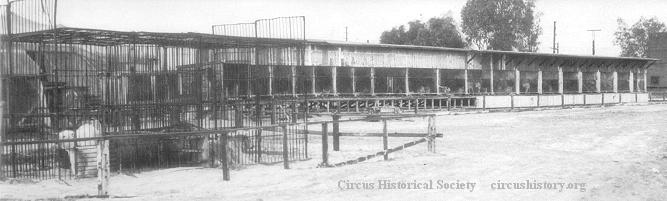
After the 1927 tour the show arrived at Baldwin Park. The quarters, which actually used about 7 acres so Mr. Puck was told when he visited there once, was on the main road from El Monte to Baldwin Park a short distance east of the bed of the San Gabriel River. This road is called El Monte Road and becomes Main Street as it enters Baldwin Park. Barnes' original large tract of land no doubt fronted Valley Boulevard at some point but the site that was actually used for the circus quarters was located as mentioned here. About fifty feet from the far side of the road in front of the quarters ran the main line of the Pacific Electric Railway from El Monte to Baldwin Park.
Two side tracks ran from the main line onto the property and were used on the property. Several sheds were constructed and permanent cages were built to house the animals while the road dens were being repaired or repainted. However, most of the equipment was housed and most of the work conducted under the show's old tents which were erected on the lot. Olga Celeste recalls that the show wintered under tents when it first went to Baldwin Park.
The circus was at Baldwin Park under ownership of Al G. Barnes only one full winter, 1927-28, because on Jan. 5, 1929 after the show had returned to the quarters following the 1928 season it was sold to the American Circus Corporation who put S. L. Cronin in as the new manager of the show. The Billboard mentions that after Cronin took over he had several more sheds and buildings constructed.
The American Circus Corp. owned the Barnes show less than a year and in early September 1929 sold all of their 5 circuses, including Barnes, to John Ringling. Ringling kept Cronin as manager and the show returned to Baldwin Park after the season. Who actually held title to the quarters in Baldwin Park while both ACC and later Ringling used them is not definitely known. I have examined the Bill of Sale given ACC by Barnes and no mention is made of any real estate. Likewise, notices of the sale of ACC to John Ringling state that also included in the deal were winter quarters real estate at both Peru and Denver but nothing is said about any land in Baldwin Park. No doubt ACC rented the quarters from Al G. Barnes himself and Ringling either rented from Barnes until his death or from whoever took over the property. It may be recalled that Al G. Barnes at the time of his death in 1931 left an estate valued at only $5,000, the $105,000 he had received from ACC for sale of his show plus his other assets had dwindled to that amount by his series of ex-wives and their continued suits and claims against him. Notes in the Billboard in late summer 1932 when it seems the Barnes show had to vacate the Baldwin Park quarters on rather short notice indicate they were rented probably on a yearly basis rather than holding any kind of long term lease on them.
The show remained at this location for the winter of 1931-32 and was at the first Baldwin Park quarters a total of 5 winters.
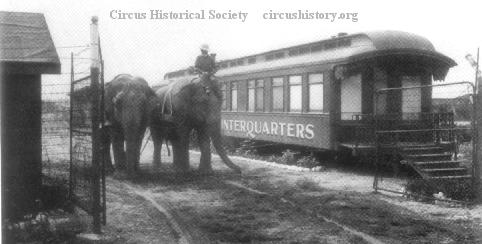
The 1932 season closed the earliest in the history of the Barnes show, August 28, at Ventura, Calif., and the next day moved into new quarters one-half mile east of the old location on the same road and with the Pacific Electric Railway running across this road from the main quarters entrance. The spot selected was very sandy and the show had to hookrope nearly all of the wagons to get them spotted. Everything was housed under tents temporarily.
The Billboard announced that Manager Cronin was confronted with the problem of making his own quarters as the premises formerly occupied had been taken over on short notice for civic improvements. It was announced also that the new location was a barren section of desert sand and that 100 workmen, with trucks, teams, and bulls, moved all lumber and small buildings from the old location to be utilized at the new. A 10-ft. wire fence was taken down and set up around the new site. Workmen began immediately to construct new and better permanent cages and it was said that construction of a barn for ring stock and an elephant barn were to follow that. Also a bunk house was to be built but the sleeping cars parked on a nearby siding were being used until it was ready.
A nearly new building and warehouse just vacated by a builder's supply company in the town of Baldwin Park was obtained for the storage of all seats, poles, banners, wardrobe, and loose equipment, and offices for the show were located there. Just how long this warehouse was used is not known but certainly for several months until the new quarters were finished.
The Billboard mentioned that a feat of the moving was the transferring of the body of a 70-ft. former sleeping car nearly a mile, most of the way thru the sand to the new location where it was remodeled to serve as a dining room for the cookhouse. Later part of the old car was used for the show's office and it remained as such as long as the show wintered in Baldwin Park. The baggage stock was turned out on a beautiful 1000 acre pasture in the foothills 10 miles away and this procedure was carried out yearly. Ring stock was housed under the padroom top but it was reported later a shed was to be build for them.
The trade publications soon announced what the use of the former quarters was to be. In October 1932 Paramount Studios acquired the place for a location in which to film "King of the Jungle." A 12-ft. fence was erected around 20 acres so as to provide a reservation for various animals and circus property to be used in the movie and had erected about 30 old tents, a big top, menagerie, padroom, side show, horse tents, wardrobe, cookhouse which were destroyed in a big fire scene.
The Dec. 3, 1932 Billboard stated that the new Barnes quarters were finished and were far superior to the old. It stated that all buildings had been painted a forest green, and that modern cement tanks had been built Lotus, the hippo, and the sea lions. Despite the better facilities no side tracks were ever run into the property although the Pacific Electric was just across the road. The rail cars were either parked at the Pacific Electric team tracks in Baldwin Park or at the sidings at the old location. Charles Puck says he recalls that for a couple of years prior to the final season of the show they still parked the cars each winter at the old sidings and loaded the train from that spot. Photos available also indicate that some winters nearby side tracks of the Southern Pacific were also used.
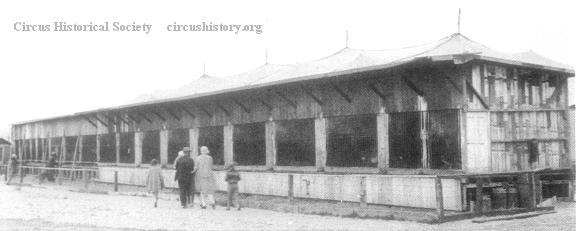
Although the trade publications mentions "buildings" at the new location, as mentioned earlier, these were just sheds, shacks, and small structures and no larger permanent type buildings were ever erected. Each winter several tents were put up and photos show these tents being used for the blacksmith and wagon building departments as well as the paint depts. At both the first and second Baldwin Park quarters a section of permanent type cages was erected for the animals and at times they were turned out into large steel arenas in order to stretch and sun.
The show continued to winter at the second location for the rest of its days. In 1937 the show added the Sells-Floto title and in 1938 some billing even proclaims the circus as Al G. Barnes-Sells-Floto and John Robinson Combined. On March 23, 1938, the Barnes train pulled out of Baldwin Park for the last time to open the season March 26-27 at San Diego. What followed during the hectic 1938 season, that almost saw the finish of show business itself, is a story of its own. Barnes was one of two out of a total of six railroad shows to finish the season. In mid-season 1938 it was augmented by additional cars and acts from Ringling-Barnum which had closed earlier at Scranton, Pa. The show continued the season as a 50-car circus under title of Al G. Barnes-Sells Floto with RBBB features. It went into quarters in Sarasota in late November and never went on the road again.
The old Baldwin Park quarters did see some circus activity in the fall and winter of 1938 and on until the fall of 1939. Howard Bary's Hagenbeck-Wallace Circus went broke in Riverside, Calif., in Sept., 1938, and the equipment was shipped to Baldwin Park and the wagons unloaded and parked in a field opposite the tracks. Ralph Clawson was sent by the Ringling interests to handle their affairs as most of the property was leased from them. Clawson set up headquarters at the old quarters and for a while the stranded show folks were fed at the old Barnes sleeper there.
By late 1939 the Hagenbeck-Wallace property had been sold and Clawson in early 1940 disposed of the quarters property, closed them for good, and returned to Sarasota. An old stake driver and a few pieces of miscellaneous equipment were sold. Details of the disposition of the old sheds and equipment are missing but in 1961 an amazing "find" was made. The old Barnes sleeping cars that had room at the quarters was discovered in a junk yard in Calipatria, Calif. served as the office and dining The old winterquarters sign was still painted on the, side of the car. Bob Taber has tried to interest various rail museums in California to acquire and preserve it but has not been successful as yet. The absence of wheel trucks on the car seems to dull their interest in it. It is hoped that some arrangement can be made for it to be saved. It is the last link of the famous old Barnes quarters in Baldwin Park, of which so few photos and a minimum of information are available in comparison to other quarters of a comparable period.
Today it is possible to pass right in front of both locations of the old quarters by riding out the road that parallels the Pacific Electric Railway from Baldwin Park to El Monte, however there is nothing that remains to give any reminder of the old quarters themselves. Charles Puck said that a few years after Barnes left in 1938 for good the old sidings at the first location were taken up. Both CHS members Puck and Chang Reynolds drove out by the old quarters recently. Today all the land is dotted with small businesses and homes and is now beginning to develop industrially. Thus the place the Al G. Barnes Circus called home for eleven winters has passed into oblivion. Thanks go to Charles Puck and Chang Reynolds for their very special help on this article.
By a happy coincidence two weeks after the completion of this article I noted that a local TV station would show the film "King of the Jungle" which was made on location at the first Al G. Barnes quarters in Baldwin Park in the fall of 1932. It is a fine movie and upon seeing it I recalled various scenes from it and remember that I saw it years ago although had since forgotten it. The film is a must for all and the following information is given about it and suggestion made that you be on the lookout for it at your local TV station.
"King of the Jungle" is a Paramount film released in 1933 and runs about 90 minutes. It stars Buster Crabbe and Frances Dee. The story concerns a young boy "adopted" by a colony of lions in Africa after death of his parents. He grows up and is captured and sold to a circus in the United States along with many of his brother and sister lions. About half of the movie is set on a circus lot. "Corey's Circus" is the movie title but of course all equipment is Al G. Barnes in 1932. There are some excellent loaded flat scenes and some showing baggage wagons coming down the runs. Several setup shots show elephants pulling wagons on the lot and spotting cages. Best views throughout the entire movie are of the interior of the menagerie and practically every cage is shown at one time or other, plus shots of the zebras, lead stock, and elephants. The cage with the carved corner statues and the old carved white ticket wagon were standouts. Authentic circus music plays in the background during most of the lot scenes and the Billboard March and other show tunes can be recognized. Short segments of many Barnes acts are shown in operation under the big top including the liberty act, statue act, iron jaw and other aerial acts, and the biggest thrill is when the announcer proclaims the next act is the greatest number of performing Royal Bengal Tigers ever assembled and you get a few glances at the incomparable Mabel Stark's act.
The big fire scene mentioned in the above article quoting the 1932 Billboard account is really a "super duper" and evidently parts of it later become canned portions which have since been used by many movies in which a circus fire scene is desired. An excellent shot shows the old Barnes water wagon with the rounded tank being brought into play to combat the flames and the realism shown when the menagerie top becomes enflamed and the lead stock being brought outside and animals escaping from their cages cannot be topped in this modern day of 3D, Wide Screen, Cinerama, or anything else you want to call it. Mabel Stark's tigers, who are performing in the steel arena in the big top when the fire is discovered, shown being prodded through the long caged runway to the menagerie cages is the type of circus thrills so often missed by Hollywood's attempt to portray the true circus. Incidently, one tiger escapes and attacks a "spectator," who of course is Mabel Stark and they go through her famous wrestling act.
Animal highlights of this spectacular film of 30 years ago show a fight between a male African lion and a bull (cow variety), lion and tiger fight, and an elephant stampede through the heart of the city that makes the Tarzan variety of bull stampedes look like a piker.
This is one movie that you won't mind staying up for the late, late show to see. It'll be worth it.
Actually a circus fan's dream come true is the most fitting description of Charlie Koehler's new Dixiana Circus. All physical equipment loads on just two trucks and trailers.
Koehler, a practicing attorney and CFA member, had mulled the idea of a small dog and pony show for some years. This type operation, he figured, could play just about any size metropolis, from hundreds to millions in population, under most any type sponsorship. Burton, a crossroads village of some 300 to Houston's million-plus have given him his extremes.
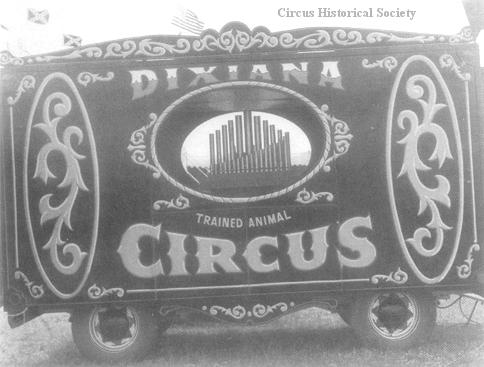 Photo 3. Wagon No. 3, tickets, props and air calliope. This one is a real show piece .
One feels an aura of the old-time southern wagon show when spotting the bright Confederate motif on the top and marquee. The ticket wagon, on its four rubber tires and sunburst-painted wheels, houses the new air calliope, as well as haul props, etc.
The new 60, with two 30's split bale ring top has evidence of custom design all over it. First off, a layout man is ancient history by virtue of painting a red band around each sidepole guyline to indicate the stakeline positions. Secondly, no quarterpoles obstruct the middlepieces. Koehler spotted these in the round ends and at the lacings. The white top and marquee both have red and white striped sidewalls. These walls will soon contrast to the blue and white ones due with a 12x12' top for the midget steer pit show in the near future.
Big show seating consists of six lengths of six-high red planks and eight lengths of the same in blue. These seats, all poles for the big top and the 15x15' marquee, stakes for both, and the big top canvas all load onto one Chevy straight job.
The other truck carries two light plants of ten kw each and lead stock.
A second show-owned trailer now serves as a dormitory coach for the canvas crew. This six-man team erects the top, seats, rigging, and the marquee. Big top interior sports a ring and a ground-level platform, surrounded by back end blues, longside reds, and three sections of shortside blues opposite the platform.
Lighting consists of a two-light chandelier suspended from each centerpole, totaling six bulbs. Red and white and blue and white seat masking fronts the respective colored seat sections, with solid color end masks. Pole patches, sweep bands, etc., also carry out the red and blue motif. Merchant's banners are on the front end of the top.
Koehler's approximately 20 employees are, for the most part seasoned troupers. Such well-known circus names as McNeese, Fuller, Loter, Morris, and Murphree, have signed on for this modern day, Gentry-type organization.
Burton is about midway between Austin and Houston. The Legion-sponsored show held forth on the local ballpark. Ye scribe showed up as the only punk to augment the canvas crew in this burg.
Show uses no cookhouse at present, with a meal allotment substituted. Midway at Burton has consisted of Tex Mayes' pony sweep and McNeese's floss, corn, snow, juice, etc., joint trailer, and a novelty rack, as well as the aforementioned ticket and calliope wagon. A brief mention of the calliope is in order as it's one of those new units currently manufactured by the Cozatt Organ Co., of Danville, Ill. This instrument is mounted in a wooden case.
The blower and lawnmower-type engine sit in the case underneath the air chamber. The pipes are set, not screwed into the frame, and connected by very small diameter tubing to the air chamber. To a real circus buff, like myself, this sounds as good as any of the old-time models.
The single bull, Norma, has a well-known lineage, as the namesake of Norma Davenport Cristiani. She's appeared with such shows as Dailey Bros., Cristiani Bros., and the Clyde Beatty-Cole Bros. Combine. McNeese picked her up from the latter show last fall, and had her out with the Ingalls Amusements shopping center ride unit before the Dixiana opening at East Bernard, Texas, in March.
Program - 1963 Season
Chip Morris, equestrian director, and Mrs. Luther Fuller, organist.
1. Liberty ponies.
2. Clowns George Matthews, Peggy and Jeff Murphree, in the Niagara Falls gag.
3. Spanish web by Linda Loter.
4. The hair-growing clowns.
5. Chip and his well-trained dogs.
6. Tex's pony-riding monkey.
7. Clown camera gag.
8. Chip's dancing horse.
9. McNeese's fine, trained chimp.
10. Concert announcement.
11. Dogs and ponies.
12. Clown stop.
13. Tex and his dogs.
14. Riding mechanic.
15. Swinging ladder, Miss Linda.
16. Clown stop.
17. Chip Morris' liberty horses.
All out and over in about one hour.
Rolling Stock Roster
Truck No. 2 - Canvas, poles, seats, and stakes (red).
Trailer No. 3 - Props, calliope, marquee canvas, rigging (red).
Truck No. 4 - Lights, ponies, and lead stock (red).
Trailer No. 7 - Workmen's sleeper (red).
(Above 4 units have black and gold lettering).
Truck No. 24 - Marie McNeese's Hammond Organ (for bally, only) (white).
Also, innumerable house trailers, pickup campers, private autos and trucks augment the show's caravan.
Staff and Key Personnel
Charles A. Koehler, Jr., Owner, under the Komor, Inc. banner.
Louis McNeese, Road Manager.
Thurman Knight, General Agent.
Perry Luth, CHS, Master Wagon Builder.
Marie Loter McNeese, Concessions.
Chip Morris, Equestrian Director.
Dick Loter, Electrical Superintendent. Luther Fuller, Office Manager.
Mrs. Luther Fuller, Organ and Calliopist.
Red Trawer, Boss Canvasman.
George "Mac" Matthews, Bannerman.
Linda Loter, Novelty Agent.
Tex Mays, Pony Sweep Owner.
Jack Burch, Boss Propman.
Admission is $1.25 for adults, 75c for kids, no reserved seats.
It's hereby understood that each member of the Dixiana Trained Animal Circus troupe will at least double in brass before signing onto the show.
As a personal note, I feel that this show is the blooming forth of a dream that many of us in the three circus hobby organizations share with Charlie. Most of the rest of us have had to be content with miniature circuses, but have always yearned to field such a show as Dixiana, ourselves. May God's Grace and Power be with this great project down through the years.
Editor's Note: This show closed shortly after this review was written, then reopened later and finally closed for the season.
The Circus World Museum of Baraboo recently added to its fast growing collection of old circus wagons a ticket wagon that served on Hagenbeck-Wallace in the 1930's. It was donated by Louis Goebel and the first photo shows it upon arrival in Baraboo in April, 1963, from Thousand Oaks, Calif., where it had been in storage for many years.
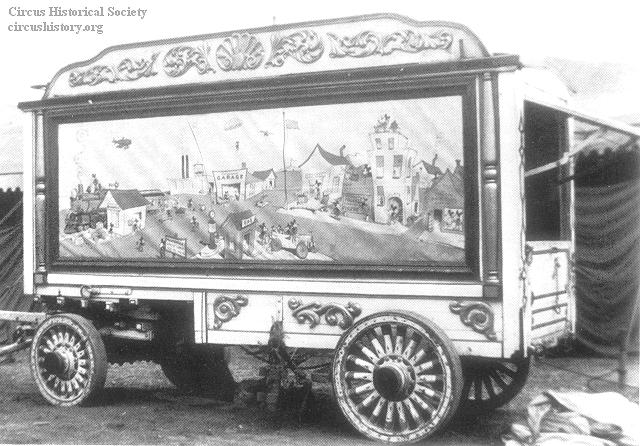
This wagon is easily identified by the rounded and grooved posts that surround a panel for paintings on the sides of the wagon; a skyboard which at various times had either carvings, painted designs, or lettering; and a bottom drop frame on which was tacked carvings. The wagon first appeared in its present form in 1934 on the Hagenbeck-Wallace Circus. Most probably on old drop frame wagon at the Peru quarters were remodeled into this one. Some speculate it could have been a rebuild of the 1933 H-W grandstand ticket wagon, but if so, although the profiles of both wagons were very much the same, the rebuild was extensive enough to prevent a positive statement from the examination of photographs alone. Several similar wagons were available at Peru that could have figured in the rebuild. Although at times some new wagon construction did take place at Peru as late as 1934 most of the work consisted of rebuilding, interchange of wheels, gears, parts, etc. After John Robinson went off the road following the 1930 season and Sells-Floto after 1932 a great number of excess wagons were on hand. The best of these were utilized by remodeling, and rebuilding, Hagen beck -Wallace, the last of the Peru shows on the road, had the choice of the best of them in the large wagon pool.
In 1934 the wagon was No. 41 and was used as the sideshow bandwagon in the big street parade featured that year. Both sides of the wagon had full length cartoon type paintings of Mickey Mouse and his friends. On one side was "Mickey's Circus," the other side had "Mouseville." In his book "Clown," Emmett Kelly claims to have done this art work at the Peru quarters in the winter of 1933-34.
For 1935 the street parade was dropped as a daily feature although some parades were given during the season. The wagon was slightly remodeled and a door was cut into one side and it was used as the grandstand ticket wagon that season. The carvings were removed from the skyboard and it was lettered "Reserved Seat Tickets." To prevent the Forepaugh-Sells title from falling into public domain as it had not been used since 1911 that name was tacked onto the Hagenbeck-Wallace title and the door side of the wagon was decorated with the full title of Hagenbeck-Wallace and Forepaugh-Sells Combined done in beautiful script. A clown with hoop painting completed the art work on that side. The other side had a large painting of the busts of Carl Hagenbeck, Ben Wallace, Adam Forepaugh, and two of the Sells brothers.
In 1936 Hagenbeck-Wallace did not go out but remained in Peru quarters the entire year.
In 1937 the Hagenbeck-Wallace title and equipment for a 35-car show were leased from the Ringling interests by J. Frank Hatch and Edward Arlington who opened the season with a great run in Chicago. Shortly after going on the regular road trip they sold their interest to Howard Y. Bary who operated it for the rest of the season. A street parade was a daily feature for a short time early in the season. This wagon continued to serve as No. 41, the reserved seat wagon in 1937. The long side of the wagon was lettered with the title of Hagenbeck-Wallace Trained Wild Animal Circus and a painting of two sea lions each balancing a large ball was at each end of the title block. On the door side the clown and hoop remained but the script lettering of the long 1935 title was replaced by the shortened 1937 title. The skyboard was attractively decorated with painted designs but had no lettering.
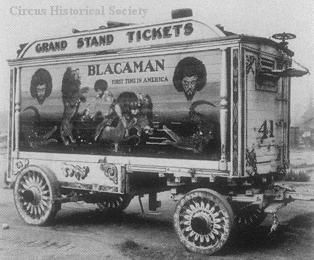 Photo: In 1938 the No. 41 Grand Stand Ticket Wagon had a beautiful full side painting of Blacaman, the Hindu Animal Hypnotist, the feature act of the show. Photo by Charles Puck.
Bary put the show out again in 1938 although it was cut down to 28 cars and a different color scheme used for the train and wagons. Several new all steel wagons equipped with dual pneumatic tires arrived from the Springfield Wagon Works. The ticket wagon remained as No. 4 and the skyboard again was lettered A most attractive full length side painting of Blacaman, the Hindu Animal Hypnotist and feature of the 1938 program adorned one side of the wagon and on the door side smaller Blacaman paintings were also used.
Despite almost fantastic odds against the show it made a full season in 1938 but went broke in Riverside, Calif., in mid-September when creditors began seizing the canvas and other properties. The Ringling interests, to whom most of the property still belonged, shipped it from Riverside to Baldwin Park and after Bary,'s efforts failed to organize a 15-car show to continue the 1938 tour they stored the property while the creditor's litigation continued.
In the spring of 1939 parties made an attempt to launch a 15-car railroad show under the title of the Great American Circus using property leased from the defunct H-W show but after union trouble and other difficulties the show folded following a few stands. After that the Hagenbeck-Wallace property was sold off and that grand old show became only a memory.
The ticket wagon, along with the rest of the steel tired baggage wagons and cages, and some of the new pneumatic tired wagons were sold to Louis Goebel who moved them to his place in Thousand Oaks. It was his intention to use them mainly for movie rentals.
In 1945 the ticket wagon was one of several of the H-W wagons that Goebel leased to the new 15-car Arthur Bros. Circus. Both sides of the wagon were painted with the title and a huge leaping tiger. A good photo of this ticket wagon on the Arthur Bros. Circus was printed in the Nov.-Dec., 1962, issue of Bandwagon.
Following the close of Arthur Bros. at end of the 1945 season the ticket wagon went back to Goebel and was stored at his World Jungle Compound in Thousand Oaks where it remained until it left for Baraboo this past April. From 1946 to 1963 it appeared with a variety of titles and paintings on it when used in many movies and television shows.
It is the intention of the Circus World Museum to immediately restore the wagon to its former glory so that it can also roll in the big Milwaukee street parade on July 4. The Museum is extremely pleased to have acquired this wagon and circus historians everywhere are most grateful to Mr. Goebel for his kindness in donating it where it can be restored and kept as a living reminder for all times of the old Hagenbeck-Wallace Circus.
July 30, 1932, the Sells Floto Circus train arrived early in the city of Springfield, Mass., with its 8 sleepers, 7 horse cars, 14 flat cars and 55 wagons.
Color scheme this year was all railroad equipment yellow; orange and red; wagons red and yellow; the ticket wagon white and the cookhouse wagons all green.
Tents on the show: Big top, Menagerie, side show, dressing, horse tents, cookhouse, kitchen, barber shop, 5 small tents, and three candy stands.
Menagerie contains: 13 cages, polar bears, brown bears, seals, monkeys, lions, tigers, 11 elephants, 11 camels, and 13 ponies. In the dressing tent they had 50 ring horses.
Side show features: Minstrels, untamable lion, snakes, half girl, fat girl, giant, Punch & Judy, the sword swallower, Oriental dancers, tattooed man, escape artist, fire eater and mentalist.
Wagons were: Grand stand chairs, grand stand planks, ticket wagon, 13 cages, 3 electric light plants, big poles, two stringer wagons, a jack wagon, seat planks, reserved seats, ring curbs, cannon, steam table, three cookhouse dept., stake driver, horse tents, stake and chain, privileges, 2 tractors, menagerie, dogs, Buffalo front, two canvas wagons, picture front, two water tank wagons, and an auto.
The cookhouse and horse tents were down and loaded as soon as supper had been served.
As soon as the big show started that night the side show and menagerie were taken down.
Everything was packed and on its way to the cars by midnight and it was shortly afterwards, when the train left for Providence.
Ed. Note: Later in the season the show began a tour of the south. The John Robinson title was added to a few wagons and to the newspaper ads.
All photos on this page from Bill Woodcock collection.
No part of this publication may be reproduced in any form or means
Last modified February 2006.
without written permission of the author and the Circus Historical Society, Inc.