


Circus Historical Society
Bandwagon, January - February 1963
Back to Bandwagon Index
Bandwagon, Vol. 7, No. 1 (Jan-Feb), 1963. Note: Only some articles are included in this online edition. Not all illustrations are included. The Circus Historical Society does not guarantee the accuracy of information contained in the information in these online articles. Information should always be checked with additional sources.
At the close of the 1893 season, the Adam Forepaugh Circus deposited a large number of animals in the National Zoological Park, Washington, D.C. In June, 1962, Sgt. Marvin L. Jones, of the United States Army, completed a project for the National Zoo which lists every species and sub species of mammal which have been exhibited at the zoo together with the date of arrival of the first example of each. It is significant that of the Forepaugh animals, deposited at the zoo on Nov. 7, 1893, no less than 23 species were the first of their kind to be exhibited in Washington, as follows:
|
Rhesus monkey
Ceylonese toque monkey Sooty mangabey monkey Yellow baboon Guinea baboon Spotted hyena Puma Bengal tiger Cape mountain zebra Sumatran rhinoceros Wart hog Common or Nile hippopotamus |
Bactrian or two-humped camel
Arabian or one-humped camel Guanaco Alpaca Axis deer Eastern waterbuck Beisa oryx antelope Gemsbok antelope Tora hartebeest White tailed gnu Blackbuck antelope |
It is interesting to note the great rarity of some of these animals. The curious, little, hair-covered Sumatran rhino is so scarce that experts estimate its current wild population at no more than 100 examples. It has not been exhibited in this country since World War I.
The Cape mountain zebra was rather common in captivity at the turn of the century, but today it cannot be seen in any American or European zoo or circus. It has been reduced to a single small herd living in a preserve near the tip of South Africa. The same is true of another South African animal, the white tailed gnu.
The tora hartebeest from the Forepaugh collection is the only example of this particular kind of hartebeest ever shown in America. While not too rare in a wild state, the U. S. Department of Agriculture currently forbids the importation of wart hogs so that they are very rare in captivity.
The Adam Forepaugh show was always noted for its fine menagerie, and the 1893 edition was no exception.
Despite the skepticism of experienced circus professionals regarding the problems of transporting a circus by truck, Andrew Downie, during the spring months of 1926, hurriedly framed a motorized circus with plans for a tour that would take the show into New Jersey, New York and Pennsylvania. Quarters for the show were selected in the baseball park at Havre de Grace, Maryland, and, although the failure of others in the field of motor transport caused Downie to be wary, he still framed the show within ninety days. "- it is the quickest show, I guess, that has ever been organized," stated Gov. Downie, but so elated was he with its success by the month of August that he vowed he wouldn't accept a railroad show as a gift. By the end of the season this famous owner was planning to enlarge the show for the next year and was stating that the motorized circus was not only practical but profitable. In addition, he was predicting that other circus owners would soon follow in his footsteps.
"You can say that the show was made up of men with railroad experience," states Capt. Frank Phillips, who left the Sells Floto Circus after its stand in the Chicago Coliseum to join the Downie show. "There wasn't a mud-show man on the lot. We learned the hard way." This statement, by a qualified observer, no doubt explains the shifting of personnel during the first weeks of the tour, and also indicates the ability of the men who remained to apply their skills at moving railroad shows to the new field of truck transportation.
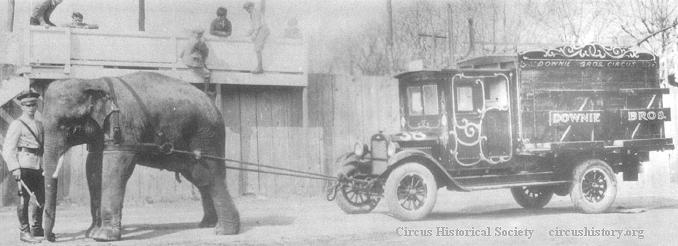
The show was transported on thirty-eight trucks, five trailers, three tractors and three advance trucks at the opening date. The three trucks used ahead of the show housed five men in each and were under the direction of General Agent, Jerome T. Harriman. One truck billed the towns on the route and the other two covered the surrounding country. All baggage trucks were painted red with gold and silver trim. The rolling stock was collected from many sources from anyone who would sell a truck according to Phillips.
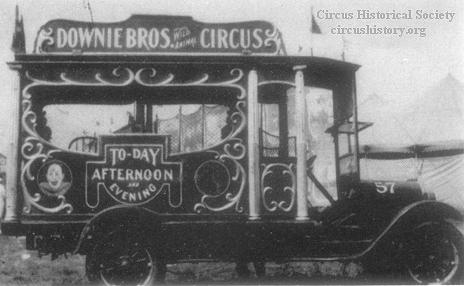
The calliope for the show was built by Mr. Joe Ori of Newark, New Jersey. A consultation with Joe Bradbury and Bill Woodcock brought out the information that Mr. Ori constructed several for the Ward Baking Company. However, Woodcock thinks that Ori built only the calliope, not the truck body. Bradbury suspects that a truck body builder worked closely with Ori since the decorations on the baking company truck and the Downie calliope are identical. The calliope has some scroll work around the title which reads, "Downie Bros. Shows." It carries a skyboard with the lettering. "This Afternoon and Evening." Above the title are the words "Admission 25 & 50." The truck is, perhaps, a Dodge.
The Downie ticket truck was a plain looking vehicle, probably a Chevy, with no decoration other than the name of the circus, admission prices, and, in large letters, "Ticket Office Open 1:30-7:30."
The two light plants were mounted on an obsolete fire truck purchased from the Havre de Grace Fire Department. "The trucks were all junk," comments Frank Phillips. "Downie got them from everywhere. I drove a Reo truck - the model that had the gas tank mounted in front of the steering wheel. In the truck I carried the lion act, the arena and my arena props. The thing caught fire every day.”
When asked about Downie's frequently repeated statement that the show never missed a performance or a meal all season long, Phillips replied, "We never missed a performance, but I guess some of us missed a meal occasionally - at least the working people did. There were many breakdowns with that equipment on every move. Anyway, we started the 1927 season with all brand-new Chevy trucks."
The show opened at Havre de Grace, Maryland, on April 24, with ideal weather during the morning and afternoon. The new big top, built by Driver Bros., was filled to capacity for the matinee. However, as the side show opened for the night's business a heavy rain and windstorm hit the town and kept the evening attendance to a minimum. Although the program for the opening date is not available, the staff at that period consisted of Andrew Downie, Owner; James Heron, Assistant Manager; Jerome T. Harriman, General Agent; William B. Emerson, Treasurer; Harry Allen, Legal Adjuster; Jack Croake, Supt. of Tickets and Purchasing Agent; Tex Cavanaugh, 24-Hour Agent; Archie Silverlake, Equestrian Director; W. Wiggins, Advance Banner Solicitor; Henry Bushea, Supt. of Concessions; Charles Lewis, Supt. of Dining Tent; Steve Roberts, Supt. of Canvas; Blackie Collins, Supt. of Tractors; Joe Gilligan, Master Mechanic, and Jack Fahah, Supt. of Properties.
The side show, under the direction of Supt. Jake Friedman, featured the Heron's Pit Show, "Jungleland." It was managed by Joe Gilligan and Vernon Ott was the inside lecturer. The candy stands were supervised by Mrs. Marie Heron, assisted by Mrs. Jack Croake. Harry Wellington operated the outside stand and the inside butchers were Joe Coob, James Johnson, William Grebb and Walter Middleton. Fred Brad handled the novelties and Herman Blotner was in charge of the lunch stand and privilege car.
The show had one elephant at this time. The bull was Teddy, a young male, that had been obtained from Toy Town, at the New York Hippodrome where he was on exhibit with Rosa's Royal Midgets. Brought to quarters early in April he was trained by N. W. McKay, the elephant trainer for the show. Later, when Frank Phillips was Superintendent of Elephants, Teddy was trained to do a head-carry. Billboard notes that Andrew Downie had purchased three more elephants which were to arrive at an early date. However, with the exception of the delivery of Tena, a punk, at Carbondale, Pa., the records do not indicate that there were others on the show this season. The next elephant to be added to this show was Babe, another youngster, that may have been on the show late in the season and was certainly present for the 1927 season. Present day elephant sympathizers will remember Babe of the Clyde Beatty Circus and Tena, still with Al G. Kelly-Miller. Capt. Phillips reports that Teddy, Tena and Babe were the Downie elephant herd until 1930 when Pinto and Queen were added from the Cole Bros. show. Until the head-carry gave him a concussion, Frank supervised the antics of these five bulls. Later, probably during the winter of 1932-33, Addie (Hattie), Cora, Inez and Marion were added.
When Andrew Downie came out of retirement in the winter of 1925-26 to launch his new circus, he was a veteran of over forty years in show business. He had joined with Clarence Austin in 1884 in a one-ring venture entitled, "The Downie & Austin Parlor Circus," after several years as an acrobat, wire walker and juggler. At that time he was just over 20 years old. For several years he piloted such organizations as the Rich & Downie Circus, Andrew Downie's Dog and Pony Circus, Downie & Gallagher, and Downie & Wheeler. Other show activities during the years before 1914 included the ownership of the Diamond Minstrels, a circus tour by barge of the towns on the Erie Canal in 1892, a tour of Canada from Winnipeg to the Pacific Coast with his repertoire company, and executive posts on the Great Wallace Circus.
Although Downie married Christena Hewer (M'lle La Tena) in 1890, he did not operate the circus by that name until 1914 when he opened with a 10-car railroad show entitled, "The La Tena Wild Animal Circus." In 1916 this show was increased to fifteen cars and Downie returned to his Canadian homeland for part of the season's route. This show folded without warning in 1917 at Havre de Grace, Maryland, but Downie leased the Walter L. Main title the following winter and was on the road with it until the end of the 1924 season, when he retired. Miller Bros. took possession on October 25, after the final stand of the season. Col. Joe Miller had been with the show since the sale was consummated in September. Downie had passed his 61st birthday in August of that year and undoubtedly felt that a rest from the strenuous life was in order. However, he was away from the circus one season only before developing the motorized circus that was to become one of the favorite shows of the eastern states under the management of Downie, and, after his death, Charles Sparks.
The new circus opened the 1926 season bearing the title, "Downie Bros. Motorized Show," and was usually referred to as the "Downie Bros. Circus." Several titles were used during the season as Billboard notes on July 10, that the title had been changed to "Downie Bros. Wild West Circus," and in the July 17 issue carried an advertisement requesting musicians, cooks and side show personnel to report to "Downie Bros. Animal Circus." The Express, of Dansville, N.Y., advertised the arrival of the "Downie Bros. World Best Shows" for June 30, 1926. Subsequent to the Medina stand, July 5-12, nearly all advertising used the title, "Downie Bros. Wild Animal Circus."
After the Saturday opening date, the show moved to Elkton, Maryland, for its first stand of the tour. The balance of the first week took the show to Oxford, Pa.; Bel Air, Md.; Red Lion and Stewartstown in Pennsylvania, and back to Cockneysville, Md., for the Saturday stand. The runs for the shake-down week varied from ten to forty miles each day and the show was moving as smoothly as could be expected.
The second week opened at Reistertown, Md., with Emmettsburg in that state the Tuesday date, followed by Waynesboro, Mercersburg, McConnellsburg and Bedford, all Pennsylvania dates.
Keyser, West Virginia, opened the third week with Cumberland, Md., the Tuesday stand, and Meyersdale, Berlin, Boswell and Ebensburg, Pa., concluding the week.
The fourth Monday, May 17, the Downie show opened a solid week of stands in Pennsylvania with Hollidaysburg, Huntingdon, Burnham, Middleburg, Salins Grove and Millersburg filling the week.
During the fifth and sixth week, the show continued its tour of the Quaker state with Tower City, Tremont, St. Clair, Frackville, New Philadelphia and McAdoo, the stands of week number five and Freeland, Weatherly, Nescopeck, Shickshinny, Exeter and Olyphant receiving engagements for the sixth week.
The Downie Circus interrupted its tour of Pennsylvania during the seventh week and crossed the line into New York State. W. B. Emerson, treasurer, reported that this week was the banner one for the early part of the tour. "Everything is moving along nicely and the show is yet to have its first late arrival," he added. However, several changes in personnel had occurred and other events indicated that Downie was not satisfied with the show as it stood at that time and was seeking improvements. The personnel changes started when Clarence Auskings closed as contracting agent with the Gentry Bros. Circus at nearby Scranton, Pa., and joined the Downie show as general agent. George Caron replaced Harry Allen as manager of the advance and Edward Heath was put in charge of the inside tickets. Heath also became banner solicitor and press agent back with the show. Peck Amsden, a former Downie employee, returned and took over as legal adjuster and superintendent of privileges. During the week a new and larger side show top was ordered, a baby elephant, Tena, was received at Carbondale, Pa., and a leopard and other animals were delivered at Callicoon, New York. Popular acts during the performance were the Silverlake Trio, the De Homan Family, Captain Turp's dogs and ponies, and N. W. McKay's turn with Teddy. Stands for the seventh week were Carbondale, Hawley, and Honesdale in Pennsylvania and Callicoon, Liberty and Roscoe, N.Y.
The eighth week included Hancock and Deposit, N.Y., and Susquehanna, Montrose, Wyalusing, and Dushore, in Pennsylvania.
The ninth week concluded the Pennsylvania tour for 1926 with Towanda Canton, Troy and Mansfield in the early part of the week. Friday and Saturday of this week the show was in Painted Post and Watkins Glen, New York.
The tenth week began on June 28 at Hammondsport, New York, with the remaining stands of the week at Hornell, Dansville, Perry, Warsaw, and Attica. Thanks to the research of Mrs. Margaret Turner of Livonia, N.Y., information has been provided regarding the Dansville stand. The Dansville Express of June 25, 1926, advertised that the Downie Bros. World Best Shows would play Dansville on Wednesday, June 30. Features of the day were "100 Animal Actors, Big Free Street Parade at Noon, the World's Greatest Acrobats, Gymnasts and Aerial Artists, and a Grand Colossal Aggregation of Wonderful Performing Elephants, Horses, Ponies, Goats, Pigs, Canines and Monkeys. Admission 25c and 50c."
On July 2, the Express carried this article:
And the Circus Came to Town. "Downie Bros. World's Best Shows came to Dansville last Tuesday, transported by a fleet of motor trucks, and the youngsters as well as many of the older folks of the village watched the interesting operation of "setting-up" the show.
"Good crowds attended both the afternoon and evening performances and were apparently well pleased with the various features presented for their entertainment. A good street parade at noon was good advertising for the circus. Many out-of-town people came in for the show."
The eleventh week was scheduled to open at Medina, New York, Andrew Downie's home town on July 5. Dates for the week's route which were contracted were LeRoy, Batavia, Alexander, Fowlerville and Wadsworth. However, these stands were cancelled and the show made a week's stand at Medina," according to Billboard. Actually a great deal of activity took place during that week - activity which improved the operation as well as the presentation of the circus.
According to some information this Medina stand was a week of reorganization - and to a certain extent this is true. When questioned on this point Frank Phillips insisted that the main purpose of the layover was the presentation of awards and a life membership in the Shrine to Gov. Downie. "It was Downie's home town and he wanted the people there to share in the celebration," commented Frank. "We gave performances every day.”
The July 10 report in Billboard states that Downie had seven cages built in Medina for his new menagerie and five new trucks were added to the fleet for the new animal acts. This increased the number of trucks on the show to forty-five according to reports from the show. New trucks for the parade were also made ready and painted while the show was in this New York state town. It was at this stand that the title, "Downie Bros. Wild West Circus," was adopted. Jake Friedman received the new top for the side show at this stand.
Personnel who joined the show at Medina were Leon Bennett and his wife, from Christy Bros. Chick Howe, also from Christy Bros., took charge of the pit show and added several new animals including a trained baboon. F. L. (Blackie) Collins, a six-horse driver of note, changed methods of locomotion and took over the driving job of one of the trucks. Bill and Pearl Agnew also departed from Christy Circus and joined Downie.
Among the new animal acts added at Medina was a lion act and several leopards purchased from Otis L. Smith. The lion act, according to Frank Phillips who worked them, consisted of eight lionesses. He also remembers a leopard act being added to the show. It was the Vallecita leopard act from vaudeville and one of the cats had recently killed the trainer. Also in the animal department, N. W. McKay started to break the new elephant, Tena. The horse "with the human brain," Colonel Fred, was added to the show along with other animals belonging to the trainer, Otis Loretta. This man had been with the earlier Downie shows.
Additional personnel who joined at this time were Vernon West, wire and swinging perch performer, from the Christy show; George Everett and Frank Barteau, clowns from Barton Bros., and Piper MacLeod, Scotch bagpiper and dancer. "Icewater" Wilson took over the operation of one of the candy stands.
Advertisements in Billboard during the weeks after the Medina stand indicated these needs - "Wanted: Banner Solicitor. Downie Bros. Wants Quick: Band Leader and Cornet and Bass Drummer for Big Show Band. Cook, two Waiters, good Mitt Reader and Second Sight Act for Side Show. Wanted: Billposters who can drive truck, Truck Mechanics, Experienced Electrician, Producing Clown and man to work Come-In, Cooks, Waiters and working men in all department. Privileges open: Tintype and Farm Paper."
The twelfth week opened at Avon, New York, on July 12. Honeoye Falls, Sodus, Wolcott, Baldwinsville and Pulaski made up the balance of the week. Mrs. Turner of Livonia found that the Livingston County Historian, Mrs. Marie Preston, had attended the opening of the show at Avon. The lot was located on what was known as the "Five Lot Farm," now part of the Avon business district. Mrs. Preston reports that one of the Spitz show dogs delivered pups that day and her husband obtained one of them. He brought it to their home and it lived with them for many years.
The Downie show was now operating at high efficiency and ready to collect the profits from the eastern part of New York State. It swung into Adams, New York, for the first stand of the thirteenth week with Lowville, Antwerp, Alexandria Bay, Gouverneur and Canton to follow.
Still in the Empire State, the show played Madrid, Norwood, Moira, St. Regis Falls, Bloomingdale and Au Sable Falls to good business for the fourteenth week.
The fifteenth week began on Monday, August 2, at Keeseville, and the show finished the week at Westport, Port Henry, Ticonderoga, Schroon Lake and Chestertown, all New York.
Lake George, Hudson Falls, Granville, Schuylerville, Ballston Springs and Altamont made up the sixteenth week of the season and the forty-fourth New York state stand. A brief report from Hudson Falls on August 10 stated that the parade featured three bands and a calliope. The Bowen Family Band, which played the side show, was a recent addition. Camels had been added to the menagerie and some members of the Sig Sautell show which had closed near Syracuse joined the Downie show.
Week number seventeen continued the New York route with Middleburg, Cobleskill, Cherry Valley, Cooperstown, Richfield Springs and New Berlin bringing good business to the show. During this week Gov. Downie was in New York City and stated, "Business has been excellent. We have not missed a performance or even a meal since the opening of the season." Comparing his experiences of the present season with those spent traveling by rail, he reported that the show utilized fifty-one trucks, and two tractors and trailers. "We move faster and more expeditiously than by rail. There are no tiresome delays, such as experienced at division points, and the red tape incident to railroad moves is entirely eliminated." Downie also related that the show moved in three sections. The cookhouse was the first section, and left the lot immediately after the evening meal. The second section was composed of the baggage and equipment which left at midnight while the third section included the performers, the majority of whom used their own cars, which permitted them to leave whenever they thought they could negotiate the road and arrive in time for the parade the next day. Performers usually got underway early in the morning. Jumps averaged 25 to 30 miles and daily consumption of gasoline was approximately 450-500 gallons. Downie stated that the parade consisted of ten cages of animals mounted on trucks, four bands and the calliope. The parade, he said, was introduced on June 10, which was the first New York state stand at Callicoon. Other evidence indicates that the show did not parade regularly until after the Medina stand, although Phillips says that the Downie show paraded all season. The most valid statements in regard to the parade rest with Downie and Phillips rather than the fragmentary evidence that indicates occasional parades early in the season.
"Our program is varied and is making a pleasing impression wherever we have exhibited," Downie continued. "We carry 152 people; have two rings, an elevated stage and a steel arena, with a four-pole round top . . .”
The eighteenth week took the Downie Circus to Sidney, Walton, Delhi, Margaretville, Stamford and Windham, all New York state.
The nineteenth week began on August 30, at Cairo with Catskill, Saugerties, Ellenville and Goshen being the concluding stands in the Empire State. After the Goshen stand, the 61st in this state, the show moved to Sussex, New Jersey, for the Saturday date, September 4. Billboard under this date carried an advertisement stating that Downie was booking for a long season south. "Wild West Team for Concert, Musicians for Big Show Band - For Side Show: Inside Lecturer, Punch, Magic and Ventriloquist, Fire Eater, Sword Swallower, Novelty Side-Show Acts, Billposters, Lithographers and Card Tackers who can drive truck; two more candy butchers, canvasman, Property Men, Seat Men, Farm Paper, Ball Game, Cigarette Shooting Gallery."
The second stand in New Jersey was at Hackettstown and at this time Billboard carried a review of the performance and other activities. The weather of the day indicated a poor stand for the circus. The lot was muddy and very soft. In spite of the weather the matinee attendance nearly filled the 2,000 seats according to the report.
In contrast with Downie's statement, the reporter listed the number of trucks as forty-two, with two tractors and many privately owned cars. The big top was an 80-foot with three 30-foot middle pieces and four poles. One ring, the steel arena, and a platform were used for the performance. There were no working horses around the lot - tractors had replaced them. This item alone held a significance for the future to any observing fan.
The staff listed at this date indicated that several changes had taken place. Jack Croake was purchasing agent; Peck Amsden, legal adjuster; Clarence Auskings, advance (2 weeks ahead), and George Caron was in charge of the advance brigade of eight billposters. Of course, Andrew Downie was owner and manager and James Heron was still his assistant with W. B. Emerson continuing as treasurer.
The parade at Hackettstown used thirty-nine trucks, seven of which contained open dens of animals; three bands; the air calliope and the elephants and horses. The reporter stated that the parade was a popular drawing card for the show and a special 20-sheet stand was used in the advance billing to herald that the Downie show paraded. This was at a time when many of the larger circuses had discontinued parades.
The program at Hackettstown presented, with the music of William Allison's concert band of ten members, the following displays:
1. Grand Entry.
2. Revolving Ladders - Faust and Rojas.
3. Clowns - Gilbert Wilson, Charles Griswold, Bob Johnson, Bob Bowan and Dime Wilson.
4. Ironjaw - The Misses Wilson and Rojas.
5. Terp's Military Ponies.
6. Athletic Evolutions - Faust and Grant.
7. Clown Band with Jack Miller.
8. Balancing Perch - Franklin Bros.
9. Hand Balancing and Tumbling - De Homas (mother, father and two daughters).
10. Terp's Educated Dogs.
11. Clown Walkaround.
12. Teddy, elephant, worked by N. W. McKay.
13. Swinging Ladders - the Misses Wilson.
14. Hand Balancing - Franklin Bros.
15. Aerial Display: Single Traps - Miss Wilson and Miss Grant. Double Traps-The Goodwins. Rings -Buddy Grant.
16. Terp's High School Horse.
17. Jugglers - The Rojas.
18. Contortion - The Grants
19. Downie's Lions - Presented by Captain Frank Phillips.
20. Aerialists - Grants, Goodwins and Faust.
The concert featured Frank Mansfield and Marie, sharpshooting; La Belle Billie, Hawaiian dancer; Capt. Jack Codding and wife, Australian whipcrackers; Capt. Terp's educated horse and bucking mule; Jack Cotton and his wife (joined at this stand), impalement.
Side show was managed by Jake Friedman and Don Taylor, the inside lecturer, presented La Belle Billie, snakes; Bowen Family Band (5); Ethel Friedman and Beulah Bennet, Hawaiian dancers. George Bennett and W. H. Brimfield were the ticket sellers. The new top was a 50-foot round with a 30-foot center and displayed six banners on the front.
Pit show was managed by James Heron with Jack Kelly in charge. It consisted of the Bob Evans reptile and animal show with midget horses and educated monkeys.
Further staff personnel were Jack Croake, inside tickets; Joseph Gilligan, supt. of trucks; Steve Roberts, boss canvasman with ten assistants; Carl Johnson, master of props; Robert Williams, supt. of lights; Dixie Adams, supt. of cookhouse with twelve helpers. Charles Williams joined at this stand to take over the electrical and mechanical departments.
After the initial shakedown of the Downie show in the spring of 1926 a staff emerged that was to play a large part in the operation of the circus until Downie retired again just before his death. Among those who filled the staff assignments in the fall of 1926 who continued on under Downie were James Heron, Jerome T. Harriman, Peck Amsden, George Caron, William Allison, Frank Phillips, Joseph Gilligan, Steve Roberts and Charles Williams.
The concluding dates of the twentieth week were Clinton, Frenchtown, Flemington, Lambertville and Hightstown, all New Jersey.
The twenty-first week. was also spent in the Keystone state with Lakewood, Tuckertown, Pleasantville, Mays Landing, Wildwood and Millville, the stands for September 13-18.
The twenty-second week opened with three stands (Hammonton, Elmer and Swedesboro), in New Jersey and then the show moved to New Castle, Middletown and Smyrna in Delaware for the Thursday through Saturday stands.
Harrington and Georgetown in Delaware were the Monday and Tuesday stands of the twenty-third week. The show was in Berlin, Maryland, on Wednesday and back to Laurel, Delaware on Thursday. Federalsburg and Easton, Maryland, concluded the week.
The first three days of the twenty-fourth week were played at Centerville, Chestertown and Denton, Maryland. Dover and Newark, Delaware, were the Thursday and Friday stands with a second stand at Havre de Grace Md., ending the week.
The record run for the season was made following the Havre de Grace stand when the show jumped 128 miles over some good and some very poor roads to Charlestown in West Virginia. During this week Charles Williams, master mechanic, completed another light plant, making three in operation on the truck that was purchased in the spring from the Havre de Grace Fire Dept. After the Monday stand at Charlestown, the show moved into Virginia for dates at Front Royal and Woodstock. The run to Harrisonburg, Thursday's town, was marked by two accidents. While crossing a narrow bridge, one of the tractors used in hauling the reserved seat trailer was struck by a touring car. The show vehicle was out of commission but was towed to Harrisonburg at once. The pony truck burned out a bearing on this move and Williams and his men repaired it on the highway, and had it on the lot before the matinee was concluded. Waynesboro and Lexington, Virginia, ended the stands for the twenty-fifth week. Leaving the show at this time were Trainer Norman McKay and the Mansfields. All three had been with the show since the opening stand and the departure was due to illness. Frank Phillips reports that McKay died shortly after leaving the show.
The first three towns of the twenty-sixth week were Buchanan, Rocky Mount and Fieldale in Virginia. The last three stands of the week were Spray, Madison and Walnut Grove in North Carolina.
The last two weeks of the season were played entirely in North Carolina with Mount Airy, Elkin, North Wilkesboro, Mocksville, Taylorsville and Newton making up the twenty-seventh week. The final week of the tour included the towns of Granite Falls, Morganton, Marion, Forest City, Cherryville and the closing stand, Kings Mountain, on November 6.
"The Downie Bros. Circus has been such a success this season that I am preparing to enlarge to 75 trucks next season," was Andrew Downie's salute to the circus world at the conclusion of the tour. He repeated that the show experienced two weeks of rain but that the weather didn't hurt business "one bit" and the show hadn't missed a performance or a meal all season long.
The advance closed on October 27 and the show itself returned to quarters at Havre de Grace, Md., after the Kings Mountain stand. Gov. Downie headed for Medina, N.Y., and then made a trip to Chicago to complete a transaction with Driver Bros. The canvas purchased at that time included a middle piece to enlarge the big top to five center poles, a dressing room and horse tent. Downie also purchased new ring stock and cage animals while on the trip west.
Meanwhile in quarters, Hy Nichols began decorating the advance trucks, ticket office and calliope; G. E. Wilson began to break new domestic animal acts, and W. H. Stokes, formerly of Lee Bros. and Orange Bros., began to finish work with Tena, the baby elephant, to break an act with two bulls, a pony and dog, and to train the leopards.
Although the tour for 1926 had taken Downie Bros. Circus into only eight states, it had been out twenty-eight weeks including the Medina layover and had played 61 dates in New York State, 39 Pennsylvania dates, 16 in New Jersey, 15 in North Carolina, 14 in Maryland, 8 in Virginia, 8 in Delaware and 2 in West Virginia. The season's tour sounded such an optimistic note that the Gov. was not hesitant about expanding, nor did he fear the future of the truck transported circus.
Many thanks are due to Gordon Borders who helped research this article and to Mrs. Margaret Turner of Livonia, N.Y., who provided information on the tour in that area. Credit is due to Billboard Magazine for reports on the season's activities of this circus; to Joe Bradbury and Bill Woodcock for comments on the calliope building activities of Mr. Ori, and to Don Carson for supplying some missing dates in the route.
The author is deeply indebted to Capt. Frank Phillips, a sincere friend for thirty years, who has supplied much information for this article. As the manuscript was being typed, Frank Phillips died. At the risk of concluding this review with unrelated facts, I would like to write a brief summary of the career of this animal trainer. Frank was born on a circus, April 4, 1908. His mother was among the performers of the Hagenbeck-Wallace Circus who were struck down by the smashing troop train near Hammond, Indiana, on June 22, 1918. In 1923, Frank joined the Walter L. Main Circus as assistant to Fritz Bruner lion trainer. In 1925, he started the season on the Gollmar show where he worked wild animals. The show closed in June, and Phillips moved to the Sells Floto Circus where he performed with a wrestling bear and worked with the elephant department. In 1926, as related, he left Sells Floto and joined the Downie show for two seasons. At the end of the 1927 tour, Downie bought a big Hagenbeck-Wallace lion which was sold to MGM and Frank exhibited it for a year and then joined the Sparks Circus to work a leopard act in 1929. In 1930 he was again with the Downie show in charge of elephants. After recovering from the skull fracture inflicted by Teddy, during the head-carry, he worked lions at the old Zoopark in Los Angeles. He also trained and worked animals in many films made during that period. In 1938 he had the lion act with the Al G. Barnes-Sells Floto Combined Circus. During later years he has been with the Benson Wild Animal Farm, Cole Bros., King Bros., and Jungleland at Thousand Oaks, California.
In the last couple of years an article by Jean LeRoy and another by Don Smith appeared in the Circus Model Builders "Little Circus Wagon," in which both commented on the color of circus wagons, particularly cages and parade wagons. Probably about every flashy color has been used on these wagons by some circus in past years.
The various color schemes used on baggage wagons by different shows have interested me quite a bit, and I'm sure they have also interested many other circus fans. Am sorry I didn't write down the various colors used for the lettering, shading, striping, etc., on the different shows that I've seen, as it is difficult to recall all the details 20 or 30 years later. But will try to give some I remember and hope others interested can give additional information on the subject after this article appears.
The Tim McCoy Real Wild West Show had the bodies, running gears and wheels of their baggage wagons painted white. The lettering was blue, outlined in black. The Indian war bonnet, which was the trade mark or emblem of the show, was in blue.
For some years around 1920 and before the Sells-Floto Circus had the bodies of their baggage wagons painted white, with the lettering in red. The running gears and wheels were red with black striping and possibly some yellow striping as well. At this time their railroad cars were also white and their sub-title was "The Show Beautiful." It definitely was all of that.
In the early 1920's the John Robinson Circus painted the bodies of their baggage wagons a rich cream color (or it might be called a light yellow), lettered in red. The running gears and wheels were red, striped in black and perhaps yellow. At this time the flat cars and stock cars were also cream color, with red coaches I believe. This was a very effective color scheme and the show made a wonderful appearance either loaded or on the lot.
In the early years of the twentieth century the Great Wallace Circus used a color scheme similar to the John Robinson show just described, except that the baggage wagon bodies were a deeper, or richer yellow than the lighter cream colored wagons, as nearly as I've been able to find out at this late date.
The 1938 season gave us a greater variety in baggage wagon colors than we had seen for a good many years. We have already mentioned the white wagons of the Tim McCoy Show. Two other shows used orange for the wagon bodies, while the three remaining shows used red. R-B and Cole Bros. had white running gears and wheels, while Barnes used yellow.
In 1938 Hagenbeck-Wallace had orange bodies for the baggage wagons, lettered in medium blue with white shading. The running gears and wheels were white with red and blue striping. That same year Robbins Bros. Circus had orange bodies on the baggage wagons with white lettering, running gear and wheels, with yellow and black striping.
The Ringling-Barnum show always had the Commissary wagon painted a medium green, lettered in white with blue shading. Running gear and wheels were white with red and blue striping, the same as the other baggage wagons. Then during the last few years that R-B operated as a flat car type show, all of their cookhouse wagons used this same green for the body, as were the cages.
I've heard that some shows used a medium blue for the body with yellow lettering and running gear and wheels red with yellow and black striping, or else yellow with red and black striping. Possibly the Sparks Circus or Pawnee Bill Wild West did this. My information on these blue wagons is meager and somewhat hazy.
The most familiar color for baggage wagon bodies was red. White lettering was very common. R-B used green shading. Some shows used blue, or black and probably other colors. With this white was most often used for the running gear and wheels, striped in red and blue, or sometimes red and green. (R-B used medium blue for the inside of the wagon bodies, but I don't remember the color used on the inside for any of these other color schemes.) Besides R-B this color combination was used by Cole Bros., Christy Bros., and at various times by Sells-Floto, Hagenbeck-Wallace, John Robinson, Al G. Barnes and many other shows.
Another combination that was quite common had the body red. Lettering, running gears and wheels yellow, with black striping, and sometimes some red stripes. This combination was used in different years by S-F, H-W, J. R., and Barnes, and no doubt other shows.
I've often thought that a display of a dozen or so model circus baggage wagons painted so, that all of the above color combinations were used, and each one carrying a different one of the well known titles of the past, would make a very effective display, particularly in 1" scale. This would be a good idea for anyone who didn't have the room for an entire circus layout, or who didn't care to expend the time and work involved in making a complete circus. But no matter where his wagon display was exhibited it would be bound to create much interest among any circus fans, model builders, or just plain "towners" who saw it, I'm sure.
Whichever of the above combinations was used, the flat car type circuses were always colorful, eye-catching and a beautiful sight to behold when they came to town. They are all gone now, another victim of "progress," but they definitely are not forgotten by those fortunate enough to have seen them.
Editor's Note: Other shows using unusual baggage wagon colors included Howes Great London, 1914, yellow bodies; Forepaugh-Sells, 1911, yellow bodies with green lettering and Cole Brothers, 1949-50, orange bodies with blue lettering.
The Sells-Floto circus, while quartered in Denver, used white wagons, and during the 1915 season placed a large red dot-on either side, and did not title each wagon. The 1900 John Robinson show used some white and some red baggage wagons. The red bodies had the title in white or yellow script lettering, the white wagons had red lettering.
Other shows also used white wagons at an earlier date. The Sells Bros. Enormous United Shows used white wagons during its last seasons before combining with Adam Forepaugh. Both the Buffalo Bill and Pawnee Bill Wild West shows used white wagons during some seasons.
There is some question as to whether there was any red on the Tim McCoy wagons. The editor's records indicate that all lettering on the white wagons was blue outlined in black. Mr. Potter's records indicate the lettering was red and that the Indian war bonnet on each wagon also had a little red in it along with the blue and black. Perhaps some of the Bandwagon readers can verify the presence of red on the McCoy wagons.
After an April 16 opening at Paris, Texas, the Carson and Barnes Circus slowly moved toward California and on May 12 entered into that state. The nearest they came to the Los Angeles area was their Barstow date on May 14, about 150 miles from L.A.
Barstow, being located in the desert area, and was another one of those windy cities that the show was so used to playing. The show exhibited on the Rodeo Grounds which were on the outskirts of town at a hillside lot.
By 11:30 everything was set up and ready to go for the 2:30 matinee, and the entire layout set a very nice appearance on the lot as a whole.
The big top is new this season, manufactured by the U.S. Tent and Awning and is a 100 ft. round with three 40 ft. middle pieces. It is a white big top with red and blue trim with blue striped sidewalls. The menagerie and side show tent was a four pole 30 by 90 top with square ends. The show owned a marquee for it, but it wasn't used at Barstow because of the wind. The only other canvas located on the lot was the small Big Jess Pit Show top, and a circular canopy over the pony ride, both of these located on the midway.
The performance was presented in three rings, with the seating being both plank and chairs. The blues and the backside both consisted of planks 6 high. The reserve section (front) consisted of 5 rows of 7 chairs to each section of 35. It is interesting to note that all of the white chairs in the reserve section were labeled with the names of various circus fans who had contributed to the show and had bought a seat for the season.
All of the show owned stock was exhibited in the Menagerie and Side Show tent, admission going for 35c a head. The Menagerie consisted of five Indian Elephants: Jenny, Mabel, Joskey, Wanda and Susie. Wanda is a baby purchased in March, 1962, from Jungleland (World Jungle Compound) in Thousand Oaks, California. Joskey was on the Sells-Floto show from 1923 to 1932, then to Al G. Barnes from 1933 to the combination of Barnes and Ringling in 1938, and then an the Ringling show from 1939 to 1958, when she was sold to Carson & Barnes.
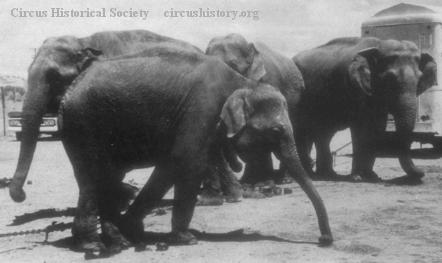 Photo: Elephants, Carson and Barnes Circus, Barstow, Calif., May 14, 1962. Susie in front, Jenny behind her, Mabel behind Susie's head, Joskey on right rear. Photo by Chang Reynolds.
Jenny came on the Kelly-Miller show in 1949 and then went to Carson & Barnes in about 1958.
Mabel, like Joskey, is a veteran trouper. She was purchased by William P. Hall in 1925 and broken by Al Langdon. She was with Hall until the end of 1933 and then was with Bud Anderson for four years; then with Parker and Watts for 1938-1939. Watts had her for a couple of years and then she was with Hamid-Morton for about ten years. Kelly-Miller obtained her in 1951 and in 1953 she was with Cole & Walters. Since that time she has been with both Tex Carson and Carson & Barnes Circuses.
Susie has been on the show since 1957.
Also located inside the tent were 3 llamas, 2 Zebus, a zebra, Asiais sheep and three cage trucks.
Two of these semi cage trucks, No. 30 and No. 31, had five cages in each, and used with a dual purpose. Besides the cages, the two trucks were located along the front of the tent and also served as the bannerline, one on each side of the entrance to the tent. Incidentally, the top portion of the banners was not erected because of the winds. Located across the back side of the menagerie was the other cage semi, No. 50.
The cages contained the following animals: a striped hyena, puma or mountain lion, 2 male lions, Himalayan bear, cinnamon bear, Russian brown bear, ocelot, macaque monkey, a bear cub (probably black bear) and three Rheaus monkeys.
The side show acts included a Fire Eater and Nails by Ernie Gabor, and Punch and Judy and Magic by Dick Loter. Dick Loter also gave the side show bally on the platform out front. Ticket sellers for the side show were Wanda Hoover and Kelly Smith. Doors were Louis Gabor and Martha Moore. The Menagerie-Side Show boss canvasman was Tony Padillia and the elephants were handled by Newman "Cherokee" Noah.
Beside the menagerie and side show on the midway, there was also located three pit shows. Next to the side show was a semi hippo walkthru which was run by Sam Price. On the left side of the midway was a pony ride under a red and white circular canopy with four ponies in it and next was the Big Jess Fat Man pit show, which was run by Al Hill. Next was the ticket office, and then the Snake, Gorilla, Tropical Birds and Penguin pit show semi, under Henry Fulbright, then came the popcorn and snowcone concessions. In the middle of the midway was also located a midway diner and a cotton candy concession. All of the pit shows and the pony ride went for 25 cents each.
Located at the far end of the midway was the show's new marquee walk-through, similar to that of Kelly-Miller. It was built upon a semi trailer with sleepers at each end this season for possible conversion later as offices. An outstanding feature of the marquee, is that on either side of the entrance way are pictorial paintings of the Two Hemispheres bandwagon and the Lion and Gladiator tab.
Located in the back yard was a long silver semi which eliminated the cookhouse tent by holding the kitchen in the front-end, plus seating 24 persons per shift to eat in the screened truck out of the weather.
The truck inventory for the show is listed below: (-s- denotes tractor and semi trailer)
Number
11-s-Power Plant
26-s-Elephants
27-s-Elephants
30-s-Cage and side show bannerline
31-s-Cage and side show bannerline
32-s-Hippo pit show
33-s-Poles
36-s-Marquee and sleeper
37 Mechanic's truck
40-s-Seats
50-s-Cages
54 Canvas loader (ex-Wallace & Clark)
55-s-Snake pit show
69 Rest room trailer
-s-Cookhouse (silver)
-s-Concessions
Midway diner (trailer)
Ticket office (trailer)
Stake driver (red)
Cat with stake driver attached
Water wagon
Flat bed single wheel trailer to carry cat
Small cross cage with two honey bears (ex-Capt. Eddie Kuhn)
Band organ truck
Personnel bus (silver)
Personnel bus (blue)
-s-Horse truck
-s-Horse truck
About 20 other vehicles were located in the backyard which belonged to the performers and personnel.
The color scheme for the trucks were: The ends of the trucks were painted white, with a large red stripe down the center, and "Carson and Barnes Circus" lettered in black and white.
The staff for the show includes Jack Moore, manager; Floyd (Bressy) Hill, general agent; Bill Stanfield, promotion; Les Garner and Claude Poe, billing crew; Lucky Garrett, 24-hour man; Henry Hoover, office; Ann Moore, doors; Kelly Swim, assistant manager; John L. (Shorty) Lynn, general superintendent; Les Brock, electrician; Warren Loftin, mechanic; Sonny Noel, superintendent of concessions; Richard Shipley, elephants; Bob Grubb, ringstock; Penny Moore, props; Francis Loter, wardrobe; Kathi Boas, Ruth Garrett, Martha Moore, tickets; Lillian Long, cookhouse.
Concession department includes Mike Moore, corn; George Shope, floss; Bill Swain, snow; Gloria Noel, grease joint; April Noel, jewelry; Connie Wycoff, novelties, and Faye Clark, inside stand.
The announcer for the big show and concert is Kennedy Swain. The band consists of Leona Hill on the organ; Snooks Swain on drums, and Kennedy Swain, trumpet.
Clowns include Charlie Boas, Ernie Gabor, Dick Loter, Castillo and Lou Walton.
Tickets for the big show are sold according to location of the seats in the tent. The blues or ends go for $1.00 for adults and 50c for children, then ring center (back side) at $1.50 for adults and 75c for children then box chairs for $2.00 for adults and $1.00 for children.
The performances are scheduled at 2:30 and 8:00 P.M. and are given in three rings. The performance for the 2:30 show at Barstow was given as follows:
1. Spec - “La Fiesta." Mounted rider (man), 3 people walking, 2 llamas, 3 people walking, 2 girls on horseback, 4 girls walking, 1 mounted rider (girl), 4 ponies, 2 people walking, 4 elephants (with Darlene Loter riding Joskey), 5 clowns.
2. Garcia Troupe - Roly Boly, Wrights-Roman Rings, "Bo Bo" (Dick Loter) - Horizontal Bar
3. Flying Murillos - Trapeze Casting Bar
4. Clowns - Onions and his clown band
5. High School Horse. Billie Smith - Black Beauty, Don Ricardo - Golden Sun, Mr. Robert Grubbs - Starnight
6. Aerial Display - Ladders. Miss Rose, Miss Rebecca, Miss Darlene, Miss Patricia, Miss Linda and Miss Flo
7. Elephants-Susie and Mabel in end rings
8. Clowns - Firehouse
9. Single Trap - "Fransua"
10. Concert Announcement - Rex King
11. Campas - Juggling, Castillo Troupe - Foot Juggling
12. Bareback Riding - "Darlene"
13. Animal Acts. Elephants - Mabel, Susie and Jennie by Richard Shipley. 3 Dog Acts
14. Balancing. Manuel - Hand Balancing, Florence & Grislda - Perch
15. Aerial Display. Miss Rosa - Cloud Swing, Gloria - Iron Jaw, Miss Patty - Swing Perch
16. Horses. Shetland Ponies, Liberty Horses - Bob Grubbs, Shetland Ponies
17. Clowns - Boxing
18. Aerial Display. Miss Linda - Web, Miss Carmelita - Web, Miss Meriam - Trap, Miss Rose - Web, Miss Becky - Web
19. Clowns - Walkaround
20. Plunkett Troupe - Trampoline, featuring Corky
The performance was followed by a wild west concert which starred Rex King. Performers included Bob Grubbs, rope; Bill Wood, rifle; Linda Barnes, trick riding; Jack Fulbright and Hoots Madden. Tickets for the concert were 25c each.
Barstow being a hard city for billing, the paper consisted mainly of small window cards and date sheets, with a few spots using pictorials. Further on up their California route was noticed some very nice billing spreads, with a wide variety of pictorials being used. The route to the lot in Barstow was well marked with arrows.
My thanks go to Kathy Boas and Dick Loter of the Carson and Barnes Circus for supplying me with a lot of the information on the show. To Donald R. Carson for supplying me with additional information and photographs and to Chang Reynolds for his help on the elephants and other animals and the use of his photographs.
Ringling-Barnum is building a new show train for Holiday on Ice. Lloyd Morgan is in charge of the project and is on loan from Ringling in a trade by which Holiday loans Ringling its European agent-promoter. Holiday has bought three railroad cars that are being converted into tunnel cars by Morgan, duplicating his work on the new Ringling train. The same firm that built R-B wagons, G. and G. Metals, is building wagons for Holiday. Meanwhile, Ice Capades is in its second season of using the basic system worked out by R-B. Capades, however, uses balloon-top Pennsy baggage cars for its Ringling-like wagons. It doesn't own its own cars yet.
Tim McCoy is scheduled to head up the second unit of the Tommy Scott outfit ... Charles Boas is press agent for Carson & Barnes ... Red Sonnenberg is laying off briefly after a tour with the Bolshoi Ballet. He caught the Tavlin show in New York . . . Joe McMahon is to take a winter edition of Kelly Miller to the Valley in South Texas, in February. Ahead of it are Charles Cuthbert, Thurman Knight, Jack LaPearl, Jack Arnott and Charlie Campbell ... The Woodcock Elephants, with Bill and Bill Jr., will make the winter shows at Grand Rapids, Detroit, Cleveland, Minneapolis, Dayton, Columbus and St. Louis. Bill Woodcock Sr. is breaking a new male elephant, Prince Obert, for the Obert Miller Fairyland Circus.
Bert and Marie Pettus have the Downie Bros. Elephants act, the former Ed Widaman bulls ... Jerry Booker scored with the promotion of the Belgian Horse Fair, which uses some former Hagenbeck-Wallace wagons. He put out an attractive press kit . . . The Tony Smahas have closed with the Circus World Museum after two seasons. Newly hired there for the coming season is Johnny Herriott.
Howard Suesz reports signing some dandy Shrine dates for 1963 and holding his Clyde Bros. Circus up as the one that plays, the most Shrine dates ... Mabel Baronoski died at Kansas City recently. She is survived by her husband, Pinky Barnes, formerly of Kelly-Miller and other shows . . . A giraffe at the Memphis zoo died recently. It had been obtained in a trade with Ringling, it was said . . . Jane Cockrell, State Fair of Texas publicist, sends a clipping in which Otto Griebling gave his favorite recipe, a potato pancake specialty. It said Otto was retiring.
Forest Freeland, who has done poster designs for several shows in recent and not-so-recent seasons, is working now for the Cristiani-Wallace show . . . Three persons who caught the first Ringling Bros. performance, 1884, held a reunion at Baraboo . . . Coco the Clown was given a citation by the Circus Hall of Fame . . . Art Miller, last year with Sells & Gray, has joined the staff of the Neal Walters Poster Corporation . . . Delano Bros. Circus, with Delores Bible, and Nancy and Donn Moyer, has been wintering at Cotati, Calif. . . . Ed Lester again is planning the Royal American loading order ... Estelline Pike is wintering at the Belvedere in New York . . . Rex Carson, India rubber man, and his wife, presently are at the AGVA home at Fallsburgh, N.Y., where he reports he is feeling much better and may move on ... Noell's Ark Gorilla Show is wintering again at Tarpon Springs, Fla. This is an outfit that ought to be taken on by an enterprising circus. It's framed for carnivals now, but would make a good circus walkthru and a highly unusual circus act . . . Roy Barrett, retired clown, still is in Los Angeles . . . Rudie Niemeyer, long-time assistant to the late Harry Atwell, famed show photgrapher, is retired in Sarasota . . . Mel Henry, of the Circo Americano, is wintering in New Orleans . . . Johanna and Charlie Webb still are off the road at Ann Arbor Mich., but Johanna played some fairs with her mitcamp the past few seasons. They were with Russell Bros. and many others ... Gladys and Howard King are at their Long Beach, Calif., home.
The late Ray Wolf, painter of numerous outstanding circus pictures, willed one, called "Liberty Horse," to C. P. Fox and others to Circus World Museum . . . Freddie Daw's Circus Hobby Hall, Coral Gables, Fla., was pictured in a Sunday feature of the Miami Herald. The Miami News carried an article about the spot as a birthday party location for kids.
Circus participation at the outdoor conventions in Chicago's Sherman Hotel last fall was light. Fewer circus owners and performers were noted than in previous years. Part of the difference was that some show people who normally make this event were in New York for the Jack Tavlin show at the Coliseum instead. Floyd King was not in Chicago this time because of the illness of his wife. Among those who were spotted at the Sherman session were Jack Mills, Harry Mills, George Hamid, Mickey Blue, Art Miller, Berni Miller, Al Dobritch, Gene Holter, Harold Barrows, George Johnson, Bernie Mendelson, Tom Parker, Slim Sommers, Dee Aldrich, Jack LaPearl, Walter Hohenadel, Walter Hohenadel Jr., E. K. Fernandez, the Rink Wrights, Nat Green, Harry Bert, Babe Boudinot, and Jack Sweetman.
Jenda Smaha is working the elephant Bertha at the Nugget Casino in Sparks, Nevada ... Joan and W. R. Timmerman are busy with correspondence for their collections of circus material. They recently got a package of lithos from shows in India and forwarded them to the Circus World Museum. Two Indian circuses are touring the world. The Great Eastern Circus is in Thailand, The Great Royal 3-Ring Circus was in Aden, Arabia.
The Galesburg (Illinois) Register Mail carried a full-page story by Bob Parkinson about old shows that appeared in that town ... The former Norma Davenport five-act has been broken up and bulls from it are with the several McClosky-Kernan shows.
The Danish show paper, Echo, reported that the Boswell Bros. Circus sustained a train wreck while touring South Africa. The smash-up was June 22. About ten cars jumped the track and piled up. Animals were trapped. One person was killed and a number were injured . . . Dot Records claim a new calliope record, "Crazy Calliope," but the description, "an 1895 Wurlitzer steam calliope" sounds more like it would be a band organ.
Walter W. Tyson, CHS, was written up in a dandy newspaper feature of the Kitchener-Waterloo (Ontario) Record. It described his collecting and his aid to the Cristiani-Wallace show on its recent appearance in Guelph . . . Milt Hinkle, the veteran show cowboy, scored in a feature article of the Madison (Wisconsin) Capital Times during a rodeo date there. Despite all the years since Milt won the first all-around rodeo championship in 1896, he makes a lot of dates. After Madison were Danville and Va., and Winston-Salem, N.C.
Obert Miller, veteran circus owner, who founded the Al G. Kelly-Miller Bros. Circus and later turned over its operation to his sons, has returned to the road this season as the owner of a fine little canvas show titled Fairyland Circus.
At Trenton the show had up a couple of daubs, a stock tiger picture that has been used by many small shows of the past, and also used several long slim half sheet lithos with two cuts, one of clowns, and one of a horse. Heralds were sent out on the mail routes and newspaper ads ran in the weekly paper for two weeks. Show was sponsored by the American Legion.
The big top is new and is a push pole type made of white canvas from U. S. Tent and Awning Co. The tent has inside blue and red trim and sidewall is white, blue, and khaki striped, and the marquee is also of this design. The top is a 60 ft. round and is 120 ft. long. It is not laced but is made in one piece. Four center poles, one row of quarters and one of sides support it. The center poles in the middle are spaced 30 ft. apart with the two outside poles spaced 15 ft. There is one ring for the performance using attractive wooden ring curbs.
Seating consists of reserves 4 high on the long side and blues 5 high on the short side and 6 high on the ends. Reserves are canvas folding chairs large enough to seat two people. At the matinee there was no additional charge for them.
An electric organ is mounted in the rear of Dale Madden's trailer which is placed inside the big top. Two doors open and swing out to each side exposing the organ. Speakers are in the doors and it is a very loud, nice sounding rig and looks good from the seats. Dale plays beautifully but not circus tunes, mostly stuff like Tea for Two, Sweet Sue, Mary Lou, Margie, Spanish Two Step, etc.
Lighting is adequate and all props and general interior looks good.
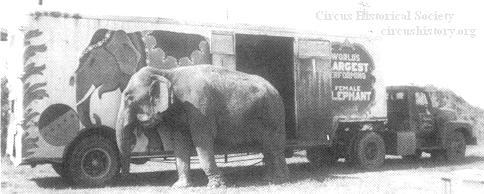
The combination sideshow-menagerie is housed in a 3 pole 40x80 ft. green and white striped tent with blue and white striped sidewall. For bannerline ten panels of outdoor stage scenery with strobelight star designs are used. Sideshow acts include whip cracking, Punch and Judy, and Chinese torture box with a free expose at the finish by opening the front panel of the box. The versatile Harry Rawls family handles the sideshow and lectures on the animals. Animals include 2 llamas, one elephant, Topsy, and a big ex Kelly-Miller cage with four dens housing monkeys, baboons, a mountain lion, and an African lion.
On the midway is a pit show truck with a canvas canopy arranged in a tent shaped fashion operated by Dale Madden and features a large "Ape." There is a concession truck with a long grease joint trailer, and two center joints, a snow-floss combination and novelties.
Motorized equipment as a whole is not new but is in good condition and painted but title is not on any of the trucks, in fact the word "circus" is seldom seen on a vehicle. Truck lineup is as follows. "s" denotes tractor with semi trailer:
1. No. 44 - seats, painted yellow and blue with red cab.
2. No. 65-light plant. Is an open affair with no body on it. Painted red.
3. Sideshow, and Rawls family props. Painted blue and silver.
4. "s" - Elephant truck. Has Madden's title on it. Nicely painted and decorated.
5. “s" - Ponies, harness. feed. also carries the bally wagon. Painted blue and yellow with blue cab.
6. Canvas spool loader. Yellow and blue with blue cab.
7. Trailer. Office and ticket wagon. Painted red with silver letters. Was old Kelly-Miller office.
8. Cave trailer, painted yellow and blue with animal panel pictures on it. Has silver roof
9. Trailer. Has Madden's name on it. Painted white and hauls props. although its lettering advertises Madden's organ.
10. Concessions. Pulls grease joint trailer (pie car).
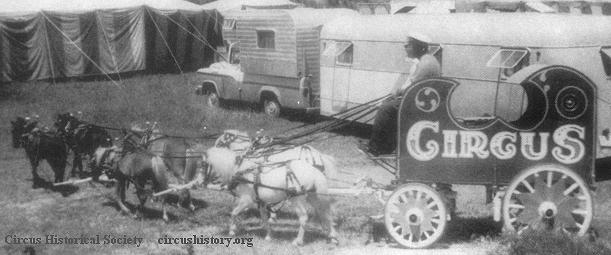
The little bally wagon that loads on the pony truck is a thing of beauty. It is painted red and has the word “ circus" in yellow on the side. Gears are white and in perfect condition. It is a shell type wagon and has wooden wheels with hard rubber tires and outside type sunbursts, and nickel plated seat railing and a foot brake. It carries a tape recorder featuring calliope music but was not in operation at Trenton. The speakers are built into each side and nicely camouflaged. The wagon is pulled by the show's 6 drill ponies. The hitch has 2 blacks in the lead, 2 sorrels for body, and 2 whites for wheelers. The harness is brand new and beautiful with breeching for wheelers. Due to shortage of help they haven't been using this team and wagon, but as a special favor to me Mr. Miller had them hitched up in Trenton. It was only the fourth time this team had been hitched up. It took Obert, Harry Rooks, two other guys and myself to get the job done but once we got them all snapped in they took off down the road just as quiet and nice as if they had been doing it for 20 years.
The show's staff consists of Obert Miller, owner and front door; Tom McLaughlin, general agent; Sid Stevens, auditor and tickets, Dutch LeBlair, superintendent; Harry Rooks, equestrian director; Harry Rawls, sideshow manager; Dale Madden, organist and pit show manager, and Loren Rex, concessions and pie car.
The entire program is put on by the Harry Rawls' family, Lois Madden's animals, and Obert Miller's ponies. There are 7 Rawl kids, nice mannerly little folks who work hard setting up sideshow and rigging and work hard during the performance. Rawls acts include trampoline, globes, juggling, tight wire, web, swinging ladders, revolving trapeze and perch. In some cases two acts worked at one time at the side of the ring, for example two girls working on swinging ladders. Lois Madden. presented a white pony, a good performing chimp, a tiny dog that did poses including balancing on one paw on Lois' thumb. She also presented the elephant. Harry Rooks worked Miller's 6 pony drill. These are colts but work smooth as satin like a bunch of old timers. There is also another spotted pickout pony but wasn't used. There is no candy pitch, no concert, and no grift. The crowd was the largest I've seen at a small show in years. People enjoyed it and talked favorably about it after it was gone.
The official program is listed as follows:
1. Pasha, single pony, worked by Lois Ann Stillian.
2. Swinging ladders, Margie and Suzan Rawls.
3. Tight wire, Mary Rawls.
4. Sparky, fox terrier, by Lois Ann.
5. Trampoline, David and Bobby Rawls.
6. Chimpanzee, Patty, with Lois Ann.
7. Rolling globes, the Rawls Family.
8. Military ponies (6) by Capt. Harry Rooks.
9. Calliope on parade by Dale Madden at the Hammond Organ.
10. Spanish webs (2) by Mary Rawls and Lois Ann.
11. Supported perch, Suzan and Harry Rawls.
12. Loop the loop, Margie Rawls, and Topsy, the elephant, presented by Mrs. Dale Madden and Ernie Gutzall.
No part of this publication may be reproduced in any form or means
Last modified January 2006.
without written permission of the author and the Circus Historical Society, Inc.