


Circus Historical Society
Bandwagon, September - October 1962
Back to Bandwagon Index
Bandwagon, Vol. 6, No. 5 (Sep-Oct), 1962. Note: Only some articles are included in this online edition. Many illustrations are not included. The Circus Historical Society does not guarantee the accuracy of information contained in the information in these online articles. Information should always be checked with additional sources.

The season of 1923 featured the one hundredth annual tour of the John Robinson Circus and, according to the route book for that year, "but what a tremendous span of time and gigantic achievements embodied in that one hundred years." Billboard first carried a report of the plans for the centennial in September, 1922, when it indicated that the Robinson Circus would not only celebrate its 100th anniversary but would take on a new physical make-up and type of program offered to its patrons.
According to Gil Robinson, writing in "Old Wagon Show Days," John Robinson was first identified with a circus of his own in 1824. The route book for the 1923 season agrees with this date but the late George Chindahl and Tom Parkinson, both competent historians, believe the first John Robinson Circus to have been organized about 1840. Regardless of the year heralding the start of this great circus, efforts to collect items of historical interest concerning the Robinson show are especially rewarding. The Robinson family owned and operated this circus enterprise until the end of the 1911 season except for the year 1898 when it was leased by the Ringlings and managed by Henry Ringling. From 1912 to 1915 the show was off the road but it was purchased by Jerry Mugivan and Bert Bowers in 1916 in order to use the John Robinson title on their Famous Robinson Circus. Apparently the equipment for this John Robinson Circus (1916 edition) came from Mugivan and Bowers shows. It was a 30-car show that year. For 1917 the owners combined the Robinson and Howes Great London Show to put out a 45-car circus but cut back to thirty cars in 1918. The train remained this size for a number of years and then was reduced to twenty-five cars.
Rumors that the 1923 version of the Robinson circus would use some of the equipment that Mugivan and Bowers had on their 1922 Gollmar Circus were verified early in February when Billboard carried a notice that advertised for sale - advance, stock, flat and sleeper railroad cars; horses of all types; tigers, lions, leopards and other wild animals; cage, tableau, baggage wagons and air and steam calliopes; full sets of Bolte and Weyer gasoline lights; seats and wardrobe of all description. Vendor was the John Robinson Shows Co., Peru, Indiana.
During the second week of March the show world was alerted to the fact that as soon as the Sells Floto train was ready to leave for the Chicago Coliseum on April 3 where it would open the 1923 season on Saturday night, April 7, the John Robinson Circus would receive the attention of the corporation employees. The Gollmar equipment, which had been in Montgomery, Alabama, during the winter, was due to arrive at Peru on April 1, where it would be merged with the available Robinson equipment. The announcement also stated that for the 1923 season the John Robinson circus would be strictly a wild animal show, "the largest of all such entertainments now before the public."
An unusual incident occurred before leaving the Montgomery quarters that delayed the move to Peru. As related by Bill Woodcock, "several hours before daylight on the morning we were slated to leave Montgomery, fire broke out in the bull car and it burned to the floor before the fire department extinguished the blaze. The car had to be rebuilt in the Montgomery car shops, in a hurry."
Describing the emergency in detail, Woodcock continues, "The six wooden stock cars were sitting on a grade with the bull car at the top. Gardner did not live in quarters and didn't get to the fire until after the excitement had just died down - the bull chains had been put in the car and even the hay spread out in preparation for a quick loading and getaway for Peru. A hand named Mike Brown grabbed Dutch and by uncoupling the cars and releasing the brakes Mike was able to take Dutch and push the stock cars one at a time, starting at the bottom of the grade, away from the burning bull car. He did this with four stock cars, and by that time a train team had been harnessed up and snatched the fifth and last stock car away from the burning bull car. I tried to help with Betty, but she was badly goofed up and I never could get her up against the cars to push. Surprisingly she didn't take out across the country with me."
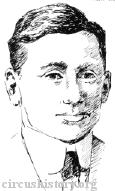 Sam B. Dill. Sketch by author.
One of the most interesting items of the 1923 season was that members of the staff and the performers were to play outstanding roles in the writing of American circus history. The manager was C. D. (Dan) Odom who had been on the Howes Great London Circus and in 1922 was manager of the Gollmar Bros. Circus. He was at Montgomery at the time of the fire and, according to reports, was as burned-up as the bull car over the incident. This capable supervisor continued in the managerial position on the 1924 Robinson show and then moved over to the Hagenbeck-Wallace Circus in 1925. Sam B. Dill managed the Robinson show in 1922, was assistant-manager in 1923 and 1924, and then moved back into the manager's job. He owned his own truck show from 1930 through 1934, but his great career was terminated early in 1935 due to an untimely death. Arthur Hopper, a great general agent, performed in that capacity on the Robinson Show from 1921-1928 and joined the Dill show in the fall of 1931. S. L. Cronin had the advertising banners on the 1923 John Robinson circus and later was manager of the Al G. Barnes Circus for several seasons. Ed Woeckener, famous band director, was in charge of the Robinson band in 1923 and 1924. He then led the Hagenbeck-Wallace Circus band for ten years, and followed this with years on the Al G. Barnes, Russell Bros, and Cole Bros. Circuses. A member of the band in 1923 was Wade Zumwalt who followed Woeckener as Musical Director on the Robinson show from 1925 to 1930. Cheerful Gardner, who first worked elephants in 1905 at the St. Louis World's Fair, was in charge of the Robinson elephants for 1923 and 1924. Gardner worked elephants on the J. E. Henry Dog and Pony Show, Sun Bros. Circus, Al G. Barnes, Hagenbeck-Wallace Circus, Russell Bros., Arthur Bros, and both Polack units during his illustrious career. Charles Rooney, from Baraboo, Wisconsin, was superintendent of baggage stock on the 1923 show. He drove for the Ringlings for several years and then became boss hostler for Gollmar Bros, in 1896. He returned to the Ringling show in 1898 and was superintendent of horses until 1919. Tom Lynch got that job after the consolidation with the Barnum Bailey show and Rooney went out with John Robinson from 1919 to 1925 when he moved to the Hagenbeck-Wallace Circus for 1926-1934. Charles Barry opened the season as equestrian director. Allan Hauser finished the tour in that spot. He later filled the same post on Hagenbeck-Wallace. La Verne Hauser was a well-known performer in the Corporation shows and during the 1923 season worked leopards in the big cage and rode manege. Also presenting wild-animal acts were John (Chubby) Guilfoyle and Harriet Guilfoyle, Peter Taylor, and Clyde Beatty. The Rudynoff riding act was one of the big attractions during the centennial year. Participating in this act were Erma and Rudy Rudynoff, Slivers Johnson, Ola Darragh and Mary Bedini. The Rudynoffs remained on the Robinson show for several seasons and later were a star act on the Ringling show. They came to the United States from Circus Knie in 1920. Last, but far from least, just beginning a great career, was Emmett Kelly on trapeze and in clown alley.
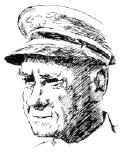 Cheerful Gardner. Sketch by author.
The show featured three 8-horse drivers, five 6-horse drivers, six 4-horse drivers and four pull-up teams working with the baggage stock under the supervision of Charles Rooney. Cheerful Gardner was menagerie superintendent in addition to his job with the bulls and had Harry Fields as assistant, and Julian Parolis as cage foreman. Gardner had been on the Barnes show in 1922 but could not agree on a contract with Al G. for the '23 season. Since the Barnes show was wintering in Dallas, Cheerful headed for the American Circus Corporation quarters for a job. He was sent to Montgomery, Alabama, where the Gollmar show was wintering.
The 1922 Gollmar Bros. Circus had been made up of the 1921 Howes Great London equipment and animals. The Great London title had been leased to Golden, Runkle and Adams for 1922 and the Gollmar title was obtained by Mugivan and Bowers for their 1922 show. In order to get the elephant census of the 1923 John Robinson Circus it was necessary to drop back to 1920 to the Howes Great London Circus and list their elephants, Alice, Lizzie, Nellie Lockhart and Toto. During 1921 the Howes show had Alice, Lizzie, Nellie Lockhart, Toto, Mary, Katie, and Babe. The last three bulls having been added from the Yankee Robinson show. At the end of 1922 in the Montgomery quarters of the Gollmar show were Lizzie, Toto, Mary, Katie and five punks added early in 1922. These five were Modoc, Jewel, Pearl, Judy, and Danny. Nellie Lockhart was sold late in the 1922 season to a Columbus, Mississippi, grocer who owned a private zoo. He in turn sold her to Floyd and Howard King. However, in carrying out the transportation necessary for delivery, the old elephant became unruly, upset the truck in which she was riding, stampeded into a swamp, and died of a broken neck during the attempt to haul her out. Babe was sold to the Christy show through the dealer, Horne, during the season and was renamed Nero on that show.
Meanwhile, in quarters, Gardner assisted by High Pockets, set out to organize the elephant acts using some of the Barnes show routines. During the winter Larry Davis, a capable bull handler with the Corporation shows and later with Ringling Bros., came down from the Peru quarters of the Robinson show with Dutch, Betty and Blanche. He left these three in Montgomery and returned to Peru with the two males, Toto and Danny.
This elephant act had changed its pachyderm personnel faster than any ever had on the Barnes show but Cheerful stayed with it and showed up at Peru in the spring with a good act of ten bulls: Modoc, Jewel, Pearl, Judy, Lizzie, Mary, Katie, Dutch, Betty, and Blanche. At Peru, Katie was dropped from the herd due to physical infirmities and two more punks, Jenny and Ruth, were added. About this time the Sells Floto show was embarking for the Chicago Coliseum and Major, scheduled to make this stand, took a swing at Zack Terrell, the manager. Terrell had a weird assortment of bulls on the Sells Floto herd and he had an aversion to anybody or anything challenging his authority. He quickly decided that Major couldn't make it to the big city with a circus under his management. Jerry Mugivan agreed and stated that Major belonged on the Robinson show anyway - so Cheerful got an even dozen.
Now if you look over this elephant herd and realize that there was only one stampede all season, no doubt you will agree that Cheerful Gardner was one of the best, if not the Dean, of all the elephant trainers at that time. He had three John Robinson bulls, one from Yankee Robinson, four from the Gollmar show, one from Great London, two new punks from Peru, and Major. In addition, one half of the herd were youngsters and willing to cause plenty of mischief. Most of the famous elephant herds in our circus history are composed of bulls that have worked together for some time. While the 1923 Robinson herd makes no claim to circus fame it apparently was an efficient group and probably credit for this is due to Cheerful Gardner and his assistants.
The Robinson show prepared for the 1923 season in the new, improved winter quarters located at Peru, Indiana. The repairs and remodeling had been completed by December 1, 1922, and consisted of ten, steel and concrete, buildings located above the flood-line. All barns were heated from a central plant located on the circus property and a water system, separate from that of the city of Peru, was installed. The quarters still depended upon the city for its lighting, however. One of the first items of business for the month of January was the settlement of a suit for $10,000 damages brought against the circus for an accidental death that occurred during the 1920 season. A fifteen year old boy had joined the Robinson show early in that tour. On May 4, 1920, at Parkersburg, West Virginia, he was operating a brake on top of a wagon. The vehicle ran over a rut in the street and the youth was thrown to the pavement under the wheels and died of the injuries. The step-father had brought suit against the Robinson show and it was settled in favor of the circus during the first week of January, 1923.
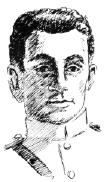 Pete Taylor. Sketch by author.
Billboard carried the usual calls for personnel during January and February and at the end of March announced that the John Robinson Circus would begin its one hundredth annual tour at Marion, Indiana, on April 21. Featured attraction would be Peter Taylor, wild animal trainer, who had recently arrived from South America. According to the report Taylor had been out of the country since 1919.
Bill Woodcock supplies this description of the John Robinson train and equipment. "This Robinson train had 25 cars, had wooden flats and stocks. The show had three tableau that were with the Gollmar show in 1922; the same steam calliope and rebuilt air calliope and the same twelve cages. A Robinson tableau, with a painting of a chariot race on one side and Tarzan fighting a lion on the other side, was added at Peru. Other equipment was added but I only recall a big light plant generator wagon. Base color on the cars and baggage was yellow, but there were one or two red baggage wagons, and the few baggage wagons added at Peru were painted a cream color with dark red trim. The Gollmar advance car went to Peru with that title on it. It was painted orange, the same as the Gollmar train in 1922."
As announced, the centennial tour opened at Marion, Indiana, on the 21st to a three-quarter matinee and near-capacity evening performance. It was a gusty, cloudy day and rain, immediately following the parade, discouraged attendance in the afternoon. Gil Robinson, descendant of the famous John Robinson, made the trip from Somers Point, New Jersey, to view the opening ceremonies. He announced that his book concerning the history of the John Robinson Circus had reached the proof stage and would soon be published.
The program, not necessarily in order of appearance, that Gil Robinson and the fans at Marion witnessed consisted of:
1. The Spectacle, "Peter Pan in Animal Land."
2. Peter Taylor in the big cage presenting a group of pumas.
3. Liberty ponies in Rings 1 and 3 presented by Charles Fulton and Allan Hauser. Victor, the famous Robinson hippopotamus, pulling a cart around the track and W. W. Weaver and George Jennier on trapeze completed this display.
4. Animal acts in all rings and the steel arena. Goats were presented by Harley Woodson and Dewey Butler. Rabbits and rats were presented by Miss Gardner and Lela Plank. The steel arena was occupied by polar bears worked by Clyde Beatty.
5. The Rudynoff Troupe and Bernard Griggs and Company featured comedy bareback riding. Felix and Piquetta Morales and Tetu Robinson presented amazing skills on wire. Cheerful Gardner concluded this display with the herd of Robinson elephants.
6. Ponies with dog and monkey riders presented in the rings by Bernice Renwick and Blanche Meyer. In the arena, Harriet Guilfoyle worked a horse and two riding lions.
7. Dancing horses and dancing girls. (Eva Moore, Mitzie Moore, Agatha Plank, Billie Burton, Gertrude West, Pompey Baio, Estelle Dixon, Sarah Mann, Etta Carreon, Ruby Chapin, Ola Darragh, Mrs. Peterson, Mrs. Weaver, Anna Browder, Miss Fulton, Clara Smith, LaVerne Hauser, June Hester, Miss Morales, Verne Grey, Anna Butler, Tetu Robinson). Slivers Johnson with Maude, the mule, was also in this number.
8. Trained pigs presented by Harley Woodson and Dewey Butler.
9. Large, mixed cat group presented by Peter Taylor.
10. The "Doveland" chorus featuring Miss Julian Rogers, prima donna, with white doves fluttering to cover horse and rider.
11. Harry Burt announcing the Morales Family who thrilled the audience with teeth, hair, foot and upside-down head slides.
12. The big cage filled with African and Asiatic leopards worked by LaVerne Hauser.
13. Trapeze number with the Flying La Vans, Celia Fortune, Teresa Morales, Mrs. Woeckener, Emmett Kelly and the Moore Sisters.
14. Equestrian stars, Mary Bedini and Erma Rudynoff.
15. Collie, monkey and pony act in two rings, presented by Richard Sadler and Harold Prophet.
16. Liberty horses presented by Allan Hauser and Charles Fulton.
17. Group of African lions in the steel arena presented by John Guilfoyle.
18. Aerial display on swinging ladders included the ladies mentioned in dancing horse presentation. 19. Elephant, pony and dog in two rings worked by Miss Peterson and Ola Darragh.
20. Jockey riding presented by Rudy Gebhardt and Company and Bernie Reed and Company.
21. Foxhunt featuring high-jumping horses. Riders: Etta Carreon, Billie Burton, Clara Smith, Anna Butler, Ola Darragh, Miss Woeckener, Charles Barry, Charles Fulton, Carlos Carreon, Allan Hauser, Paul Smith, and John Butler.
 Abe Goldstein. Sketch by author.
Clowns: Joe Wilde, Emmett Kelly, Tom Plank, Ab Johnson, Slivers Johnson, Charles Lewis, Lawrence McAllister, Mann and Mann, Walter Wellington, Jack Welch, Fred DeMarr, Doodles DeMarr, Billy Stites, Joe Stites, George Jennier, Monk Allen, Carl Myers, and Abe Goldstein, clown cop.
Wild West Concert: Carlos Carreon, Etta Carreon, Bobbie Brant, Tom Ellis, Tex Filbert, George Daveron, Will Samson, Bill Rowlison, Pete Nubert, Mrs. Dewey Butler, Dewey Butler, Johnnie Parker, Hazel Hickey, J. H. Butcher, and Montana Joe.
Wrestlers: Herman Hackenschmidt and Eugene Parquettee.
The official staff listed for 1923 was as follows: Mr. Jerry Mugivan, president; C. D. Odom, general manager; Sam B. Dill, asst. mgr. (joined late in May); Frank F. Meyers, treasurer; Frank McGuyre, attorney; Wm. McCoy, supt. of police; Leonard Karsh, supt., main entrance; C. B. Haroldson, time keeper; Robert E. Hickey, general press representative; S. L. Cronin, advertising banners; Ed Woeckener, musical director and mail agent; Gardner Wilson, press representative; William Backell, mgr. of advance car No. 1; F. G. Barker, mgr. of advance car No. 3; Robert L. Morgan, mgr. of brigade No. 1; Charles Barry, equestrian director (part of season and Allan Hauser finished the season at this post); Robert Courtney, supt. of inside tickets; R. M. Smith, supt. of ushers; James Scanlon, supt. of ring stock; Charles Prentiss, supt. of mechanics; Cheerful Gardner, supt. of menagerie; Charles Lancaster, supt. of properties; Charles Young, supt. of big top canvas; Jack Pfeifenberger, supt. of side show canvas; Harry Levy, supt. of privileges; Joe Litchell, master of transportation; August Christ, trainmaster; Charles Rooney, supt. of baggage stock; "Tim" Carey, steward; and R. H. King, chief electrician.
John Robinson's World of Wonders; Raymond Daley, mgr.; Jack Sampson, lecturer; The Musical Bensons, Hawaiian Musicians; Frank Kean and Co., Scotch Bagpipers; Bobbie Reed, sword dancer; Rose Rifle and Co., Australian Sharpshooters; Clara Sampson, trained reptiles; Tianita Midgets; Jess Adams, giant; Sampson and Co., Punch and Judy; Sailor McClendon, tattooed wonder; Fred Marineu, sword swallower; and Ernest Montague, Director of Minstrels and Side Show Band.
William Backell reported that his Advance Car No. 1 had been encountering opposition since it left Peru early in April. Sparks and Walter L. Main advance brigades were found in West Virginia and in western Pennsylvania the lithographers from the Al G. Barnes circus were an obstacle. At Youngstown, Ohio, the Robinson advance first ran into the Ringling Bros, and Barnum & Bailey brigades who were also encountered at Canton and Akron. Although the Robinson show was due a month ahead of the Big One, the Ringling advance plastered the same territory with "Coming Soon" paper. A two-day wind and snow storm in early May destroyed much of the Ringling paper and allowed the Robinson show to recover the territory. Backell got a stand on the outside elevator of a new 14-story building under construction and commented that "even if I didn't have as much paper up as the opposition, I had the highest."
After the Marion, Indiana, opening the Robinson show played the first week of the season (April 23-28) in Muncie, Indiana; Lima, Marion, Logan, Athens, Ohio; and Parkersburg, West Virginia. The week was marred by the fall of Erma Rudynoff at the second stand of the season. This spill from her fast-moving horse caused a severe fracture of the rider's left leg and confined her to the Muncie hospital for fifteen weeks. The weather during the opening week, was fair and warm except at Parkersburg where a cold rain fell. In spite of the drizzle and muddy lot the parade went out on time and attendance for both performances was good. The second week of the season found the show playing stands at Huntington and Charleston, West Virginia; Middleport, Marietta, Zanesville and Cambridge, Ohio. Three shows were given on May 1 at Charleston.
During the third week the show played Steubenville, Ohio; Washington, Pa.; Wheeling, Clarksburg and Morgantown, West Virginia; and Connellsville, Pa. Steubenville brought the only day of sunshine in the third week and gave two packed houses. At Washington rain caused a soft lot and cancellation of the parade. At Wheeling, on May 9, there was two inches of snow. Three thousand patrons showed up at the matinee but the night show was poorly attended due to the cold weather. The show was off the lot by midnight at this stand. A 108-mile haul to Clarksburg caused a late arrival. This plus a long haul to the lot and a cold wind eliminated the parade at this stand. The menagerie was corralled but business was good. Both performances at Morgantown on the 11th were lost due to the location of the lot and the clay road leading to it that was too slippery for wagons and teams. Connellsville again featured rain and cold weather but the parade was given and both performances were well attended.
 Lithograph, John Robinson's Circus, featuring hippo Congo. Fred D. Pfening Jr. Collection.
The fourth week brought the Robinson show to Youngstown, Ohio; New Castle, Pa.; and Canton, Ohio,, and Cleveland, Ohio. At Youngstown a heavy downpour before the evening performance failed to dampen the spirits of a packed house. The show played New Castle in ideal weather with both houses filled to capacity. At Canton there was a steady downpour all day and the train was late. The parade went out at one o'clock and the matinee began at three-thirty. Matinee was well-filled and there was a capacity house at night. The show was at Cleveland on May 18-19 with the weather warm and fair and capacity houses at all four shows. Vic, the hippo, toured the city hall with Mayor Kohler on the first day.
The fifth week found the show in Erie, Grove City, Butler, Punxsutawney, Indiana and DuBois, all in Pennsylvania. Erie was the home of Ed Woeckener, and one paper carried a three thousand word story about the Musical Director. At Grove City it was cold and there was difficulty getting onto the lot. No parade was given that day.
During the sixth week the Robinson show finished its spring tour of the states with stands at Warren, Pa. and Dunkirk, Buffalo, and Niagara Falls, N.Y. Buffalo on May 30 gave the show two tremendous houses and Niagara Falls on the 31st proved equally as good. On June 1 the circus moved the fourteen miles to St. Catharines, Ontario, the first Canadian stand. At this stand sleeping car, No. 63, caught fire. Damage was slight but excitement high. The sixth week ended at Hamilton, Ontario, on June 2.
The seventh week was reported in Billboard as follows: "Business throughout Canada has been good for the John Robinson Circus. In fact, the attendance record, while not as large as in the States, has been satisfactory, wherever weather permitted. The inclement weather has been the chief drawback, especially at Toronto. At that city the rain began falling heavily the day before the show arrived in town, continued over Sunday, June 3, and on Monday and Tuesday, June 4 and 5, the show exhibited." The route book states that the "Toronto folks didn't seem to mind the rain in the least, and they turned out in full force for the four performances. However, it was rainy and cold and at one time there was two inches of water on the ground." The week continued with stands at Kitchener, London, Chatham, and Windsor. At Kitchener, June 4, the bad weather cleared and the show enjoyed an excellent day's business. London, the next day, brought rain again but business was good. Chatham and Windsor were played to big business.
The eighth week included stands at Stratford, Guelph, Peterborough, Belleville, Kingston, and Ottawa, all in Ontario.
The ninth week opened in Montreal on June 18 and 19 and brought excellent business to the John Robinson Circus which played the lot at Delorimer and Ontario Streets. A new menagerie top was raised at this stand. St. Johns on the 20th, brought good attendance at the matinee but the night stand was light. At Sherbrooke, Quebec, the last Canadian stand, the parade was cancelled due to a difficult hill approaching the lot. Both matinee and evening houses were large. Three baby tigers were born at this stand. The week concluded with stands at Newport and St. Johnsbury, Vermont. The parade was again cancelled at Newport due to a late arrival caused by the delay in crossing the border. The first wagon did not leave the runs until nine o'clock. Business, however, was good. St. Johnsbury brought a large matinee attendance but was weak in the evening.
The first five days of the tenth week of the season was spent in Vermont with stands at Montpelier, St. Albans, Burlington, Bennington, and Rutland. On June 30 the show moved to Glens Falls, New York. All these stands gave the John Robinson Circus wonderful business. The weather was sunny and cool during the day with pleasantly cool nights.
The eleventh week of the season, featuring stands in New York State, was one of the most prosperous of the tour. At Plattsburg on July 2 the attendance was excellent both in the afternoon and evening. At Malone, July 3, there was a drizzling rain all day and attendance was light. The crowd at the Ogdensburg matinee on July 4 was so great that the doors were closed at one-thirty. A half hour later a terrific hail and rain storm that lasted the rest of the day arrived, but it did not affect the night business. Gouverneur and Fulton, on July 5 and 6, were both good stands and Penn Yann, on the 7th, had good houses. Mrs. Mary Myers of the Rudynoff Troupe fell from her horse at this last stand during the matinee and severely injured her ankle.
The Robinson show spent the twelfth week in Pennsylvania with stands at Lock Haven, Clearfield, Johnstown, Greenburg, Uniontown, and Somerset. At Lock Haven the personnel of the Mathew J. Riley Shows attended the matinee. Heat at this stand was severe. The haul from Somerset, Pa., to Hagerstown, Md., a run of 138 miles, is complete with mountains and steep grades. This made the Hagerstown arrival the latest of any Sunday run of the season. All equipment was on the lot, however, by five in the afternoon.
Hagerstown opened the thirteenth week and was a real circus day. Rain fell at the night performance, but not enough moisture arrived to interfere with business which was phenomenally large at both shows. Frederick, Md., the next stand, featured real, blistering circus weather but the matinee was attended by a huge crowd and the night performance lacked only a few of being as large. During the rest of the week at Winchester, Harrisonburg, Staunton, and Charlottesville, Virginia, the business continued to be excellent in spite of the hot weather. Charlottesville on Saturday registered nearly one hundred degrees - the hottest day of the tour.
The entire fourteenth week of the season was spent in Virginia with stands at Richmond, Newport News, Portsmouth, Norfolk, Petersburg and Farmville. On Sunday, during the run to Richmond there was a severe storm but Monday was bright and clear with standing room only at the evening performance. Newport News, July 24, brought rain again but business was very good. The circus moved by ferry from this town to the next stand, Portsmouth.
The fifteenth week opened at Lynchburg, Va., on July 30, with stands at Roanoke, Va., Bluefield and Williamson, West Va., and Ironton, and Portsmouth, Ohio, following. At Bluefield, August 1, the show arrived late and the parade was cancelled. About 800 fans stood up to see the matinee and there was big business at night. Show officials thought that three performances could have been filled if the show had not arrived late. Williamson, the next stand, featured a straw matinee and a satisfactory house at night. This was a surprise since the streets were nearly empty at parade time. Ironton brought rain again but it did not commence until the evening performance had begun.
The sixteenth week was spent on a three-day engagement in Greater Cincinnati and other Ohio towns. The three days at Cumminsville, Norwood and Newport, Ky. (Aug. 6, 7, 8), were successful with good business in ideal weather. The last three days of the week brought performances to Hillsboro, Chillicothe, and Washington Court House, all Ohio. Hillsboro had a capacity matinee and a weak night house. At Chillicothe the matinee was cancelled due to national services for the late President Harding. The big top was open for worship during the afternoon. A night performance was given. Washington Court House completed the week. Mr. Jerry Mugivan visited the show at Cincinnati.
The seventeenth week was also spent in Ohio with stands at Newark, Mt. Vernon, Massillon, Alliance, Wooster, and Bucyrus. Business at these stands varied from very good to excellent with the exception of Bucyrus which sent only two fair houses.
The show moved into Michigan for the eighteenth week with stands at Jackson, Saginaw, Mt. Pleasant, Cadillac, Petoskey, and Traverse City.
During the nineteenth week the John Robinson Circus played Manistee, Big Rapids, Grand Rapids, Kalamazoo, Sturgis (all Michigan) and Plymouth, Indiana.
On Sunday, September 2, the show had a run of 167 miles to Piqua, Ohio. Anderson, Indiana, with capacity houses was next on Sept. 4, with Kokomo, Frankfort, Martinsville, and Bloomington concluding the twentieth week. Mr. Mugivan again caught the show at this stand. The last three stands of the week featured exceptional business. On Labor Day, Harry Bert, Supt. of Inside Tickets, arranged an athletic program for the performers between shows. At Frankfort, Indiana, eight of the twelve bulls were frightened by an express wagon as they were moving along the street. Seeing the danger, John Guilford, attendant, who was leading Lizzie, the largest elephant, at the front of the line, attempted to quiet the animal. Two elephants, chained together, ran toward Guilford. He was struck by the chains, knocked to the pavement and the bulls passed over him. The elephants ran more than a block before they were controlled. Guilford was taken to the local hospital and returned to the circus train that night.
As the twenty-first week opened the John Robinson Circus began its run of six days at the Louisville State Fair. It was the first circus to play this fair and everyday, at both performances, the tent was packed. On Thursday, September 13, three performances were given. The stand at the fair was from Sept. 10 through the 15th. Mr. Jerry Mugivan was back on the show again at this stand.
The twenty-second week brought the Robinson show to Chattanooga and Knoxville in Tennessee; Middlesboro, Ky., and Morriston, Johnson City and Bristol, Tennessee.
During the twenty-third week Ashville, N.C.; Spartansburg, S.C.; Gastonia, N.C.; and Greenville, Anderson, and Greenwood, South Carolina, were played.
Columbia, Camden, Rock Hill (South Carolina), and Charlotte, Salisburg and Durham (North Carolina), were the stands of the twenty-fourth week. At Camden, William Backell, manager of No. 1 car saw the show for the first time during the season.
High Point, N.C., on October 8, started the twenty-fifth week with the Burlington, Raleigh, Wilson, Rocky Mount and Goldsboro (North Carolina), stands filling the balance of the week.
The twenty-sixth week began with two North Carolina stands at Wilmington and Fayetteville and concluded with Bennettsville, Darlington, Georgetown, and Charleston in South Carolina.
Frank Barker, manager of advance car No. 3, secured a window in Jacksonville's largest department store where he erected a billboard and hung a 24-sheet to herald the John Robinson Circus's two-day stand in that town on Oct. 22-23. He also placed lithos in many of the smaller windows of the same buildings. With the two-day stand at Jacksonville, Florida, beginning the twenty-seventh week the show moved on to Ocala, Tampa (two days), and Orlando, all towns in Florida.
The twenty-eighth and last week of the season found the show at Waycross, Albany and Columbus (Georgia); Montgomery and Tuscaloosa Trenton, Tenn. Trenton was played (Alabama); Columbus, Miss.; and on November 5, the last stand of the season.
Total mileage for the season was 11,976 miles in seventeen states and two Canadian provinces. The longest run (288 miles) was from the Louisville Fair Grounds to Chattanooga, Tennessee. The shortest haul was from Cummingsville, Ohio, to Norwood in the same state - a distance of 5 miles. From Trenton, Tenn., the Robinson show moved to the Peru quarters via Cairo and Danville, Illinois.
In order to prepare this article concerning the activities of the John Robinson Circus in 1923 I have consulted the official route book for that year, Billboard Magazine, and have drawn heavily from the historical knowledge of my friends, Gordon Borders, Bob Bernard and William Woodcock (who was with it during part of the season).
(The pen and ink sketches were drawn by the author especially for the Bandwagon.)
Reviewed at Parma, Ohio, April 28, 1962.
After a blowoff opening day, April 21, in perfect weather in which the Mills Brothers were host to some 600 fans and friends at a between shows banquet the show took to the road for its first week of daily stands. The weather was summer in April and catching the show its first weekend I found the program going smoothly.
This years show, in its 23rd season, is better in some respects than last years due to work Johnny Herriott did during the winter with the stock. The show is paced by a band of 10 pieces led by Joe Stephan and they play real circus music, probably the best band traveling with any show today. The announcing is done by John Herriott and the Equestrian director is John Schmitz.
Beginning with the grand entry and ending with the elephant act of Virgil K. Y. Sagraves the show moves well and all prop movements are held to a minimum.
The second year of young John Zerbini's lion act shows more polish and his 6 young lions do everything from posing to jumping thru hoops even to a spinning lion as a climax, and there is a minimum of gun shooting, all in all a good act to watch and will get better as the lions grow.
A real novelty is feature seven, three rings of Plate Spinners, all different acts and where shows are content with one such act, Jack Mills has three rings going at once with the Bakers and Heinz and Margo in the end rings and the Les T. Funs duo from Germany in center ring with the lady member climaxing the act by hanging by her hair and plate spinning, a la the Chinese.
The Pedrola duo, back after working in the Jumbo picture work twice, once on the double traps and later on the tight wire and their acts are real flash with beautiful wardrobe. Gerda Pedrola does an iron jaw slide for life from the top of the tent near the end of the program; just real circus troupers.
But to me the most improvement came in the liberty horse act worked by John Herriott and his wife. In the past few years the horses have been worked as two units in the end rings, but this year Mr. Herriott has combined them into one center ring act using all twelve in one of the fastest and best acts on any show. Dressed with colorful harness and colored plumes they do all the turns including a hind leg walk off. Here was circus at its best. John Herriott's other act, including camel, llama and ponies, was also outstanding.
New acts include the Trio Aerols from France, two girls and boy who work on a suspended ladder balanced by the boy on one end and the girls working on twin traps on the other end. Pamela and Torrys in a novelty trampoline, plus the reliable Juggling Drougetts, Bakers, Charles Zerbinis chimps in a flying return act and the ponies, the web act and the clowns, led by Herman Joseph, all made up an enjoyable afternoon of viewing.
The show has all new canvas made by United States of Sarasota, Florida. The big top is a 120 with 3 forty foot middles, white top with blue and white striped sidewall and orange trim. The poles are all aluminum with four main poles, two rows of quarter poles making for a real track around the rings.
Seat's are all on wagons, seven in all. The long side is chairs, the rest blues. When all are used the big top seats 3750.
The ring curbs are metal and lighted from within and made a nice flash. The big top lighting is 4 cluster on each main pole and adequate. Side spots are used in the center ring. Ring mats are used and are real circus. The bandstand is traditionally situated opposite the center ring. All props are newly painted.
The marquee is new, as is the combination menagerie side show, although no acts or band are included. The front is paneled, attached to truck which opens up to make a nice front for the show. The tent is about a 50 with two 30's, and includes The Five Bulls, Burma, Lila Bordi, Bunty, Jennie, and Una. The seven Zerbini lions in small cages, some rabbits, 8 monkeys caged, 1 baboon and 2 raccoons. A 25c pitch is made from one ticket box. Heading the left side of the midway is Joe Lewis' famous walk thru ape trailer and when I saw the show he seemed to be getting his share of customers.
On the right side of the midway are two of Harry Mills' candy stands. The one closest to the marquee furnishes the candy butchers their wares. Alongside this stand is the ticket wagon, actually the back end of trailer 92 which hauls the candy stands. Two small balloon and novelty pitch stands in the center of midway complete the front.
One other tent, a small square push pole top, no sides, is used to eat in at the backyard cookhouse, trailer 32 which contains range, dishes and supplies.
The concert is given by the Zerbini family in Wild West style with John Zerbini doing whip cracking and fancy roping and all clowned by Herman Joseph. All in all the show is a real credit to the vision of Jack and Jake Mills in giving the public a circus they can be proud of. Plus the fact that the fan is always welcome on the lot makes a visit to the Mills Bros. Circus a standout circus day.
The Staff
Jack Mills, Pres. and Gen. Mgr.
Jake Mills, V.P. and Producer
Ida Mills, Treasurer
Rose Mills, Secretary
Harry Mills, Supt. of Concessions
Felix Brazauskus, Gen. Supt. Purch.
Howard Arhart, Gen. Agt.
Robert Scoczy, Electrical Supt.
Virgil Sagraves, Elephants and Transportation Supt.
Johann Schmitz, Equestrian Director
John Herriott, Announcer
Joseph Stephan, Bandmaster
Paul McMann, Properties
Joseph Gilligan, 24 Hr. Man
Buddy Billings, Supt. Ring Stock
Ralph Gray, Stewart
Stock
5 Elephants
7 Lions
12 Horses
2 Chimps
10 Ponies
Dogs
2 Camels
8 Monkeys
3 Llamas
1 Baboon
Following is list of trucks and trailers, all the power tractors are Chevrolets, all rather new and painted alike - red, white and blue with stars on front. "S" will denote semi with tractor.
Seat Trucks
21 S
35 S
65 S
75 S
84 S
88 S
99 S
9 - Flat Bed - Stake driver carries stakes
85 - Flat Bed - Truck repairs - carries tools
92-S - Ticket wagon-carries candy stands
11-S - Carries Zerbini lion cages and chimps
32-S - Cookhouse
31-S - Elephants
34-S - Elephants
30-S - Ponies and sorrells
63-S - Ponies and 5 blacks, 2 camels, 3 llamas
46-S - Carries floats
83-S - Canvas
86-S - Carries menageries
48-S - Light plant
18-S - Workmen's sleeper
77-S - Men's sleeper
66-S - Performers living quarters
79-S - Performers living quarters
95-S - Performers living quarters
S - Wardrobe
Panel truck hauls aluminum rest room trailer which is spotted between the marquee and big top.
Mills Bros. Circus 1962 Program
1. Spec, "A Storybook Fantasy."
2. Trained lions worked by John Zerbini.
3. Ring 1, Miss Rita, Loop the Loop Act; Ring 3, The Trio Aerols.
4. Trained Shetland Ponies in Rings 1 and 3.
5. Clowns.
6. Plate Spinners in all 3 rings. Ring 1, The Bakers; Ring 2, Les-T-Fun's Chinesisdie Spielerien; Ring 3, Heinz and Margo.
7. Crown funny ford act.
8. Pirate Aerial Ballet. Les Pedrolas double traps over center ririg. Swinging ladders around the track.
9. Concert Announcement. Tom Ricardo and his cowboys and cowgirls.
10. Ring 1, The Van Loos, springboard work; Ring 2, Pamela and Tommys, trampoline; Ring 3, Siegried and Hanse, acrobatic ballet.
11. Dressage Act; John Herriott riding Duke.
12. Juggling in all 3 rings; Ring 1, Juggling Drouguetts; Ring 2, The Great Franstine, juggling on the rolling globe; Ring 3, the Juggling Bakers.
13. Ring 1, Paulo and Elizabeth, contortionists; Ring 3, Roby and Heidi, contortionists.
14. Liberty Horses presented by John Herriott and Mary Ruth.
15 Second Concert Announcement.
16. Wire Act of the Pedrola Trio.
17. Aerialists over all rings. Ring 1, The Glamorous Mimi; Ring 2, Peerless Perchists; Ring 3, The Petite Miss Audrey. Winter Wonderland Aerial Extravaganza, Spanish Webs around the track.
18. Animal Fantasy. Trained camels, llamas, and ponies.
19. Clowns.
20. Ring 1, trained chimpanzees, presented by Charles Zerbini; Ring 3, Otto's Capering Canines.
21. Mills Bros. High School Horses.
22. Mills Bros. High Jumping Horses.
23. Miss Gerda, Slide for Life.
24. Clowns.
25. Ring 1, Mauricio and Julie, furniture movers; Ring 2, Carsfellie Trio, head to head balancing; Ring 3, DeKasters on the balancing ladder.
26. Trained Elephants presented by Prince Kai-Wai.
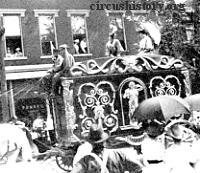 Center Statue Tableau in Parade, John H. Sparks Shows, Wilmington, Ohio, Season 1914. Photo by Marion Organ.
The tableau wagon shown in Photos No. 1 and 2 has been commonly called by wagon historians for identification purposes the Sparks Center Statue Tableau. It is believed to have originated on the John H. Sparks Shows about 1911 and was one of the first tab wagons put into use by that show as it grew into a 10 car, flat car type, circus. The earliest dated photo I have seen of it is 1914, the one shown here. A good guess as to the builder would be Sullivan & Eagle as that firm did build some wagons for Sparks during that period, however, I have no definite information as to who actually built it nor the date of construction. It is assumed the wagon was used continuously by Sparks through the 1921 season, and all photos of it in parade show it to be used as a tableau wagon rather than a bandwagon with various costumed performers riding atop it. Bill Woodcock says when he arrived in Macon winter quarters in early 1922 to go out on the Sparks Circus that season that the tab wagon was not there and he was told that one tableau wagon had been sold earlier in the winter to Andrew Downie. By the process of elimination and accounting for the other tableau wagons the show had, we believe this was the wagon that was sold. However, the wagon does not show in any photos of Downie's Walter L. Main Circus in the period 1922-24 so speculation is that perhaps it was sold to another show or that Downie disposed of it some way. In any event it left Sparks in the winter of 1921-22 and so far has not turned up in photos of any other show after that.
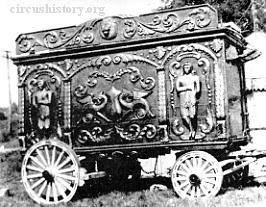 Two Statue Tableau, Gentry Bros. Circus, Season 1928 or 1929. Joe Bradbury Collection.
The other tableau covered in this article as shown in Photos No. 3 and 4 is one usually referred to as the Sparks Two Statue Tableau. It is believed to have originated on the John H. Sparks Shows about the same time as did the other tab and Sullivan & Eagle could have been the builder but here again the exact date it was built and the builder's name are not known. This wagon was highly carved and for some years was used as the No. 1 bandwagon. It was probably on the Sparks show from about 1911 although 1913 is actually the earliest dated photo I have seen of it. It was used through the 1921 season. In the early 20's Sparks started replacing many of his older tableau and baggage wagons and eliminated his cross cages in favor of newer and larger dens. Bill Woodcock says that this particular tableau did not go out in 1922 but was stored at Macon quarters. The 1922 Sparks train was a beauty having 6 new Mt. Vernon built flats which had been delivered a year earlier, 4 stocks, 4 sleepers, and 1 advance for a total of 15 cars. The flats were painted yellow while the stocks and sleepers were yellow and red. In 1923 the show enlarged to 20 cars but I have no information as to whether the tab went out that year or still remained in quarters. The same is true for 1924.
In the winter of 1924-25 this tableau, plus another Sparks tab, the one with the Sea Serpent carvings (see Circus Wagon History File, Jan.-Feb., 1961, Bandwagon) were sold to Floyd and Howard King. In 1925 the Two Statue Tableau went on the King's new flat car show titled Walter L. Main Circus and remained there for the 1926 and 1927 seasons. In 1928 and 1929 the show was called Gentry Bros. Circus. It was on the Gentry show when it folded at Paris, Tenn., Oct. 25, 1929. At a receivers sale all of the wagons went to the Donaldson Lithographing Co. and were stored at the old winter quarters in West Baden, Ind. During the winter of 1929-30 the property was sold off piecemeal until the company finally advertised on March 15, 1930, that only 18 large baggage wagons remained. Just what happened to this particular tab wagon plus some of the other Gentry tabs has long been a mystery to me. Some bandwagons and tabs were reportedly sold to the Otis L. Smith Carnival which advertised it would put on a large circus style street parade in 1930. It seems the Smith Carnival folded or was sold to other parties after 1930 as no further mention of it is made in the Billboard. No positive information though has turned up on this tab and some of the others after they reached West Baden. Now, there is a key to the mystery of the Gentry tableau wagons which perhaps someone may unlock. In 1943 when the little V & H Circus Parade wagons were built at Harrison, Ohio, some carvings off another 1929 Gentry Bros, tableau wagon appeared on some of these wagons. These particular carvings were off an old Ringling Bros, tableau-den and to this date the V & H Bandwagon which was last used by King Bros, in 1956 has some bird carvings oft this old wagon. I have without success for many years tried to find out definitely from what source came these V & H carvings. Surely they had to come off this old Gentry tableau wagon. To know its location perhaps would give us the key to knowing exactly what happened to the Two Statue tableau and other Gentry wagons. It is said by some that the late Terrell Jacobs had picked up the carvings from some source and furnished them to be placed on the V & H parade wagons when they were built, hence his later interest in them. However, no one seemed to know where Terrell got the carvings. If some of our older readers or anyone can inform us just where these carvings came from please let us know so the information can be printed for the benefit of all. Surely the mystery of the missing Gentry 1929 wagons must have baffled serious wagon historians for many years.
Several interesting comments have come from our members concerning the old Dode Fisk Bandwagon covered in this column in the Mar.-Apr., 1962, Bandwagon. Dick Conover notes that the original Dode Fisk wagon was extensively rebuilt, and mentions that the Oct. 4, 1913, Billboard states that the Great Sanger Shows (where the wagon was at the time) recently lost their bandwagon in a wreck. Conover suspects this was the Dode Fisk wagon and that the rebuild was necessary due to the wrecked wagon. He further says that it would appear that all that survived the wreck was the carved arches and part of the pillars and even the span of the center arch appears to have been lengthened and the position of the step changed. From this observation of Conover's it would indeed seem that the Mugivan and Bowers version of the old Dode Fisk wagon was almost a complete rebuild.
In my original article I had mentioned fact that I had not seen further evidence of this wagon after John Robinson quit parading in 1925 and that perhaps it was destroyed about 1926 in a fire that it is believed claimed other Robinson wagons. But indeed such was not the case as Photo No. 5 clearly shows. This remarkable photo taken by Clarence Kachel and loaned to Bandwagon by Joe Fleming shows the old Dode Fisk wagon as baggage wagon No. 75 on the John Robinson Circus in its final season of 1930, which the show claimed was the 107th Annual Tour as the decoration on the wagon side so declares. With this undisputable evidence at hand we can now say that there is a good chance the wagon remained on the show all the years 1926 through 1930 as a baggage wagon. The wagon list for 1929 says No. 75 carried trunks. The wagon's final demise no doubt came during the great wagon burnings at the old Peru quarters about 1941.
Gordon Potter recently commented on the France tableau mentioned in the U. S. Motorized Circus article in Jan.-Feb., 1962, Bandwagon and says that the reason it alone escaped the big fire at the Cole Bros. Rochester quarters in February, 1940, was that the wagon did not go out on the Cole show in 1939 but was stored under a shed some distance from the paint and wagon shops with other unused wagons. The rest of the Spellman wagons were in the paint shops being made ready for the 1940 season when the fire occurred. With this evidence at hand we can now say with certainty that the 1938 season of Robbins Bros, was the last time the France wagon toured. For some reason it was not carried in 1939 but whatever it was saved the wagon for posterity.
Potter sent us the complete train loading order for Cole Bros, in 1939 which he personally compiled on the spot and this will be printed in Bandwagon at a later date.
Reviewed at New Bedford, Mass., May 11, 1962.
On May 11, 1962, I drove to New Bedford, Massachusetts, to catch the Clyde Beatty-Cole Bros. Circus. Arriving on the lot at 10:45 A.M., I found the show was just starting to set up. Show was late getting in from a 130 mile jump, coming from Ansonia, Connecticut. The day was clear and sunny but very windy which made the work of getting the top up very difficult. The matinee was to have been held at 4:00 P.M. but did not start until nearly 5:00 P.M. Schools were let out at noon and the show enjoyed two full houses.
The big top is last year's bale ring type, a 150 round with 3-50 middles, made by the Lief Tent & Sail Co., of Sarasota, Florida. Poles are all aluminum with the exception of side poles which are of wood and painted white. Side wall is blue and white striped. The top holds about 4800 people I am told. It has two rows of quarter poles. The big top interior and seating is about the same arrangement as last year. Five mechanical seat wagons were used for blues. These are 12 rows high and were' made at the Beatty-Cole winter quarters in Deland, Florida, from old wagons used on the Clyde Beatty Circus of 1956. They are all equipped with mud rings. The reserves are all new wooden chairs, painted red and are 10 rows high. In Massachusetts the law allows only nine rows high. The big top interior is very neat and well lighted. There are four big clusters of bulbs along the top plus spot lights around the rings. Ring curbs are painted red, green and yellow. Canvas in front of reserves is red, green and yellow. Back door curtain is red and white stripes.
The combination side show and menagerie, managed by Tommy Hart, is a 70 with 3-30's. It is a push pole top with all aluminum poles made by the Lief Tent and Sail Co., of Sarasota, Florida. The day I saw the show, the side show was not put up until after the matinee because of wind. It was used for the night show, but the 6 small cages were not unloaded and the giraffe semi was not put in the top. The side show acts include: Dixieland Review, Sword Swallower, Satina, Punch and Judy, and Indian Sculptor. The six small cages used in the menagerie contain black bear, chimp, mountain lion, leopard, tiger, and an ant eater. The bulls and lead stock are also put in menagerie top. The midway looks very good with a blue and white striped marquee and features two pit shows, The Calcutta Monster and the Hippo Show. The hippo show was closed due to not having a talker, in both New Bedford and Fall River, Mass. These shows are well painted and flashed up, decked out with small flags on top. The side show banner line is the same one used last year with five banners on each truck. They also have a pony ride, grease joint, cotton candy stand, novelty stand and white ticket wagon with light tower on top. Midway is well lighted.
Show carries a 40 x 60 cook house. Cooking is done in semi No. 74. Lead stock carried on the show includes: two camels, two horses, nine ponies, 1 llama, and eight elephants. Rex Williams has charge of the elephants and told me that the rest of the herd is in Hollywood, California, making the motion picture "Jumbo" and will join the show around Chicago.
The show looks very good on the lot. All trucks and trailers are very well painted and in good condition. Trailers are painted red and blue with plenty of circus scroll work. Tractors are painted blue. All are Chevrolet tractors with the exception of one which is an International. Show has been playing to very good business and in many places 3 and 4 shows a day. Show people looked very tired from the many shows and long jumps.
The 8 man band is headed by "Boom Boom" Browning and sounds real circusy. The announcer is Count Nicholas. The Count is breaking in a new man as he is to leave for the Strates Shows very soon. The show's program runs about the same as last year with the feature acts being: Clyde Beatty, La Norma, and Capt. Astronaut. Beatty's act worked 7 lions and 3 tigers but understand he has bought 5 new lions. Eddie Dullum is producing clown and banner painter. Frank Orman is manager and on the front door. All dates are sponsored and show carries a 12 man bill crew with 5 trucks, one straight body Chevrolet and 4 Chevrolet panels. Plenty of paper is put up and country billing is also done very heavily. The show was sponsored by the American Legion Post No. 1.
Frank Braden, the press agent, died at Providence, R.I., while making the New England towns and he was replaced by Earl Shipley.
The circus is owned by the Acme Circus Operating Co. Inc. and is under the general direction of Frank McClosky and Walter Kernan.
Clyde Beatty-Cole Bros Circus 1962 Program
1. Trapeze Loop the Loop in Rings 1 and 3.
2. Clyde Beatty's Wild Animal Act.
3. Clowns.
4. Plank Walking Elephants in Rings 1 and 3.
5. The Two Wallabys, trampoline in Ring 1; The Four Titos, trampoline in Ring 3.
6. Bob Top and Lauren, High Platform Skating Act.
7. Spec, "Nepal."
8. Acrobatic Acts in 3 Rings, Lili Querto, The Two Cannestrellis, Marlene.
9. Colleen, cloud swing, Ring 1; La Norma, single trapeze, Center Ring; Mlle. Louette, web and ladder act, Ring 3.
10. Clowns.
11. Wire acts in all rings; Gran Moises, the Two Latinos, The Victors.
12. Elephants in 3 rings.
13. Elephant Long Mount on the Track.
14. Ring 1, Gallasso, "The Man Who Stands on his Forefinger;" Center Ring, Olga Ming, hair swinging act; Ring 3, Freddi, ladder act.
15. The Great Huberto, slide for life.
16. Clowns, "Firecracker" gag.
17. The Great Gaonas, flying trapeze.
18. Clowns.
19. Captain Astronaut, the Human Cannonball.
1962 Truck Inventory
No.; Veh. No.; Type; Make; Purpose; Color
1; 1; Semi; Chev.; Mechanical and Spec Floats; Red
2; 7; Semi; Chev.; Big Top Poles; Red
3; 16; Semi; Chev.; Concessions and Grease Joint; Red
4; 21; Semi; Chev.; Girls' Sleeper; Silver
5; 22; Semi; Chev.; Hippo and Side Show-Working Men's Sleeper; Red
6; 24; SB.; Chev.; Canvas Spool; Red
7; 27; Semi; Chev.; Bibles; Red
8; 30; Semi; Chev.; 6 Cross Cages-Menagerie Equip; Red
9; 31; SB.; Chev.; Stake Driver-Pulls Rest Room Trailer; Red
10; 33; Semi; Chev.; Snake Show and Pony Ride; Red
11; 34; Semi; Chev.; Band Sleeper and Trunks; Red
12; 44; Semi; Chev.; Chairs and Wardrobe; Red
13; 51; Semi; Chev.; Props; Red
14; 54; Semi; Chev.; Light Plant and Prop Men's Sleeper; Red
15; 60; Semi; Chev.; Elephants; Red
16; 61; Semi; Inter.; Elephants-Working Men's Sleeper; Red
17; 62; Semi; Chev.; Elephants-Animal Men's Sleeper; Red
18; 63; Semi; Chev.; Giraffe and S.S. Band and Ticket Sellers' Sleeper; Red
19; 64; Semi; Chev.; Light Plant; Red
20; 74; Semi; Chev.; Cook House; Red
21; 77; Semi; Chev.; Beatty's Cats; Red
22; 78; Semi; Chev.; Beatty's Cats; Red
23; 76; SB.; Chev.; Beatty's Arena and Pulls Band Stand; Red
24; 81; Semi; Chev.; Stringers; Red
25; 85; Semi; Chev.; Side Show Panels and Sleeper; Red
26; 86; Semi; Chev.; Side Show Panels and Lead Stock; Red
27; 91; SB.; Chev.; Ticket Wagon and Office; White
28; 96; Semi; Chev.; Chairs and State Room for G. Werner; Red
29; 99; SB.; Chev.; Water and Boom Truck; Red
30; 110; Semi; Chev.; Seat Wagon; Red
31; 111; Semi; Chev. Seat Wagon; Red
32; 120; Semi; Chev. Seat Wagon; Red
33; 121; Semi; Chev.; Seat Wagon; Red
34; 131; Semi; Chev.; Seat Wagon; Red
35; - ; Pick-Up; Chev.; Twenty-Four Hour Man; Blue
36; - ; Panel; Chev.; Purchasing Agent; Green
Advance
37; SB.; Chev. Bill Posting Supplies; Red
38; - ; Panel; Chev.; For use of Bill Posters; White
39; - ; Panel; Chev.; For use of Bill Posters; White
40; - ; Panel; Chev.; For use of Bill Posters; White
41; - ; Panel; Chev.; For use of Bill Posters; White
It was spring . . . and back at circus winter quarters they were painting the rolling stock in brilliant blues, creamy pink and fire wagon red. They were doing the same thing at the Metro-Goldwyn-Mayer studio where they were filming the Billy Rose spectacle, "Jumbo." But this wasn't the 1938 verson. This is the first, and certainly the biggest, circus musical comedy that was ever produced - starring Doris Day, Stephen Boyd, Jimmy Durante, Martha Raye, and 300 circus artists of world renown. Among the stars is Anna-May, a fifty-year-old smart circus elephant, who (with Clark Gable and Spencer Tracy) has the distinction of having two stand-ins . . . Hattie and Sidney.
The bulls are circus veterans, loaned to Metro-Goldwyn-Mayer by the Clyde Beatty & Cole Bros. Circus, their present owners. Hattie was imported to the United States in 1928 by the Coca Cola Company's chief, Asa Candler, for his own zoo. From there she went to Downie Bros. Circus and later to Frank Walters of Houston, Texas; then to the Wallace Bros., after that to the Cole show and in 1942 she was with the Clyde Beatty show. Sid and Anna-May were imported by Bill Hall of Lancaster, Missouri, about thirty-five years ago. In 1935 they were sold to Cole Bros., and in 1938 they were bought by Clyde Beatty.
The bulls were brought to the coast, overland, by Benny White of the Beatty Show, with Jack "Tex" Simmons as assistant and swamper. They have been housed in a stage at MGM with a training ring bank and taught the show's routine by Slivers Madison, who works them in the picture.
A typical layout of a big circus has been set up at the studio. The big top, rented from Clyde Beatty, is 145 x 190, complete with reserves and blues and ring, all from Wallace & Clark. The side show is a 26 x 56, together with a ten panel banner line, from the Wallace & Clark show. The menagerie tent is a 40 x 69, also from Wallace & Clark. The pad room is 60 x 90, wardrobe 25 x 12 and the cook ten is 25 x 40. The canvas was set up by George Werner who came from the Beatty show to do the job.
Wagons are oldies and original. A ticket wagon, an elephant truck and six old Hagenbeck-Wallace wagons came from Louie Goebel. Walt Disney furnished twelve reconstructed wagons from the Disneyland circus.
The twenty horses on the show were trained and furnished by Mark Smith. They are ridden and exhibited by Corky Cristiani with a routine of the famous Cristiani bareback tricks.
Barbette staged the aerial display with twenty-five girls on webs and flying ladders and on the ground with a semi-musical extravaganza routine.
"Jumbo" has been shooting more than three months under the direction of Charles Walters and the production guidance of Joe Pasternak, producer of many MGM musical comedies.
Al Dobritch, producer of indoor circuses, has been in charge of rounding up and engaging the circus head-liners and performers, who number about 250.
George Emerson has been the boss animal man at MGM for many years and hails from Worcester, Mass. When he was seventeen years old his job was driving a horse-drawn milk wagon. A circus came to town one day and when it left, George became a shovel and broom man back of the elephants, leaving the milk wagon on the stage. In the years between he has been all over the world in the quest of animals for the MGM pictures. He rounded up the lions and horses in Europe for the production of "Quo Vadis." George found the horses for Ben Hur in Yugoslavia and Yakima Canute, a star of the silent westerns trained them. Again George was in charge of locating the scores of horses, animals and elephants for the picture "Jumbo."
Slivers Madison, the trainer of Anna May, the elephant star of "Jumbo" and her stand ins - Sid and Hattie, comes from a small town near Denver. When he was fourteen years old a circus was playing in Denver and he was so attracted to the pictures of the elephants he ran away from home and got a job on the elephant line. He stayed with the circus for only one month and in fear that his parents might come for him, he quit and joined another circus. Slivers' boyhood was a pattern of one circus after another.
Doris Day, who stars in Jumbo also is elephant "tetched." She told me the other day, "I've been fascinated by these wonderful pets since I was a child." Doris brings a large bag of fresh fruit to them every morning and is not afraid to pet and handle them.
Louis Goebel, one of the best known importers of wild animals in the United States, owns Jungleland, a famous zoo of strange animals and circus performers, located at Thousand Oaks, Calif., about thirty miles from Los Angeles. Two or three baby elephants can always be found wandering around his farm or barns. Of course the baby elephants are for sale but as Louis says, "I hate to see them go and I refuse to sell them until I know they will have a good home."
Louis is definitely elephant "tetched."
You ask about me? Well, I've been in show business for more than sixty years, carnival, circus, road shows, legitimate attractions, vaudeville and motion pictures. For thirty years I was head of the studio advertising department, produced and narrated the "trailers" of the coming attractions. When MGM produced the "Tarzan" pictures, they imported seven baby elephants from India to work in the series of adventures of the ape man. Four of the babies died of intestinal parasites. The three survivors were trained by George Emerson for their roles in the "Tarzan" films and were taught a routine of twenty-two circus tricks. When the trio was seven years old the studio abandoned the Tarzan attractions temporarily. The elephants were up for sale as a group or singly but I believed the three would die of heartbreak if separated. I told the management how I felt and he suggested I buy them. George Emerson, Louis Goebel and myself bought them. They were booked with the Polock Brothers Shrine Circus as the star attraction. In July of 1950 Reader's Digest published a story about these three great gals.
For the third straight year, the Gil Gray International three-ring circus will be an important feature of the 77-year-old State Fair of Texas, the nation's largest annual exposition in terms of attendance. The 1962 schedule will run October 6 through 21.
This year, the Gil Gray Circus will be in the spotlight in two free shows - on Wednesday, October 10 and Thursday, October 11. The performances, open to the public without charge, will be held in the Cotton Bowl (75,504 capacity).
Three rings, two stages and a wild animal arena will be set up in the Cotton Bowl. Gil Gray's staff for the event includes Max Craig, general superintendent; Cleo Plunkett, ringmaster and announcer; and Raymondo Aguilar, band director.
After the opening parade, the lineup of performers will be: Hoover's lions and tigers; the Montons, aerial; Golden Kids, monocycle; Dwight Moore's dogs; Flying Johnsons, flying act; Carlyles, teeterboard; Wongs, aero contortion; elephants; Allen's bears; Peterson's leopards; ponies, llamas, zebus; aerial spec; Joanides, slack and juggling; Kinko, midget car and clowns; three rings of roller globes and juggling; and in clown alley, Randow and Simmons, Billy Burke, Larry Cross and the Wilson troupe.
Participation of the Gil Gray Circus at the State Fair of Texas began in 1960. That year, the Fair observed its Diamond Jubilee anniversary and inaugurated a nightly parade around the fairgrounds.
The event, held at twilight each evening, was called the Torchlight Parade and the Gil Gray Circus - which winters in Dallas - contributed a calliope and live animals to the parade lineup.
In 1961, the popular nightly parade was continued. The State Fair's theme that year - Exposition of Music - dictated the title of the illuminated spectacle: the Torchlight Parade of Music. Gray's participation in this parade mushroomed to eight units: floats, animals and again the calliope.
Also in 1961, for the first time, the State Fair produced a Circus Night in the Cotton Bowl, which drew some 15,000 spectators.
In 1962, the circus plays its most important part yet in the Fair. In addition to the Cotton Bowl performances, Gray will contribute at least 12 units to the annual opening day parade downtown, including floats, clowns, carrying pieces and animals.
The same units will appear nightly in the dazzling Torchlight Parade of Nations, around the fairgrounds.
Of special interest to parade spec - A miniature replica of Ringling Bros, tators will be Gil Gray's bell wagon, famous wheeled carillon, the wagon was built at considerable expense and includes a restored Uniphone to provide bell-like music.
Also, throughout the Fair, Gray's floats and menagerie will be on display daily at "Circusland," a new State Fair feature for 1962. The free exhibit will probably be the largest collection of circusana ever assembled in the Southwest. It will include displays from the Hertzberg Collection in San Antonio, Tex., and the Circus World Museum in Baraboo, Wis., plus paintings, miniature replicas and historic relics of bygone circus days.
No part of this publication may be reproduced in any form or means
Last modified February 2006.
without written permission of the author and the Circus Historical Society, Inc.