


Circus Historical Society
Bandwagon, May - June 1962
Back to Bandwagon Index
Bandwagon, Vol. 6, No. 3 (May-Jun), 1962. Note: Only some articles are included in this online edition. Many illustrations are not included. The Circus Historical Society does not guarantee the accuracy of information contained in the information in these online articles. Information should always be checked with additional sources.
Television in Australia is comparatively new and being a novelty has made a terrific impact on show business especially circuses. Sydney is a city of two and a half million people, to say nothing of the floating population, yet circuses give it a wide berth because people will not leave their homes to go and sit in a tent when they can see excellent circus pictures on their TV sets.
Bullen Bros, circus was the last to come to Sydney, 9 months ago, and despite the fact of its extremely good program and excellent publicity the customers stayed away in thousands, even bush telegraph had no effect. Maybe the expression "bush telegraph" is somewhat strange to readers of Bandwagon and I will explain it this way.
Outside of the coastal fringe on which all Australian cities are situated the country is known as "the great Australian bush." Small towns are bush towns, farms are bush farms. One doesn't go to the "country" on a journey, he goes to the bush. So bush telegraph is a word of mouth description of a show. The word goes from town to town as to whether a show is good, bad or indifferent and even in the cities the same thing applies and the word bush is used as a means of oral communication and advertising.
So if a show opens in Sydney it naturally follows that the customers will go home and talk it over with their friends and that is known as bush telegraph.
Perhaps another expression used largely among Australian circuses is to "bounce" a town, which means going into a town for a day without any previous advertising. A show often has to do this to fill in time and it depends upon bush telegraph to publicize it.
Another expression is the word "Bridge." Forgive me if you have heard all these expressions before but I don't remember reading of them in Bandwagon, so just as a matter of interest to the uninitiated I am explaining them. And so to the word "bridge" - it is an outside attraction which holds public attention. It could be a good clean appearance of the equipment and outfit in general. It could be a well organized street parade, it could be the appearance of the working staff or anything of an attractive nature. Symbolically it is something that will bridge the gap between the customers and the ticket wagon.
On the other hand I've heard proprietors say - we will have to smarten the men up a bit, it's a bad bridge to have them shabby - or that dirty broken down wagon is a bad bridge, we must get rid of it, and so on.
In conclusion I might add that I will be pleased to receive and answer any letters that C.H.S. members care to send and I will to my best to answer all questions.
Sid Baker, Sydney, Australia
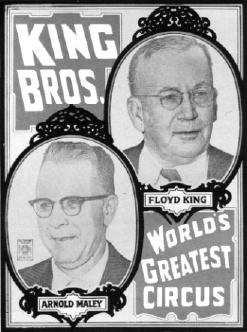
With the dawn of the 1956 circus season, there was about enough equipment in the Macon, Ga., quarters of the King Bros. Circus to have put out one show properly outfitted with relatively new trucks and other necessary equipment.
However, instead of putting out one good unit, Arnold F. Maley and Floyd King, owners, insisted upon putting some good equipment with each of two units, one to be operated by Maley, and the other by King, and filling out each with second rate equipment.
Staff for the two units was soon disclosed. Maley was to head up the Western unit as manager, with Ira M. Watts, superintendent. Other staffers on the unit were: James Hirschberg, treasurer; Mrs. Leona Watts, secretary; Hughie Hart, front door; F. C. Fisher, inside tickets; Charles Zerm, sideshow manager; Mel Fleming, legal adjuster; Red Larkin, concessions; Phil Escalante, equestrian director, A. Lee Hinckley, bandmaster; Teddy Porter, sideshow band leader; Bert Pettus, elephants, and C. M. (Red) Miller, electrician.
King was to be manager of the Eastern unit, with Al Moss as superintendent. Other staffers for this unit were: Vickie King, front door; "Slats" Beason, purchasing agent; Col. Calvin Miller, equestrian director; Joe Rossi, bandmaster; Carl Tyler, sideshow manager; Norman Anderson, concessions and hippo pit show; J. H. (Doc) Simpson, 24-hour agent; Ted Gallup, elephants; Charles Browne, wildlife; Napoleon Reed, cookhouse; Dave Murphy, inside tickets; Louis Neismester, transportation; Whitney Thorne, electrician; "Jelly Roll" Rogers, sideshow bandleader; and Bill Webb, pony ride.
It was later announced that the Eastern unit also would include Eddie Keck, secretary-treasurer; Warren Wilson, general press agent; Frank Hinton, press; "Shaky Legs" Murphy, lot superintendent; Russell Ferguson, transportation; Pete March, big show boss canvasman; Kelley Pressly, sideshow boss canvasman; Carl Tyler and "Curley" Miller, parade marshals; Harry Rooks, chief electrician; Charles Luckey, boss carpenter, and George Brown, blacksmith.
Advance staffs for the two shows were announced in March. On the Eastern unit, Richmond W. Cox, Jr., head of the World of Mirth Carnival press department, was to be general press agent for about 10 weeks before returning to the carnival. Clark Queer was press agent, and Eddie Jackson was contracting.
Advance staffers on the Western Unit included Charles Underwood, general press agent; Francis Kitzman, Advertising Car Manager; Mrs. Francis Kitzman, C. C. Smith, and Louis Ringol, contracting agents.
Promotion managers served both units, and these were: Douglas Brown, J. R. Fremont, Herbert M. Knight, Raymond A. Walton, Ralph Brodwin, George L. Gobel, Jack R. Wilson, George Vonderheid, Ralph Miller, Mrs. Marie Reed, Mrs. Margaret Houseman, Les Harris, and Joe Walsh.
Even though the shows were tagged "Eastern" and "Western," it was planned for both units to remain east of the Mississippi River and to play in much the same territory. Both were to be considered as separate units, and operated independently of the other.
Rehearsals for both units started in Macon on April 3, to prepare for their April 7 openings. Acts on the Western unit were to include the Suarez Troupe (5) who did riding, teeter-board, and bicycle acts: Carlos Ricca, juggling; the Rodriguez Troupe (9), bar act, head balancing, iron jaw, wire, and cloud swings; Tony and Inga Smaha, horse trainers; Francis Duggan, contortion; William Rodgers, cloud swing; Walcott's dogs; and Harry Rooks, head balancing. Clowns were Tommy Whiteside, Jimmy O'Donnell, and Jan Vanicky.
Acts on the Eastern unit were to include Alberto Zoppe Troupe (7), riding act, aerial, triple iron jaw, and three lady principal riders; Signorina Ruggera, upside-down ladder and slide for life; Matt Laurish, horse trainer; Mary Laurish, trained dogs; Eddie and Helane Hendricks, wireact, single trapeze, and iron jaw; Lolita Perez, wire act; DeRiskie Troupe (6), head balancing, acrobats, juggling, featuring Gayle DeRiskie, head balance on the trapeze; Great Rocketto, cannon act and hippodrome races; Edward Hodgini and company, comedy auto; and clowns Bozo Ward (producing), Charles Hilderra, Frank Hunter, Henry Brown, Charles E. Browley, Royston Smith, and Chuck Yale, the latter with table rock.
Very little or no painting of the equipment had been done at their winter quarters, so when the shows opened, the equipment had a "rundown" appearance.
The Western unit opened on April 7 at Thomaston, Ga., while the Eastern unit opened the same date a few miles away in Macon.
The Western unit was traveling on about 26 trucks, with three ahead, whereas the Eastern unit was traveling on 30 trucks, with three ahead. It also was giving a parade. The Western unit had a free show of feeding the animals on the lot.
(From this point on, we shall follow the activities of the Western unit, and then retrace our steps and follow the course of the Eastern unit; and finally the combined show.)
The Thomaston opening of the Western unit was considered a fair day, grossing a reported $2,500, with good matinee and evening houses.
The big top canvas for the show was a 90, with three 40's which had been purchased from Roger Bros. Circus in poor condition. The menagerie and side show top was a 4-pole, about a 60, with three 20's. There also was a cookhouse located on the lot.
Two trucks, a bandwagon, and some surplus equipment was left in quarters at Central City Park in Macon.
The truck lineup for the Western unit on opening day was as follows: (—s— denotes semi's)
5 -s- Props
7 Bus sleeper
16 -s- Horses
22 -s- Elephants (2)
23 -s- Light plant
26 -s- Horses
37 -s- Sleeper
46 -s- Horses
50 -s- Chairs
63 -s- Sideshow
69 -s- Concessions
75 Cage
77 -s- Sleeper
85 -s- Cage
110 -s- Grandstand
117 Bus sleeper
-s- Poles (from Rogers Bros.)
-s- Cookhouse (from Rogers)
-s- Red ticket wagon
-s- Ticket wagon (grandstand, used by Maley)
-s- Penguin pit show
Canvas loader
Water truck
Midway dinner
In cage No. 75 there were two lions, two spotted hyenas, and one American black bear. In cage No. 85 there was the hippopotamus and one polar bear. All these animals were exhibited in the side show.
Color scheme for the trucks was yellow, with red lettering on all except the following: red ticket wagon (title in gold); penguin pit show (blue with white lettering) and the midway diner (aluminum).
Arnold Maley had both the show-owned ticket wagons on the Western unit. (This left the Eastern unit using a ticket box). The Western unit perhaps had the best trucks, but its big top was in the worst condition, with several gaping holes in it.
There were only two elephants on the show to begin with, but Bert Pettus soon rejoined the show with five other bulls which had been making winter dates.
The Western unit had apparently cut personnel and equipment to minimum and were geared to make money. Maley stated that with a few weeks under normal conditions, he and King would overcome their financial strains.
The Western unit started the next week on Monday, the 9th, at La Grange, Ga., which gave good business. Tuesday was in Newnan, but was mediocre because of heavy rains. Roanoke, Ala., on Wednesday (10th), was poor. On the 11th at Anniston, Ala., the show was a day behind the Cristiani Bros. Circus, but the Western unit had a downtown lot, and did a turnaway business.
Coupled with reports that the show was getting adequate business at most of its stands, came news that its adjuster, Malcolm Fleming, had died of a heart ailment at Scottsboro, Ala., on the 16th. His duties were taken over by "Butch" Cohn.
It was also noted that Mrs. Ira Watts had recently returned to the show from Winder, Ga., where she had helped the Eastern unit out of the mud.
As the Western unit rolled along, it seemed to be getting good business, despite prevailing low temperatures and some rain. The bad publicity that the Eastern unit was getting hurt the crowds in several spots, but at Glasgrow, Ky., there were two strong turnouts, even though temperatures were in the low 30's. A turnaway was recorded at Campbellsville, Ky., and there were two strong houses at New Albany, Ind., on the 25th of April.
The Western unit continued along its route, and after a short period, while public acceptance improved, the weather became worse.
At Marion, Ind., on May 3rd, it was reported that the show drew an audience of 300 in the afternoon, but had a straw house in the evening, and the VFW sponsors made over $600 on the date. But after that there were several bad days at Columbus City and Fort Wayne, and mud problems continued to hamper the show, while high winds ripped the canvas.
The Western unit then entered New York State on the 15th at Olean and played several dates around there, but had to cancel the rest because it couldn't meet the equipment standards of that state. The show then proceeded to Sayre, Pa., for its May 18th date, and ended up staying over there for a short period.
The advance crew was able to book two dates in place of the cancelled New York ones on a one day notice, so on May 23 the Western unit played Towanda, Pa., and on the 26th they played Tunkhannock, Pa.
Meanwhile, all was not well, for in Macon, creditors of the show had filed a petition against it for involuntary bankruptcy. They asked for the appointment of a receiver and the operation of the show's two units under court supervision.
Maley flew to Macon to try to get things straightened out, and said he expected to reopen his unit shortly, following a new route. (Meanwhile, Floyd King's Eastern unit continued in operation.)
The four who filed the $10,000 petition were lesser, unsecured creditors, including those who supplied the show with tickets, some printing, a tire dealer, and a mattress dealer.
The petition charged that some of the creditors were preferred over others, that the show was insolvent, and that its equipment was worth about the same but was being depreciated.
A meeting of the creditors was expected to be called in about 10 days. It was then believed that a chief creditor might be named operator, and that he might designate an agent to operate the Western unit.
It was learned that due to snows in Hornell, N.Y., the Western unit's canvas had given out. A new top was being made for the show, and a substitute top was being readied to fill in until the new one was completed. It was presumed that one of these would be ready after the show ended its layoff at Sayre, Pa. In addition, it was reported that superintendent Ira Watts had closed with the show.
On the 25th of May it was learned that William J. Bailey, a Macon businessman, and head of the Macon Shrine Circus, had been named as receiver of both of the King Bros. Circus units in federal court action instituted by a group of local creditors.
It was revealed that Bailey was a long time circus enthusiast and a financial backer of the King show, and, for this reason, Judge E. P. Johnson, referee, selected him as receiver.
Maley filed a response admitting, individually and as co-partner of King, the insolvency and all other acts alleged by the creditors. Maley waived an indemnity bond, ordinarily required of receivers, but the court set a statutory bond of $5,000.
In Maley's answer, the court was requested to permit circus operations for the remainder of its current season, or longer, in an effort to gross sufficient revenues to pay off the creditors.
Court officials said that, under the judge's order, Bailey had the authority to permit operations of either one or both units, naming an agent to travel with the shows and personally supervise operations. This seemed to mean that Bailey could name either Maley or King, or both, as agents-in-charge, and continue the show's operations.
Paul M. Conaway and Jack J. Gautier served as attorneys for the King partnership, and Durward B. Mercer was the attorney for the petitioning creditors and the receiver.
After several meetings with King and Maley, Bailey announced that both units would continue operation for the time, at least, but that the future of both probably would be determined at the June 12th meeting of the creditors.
On June 4th, it was learned that Maley's Western unit had closed and had combined with King's Eastern unit, and that future plans called for operating again as a single show, as in previous seasons.
The Western unit had operated for two months, and the previous Monday had been its seventh day of sunshine. It seemed that the weather had ruined the business of the unit. Its canvas had given out earlier, and after reopening the show after the layoff, business was found to be no better than before.
Earlier in the week, the Western unit was at Berwick, Pa., getting tornado warnings. The afternoon house was cancelled because of heavy rains, and the evening show was given to a one-quarter house despite more rain. After a few other towns and poor business, the Western unit called it quits at Pottsville (Port Carbon) and cancelled Sunbury. The Sunbury auspices published a suggestion that the townspeople should go to Benson Bros. Circus instead. This circus was due in later.
The first date for the reunited show was East Stroudsburg, Pa., on June 5th.
(Now we will back track and pick up the operations of the Eastern unit from its opening in Macon, Ga., and continue throughout the rest of the season with that unit.)
The Eastern unit of the King Bros. Circus was under the management of Floyd King, and opened the same day as the Western unit, April 7th, at Macon, Ga., the show's winter quarters.
The Eastern unit opened its stand with a street parade which consisted of the following units:
Flag Bearer Blue and gold bandwagon (4-horse team)
Clown on cart
Rider
Red cross cage, monkeys (2-pony team)
Cage truck No. 95, lion
Police patrol wagon with clowns (2-pony team)
Two costumed riders, girls
Roman chariot (2-pony team)
Orange cross cage, closed (2-pony team)
Side show band on flat bed semi
Donkey cart with clown
Cannon truck
Six elephants (five with blankets)
Steam calliope
Following the steam calliope was a commercial exhibit. This in turn was followed by the air calliope, which had been late in leaving the lot, therefore, it had to catch up with the rest of the parade.
The two other cross cages, blue and green, did not parade, but were left on the lot.
The big red and gold bandwagon, which had been built for the 1955 season, was left in the quarters, minus its wheels, and was not taken on the road in 1956.
All the trucks were painted yellow, with red lettering, except the following: Stake driver (red title on white); hippo cage (Cab-white, trailer-aluminum); midway diner (aluminum); and the steam and air calliopes (red, with gold leaf).
The truck lineup was as follows at Macon: ( -s- denotes semi's)
3 Stake and chain
9 Shop
12 -s- Horses
15 -s- Steam calliope
17 Bus sleeper
25 Motor shop and tires
27 -s- Sleeper
29 -s- Cookhouse
30 -s- Seats
32 -s- Elephants
33 -s- Light plant
36 -s- Lead stock
45 -s- Props
57 -s- Band sleeper
59 -s- Concessions
60 -s- Poles
61 -s- Sideshow
62 -s- Elephants
87 Sleeper
90 -s- Seats
95 Sideshow "Fighting lion" cage
-s- Grandstand
-s- Flat bed (Bandwagon, four cross cages, and carts)
-s- Hippo pit show, Norman Anderson's
Stake driver
Canvas loader (ex-Wallace & Clark)
Air calliope
Cannon truck
Midway diner
Lead stock on the Eastern unit consisted of two llamas, a camel, a water buffalo, a highland cow, a brahma (zebu) calf, and a goat.
The show's canvas consisted of a 120 big top with three 40's. At Macon, only two middles were used because of the high winds. The sideshow canvas was a three-pole tent, about a 60 with two 20's. The menagerie was a two-pole tent, about a 60 with one 20. Also on the lot were a wildlife pit show tent and a cookhouse tent. In addition to the previous acts listed, the following were with the Eastern unit: Truzzi, juggler; the Sachano Sisters (3), bounding rope and trapeze; John Smith, liberty horses; Aero Trio, motorcycle on high wire; Mendez Brothers (3), acrobats; Miller's Trained Horses; and Jerry Pressly, wire.
Carl Tyler headed up the sideshow as manager. Howard King had the sideshow doors, and "Jelly Roll"Rogers was bandleader with the minstrel show.
Sideshow platforms were: Charles Harris, Punch, magic, and inside lecture; Sylvia Smith and fighting lion; Don James, glass blower; Fred West, who headed up the Hawaiian show, which featured Sandra O'Hara as one of the dancers; Jo-Ann, half and half; and there was a two-headed baby in the annex.
Roy Smith was in charge of the Wildlife No. 1 Sideshow.
That was the way the equipment and personnel stood on the opening day.
One might say that the show was doomed from the start, for during the first afternoon, cold weather and winds hit it hard, inflicting damage to the canvas and other equipment. The Wildlife No. 2 Sideshow's top and side wall also suffered heavy rain damage and it was not operated after the first hour of business, and future stands showed that it was discontinued after Macon.
The first afternoon show on April 7th, was a near full house, but the winds held the evening crowds to something over half of capacity.
King apparently was pleased, although the attendance was less than that of former years. The day's gross was reported at $4,000, which was $2,000 less than when the show was there in 1955, but the nut had dropped from $5,800 at the start of 1955 to about $2,500 for the Eastern unit.
After Macon, the Eastern unit proceeded to Athens on Monday (9) where it did very well. But, in Elberton, Ga. (the Tuesday stand), the show was again hit by heavy rains and wind, bogging it down in the mud. The show was unable to get off the lot until 4 P.M. on Wednesday. Then piece by piece, the trucks slowly arrived in Winder, Ga., the scheduled Wednesday stand, late that night.
The parade and afternoon matinee which had been scheduled for Wednesday afternoon were cancelled. As the Winder News of April 18, 1956, describes it, "Many of the Winder citizens went out to the lot in the late afternoon to see the show, but nothing happened. A performance was promised by the show as late as 9:00 P.M. . . . still nothing happened."
The show agreed to stay in Winder on Thursday and to put on two performances. Thursday arrived, but the show just couldn't get things organized. Finally a parade was hurriedly pieced together around noon, and wound through the town, but it proved to be a disappointment to the school children who had been let out early for the second day in a row to see it.
Late in the afternoon, the tent was erected and a single show was held that night.
Thursday's scheduled stand at Marietta, Ga., was played on Friday. Thus the Eastern unit fell a day behind its paper.
The show took almost all day Friday, the 13th, moving its equipment off the Winder lot. But it left behind a small zoo consisting of an elephant, a water buffalo, a camel, two llamas, two dogs, and another animal which had the citizens of Winder baffled. A truckload of props also was left. This consisted of the parade bandwagon, the four cross cages, chariots, and other miscellaneous equipment.
It was stated that those in charge of the show had said nothing to anyone about leaving the animals and equipment. Then, Friday night, Richard Russell, III, and Clay Howard, from Winder's Kiwanis Club, went to the showgrounds to see how the show had left the surrounding property. From the road they saw two trucks. On inspecting these closer, they found the animals to still be in them.
Lucy, one of the show's elephants, was left on the loose, and was finally captured by a young mechanic, after it had done some damage to local property.
The animals were put in a truck and transported to Grant Park Zoo in Atlanta.
Floyd King explained to the city officials that the show was running behind schedule because many of its workers had quit. Also, he said it didn't have enough trucks to transport the animals from place to place. When questioned about the animals, King replied, "The animals weren't lost, we knew they were there."
This was just the start of many similar incidents which occurred throughout the season.
Meanwhile, the show moved on to Marietta, Ga., on Friday the 13th, a day behind its paper. On the way, the show's canvas spool truck caught fire and the big top was destroyed. Arriving in Marietta, the circus side-walled and played to two half houses.
Since most of the parade equipment was left in Winder, the show discontinued its street parade.
The show equipment was shuttled because of truck trouble. Reports were that 14 motors had been burned out as the show got off the Elberton mud. This would account for about half of the motors on the circus.
On Saturday (14), the show blew Rome, Ga., in order to catch up with its paper at Cleveland, Tenn. On the way, the Sideshow's fighting lion truck had stalled near Alpharetta, Ga. While it awaited repairs, the local townspeople called Atlanta, and the humane society there came out and picked up the lion and truck. (The truck was still in the Humane Society's building in Atlanta up to about a year ago.)
Upon leaving Cleveland, the show left five elephants on the lot. They were to await the return of trucks that later would shuttle them to the next stand.
By this time, the newspapers were really playing up the incidents of lost animals in Georgia, and at Cleveland.
Severe rain hit the show Sunday, the 15th, and on Monday (16), and the lot at Oak Ridge, Tenn., was a pool of mud. Moreover, the weather on Monday included snow, hail, wind, and more rain.
The new tent, which was sent from Macon to replace the big top which had been destroyed earlier by fire, blew down in the early morning at Oak Ridge, so the show sidewalled. There was a fairly good turnout, since the schools had been dismissed early for the show.
En route from Oak Ridge to Newport, Tenn., on Tuesday (17), a truck carrying three elephants was stopped at Knoxville until the show could be contracted for payment of a gasoline bill.
About this time it was reported that the show would play Middletown, Conn., on June 13th, under the auspices of the Junior Chamber of Commerce. The show was scheduled to use the old Coleman Show's carnival lot.
On May 5th, it was reported that the tide had turned for the Eastern unit, and that the show had begun to adopt winning ways.
King reported that during the past week strong business had been reported at most of its dates. However, on Thursday the 19th, at Abingdon, Va., the matinee had been cancelled, and the night show started at 10 P.M., with the aid of auto and truck lights, as the light plant had been left mud-bound in Erwin, Tenn.
The show reportedly had solved its transportation problems, with the recent arrival of four new trucks, and a new top, to replace the one destroyed by fire, was scheduled to arrive any day from the Norwalk Tent & Awning Company.
It also appeared that the show had overcome many of its other difficulties and was now rolling smoothly. It had ordered a fourth middle piece for its tent, which was different than the one ordered. By this time, the show had about 20 tractors moving 27 loads in good time. The steam calliope was being carried with the show but hadn't been used in recent towns because no one was able to play it.
The Zoppe Family, with Cucciola, had just rejoined, along with the Sparton Family.
A hippo and five elephants, together with some other animals, also were on the show. "Jelly Roll" Rogers and his band were playing the big show, following the departure of Joe Rosei.
These changes indicated that the show was back on schedule, and it was reported that it had only missed one afternoon performance in the past two weeks.
In the May 19th issue of Billboard, there was an ad seeking performers for the Eastern unit. This ad listed the following positions as being open: High class promotion manager; trampoline; teeterboard and horizontal-bar acts; clowns; superintendent of elephants; assistant boss canvasman; truck mechanic with tools; side show manager; punch and magic; colored musicians for sideshow band, and a steam calliope player.
This further indicated that the show had lost many of its older personnel and acts during its trying days at the beginning of the season, but that things were then moving along smoothly and the show was adding to its departments and performances.
Business was reported as average during the few weeks, although the show still had been bucking bad weather. Also, a truck mishap at Niles, Ohio, had caused a tangle with two elephants.
Meanwhile, the Western unit had halted at Sayre, Pa., and a bankruptcy suit had been brought against the show.
Floyd King said that he had no direct knowledge of the bankruptcy action against him and Maley in Macon during the previous week, but that his unit was moving along normally, with no mishaps. He said that Frank Orman, manager of the Clyde Beatty Circus until recently, was expected to join the show shortly, and that the lineup of the performance had remained unchanged from the first of the season.
But, later on in the same week, King acknowledged the bankruptcy charges against him and Maley. Meanwhile, a federal judge in Macon had ruled the partnership and individuals as bankrupt.
King said that his Eastern unit was operating with a nut of $1,200 and that it was showing a profit every day. He told the court, that if he were permitted to continue the operation of this unit, it would show substantial profit at the end of the season.
King, in answering a creditor's petition, said that any acts of bankruptcy were committed solely for the purpose of preventing attachment or seizure of property that would prevent the two units from continuing. He said this was done in the expectation that the circus income would permit it to pay off all debts.
Referee in the bankruptcy proceeding was Judge E. P. Johnson, and he scheduled the first meeting of the creditors for June 12, the same day the creditors of the National Circus Corporation, which operated the Clyde Beatty Circus, were also meeting in the Federal Court in Macon.
At this time, the attorneys of King and Maley filed their preliminary schedules, which showed debts of about $298,000, and assets which were valued in March, 1956, at $301,000.
The Macon receiver for the two units, W. J. Bailey, said then that both units of the show would continue on their present routes for the time being.
But business was no better for either unit, and the Eastern unit suffered because of bad weather which ripped through Pennsylvania. On Thursday, May 31st, the show was at Hanover, where it rained all day and winds caused some damage to the canvas. As a precautionary measure, the afternoon audience was asked to leave the big top because of the increasing winds.
In Norristown, Pa., the show's June 2nd stand, it was noticed that the show had about half enough tractors to get the equipment over the road. A lot of the better trucks were doubling back of it. It was a very rainy day and the big top had more holes in it than canvas. Practically no seats were erected, although a few chairs were spread around one ring which was used. Music at Norristown was furnished by "Jelly Roll" Rogers on the cornet and by a laborer on drums. The sponsor was the city fire department, and the advance sale was probably the largest and the best the show had had that spring. But the show just about killed circus business in that area for a couple of years.
Meanwhile, the Western unit, also was catching some of the rains that the Eastern unit had been suffering from. The Western unit's business turned from bad to worse, and at Pottsville (Port Carbon), Pa., on June 4th, the show called it quits and the Eastern and Western units combined at East Stroudsburg, Pa., on Tuesday, June 5th. From here on out, the King show operated as one unit.
Even with the combined shows, the show appeared to be short handed. But it progressed slowly along its route, missing a few performances here and there, and hitting up a big day once in a while. At Danbury, Conn., on June 10th, three performances were given to take care of the crowds, but unfortunately the show was tied up for a short time by the Greenwich, Conn., auspices. The show had cancelled its Greenwich date earlier.
On the 13th of June, the King Bros. Circus arrived in Middletown, Conn., and gave its performance, staying over for Thursday. It was still there on Friday (15). It was understood that the advance had folded and that the show was without any place to go. At first, there was some reason to think that it might start up again the following week in Rhode Island, but these plans did not materialize. Most of the performers were just left stranded at Middletown.
The help from the townspeople was tremendous, as many as 3,000 to 5,000 people would visit the grounds on weekends. Collection boxes were set up and pony and elephant rides were given. Popcorn, sodas, and peanuts were sold. Some of the show people earned considerable sums of money during these days at Middletown, but the show couldn't get started.
Maley stated that, acting on a court order on June 5th, he assumed control of the Eastern unit, and from that time on, King was regarded as just an employee, serving as general agent. Maley added that the combined organization was made up predominantly from his Western unit, and that the excess equipment had been stored at East Stroudsburg, Pa., the location of the merger.
The single King show then played several dates on the Eastern show's route, because it had about five sponsored dates involving advance sales, whereas the Western unit had been playing lot-and-license auspices.
At this point, Maley denied that his Western unit had ever closed. He said that it had laid off earlier for a few days in Pennsylvania because the advance had failed to make necessary registration with New York State and those stands had to be cancelled.
He pointed out that dates in two of the towns were picked up later and that additional towns were played when the show reopened. He also stressed that the Western show had not closed earlier, but that the Eastern had closed, and that the Western moved to its route.
Maley said he planned to send an agent back along the Eastern show's route to reclaim equipment abandoned by it. He said that the Western show had not abandoned any equipment at all.
Meanwhile, the first meeting of the creditors was held in Macon on June 12th, with Judge E. P. Johnson, U.S. referee in the bankruptcy case, presiding.
Floyd King did not appear, and Maley assured the court that he would be in attendance at the second meeting on June 19th.
In his testimony, Maley outlined operations for the 1954, 1955, and spring of 1956 seasons, after he and King had acquired the former King Bros. & Cristiani Circus.
"We grossed about $1,000,000 during the year 1953 when King and Lucio Cristiani were partners and I was treasurer," Maley testified, "we assumed that substantially the same business could be anticipated for 1954, but the gross dropped about $400,000 to approximately $600,000. Meanwhile, our expenses of operations increased.
"In this first year of our ownership, 1954, we made a profit, but practically all the money was put back into the show."
Maley said that in 1955, the show lost approximately $125,000.
"The experiment of putting out two units this spring was a big failure," Maley admitted.
"The plan looked good on paper, but just didn't work out," he testified. "Last week, ending June 9, after closing the Eastern unit at Stroudsburg, Pa., and transferring the Western unit to the Eastern's route, we had our first winning week."
He said that the "replacement value" of the circus properties and animals owned by the partnership would exceed $300,000, and that the liabilities were about $290,000, some of which were disputed. He added that in the event of a forced sale, the property would not bring 10 per cent or $30,000.
If the show were allowed to continue this year, a minimum of $50,000 would be realized to the benefit of the creditors, it was stated by him.
It seemed that the biggest creditor was the Federal Government, which held tax claims of about $100,000 and in addition, there were numerous creditors holding securities on the show's canvas, trucks, light plants, elephants, and other property.
Suddenly, the receiver, W. J. Bailey, announced that he was unwilling to continue as receiver, and the court then appointed Durward Mercer to take his place.
Judge Johnson pointed out that ordinarily property in the hands of the bankruptcy court was not subject to attachment or levy, and he instructed Maley to attach a sign to each piece of equipment, stating: "Do Not Touch - Property in hands of receiver in bankruptcy King Bros. Circus, Middle District, Georgia."
Because the railroad agent had said that the La Tena's Big Three Ring Wild Animal Circus train was to arrive early from North Adams, we got to the Pittsfield, Mass., yard about 2:30 A.M. on Sept. 5, 1914. The circus train did arrive at 3 A.M. and was shifted to a siding where it could be unloaded. However none of the circus people stirred until about 6 a.m. at which time they did start unloading the show. Once they started they moved fast and everything was off the train and on its way to the circus grounds by 8 A.M.
Actually there was only one train which consisted of 5 flat cars, 2 horse cars, 2 sleepers and 27 wagons, including several cages. All of the train equipment and the wagons were painted a bright red.
In addition to the cages there were wagons for the cookhouse, a water tank, tableau or props, two carriages, reserved seats, canvas, stake and chain, poles, light dept., side show and menagerie, horse top, blacksmith, ticket office, calliope, dressing room and canvas, blue seats, a cart, privilege wagon, big top center poles and a clown cart.
Wild animals in cages were 5 black bears; 5 lionesses, 1 big lion, 5 seals, 1 hippo, 1 hyena.
At about 11 A.M. the circus gave its free street parade down North Street and it was formed in the following manner:
Mounted bugler
Two riders on horses
Carriage, pulled by 1 horse
Band tab - 2 horses
Small cage - 2 ponies
Open cage - 2 horses
Small cage - 2 ponies
Open cage - 2 horses
Open cage - 2 horses
Clown band
Boy with pony
Open cage - 4 ponies
Small cage - 2 ponies
Open cage - 4 horses
Mounted rider
Clown cart
A goat led by a boy
Small cage - 2 ponies
Tab wagon, negro band - 6 horses
Open cage - 2 horses
One camel
Two elephants
Calliope - 2 horses
A free attraction was presented on the circus grounds just before the afternoon and evening shows. This was a Slide for Life act on a steep wire. At the afternoon show there were only a few people in the seats and in the evening the show was about half full.
The menagerie and side show were all in one tent, which had the cages, elephants, camel and 13 ponies. There also was a sword walker, musical act, trained monkeys and cockatoos, Colored band, 2 Oriental dancers and the one goat.
Eleven tents made up the whole show and these were a four pole big top, side show and menagerie, 2 candy stands, colored dodger, small side show, horse top with 27 horses, the cookhouse, dressing room, dancing girls and a small top covering an odd knife rack.
The lot on Pleasant Street was very small for the circus, so actually they sidewalled the horse tent. The way that the show was set up, nothing could be moved on or off the lot until the side show had been taken down. This they did about 8 P.M. The other tents were quickly taken down afterwards and in fact by 11 P.M. the big top was down, too.
By 1 A.M. the train had already pulled out of town and was heading towards its next stand in Hudson, N.Y.
Robert "Little Bob" Stevens and Bill Griffith have combined their talents into a winning show partnership this season. Both have known past failures in the business. Bob had his Stevens Bros, on the road from 1946 thru 1952, then his abortive Sterling Bros, effort in 1961 with Vernon Pratt.
Bill had the Adams-Sells title on the road from 1958 thru mid-season 1960. He chalks up his show's demise to inexperience in the business.
While Bob handles the management of the show, Bill pilots the advance and promotion, using Neal Walters paper and his own press artistry in the heralds and press book. The signature cuts for the show title, etc., show the old-time circus style to the best advantage possible.
Nucleus of the show-owned rolling stock came from the Stevens and Sterling Bros, circuses. Lee Bradley has his two sideshow trucks on for a few dates, likewise the Woodcock bull act. Among those who seem to be set for the season are the Chip Morrises, the Frank Silver-lakes, and Marie Loter.
The Fredericksburg date drew three big houses to a lot at the edge of town. Show personnel said that this was just a sample of the tremendous business they have done since opening February 17th. Three and four nearly every day. To digress a bit, most small towns have movies only on weekends, so the circus is still a very big event in the lives of the rural population.
A well-rounded 17-display program is given under the 70 with 3-30's O' Henry top. It has about 1,250 seat spaces on six-high blues at each end and eight-high reserved planks on the long side. Four center-poles and a single row of quarters help hold the white canvas aloft. Sells Bros, uses one ringcurb and leaves the rest of the arenic space for props and aerial apparatus. The track is very narrow, but has space for the spec and manege. Big top lighting is supplied by clusters of two and four incandescent bulbs suspended from the centerpoles. Marie Loter and her electric organ supply a very snappy musical background to the performance.
The show goes in very heavily for front-end units, and can thus afford to price its big top tickets at $1.00 for adults, 50c for kids, and 50c for reserves, the latter are roped off, instead of using seat masking. Bob says that he has an 80 ft. with 3-40's on order to be delivered in the Chicago area. The present top should hold up till then.
As for the front end, you have a snake show, rifle range, six-cat joint, grease joint, white wagon, and juice joint down one side of the midway, while a novelty stand and Louie McNeese's corn and candy trailer grace the center. The other side has a live pony ride and the kidshow. The Bradleys do a sword act and sometimes a snake-charmer blow-off in the kidshow. The menagerie therein has the 3 Woodcock bulls, four small cages containing monkeys, chimp, raccoon, and goat.
This top is blue, 20x60', and originated on the Don Franklin Carnival. Lee Bradley brought the bannerline over from the Hoxie show.
A new 50 kw GMC diesel light plant has just been added to the equipment. All show owned rolling stock has stickers stating that it's leased from the Phoenix Equipment Co., and the marquee has a Coca Cola sign emblazoned on the front.
I would put this show in the eight-truck plus private equipment class. Show-owned and private important units are as follows: (S denotes semi-trailer)
22 -S- McNeese's bull and her props.
42 -S- Pony ride and sleeper.
43 - Seat lumber.
64 -S- White ticket wagon and auxilliary.
Light plant.
S - Concessions and main light plant.
S - Poles and extra props, etc.
Canvas spool wagon.
Pickup water wagon.
Converted bus for lead stock.
S - Woodcock's bulls and stateroom.
Chip Morris' ringstock.
Marie Loter's organ truck.
A majority of the trucks were painted white and trimmed in red and blue.
Announcer-equestrian director Chip Morris precedes the big shop performance with a clean-cut candy pitch.
Program
1. Spec.
2. Miss Janice's canine review.
3. Loop-the-loop trap by Pinkie Lee Bradley.
4. Clown firecracker gag by Peggy and Jeff Murphree.
5. Louis McNeese and his very fine bull, Dyna. This is a show stopper from the word go.
6. Swinging ladders by Misses Pinkey Lee, Janice, and Mavis.
7. Chip Morris and his dancing horse.
8. Clown long shirt stunt.
9. Woodcock's barbershop bulls.
10. First concert announcement - Chip and Doris Morris.
11. Lee Bradley's excellent manege horses on the track.
12. Don Gillette and the McNeese chimp act.
13. Webs by Pinkey Lee and Mavis.
14. Second concert announcement.
15. Hazel and Lee Bradley and their riding mechanic act, using kids from the audience.
16. Clown stop.
17. Barbara and Buckles Woodcock send the audience and the sponsoring Lions Club home to spread the gospel after seeing their excellent big bull blow-off.
The staff has a fine balance of veteran troupers and "showmen of tomorrow." Included are:
Bob Stevens and Bill Griffith, co-owners
Ted Wilson, legal adjuster
Billy Sheets, car manager, with three billers
Raymond Duke and Vera Hines, contracting agents
Earl Tillman, boss canvasman
Mrs. L. Johnson, office
Bethel Church, transportation
Clara Stevens, candy top and juice joint
Lee Bradley, sideshow manager
To round out the layout, a cookhouse will be added in the near future.
Ringling-Barnum and Madison Square Garden have just signed a new lease covering the next five years. By that time, it probably will involve the proposed new Garden . . . The Ringling-Barnum corporation has set up a new organization to be called the John Ringling North International Worlds Fair Circus. This is to be the Ringling show for the 1964 New York World's Fair. Title recalls the early P. T. Barnum "world's fair" titles.
The Beatty-Cole show will play Chicago and Milwaukee . . . After work with the Jumbo movie is completed and the bulls are sent back to the Beatty show, Slivers Madison goes to the Benson Wild Animal Farm on a two-year contract . . . Vander Barbette is working an aerial ballet with 50 girls for Jumbo . . . The Bob Orth Circus, planned for California fairs, apparently won't go out . . . Ad Tpperwein, sharpshooter for years with various branches of show business, died recently. By hitting all but nine out of 72,500 two-inch wooden blocks in 1906, he beat the previous record (60,000 out of 60,650) set by Dr. W. F. Carver of the Buffalo Bill show . . . Neal Walters has been working on some ideas for selling circus posters in new ways . . . C. A. (Red) Sonnenberg has been on the West Coast with a company of "The Best Man." . . . AP feature writer CHS Gene Plowden, Miami, recently did a story about Beers-Barnes . . . The Stan Kramlen, Portland shopping center show owner, bought a tiny elephant from the Ruhe Bros., new operators of the former Jungle Compound. It died a day after delivery. The bull was about two months old and weighed under 100 pounds, it was reported . . . Roy Bible has been playing dates in California. He also raises rabbits at his Petaluma home . . . Sells Bros. Circus is using an eight-page tabloid-size postal herald mailed out of Perry, Iowa.
The DeWaynes produced a circus for Pacific Ocean Park, April 28-29 . . . Evelyn Currie, trainer, and Henry Trefflich, animal dealer, have been battling in the courts. She sued for $750,000. He sued for $6,150. A court denied her claim; his was granted. When a U.S. marshal came to Madison Square Gardens to attach her animals, she showed they were owned by others. The marshal ordered the animals kept inside the Garden until the next step was determined.
King Bros. & Sells & Gray, at Palisades Park, N.J., billed the Wallendas, Flying Jordans, Riding Dorchesters, Roy Rogers' Liberty Horses, the Jungs, Six Ralstons, Olga Ming, Six Freddies, Victors, Two Latinos, La Norma, Cannestrellis, LaLage, Corinne, Dearo, Morris Seals, Zoppe's Dogs, Newman's Bears, Chet Juszyk's Mixed Jungle Group, and Woodcock Elephants. Across the continent but with overlapping dates, Al Dobritch's International Super Circus at Los Angeles, billed the Wallendas early in its promotion but changed this to the Jordans on the High Wire. It also billed Chet Juszyk's Lions, Flying Alexanders, Mills Elephants, Emmett Kelly, George Hannefords, Norbu, Meteors, and Michelle and Michael . . . More acts with Jumbo: Albert Ostermaier, Mark Smith, Hannefords.
Among those with Ringling-Barnum: Merle Evans, Harold Ronk, Harold Alzana, George Hanneford, Jr., Roberto deVasconcellos, Gerard Soules, Galla Shawn, Zacchinis, Unus, King Everest, Dos Santos, the Palacios, the Astronauts, Flying Gobsons, Valadors, Kaichi Namba, Otto Griebling, Lou Jacobs, Paul Jung, Paul Wenzel, Edward Healy, Jane Young, Great Bartschelly, Bisbinis, Tony Durkin, Kolmedys, Alis, Madame Gena's Camels, Charles Moroski, Bill Buschbaum, Kaluser Bears, Del Morals, Trevor Bale, Evelyn Currie, Hugo Schmitt, Stephensons Dogs.
Earl Shipley is expected to be ahead of the Beatty show . . . Beers-Barnes is using a publicity shot that has a picture of the Woodcock Elephants superimposed on a montage of the B-B big top ... Kelly-Miller will make Joplin, Mo., June 1 ... Milt Hinkle, who was manager of Austin Bros. Circus for a while, read The Bandwagon's recent round-up on the Austin show and enjoyed it. He adds that it was first planned to build the new show in Dailey Bros, quarters but that Ben Davenport feared one show might lift equipment or people from another. So separate quarters were set up at Austin, Texas. When Davenport, Hinkle and Harry Hammil met at Davenport's home to name the show, it was Hinkle who suggested it be named for the quarters town. Hinkle managed the show only a short time and was succeeded by Mickey O'Brien. Dorothy Herbert also left the show early.
Circus World Museum has a new brochure for tourists . . . Harry Shell is scheduled to play the Circus World Museum calliope this season . . . Don Marcks writes that Epic recording LN-3463, "Music Man Goes Dixieland," has three circus lithos in the background of the cover . . . Acts that played Honolulu for Fernandez were stranded in the Islands for a while by a shipping strike. Several had been scheduled to open with the Ken Jensen Circus but missed the starting date.
Sells Bros. Circus will be in the Chicago area by June 1. Mills Bros, will be in the suburbs at the same time . . . Jackie Kennedy has asked India for a pair of rare pandas, according to AP. A pair in Hamburg, Germany, will be sent to the U.S. and India will send two new ones to Hamburg . . . Mills Bros. Circus opening banquet was April 21 ... Tom Woodward writes that Edward G. Hagner, former circus side show act billed as the skeleton dude, five feet tall and 48 pounds, died at the age of 70 recently.
Sells Bros, has been doing good business, giving extra performances in five Texas towns. The show rented a cage truck and an elephant truck from Hagen Bros. Elephants on the show are Freida, Terry and Maud. Louis McNeese has a bull on the show. McNeese and Marie Loter were married recently and together they have an elephant truck, concession truck and trailer, car, house trailer, and organ truck. The Woodcock Elephants closed as scheduled to make the King-Sells & Gray show in New Jersey.
Jumbo film work is scheduled to be completed in mid-May for parts of it and June for more. Ringling-Barnum will return to Baraboo, Wis., for the first time since its Jubilee stand there in 1933. The show will return to the town where it was founded and where it formerly wintered. But this time it will be to "summer." The show will lay off during most of July, as it has for the past several years, and this time will lay off at Baraboo . . . Bob Couls’ show, Famous Cole, will play Baraboo at convention time.
The Diamond "O" Wild Animal Ranch near Canton, Ohio, is owned by a Canton businessman, Anthony (Tony) Diano. This farm cannot be compared with the old Hall Circus Farm at Lancaster, Missouri, but in a minor way it represents such a farm and in some cases has animals that never were at the Hall Farm, such as giraffe and African elephants. It is the only farm of this kind ever in this part of the country.
The large clubhouse at the ranch was known as The Canton Club during "The Roaring Twenties." Later the surrounding land was taken over and a large barn built for a dairy farm.
During the late 1930's Tony Diano took over the land and clubhouse and started stocking the land with animals. These included not only a herd of buffalo (bison) from the Western Plains but animals from all parts of the world, from small monkeys to elephants and a giraffe. He had a herd of eight or ten zebras, including "Gonga" the famous performing zebra, as well as llama, camel, hippo, rhino, polar bear, hyena, cheetah and many other rare animals.
In the fields around the quarters can be seen not only domestic cattle feeding with the buffalo but Texas longhorn and imported cattle such as Brhman, Scotch Highlanders, English short horn and others.
He constructed a bull barn, ring barn, barns for wagons and trucks and proceeded to build it into one of the finest circus quarters ever in this country. Beautiful paintings of animals and jungle scenes on the high fence that separated the clubhouse grounds from the barnyards were added. There were large lithographs of show people of the past on the walls of the clubhouse, including P. T. Barnum, Ringling Brothers, Adam Forepaugh and Buffalo Bill on his horse.
Diano at times leased out animals to different shows, carnivals and circuses as well as for motion pictures. In the spring of 1953 Diano and Ben Davenport combined their show properties into Diano Bros. Circus, but for various reasons this circus did not last out the season. But that is for another story.
In 1954 and 1955 Diano's animals were with World of Mirth Shows, a railroad carnival and Diano's stock car was used on that show. In 1958-60 these animals were on Cristiani Bros. Circus. In 1961 they were on Ringling International on a South American tour. At other times some of the animals were on King Bros. (Benny Cristiani Unit) and other shows.
For years Diano has had one of the great herds of elephants in modern show history, not for quantity but for quality and variety. This included not only the common Asian female but male tuskers and Africans. If Diano had a good steady handler for his elephants, he probably could have one of the best elephant acts in this country.
In this herd, I believe Katie was the first, bought from Henry Trafflick early in 1952. Soon afterward Young Tusko, a male tusker and Betty an Asian female were added from Bronx Zoo. These three were very young and small when going to Diano's and Betty is said to be only about three years old when she toured with Diano Bros. Circus in 1953. Calcutta and Mysore came from Hamid-Morton Circus and the two Africans, Mackatella and Gandy came from Carl Hartley in Africa. Last but not least was Tommy the big male tusker. Tommy was imported and trained about 1947 with a bunch of other punks for the Dailey Bros. Circus. After the close of the Dailey Show, Tommy was on Campa Bros, and in 1952 was on Wallace Bros. He came to the Diano quarters about 1954.
At various times other animals are at the Diano quarters, when some circus or animal acts lay over for a few days, as Cristiani Bros, did two or three years ago. Bill Woodcock and his elephants laid over there two different times and the late Prof. George Keller and his cats were at the quarters a number of times.
Tony's equipment consists of some of the finest cages and bull trucks ever on the road, including the largest bull truck ever built. These are kept brightly painted in Diano colors of red, green and yellow. The Diano Bros. Circus letterhead was one of the most colorful of modern day shows.
Old show equipment and antique wagons, some of which date back to Wells Fargo Overland Stage Lines, can be seen here. The ticket wagon from Cole Bros. Circus is stored in one of the barns. Wagon No. 104 that was hospital on Cole Bros, for years belongs to Tony and he has had this wagon built into a tool wagon for repair jobs on the road. One railroad stock car that was part of the Cole Bros, Circus train belongs to Diano and is the one previously mentioned as being used on World of Mirth Shows when Diano's animals were on that show.
One large cage wagon and an old bus used on Biller Bros. Circus are in the quarters. The bus was used on Diano Bros. Circus for show personnel. Besides the different old wagons, there are bales of canvas, poles and stakes from a number of shows of the past.
For years this has been "The Show Place" in this part of the country. The buildings are heated by fuel from wells on the property. The farm was kept well painted and nice looking until the last few years.
But in the past few years many of the animals have disappeared from the scene and the beautiful paintings are peeling off. Gonga is gone, as are most of the members of the zebra herd. The once fine herd of buffalo has come almost to the point of extinction, although fans on different occasions have enjoyed buffalo steak dinners prepared in the Diano cookhouse.
The Diano ponies went to King Bros. (Cristiani owned) in 1959. "Mollie" the famous African rhino that appeared in the movie "Snows of Kilimanjaro," died on the road with Cristiani Bros. Circus in 1960. Gandy one of the African tucker elephants died at the quarters in the winter of 1960-61. Other animals have died and Young Tusko was sold in the fall of 1961.
Earl "Irish" Greer, old time animal keeper, who has spent a big part of" his 87 years around circus animals, was animal superintendent at the quarters and on the road with the animals for several years. Irish is now spending his days in The Sunshine State of Florida.
Is this "Showplace" of Ohio to become just history like the Hall Farm of Lancaster, Missouri? Let us hope not.
(Henry Varner, a part time attendant, who takes different groups of visitors on lecture tours of the quarters, has given me some data on the background of the quarters.)
Many a cold winter night has been spent in pleasant nostalgia gleaning over old photos and bits of information and conversation picked up from circus hands about former quarters at Granger, Lancaster, Baldwin Park, West Baden, Peru, Venice, Denver, Bridgeport and other spots on the map that nobody but circus historians and fans ever heard of. Now, one more can be added to the list. Sarasota, the mecca of all circus fans in our generation and in particular the quarters used by Ringling-Barnum from 1928 until 1960 has become the latest addition to the list of our places down memory lane.
Following the decision of the Ringling show to move to Venice, activity began taking place that took its toll of a large amount of circus plunder which in a way paralleled the famous wagon burnings in Peru. Buildings that hadn't rotted away were demolished, wagons and cars were burned and scrapped, the steel work that was of use for building in Venice was saved to be moved and some equipment was sold while a few pieces found way to the museums in Sarasota and Baraboo. Now, the former quarters is a piece of ground surrounded by a barbed wire fence that encompasses nothing but head high weeds.
In February of this year I endeavored to make a complete compilation of what is left in both Sarasota and Venice. The list is interesting to the point of asking why was some equipment saved and for what use and why were so many wagons and cars destroyed that could have proved to be of value to museums and collectors. There are probably reasons for the actions of the top brass that will never be known except to themselves. I have had several requests for the listing, hence this article so that all may share in my fortune or misfortune, depending on your point of view.
Wagons at Goodman's Junkyard E. 17th St., Sarasota, 2/7/62
No.; Length; Color; Type; License Plate
14; 14'; Alum.; Baggage; 1950 RB-14
20; 18'6"; Red; Baggage ; -
109; 17'6"; Red; Light plant ; -
- ; 18'; Alum.; Baggage; 1949 RB-55
7; 18'; Green; Ranges; 1956 RB-7
141; 20'; Red; Trunks ; -
110; 16'; Red; - ; 1956 RB-110
75; 17'; Alum, and Green Cage, 2 section, hard tires ; -
130; 14'; Red; Train lights; 1956 RB-13
142; 20'; Red; Wardrobe ; -
64; 17'; Red; Uniforms; 1956 RB-64
61; 19'; Red; Props; 1956 RB-61
4; 20'; Green; Cookhouse supplies ; -
125; 20'; Red; - ; -
124; 16'; Striped; Tickets; 1956 RB-98
143; 20'; Red; Trunks; 1956 RB-118
3; 18'; Green; Cookhouse ; -
Also located here are two of Oscar Konyat's old wagons that are on the axles and rotting away. This equipment is for sale and many wagons contain bits and pieces of circus property including press material. It might also be noted so that nobody is misled that unless the license plates correspond in number to the wagon number, that they were probably put on the vehicles only for the purpose of moving them. Many were only wired to the rear axles.
Also located in Sarasota is No. 16, a 20 foot wagon painted aluminum that is located on a farm operated by C. R. Montgomery. At Texas Jim's are three cages, two being cat act cages, low profile, that were first used when the chutes were eliminated. The other cage is a 12' cage, one of the ones listed as missing in the Bandwagon review of the Ringling cages. (Sept., Oct., Nov., 1961).
Joe Bradbury did a fine article on the wagons at the two Sarasota museums in the White Tops, March-April, 1961. Since then, however, the Circus Hall of Fame has added the No. 29 bandstand wagon and Mel Miller at the Ringling museum was fortunate enough to get a handful of wagons from quarters. These are in such deplorable condition that I was unable to identify them but Mel states that in time they will be restored.
One other wagon remains in Sarasota and that is No. 147, a red baggage wagon that is located behind a barn across the street from the old quarters.
Some twenty miles south of Sarasota lies the sleepy town of Venice that hasn't known a circus since the ill fated James Edgar's Sparks Circus of 1947. Here is the new winter home of the once Greatest Show on Earth but unless you are definitely looking for it, you would never suspect that the town is a winter quarters town. Lying west of U.S. Highway 41 the main quarters is housed in a large building that is layed out to give as much floor room as the Garden in New York. One other large building and a wagon shed complete the layout. Here are many pieces of equipment sitting in the hot sun and going to pieces. Included in the assortment of vehicles are several semi's that were used to haul the show when it first went out as an arena type show. These are loaded with old spec floats plus the following other equipment:
135; 16'; Red
237; - ; Red; Truck, chain drive, Mack
- ; 30' Alum; seat wagon
- ; 30' Alum; seat wagon
- ; 30' Alum; seat wagon
- ; 30' Alum; seat wagon
- ; 30' Alum; seat wagon
- ; 30' Alum; seat wagon
- ; 30' Alum; seat wagon
- ; 20' Red; Baggage
- ; - ; Yellow; Cat with boom
- ; - ; Yellow; Cat with stake driver
- ; 28' Green; Gorilla cage
- ; 28' Green; Gorilla cage
- ; - ; Red; Ticket wagon
104; 16'; Green; Commissary
122; 17'; Striped; Ticket wagon
- ; 12'; Red; Jeep
- ; 12'; Red; Jeep
Part two of the Venice quarters and where most of the activity is taking place at the present time is a rail siding located about one quarter mile east of U.S. 41. Here the bulk of the remaining rail and wagon stock is located and as with the quarters, it is not visible from the main highway unless you know about where it is and what you are looking for. During this February, much work was in progress under the direction of Lloyd Morgan and Bill Perry as the show was in process of updating four cars to be sent north to replace four of the cars that were damaged in a minor rail accident in Philadelphia during December of 1961. Two of these are stateroom cars, one sleeper and one tunnel car. It is also rumored that the show will go to twenty cars in 1963.
Wagons at Venice Siding - 2/11/62
6; 19'; Green; Dishwasher
123; 20'; Striped; Tickets, Gen. Mgr. Office
14; - ; Green; -
93; - ; Red; Cage, old, hard tires, 2 section
38; 17'; Red; Big top stakes
15; - ; Red; Pole wagon
150; - ; Red; Sides removed
5; 14'; Green; Cookhouse equipment
2; 12'; Green; Cookhouse power
43; 40'; Red; Big top poles
43; 40'; Red; Big top poles, old
154; - ; Red; Sides removed
115; 19'; Red; Sideshow front, front door
120; 21'; Red; Sideshow front, equipment
6; - ; Alum.; Cookhouse; 1950 RB-6
30; 17'; Red; Ringstock wardrobe
119; 21'; Red; Sideshow front, sideshow top
105; 18'; Red; Light Dept. Office, Equipment
116; 19'; Red; Sideshow front, Miller's supplies
121; 17'; Striped; Ticket wagon, Mgr. Office
32; - ; Red; Baggage wagon
117; 17'; Red; Horseshoe shop
136; 18'; Red; Doctor's and Vet's supplies
58; 18'; Red; Props
70; 12'; Striped; Sideshow ticket office, original 12' cage
31; 29'; Red; Arena wagon
The show is using two spurs off a siding run in for a sand company. Serving as an office and quarters for Bill Perry is the famous Jomar. Also on the spurs are the following cars, all that remain from the original train:
- Jomar
- Cheyenne
369 Little Rock, being refitted
- Coach, being refitted
24 Coach, being refitted, old #330 shows through paint 42 Coach, being refitted, old #22 shows
through paint
243 Flat, 72' Warren
226 Stock car
224 Stock car
225 Stock car
223 Stock car
350 Stock car
351 Stock car
352 Stock car
On questioning Bill Perry as to the whereabouts of the balance of the rail equipment, he stated that the 14 Thrall flats added since World War 2 went to the Royal American Shows and that all other cars except for the ones going to the Baraboo museum plus the Randy and three other coaches in Sarasota had been junked. The long range plans of the show call for the use of the Jomar as a walk through and that at some time in the future the management plans to open a park at Venice quarters and will probably display one each of a coach, flat and stock car plus some selected wagons. Shall we all fall upon our knees and solemnly say a quiet "Amen."
Special Notice
On March 19, 1962, just a few weeks after Bill Elbirn made the list of wagons in Venice, welders were dismantling an old seat wagon that was stuck in the sand near a railroad siding in Venice where several old Ringling-Barnum railroad cars were parked. Several other wagons were in the immediate area also. Sparks from the welding torch set fire to the heavy undergrowth around the wagon and quickly spread throughout the surrounding area where the wagons were parked. The result was that 16 wagons were destroyed and one rail car in which was stored the big top last used in 1956. Many of the destroyed wagons contained items of equipment that were to be displayed at the proposed "Ringling-land" to be built at Venice. The wagons were also scheduled for display there.
Mel Miller, curator of the Ringling Museum of the Circus in Sarasota reports that the following wagons were destroyed in the fire. They were Numbers 2, 15, 26, 38, 43, 52, 58, 70, 93, 117, 134, 135, 138, 136, 150 and the little utility wagon that had once been a cage. Wagon lovers especially mourn the destruction of No. 135 which was an Al G. Barnes original wagon the late Red Forbes built at Baldwin Park about 1930 and had been used by Ringling-Barnum after the Al G. Barnes-Sells Floto equipment had been brought to Sarasota following the 1938 season. It was equipped with modern gears and pneumatic tires and had lost much of its old time wagon flavor. The old menagerie pole wagon No. 15 was another favorite among wagon lovers. Some gears and various parts may be able to be salvaged from the wagons in the fire.
In his second season as a circus owner and manager Pete Cristiani has added his family name to his Wallace Bros. Circus which made its initial tour last year. The official title which appears in the billing and on the equipment for 1962 is Cristiani-Wallace Bros. Circus. It is owned by the Sarasota Operating Company with Pete Cristiani as one of the principal owners and general manager.
A few changes have been made since last season but essentially the show is the same. There has been a slight decrease in the number of trucks and the big top is somewhat smaller. The program presented is on par, if not stronger, than a year ago and the show has attempted to put first class production into it.
The show looks great on the lot and the snowy white canvas of the brand new big top is an eye pleaser. The big top was made by Leaf Tent and Sail Co. of Sarasota and was in the air for the second time of the 1962 season at East Point. It is a 120 ft. round with one 50 and two 40 ft. middle pieces and is a bale ring type which is supported by all aluminum poles - 4 centers, two rows of quarters, and one row of side poles. There are 20 red and silver poles in first row of quarters and 26 blue and silver poles in second row of quarters. Center and side poles are painted silver (aluminum). The canvas is white and trimmed in red and blue with blue and white striped sidewall. Last year's big top, the big blue 140 ft. round top which had been the pride of the Cristiani Bros. Circus in its heyday in 1959 finally wore out after three seasons of hard wear and tear.
The combination sideshow-menagerie top is the one made new for King Bros, in 1960 and is entering its third season of use. It is a 50 ft. round with two 20 ft. middles, and is a push pole type supported by 3 center poles, one row of quarters, and one row of side poles. All poles are aluminum. The top was built by U. S. Tent & Awning Co. of white canvas with orange and blue striped sidewall. The tent is still in fairly good condition.
Other canvas on the show consists of a dining tent 20x20 which is a regular Coca Cola green top; another 15x15 concession top also of green canvas; and a 15x15 dressing room top of blue canvas.
A new marquee is used featuring red and white striped canvas with the show's title stenciled in blue. On the midway the one grease joint and four small concession tops also use red and white striped canvas.
Interior of the big top is neat and pleasing. Seating arrangement is similar to that used a year ago although total capacity is somewhat smaller. Four mechanical seat trucks are used, two at each end for blues, which are 14 high. The "blues" this year are red painted planks. Grandstand chairs are 9 high and are located on long and short sides. They are painted red and were purchased this past winter from Hunt Bros. Circus and had formerly been used on the King Bros, units in 1956. The lightweight aluminum and canvas chairs the show used last year have been placed on the Lucio Cristiani show for 1962, titled the Dan Carson Circus and Wild West.
The performance is presented in three rings using wooden ring curbs painted red, white, and blue. The chair truck is backed into the short side of the big top at the back door a distance of about 6 feet. The rear of the truck body serves as the bandstand for Orville "Frenchy" LeBeouf's six piece band. Red, white, and blue bunting decorate the bandstand and orange and blue striped backdoor curtains are used.
Interior lighting is adequate with 4 bulb clusters hung on each center pole and single bulbs placed on the first row of quarters.
The show is carrying three elephants, all Indian females. Herd consists of Lois, formerly of the Ringling-Barnum show; Sheeba, purchased from a Vermont Animal Farm; and Susie, purchased from the St. Louis Zoo. All three were on the show last year. Steve Fanning is supt. of elephants and Iris Hill works the principal act in the center ring. Other lead stock consists of 11 horses and 8 ponies. During the past winter the show purchased the Vernon Pratt liberty act from Hugo, Okla. Duke Jensen, who is in charge of all lead stock, has two of his own horses on the show, and a truck purchased to haul the additional horses, although show owned, also has the name of Duke Jensen Wild West painted on the front.
Menagerie animals consists of the hippo, Eva, which is housed in Cage No. 4, and a large chimp occupies Cage No. 5 which last year held the sideshow fighting lion. Both of these cages were built new for Cristiani Bros. In 1959 to originally house a hippo and a rhino and are as fine as any ever constructed. The two cages and elephants are housed in the sideshow-menagerie with other lead stock in the backyard. Two working chimps and several dogs are also kept in the backyard.
The show's midway is very colorful, neat, and well kept. On the right as you enter is the sideshow-menagerie. Same general layout for it is used as was in effect in 1961. Cages No. 4 and 5 have attached metal banners which fold out into a colorful bannerline of ten banners. Art work was done by T. J. Cooper of Sarasota. A total of 20 small colorful flags fly from top of the banners with another two used over the center entrance. Carl Tyler operates the sideshow and presents a good old time opening using Jelly Roll Rogers' colored minstrel band and other attractions on the bally platform. Sideshow acts consists of a minstrel show, fire eating, sword swallowing, sword ladder climb, impalement box, and a lion woman blowoff. Jelly Roll Rogers of the old school has a four piece band and two dancers. Sideshow tickets go for 50c.
Other midway attractions include a walkthrough Killer Monster Snake Show mounted on Truck No. 6 which goes for 25c. Small flags are also mounted on top of this vehicle. A pony ride completes the midway lineup.
The circus is traveling on 21 trucks this season, about 3 less than a year ago. Principal units missing in 1962 are the steam calliope, last year's office and ticket truck, and a sideshow cage and property truck. During the winter an office and ticket compartment was built into the rear of Concession Truck No. 9. The show has a new truck which hauls the liberty act giving the show two horse trucks, one more than was carried in 1961. The van type semi which carried the grandstand chairs is also missing. Instead an open type semi with medium height sides is used to haul the chairs. Sideshow equipment formerly carried on a cage truck last year is doubled up on one of the seat trucks.
Truck color scheme is same as a year ago. Tractors are mainly red and all seat trucks are painted solid red without the title on them. Majority of the truck bodies have the top half in white and the lower in red with the part of the title on the white painted in blue and that on the red in yellow trimmed in blue. So far only three units have been painted with the new title of Cristiani-Wallace Bros., the rest still bearing the 1961 paint job and title of Wallace Bros. The show is in process of repainting the various units and should complete the job in several weeks. Many units have plenty of yellow, gold, and blue scroll work and the various trucks present a handsome appearance on the lot. No new trucks were observed, however all appear to be in fairly good condition, but no doubt some will have to be replaced during the season due to the length of the jumps the show is making. About half of the trucks are numbered.
Truck lineup is as follows:
No.; Show No.; Type; Contents; Make; Color
1.; No. 4; semi; Hippo den, sideshow panels, sideshow properties; Chev.; White, blue trim
2.; No. 5; semi; Cage (1 chimp) sideshow panels, sideshow properties ; Chev.; White, blue trim
(Note: These two trucks still have the original 1959 color scheme of blue and white when they were built new to house a hippo and a rhino).
3.; No. 6; semi; Sleeper, walkthrough pit show; Chev.; Red and white
4.; No. 9; semi; Concessions, ticket wagon and office; GMC; Aluminum with title in blue
(Ticket office built into this truck during winter, was last year's concession truck).
5.; No. 14; semi; Seats, properties, etc.; GMC; Red
6.; No. 15; semi; Seats; GMC; Red
7.; No. 16; semi; Seats; GMC; Red
8.; - ; semi; Seats, poles, etc.; Int.; Red
(Note: The above 4 trucks in addition to having a mechanical folding seating unit are also loaded with stringers, planks, jacks, etc., of the grandstand plus various other properties. All are very compactly loaded).
9.; No. 22; semi; Sleeper, wardrobe; Chev.; Red and white
10.; No. 23; semi; Sleeper, workingmen; GMC; Red and white (Note: The tractor has a large water tank mounted on it for use on the lot. This truck was from the 1960 King Bros. Circus).
11.; - ; semi; Chairs, props; GMC; Red
12.; - ; semi; Light plant and fixtures; GMC; Red and white (This truck also from the 1960 King Bros. Circus).
13.; - ; semi; Horses (8) and ponies (3); GMC; Red (This truck from the 1960 King Bros. Circus).
14.; - ; semi; Horses (3) and ponies (5); Chev.; Red and white (Lettered with show's title on the sides and on the front "Duke Jensen Wild West)."
15.; - ; semi; Elephants (3); GMC; Red and white
16.; No. 24; straight; Stake and chain, mounted stake driver; Int.; Red
17.; - ; straight; Concession stand; Int.; Red
18.; - ; panel; Shop and repair; Chev.; White
19.; - ; panel; Cookhouse supplies, pulls cookhouse kitchen trailer; - ; Red
20.; - ; panel; Miscellaneous properties, pulls rest rooms trailer; - ; White
21.; - ; straight; Canvas loader; - ; Red
Many of the semis have sleeper compartments in the forward part. Various department properties are loaded where space is available regardless of primary purpose of the vehicle. This is in keeping with the trend of all canvas shows on the road today to more compact loading with fewer units being necessary to move the circus. In addition to show owned vehicles there is an assortment of about 15 privately owned house trailers, trucks, and busses. Barbara Zachinni's Miss X-l Rocket Truck is a conversation piece both on the lot and inside the big top. Rocket fins and attachments have been added to "modernize" one of Papa Hugo's "old timer" cannon trucks to fit the taste of the new generation.
Pete Cristiani indicated he was planning on big things for the 1962 season last fall when he hired Neil Burk as general agent, a man of topnotch ability. Burk designed a colorful brochure which was widely distributed to civic groups, fans, and potential sponsors and he and his staff have succeeded in lining up first class sponsors. Phones are used extensively. The East Point Lions Club sponsored the repeat two day stand at the Atlanta suburb and again were able to secure use of the spacious asphalt parking lot of the Tri Cities Shopping Center. The sponsor had an amazingly high advance sale of 11,700, which in good weather should have filled the tops for practically all of the 4 performances. Unfortunately extremely cold weather for mid April set in with temperatures in high 30's Monday night and cold winds all day for the first day. Crowd was light at both matinee and evening on Monday and stronger considerably the next day. Stand proved a satisfactory winner for the show although side shows and concessions suffered due to the light turnouts.
Considerable paper was posted, consisting mainly of half and one sheets using stock cuts and red, white, and blue date sheets. About half of the paper up had the new Cristiani-Wallace title with rest using Wallace Bros, title. Outdoor daubs were few and far between although problems encountered in a heavy metropolitan area may have limited these and no doubt a larger amount is posted in smaller towns. The considerably heavy amount of half and one sheets used in the downtown suburban area gave a nostalgic flavor of the past.
Frenchy LeBeouf's band plays the finest program of traditional circus marches, galops, and waltzes it has been this reporter's pleasure to hear in 15 years. Not being an expert in circus music and unable to identify many of the old tunes I was still able to recognize The Big Cage, Rolling Thunder March, Stop It, Royal Decree, Entrance of the Gladiators, Barnum & Bailey Favorite, Jungle Queen, Circus Echoes, and a couple of real old timers that will do your heart good to hear again, Smokey Mokes, the original cake walk song and Georgia Camp Meeting, another famous old cake walk.
Norma Cristiani, wife of the owner, has directed the aerial web and ladder numbers using 10 young ladies, who are very well costumed. She has attempted to put major production into the performance. Several new sets of costumes were used and a change of wardrobe takes place by all acts doubling. The aerial ballet ladies also ride in the opening number and other equestrian numbers. Their performance is reminiscent of the corporation shows of the 20's when Hagenback-Wallace, John Robinson, and Sells-Floto used to have a ballet corps of young ladies that appeared in the various specs, aerial, and equestrian numbers, Norma has succeeded in bringing back even in an abbreviated way this well known part of the circus performance of former years.
Two traditional features missing this year are the aftershow and candy pitch. Strict new federal regulations concerning the use of prize candy have seriously hampered if not killed off the candy pitch and its fine source of revenue. It is hoped this matter can be solved in some manner.
Carl Tyler is equestrian director and announces the show. He very kindly for this article wrote out the official program as presented for the 1962 season as well as the announcements over the public address system he makes. His detailed program, plus comments of this reviewer, are as follows:
"Children of all ages, welcome to the 1962 Edition of the Internationally Famous Cristiani-Wallace Bros. Circus."
Display No. 1 - Six lovely girls mounted on six beautiful matched black and white horses in a colorful display of American flags. (Audience is asked to stand while the band plays "God Bless America." The traditional walk-around of all performers and animals not used this season).
Display No. 2 - Foot juggling, Anita Fornasaries; Bar Act, Williams; Baskas and Co. from Old Mexico; Trampoline, Etilo Fornasaris, Cossetta Cristianti, Benny Zerbini.
Display No. 3 - "Cristiani-Wallace Bros. Circus very proudly presents our own version of the Indian love call on the ground and aloft and featuring high above the center ring a combination of rhythm, grace, and beauty, the incomparable MARJORIE." (3 girls appear in single traps over the rings and 7 girls are on webs surrounding the track. Costuming and production on this number is very good).
Display No. 4 - Clowns. Hilarious safe crackers (atomic safe gag).
Display No. 5 - Trained ponies (4) presented by Duke Jensen; trained chimpanzees (2); trained dogs. Display No. 6—Single elephant acts in all three rings under direction of Capt. Steve Fannin. Display No. 7 - Liberty horses (6) in center ring under direction of Duke Jensen (this is the group of beautiful spotted horses purchased during the past winter).
Display No. 8 - Europe's famous comedy vaultese. Featuring Cosseta Cristiani, Benny Zerbini, Etilo Fornasaris, Remo Cristiani. (This act is superb, one of the few of its type in which you never tire of seeing it. This group of marvelous performers never fail to please the audience).
Display No. 9 - Big elephant act in center ring. "You have seen this type act on International Showtime. Now for the first time in America the Internationally Famous Zerbini Elephants." (Elephants worked by Steve Fannin and Iris Hill) (FrenchyLeBeouf's band gives this act the real treatment with Entrance of the Gladiators and Royal Decree, two of the best numbers for elephants ever written).
Display No. 10 - Clowns. A riot of washwoman and camera fiends.
Display No. 11 - Ferroni Due. "A sensational display of balancing on the roly poly." (Act works on an 8 ft. high platform to old standard "Begin The Beguine." This is an outstanding act.)
Display No. 12 - Leaps. The Tripolis, leaping acrobats over two herds of elephants. (This act performed by the Benny Cristiani troupe to stirring circus music, The Big Cage. Benny highlights act with leap over 3 bulls). (This is another act no one ever gets tired of seeing).
Display No. 13 - Clowns. An amusing funfest of oriental snake dancing.
Display No. 14 - "The acme of animal intelligence and training, high school horses, presented in all three rings." (Members of the lady ballet corps ride in this act to shades of old John Robinson music, a la Smokey Mokes, and Georgia Camp Meeting, traditional cake walk music). (This act shows real production so sadly lacking in circus performances at times).
Display No. 15 - An aerial extravaganza on swinging ladders and cloud swings. (This is the second aerial ballet number with 3 young ladies on cloud swings over the rings and 7 on ladders surrounding the track. New blue and silver costumes are used and this act also shows the production put into the 1962 program).
Display No. 16 - Hippopotamus walkaround. "One of the greatest animal attractions of all time. The only trained blood sweating hippopotamus in captivity. Trained and presented by Capt. Harry Eagles." (Miss Eva, the hippo takes her leisurely walk around the track. This is an unusual act and the novelty of it makes a big hit with the audience).
Display No. 17 - Cristiani -Wallace Bros, society high jumping horses and Roman standing over six feet hurdles.
Display No. 18 - Eddie Frisco's comedy hot rod. (This trick auto act is perhaps the finest ever witnessed by this reviewer. This is an outstanding act that sends them into hysterics).
Display No. 19 - Cannon act featuring Miss Barbara Zachinni, daughter of the famed Hugo Zachinni, Miss X-l. (Cannon is decked out as a 1962 model rocket). (This is the type of socko finish that sends them home happy). All out and all over. Performance runs about an hour and a half.
Clowning is adequate and there are several walk-arounds during setting of rigging, etc., not listed as displays in the official program.
Admission prices in effect for this stand were adults $1.90, children $1.00 with reserves going for an additional 90c.
Ringling Bros. And Barnum & Bailey Circus
Jan. 24-28, Miami Beach, Fla.
Jan. 31 -Feb. 4, Jacksonville
Feb. 6-7, Columbus. Ga.
9-11, Montgomery, Ala.
13-14, Nashville, Tenn.
16-18, Raleigh, N.C.
19-21, Winston-Salem
22-24, Greenville, S.C.
March 1-4, Greensboro, N.C.
7 - 11, Charlotte
14-18, Philadelphia, Pa.
21-22, Haddonfleld, N.J.
March 23-April 1, Washington, D.C.
April 4-May 13, New York, N.Y.
14-15, New Haven, Conn.
16-20, Boston, Mass.
May 29-June 3, Toronto. Ont.
5-6, Ottawa, Ont.
8-10, Muskegon, Mich.
12-17, Detroit
June 21-July 1. Chicago, Ill.
Two weeks summer layoff at Baraboo, Wisconsin Fairgrounds.
Clyde Beatty-Cole Bros. Circus
Commack (Long Island Arena), Apr. 20-29
Alexandria Va., May 1
Rockville, Md., 2
Silver Springs, 3
Annapolis, 4
Wilmington, Del., 5
Atlantic City, N.J., 6
Long Branch, 7
Angonia, Conn., 8
New Bedford, Mass., 9
Fall River, 10
Taunton, II
Stamford, Conn., 12
Plainsville, 13
Meriden, 14
Groton, 15
Willimatic, 16
Torrington. 17
Waterbury, 18
New Brunswick, N.J., 19
Philadelphia, Pa. (Front and Erie), 20-30
Paterson, N.J., 31
Bridgeport, Conn., June 1 and 2
Manchester, 3
Springfield, Mass., 4
Worchester (Shrewsbury lot), 5
Brockton, 6
Providence, R.I., 7 and 8
Manchester, N.H., 9
Exeter, 10
Portland Maine, 11
Rumford, 12
Bangor, 13
Lewiston. 14
Waterville, 15
Portsmouth, N.H., 16
Nashua, 17
Fitchburg. Mass., 18
Haverhill, 19
Norwich, Conn., 20
Newington, 21
Bethlehem, Pa., 22
Easton, 23
McKeesport, 25
Lorain, Ohio. 26
Findlay, 27
Monroe, Mich.. 28
Jackson, 29
Wyandotte, 30.
King Bros. Circus Route
Fitzgerald, Ga., April 14
Americus, 16
Manchester, 17
Griffin, 18
Newman, 19
Rome, 20
Sandy Springs, 21
Winder, 23
Elberton, 24
Anderson, S.C., 25
Union, 26
Shelby, N.C., 27
Hickory, 28
Yadkinville, 29
Lexington, 30
Mt. Airy, May 1
Galax, 2
Wytheville, Va., 3
Marrows, 4
Princeton, W. Va., 5
Bluefleld, 6
Oak Hill, 7
St. Albans, 8
Gallipolis. Ohio, 9
Athens, 10
Marietta, 11
Parkersburg, W. Va., 12
Pennsboro, 13
Clarksburg, 14
Morgantown, 15
Connellsville, Pa., 16
Clairton, 17
Indiana, 18
Johnstown, 19
Kittaning, 21
Butler, 22
New Kensington, 23
New Brighton, 24
Zelieople, 25
Tarentum, 26
Oil City, 28
Meadville. 29
Farrell, 30
Conneaut, Ohio, 31
Westfleld, Pa., June 1
Salamanaca, N.Y., 2
Tonawanda, 3
Lockport, 4
Warsaw. 5
Mt. Morris, 6
Wellsville, 7
Addison, 8
Waverly, 9
Owego, 11
Norwich, 12
Sidney. 13
Waiton, 14
Susquehana, 15
Scranton, 16
Berwick. 18
Tanaqua. 19
Hamburg, 20
Carlisle, Va., 21
Chambersburg, 22
York 23.
Cristiani-Wallace Bros. Combined Circus
April 14, Warner Robbins, Ga.
16-17, East Point
18, Aiken, S.C.
19. Sumter;
20, Columbia
21. Rock Hill
23, Danville, Va.
24, Waynesboro
25, Staunton
26, Charlottesville
27, Gaithersburg, Md.
28, Bethesda
29, Ft. Belvior, Va.
30. Frederick, Md.
May 1-2, Baltimore
3, Glen Burnie
4, College Park
5, Chester, Pa.
7, Salisburg, Md.
8, Cambridge
9, Elkton;
10, Centerville
11, Woodbridge, Va.
12. Fredericksburg
14, Lancaster, Pa.
15, Coatesville
16, Bethlehem
17, Allentown
18, Schuylkill Haven
19-20, Reading.
Hoxie-Bardex Bros. Combined Circus
April 14, Adel, Ga.
16, Canilla
17, Moultrie
18, Tiffton
19, Osilla
20, McRae-Hellna
21, Cochran
23, Athens
24, Buford
25, Cummings
26, Ballground
27, Roswell
28. Carrollton
30. Anniston, Ala.
May 1, Boaz
2, Guntersville
3, Gadston
4, Piedmont
5, Center
7, Chattanooga, Tenn.
8, Athens
9, Ethowah
10, Dalton, Ga.
11, McCaysville
12, Ellijay
14, Murphy, N.C.
15, Young Harris, Ga.
16, Clayton
17, Bryson City, N.C.
18, Franklin
19, Brevard
21, Erwin, Tenn.
22, Morristown
23, Sevierville
24, Jefferson City
25, Newport
26, Marysville
28, Lenoir City
29, Oakridge
30, Kingston
31, New Taselwell
June 1, Pineville, Ky.
2, Harlin
4, Abbington, Va.
5, Lebanon
6, Wise
7, Big Stone Gap
8, Gates City
9, Rogersville, Tenn.
11, Frankfort. Ky.
12, Georgetown
13. Paris
14, Flemmingsburg
15, Portsmouth, Ohio
16, Ashland, Ky.
Mills Bros. Circus
April 21, Jefferson, Ohio
23. Gerard
24, Lowellville
25, Windham
26, Streetsboro
27, Brunswick
28, Parma
30, Westlake
May 1, Sheffield Lake
2, Amherst
3, Sandusky
4, Clyde
5, Wauseon
7, Allen Park, Mich.
8, Detroit
9, Dearborn
10, Utica
11, Mt. Clemens
12, Flushing
14, Columbiaville
15, St. Louis
16, Ionia
17, Grand Rapids
18, Wayland
19, Hillsdale;
21, Holt
22, Kalazam
23, Waterveilt
24, South Bend, Ind.
25, Hammond
26, North Aurora, Ill.
28, Mundelheim
29, Roselle
30, Park Ridge
31, Northbrook
June 1, Oak Lawn
2, Forest View
4, Lombard
5, Broadview
6, Lisle
7, St. John, Ind.
8, Lansing, Ill.
9, Portage, Ind.
11, Indianapolis.
Sells & Gray Circus
April 23-29, Palisades, N.J.
May 1, Phoenixville, Pa.
2, Coatesville
3, Calumbia
4, Hanover
5, Waynesboro
6, Hancock, Md.
7, Cumberland
8, Keyser. W. Va.
9, Meyersdale, Pa.
10, Uniontown;
11. Charleroi
12, Mt. Pleasant
13, Mason-town.
Sells Bros. Circus
Feb. 17, LaFerie, Texas (opening)
18, Edcouch
19, Santa Rosa
20, Post Isabel
21, San Benito
22, Donna
23, LaJoya
24. Pharr
26, Rio Grande City
26, Roma
27, Zapata
March 1, Mirando City
2, Benavides
3, San Diego
4, Freer
5, Hebronville
6, Fremont
7, Driscoll
8, Portland
9, Rockport
10, Arkansas Pass
11, Skidmore
12, Woodsboto
13, Sinton
14, Pettus
15, Runge
16, Karnes City
17, George West
18, Pleasanton
19, Dilley
20, Natalia
21. Castroville
22, Sabrinal
23, Hondo
24. Bandera
25. Boerne
26. Comfort
27, Fredericksburg
28, Johnson City
29, Lampassas
30, San Saba
31, Goldwaite
April 1, Evant
2, Gatesville
3, Hamilton
4, Meridian
5, Whitney
6, Blooming Grove
7, Herns
(8 to 28 not available at press time)
29, Miller, Missouri
30, Greenfield
May 1, Humansville
2, Eldorado Springs
3, Warsaw
4, Versailles
5, California
6, New Franklin
7, Glasfow
8. Slater
9, Sweet Springs
10, Higginsville
11, Waverly
12, Carrollton.
Al G. Kelly & Miller Bros. Circus
April 13, Hugo, Okla., opening
15, Clarksville, Texas
16, Greenville
17, Terrell
18, Corsicana
19, Tyler
20, Longview
21, Jacksonville
22, Crockett
23, Marlin
24, Waxahachie
25, Mesquite
26, Haltom City
27, Richardson
28, Denton
29, Madill, Okla.
30, Sulphur
May 1, Seminole
2, Shawnee
3, McAlester
4-5, Muskogee
6, Sapulpa
7, Bristow
8, Sand Springs
9. Cushing
10, Perry
11, Guthrie
12, Norman
13, Oklahoma City
14, Duncan
15. Wichita Falls, Texas
16, Lawton, Okla.
17, Frederick
18, Hobart
19, Altus.
Carson & Barnes Circus
April 16. Paris, Texas (opening)
17. Carrollton
18, Decatur
19, Jacksboro
20, Graham
21, Olney
22, Archer City
23, Vernon
24, Quanah
25, Matador
26, Floydada
27, Abernathy
28, Littlefield
29, Muleshoe
30, Portales, N.M.
May 1, Fort Sumner
2. Mountainaire
3, Belen
4, Grants
5, Gallup
6, Holbrook, Ariz.
7. Winslow
8, Flagstaff
9, Williams
10. Seligman
11, Kingman
12, Needles, Calif.
13, Sunday Off.
Famous Cole Circus
April 9. Cooper, Texas (opening)
10, Sulphur Springs
11, Wills Point
12, Grand Saline
13, Ennis
14, Ferris
15, Midlothian
16, Alvarado
17, Glen Rose
18, Granbury
19, Benbrook
20, Springtown
21, Bowie
22, Ryan, Okla.
23, Marietta
24, Durant
25, Coalgate
26, Wetumka
27, Eufala
28, Haskell
29, Collinsville
30, Owasso
May 1, Chelsea
2, Afton
3, Miami
4, Galena, Kan.
5, Webb City, Mo.
7, Bolivar
8, Clinton
9, Knob Noster
10, Seladia
11, Fayette
12, Centralia
13, Edina.
Obert Miller's Fairyland Circus
April 23. Clayton, Okla. (opening)
24, Talihina
25, Heavener
26, Red Oak
27, Quinton
28 Stigler
29, Keota
30, Vian
May 1, Porum
2, Weleetka
3, Allen
4, Konawa
5, Maud.
No part of this publication may be reproduced in any form or means
Last modified February 2006.
without written permission of the author and the Circus Historical Society, Inc.