


Circus Historical Society
Bandwagon, May-June 1961
Back to Bandwagon Index
Bandwagon, Vol. 5, No. 3 (May-Jun), 1961. Note: Only some articles are included in this online edition. Not all illustrations are included. Scroll down for the article you are looking for in this issue. The Circus Historical Society does not guarantee the accuracy of information contained in the information in these online articles. Information should always be checked with additional sources.
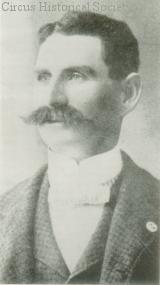
Rhoda Royal, photo taken on Ringling Bros. World's Greatest Shows, season 1898. Paul Luckey Collection.
The Rhoda Royal Circus of 1919-22 was one of several new circuses that cropped up in the immediate period following World War I. It was designed to take advantage of the good times and prosperity of the country caused by the accelerated war time economy and the amusement hungry populace which after a year and a half of war and its necessary restrictions on circuses and other amusements were now anxious to live it up again. Like others of its kind the Rhoda Royal Circus started off with a bang, made a pot full of money right away, enlarged, and was on its way to prosperity but was soon caught in the middle of the sharp 1921 recession which quickly whittled away the earlier profits and made the show a candidate for bankruptcy a few days after the start of the 1922 season.
The show was owned and operated by three well known and capable showmen, all well experienced in outdoor show business. They were Rhoda Royal, Darwin C. Hawn, and Harry "Kid" Hunt.
Although this article deals primarily with the Rhoda Royal show which was on the road the four seasons of 1919-22, a short background for each of the three owners is in order. It is sketchy of course as a volume could be written on each of the three colorful showmen, each of which wrote his name in his own particular way in the annals of American show history.
Rhoda Royal, for whom the show was named, was born in 1866 and entered circus business at an early age. His first circus experience was with the Adam Forepaugh Circus and he was in charge of the ring stock on that show as early as 1884. The late Walter L. Main once said that Royal started off with Forepaugh driving a team of small mules and soon acquired the nickname of "Muley." Royal was in charge of the ring stock, on Ringling Bros. in the 90's and joined the Walter L. Main Circus as boss hostler in mid season 1899. The Main show was sold following that season and did not tour in 1900. Royal and Joe Berris leased 8 or 9 cars from W. L. Main that had not been sold and the two took out a railroad circus for the 1900 season. Don Marcks' father reviewed the show at Pittsfield, Mass., Aug. 17, 1900 and his notes show that the circus had a train of 9 cars, which included 5 flats, 2 stocks, and 2 sleepers. Some 21 wagons of which 6 were cages loaded on the flats. Royal and Berris used the title of THE GREAT RHODA ROYAL AUSTRALIAN RAILROAD SHOWS. The official program for 1900 as listed in the Marcks collection was as follows:
1. Grand Tournament
2. Novelty Burlesque Clowns
3. The Petits - Aerial Bars
4. Clown song
5. Madame Royal and her tandem of Arabian Horses "Black Prince" and "Golden King."
6. Trick mules and donkey
7. M'lle Petit - Bounding wire
8. Prof. Joseph Berris' 63 trained horses - concluding with living pyramid.
9. Ladder act - Burlesque clowns.
10. The Eddys - Flying meteors.
11. Burlesque Clowns.
12. Posturing act.
13. Prof. Berris and his 6 educated ponies.
14. Prof. Roberts - the boneless wonder and Great Lizard act.
15. Bump - the cute riding pony and only one in existence - he made actually rides unaided upon
the backs of two larger horses.
16. M. & Madame Royal - High school menage act
17. Raymond & Albert Thompson, burlesque clowns riding mules.
18. The Petits - trick house.
19. The Six Marvelous Eddys - Premier acrobats.
20. Series of Hippodrome Races - Ladies & Gents, Monkey jockeys on ponies, clown riders on mules, liberty horses, man vs horse, and Capt. Sharpe and his detachment of Rough Riders.
W. L. Main stated that for the 1900 season Royal and Berris paid him $15,000 on the equipment and banked $9,000 for themselves, but that they made the mistake of trying to operate all winter in Florida in early 1901 and as a result lost their earnings and their equipment. Main repossessed the equipment.
Royal then worked with a variety of shows, including Walter L. Main who returned to the road after a years lay off and lasted through the 1904 season. Royal was primarily connected with the ring stock He was an excellent horseman and horse trainer and Main gives him credit for originating the wild west after show concert. Acquaintances who know and worked with Royal say he was a very likeable fellow, honest, trusting, and who often got the worst end of a bargain. He was a good looking man who wore a handlebar mustache, but he could scarcely read and write. Royal was a real lover of horses and in 1919-22 when he owned the show bearing his name he could be observed walking around with his spurs on. He often would drive the 8 horse team when there was no driver for it. He was always best known for his training and working with horses, and was often successful in circus ownership and promotional ventures, but like so many in the business he had his share of ups and downs. For several seasons about 1910 he promoted a big indoors circus that played sponsored dates. A 1910-11 folder for the Buffalo Bill Pawnee Bill Wild West Show lists Rhoda Royal and Ray Thompson as head of the list of menage riders. In the period 1912-16 he was on the Sells-Floto Circus. Royal also acquired a herd of elephants, having owned as many as nine different bulls. In 1918 he leased four elephants to the Coop & Lent Motorized Circus while Royal himself that season had other elephants on Polack Bros. World at Home Shows, one of the leading carnivals of that day. In 1919 when Royal, Hunt, and Hawn started the Rhoda Royal Show, Royal still had a "circus" show on the World at Home Carnival including two elephants, Carrie and Muggins.
Royal's wife, Carrie, was also an accomplished horsewoman and trainer and was his devoted partner and companion in all their circus experiences.
Darwin C. Hawn was born in 1875 and entered circus business in the early 90's with Sells Bros. His obituary in 1950 listed him as having served with Sells Bros., Forepaugh-Sells, Barnum & Bailey, Buffalo Bill, Walter L. Main, Col. Cummings Wild West, Campbell Bros., and J. H. Eschman. He served in a variety of jobs from general agent, superintendent, to manager. He was contracting agent for the J. H. Eschman Circus in 1915. People who knew him described him as a good old guy, one who started as a baggage stock hand and worked himself up into responsible positions. He had a very kind disposition behind a rough, "eat em alive" exterior. He used to wear a large black hat and a rather long black coat. In the early days he was known as "Slim" Hawn although in later days he grew very portly.
Kid Hunt, whose real name was Thaddeus Gerig, was a rather small man who had his start in the minstrel field. He was crippled somewhat during the war as a result of being ridden out of Dyersburg, Tenn. on a rail. It was during World War I and hands were short, and although Hunt had a license for his minstrel show to play the town, the citizens forbid the show, claiming it would draw their colored help's attention away from the work. Hunt sued for a large sum of money and eventually won $5,000. People later used to ask him if he remembered the time he had a five grand day at Dyersburg, Tenn. with a minstrel show. Hunt was an outstanding nut dealer in his day and used to spread his joint in front of the marquee with the minstrel show when it could be straightened out. He used to have a nice pony and cart and he led the parade with the Old Kentucky Minstrels, and Sugar Foot Greene From New Orleans Shows. At one time he also used the name of George W. Murray Famous Georgia Minstrels, a name he lifted off a tombstone in North Little Rock, Ark. cemetery. Hunt had operated minstrel shows for a number of seasons before teaming up with Royal and Hawn, and even while with the Rhoda Royal show, he continued to own a show titled A. G. Allen Minstrels, which was managed by A. G. Allen himself.
Royal, Hawn, and Hunt formed a partnership in early 1919 and proceeded to organize a gilly type railroad circus at Memphis, Tenn., which opened on May 19.
Very few details are available as to the exact size of the 1919 show and so far no photos of the show have been uncovered. That it was a gilly type rail show is certain and is believed to have started on 3 cars and later enlarged to 5 cars, and later on to 6. The May 29, 1920 Billboard carried a report that a representative had looked over the Rhoda Royal show at Corry, Pa., May 19 and noted that the show had grown almost overnight from a 3 car show to a 15 car show. The Sept, 11, 1920 Billboard quotes Sam Banks, local contractor, as stating that the Rhoda Royal show had grown in one year from a 6 car to a 15 car show. Notes in the Don Marcks collection state that the show at one time in 1919 traveled on 5 cars. Throughout the history of the Rhoda Royal show it displayed an amazing ability to adjust in size to varying conditions, by adding cars, or cutting cars, so as to meet the situation demanded.
Details are likewise lacking as to the exact car makeup of the 1919 train. Bill Woodcock who was on the show for a time in 1920 and to whom we are indebted for the detailed lineup of wagon and train equipment for 1920 says that he feels sure that a rather long coach with windows along the sides that had been converted into a stock car and had a door for end loading was carried in the 1919 train, and he suspects at least one of the sleepers used in 1920 was also there in 1919. Woodcock further says that he had been told once that the show used a gondola car in 1919 but that he did not believe it because regardless of how short rolling stock was at the time they surely could have done better than that and mentioned the frightful inconvenience of gillying stuff over the high sides of such a car. The show carried two elephants, Victor and Helen, which aided whatever baggage horses they had in pulling the gilly wagons back and forth to the lot. One report placed the number of stock on the show in 1919 at 30. A Billboard report in late season mentioned the show adding a car load of baggage stock. Woodcock mentions the show had a "dilly" of a cage wagon with one or more lions that first season, but that the cage was junked at quarters following the tour.
The title selected for the 1919 show was RHODA ROYAL HIPPODROME AND OLD BUFFALO WILD WEST. Staff included Dan France, general agent; Frank Irvine, supt., Fred H. Ashley, supt. privileges; W. C. Chapman, legal adjuster; Harry McGowen, bandmaster; James W. Butler, manager sideshow. Acts presented in the performance included A. Potter and Gertrude Russell, high school horses; John Hock and Irene Smith, high jumping horses; Augustus Gomery and Al Dareah, fancy and trick riding; Mrs. Rhoda Royal, trained elephants; Mlle Kinson, posing and statues; Silver Tip Baker and wife, Wild West department; Texas Joe and wife, fancy roper, whips, bronc riding etc.; Arizona Kid, sharpshooting and pick up; and a half dozen other wild west and Indian performers. The feature act later become the Stickney Family of riders who joined in mid-season. As noted the performance was strong on equestrian and wild west acts which was played up in the show's billing. A sideshow was also carried.
The size of the big top can be assumed to be in line with those carried on shows at similar size, about an 80 ft. round with three 30's or 40's. The May 10, 1919 Billboard which told of the show's opening mentioned that a feature of the circus would be a new war spectacle as the opening number of the program, and that negotiations were under way with the government for a French war tank to be used in advertising the circus when the show arrives in town.
The new circus opened with a May 19-25 stand of the Memphis Centennial Exposition, Memphis, Tenn. and then headed for the coal regions of Kentucky and West Virginia. Business from the start was good and the show was a big success and made a pot full of money that first season. Good acts and competent circus help went for a premium in 1919 and throughout the season the show was continually advertising in the Billboard for musicians, performers, side-show personnel, billposters, canvas and seat men, in fact any and all kinds of circus people.
The July 19, 1919 Billboard stated that Rhoda Royal had ordered new canvas from the U. S. Tent and Awning Co. and he described business as "superfine." The show remained in the mountains and coal fields until almost Sept. 1 and from all reports reaped a healthy harvest. The Aug. 18 Billboard stated that the Rhoda Royal Hippodrome Shows did an immense business at Morgantown, W. Va., and a reviewer highly commended the performance.
The Stickney Family of Riders, a top notch act, joined in late August after being stranded in Coshocton, Ohio when America's Combined Motorized Circus, also called the U. S. Motorized Circus, owned by Frank P. Spellman, folded after a few days tour.
The Sept. 13, 1919 Billboard reported the following activities under heading of Rhoda Royal Circus, "The weather man has been very good to the Rhoda Royal Circus as have also the railroads, and the show is moving along under the direct eye of Harry Sells, as superintendent, E. S. Monroe, as boss canvasman, and Smith as sideshow man, in rapid style. A car load of circus acts was added to the show recently when the famous Stickney Family of Riders and other circus acts of America's Combined Motorized Circus joined. Jack Walsh also came on recently as light man and under his direction the lighting effects are great. Rhoda Royal may be seen here there and everywhere. Walter L. Main was a visitor last week,"
After leaving the coal regions the show went south through the Carolinas, Georgia, and into Florida.
The Nov. 29, 1919 Billboard under heading of "Rhoda Royal Circus, Having Most Profitable Season - Will Play Five Weeks in Florida," reported as follows, "Jacksonville, Fla., Nov. 24, 1919 - Rhoda Royal, well known equestrian director and circus manager is here with several of his advance representatives making arrangement for the show's engagement here next week. Mr. Royal reports a wonderful season playing thru West Virginia, Tennessee, North and South Carolina, and Georgia, and states that business was exceptionally good in the cotton and tobacco districts of the Carolinas. The show which is a three ring outfit with two stages and a big hippodrome track has been making all one day stands and is now heading towards Florida where it will play about five more weeks prior to closing for the season. Mr. Royal states that he has recently enlarged the show by adding two new cars which he purchased lately together with a car load of fine dappled gray baggage horses. A new Delco light plant has recently been installed on the show train and plans are now under way for the enlargement of the show for next season when it will take to the road as a twenty car show with a novelty program that will surprize many of Mr. Royal's old friends. Rhoda Royal has closed contracts for several indoor events for the winter season all of them under Shrine auspices and all of them in big and prosperous cities in the Middle West."
Late in the year due to a nation wide coal shortage the show train ran into rail transportation difficulties and an embargo finally made the show abandon rail travel altogether. For several weeks the show then moved on Florida waterways on barges. For a time D. C. Hawn was ahead of the show and a man with him at the time later told how old Hawn used to sigh and groan and "Wonder" what sand bar they are stuck on tonight." Wagons loaded on three large barges to move the show.
The incomplete route for 1919 printed in this issue states that the show played Miami and then a stand Dec. 29-31 at Nassau. Just when the show finally closed is not definitely known, but it may have gone on for a week or so into January 1920. The Jan. 31, 1920 Billboard reported that the Rhoda Royal Circus was still moving around in Florida on water due to recent rail transportation difficulties. Following the close of the season the show went into winter quarters at the Valdosta, Ga. fairgrounds. The initial season had been a tremendous success and plans were made to enlarge to a 15 car, flat car type, circus for the 1920 season.
There is speculation that a change of title was contemplated for the 1920 season. An advertisement appearing in the Jan. 17, 1920 Billboard stated "Great Van Amburgh Circus and Oklahoma Bill's Wild West wants all kinds of acts, personnel, etc. Address Rhoda Royal, Jacksonville, Fla." However the title for 1920 remained essentially the same with one version reading RHODA ROYAL WORLD TOURED SHOWS AND OLD BUFFALO WILD WEST with other variations of the title used in various printed matter.
Rhoda Royal and his partners immediately set out to acquire new equipment for the enlargement and their first trip was to nearby Macon, Ga. where Sparks Circus was wintering. The Feb. 7, 1920 Billboard stated that Rhoda Royal had arrived in Macon and had purchased 4 cages from Charles Sparks. The Feb. 14, 1920 Billboard reported that D. C. Hawn and Rhoda Royal had purchased from W. P. Hall of Lancaster, Mo. two car loads of draft horses, some cat animals, 6 car loads of tableaus and cages, including Mr. Hall's famous bandwagon, and a 32 whistle steam calliope. Also the article mentioned that Rhoda Royal had purchased one car load of horses from Ringling-Barnum and a car load of tableau, and cages from Sparks Shows.
The train when finally assembled for the 1920 season had 15 cars, one in advance and 14 back, The train makeup included 1 advance, 3 stock cars, 7 flat cars, and 4 sleepers. The advance car had been with Roy Shelley's "Brown & Bowers Minstrels." One of the stock cars was a regular show stock car and carried baggage stock. A baggage car was used to carry ring stock, and the third stock car was an old coach, a long one that was loaded and unloaded through an end door. This car carried baggage stock, elephants, and lead stock. The elephants and lead stock went into the dead end and had to be loaded before the baggage stock and unloaded after they had been taken out. The seven flat cars included 5 regular show flats built by the Venice Transportation Co. and 2 system flats from a railroad. Four sleepers completed the train.
Bill Woodcock says as he recalls it, the train was painted orange or yellow, with maybe both colors appearing as the cars were not uniformly painted or lettered. He says the sleepers and the tunnel car both had letters above and below the windows using the Rhoda Royal World Toured and Old Buffalo Wild West name. Woodcock says that while he was on the show in 1920 that they had a one armed painter and he lettered the stock car, "Rhoda Royal 3 Ring Circus," but couldn't remember whether the ring stock was lettered or not. Photos of the flat cars show them to have been lettered.
Wagons were difficult to obtain and went for a premium in the period right after World War I with everybody rolling in money and new circuses starting out right and left. Most of the wagon equipment was obtained from W. P. Hall of Lancaster, Mo., with a tableau and several cages coming from Sparks. The show had only two real circus baggage wagons, the cookhouse wagon, and the stake and chain, both of which came from Hall. Seven U. S. army wagons were purchased from the government. These were open top affairs, similar to small prairie schooners. The gilly wagons from the 1919 show were used, but did not knock down, but were loaded on the flats instead. Two big log wagons with long reaches from front to back gear were also used for the pole and stringer wagons. No motor equipment nor water wagons were carried. When all of the equipment was assembled for the start of the 1920 season there were 30 pieces listed as follows:
PARADE WAGONS
1. Big, highly carved, band chariot wagon, from W. P. Hall. Was originally on the Barnum & Bailey show. This wagon had been renovated at Lancaster and the wheels had mirror sunbursts, which as Bill Woodcock says lasted for a while but it didn't take long to break the mirrors.
2. Great Wallace steam calliope purchased from W. P. Hall.
3. Sparks Dragon & Mirror Tableau, purchased from Sparks Circus. Was used for the chandelier wagon and seldom went in parade.
4. No. 45 Tableau, big, heavy wheeled wagon. Used by sideshow band in parade and carried padroom and trunks. It had big rectangular mirrors on sides and also had mirror sunbursts in the wheels. Was purchased from W. P. Hall and wagon originally was on Young Buffalo Wild West Show.
5. Clown Band Tableau. Had some carvings and was painted green and gold. Carried trunks and probably came from W. P. Hall.
6. Miniature Tableau. Carved and carried ring stock trappings. Pulled by small mules in parade. May have come from either Sparks or Hall.
7. Unafon Wagon. Built from old cage wagon and probably purchased from W. P. Hall. Sideshow odds and ends loaded in the wagon. It was pulled by two bulls in parade.
8. Ticket Wagon Tableau. Was a rebuild from an old Campbell Bros. tableau. Purchased from W. P. Hall. This was used to sell tickets from but actually the office was in the treasurer's stateroom on the train, as candy stands loaded in the wagon. The coach dancers rode parade on this one.
CAGES AND DENS
9. Cage Wagon, carried an elk. Probably from Sparks.
10. Cage Wagon, carried one male lion, probably from Sparks.
11. Cage Wagon, carried one female lion, probably from Sparks.
12. Old Sparks seal den, carried a black bear and two wolves, purchased from Sparks Circus.
13. Cage Wagon, containing emu, llama, and some trained dogs that belonged to old Bob Stickney. This is the one the elephant tandem pulled in parade.
14. Old Campbell Bros. Cage, carried one puma in front, with carpenter's tool box, etc. in rear. Purchased from W. P. Hall.
15. Untamable Lion Den. This one was big as is customary, with side show plunder loaded in it with lion shifted up into front end. The captain rode this one in parade, inside, as was the custom.
16. Small Cage, carried peccaries and Rhesus monkeys.
17. Small Cage, carried an ocelot.
BAGGAGE WAGONS
18. Cookhouse wagon, purchased from W. P. Hall.
19. Stake & Chain wagon, purchased from W. P. Hall.
7 ARMY WAGONS PUT TO USE AS FOLLOWS
20. Big top canvas wagon.
21. Sideshow canvas wagon.
22. Properties wagon.
23. Pit show and midway joints wagon.
24. Jack wagon.
25. Blue plank wagon.
26. Reserve planks, star backs, wagon.
2 IRON WHEELED GILLY WAGONS LOADED AS FOLLOWS
27. Doc Stern's pit show wagon.
28. Menagerie canvas wagon.
2 LOG WAGONS LOADED AS FOLLOWS
29. Pole wagon.
30. Stringer wagon.
The two circus baggage wagons were painted red, while the ex-army wagons were painted the army color, a dingy gray. There was scarcely any place to do any painting on the two gilly and the two log wagons and they were usually just decorated with mud.
The menagerie was adequate for a 15 car show. The untamable lion den went into the sideshow and the two small cages with the ocelot and peccaries and Rhesus monkeys were placed in the sideshow or in one of the pit shows. The other 6 cages went into the regular menagerie top. Bill Woodcock says that while he was on the show in 1920 the small cage carrying the ocelot was abandoned on the lot one day, but doesn't remember whether the animal had died, or was transferred to another cage. Most of the cage wagons were decorated with carvings and were equipped with sunburst wheels.
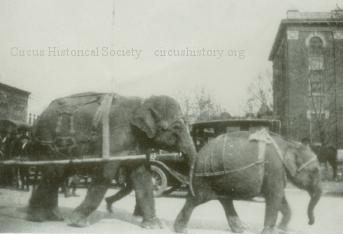
Carrie (in lead) and Muggins pulling a cage (not visible) in 1920 parade. W. H. Woodcock Collection.
Lead stock included four elephants, two young camels, a water buffalo, a zebu cow with a hybrid calf. All lead stock were normally housed in the menagerie top. The four elephants included Vic, Helen, Muggins, and Carrie, and all were personally owned by Rhoda Royal. All were rather young and small with Muggins the largest of the herd, In 1919 Muggins and Carrie had been on the World at Home Shows. Vic, a tusker and Helen worked as a team, and Muggins, a tuskless male, and Carrie, named for Mrs. Royal, pulled in tandem in the parade.
Rhoda Royal, as mentioned before, always had his programs heavy on equine acts and the show carried a goodly number of horses. Approximately 40 head of baggage stock and 20 to 30 head of ring stock were carried.
The three owners worked as a team. Royal was in charge of the performance, Hawn was business manager and assisted the advance, and Hunt supervised the side and pit shows and concessions. The staff for 1920 included, Dan France, general agent; George Morey, adv. agent; Charles Bernard, treasurer; and press agent; Sam J. Banks, special advance and local contractor; Bob Stickney, ring master; Jim A. Norman, bandmaster; Col. Pete Stanton, sideshow manager; Bert Carroll, supt.; Eddie Schaefer, boss hostler, and Harry R. Overton, manager of the advance car.
As was true of all shows in those days Rhoda Royal went in heavy for outdoor billing, using good stock paper from the Donaldson Lithographing Co. Colorful heralds from Erie Printing Co. were used and large and attractive newspaper cuts appeared in abundance.
The street parade was a daily feature of the show. The highly carved, canopied, chariot bandwagon, pulled by an 8 horse team lead the parade. The clown band rode a green and gold tableau and the sideshow band was atop No. 45 heavy wheeled mirror tableau which was formerly on the Young Buffalo Wild West Show. The unafon and the old Great Wallace Shows steam calliope completed the musical units. The old Sparks Circus dragon and mirror tableau, the ticket tableau wagon with the coach show dancers riding atop, and a miniature tableau wagon filled out the tableau section. The cages, lead stock, mounted people, and wild west departments completed the parade. The elephants did not march tailed up as is customary but were used to pull vehicles. Vic and Helen pulled the unafon wagon, while Muggins and Carrie tandemed the cage with the emu, llama, and dogs. Advertising banners, when sold, were tacked to the elephant's harness.
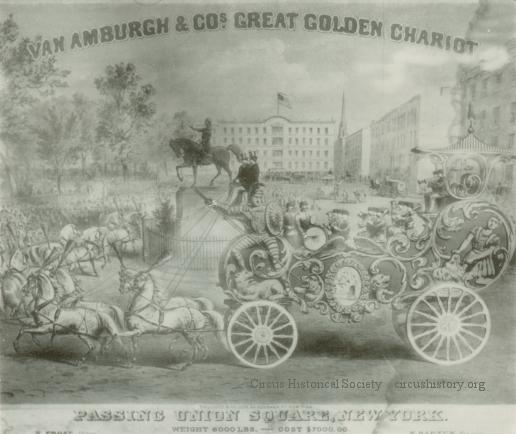
The show had a real gem in the big chariot bandwagon which was one of the most colorful and highly carved parade vehicles ever constructed. In 1920 it was probably the oldest parade vehicle on any circus, and as late as 1920 most chariot type wagons had been replaced on most shows by box type tableau wagons that were designed to carry a baggage load. This wagon is believed by many historians to have originated in 1866 on the Van Amburgh & Co's Menagerie and by careful study of the bandwagon shown in the Van Amburgh lithograph photo graciously furnished by Don Smith, esteemed founder of the Circus Historical Society, from a very rare original lithograph in his collection, it seems that it is one and the same as the one pictured in the 1920 Rhoda Royal parade shot. Dick Conover adds evidence that Van Amburgh had an actual wagon as pictured in the litho and that the illustration was not merely the figment of some artist's imagination that may in later years have served as the blueprint for the construction of a tableau wagon. Conover furnished a quote from the March 24, 1866 issue of the New York Clipper which read as follows:
"The Fielding Brothers, at the corner of Third Avenue and 41st Street, this city, have nearly completed a magnificent band chariot for Van Amburgh & Co's Menagerie, which is one of the finest affairs of this kind ever built in America. It is modeled much in the style of the ancient Roman triumphal chariots, and is almost entirely covered by elaborate carvings, richly gilded, relieved by several swell panels decorated with exquisitely executed paintings. Lions, tigers, lynxes, wolves, and other animals, figure among the ornamental carved work, and the effect of the whole when fully completed and put upon the road, behind a team of ten superb horses, will be brilliant and imposing in the extreme."
Conover also asserted that the Old Print Shop, a local expert on Union Square, N. Y. C. had fixed the date of the lithograph as before 1870. The wagon later got to the Barnum & Bailey show and appears in a photo dated 1891 taken in Peoria, Ill. along with the canopy bandwagon (Original 1871 Howes Great London), bell wagon, and organ wagon, in a Barnum & Bailey photo circulated several years ago by the late George Chindahl. The wagon also appears in a parade mount photo taken in Chester, England in 1899, the day Barnum & Bailey first paraded in Europe. It remained in Europe through 1902 with that show. Then its history becomes "lost" for a few years. By some route it came into the hands of William P. Hall of Lancaster, Mo., who considered it his prize of all the many bandwagons, tableaus, and calliopes that passed through his hands. It was always mentioned as “Mr HaIl's Bandwagon." Employees at Hall's farm referred to it as such and note the Billboard quote earlier mentioning the same reference to it. Bill Woodcock, the leading wagon historian in the country states that he assumed it always came to Hall through the Walter L. Main Circus which Hall purchased following the 1904 season, but admits this is only speculation. Woodcock further opines, "It is entirely possible that Hall bought this bandwagon directly from Barnum & Bailey. Hall sold them horses and had various trades with Ringling, Barnum, and Forepaugh-Sells for many years, From what I was able to learn in Lancaster several years after Hall's death, that the wagon was on Hall's own show in 1905, the Great William P. Hall Shows, and the attitude was that it was "Mr. Hall's Bandwagon," all very vague, and nothing definite. I never thought to pin Bert McLain down on it. Just took it for granted that it come to Lancaster with the W. L. Main stuff." Just what shows it went out on from the many that were equipped and sent out from the Hall Farm in the period 1905-19 is not known definitely. Woodcock says he once saw a photo of this wagon in a parade scene in a cafe in Baker, Mont. and that he suspected it was the Barton & Bailey Circus in 1915. Both Barton & Bailey in 1915 and Orton Bros. in 1916 were equipped with wagons from Hall and Orton is believed to have had a chariot type bandwagon but most of the speculation seems to be that it was the old Forepaugh lion chariot that was used. It is highly possible that due to Hall's affection for the wagon that it was not sent out until he sold it to Royal and his partners in early 1920.
The steam calliope with the huge dragon carving originated on the Great Wallace Shows about 1899. It was built by Sullivan & Eagle wagon works of Peru, Ind. Many fans have claimed it was their favorite steam calliope of all time. It was used on the Great Wallace Show from 1899 through the 1906 season, and in 1907 was sold to Campbell Bros. Great Consolidated Shows where it remained through the 1912 season. It went to W. P. Hall with the Campbell show in the fall of 1912, and is most likely to have been sent out in 1913 on Cole Bros. Circus which was sent out from the Hall farm using mainly Campbell Bros. equipment. Recent photographic evidence has come to light putting the calliope on the Barton & Bailey Circus of 1915. Another possibility is Orton Bros. Circus in 1916 but no positive evidence pro or con has come up on that.
The chandelier wagon that come from Sparks was a nice one with 3 mirrors and winged dragon carvings on the sides. This one probably originated on Sparks about 1913 and remained on that show until sold to Rhoda Royal.
The No. 45 tableau was said to have been on the Young Buffalo Wild West Show from 1910 through 1914 seasons until the equipment was sold to W. P. Hall. What shows it may have been sent out on until Royal purchased it is not known.
The unafon wagon was a short one built from an old cage. The bars were removed and a Deagon unafon instrument was mounted in the wagon. Small carvings were added to outline the center oval opening. Although all of the Royal equipment was highly decorated and very attractive, most of it was old and had rolled many a mile in past circus history. No photos have been turned up to give a detailed description of the ticket wagon, clown band tab, and miniature tab.
The canvas spread was in line with those usually found on a 15 car show in those days. Big top was about a 110 or 120 round with three 40's, the menagerie top about a 70 with three 20's, and the sideshow about a 60 with three 20's.
Bill Woodcock who was with the show for 6 or 7 weeks in the early part of the season says, "When I was with Rhoda Royal they had the big top, menagerie, sideshow, dressing room, Doc Stearnes pit show (Stearnes was a bewhiskered old character whom they used to point him out as Old Buffalo), and sometimes a second pit show. Seemed to have trouble getting somebody to handle the latter. When I joined the show there was no cookhouse top and no horse tops. Baggage horses went on outside picket lines, On Sunday nights they used to put the horses in the menagerie and the cages in the sideshow. Cookhouse tables were set up in the open except when raining, and they were put up in one end of the menagerie and blocked off with a curtain, an old coach or dramatic proscenium, doubtless. Before I left the show new cookhouse and horse tops had been added and after I left the Billboard has ample to say relative to new spread of canvas. The show was getting plenty of money and I feel sure they got a new spread of canvas but as for giving the exact sizes I am helpless. I remember somebody saying they visited the show late in the season and D. C. Hawn was reared back in a marquee big as the Barnum show, with nickle plated posts and chains."
The program was again heavy with various riding and equestrian acts and wild west and with an added wild west concert highly publicized. Acts included the famous Stickney Family of bareback riders; Arthur Burson, wire act; Royal Holland Bell Ringers; The Flying Kirks, flying act; Edward and Kitty Archer, rings and traps; Alton, wire walker; Fred Collier, menage act; Mrs. Rose Collier statue and trick horse; Bob Stickney, trained dogs; and Mrs. Rhoda Royal working the four elephants, ponies, dogs, monkeys. Wild West acts included Texas Joe, whip cracking; Arizona Kid, whip cracking; Alberta Jim, trick roper and bronc rider; Jim Shannon, pony express and pickups, and some half dozen other wild west performers.
Harry "Kid" Hunt, who was the general manager over the sideshow had a good lineup of attractions including the Swiss Family of bell ringers; Sword swallower, snakes, colored band minstrels, untamable lion act, contortionist, and a monkey circus.
The Rhoda Royal show as was true of so many in those days went in heavy for the grift. Col. Bill Woodcock describes the grift on the show as follows: "When I was on the show I saw five stores working at one time in the Rhoda Royal sideshow, nuts, broads, dropcase, pickout, and logs. This kid show featured a wild man blowoff, also on untamable lion, and had a very strong coach department. On the midway was always plenty of light joints, jingleboards, spindles, sheet-writers, and the like, plus George Bedonie, positive kind of all jam pitchmen at that period. There were always four or five connection men taking short in the alley between the menagerie and big top, some taking silver, some cutting up soft money." Of course at times the grift created quite a bit of heat but Woodcock once remarked that trouping with Campbell-Bailey-Hutchinson which was a square John troupe and carried no grift, through the mountains and coal fields of Kentucky and West Virginia was just as rough as trouping through the same territory about the same time with Rhoda Royal which had the grift. Trooping in that territory in those days was rough, period.
Within a very few weeks the new enlarged flat car Rhoda Royal show was ready to go, It opened rather early, March 6, at Valdosta, Ga. the winterquarters town, and after a swing through Florida, Alabama, and Mississippi, It headed back toward eastern Tennessee, and West Virginia and the mountains and coal regions which gave such good business on the previous season. Business was good almost from the start and throughout the season the show used the profits to make improvements. New seats were added, and the show was equipped with almost a complete set of new canvas. The May 22, 1920 Billboard mentioned that Rhode Royal had received two new stables at Massilon, Ohio on May 14 and that a new menagerie top was expected in a week and a new big top before the end of the month. A later note said the new big top gave plenty of space for 3 rings and track, the lack of which had been a great handicap to all performers previously. This would indicate the new top was considerably larger than the old one.
The June 19, 1920 Billboard said that new harness and tops were used at Cumberland, Md., and also said the show had received some new baggage wagons. The show rebuilt and replaced several wagons before the end of the season.
For most of the season the show advertised in the Billboard for various acts and help of all kinds. The June 26, 1920 Billboard stated that Cook Bros. Circus, a wagon show, had closed in Mahaffey, Pa. and that personnel had gone to join Rhoda Royal and the Walter L. Main Circus. The Aug. 21, 1920 Billboard had the following shows advertising for help, Sells-Floto, Cole Bros., Sparks, Christy Bros., Howes Great London, and Yankee Robinson, as well as Rhoda Royal.
A rather detailed account was printed in the July 3, 1920 Billboard about Rhoda Royal following the custom of memorial services for victims of the W. L. Main wreck in Tyrone, Pa. plus other items of interest as follows, "Rhoda Royal Circus, Shows Ten States In Fifteen Weeks - Movement Started For Fund to Erect Monument For Main Show Wreck Victims" "To those in doubt about the size business and popularity of the Rhoda Royal Circus it may be interesting to read data taken daily by a tourist, who left winter quarters with the show at Valdosta, Ga. March 6 and has enjoyed seeing uniformly good business thru fifteen weeks of all varieties of weather in ten states between the Gulf and Lake Erie. Regardless of almost daily rain for over six weeks not a single advertised stand has been lost. Only one matinee, one night show and parade three times constitute the breaks in the daily routine of two performances and a forenoon parade. Salary day regularity is another of the pleasing special features of the Royal organization.
"Pensacola, Fla., Mobile, Ala., Cullman, Ala., Kingsport, Tenn., Lock Haven, Pa., and Bellefonte, Pa., were seemingly determined to furnish the banner days business of the 1920 season but Cumberland, Md. has topped the list of big ones with business.
"At Tyrone, Pa., on June 1st after the matinee, members of the business staff, performers, workingmen, many citizens of Tyrone, including the Mayor, Chief of Police, and Capt. G. Snyder of the Salvation Army, were taken in automobiles led by J. A. Norman's Big Show band to the Tyrone Cemetery where memorial exercises were held at the graves of the Walter L. Main Show wreck victims, who lost their lives in that disastrous wreck near Tyrone in May 1893. The graves were covered with beautiful flowers, donated and sent by Supt. Johnson of the Tyrone division of the Pennsylvania Railroad and a specially prepared vase of flowers from the home of Mayor Beson. Capt. Snyder offered a touching prayer, read a clause from the fourth chapter of Revelation and concluded with a touching talk on the noble spirit and notable work of showfolks at all times and places where charity and assistance for a worthy cause is called for and concluded the talk with a special blessing on the showfolks present for their evidence of true friendship to members of their profession in visiting the graves of their long departed showmen. A very impressive talk was made by the Hon. Mayor in which he called special attention to the fact that not a single circus, carnival, or outdoor show visiting Tyrone since the Main wreck had failed to show its respect at the graves of the wreck victims, which he said had so impressed the citizens of Tyrone that in recent years the coming of a circus was looked forward to as a Memorial Day for, which preparations were made in advance to aid the show folk in their memorial exercises. In the mayor's talk he also called attention to the fact that the graves of the dead showmen were, to some extent, neglected by the cemetery keeper and employees because no one ever directed or paid for care, as is the case with other graves in the cemetery. He suggested a little donation by those interested for the annual payment of a small fee to the keeper and to a fund for purchase of a suitable stone to mark the graves permanently. Following the Mayor's suggestion, Charles Bernard, treasurer of the Royal circus who was during the 90's agent and treasurer of the Main circus for a number of years, briefly told of his connection with the Main show and his interest in keeping the memory green of the unfortunate victims of the wreck and said he would head the list with a substantial donation for the purpose suggested by the Mayor and that the Mayor be made custodian of the fund and act as local representative for the showmen. Rube Dalroy in a touching short talk offered his aid to the movement and Manager D. C. Hawn who was also many years with the Main show gave his full endorsement of the worthy cause and asked all members of the profession to show their interest by a small mite for the fund sent direct to the Hon. Mayor of Tyrone, Pa.
"A later conference between Mayor Beson and Treas. Chas. Bernard perfected arrangements by which donations sent will be deposited in Tyrone Bank until used for a stone to mark the graves and for care of graves by the cemetery keeper" - Tourist.
The show continued playing Pennsylvania, West Virginia, and Kentucky through July, and then began the Southern tour Aug. 2 at Ashville, N. C.
The Aug. 21, 1920 Billboard made more mention of the Royal show under heading, "Conroy Visits Royal Show," "Edward L. Conroy in advance of the Royal show has been back on the show for a visit of a few days and writes that the circus is meeting with wonderful success all along the route. "When the natives see the big train of double length cars roll in they immediately expect something big and good in store for them," he says. "Then when they get to the lot and see the big six pole main tent all new, spic and span, and the many other tents it isn't long until the crowds go into the big show. Such was the case at Barbourville, Ky., and especially at Manchester, Ky., and in spite of the hilly condition of the town very little trouble was encountered in erecting the layout of the circus. The show arrived at Barbourville at an early hour. The little town which is the county seat was bristling with country people and mountaineers quite early in the day and far over the hills on all roads leading to the town one could see the people coming in on horse and mule back. The only wagons known to this section are road wagons or lumber wagons and they came loaded with men women, and children. The lot was well filled with people and by the time for the matinees the lot was jammed and crowded and the business for the afternoon show was capacity. Everyone expressed approval of the performance and over three-fourths of the audience remained for the Wild West Concert, which is really a big show in itself. The show moves with remarkable swiftness and is manned by a corps of expert department heads ably managed by General Manager D. C. Hawn. One of the outstanding features is the Rhoda Royal troupe of performing elephants. The sideshow is under the direct supervision of Kid Hunt and this gentleman has spared no expense in putting together a corking good show including Swiss family of bell ringers, five people, a sword swallower, an exhibition of snakes, a complete colored minstrel and band, untamable lion, contortionists, and a miniature monkey circus.
"Manager Hawn's automobile attracted considerable attention in Manchester for strange as it may seem an automobile in this section is a real curiosity. The show was down and loaded in good time and ready for the trip to Pineville. At Heidrick the show train was held up about three hours by a freight wreck but in spite of this managed to get into Pineville in time to give a parade. General Agent Dan France came on the show for a brief stay at Pineville and then left for his summer place near New York."
Further news of the show appeared in the Sept. 11, 1920 Billboard under heading "Sam J. Banks Back on Rhoda Royal Show For Second Time This Season." "For the first time since early in March at Mobile, Alabama, has Sam J. Banks, local contractor, been back on the Rhoda Royal show and that occurred recently at Columbia, S. C. Quoting Mr. Banks, "I jumped from Atlanta, Ga. to Columbia, S. C. on business arriving in the latter city a half day ahead of the show. Being there, I lost no time in "doing" the newspapers the night before the show's arrival and on the morning and afternoon of show day. Besides the circus story with cut carried by the Columbia Evening Record I handed them an "elephant" story written from a purely local viewpoint and they ran it at the top of the last page. (The story concerned a negro, who had used the elephant's hay for a bed, being thrown thirty feet by the pachyderm).
"Columbia under fair skies gave the show a good days business. The people were lined up on the main street of the town as though they were anticipating the Ringling-Barnum show. I found everyone with the show well and happy. Already the Rhoda Royal troupers have had a season, the opening date having been March sixth but they are looking forward to several weeks more before the band shall have played Home Sweet Home."
Money was still flowing in the South as tobacco and cotton crops were good, and the show played a lengthy season in the Carolinas, Georgia, Alabama, Mississippi, Louisiana, and entered Florida Nov. 8 at Quincy. At the previous stand at Abbeville, Ala. the show was cut to 10 cars for the smaller towns in Florida and the other 5 cars were sent on to Montgomery, Ala. where the show had arranged for winterquarters. A few weeks later the show ran into rail transportation difficulties. The Dec. 11, 1920 Billboard reported as follows, "Rhoda Royal Circus Held Up By Florida Railroad” “Refused Freight Traffic Service by Florida East Coast Co. According to Dan France Who Files Complaint With State Railway Commission - Will close December 18." "On account of the Florida East Coast Railway Co., without notice, attempting to enforce a discriminating and prohibitive increased traffic on circus movements thru its passenger department refusing the Rhoda Royal Circus freight traffic service, Dan France, general agent of the show has filed a complaint with the State Railway Commission according to a telegram received by the Billboard from him, Sunday, December 5th. The hearing occurs at Jacksonville, Fla. in the Board of Trade Rooms, Wed., Dec. 8 at 10 a.m. The railway company jumped the ten car minimum rate from $269 to $499 Mr. France further states."
On December 18 at Perry, Fla. the show was cut to 2 cars, with the 8 additional cars being sent to Montgomery quarters. The name of the two car show was changed to GREAT BARRETT SHOWS & OKLAHOMA BILL'S WILD WEST and small Florida towns were played with the abbreviated show. The final stand was Dec. 31 at Apopka which officially closed the 1920 season and from there the show departed to Montgomery. Extremely cold weather was given as the reason for the close. The 1920 season had been a big winner as it was for most circuses on the road that year.
Winter quarters were obtained in Montgomery at Vandivere Park, which was the site of old Camp Sheridan, a World War I training camp. The quarters were adequate and offered all desired facilities.
The show did quite a bit of construction and repair work during the winter. Some time from early 1920 until the show closed in 1922 the log wagons were replaced by regular circus wagons and other regular circus baggage wagons were added. The army wagons were also rebuilt to more nearly resemble traditional show wagons. Bill Woodcock says when he saw the Rhoda Royal equipment stored in Montgomery after the show had closed for good that he noted some baggage wagons not on the show when he was there, and also noted a small chariot type bandwagon said to have originally been on the old Teets Bros. Show.
The April 9, 1921 Billboard reported that some of the handsomest cages and wagons ever seen are those constructed by the Rhoda Royal show at Vandivere Park quarters. The article also stated that the train had been newly painted burnt orange and trimmed in green.
The show during its existence used a variety of titles incorporating the Rhoda Royal name. In 1921 it was RHODA ROYAL ENORMOUS UNITED 3 RING CIRCUS COMBINED WITH OLD BUFFALO WILD WEST. Staffers for 1921 included P. N. Branson, treasurer; Mell Hamlin, secretary; Dan France, general agent; Dave McCoy, gen. supt.; Fred Collier, equestrian director; Wm. C. Warner, supt. canvas: Chas. Herman, trainmaster; Charles Rodiner, boss hostler; Doc Stearnes, in charge of pit shows. The 1921 program included many hold-overs and the feature acts were, the Stickney Family of riders, Claude LaPearl, trapeeze act; Luiger brothers, acrobats, Phil King, stilt walker and producing clown, The Parents, acrobatic act and contortion; Carson and Campbell, rifle shots; the Aftons, acrobats; W. D. & Therse Swigrist, iron jaw act; and Liniger brothers, clowns. Trained dogs, monkeys, horses, and elephants rounded out the program.
The sideshow included Prof. W. Ford's minstrel band, sword swallower, magic, mind reading, untamable lion act, strong woman, and cooch dancers.
The 1921 season opened at Montgomery, Ala. on April 6 under auspices of the Anti-Tuberculosis League and good business was experienced. The show headed north quickly through Alabama, Georgia, and Tennessee. The two big days were experienced at Knoxville, but business in general was off. The show headed straight into Ohio and a hot bed of circuses.
The May 7, 1921 Billboard reported that there were four circuses in Ohio, Hagenbeck-Wallace, John Robinson, Ringling-Barnum, and Rhoda Royal. Due to very heavy opposition Royal cancelled Canton. The show also ran into three weeks of bad weather in Ohio and the big top suffered a near blowdown in a storm of Warren and only quick work by all personnel saved it from disaster. The show got good business at Sandusky, but other stands were way off. The entire circus industry was suffering from the sharp depression that struck in the Spring of 1921 bringing to an end the lush business boom that had followed the war. The May 14, 1921 Billboard printed a map from Nations Business which showed only poor and fair business areas throughout the entire country with no areas listed as good.
Hoping to get into better areas the show was routed into "new" territory in Michigan, Wisconsin, and Minnesota. All shows seem to congregate in one place each trying to pry open some good towns and as a result many shows were viciously fighting for each and every good stand, To give an example of the type of show business competition in those days the July 23, 1921 Billboard reported that Sheboygan, Wis. had in Lindeman Bros. Motorized Shows first, then came Rhoda Royal Circus, Freed's Exposition Shows, Terry's Uncle Tom's Cabin Co., Al G. Barnes Circus on July 18, and Sells-Floto on July 27, with two carnivals scheduled for the fall. Business took an upturn in Minnesota in late July and the July 30, 1921 Billboard stated that Rhoda Royal played Austin, Minn. to two packed houses with the program going over big. The reviewer praised the many fine horse acts, the riding of Emma Stickney, and the acrobatic work of the Liniger brothers, who were the features of the performance. The show's press and promotional departments worked overtime thinking up gimmics to draw a crowd and the Aug. 13, 1921 Billboard stated that Rhoda Royal at Beaver Dam, Wis. resorted to doing Dode Fisk's old trick of giving away a real live bovine or milch cow at every afternoon show, but Press Agent Herbert Moody admitted it wasn't done all the time but the stunt was pulled several times.
In late August the show headed down through Illinois and Indiana and back into Kentucky trying to pick up some money that was so plentiful there the past two seasons. From then on news of the show's activities are missing from the pages of the trade publications, and that is almost always an indication even to this day that things are not going well. However the show made a full route, in fact a long route and played extensively in the south with many stands in Arkansas and Louisiana. A seven day stand in New Orleans under auspices at the Loyal Order of Moose from Dec. 19-25 wound up the season which had seen the show in 19 states traveling 17,000 miles. Quarters were established at the Foundation Ship Yards in New Orleans, The Howes Great London Circus, owned by Jerry Mugivan and Bert Bowers, had gone into quarters at Vandevire Park in Montgomery.
The show's performance had been somewhat curtailed in the latter part of the season and Royal had sent two elephants, Vic and Helen, with Don Darragh to play theater dates. Both of these elephants died on the theater tour in the early Spring of 1922 and tradition has it that Darragh let them freeze to death.
The Jan. 7, 1922 Billboard reported that a petition for an injunction to prevent Rhoda Royal Circus from leaving the state until tax of $510 is collected was filed by the City of New Orleans in Civil District Court. The petition stated that a 1920 act assesses a circus employing more than 100 persons a tax of $600 and that Royal paid only $90. The matter was squared and the show was allowed to leave at the beginning of the 1922 season.
The elephant, Carrie, was sent out for a time during the winter and spring with Sternard's Midget troup and is doubtful that she returned by time the show opened. There is a good chance that Royal had only one elephant, Muggins, on the show at start of the 1922 season. Shortly after the show closed and went to Montgomery quarters Carrie was sold to Andrew Downie, owner of the Walter L. Main Circus.
As the show was in financial difficulty it is doubtful that much renovating of equipment was done during the 1921-22 winter. However, a good and experienced staff was on hand to start the new season. Staffers included P. N. Branson, treasurer; Dan France, general agent; Fred J. Collier, equestrian director; Bush Ainsworth, band leader; Fred L. Shaffer, lot supt.; Charles Herman, trainmaster; and C. J. McCarthy, legal adjuster.
The 1922 Program was as follows:
1. Tournament.
2. Rose Collier and Emma Hitt, statue horses.
3. Clown number.
4. Garland Entry, 16 riders.
5. Mrs. Royal and Al Darragh, trained elephants.
6. Lorden Sisters, iron law.
7. Capt. Harry Hall, trained lions.
8. Revolving tables, clowns.
9. Fred Collier and Mrs, Royal, 8 trick horses.
10. Tom Hitt, Australian whipcracking.
11. Three Harolds, comedy acrobats.
12. Mrs. Royal and the Fred Colliers, trained dogs, pony, and bear.
13. Clown number.
14. De Leion Troupe, contortionists.
15. Roy Smother and Tom Hitt, high jumping horses.
16. Clown number.
17. Menage act, 9 horses
18. Lorden Sisters, swinging ladders.
19. Feister and Ross and Nickleson and Wright, comedy revolving ladders.
20. Mule acts.
21. Indian Bareback Act
22. Hippodrome Races
The sideshow presented a very strong program with mind reader, bag puncher, tattooed man, snakes, sword swallower, punch and Judy, fire eater, magic, and roller skating bears, plus a minstrel show of 6 people and the Turkish Theater with 8 cooch dancers.
The 1922 season opened Wednesday, March 15 at Biloxi, Miss. and following a swing across Southern Alabama went into Florida for 8 stands. Two Georgia stands followed then three in Alabama, and April 7 at Troy, Ala. the show suddenly closed, cancelling a week already billed in Georgia and Alabama, and went into Vandevire Park quarters in Montgomery which were being vacated by Mugivan and Bowers' circus, now called Gollmar Bros. instead of Howes Great London Circus.
The Rhoda Royal Circus was finished. Little of the proceedings that took place were reported in the trade publications. A note in the April 15, 1922 Billboard stated that general agent, Dan France, was now at liberty on account of Rhoda Royal dissolving business as a 15 car show. Efforts were made to throw the show into bankruptcy by creditors and the May 6, 1922 Billboard reported the proceedings as follows, "Rhoda Royal Case Dismissed." "Montgomery, Ala., April 27, "The case of the Rhoda Royal Shows alleged bankruptcy was dismissed by Judge Henry D. Clayton on the ground of lack of territorial jurisdiction in the case. The property of the shows was turned over to its owners by the receiver Mr. Hugh Stewart in pursuance to the order. The case was dismissed after it had been shown that the alleged bankrupts Rhoda Royal, Harry Hunt, and D. C. Hawn, owners of the Rhoda Royal shows had not had their place of business in the middle district of Alabama required by law for the time. The report submitted to Judge Clayton by M. S. Carmichael, special master in the case stated that the show has no home but moves from place to place. The petition seeking to have the Rhoda Royal shows adjudged bankrupt was filed by J. S. Muckle and fifteen others." The May 13, 1922 Billboard reported that William Cunningham passed thru Cincinnati on May 6 en route from Montgomery, Ala. to Pittsburgh, Pa. in charge of Carrie, an elephant which Gov. Downie purchased from the Rhode Royal Shows for the Walter L. Main Circus, and mentioned that the pachyderm was with Sternards Midgets in vaudeville last winter.
Details as to the dissolution of the Rhoda Royal show are sadly lacking. However, Kid Hunt soon got his minstrel show on the road again and D. C. Hawn went with it. For some time after the Royal show folded Hunt advertised several railroad cars for sale, which no doubt represented some of his equity in the show. Evidently the minstrel show did all right as the Jan. 13, 1923 Billboard reported that D. C. Hawn and Harry "Kid" Hunt were cleaning up with their minstrel show and that they planned to launch a five car circus next season, however these plans did not materialize. For the minstrel show they used the title of Old Kentucky Minstrels and although Hawn was with it for some time he didn't have a quarter invested in it. This show went on for some years. Bill Woodcock says that when he caught up with the show in Hot Springs in 1929 the title above the car windows was George W. Murrey Famous Minstrels, and below the windows in big letters was Sugar Foot Greene From New Orleans. Woodcock says that this was a fine car and by that time Hunt also had several trucks going overland as was done with the big Silas Green Show. Trucks included an air calliope and the show had a fine outfit of canvas. Hunt later pastured his old team of work horses to end their days in peace. Hunt gradually faded from the American show scene and although no one can seem to recall having seen his obituary in the trade publications it is assumed he has been dead for some years now.
D. C. Hawn later got back into circus business doing a variety of jobs on various shows. He served as general agent for Gollmar Bros. Circus in 1925 which was owned by Chester Monaghan, and in 1928 was connected with the motorized Schell Bros. Circus. In 1935 he went with Jess Adkins and Zack Terrell's new Cole Bros. Circus and served as a watchman for several years. He died at the age of 75 on Dec. 9, 1950 in Chicago of injuries received in a fall at his home. He was buried at Showmen's Rest in Chicago.
With the departure of Hunt and Hawn from Montgomery in 1922, Rhoda Royal got together a small gilly type railroad circus on two cars and put it on the road to complete the 1922 season. Oscar Wiley, Royal's agent, begged him to put the show on farm wagons and mud show it and make some money, but Royal insisted on the rail show. In August the show was reported in Ohio. The show ran into opposition with Floyd and Howard King's gilly Circus with the Kings getting the best of the deal by beating Royal into many of the good branch line towns. With the close of Royal's two car show that season it marked the end of his career as a circus owner. The March 24, 1923 Billboard reported that Rhoda Royal was planning on putting out a one ring circus to play week stands under canvas but nothing came of this. Muggins, the last elephant Royal owned, was sent out on the Bob Morton Circus, a canvas week-stand auspices circus that operated in the mid 20's. Muggins died with that show as a result of traveling in a drafty baggage car with doors wide open sometime about 1926.
The disposition of the rest of the 15 car show equipment, especially the baggage and tableau wagons has long been a mystery to this reporter. The Venice Transportation Co. is believed to have taken back the flat cars, and of course the rest of the cars can be accounted for by those going into the two car circus and those taken by Hunt. Very few details of the disposition of the wagons can be found. The Feb. 10, 1923 Billboard mentions that the Frank West Shows, a railroad carnival, had recently purchased new animals, including lions, tigers, and bears from Rhoda Royal, and the article went on to talk about the big new street parade the West Shows would feature in 1923 and gave indication that the cage wagons must surely have been sold along with the animals. It is also a possibility that some parade wagons were also involved in the deal but nothing definite.
Bill Woodcock says he saw some of the Rhoda Royal wagons still in the barn in Montgomery in 1923 but could shed no light on their eventual disposition. He reminded that the bandwagon, calliope, tableaus and other wagons were old, having turned many a mile, and could not have been in very good condition. There is a good chance they were just junked and destroyed in Montgomery. There is always the possibility that some carnival may have picked up the steam calliope but careful perusal of the Billboard files fail to shed any light on it.
CHS member, F. C. Fisher, now a veteran circus man himself, says that he was a pony boy and drove ponies in the parade of the Rhoda Royal Circus and that he came to know Mr. and Mrs. Royal quite well in later life and that he liked them both very much. Fisher, like others, is unable to shed much light on the disposition of the equipment but he says that sometime after the Royal show closed that a man in Jeffersonville, Ind. who operated small ice cream wagons on the streets drawn by ponies, once advertised some railroad show property for sale and that this property was said to have once belonged to Rhoda Royal but no further details are known. Mr. Fisher says that Royal salvaged a few head of stock from his circus and in the 20's he served on several shows, and in 1928 was on a couple of carnivals, Roscoe Wades and J. Harry Six Shows. Later Royal was on the Paul Lewis Promotional Circus. Mr. Fisher mentions that Royal and his wife were often the victims of short payoffs on various fly by night outfits. When Royal joined the Lewis show he had only one horse left, Carrie, named after Mrs. Royal, and Fisher says he was sent by Mr. Lewis to Peru, Ind. to get the horse and bring it to his place.
Royal was active on through the 1930's and up until the year before he died. Many fans remember when Rhoda Royal was equestrian director of the big Tom Mix Circus in 1936 when the motorized show made a coast to coast tour that year and the big garland entry and spec that Royal directed on the show.
Rhoda Royal died at the age of 74 on July 22, 1940 in Alexian Bros. Hospital in Chicago. He was buried in Showmen's Rest in Chicago, to be followed by his old partner, D. C. Hawn, at the ssme place ten years later.
The elephant, Carrie, went by way of the Walter L. Main Circus, to the 101 Ranch Wild West Show, and then to Cole Bros. in 1935. She was active as a member of the big King Bros.-Cole Bros. herd in the mid 50's. At last report she was still living of the Miller's Animal Farm in Pigeon Forge, Tenn.
So far as is known by this reporter no wagons or other show equipment of the Royal show are in existence, and unless sometime in the future an old Royal wagon or cage turns up in a dusty barn someplace, and such things do happen ever so often, we can assume the Rhoda Royal Circus is another one of the many that has completely passed from the American Circus scene.
For valuable assistance in preparing this article I would like to thank most sincerely Col. W. H. Woodcock, Don Smith, Fred Pfening, Dick Conover, Homer Walton, F. C. Fisher, Leonard Farley of the San Antonio Public Library, Hertzberg Circus Collection, C. P. Fox, Dr. H. Chester Hoyt, Paul Luckey, and Don Marcks.
Rhoda Royal Hippodrome & Old Buffalo Wild West 1919 - Incomplete
|
May 19-25 - Memphis, Tenn.
May 26 - Bells, Tenn. May 27 - Bowling Green, Ky. May 28 - Bolivar, Tenn. May 29-30 - Bradford, Tenn. May 31 - Milan, Tenn. June 1-2 - Big Sandy, Tenn. June 3 - Erin, Tenn. June 4 - Elkton, Ky. June 5 - Springfield, Tenn. June 6 - Hartsville, Tenn. June 7 - Scottsville, Ky. June 11 - Glasgow, Ky. June 12 - Horse Cave, Ky June 13 - Lebanon Junction, Ky. June 14 - New Haven, Ky. June 15 - Greensburg, Ky. June 16 - Mount Vernon, Ky. June 17 - Campbellsville, Ky. June 18 - London, Ky. June 19-20 - Barboursville, Ky. June 19 - Williamsburg, Ky. June 20 - Pineville, Ky. June 21 - Ewing, Tenn. June 23 - Middlesboro, Ky June 23 - Big Stone Gap, Va. June 24 - Cluckport, Ky. June 25 - Appalachie, Ky. June 26 - Norton, Ky. June 27-28 - Cochran, Ky. June 27-28 - St. Paul, Ky. June 30 - Elkhorn City, Ky. July 1 - Pikeville, Ky. July 2 - Prestonburg, Ky July 3 - Paintsville, Ky. July 3 - Peach Orchard, Ky. July 3 - Charleston, W. Va. July 4 - Louisa, Ky. July 4 - Cattlettsburg, Ky July 5 - Barboursville, W. Va. July 7 - Logan, W, Va. July 8 - St. Albans, W. Va. July 9 - Montgomery, W. Va July 10 - Quinnmont, W. Va July 11 - Alderson, W. Va. July 12 - Ronceverte, W. Va. July 14 - Marlington, W. Va, July 15-16 - Cass, W. Va. July 17 - Dubin, W. Va. July 18 - Beverly, W. Va. July 19 - Huttonville, W. Va. July 21 - Belington, W. Va. July 22 - Phillipi, W. Va. July 23 - Buckhannon, W. Va. July 24 - Burusville, W. Va. July 25 - Gassoway, W. Vo. July 25 - Adrian, W. Va. July 25 - Walkersville, W. Va. July 26 - Webster Springs, W. Va, July 27 - Sutton, W. Va. July 28 - Western, W. Va. July 31 - Rowlesburg, W. Va. |
Aug. 1 - Kingwood, W. Va.
Aug. 2 - Morgantown, W. Va. Aug. 4 - Mannington, W. Va. Aug. 5 - Littleton, W. Va. Aug. 6 - Cameron W. Va. Aug. 7 - New Martinsville: W. Va. Aug. 8 - Pine Grove, W. Va Aug. 9 - Smithfield, W. Va, Aug. 11 - Salem, W. Va. Aug. 14 - Ravenswood, W, Va, Aug. 15 - Spencer, W. Va. Aug. 16 - Point Pleasant, W. Va, Aug. 18 - Wayne, W. Va . Aug. 20 - Williamson, W. Va. Aug. 21 - Isegar, W. Va. Aug. 22 - Gary, W. Va, Aug. 23 - Northfork, W. Va. Aug. 25 - Maebury, W. Va, Aug. 26 - Pocahontas, W. Va, Aug. 27 - Pearisburg, W. Va. Aug. 27 - Clarksburg, W. Va Aug. 27 - Rocky Mount, Va Aug. 28 - East Radford, Va. Aug. 28 - Martinsville, Va. Aug. 29 - Blackburg, Va. Aug. 29 - Madison, N. C. Aug. 30 - Salem, Va. Aug. 30 - Walnut Cove, N. C. Sept. 1 - North Wilkesboro, N. C. Sept. 2 - Elkin, N. C. Sept. 3 - Raleigh, N. C. Sept. 4 - Mount-Salem, N. C. Sept. 5 - Winston-Salem, N. C Sept. 6 - Kernersville, N. C. Sept. 6 - Greensboro, N. C. Sept. 6 - Raleigh, N. C. Sept. 18 - Louisburg, N. C Sept. 19 - Warrenton, N. C. Sept 20 - Roanoke Rapids, N. C. Sept. 22 - Scotland Neck, N. C. Sept. 23 - Scarsboro, N. C. Sept. 25 - Plymouth, N. C. Sept. 26 - Hertford, N. C. Sept. 27 - Elizabeth City, N. C. Sept. 29 - Edenton, N. C. Sept. 30 - Columbia, N. C. Sept. 30 - Macon, Ga. Sept. 30 - Maysville, N. C. Oct. 16 - Monroe, N, C. Oct. 17 - Mooresville, N. C. Oct. 18 - Mocksville, N. C. Oct. 20 - Taylorsville, N. C. Oct. 30 - Lancaster, S. C. Nov. 1 - St. Matthew, S. C. Nov. 3 - Branchville, S. C. Nov. 4 - Bramburg, S. C. Nov. 6 - Batesburg, S. C. Nov. 7 - Saluda, S. C. Nov, 8 - Edgefield, S. C. Nov. 10 - Thomson, Ga. Nov. 26 - Palatha, Fla Nov. 27 - DeLand, Fla. Nov. 28 - Sanford, Fla. Nov. 29 - Dec. 1 - Plant City, Fla. SEASON CLOSED Dec. 24-27 - Miami, Fla. Dec. 29-31 - Nassau |
Rhoda Royal and Old Buffalo Wild West Official Route - 1920
Hippodrome Shows - Railroad Show
Season (1920) opened at Valdosta, Georgia, Saturday, March 6th (Home Opening.)
|
Mar. 6 - Valdosta, Ga.
Mar. 8 - Quitman, Ga. Mar. 9 - Monticello, Fla. Mar. 10 - Camilla, Ga. Mar. 11 - Cairo, Ga. Mar. 12 - Hosford, Fla. Mar. 13 - Apalachicola, Fla Mar. 15 - Marianna, Fla. (Haag Show Winterquarters) Mar. 16 - Chipley, Fla. Mar. 17 - DeFuniak Springs, Fla. Mar. 18 - Milton, Fla. Mar. 19 - Pensacola, Fla. Mar. 20 - Atmore, Ala. Mar. 22 - Mobile, Ala. Mar. 23 - Pascagoula, Miss. Mar. 24 - Biloxi, Miss. Mar. 25 - Gulfport, Miss. Mar. 26 - Wiggins, Miss. Mar. 27 - Columbia, Miss. Mar. 29 - Lumberton, Miss. Mar. 30 - Poplarville, Miss. Mar. 31 - Hattiesburg, Miss. Apr. 1 - Meridian, Miss. Apr. 2 - Eutaw, Ala. Apr. 3 - Tuscaloosa, Ala. Apr. 5 - Bessemer, Ala. Apr. 6 Ensley, Ala. Apr. 7 - Cullman, Ala. Apr. 8 - Decatur, Ala. Apr. 9 - Huntsville, Ala. Apr. 10 - Tullahoma, Tenn. Apr. 12 - Sparta, Tenn. Apr. 13 - McMinville, Tenn. Apr. 14 - Murfreesboro, Tenn. Apr. 15 - Lebanon, Tenn. Apr. 16 - Cookville, Tenn. Apr. 17 - Rockwood, Tenn. Apr. 19 - Newport, Tenn. Apr. 20 - Greenville, Tenn. Apr. 21 - Johnson City, Tenn. Apr, 22 - Kingsport, Tenn. Apr. 22 - St. Paul, Va. Apr. 24 - Tazewell, Tenn. Apr. 26 - Bluefield, W. Va. Apr. 27 - Mullens, W. Va. Apr. 28 - Lester, W. Va. Apr. 29 - Oak Hill, W. Va. Apr. 30 - South Charleston, W. Va. May 1 - Mt. Pleasant, W. Va. May 3 - Ripley, W. Va. May 4 - Parkersburg, W. Va. May 5 - New Martinsville, W. Va. May 6 - Moundsville, W. Va. May 7 - Bellaire, Ohio May 8 - Cambridge, Ohio May 10 - Dover, Ohio May 11 - Massillon, Ohio May 12 - Salem, Ohio May 13 - Beaver Falls, Pa, May 14 - Elwood City, Pa. May 15 - Butler, Pa. May 17 - Oil City, Pa. May 18 - Union City, Pa. May 19 - Corry, Pa. May 20 - Kane, Pa. May 21 - Bradford, Pa. May 22 - Ridgway, Pa. May 24 - St. Marys, Pa. May 25 - Renova, Pa. May 26 - Lock Haven, Pa. May 27 - Jersey Shore, Pa. May 28 - Milton, Pa. May 29 - Millheim, Pa, May 31 - Bellefonte, Pa. June 1 - Tyrone, Pa. June 2 - Hollidaysburg, Pa. June 3 - Mt. Union, Pa. June 4 - Saxton, Pa. June 5 - Everett, Pa. June 7 - Bedford, Pa. June 8 - Hyndman, Pa. June 9 - Cumberland, Md. June 10 - Keyser, W. Va. June 11 - Davis, W. Va. June 12 - Parsons, W. Va. June 14 - Huttonsville W. Va. June 15 - Elkins, W. Va. June 16 - Grafton, W. Va. June 17 - Morganton, W. Va. June 18 - Mannington, W. Va. June 19 - Fairmont, W. Va June 21 - Clarksburg, W. Va. June 22 - Buckhannon, W. Va. June 23 - Weston, W. Va, June 24 - Cassaway, W, Va. June 25 - Cowen, W. Va. June 26 - Burnsville, W. Va. June 28 - Spencer, W. Va. June 29 - Middleport, Ohio June 30 - Galliopolis, Ohio July 1 - Wellston, Ohio July 2 - Jackson, Ohio July 3 - Oak Hill, Ohio July 5 - Washington C. H., Ohio July 6 - Xenia, Ohio July 7 - Piqua, Ohio July 8 - Sidney, Ohio July 9 - Hamilton, Ohio July 10 - North Vernon, Ind. July 12 - Lebanon, Ky. July 13 - Lancaster, Ky. July 14 - Irvine, Ky. July 15 - Jackson, Ky. July 16 - Hazard, Ky. July 17 - Fleming, Ky. July 19 - Beattyville, Ky. July 20 - Richmond, Ky. July 21 - Barboursville, Ky. July 22 - Manchester, Ky. July 23 - Pineville, Ky. July 24 - Lynch, Ky. July 26 - Harlan, Ky, July 27 - Middlesboro, Ky. July 28 - Appalachia, Va. July 29 - Bristol, Tenn. July 30 - Erwin, Tenn. July 31 - Marion, N. C. |
Aug. 2 - Asheville, N. C.
Aug. 3 - Morganton, N. C Aug. 4 - Statesville, N. C. Aug. 5 - Salisbury, N. C, Aug. 6 - Winston-Salem, N. C. Aug. 7 - No. Wilkesboro, N. C Aug. 9 - Elkins, N. C. Aug. 10 - Mt. Airy, N. C. Aug. 11 - Greensboro, N. C. Aug. 12 - Reidsville, N. C. Aug. 13 - Burlington, N. C. Aug. 14 - Oxford, N. C. Aug. 16 - Selma, N. C. Aug. 17 - New Bern, N. C. Aug. 18 - Goldsboro, N. C. Aug. 19 - Dunn, N. C. Aug. 20 - Fayetteville, N. C. Aug. 21 - Bennettsville, S. C Aug. 23 - Florence, S. C. Aug. 24 - Manning, S. C. Aug, 25 - Columbia, S. C, Aug. 26 - Newberry, S. C. Aug. 27 - Laurens, S. C. Aug. 28 - Spartanburg, S. C. Aug. 30 - Greenville, S. C. Aug. 31 - Anderson, S. C. Sept. 1 - Seneca, S. C Sept. 2 - Taccoa, Ga. Sept. 3 - Atlanta, Ga. Sept. 4 - Cedartown, Ga. Sept. 6 - Anniston, Ala. Sept. 7 - Calera, Ala. Sept. 8 - Fayette, Ala. Sept. 9 - Starkville, Miss. Sept. 10 - Canton, Miss. Sept. 11 - Yazoo City, Miss. Sept. 13 - Hazelhurst, Miss. Sept. 14 - McComb, Miss. Sept. 15 - Kentwood, La. Sept. 16 - Independence, La. Sept. 17 - Covington, La. Sept. 18 - Bogalusa, La. Sept. 19 - Slidell, La. Sept. 20 - Sidell, La. Sept. 21 - Picayune, Miss. Sept, 22 - Lumberton, Miss. Sept. 23 - Collins, Miss. Sept 24 - Mendenhall, Miss. Sept. 25 - Silver Creek, Miss. Sept. 27 - Brookhaven, Miss. Sept. 28 - Belzoni, Miss. Sept. 29 - Morehead, Miss. Sept. 30 - Lambert, Miss. Oct. 1 - Shelby, Miss. Oct. 2 - Sumner, Miss. Oct. 4 - Charleston, Miss. Oct. 5 - Greenwood, Miss Oct. 6 - Grenada, Miss. Oct. 7 - Winona, Miss. Oct. 8 - Eupora, Miss. Oct. 9 - West Point, Miss. Oct. 11 - Aliceville, Ala. Oct. 12 - Uniontown, Ala. Oct. 13 - Montgomery, Ala. Oct. 14 - Montgomery, Ala. Oct. 15 - Prattville, Ala. Oct. 16 - Maplesville, Ala Oct. 18 - Marion, Ala. Oct. 19 - Greensboro, Ala. Oct. 20 - Northport, Ala. Oct. 21 - Livingston, Ala. Oct. 22 - York, Ala. Oct. 23 - Demopolis, Ala. Oct. 25 - Linden, Ala. Oct. 26 - Jackson, Ala. Oct. 27 - Thomasville, Ala. Oct. 28 - Monroeville, Ala. Oct. 29 - Brewton, Ala. Oct. 30 - Evergreen, Ala. Nov. 1 - Chapman, Ala. Nov. 2 - Greenville, Ala. Nov. 3 - Luverne, Ala. Nov. 4 - Ozark, Ala. Nov. 5 - Enterprise, Ala. Nov. 6 - Abbeville, Ala. Nov. 8 - Quincy, Fla. Nov. 9 - Madison, Fla. Nov. 10 - Live Oak, Fla. Nov. 11 - High Springs, Fla. Nov. 12 - Dunnellon, Fla. Nov. 13 - Brooksville, Fla. Nov. 15 - Tampa, Fla. Nov . 16 - Tampa, Fla. Nov. 17 - St. Petersburg, Fla. Nov. 18 - Clearwater, Fla. Nov. 19 - Tarpon Springs, Fla Nov. 20 - Plant City, Fla. Nov. 22 - Sarasota, Fla. Nov. 23 - Bradenton, Fla. Nov. 24 - Arcadia, Fla. Nov. 25 - Ft. Myers, Fla. Nov. 26 - Punta Gorda, Fla. Nov. 27 - Wauchula, Fla, Nov. 29 - Ft. Meade, Fla. Nov. 30 - Bartow, Fla. Dec. 1 - Dade City, Fla. Dec. 2 - Winter Haven, Fla. Dec. 3 - Avon Park, Fla. Dec. 4 - Moore Haven, Fla. Dec. 6 - Lake Wales, Fla, Dec. 7 - Kissemmee, Fla. Dec. 8 - Orlando, Fla. Dec. 9 - De Land, Fla. Dec. 10 - Sanford, Fla. Dec. 11 - Eustis, Fla. Dec. 13 - Leesburg, Fla. Dec. 14 - Ocala, Fla. Dec. 15 - Palatka, Fla. Dec. 16 - Gainesville, Fla. Dec. 17 - Trenton, Fla. Dec. 18 - Perry, Fla. Dec. 20 - Mayo, Fla. Dec. 21 - Branford, Fla. Dec. 22 - Newberry, Fla. Dec. 23 - Williston, Fla. Dec. 24 - Hernando, Fla. Dec. 25 - Inverness, Fla. Dec. 27 - Webster, Fla. Dec. 28 - Trilby, Fla. Dec. 29 - Groveland, Fla. Dec. 30 - Winter Garden, Fla. Dec. 31 - Apoka, Fla. SEASON ENDS. |
Rhoda Royal Circus and Old Buffalo Wild West Official Route - 1921
Season 1921 opened at Montgomery, Alabama, Wednesday, April 6th (Home Opening.)
|
Apr. 6 - Montgomery, Ala.
Apr. 7 - Montgomery, Ala Apr. 8 - Sylacauga Ala. Apr. 9 - Talladega, Ala. Apr. 11 - Gadsden, Ala. Apr. 12 - Rome, Ga. Apr. 13 - Dalton, Ga. Apr. 14 - Cleveland, Tenn. Apr. 15 - Athens, Tenn. Apr. 16 - Lenoir City, Tenn. Apr. 18 - Knoxville, Tenn. Apr. 19 - Knoxville, Tenn, Apr. 20 - Jellico, Tenn. Apr. 21 - Corbin, Ky. Apr, 22 - Winchester, Ky. Apr. 23 - Morehead, Ky. Apr. 25 - Ashland, Ky. Apr. 26 - Ironton, Ohio Apr. 27 - Portsmouth, Ohio Apr. 28 - Circleville, Ohio Apr. 29 - Lancaster, Ohio Apr. 30 - Zanesville, Ohio May 2 - Mt. Vernon, Ohio May 3 - Mansfield, Ohio May 4 - Wooster, Ohio May 5 - Coshocton, Ohio May 6 - Cambridge, Ohio May 7 - Cadiz, Ohio May 9 - Steubenville, Ohio May 10 - East Liverpool, Ohio May 11 - Lisbon, Ohio May 12 - Ravenna, Ohio May 13 - Warren, Ohio May 14 - Painesville, Ohio May 16 - Lorain, Ohio May 17 - Bellevue, Ohio May 18 - Sandusky, Ohio May 19 - Bucyrus, Ohio May 20 - Marion, Ohio May 21 - Fostoria, Ohio May 23 - Ann Arbor, Mich. May 24 - Owosso, Mich. May 25 - Mt. Pleasant, Mich May 26 - Cadillac, Mich. May 27 - Traverse City, Mich. May 28 - Manistee, Mich. May 30 - Ludington, Mich. May 31 - Big Rapids, Mich. June 1 - Greenville, Mich. June 2 - Allegan, Mich. June 3 - Benton Harbor, Mich. June 4 - Indiana Harbor, Ind. June 6 - Maywood, Ill. June 7 - Evanston, Ill. June 8 - Waukegan, Ill June 9 - Racine, Wis. June 10 - Sheboygan, Wis. June 11 - Manitowoc, Wis. June 13 - Fond du Lac, Wis. June 14 - Wis. Rapids, Wis. June 15 - Wausau, Wis. June 16 - Marshfield, Wis. June 17 - Black River Falls, Wis. June 18 - Eau Claire, Wis. June 20 - Medford, Wis. June 21 - Rhinelander, Wis. June 22 - Park Falls, Wis. June 23 - Ironwood, Mich. June 24 - Ashland, Wis. June 25 - Hayward, Wis. June 27 - Spooner, Wis. June 28 - New Richmond, Wis. June 29 - Buffalo, Minn. June 30 - Glenwood, Minn. July 1 - Little Falls, Minn. July 2 - Aitken, Minn. July 4 - Brainerd, Minn. July 5 - Wadena, Minn. July 6 - Detroit, Minn. July 7 - Alexandria, Minn July 8 - Paynesville, Minn. July 9 - Willmar, Minn. July 11 - Morris, Minn. July 12 - Benson, Minn. July 13 - Watertown, S. D. July 14 - Marshall, Minn. July 15 - Sleepy Eye, Minn. July 16 - Fairmont, Minn, July 18 - Albert Lea, Minn. July 19 - Austin, Minn. July 20 - Preston, Minn. July 21 - Sparta, Wis. July 22 - Lansing, Iowa July 23 - Postville, Iowa July 25 - Prairie du Chein, Wis. July 26 - Boscobel, Wis. July 27 - Richland Center, Wis. July 28 - Watertown, Wis, July 29 - Mauston, Wis July 30 - Beaver Dam, Wis. Aug. 1 - Elkhorn, Wis Aug. 2 - Monroe, Wis Aug. 3 - Platteville, Wis. Aug. 4 - Lancaster, Wis. Aug. 5 - Dodgeville, Wis. Aug. 6 - Ft. Atkins, Wis. Aug. 8 - Neenah-Menasha, Wis. Aug. 9 - New London, Wis. Aug. 10 - Oconto, Wis. Aug. 11 - Marinette, Wis. Aug. 12 - Escanaba, Mich. Aug. 13 - Manistique, Mich. Aug. 15 - Crandon, Wis. Aug. 16 - Tomahawk, Wis. Aug. 17 - Merrill, Wis. Aug. 18 - Tomah, Wis. Aug. 19 - La Crosse, Wis. Aug. 20 - Viroqua, Wis. Aug. 22 - Galena, Ill. Aug. 23 - Savanna, Ill. Aug. 24 - Rochelle, Ill. Aug. 25 - Dixon, Ill. Aug. 26 - DeKalb, Ill. Aug. 27 - Belvidere, Ill. Aug. 29 - Harvard, Ill. Aug. 30 - McHenry, Ill. Aug. 31 - Elgin, Ill. |
Sept. 1 - West Chicago, Ill.
Sept. 2 - La Grange, Ill. Sept. 3 - Blue Island, Ill. Sept. 5 - Harvey, Ill. Sept. 6 - Hammond, Ind. Sept. 7 - Whiting, Ind. Sept. 8 - Michigan City, Ind. Sept. 9 - LaPorte, Ind. Sept. 10 - Gary, Ind. Sept. 12 - Chicago Heights, Ill. Sept. 13 - Watseka, Ill. Sept. 14 - Tuscola, Ill. Sept. 15 - Sullivan, Ill. Sept. 16 - Robinson, Ill. Sept. 17 - Grayville, Ill. Sept. 19 - Henderson, Ky. Sept. 20 - Morganfield, Ky. Sept. 21 - Providence, Ky. Sept. 22 - Marion, Ky. Sept. 23 - Princeton, Ky. Sept. 24 - Greenville, Ky. Sept. 26 - Beaver Dam, Ky. Sept. 27 - Litchfield, Ky. Sept. 28 - Fordsville, Ky. Sept. 29 - Owensboro, Ky. Sept. 30 - Hawesville, Ky Oct. 1 - Hardingsburg, Ky. Oct. 3 - West Point, Ky. Oct. 4 - Shelbyville, Ky. Oct. 5 - Frankfort, Ky. Oct. 6 - Paris, Ky. Oct. 7 - Maysville, Ky. Oct. 8 - Flemingsburg, Ky. Oct. 10 - Carlisle, Ky. Oct. 11 - Mt. Sterling, Ky. Oct. 12 - Lexington, Ky. Oct. 13 - Williamstown, Ky. Oct. 14 - Lawrenceburg, Ky. Oct. 15 - Harrodsburg, Ky. Oct. 17 - Somerset, Ky. Oct. 18 - Whitley City, Ky. Oct. 19 - Lebanon, Ky. Oct. 20 - Elizabethtown, Ky. Oct. 21 - Munfordsville, Ky. Oct. 22 - Glasgow, Ky. Oct. 24 - Russellville, Ky. Oct. 25 - Springfield, Tenn Oct. 26 - Columbia, Tenn. Oct. 27 - Lawrenceburg, Tenn. Oct. 28 - Sheffield, Ala Oct. 29 - Corinth, Miss. Oct. 31 - Marked Tree, Ark. Nov. 1 - Osceola, Ark. Nov. 2 - Blytheville, Ark. Nov. 3 - Paragould, Ark. Nov. 4 - Earle, Ark. Nov. 5 - Augusta, Ark. Nov. 7 - Forrest City, Ark. Nov. 8 - Marianna, Ark. Nov. 9 - Holly Grove, Ark. Nov. 10 - Clarendon, Ark. Nov. 11 - Watson, Ark. Nov. 12 - Dumas, Ark. Nov. 14 - Warren, Ark. Nov. 15 - Dermott Ark. Nov. 16 - Crossett Ark. Nov. 17 - Lake Village, Ark. Nov. 18 - Eudora, Ark. Nov. 19 - Lake Providence, Ark. Nov. 21 - Tallulah, La. Nov. 22 - St. Joseph, La. Nov. 23 - Winnsboro, La. Nov. 24 - Vidalia, La. Nov. 25 - Jena, La. Nov. 26 - Winnifield, La. Nov. 28 - Minden, La. Nov. 29 - Oil City La. Nov. 30 - Mansfield, La. Dec. 1 - Zwollo, La. Dec. 2 - - Leesville, La. Dec. 3 - De Ridder, La. Dec. 5 - Elizabeth, La. Dec. 6 - Oakdale, La. Dec. 7 - Lake Charles, La. Dec. 8 - Jennings, La. Dec. 9 - Crowley, La. Dec. 10 - Abbeville, La. Dec. 11 - La Fayette, La. Dec. 12 - Jeanerette, La. Dec. 13 - Franklin, La. Dec. 14 - Patterson, La. Dec. 15 - Houma, La. Dec. 16 - Napoleonville, La. Dec. 17 - Thibodaux, La. Dec. 18 - Lockport, La. Dec. 19 - New Orleans, La. Dec. 20 - New Orleans, La. Dec. 21 - New Orleans, La. Dec. 22 - New Orleans, La. Dec. 23 - New Orleans, La. Dec. 24 - New Orleans, La. Dec. 25 - New Orleans, La. SEASON ENDS Wintered in New Orleans, Louisiana. |
Rhoda Royal Big Three Ring Circus Official Route - 1922
1922 season opened at Biloxi, Mississippi, Wednesday, March 15th, 1922.
Mar. 15 - Biloxi, Miss.
Mar, 16 - Mobile, Ala.
Mar. 22 - Pine Apple, Ala.
Mar. 23 - Pensacola, Fla.
Mar. 24 - Milton, Fla.
Mar. 25 - De Funiak Springs, Fla.
Mar. 27 - Chipley, Fla.
Mar. 28 - Panama City, Fla.
Mar. 29 - Marianna, Fla.
Mar. 30 - River Junction, Fla.
Mar. 31 - Quincy, Fla.
Apr. 1 - Tallahassee, Fla.
Apr. 3 - Bainbridge, Ga.
Apr. 4 - Donaldsonville, Ga.
Apr. 5 - Dothan, Ala,
Apr. 6 - Ozark, Ala.
Apr. 7 - Troy, Ala.
(Closed here and went to Vandevire Park, Montgomery, Alabama. Gollmar Brothers circus, winterquarters.)
This was the last of The Rhoda Royal Circus. One Week already billed in Georgia and Alabama was cancelled. The show was to have gone to Columbus, Ga. over the Central of Ga. Railway.
There is speculation that the Ringling show is on the verge of another overseas tour for its second unit. That unit has returned to Venice, Fla., quarters and it reportedly shows a profit an its adventures in South America.
Now there is talk of going either to Japan or to Europe. Show officials have denied such plans fairly recently. A wall map in the show's Madison Square Garden office had marks for the European towns with arenas, but show executives said the idea, which has been discussed for a couple of years, had been killed by John Ringling North.
The fact remains that various Ringling sources indicate the European tour is still much a possibility. Some of the South American show's money was banked in Switzerland, although this could be for any of a dozen reasons, some of them involving promoters rather than the show. Art Concello has spent time in Europe recently.
A drawback is that international relations make Berlin look like a hot spot for the future. Japan also is being considered in the light of world events.
The company bought a new floor mat for the Number 1 unit, and this would make the other mat available for a second unit. The No. 2 unit already had its own aerial rigging and used it in South America. So equipment would appear to be available.
Both Art Concello and Rudy Bundy have purchased railroad coaches from the Ringling show and are having them converted into private cars. Both are ex-army cars that have been on the show since the late 1940s. They will be spotted at the Venice quarters and used by their owners as residences when they are at the quarters rather than on the show or at their Sarasota homes. Concello also retains the Randy, private car he has owned for some years. The car Bundy has was formerly number 372 and before that it was 66. It had been used by Henry North and Concello on the show, when each had half of it.
Of the 25 cars the show bought from the army, 15 are refitted and on the circus now, one is at the Circus World Museum and now two are sold as private cars.
Fred Pfening's Circusiana Publishers is now preparing programs for Wallace Bros. as well as Carson and Barnes. He will do a 1961 Beatty Route Book also.
Jimmy Cole closed with Kelly-Miller because of health and returned home to Penn Yan, then joined the King show in the wagon. Mrs. Cole still has the white wagon with K-M . . . Barbette closed with Pollack Bros. Circus. Shortly thereafter, he trained an aerial ballet group for Clyde Bros. That show will use the Barnes-Carruthers staff for training another ballet this summer, although Howard Suesz is pleased with the work Barbette did . . . Kelly-Miller plans to resume its street parades soon.
Charlie Smith, who did an aerial act on the Dailey show and is related to Bertha Drane, and to Paul Pyle, is with the Ringling show and supervises the unloading and loading. Some of the new improvements on the show train were developed by him. He also has built a new wagon to haul shop equipment on the show. it is a small wagon that loads with the cages and floats.
A deal that fell through at the last minute would have sold the Hagen show to a New Jersey business man this spring. Now it is completely off. The business man is the same person who dickered to start a new Downie Bros. a couple of winters ago and earlier talked with Arnold Maley about starting a show.
Beers-Barnes has been doing well . . . Joe McMahon is expected to route KellyMiller into the East . . . Carson & Barnes goes to Canada and appears likely to come out of Canada at a point west of where it enters . . . King Bros. is in New England and changing contracting agents frequently . . . Wednesday has developed into a big day for show business in the Chicago area. Ringling last year and this found that business is surprisingly big on that day of the week. It seems to be because the doctors, barbers, some storekeepers and certain others take Wednesdays off. Jack Smith and his seal act have left Carson and Barnes and joined Wallace Bros.
In the March-April 1961 edition of the White Tops there appeared one of the most interesting and nostalgic circus articles it has been my pleasure to read in quite some time. I am referring to the Joe Bradbury story on his trips to Ringling quarters in Sarasota. I am a little envious of Joe as it has never been my pleasure to make the trip but at the same time I am most grateful that someone who is as interested in circuses and rail shows in particular has taken the time to record all the information that he has and to pass some of it along to others.
After reading and re-reading the article I felt compelled to make a trip to New York and the Garden to see the Ringling show and to find out for myself just what wagons were still in use and any other information that was available. My trip was not in vain and the paragraphs below will speak for themselves. I would like to dedicate them to Joe Bradbury who has provided me with hours of interesting reading and I hope that future editions of The Bandwagon and The White Tops will carry many more of his well written and informative stories.
On Tuesday, May 2nd, Ed Schofield of the Bridgeton Evening News and I trekked up the New Jersey Turnpike to see the Clyde Beatty-Cole Bros. Circus on display at Palisades Amusement Park and then on to New York and the Garden to see Ringling. This being my first trip to the Garden and my first view of Ringling since 1956 made the trip a little more exciting for me than the usual visit to a circus.
It was a damp overcast day not very conducive to under canvas circusing and it become more evident by the size of the 3:30 matinee that Beatty put on at the parking lot of this huge entertainment resort. I doubt if over 200 people were in the stands but those that were there were treated to the full performance. Frank Orman told me that the evening before only 37 persons went through the front gate and the management sloughed the show and refunded the money. Business has been reported good on Saturdays and Sundays when three shows are given but that week days have shown poor attendance and overall business has shown a decrease from previous years.
The show looks very good on the lot with everything newly painted and in very good condition. All new canvas is in use this year but the big top suffered a blowdown before the engagement opened and has been shipped back to Sarasota for repairs. It will probably be returned in time for the Philadelphia engagement. The show uses a separate menagerie top for the large stands and although I didn't get the exact measurements it looks to be a seventy with three twenties. Inside the menagerie is the following stock: semi, giraffe; semi, 7 lions and 3 tigers, these are the animals Beatty uses in his cage act; semi, hippo, this is used as a pit show when on one day stands; cross cage, tiger; cross cage, black bear; cross cage, leopard; cross cage, puma; cross cage, jaguar. The lead stock department has 11 bulls, 2 camels and 2 llamas.
I will not endeavor to review the show and rolling stock as time did not permit me to cover either of these important items but I imagine that others more capable than I will do this before the season is over.
Then on to the Garden and my main reason for taking the journey. We entered this huge edifice through the press department and through the courtesy of Joe Shea we were permitted to look at the menagerie located in the basement before the customers were admitted for the evening show. It makes quite an impressive layout with the cages and stock lining three walls and the platform acts lined up back to back down the center of the room. Nine platform acts are used and I believe that they are only engaged for this stand as is the menagerie only used on this stand. I had no idea what cages had been saved but I had no trouble listing those that were there was no crowd to interfere. The cages on display are as follows:
79 Kangaroo and guanaco - 12'
81 2 Bengal tigers - 12'
75 Lion and Lioness - 12'
76 Pig tail ape, 2 baboons - 12'
97 2 Gorillas - 28'
- empty cage - 12'
73 - Tiger, Chimp, Wolf - 12'
78 Himalayan Bear, European Bear - 12'
71 Monkeys - 12'
85 Hippo, Lilly - 21'
72 Leopard, Lioness and Cubs - 12'
Also on display in pens were 2 giraffes and the okapi that has been the center of so much controversy in the past. The lead stock department lists 17 bulls, 3 camels, 2 llamas and a zebra. This is a far cry from the Ringling menagerie of the past but is much larger than can be seen on on any other show.
In addition to the above items that are on display for the public, the basement also holds the small shifting cages of the Trevor Bale cage act, the cages of the Keller act now worked by Capt. Horn, all horses and ponies and about half of the baggage wagons new to the show this season The rest of the baggage wagons are on the parking lot next to the building Also on the parking lot is one giraffe den but I was unable to find it to get the number. One other wagon is in the basement and that is old No. 10 now used to store the sideshow props used here. This is one thing that I cannot understand as Joe Bradbury lists No. 10 as being on the parking lot in Sarasota along with the other wagons that were being sent to Venice. This wagon is till painted Ringling red but I saw no sign of a title on it. All the cages except the gorilla cage are just the same as they were when they came off the show in 1956, still painted cookhouse green and carving the shows title in that small shield on the back. The jungle motif is still on the sideboards and the wagons must be kept under cover as they are in very good condition considering that they haven't been painted in five years or more.
The cages are used and kept at The Kiddie Zoo located on Upper Saddler River Road, Fairlawn, New Jersey. This is a park owned and operated by Robert Dietch. An employee told me that he owns now all the animals except the okapi, the two giraffes and the hippo which the show still owns, and the two gorillas which are owned by a Mrs. Hoyt of Havana, Cuba. They are under the care of Jose Thomas.
Returning to wagon No. 10, my last Ringling wagon list is 1955 and this wagon was listed as an animal supply wagon and was carried on the cage cut of the 1st section and is 14 feet long.
My curiosity is now aroused and I won't be satisfied until I can visit the Kiddie Zoo and see what other wagons, if any, are left and to obtain some pictures of them as they are now used. When this information is available, I will be glad to pass it along so that other nuts, as Joe refers to us, will be able to store it away with our other tidbits of information.
Since gathering the above information, I have been told that another Ringling wagon is still in existence This is a generator wagon that was bought from the show and moved to Cypress Gardens, Fla., where it was completely overhauled and repainted and is now in use as a power plant and is providing lights at that resort. This was furnished one by CFA member Howard Dolan. He stated that the number had been removed when the wagon was painted and he was unable to find out which wagon it was but that other than having no number and no title on it, its appearance is just the same as when it once rode the flats.
No part of this publication may be reproduced in any form or means
without written permission of the author and the Circus Historical Society, Inc.
Last modified December 2005.