


Circus Historical Society
Bandwagon, January-February 1961
Back to Bandwagon Index
Bandwagon, Vol. 5, No. 1 (Jan-Feb), 1961. Note: Only some articles are included in this online edition. Not all illustrations are included. Scroll down for the article you are looking for in this issue. The Circus Historical Society does not guarantee the accuracy of information contained in the information in these online articles. Information should always be checked with additional sources.
From the Circus Hall of Fame in Sarasota Dr. H. C. Hoyt, the genial curator, who is affectionally called by his friends, "Doc," sends the following report on the current situation at the Hall of Fame.
The Hall of Fame has been kept open continuously this winter. A special evening affair was held in December with city officials, motel, and hotel officials, and stockholders in attendance in which the new acts performed. A good crowd was on hand and the new acts were well received.
Currently there are four tours and four performances a day. Acts performing include The Montons and Carmen Rosita, doing single and double trapeeze, wire walking and novelty balancing act. Paul and Anna Fritz work three chimps (owned by the Hall of Fame) and a dog in an act that is always good. Ivanhov works in a comedy horizontal bar act. Weldy's bear act with four bears worked by a young lady complete the show. Clowns include Coco, Victor, and Bobo, from the Mills Bros. Circus, and George Weedon, also of the Mills show, is at the Hammond organ.
Several changes in layout have taken place recently. The first bay in the Bradna building has been rearranged for the "Awardees" as elected by the special committee. All awardees will be shown in 11 x 14 photos and a biographical sketch is included in sateen lined cases. The exhibit cases will be roped off with plush rope and brass standards to give distinction to the room.
The wood carving exhibit has been changed to include about 20 of the redecorated sunburst wheels and the Parade bay has been changed to include the Wally Smith miniature circus layout which includes a "cut away" big top with performers inside.
The West building where the wagons are located has been arranged with a picture gallery of wagons and old parade pictures. All photos are 11 x 14 and include many rare pictures of the old time parade vehicles.
The connection between the East building and arena has been set up with a set of pictures named Circus Vignette of Yesteryear. A new work shop has also been established here.
Many new photos have been added to the picture exhibit. All are now standardized in 11 x 14 and have been greatly improved by the addition of gold lettered captions which are easily read, brief, and to the point.
Restored carvings now include Columbia, An Indian Girl, and Dancing Girl, from the old Ringling Bros. United States Bandwagon, and soon to be added is an Indian Boy with bow and arrow. Two half busts of Ubangis, bust of Alfredo Codona and others are now complete and soon to be completed is a model of Ringling's first wagon which will be placed along side a model of the seat wagons in the glass case.
Major restorations of old circus vehicles recently completed include the following as depicted by the numbered illustrations.
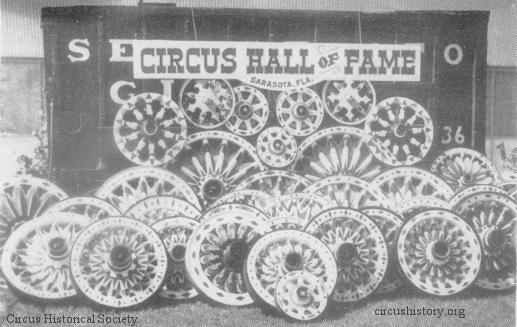
Photo No. 1 - Group of old Sunburst Wheels restored by Dr. H. C. Hoyt at Circus Hall of Fame. Photo by Dr. H. C. Hoyt.
Photo No. I shows the display of some 30 sunburst wheels recently restored by Doc Hoyt. The wheels have been moved indoors of course. The display is said to be the largest collection of authentic circus wagon wheels anywhere, and come from such collectors as Col. B. J. Palmer, who also donated the Two Hemispheres Bandwagon to the Hall of Fame, from Dr. H. C. Hoyt, an old time "Wheelrite striker" in his early days, and from others. Some wheels were rebuilt from parts obtained at Ringling-Barnum quarters in Sarasota. Several wheels were without tires and this constituted a problem since no adequate forge facilities were available. However, steel tires have now been placed on all and to all appearances the wheels are perfect for museum purposes. Here a great deal of preparatory work was involved. Old paint was removed to the wood and rotted places eliminated by excavation, after which prolonged treatment with Vitrol wood preservative was given to insure long life for the remaining elements of the wheel. Epoxy Barrier, a marine plastic product has been used in abundance. This hardens like iron and will not shrink and takes paint well also. Fiberglass and iron wood putty have played an important part in the restoration. As to the decorative design a simple diamond and circle was used largely as this design gives a good appearance on rough surfaces but where the surface rim was reasonably smooth a chain link design was used. Four colors predominate using conventional points, such as Ringling Red No. 42, and marine blue and white. The yellow used is a latex industrial which gives a fine durable sheen that stands up well. No gold leaf was used on the wheels as it was in limited supply. The true sunburst design is employed always on a panel filled wheel. This means that the effect is a wheel within a wheel effect obtained by the series of concentric circles created by the different color design emanating from the central hub and expanding in larger areas as the outer perimeter is reached. This is the true sunburst.
A mere longitudinal decoration on the between spoke panel is not a correct sunburst. It is this arrangement of circles that gives the completed wheel its pleasing beauty as it turns. The colors seem to radiate as a moving kaleidoscope until they are cut off by the rim of the wheel. This seemingly radiation movement is an optical illusion spoken of in the Bible, Ezekiel 1:16. Zeke saw the WHEEL as it appeared as a "wheel within a wheel." He saw movement in the wheel that he couldn't understand so he said the wheel ran by the power of God. What Ezekiel saw you have seen in old time movies where the wheels seem to be running backward on a wagon going the opposite direction. It is this optical illusion that makes the sunburst wheel so noticeably beautiful in movement. Try it with a wheel sometime. The effect is uncanny. Many of the early wheels in the circus were decorated with the so called Rosette decoration. This devise had its beauty points but not like the sunburst. Then the rosette was always getting broken as the wheel went into ruts and mud. Doc Hoyt concludes his above essay on wheels, "I may be crazy, but Ezekiel saw what we are talking about and because he couldn't understand the meaning of the optical phenomenon he attributed it to a higher Being. Wheels are an obsession to me. I love them and have carted several around for years. To me they are man's greatest invention. It is basic in all industry." Those of us who have seen a color print of the Hall of Fame sunburst wheel collection can vouch for the tremendous beauty of them.
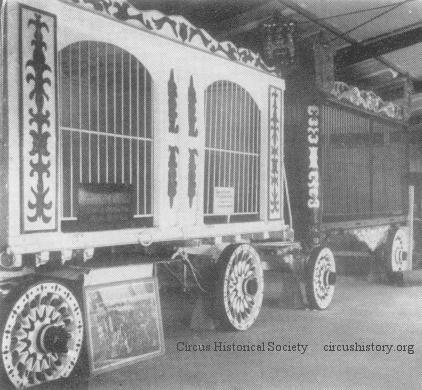
Photo No. 2 - Cage Wagon built from old Ringling-Barnum No. 110 light plant. No. 74 cage on right. Photo by Dr. H. C. Hoyt.
Photo No. 2 depicts a cage wagon built by the Hall of Fame from the old Ringling-Barnum No. 110 light plant wagon. It is not an authentic restoration as Doc Hoyt readily admits and no one is deceived into thinking it is, but use has been made of an old wagon which was in such a rotten condition its value would have been nil unless some design changes were made. The old light plant wagon was converted into a cage wagon of similiar design of many typical railroad show cages. It is pointed white with gold leaf designs on the skyboard and splash board, a color scheme used by Sells-Floto The Circus Beautiful in the period of 1918-20. Equipped with sunburst wheels and wagon banners it has a real "circusey" look. It is true that some fans do not approve of making such modifications, but most fans fully understand the situation. What has happened is this. An old time circus wagon has not been “modernized" by replacing old steel tired wheels with pneumatics and modern gears, but actually just the reverse has occurred. A modern box type wagon already equipped with pneumatic tires, modern gears etc., which was in such foul condition that its worth was pratically nothing, has been "aged" by replacing it with sunburst wheels and making it into a cage wagon of a design used by many circuses of the past. Herin lies a vast difference and as Doc says, "We exhibit it without any apology, for together with old Cage No. 74 we have captured in some measure the cavalcade of open dens that used to be such an important feature of the old time parade."
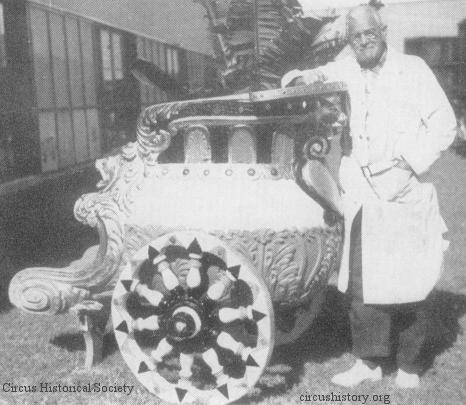
Photo No. 3 - Dr. H. C. Hoyt, Curator, Circus Hall of Fame standing beside old circus chariot he recently restored. Collection of Dr. H. C. Hoyt.
Photo No. 3 shows a restored chariot, representing the finest in wood carving It is regretted that a color print can not be used here as the coloring, the jewels etc. are a sight to behold. All of the restorations mentioned here were completed by Doc Hoyt, who spent so many hours of work on them they cannot be counted. Details on the original construction of the chariot and its early history is lacking. It was acquired along with the Jenny Lind cutter, the Tom Thumb coach, and the several Spanish-American War ship models, that were carried as a patriotic exhibit on the Barnum & Bailey Show in 1903. This collection was owned by the late Sam Gumpertz who was manager of the Ringling-Barnum Circus from 1933 thru 1937. All of the items in the collection had a connection with P. T. Barnum, and Barnum & Bailey, and we can assume this chariot also had a like connection.
It was typical of many built for hippodrome races, specs, etc., once a feature with most circuses. The chariot itself needs only to be studied to see and appreciate its beauty and the degree of craftsmanship that designed and executed it. It was obviously built for speed and was well constructed. When received it was minus a pole and was carrying a heavy load of white lead from many paintings. So heavy was the lead that the depth of the carvings was completely lost. the lion's head on the front and the two half heads on the skirt were just blobs with carved features completely lost. Large jewels adorned the belt and a series of multi-jewels were embedded around the dash board. The whole was a decrepit looking affair when it arrived, in fact it was almost slated for the junk pile. Doc Hoyt tried every method he knew in an attempt to remove the hardened lead. Point removers were of little help. Burning with torches worked too well, in order to get the heat into the deep spots he would risk burning the high spots and dull the carvings attempted to be saved. Chipping was excellent but dented the wood too easily. Finally the only way to do it was found, and that was to carve out the old paint. It was a painstaking task but was accomplished. Finally when is was completed and the new paint of red, white, blue, and gold was added the old chariot took on the appearance of a freshly constructed vehicle just out of the winter quarters shops and ready for the road.
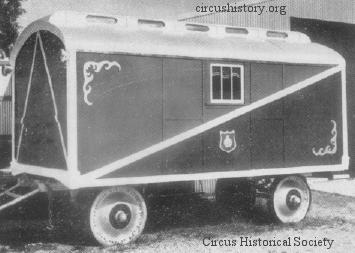
Photo No. 4 - "Italian Caravan," recently restored European circus van. Photo by Dr. H. C. Hoyt.
Photo No. 4 shows a recently restored European circus van, called a "Caravan." This caravan was built in Italy in 1911 for a Gypsy Family by the name of Negric, travelling as performers with a well known Italian Circus known as The Gerardi Circus. The caravan was lavishly fitted out as living quarters and for that day was a great attraction in itself. It travelled all over Italy for many years. During World War II Oscar Konyot, working with the show with a lion act, sold his act to the circus and took the caravan as part of the deal.
He rebuilt the inside to accomodate some of the animal actors and two bunks for trainers. The outside was repainted and the name of Oscar Konyot appearing in large letters and a picture of a lion's head decorated the sides. In 1949 Oscar Konyot come to the U. S. to be with the Ringling show and brought the caravan with him. Since it didn't fit into the loading scheme of the Ringling show it was never used here, but found a parking space at winter quarters where it remained in a state of progressive deterioration until the winter quarters were abandoned in 1959. During the period mentioned a gross fire singed the caravan blistering its paint and weakening the floor and creating a situation that left it open to almost complete destruction by rust and weather. Marked for the scrap pile with its sides and roof hanging in shreds it was a woe begone piece of forgotten equipment. The Hall of Fame took it over on the recommendation of Doc Hoyt, its curator, who alone undertook the task of reconstruction. The outside has been completely restored, and handsomely painted in red, green white, and gold. The inside is being carefully restored from details of pictures of similar deluxe caravans and from first hand descriptions of those familiar with old country caravans. The wagon is typical of those used in many European circuses at the present time.
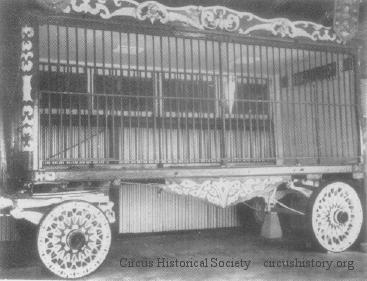
Photo No. 5 - Ringling-Barnum No. 74 rhino cage. Photo by Dr. H. C. Hoyt.
Photo No. 5 shows an authentic restoration of Ringling-Barnum Cage No. 74. It is now complete with exception of a new floor which will soon be installed. The wagon is painted red with carvings and painted designs done in silver. It has been equipped with cage banners and sunburst wheels. The date the wagon was originally constructed is somewhat obscure. Probably it was built at Bridgeport quarters in the early or mid 20's for Ringling-Barnum. In a 1932 equipment list, No. 74 was used to carry a rhino. That year the show had two, Bill and Lilly, both African rhinos. By 1935 both had died and the show did not acquire another rhino until Bobby was purchased from the Brookfield Zoo about 1945. After the death of the rhinos the cage was used to carry polar bears and in a 1939 menagerie list it shows polar bears as the contents for cage No. 74. Also by 1939 the wagon had been equipped with pneumatic tires and modern gears. The cage no doubt was used to house polar bears until it was retired following the 1947 season. When acquired it still had a Florida 1947 license plate attached to it.
Other exhibits as mentioned in earlier reports such as the Two Hemispheres Bandwagon, the Sig Sautelle chariot bandwagon, the dozen old baggage wagons obtained from Ringling-Barnum etc., are still prominent features of the Circus Hall of Fame.
Lowande was a name famous in the circus world of the Western hemisphere for over 100 years. Family members through three generations have been famous bareback riders as well as all-around performers. Several were successful as owners and operators of their own show. A number of circuses under the title of Lowande were well known in South and Central America, the West Indies and parts of the United States.
One of the third generation, Oscar Lowande, Jr., is now retired from riding and lives in West Los Angeles, California. Mr. Lowande was literally born in the business recalling that as a boy he traveled with various circuses during school vacation. Later he was on some of these as a rider. He was also a performer on shows operated by his father and uncles.
Mr. Lowande was born at Boston in 1902, spending his winters there in schools and the summer enroute with members of his family. It was only natural that he should take to riding as his forefathers were great riders.
There is in his home an interesting collection of mementos of the past. One he prizes most is a gold medal awarded his father when a performer on the Adam Forepaugh & Sells Bros. circus in 1902. One side reads "Presented to Oscar Lowande for being the first person in America to accomplish a somersault from one horse to another while the horses were running at full speed." On the reverse side is a picture of Mr. Lowande performing this feat.
In the early part of 1907 Oscar Lowande's circus unit was busy. Historical records show Feb. 25-27, Manchester, N. H.; Feb. 28 - March 2, Lowell Mass.; Mar. 4-9 Fall River; 11-16, Lynn; 18-24 Portland, Maine.
The title was well known in the New England states near his home base, Reading, Mass. In the early summer of 1908 he had a 12 week engagement at Nantasket Beach, Mass. followed by an engagement of the New York Hippodrome from Sept. 5 to Nov. 28.
The next year old route books show he exhibited during June and July in New Hampshire and Massachusetts.
The Lowandes operated in such a large field scattered in the United States, South America, Central America and the neighboring islands they were all outside the United States, at times, for periods of considerable length.
In 1917 the Lowande & Sautelle Monster Motor Truck Circus played three months in the Rhode Island, Connecticut and Massachusetts area. He recalls how it had financial trouble, closed and the performers took off down the highway.
Later in that year he was with the Lowandes on the Pantages circuit. They were billed as The Topsy Turvey riders. This troupe included Oscar, Sr., his mother Mamie, sister Elsie-May and Edward Delme, a clown from Cuba.
During the next few years the act kept busy. Between 1923 and 1927 Oscar, Jr. was a member of the Poodles Hanneford act playing the big time fairs and in vaudeville; also getting top billing on the Sells-Floto circus in 1926 and 1927.
After a few weeks of rest at the close of the '27 season this act opened at the Wintergarden New York with the Circus Princess company. This played to big business for 28 weeks.
He was one Lowande to enter motion pictures. In 1928 he worked with Joe E. Brown and Frankie Darro in The Circus Kid; also in some comedies with Poodles Hanneford.
When the Charlie Chaplin picture "The Circus" had an extended run at Grauman's Chinese Theater in Hollywood there was presented a prologue of circus acts. In this appeared the Poodles Hanneford troupe. He was with it.
Later as a member of the George Hanneford riders he was on the Downie show in 1933-34 seasons. The Al G. Barnes circus in 1935 had a riding act of picked performers including Oscar, Jr. It was billed as Bernetti troupe.
In the collection of Al G. Barnes historical items I found a record of his ancestors. This family tree had been prepared in 1929 by Mrs. Lowande Shipp, widow of one of the owners of the Shipp & Feltus circus, long popular in South America and adjoining territory.
Alexander Lowande, who established the name in circus records, was born at Boston, Massachusetts in 1805. As a youngster of 8 or 9 years he was apprenticed to the owner of a California circus playing in Boston. On that show he was taught bare back riding.
In 1830 while enroute through South America Alexander bought the show from the man who had trained him on the circus out of Boston.
He changed the title to Circo Alexander Lowande. This continued to operate as for as is known in the area of South and Central America as well as the West Indies for more then 30 years.
Although of Yankee stock the Lowandes were performers in the South American countries for so long that when appearing later in the United States they were referred to as being Brazilians.
In 1869 the Lowande name appeared on a circus program at Denver, Colorado. Dan Costello in advertising his show for June 4-5-7 announced "I am taking special pride in presenting for the first time in America the family of Alexander Lowande, the rider; Martino Lowande, Young Arbaloga and Natila Lowande."
From his first marriage three daughters were born. None followed in the profession. Those appearing at Denver were from the second marriage, his first wife having died.
Martinho Lowande of the second family become a famous rider and later proprietor of his own circus. He died during the 20's in Cuba.
Two other children were Clarinda and Guilamena. Both become famous.
Over a period of years the name of Lowande was on many titles and circus programs in the United States.
Cecil Lowande, later to become a headliner, was born at Philadelphia on March 12, 1877. He sold papers on the street. There was a ring barn for training on the home place. In this three shows were given each week. Here he had his first training and public appearance. He was long with the George Hannefords.
Julia Lowande Shipp tells how eight cousins rehearsed in that barn. One act they learned was a Chinese dance. She recalls how she had her knuckles bruised in one of these hours of practice and went out fighting.
It is related how the family moved to Petersburg, Illinois. She did her first riding with the A. H. Reed show in 1892. it opened at Carton, Illinois. It is noted that her brother Alexander did a tight rope act and that "mother was along with the boys."
Several children remained in school at Petersburg in 1893-94.
Commencing with 1895 through 1900, except for '96, there was always a Lowande act on the Ringling Bros. Worlds Greatest doing principal riding and Mexican hurdle numbers.
In '96 they were On Wood Bros. circus out of Brighton, Iowa.
Several of the Lowande brothers were ambitious to have their own show enroute in North America as their father had in South America.
In 1883 Martino Lowande's Brazilian circus was enroute. Among those in my old records were Martino Lowande, owner and manager; Performers included Martino, bareback rider; William, bareback rider; Anthony, somersaulter; Martino, Jr., pony rider, Venus, Mrs. Lowande, rider; Alexander acrobat; Little Papus, acrobat; Alexis Scafer, bounding jockey; Ed Libbey, cannon ball catcher; Francisco, clown; Pedro Lobano, contortionist; Mrs. Lowande, slack wire.
The following season it was O'Brien, Handenberger, Astley 6 Big Railroad Circus. It is recorded they had two advance cars; one with 16 men and the other fully staffed. That year O'Brien was manager; Martino Lowande, equestrian director; Mollie Brown, bareback rider; Tony, pad rider; Willie L. somersault rider.
In 1901 the Lowandes were featured on the Walter L. Main show. In 1902 some of the members were off the road on account of sickness. That was the season one branch of the family was featured on the Adam Forepaugh & Sells Bros. Enormous Shows United and Oscar, Sr. received his medal. The circus opened in Madison Square Garden April 2-19 with a night performance; closing at New Orleans Nov. 6-19. That engagement, at Audubon Park, also started with a night performance.
The Campbell Bros. out of Fairbury, Nebraska got them in '04, '05, '06, '07. Mrs. Shipp then recalls they were on the Sells-Floto circus with Harry Tammen as manager in 1908. On all these shows they did a three principal riding act.
Cecil Lowande was in Panama, Puerto Rico and Jamaica with his cousin, Harry Lamkin for Ed Shipp during the winter of 1908-09. This engagement lasted 10 weeks. They returned to New Orleans. Mrs. Shipp reported they had three horses on the tour.
A Lowande act opened with Gollmar Bros. out of Baraboo, Wis. in the Spring of 1910.
Jerry Mugivan engaged Lowandes, then famous riders, placing them on the Howes Great London, Sanger and others of his shows between 1911-24. She refers to the 1911 Howe show as being one with two rings.
One title in 1913-14 was Sig Sautelle's Nine Big Shows ltd. It was advertised as a circus, museum, menagerie. Owners were Sig Sautelle, Oscar Lowande and Geo. W. Rollins.
On one page of a highly colored old time herald Oscar Lowande is described as "The most marvelous rider the world has ever known; performing all the famous feats of equestrianism with a grace and ease never before equalled." "Oscar Lowande, equestrian emperor of the Brazilian pampas, is the only rider on earth who throws a somersault from one horse to another while running tandem at full speed.”
Also on the herald were advertised "The eight world famous Lowandes in their celebrated derby day act exhibiting astonishing deeds of acrobatic equestrianism." It was said to be a spirited, sensational and dramatic tally-ho act; triumph of triumphs in equestrian innovations.
Old routes show that in 1917 it was Sautelle's & Lowande's Monster Motor Truck circus. It opened at Reading, Mass. May 12. The last date shown is North Attleboro, Cape Cod, July 30.
In 1917 there was a Lowande circus in Cuba.
Several Lowande brothers operated shows as owners and managers. In this they were most successful when operating outside the United States. Their fame in this country came as riders.
On looking at old routes it is disclosed that in 1913 the Lowande & Robbins Circus was in Florida; M. Lowande's World Toured Circus was at Panama City Jan. 26-31. Christmas was spent at Colon, Panama.
When Sells-Floto played Redlands, California, April 7, 1913 newspapers carried stories about the feature act of riding being presented by the Lowandes.
In 1915 on July 3 Tony Lowande's was at Buenos Aires, Brazil, South AmerIca. In the same year Oscar's Great Eastern Show toured Atlantic seaboard towns.
In 1916 a riding act presented by Oscar, Sr., and family consisting of Oscar, Sr., wife Mamie, daughter Elsie-May and Oscar, Jr. was on the Hagenbeck-Wallace Circus.
In 1918 Tony Lowande show routed in Uruguay.
People, not experienced in the business, backed with money for Martino Lowande in a circus that went to Puerto Rico in 1918. Oscar, Jr. recalls when the money was gone and the promoters couldn't get along either together or apart the show closed.
Oscar, Sr. spent several years in South America with the circus of his brother Martino while his family remained at home in Reading, Mass. The 1919 routes show the Martino show in West Indies, Central and South America.
In May 1920 the Billboard carried a story about the return of Oscar, Sr. from Puerto Rico, where the Martino Lowande circus was doing excellent business. It said he was leaving New York for Reading, Massachusetts to prepare the Oscar Lowande American circus for the road. In October it was reported that his show was playing the Cape Cod section to good business.
Frank Gardner was a well known leaper before he went to the West Indies and established his own show.
In the fall of 1920 the title was Lowande and Gardner Circus combined. The Billboard had a story that Oscar and Alexander gave particulars about the new show. It was to leave on a Puerto Rican steamer from Brooklyn on November 25. The canvas would include, besides the big top, equipment for a mammoth pit show. Old photos picture a long banner line. There would be 33 people on the first boat, including a 10 piece band. More had been engaged to follow on a later boat.
An account in the some paper of April 23, 1921 carried a story with a picture of the Tony Lowande circus and menagerie on a lot in South America.
The circus was said to be the largest show up to that time to play in that country. It was run on the American plan and had been on the road 25 consecutive years, not seasons, without closing. Apparently the photo was taken at parade time. In front of the big tent stood an ornate bandwagon with eight horses attached besides camels, elephants and many people in line. In 1929 Mrs. Shipp wrote "Anthony Lowande rider and proprietor is now in Brazil."
In the April 7, 1923 issue, the Billboard had a story of the coming soon of the new season for Hagenbeck & Wallace. Cecil Lowande was to be a featured rider.
The Lowande family is not represented on circus programs any longer. Oscar's mother, known as Mamie in the show world and his sister, Elsie-May, reside in Reading, Massachusetts.
An Aunt Marietta Correia and her daughter Ameila live in New York City. The husband J. Correia, Sr. was long in the Lowanda act.
Mrs. Correia has a son Anthony Correia of Los Angeles and another John Edward of Petersburg, Illinois.
Julia Lowande Shipp makes her home with a daughter, Virginia Shipp, in New York. Virginia rode menage, liberty and other numbers on the Shipp & Feltus for years well known in South America.
Martino passed away in Cuba some years ago.
Arlado, an adopted son and apprentice, died at the age of 79 years in Orange, New Jersey. Another adopted son, Willie has passed on.
Alexander the first died at Port Au Prince, Haiti. He left a large plantation near Savannah, Georgia.
Oscar, Sr. passed away in New York City about 1956.
Alexander G. Lowande, who died at Los Angeles in 1958, was a bareback rider and bounding rope performer in his prime. Later he become a dog trainer and knock-about clown.
The Lowande name has gone down in American circus history as a long prominent family of owners and performers that reigned in both North and South America for the better part of 150 years.
There were 17 Lowande descendants at one time or another appearing before the public as shown by Mrs. Shipp.
This brief story of the Lowandes show that the art of the circus, is in one respect, unique in that it is startling inheritable.
A long line of artists, as in the case of this family, spring to life from the original founder; acrobat upon acrobat, rider upon rider, clown upon clown. The circus blood flows true for generation after generation. This art is handed from fathers and mothers to sons and daughters.
Fred D. Pfening, Jr. Bandwagon, Vol. 5, No. 1 (Jan-Feb), 1961, p. 8.
THE BILLBOARD was founded by W. H. Donaldson and James Hennegan in Cincinnati toward the end of the year 1894 under the name of Billboard Advertising.
The magazine started as a monthly, and the first issue contained eight pages devoted principally to billposting and poster-printing. As the magazine caught on with the outdoor advertising trade, billposters began leaving copies around the shops and other employees began reading the publication. In the summer many of these "knights of the brush" would join out ahead of circuses. Soon the Billboard Advertising was found on the advance cars of circuses, and circus agents and advance men began to read it.
Beginning with the issue of July 1, 1897 the name was changed from Billboard Advertising to The Billboard. A circus department was installed with the last monthly issue of May, 1900, and four days later under the name The Billboard it become a weekly. With the addition of the circus and a new fair department the circulation leaped from the few hundred copies being printed. W. H. Donaldson had now assumed full ownership of the publication. He was so encouraged with the new interest he decided to break into the theatrical field with the paper. So rapid was the growth of the magazine during 1900 that it was necessary to arrange with the Cincinnati News Co. to distribute The Billboard to train agents, and news stands. During the first ten years of The Billboard Donaldson continued his connection with the Donaldson Lithographing Co. Mr. Donaldson's one daughter married Roger S. Littleford who later become president of the Billboard Publishing Co. His sons now operate the company.
The magazine began publishing circus and wild west show routes in 1900. Fifteen different circus routes were listed that year. However, in 1901 thirty-seven shows allowed their routes to be listed each week. The number of routes listed grew until in 1904 forty-three shows were represented, that year being the all time high. In the years near the first world war the number of circus routes lessened, dropping to around 20. In the year 1928 it jumped to twenty-five.
On December 29, 1934 a wonderful 40th anniversary issue was published containing 322 pages. The full eight pages of the first issue were reproduced, and an extensive division was devoted to each department. Interesting information was printed from the files of the magazine. In the special circus division were such articles as "The Passing of James A. Bailey," "Abandonment of the Parade" and "Origin of Circus Tights."
This special anniversary issue contained a two page greetings ad from the Al G. Barnes Wild Animal Circus, and full page ads for Ringling Bros. and Barnum & Bailey, Polack Bros., Tom Mix Circus and Wild West. A half pace ad heralded the coming of Cole Bros. World Toured Circus.
The full staff was pictured. Only a few remain with the publishing company today - B. A. Burns and Bill Sachs are the only two we recognize. CHS member Nat Green was shown under the "department editors."
In the 1930s the circus department each week contained three or four full pages of news. However, from its inception the circus department was both informative and newsey. In the spring and early summer of each season most shows were reviewed and a full roster was listed.
This information from past issues is the circus historians greatest single source for research. A few of our most capable and serious circus historians have complete files from the late 1890s to date.
In the middle 1940s, Tom Parkinson, a long time circus fan and journalism graduate, joined the Billboard staff. Under his leadership the circus department renewed its vigor in reporting complete coverage of the tented shows. Tom contributed many interesting and factual biographies of leading circus personalities.
On December 31, 1960, after sixty-six years of publication, Old Billy Boy folded his tent for the final time. The Billboard is no more. The showman's bible is gone after low these many years. A loss is felt down deep in the heart of many a trouper, as well as all of the circus buffs, who felt a part of the industry as they read, "who was putting it up and taking it down in Kankakee or Chillicothe."
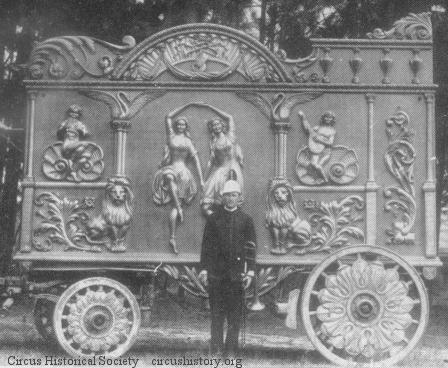
Photo No. 1 - Dancing Girls Bandwagon, Sparks Circus, season 1916, somewhere in Georgia. J. J. Ruff, trombonist in his helmeted uniform in foreground. Note outside type sunbursts. These were later replaced with inside type. Collection of J. J. Ruff.
Probably the most famous of all of the parade wagons of the Sparks Circus is shown in photo No. 1. This wagon is called the "Dancing Girls" Bandwagon, a name given it by historians for identification purposes, so named of course because of the carvings on the wagon. It hasn't been established who built the wagon, but I have long guessed it was the Bode Wagon Works of Cincinnati. Mind you, this is only a guess, and the reason for such a guess is that some of the carvings had a look similar to carvings found on other wagons Bode is known to have constructed. It is now fairly well known that the wagon was built new for the show for the 1916 season. Several witnesses on the show in 1916 affirm it to have been new for that year. In 1916 the Sparks train was enlarged to 15 cars, adding some 3 cars to the train carried in 1915. In 1916 the show's title was "John H. Sparks World Famous Shows," and in some of the billing paper the name of "John H." was omitted. The show was owned by Charles Sparks, with his step brother Clifton Sparks associated with him in the management.
This beautiful bandwagon was put into service as the lead or No. 1 bandwagon in the street parade, a daily feature of the Sparks Circus as long as Charles Sparks owned the show. In the fall of 1928 Sparks sold the circus to H. B. Gentry, who while unknown to Sparks, was acting as an agent for the American Circus Corporation, which was owned by Jerry Mugivan, Bert Bowers, and Edward Ballard. For some time Sparks had refused to sell his show to this trio and always vowed he would never do so. The late E. W. Adams, who was in Macon at the time, told me once, that when Sparks found out that it was the American Circus Corporation that now held title to his show, that he cried like a baby when he learned the truth and threatened old H. B. Gentry with the. words, "I ought to bash your head in with my cane you old so and so." When sold in 1928 the Sparks show was travelling on 20 cars.
Although the American Circus Corporation units, Sells-Floto, Hagenbeck-Wallace, and John Robinson, had quit parading following the 1925 season, it was felt that the Sparks parade was such an institution in the South East, and Eastern Canadian provinces that it would be wise to retain it for 1929. H. B. Gentry was named manager for the show in 1929 and it went out the same size as in 1928 retaining many of the acts and with the parade a daily feature. The Dancing Girls bandwagon throughout the years had been painted a variety of colors, and in 1929 Gentry had it painted white along with most of the other parade equipment. The painting of parade equipment white was always a strong tendency with Gentry and it may be remembered that when he managed the Sells-Floto from 1917 through 1920 he had most of the parade vehicles painted white.
In the fall of 1929 John Ringling purchased the American Circus Corporation's five circuses, Sells-Floto, Hagenbeck-Wallace, Al G. Barnes, John Robinson, and Sparks. Under the new Ringling named manager, Ira Watts, the Sparks parade was dropped in 1930, however with the exception of the steam calliope all of the tableau wagons remained on the show as baggage equipment. For years the Dancing Girls wagon had carried trunks. The show did not return to Macon winter quarters following the 1930 season but went into quarters with Ringling-Barnum in Sarasota. For 1931 the show was cut to 15 cars and following the season the title was shelved and did not go out in 1932. The Dancing Girls bandwagon and some of the other tableau wagons were stored in Sarasota following the 1930 season when the cut in the train occurred. Some time later, the Dancing Girls wagon, the Dolphin wagon, a Sparks cage, the old Ringling Bros. United States Bandwagon, and a couple of chariots were put on display at Sarasota quarters as shown in photo No. 4. It seems odd indeed that the wagon was shown such sentiment not usually found in the Ringling management of that time. It is regretted that this sentiment didn't last long, as in the late 30's, all of the Sparks equipment baggage and tableau wagons, calliopes - nothing was spared, was burned at Sarasota quarters. This happened about the time many other wagons were being destroyed in Peru. To this day nothing remains of the fine street parade wagons that Sparks had in the late 20's that were used in the fine parades given for several years after most circuses had discontinued this beloved custom.
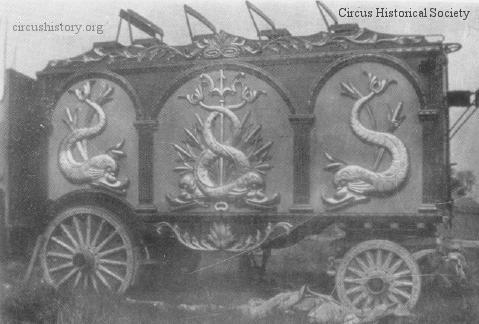
Photo No. 2 - Dolphin Bandwagon, Sparks Circus, season 1927. Collection of J. V. Leonard.
Photo No. 2 shows another famous parade wagon long associated with the Sparks Circus. This wagon is commonly called the "Dolphin" wagon because of its carvings of dolphins, sea serpents, or whatever you would call them. The wagon was built by Moeller Bros. of Baraboo for the Forepaugh-Sells Bros. Circus in 1910 and was on that show for the 1910 and 1911 seasons. It may be remembered that this show did not go out in 1908 and 1909 but was stored at Ringling quarters in Baraboo, and then in 1910 the Ringling management put it back on the road for two seasons and then closed it for good following the 1911 season. Evidently the wagon was built to replace older equipment. The show's equipment was stored in Baraboo following the close and would have been available to Sparks from 1912 on, but the exact date it did go to Sparks is not known. It fails to show in Sparks photos I have seen dated 1915, 1916, and 1919, and doesn't appear until the early 20's, however, it could have gotten to the show earlier than that. My theory is that when Sparks was obtaining baggage and tableau wagons from Moeller Bros. about 1921 that this wagon was also purchased from the Ringling interests about the same time. Anyway, it appears on the Sparks Circus in the 20's being used as the No. 2 bandwagon. From then on it follows out the same route as does the Dancing Girls wagon and was destroyed at the same time.
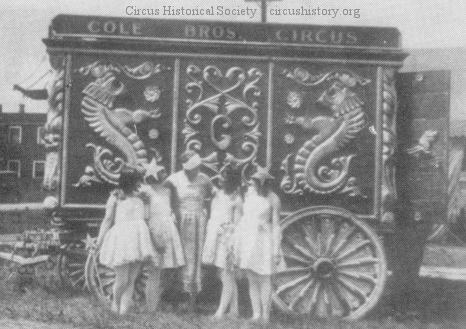
Photo No. 3 - Sea Serpent Tableau, Cole Bros. Circus, season 1929. Spec girls in foreground. Collection of Billy Dick.
Photo No. 3 pictures the tableau wagon historians refer to as the "Sea Serpent" tableau. Note the similarity of the carvings to that of the Dolphin wagon. In late years some have confused this wagon with the Dolphin, and although at a glance they are quite similar, upon closer examination you can readily see that two wagons are involved The carvings are quite different and one wagon somewhat longer than the other.
The Sea Serpent tableau is said to have originated on the John F. Sparks Shows in the period 1910-15. Some place it on the show as early as 1910 when Sparks travelled on nine cars, 1 advance, 2 stocks, 4 flats, and 2 sleepers. The wagon was built by Sullivan & Eagle of Peru and was probably built about the some time as the Sparks steam calliope mentioned in this column in past issue of the Bandwagon. It was used for parade purposes and in 1922 served as the show's ticket wagon. The wagon was sold to Floyd and Howard King in the winter of 1924-25 and in 1925 it was used on the King Brothers' Walter L. Main Circus. In 1926 and 1927 it was on the King's 10 car circus titled Gentry Bros. Circus, and in 1928 was on their Walter L. Main Circus. The 1928 Main show was called Cole Bros. in 1929 and 1930. The wagon was on the Cole show when it went broke Aug. 30, 1930 at Scottsville, Ky. The entire show's equipment was soon acquired by H. C. Ingraham and Bert Rutherford who had planned a big railroad circus to tour in 1931 to be called the Ingraham and Rutherford Circus. The equipment was moved to Peoria, Ill. to frame the show, but further litigation came up and the Venice Transportation Co. of St. Louis, Mo. ended up with the property.
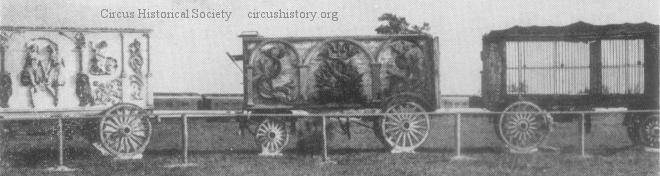
About 1938 the Sea Serpent tableau along with the other Cole 1930 property was sold to G. W. Christy and moved to his quarters in South Houston, Texas. Christy never did follow out the rumors that he was returning to the road with a railroad show. No doubt the big 1938 recession that cut the country's five railroad circuses down to two in a single season and knocked off some of the leaders of the motorized field, had something to do with Christy's decision not to go out. For several years he advertised the property for sale as a unit. A carnival in Iowa purchased the Sea Serpent wagon, along with two other tableaus about 1947, but soon sold them to the Chicago Railroad Fair of 1949-50 where they were displayed. For many years there was a movement within the Circus Historical Society to purchase the wagons or at least lead them into a good permanent home, It seemed at one time that the Museum of Science and Industry in Chicago would get them but that fell through. Then about 1953 they were acquired and sent to the Dover, Ohio fairgrounds to be used for display and ballyhoo purposes by the local Boy Scout council. They are looked after under the watchful eyes of good fans and CHS members, Bob and Norman Senhauser. I trust the wagons are in as good as condition as they were when Bob Senhauser sent me photos of them in 1953. They had been put into good condition, painted, and looked great, and best of all no "modernization" had taken place. As I wrote and pleaded with Bob then and still make the plea today to anyone who has custody of any old original circus wagons with the traditional steel tired wheels and old style wagon gears, "Don't ever 'modernize' them." To put on modern gears, pneumatic tires and wheels is to simply ruin them. Then they are no more real circus wagons than what anyone can rig up with a few pieces of plywood, some sponge rubber "carvings" and four automobile wheels and tires. This Sea Serpent wagon is one especially dear to the hearts of wagon lovers because it is to the best of my knowledge the ONLY wagon in existence today that ever saw service on the old Sparks Circus, and I guess it was fortunate that it left the show in 1924 or no doubt would have suffered the same fate as the rest of the show. We trust it will be in good, safe hands, for many years to come.
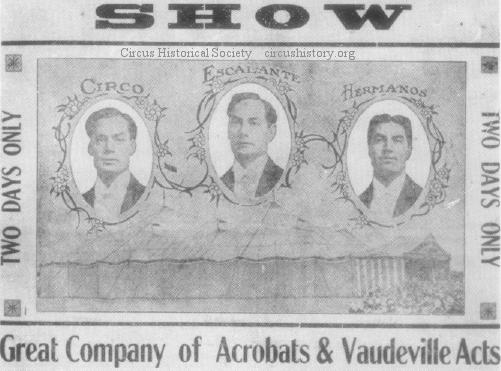
There was an era in the circus history of the Southwest, principally California, Arizona, New Mexico and Colorado, when the so-called Mexican circus filled its place. Performers from these later presented acts as stars of circuses playing from Coast to Coast, Canada and the United States.
Between 1910 and the mid-thirties there came to this country from South of the border Mexican parents with their talented children. They had an entire show within the family as all members did several acts. Their expenses were small, local restrictions were not too strict and they prospered.
Well known titles were Escalante Bros., P. Perez, Juan Soto, Rivas Bros., Guttierez, El Modelo and several more.
Various American circuses found in these family shows a source of supply for new acts. The Latin-Americans were featured on the Al G. Barnes, Russell Bros., Cole Bros., 101 Ranch Wild West Circus, Hagenbeck-Wallace, Dailey Bros., Clyde Beatty and later the Beatty-Cole.
With the change of times and expensive licenses they were forced off the road. Residents of small communities, both American and Spanish speaking residents lost this form of entertainment.
The Barnum of these was the Escalante Bros. show.
There were three flesh and blood brothers. Mariano, the oldest, was the prime mover; Pete was the general agent. Marcus was the clown and in charge of the light plant. All doubled in acts when necessary.
These three brothers are now living in retirement at Los Angeles.
When senior circus fans of the West think of Escalantes they recall Mariano first. He was born at Zacatecana, Mexico 81 years ago.
Recently in a talk he recalled to me how as a boy he and his brothers sold religious articles his father had made. Soon all became interested in stunts of the strolling acrobats, who passed the hat for remuneration.
In school Mariano learned some circus tricks that he taught to his younger brothers.
His first endeavor with a circus of his own was in 1909. For more than half a century descendants have toured North America as owners and performers.
In the beginning his show moved via ox-cart across the trail-like roads of Mexico. The first entrance into the United States was at Brownsville, Texas Oct. 22, 1911 for a three month trial tour of Texas. The family became homesick, persuading the father to return to the old country.
On arriving there they found the Mexican revolution in progress. No one appreciated bullets whizzing overhead. In three weeks the show was back in the United States, crossing early in 1912 at Laredo, Texas. Later in the same year they played two months on the same location in San Antonio.
With the assistance of his wife, sisters, who were dancers and acrobats, and his children the show prospered.
Mariano and his brothers have long been handy with the needle. They made their own tents.
All these shows were patterned on the European type. They were one ring affairs with a stage at the end, where the dancing numbers were presented. Two or three rows of chairs in circles surrounded the ring. These were reserved for extra money. Typical blues eight or ten high were next to the sidewall.
A bright red carpet covered the ring floor with the initials of the show worked out in gold or white. Baskets of paper flowers were fastened to the quarter poles. On occasions those flowers were sprayed with perfume.
The interior of the tent was decorated with flags and pennants. At first illumination come from gasoline lights, later it was electricity. Over the tent was strung a row of colored lights.
Before each performance the band gave an outside concert.
The Escalante family fast became Americanized. In the Billboard for Oct. 16, 1920 a call was made for aerial and ground acts. This same paper told how the show had opened at Powell and Chestnut streets in San Francisco. It would work south through the state following the harvest of grapes and other fall crops. Fresno and Salinas were given as addresses enroute into Old Mexico.
Whether it was a small one pole tent or one with several middle pieces it drew crowds. They wild-catted. That is the show would stay in one spot so long as there was business. They literally milked the field dry. The programs were changed several times during the engagement. Only night performances were given with an occasional Sunday matinee. I have seen the time when the people were so anxious to patronize the show that they would borrow money from the grocer for the price of a ticket. This was charged to their account with a profit for the money lender.
Little advertising was done in advance. Usually the advance would visit a community and pass out a few handbills announcing the coming of the show without a certain date. The day of arrival and part of the following was spent in setting up. News of their arrival spread fast. About the time the men came from work on show day the band mounted on a truck paraded through the settlement, stopping at central spots to play several selections. Handbills were passed reading "Hoy" or "Esta Noche" meaning the show would open that night.
Mr. Escalante still feels, as he did, that to have a successful circus one should have a good tent, lots of bright light and a good band. He recalls that in 1916 there were 16 loud-blowing musicians in the band. The first calliope was delivered to the circus of Las Cruces, New Mexico in the summer of 1929. With that and his band he paraded in Agua Prieto over the border, bringing good business that night across the International line to his show.
The show wintered in Los Angeles.
Here is what was advertised one season - Miss Aurora Escalante, famous juggler and trapeze performer; Miss Amparo Escalante, comic singer and somersaulting performer; Mrs. Rita Oliva, aerial performer, equilibrist and Spanish dancer; Little Elodia Escalante, singer and dancer; Angelita Escalante, contortionist; Mr. P. Fermin Oliva, performer on five bars; Child Nicolas Escalante in a special act "round and round;" Child Eduardo Escalante, gymnastics; Senor Acevedo, tight wire artist; Filomeno Escalante, smallest tight wire actor; clowns, Cara Sucia, Juanillo and Tonito; Boots the most beautiful trained bear, a musical burro; educated ponies; the only singing coyote in the world; magnificent brass band under direction of Jesus Mendoza.
Pedro Escalante presented the trained animals.
After the brothers become owners of property in Los Angeles they made their winterquarters there. That city has long had a large Mexican population. With much good weather they got in some extra winter business. The lots were close in - several years they were able to get locations near First and Main streets.
One winter the show advertised in the Billboard for "aerial and ground acts, tumblers, a troupe of trained dogs; any good act, dumb or that speaks Spanish, Need a woman who speaks English and Spanish." Lee Teller was then the agent.
On the program were a varied list of acts as tumbling, hand balancing, horizontal bars, aerial numbers. At the conclusion of an act in the ring by the children occupants in the reserved chairs always threw money to them. The talking clown was always popular. Dan Rice never had more enthusiastic fans.
The Mexican shows did not carry many performing animals of their own. Rubin Roy had some lions on the P. Perez show; Tom Atkinson furnished dogs, ponies and monkeys for the Guttierez show.
Al G. Barnes himself recognized the abilities of the versatile children. S. L. Cronin when manager used them in several acts.
An Escalante troupe of 30 people filled an extended engagement in Mexico City during the winter of 1934-35 or the Circo Bell.
The Escalante show continued during the depression of the 30's. It was about that time that some members pulled out to fill dates through booking offices for fairs. This left the show short at Sacramento, California. The ever resourceful Mariano trained some of the younger children to do tumbling and the show went right on. When the runaways returned after the fairs they were greeted by the boss with "I don't need you any longer, I have some new performers." Of course their differences were patched up and all were once again one big happy family.
The Mexican shows like the American found their overhead increased. Many city licenses were raised like those at Riverside, California. At one time the reader was $50 a year for a tent show. There were three lots in different parts of town that could be played once or twice a year for three or four days each time. That cut the average down to a few dollars per day. When the reader was changed to $85 a day that was one thing that lead to their closing.
A Mr. Elkins was a helpful man around the Guttierez show for years. To cut down the overhead that show featured marionettes.
The P. Perez show got by because the owner had a large family of talented girls in Spanish dances. Harry Phillips combined his Robinson Bros. circus with the P. Perez show one season.
The Escalante show continued thru 1936. Following that several members went to the new Cole Bros.
Miss Velarde, whose father had the Modelo show out, was on the Cronin Bros. Circus.
Johnny Guttierez and family were on several American shows. He is now retired and lives at Arvin, California.
Phil Escalante in the 50's was featured in the Clyde Beatty show in a wire act. The Flying Escalante were on the same show.
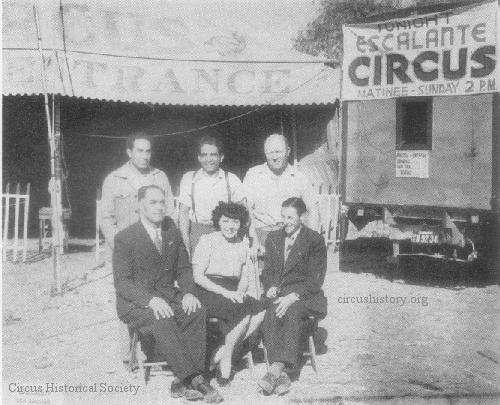
Some of those with the 1944 Escalante Circus. Rear row - Lalo Escalante, Billy Temple and Harry Ross. Front row - Chata Escalante, Mrs. Herbie Weber and Herbie Weber.
Herbie Weber, who married Chata Escalante, revived the Escalante show in 1944. Later he had the Great Flamante show on the road with some of the family in acts. He and his wife have been with the Beatty-Cole show several seasons billed as the Latinos in a wire act.
Mrs. Malonga Cline was the youngest of the Escalantes. She and her husband were long with Beatty. They now have a dog, a pony and elephant act.
Lalo of the Flying Escalante is still appearing with his wife an aerialist. Billy Temple of the same act had a sad ending a few years back.
Phil Escalante, the former star wire walker, makes headquarters in New York City. Angels, the contortionist died in 1940.
Lalo has also worked many seasons on the horizontal bars.
Chata, better known today as Mrs. Herbie Weber, as a girl appeared in singing and dancing numbers. She and her husband have been doing several acts on the Beatty-Cole show including a wire act and he in his backward slide from the dome of the tent. He is billed as Senor Huberto.
Esther formerly a trapeze artist, who was featured in her heel swing, is retired and lives at Pico Rivera, California.
Blanca Escalante, now residing in San Francisco, was a tumbler and singer.
Henry with his sister Esther did a double trapeze act.
Mariano, Jr., now in commercial lines, was a slack wire artist.
While all children were specialists in some particular line they were able when necessary to double for members of the family.
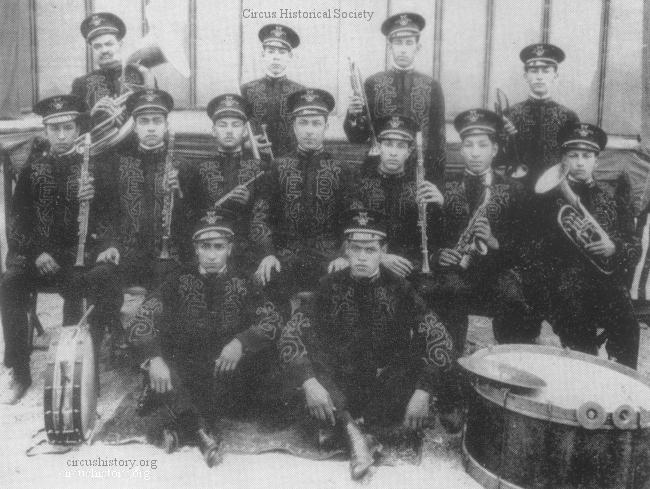
The show laid off one winter in Riverside. Malonga recalls that it was customary for her father to give all receipts from the first performance of the season to the Catholic church. In its travels the circus often pitched its tents on church property.
Escalante like the Mexican shows of today depended much on the circulation of handbills for publicity. One of these, loaned to me by Bert Hansen of Daly City, California, is 40 years old. It is of the 1/4 sheet size with plenty of illustrations. One side is in Spanish and the other in English.
Such well known names as Escalante, Guttierez, Velarde, Gasca, Mijares, Garcia, Weber, Soto, Perez have been found and some are still on American circus programs.
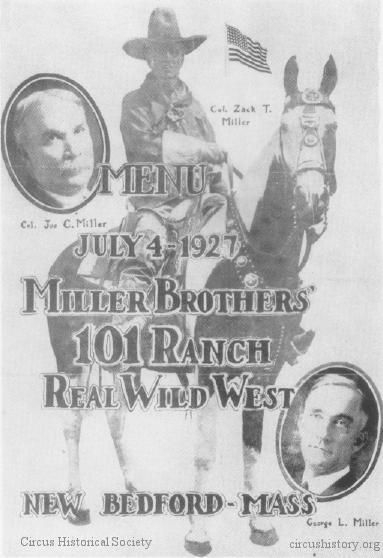
An unusual type of circusiana, that is not found in many collections, is the circus menu issued for special occasions.
Although I have not made a special effort to collect menus, I have nearly 30 different ones in my collection. They range in size and elaborateness, from a simple plain sheet printed in black to a very fancy folder with an embossed cover printed in four colors.
Two special days account for most of the menus issued. The most important day was the 4th of July; the other was closing day of the season. However, special dinners were served at other times and a menu was issued to record the occasion. One such dinner was given by Mrs. William (Cap) Curtis at Vallejo, California, on May 6, 1913. The menu was printed to commemorate the special day and was titled as follows:
Complimentary Dinner given by
Mrs. William Curtis
To Her Lady Associate Members of Sells-Floto Circus
In Honor of Her Thirty-first Birthday
The farewell dinner on the closing day of the season was a traditional affair that was looked forward to by all show folks. The menu for the farewell dinner of the Sells-Floto Circus in 1913 was printed on a blank route card, Dixie Engle was the steward on the show at that time and served an extremely fancy meal, with a wide selection for each course, such as roast young turkey, oyster dressing or suckling pig with baked apple.
The folder-type menu sometimes included additional information, somewhat along the lines of a season route sheet. In 1924 special 4th of July banquet menu issued by the Walter L. Main Circus carried a large photo of Andrew Downie on the cover and listed the official program as well as the staff and heads of departments.
An illustrated menu was issued to record the luncheon given the CFA in 1928 by the Miller Bros., 101 Ranch Wild West in Philadelphia on May 24. The inside has a fine drawing by Karl K. Knecht, showing CFA officers in the cookhouse with the Miller brothers, The main course of this meal was roast prime ribs of "Famous 101-Sweet Pickle Buffalo,"
The July 4, 1916, menu of the Wheeler Bros. Enormous Shows was titled "Hotel de Wheeler Bros.” and had eight pages printed in red and blue, Rather than listing show officials names, it lists all of the cooks and waiters.
Perhaps the most elaborate menus were published by the Barnum & Bailey show The Independence Day folders were especially fancy, usually bound with ribbons or colorful string. The Barnum show menus carried only the listing of the order of the day, and usually did not have additional information. An exception to his, however, was the fine menu issued to record the closing day on the Advance Car, No. 1, in Richmond, Virginia, on Saturday, November 3, 1906. The inside first page shows the tables set, with flowers, ready to serve the crew. It has some interesting little notes, interspersed, such as: "Motto - Don't leave anything for the other guy,'' "What you can't cover, contract," and, last, but not least, "Note - Ask the waiter for individual toothpicks and use the paste buckets for finger bowls." The "Publicity Promoters" were listed with a line added. An example is: R. M. Harvey (general agent), "Who starts the trouble."
The farewell dinner of the Ringling Bros. Circus held on November 6, 1903, was served in dining cars WASHINGTON and BOSTON. This menu, printed in six colors on cardboard, is most elaborate. It lists a number of French delicacies, such as Souffle a l'Orange and Red Snapper a La Joinville.
The only special Thanksgiving Dinner menu I have in my collection was published for the advance Car No. 2 of the Sun Bros. World's Progressive Shows. This one does not list the year, but lists the winter home locations of the full crew.
The popularity of the special menus continued through the 1920s and they were issued by the Corporation shows as well as those operated by the King Bros.
In the 1940s the custom of special dinners and printed menus was revived by John M. Staley. Mr. Staley's menu for the Cole Bros. Fourth of July dinner in 1949 listed a number of songs, which he no doubt played during the meal over a public address system. This menu carried a note, "As we celebrate Independence Day, beer is allowed at the table" - "At no other time will intoxicating liquors be allowed in this Cook House." Mr. and Mrs. Staley provided cigars for the men and chocolates for the ladies and children to top off the menu that included tenderloin steak.
In 1948 the Staleys were on the Clyde Beatty show and in 1953 on Kelly-Miller. I have menus published by them on these shows also. Each has this on the cover, "Serving good wholesome meals to a swell bunch of show folks."
Some of the more colorful menu covers are shown in the illustrations.
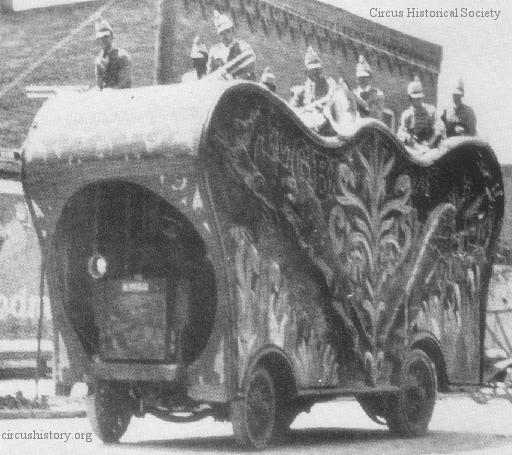
Since my first article on the little known Barnes Electric Bandwagon was published a year ago, I have tried to get a photo of it in actual parade, since the known pictures of it were posed, and none showed it in use as a parade feature.
After reading my article, old reliable Bill Woodcock wrote to me to say he believed he had a photo of this wagon in parade at home in Hugo, Oklahoma, but since he was in California with Rudy Bros. Circus it seemed I was to be foiled again.
But not to be stumped by time I waited till Bill returned to his home at the end of the season and wrote him again and he came up With this photo.
The story of this photo is this; Bill received this photo from a Connie Schilperoot of Allegan, Michigan who either took the original picture or acquired it, as it is dated July 14, 1916, Allegan, Michigan. Perusing Barnes route for the year 1916 I found the show routed in Michigan for July 12, Coldwater; 13, Three Rivers; 14, Allegan; 15 South Haven so the date on the photo is correct and it must be assumed the photo was taken during the parade that day.
I believe this was the first bandwagon built that was motor powered and Mr. Cook who built it at Winterquarters the winter of 1915-1916 was quite an original artist. Imagine any of todays motorized shows with a downtown bally of this kind; it must have been something to see.
In conclusion I want to give photo credit to Mr. Schilperoot and thank Bill Woodcock for advancing little known circus history. [Note: see Bandwagon, March-April, 1958 article.]
There always was a clamor for bigness, and the agents who could make the most preposterous claims were in demand by the circuses to help proclaim their real and imaginary attractions. But there are circuses content to remain small. They are always billed as three rings but only once or twice during the show do they use them. Most all the acts take place in the center ring. The days of the big top holding over five thousand are gone. First place, the big lots are gone in the large cities and towns. Almost everyone has a car so again it would take a lot twice the size of the circus for parking, Then again television did not help any. Once you have seen it on television most people see no reason to go to the circus. Only true circus fans can go every week to the same show and enjoy each performance but the American Circus will never die, why? because each year there are over half a million new babies born and to the circus they must go to see lions, tigers, elephants, and all other animals. Only a few zoos can afford to keep them. The small traveling shows are on the go working in town under the auspices of some local organization. This is good for the show for under such a set up the organization has to supply the lot, license, fire protection, and cooperation of the police.
So let's go back to the circus era in and around Montgomery County here in Pennsylvania. The Barnum Circus and the Forepaugh Circus, mostly nineteenth century aggregations used to show Norristown, travel in horse drawn wagons over the roads, then in the 1880's using railroad trains.
The shows playing a Monday date always let the public in for two shows. Sunday the towns people turned out to see the unloading and erection of tents without the great hustle usually caused by one day stands. But there was always trouble even in those days of the great circus era. In 1885, Barnum Circus was to show Norristown on May fourth. This was on a Monday so several Clergymen went to Burgess John H. White to enforce the strict Sunday observance, wanting them to wait until Monday before unloading the train. At this time Barnum had the great "Sacred White Elephant," so early Sunday Burgess White was on the scene himself to view the unloading. Of course, throngs of spectators hoping to get a look at the elephant free of charge, were at Mill Street Station to watch the unloadings. By seven o'clock all equipment was on the lot at Marshall and Stoney Creek. By ten o'clock in the morning the tents were unfolded and up. The circus had arrived. Burgess White stayed on to see there was no disorder. This circus came to Norristown at long intervals. Such a visit was an outstanding event in a child's life so David Scahll, a member of school board, on May first meeting moved the public schools be closed circus day. His motion carried through with only three objections.
The great street parade on Monday was something to see; horses drawing beautifully carved circus wagons in gaudy colors, wild animals, dozens of gold chariots, band music and a herd of elephants followed by the steam calliope. Then two shows were given in two rings and a stage. The circus day was looked forward to and long remembered.
O'Brien's Circus came to town that same season but at a much later date. Professor W. W. Dill, a big shot of the town and patent medicine manufacturer, was leader of Sunday closing endeavor. Professor Dill went to the lot and waited until several tents were up then with action much more vigorous than Burgess White warned them if any more were erected they would all be arrested. Work ceased for the day.
John O'Brien was bucking the big circus with only one ring. He had a wonderful street parade which brought the people to the lot. His prices were much lower than the big shows; twenty-five cents admission to all with free admission to the clergy.
The first time the Barnum Circus played Norristown was April 1874. This show had played West Chester traveling in wagons all the way. Heavy rains had soaked the ground for days, the primitive roads or highways were hub deep in mud for all waggons. Getting in late at two o'clock, they had to omit the street parade. After showing here they left for Hazelton only to run into rain all the way. Conditions were too bad to show so the schedule date was abandoned and they returned to New York.
The next time Barnum Circus hit town it was 1907, and the show ground was Main and Forrest Avenue.
When the show was consolidated with Ringling Bros. they showed in West Norriton township May twenty-third, 1924. Their train unloaded at Ford and Lafayette Streets. It was a four mile haul to the lot.
Around 1880 Norristown had a treat to see the first electric illumination on Cooper, Bailey and Hood Circus, The papers played up this as much as the wild animals and acrobats, With a twenty horse power engine, a forty horse power boiler along with two thousand yards of insulated wire. Eighteen electric chandeliers served to light the big top. All this equipment cost fifteen thousand dollars.
Robert S. Hood lived in Norristown at 1046 DeKalb Street. Later his family lived on a farm in Penn Square. The show wintered on the Northeast side of Germantown Pike from Swede Road to Stoney Creek. After eleven years he sold his interest in the show to James L. Hutchinson. Not too long after it became part of the Big Barnum Circus. Hood died in Norristown at his home in 1896.
On August two, 1880, W. C. Coup's New United Monster Shows played town with its new electric light. Also featuring Ritchell's Flying Machine.
On October twelve, 1853, at Swede Street about Oak Street, R. Sands and Co. Circus showed. Their ads promised "Brilliant Illumination At Night With A Portable Gas Chandelier."
Dan Rice showed at Eschbach's Hotel Barbadoes and Main Street, His pig which he performed with was seized for debts. But later returned by citizens of the town who liked the show. For this Dan Rice took these folks for a ride in his wagon which he owned with a pair of fine matched horses.
Isaac Snacely, a town tobacconist opened a small circus and was the circus acrobat under the name of Professor Leopold. This show played Norristown in 1903 and 1904 at Franklin Avenue and went under the name of Leopold's Great Shows, Mammoth Museum and Colossal Vaudeville Carnival.
General Tom Thumb showed Norristown on May second and third 1849 at the court house. Price was twenty-five cents, children under ten, twelve and one half cents.
Hatboro
Adam Forepaugh's wintered in Hatboro in the 60's. In December 1867 Williams, a Canadian in charge of the elephant Romeo, had her out for a walk when she grabbed him and fell upon her knees killing him. This caused a great stir. The people said the elephant had to be punished so they took her out and beat her with clubs and pitchforks keeping this up until she squealed thinking this would stop the killer instinct in her But much to their sorrow she died a few days later from the injuries. The keeper, Williams, was buried in the Hatboro Methodist Church yard. To this day his grave remains unmarked.
Editor's note:
Arthur Speltz, one of our younger members in the Circus Historical Society sent in an ad to be run in the Jan-Feb. issue of the Bandwagon including photos from various circuses. He mentions Schmit's Circus, and as neither the Editor nor her husband had heard of this we wrote to Art inquiring about this circus, and here is his reply:
On August 5, 1960, I drove to Clark's Grove, Minn. which is a few miles north of Albert Lea. When 1 reached town, I found the show set up in the town park. After looking around the lot, I found out that the show moved on 4 trucks. They were older models Chevs. They were painted red on the bottom half of the sides with the upper half painted white. Most of the trucks (4) had a map of Africa in black on the truck sides with "Circus" lettered in yellow. The four small house trailers were the some color scheme but were not lettered.
Next I walked up and down the main street. The show had most of the stores displaying window cards and lithos. These were picked up by the show personnel later in the day. The whole town seemed to be in a circus mood, and the Clark's Grove Business Men's Club who sponsored the show were very happy with this.
When I returned for the evening show (the only show) I was surprised by the large crowd on the small midway and around the whole Circus in general.
The Main Entrance to this show was truly unique. It was one of the four house trailers. It was placed with its long side facing the street. This house trailer had a circle of electric lights around the outside of it. Also it advertised the various animals, and the other acts in the show. Inside the house trailer was fitted out for selling tickets. There was another door on the far side of the trailer so you could get out.
Once outside of the ticket trailer I come to the small midway. It consisted of a few ball games, one souvenir stand and two of the other trucks were fitted out as shows. One was a Fun House, the other an animal show.
After I walked in the small big top I was really surprised by the arrangement of things in it. The Show had a respectable number of animals for a small Circus. In the end of the Big Top they displayed their little elephant, lion, bear, monkeys, snake and ape. The people liked the animals and had a good time feeding the elephant.
The show got underway at 8:00 p.m. It featured acts such as, tap dancing, ballet, unicycle, clowns, whip act, juggling. A trained dog was not able to take part because of illness. This show may not sound like much but the tent was "strawed" with many standing in the back. Music was by records.
After the show, members of the show were out selling cotton candy, etc., running the pit shows on the midway.
This show is run by the Schmidt family of Watertown, South Dakota. There is a father, mother, two daughters, two sons. They all take part in the show and help set up the tents.
This show has not played around our part of Minnesota for a few years. It plays only the smaller towns.
After the night show was over they started taking down the tent. They remained in Clarks Grove all night. Next day they moved to Hartland, Minn, about 10 miles away, They put their tent up in the afternoon so there is only a night show.
I hope you have enjoyed this article, and it you ever have a chance to see them, don't miss it,
George E. Holland was born April 25, 1875 and died December 17, 1960. He was a son of George F. and Kate Holloway Holland, His father was born on a farm near Delavan, Wisconsin and become a noted bareback rider and circus owner. Kate Holloway was an English equestrienne, George E. followed in the footsteps of his illustrious parents, becoming a performer at the age of thirteen. He trouped for the next fifty years and came to be known as one of the all time great bareback riders. He joined the John Robinson Circus in 1889 as a center ring rider, at the age of fourteen.
In 1894 Mr. Holland met Rose Dockrell and married her in 1901 when she, too, became a featured bareback rider on the John Robinson Circus.
The senior Holland, George F., was the first man ever to perform a backward-forward somersault on a galloping horse. (In this feat the rider faces the horse's rump and somersaults forward.) Romeo Sebastian, who is often credited with being the originator of this act, told George E. Holland that he, Sebastian, learned the trick from the senior Holland. The latter routinely performed the backward, the backward-forward, the forward-backward, and the forward somersault on the backs of galloping horses. He and Mr. Stickney, another noted rider, become friendly rivals and often strove to out-perform each other. On one occasion they were both playing in St. Louis when the circus owner (George E. remembered this to be John Robinson but of this he was not sure when in his late years re related the incident to us) arranged for a contest between them. It was announced that each would see who could turn the most somersaults on the back of a galloping horse before a fall broke the consecutive string of one of them. These were not to be performed in a single performance, nor were Holland and Stickney to perform simultaneously. Stickney missed after 18 somersaults: Holland turned 44 before he fell. The younger Holland, George E., turned 56 such somersaults while playing with the John Robinson Circus about 1900 and in the succeeding years approached this record on many occasions!
Rose Dockrell's father was born in England but lived much of his life in our country. He was the equestrian director of the Barnum and Bailey Circus at varying times for a total of twenty-five years, first joining them in 1872. Rose's mother was considered by many critics to be the greatest female bareback rider ever to grace a circus ring. Many of these, among them E. F. Alby, maintain that Mme Dockrell was a more talented performer than the world famous May Wirth! The daughter, Rose, was herself a petite, pretty, graceful, talented rider.
After their marriage in 1901 George and Rose Holland trouped as a team and won many laurels and the plaudits of thousands. In 1902 they trouped with the John Robinson Circus. In 1903 they joined the Walter Main Circus in mid-season but left before its close because they disapproved of some of this Show's policies. They went to California and signed with the Sells Downs Circus for the balance of the 1903 season During the next four years (1904 thru 1907) they were featured artists with the Norris and Rowe Circus. Thereafter George and Rose chose to play chiefly fairs and winter shows, interspersing these dates with vaudeville appearances. They played the famous New York Hippodrome the season of 1913-14. In 1933 and 1934 they trouped with the Seils-Sterling Circus out of Sheboygan, Wisconsin, and in 1935 were with Jack Hoxsey. The following season they went out with the Frank Hall Circus. The Hollands, with a trunkfull of tributes and myriads of memories of brilliant successes, closed their career with the St. Louis Police Circus in 1937, returned to their farm near Delavan, Wisconsin, and shortly bought a pleasant home in nearby Darien. Rose still lives in this home.
A Tribute to George E. Holland
By Sverre and Faye Braathen January 13, 1961. Bandwagon, Vol. 5, No. 1 (Jan-Feb), 1961, pp. 22-23.
We first met George and Rose Holland in 1948. That year marked the centennial of Wisconsin statehood. We had sought to persuade the Ringling-Barnum Circus to play Delavan that summer. This small but beautiful city in southern Wisconsin was at one time the circus capital of this country. In 1847 the Maybie Circus chose it as their winterquarters, and thereafter several other shows did likewise. For three or four decades virtually every resident of this community was either directly or indirectly connected with one or another of these circuses.
The Ringling-Barnum executives felt they could not hazard to play so small a community, so we prevailed upon Mr. Zack Terrell to arrange for his Cole Bros. Circus to play the date. The citizens of Delavan were delighted and went all out to cooperate in this venture. In store windows there were lavish displays of circusiana, with George and Rose Holland probably contributing more items than anyone else. Desiring to learn if perchance they would be interested in disposing of their collection, we contacted the Hollands. There followed a delightful friendship. We have spent many happy hours in their home and have sat enthralled as George has related incidents of his fifty years of trouping as a headline attraction with circuses and fairs and in vaudeville.
George Holland was a man of rare integrity, possessed of a wonderfully retentive memory, and a splendid sense of fair play. He would never belittle a fellow performer but he would frankly express his opinion as to the relative merits of the talents and artistry of various individuals whom he had seen perform during his career of a half century. Born into a famous circus family and married into yet another and living his entire life in a community rich in circus history, George was naturally steeped in the lore of Spangleland, To spend a Sunday with him was to step on to a magic carpet for a few hours, and we were privileged to be thus transported back thru the years on many happy occasions. For this and the friendship of George and Rose Holland we shall be forever grateful.
We shall always cherish the memory of George telling us of their last appearance. It was in 1937 with the Police Circus in St. Louis. George, a tear in his voice and dew in his eyes, said: "I can still see us as we followed our horses from the ring and down the hippodrome track after that final performance. I remarked to my Rose, as I watched the nodding ostrich plumes and the glittering rhinestones in our horses harness, 'This is the end, Rose. You and I are through trouping forever.' " Then, mindful of his emotion-filled voice and his tear bedewed eyes, he turned to us and said, "it was so when I made that remark to my Rose."
No part of this publication may be reproduced in any form or means
Last modified December 2005.
without written permission of the author and the Circus Historical Society, Inc.