


Circus Historical Society
Bandwagon, March - April 1960
Back to Bandwagon Index
Bandwagon, Vol. 4, No. 2 (Mar-Apr), 1960. Note: Only some articles are included in this online edition. Not all illustrations are included. Scroll down for the article you are looking for in this issue. The Circus Historical Society does not guarantee the accuracy of information contained in the information in these online articles. Information should always be checked with additional sources.
The Sells Brothers Circus enjoyed a long and successful career and built up a fine reputation from the early eighties combining with the Adam Forepaugh Show in the nineties.
The Sells Brothers title was sniped at several times. Willie Sells was enjoined from meddling with it in 1905 in his dealings with Tammen and Monfils. The Court held that though he was a Sells brother, he could not use the Sells Brothers title for another Circus but was not prevented from using his own name Sells. Consequently, the title of Tammen and Floto show became Sells-Floto. Otto Floto was sports writer on the Denver Post.
A hand bill dating Rocky Mount, North Carolina, Tuesday, October 14 exploits the merits of the Sells Circus - titled Sells Circus Combined with the Floto Trained Wild Animal Show. It seems to have been challenged by a competitive show in the South at the same time. The Bill headlines "The great Circus bargain of the season - presenting more sensational acts, more ballet girls, more trained wild animals, more high priced jumping horses, and more spectacular events that all the smaller circuses combined."
It guaranteed to present in every city and town visited in the South, the very some performance that it presented for three weeks in Chicago last Spring. "Presented daily under the personal supervision of one of its owners, Mr. Zack Terrell, a resident of Owensboro, Kentucky. Another one of the owners of the famous Sells Circus, is Mr. Ed. Ballard of Miami, Florida."
No mention of the Show has been found in the Billboard and few circus people even recall this title. It sounds like Sells-Floto. Zack Terrell was its manager in 1924 but Ballard had no connection with Sells-Floto. If it was not Sells-Floto, it would be interesting to know where this Show came from into the South, October 14 - what year, and where did it go from there? Inquiries have been made of several Circus Historians including the late George Chindahl.
The perpetual calendar shows October 14 on a Tuesday in the years of 1913, 1919 and 1924. Which one of those years is the question. Circus routes in the Billboard for 1924 have Sells-Floto in the South at Rocky Mount, North Carolina, Tuesday, October 14. That would indicate that the Sells Circus named on the handbill was really Sells-Floto. Zack Terrell was its manager in 1924. Ballard had formerly been associated with Mugivan, Bowers and Terrell and possibly loaned his name with that of Terrell.
However, if the Show was really Sells-Floto billed in Rocky Mount as Sells Circus and Floto Wild Animal Show, what could have been the motive? Sells-Floto was second in size to Ringling-Barnum and nationally known in the Circus field since 1910. Competitively, surely it could better stand on its own name and reputation than Sells Circus.
In 1924, Sells-Floto tour of the South was rough on opposition. The Billboard reports that a feud developed between Sparks and Sells-Floto. Charley Sparks accused the Sells-Floto Billers of posting over Sparks paper and Sells-Floto claimed that Sparks covered theirs first. The result was a Court order preventing both from interfering with each other. Maybe the "Rat" sheet used in Rocky Mount was aimed at Sparks opposition? It could be they thought the old Sells Circus had more appeal in the South which was Sparks territory.
So much for 1924. Let's take October 14, 1919. Zack Terrell then was a young man under Jerry Mugivan. Mugivan liked grift and Terrell in those day didn't turn away from it. Wouldn't it be rather fitting for Terrell and Ballard to frame a small show for the Summer and Fall of 1919 for the sole purpose of getting some of the cotton and tobacco money in the South - using a faked title to oppose Sparks and John Robinson?
Perhaps somebody in Rocky Mount, North Carolina or elsewhere in the South remembers or has heard of Sells Circus. If so, please send comment to Agnes King, Editor of the "Bandwagon."
P. T. Barnum and J. A. Bailey were equal owners. Barnum died April 7th, 1891.
Manager - James A. Bailey
Treasurer - Merritt Young
Secretary - Benjamin Fish
Superintendent - Frank Hyatt
Trainmaster - Byron Rose
Supt. Canvas - Chas. McLean
Supt. Baggage and Stock - Dave McKay
Supt. Ring Stock - Wm. Smith
Supt. Menagerie - Geo. Conklin
Supt. Elephants - Wm. Newman
Supt. Properties - Wm. White
Equestrian Director - Wm. Ducrow
Four Advance Advertising Cars (4)
Baggage Stock Dep. - Supt. Dave McKay assisted by Tom Lynch and Jos. Hannah.
4 - 8 Horse Drivers; 10 - 6 Horse Drivers; 32 - 4 Horse Drivers; 2 - Pull up Drivers.
Dining Department - W. T. Campbell, Proprietor and Manager, evidently a concession in those days.
Barnum's Military Band-Prof. J. S. Robinson conducting with 29 musicians in band.
Side Show Band - G. D. Rossia conducting with 9 men.
1891 Parade List
|
1. Drum Corps
2. 24 Mounted Ladies 3. 40 Mounted Gents 4. Cage 50 - Tigers-open 5. Cage 51 - Lions-open 6. Cage 52 - Leopards-open 7. Cage 53 - Wolves-open 8. Gold Band Chariot (Band) 9. 24 Mounted Ladies 10. 40 Mounted Gents 11. Cage 54 - Panther den-open 12. Cage 55 - Bear den-open 13. Cage 58 - Hyenas-open 14. Cage 45 - Tableau Chariot. (Band) 15. Cage 63 - Tableau cage 16. Cage 64 - Tableau cage 17. Cage 65 - Tableau cage 18. Cage 66 - Tableau cage 19. Cage 67 - Tableau cage 20. Cage 68 - Tableau cage 21. Chimes Chariot 22. Lady Jockeys 23. Men Jockeys 24. Roman Race Riders |
25. 3-2 Horse Racing Chariots
26. 3-4 Horse Racing Chariots 27. Green Band Chariot (Band) 28. Cage 69 - Tableau cage 29. Cage 70 - Tableau cage 30. Cage 72 - Tableau cage 31. Cage 73 - Tableau cage 32. Melechoir Organ 33. Two Trapped Elephants 34. 12 Led Elephants 35. Dragon Chariot drawn by 4 Camels 36. 14 Dromedaries 37. Clown Cart 38. Cage 46 - Tableau Chariot (Band) 39. Cinderella Chariot 40. Sinbad the Sailor Chariot 41. Red Riding Hood Chariot 42. Old Woman in Shoe Chariot 42. Jubilee Tableau Chariot 44. Santa Claus Chariot 45. Mother Goose Chariot 46. Blue Beard Chariot 47. Steam Calliope |
Note: The following is taken from a carbon copy of the original, sent by the Neumann Tent and Awning Company, to the Hagenbeck-Wallace Circus. All spelling is the same as it appeared on the original. There were some pencilled notes, which we have shown in this article by the following: (Note - etc.).
Many of our members have expressed an interest in an article of this type, and we are more than pleased that Bob Bernard has been able to furnish us with this. An extra word of "Thanks" to him.
Neumann Tent & Awning Co.
1419 Carroll Avenue
Chicago, Ill.
Sept. 10, 1924
Contract Season 1925
Hagenbeck-WaIlace Circus
West Baden, Ind. Gentlemen - We submit the following quotations
Big Top
160 ft. R. T. made in 6 pcs. of 9 sections each with 3 - 50 ft., middles made in 6 pcs. to lash at ridge with laps.
Material: - Top Boyle's 8 oz. drill, Sidewall Boyle's "AA" drill. All rope to be best grade Plymouth.
Rain ropes at all lacings. New style quarter poles with reinforcement pieces on outside and triple patches inside. Bands for quarter poles do double. Thimblesen bands 8" back. Top made with 16" extension eaves with sidepole holes to have patent irons which are to be leathered with russet leather and sidepole irons to have loop for sidewall lamyard. 14" beckets on all lacings using 12 thread rope on some and 1 3/4" rings for lacing holes. 8 ft. long clear lash ropes in thimbles on bands & lacings - Double guys at every sidepole. Round end pieces to have 5 spool patches on each piece with center patch to be 1/2 way between ridge and eave and balance of ropes in line. Spool patches on middle pieces arranged with 3 full patches in center and 1/2 patches on outside at lacing. All patches to be well sewn and to have 2 rings sewn in with patch on outside and to splice a 1/2 red rope 9' clear in each spool patch. Sew 1" ring on down rope at sidepoles placed 1/2 way between rim and first band on middles and on first pole rope in from lacing on all round top pieces. All middle pieces to be made with 2 large and 2 small quarter pole holes. The rain roped bands to be stiched down or seized where they cross. No anchor or brace guy ropes. Seizing at sidepoles on eave rope to be well done. Bale ring lasher ropes to be 1" rope 16' long.
Roping to be as follows:
Eave rope 7/8
Up & down ropes on main ropes at sidewalls 3/4
Up & down ropes on Extras 5/8
Band ropes 24-27-30 th.
Main pole sideguys 7/8 cut 30'
Main pole sideguys 3/4 cut 33'
Extra side guys between sidepoles 3/4 cut 33"
Ridge 4" belt rope
Downhanks for 27 & 34 ft. quarter poles.
Bale rings 26"
Distance between bottom row of quarter poles to be 27 ft. on the ground starting from inside rim rope on extension eave. Distance between large and small quarter poles to be 25'6 ground measure. Top to have 8 band sand bottom of hood to be roped. All material to be used in top Boyle's 61/2 oz. drill. Hood to be 12 ft. deep. All side pole guys to be spliced into thimbles at eave. All Hardware to be galvanized.
Scalloped border around top at eave to be 1/3 width deep which includes the scallop. The extension eave is to be inside of the 160 ft.
Sidewall 13 ft. high in 11 pieces with 2 pole laps. roped all around and to have 1/4 width band through center sewn 3 times. Made as follows:
Five (5) pieces 13 sections or 14 pole pieces
Five (5) pieces 8 sections or 9 pole pieces
One (1 ) piece 8 sections or 9 pole pieces
Sidewall lanyards 15 ft. Bottom ropes 12th 4 ft. long. Wall to be stencilled both upper corners B T and with number of poles in large letters.
Price - $7980.00
Big Top Marque
30 x 30 Big Top Marque, 13 ft. sidewall, made for 2 center poles, 6 ft. netting on both sides, made of Boyle's 8 oz. drill all through. Lettered "Big Show Main Entrance price $225.00
The inside of marque to be trimmed in red and made attractive.
Partition for marque made of red duck and lettered 35.00
All Must Have Tickets. Doors open 1 and 7 P.M. Children under nine years of age 50 cents
Menagerie
80 ft. R. T. with 4-40 ft. middle pieces. Top Boyle's 8 oz. drill (Note - 5 Middles OK)
13 ft. sidewall made of Boyle's AA drill and made with red band in center and to have 2 pole laps. Wall to be lettered.
Top made with regular eaves with patent irons to be leathered.
Downhauls at all sidepoles. Thimbles at eave with sideguys spliced into same and to large enough for marque ropes.
14" beckets for lacing. Price $3065.00
Sideshow
70 ft. R. T. with 2-40 ft. middles Top Boyle's 8 oz. drill.
Made with extension eaves. Made for 14 quarter poles
Quarter pole holes to be lacings.
12" beckets on lacings arranged with one long becket in center and bottom.
12 ft. sidewall made of Boyle's AA drill. Made with 2 pole laps. Sidewall to be lettered. Price $1912.65
Sideshow Marquee 20 x 10 Top made of Boyle's 8 oz. drill
12 ft. sidewalls 1/2 widths red & white. Price $60.00
Dressing Room
(Note - 60 ft.)
55 ft. R. T. roped every 4 widths Top Boyle's 8 oz. drill. Made for 16 quarter poles. One in each round end and on lacings and in center of middles. All poles holes to be leathered and to lap at lacings. Laps over all Lacings.
Made with 3 - 30 ft. middle pieces.
All quarter pole holes to be arranged so as to use 14 ft. troughs. 12" beckets on all lacings.
10 ft. sidewall made in 5 pieces as follows
Round end pieces to be 2-11 sections Khaki
1 piece 12 sections for back made of Boyle's AA drill
2 pieces 6 sections for front made of Boyle's AA drill
This will give 2 pole laps on sidewall.
Downhauls for Troughs, Also for all poles. Price - $1500.00
8 Horse troughs 14' made with 10 pockets. Price $30.00 each - 240.00
1 Pony trough 14' made with 10 pockets - 30.00
Dining Tent
45 x 112 1/2 Hip roof square ends
18 widths wide x 45 widths long. Top in 3 pcs. to lace with lap over lacing. Roped every 3 widths.
Rain ropes at lacings. Top made push pole style
12" extention eaves. Made for 6 center poles.
7 ft. sidewalls made loose to snap to top
Wall made of Boyle's AA drill
Marque 14' wide 7' deep with 7ft. wall, striped.
1 partition 8 x 47' 6" roped Made of Boyle's AA drill
Price - 750.00
Kitchen
30 x 30 Hip roof end tent Top Boyle's 8 oz. drill
Made for 2 center poles
7 ft. wall in 4 pieces to snap to top and lace at corners made of Boyle's AA drill. 250.00
Canopy
Made 12 widths wide and 15 ft. deep. Top Boyle's 8 oz. drill made for 3 center poles and lo side poles leathered.
7 ft. wall on the 2-15 ft. sides sewn on made of Boyle's AA drill. Price - 90.00
Dishwashers
12 ft. (5) widths x 15 ft. (6 widths) made for 1 center pole and 8 side poles Top Boyle's 8 oz. drill roped
7 ft. wall sewn on 2 sides and back made of Boyle's AA drill. No front wall. Price 70.00
Stables
2 Horse tents 34x70 Gable ends. Tops Boyle's 8 oz. drill Top made in 2 pieces to lace with laps over the lacing 16"' extension eaves. 12 beckets on lacings. Center poles 6 widths apart and side poles 3 widths apart. 7 ft. sidewall in 4 pieces to snap. Made of Boyle's AA drill. Downhauls for troughs and all poles.
Price each $443.78 - 887.56
1 Horse tent 34x85. Top in 2 pcs. to lace otherwise as above - Price - $525.10
18 Horse troughs 14 ft. with 3 boxes. Price 480.00
Blacksmith
20x20 Blacksmith top. Boyle's 8 oz. drill. Made for 12 sidepoles. No sidewall - Price 100.00
Wardrobe
20x20 Square hip roof tent. Top, Boyle's 8 oz. drill. Made for 1 center pole and 12 sidepoles. 7 ft. wall in one piece to snap to top Khaki drill 125.00
Candy Tents
3 Candy tents 12x12 square hip roof for 1 center pole made of 1/2 width red & white duck. Blue trimmed. Made for 1 lo ft. Center pole and 7 7 ft. sidepoles, 7 foot sidewall in one piece to snap to top and go around 2 sides and back, No front wall. Price each $72.50 - 217.50
Connection Walls
2 pcs. 18 ft. wall 6 sections (7 pole). Roped with 18th rope. Lettered B. T. Conn. Made of Boyle's AA drill. Price each $60.00 - 120.00
1 pc. 13 ft. connection wall 13-4 width sections. AA drill roped with 5/8 rope, lettered D.R. Conn 130.00
4 toilet tents, 7x7 One center pole 6'6" wall 8 oz. drill with ventilators in top. 110.00
1 Red & white curtain 12 ft. wide x 13 ft. high, solid red with rings on top to slide on iron bar 20.00
1 pc. canvas 4'6"x 19' for entry door with ropes 13.00
Hopeing to receive your order, we remain, Yours truly Neumann Tent & Awning Co. By C. A. Neumann, Pres.
Accepted Hagenbeck-Wallace Circus by H. E. Sarig, Asst. Secy
Down in this left hand corner written in pen and ink. Prices based on -
Boyles 8 oz. Drill 29 cents
Boyles 6 oz. Drill 24 cents
Boyles AA Drill 18 1/2 cents
Rope 17 1/2 cents
Labor 90 cents hr.
According to the adding machine tape attached to the original letter the amount of the above tents come to $18,936.31. However, down in this right hand corner appeared - Rec'd ck. for $18,000 in full of above items. Signed by Edw. Neumann. No Date.
Neumann Tent & Awning Co., 16 N. May Street Near Madison, Chicago, Ill. March 14, 1925
Hagenbeck-WaIlace Circus, Peru, Indiana
Gentlemen:
We delivered on March 12th to the Taylor Street Warehouse for your account the following:
Eight (8) Bundles containing:
Marque for Big Top
1 - lettered partition for same
40 ft. middle for 80 ft. Round top
3 - 12x12 Candy Tents with 4 pcs. of sidewall in each
2 - Ends and 1 Middle Piece for Dining tent
4 - Pcs. 7 ft. sidewall for Dining tent
1 - Pc. of canvas 4'6"x 19' to be used for entry door
2 - Red & White 13' sidewalls to be used as connection Wall from Big Top Marque to Big Top when Menagerie is torn down.
1 Red & White curtain 12' wide x 13' high with rings on Top to be used in closing entry door.
1 Pc. Red & White canvas 10' wide x 13' high to go back of band stand.
1 Pc. of 13' connection waIl 13 - 4 widths sections long
2 - Pcs. 13' connection wall 6-4 widths sections long each
The Warehouse advised us that they would send the Warehouse Receipt to you direct, although we tried to get it to send to you but their rule is that the receipt must be sent to the parties for whom the goods are stored.
Assuring you of our appreciation of having been favored with your order which we were glad to give every attention, trusting that you may find everything satisfactory as we have made every effort to make the best outfit we have ever turned out in the hope that it may secure us your order for next season, we remain
Yours very truly, Newmann Tent & Awing Co., EPN:VFC, By Edw. Neumann
Forty years ago in the winter of the 1919-'20 period there were 39 circuses and wild west shows listed as in quarters. These were scattered across the country from Connecticut to California. Of these titles not a single one is in quarters this winter. The only title still before the public is the Ringling-Barnum one though it is not laying off as it did in that period.
The shows with managers and headquarters follows -
Arp's American Circus, Emil A. Arp, manager, Davenport, Iowa.
Atterbury Bros. Wild Animal Circus, Lancaster, Missouri.
Backman-Tinsch Trained Wild Animal Circus, John T. Backman, manager, San Antonio, Texas.
Al G. Barnes Trained Wild Animal Circus, Phoenix, Arizona.
Frank Belmont's Wild Animal Arena, Oxford, Pennsylvania.
Robert W. Butler's Trained Animal Show, Friday Harbor, Washington.
Carlisle's Frontier Wild West Show, R. C. Carlisle, manager, Catskill, New York.
Christy Railroad Show, Galveston, Texas.
M. L. Clark & Sons Show, Alexandria, Louisiana.
Carl H. Clark's Trained Animal Circus, Carl Clark, manager, Chambersburg, Pennsylvania.
Cole Bros. Shows, E. H. Jones manager, state fairgrounds, Shreveport, Louisiana.
Cook Bros. Circus and Wild West, D. Clinton manager, Trenton, New Jersey,
De Blaker's Dog & Pony Show, John De Blaker, owner, Patterson, New Jersey.
Gentry Bros. Houston, Texas.
Great Sanger Circus, Floyd King, manager, Memphis, Tennessee.
Hagenbeck-WaIlace, Bert Bowers, manager, West Baden, Indiana.
Geo. W. Hall's Shows, Wm. P. Campbell, manager, Evansville, Wisconsin.
Honest Bill Show, Ada, Oklahoma.
K Bar Wild West, Bill Penny, manager, Denver, Colorado.
Lamont Bros. Shows, C. R. Lamont, manager, Salem, Illinois.
Lowande's American Circus, Oscar Lowande, manager, Reading Massachusetts.
Lowery Bros. Show, Geo. B. Lowery, manager, Shenandoah, Pennsylvania.
Lucky Bill & Honest Bill Shows, Quenemo, Kansas.
McGill's Wild West, Col. McGill, manager, Red Lion, Pennsylvania.
McKenney, Blanche-Hunter Combination, Shelbina, Missouri.
Walter L. Main Circus, Andrew Downie, proprietor, Havre de Grace, Maryland.
Maloon Bros. New Model Shows, Coonie Maloon, manager, Union City, Indiana.
Miller's Wagon Circus, H. R. J. Miller, manager, Wilton, Wisconsin.
Monroe's Eastern Circus, Ed E. Myhre, proprietor, Grand Meadow, Minnesota.
Rippel Bros. Shows, Gus Rippel, manager, Orange, Virginia.
Ringling Bros.-Barnum & Bailey Combined Shows, Bridgeport, Connecticut.
John Robinson's Circus, Jerry Mugivan, manager, Peru, Indiana.
Rhoda Royal Circus, Augusta, Georgia.
Silver Family Show, Bert Silver, manager, Crystal, Michigan.
Sells-Floto Circus, H. B. Gentry, manager, Denver, Colorado.
Sparks World Famous Shows, Chas. Sparks, manager, Macon, Georgia.
John R. Van Arnam's Circus, J. R. Van Arnam, proprietor, Northville, New York.
Wild Bill's Wild West & Old Cheyenne Frontier Days Combined, Hall & Roby, managers, Lancaster, Missouri.
Yankee Robinson Circus, Fred Buchanan, manager, Granger, Iowa.
Some shows were enroute all winter.
Boone's Circus & Wild West was at Clayton, Oklahoma, December 18.
Convey's Circus was indoors at Milwaukee, Wisconsin, December 20-28.
America has many celebrities whose deeds in war and in peace are, so far as the masses are concerned, confined to books; there is one, however, who so thoroughly belongs to his time as to virtually live daily with the people whom he so well served and that is Colonel William F. Cody, known to his generation and destined to be remembered as "Buffalo Bill." This American notability comes not alone with his story from the historic scenes in which he figured, but with the very atmosphere of the plains, the once wild west, the Indian with the camping ground and buffalo hunt, accompanying his work. The battle in which, nearly forty years ago, a young scout killed an Indian chief whose atrocities had marked the advance of civilization with horrors untold, is more than a matter of history to the public even to this day, for the scene is daily and nightly being re-enacted by the very scout who was the leader in that fight. Aided by the art of the first class performance and emphasized by the magnetic fact of the original scout in the saddle, the scene is among the most telling of modern realistic presentations.
If there were no other features in "Buffalo Bill's" wild west than his own appearance, and the real pictures of the scenes in which he won fame, and his place in the affection of the American people, the performance would easily have first place among amphitheatrical exhibitions. But from the first feature, which grows in interest, until the audience sees rough riders of every nation assembled as if they walked out of history, and out of scenes from Fonteney to Waterloo, from Moscow to Gettysburg, from the sands of Africa to the Valleys of Wyoming, the exhibition is entertaining. Thus the play becomes at once educational in a dramatic sense, and this generation owes it to a time in which it lives, to see and know as much as possible of the strong lives and splendid daring which reduced the wild west to the empire of peace and prosperity that it now has become.
It is a historical fact that in 1869, after months of arduous trailing and pursuit, the command of Major General Eugene A. Carr, with "Buffalo Bill" as chief of scouts, ran down, surrounded, and surprised the then most desperate band of red maurauders that roomed the plains, named the "Dog Soldiers," renegades from different tribes under the command of Chief "Tall Bull." The battle that ensued was a bloody one, and most disastrous to the Indians, many being captured, over one-hundred killed and wounded (left on the field) and the rest scattered: their herds of horses, tents, provisions and equipage taken and the guiding spirit, "Tall Bull," killed by Chief of Scouts Cody. This battle scene is vividly represented, as well as details of Indian primitive life on the trail and in the camp; the surprise attack and the victory, is one of the main features of the season's exhibition.
It is more complete in detail than any picture of the old time western life yet presented and has been witnessed in New York and Washington by many army officers who figured in the engagement and will always live in history as Carr's great victory at Summit Springs.
The program this year is replete with many novelties, notably Ray Thompson's trained Texas Horses, a game of football on horseback, the Union Pacific train holdup, besides all the well known features. At La Crosse August 19th.
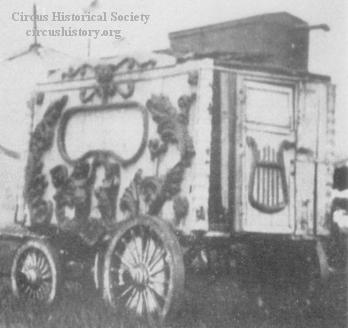 Photo No. 1 - Air Calliope on lot, Al G. Barnes Circus, about 1928. William Woodcock Collection.
Shown in photo no. 1 is the air calliope on the Al G. Barnes Circus about 1928. This particular wagon is the last air calliope to appear on that show. Barnes had at least three other air calliopes earlier, including one mounted on a truck.
The wagon was built in the early 20's, sometime after the 1920 season. Bill Woodcock was on the Barnes show in 1920 and reports that the show had two air calliopes that season, both on the show at the same time, but that this one had not yet appeared. It is believed that the air calliope shown in the illustration was built at Barnes quarters in Venice, California in the winter of 1920-21. At that time several new parade wagons were constructed using carvings obtained from the Bode Wagon Works of Cincinnati. If this assumption is correct then 1921 would be the first season on the show for the new air calliope. In parade it was drawn by a pony hitch. It continued on the show even after parades were cut out in mid season 1924, and we have reason to believe it remained on the show through the 1928 season, which was the last one the show was under the ownership of the late Al G. Barnes.
The circus was sold to Bert Bowers, representing the American Circus Corporation (Jerry Mugivan, Bert Bowers, and Edward Ballard) on January 5, 1929 for $150,000. Most historians think the air calliope was carried on the road in 1929, the only season the show was operated by the Corporation. In September 1929 all of the five circuses owned by the American Circus Corporation were sold to John Ringling. Some observers place the air calliope on the Barnes show in both 1930 and 1931, although photographic proof seems to be lacking. Agreement seems to be unanimous that by 1932 the wagon was retired and was probably dismantled at the old Baldwin Park, California quarters.
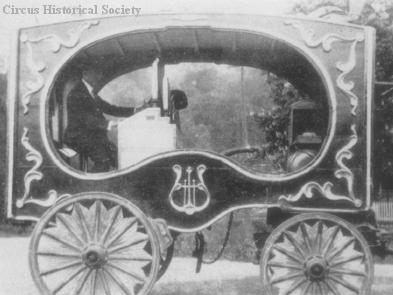 Photo No. 2 - Air Calliope, Sparks Circus, 1928. J. V. Leonard Collection.
The air calliope shown in photo no. 2 is quite well known to most circus photo collectors and can readily be identified as the Sparks calliope used in the 20's. The wagon was built by Moeller Brothers of Baraboo, Wisconsin along the lines of those previously built for Ringling Bros. and Gollmar Bros. circuses. C. P. Fox has a photo showing the wagon in a group of newly constructed Sparks cages and baggage wagons standing outside the Moeller shops in 1921. It should have been delivered to the show in time for the 1921 season. The instrument was manufactured by Joe Ori, calliope builders.
The calliope was used in the fine street parades the Sparks Circus, owned by Charles Sparks, put out on through the 1928 season. In the fall of 1928 after the show had returned to winter quarters in Macon, Georgia's Central City Park, Sparks sold the circus to Henry B. Gentry, well known showman who with his brothers had operated the Gentry Bros. Famous Shows through the 1916 season, and following that had managed the Sells-Floto Circus for a few years for Tammen and Bonfils. It soon developed that Gentry was only acting as an agent for the American Circus Corporation, to whom Sparks had repeatedly refused to sell. For the 1929 season Gentry managed the show for the Corporation and the street parade was continued. It was the first regularly scheduled street parade for one of the Corporation circuses since 1925.
Ownership of the Sparks show as well as the other circuses the American Circus Corporation had passed to John Ringling in September of 1929. The show returned to Macon quarters following the season and Ringling sent Ira Watts to take over the management of the show for the coming 1930 season. The street parade was discontinued and Watts sent the show's steam calliope to the Ringling-Barnum quarters in Sarasota, but the rest of the shows parade equipment, including the air calliope, was taken on the road in 1930. All of the tableau and bandwagons were of box type construction designed to carry a load anyway, so the show was not impeded. The air calliope took up very little train space and it was worth that for the ballyhoo benefit it provided.
Following the 1930 season the Sparks show went into quarters with the Ringling-Barnum show in Sarasota. For 1931 the show was cut down from 20 cars to 15, and the bandwagons were stored with the excess equipment in Sarasota, however the air calliope remained on the show. It was used to house the recorded "canned" music apparatus the show used in 1931 in lieu of the traditional circus band. After the 1931 season the Sparks show was taken off the road and the equipment was all stored in the fields of the Ringling-Barnum quarters in Sarasota. In a few years of inactivity the Florida sun and rain had reduced the wagons to dry rot. About 1938 all of them, including the air calliope, steam calliope, bandwagons nothing was spared - were burned and the scrap iron salvaged. What disposition, if any, the Ringling management did with the air calliope instrument is not known.
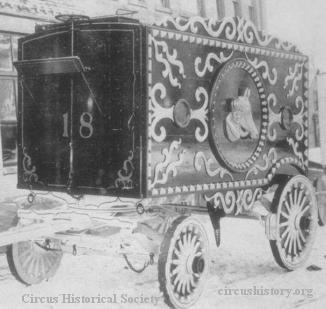 Photo No. 3 - Newly constructed Clown Bandwagon for Sparks Circus standing outside Moeller Bros Wagon Shop in Baraboo, Wisconsin, 1921. C. P. Fox Collection.
The third photograph pictures the Clown Bandwagon used on the Sparks show in the 20's. The wagon with carvings featuring a horse's head and jockey was built by Moeller Brothers in Baraboo about the same time as was the air calliope. My records list 1922 as the first year for the wagon on the Sparks show. It was used in parades as the clown bandwagon on through the 1929 season, and as previously stated although street parades were discontinued in 1930 the wagon was carried on the show being used to carry various properties. Following the 1930 season when the show was cut down in size the wagon was stored in Sarasota. It was included of course in the wagon burnings about 1938.
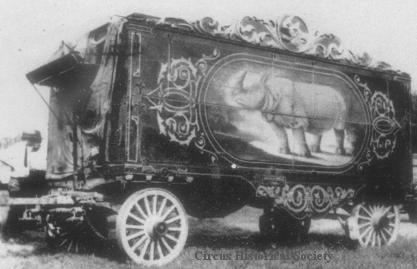
This photo was taken around 1920 on the Ringling Bros. and Barnum & Bailey Circus. The Ringling Barnum dens of that era were beautifully painted and gold-leafed. This cage carried the male Indian "Armored" Rhinoceros named Bill. The Barnum show first exhibited Bill around 1907 and he died at Fort Worth, Texas during the 1926 season.
No part of this publication may be reproduced in any form or means
Last modified January 2006.
without written permission of the author and the Circus Historical Society, Inc.