


Circus Historical Society
Bandwagon, November - December 1959
Back to Bandwagon Index
Bandwagon, Vol. 3, No. 6 (Nov-Dec), 1959. Note: Only some articles are included in this online edition. Not all illustrations are included. The Circus Historical Society does not guarantee the accuracy of information contained in the information in these online articles. Information should always be checked with additional sources.
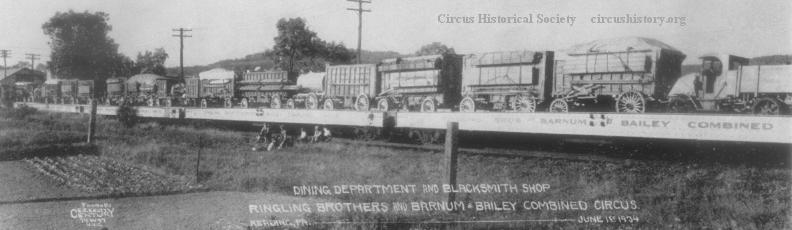
The loading of the Ringling Bros. and Barnum & Bailey Circus train has been a fascinating subject to most circus fans through the years and continues to be so even now that it is no longer a flat car type show.
In 1919 and 1920 Ringling Bros. and Barnum & Bailey carried tableaux wagons and gave a street parade. I have very little information on the numbering system in use in those days. But from 1921 on, the show became pretty well stabilized and there were only minor year to year changes in the numbering system of the wagons. So it was possible to become quite familiar with the equipment.
Beginning in 1935 rubber tires began to be used on some wagons, there were more trucks and similar modern touches began to appear. Then in 1939 North began to upset things around the show and modernization crept in to the point where the show lost much of the interest of circus fans. The wagons were changed around and used for different things, new ones were built, numbers changed and so on. But during the 1920's and most of the 1930's the show was in its hey day and tops in interest as for as the fans were concerned.
A 1932 train loading list is printed with this article and the wagons are typical of this period of the shows history, probably the finest baggage wagons ever built for any show and also a first class group of cage wagons. The Big Show was one of the last to abandon 60 foot wooden flat cars but in the late 1920's they took delivery of forty steel 70 foot Warren flat cars. The stock cars had been 72 feet in length for the entire history of the Combined Shows, I believe.
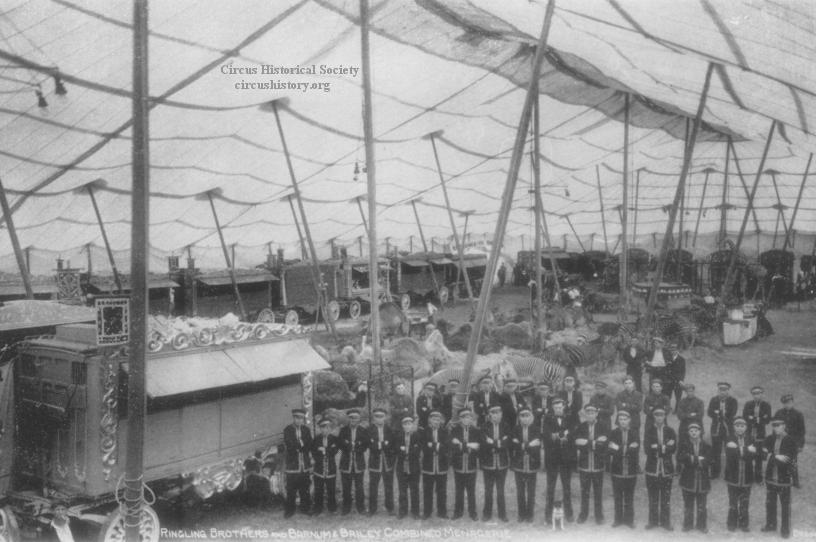
While the show traveled in four sections there were no flat cars on the fourth section. The first section was called the Flying Squadron and carried the layout gang and stake drivers as well as the cookhouse, blacksmith shop and baggage stock tents and equipment, plus the menagerie top and the cages loaded on 15 flat cars. Three cars of baggage stock plus four coaches for the personnel made a total of 22 cars for this section which left town by 11 p.m. as a rule.
The third section flat cars were loaded next and carried wardrobe, props, trunks and the seats. The work of loading the second section flat cars began before all the wagons were on the third section flats. The second section flats carried the side show, most of the concession department and the electrical department as well as big top canvas, poles and rigging. Also ring stock tents, dressing tents and some of the props. When the last of the second section flats were loaded the baggage stock was loaded. Five cars traveled on the second section and three on the third. Coaches on the second section carried the personnel with this section. The second section left town as soon as it was loaded, by about 1 a.m.
The third section carried two stock cars that held what could be called supplies and extras. Last year's big top, some extra tent poles, plus lumber of various sizes to repair wagons, seats and so on. Also some steel for use by the blacksmith shop in making repairs. Additional supplies of stock to be sold by the concession department were carried in these cars as well as some hay, oats and bran used to feed the stock. Coaches on the third section housed personnel traveling with it. The third section left town within an hour after the second section, which was unloaded before the third section, upon reaching tomorrows town.
The fourth section carried the elephants, which did practically no work as long as the show carried baggage stock. Also the menagerie lead stock, camels, zebras etc. These were loaded as soon as they began tearing down the menagerie which was as soon as the evening performance started. The ring stock also went on the fourth section and went down to the cars soon after the evening performance was over. The fourth section coaches housed the performers, executive staff and others connected with the performance end of the show. The fourth section usually left town within an hour after the third.
During a part of the evening, after the big show performance was over, the second and third section flat cars were being loaded at the same time. So the trainmaster had quite a bit of choice in loading the wagons as they came down to the runs. So one night some of the wagons might be loaded on the second section and the next night they might be loaded on the third section, or vice versa. Important wagons that would be needed as early as possible the next morning were of course loaded on the second section. This would apply in particular to stake and chain wagons, big top pole, rigging and canvas wagons and so on.
Probably all 40 of the flat cars were never loaded exactly the some way twice, as wagons of the same length could be interchanged and some wagons were even loaded on different sections. But wagons carrying important equipment were always loaded on the proper section. In quite a few cases several wagons were usually loaded together. For example No. 49 almost always followed No. 58, with a 16 foot wagon behind it to fill out the car. Also No. 32 and 33 were practically always loaded on one car and they just filled it. No. 119 and 120 were usually loaded together with a third wagon to fill out the car. The show carried three ticket wagons and one was carried on each of the first three sections as a rule.
Back in the 1920's the show had some Mack and some Pierce-Arrow tractors but by the late 1920's all the latter had been replaced with Macks and as time went on a few more were carried than they had in earlier years. About three of these usually went on the first section and the rest of them on the second.
The No. 125 wagon was built to haul Pawah the White Elephant between the runs and the lot in 1927 when he traveled with the show so that the towners wouldn't get a free look at him. It had a double drop frame similar to a giraffe wagon. In 1928 and for some years afterward it was used for props and trunks. Toward the end of the 1930's it become the No. 109 menagerie trapping wagon, or "meat wagon" as it was popularly called.
In 1928 Goliath the Sea Elephant was featured on the show and he required two wagons. Both had stakes along the sides similar to a jack wagon. No. 151 was 18 feet long and was used to haul Goliath around, for his appearance in the big top and also between the runs and the lot. No. 154 was 16 feet long and had an enclosed portion covering about the front third of the wagon to house a water pump. The open portion behind this carried the canvas tank that was set up in the backyard that Goliath stayed in between performances. The pump was used to empty the tank before it was rolled up and loaded on the wagon. Both these wagons went to the Sells-Floto show when Goliath was a feature on S-F in 1932 for its last season. No. 151 was rebuilt into the Frigidaire polar bear float on Hagenbeck-Wallace in 1934.
While No. 62 was not on the show in 1932 it was a trunk wagon similar to No. 59 and 60 and was used most seasons after that. No. 98 was a 16 foot dog wagon that had been with the show most seasons prior to 1932. Soon after 1932 more illumination was needed for the big top so another light plant was added, No. 126, just like 111 and 112. Another baggage wagon to load an automobile into was needed so No. 140 was added, almost identical to 141.
In the early part of the 1920's when R-B presented cat acts in steel arenas the performing cats were housed in cage wagons kept in the backyard. These were numbered 140 to 150 inclusive and varied in length from 16 to 24 feet. These cage wagons, as well as the two for the sea lions, were loaded on the third section. Incidentally, in those days they didn't use chutes for the cats to run through on their way to the steel arenas as Clyde Beatty and Terrell Jacobs did in the 1930's. Some seasons cage wagons about 14 feet long pulled by a two horse team were used to bring the cats into the steel arenas. Other seasons smaller cages about 10 feet long and mounted on pneumatic tires were used for this purpose. A large group of prop boys pulled and pushed these wagons in and out of the big top. Some seasons three steel arenas were used, one in each ring, while other seasons four were used, one on each stage.
Originally the three water wagons No. 102, 103 and 104, all had round tanks. About 1930 two new wagons were built with square tanks. Although they were a bit shorter their capacity was greater than the old wagons. These two new wagons were numbered 102 and 104, I believe 1936 was the last season for these tank wagons as a number of Mack tractors were equipped with water tanks by that time so took their place.
If anyone has any information on cages with numbers 68, 72 or 75 in years prior to 1935 the writer would be most interested to hear about them, or about any corrections or additions to this list or these remarks.
Even though there have been no circus wagons in actual use anywhere in the country for several years now, there are a few in museums at various locations. It is doubtful if we will ever have a flat car type circus on the road again. "Gone, but not forgotten" would apply here. A circus wagon is one of the finest things ever built by man and they live on in the photo collections and in the memories of all circus fans who were fortunate enough to see them, back in the "good old days."
Train Loading List for 1932
First Section
Stock Cars No. 10, 11, 12 Baggage Stock
Flat Cars - Baggage Cut
109:
Cage Cut.
101:
Second Section
Stock Cars No. 13, 14, 15, 16, 17. Baggage Stock. Flat Cars.
116:
Third Section
Stock Cars No. 18, 19, 20 Baggage Stock. No. 32, 33 Supplies & extras. Flat Cars.
140:
Fourth Section
Stock Cars No. 21, 22, 23, 24, 25 Ring Stock. No. 26, 27 Menagerie Lead Stock. No. 28, 29, 30 Elephants.
Coaches No. 81 Louisville, No. 82 Des Moines, No. 83 St. Louis, No. 84 Cleveland, No. 85 New York, No. 86 Worcester, No. 88 Los Angeles, No. 89 Seattle, No. 90 Washington, No. 91 San Antonio, No. 100 Jomar (private car).
Summary
Stock Cars, Flat Cars, Coaches, Totals
Advance: - , - , 2, 2
1st Section: 3, 15, 4, 22
2nd Section: 5, 11, 6, 22
3rd Section: 5, 14, 4, 23
4th Section: 10, - , 11, 21
Totals: 23, 40, 27, 90
A total of 145 pieces loaded on 40 flat cars for an average of about 3.6 pieces per flat car. The lengths given for the wagons are the actual lengths of the bodies, not the space taken up on the flat car.
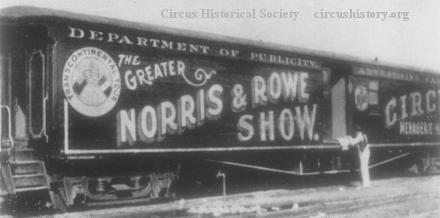
Norris & Rowe was a circus household name soon after the turn of the century. It grew from a small beginning with a few dogs performing in theaters to a railroad show in the 20-car class.
This title remains in the memories of some of our elder members because it was the first show they ever saw.
Originating on the Pacific Coast it early made transcontinental tours. It was advertised as a western show, “The Pride of the West."
It had a fast growth during nine years, only to meet a sad end at the hands of the auctioneer in 1910.
On March 4, 1889 there was billed for the opera house in Provo, Utah for afternoon and nite performances, Prof. C. Norris' Canine Paradox. In this would be seen 25 wonderfully educated dogs. This was claimed as the most wonderful attraction of its kind in the world. Every child attending was promised a beautiful autograph of Fritz "king of dogs," "who does 56 tricks and actually tells the time of day."
During the 90's the name of Norris appears in advance notices of several shows playing Iowa. He was to present trained dogs and ponies.
In 1898 the title was Norris Bros. Peerless Dog and Pony show when it appeared in the theater at Riverside, California. One advance press story read "The unusually successful program of Prof. Norris includes a military drill by four ponies, bareback riding dogs, goats and monkeys; a minstrel first part in which 30 dogs take part." The date was March 14.
Enlarged it returned under the same title March 4, 1899. The papers said the street parade was a creditable one with Fargo the baby elephant monopolizing the attention of both old and young. "The pretty little vehicles offered a free ride for many home boys" it continued.
In 1901 it was termed the Norris & Rowe Trained Animal Show. Just where Rowe came from I have never been able to ascertain. I doubt he was any relation of Andrew S. Rowe, proprietor of the Rowe Pioneer circus of gold rush days of the 50's in California.
That year the show featured the monkey fire department. These simians with their miniature fire fighting equipment came dashing into the tent in vehicles drawn by ponies. Another number was the Society coach. In this little buggy rode a big dog and his family. When the party reached the center of the tent one wheel always come off. A big baboon got out and replaced the wheel. The prices were 15 cents and 25 cents. Snowflake was advertised as the handsomest and only pure white Shetland pony in all the world.
Bill Tait had the band in '01 and the show traveled on 3 cars, one being a new 60 foot flat.
Don Marcks, whose father was an ardent circus collector, believes the show was a five car outfit when it played Pittsfield, Mass. August 12, 1902. Chic Newton was the band leader.
He has an old throwout inherited from his father. On this the Norris & Rowe Big Shows is described as "Positively the greatest congress of genuine novelties in the world." This is of yellow paper printed both sides in black ink. It was termed "The bright particular exhibition all try to imitate, prices 15 cents and 25 cents; performances at 2 and 8 p.m." Snowflake was still featured.
Bill Woodcock, the circus historian, tells me he believes the Cozag dog and pony show that has been reported on was a Norris & Rowe show No. 2. It was a two car show that played mostly in Northern California, Oregon and Washington. It never reached my part of the country, Southern California.
Winterquarters of the Norris Bros. circus in winter of 1900-1901 was at Oakland, California. After that most of the winters were spent at Santa Cruz, California. Old timers remember the show, not exactly the title. A few years ago when the Clyde Beatty circus was playing in that area some asked us "Is this the show that stopped in Santa Cruz years ago?"
In 1902 two similar shows were enroute, Gentry Bros. and Norris & Rowe, both dog and pony shows. The two clashed at Helena, Montana. The western show felt that the eastern outfit was invading its territory.
It had commenced to emerge from the dog and pony class in 1904. When it played Fort Dodge, Iowa, August 16 it was advertised as the Norris & Rowe two ring circus with elevated stage and hippodrome track. It was then prosperous claiming to have a big double menagerie. There were promised performing animals of all kinds, 20 clowns and 100 startling acts.
It had added a few more railroad cars. It encountered a wreck in early Spring in the mountains of California. This was caused by a snowslide as the show was enroute from Marysville, to Reno, Nev.
That was the year Prince Mungo, sometimes billed as South Sea Joe arrived. He was advertised to present his Torture Dance. This was given in the side show. He was a feature around there for years on the show lot and in the parade. He was killed while on the Sparks show.
Oscar Landmesser, an old timer now living in Pomona, California, was with it about that time. He recalls how at La Crosse, Wis. a camel would not cross a bridge. The keeper threw a sock over the animal's head and it walked over without any objection. On another occasion a big colored boy was hanging sidewall. He looked down to see a lion loose at his feet. He grabbed a piece of canvas threw it over Mr. Lion, who was quickly caught.
The Norris & Rowe show pioneered that route used by all later western shows. It would get an early March opening in California, head up the Pacific Coast into Canada working its way East to re-enter the United States in August or September. Then head south and west to close in California late in the Fall.
In 1905 it opened near San Francisco in March. Routes in old Billboards show that September dates were Austin, Minn., 20; Hampton, Ia., 21; Oelwin, 22, West Union, 23; Independence, 25, Vinton, 26; Tipton, 27; Washington, 28; Seymour, 29; Gallitin, Mo., 30; Queretaro, Mexico, Oct. 25; Pachuca, 26; Mexico City, Oct. 28-Nov. 5.
Among the advance crew were Josh Billings, Joseph Eble, both later well know circus men; J. C. Stuart was local contractor.
When a date was filled at Brantford, Canada, August 4, 1905 it was advertised as "Norris & Rowe's New Big shows. The Pride of the West" "The great tented amusement that fulfills every promise A multitude of new features never before presented in America."
The bareback riders were said to include Rose Dockrill, Estelle Settler, M'lle Julian, George Holland, Austin King, Wm. Dutton, H. Joe Lyons, Herbert Rumley.
Acrobats, gymnasts and mid-air performers; seven marvelous Belfords; Melotte, La Nole & Melotte; Flying Victorellas; Daring Aerial Weavers; Five Flying Banvards; Famous Gariner Family; Graceful McDonald trio; Six Sugimoto Japanese. Animal acts were to include a herd of elephants, congress of seals, dromedaries broke to harness, trained pelicans and pigs; 20 jolly jesters headed by "Cheerful" Jim West; Happy Bill La Rue; The Grotesque Olipans; Tote Duckrow.
A grand and glittering parade was scheduled for 10:30. Prices had been changed to 25 cents and 50 cents; one ticket to everything.
D. C. "Pop" Smith was the bandleader.
Billboard of Sept. 25 tells of Wm. La Rue closing at Stratford, Canada to join the Otto Floto show nearby.
During these years the circus was prosperous, growing fast. The Beggs Wagon Works of Kansas City built some old type tableau wagons and cage vehicles. Photos of these are rare collectors' items today.
It was about this period or a year previous that Walter Shannon arrived to assume charge of the concessions and side show. He was to play an important part in the operation of the circus a few years later. He made a strong opening and turned the crowds to see the untameable lion act in the side show. I can see and almost hear him today as he stood on the bally stand.
In the side show about that time I remember were Lentini, the three legged man, later to become nationally famous and Laloo, who had a female appendage growing out of his chest.
The latter was killed in Old Mexico in 1906 when the circus suffered a serious wreck. It really never did fully recover from that.
Bill Russkamp of Cape Girardeau, Mo., says it played his town. He doesn't remember the year. Must have been 1904 or '05. He recollects it was a good show. There were some games in the side show.
That was about the time they advertised the Indian, Ros Indicus in menagerie with "every act a feature and every feature new."
Although the show for years was strong on dogs it never had a dog wagon. These performers were transported in compartments built in one end of a coach. It was a noisy bunch of animals barking as the cars stood on a side track on arrival. Good advertising. They were added to the lead stock to give more publicity as they traversed the route to the lot.
In 1906 when it exhibited at Ft. Smith, Ark., Sept. 12, it was termed The Greater Norris & Rowe Circus.
On the bill there would be 22 famous equestriennes, seven Russian Cossacks, 11 Arabian tumblers, a complete Japanese circus. Edna Maretta, a somersault rider and Austin King, famous jockey and hurricane rider, got top billing. Mr. King was to gain fame later on the Al G. Barnes show as a horse trainer. He came from Corte Madera, California. Others advertised were The Marvelous Pickards, aerialists supreme, the Celebrated Stirk family of cyclists, the Le Fleur family of 10 ladies of faultless form in classic poses on a revolving table.
The show claimed to have three elephants, two llamas and the bos indicus, whatever that was.
The opening was at Santa Cruz, Calif., March 10, 1906. The route was the usual one. At Jerseyville, Illinois they advertised 42 cars, August 30. The show entered Old Mexico at Nuevo Laredo, October 11, played Mexico City Dec. 3, for a week. They returned to the United States at El Paso, Dec. 29. Enroute home one date was San Bernardino, Calif., Jan. 8, 1907. It was a long season over into two years.
In 1906 their bad wreck occurred in Mexico. The show never returned there for many stands.
The 1907 season began at Santa Cruz, Calif., March 30. The Sells-Floto circus, then in its second season, was in quarters at Venice, Calif. The Norris & Rowe show did not come to Southern California consequently. It made a quick trip North into Canada, picking up some dates in Southern California when it came back in the fall.
The show entered Canada at New Westminster, British Columbia, June 14. It was in Canada all summer except for two weeks in August when it was in Minnesota, Wisconsin and Michigan. It returned to the United States at Port Hope, Ontario, Sept. 28, closed at Santa Cruz, November 28.
At Barron, Wisconsin, August 5, they promised over 100 circus champions, the Stirk family of cyclists and roller skaters.
The show had a serious wreck near Saskatoon, Canada, where it was billed for July 3, 1906.
Evidently the management was feeling a financial pinch in the Spring of 1908.
Practically all newspaper display ads were the same as the year previous. No new acts were mentioned.
The show gave 44 performances in San Francisco between Jan 11 and February 2. The regular season under canvas started at Santa Cruz, March 18.
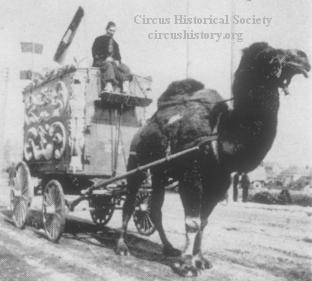 Charlie Puck photo.
Another hurried trip into the Northwest, took three weeks in Canada, coming out at Virginia, Minn., August 6. Thence west across North Dakota, Montana into Idaho, south across Colorado into Texas, then New Mexico and Arizona. The show crossed into Old Mexico for Cananea, October 16; Hermosillo, 18; Guaymas, 19. The closing stand was Salinas, Calif., Nov. 7. It had exhibited in 22 states and Mexico.
Prof. Betz had the band. Charley Haley, an old timer was with it. Mickey Feeley, the clown was also around. Harry Phillips did a Roman standing race and sold balloons and whips for Walter Shannon.
There had been friction for some seasons between wives of the two partners. By 1909 C. I. Norris was out of it. Walter Shannon had purchased his interest.
In February western newspapers carried stories to the effect that H. S. Rowe of the Norris & Rowe circus had, during the Alaskan gold rush, grubstaked a prospector. That individual had struck it rich in them their hills. He had come to the financial aid of the show and it would be on the road in 1909. No doubt that prospector with the gold was Walter Shannon.
This was the first circus in the memory of the writer to appear under the auspices of any lodge in Southern California.
It opened at Santa Cruz, March 11, playing Los Angeles 16-20. The Riverside date was under the Elks on the 25th.
The local evening paper said "Local members of the Elks lodge that brought the show here, were very conspicuous riding the animals and driving and riding on the beautiful wagons in the parade this morning. The crowd was big this afternoon and a larger crowd is anticipated tonight."
The show took its usual route up the Coast. The Sells-Floto show was a month behind with Wait paper up.
In Marshfield, Wisconsin, July 6 advance publicity promised a wealth of marvelous sensations, including Congo, greatest mountain of flesh, down to Baby Prince. The leaping tournament had been revived. "Men of the East as well as the West have been engaged."
One story said, "There will be held in Marshfield a contest between the acrobats such as the Banvards, La Verne and Lemayne troupes. The audience will select the winner. The prize will be a purse of gold and a diamond medal. These will go to the individuals with the most grace, skill and daring."
Walter Shannon had an ad in the Billboard for a lady bag puncher, a sister team and other outstanding acts and curiosities.
During the last full season the show was out 33 weeks and one day. It went as for East as New Brunswick, Canada, re-entering the United States at Huntington, Indiana. A bad blow hit the show at Princeton, Indiana, October 22 doing considerable damage to the property and injuring several.
It closed suddenly at Booneville, Oct. 28. Three towns were blown.
Chris Zeitz had come to the show from the Otto Floto outfit. He was in charge of elephants at quarters that winter. Several died, including Fargo, Bill Woodcock remembers.
There was no money in the red wagon for repairs that winter. Everything was in a run-down condition when the opening date was set for Evansville, April 15 and 16, 1910. No paint had been used.
C. E. Duble was with it in the band. Charlie Tinney was bandmaster with 22 real circus musicians.
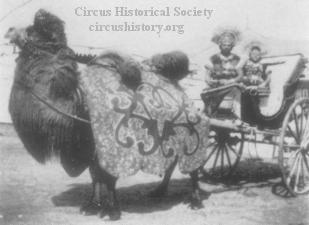 Charlie Puck photo.
Mr. Duble recalls the flats were the old 60 foot wooden type. They sagged with the weight of the heavy wagons. There was a new side show tent and banners. The rest was old. Mr. Duble says it made quite a spread. He remembers that Herbert Maddy was press agent on the show. He believes that Stick Davenport was equestrian director. Jack Albion was head clown.
Bad luck, poor weather, a shooting when the wardrobe mistress shot a towner for looking under the women's dressing tent, lack of money to move the show plagued the management.
The end came at Newport, Kentucky, May 9 when a printing concern to which the show owed money for advertising matter foreclosed. Everything was loaded and shipped to Ben Wallace's quarters at Peru.
Bill Woodcock says that the first sale announced for June 11 did not take place. It was on the third attempt that Wallace and W. P. Hall alternated in bidding and dividing the property.
Thus went down in history a popular show that grew from a few dogs into a strong and well known railroad show. The Billboard had carried ads in the winters of '05, '06, '07 calling for acts and 20 billposters.
C. I. Norris returned to theaters with an animal act. I saw him on the Foley & Burke carnival in 1915 with a Rhesus monkey show. In 1920 he was on the Al G. Barnes show with Norris' baboons. Bill Woodcock recalls that one of the animals walked down the hippodrome track on a pair of high stilts.
Billy Walsh of Rogers, Arkansas says he was with a California wagon show called Norris & Rowe in 1914. Mr. Rowe was with it. The show was framed at Richmond, California; opened at Pinole and closed soon at Willits. It carried no animals. Its life was so short that western circus fans don't know anything about it.
It seems to me that it was in the early 20's that a truck show termed Norris Bros. went out of Los Angeles. It didn't last long.
According to records H. S. Rowe was assistant manager of the Coop & Lent circus in 1918. Mrs. Rowe had the refreshment privilege.
Mr. Rowe in 1915 was called to assume the managership of the Hugo Bros. circus, replacing one of the organizers, Vic Hugo.
Walter Shannon spent his last days at his home on the outskirts of Santa Cruz, California. I visited him there in the mid-30's.
This article has been made possible through the help of Chas. Puck, Don Marcks, Bill Woodcock, C. E. Duble and others to whom I am very appreciative.
The Norris & Rowe circus always presented the public with a good performance from the dog and pony show to a big two ring circus.
Here is a copy of the 1910 program -
Display No. 1 - Introductory pageant.
Display No. 2 - Charge of the Black Hussars and the Gathering of the Garlands; statuary reproductions of the masters and gladiatorial groupings by the Walton troupe.
Display No. 3 - Ring No. 1.: Trained elephants by Chas. Zeitz; Stage: trained pigs by Miss Lillian Van Arken.
Display No. 4 - Vaulting, long distance jumping, headed by Dan O'Brien; Ring No. 2 - Performing Shetland ponies.
Display No. 5 - Miss Maude Earl and Miss Amy Albion; trapeze and rings - M'lle Ethelea and Miss Eleanore Moore, contortion and rings. M'lle Vernette Clark, swinging ladder; Miss Marjorie Albion, Roman rings.
Display No. 6 - Ring No. 1 - Miss Norma Davenport riding act; Stage - The clowns; Ring No. 2 - Miss Bessie Koontz, equestrian act.
Display No. 7 - M'lle Hortense and Edwin Foster, wire; M'Inotte La Nole trio, wire; Grandall Bros. and dog, acrobats.
Display No. 8 - Exhibition of Haute Ecole in rings and on hippodrome.
Display No. 9 - Equilibristic marvels, Ring No. 1 - Ejiska and Tots, contortionists; Stage - The Waltons, acrobats; Ring No. 2 - Coma and Moss, acrobats.
Display No. 10 - Stick Davenport and Norma, equestrian act in ring No. 1; Miss Bessie Koontz and Everett Grandall in ring No. 2.
Display No. 11 - Amy and Marjorie Albion, teeth artists and the clowns.
Display No. 12 - Equestrian acts, Merritt Belno and Chas. G. Clark. The above Merritt BeIno may have been Merritt Belew, who was later noted horse trainer on Christy Bros. and others.
Display No. 13 - Baker troupe, bicycle riders.
Display No. 14 - Ring No. 1 - A. M. Davenport, somersault bareback rider. Stage - Clowns; Ring No. 2 - Everett Crandall, somersault rider.
Display No. 15 - Hugh Melnotte, balancing; The Imperial Japanese troupe acrobats; Four Ishekawa Bros., acrobats.
Display No. 16 - Howard Melnotte, dancing ladder.
Display No. 17 - Captain Schmet's company of Fourteen Zouaves.
Display No. 18 - Clowns.
Display No. 19 - The Flying Da Comas and the Flying Moores.
Display No. 20 - Charles Clark and mule hurdle; Merritt Belno and mule; clowns.
Display No. 21 - Hippodrome races.
Mr. Duble remembers that among the attractions in the side show were Chief De Bro, Eskimo midget and wife from Kendallville, Indiana not Alaska, also the original Barnum's Zip. There was a good colored band and minstrels.
In the menagerie an aeroplane was on exhibition; something new to many.
Last Route
The route as furnished me for the short 1910 tour follows -
April 15-16 - Evansville, Ind.
April 18 - Henderson, Ky.
April 20 - Paducah, Ky.
April 21 - Hopkinsville, Ky.
April 22 - Central City, Ky.
April 23 - Owensboro, Ky.
April 25-26 - Louisville, Ky.
April 28 - Danville, Ky.
April 29 - Elizabethtown, Ky.
April 30 - Georgetown, Ky.
May 2 - Lexington, Ky.
May 3 - Winchester, Ky.
May 4 - Mt. Sterling, Ky.
May 5 - Morehead, Ky.
May 6 - Ashland, Ky.
May 7 - Maysville, Ky.
May 9 - Newport, Ky.
It was foreclosed here by a printing concern . It was billed to show the following, but had to cancel.
May 10 - Covington, Ky.
May 11 - Middleton, Ohio
May 12 - Greenville, Ohio
May 13 - Sidney, Ohio
May 14 - Urbana, Ohio
May 16 - Marion, Ohio
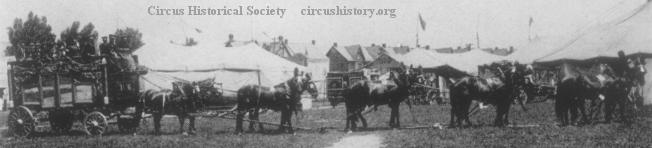
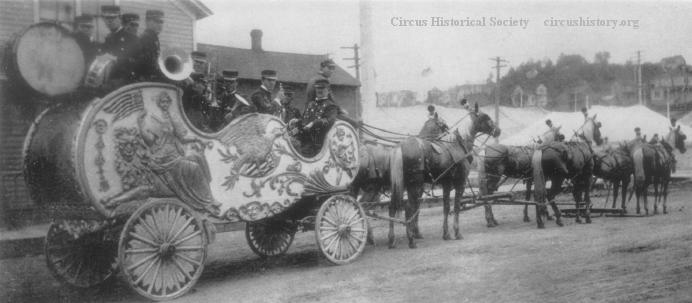
Photo No. 1 shows the Gollmar Bros. 4 mirror bandwagon, which is now permanently housed in the Baraboo Museum, and in time should become one of the best known tableau wagons in existence. The photo allegedly was taken on the Gentry-Patterson Circus period 1923-25. Some have noted on one of the baggage wagons in the background what looks to be part of the title of "Patterson's Circus" and suggest perhaps the photo was actually taken a year earlier on Patterson's Big 4 Ring Wild Animal Circus in 1922. I had noticed that also but can give no explanation with exception that it is a possibility. The photo come to me from the late A. Morton Smith who had it identified as Gentry-Patterson.
The 4 mirror bandwagon was built about 1903 for Gollmar probably by Moeller Bros. I would think that most likely it was delivered in time for the 1903 season, the first one on rails for Gollmar Bros. Greatest of American Shows, which was owned and operated by the Gollmar brothers of Baraboo, Wisconsin. All parade photos I have of that show picture this wagon as the No. 1 bandwagon. The Gollmar show, which had begun in 1891 as a mud show, after it went on rails and expanded it's territory soon became one of the most successful and best liked medium sized railroad circuses in the Midwest in 1916, the last season under ownership of the original Gollmar boys, the show traveled on 25 cars which included 2 advance, 6 stocks, 11 flats, and 6 coaches.
Following the 1916 season the show's equipment was sold to James Patterson of Paola, Kansas, who had operated carnivals for a number of years. Patterson also obtained a lease of the Gollmar title.
In 1917 the 4 mirror bandwagon led the parades of the James Patterson-Gollmar Bros. Combined Circus, but the show was out only one season. Following the 1917 season Patterson sold off some of the equipment but kept the greater part of it intact. During the seasons 1918 thru 1921 he used some of the bandwagons and calliopes on his carnivals for bally purposes. Just recently I saw a photo of the Gollmar 4 mirror bandwagon supposedly taken on Patterson's Carnival in 1921.
In 1922 James Patterson again put a circus on the road, this time under title of Patterson's Big 4 Ring Wild Animal Circus, which traveled on 1 advance, 4 stocks, 9 flats, and 6 coaches, a total of 20 cars. The Gollmar bandwagon again led the Patterson parades.
For the 1923-24-25 seasons the wagon was on the Gentry Bros.-James Patterson Circus. Following the 1925 season the 15 car show was sold to Floyd and Howard King, who had entered the railroad flat car type circus field in 1925 with their Walter L. Main Circus. The King brothers did shuffle some of the equipment of their two shows during the winter of 1925-26 but in 1926 the greater part of the Gentry-Patterson equipment went into the King's new Gentry Bros. Circus which toured on 10 cars, with one advance, 2 stocks, A flats, and 3 coaches. The Gollmar bandwagon went out in 1926 on the Gentry Bros. Circus and remained on the King's 10 car show through the 1930 season. The King brothers also operated a 15 car show from 1926 through the 1929 season. In 1926 and 1927 the 10 car show was titled Gentry Bros. Circus. In 1928 it was Walter L. Main Circus, and in 1929 and 1930 it was Cole Bros. Circus.
Cole Bros. went bankrupt August 30, 1930 at Scottsville, Ky. The equipment, including the Gollmar bandwagon, was then acquired by H. C. Ingraham and Bert Rutherford who moved it to Peoria, Ill. The proposed Ingraham and Rutherford Circus never got started and the Venice Transportation Co. of St. Louis took over the equipment to protect their mortgage.
In 1938 George W. Christy purchased the Cole Bros. 1930 equipment and had it shipped to his quarters at South Houston, Texas. The bandwagon as well as the other equipment was repaired and readied for the road. It was rumored that Christy was returning to the road with a rail show, however he never did. For some time he advertised the property for sale as a unit but no buyers took it. Following World War II Christy began selling off the old Cole equipment piecemeal and about 1947 the Gollmar 4 mirror bandwagon was sold to the Sutliff and Case Druggists Association of Peoria, Ill. They completely restored the wagon and kept it in good shape until it was sold to the Baraboo Museum last year. The museum of course has it fixed up very nicely now. It is painted red and gold and has the Gollmar title very fittingly painted on the skyboard.
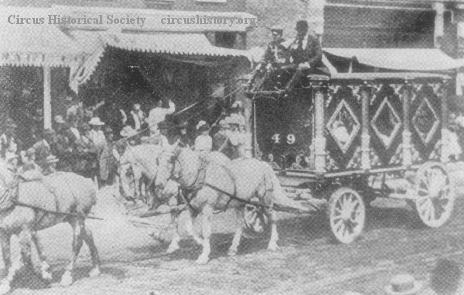
Photo No. 2 shows the 3 diamond mirror tableau on Gollmar Bros. Greatest of American Shows about 1910. This wagon was also a Gollmar original and was probably built by Moeller Bros. for the show about 1903. It was used on the Gollmar show through the 1916 season and in 1917 was on the James Patterson-Gollmar Bros. Combined Circus. In 1919 this wagon was sold by James Patterson to the Al G. Barnes Circus, along with some equipment and the hippo, "Lotus." The wagon was then used as a tableau wagon on the Barnes show for a number of years and I assume was used on through the 1924 season, which was the final one for parades on that show. In 1928 it was sold to the Studio Rental Service and some years later acquired by Jimmie Woods, who moved it to his place in Venice, Calif. Many fans saw it while at the Woods lot prior to 1951. In 1951 when Woods closed out his lot the wagon was moved with several other old Barnes wagons over to Jimmy Condon's junk yard nearby. A year later those wagons that could be salvaged were done so and were acquired by the Venice Chamber of Commerce. However the old 3 diamond mirror tableau was in such foul shape that it was destroyed.
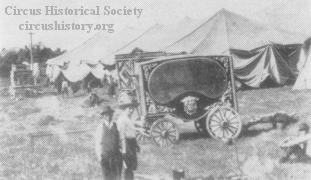
Photo No. 3. - Lot Scene Gollmar Bros. Circus about 1915, showing air calliope and 3 diamond mirror tableau. Joseph T. Bradbury Collection.
Photos No. 3 and 4 show the Gollmar Bros. air calliope. This wagon was built for Gollmar Bros. about 1913 by Moeller Bros. of Baraboo. It is quite similar to air calliopes also built by Moeller for Ringling Brothers and Sparks circuses. Evidently all were made from the same general pattern. The air calliope served on the Gollmar Bros. Circus from about 1913 through the 1916 season, and in 1917 was on the James Patterson-Gollmar Bros. Combined Circus. During the years 1913-21 it was owned by Patterson and it is quite possible it could have been used on one of the Patterson carnivals. This is just a possibility. In those days carnivals frequently used bandwagons and calliopes, both steam and air for bally-hoo purposes. For example in 1919 Patterson put the Gollmar Bros. steam calliope on the Patterson and Kline Carnival.
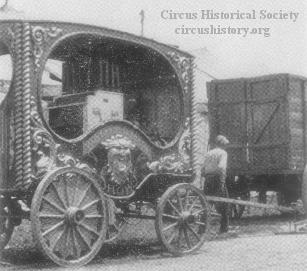
Photo No. 4. - Air Calliope on Walter L. Main Circus about 1926. P. M. McClintock Collection.
In 1922 when Patterson returned to the circus field this air calliope went on his Patterson's Big 4 Ring Wild Animal Circus, and in 1923-24-25 was on the Gentry Bros.-James Patterson Circus. After the Gentry-Patterson show was sold to Floyd and Howard King in the winter of 1925-26 they used it on their 15 car show for the 1926 through 1929 seasons. In 1926 and 1927 the King's 15 car show was called Walter L. Main Circus, and in 1928 and 1929 it was titled Gentry Bros. Circus. Gentry Bros. went broke in Paris, Tenn., October 22, 1929. The property was moved to Nashville and soon was taken over by the Donaldson Lithographing Co. of Cincinnati who held a mortgage on it. The show with exception of a few cars which were the property of the Warren Tank Car Co. was sent to the old Hagenbeck-Wallace quarters in West Baden, Indiana. Complete disposition of the Gentry Bros. equipment from West Baden has long been a mystery to me. Andrew Donaldson donated the steam calliope to the Ford-Edison Museum in Dearborn, Michigan where it remains to this day, and the Billboard reported that some equipment was sold to the Smith Carnival in 1930, and other equipment was sold to Andrew Downie, owner of the motorized Downie Bros. Circus. One Billboard notice did say the Downie Bros. got an air calliope, but this is believed to have been just the instrument as Downie Bros. at the time was using a very fancy decorated air calliope truck, and would have had no need for a railroad show wagon equipped with steel tired sunburst wheels etc. My guess is that the wagon was either destroyed or just finally rotted away at West Baden. If any fans can produce any data on the detailed disposition of the Gentry equipment, or should they have any photos taken of the Gentry property at West Baden please advise. We'd very much like to print the data and if we could borrow any photos would like to have them printed in this column at a later time. The photos of course would be returned in good condition.
Recently in this column it was mentioned that in recent years carvings off the old Al G. Barnes elephant tableau and the Barnes Cornelia tableau had turned up but that I had no knowledge of any carvings off the old Barnes No. 180 tableau still being in existence. Well, since then, I have been pleasantly informed that several carvings off this wagon are indeed in existence and all in good hands at present. C. P. Fox, CHS vice president, has the carvings of a horseman, which from the costume Fox says is evidently an Arab. Chet Slusser of Porterfield, Calif. well known model builder and fan in that area has a couple of cat carvings, and Gordon Borders, CHS member in Los Angeles has a carving of a dragon.
In the spring of 1884 the Wintermute Bros. New Colossal Shows left Hebron, Wisconsin winterquarters for their first season's tour. This colossal circus consisted of the three brothers and one wagon.
Thru the subsequent years it gradually grew into a 15 wagon show plus two advance wagons. This was in 1902. In 1917, after a life of 33 years, the show folded.
Harry Wintermute was a magician and ventriloquist. Brother Thomas was and acrobat and juggler while Brother Halsey handled the advance. Halsey Wintermute is still living on the homestead farm which served as winterquarters. For a man of 93 he has a clear mind and an interesting memory of his show days.
In talking to this showman he recalled many facts and incidents. However, after all these years, he was never quite sure of what season an incident took place. In spite of this shortcoming the story of this tiny circus is worth recording.
Halsey Wintermute said that at most they had 30 to 35 horses and 8 or 10 ponies. The largest tent they ever had was an 80 foot round top with two 30's. One winter they made their own tent by working 10 hours a day for three solid months. This gigantic effort, he commented, was done in the living room in which we were talking.
The circus usually carried 20 performers and 10 workmen. For a period of four years they had an elephant which they rented from Popcorn George Hall Circus in nearby Evansville, Wisconsin.
The bull, of course, walked from town to town. By late summer they were forced to put canvas boots on the elephant as her feet were getting tender from the gravel roads.
The show bought a camel one year and took it out on tour. After only a month on the road they were forced to sell it to a farmer in Iowa. The reason for the sale was the fact that the camel frightened practically every team of horses the show caravan met on the road. The runaways were expensive and kept their fixer busy.
This was always a 25 cent show. For a number of season they had a marionette show in their annex.
The title changed as did the titles of most circuses in those days although their Wintermute name was always in it. At one time the title was "Wintermute Bros. and the Great Melbourn Shows."
In 1910 the circus was called "Wintermute Bros. and Halls Big United Shows."
Around 1890 these boys called their circus "5 Big United Shows - Congress Of Educated animals and Museum of Living Wonders - Triple Arena, Wild Beast Bazar and Free Street Carnival." In this courier they advertised a horse fair. They said that no pictorial lies disgraced their billboards. In another spot they claimed theirs was the mastodon show of the universe. The courier said that they were the largest and best wagon show in the whole wide world.
Halsey Wintermute said he usually posted about 50 lithos in each of the big show towns and 10 to 15 in the villages.
Zella Wintermute, the boys' sister, married Popcorn George Hall's grandson, Frank.
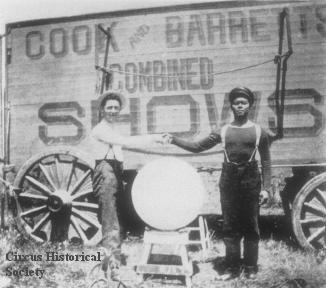
Geo. Jennier, Jr. and Fillipino Joe, performers with Cook and Barrett Shows - either 1905 or 1906. Ten car show, formerly Harris Nickel Plate Shows. Equipment leased from Wm. P. Hall, Lancaster, Mo., by Schiller Bros.
No part of this publication may be reproduced in any form or means
Last modified January 2006.
without written permission of the author and the Circus Historical Society, Inc.