


Circus Historical Society
Bandwagon, March - April 1959
Back to Bandwagon Index
Bandwagon, Vol. 3, No. 2 (Mar-Apr), 1959. Note: Only some articles are included in this online edition. Not all illustrations are included. The Circus Historical Society does not guarantee the accuracy of information contained in the information in these online articles. Information should always be checked with additional sources.
This paper will, in a measure, supplement my pamphlet The Affairs of James A. Bailey which was published in July, 1957. It is largely based on new information that has become available to me in the interim since that pamphlet was published.
Part I the European Show Train
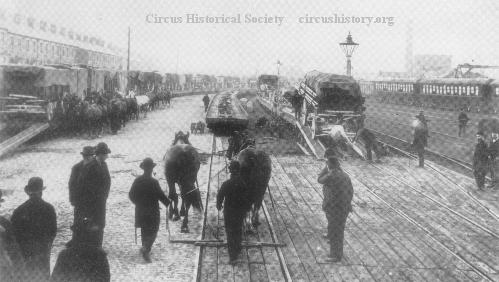
The source for this part is a 40-page pamphlet entitled "Barnum & Bailey Enroute, leur Systeme Special de Transport." This pamphlet was published by the show in 1902 for the purpose of acquainting the management and operating personnel of the French railways on how a show train is run. It contains, besides that which I have extracted for this article, the usual discourse on show train procedures such as the schedule of the advance car, the function of the 24-hour man, a detailed explanation on how the cars are loaded and unloaded, approximate dispatching time for each train, and the division of responsibilities between the show and railroad personnel.
The oval cross-section of the tunnels and the narrow bridges used on the European railroads compromised the optimum design of the show's rolling stock. Except for the advance car, which traveled in ordinary rail movements, the show cars were built with lower decks than standard European dimensions and both lower and narrower than American practice. Even with gaining this extra clearance, it was necessary to cut down the height of some of the cages and to take advantage of the additional tunnel height in the middle of the track to build the elephant and double-decked pony cars with rounded roofs in order to provide the minimum required standing room.
The entire train, with the exception of the advance car, used 28-inch wheels instead of the usual 37-inch European standard. The centerline of the draw bars were thirty inches above the track, which was about eleven inches lower than European practice. The show traveled in four sections, and the intercoupling of the cars in each section was made with American-type couplings. The fore and aft cars of each section were provided with special means to couple to European equipment. One of the illustrations shows this special coupling and the 11-inch offset. European couplings are not automatic and consist of spring-loaded, circular bumper pads projecting from the corner of the cars and a separate link comprising two hooks and a turnbuckle. To couple, a hook is attached to each car and the link is drawn up by the turnbuckle until the bumper pads are spring loaded in compression. While this is a slow process, it is possible that the decidedly smoother riding that is experienced on the European railroads is largely due to the minimizing of roll by the snubbing action of the bumper pads.
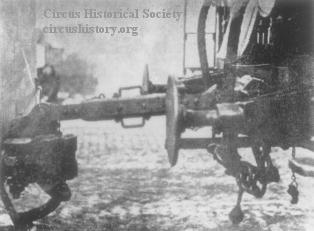
Special Linkage for Coupling European Cars
All cars were equipped with Westinghouse air brakes. The train was constructed in England by Messrs. Renshaw & Company of Stoke-on-Trent, but a consultant was hired from the Barney & Smith Company of Dayton, Ohio, to assist in the engineering.
Each car, regardless of type was 53 feet long and 8 feet, 2 inches wide. This narrow width made poling difficult on the flat cars and necessitated loading the horses at a slight angle in the stock cars. Since the early part of the century the situation seems to have changed, because I measured the width of a French railway car last summer and found it to be nine feet inside. Altogether, there were 67 cars, consisting of 35 flats, 18 stocks, I double-decked pony car, 3 elephant cars, 8 sleepers (including Mr. Bailey's private car), 1 baggage car, and 1 advance car.
Each section was made up as follows:
Section 1
3 Elephant Cars (1st with special coupling); 12 Flats; 1 Led Stock (special coupling).
This was the menagerie section. It was loaded first and always unloaded last so the lot lice would get a minimum of free show. Three flats were cut off this section when the show discontinued parading after the 1900 season. The parade equipment, including four tableaus, three bandwagons, and the Bell Wagon, were stored in Vienna for over a year.
Section II
1 Stock (special coupling); 7 Flats; 7 Stocks (ring stock); 1 Pony Car (special coupling).
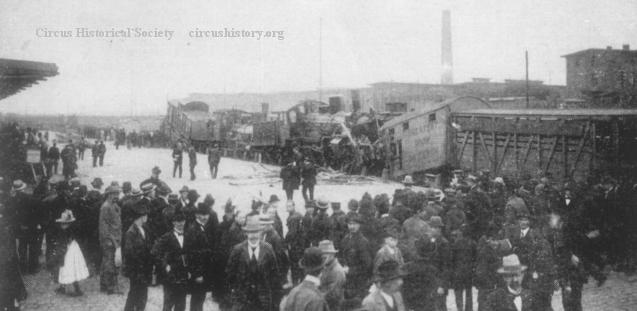
The pony car was equipped with a compartment for about ten men. It was demolished in the wreck at Beuthen, Germany, on July 6, 1901, when three men were killed (see photograph).
Section III
1 Stock (special coupling); 3 Sleepers (workmen); 6 Flats; 6 Stocks; 1 Stock (special coupling).
Sometime between the tour in England and the tour in France, one flat was moved to this section from the fourth section.
Section IV
1 Camel Car (special coupling); 5 Sleepers (performers, workmen, and private car); 10 Flats; 1 Baggage (special coupling).
In addition, each section carried two braking cars, one immediately behind the engine, and the other on the rear of the train. These cars resembled the conventional American railway caboose. In the Beuthen wreck picture one of these is immediately behind the second engine. The two engines in the picture pulled the third section which failed to heed a block signal and thus caused the disaster. All damaged cars were replaced at the expense of the German Railways.
The special construction of this show train probably answers the often-asked question: "What happened to it after the Buffalo Bill Show was returned to the States in 1906?" It was very likely scrapped as it would be worthless for any normal operation on the European railroads.
Part II Stock Manipulation and the Sale to the Ringling Brothers
The sources of information for this part are two letters written by Otto Ringling, made available to me by Sverre O. Braathen, and an additional document from the McCaddon Collection at Princeton University which I had previously missed. The latter clears up most of the circumstances attendant to the function of A. A. Stewart in the sale of the show. These two letters were written from Bridgeport in 1907 shortly after the Ringlings took possession of the Barnum & Bailey Show and are addressed to his brothers in Baraboo.
Background
On April 11, 1906, James A. Bailey died in New York. The following May 21, his widow Ruth L. Bailey, W. W. Cole, Joseph T. McCaddon (Mrs. Bailey's brother), and Albert A. Stewart (a sales agent for the Strobridge Lithographing Company, friend, and, on occasion, special agent for Bailey) formed the Bailey Estate Trust to administer the operation and the liquidation of Mr. Bailey's various show properties. At that time the following situations existed:
(1) The property and the European title rights of the Barnum & Bailey Show were owned by Barnum & Bailey, Ltd., a British stock company. However, the show was then in the States and was paying a royalty for the use of the Barnum & Bailey title in America. (Note: When the corporation was formed, Bailey retained the American title rights and leased them for a percentage of the profits after the show returned to the States in 1903.) At the time of his death, Mr. Bailey and his in-laws held a little less than fifty per cent of the stock in the British company.
(2) The Forepaugh-Sells Show was jointly owned by the Estate and the Ringling Brothers. (Ringlings bought the Bailey Estate's interest in this property on June 6, 1906.)
(3) The Buffalo Bill Show was being operated by the firm of Cody & Bailey, but most of the equipment was leased from the British stock company.
About one year after the formation of the Bailey Estate Trust, negotiations were begun to sell the Barnum & Bailey Show and Barnum & Bailey Ltd.'s interest in the Buffalo Bill Show to the Ringlings. From correlative documents, it appears that an agreement was reached in July, 1907; but I, personally, have not seen the actual contract for this transaction. It is surprising that the McCaddon Collection does not have a copy; but, if and when one ever turns up it is almost certain that the sale price will be found to be $500,000, with $140,000 being paid down and the remainder due at the end of the season after the show was delivered to Bridgeport.
There were two properties involved, one being the assets of the corporation, and the second being the American title rights. The corporation's assets were formally sold to Mr. Stewart on July 27, 1907, for $400,000 - $40,000 down and $360,000 payable at the end of the season after delivery to Bridgeport. This is the only transaction that the stockholders were ever told about, as the role being played by the Ringlings was not made public until late in the fall. It was necessary to keep this a secret because the Bailey Estate did not have absolute control of the corporation, and this bit of news would have sent the price of the stock soaring.
In the interim between July 27 and October 23, when the stockholders' meeting was called to legalize the proceedings, Stewart went to England and quietly bought up enough shares to enable the estate to gain control. Since the show was not making any money and none of the pending transactions had been announced, he was able to do this for $34,000. Then at the October meeting those who attended were informed of the Stewart deal and were advised to approve the sale. This, of course, was a mere formality, because approval was automatic with the control of the stock.
With the corporation's assets now the property of the Bailey Estate Trust, and with the American title rights already owned by it, the sale to the Ringlings could then be made in one package. From an entry which Stewart made on a ledger sheet, that summarized the receipts of the trust, marked "Title Sale $100,000," I have arrived at the total sale price of $500,000.
For this five hundred grand, the Ringlings received little more in usable assets than the title and a surplus of elephants and camels. It appears from Otto Ringling's letters that either the poor condition of the equipment was a well-kept secret by the Bailey management or the brothers from Baraboo did not take the trouble to look it over before they bought. They may have considered the title alone to be worth the price; but, even so, had they known of the financial difficulties in the Bailey camp, they could undoubtedly have bought it for half that sum if they had stalled for a few months. As it was, they encountered some difficulty in borrowing the $360,000 which was due when the show was delivered to Bridgeport, because the week that transpired happened to coincide with the short-lived financial panic of 1907.
It was necessary to take the Forepaugh-Sells Show off the road to get enough equipment to take out Barnum & Bailey in 1908. An appreciable portion of the Barnum cars were unsafe, the cookhouse facilities were unsanitary, the seats that were new in 1903 were too heavy to handle, the menagerie was way short on cage animals, and the best cages did not compare with the poorest on the Forepaugh-Sells Show. The only good wagons that the Barnum Show had were the lightplants and the thirteen floats built in 1903. The latter carried practically no load, and the Ringlings would not think of using all of these to flash up a parade and even seriously considered abandoning the Twin-Hemisphere Bandwagon because of its size. In Otto's first letter, it appeared doubtful if they would even try to parade, but by two weeks later they had definitely decided to put on the parade.
Both letters were written before the Forepaugh-Sells Show closed and discussed, chiefly, the poor condition of the Barnum & Bailey equipment and what would be needed from the Forepaugh-Sells equipment. In general, it appears that about three-fourths of it was shipped to Bridgeport, with the remainder (mostly baggage stock) being sent to Baraboo to replenish the Ringling Show. About the only saleable surplus were some elephants and over-age work horses.
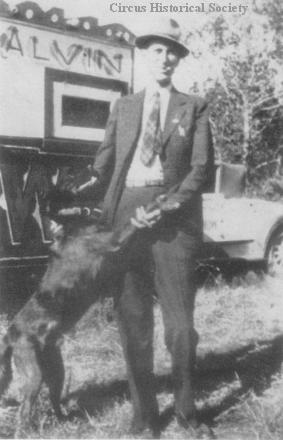 Photo: Jessie A. "Slim" Milliken and dog Jack
The following is the story of Jesse A. "Slim" Milliken and Milliken Bros. Modern Circus. This was a truck circus that toured the Eastern part of the country for a short season in 1934.
During the winter of 1933-34, Jesse Milliken framed a small truck show to go on the road in the spring of 1934 under the title of Milliken Bros. Modern Circus & Trained Animal Show Combined. Milliken had for several years been in outdoor show business and to own a circus was his greatest ambition and a long time dream. Winter quarters was at the Fairgrounds at Woodstock, Va.
Jesse Milliken was owner but his three brothers were on the show. Otto was a member of the band, Wilbur and E. W. Milliken were the other brothers. The show moved on 10 trucks and 7 trailers and house cars. Advertised as having 75 people, which is doubtful for so small a circus, they started out with a ten piece band. They carried an elephant, lion and llama. The elephant "Maxine" was leased from W. C. Richards and worked by Babern Miller, nephew of Richards. Milliken told me he carried a llama instead of a camel because he thought it would make a better attraction as there were fewer llamas with shows at that time. They also carried about 8 performing ponies and 2 ring horses. The show featured Ira Millette and Family and the Riding Waltons. Millette had formerly been on the Big Show.
In the side show besides "Maxine" the elephant, "King Fighting Lion" and the llama was several performing cockatoos, what was supposed to be a two headed baby in alcohol, girls and a gig band. One time a lady asked where the "Pinhead Family" was, this was pictured on the "Bannerline" and was told, "they are out to lunch."
The Milliken Bros. Modern Circus opened at the fairgrounds at Woodstock, Va., April 15, 1934. After several stands in Virginia including Warren 18; Front Royal 19; Middleburg 20; and Leesburg 21, they were soon in New Jersey and played Penns Grove, May 2nd. Soon after opening day a long spell of cold rainy weather set in and even with the help of "Maxine" it was difficult to get the trucks on and off the soft New Jersey lots. As this was a new show starting out during the depression made it very hard on the gate receipts. The show struggled along until the fourth of July when it was forced to close and "Slim" Milliken saw his life's ambition, to be a successful circus owner, shattered. He finished the 1934 season with the circus side show at county fairs.
Jesse Milliken tried one other season to take a circus on the road, it was titled Milliken Bros. Circus & Ken's Wild West Shows, this attempt also failed. In the years following he had Milliken Bros. Shows, a carnival. He kept the carnival on the road until about 1955, when he sold his carnival. He had been in bad health for two or three years.
After selling his shows he settled in Sparks, Georgia, where he opened a trailer camp and also raised watermelons and cantaloupes. On April 15, 1957 (just 23 years to the day of the opening of Milliken Bros. Modern Circus) he was stricken with paralysis and died on April 24th at the age of 63.
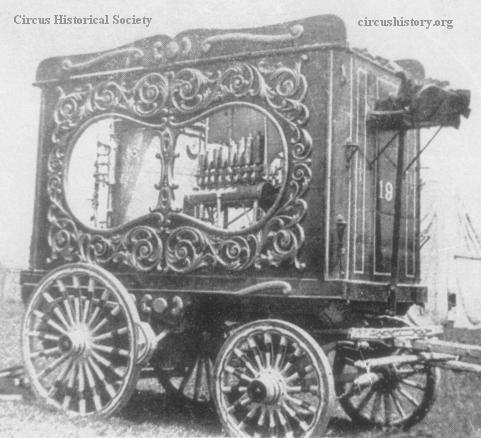 Photo: Steam Calliope, Howes Great London Show, About 1909. Photo by W. Hope Tilley.
Last issue we apologized for having to use such a poor print of the Howes Great London Show steam calliope and appealed for a better photo. CHS member Leland L. Antes, Jr. has just provided us with the good, clear, sideview we wanted. The first photo shows this steam calliope on Howes Great London Show about 1909 and was taken by W. Hope Tilley, the calliopist on the show. Thanks Leland for sending the photo. With this type of cooperation The Bandwagon can't help but be successful.
Those of us who have been collecting circus photos for many years now will remember the frustrating experience we encountered trying to find a photo of the Al G. Barnes steam calliope. Somehow this developed into a first class jinx. Parade photos of the Barnes show would turn up from time to time but no steam calliope pix were among them. Bill Woodcock, who was on the Barnes show in 1920 gave us a description of the one on the show of that time and which was also the same calliope he had seen on the show earlier in 1916. Then, finally after so many years of looking, Walker Morris, an old musician who was on the Barnes show in 1924, and is now retired and living in Beaumont, Texas, came up with a photo of the steam calliope he took on the show in 1924. This caused considerable excitement among the collectors, but this still wasn't the calliope Woodcock had described, so we knew there was another one we were still looking for. Then last year, CHS George Piercy found a photo of the Barnes calliope that was used in the period of 1916-20, and so at last the mystery of the Barnes steamers has begun to unveil. Piercy very kindly of my request furnished us the photo of this calliope.
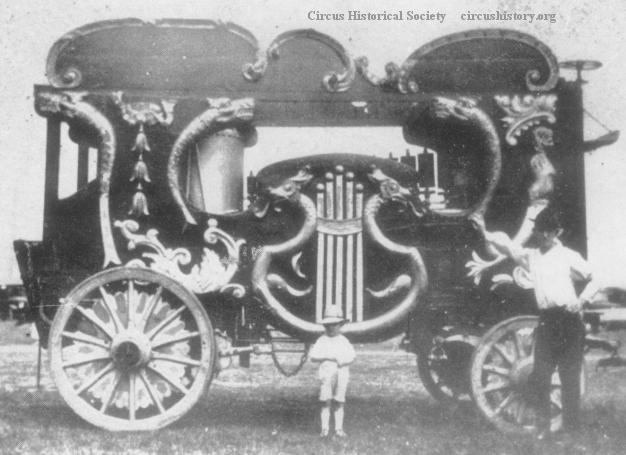
Photo number two shows the steam calliope used on the Al G. Barnes Circus about 1916 to 1920. The exact date of origin is unknown. We do not know the builder nor where Barnes got the calliope. It is of course possible that it was on the show as early as 1911 when the Barnes show went out on rails as a full fledged wild animal show making daily stands. Bill Woodcock says that in 1916 the calliope was painted yellow with carvings done in gold leaf. In 1920 he says it was painted red with silver carvings, and there were red tin sunbursts tacked on the outside of the wheels.
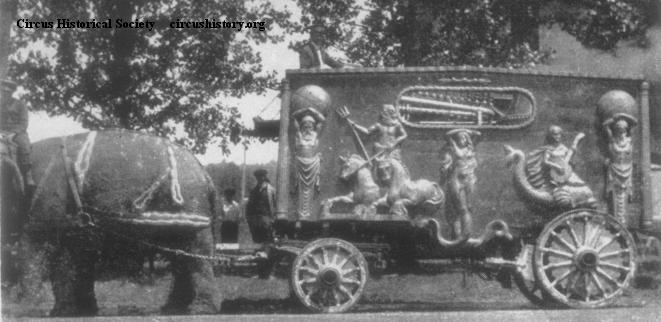
Photo No. 3 shows the calliope that Al G. Barnes used in 1924 and later, and evidently it was built to replace the earlier wagon. Just when the new one was put into use is not definitely known, but we do know it must have been between the 1920 and 1924 seasons. Likewise we don't know the origin of this wagon, nor who built it, but my guess is that it was built at the Barnes quarters using fancy carvings of Neptune, Atlas, and other mythological characters, furnished by some wagon builder or woodworking shop. It is a fact that in the early 20's Bode Wagon Works furnished Barnes with some carvings for wagons that had been constructed by the show. In 1924 Dick Allen played the calliope and it was pulled in parade by an elephant hitch. The final regular street parade of the Al G. Barnes Circus was held July 14, 1924 at Denver, Colo. Even though no parades were given the balance of the 1924 and the 1925 season, the calliope was carried for lot concerts.
Walker Morris, who furnished this photo, also has photos showing the calliope on the show in 1925 so we know definitely it was there that season. Some say the calliope was carried by the show for several years thereafter and on through 1928, the final year Barnes had the show. CHS Hardy O'Neal says he saw the Barnes show in Shreveport, La. in both 1927 and 1928 and the calliope was there both years. I have seen no photographic proof of it being there in 1927 and 1928, and could find no reference to it being on the show in the Billboard files for those years, but I'll take Hardy's word that it was there. No reason it shouldn't have been there in 1928 because the inventory of equipment when Mugivan, Bowers, and Ballard purchased the show from Barnes in 1928 definitely lists a steam calliope among the property.
We are reasonably sure it was not carried in 1929, the one year the American Circus Corporation operated the show, nor was it carried anytime from 1930 through 1938 seasons when Ringling interests owned the show.
It is not definitely known just what happened to the wagon. In 1939 MGM studio constructed a chariot type wagon that carried a steam calliope instrument for use in the movie, "Chad Hanna.” After the filming, this chariot type calliope was then stored at Jimmy Wood's lot in Venice, Calif., where several other old Barnes bandwagons and tableaux were located. This chariot type calliope was reported to have still been in Venice a few years ago, now owned by the Chamber of Commerce. Many fans have been of the erroneous opinion that this chariot wagon was a Barnes original, but such was not the case. I think the instrument was from the Barnes steamer, which was probably dismantled sometime prior to 1939.
In the last issue I pulled a real goof by saying the ex-Gentry air calliope was on the John Robinson Circus in 1923. It was not. It was there in 1921 and 1922, but the Howes Great London air calliope that the show used in 1921, and was on Gollmar Bros. in 1922, came onto the John Robinson show in 1923.
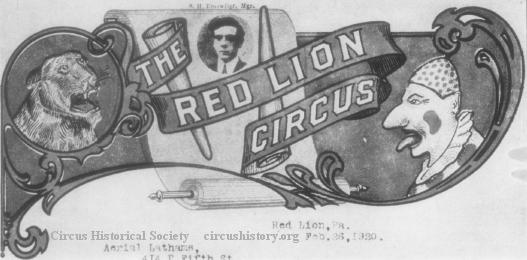 Image: Letterhead of the Red Lion Circus 1920
Okay, you letterhead collectors, here is one you don't see every day. In fact, I'll bet few CHS members can even place the Red Lion Circus. I know I had never heard of such a show and had to call on Bill Woodcock to brief me on it. Here is what he says.
In 1919 Sig Sautelle and Barney Demorest had out a 2 car circus that toured in the East but the show didn't last long. When it folded Sig Sautelle took the sleeping car which he later sold to the Mighty Doris Carnival. Demorest retained the baggage car. Sautelle advertised for sale the canvas, seats, lights etc., and sold them to S. H. "Red Lion" Emswiler who threatened big deeds with the property as a mud show. Emswiler organized the Red Lion Circus at Red Lion, Pa. during the winter of 1919-20 and the show went out in 1920 as a medium sized wagon circus. The show wasn't on the road very long and after it folded the equipment was advertised for sale in the Billboard.
In the photo of the letterhead you can note it is a pretty fancy sheet for a wagon show, although some of the old mud shows had even some better letterheads than this one. For those interested in the color scheme of it, the title of the show of course is in white, with the scroll surrounding the title in red. Also the bottom and side scrolls are in red. The rolled up scroll surrounding the portrait of S. H. Emswiler is in pink. Of course the portrait is black and white. The background around the puma's head and the clown's head is a light blue, with the spots on the clown's costume, face, and head is red.
There are none of the fine "Shrine" circuses to be seen during the winter months in Great Britain, but several of our larger cities stage indoor circuses of a high standard roundabout Christmas time.
Pride of place must go to the Bertram Mills' Circus which puts up its "big top" inside Olympia, London each year for about six weeks. This is one of the world's finest circuses and is a part of the London Christmas Season, invariably attended by members of the Royal Family and the Notabilities of the land. The Circus Directors present a lavish luncheon to a large body of distinguished guests to launch the circus season, each year. During the last thirty years or so, the Bertram Mills Circus has featured most of the world's most celebrated artists and this years programme is no exception to the rule. The programme which I saw, just before Christmas 1958 included the Guido Aratas (Tight wire); The Berosinis (Foot Jugglers); The Aerial Chapmans (Aerial Thrills); The Five Elwardos (Acrobatic Whirlwinds); Francesco and Anna (Pole Perchists); Knie's Jungle Phantasy (Wild Animal Act); The Three Riegels (Comedy Gladiators); Ivor Rosaire and Sir Roberts Fossett's Elephants; Pauline, Albert and Max Schumann, with Douglas Kossmayer presenting High School, Liberty Horses and Ponies; The Rudolph Steys (High wire); The Ascotts and Clarinda (Riding Acts); Ferry Forst (Illusionist); Knie's Sea Lions; The Rigettis (Ladder Balancers); Wini and Carmen (Trapeze) and clowns Coco, Percy Huxter, Jimmy Scott, Little Billy, Nikki, Kiki and Antonio. The circus arena is draped with bunting to represent the interior of a tent, and outside is built up a large "Fun Fair," rather like an American Carnival or County Fair, but all under cover.
Until this year London had another fine circus produced by Tom Arnold, a theatrical impressario, at Harringay Arena. Unfortunately this building has been recently sold for a grocery warehouse and consequently Tom Arnold's Circus has no home this year. It is to be hoped that a suitable building will be found for this circus by next Christmas for it would be a thousand pities if Arnold's brilliant productions become no more. Produced in a more flamboyant style than Mills, Tom Arnold's Circuses reminded me of the Ringling shows in Madison Square Garden, and even featured three rings on occasions, a most rare feature for an English circus.
In recent years, Jack Hylton, another theatre producer has put on circuses at Earls Court, London, for two seasons, but this building is rather too close to Olympia for comfort and his circuses, though programmes were good were not conspicuous successes. Before the war, London had a wonderful low-priced Circus and "World's Fair" each Christmas at the Royal Agricultural Hall, but during hostilities this building fell into the hands of the General Post Office and has never left them since.
The Winter Circus with the longest run is Manchester Belle Vue, a show produced in a permanent circus building in an Amusement Park. Noted for its fine international programmes, this year Belle Vue has, for a change, many acts from British circuses which should ensure plenty of customers for its two months run. A notable and seemingly permanent feature of Belle Vue is the Ringmaster, George Lockhart who has been carrying out that office for thirty years, or the same number of years as the circus itself. This years programme has Capt. Sydney Howes with lions; Jacko Fossett with boxing kangaroo; (both acts from Roberts Bros. Circus) Baby Elephants; Group of Palominos, Zebras, Ponies; Liberty Horses; (all from Bertram Mills' Circus and presented by Joan Kruse, Kurt Dubrow and Nadia Houcke); Borra (Pickpocket); Five Castors (Risley Act); Dior Sisters (Rolling Globes); Donatha's Bears; Six Erminos (Juggling); Famous Folcos (Trampoline); Six Poulos (Continental Clowns); Two Esperantos (Perch): Rix and Rix (Knock-about acrobatics); and clowns Whimsical Walker, Hampe, Ross Adams, Mickey Chapman and Noe-Noe.
Glasgow runs a very successful Winter Circus and Carnival, and this being promoted by the Glasgow City Corporation becomes Britain's nearest approach to a "State Circus!" I am told that the original idea was to provide the poorer citizens of Glasgow with a cheap and wholesome form of entertainment for the bleak Scottish winter evenings. True or not, the fare provided is invariably of the richest as this years programme will prove. The Enders Brothers (Bare-back riders); Arno and Rita Van Bolen (Illusionists); Allan Kemble & Christine (Unicyclists); Mari and Jean Lemoine (Cowboy Act); The Lorandos (Comedy wire); The Five Orlandos (Tumblers); The Two Tacomas (Perch Act); Schaller Bros. (Trampoline); Soeder & Gladys (Trapeze and Rings); Frankie Fossett & Co. (Clowns); Billy Smart's Elephants and Horses presented by Rudi Jurkschat; Ivan Bratuchin and his Cossack Riders; Schnacks Chimpanzees are all included in the bill which is completed by a Wild West Spectacle. Outside of the Circus, a free attraction is provided in the covered-in Carnival by Alex Kerr and his tigers, from Bertram Mills Circus. Roi Delbosq, a well known Ringmaster is usually to be found officiating at this Circus.
Also in Scotland, Edinburgh likewise stages a Winter Circus and Carnival each year at the Waverley Market. Despite good programmes, these circuses have not been too successful in past years and sometimes a vaudeville show has been presented instead. However, this year the circus is being presented by the famous "Lord" George Sanger Circus and I understand that it has been reasonably successful. The performers include Pat Freeman and Muriel (Indian Riders); Miss Lilian (Contortionist); Anton and Manet (Twin trapeze act); "Old Regnas" (Donkey and Dog act); Trio Jensen (Balancing and Acrobatic Routine); Albert Kean and Babs Zola (Clowns); Horses and Ponies, Llama and Pony acts from the Sanger Circus, presented by Claude Yelding and Pat Freeman, and a riding act from the parent circus.
Nearer to my home is Birmingham, the second largest of Britain's cities, and a place with a chequered career concerning winter circuses. Many famous British circuses have staged shows there, in the past, successful and otherwise. Stanley V. Parkin, not a true circus proprietor, put on a series of excellent shows during the post-war years with varying success. Once in the 1930's the Great Carmo Circus built up its tents for a winter season with disastrous results. This fine show was first wrecked by fire, then by a snow storm, two decisive blows from which the circus never recovered. Billy Smart had a magnificent circus in the Bingley Hall (the only suitable hall in Birmingham) a few years back, which did not get the patronage it deserved. The truth is that Bingley Hall is a cold unattractive building which does not encourage the customers. However, the famous English circus family Chipperfield put on a big "animal" circus in the Christmas season of 1957-58 which favored by mild weather, low prices (and of course a good programme) was a big success. This has encouraged the Chipperfield's to have another go this winter, and as this one is proving quite successful, I can visualize "Chipp's" occupying Bingley Hall for many Christmases to come.
Chipperfield's bill includes many of their "house" acts and quite a number of Chipperfields, such as Richard, John Richard Jr., and Ann, with elephants, horses, dogs and ponies, Camels, llamas, giraffes, hippopotamus and chimpanzees. Lions are presented by Roger DeBille and John Chipperfield, and circus clowns are Little Hubert, Fiery Jack, Bill Smee, and Grimble. The "house" riding act is made up from the Chipperfield, Sandow and Paulo families and more Paulos may be seen in the comedy wire act and aerial presentations. The Brothers Biasini (Cyclists), The Sylvanis (Knock-about acrobats), Chako (Human "Ape") all contribute to a good family type of circus, and as an extra draw, Chipperfield's have engaged Fred Emney a heavyweight stage and television personality to act as a guest ringmaster.
Belfast, in Northern Ireland, has a novel circus staged each year by the veteran former Registrar of Queens University, Dr. Richard Hunter, upon the stage of the Empire Theatre. At 73 years of age this lively gentleman fits a very good bill into a small space and this year has Robert Bros., Polar and Black bears, also ponies and llamas from the same circus; Amazing Ariston (Magician); Darly's Dogs; Frederickas Cats and Dogs; Scott's Sea-lions; Babu (Slack wire); Les Gilbertys (Balancing); Three Corrals (Lariots and Whips); Mickey Ung (Contortionist); George and Lydia Gridneff (Unsupported ladders; Congo and Partner (Jugglers); Eight Ace Girls (Dancers); Johnny Gray and Partner (Equilibrists); and Toni, Tina and Tony (Musical clowns).
Back in England, the Roberts Brothers and Harry Coady stage condensed versions of their travelling circuses at our Music Halls, which I think you would call Vaudeville Houses.
Circuses have been promoted in Liverpool, Southend on Sea, Blackpool and a few other cities during the winter, in past years, but for one reason or another have ceased to function. From my personal observation I think it is reasonable to assume that all the circuses reviewed above will be financial and artistic successes, and enable the fans to enjoy the thrills of the circus until the tenting season comes around again.
Karl King is one of the most colorful figures in the world of bands and band music. A resident of Fort Dodge, Iowa and conductor of its municipal band for thirty-eight years, he is considered the Dean of American Band Music Composers.
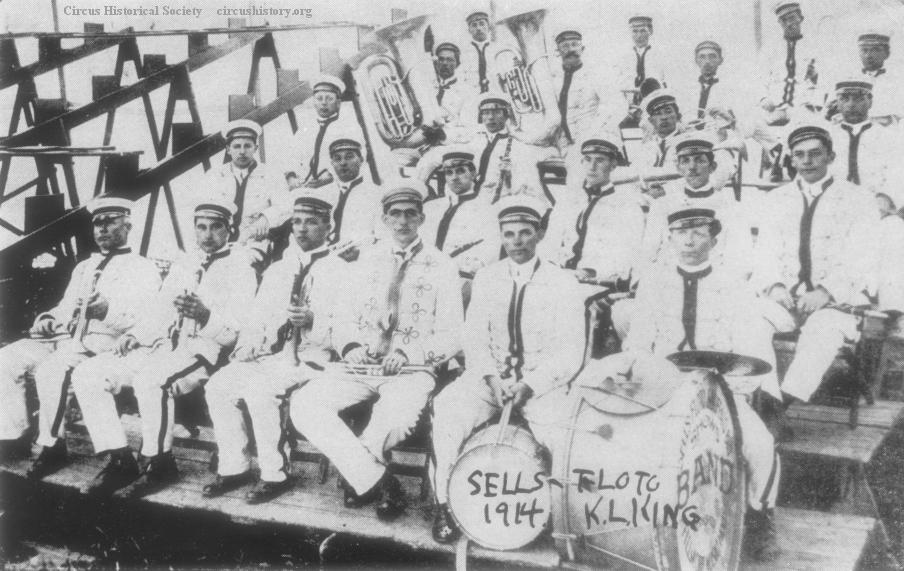
Mr. King began his musical career in 1910 when he joined a circus band. In 1914, he become director of the Sells-Floto musicians, and three years later assumed the same position with the Barnum and Bailey Band.
More than 250 of his band compositions have been published and some twenty of them, including "Barnum and Bailey's Favorite," "The Golden Dragon Overture," and "A Night in June" are in the libraries of half of the bands in the United States. He has also composed band numbers for most of the Big Ten Universities, including "Hawkeye Glory" for the State University of Iowa. More than 100 bands throughout the world have played concerts made up entirely of his compositions.
For thirty-four years, King brought his band to the Iowa State Fair for appearances in front of the Grandstand, and for several years he played at County Fairs throughout the state.
Mr, King is Past President and Honorary Life President of the Iowa Band Masters Association and a Past President of the American Band Masters Association.
For many years he has operated a music publishing business in Fort Dodge. His wife, Ruth, is proprietor of a music shop next door.
The photograph was taken on the Sells-Floto Buffalo Bill Circus in 1914, at which time there were 22 men in the band.
The above information come to us through William Temple of Des Moines, and Fronk Pouska of Garfield Heights, Ohio. The photograph was furnished by Frank Pouska.
It was a battle royal during several seasons between Ringling owned shows and the Sells-Floto circus.
Commencing with 1909 and for several seasons the Tammen & Bonfils owned Sells-Floto swung deadly blows at the larger Ringling Brothers or Barnum & Bailey circus.
The Denver show went all out as they showed from town to town, state to state across the nation. It was advertised as a show "not in the circus trust;" a high class circus program for 25 cents to anyone. The enemies were both sticking to their guns with admissions of 25 cents and 50 cents. Some cities had both shows playing it out day and date. They even paraded on the same streets at the usual time. In some cases the Tammen and Bonfils lawyers persuaded cities to change the tax ordinance, making it prohibitive for the Ringling owned shows.
Memories of those battles were brought to mind recently on a visit to Denver. I read in the Denver Rocky Mountain News of July 16, 1909 the following "John M. Kelley, general counsel for the Ringling Brothers circus comes to Denver to proceed against the blackmailing gang." It went on to tell how Kelley on arrival sought information from Tammen, himself, for exerting pressure on Mayor Speer and the police board for refusing the Ringlings a license. "Tammen declaring with his customary self assurance 'We own a circus and we don't want any other circus coming to town. The mayor does what we tell him to do' the story went on
"The local billposting company will not post any paper when the No. 2 car comes to town next Monday."
This John Kelley is the man who was for a third of a century, counsel to the Ringlings as well as their trial attorney. He is president of the new Circus World Museum at Baraboo. He was for several years in the thick of this circus war.
Recently he told me that this war really began at Kansas City, where Tammen and Bonfils owned the Kansas City Post and the city administration as well. They influenced enactment of an ordinance where the Sells-Floto show would pay $300 a day; Ringlings $5,000. "Before the council I fought it out with Bonfils. I might as well have remained at home, they had the town sewed up. We showed outside the city.
"The papers said, 'Circus hurls defiance - John M. Kelley, counsel to Ringlings now in charge of situation.'
"I filed a petition in federal court. I filed my affidavit to show conspiracy between Tammen and Mayor Speer; How in New Orleans Tammen had told me how he and Bonfils had tried to force the Ringlings to buy his show, which Tammen said had cost him $500,000. That he had a houseful of money in Denver, and if the Ringlings did not leave him alone, he would take his 44 and shoot his way through.
In the press he charged the Ringlings of having a band of gunmen, burglars, pickpockets and plug-uglies.
"The court denied our petition for lack of jurisdiction.
"We showed outside the city limits to two packed performances.
"Tammen then carried the battle to Texas; having influenced a license on the performance basis, graduated on number of cars. There we beat him to a frazzle. I advised cutting the 'twice daily' to a one-performance show. It was the first and only time in circus history Captain Bill McDonald made his arrests on the spot. I went into court and tried the issues while the evening show was going on. We never lost a case.
"It didn't end there. The next spring Tammen began using lithographs of the original Sells Bros. I took photos of those lithos and sued him in Federal court in his home town. He lost the right to use the trade-name, features of the Ringling owned Adam Forepaugh and Sells Bros. Enormous Shows United or any part of it.
"Tammen told me later that the battle cost him $260,000. He won nothing.
"One thing few know is that in April, 1910, 1 received a letter from the editor of the Billboard in which it was said that it appeared the Sells-Floto has taken a copy of the Kansas City ordinance framed against the Ringlings; made copies of it and sent these for adoption to the mayors of about 5,000 towns and cities throughout the United States. That was the car-basis license that leveled a license of $5,000 against the Ringlings.
"There was no grand rush to adopt this high license.
"After the battle clouds cleared away Tammen become very friendly with me. On several occasions later I represented, at Washington, all circuses. My appearance before the Senate committee concerned high taxes and other restrictions.
The following interesting letter from Tammen, dated June 1, 1917 is in the possession of Mr. Kelley -
"Dear Mr. Kelley: If you were in my employ I would, without reservation, suffocate you with congratulations for the tremendous, splendid and successful argument made to the Senate committee in behalf of all circuses. I know you sized up the matter from every angle. The course you took I endorse.
"I hope you are well and happy. With love and good, cheer, H. H. Tammen,"
Oscar Landmesser, an old time circus employee, now retired and living in Pomona, California, remembers the incident at Winnipeg, Canada, Monday, July 28, 1913.
He tells how both shows arrived in town Sunday. It was a long hard haul to the lot for both.
Sells-Floto management hired extra local horses to pull the big wagons to the grounds. This left the Floto horses in good shape for the big parade next day.
Both shows were on the streets at about the some time with their horses. The Barnum & Bailey animals showed the effect of the hard pull the day before, he says.
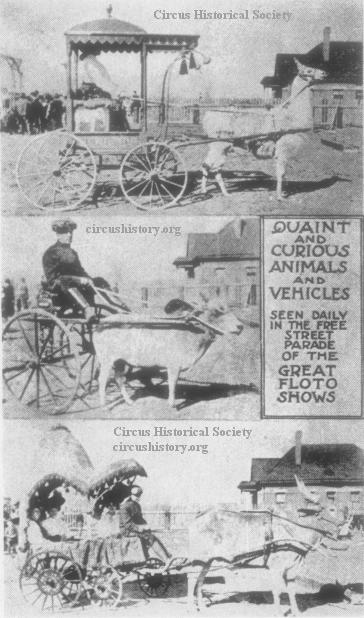 1. Otto Floto, superintendent of parade, driving "Pasha," the $9,000 Arabian stallion.
2. Bugle Corps: horses in full dress.
3. Two mounted Knights: Advance horse guards.
4. The Ben Hur herd of royal blooded Arabians with the giant Royal Chariot.
5. First big band Chariot; Signor Zierke bandmaster, with sixteen soloists.
6. Queen Anne Tableau Cage with the largest Bengal Tigers in Captivity.
7. Carved Roman Open Lion Dens, contains "Sultan" and his family.
8. Fancy Kentucky Saddle Horses: Mrs. Carroll and Mrs. Rooney riding.
9. Grecian four-horse open cage.
10. The Hussar Quartet: Saddle horses from the Floto stock farm, Denver.
11. Big Band Chariot; eight Rocky Mountain mustangs driven by Carlo Carson, famous California driver.
12. Royal India Cage of Monkeys; 57 varieties.
13. Neptune Chariot with the Continental Drum Corps.
14. Foreign exhibit; Mexican Vaqueros, etc.
15. Tableau Band Car; eight horses with outriders and costly trappings.
16. Miniature Happy Family van, drawn by four Camels.
17. Oriental Tableau car, drawn by the only Brahma Bull ever harnessed.
18. Children's Menagerie cage, eight ponies driven by Master Tony Ross, formerly jockey to King Edward.
19. Italian veranda cage of Llamas from the Forbidden Land.
20. The Royal India Zebu carts.
21. Oriental Band; shetland team.
22. Eight of the Sultan's favorites; Camel trip across the desert.
23. Herd of Asiatic trained Camels; the largest ever captured.
24. Children's Annex; Australian hammock Den of Kangaroos; eight ponies from Floto Shetland Farm, Denver.
25. Queen of the Parade, in embossed solid copper Howdah from Bombay, India, introducing "Mama Mary" the largest elephant in America.
26. "Trilby," trick clown elephant.
27. Open Leopard Cage, mounted on the educated elephant "Frieda," and the great Floto herd of performing elephants.
28. Patrol wagon with funny clown chorus.
29. The comedy bicycle riders.
30. Grand German Orchestral Calliope tuned to concert pitch, Prof. Frederick Jewell soloist, drawn by six musical horses from Floto's equine college at Denver.
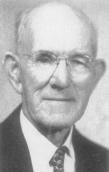
Jethro Almond, Circus owner - Wheeler & Almond, recently celebrated his 90th birthday with friends at his home in Albemarle, N. C.
The veteran showman, now operator of a parakeet ranch, entered the entertainment field in 1900 with a horse and wagon. He bought the wagon for $4.65 and borrowed the horse to make appearances before schools and churches with slides and a stereopticon machine. The second season, another wagon and a small tent was purchased. In 1903 the wagons were replaced with a railroad car.
Jethro did well with his traveling magic pictures and vaudeville entertainments. In 1916, he put two units on the road, one under the direction of his friend, C. E. Springer, who remained with Almond until his death 31 years ago. Many people in rural towns saw their first moving pictures under an Almond tent, such as Western Train Robbery and the Passion Play.
World War I brought on high rail rates and Jethro then motorized his vaudeville and dramatic shows. At the close of the 1929 season, a Circus partnership was formed with Al. F. Wheeler under titles, Wheeler & Sautelle and Wheeler & Almond. The routes played were principally the Atlantic Coastal states through the Carolinas, Virginia, New Jersey and New England into Canada. The Wheeler & Sautelle title was used in the New England states for reason that Sautelle was better known. "For four years," says Jethro, "this circus partnership was pleasant and profitable."
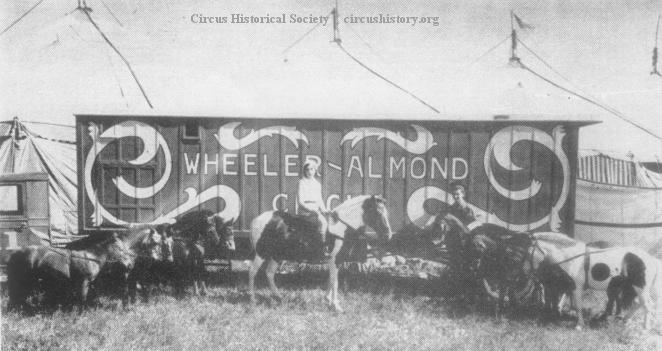
In the Fall of 1933, Mr. Wheeler sold his interest to Jim Conley and in 1935 Jethro Almond became sole owner and manager. The show was then titled Jethro Almond Circus - completely motorized and well equipped. Some of the top notch performers with the show that season were Labelle-Ray Troupe society acrobatic and clowning, the Gordens unsupported roman ladders, Professor Keely with his troupe of educated ponies, dogs, and monkeys. Mrs. Almond took an active part with Mr. Almond. After another season, Almond sold his circus and continued business as owner of a Movie Theatre for seven years until retirement with parakeets.
Almond's shows during his 60 years in show business, never presented a program of questionable taste. There were no side shows with semi nude women nor were there grifters and con men running games and concessions. Jethro was a Christian gentlemen and his show was welcome everywhere.
John Hanly CHS who worked for Jerry Mugivan on the Corporation Shows, their Chicago office, and later an executive with other circuses, has spoken of Jethro Almond. John, too, is in the parakeet business and as one showman to another, has established a friendship with much the same interests. After a recent visit with Jethro and Mrs. Almond, John has said, "Just as in show business, Jethro Almond continues to follow the Golden Rule with his Parakeet business. He will not sell an imperfect bird. Customers seeking a young bird often demand immediate delivery. "I want a male," they may say. But Jethro says, "I will not sell a young bird and designate its sex. I can not tell its sex and I have yet to meet a person who can. I have talked myself out of a sale on many occasions."
No part of this publication may be reproduced in any form or means
Last modified January 2006.
without written permission of the author and the Circus Historical Society, Inc.